JRC Construction Diary #4

img_2470.JPG

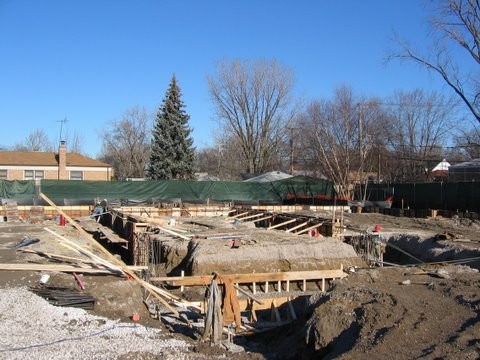
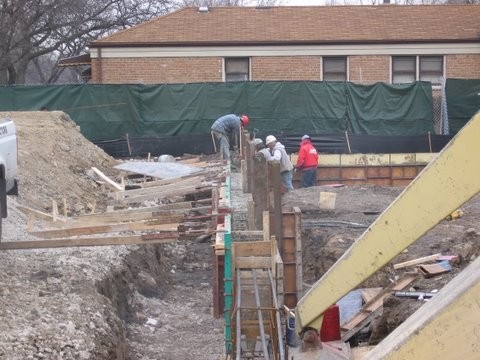
This past week the construction workers worked on the foundation walls of our new building. Specifically, this means they built wooden framing that served as molds for the concrete beams that sit on top of the caissons. A grade beam now runs the perimeter of the building and there is also one down each side of the center section of the building to support internal loads. Half of the grade beams have now been poured and the rest will be installed next week.

Above you can see a picture of the framing around the perimeter of the building. Below is a shot of the workers pouring the concrete for the grade beams.

The basic outline of our new building is now clearly visible! There was some rain this past week, but thankfully construction is still proceeding more or less according to schedule.

img_2486.JPG

JRC Construction Diary #3

construction-002.jpg

Cold weather construction: it’s no picnic.

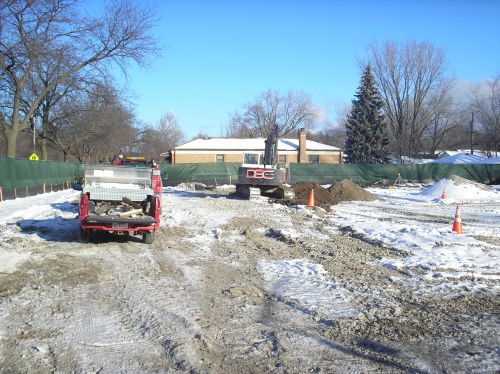
Last week’s huge Midwest snowstorm was followed by frigid temperatures that lasted well into this week. Amazingly, amidst it all we only lost three total days of construction. The crew was back out on the site today, continuing to work on the foundation.

The temperature is supposed to warm up this weekend and the first shipment of steel is scheduled for next week. If all goes well the workers will install the rebar, which will provide reinforcement for the foundation. Hopefully it will be warm enough to pour the concrete foundation floor as well. Stay tuned.

Needless to say, I have new-found respect for Chicago construction workers…

JRC Construction Diary #2

caissondrilling.jpg

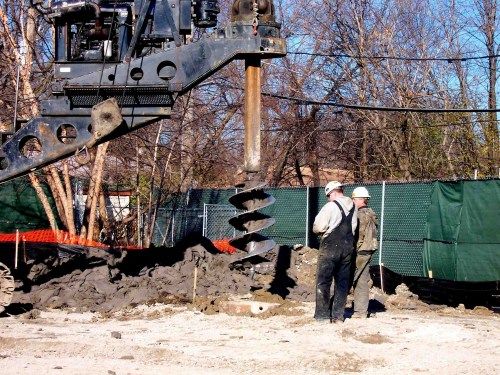
Here’s something you don’t see too often on a construction project…

We discovered last year that the soil on our property was soft and sandy – definitely not suitable for supporting a large three story building. This necessitated the drilling of caissons: concrete pillars driven deep into the ground that will serve to stabilize the structure. Last week, we drilled the long shafts for our caissons, which needed to go down 55 feet into the earth in order to reach hard clay. The foundation surface will eventually be supported by these massive underground pillars – eighteen in all.

Just before the caisson drilling commenced, our congregation’s president, Alan Saposnik, came up with an inspired idea. Since we are constructing pillars to support our congregation, why not create eighteen symbolic “pillars” of our community – spiritual values that we could somehow connect to the physical caissons? And the fact that we would be drilling eighteen underground pillars was just perfect. Eighteen, after all, is a celebrated Jewish number: equalling “life” according to Hebrew numerology.

I took Alan’s idea to our 4th and 7th grade religious school students. I did my best to explain the concept of caissons to them, then we read a classic Jewish text from Pirke Avot (“The Chapters of the Fathers”): Rabbi Shimon the Righteous said, “the world stands on three things: study, worship and acts of lovingkindness.’ What, I asked our students, would you consider to be the eighteen “pillars” upon which our congregational community stands?

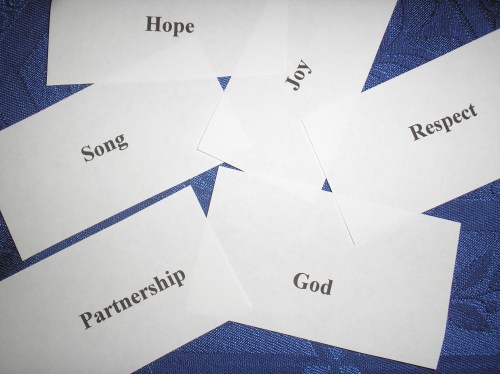
Then together we brainstormed eighteen spiritual values of our JRC community: God, Judaism, Joy, Prayer, Hope, Respect, Partnership, Song, Tikkun Olam, Community, Study, Freedom, Friendship, Spirit, Learning, Peace, Growth, and Love.

Afterwards, I wrote out the values on a separate pieces of paper and each one was placed by the construction crew into a separate caisson shaft to be mixed together with the concrete, becoming a permanent part of JRC’s support structure.

Marc Bonnivier, our construction supervisor, just LOVED the idea. He later mentioned to me his workers were so enthusiastic about it, they each jockeyed for a turn to place a paper slip into the shafts after they were drilled. Needless to say, working with JRC is turning out to be a unexpectedly unique experience for him and his entire crew.

I love the notion that these unseen but powerful pillars for our building will be a permanent support structure to our community in more ways than one.

pillars.jpg

JRC Construction Diary #1

As I wrote in an earlier post, my congregation, JRC, is currently building a brand new synagogue facility on the site of our old building. Construction officially began last month is slated to be finished Nov./Dec. 2007. In the meantime, I’ll be posting perodic reports of our progess over the course of the coming year.

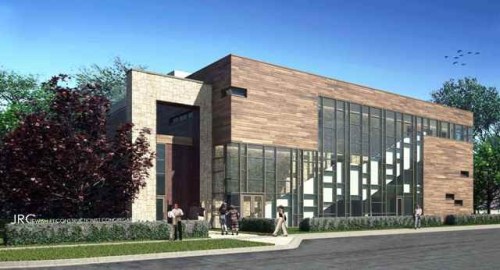
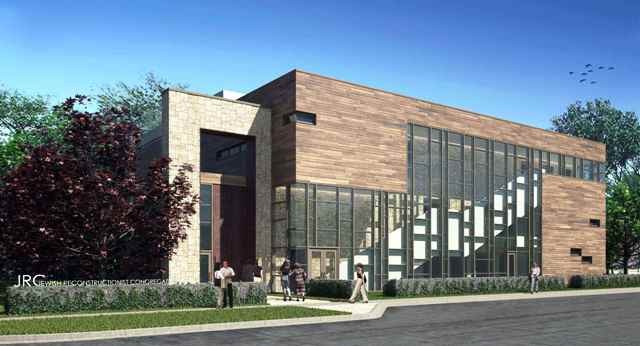
We’re particularly proud that we are attempting to create the first certified “Green Synagogue” in the world. Specifically, this means we hope to be certified at a LEED Gold Level by the US Green Building Council. The pic below is an artist’s rendering of what the final product, designed by the architectural firm, Ross, Barney, Jankowsky, will look like.

mishkan-day-view.jpg

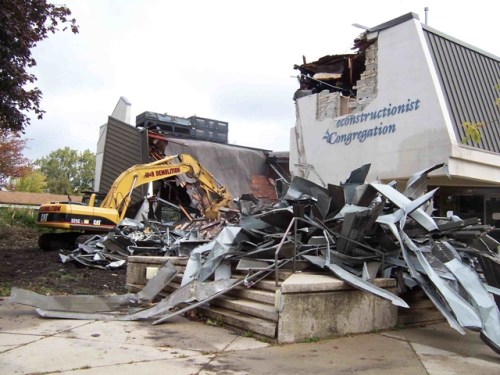
JRC moved into temporary quarters this past summer and the demolition of our old synagogue building commenced in September. It was an exciting moment for us all – the first tangible evidence of so many years of devoted work and preparation. Still, we were unprepared for how it would feel to see our synagogue being demolished (see below). While it was clear to us all that our old facility was too small, too decrepit, and not terribly functional to our needs, it had still been our spiritual home for over twenty years. Many members told me it was unexpectedly traumatic to see our synagogue, the place of so many sacred memories, torn down in this way. It felt much better when the site was eventually cleared out of debris and was unrecognizable as its “former self.”

jrc-demo-2-101706.JPG

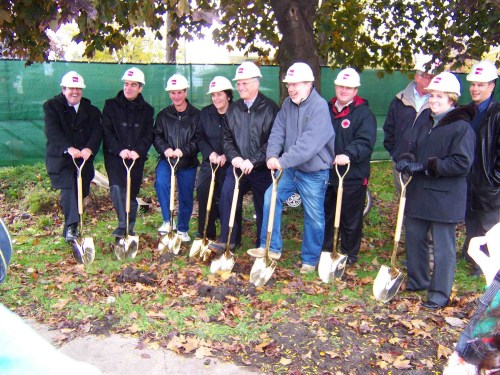
We had our official groundbreaking ceremony toward the end of the demo process. On a very cold Sunday afternoon, we gathered together, sang songs, recited blessings, then we busted out the hard hats and gold shovels for the obligatory PR pix. Carol Ross Barney, our architect, and Ann Rainey, the Alderman of our ward, were among the digniaries who spoke movingly at the ceremony. Now we were officially on our way!

goldenshovels1-1.jpg

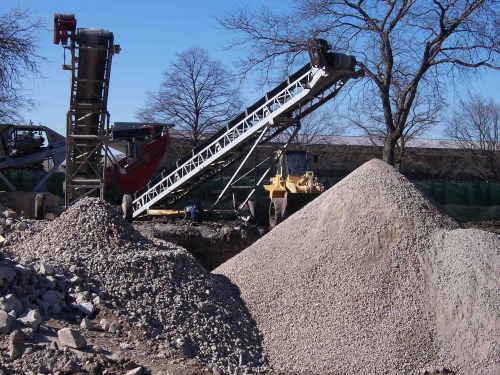
One very cool aspect of our green building project is the recycling of the concrete from the front steps and facade of our old facility. Two huge grinders were brought onto the construction site for this purpose so the old concrete could be ground up and reused in our new foundation. If any JRC members ever feel homesick for the old building, I’ll just remind them that they they’re still standing on it…

crushing3.jpg

(Thanks to David Parisi of dPict Visualization and Howard Ellegant for the great pix.)

Our Green Shul

mishkan-day-view-1.jpgPlease allow me to brag just a bit about my synagogue, Jewish Reconstructionist Congregation, which is currently constructing a brand new building in Evanston, IL. We’re looking to earn a gold rating with the US Green Building Council, which would make it the “greenest” synagogue in the country!

Here’s a recent Chicago Tribune article describing our project:

October 27, 2006

Temple Plans Eco-Friendly Makeover

An Evanston congregation hope to become the nation’s first “green” synagogue.

By Deborah Horan

Tribune Staff Reporter

By building a new home with salvaged brick, low-flow toilets and solar-powered lights, the Jewish Reconstructionist Congregation in Evanston hopes to become to first certified “green” synagogue in the nation.

Congregants said they drew from Jewish teachings on respecting God’s creation when they decided to construct the $6.5 million house of worship according to U.S. Green Building Council “gold status” specifications.

“Anything we can do to help the environment is in our best interest and in our children’s best interest,” said Alan Saposnik, the synagogue’s board president.

The congregation held a groundbreaking ceremony Sunday to celebrate ambitious plans to replace an older synagogue at 303 Dodge Ave. with the new one at the same spot. The old synagogue is being demolished, and the green-friendly one is slated for completion by the end of 2007.

During a recent sermon titled, “Walking the Walk: The Sacred Art of Energy Conservation,” Rabbi Brant Rosen told the congregation that God created the world to be inherently sustainable and that sustainability depends upon human behavior.

“To put it simply, the future of our world is up to us,” Rosen said, according to a transcript.

Sapsosnik said the new synagogue will feature energy-efficient boilers, heavy insulation, flourescent lights inside the synagogue and solar ones in the parking lot – all designed to reduce energy consumption by about a third from the usual standards.

Sensors will automatically shut off lights if they detect no movement in a room. Large windows will maximize natural light, and a white roof will deflect sunlight to reduce dependancy on air conditioning in the summer, Saposnik said.

The landscaping won’t require permanent irrigation, and about 80 percent of the building material will come from recycled sources, including old bricks from the demolished synagogue. Architects plan to use recycled cypress wood to build the facade.

“We want to use material that might have gone into a landfill,” said Michael Ross of Ross Barney Architechts, which designed the new synagogue.

Each element of the desgin that conserves energy earns points toward Leadership in Energy and Environmental Design certification, said Helen Kessler of HJ Kessler Associates, a consultant working with the synagogue.

A score of 39 qualifies a building for gold status; a score of 52 confers platinum status.

The synagogue went for gold because many of the features that would have counted toward a platinum rating – such as a geothermal heat pump system – were too expensive, Kessler said.

In January, the synagogue became the first in the nation to register with the Green Building Council to become LEED certified. Only one place of worship – the Unitarian Universalist Fellowship in Wooster, Ohio – has earned gold status, according to Caitlin Bennett, a council spokeswoman.

The council will not grant certification to the synagogue until it can inspect the building after completion, Bennett said. But according to the design, it is on track to earn 40-odd points, Kessler said.

Few non-profits and places of worship seek LEED certification because going green can be expensive, Saposnik said. The green-friendly features of the Evanston synagogue, for instance, will add $650,000 – roughly 10 percent of the building’s total costs.

The synagogue received a grant of $105,000 from the Illinois Clearn Energy Community Foundation to help defray those costs, said Bob Romo, program officer at the foundation.

The synagogue will have to raise enough money to foot the difference.

The congregation expects to recoup some of the expense through lower heating, air conditioning and electricity bills.

Jesse Greenberg, a domestic affairs associate at the Jewish Community Relations Council in Chicago, said he doubted many synagogues would seek to become green enough to qualify for LEED certification.

But, he said, his organization has started an envirnomental awareness campaign to encourage synagogues to do what they can to conserve energy by installing flourescent lights, carpeting and new windows.

“It really comes from our sacred texts, the Torah and the Talmud,” Greenberg said of his council’s environmental push.

The campaign, only three months old, includes a flier with a slogan taken from Ecclesiastes to drive the point home: “See to it that you do not destroy my world, for if you do there will be no one else to repair it.”

“Our Jewish values (encourage) us to take care of our environment,” Greenberg said.