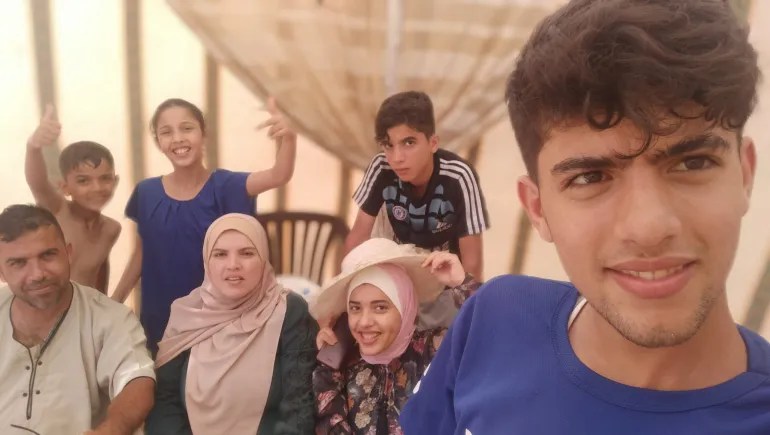
A few days before Sukkot, the world witnessed the unbearably tragic image of 19-year-old Sha’ban al-Dalou, a software engineering student burning to death after Israel bombed Gaza’s Al-Aqsa Hospital in Deir al-Balah in Gaza. In the horrifying video footage, Sha’aban’s was lying on a hospital gurney, screaming as the flames engulfed him and onlookers screamed for help. His mother and younger brother also died in that fire. It was recently reported that his younger sister Farah has succumbed to her burns as well. May their memories be for a blessing.
Before his death, Sha’aban had recorded videos asking for help to move his family to safety in Egypt. In one video, he described his and his families life attempting to survive amidst the genocide: “I’m taking care of my family, as I’m the oldest,” adding that his parents, two sisters and two brothers were displaced five times before finding refuge on the hospital’s grounds. “The only thing between us and the freezing temperatures is this tent that we constructed by ourselves.”
Shaban al-Dalou with his parents and siblings [Photo courtesy of the al-Dalou family]
Like so many, I was shattered after learning of Sha’aban’s life and death. I was particularly devastated to learn that he burned to death while he was recovering from a previous attack and was receiving medical treatment in a shelter he had constructed to protect his family.
As it would turn out, all of this transpired as the Jewish community was preparing for the Sukkot holiday, in which we build fragile, makeshift shelters to dwell and eat in during our week-long festival. Like all of the Jewish festivals, Sukkot has now taken on an entirely new and immediate meaning after witnessing more than a year of Palestinians being driven from their homes, forced to life in flimsy makeshift tent shelters, which all too often have served as the place of their final, terrifying moments on earth.
As has been the case with other Jewish holidays this past year, many of us were unable to treat the Sukkot festival as “business as usual.” Rather, this holiday which sanctifies the literal creation of shelter, has provided us a ritual means to express our sacred solidarity with the Palestinian people during a time of genocide. And not unsurprisingly, college students across the country have once again led the way for us. According to Nate Cohn, the National Campus Organizer for Jewish Voice for Peace, almost 30 “solidarity sukkot” have been built – or are planning to be built – on campuses around the US. At least four that we know of have already been destroyed by police forces.
In the wake of the student Palestine solidarity encampment movement last spring, college administrations have spent the summer devising ways to crack down on its resurgence by developing draconian new rules designed to severely restrict freedom of assembly and speech. Of course, when it comes to Jewish students constructing sukkot on their campuses, it adds in the critical issue of freedom of religious expression. Moving, dismantling or destroying sukkot is, quite simply, act of religious desecration.
(Photo: JVP NU)
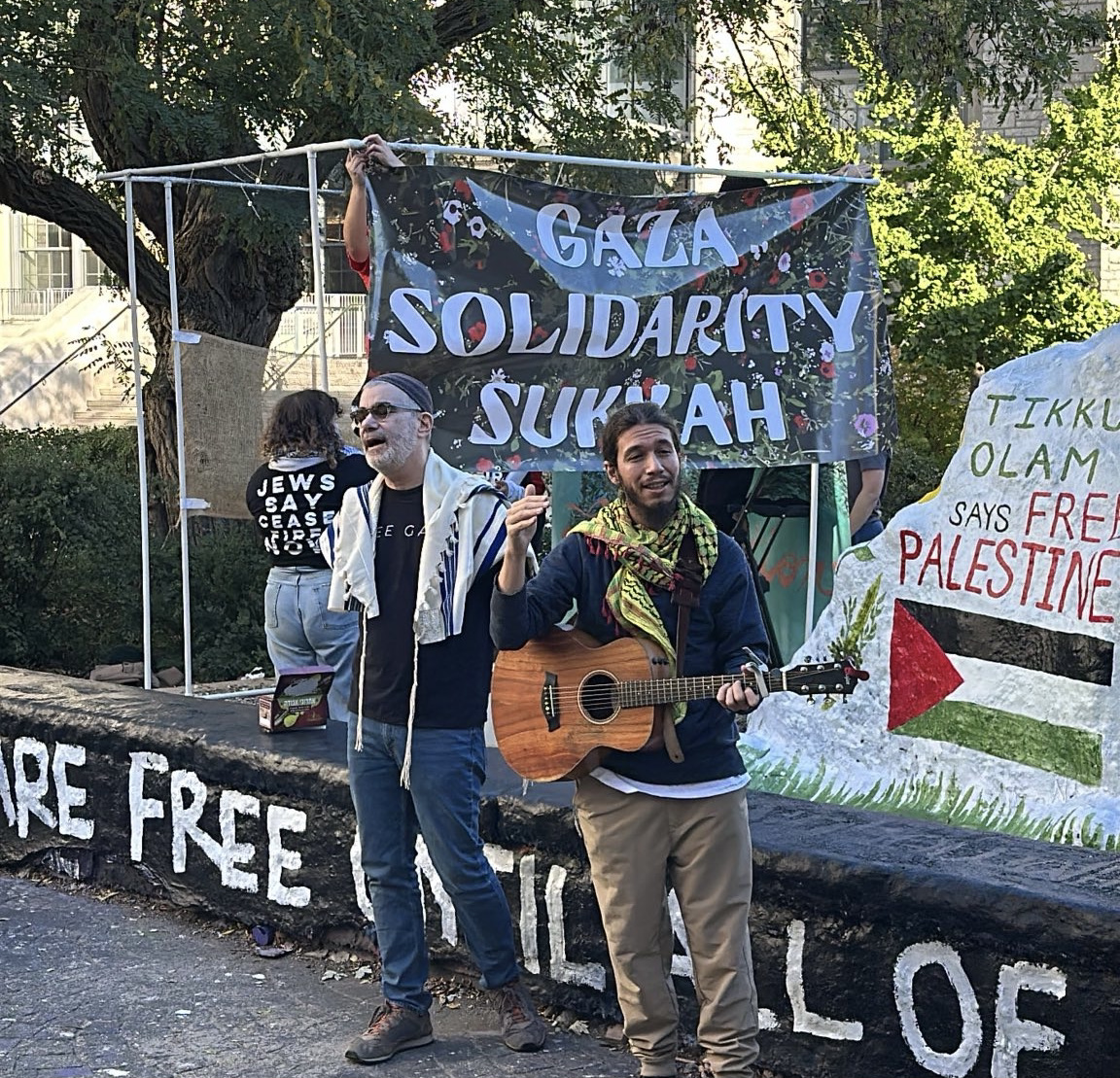
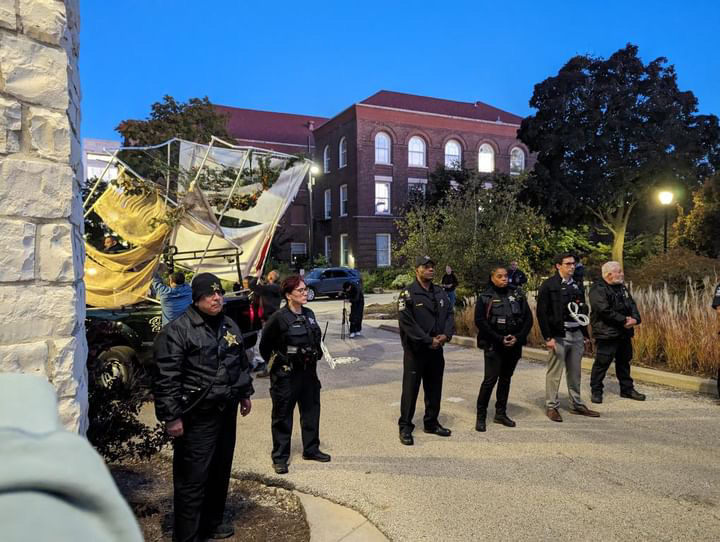
At Northwestern University, in my hometown of Evanston, the campus chapter of Jewish Voice for Peace attempted in vain to receive a permit to build a sukkah on their campus. On the eve of Sukkot last Wednesday evening, they put up a solidarity sukkah in Deering Meadow, a large open grassy area on campus (see above) – and within hours it was destroyed by campus police. With no other options, they decided to rebuild their sukkah last Friday at The Rock, a centrally located and historically protected space of expression which is the only area on campus where tents are techincally permitted.
Leaders of JVP NU reached out to my congregation, Tzedek Chicago, to support and protect their rebuilding, which took place on the eve of Shabbat. And so when the time came, Tzedek cantorial soloist Adam Gottllieb and I led a Shabbat service (see top pic) as students constructed the sukkah next to The Rock, on which they had painted the messages “TIkkun Olam Means Free Palestine” and “None of Us are Free Until All of Us are Free.” Dozens of people enthusiastically in the ceremony, which culminated in the final touches on the structure and the communal blessing for dwelling in the sukkah.
Two hours after the end of the service, we learned that campus police had come, thrown the student’s sukkah in a truck and drove it away.
(Photo: JVP NU)
There is little more to be said: this is what things have come to in American Jewish life. Jewish religious expression of solidarity with an oppressed people is deemed “antisemitic” while college campuses are desecrating sacred Jewish ritual with impunity. These facts tell you everything you need to know about the moment we are currently in.
In the end, however, the destruction of these symbolic fragile structures must not and should not be viewed primarly as an act of repression against Jewish college students. This would be an egregious misreading of the true meaning of Sukkot 2024. Rather, I fervently believe these acts must only serve to further sensitize us and deepen our outrage a desecration that is far more egregious and tragic: i.e., the genocidal violence that Israel has been inflicting on the Palestinians of Gaza, who have been seeking in vain for shelter for over a year.
And even more importantly, it must strengthen our resolve to do everything we can to create a real and lasting shelter – by finally bringing this heinous genocide to an end.
Why do we sound the shofar on Rosh Hashanah? Over the centuries, commentators have offered us a variety of reasons. Moses Maimonides famously called it a wake-up call to personal atonement; others view it a call to action or a tribute to God’s power. This new year, however, I believe one reason stands out among all others. Today, this Rosh Hashanah, we sound the shofar as a call to moral accountability.
Today, we begin the holiest season of the year. Over the next ten days, we’ll be challenged to break open the shells of inertia and complacency that have built up over the past year. We’ll sound the shofar to herald the inauguration of a deep, collective soul searching: to look deep within, to face honestly what must be faced, if we are to truly begin our new year anew.
To put it frankly, I honestly cannot remember a Rosh Hashanah when the collective moral stakes were any higher for the Jewish community than this year. I would even go as far to say that this may be the most morally consequential High Holiday season of our lifetimes. As we begin this new year, the shofar calls us to account for a genocide, ongoing even as we speak, perpetrated by a nation acting in the name of the Jewish people.
How can we begin to fathom a moral accounting of such a magnitude? Over 41,000 Palestinians killed in Gaza to date and over 95,000 injured, the majority of whom are women and children. According to one estimate, the ultimate death toll may eventually be nearly 200,000. Whole extended families, entire Palestinian bloodlines have been wiped out completely. Much of Gaza has been literally reduced to a human graveyard, with scores of bodies buried beneath the rubble of destroyed and bulldozed homes. Neighborhoods and regions have been literally wiped off the map.
Gaza’s infrastructure and health care system has been decimated. According to the UN an “intentional and targeted starvation campaign” has led to widespread famine and disease throughout the Gaza strip. Polio has now broken out – relief workers are literally working to deliver vaccines to children as bombs and missiles fall around them.
Health care workers, humanitarian workers and journalists are being killed, injured and imprisoned in massive numbers. Human rights agencies have documented widespread torture and abuse of prisoners, including sexual abuse, throughout a network of torture camps.
Please note that this unspeakable litany is not a review of the past year. It is a description of a nightmare that continues as I speak, with no end in sight.
As we contemplate this inhuman status quo, it occurs to me that this Rosh Hashanah, the broken sound of the shofar is more than a mere all to accounting. It is a broken wail of grief – and a desperate moral challenge. This year the shofar calls out to us in no uncertain terms: We Charge Genocide.
This is not a point upon which we can equivocate. Not today. On this day, we face what must be faced and say out loud what must be said. To argue this point now would frankly be a sacrilege.
From a purely legal point of view, a myriad of academic and legal experts have long since confirmed the charge of genocide. As far back as October, Holocaust and Genocide scholar Raz Segal has called Israel’s actions in Gaza “a textbook case of genocide.” On October 18, almost 800 scholars, lawyers and practitioners called on “all relevant UN bodies…as well as the Office of the Prosecutor of the International Criminal Court to immediately intervene…to protect the Palestinian population from genocide.” More recently, Omer Bartov, a respected historian of the Holocaust and Genocide Studies at Brown University accused Israel of “systematic war crimes, crimes against humanity and genocidal actions.”
But beyond the legal arguments, there is a critical, moral imperative behind this claim. For many Jews, it’s impossible to imagine – let alone say out loud – that a Jewish state, founded in the wake of the Holocaust, could possibly be perpetrating a genocide.
I understand the pain behind this refusal. I know it confronts many Jews with an unimaginable prospect: to accept that we have become our own worst nightmare. But if we cannot admit the truth on this of all days, then why bother gathering for Rosh Hashanah in the first place? To dither on this point would make a sham of a festival we dare to call the holiest season of the year.
Not long ago I had a long conversation with my dear friend and colleague Rachel Beitarie, director of the Israeli organization Zochrot. Rachel is among the precious few Israeli activists who are in unabashed solidarity with Palestinians. You may remember her presentation to our Tzedek community several months ago. Among other things, she spoke about what it was like to be an Israeli activist for Palestinian liberation who grew up on a kibbutz near the Gaza border, who personally knew Israelis who were killed and taken hostage on October 7.
During our recent conversation, Rachel and I talked in particular about the way Israel metabolizes the traumatic memory of the Holocaust as a way to rationalize away its genocidal violence in Gaza. In a follow up letter to our conversation, Rachel wrote the following words to me:
As years go by and most Holocaust survivors are no longer with us, the identification and reliving of the trauma of former genocide seems to only grow, in direct relation to the crimes committed under the excuse of the right to defend ourselves and “prevent a second Holocaust.”
Because of this unrelenting propaganda, the linkage of the Hamas attack of October 7 to the Holocaust was made immediately, even though it was logically bogus. It was understandable at first, especially from people – many of my friends and acquaintances among them – who personally experienced the horrors of that day, waiting for help that took many hours to come.
Having grown up in Israel, exposed as we are to re-traumatizing Holocaust education, the associative connection was almost inevitable. Soon however, it became clear that this linkage was being overblown and manipulated to justify the annihilation of Gaza; to justify, dare I say it, another Holocaust.
Many outside of Israel have made the linkage between October 7 and the Holocaust as well. Almost immediately in fact, the terrible massacres of that day were openly characterized as “the worst mass murder of Jews since the Holocaust.” As Rachel pointed out, the two events have nothing to do with each other whatsoever. Still, it is indeed painfully poignant to consider that this mass killing occurred in a state founded in the wake of the Holocaust in order to safeguard Jewish lives once and for all.
We can only imagine what on earth will be said about October 7 on its one year anniversary, which will arrive exactly between Rosh Hashanah and Yom Kippur. From what I’ve read about officially sponsored Jewish community commemorations, the dominant message will be thoroughly suffused with a Holocaust-informed victim mentality: “Bring them home,” “We stand with Israel,” “It’s us against the world,” with nary a mention of the vengeful carnage Israel has been unleashing on Gaza for the better part of a year.
In contrast to this particular messaging, however, I would suggest that sacred Jewish tradition presents us with an important opportunity on this anniversary. Yes, the Days of Awe are an occasion to mourn the losses of the past year – but this season is also a time to seek out a deeper understanding. To do a genuine accounting and to take real accountability.
As we start to reckon with the events of October 7, I would suggest that the first step would be to admit that this date was not a starting point. If we are to truly and honestly commemorate this tragic anniversary, we must understand it in the context of the ongoing violence and injustice known as the Nakba – a nightmare that began decades ago and is still ongoing.
As Israel’s violence in Gaza escalated during the final months of 2023, Tzedek Chicago’s board had numerous conversations about whether or not to issue a congregational statement. I’ll make a confession: I wasn’t originally in favor of it. To be honest, I was starting to become dubious about the value of these kinds of gestures. At a moment when so many of us were working overtime organizing on behalf of the Palestine solidarity movement, it seemed like a waste of time to spend our time on a congregational statement. It felt as if the only statement that needed to be made, over and over again in the streets, was “Ceasefire Now!”
Eventually, however, I came to agree with our board that Tzedek Chicago – as an avowedly anti-Zionist congregation – had a unique voice to offer on this issue. And so, during the month of December, we worked together to craft a statement titled, “In Gaza, Israel is Revealing the True Face of Zionism.”
Here’s an excerpt:
We … know there was a crucial, underlying context to (the) horrible violence (of October 7). We assert without reservation that to contextualize is not to condone. On the contrary, we must contextualize these events if we are to truly understand them – and find a better way forward.
The violence of October 7 did not occur in a vacuum. It was a brutal response to a regime of structural violence that has oppressed Palestinians for decades. At the root of this oppression is Zionism: a colonial movement that seeks to establish and maintain a Jewish majority nation-state in historic Palestine.
While Israel was founded in the traumatic wake of the Holocaust to create safety and security for the Jewish people, it was a state founded on the backs of another people, ultimately endangering the safety and security of Jews and Palestinians alike. Israel was established through what Palestinians refer to as the Nakba: the ethnic cleansing of 750,000 Palestinians from their homes in 1948. And since that time, Israel has subjected Palestinians to a regime of Jewish supremacy in order to maintain its demographic majority in the land.
This ongoing Nakba is the essential context for understanding the horrifying violence of the past three months. Indeed, since October 7, Israeli politicians have been terrifyingly open about their intentions, making it clear that the ultimate end goal of their military assault is to ethnically cleanse Gaza of its 2.2 million Palestinian residents. One prominent member of the Israeli government put it quite plainly: “We are now rolling out the Gaza Nakba. Gaza Nakba 2023. That’s how it’ll end.” More recently, Prime Minister Netanyahu was reported as saying that he is actively working to transfer Palestinians out of Gaza. The problem, he said, “is which countries will take them.”
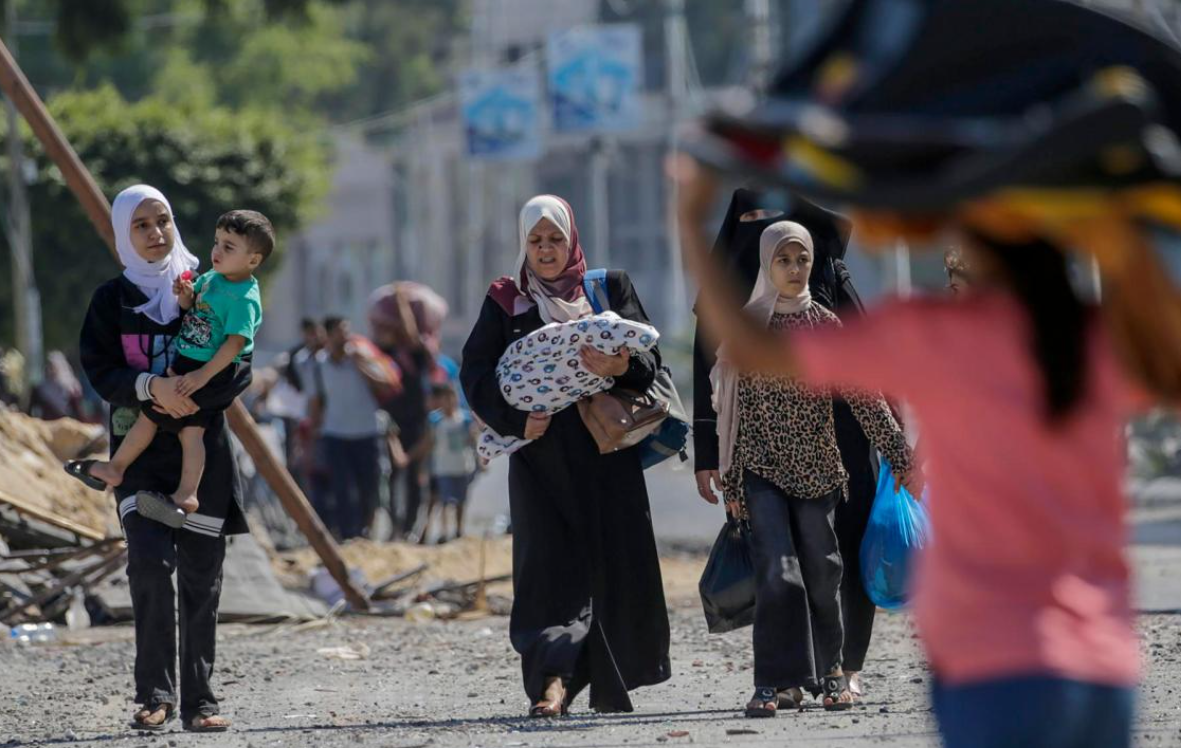
Israeli leaders are being true to their word: we are witnessing the continuation of the Nakba in real time. As in 1948, Palestinians are being driven from their homes through force of arms. As in 1948, families are being forced to march long distances with hastily-collected possessions on their backs. As in 1948, entire regions are being razed to the ground, ensuring that they will have no homes to return to. As in 1948, Israel is actively engineering the wholesale transfer of an entire population of people.
It is now eight months since we released that statement and I believe it is more accurate than ever. In her letter to me, Rachel observed the irony that more and more Israelis are now threatening a “second Nakba” when “until recently Israelis denied that the Nakba ever happened.” Now however, many Israelis are using the term with unabashed vengeance. Through word and deed, Israel’s ultimate end game is becoming all too clear: it is the ethnic cleansing of Gaza.
This past August, in fact, the Israeli press revealed the presence of a government plan for Israel’s long term occupation of Gaza on “the day after.” According to the plan:
Israel will control the northern Gaza Strip and drive out the 300,000 Palestinians still there. Major Gen.Giora Eiland, the war’s ideologue, proposes starving them to death, or exiling them, as a lever with which to defeat Hamas. The Israeli right envisions a Jewish settlement of the area, with vast real estate potential of convenient topography, a sea view, and proximity to central Israel… The southern Gaza Strip will be left for Hamas, which will have to care for the destitute residents under Israeli siege, even after the international community loses interest in the story and moves on to other crises.
In other words, a “real time Nakba” is being discussed openly in Israeli political and academic circles. More recently, on September 15, Professor Uri Rabi, a prominent researcher at Tel Aviv University, actually said these words in a radio interview: “Remove the entire civilian population from the north, and whoever remains there will be lawfully sentenced as a terrorist and subjected to a process of starvation or extermination.”
As we engage in moral accounting over the next ten days, we must reckon seriously with words such as these. Indeed, from the very beginning of this genocide, Israeli leaders and politicians have been all too transparent about their intentions. Just as the founders of the Zionist movement themselves, from Theodor Herzl to David Ben-Gurion promoted the “transfer” of the native Palestinian population to make way for a majority Jewish state. Then, as now, we must take these leaders at their word. We must take them very seriously. We can never say we didn’t know.
More than ever before, this High Holiday season calls to us to reckon seriously with what Zionism has wrought. Not only in Gaza, but throughout the West Bank, where violence and ethnic cleansing is running rampant and in Lebanon, which is now experiencing its own carnage and displacement, bringing the entire region ever closer to all-out war.
How could it be otherwise? This is what comes of an ideology and movement that from the beginning viewed Jewish safety as zero sum; in which our security can only be achieved at the expense of others, empowerment gained through the sheer power of superior military technology, stronger weapons and higher walls.
And finally, this High Holiday season, we must take this opportunity to ask ourselves collectively: where have we fallen short? This is a critical question in particular for those of us who have been active in the Palestine solidarity movement.
If this is indeed the season for hard truths, we must face the fact that despite all our efforts this past year, we failed to stop a genocide. For all our calls for ceasefire, on street corners and in the halls of city governments, for all of the mass protests and acts of civil disobedience, for all of the courageous student activism on college campuses, a ceasefire seems farther away than ever at the moment.
This is not to say that there has not been genuine progress this past year. But how do we measure these successes against the mass killing that has occurred and continues to occur every single day? On this point, I’d like to share with you the words of Sumaya Awad, of the Adalah Justice Project, who offered us this powerful challenge at the plenary for the Socialism 2024 conference here in Chicago last month:
We know that there has been a massive shift in the United States around Palestine. We have seen poll after poll show that the majority of Americans support an arms embargo, the majority of Americans don’t want to support Israel, are critical of Israel and yet we haven’t seen that translate into the mass action we need.
Despite this massive shift, we grapple with the fact that this shift came at the expense of how many lives lost? How many people murdered? Who paid the price for these people to shift? And it’s not to say that this shift is not tremendous and incredible and good – it is all of those things, but we must also grapple with the fact that lives are being lost on the daily. And that it is all by design and that it all can be stopped in basically a moment.
And I say all of this not to pity Palestinians, quite the opposite, nor that we must grieve more. Grief is necessary, but that’s not the answer. I say it all because … we have to keep asking ourselves – you have to ask yourselves – what am I doing with this knowledge? What am I doing with this education? How is it translating into action? How does it translate into action that does not preach to the choir, but preaches to those who are not yet where we need them to be?
And you have to have an answer to that question. Because a year from now, when you are back here, you have to have an answer. Don’t find yourself just asking the same question. Be ready to answer, what have I done in the last year?
Though Sumaya spoke these words in a very different context, I find them nonetheless appropriate to the sacred imperative of this new year. A year from now, when we are back here, we will have to have an answer. We can’t find ourselves just asking the same question. We must be ready to answer: what did we do in the last year to bring this genocide to an end?
I know this in my heart and soul as well: years from now, we will likewise have to stand in judgment. When the story of this genocide is written, we will be asked: did we speak out? And if so, what did we say? What did we risk?
For now, that book is still open, even if every new page is becoming increasingly unbearable to read. Even if the world would rather move on to another story. How will we write ourselves into this book when it is finally recorded?
May we all play our part in bringing this book of the genocide to a finish. May it come to an end soon, in our own day. And when it does, may we come to understand it was only part of a larger story – an even greater book that will conclude with these glorious words: “then Palestine was finally free, from the river to the sea.”
By all accounts, the Democratic Party is closing ranks at lighting speed. As of this writing, Vice-President Harris now has more than enough delegates to clinch the party’s nomination, with a virtual roll-call planned prior to the convention in Chicago next month. The endorsements from powerful Dems continue to roll in, including from virtually all of those who might be considered viable as her potential opponents. Just two days after Biden’s withdrawal from the race, her coronation as the Democrats’ candidate is now all but assured.
I fully understand the euphoria of this moment. With Biden as the Democratic candidate, the prospect of another Trump presidency was becoming more terrifyingly real by the day. But make no mistake, Biden’s downfall was not the product of one horrible debate. On this point, I am in total agreement with Palestinian-American community organizer Linda Sarsour, who recently posted on her Facebook page:
They will never admit this but Joe Biden became a political liability for the Democratic Party on Gaza. Period. The media won’t say this. The pundits will talk around it and the party will say it’s not the case as not to offend their pro-Israel donors – but they knew that they could not win states like Michigan, Georgia, Wisconsin and they had lost big chunks of important constituencies like young people, Arab and Muslim voters, and many progressives. The fact that anyone thinks we are going to believe that one dismal debate performance was the reason they pushed Biden out is just ludicrous.
Absolutely. While the doubts over his age may have motivated his donors to abandon him in the end, Biden was fatally weakened as a candidate by his unabashed support for Israeli genocide – and the solidarity movement that held him to account. As was reported as far back as January, “It’s not just the major prime-time rallies that are now attracting the anti-Gaza war crowd’s wrath. Everywhere Biden goes he is being dogged, whether it is outside the church he attends near his home in Delaware or along the route of his presidential motorcade.”
Many are noting that Harris has been marginally better on the issue of Palestine/Israel than Biden. Last December, it was reported that she was pushing the Biden administration to “to show more concern publicly for the humanitarian damage in Gaza.” During a speech in Selma last March she called for a temporary ceasefire, adding that “too many innocent Palestinians have been killed.” In the same speech, she spoke empathetically about Gazans seeking aid who “were met with gunfire and chaos.”
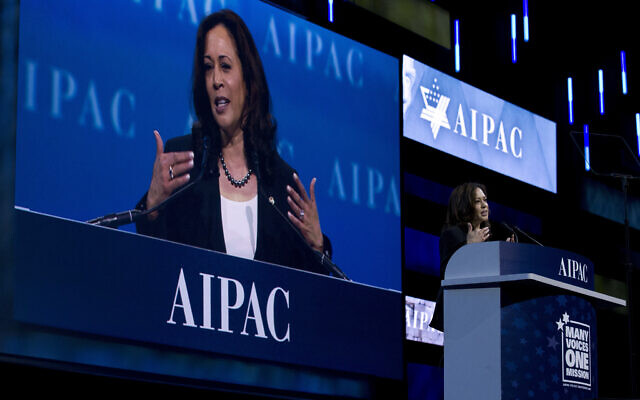
At the same time, we should have no illusions about Harris’ record of unconditional support for Israel. During a speech at the 2017 AIPAC conference, she offered the requisite oath of fealty, ““Let me be clear about what I believe. I stand with Israel because of our shared values, which are so fundamental to the founding of both our nations.” And during her 2019 Presidential campaign, she was praised by the lobbying group Democratic Majority for Israel for running to the right of Obama on the Iran deal. Indeed, despite her softer tone, Harris has been in lockstep with the Biden administration – indeed with, the entire Democratic Party leadership – on this issue.
For the past several months I’ve been actively involved in the Palestine solidarity movement holding the Biden administration to account for enabling and support Israel’s genocidal violence in Gaza. Along with scores of others, I’ve made plans to participate in the protests planned at the Democratic National Convention next month. Even with Kamala Harris now leading the ticket, I have no intention of changing those plans.
Those of us who are part of this movement have not forgotten the essential reason for our organizing: we are living in a time of genocide – one that is being aided and abetted by a Democratic government. Whether it is Biden or Harris at the top of the ticket, nothing has changed in this regard. Moreover, conventions are the place where party policy and platforms are decided. Those of us who have been holding our government to account all year have a solemn responsibility to continue to do so: to demand that the governing party enact an arms embargo on the Israeli government and to establish a foreign policy centered in human rights.
Though news of Gaza has been swept off the front pages, Israel’s carnage against the Palestinian people has continued with impunity. It was reported today that “at least 84 Palestinians were killed over the past day in (Khan Yunis), with more than 300 others wounded. Medical staff at the Nasser Medical Complex report they are completely overwhelmed and have been forced to treat patients on hospital floors.” Yesterday, the World Health Organization revealed there is now a high risk of the polio virus spreading across Gaza – and beyond its borders – due to the dire health and sanitation situation there. The Israeli military has just announced that it will start offering the polio vaccine to its soldiers though there are not enough vaccines – or the distribution capacity – to reach the 2.2 million Palestinians in Gaza.
In other words, now is not the time to let up. In the words of Linda Sarsour, “no matter what, our work doesn’t change.” Or as Waleed Shahid of the Uncommitted Movement has correctly said:
We are making clear that we think that Biden and the White House’s disastrous policy on Gaza makes it harder for them to defeat Trump. In fact, having a campaign based on democracy, having a campaign fighting far-right authoritarianism, while sending bombs to one of the world’s biggest far-right authoritarians in Netanyahu, who is now visiting Washington, DC, makes a mockery of that party’s claim to be fighting on the right side of history, fighting on the behalf of democracy. And we want to see that party change course.
That’s why, no matter who is heading the ticket, I plan to be on the front lines with my friends and comrades when the DNC comes to town next month.
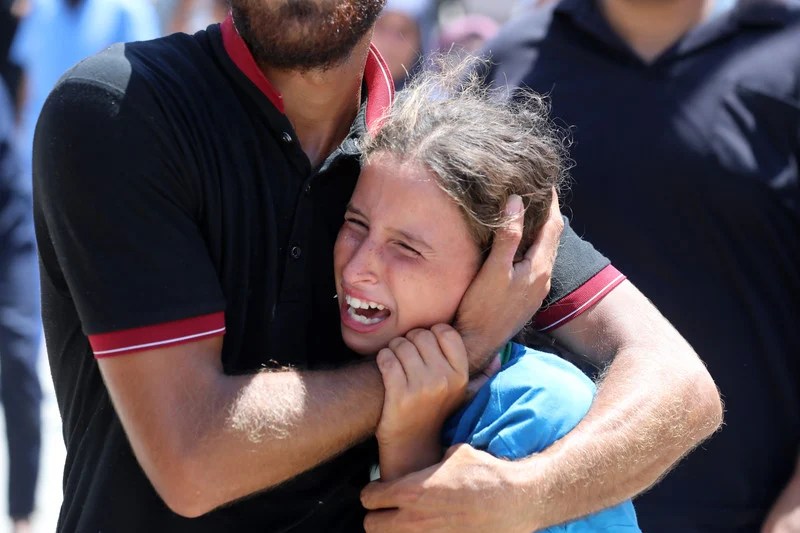
Israel killed at least 90 people in Al-Mawasi in several airstrikes on an area the military had designated as a “safe zone.” Here a child reacts as bodies are salvaged from the site on July 13. Omar AshtawyAPA images
Warning: this post contains descriptions of extreme violence.
On Saturday, while the world was riveted to the news about the assassination attempt on Donald Trump, Israel unleashed airstrikes on Al-Mawasi in Central Gaza – in an area previously designated as a “humanitarian safe zone.” Gazan health officials reported that approximately 90 people were killed and at least 300 injured in this attack. Eyewitness testimonies attested to unspeakable carnage. According to 16 year old Gazan Shaima Farwameh:
A leg hit me, and I saw dismembered bodies a few meters away. I saw a young child screaming. He lost his lower limbs and was crawling on his hands and screaming. The bombs didn’t stop, and suddenly the boy disappeared. I saw how he vanished before me while we ran and lowered our eyes to the ground, unable to do anything but run…What a life we live in these tents that we have to see the dismembered bodies of our siblings and families fly over our heads.
Yesterday, Israel bombed Southern and Central Gaza once again, killing more than 60 Palestinians. Among the targets was a UN school in Nuseirat where families were sheltering. Other strikes in Khan Younis and Rafah killed 12 people, according to medical officials and AP journalists. According to AP, “footage showed the school’s yard covered in rubble and twisted metal from a structure that was hit. Workers carried bodies wrapped in blankets, as women and children watched from the classrooms where they have been living.”
Given the reality of such hideous violence, it was difficult to ignore the irony in the rhetoric following the attempted assassination attempt last Saturday. For me, the most egregious example occurred when Biden said, In his speech to the nation, “There is no place in America for this kind of violence or for any violence ever. Period. No exceptions. We can’t allow this violence to be normalized” (emphasis mine).
This statement is truly breathtaking in its hypocrisy. The genocidal violence Israel has been unleashing on Gazans for the past ten months has long been been normalized for most, save the Palestinian people and their allies. Even as the death toll has now reached nearly 40,000. Even as a new report in the British medical journal Lancet estimates that the actual death toll in Gaza could eventually reach 186,000 or even higher — roughly 8% of Gaza’s population.
It truly takes a special kind of moral gall for Biden to say “we can’t allow violence to be normalized” when it is his very administration that is unconditionally providing Israel with the very bombs that have killing and maiming Gazans on a daily basis. In terms of sheer numbers, President Biden is enabling the deadliest political violence in the world at this very moment.
There has been a chorus of condemnation of “political violence” from across the political spectrum over the past several days. As I’ve listened to the robotic sameness of these responses, it’s occurred to me that they are all unified over one common assumption: political violence is worthy of condemnation when Americans kill other Americans for political purposes – but when the US government commits or enables political violence around the world, it amounts to mere background noise.
Of course, the US itself was created by means of political violence – through the genocide of indigenous inhabitants and the stolen labor of black slaves. This country engages in political violence every day through deadly systems of mass incarceration and policing. And of course, the US has historically expanded its imperial power and influence throughout the world by fomenting the political violence of regime change. MLK famously made this point in his speech A Time to Break Silence when he excoriated “the greatest purveyor of violence in the world today – my own government.”
So please don’t stop raising your voice about Gaza. Please don’t allow this political violence be normalized. Please heed the words of my friend and colleague Jehad Abusalim (who comes from Deir Al-Balah in Gaza):
This is annihilation. There are no words left to capture the horror. Gaza is being obliterated—people are being murdered, starved, and displaced for months on end. Repeating these words feels like a hollow echo and a useless endeavor. But we have no choice but to persevere and keep pushing for an end to the genocide, for accountability, for justice, for healing, for rebuilding, and for liberation. We on the outside have no excuse. As long as Gaza’s defenders, doctors, nurses, first responders, and volunteers keep working and pushing, we have no choice but to keep working and pushing. Gaza needs your activism, your courage, your dedication, your boycott, your presence on the streets, and your donations now more than ever. This is a battle for hope, and hope is the last thing we’ve got. Let’s not let them take it away from us.
Here are my remarks from, “Gaza: Religion, Politics and Solidarity,” a program sponsored by Bright Stars of Bethlehem on May 5, held at the First Presbyterian Church in Evanston. It was my honor to speak in conversation with Palestinian liberation theologian Rev. Dr. Mitri Raheb (founder and President of Dar al-Kalima University College of Arts and Culture in Bethlehem), Dr, Rami Nashashibi, (founder and Executive Director of the Inner-City Muslim Action Network) and Dr. Iva E. Carruthers, (General Secretary of the Samuel DeWitt Proctor Conference).
Remarks by Maya Schenwar, from last night’s Tu B’shvat gathering sponsored by Tzedek Chicago and the Jewish Fast for Gaza. (Maya is director of the Truthout Center for Grassroots Journalism. She is also a coordinator of the Jewish Fast for Gaza and a member of Tzedek Chicago.)
Many of those of us involved in Jewish Fast for Gaza are breaking our fast tonight. We’ve been fasting weekly on Sundays since mid-October, and we will keep fasting weekly until a ceasefire. We donate the money we would’ve spent on food to organizations supporting people in Gaza in this time of starvation and mass death. And each week, we are also reflecting on and renewing our commitment to solidarity with our Palestinian co-strugglers and people around the world who are calling for an end to this genocide, an end to US funding for Israel’s weapons, an end to colonization and apartheid.
When we call for a ceasefire, when we fast for a ceasefire, we are uplifting a call for life. In the months since October 7, I’ve heard many people quote Ruth Wilson’s Gilmore’s sacred words, “Where life is precious, life is precious.” And one of the things Ruthie is saying, with that message, is that in societies where life is actually treated as precious—where they don’t have the death penalty and life sentences and large-scale state violence and state-sanctioned environmental devastation—in those places, violence is less likely overall, the culture is less violent, because life is affirmed.
We should bear in mind that as the US fuels Israel’s genocide in Gaza, here in the US, Alabama is preparing to carry out the US’s first execution via nitrogen gas—which is torture—on the day of Tu B’Shvat.
People are more likely to treat life as precious when their own lives are treated as precious. So we have to create the conditions in which everyone’s life is treated as inherently sacred and irreplaceable. That work is on all of us.
Our Fast for Gaza draws inspiration from the Jewish tradition of fasting as an act of mourning, and it also draws inspiration from Palestinians incarcerated inside Israeli jails, who have launched many hunger strikes to protest their incarceration, and the incarceration of all Palestinians under occupation, to INSIST that their lives are precious.
When Ruth Wilson Gilmore first introduced this idea—where life is precious, life is precious—she was at an environmental justice conference for youth, where, among other things, the youth denounced the effects of pesticides, including on humans– and of course, pesticides also have impacts on native plants and animals. I think this is significant, for Tu B’Shvat. Recognizing that all life is precious means recognizing our interconnection with all life around us. It means we need to, in the words of Thich Nhat Hahn, “awaken from the illusion of our separateness.” It means recognizing the ways that trees have been weaponized to push Palestinians off their land. It means recognizing Israel’s mass destruction of olive trees.
Trees themselves recognize that where life is precious, life is precious. Forests are social systems in which trees support each other through their root systems, through chemical signals in their leaves, through the social climate they create. As we celebrate the trees’ birthday today, we can also celebrate their preciousness, the preciousness of all the life they nurture and that nurtures them. And we can express that through our urgent calls for a ceasefire, for Palestinian liberation, and for collective liberation.
When we say ceasefire now, we are also saying environmental justice now. When we say ceasefire now, it is a call for Indigenous liberation now, from Palestine to Turtle Island and beyond.
Ceasefire now can be a call to stop death penalties of all kinds, including this execution that is set to happen in our own country on the day of Tu B’Shvat. Let’s insist on the preciousness of people, and of trees, and of the interconnectedness of all beings.
The introduction to the book of Exodus, which we begin reading this Shabbat, has never resonated so deeply or so powerfully for me as it does this very moment.
We’re all familiar with the events that spark the Exodus narrative: a new Pharoah arises over Mitzrayim who does not know or remember Joseph. Alarmed that the Israelite minority is growing, he oppresses them with forced labor – but the more he oppresses them, the more the Israelites increase in number.
Pharoah then attempts to stem the Israelite birth rate directly by ordering the Hebrew midwives Shifra and Puah to kill every newborn boy. When they defy his order, Pharoah orders that every newborn boy be cast into the Nile. Commentators differ on why Pharoah made this very specific decree. Some say that in his paranoia, he believed the boys would eventually grow up to be soldiers and take up arms against his people. Other say his soothsayers predicted the birth of Moses. Still others say Pharoah believed that the Israelite women would intermarry and assimilate into the majority culture.
Whatever the reason, it is striking to note that Exodus’ liberation narrative begins with Pharoah’s efforts to head off the Israelite birth rate. As I’ve noted before, there are powerful parallels between this narrative and the state of Israel’s regard of the Palestinian people as a “demographic threat” to their Jewish majority. But in the midst of Israel’s genocidal assault on the people of Gaza, I’m finding that these verses now resonate with a brutal – and almost unbearable – urgency.
On November 3, less than a month into Israel’s military bombardment of Gaza, UNICEF, the World Health Organization and other NGOs reported that “Women, children and newborns in Gaza are disproportionately bearing the burden of the escalation of hostilities in the occupied Palestinian territory, both as casualties and in reduced access to health services.” More recently, the UN estimated that “around 50,000 pregnant women are currently living in Gaza, with more than 180 births taking place every day amid the ‘decimation’ of its healthcare system.”
The most devastating details on the impact of this onslaught on Gazan mothers can be read in the South African government’s application to the International Court of Justice, formally accusing Israel of committing genocide in Gaza. I strongly recommend reading this document in its entirety. Though South Africa’s claim was cynically dismissed by the White House as “meritless, counterproductive and completely without any basis in fact whatsoever,” its 84 page report is painstakingly researched, citing 574 independent sources. Though it is often near-unbearable to read, I believe it is an immensely important document and deserves the widest possible readership.
Here is a sample of the report’s findings on impact of Israel’s genocidal violence on pregnant women and newborn babies. Please be warned: the following quote it includes very graphic descriptions of traumatic violence inflicted on women and children.
Pregnant women and children –– including newborn babies –– are also particularly impacted by displacement, lack of access to food and water, shelter, clothes, hygiene and sanitation, and lack of access to health services. These effects are severe and significant. An estimated 5,500 of approximately 52,000 pregnant Palestinian women in Gaza giving birth each month are doing so in unsafe conditions, often with no clean water, much less medical assistance, “in shelters, in their homes, in the streets amid rubble, or in overwhelmed healthcare facilities, where sanitation is worsening, and the risk of infection and medical complications is on the rise”. Where they are able to get to a functioning hospital, pregnant women are having to undergo caesarean sections without anaesthetic.
Given the lack of access to critical medical supplies, including blood, doctors are being compelled to perform ordinarily unnecessary hysterectomies on young women in an attempt to save their lives, leaving them unable to have more children. Indeed, the Minister of Health for the State of Palestine, Dr May al-Kaileh, confirms that the only option facing Palestinian women in Gaza who ‘bleed out’ after giving birth is to undergo a hysterectomy in order for their lives to be saved. The lack of available drugs, such as the anti-D injection –– given to Rhesus negative women on the birth of a Rhesus positive baby –– also seriously impacts the possibility of future healthy pregnancies for affected women.
Premature births have reportedly increased by between 25-30 per cent, as stressed and traumatised pregnant women face a myriad of challenges, including being compelled to walk long distances in search of safety, attempting to escape from bombs and being crowded into shelters in often squalid conditions. Particularly in northern Gaza, cases of placenta abruption –– a serious condition that occurs to pregnant women during childbirth which is potentially life-threatening to both mother and baby –– have more than doubled.
An ever-increasing number of Palestinian babies in Gaza are reportedly dying from entirely preventable causes, brought about by Israel’s actions: newborns up to three months old are dying of diarrhea, hypothermia, and other preventable causes. Without essential equipment and medical support, premature and underweight babies have little to no chance of survival. Palestinian newborn babies have died due to the lack of fuel to supply hospital generators; others have been found decomposing in their hospital cots, medical staff taking care of them having been forced by Israel to evacuate.
On 3 November 2023, the World Health Organisation warned that “[m]aternal deaths are expected to increase given the lack of access to adequate care”, with deadly consequences on reproductive health, including a rise in stress-induced miscarriages, stillbirths and premature births. The impact will necessarily be long lasting and severe for Palestinians in Gaza as a group. By 22 November 2023 the United Nations Special Rapporteur on violence against women and girls, its causes and consequences, has expressly warned that:
“[T]he reproductive violence inflicted by Israel on Palestinian women, newborn babies, infants, and children could be qualified as… acts of genocide under Article 2 of the Convention on the Prevention of Genocide … including “imposing measures intended to prevent births within a group”. She stressed that “States must prevent and punish such acts in accordance with their responsibilities under the Genocide Convention.”
(Sections 96-100)
If there could be any doubt as to the question of intentionality behind these barbaric measures, the section immediately following these findings includes exhaustive quotes by Israeli politicians and military leaders that make their genocidal intentions all too clear. Most chillingly, it offers this quote from 95-year old Israeli army reservist Ezra Yachin — a veteran of the Deir Yassin massacre during the 1948 Nakba — who was called up for reserve duty to “boost morale” amongst Israeli troops ahead of the ground invasion: Be triumphant and finish them off and don’t leave anyone behind. Erase the memory of them. Erase them, their families, mothers and children. These animals can no longer live. . . Every Jew with a weapon should go out and kill them. (Section 102)
In this week’s Torah portion, the cry of the oppressed Israelites rises up to God, who hears and hearkens to their pain. This year, there can be no more critical question posed by our Torah portion: will God hearken to the collective cry of the people of Gaza?


 Shalom Rav