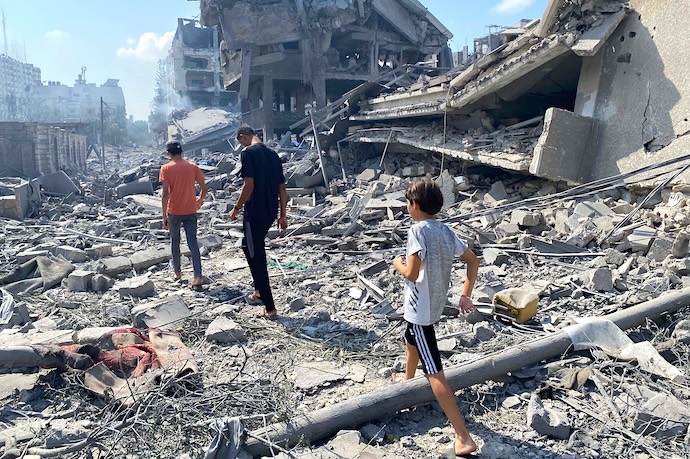
In December 2023, just three months into Israel’s genocide on Gaza, Tzedek Chicago’s board released a public statement entitled, “In Gaza, Israel is Revealing the True Face of Zionism,” arguing that “ongoing Nakba is the essential context for understanding the horrifying violence of the past three months.” A year and a half later, these words are resonating with an even more powerful urgency. There is every indication that Israel is beginning the process of engineering the wholesale destruction of Gaza – and the Palestinians who live there – by any means necessary.
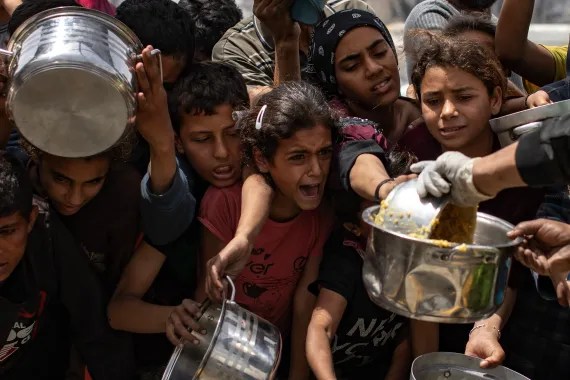
We are now three months into Israel’s total blockade of food, fuel and humanitarian aid – and Gazans are gripped by an increasing famine. On May 4 it was reported by Gaza’s government media office that at least 57 Palestinians have already starved to death, more than 3,500 young children face imminent death from starvation, another 70,000 children are being hospitalized for severe malnutrition, and 1.1 million Palestinian children lack the minimum nutritional requirements for survival. Over 20 UN human rights experts have determined that Israel is wielding starvation as a weapon of war, concluding that “these acts, beyond constituting grave international crimes, follow alarming, documented patterns of genocidal conduct.”
At the same time, the Israeli military has been stepping up its bombing campaign, killing Palestinians at a higher rate than any point since the beginning of the genocide. As of this writing, Israel has killed 100 people in the past 24 hours in a series of bombings throughout northern Gaza. In footage taken by NBC News, the bodies of young children could be seen lying among the dead at Al-Shifa Hospital in Gaza City.
There are ominous, compelling signs that we are indeed witnessing the end game of Israel’s Nakba in Gaza. On May 4, the Israeli government approved a military operation called “Gideon’s Chariots,” directing the Israeli army to seize complete control of the Gaza Strip and displace the entire population to a small area of land in the south. Though this was technically a leaked story, some Israeli politicians have been unabashed about the plan. Finance Minister Betzalel Smotrich put it very plainly: “Gaza will be entirely destroyed” as a result of an Israeli military victory, and that Palestinians will “start to leave in great numbers to third countries.”
On top of this news, this past Wednesday, Reuters recently reported that the US and Israel have discussed the possibility of Washington leading “a temporary post-war administration of Gaza.” According to five sources, there would be no set timeline for how long the US led administration would last. They compared the proposal to the Coalition Provisional Authority in Iraq that Washington established in 2003, shortly after the US led invasion that toppled the regime of Saddam Hussein. As journalist/commentator Mehdi Hasan correctly pointed out in an interview today, the US’s administration of Iraq was an “absolute disaster.” As Hasan put it, “It increased sectarian tensions. It increased violence. It divided the country. It fomented more violent resistance.”
On May 15, the Palestinian people will observe Nakba Day, their collective observance of their dispossession and ethnic cleansing from their homes. For Palestinians this is not only an acknowledgement of an event that occurred in the past but a commemoration of an injustice that is still unfolding in real time. And yet the genocide in Gaza – as well as the ongoing ethnic cleansing of the West Bank – are completely absent from the mainstream press and international governmental concern. How long will the world allow this decades-long crime to continue?
I can’t help but note that this week’s Torah portion, Parashat Acharei Mot (which means “after the death”) describes an elaborate sacrificial rite of collective atonement. As I read these words, it is so clear to me that our complicity in this ongoing sacrilege continues to deepen the longer we allow it to unfold. The news out of Gaza has long since receded into the background, even as the Palestinian people continue to cry out to the world.
The world is watching. Will Member States live up to their obligations and intervene to stop the slaughter, hunger, and disease, and other war crimes and crimes against humanity that are perpetrated daily in complete impunity?
…The decision is stark: remain passive and witness the slaughter of innocents or take part in crafting a just resolution. The global conscience has awakened, if asserted – despite the moral abyss we are descending into – justice will ultimately prevail.
I’m sure I’m not the only anti-Zionist Jew who experiences cognitive dissonance when we get to the line that ends every Passover seder, “Next year in Jerusalem!” In the age of Zionism, what do these words really mean: when a Jewish person can fly to Jerusalem not next year, but tomorrow, and become an instant citizen upon arrival? How can we joyfully shout these words knowing that Israel ethnically cleansed half of Jerusalem in 1948 and militarily conquered and occupied the other half in 1967? What do they mean while scores of Palestinians who have deep generational ties to the land are forbidden from even setting foot in that city?
Over the years, I’ve come to the conclusion that the only way I can say this line with moral integrity is to understand the word “Jerusalem” not as referring to a physical city but to a spiritual ideal. This ideal, in fact, is central to Jewish tradition. After the destruction of the Temple and the ruination of Jerusalem by the Romans, the rabbis posited the existence of two Jerusalems: Yerushalayim Shel Mata (“Jerusalem Below”) and Yerushalayim Shel Mala (“Jerusalem Above”). Earthly Jerusalem is the physical city we know while the Heavenly Jerusalem is the messianic Jerusalem: a mirror reflection of the city on high: the Jerusalem of our highest aspirations.
In other words, while a small number of Jews always lived in the city after the destruction of the Temple, for the majority of Jews who lived throughout the diaspora, the concept of Jerusalem became a spiritualized symbol. I’ve often been struck that diaspora cities that were centers of robust Jewish life have typically been referred to as “Jerusalems.” In the late 16th and early 17th centuries, for instance, Amsterdam was referred to as the “Jerusalem of the West” following the immigration of Sephardic Jews from Spain and Portugal. Likewise, Vilna was known as the “Jerusalem of Lithuania” and Tlemcen, Algeria was called “Jerusalem of the Maghreb.”
When the ideology of Zionism emerged, and this spiritual ideal was subsumed into a physical place, the words “Next Year in Jerusalem” became a literal battle cry. But when we limit our understanding of Jerusalem to one specific city, we do damage to the very idea of Jerusalem itself. It’s tragically ironic that while the Hebrew word Yerushalayim literally means “City of Peace,” it has rarely known a moment’s peace in its history. It certainly hasn’t since the establishment of the state of Israel.
While the metaphor of Jerusalem still has a prominent place in Jewish tradition and liturgy – the words “Next Year in Jerusalem” mark the end of Yom Kippur as well as the Pesach seder – this ideal can be deeply meaningful even for those of us who do not ascribe to the messianic aspects of Jewish tradition. They can continue to be deeply aspirational, indicating our hope for a future of justice, equity, and peace throughout the world – and our commitment to the work it will take to make that future real.
For anti-Zionist Jews, these words are not only a statement, but an affirmation of our opposition to the violence and dispossession that continues to be wrought in the name of the Jewish people in that city and throughout the land. “Next Year in Jerusalem” can mean “Next Year, a Jerusalem for all its inhabitants.” It means “Next Year in Jerusalem without Jewish Supremacy.” It can mean “Next Year, may there be a return for all who have been dispossessed from their homes.” When we affirm that Jerusalem is not only an earthly location, we affirm the true Jerusalem cannot be destroyed, conquered or reconquered: it continues to live in our hearts and motivate our actions.
May it be so this and every Passover: “Next Year in Jerusalem!”
Content Warning: This article contains graphic descriptions of violence to children.
As the Jewish community prepares to observe Passover this year, I’m thinking a great deal about the centrality of children to the Exodus story we tell around the seder table. In particular, I’m struck that this narrative from the Torah begins with a terrifying description of atrocities committed against children. As Exodus opens, a new pharaoh arises over Egypt who openly dreads the demographic growth of the Israelite minority. After oppressing them with forced labor, he orders Hebrew midwives to kill newborn male children. When they resist his demand, he charges the Egyptians to throw all baby boys into the Nile. Shortly after, Moses is born and is saved from this decree of death by his mother, his sister and the pharaoh’s daughter, who adopts him.
Among other things, the Exodus story drives home the tragically familiar truth that children are not mere casualties of wartime atrocities, but are actually targeted by state violence. According to a 2014 report in The New Yorker, “The specific targeting of children is one of the grimmest new developments in the way conflicts have been waged over the past fifty years.”
Those who participate in the Passover seder are required not only to read the story of the Exodus, but to examine its relevance, as the Haggadah instructs us, “in every generation.” As such, the opening of the narrative presents us with all too disturbing parallels — and a critical moral challenge. This Passover — the second to come amidst the ongoing genocide perpetrated by Israel against Palestinians in Gaza, we would be grievously remiss if we failed to acknowledge the scores of children who have been killed, maimed and traumatized by Israel’s ongoing military onslaught.
The official death toll in Gaza has now broken the 50,000 mark, including more than 17,000 children. (The medical journal The Lancet has concluded that the total number of those killed is likely 40 percent higher.) On March 18, the day that Israel broke a two-month ceasefire, the Israeli military killed more than 400 Palestinians, including 183 children and 94 women — on what observers call the single bloodiest day of the genocide.
More recently, on April 3, Israel bombed the Dar al-Arqam School-turned-shelter in Gaza City, killing 29 people, 18 of whom were children. In its report on the attack, Al Jazeeraquoted a spokesperson from Gaza’s emergency rescue workers: “What is going on here is a wake-up call to the entire world. This war and these massacres against women and children must stop immediately. Children are being killed with cold blood here in Gaza.”
For those who stand in solidarity with Palestinians, certain reports and images have become seared into our hearts and minds. For many, the tipping point moment into the abyss occurred in early 2024, with the phone recording of 6-year-old Hind Rajab, pleading with her mother for rescue before the Israeli military shot 335 bullets into her family’s car. One month later, the world was horrified by the image of Sidra Hassouna, a 7-year-old Palestinian girl from northern Gaza, hanging dead off the ledge of a destroyed house with half her body missing.
On May 26, 2024, a 1-year-old baby, Ahmad Al-Najjar, whose headless body was held aloft by a terrified, grief stricken man following what has come to known as the Rafah Tents Massacre — a night in which 45 Palestinians, most of them women and children, were killed, burned alive and beheaded. One doctor who witnessed the carnage commented, “In all my years of humanitarian work, I have never witnessed something so barbaric, so atrocious, so inhumane. These images will haunt me forever… And will stain our conscience for eternity.”
Denial can take many forms. For some, it is rooted in racist dehumanization of the other; others may be just too overwhelmed to allow themselves to comprehend the massive slaughter of children in such a heinous fashion; still others rationalize the truth of it away, dismissing mass murder as “collateral damage” or Hamas’s use of “human shields” (a cynical claim that has been consistently debunked by human rights observers).
For Israel’s supporters, it is even more unthinkable to face the increasing evidence that the Israeli military might well be intentionally targeting children for mass murder. A recent Al Jazeera “Fault Lines” documentary, “Kids Under Fire,” makes a compelling case for this claim, with extensive eyewitness interviews with volunteer American health care workers and human rights experts. Their accounts, corroborated across hospitals and over time, suggest a systematic pattern: increasing numbers of child victims were not injured as a result of bombing raids, but of direct gunshot wounds, often to the head. One of the doctors interviewed in the film, Tammy Abughnaim, an American emergency physician from Chicago, commented:
More and more, I started to see children with penetrating injuries like gunshot wounds. After five, six, seven, eight, I came to the realization that somebody is shooting children. I didn’t want to believe that children were being shot. Nobody wants to believe that. Nobody wants to think that other humans are capable of annihilating children in that way.
Abughnaim’s testimony is corroborated in the film by Mark Perlmutter, an orthopedic surgeon from North Carolina: “The target at the end of a scope is unmistakable. They are a young human being, and when that trigger gets pulled on that target, it is not by accident. At all. Ever.”
At one point, the interviewer asked Miranda Cleland of Defense for Children International – Palestine, “How you ever thought through ‘what’s the strategic reason to shoot a child? What message should we take from a military that would target children?’” Cleland’s reply: “I’ve thought about it a lot and the only conclusion I can come to is that Israeli soldiers are shooting Palestinian children because they want to. And I think they do it because they are allowed to and nobody has stopped them.”
Nabeel Rana, a vascular surgeon from Peoria, Illinois, put a finer point on it: “You’re wiping out a certain number, maiming a certain number and permanently mentally and emotionally disabling the rest. And that’s going to be passed down to the next generation. So, this is how you cripple a society.”
As centuries of state violence against oppressed communities have long demonstrated, the most direct way to undermine and even eradicate a society is to target its children. In December 2024, the Palestinian Centre for Human Rights (PCHR) released a report, “Generation Wiped Out: Gaza’s Children in the Crosshairs of Genocide,” examining Israel’s crime of genocide against Gazans, including the genocide of children. The PCHR report concluded:
The killing of children, infliction of serious physical and mental harm, and subjection to harsh living conditions that destroy their lives cannot be dismissed as mere collateral damage of military attacks. Instead, these actions are part of a systematic strategy aimed at erasing Palestinian identity and annihilating future generations.
There are ominous indications that this annihilation is well underway. A Reutersanalysis of data from the Gaza Health Ministry revealed that at least 1,238 families — defined as married couples and any children they might have — have been totally erased, with no survivors. In an AP article on this issue last year, Omar Shabaan, a Gazan researcher and economist, observed that of Gaza’s 400,000 families, none have been spared, causing permanent harm to Gaza’s society, history and future. “It is becoming clear,” he said, “that this is a targeting of the social structure.”
This dramatic upsurge in the killing of Palestinian children is not limited solely to Gaza. According to a recent report on the “Gazafication” of the West Bank, the Israeli human rights group B’Tselem found that Israel is now using the military tactics of its assault on Gaza throughout the Occupied Territories, “where Palestinians face mass forced displacements, a surge in airstrikes and a sharp rise in attacks on children and other civilians.” B’Tselem reported that 180 children have been killed by Israeli forces in the West Bank since the Gazan genocide began, making it the deadliest period of Israel’s nearly 60-yearlong occupation for adults and children alike.
Reports of violence against children are indeed reminiscent of reports from Gaza. In an article entitled “Child Deaths Surge Amid ‘Gazafication’ of the West Bank,” the Guardian, interviewed Rigd Gasser, the father of 14-year-old Ahmad Rashid Jazar, who was shot in the chest in the village of Sebastia by an Israeli soldier while on an errand to get bread in January. Gasser was in a cafe when he heard the gunshots and rushed out when he heard calls for help. “I got closer and recognized my son. I knew him by his clothes, his body was all covered in blood,” he said.
The article also reports on the killing of cousins Reda Basharat (8) and Hamza Basharat (10) who were killed near home by an Israeli drone strike on January 8. The children were sitting outside with their 23-year-old cousin Adam when Hamza’s mother Eman heard the explosion. When she ran outside, she found Hamza injured and struggling to breathe. “He died in my arms,” she said. Eman added, “When I think about what happened to my son and remember the images of their bodies, and I see what is happening in Gaza on TV, I felt suddenly that they are doing the same thing.”
While these individual reports portray unspeakable cruelty, it’s important to bear in mind that it ultimately serves a larger purpose. Just like the violence inflicted by the pharaoh in the Exodus story, Israel’s violence toward children stems from the view of an entire people as a “demographic threat.” This view itself stems from Zionism: an ideology and movement that seeks to create and maintain a majority Jewish nation-state in historic Palestine. As such, the targeting of children is part of a larger effort to ethnically cleanse Gaza through a variety of means, including demolition of homes, population transfer and, as the PCHR report puts it, “erasing Palestinian identity and annihilating future generations.”
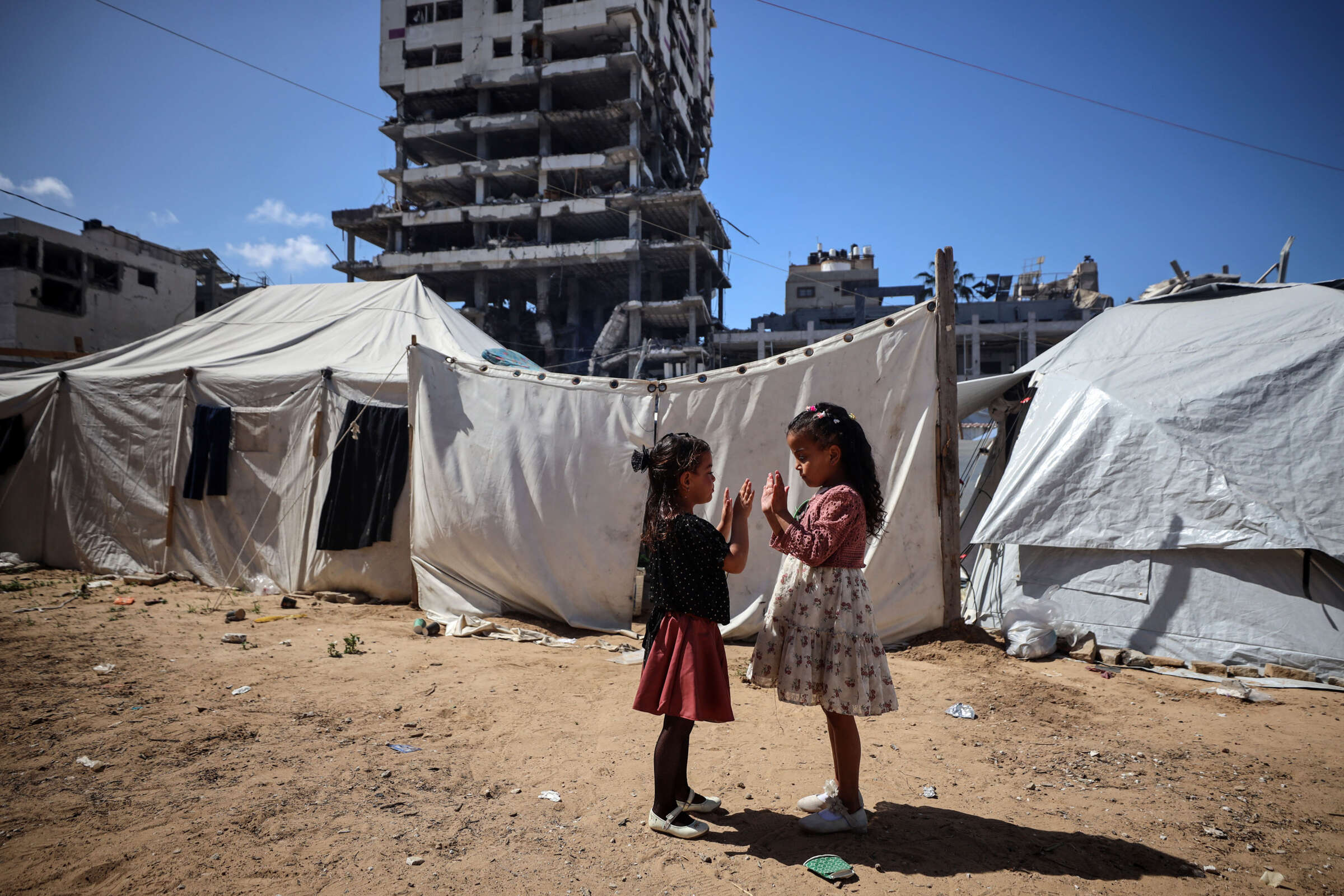
In this regard, Israel’s open fire policy toward Palestinian children is inseparable from other draconian actions that clearly seek the depopulation of Gaza and the West Bank. As of this writing, the AP has reported that Israel now controls 50 percent of Gaza as it enlarges its buffer zone, razing Palestinian homes, farmland and infrastructure to “the point of uninhabitability.” The military has also destroyed 90 percent of the southern city of Rafah, after issuing evacuation orders to its residents.
If there could be any doubt as to Israel’s intentions, Deputy Speaker of the Knesset Nissim Vaturi, of the Likud party, like so many other Israeli politicians and military leaders before him, recently made Israel’s end game all too clear. In a radio interview he said pointedly that Israel should “wipe Gaza off the face of the earth,” adding, “There are no innocents there.… I have no mercy for those who are still there. We need to eliminate them.” More recently he commented in a TV interview: “You can’t live with these creatures next to us.… There is no peace with anyone here.… Every child born now — in this minute — is already a terrorist when he is born.”
Notably, Vaturi has also made similar comments about the West Bank region of Jenin, where 40,000 Palestinians were displaced by Israel in the month of February alone. “Erase Jenin. Don’t start looking for the terrorists — if there’s a terrorist in the house, take him down, tell the women and children to get out.” While Israel’s apologists dismiss comments such as these as hyperbole, it is critical to note that these very clear statements of intent are being backed up by very clear action.
As a congregational rabbi, I’ve been asked recurring questions over the last two Passovers. How can I celebrate this holiday while a genocide is being committed in my name? How can I observe a festival of Jewish liberation while a Jewish nation-state is acting as a pharaoh over an entire people? While I understand the anguish behind these questions, I believe the Passover ritual actually offers us an important opportunity: to squarely face the way the Exodus narrative is playing out in a very real way in our own day, to ask hard questions and avoid the simple, pat answers.
In his searing book about Israel’s genocide, One Day, Everyone Will Have Always Been Against This, writer Omar El Akkad writes:
A woman’s leg amputated, without anesthesia, the surgery conducted on a kitchen table. A boy holding his father’s shoe, screaming. A girl whose jaw has been torn off. A child, still in diapers, pulled out of the tents after the firebombing, his head severed from his body.
Is there distance great enough, to be free of this? To be made clean?
This Passover, the season for asking questions, El Akkad’s challenge pounds insistently on the collective conscience of the world.
With Passover starting Saturday evening, April 12, Tzedek Chicago is honored to present our annual seder supplement, “Passover as Collective Liberation.”
As we witness fascism growing in the US and around the world, Passover arrives this year with a special urgency – and a sacred opportunity. As our supplement notes:
Merely telling the story is not enough. The seder requires us to interrogate this sacred narrative: to contemplate its meaning and to examine the questions it raises for us in our own day. Most critically, Passover demands that we connect the lessons of the Exodus story to Pharaohs that arise “in every generation.”
To that end, we encourage you to use the Passover narrative as a template to understand – and respond – to the stakes of the current political moment. First and foremost, we encourage you to universalize the Exodus narrative; to view our sacred liberation story in the context of collective liberation; to understand that the Jewish struggle and liberation is ultimately inseparable from so many other liberation struggles, past and present.
I believe it is more critical than ever to make these connections. As the Columbia grad student Mahmoud Khalil wrote in his “Letter from a Palestinian Political Prisoner in Louisiana.” (which we include in our supplement):
The Trump administration is targeting me as part of a broader strategy to suppress dissent. Visa-holders, green-card carriers, and citizens alike will all be targeted for their political beliefs. In the weeks ahead, students, advocates, and elected officials must unite to defend the right to protest for Palestine. At stake are not just our voices, but the fundamental civil liberties of all.
As another Palestinian American, Noura Erakat has noted (in an article that we quote in our supplement as well):
But resisting fascism is our collective goal. We just know that in order to resist it, we have to fight it on two fronts of U.S. state violence: at home and abroad. Because if the United States, together with Israel, manages to disembowel the ICJ, the ICC, the UN, and a broader global order built after the Holocaust and World War II, no one is safe… As Colombian President Gustavo Petro warned back in December 2023, ‘“What we are seeing in Gaza is a rehearsal of the future.’”
Yes, resisting fascism must be our collective goal. Those of us who have been advocating for Palestinian liberation must understand that their liberation is irrevocably connected to the liberation of all who are targeted by state violence. At this moment, the stakes could not be higher. Under the current regime, we are witnessing a terrifying state backlash about those who have publicly voiced their support for the Palestinian people. At the moment, activists of color with student visa are the primary targets. But as Mahmoud Khalil rightly noted in his letter, soon “visa-holders, green-card carriers, and citizens alike will all be targeted for their political beliefs.”
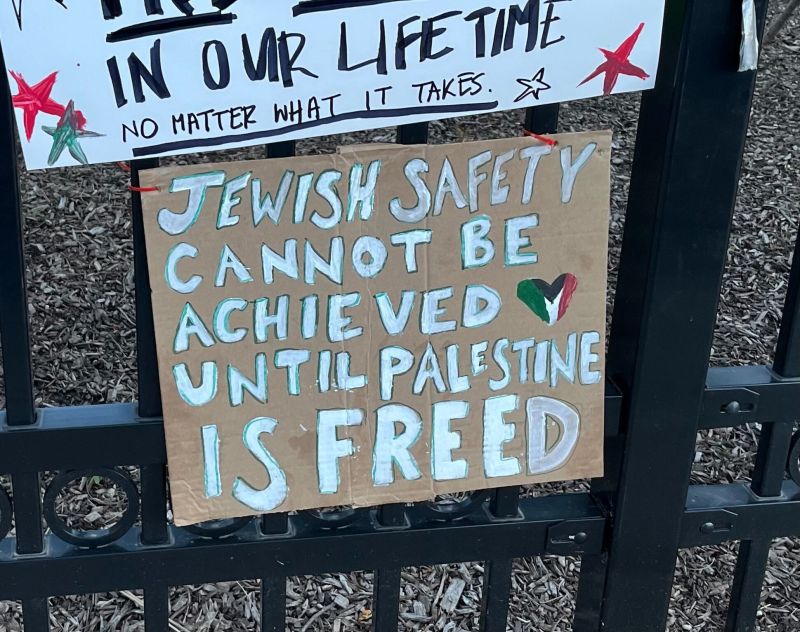
As Jews, we have a unique role in the current political moment. Indeed, we must fail to note that this state violence is being cynically carried out in our name, justified by concern for “Jewish security,” More than ever, we must to refuse to let our safety be used as a pretense to strengthen fascist state power. We must insist that this pretense will only endanger Jewish security all the more. We must affirm in no uncertain terms that Jewish safety and security is inseparable from the safety and security of all.
This Passover, let us insist that the Exodus story must be about the liberation of all who are oppressed by the contemporary Pharaohs of our day. This Passover, may we discover the true meaning of collective liberation – and find the inspiration to make it real in our world.
Yesterday I received a DM that read: “Evil, kapo, judenrat, self hating Jew.” (If you don’t know the meaning of some of those words, let’s just say that two of them are historical terms for Jews who collaborated with the Nazis during WW II.) As this kind of thing isn’t an uncommon occurrence for me, it wasn’t particularly upsetting. I’ve been receiving these kinds of messages for over a decade now, to the point that it’s become a kind of background noise – as I’m sure it is for any Jewish activist who dares to publicly affirm the humanity of the Palestinian people.
This time, however, I received the message as I was reading news of the heinous abduction and disappearing of Columbia grad student Mahmoud Khalil – and it caused me to pause and think: given the message, who are the real Jewish collaborators at this particular moment?
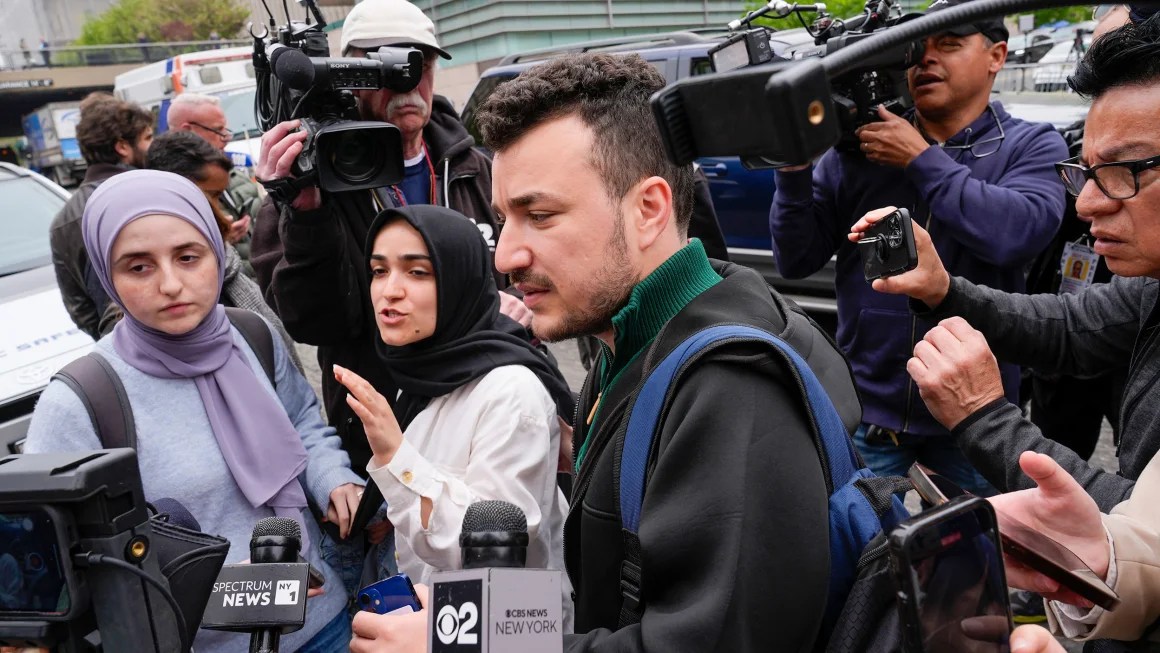
As has been widely reported, Khalil (a prominent leader of the student Palestine solidarity protests at Columbia) was walking home with his wife last Saturday when they were approached plain-clothed agents from the Department of Homeland Security who informed them that the government was revoking Khalil’s student visa. When they showed them his Green Card, which made him a legal US resident, an agent made a phone call and told them they had now revoked his Green Card. When they protested, the agents threatened to abduct Khalil’s wife, who is 8 months pregnant. Then they put Khalil in a car and drove him away.
For the next several hours, Khalil’s loved ones had no idea where he was. His lawyers immediately filed a writ of habeus corpus in a New York City court; they later learned that the authorities transported Khalil to an infamous ICE detention center in Louisiana, where he will almost certainly be subjected to a more government-friendly immigration court. In the meantime, a federal judge in Manhattan has ordered the government not to remove Khalil from the US while the judge reviews his lawyer’s petition challenging his abduction and detention.
There is so much that is so deeply chilling about this story it’s difficult to know where to start. For me, however, one of the most disturbing aspects was the report that Khalil had sent multiple emails appealing to Columbia’s interim president Katrina Armstrong for protection from harassment, doxxing and the threat of ICE agents. He sent his final email to Armstrong on March 7 one day before he was abducted and disappeared:
Since yesterday, I have been subjected to a vicious, coordinated, and dehumanizing doxxing campaign led by Columbia affiliates Shai Davidai and David Lederer who, among others, have labeled me a security threat and called for my deportation.
Their attacks have incited a wave of hate, including calls for my deportation and death threats. I have outlined the wider context below, yet Columbia has not provided any meaningful support or resources in response to this escalating threat.
I haven’t been able to sleep, fearing that ICE or a dangerous individual might come to my home. I urgently need legal support, and I urge you to intervene and provide the necessary protections to prevent further harm.
Khalil’s emails, of course highlight the very real likelihood that Columbia actively collaborated with ICE and DHS, thereby compromising the physical safety and security of their own student. They also illuminate the active role of Jewish Zionist activists in the events leading to Khalil’s abduction and disappearance. Shai Davidai is an Israeli assistant professor of business at Columbia Business School who has a documented history of harassing students and school employees. David Lederer is a junior in Columbia’s School of Engineering and Applied Sciences and the co-chair of Aryeh, a self-described “student-led organization that aims to provide opportunities to engage with Israel and Zionism.”
It should not come as a surprise that Zionist activists and organizations played a part in Khalil’s abduction. Last December, it was reported that the US chapter of Betar, a worldwide Zionist youth organization (originally founded by Revisionist Zionist leader Vladimir Jabotinsky in 1923) had recently been revived. It’s Executive Director, Ross Glick, made it clear that targeting college students would be its first order of business. Most ominously, Glick revealed that Betar US “had amassed a large repository of video footage from college protests over the past year” and was employing a team of professionals using facial recognition software and relationship databases to identify foreign students appearing in the videos.
Glick has now been openly bragging about his role in the government’s abduction and disappearance of Mahmoud Khalil. In an interview with the Forward, Glick said that he had met with aides to Senators Ted Cruz and John Fetterman in DC to discuss Khalil during the Columbia encampment protests and that the senators promised to “escalate” the issue. He also said that “some members of Columbia’s board had also reported Khalil to officials.” In the interview, Glick referred to Khalil’s unmasked presence in the protests, commenting “This unfolded very quickly because it was very obvious… This guy was making it too easy for us.”
The Forward article also reported that David Lederer, circulated photos of a pamphlet labeled as coming from the “Hamas Media Office,” suggesting it was distributed at the protest. Lederer also claimed Khalil was “known to have been on a foreign visa last year.” Clearly, the government was aided and abetted by well-known Jewish Zionist activists who made no secret of their intentions to work with authorities to target Palestinians and pro-Palestine student activists who protested Israel’s genocidal violence against the Palestinian people in Gaza last spring.
The government abduction and disappearance of legal residents who exercise their right to free speech is, of course, a basic staple of fascist regimes. What can we say about Jewish activists and organizations that collaborate with such a government – a regime led by a president that actively emboldens antisemitic hate groups and has given significant power to a billionaire who promotes antisemitic theories and publicly sig heils at rallies? While I won’t use the vile terms that extremist right-wing Jews sling against Jewish activists who dare to express their solidarity with Palestinians, I do believe it’s important to name them what they truly are: collaborationists.
It’s important to note that this most recent Jewish collaboration with rising fascism is not limited to small extremist actors such as Betar US. The Anti-Defamation League itself responded to Khalil’s abduction with this statement on X: “We appreciate the Trump Administration’s broad, bold set of efforts to counter campus antisemitism — and this action further illustrates that resolve by holding alleged perpetrators responsible for their actions… We also hope that this action serves as a deterrent to others who might consider breaking the law on college campuses or anywhere.”
For its part, the Trump administration celebrated Khalil’s abduction on X with the statement “Shalom Mahmoud” – a cynical and appropriative expression of “solidarity” with the Jewish people. Even more chillingly, the statement went on: “This is the first arrest of many to come. We will find apprehend and deport these terrorist supervisors from our country ‒ never to return again.” By now we should know that Trump should be taken at his word. If Mahmoud Khalil, a legal resident of the US can be disappeared by this government, they will almost certainly continue with any American citizen whom they identify in their growing data base: and not only Palestinian Americans and Muslims.
I’ll make it plain: collaborationist Jews will not help make Jews safer. In the end, Glick, Davidi, Lederer and their ilk are extremely useful idiots who are actively working with an antisemitic regime that has zero interest in Jewish safety and security. Even more important, collaborating with fascism will not make anyone safer. It feels somehow ridiculous to have to say these words out loud, but here we are. For the sake of our collective liberation, we must all actively resist and stand down this fascist regime – as well as those who aid and abet it.
It occurs to me that this form of collaboration with illegitimate authority really is a form of idolatry. In this week’s Torah portion, the recently-liberated Israelites, who have just entered into a sacred covenant with God, construct a Golden Calf, bow down to it and exclaim, “This is your god, O Israel, who brought you out of the land of Egypt!” (Exodus 32:4) This narrative is powerfully resonant to the current moment, in which members of the Jewish community are betraying the sacred, liberatory core of Jewish tradition through idolatrous attachment to corrupt state power.
But in the end, this is a fatal form of idolatry: a Faustian bargain. And we know all too well from history where this will lead. Please join me in answering this call from Jewish Voice for Peace to contact our senators and representatives demanding that they do everything in their power to secure Khalil’s release and to protect student activists and immigrants.
The ambitious intentions of Peter Beinart’s new book are evident from the title: Being Jewish After the Destruction of Gaza: A Reckoning. Responding to the current moment, Beinart has written nothing short of a spiritual manifesto for the future of Judaism.
It’s a tall-order for such a slim volume, but it’s one that Beinart is uniquely positioned to take on. As a well-known journalist, thought leader, and editor-at-large for the journal Jewish Currents, Beinart’s ideas carry a great deal of weight among large swaths of the Jewish establishment. His 2010 article in The New York Review of Books, “The Failure of the American Jewish Establishment” and his subsequent book, The Crisis of Zionism were widely read and debated in the American Jewish community. Since then, he’s continued to push the envelope in the discourse on Israel/Palestine. His 2020 New York Times op-ed, “I No Longer Believe in a Jewish State” and his 2021 Guardian essay, “A Jewish Case for Palestinian Refugee Return” were likewise considered game-changers in the Jewish communal discussion on Israel-Palestine.
Being Jewish, which attempts to reframe the Jewish spiritual narrative itself, is arguably his most dramatic attempt at game-changing. Following October 7 and Israel’s devastating military onslaught on Gaza, Beinart suggests that Judaism and Jewish identity have now reached a critical turning point. As he writes in the Prologue:
Jews have told new stories to answer the horrors we endured. We must now tell a new story to answer the horrors that a Jewish country has perpetrated, with the support of many Jews around the world… [This new Jewish story must be] based on equality rather than supremacy—because the current one doesn’t endanger only Palestinians. It endangers us.
As if this isn’t ambitious enough, Beinart also hopes his book will help heal the widening fractures over Israel/Palestine in the Jewish community. To drive this point home, he begins with a letter to a friend with whom he’s become estranged over the issue of Israel/Palestine. “I know,” he writes, “you believe that my public opposition to this war…constitutes a betrayal of our people…[and] I consider your single-minded focus on Israeli security to be immoral and self-defeating.” He ends his letter with the words: “I hope the rupture is not final, that our journey together is not done.”
While Being Jewish was published by a mass-market publisher and is being promoted to a wide readership, Beinart states at the outset that he’s suggesting a new Jewish narrative to bring the Jewish “family” together; to mend the deep familial rifts that have widened over Israel’s destruction of Gaza. “This book,” he writes, “is for the Jews who are still sitting at that Shabbat table, and for the Jews—sometimes their own children—who have left in disgust. I yearn for us to sit together.”
Beinart thus begins his book with a formidable—perhaps unbridgeable—tension. While he’s clear about his intention to bring Jews together, he also suggests that Israel’s oppression of Palestinians is rooted in a narrative of Jewish supremacy—a view which surely won’t endear him to millions of Jews in Israel and throughout the diaspora who identify deeply with Israel and Zionism. In many ways, this tension is characteristic of Beinart’s pedagogy: he seeks to influence Jewish communal discourse even as he pushes hard on the ideological envelope. It’s a balancing act that’s become increasingly precarious with his writings over the past several years. Given the stakes of the current moment, he sets a profoundly daunting goal for himself with his latest book.
For most of Being Jewish, Beinart does what he does best, expertly dismantling Israel’s hasbara—the propagandistic talking points used to justify Israel’s oppression of the Palestinian people. In chapter one, “They Tried to Kill Us We Survived, Let’s Eat,” for example, he interrogates the ways that Israel and Israel’s Jewish communal advocates, conveniently ignore Zionism’s colonial origins and reframe Israel’s founding to fit a Jewish narrative of victimhood:
The plot goes like this. We have finally achieved what every other people takes for granted: a state of our own. Yet in the case of Jews, and Jews alone, that right is contested. So even with a state, we remain victims.
His repeated willingness to frame political Zionism in a colonial context is a powerful, ongoing theme for Beinart. In another chapter “To Whom Evil is Done,” he considers the ways the violence committed by Hamas and other Palestinian resistance groups on October 7 was compared to the Holocaust by Israelis and Jews around the world. He goes on to assert that such a framing “transforms Palestinians from a subjugated people into the reincarnation of monsters of the Jewish past.” Again, Beinart doesn’t hesitate to reject this comparison in favor of a settler colonial framework. A better analogy, he suggests, would be the violent attacks of colonized Haitians, Creek Indians, or Mau Mau rebels against their colonial oppressors.
In “Ways of Not Seeing,” Beinart systemically eviscerates many other familiar claims wielded by Israeli leaders and Israel advocates: from their rejections of death estimates by the Gazan Health Ministry to the canard of Hamas’ human shields. He also devotes a chapter to the issue of antisemitism, using convincing argumentation along with hard survey data to demonstrate how Israel cynically uses the claim of antisemitism—which is much more prevalent on the Right than the Left—to cudgel Palestinians and their supporters. Taking the claim that anti-Zionism equals antisemitism head on, he writes astutely:
The whole point of conflating anti-Zionism with antisemitism is to depict Palestinians and their supporters as bigots, thus turning a conversation about the oppression of Palestinians into a conversation about the oppression of Jews.
Beinart’s book is strongest when he makes these kinds of expert political arguments. Yet, as critical as they are, as I read Being Jewish I found myself increasingly wishing he would drill deeper into the themes suggested by the title. Beyond promoting a Judaism of equality over conquest, how should Jews respond to the devastating moral reality of this moment? In his final chapter, “Korach’s Children,” he attempts to do precisely this, suggesting that Jewish political nationalism has become a form of Jewish “idolatry,” arguing that the only way toward an equitable future in Israel/Palestine is a single state in Israel that guarantees full citizenship for all.
While it’s a compelling vision, there’s little in his final chapter that he hasn’t already argued for more extensively in his 2020 and 2021 articles, which were written well before Israel’s destruction of Gaza. In this book, as with his earlier articles, Beinart offers examples from Ireland and South Africa to demonstrate how colonizers and colonized have found the political wherewithal—however imperfect—to dismantle systems of oppression and engage in processes of reconciliation.
In the midst of his argument, however, there’s little reckoning with the possibility that anything has fundamentally changed with Israel’s genocide in Gaza. Instead, Beinart simply repeats his talking points, continuing to hold out hope for a better future for Israeli Jews and Palestinians:
Although it won’t look the same, this kind of liberation is possible for us. We can lift the weight that oppressing Palestinians imposes on Jewish Israelis, and indirectly, on Jews around the world.
But who is the “we” in this statement? It’s certainly not in the power (nor is it currently the desire) of American or Diaspora Jews to leverage a socio-political transformation of such a magnitude in Israel/Palestine. The majority of Israelis have, for their part, long rejected a one-state solution—and by all accounts, they’re farther away than ever from embracing such a vision.
Indeed, Israelis post-October 7 are a thoroughly traumatized nation, inured to the carnage their nation is inflicting on Palestinians and according to polls, overwhelmingly supportive of Israel’s genocide in Gaza. As for Palestinians, many, if not most, are undoubtedly less inclined to imagine the realistic possibility of living side by side with Israeli Jews in a single state given the horrific reality of the past 16 months.
It’s notable that, even as Beinart doesn’t flinch from describing Israel’s onslaught in Gaza—often in terrifying detail—he largely avoids using the word “genocide” to describe it. This is more than merely a semantic issue. If we are to truly reckon with what it means to be Jewish after the destruction of Gaza, we must face this central question: what does it mean for the Jewish people that a Jewish state, founded in the wake of the Holocaust, is actively committing a genocide against another people?
Though Beinart writes that he “yearns for us to sit together,” it’s well worth asking: can we truly create Jewish community within such a reality? Can Jews who believe Israel is committing genocide coexist in community with those who are actively supporting it—or rationalizing it away? Is it possible for Jews to pray and study and make Shabbat and celebrate holidays together under such circumstances? If Jewish ethical values are the bedrock of our spiritual life, how do we truly bridge such a massive moral divide?
Although he doesn’t answer this question in his book, Beinart did give a clue to a potential response during a recent appearance at Duke University. Admitting that Israel was no longer a “unifying force” among Jews, he responded:
What I would like people to do is to bring Jews together across the ideological, political and religious spectrum, to study Torah, to study our texts. This is what ultimately unifies us, and I think that it can be a foundation for other kinds of conversations.
This kind of response might make sense to Beinart, an Orthodox Jew who cherishes traditional Jewish study, but it’s doubtful such an approach will bring together Jews in the way he envisions. It’s optimistic, to put it mildly, to assume that Jews will be able to put aside their differences on Israel and find a foundation for fruitful conversation through the study of Torah and Jewish text. It may be time for us to admit that being Jewish after the destruction of Gaza means our community isn’t simply fractured, but separated by a deep moral abyss that may well be unbridgeable.
As I read Beinart’s new book, I couldn’t help but be struck by the significant debt it owes to the landmark work of Jewish scholar and theologian Marc Ellis, who asserted as far back as the 1980s and 90s that post-Holocaust, the fusion of Judaism and Jewish state power had created a conquest-focused “Constantinian Judaism,” even as Israel maintained a collective myth of innocence.
The central question is how to move Jews in Israel and around the world to see that Jews can only be free if Palestinians are free as well. During the Gaza war, we could not be further from this goal. This makes it even more imperative that we begin now.
But while Beinart’s and Ellis’ analyses of the crisis may have been similar, their prescriptions for going forward were dramatically different. As Ellis put it in a 2018 interview, Israel’s state oppression of the Palestinian people represented the “end of ethical Jewish history”:
We Jews, all of us, no matter our various political positions, are responsible for what Israel has done and is doing to the Palestinian people. That is why I believe that we, as Jews, dwell in the abyss of injustice. The injustice we have perpetrated upon Palestinians has brought us to the end of ethical Jewish history. The question for Jews, the only question, is what are we to do at this end?
Marc Ellis died in July 2024, while Israel’s genocide in Gaza was raging in full force. His question, however, offers an important counterpoint to Beinart’s. While Beinart asks how we will come together to write a new Jewish story, Ellis asks how Jews will dwell in the abyss of injustice. In the end, Beinart’s book, for all of its courage, is ultimately unwilling to take this step: to truly reckon with how Jews of conscience should respond to the ongoing moral devastation that is Israel’s genocide in Gaza.
(There) are plenty of Jewish congregations out there: why does the world need another? What do we have that’s unique to offer? As I think about it, this is a critical question for any Jewish community. Do we exist just to exist or for a more transcendent purpose? Does our existence actively seek to repair the world or does it merely serve to use up Jewish community resources? Or worse still, does our communal existence contribute to harm in the world?
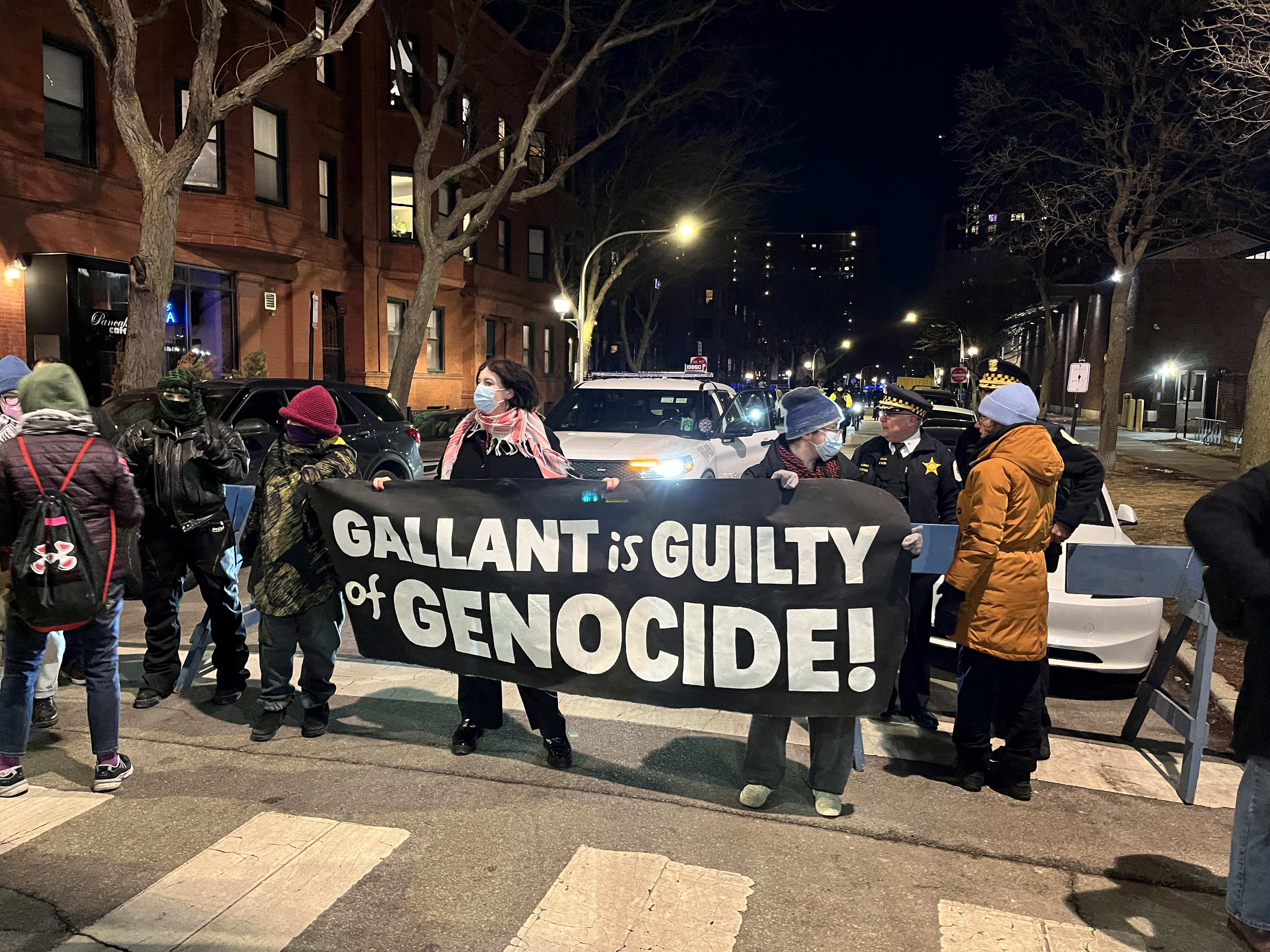
I recalled those words last week when I learned that Anshe Emet, a prominent Conservative synagogue in Chicago planned to host a program with invited guest Yoav Gallant, the former Israeli Minister of Defense and one of the primary architects of Israel’s genocide against Gaza – who currently has a warrant out for his arrest issued by the International Criminal Court.
It should go without saying, but I’ll say it out loud: it is appalling and sickening that a prominent synagogue welcomed – and in fact celebrated – a genocidal war criminal in their house of worship. I’m proud to say that a massive protest was organized by a wide coalition of Palestine solidarity groups, including US Palestine Community Network, American Muslims for Palestine, Jewish Voice for Peace and #IfNotNow to voice a message of outrage, solidarity and collective conscience.
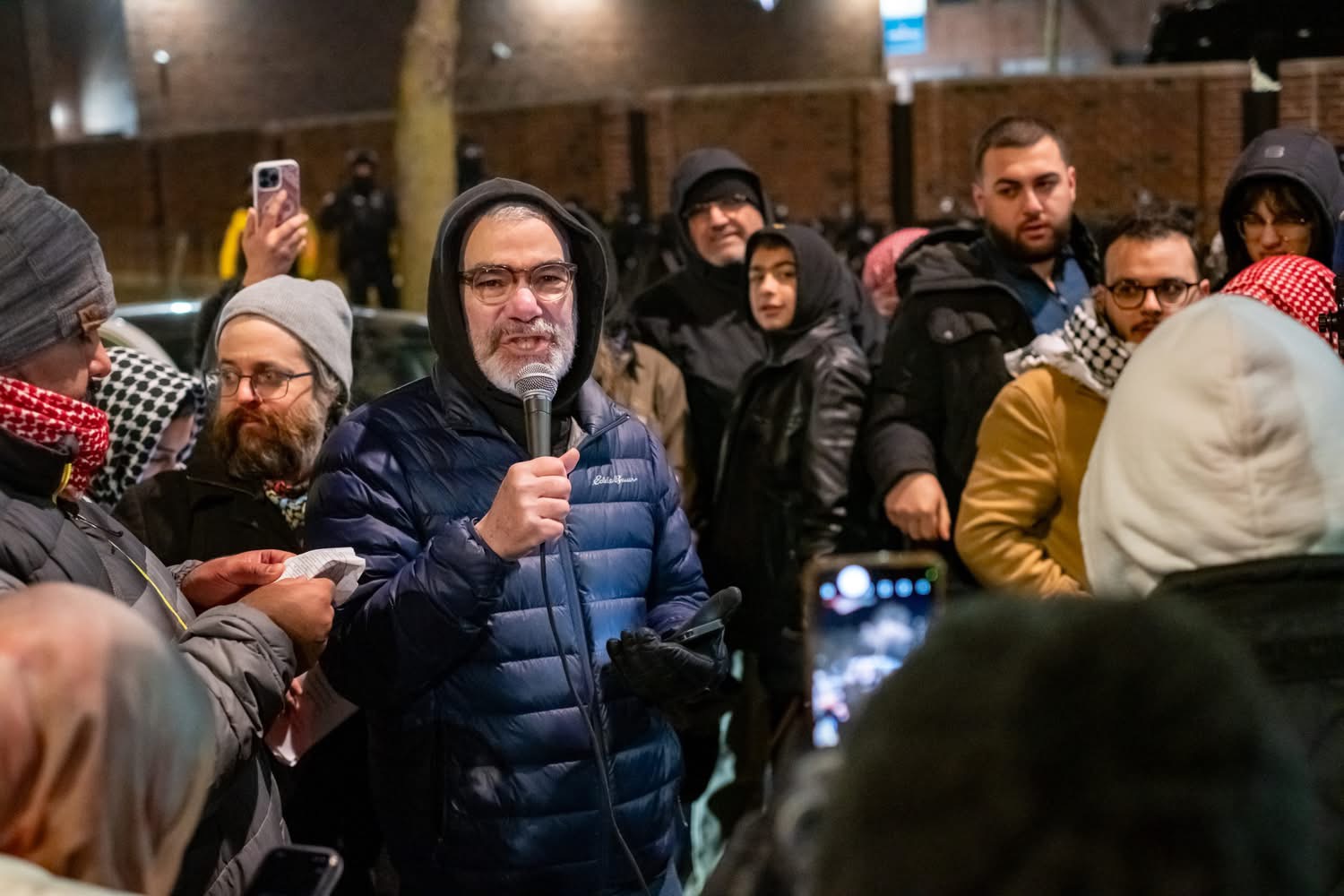
Hundreds of us gathered last night across the street from the synagogue in the freezing cold to express our outrage and mutual solidarity. There were many speakers from our diverse coalition and it was my honor to be among them. Here are my remarks, below:
photo: Love and Struggle/Sarah Ji
My name is Brant Rosen; I’m a proud member of Jewish Voice for Peace, the Jewish Voice for Peace Rabbinical Council, and I’m the founding rabbi of Tzedek Chicago – a proudly anti-Zionist synagogue here inI Chicago with members here and around the world.
In Jewish tradition there is a central concept we call Hillul Hashem. It literally means “desecration of God’s name.” This is at root a deeply moral concept that goes to the heart of what it means to be a human being. When we diminish the humanity of another, we diminish God’s presence in the world – and we commit the worst kind of Hillul Hashem when we commit the crime against genocide against another people.
In October 2023, Yoav Gallant, Israel’s then defense minister, said:
We are imposing a complete siege on Gaza. There will be no electricity, no food, no water, no fuel, everything is closed. We are fighting human animals and we are acting accordingly.
The Palestinian people know what it means to be robbed of their humanity. They have been deemed a collectively disposable people by Israel for over 100 years. Their very presence is a problem for Israel. We Jews should know all too well what happens when a state robs a people of its essential humanity.
The ICC has put a warrant out for Yoav Gallant’s arrest as a war criminal because he actively dehumanized the Palestinian people in word and in deed. Over 60,000 Palestinians killed in Gaza to date and over 100,000 injured, the majority of whom are women and children. According to one estimate, the ultimate death toll may eventually be nearly 200,000. Whole extended families, entire Palestinian bloodlines have been wiped out completely. Much of Gaza has been literally reduced to a human graveyard, with scores of bodies buried beneath the rubble of destroyed and bulldozed homes. Neighborhoods and regions have been literally wiped off the map.
Gaza’s infrastructure and health care system has been decimated. According to the UN an “intentional and targeted starvation campaign” has led to widespread famine and disease throughout the Gaza strip. Health care workers, humanitarian workers and journalists are being killed, injured and imprisoned in massive numbers. Human rights agencies have documented widespread torture and abuse of prisoners, including sexual abuse, throughout a network of torture camps.
This is dehumanization, this is Hillul Hashem of the worst kind. And to you Yoav Gallant, we say, “We Charge Genocide!” “You are not welcome in our city!”
But Yoav Gallant and the nation he served could not have succeeded if there where not those who normalized this genocide. And that is why we are here tonight. As a rabbi, as a Jew, as a person of conscience, I am morally outraged – I am sickened – that this war criminal is being hosted – and in fact celebrated – at a synagogue, a Jewish house of worship. This is what it has come to.
And here I want to address the members of Anshei Emet and the Jewish community of Chicago. Our community has a profound moral choice to make. What is the Judaism we will affirm? Will we uphold Zionism – and its ideology of Jewish supremacy – or will we stand for the sacred divine image of all people? Will we stand with war criminals or will we stand with those who are deemed to be disposable? Will we stand with the genocidal state of Israel or will we stand with the Palestinian people?
Now I’d like to address my friends and comrades in the Palestinian community:, please know that are so many of us in the Jewish community who stand in solidarity with you. There is nowhere else we can possibly be at this moment. And there are so many of us who are voicing the alarm, marching in the streets, taking arrest to demand justice for Palestinians
It is not an overstatement to say this: history will remember what we did or did not do in this moment. We are ready, together with you, to call out those who, in our name, are committing the worst kind of Hillul Hashem against you, whether it is in the streets of Rafah and Deir al Balah, the halls of Washington DC or a synagogue in Chicago. And we will not cease until all are free, from the river to the sea!
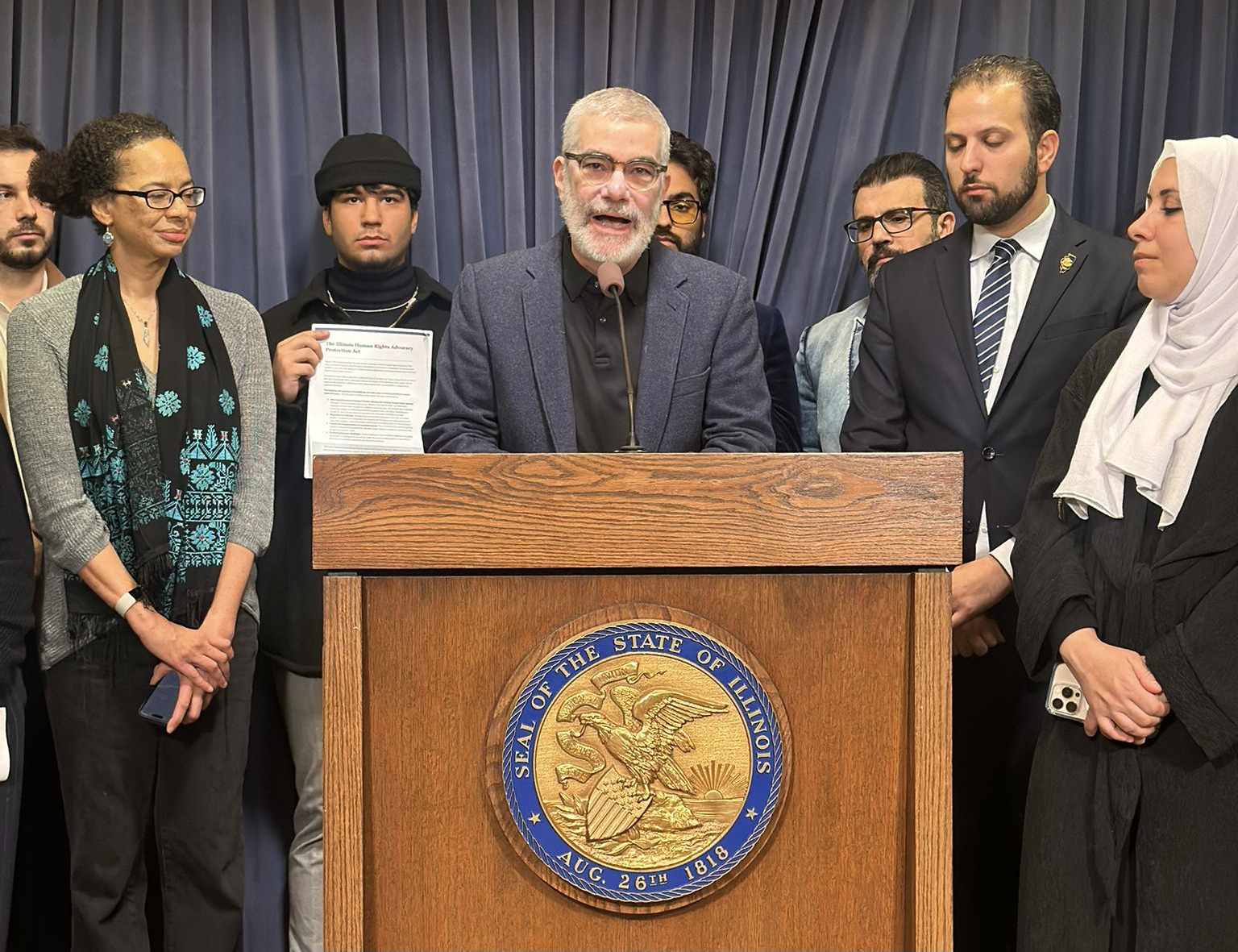
It’s been a busy week. This past Wednesday, I was in Springfield with friends and comrades to announce new IL state legislation, “The Illinois Human Rights Advocacy Protection Act,” which would repeal our state’s 2015 anti-boycott legislation that punishes advocacy for Palestinian human rights. This unconstitutional and immoral legislation, signed by then Gov. Bruce Rauner, directed the Illinois Investment Policy Board to restrict public funding to companies that use human rights filters that exclude doing business with Israel.
The new legislation, which is being introduced in the IL State House by Palestinian-American representative Abdulnasser Rashid, will “(remove) provisions requiring the Illinois Investment Policy Board to include companies that boycott Israel in its list of restricted companies.” An identical bill will be introduced in the IL Senate as well.
You can watch the entire press conference here. My remarks follow below:
Here in Illinois and around the world, we are at a critical and frightening moment. The US is governed by an administration that openly considers certain populations to be disposable. Whether it is undocumented immigrants, birthright citizens, trans youth or the Palestinian people. Just yesterday, our president announced his intention to depopulate the entire Gaza strip of over 2 million Palestinians and turn it into the “Riviera of the Middle East.” This after a previous administration helped to arm Israel in its crushing military assault – one that many reputable human rights organizations have termed a genocide against the Palestinian people.
In Jewish tradition, one of our most central theological tenets, which is repeated over and over, is that God responds to the cries of the oppressed. The Palestinian people have long been crying out to the international community. Over the past sixteen months, their cries have reached a fever pitch. The question before us, that has ever been before us, is how will we respond?
That is the essence of the Palestinian call for Boycott, Divestment and Sanctions. It is a call from an oppressed people who are seeking support and solidarity from the international community. It originated in 2005, when a wide coalition of Palestinian civil society organizations made a crie de cour for solidarity and support. They issued a call to the world to use the time-honored nonviolent strategy of Boycott, Divestment and Sanctions.
There are three essential demands of this call, which are all are based in international law: to end the occupation of the West Bank and Gaza, full and equal rights for Palestinian citizens of Israel, and to honor the UN mandated Palestinian right of return. Like all boycotts, it allows private citizens, companies and civil society organizations around the world to actively and meaningfully respond to the legitimate and collective cry of the Palestinian people.
It is also a form of free speech. Just like historic Montgomery Bus Boycott, the United Farm Workers Boycott, the boycott of apartheid South Africa before it. When the state of Illinois passed legislation restricting participation in this pro-peace, pro-human rights movement, it actively criminalized free speech. It was immoral and illegal to do so when it was enacted by Governor Rauner in 2015 – and it remains so today. In the current moment, when our country is ruled by a regime that is actively and unabashedly criminalizing free speech, we should see this legislation for what it is. The state of Illinois has no business aiding and abetting in this stripping of our right to free speech. It has no moral standing to stifle and stigmatize the legitimate cry of the oppressed.
In the Jewish community this week we are reading from our Torah, the Exodus story. And the Exodus story makes it very clear: that God responds to the cry of the oppressed and demands their liberation. We also read that this process began with brave people to defy and resist oppression. That is how liberation happens.
We are at just a moment right now. This is truly a which side are you on moment. Will we hearken to the cries of the oppressed, or will suppress their voices – and those who support their call for liberation? We urge the state of Illinois to stand the right side of history.
A Jewish letter of support for the Illinois Human Rights Advocacy Act will soon be made public as well. I’ll make sure to post it when its available.
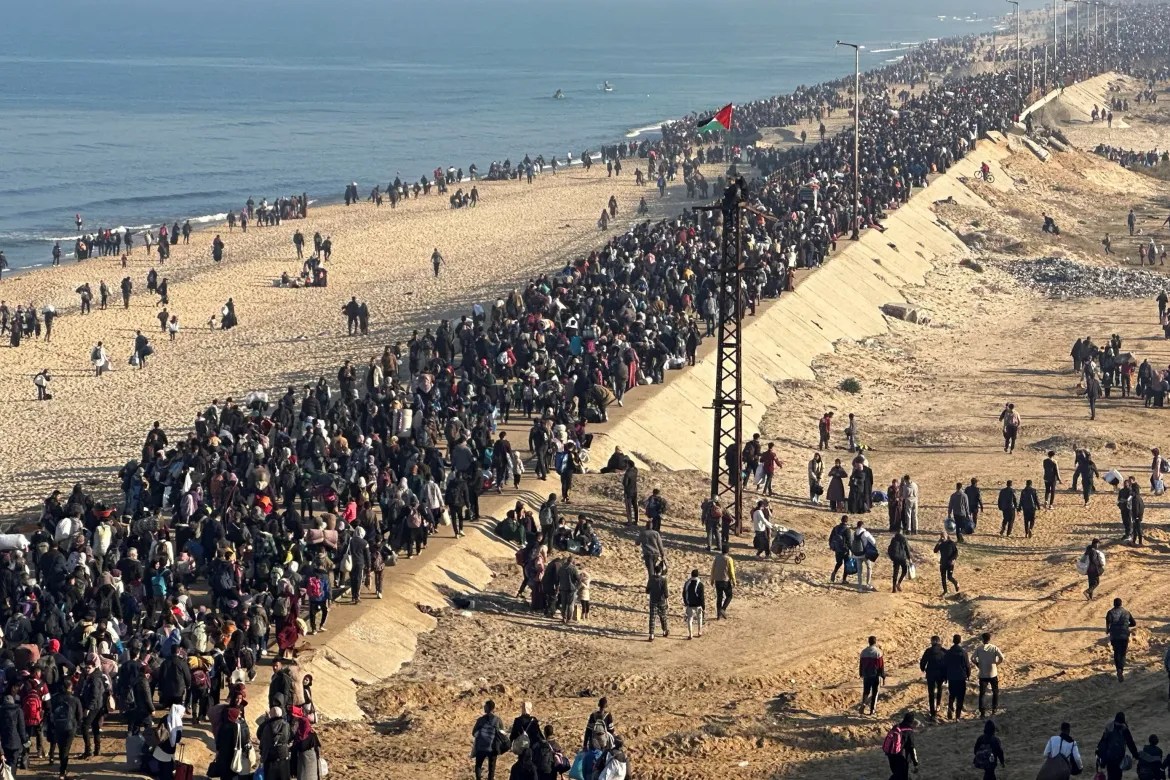
It’s difficult to describe the feelings I experienced this past weekend, as I watched hundreds of thousands of Gazans in a long and seemingly endless line, heading on foot to their homes in the north. Crossing the Netzarim corridor – the border the Israeli military demarcated separating north from south – they headed back with whatever possessions they were able to carry. Family members who thought each other dead clutched each other in tearful embrace. It was truly a wonder to behold: this resilient people who had defied and withstood the most destructive miliary onslaught in modern times. As Gazan activist Jehad Abusalim put it:
Gaza today, for now, disrupts and defies the global agenda of rendering entire populations disposable and rightless. This was achieved through the resilience of an entire population that has endured months of displacement, starvation, disease and bombardment.
Though this is a fragile and temporary ceasefire, it’s striking to note the depth of Israel’s failure to achieve any of its stated objectives of its genocidal war. It failed to destroy Hamas and the Palestinian armed resistance in Gaza. It failed to rescue hostages taken on Oct. 7 through military means. It failed to implement its so-called “General’s Plan” – its blueprint for ethnically cleansing northern Gaza. And perhaps most importantly, it failed to break the will of the Gazan people to survive its genocidal war.
Jehad’s words “for now” are appropriate. The overwhelming number of Gazans are returning to homes that are rubble – and it is by no means certain how they will be able to rebuild their lives. The ceasefire is a tenuous one; there is still no agreement on the second or third phases of deal and there is every possibility that Netanyahu will use the deal as cover to eventually depopulate Gaza of Palestinians. Trump’s recent comments (“I’d like Egypt to take people, and I’d like Jordan to take people…we just clean out that whole thing”) have made his intentions clear, even if his plan has been rejected outright by Arab states.
As I read the reports and analyses in the wake of this ceasefire, one thing seemed consistent to me: as ever, there is little, if any, concern for the humanity of the Palestinian people. On the contrary, every pronouncement by Western governments and the mainstream media treats their mere existence as a problem to be dealt with. In this regard, Jehad’s reference to “the global agenda of rendering entire populations disposable and rightless” is spot on. Palestinians in general – and Gazans in particular – have always been the canaries in the coal mine when it comes to the use of state violence against “problematic populations” deemed “disposable” by authoritarian states seeking to consolidate their power.
“Entire populations rendered disposable and rightless” certainly applied to events in my hometown of Chicago this past Sunday, where the Trump launched “Operation Safeguard,” a shock and awe blitz spearheaded by ICE, the FBI, ATF, DEA, CBP and US Marshals Service. Led by Trump’s so-called “border czar” Tom Homan (and surreally videotaped live by “Dr” Phil), heavily armed and armored forces terrorized Chicago neighborhoods all day, mostly going door to door, staking out streets in search of undocumented people, taking them away in full-body chains. While there is no definitive information on the numbers of people taken, federal immigration authorities claim to have arrested more than 100 people in recent days.
On a positive note, however, we are seeing that the strategies employed by local immigrant justice coalitions are making a real difference. My congregation, Tzedek Chicago is part of a local interfaith coalition called the Sanctuary Working Group, which has been mobilizing Know Your Rights trainings and Rapid Response teams. From our experience in Chicago over these past few days, we’ve seen that this kind of mobilization really does have an impact. Perhaps the strongest validation of these resistance strategies came from Homan himself, who said on an interview with CNN:
Sanctuary cities are making it very difficult to arrest the criminals. For instance, Chicago, very well educated, they’ve been educated how to defy ICE, how to hide from ICE. They call it “Know Your Rights.” I call it how to escape arrest.
in my previous post, I wrote that “the current political moment has left many of us breathless.” But over the course of the last several days, we’ve seen it is indeed possible “to disrupt and defy the global agenda of rendering entire populations disposable and rightless.” If we had any doubt at all, let us take our inspiration from the Gazan people, who have refused to submit after 15 months of merciless genocidal violence and are returning to their homes, vowing to rebuild and remain.
The most powerful shock and awe in the world could not break them. Let this be a lesson to us all.
(Rabbi) Shemiah said, “Love work. Hate authority. Don’t get too friendly with the government.” Pirke Avot, 1:10 (translation, Jacob Neusner).
This classical rabbinic saying comes from “Chapters of the Fathers,” a well-known collection of rabbinic sayings and aphorisms from the 2nd century ACE. While there are many more finessed English renderings of this particular saying (one version, offered by Talmudic scholar Dr. Joshua Kulp reads: “Love work, hate acting the superior and do not attempt to draw near to the ruling authority”), I’ve always appreciated the bluntness of Jacob Neusner’s more direct translation. We don’t know much about Shemiah, but we do know that he was a Jewish leader in the 1st century BCE and the he wasn’t a big fan of Herod, the appointed authority over Palestine during the reign of the Roman empire.
As a member of the Jewish community, I definitely appreciated Shemiah’s caution over cozying up to state power after reading reports from yesterday’s inauguration of Donald Trump, which featured a prayer from Rabbi Ari Berman, the President of Yeshiva University. Among other things Rabbi Berman hailed this “moment of historic opportunity” and prayed for the new administration to “unite us around our foundational biblical values of life and liberty, service and sacrifice, and especially of faith and morality.” (Americans who do not adhere to Biblical tradition were presumably left out of his vision of national unity.)
Needless to say, Rabbi Berman’s legitimizing of Trump’s inauguration did not speak for many of us in the Jewish community, especially when you consider that Trump has now pardoned virtually all of the Capitol insurrectionists, including their white supremacist, neo-Nazi leaders. When you consider that Proud Boys were seen marching and chanting through the streets of DC for the first time since January 6 while Trump was being sworn in as President.
Then there was the moment in which Trump’s new friend Elon Musk – who has made no secret of his support for the European far right – made two clear and unmistakable Nazi salutes at an inaugural event. As painful as this was to witness, for me the even more nauseating moment occurred when the Anti-Defamation League subsequently issued a statement dismissing the salute as an “awkward gesture,” adding: “This is a new beginning. Let’s hope for healing and work toward unity in the months and years ahead.” Apologizing for Nazi messaging at Presidential Inaugural is a truly new low for the ADL – and that is saying a lot.
I also couldn’t help but think of Shemiah’s teaching yesterday as I watched so many public figures, corporate leaders and politicians (from both sides of the aisle) flashing cheerful smiles as they were wined and dined in Washington by this new authoritarian administration – on MLK Day, of all days. “Don’t get too cozy with the government” would have been particularly good advice to New York Mayor Eric Adams, who reportedly cancelled previously scheduled appearances at events celebrating MLK after he received a last-minute invitation to attend the inauguration.
There has been much commentary about how dramatically different Trump’s inauguration feels in comparison to his previous inaugural in 2106, when the resistance was actively organizing and protests would soon fill the streets. This time around, the main theme seems to be political resignation and capitulation. I have no doubt that Michigan’s Democratic governor Gretchen Whitmer spoke for many in her party when she said last week, “My job is to try to collaborate and find common ground wherever I can.” (Couldn’t she have at least chosen a better word than colloborate?”)
As yesterday mercifully came to a close, I finally decided on a new rendering of Rabbi Shemiah’s teaching – one more apropos to the current political moment:
Love the work of resistance. Hate fascism. And don’t expect politicians to save you.
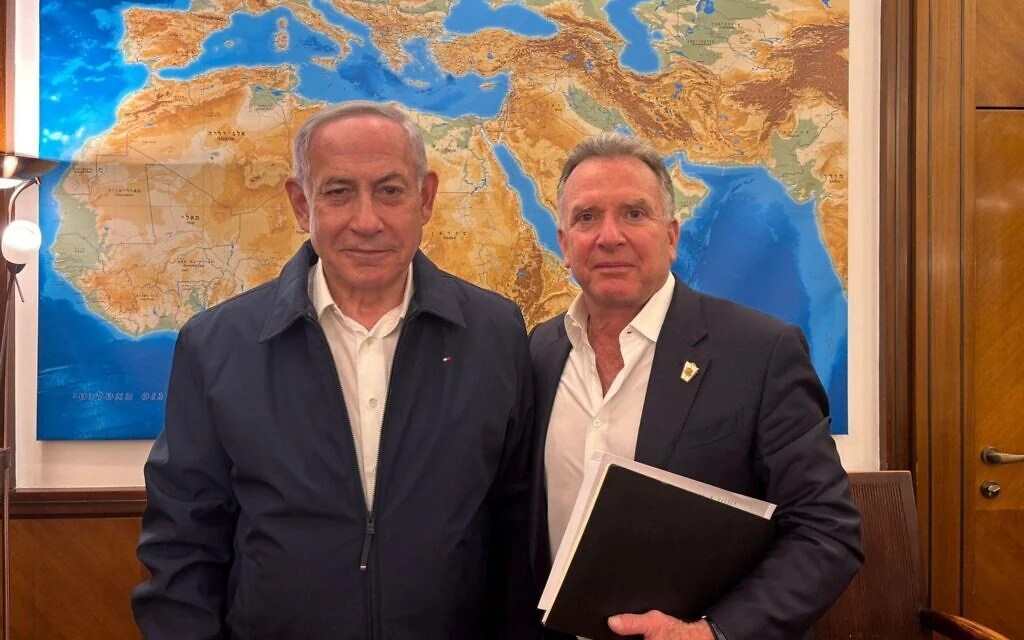
Benyamin Netanyahu and Steve Witkoff, January 11, 2025
For Palestinians and those who stand in solidarity with them, the news of a ceasefire agreement between the Netanyahu administration and Hamas was welcome news. When the reports first broke, and I saw images of Gazans singing and dancing in the streets, I couldn’t help but feel a joyful solidarity with them. But like all brokered agreements between Israelis and Palestinians, this deal is also fragile and fraught – and filled with deeply disingenuous political maneuvering.
Some history: according to reports, this ceasefire deal is identical to the one brokered by the Biden administration last May, which was accepted by Hamas leaders in early July. At the last minute, however, Netanyahu later backed out, insisting on nothing less than the total destruction of Hamas. Israel then assassinated Hamas’ political leader and chief negotiator, Ismail Haniyeh and continued its relentless bombardment of Gaza.
Though this was all a direct affront to the Biden administration, the US government responded not by pressuring Netanyahu to accept the deal but by rewarding Israel with a $20 billion arms sale. Biden and Secretary of State Blinken also actively promoted the lie that it was Hamas and not Israel that had kiboshed the deal. In the meantime, the Israeli military continued with its genocidal onslaught. From the time that the talks fell apart until now, the death toll of Palestinians rose from at least 39,000 to 46,707, including more than 18,000 children.
So why is Israel accepting the very same deal a half a year later? We now know it was due to the efforts of Donald Trump, who has made it clear he didn’t want to deal with the distraction of Israel’s war on Gaza as he began his presidency. Last week, Trump asked his friend, Steve Witkoff, a billionaire real estate developer, to call Netanyahu and tell him in no uncertain terms that Israel’s military operations in Gaza must end before the inauguration.
In other words, a President-elect was able to do with a single visit from a private citizen what the Biden administration was either unable or unwilling to do for over a year.
Though the ceasefire deal was welcome news, it was not accomplished through the “tireless efforts of the Biden administration.” Neither was it due to the altruism (needless to say) of the President elect. Trump is nothing if not transactional – and there is already speculation over what he might give Netanyahu in return, whether it’s a brokered diplomatic deal with Saudi Arabia or the annexation of the West Bank (or both).
In the meantime, within 24 hours of the announcement of the deal, Israel escalated its bombing of Gaza, killing 80 Palestinians. According to analyst Yousef Munayyer, Israel has a habit of late-hour bombing to empty its stockpiles in anticipation of larger military aid packages from the US. In this case, since Israel has not realized its military objective of obliterating Hamas, “there may be an urge to do great damage while they can before ceasefire comes in, reacting to that disappointment.” As of this morning, the Netanyahu government, is indicating his government is prepared to accept the deal, which is set to go into effect on Sunday, but it is still yet to be signed.
But even if it is finalized, we should have no illusions. Like past deals, there is so much that Israel can do to pursue its own designs going forward. Like past deals, this one is set to unfold in stages. The first phase will feature a ceasefire, a withdrawal of Israeli troops, an initial swap of hostages and prisoners and an influx of humanitarian aid into Gaza. However, the second and third phases are far less developed. There is no agreement on the rebuilding of Gaza, the future of the Israeli military presence, who will govern, or how.
When I read the details of this agreement, I couldn’t help but recall the Oslo Accords in 1993, which was also negotiated in phases. The first was an interim phase, in which Israel would gradually withdraw from Palestinian areas in the West Bank and transfer administrative power to a temporary “Palestinian Authority.” The second phase involved permanent status details such as Jerusalem, refugee rights, settlements and borders. In the end, Israel agreed to the first phase as a cover to extend its settlement regime across the West Bank – all the while enacting policies that further dispossessed Palestinians from their homes.
Oslo was a hard lesson on the ultimate designs of all Israeli administrations, from left to right. No matter who is in power, the Israel’s goals are the goals of Zionism itself: the maintenance of a Jewish majority in the land. This goal necessarily entails the ongoing ethnic cleansing – an ongoing Nakba – of the Palestinian people. After the genocide in Gaza, we can honestly add the words “by any means necessary” to this sentence. No matter the diplomatic rhetoric around this current deal, we must not lose sight of this crucial history. Put simply: Netanyahu is all too likely to assent to phase one of the deal, get back a requisite number of hostages, then continue with the genocide in Gaza in order to destroy Hamas completely, ensure a maximum number of Palestinians are either dead or unable to return to their homes, and re-entrench Israeli civilian settlement there.
In this week’s Torah portion, Parashat Shemot, there arises a new Pharoah who “did not know Joseph.” Threatened by the demographic growth of the Israelite people in the land, he institutes murderous policies to stem their birthrate and reduce their number through harsh enslavement. But there are also those who resist Pharoah’s tyranny through acts of courageous civil disobedience: Hebrew midwives who refuse to kill Israelite baby boys, a mother and sister who save an Israelite child and a daughter of Pharoah who adopts him. All of these events set in motion a chain that will inexorably, inevitably lead toward the liberation of the Israelite people.
So in this moment, let us welcome the prospect of the cessation of hostilities. But let us have no illusions about the designs of all Pharoahs past and present. Like the Israelites in our Torah portion, the Palestinian people continue to cry out for liberation.


 Shalom Rav