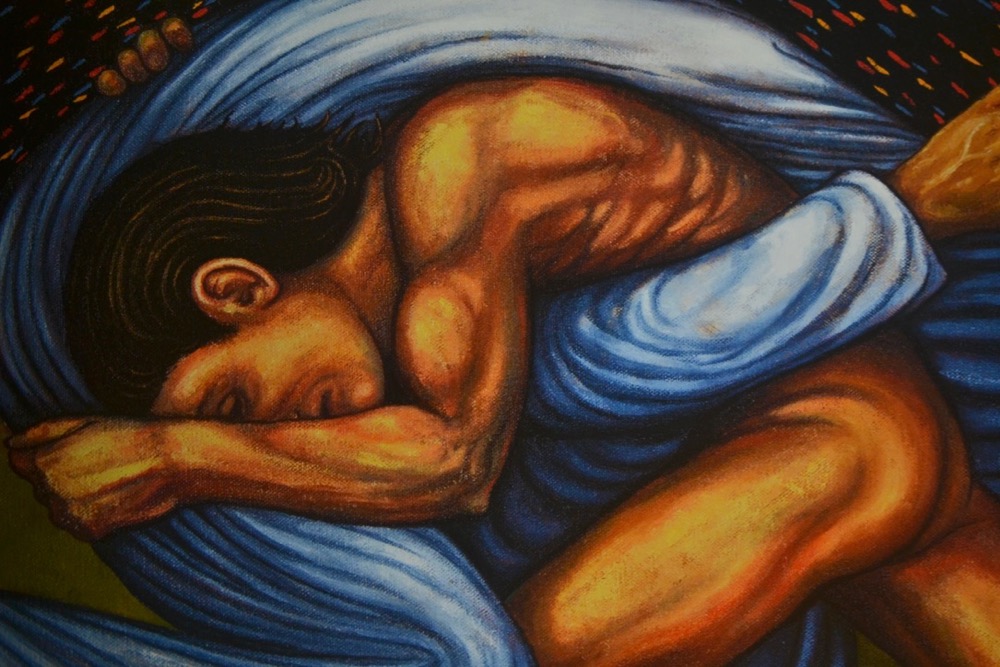
In this week’s Torah portion, Parashat Vayishlach, Jacob prepares for a meeting with his long-estranged brother, who is coming to meet him with a retinue of four hundred. Understandably frightened, Jacob divides his family up into groups and sends them ahead separately, hoping to placate Esau with tribute. He then spends the night alone on the bank of the Jabbok River.
During the night, Jacob wrestles by the riverbank with a mysterious man until the break of dawn. When the man sees that he cannot prevail against Jacob, he wrenches his hip at the socket. Jacob demands a blessing from the stranger, who renames him Israel (Hebrew for “wrestles with God”) adding, “you have struggled with beings divine and human and you have prevailed.” Jacob names the place of this encounter Peniel, (“God’s face”), saying, “I have seen a divine being face to face and have survived.”
The next morning, Jacob/Israel approaches Esau. Esau runs to greet him and weeping, they embrace and kiss one another. During the course of their reunion, Esau asks why Jacob had sent him gifts. “I have enough, my brother,” he says, “Let what you have remain yours.” But Jacob insists, “No, please do me this favor by accepting this gift, for to see your face is like seeing the face of God.”
There’s so much to say about this short, powerful story. Like much of Genesis, since many characters are representative of nations, we can read it on two levels simultaneously: as a narrative about an extended family and as a symbolic allegory about the relations of nations in the ancient Near East. Here, Jacob represents Israel and Esau is Edom; thus, we are reading both about the struggles of twin siblings and the origins of the fraught relations between the Israelites and Edomites.
Since these two peoples have a largely antagonistic relationship in the Hebrew Bible, classical commentary has not been kind to Esau and the Edomites. The Rabbis famously associated Esau with the Romans, the “wicked empire” who persecuted the Jews before and after the destruction of the Temple. One vivid midrash relates that Esau didn’t kiss but rather bit Jacob in the neck! Jewish commentators later coined the term “Esau hates Jacob,” a reference to (what they believed was) the eternal, immutability of gentile antisemitism.
It has always seemed to me that this complex and poignant narrative of twin brothers struggling toward reconciliation belies this simplistic interpretation of “good Israel” vs. “evil Esau.” I’m struck that the first time we met Jacob and Esau, they are wrestling with each other in utero – and when they are reunited, they embrace. This is not just a simple story about the struggle for personal/national dominance. The struggle we read about here is much deeper and far more profound than that.
I would argue that it is far too reductive – and even dangerous – to view the Torah as a narrative about the heroic Israelite wars with antagonistic nations. Embedded in Biblical tradition, there is a much deeper and more profound portrayal of deep love and solidarity between different peoples who are described as a complex, yet loving extended family. There are numerous examples: Abraham’s sons Isaac and Ishmael reunite to bury their father (as Jacob and Esau do when Isaac dies at the end of our portion). Moses marries Zipporah, the daughter of the Midianite High Priest Jethro (who is his spiritual mentor). Ruth, a Moabite, shows great love and loyalty to her Israelite mother-in-law Naomi, and later marries an Israelite, beginning the lineage that leads to King David.
In this fearful current moment, when war and fascism is escalating in too many places around the world, it seems to me that these sacred streams of our spiritual tradition are speaking out to us with renewed urgency. Let us reject the voices in Judaism – and all traditions – that preach the immutability of hatred and war. Let us live up to our inherited spiritual legacy as Israel/Godwrestlers. Let us lift up the Torah of struggle that leads to reconciliation and collective liberation.
 Shalom Rav