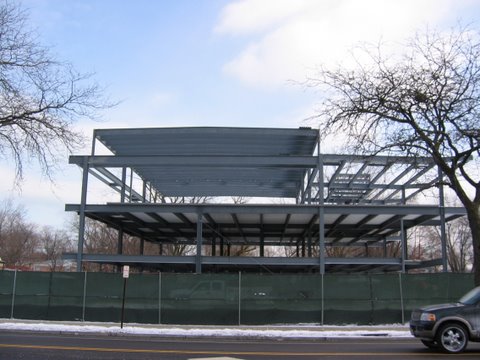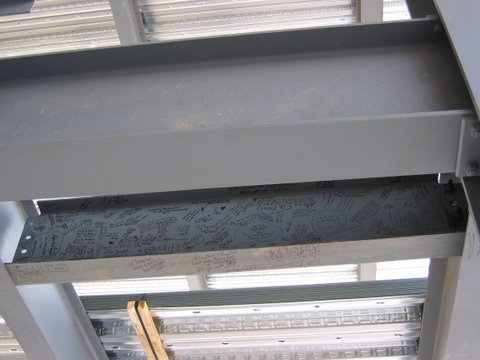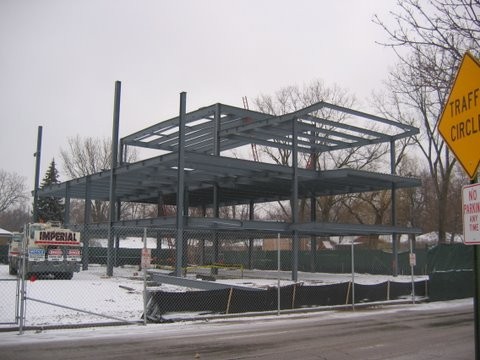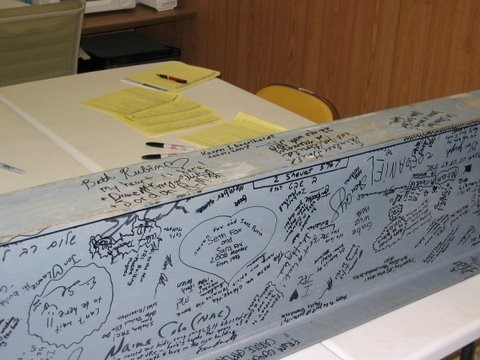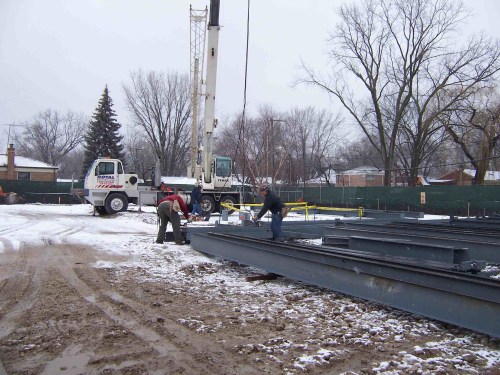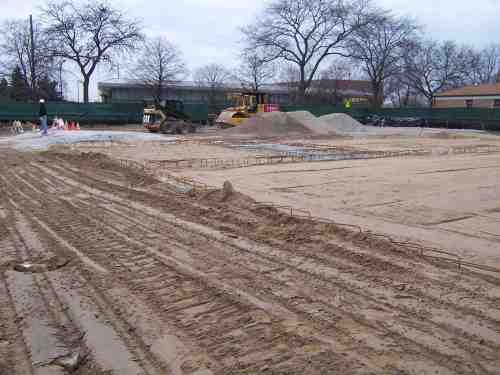
The frame of our new building is now complete. Take a look at the three pictures below: the top one shows a view of the site looking northeast. The middle picture shows an eastward view. (See the raised ceiling on on the third floor? That’s our sanctuary/social hall!) The bottom picture shows the signed beam (see previous diary entry) bolted into place in the second floor landing of the main stairwell.
Welcome
My posts on "Shalom Rav" focus primarily on Judaism and social justice, with a particular emphasis on Israel/Palestine. Please check in regularly and feel free to share your comments.
I'm the Rabbi of Jewish Reconstructionist Congregation in Evanston, IL. The opinions I share here, however, are mine alone. They don't represent the positions of my congregation or any other organization with which I am affiliated.
My Latest Tweets:
- Rabbi Lynn Gottlieb in "Pal. Talmud" - On Religious Ethical Zionism: An Open Letter to J Street http://t.co/zPVJrGh0 via @wordpressdotcom 1 day ago
- A Single Tree is Really a Whole Forest: Zen Wisdom for Tu B'shvat http://t.co/IlzYyaRK 1 day ago
- Biblical Myths, Cultural Boundaries and Political Realities: Rachel Havrelock's Important New Book http://t.co/7EAgh6Xx 2 days ago
- Purim Came Early This Year http://t.co/ZiHKLyMp 3 days ago
Categories
From My Other Blog:- A Single Tree is Really a Whole Forest: Zen Wisdom for Tu B’shvat Rabbi Brant Rosen
- Purim Came Early This Year Rabbi Brant Rosen
- Who You Gonna Serve Now Rabbi Brant Rosen
- A New Reconstructionist Dialogue on Chosenness Rabbi Brant Rosen
- Passover Observance Then and Now Rabbi Brant Rosen
-
Recent Comments
- Richard Kahn on Biblical Myths, Cultural Boundaries and Political Realities: Rachel Havrelock’s Important New Book
- Ken Kaufman on New Report on Israel’s Abuse of Palestinian Children
- Dave on Biblical Myths, Cultural Boundaries and Political Realities: Rachel Havrelock’s Important New Book
- jlseagull on Rais Bhuiyan and the Power of Forgiveness
- pabelmont on Moment of Truth for Liberal Zionism
- Jeffrey Silverman on Moment of Truth for Liberal Zionism
- Seth Morrison on Moment of Truth for Liberal Zionism
- umrayya on Moment of Truth for Liberal Zionism
- WPearlman@aol.com on Moment of Truth for Liberal Zionism
- Why I support the Boycott, Divestment, and Sanctions movement « Free Yet in Chains on Is BDS anti-Semitism?
Shalom Rav Archives
Blogroll
- +972
- ActiveStills
- Beth Miller
- Bethlehem Blogger
- Beyond Zero Sum
- Emily Hauser
- Eyes On the Ground in East Jerusalem
- Hybrid States
- Israeli Occupation Archive
- Jared Malsin
- Jewdas
- Jewish Fast for Gaza Blog
- Jewschool
- Joseph Dana
- Juan Cole
- Kol Shalom
- Mark Braverman
- Mark Lynch
- Max Blumenthal
- Mirembe Kowmera Blog
- MJ Rosenberg
- Mondoweiss
- Morgan Bach
- Multifaith World
- Muzzlewatch
- Mya Guarnieri
- Nima Shirazi
- Noodge Report
- Project Democracy
- Promised Land
- Prospects for Peace
- Rabbi Brian Walt
- Rabbi Shai Gluskin
- Religion Dispatches Blog
- Rethink Afghanistan
- Sheikh Jarrah Blog
- Stephen Walt
- The Electronic Intifada
- The Magnes Zionist
- The Media Line
- The Only Democracy?
- The Third Way
- Tikun Olam
- TomDispatch
- Velveteen Rabbi
- War in Context
- Yedid Nefesh
- Zeek
However one feels about the policies that have made such a mess of the Iraq war, it is politically and morally unacceptable to be so distanced from those in harm’s way and their families.
Ganji is an Iranian journalist who has written and spoken out extensively against Iran’s oppressive domestic policies. He spent six years in prison and underwent an extended hunger strike before his release in March 2006. Although the US government spoke out on his behalf, Ganji refused a personal invitation to the White House last summer because he believes current US policy does not help promote the cause of democracy in Iran.
Ebadi is an Iranian lawyer and human rights activist who was awarded the Nobel Peace Prize in 2003 for her efforts – in particular on behalf of women and children in Iran. Like Ganji (whose case she defended), Ebadi has also spent time in an Iranian prison. And like Ganji, Ebadi believes that an invasion of Iran would be a tragedy for all concerned. In an 2005 article for the
“See, I shall strike the water in the Nile with the rod that is in my hand, and it will be turned into blood; and the fish in the Nile will die. The Nile will stink so that the Egyptians will find it impossible to drink the water of the Nile.” — Exodus 7:17-18
The journalistic bombshell of the week is 
“The Israelites were groaning under the bondage and cried out; and their cry for help from the bondage rose up to God.” — Exodus 2:23
Parashat Bo 5767
Why does God need the Israelites to mark the doorposts of their houses with blood? Being omniscient, wouldn’t God automatically know the difference between an Israelite and an Egyptian house? Rashi famously answers this question by pointing to the words “a sign for you.” According to this interpretation, the blood on the doorpost is less a sign for God than it is for the Israelites – presumably as a reminder of God’s redemptive power.
Taking Rashi one step further, we might regard the blood on the doorpost not only as an internal sign for the Israelites, but as an external sign for the Egyptians as well. After all, by marking their doorposts in the way, the Israelites were publicly identifying themselves and their households throughout Egypt. Marking their homes with blood was thus be an act of proud defiance – the Israelites were, in a sense “wearing their oppression” openly to the outside world.
Ironically, however, blood is not only symbolic of oppression and death, but of life force. Indeed, according to the Ancient Israelite world view, sacrificial blood was regarded as having saving power. By marking their homes with their pain, the Israelites were also saving themselves – initiating a process that would lead to their eventual redemption.
Post Script: The notion of publicly “wearing one’s pain” was recently explored in a powerful way by one contemporary artist. In 1996, a Jewish museum in Berkeley, CA displayed a mezuzah filled with artist Albert Winn’s HIV-infected blood on a temporary doorpost. Winn commented that displaying his blood was his personal way of “making sense” of his illness while raising awareness about HIV/AIDS on World AIDS Day.
Post-Post Script: The CBS News reported last summer on a fascinating phenomenon occurring in the Gulf Coast region: the dramatic increase in tattoos bearing storm-related images. According to the report, many Katrina survivors are having images of “hurricane swirls, crumbling buildings, names of the dead or broken hearts gushing floodwater” displayed permanently on their bodies. One tattoo parlor owner suggested that these new tattoos were a kind of therapy for the wearers:
→ 3 Comments
Posted in HIV/AIDS, Hurricane Katrina, Torah Commentary