Monthly Archives: May 2007

Maybe Now He’ll Change His Spots…

amur_leopard3.jpgHere’s my vote for the headline of the year: “Man Clad in Underwear Pins Leopard.”

Yep, it’s true – according to the AP:

JERUSALEM (AP) — A man clad only in underwear and a T-shirt wrestled a wild leopard to the floor and pinned it for 20 minutes after the cat leapt through a window of his home and hopped into bed with his sleeping family.

(I wonder if this story would get the same level of play if the guy wasn’t wearing underwear…)

Oh well, if you’re tired of reading about Rosie and Lindsay, click here for the details…

JRC Construction Diary #15

img_28471.jpg

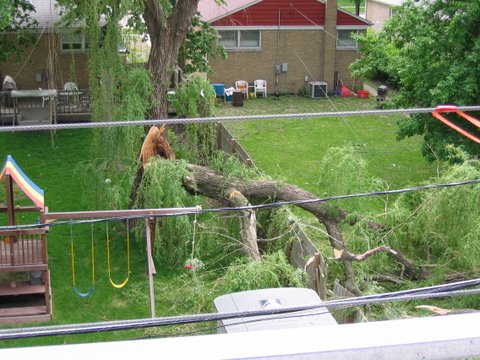
Oh no! During a recent windstorm our neighbor’s tree was partially blown down, somewhat compromising the great leafy view from our sanctuary’s east window. We’re hoping against hope that the rest of the tree won’t have to be cut down.  In the meantime (as the pic below indicates) there’s still plenty of green to be seen as we look east…

img_28511.jpg

Memorial Day 2007

070324_in02_widehlarge.jpg“A single man was created to teach you that one who destroys a single soul, it is as if he has destroyed an entire world…” (Mishnah Sanhedrin 4:5)

As we appropriately remember America’s war dead this Memorial Day (see my earlier post), here’s a plea that we honor the memory of all who have fallen as a result of our nation’s tragic, misbegotten war in Iraq:

For Suhad Shakir, 36, her new job was a dream come true. She had always wanted to work with Americans, and she loved helping people. Last September she quit her post as a journalist at state-owned TV and jumped at an opening with the Iraqi Assistance Center, a Coalition-run office in the Green Zone that works with U.S. and Iraqi agencies to provide social services. It seemed safer than reporting, and it paid better.

On Feb. 4 she was on her way to work, waiting in the queue at a checkpoint near an entrance to the Green Zone which is often targeted by suicide bombers. Shakir was in the slow lane, for Iraqi cars that are subject to careful searches. A convoy of armored vehicles came roaring up and got stuck at the checkpoint. One of the bodyguards in the first vehicle threw a bottle of water at the driver in front of Shakir to signal him to move. The driver panicked and backed into Shakir’s car. She tried to get out of the way but backed into the car behind her. Someone aboard the fourth vehicle in the convoy, seeing Shakir’s sudden move, opened fire, hitting her once. The vehicle slowed and a goateed Westerner in khaki leaned out his window and shot her again in the face at close range. Then the convoy raced off into the Green Zone.

Iraqi cops think Shakir’s killer mistook her for a suicide bomber, but they say they’re continuing to investigate. “It is very important I know why she is killed and who killed her,” said Shakir’s mother, Salima Kadhim, dressed in black a month after her daughter’s death. Like many Iraqis, she still waits.

(Newsweek, April 2, 2007)

Face to Face

priestlyblessing.jpg“May ADONAI bless and protect you. May ADONAI shine (God’s) face upon you show favor to you. May ADONAI turn (God’s) face to you and grant you peace.” –Parashat Naso (Numbers 6:23-26)

One of the most notable aspects of the three-part Birkat Cohenim (Priestly Benediction) is its use of the metaphor of “God’s face.” The final two blessings utilize this image in two different ways: in the second blessing, the “light” of God’s countenance bestows acceptance or grace (in Hebrew, chen); in the third and final blessing, the “turning” of God’s face expresses Shalom – peace, wholeness, fulfillment.

The metaphor of God’s face is used throughout the Bible, often to convey the powerful and immediate experience of the Divine Presence. For instance, Moses’ unique relationship with God is driven home when we read that “God singled him out face to face” (Deuteronomy 34:10). On the other hand, the concept of hester panim (the hiding of God’s face) is often invoked to convey divine anger and punishment. (See Deuteronomy 31:18). This metaphor is also used in a powerful and poignant way during the reconciliation of estranged twin brothers Jacob and Esau. Upon their reunion, Jacob says to his older brother:

Please, if you would do me this favor, accept from me this gift; for to see your face is like seeing the face of God… (Genesis 33:10)

This use of the metaphor suggests that Godliness is particularly manifest in the act of conflict resolution – when former enemies find the wherewithal to “turn their faces” to one another. In this regard, we might well view the Birkat Cohenim not merely as a blessing of well-being but as a spiritual imperative. How will God’s face shine upon or turn to greet us? When we turn our faces to one another in acceptance and peace.

Postscript: This imperative is particularly endangered in a world where extremism too often eclipses the faces of moderation on all sides. The OneVoice Movement in Israel/Palestine is one inspiring example of an effort to empower the forces of acceptance and peace on a widespread, grassroots level. By their own description:

OneVoice aims to amplify the voice of the overwhelming but heretofore silent majority of moderates who wish for peace and prosperity, empowering them to demand accountability from elected representatives and ensure that the agenda is not hijacked by forces of militant absolutism.

Want to be inspired? Visit their website and/or view their video below:

Happy Shavuot!

In honor of Shavuot: sunrise at Mt. Sinai.

May this be a season of revelations…

Death Grip in Gaza

_42932989_funeral_ap.jpgAs the agony occurring in and around Gaza increases, the most helpful analysis I’ve yet read is “Who’s at Fault?” by Dr. Gershon Baskin of the Israel-Palestine Center for Research and Information. (I’ll spill the beans: there’s enough blame to go around…)

(Today) we still keep saying there is no partner. Palestinian leader Abbas is indeed weak, but instead of repeating this as if the State of Israel was not at least partly responsible for his weakness, we would do well to quickly grasp that his weakness does not serve us, and that Israel’s actions only serve to further weaken his constantly deteriorating status.

Proof of this is the situation in the Gaza Strip: Israel argues that Abbas controls tens of thousands of uniformed police officers, who fail to curb the Qassam rocket attacks. Is that indeed the case? His loyalists have not been paid regularly for more than a year now. The Palestinian Authority’s government system has collapsed a long time ago. Gaza Strip residents live without any personal or social security. They can see neither political nor economic horizon. Radical elements pay every boy willing to fire Qassams at Israel NIS 250 (roughly USD 60.) The Gaza smuggling, and we are not only talking about arms, helps many make a living. Gaza residents have almost gotten used to the occurrences of abductions for ransom. There is no law and order. Private militias are being established on a daily basis. Perhaps Israel does not bear direct responsibility for this situation, yet it is certainly a direct result of its policy…

Click here for the entire article.

Into the Wilderness

desert10.jpgAs we begin Parashat Bamidbar – the first portion in the book of Numbers – we read:

God spoke (vaydaber) to Moses in the wilderness (bamidbar).

It’s notable that the Hebrew verb “to speak” and the word for “wilderness” share a common root: d-b-r. The Torah may be suggesting here an important connection between the wilderness and speech – and more specifically divine speech.

There are, in fact, numerous Biblical descriptions of Godly encounter that take place in a deep wilderness setting. Before Moses discovers the burning bush, for instance, he drives his flock “achar hamidbar” – “beyond the wilderness. ” In 1 Kings 19, the prophet Elijah encounters the still, small voice of God after traveling “bamidbar derech yom” – “a day’s journey into the wilderness.”

It is not difficult to understand why the desert habitat has been regarded by many spiritual traditions as a natural locus of divinity. At first glance, the wilderness might seem to be a wasteland – a “God-forsaken” environment unable to support life. But desert biomes are actually vital, and dynamic ecosystems teeming with a wide array of geological variety as well as significant plant and animal biodiversity. Anyone who has ever lived in a desert will surely attest that this world is truly a living, breathing environment.

At the same time, the wilderness may be symbolically regarded as elemental terrain – an existential place far from the “noise” of culture, artifice and ego. This form of spiritual experience is indeed available even to non-desert dwellers: a mindfulness or way of life that seeks to strip away these outer layers so we may discover, like the ancient Israelites, the divine word that dwells at the elemental core.

In the end, the journey into the wilderness is one that leads both inward and outward: to the outermost reaches of experience and the innermost reaches of the human soul – the place where the voice of God may truly be heard.

Postscript: In honor of Shabbat Bamidbar, I encourage you to learn more about the Arava Institute for Environmental Studies, a regional center for environmental leadership located in the Arava desert (in Southern Israel). The Arava Institute is an important learning center that encourages environmental cooperation between Israelis, Palestinians and other peoples, promoting peace and sustainable development on a regional and global scale.

JRC Construction Diary #14

img_27432.jpg

Here are a few photos from this week – nothing too dramatically different. The leaves are really getting thick on the treetops and the view from the sanctuary’s east window opening is incredibly green (above).

The main supply air duct (next pic down) has been installed from the roof down to the second floor, where we have our main fan system. It is going behind the opening that is being saved for a second elevator which we hope to install sometime in the future.

Our electric transformer from Commonwealth Edison was delivered this week (see bottom pic). Getting service from a utility can often be a challenge but they have been very cooperative with us and we are pleased to have the service on schedule.


img_27501.jpg

img_27511.jpg

The Genocide Olympics

darfur-banner-800.jpg

Mia Farrow’s incredible Wall Street Journal editorial last March – regarding Sudan, China and the 2008 Beijing Olympics – has given powerful new momentum to the Darfur activist movement. In the words of one NY Times writer, Farrow’s efforts “could accomplish what years of diplomacy could not.”

In the meantime, there’s been a great deal of worthwhile responses to her challenge throughout the blogosphere and in the print media. Among the best is this recent piece from Sports Illustrated by my all-time favorite sportswriter, Rick Reilly. This kind of advocacy from such a major publication is HUGE, quite frankly.

I have a feeling we’ll be reading much more about the “Genocide Olympics…”

Mia’s Olympic Mettle

Rick Reilly

Sports Illustrated, May 14, 2007

The first hero of the 2008 Beijing Olympics stands 5’4″ and weighs 108 pounds, including purse. She’s 62, runs the 100 meter dash in about a day and has 14 kids. She speaks in a weak voice, yet her words are shaking the world.

She’s Mia Farrow. Remember? Rosemary’s Baby? UNICEF goodwill ambassador?

On TV and in newspapers, Farrow has been pressuring China to face up to its role in the genocide being carried out by Arab militia groups in the Darfur region of Sudan, where an estimated 400,000 non-Arab Africans have been slaughtered and another two million have been made refugees. “These are the Genocide Olympics,” says Farrow, who has made two trips to Darfur and three to camps in neighboring countries. “China is funding the first genocide of the third millennium.”

According to the Council on Foreign Relations, China buys about two thirds of Sudan’s oil. The Sudanese government then uses the majority of its oil profits to buy weapons and aircraft, most of them made by China. The arms are turned over to a proxy militia, the Janjaweed, which burns, dismembers, rapes and kills Darfur’s villagers and destroys their land. China maintains that it doesn’t interfere with the internal politics of other nations, and using that policy it has blocked U.N. efforts to send a peacekeeping force into Darfur by insisting that Sudan first invite the troops in.

Farrow has also tried to get at China by taking on Steven Spielberg. The King Kong of directors is one of the Beijing Games’ “artistic advisers,” helping to orchestrate the opening and closing ceremonies. But how can a man who decried one holocaust in his finest film Schindler’s List be in bed with a country that is helping to bankroll another?

Spielberg could “go down in history as the Leni Riefenstahl of the Beijing Games,” Farrow wrote in a Wall Street Journal op-ed piece in late March, referring to the German woman whose film about the 1936 Berlin Olympics is viewed as Nazi propaganda.

Spielberg’s face must’ve fallen like E.T.’s when he read that. He immediately wrote a letter to China’s president, Hu Jintao, asking him to intercede in Darfur. China sent a high-ranking official to Khartoum to try to persuade the Sudanese government to allow in the 20,000 peacekeeping troops who stand ready to enter Darfur under U.N. Security Council Resolution 1706. That envoy returned to pronounce the situation “improving.”

“That visit meant nothing,” says Eric Reeves, a Smith College professor who is a leading Darfur activist. “He toured the camps with the most food and the most control. This was airbrushed genocide.”

Spielberg declined to comment to SI, but his spokesman, Marvin Levy, said, “This is a step-by-step process. We think there was some movement. We’ll see.”

“At what cost?” asks Farrow. “Ten thousand a month are dying, minimum.” Forget Private Ryan, Mr. Spielberg. Save Darfur!

Before the world arrives, Beijing has instituted a campaign to get residents to stop spitting and rushing into buses and trains without waiting for people to get off. But if the Chinese have to clean up for company, why shouldn’t their government?

The last thing anybody wants, including Farrow, is an Olympic boycott. It would make China a sympathetic victim, and innocent athletes would suffer. But China’s feet must be held to the fire, even if that fire is an Olympic torch. And activists are lighting the flame any way they can by:

Organizing an alternative torch relay, which will go from Darfur to Hong Kong, linking the bloodshed to its biggest banker (www.dreamfordarfur.org).

Insisting Olympic sponsors (go to www.miafarrow.org for a list) lean on China to pressure Sudan to let the peacekeepers in.

Writing protest letters to the Chinese government, such as the one just signed by 12 Cleveland Cavaliers.

Convincing athletes, if nothing changes by 2008, to compete in Beijing wearing Dream for Darfur’s Chinese-character tattoo (translation: China, please) on the inside of their wrists, a reminder of the way Germany’s holocaust victims were tattooed.

“I wish I could take China’s president to Darfur, take Mr. Spielberg there, every Olympic official,” Farrow says. “Because once you’ve seen it, you can’t turn away.”

Do you remember Tiananmen Square, 1989? The guy who stood all alone, in front of a column of tanks? Today, that lone figure is tiny Mia Farrow.

Who will line up behind her?

New Jewish Music: From the Sublime…

From neo-klezmer to world music to Israeli hip-hop (not to mention hasidic reggae beat-box) there’s a pretty amazing renaissance going on in the world of post-modern Jewish music. That doesn’t mean, however, that all the music being generated is worthwhile – like all wide-ranging movements, this new scene certainly contains its fair share of musical dross.

Here’s an example: take a look at two different contemporary musical pieces based on Jewish liturgy. Click above for a video of Israeli “hip-hop violinist” Miri Ben-Ari and Israeli rapper Subliminal performing their version of Adon Olam. It’s an incredibly heavy-handed reworking of this Jewish prayer as a Holocaust remembrance – and like too much new Jewish music it’s all pose and very little substance. (Note Miri’s completely inappropriate seductive smirks – and what’s with the goofy interpretive dancers?)

Now compare that to Basya Schechter and her band, Pharoah’s Daughter (below) performing Kah Ribon (a piece from their upcoming album “Haran.”) Pharaoh’s Daughter is one of the truly talented groups producing new Jewish music today, synthesizing a vast array of musical influences (Indian ragas, Arabic folk, hasidic niggunim) to create something both original yet utterly authentic.

Feel free to weigh in with your own picks and pans. (For great discussion of emerging Jewish music and new Jewish cultural trends in general, check out Adam Davis’ blog, Jewish Fringe).