Monthly Archives: July 2007

JRC Construction Diary #20

img_3319.jpg

There has been some exciting progress on the building, so here’s one more post on the construction before we head off to Israel tomorrow…

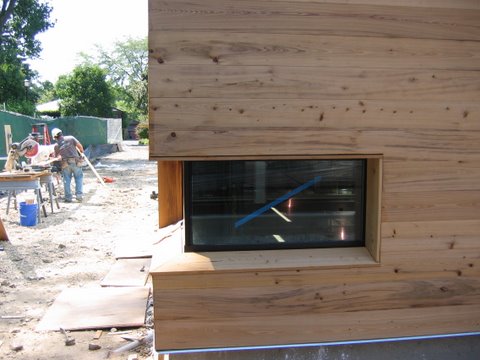
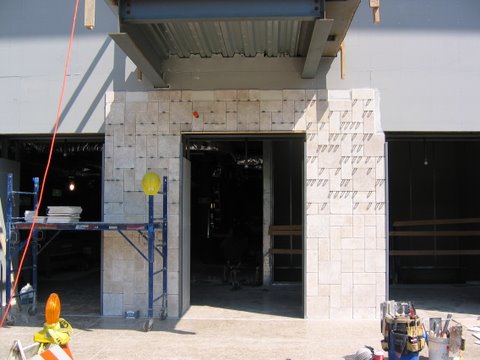
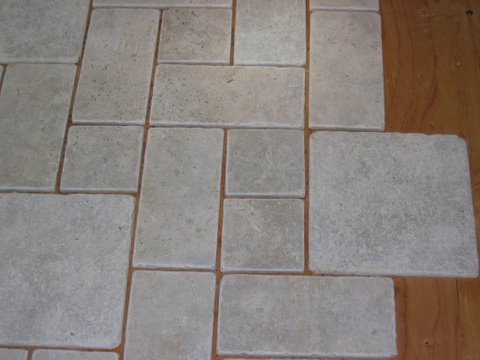
The reclaimed cypress siding has started to go up on the exterior walls (see the second and third pix down). The siding will eventually get two coats of clear sealer which will protect and enhance the look of the wood. The Jerusalem stone is now going upon the main wall – the bottom pic shows some of the work that was done yesterday and today. (In case you are wondering, the small shadows on the the stones are made by the spacers that have been placed between the tiles to prepare them for grouting.)

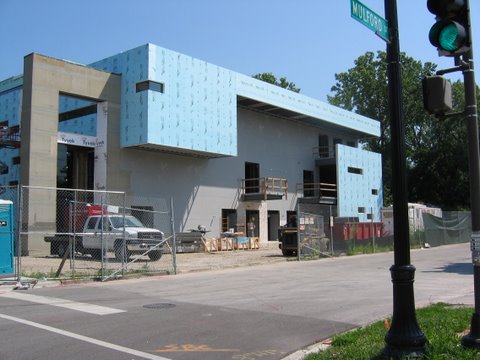
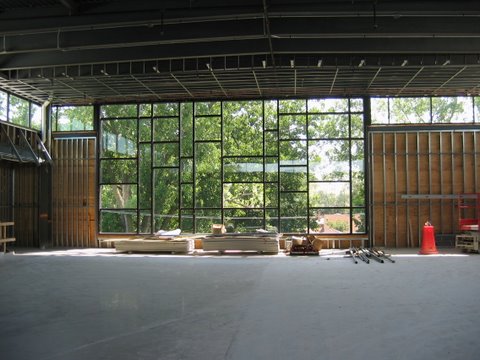
As the pictures above and below indicate, the exterior of the building and the third floor sanctuary window are coming together beautifully. Looking forward to seeing even more progress when I get back to town August 15!

img_3307.jpg

img_3298.jpg

img_3301.jpg

img_3297.jpg

Coexistence in Chicago

hop_20070726_0927.jpgToday marks the end of an extraordinary two weeks of coexistence, conflict resolution and peacemaking. I’m referring to Hands of Peace – a Chicago-based organization that brings Jewish-Israeli, Palestinian-Israeli, and West Bank Palestinian High School age youngsters together to engage in coexistence work with one another and with Jewish, Christian, and Muslim Americans.

The program is intensive and substantive, in many ways inspired by the groundbreaking coexistence organization Seeds of Peace. What makes Hands of Peace particularly unique is the fact that it is community-based: participants live in host family homes and experience first-hand our local Chicago Jewish/Christian/Muslim communities. Last Friday night, for instance, JRC welcomed HOP participants to our Shabbat service (which they attended immediately after attending a Muslim Sabbath service at a local mosque).

The centerpiece of the HOP program are the “coexistence sessions” – intensive dialogues with trained conflict resolution faciliators. I have nothing but the utmost admiration for the staff of HOP, who engage and challenge these young people to dig deep into their own identities, their own fears, and find the wherewithal to access their common humanity. It is clear to me that making peace is not a lofty or ephemeral abstract concept: at its core it is difficult and often exhausting work. But clearly it is the most sacred work there is. At HOP’s closing celebration last night, I sat in awe as young Jews, Christians, and Muslims from the Middle East and America stood together and proudly spoke of what they had accomplished together.

I have the honor of serving on the board of Hands of Peace, and encourage you to add them to your list of organizations eminently worthy of your support. In the midst of the seemingly intractable politics of this conflict, it is critical to know that there are institutions like HOP that are helping to create future peacemakers one youth at a time.

The Middle East participants are heading home today and tomorrow – and I will be hot on their heels! I’m off to Israel this Wednesday with 30 other members of JRC – and a portion of our itinerary will be devoted to ongoing coexistence efforts there. Looking forward to sharing my thoughts, experiences and pix with you.

Shalom, Salaam, Peace…

The Hope of New Life

msh84_st_helens_from_harrys_ridge_fireweed_august_1984_med.jpg

It’s Shabbat Nachamu: the High Holidays unofficially begin today…

This weekend we begin chanting the seven “Haftarot of Consolation” during Shabbat services. The tragedy of Tisha B’Av behind us, we now highlight healing, renewal and hope. With the help of these exquisite prophetic portions, we remind ourselves that there is no trauma so powerful, no despair so overwhelming, no wound so deep that we forever forfeit our ability to find our way back to new life.

It often occurs to me that this profound lesson of renewal is woven into the very fabric of creation itself. Here’s some “environmental commentary” in honor of a new season: a 2005 news report documenting the destruction and subsequent rebirth at Mount St. Helens in Washington State:

A small Douglas fir breaks through the ground six miles from the base of Mount St. Helens. In the distance, trees scattered like dropped matchsticks still lie where they were toppled by a cloud of fragmented rock and ash that exploded from this mountain 25 years ago.

A quarter-century has passed since the devastating blast killed 57 people and an overwhelming amount of plant and animal life. But the barren landscape is now scattered with green, and wildlife has made a home in the vastly different habitat.

As the force of the blast destroyed all in its path, it also carried within it new life – seedlings carried from the south side of the mountain landed and began to grow. Seeds continue to arrive via the fur of animals returning to the area.

Pine trees, honeysuckle and firs are all growing in the blast zone, without the help of man. Alder, cottonwood and willows abound. Some have fallen victim to hungry elk, who nibble at the trees, stunting their growth. But many are thriving in the area that was once covered with ash and debris.

“There was nothing out here. It’s easy to forget it was like that,” said Peter Frenzen, monument scientist for the U.S. Forest Service at Mount St. Helens. “The next forest is essentially here. We just have to wait for it all to grow up.”

2002273006.jpg

Israel and the Arab League Pt. 3

br-30314.jpgOne day after Tisha B’Av, the Jewish day of communal mourning, some cause for communal hope. From today’s AP:

The foreign ministers of Egypt and Jordan began a historic visit to Israel on Wednesday to formally present an Arab peace plan, saying they were extending “a hand of peace” on behalf of the region.

The ministers arrived as representatives of the Arab League, the first time the 22-member group has sent a delegation to Israel. The Arab League peace plan envisions full recognition of Israel in return for evacuation of lands captured in the 1967 Middle East war.

“We are extending a hand of peace on behalf of the whole region to you, and we hope that we will be able to create the momentum needed to resume fruitful and productive negotiations” between Israel and the Palestinians and the rest of the Arab world, Jordan’s foreign minister, Abdul-Ilah Khatib, said at a news conference with Israeli President Shimon Peres.

Egyptian Foreign Minister Ahmed Aboul Gheit said the two delegates had been asked by the league “to come and offer Israel the Arab peace initiative.” He urged Israel to consider the plan seriously.

“We hope that upon our return, we would also convey to the Arab League … the responses of Israel and I hope that such responses will be positive,” he said.

(For my previous two posts on this issue, click here.)

It’s Pronounced “PUTS!!!”

7205.jpgDid you know that one of the best relief pitchers in the major leagues is named JJ Putz?

That’s right: Putz is the closer for the Seattle Mariners and he’s currently tearing up the stat book. He has more saves (29) than base runners (28) in 46 1/3 innings. He’s also given up just one run in a save situation, has no blown saves and the best ERA in baseball.

Want to read more? Here’s a recent article from seattlepi.com entitled (I kid you not) “Putz Putting up Cy Young Numbers.”

The Environment Knows No Borders

picbig-jump-2007479.jpgOne of the more inspiring aspects of the environmental movement is the way its universal focus naturally breaks down barriers between peoples and nations. In an earlier post, I wrote about the Arava Institute, a center in Israel that promotes environmental cooperation by working towards peace and sustainable development. Here’s another noteworthy environmental project from that part of the world:

According to a recent article in the Jerusalem Post, the Friends of the Earth Middle East has brokered a memorandum of understanding between Palestinian and Israeli towns that share a water source but are separated by the Green Line and the security barrier:

Friends of the Earth Middle East sponsored the event as part of its Good Water Neighbors project, which operates under the “basic understanding among all people that water is the source of life,” said Gidon Bromberg, the Friends’ Israel director. “Therefore we have a mutual dependence on managing those shared water resources. Whether in times of conflict or… in times of peace.”

“The environment knows no borders,” said Friends of the Earth Middle East Palestinian director Nadr el-Khatib.

Friends of the Earth Middle East is an organization eminently worthy of our attention and support. Originally founded in 1994 as “EcoPeace” at an historic meeting in Taba, Egypt, FoEME came about as environmental NGOs from the Middle East met with the common goal of furthering sustainable development and peace in their region. In this historic moment, Egyptian, Israeli, Jordanian and Palestinian environmentalists agreed to join forces to promote environmentalism in the regional development agenda. As of 1998, EcoPeace officially became the Middle East chapter of Friends of the Earth International, the world’s largest international network of environmental organizations.

The photo of the Israeli and Palestinian mayors above about says it all. Could it be that the environmental movement will be the ones to show us the way out of this intractable and miserable conflict?

The End of the Beginning

11089.jpgWith this week’s Torah portion we begin reading the final book of the Torah. I’ll let Bible scholar Richard Elliot Friedman set the scene:

The people are at the end of a journey. They are located east of the Jordan River, at the border of their promised land, in the plains of Moab. They are about to enter a new land and a settled life. And their leader is about to die. It is no surprise that Moses tells them not to be afraid. There is every reason for them to be in need of such reassurance.

As for Moses, he knows he is about to die, and he is not accepting it with wise acquiescence. He pleads with YHWH is let him live to cross over into the land, but YHWH tells him, “Don’t go on speaking to me anymore of this thing.” And Moses gives a glorious farewell speech. It starts off unattractively to the audience, a review of history, mostly unpleasant, a criticism of the people’s unworthiness; then a lengthy list of laws, reviewing some old ones and adding many new ones; then a list of blessings and horrible curses; then a beautiful conclusion: encouraging, inspiring. And then he ends with songs.

The narrative has come a long distance from the cosmic Genesis 1. Now, for the whole of the last book of the Five Books of Moses, it is a picture of a group of people listening to the speech of a man. No seas split; no angels appear; there are in fact no miracles at all in Deuteronomy. There is rather the retelling of the miracles…

– Richard Elliot Friedman, “Commentary on the Torah,” p. 557

JRC Construction Diary #19

intsanc1.jpg

There has been a fair amount of progress on our building over the last two weeks. All of the windows have been now been installed: the pic above shows the window framing for the east wall of the third floor sanctuary and the shot below shows the east window of the first floor chapel. The second pic down offers a good view of the windows in the second floor classrooms.

They have also begun polishing the concrete floors (you can see the workers doing just that in the sanctuary shot above.) We are told that this process will continue well into next week.

As I reported in my last diary entry, we have received the shipment of reclaimed cypress siding for the exterior walls. The contractors are still debating the best way to treat the wood before installing it, which will hopefully begin next week. The second pic from the bottom shows a test model of the cypress planks as they will look on the walls.

We have also just received the shipment of the Jerusalem stone (bottom pic) that will clad the entry arch and main interior wall. This installation should begin as soon as the concrete floor polishing is completed.

intchapel1.jpg

int1.jpg

cypress.jpg

jstone1.jpg

My Nalgene Vow

nalgene_big.jpgSpent last week serving on the faculty of Camp JRF, the Reconstructionist movement’s wonderful summer camp. Much to say about this very special place: the beautiful Poconos location, the devoted, multi-talented staff, the rich spiritual/educational program that pervades throughout. As a Jewish summer camper from way back myself, I am especially impressed at how devoted this camp is to the creation of a safe, caring and inclusive camp community. As Camp JRF’ers (including my two sons) will attest, it is Jewish community as it should be.

That’s all by way of lead-in to the real subject of this post: bottled water.

The Nalgene water bottle is, of course, an essential piece of camp equipment – anyone who has ever attended camp is familiar with the constant directive to campers to keep their water bottles with them and to keep them filled with tap water in order to keep dreaded dehydration at bay. Now that I’m back home, though, I’ve decided to continue following my own directive. In fact, I’ve decided to take this opportunity to swear off bottled water for good.

Why? Because I’ve known for some time that our national obsession with this particular “beverage” has profound environmental, economic, and even public health consequences. So why shouldn’t I continue to keep the Nalgene handy?

A few trenchant bullet points on the subject:

- Last year, Americans spent $15 billion on bottled water, even though bottled water isn’t healthier or safer than tap water.

- While the EPA regulates the quality of public water supplies, the agency has no authority over bottled water. Some studies indicate that certain brands of bottled water test positive for chemical and bacterial contamination at higher levels than tap water.

- One out of six people in the world has no dependable, safe drinking water. The global economy denies drinkable water to 1 billion people, while delivering to us an array of water “varieties” from around the globe, not one of which we actually need.

- Americans went through about 50 billion plastic water bottles last year, 167 for each person. We pitch into landfills 38 billion water bottles a year – more than $1 billion worth of plastic (while the recycling rate for this particular kind of plastic is only 23%).

- We’re moving 1 billion bottles of unnecessary water around a week in ships, trains, and trucks in the United States alone. That’s a weekly convoy equivalent to 37,800 18-wheelers delivering water.

Here’s a comprehensive article about the subject from a recent issue of Fast Company. Another excellent, if older, article on the subject can be found in E Magazine. If you are interested in engaging in a little “anti-bottled water activism” check out the Think Outside the Bottle campaign. (Heartfelt thanks to Lesley Williams for originally expanding my water consciousness on this issue…)

The Cantor from Poughkeepsie

Thanks to my good friend (and clergy partner-in-crime) Cantor Howard Friedland for steering me toward this amazing piece of footage: cantor-comedian Shepsil Kanarek doing one of his routines.

This particular bit involves Shepsil’s outrage at being forced to audition for a High Holiday position at a synagogue (“Me?! Shepsil Kanarek from Poughkeepsie??!!”) I’m not quite sure how to describe his comedy – this man was simply a force of nature and really must be seen to be believed. If you understand Yiddish or know anything about old school cantorial styles, you will love this. Howard howls every time he watches it…

This clip is beginning to make the rounds on the Jewish blogosphere, so it seems that Shepsil is finding new life via the internet. I’ve searched in vain for more info on him – if any of you know anything more about the cantor from Poughkeepsie, please write in!