Monthly Archives: August 2007

Labor Day Torah

labor-day-bug.gifFrom this week’s Torah portion, Ki Tavo:

“Cursed is he that removes his neighbor’s landmark.” (Deuteronomy 27:17)

This curse forms the basis of the commandment known as Hasagat G’vul, (literally, “infringement of boundary”) which, according to the rabbis of the Talmud, was intended to prohibit unfair competition in business or trade. As it is clearly wrong to move one’s border fence to acquire land, this metaphor was understood to address unfair competitive practices that might benefit one’s own business.

Not surprisingly, this law also has been used to address the problem of unfair and immoral labor practices. According to a “Labor Day commentary” on the Interfaith Worker Justice website:

(From) what would appear the most unlikely place—a (verse) about not moving a boundary marker…the rabbis derived an injunction against infringing on another’s livelihood. Interestingly, this line also became the proof text for the rights of both business owners and tradespeople to form associations and fix prices. On this Labor Day weekend, we might turn to this line as both proof text and reminder of the basic rights of workers—in their own effort to pursue justice—to form unions and set fair, standard wages.

While we’re at it, how about some more Labor Day Torah?

- You shall not abuse a needy and destitute laborer, whether a fellow countryman or a stranger in one of the communities of you land. You must pay him wages on the same day, before the sun sets, for he is needy and urgently depends on it; else he will cry to the LORD against you and you will incur guilt. (Deuteronomy 24:14-15)

- Great is labor for it gives honor to the laborer. (Babylonian Talmud, Nedarim 49b)

- What does labor want? We want more schoolhouses and less jails; more books and less arsenals; more learning and less vice; more leisure and less greed; more justice and less revenge; in fact, more of the opportunities to cultivate our better natures, to make manhood more noble, womanhood more beautiful, and childhood more happy and bright. (Samuel Gompers)

For some thoughts about how to REALLY celebrate Labor Day this weekend, I recommend surfing thoroughly through the link above. And may this holiday inspire us “to cultivate our better natures, to make manhood more noble, womanhood more beautiful, and childhood more happy and bright…”

A Teenage Blueprint for Peace

shakethumbnail.jpgMore inspirational news on the co-existence front – this in today from the European Jewish Press:

HELSINKI (AFP) – Israeli and Palestinian teenagers, meeting in Finland, put their names Wednesday to their own blueprint for Middle East peace, one that envisions two separate states and the eradication of terrorism.

Inspired by the international diplomatic roadmap that calls for a sovereign Palestinian state alongside Israel, the youngsters’ proposals are to be sent to UN Secretary General Ban Ki-moon, Israeli President Shimon Peres and Palestinian Authority president Mahmud Abbas.

The six Israelis and six Palestinians, aged 14 through 16, who hail from Tel Aviv, Jerusalem and Ramallah, spent a week laying out their five-point document.

“We believe in peace which will be achieved through the two-state solution… stopping the violence, and eradicating the terror organizations,(and) economic cooperation as a tool for mutual understanding,” they said in a statement.

They added: “Education as an important tool in the peace process and the growth of a new generation of peace supporters.”

The young Israelis and Palestinians had come to the Finnish capital for a “children’s parliament” with the sponsorship of the Israeli government and the Palestinian Authority.

Amos Atzmon, 16, from Jerusalem, told AFP: “My parents are very open-minded. When I was younger, they kept telling me: ’If you do not like it, change it’. That’s what I’m doing here.”

Christina Yousef, 14, from Ramallah, said: “My opinion towards Israelis has changed. I realized their thoughts are the same as ours”.

Israel’s ambassador to Finland, Shemi Tzur, and the Palestinian delegate to the Nordic nation, Nabil Al-Wazir, were on hand for Wednesday’s signing ceremony.


Bereaved Families for Peace

1165521469_43774778_cb9e062f5a.jpgAnother important co-existence org I recommend to your support list is The Parent’s Circle – Families Forum – a consortium founded by bereaved Israelis and Palestinians who have lost loved ones to violence. I was pleased to see the Parent’s Circle featured in this recent BBC report that spotlighted their Israeli-Palestinian phone-call network, “Hello, Shalom, Hello, Salaam:”

In 2000, in the early days of the second intifada, a young Israeli woman called Natalia Wieseltier dialed a Jewish friend in Tel Aviv but found herself talking to a Palestinian living in the Gaza Strip.

Instead of hanging up she started a conversation.

“He told me his name was Jihad and that things were not going well. He told me that food is rotting at the checkpoints and that his wife was expecting a baby any day and he had no way of getting to the hospital,” she says.

Jihad was surprised to find an Israeli being so open and understanding and Natalia was soon receiving regular calls not only from Jihad but from his friends and family too.

She in turn put them in touch with her friends and soon a network of contacts had developed.

When Natalia approached the Parents’ Circle with the idea of turning this into a national phone line linking Israelis and Palestinians they embraced the idea.

Here’s how it works: when callers use the toll free number they receive the following voice message: “Hello, you have reached ‘Hello, Shalom, Hello Salaam.’ If you wish to talk to an Israeli about reconciliation, tolerance and peace, dial one; if you wish to talk to a Palestinian about reconciliation, tolerance and peace, dial two.” Callers can then listen to numerous voice messages and decide whom they want to contact. To date, “Hello Shalom, Hello Salaam” has logged over 1,000,000 calls!

Another important Parent’s Circle project is their “Offering Reconciliation” art exhibit, which features artwork by 135 Israeli and Palestinian artists, sculptors and photographers, each presenting “a unique offering of reconciliation, of peace and hope.” It has currently been exhibited throughout the US and will be shown in NYC from September 1 thru October 18, and here in Chicago from November 2-4.

As I wrote in an earlier post, grief can cut any number of ways – while it too often inspires feelings of hatred, on certain precious occasions it can be a powerful tool for healing and reconciliation. I do believe that The Parent’s Circle is one inspired example of how this unique form of healing can ultimately be harnessed for a greater good.

The Bad Seed

teenscream.jpgFrom this week’s Torah portion, Ki Tetzei:

If a man has a wayward and defiant son, who does not heed his father or mother and does not obey them even after they discipline him, his father and mother shall take hold of him and bring him out to the elders of his town at the public place of his community. They shall say to the elders of his town: “This son of ours is disloyal and defiant; he does not heed us. He is a glutton and a drunkard.” Thereupon, the men of his town shall stone him to death. Thus you will sweep out evil from your midst: all Israel will hear and be afraid. (Deuteronomy 21:18-21)

So what is this, some kind of sick joke?

In fairness, it should be noted that many classical Jewish commentators have properly recoiled from these infamous verses. In a well-known Talmudic passage, R. Judah and R. Simeon went as far as to claim that this law was never actually enacted, stating:

There never was and never will be a wayward and defiant son. (BT Sanhedrin 71a)

Why then, you might ask, was this law included in the Torah? Rabbis Judah and Simeon cryptically respond: “Seek and you shall find reward” – a comment commonly understood to mean parents should study this passage and be appropriately scared enough to set their children on the right path.

In this Talmudic understanding, then, the commandment of the wayward and defiant son thus seems to serve as a kind of parental “shock therapy.” It is particularly fascinating in the way it reflects every parent’s deepest, darkest insecurities – and society’s latent fear that it might somehow “lose control” of its children.

It should also be noted that this commandment treats the issue of troubled children an issue for the entire community – it is not the parents’ problem alone. In this regard, it could well be claimed that these verses have a great deal of relevance to an American culture that too often throws up its hands when it comes to safeguarding the well being of at-risk children.

Examples? Look no farther than our nation’s fragile support of after-school programs. According to National Youth Violence Prevention Resource Center:

The after-school hours are the peak time for juvenile crime and risky behaviors such as alcohol and drug use. Most experts agree that after-school programs offer a healthy and positive alternative. These programs keep kids safe, improve academic achievement and help relieve the stresses on today’s working families. They can serve as important youth violence prevention and intervention strategies.

Yet most youth do not have access to after-school programs. Every day, at least eight million children and youth are left alone and unsupervised once the school bell rings. While nine in 10 Americans think that all youth should have access to after-school programs, two-thirds say it is difficult to find programs locally. With more and more children growing up in homes with two working parents or a single working parent, today’s families can benefit from the safe, structured learning opportunities that after-school programs provide.

Here’s a thought: in honor of this week’s Parshat Ki Tetzei, why not consider helping advocating for the invaluable and perennially endangered after-school programs in in our country? Here’s a timely call to arms from the Afterschool Alliance:

With students heading back to school in late August and early September, and media filing back to school stories, after-school leaders and supporters can have a real impact right now by sending the message that millions of students have no place to go each afternoon after the school day ends. With Congress still considering the 21st Century Community Learning Centers (21st CCLC) appropriation for next year, this is an especially important time for advocates to send messages about the benefits after-school programs provide to children, families and communities.

For more info on how to engage in some “Back to School Organizing,” click here.

Shalom, Salaam, Cowabunga…

ridethewildsurftransition.jpgThe latest headline to catch my eye was this attention grabber from today’s Ha’aretz: “Jewish-Hawaiian Surfing Guru Donates Surfboards to Gazans.”

Yep, here’s the lowdown:

An 86-year-old Jewish surfing guru from Hawaii donated on Tuesday 12 surfboards to Gaza’s small surfing community, in a gesture he hoped would get Israelis and Palestinians catching the same peace wave.

“God will surf with the devil, if the waves are good,” retired doctor Dorian Paskowitz said Tuesday. “When a surfer sees another surfer with a board, he can’t help but say something that brings them together.”

Click here if you still want to read more…

My Israeli Music Pix

Some of the Israeli tunes I’ve been listening to since I’ve returned…

When I was in Tel Aviv, I made a beeline for Tower Records and picked up the first two Israeli releases by The Idan Raichel Project. Raichel is a musical phenom who has been extremely popular in Israel for some time, but has only recently introduced to American ears. He’s a multi-talented keyboardist, composer, producer and singer, whose musical “project” involves over 70 different musicians from a wide variety of backgrounds and he produces an amazingly rich musical synthesis of Israel’s ethnic diversity. While Raichel highlights Ethiopian music and musicians prominently, his songs also feature Arab musicians, traditional Yemenite vocalists, a percussionist from Suriname and a South African singer, among others.

Unlike most Israeli popular music, which is for me too often a mediocre rehashing of Western style rock and pop, Raichel’s music represents an attempt to create an authentically Israeli style by bringing together the unique musical traditions of a uniquely multi-ethnic Israeli culture. (I know I’m making his music sound like an anthropology dissertation here, but trust me, this is eminently listenable and often beautiful music.)

If you’re new to Idan Raichel, I’d recommend his 2006 American-released CD which is a “best-of” collection from their first two albums. While you are at it, click above to see the video of his song, “Mi’Ma’amakim.” (Even more exciting: according to his MySpace site, he’s coming stateside this fall – I hear his performances are not to be missed.)

Pick #2: While I was at Ben-Gurion and preparing for my flight home, I wandered into the Duty Free shop and I noticed the latest CD by Habreira Hativit- an Israeli group that I haven’t listened to in years. Habreira is led by great Shlomo Bar, a Moroccan-born Israeli, and has long been creating exciting Israeli music that combines Eastern Jewish cultural influences. I became a devoted fan after seeing them in concert in LA in the early 1980s, and I confess I didn’t know Habreira was still alive and kicking. I’m delighted to become reacquainted with their new lineup and their latest music. (Click below for the video of their song,”Da’re,” from their recent album, “Low Clouds.”)

JRC Construction Diary #21

img_3405.jpg

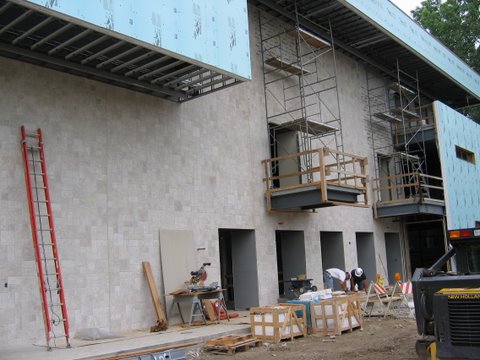
While we were away in Israel these past two weeks, there was some nice progress on the building, though I am told the exterior work went somewhat more slowly because of some recent heavy rains. The pix above and below show the extensive work on the Jerusalem stone wall that runs along the south end of the building. This aspect of the project has been been critical as the workers cannot begin work on the main staircase until it is complete. The third pic down gives a good view of the cypress siding on the north wall, which has now been completed. They have also almost finished setting up the studs for the interior walls on the first and second floors (see bottom pic).

Looks like more rain is coming this week – thankfully we’re almost finished with the exterior work at this point…


img_3404.jpg

img_3418.jpg

img_3406.jpg

The Ancient Art of Energy Efficiency

bulb.jpgIn this week’s Torah portion, Shoftim, we read the following commandment, which is presented amidst various Biblical laws of warfare:

When in your war against a city you have to besiege it a long time in order to capture it, you must not destroy its trees, wielding the ax against them. You may eat of them, but you must not cut them down. Are trees of the field human to withdraw before you into the besieged city? Only trees that you know do not yield food may be destroyed: you may cut them down for constructing siegeworks against the city that is waging war on you… (Deuteronomy 21:19-20)

Interestingly enough, the importance of this law to Jewish tradition has had absolutely nothing to do with war. Rather, it has subsequently become the foundation of a Jewish ethic of energy efficiency (known as “Bal Taschit” or “Do not Destroy.”) In characteristically subversive fashion, the rabbis of the Talmud took the Torah’s concern over destroying fruit bearing trees during wartime and extended it to address more deeply the abuse of the earth’s natural resources. In one famous example they warn against creating a Talmudic era “oil shortage:”

Rav Zutra says, “Whoever covers an oil lamp or uncovers a naphtha lamp violates the law of Bal Taschit (BT Shabbat 67b)

For his part, the Rambam (Moses Maimonidies) extended this list even further:

Whoever breaks vessels, or tears garments, or destroys a building, or clogs a well, or does away with food in a destructive manner violates the negative mitzvah of Bal Tashchit (Hilkhot Melakhim 6:10)

Thus we learn that energy efficiency is not simply a fad or bandwagon – the concern over the exploitation of the earth’s natural resources actually has ancient roots in Jewish tradition. This concern stems from the fundamental conviction that we are but temporary residents upon a natural world that does not ultimately belong to us (see for instance Leviticus 25:23: “for the land is Mine; you are but strangers resident with Me.”) In an era that is consuming earth’s sacred resources at an unprecedented rate, this conviction speaks to us more powerfully than ever before.

(Want a more contemporary list of things you can do to observe the ancient art of energy efficiency? Click here for more ideas!)

Open House, Open Heart

picture-038.jpg

Our second to last day in Israel has been one of our most memorable: a visit to the Open House in Ramle and a conversation with its co-founder, Dalia Landau. (That’s me on the left, above, next to Dalia, JRC member Maxine Topper, and Open House’s Administrative Director, Khader Al-Kalak).

You may know Dalia’s story from “The Lemon Tree,” the powerful, must-read book by journalist Sandy Tolan. This house in Ramle was originally built by a Palestinian Arab family that was expelled by the Israeli army during the 1948 war and subsequently became the home for Dalia’s family, who were Holocaust refugees from Bulgaria. As “The Lemon Tree” documents, Dalia eventually struck up a friendship with Bashir Al-Khayri, a Palestinian man who had grown up in the same house and whom she met when he came back to visit in 1967. The house has since been transformed by Dalia and Bashir into a coexistence center, housing a preschool for local Arab children and sponsoring coexistence programs for Jewish and Arab children in the region.

Our visit with Dalia has been one of the emotional highlights of our trip. We were especially struck by her open-hearted presence – and the way she has used her own personal transformation as a tool for healing in the midst of seemingly intractable hatreds. When I asked Dalia if she was hopeful about prospects for peace, she responded that she cannot ultimately look to external events for hope. In the end, as she put it, hope has to come from within. Real hope can only be found when we stop depending upon politicians to create change and begin taking personal responsibility for making a difference in the world.

Dalia truly typifies for me why coexistence work is so essential. While it may be true that the ultimate solution to this conflict will have to be a political one, we can never underestimate how essential inter-personal reconciliation is to the peace process. The participants on our JRC trip have discussed this issue in great depth these past two days: certainly we cannot cease in advocating for a political solution to this conflict – but neither should we dismiss the importance of coexistence work that has the potential to transform the lives and attitudes of real individuals.

Institutions such as Open House (or Neve Shalom/Wahat al-Salam - the venerable Jewish-Arab village we visited yesterday) are particularly critical in the way they give children the foundational context for ongoing coexistence that could well last for the rest of their lives. Regardless of the ebb and flow of the ongoing political situation, I agree with Dalia that these efforts are where true hope resides.

Tomorrow is our last day in Israel – my next post will most likely come from stateside.

Shalom, Salaam, Peace…

picture-036.jpg

Green Shuls on the Move!

mishkan-day-view.jpgThrilled to see that JRC’s Green efforts were highlighted prominently in the Jewish Forward this past week:

When their synagogue opens in less than a year, members of the Jewish Reconstructionist Congregation in Evanston, Ill., will have to adjust to a lot more than just a new roof over their heads. For starters, they’ll have showers and bike racks — just in case they want to pedal to services — and tinted glass windows, to minimize the amount of heat the building absorbs. Less obvious to synagogue-goers might be the solar-powered parking lot lights, the high-efficiency boilers and the cypress wood recycled from an old East Coast barn, all of which factor into the construction.

Those changes are among a laundry list of environmentally friendly, or “green,” design choices that the Chicago-area synagogue is implementing in its new home. When it opens in January 2008, the building will become the first synagogue to receive the second-highest possible classification — known as a LEED gold designation — from the U.S. Green Building Council, which rates buildings for sustainability. With months of construction ahead, the $10 million model synagogue may even still manage to make a few more adjustments to attain the highest level that only some 4% or 5% of applicants receive: LEED platinum status.

While the 450-family congregation represents the most devoted end of the spectrum, it is not alone in its efforts to bring its religious ideals in line with environmentally conscious ideals. In fact, synagogues and Jewish organizations across the denominations are moving — some faster than others — toward better aligning their buildings and business practices with Mother Nature. For the most part, they’re joining the wider global shift toward environmentalism for distinctly Jewish reasons.

Click here to read the entire article…