Monthly Archives: January 2010

Replanting the Uprooted on Tu B’shevat

Last week, Israeli Prime Minister Netanyahu celebrated the festival of Tu B’shevat (“The New Year of the Trees”) by leaving a meeting with American peace envoy George Mitchell and promptly embarking upon a tree-planting tour at Jewish settlements in the West Bank.

Here is what he had to say:

The message is clear – we are here and will remain here. We are planting and building; this is an inseparable part of the State of Israel.

For those looking for a different way to connect the festival of Tu B’shevat to the current political reality in the State of Israel, I recommend reading this at your seder, written by Rabbi Arik Ascherman of Israel’s Rabbis for Human Rights:

Lift the olive branch and say:

The olive branch, what is the reason for this?

We raise the olive branch as a symbol of responsibility, identification and hope.

We raise this branch in sorrow because each and every year, olive trees, the source of livelihood for Palestinian families, are intentionally chopped down, burned and uprooted.  In attempting to exercise their right to work their lands, farmers repeatedly put themselves in danger. Both the human being and the trees of the field are desecrated, and there is no earthly law or judge (ein din v’ein dayan). Only a few are guilty, but all are responsible (Rabbi Abraham Joshua Heschel).

On Tu B’shevat, we are taught that the trees cease to drink from the rains of the past year and begin to be nourished from the rains of the current year (Jerusalem Talmud, Rosh Hashanah 56a). However, into the old and the new waters have fallen the tears of the dove of peace whose feet cannot find a resting place (Genesis 8:9) because the earth has become filled with violence (Genesis 6:11). The olive branch has become bitter in her mouth – a symbol of strife.

We raise this branch as a symbol of identification with those Israelis and Palestinians who are doing everything in their power to change this reality and make enemies into friends (Pirke Avot De’Rabbi Natan) by planting, pruning, plowing and harvesting together, despite the voices of hate and incitement from both sides.

May it be Your will that the fruit of the olive, symbol of the World of Yetzirah/Creativity (Pri Eytz Hadar) inspire us to create justice and peace out of the basic materials of the soil, the fruit of the soil, and the human spirit (adamah, pri adamah, ve’ruakh ha’adam) so that by the time evening falls (Genesis 8:11) we will reconnect the olive branch to the root of the soul (Shoresh Nishmato).

May we thus beat our swords into plowshares and  our spears into pruning hooks…so that every person may sit under their vine or fig tree and none shall make them afraid (Micah 4:3-4) and the land shall know tranquility (Judges 3:11, etc.) and all of its inhabitants will rejoice.

Rabbi Brian Reports From Israel/Palestine

My friend Rabbi Brian Walt is currently living in Jerusalem with his family and will be there for next five months. I strongly encourage you to read his blog posts, in which he powerfully reflects on his experiences and describes the struggle for justice in Israel/Palestine. He just posted a piece on a recent demonstration in Sheikh Jarah; his post on a visit to Hebron last week is breathtaking.

“Israel, Good Job!”

Re Israel’s Haiti relief effort: check out this unbelievably edgy skit from Israel’s popular comedy show, “Eretz Nehederet.”

If it comes from Israel, is it still “Israel bashing?”

Playing Politics at Yad Vashem

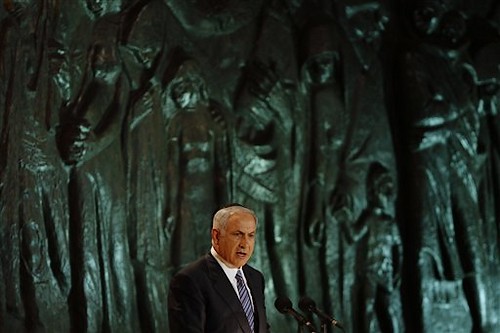
This is what I call cynically using the Holocaust for political purposes: Netanyahu recently used the opening of a new exhibit at Yad Vashem as an opportunity to denounce the Iranian regime, saying:

There is a new call to destroy the Jewish state, it’s our problem, but not only our problem. This is a crime against the Jews, and a crime against humanity, and it is a test of humanity. We shall see in the following weeks whether the international community deals with this evil before it spreads.

When I read this report, it sounded vaguely familiar – then remembered blogging about a similar comment Netanyahu made three years ago. Here’s what I wrote at the time:

Clearly Ahmadinejad’s murderous rhetoric toward Israel cannot and should not be taken lightly, and we should never minimize the threat posed by Iran’s nuclear ambitions. But we must also be very clear about what we are suggesting when we compare Ahmadinejad to Hitler and present day Iran to Nazi Germany. For what it’s worth, consider me to be one member of the organized Jewish community that finds this comparison unhelpful – and the prospect of an American or Israeli attack on Iran truly horrifying to contemplate.

Apropos of Netanyahu’s most recent comments: Ahmadinejad’s rhetoric toward Israel is definitely hateful, and is clearly designed to bait Israel and the West – but I can’t see how it possibly constitutes a “crime against humanity.”

Netanyahu’s Yad Vashem rhetoric certainly seems to indicate he’s itching to take the bait. Let’s hope the international community will see past his dangerous, wrongheaded invoking of a “second Holocaust” and deal with this crisis with intelligence and moderation.

An Epitaph for Abraham Sutzkever, z”l

Courageous Yiddish poet Abraham Sutzkever, may his memory now be for a blessing:

from “Epitaphs”

Written on a slat of a railway car:

If some time someone should find pearls
threaded on a blood-red string of silk
which, near the throat, runs all the thinner
like life’s own path until it’s gone
somewhere in a fog and can’t be seen—

If someone should find these pearls
let him know how—cool, aloof—they lit up
the eighteen-year-old, impatient heart
of the Paris dancing girl, Marie.

Now, dragged through unknown Poland—
I’m throwing my pearls through the grate.

If they’re found by a young man—
let these pearls adorn his girlfriend.
If they’re found by a girl—
let her wear them; they belong to her.
And if they’re found by an old man—
let him, for these pearls, recite a prayer.

Translated by Jacqueline Osherow

Interfaith Jamming the the Desert!

Just learned that the great alt-Jewish band The Sway Machinery, recently played at “Le Festival au Désert” – an amazing international music festival held annually in the Sahara desert near Timbuktu, Mali. Apparently, SM played before a largely Muslim audience and performed with several local African musicians as well. Click above for a taste.

Afro-pop Worldwide:

Koudede was followed by Sway Machinery’s own set.  They were strong and energetic.  They brought the audience into their groove within seconds.  While (band leader Jeremiah) Lockwood sang singing in Hebrew, the Muslim crowd respected the music and showed its appreciation by dancing along.  Haira Arby joined the group for their final song and showed once again her mastery of music.  She was immediately in the groove and brought her own authenticity to the number.

The Sway Machinery website reports:

In an unprecedented act of intercultural exchange, underground rock cult favorites and iconoclastic champions of historic Jewish music traditions, The Sway Machinery, have been invited to perform at The Festival of the Desert in Esekane, Mali, in the depths of the Sahara Desert this January. The Sway Machinery will bring its unique vision of Jewish Spiritual Music traditions to the heart of Islamic Africa, performing for an audience of thousands!

While in Mali, The Sway Machinery will record a new album, featuring collaborations with stars of the Malian music world. A documentary film about this journey is also in the making!

“The Sway Machinery Pilgrimage, as they have entitled their Africa project, is a beautiful example for the world of the great role artists can play in building bridges of love and understanding between cultures. This project is of clear importance in establishing new and positive images of Jews and Muslims engaging with each other”  (Imam Feisal Abdul Rauf, Chairman, Cordoba Initiative).

Israel in Haiti: More Perspectives

Some more interesting features on Israel’s relief (and public relations) efforts in Haiti…

The Jewish Forward:

(On) the ground was a retinue of Israelis dedicated to making sure people heard about their country’s humanitarian mission and spreading the word. Press officers from the Israeli military were flown in, as were photographers and a video team to document the work of Israeli medical and rescue personnel. They distributed daily footage to the press. Representatives of Israeli and foreign media were embedded with the group, and other reporters were invited.

A day after the Israeli field hospital opened, two Israeli officers in uniforms canvassed the row of TV producers sitting in their broadcast positions along the city airport’s runway. “We’re telling them about our hospital,” one said.

A feature from The Media Line by Brian Joffe-Walt:

Dahlia Scheindlin, an Israeli public opinion researcher and political strategist … (said) “Israelis hate when they are seen only in light of the conflict, especially when they are seen as aggressors, and they feel that most of the world is against them, with the possible exception of America.”

“As a result, Israelis are extremely supportive of anything that shows them in a better light because it’s so rare that they get any good news about how they are viewed in the rest of the world,” Scheindlin said. “We see this whenever there is global attention towards Israel for anything other than the conflict. This happened recently, for example, when an Israeli won the windsurfing gold medal or when an Israeli astronaut died.”

“That said, do I think the government participated in this aid effort for publicity? Absolutely not,” she said. “I don’t think it was a cynical move. Israel would have participated anyway. But Israelis do try to use these things to try to leverage a better image for themselves around the world.”

A very trenchant article by Ha’aretz correspondent Anshel Pfeffer:

The fundamental reason that Israel is routinely treated much more harshly than its adversaries, despite the fact that they very often carry out far worse atrocities, is that Israel puts itself out to be so much better than them. If in almost 62 years of existence, Israel had succeeded in evolving into a tinpot dictatorship, like most of its neighbors and many of the countries that achieved independence during that period, no-one would be holding it to such high standards, sometimes perhaps, unfairly. Israel is not condemned regularly in the media just because it keeps millions of Palestinians under occupation and embarks on a another mini war every other year, but because it is a country aspiring to be a western democracy while doing so.

Various pro-Israel advocacy groups publish glossy pamphlets detailing the manifold benefits Israeli technology has brought the entire world. Every word there is true and in the next editions, there will be an extensive chapter on the IDF’s international humanitarian missions, complete with photographs of the field hospital in Port-au-Prince. But that won’t improve Israel’s international image one iota. Quite the opposite.

We are a disproportionate country, and the difficulty is to reconcile a tiny brave democracy capable of such acts of greatness with an occupying regime constantly at war with its neighbors will continue to bring us bad headlines. Once the delegation comes back from Haiti.

On Haiti Remembered and Gaza Forgotten

Two prominent Israeli columnists ask: why are Israelis so eager to pitch in to the rescue effort in Haiti and yet show such little concern over the dire humanitarian crisis they’ve helped to create just a few kilometers away in Gaza?

Akiva Eldar, writing in Ha’aretz

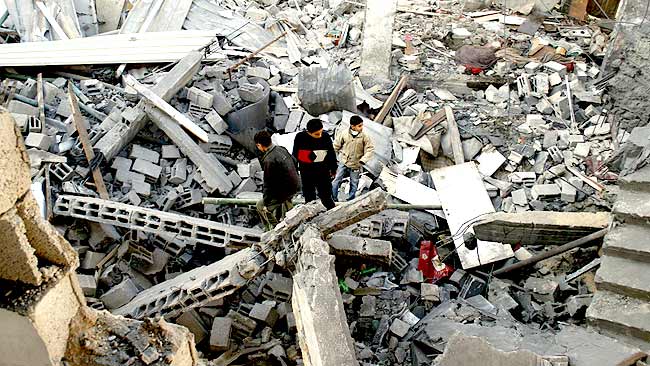
(The) remarkable identification with the victims of the terrible tragedy in distant Haiti only underscores the indifference to the ongoing suffering of the people of Gaza. Only a little more than an hour’s drive from the offices of Israel’s major newspapers, 1.5 million people have been besieged on a desert island for two and a half years. Who cares that 80 percent of the men, women and children living in such proximity to us have fallen under the poverty line? How many Israelis know that half of all Gazans are dependent on charity, that Operation Cast Lead created hundreds of amputees, that raw sewage flows from the streets into the sea?

The disaster in Haiti is a natural one; the one in Gaza is the unproud handiwork of man. Our handiwork. The IDF does not send cargo planes stuffed with medicines and medical equipment to Gaza. The missiles that Israel Air Force combat aircraft fired there a year ago hit nearly 60,000 homes and factories, turning 3,500 of them into rubble. Since then, 10,000 people have been living without running water, 40,000 without electricity. Ninety-seven percent of Gaza’s factories are idle due to Israeli government restrictions on the import of raw materials for industry. Soon it will be one year since the international community pledged, at the emergency conference in Sharm el-Sheikh, to donate $4.5 billion for Gaza’s reconstruction. Israel’s ban on bringing in building materials is causing that money to lose its value.

Gershon Baskin, in today’s Jerusalem Post:

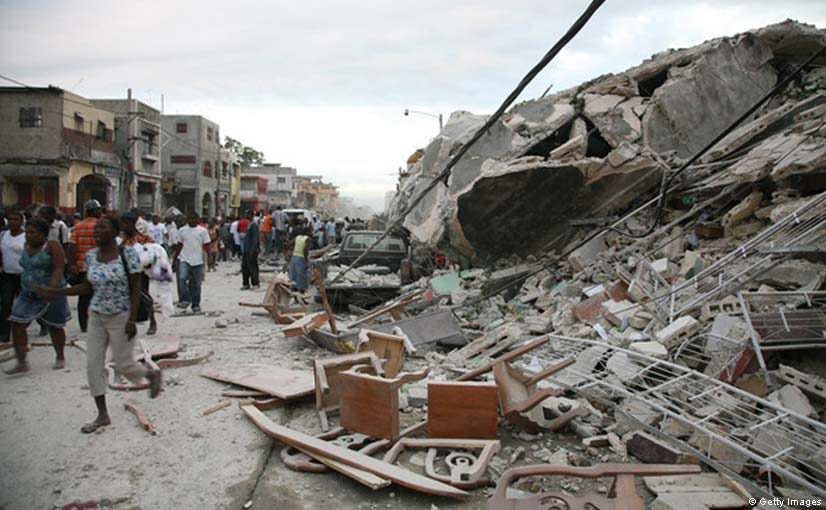
Humanitarian disasters around the world bring out the best in Israel and in Israelis. The horrific devastation caused by the earthquake in Haiti and the scenes of unbearable human suffering brought about an immediate enlistment of both civilian and public efforts to come to the aid of the poorest nation in the Western hemisphere…

But what about the humanitarian disaster in our own backyard caused in a large part by our own doing? What about Gaza? More than 1.5 million people are living in total poverty, without sanitary drinking water, under an economic and physical siege, locked in what could easily be called the world’s largest prison. While we ask to see in all of the gory details, all of the destruction including hundreds of corpses on the streets of Port-au-Prince, we wish to see none of the human suffering of our Palestinian neighbors in Gaza where we literally hold the keys to the end of their suffering.

My Favorite Rabbis: Everett Gendler

Most people probably don’t realize this, but rabbis need rabbis too.

And there are a lot of great rabbis out there. Over the years I’ve been personally inspired by many of them: remarkable, talented leaders whose work challenges me, drives me and constantly reminds me why I do what I do. So with this post I’m debuting a new series I’m calling “My Favorite Rabbis:” ongoing profiles of the contemporary rabbis whom I consider to be my own spiritual teachers.

I’ll start by introducing you to Rabbi Everett Gendler, a Conservative rabbi whose moral courage has provided Jewish leadership for some of the most important progressive causes of our day. Today, some fifty years since he became a rabbi, I believe he remains on the cutting edge of the issues that truly matter.

This MLK weekend, it is certainly appropriate to note that Rabbi Gendler was one of the first rabbis to become actively involved in the struggle for civil rights in America and played a critical role in involving American rabbinical leadership in the movement. It’s doubtful that American rabbis would have stepped up to this struggle nearly as much had it not been for Rabbi Gendler’s prophetic influence.

During the early and mid-1960s, Rabbi Gendler led groups of American rabbis to participate in numerous prayer vigils and protests throughout the South. Of course many know that the legendary Rabbi Abraham Joshua Heschel marched with Dr. Martin Luther King in Selma in 1965. I imagine far fewer are aware that it was in fact Rabbi Gendler who persuaded Heschel to do so.

Heschel biographer Edward K. Kaplan writes:

Despite fears for his safety from his wife and the twelve year old Susannah, (Rabbi Heschel) agreed to join the march at the urging of Rabbi Everett Gendler, a pacifist and former student. Gendler had led a group of rabbis to Birmingham, Alabama to work for voting rights and remained in touch with the Reverend Andrew Young, King’s Executive Assistant at the SCLC. (From “Spiritual Radical: Abraham Joshua Heschel in America,” p. 222)

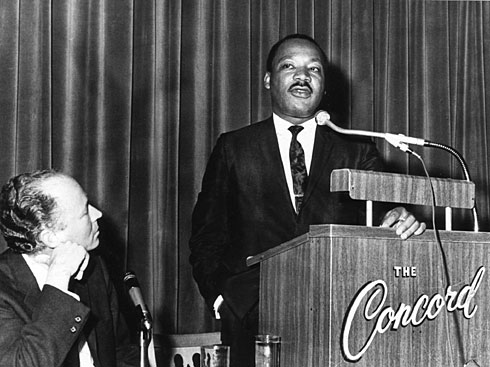
Rabbi Gendler was also instrumental in arranging Martin Luther King’s keynote address at the Rabbinical Assembly’s convention on March 25, 1968. This now-legendary speech took place at the Concord Resort hotel in New York’s Catskill Mountains just 10 days before King’s death. (That’s Rabbi Gendler to the left of Dr. King in the pic above).

Today, decades after King’s death, Rabbi Gendler remains an eloquent Jewish advocate for the path of nonviolence. His work has taken him across the world – most notably to India where he and his wife Mary teach the principles of nonviolence to Tibetan exiles.

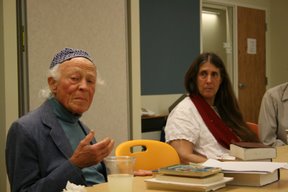
I’m personally honored to serve with Rabbi Gendler on the Elder’s Council of the Shomer Shalom Institute for Jewish Nonviolence. In this picture, he leads a workshop at JRC in 2008. Shomer Shalom founder Rabbi Lynn Gottlieb (someone whom I may well be profiling in the future) is sitting next to him.

Rabbi Gendler has also been a long time advocate for Palestinian human rights – and his courageous stands have made it possible for new generations of rabbis to find their own voices on this painful issue. When Rabbi Brian Walt and I first began Ta’anit Tzedek and were looking for rabbis to join our campaign to protest the blockade of Gaza, we immediately turned to Rabbi Gendler, who joined our effort without hesitation. It is difficult to describe how much it means to know there are rabbis out there like Everett, someone who has been putting himself on the line for so long, and upon whom we always know we can rely for guidance and support.

Rabbi Gendler was also one of the first Jewish leaders to embrace environmentalism and vegetarianism long before they became fashionable. As the rabbi of a green synagogue myself, I recognize a tremendous debt to Everett, who more than anyone helped to put environmental issues on the radar screen of the Jewish community.

From a 2008 article in the Los Angeles Jewish Journal:

On a ferociously cold evening in November 1978, Rabbi Everett Gendler climbed atop the icy roof of Temple Emanuel in Lowell, Mass., and installed solar panels to fuel the synagogue’s ner tamid (eternal light)…

Gendler’s conversion of that eternal light marks the first known action to green a synagogue, making it more spiritually and ecologically sustainable, and Gendler himself, now Temple Emanuel’s rabbi emeritus, has been hailed as the father of Jewish environmentalism.

There so much more to say about Everett and his work. I suppose the most essential thing I can say about him is that he was and remains a spiritual maverick. His work remains as relevant and courageous as ever.

As we honor Dr. King this weekend, it’s critically important to honor those who continue his to walk his path in our own day. For me and so many others, Rabbi Everett Gendler is the one who teaches us how to walk that walk.

What We Need To Do For Haiti

In the wake of the terrifyingly tragic earthquake in Haiti, it has been gratifying to see private citizens give so generously to relief efforts. At the same time however, we shouldn’t forget that our own country’s policies can have a considerable impact on Haiti’s recovery. Check out what constitutional lawyer/human rights activist/Katrina survivor Bill Quigley has to say in his piece, “Ten Things the US Can and Should Do for Haiti.”

Item #3, for example:

Give Haiti grants as help, not loans. Haiti does not need any more debt. Make sure that the relief given helps Haiti rebuild its public sector so the country can provide its own citizens with basic public services.