Category Archives: God

Palestine Solidarity from the Streets to the Statehouse

From my Yom Kippur sermon this past October:

(There) are plenty of Jewish congregations out there: why does the world need another? What do we have that’s unique to offer? As I think about it, this is a critical question for any Jewish community. Do we exist just to exist or for a more transcendent purpose? Does our existence actively seek to repair the world or does it merely serve to use up Jewish community resources? Or worse still, does our communal existence contribute to harm in the world? 

I recalled those words last week when I learned that Anshe Emet, a prominent Conservative synagogue in Chicago planned to host a program with invited guest Yoav Gallant, the former Israeli Minister of Defense and one of the primary architects of Israel’s genocide against Gaza – who currently has a warrant out for his arrest issued by the International Criminal Court.

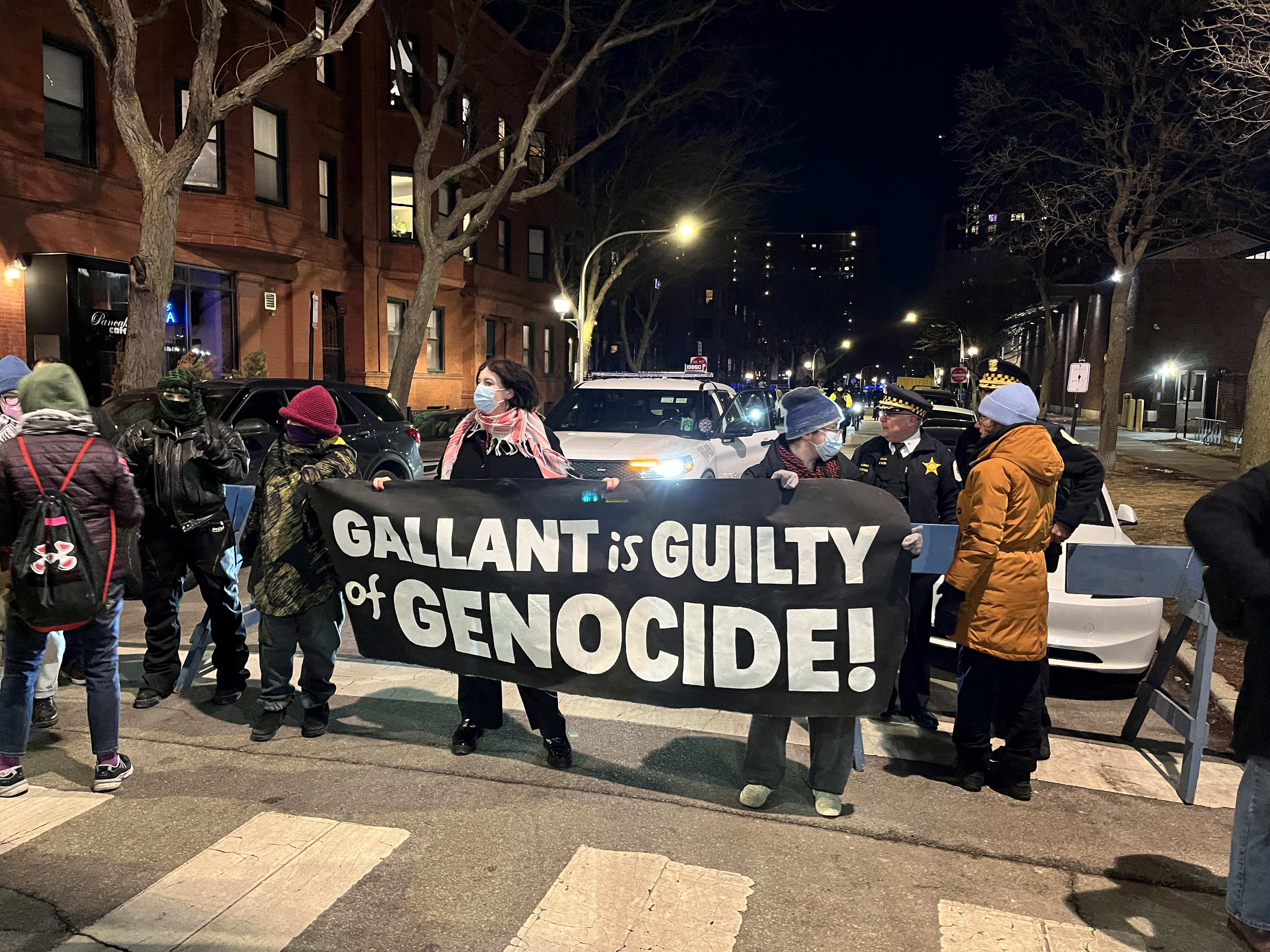
It should go without saying, but I’ll say it out loud: it is appalling and sickening that a prominent synagogue welcomed – and in fact celebrated – a genocidal war criminal in their house of worship. I’m proud to say that a massive protest was organized by a wide coalition of Palestine solidarity groups, including US Palestine Community Network, American Muslims for Palestine, Jewish Voice for Peace and #IfNotNow to voice a message of outrage, solidarity and collective conscience.

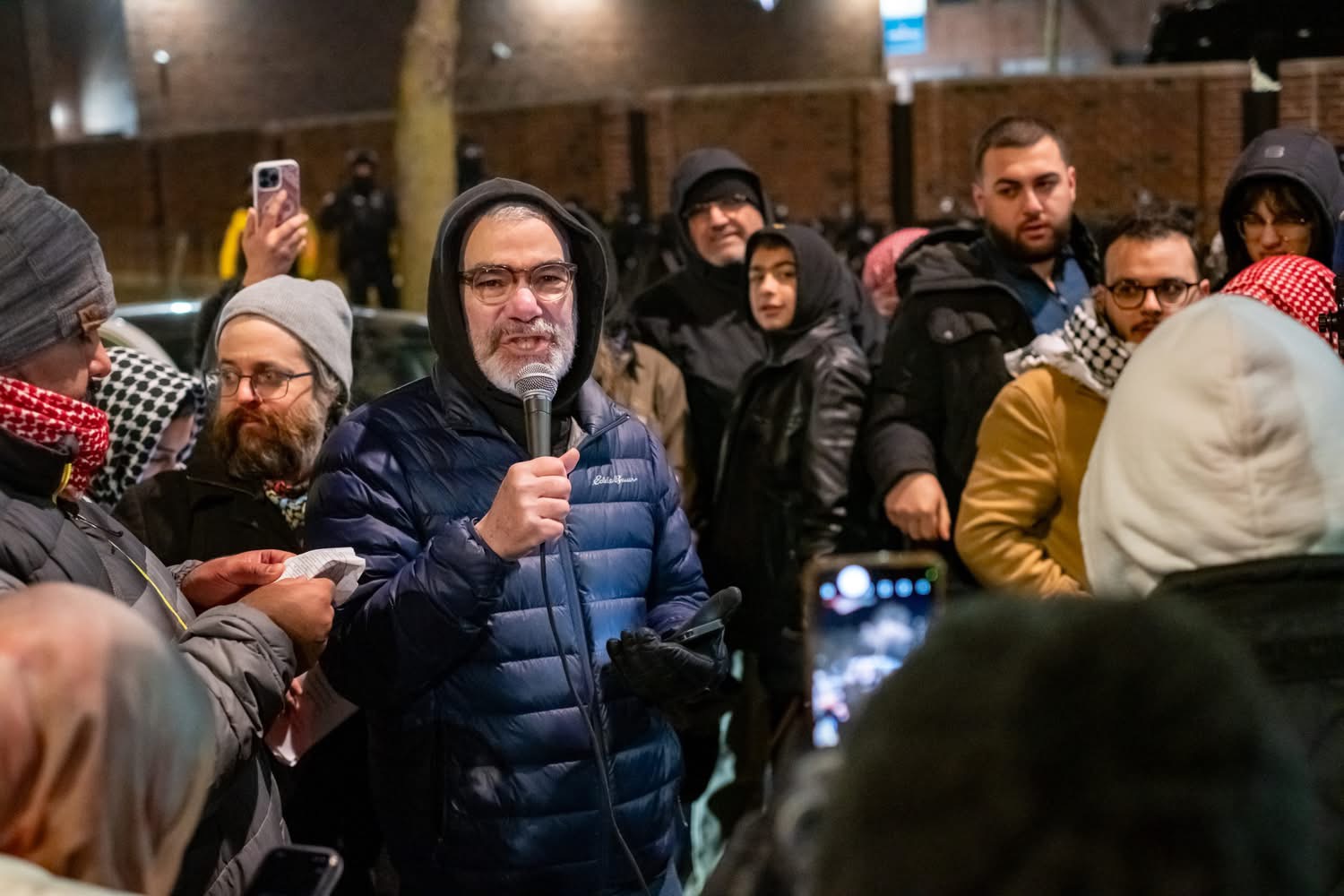
Hundreds of us gathered last night across the street from the synagogue in the freezing cold to express our outrage and mutual solidarity. There were many speakers from our diverse coalition and it was my honor to be among them. Here are my remarks, below:

photo: Love and Struggle/Sarah Ji

My name is Brant Rosen; I’m a proud member of Jewish Voice for Peace, the Jewish Voice for Peace Rabbinical Council, and I’m the founding rabbi of Tzedek Chicago – a proudly anti-Zionist synagogue here inI Chicago with members here and around the world.

In Jewish tradition there is a central concept we call Hillul Hashem. It literally means “desecration of God’s name.” This is at root a deeply moral concept that goes to the heart of what it means to be a human being. When we diminish the humanity of another, we diminish God’s presence in the world – and we commit the worst kind of Hillul Hashem when we commit the crime against genocide against another people.

In October 2023, Yoav Gallant, Israel’s then defense minister, said:

We are imposing a complete siege on Gaza. There will be no electricity, no food, no water, no fuel, everything is closed. We are fighting human animals and we are acting accordingly.

The Palestinian people know what it means to be robbed of their humanity. They have been deemed a collectively disposable people by Israel for over 100 years. Their very presence is a problem for Israel. We Jews should know all too well what happens when a state robs a people of its essential humanity.

The ICC has put a warrant out for Yoav Gallant’s arrest as a war criminal because he actively dehumanized the Palestinian people in word and in deed. Over 60,000 Palestinians killed in Gaza to date and over 100,000 injured, the majority of whom are women and children. According to one estimate, the ultimate death toll may eventually be nearly 200,000. Whole extended families, entire Palestinian bloodlines have been wiped out completely. Much of Gaza has been literally reduced to a human graveyard, with scores of bodies buried beneath the rubble of destroyed and bulldozed homes. Neighborhoods and regions have been literally wiped off the map. 

Gaza’s infrastructure and health care system has been decimated. According to the UN an “intentional and targeted starvation campaign” has led to widespread famine and disease throughout the Gaza strip. Health care workers, humanitarian workers and journalists are being killed, injured and imprisoned in massive numbers. Human rights agencies have documented widespread torture and abuse of prisoners, including sexual abuse, throughout a network of torture camps. 

This is dehumanization, this is Hillul Hashem of the worst kind. And to you Yoav Gallant, we say, “We Charge Genocide!” “You are not welcome in our city!”

But Yoav Gallant and the nation he served could not have succeeded if there where not those who normalized this genocide. And that is why we are here tonight. As a rabbi, as a Jew, as a person of conscience, I am morally outraged – I am sickened – that this war criminal is being hosted – and in fact celebrated – at a synagogue, a Jewish house of worship. This is what it has come to.

And here I want to address the members of Anshei Emet and the Jewish community of Chicago. Our community has a profound moral choice to make. What is the Judaism we will affirm? Will we uphold Zionism – and its ideology of Jewish supremacy – or will we stand for the sacred divine image of all people? Will we stand with war criminals or will we stand with those who are deemed to be disposable? Will we stand with the genocidal state of Israel or will we stand with the Palestinian people?

Now I’d like to address my friends and comrades in the Palestinian community:, please know that are so many of us in the Jewish community who stand in solidarity with you. There is nowhere else we can possibly be at this moment. And there are so many of us who are voicing the alarm, marching in the streets, taking arrest to demand justice for Palestinians

It is not an overstatement to say this: history will remember what we did or did not do in this moment. We are ready, together with you, to call out those who, in our name, are committing the worst kind of Hillul Hashem against you, whether it is in the streets of Rafah and Deir al Balah, the halls of Washington DC or a synagogue in Chicago. And we will not cease until all are free, from the river to the sea!

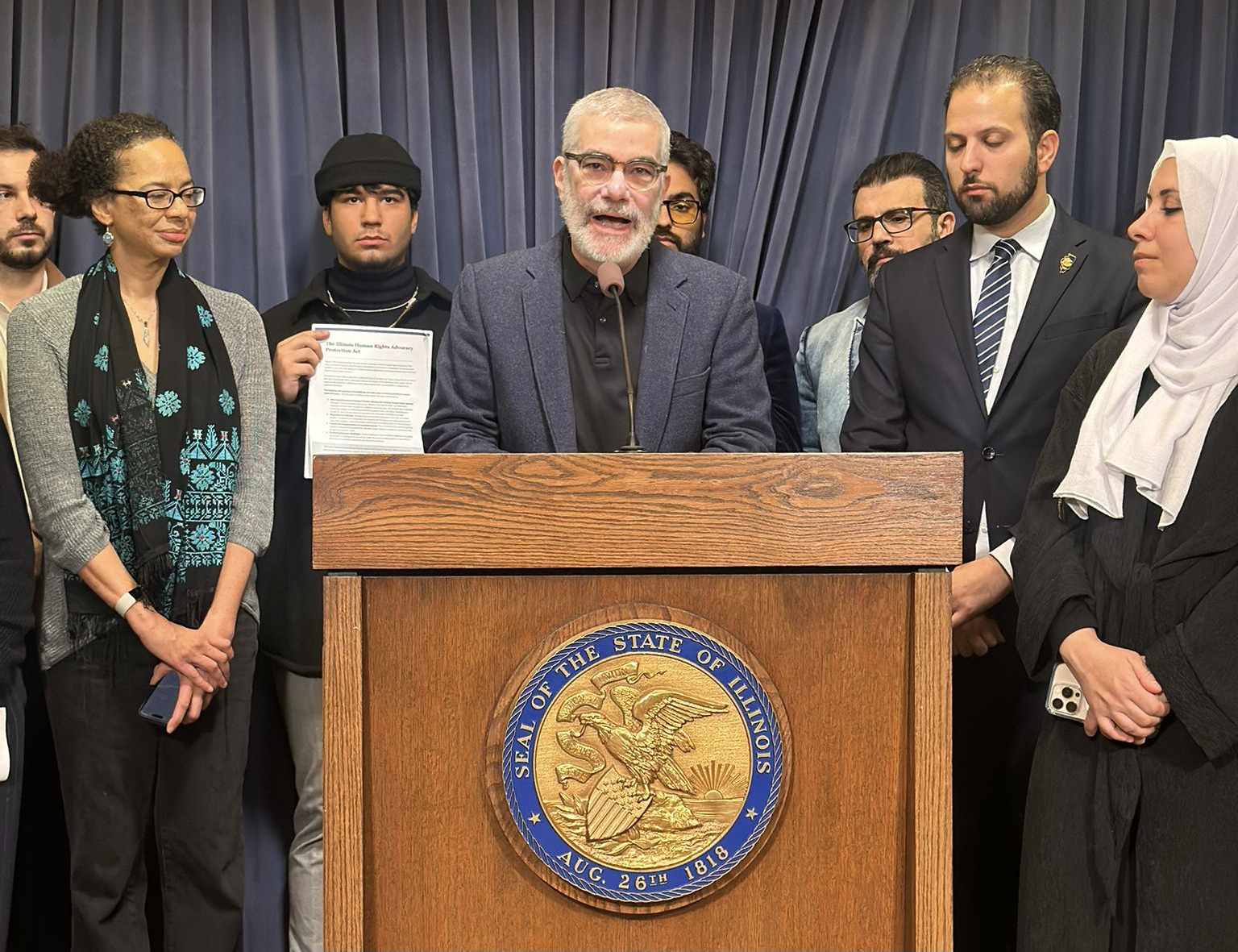
It’s been a busy week. This past Wednesday, I was in Springfield with friends and comrades to announce new IL state legislation, “The Illinois Human Rights Advocacy Protection Act,” which would repeal our state’s 2015 anti-boycott legislation that punishes advocacy for Palestinian human rights. This unconstitutional and immoral legislation, signed by then Gov. Bruce Rauner, directed the Illinois Investment Policy Board to restrict public funding to companies that use human rights filters that exclude doing business with Israel.

The new legislation, which is being introduced in the IL State House by Palestinian-American representative Abdulnasser Rashid, will “(remove) provisions requiring the Illinois Investment Policy Board to include companies that boycott Israel in its list of restricted companies.” An identical bill will be introduced in the IL Senate as well.

You can watch the entire press conference here. My remarks follow below:

Here in Illinois and around the world, we are at a critical and frightening moment. The US is governed by an administration that openly considers certain populations to be disposable. Whether it is undocumented immigrants, birthright citizens, trans youth or the Palestinian people.  Just yesterday, our president announced his intention to depopulate the entire Gaza strip of over 2 million Palestinians and turn it into the “Riviera of the Middle East.”  This after a previous administration helped to arm Israel in its crushing military assault – one that many reputable human rights organizations have termed a genocide against the Palestinian people.

In Jewish tradition, one of our most central theological tenets, which is repeated over and over, is that God responds to the cries of the oppressed. The Palestinian people have long been crying out to the international community. Over the past sixteen months, their cries have reached a fever pitch. The question before us, that has ever been before us, is how will we respond?

That is the essence of the Palestinian call for Boycott, Divestment and Sanctions. It is a call from an oppressed people who are seeking support and solidarity from the international community. It originated in 2005, when a wide coalition of Palestinian civil society organizations made a crie de cour for solidarity and support. They issued a call to the world to use the time-honored nonviolent strategy of Boycott, Divestment and Sanctions.

There are three essential demands of this call, which are all are based in international law: to end the occupation of the West Bank and Gaza, full and equal rights for Palestinian citizens of Israel, and to honor the UN mandated Palestinian right of return. Like all boycotts, it allows private citizens, companies and civil society organizations around the world to actively and meaningfully respond to the legitimate and collective cry of the Palestinian people.

It is also a form of free speech. Just like historic Montgomery Bus Boycott, the United Farm Workers Boycott, the boycott of apartheid South Africa before it. When the state of Illinois passed legislation restricting participation in this pro-peace, pro-human rights movement, it actively criminalized free speech. It was immoral and illegal to do so when it was enacted by Governor Rauner in 2015 – and it remains so today. In the current moment, when our country is ruled by a regime that is actively and unabashedly criminalizing free speech, we should see this legislation for what it is. The state of Illinois has no business aiding and abetting in this stripping of our right to free speech. It has no moral standing to stifle and stigmatize the legitimate cry of the oppressed.

In the Jewish community this week we are reading from our Torah, the Exodus story. And the Exodus story makes it very clear: that God responds to the cry of the oppressed and demands their liberation. We also read that this process began with brave people to defy and resist oppression. That is how liberation happens.

We are at just a moment right now. This is truly a which side are you on moment. Will we hearken to the cries of the oppressed, or will suppress their voices – and those who support their call for liberation?  We urge the state of Illinois to stand the right side of history.

A Jewish letter of support for the Illinois Human Rights Advocacy Act will soon be made public as well. I’ll make sure to post it when its available.

Learning How to Breathe in the Era of Trump

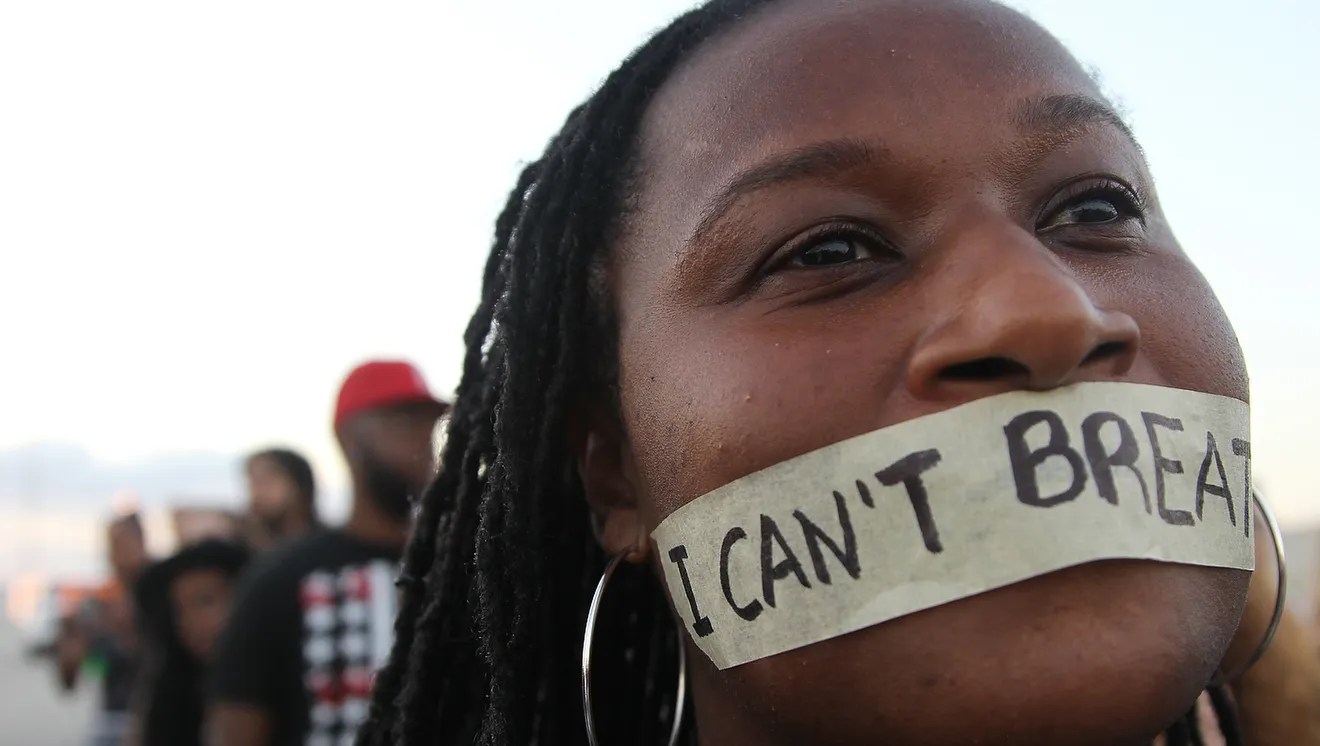
(photo: Carl Juste/AP)

In this week’s Torah portion, Parashat Va’era, God’s tells Moses to return to Mitzrayim and say to the Israelites:

“I am יהוה. I will free you from the labors of the Egyptians and deliver you from their bondage. I will redeem you with an outstretched arm and through extraordinary chastisements.” (Exodus 6:6)

But when Moses attempts to impart this message of liberation to the people, they weren’t able to hear it as “their spirits were crushed (kotzer ruach) by cruel bondage.” (6:9)

This one verse says so much about the trauma of personal and systemic abuse. The Hebrew word ruach means both “spirit” and “breath/wind.” On one level this could mean that their oppression was so severe that individual Israelites could barely breathe. On a deeper level, it might indicate that their collective spirit was so damaged they couldn’t even begin to comprehend the possibility of liberation.  

The dual meaning of the word ruach in Jewish tradition suggests that the divine spirit is embodied by our very breath: the life force that we share with God and all that lives. In the first chapter of Genesis, we read that the process of creation began when the ruach elohim (“God’s breath”) rippled across the primordial waters. Humanity itself came to life when God breathed into the first human. In Jewish liturgy, we awaken every morning expressing gratitude for “the breath of every living thing and the spirit of all flesh.”

I believe there are powerful spiritual/political implications embedded in this theological concept. It suggests that when human beings – or humanly-created systems of oppression – deprive people of their ability to breathe freely, the flow of divine life force in the world is disrupted. Moreover, the demand to be able to breathe is itself a clarion call to action. We need look no farther than the phrase “I can’t breathe,” the final words of George Floyd and Eric Garner, whose deaths at the hands of systemic racism provided a powerful spark for the Black Lives Matter movement. Nigerian writer/poet Ben Okri has suggested that these three words “should become the mantra of oppression,” from the racist systems in our communities to the life-choking forces of global climate change.

In this regard, we might view the Jewish practice of giving thanks for our breath every morning as much more than a simple prayer discipline: it is nothing less than a statement of connection and solidarity with all that lives. Those who can breathe easily tend to regard the act of breathing as a natural, involuntary reflex. But as those with chronic respiratory illnesses will surely attest, it is no small thing to be able to take a breath. And in the age of COVID and climate change, millions throughout the world are increasingly becoming chronically kotzer ruach as a result of systemic oppression and corporate profit.

In other words, a commitment to a world in which everyone can breathe freely is a spiritual/political act of resistance. As disability justice activist Rabbi Julia Watts Belser has written:

Let’s learn to work more slowly, move more deliberately. Let’s learn to listen, when our bones say no. Let’s mandate breaks for anyone who works outside. Let’s require air purifiers, ventilation systems and safe work environments. Let’s make sure that all of us can breathe.

It is not too hyperbolic to suggest that the current political moment has left many of us breathless. As we death-scroll through the news of Trump’s executive orders and authoritarian policies, the ferocity of this onslaught can leave us literally or figuratively gasping for air. But this is, of course, just what Trump and his movement wants: to leave us reeling through a calculated strategy of shock and awe. They want us to feel breathless, paralyzed, despairing. We must not succumb. We must not accept that breathlessness is the new existential normal of our political age. We cannot become, like the Israelites of our Torah portion, so kotzer ruach that we cannot even imagine the possibility of something better beyond this authoritarian tyranny.

In the work of resistance, the first order of business is, quite simply, remembering to take a breath. Because in the end, if we are paralyzed with breathlessness for the next four years, we will be of no use to ourselves or anyone else. Moreover, once we regain our breath and our equilibrium, we will be in a better place to discern what we can do to meet this moment. In the wise words of Chicago organizer Kelly Hayes:

When your enemy wants you disoriented, your ability to focus is an important means of self-defense. What matters to you in this moment? Most of us can meaningfully dedicate ourselves to one or two causes, at the most. What can you commit to doing something about? Where do you get trustworthy information about those subjects? Who do you connect with when deciding what to do about what you’ve learned? Is there an organization whose resources you will employ or whose calls to action you will answer? Do you have a friend group or solidarity network that will formulate a response together? Answering these questions is key to steadying yourself in these times. Remember: Vulnerable people don’t need a sea of reactivity right now. They need caring groups of people who are working together to create as much safety as they can. We need to create a rebellious culture of care. That will take focus and intention. It will take relationships and a whole lot of energy. 

This Shabbat, let’s all commit to breathing more freely. Then let’s fight for a world in which that freedom is extended to all.

Lifting up the Torah of Struggle and Collective Liberation

Artist credit: Jack Baumgartner

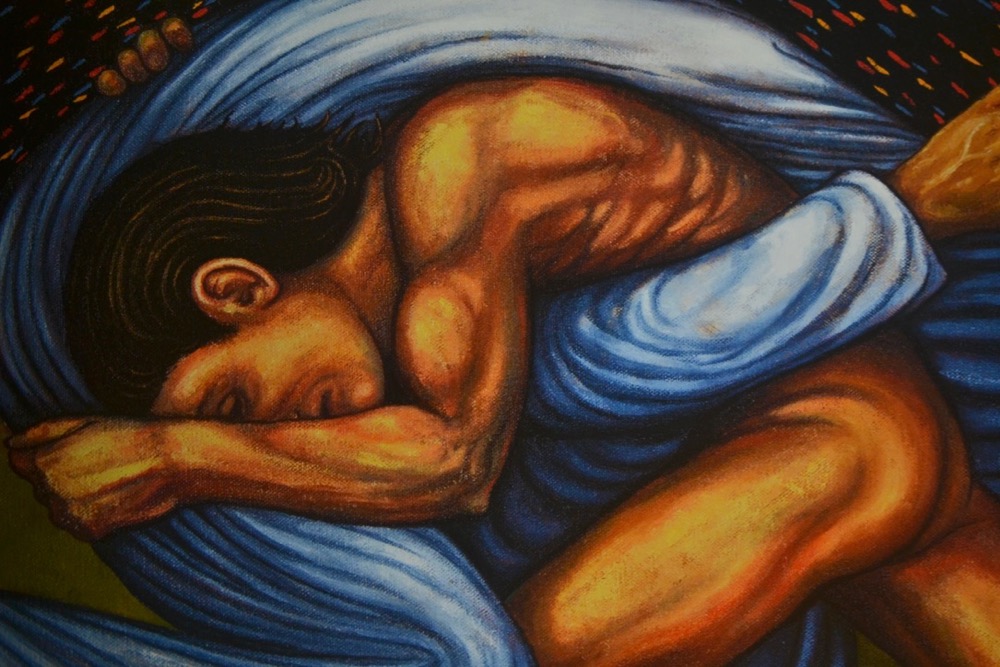
In this week’s Torah portion, Parashat Vayishlach, Jacob prepares for a meeting with his long-estranged brother, who is coming to meet him with a retinue of four hundred. Understandably frightened, Jacob divides his family up into groups and sends them ahead separately, hoping to placate Esau with tribute. He then spends the night alone on the bank of the Jabbok River.

During the night, Jacob wrestles by the riverbank with a mysterious man until the break of dawn. When the man sees that he cannot prevail against Jacob, he wrenches his hip at the socket. Jacob demands a blessing from the stranger, who renames him Israel (Hebrew for “wrestles with God”) adding, “you have struggled with beings divine and human and you have prevailed.” Jacob names the place of this encounter Peniel, (“God’s face”), saying, “I have seen a divine being face to face and have survived.”

The next morning, Jacob/Israel approaches Esau. Esau runs to greet him and weeping, they embrace and kiss one another. During the course of their reunion, Esau asks why Jacob had sent him gifts. “I have enough, my brother,” he says, “Let what you have remain yours.” But Jacob insists, “No, please do me this favor by accepting this gift, for to see your face is like seeing the face of God.”

There’s so much to say about this short, powerful story. Like much of Genesis, since many characters are representative of nations, we can read it on two levels simultaneously: as a narrative about an extended family and as a symbolic allegory about the relations of nations in the ancient Near East. Here, Jacob represents Israel and Esau is Edom; thus, we are reading both about the struggles of twin siblings and the origins of the fraught relations between the Israelites and Edomites.

Since these two peoples have a largely antagonistic relationship in the Hebrew Bible, classical commentary has not been kind to Esau and the Edomites. The Rabbis famously associated Esau with the Romans, the “wicked empire” who persecuted the Jews before and after the destruction of the Temple. One vivid midrash relates that Esau didn’t kiss but rather bit Jacob in the neck! Jewish commentators later coined the term “Esau hates Jacob,” a reference to (what they believed was) the eternal, immutability of gentile antisemitism.

It has always seemed to me that this complex and poignant narrative of twin brothers struggling toward reconciliation belies this simplistic interpretation of “good Israel” vs. “evil Esau.” I’m struck that the first time we met Jacob and Esau, they are wrestling with each other in utero – and when they are reunited, they embrace. This is not just a simple story about the struggle for personal/national dominance. The struggle we read about here is much deeper and far more profound than that.

I would argue that it is far too reductive – and even dangerous – to view the Torah as a narrative about the heroic Israelite wars with antagonistic nations. Embedded in Biblical tradition, there is a much deeper and more profound portrayal of deep love and solidarity between different peoples who are described as a complex, yet loving extended family. There are numerous examples: Abraham’s sons Isaac and Ishmael reunite to bury their father (as Jacob and Esau do when Isaac dies at the end of our portion). Moses marries Zipporah, the daughter of the Midianite High Priest Jethro (who is his spiritual mentor). Ruth, a Moabite, shows great love and loyalty to her Israelite mother-in-law Naomi, and later marries an Israelite, beginning the lineage that leads to King David. 

In this fearful current moment, when war and fascism is escalating in too many places around the world, it seems to me that these sacred streams of our spiritual tradition are speaking out to us with renewed urgency. Let us reject the voices in Judaism – and all traditions – that preach the immutability of hatred and war. Let us live up to our inherited spiritual legacy as Israel/Godwrestlers. Let us lift up the Torah of struggle that leads to reconciliation and collective liberation.

What Makes Space Sacred? What Makes Land Holy?

photo credit: Zaha Hassan

Are some places in the world more inherently sacred than others? Or is the entire world itself a sacred place? These questions are at the heart of this week’s Torah portion, Parsahat Vayetze.

As the portion opens, Jacob has fled his home to escape from the wrath of his brother, Esau. Alone in the wilderness, he arrives at a place (in Hebrew, makom) to spend the night, using a stone as his pillow. That night, he dreams of steps reaching from earth to heaven, upon which angels ascend and descend. God appears to Jacob and reaffirms the promise made to Isaac and Abraham, promising to protect Jacob on his journey until he returns home.

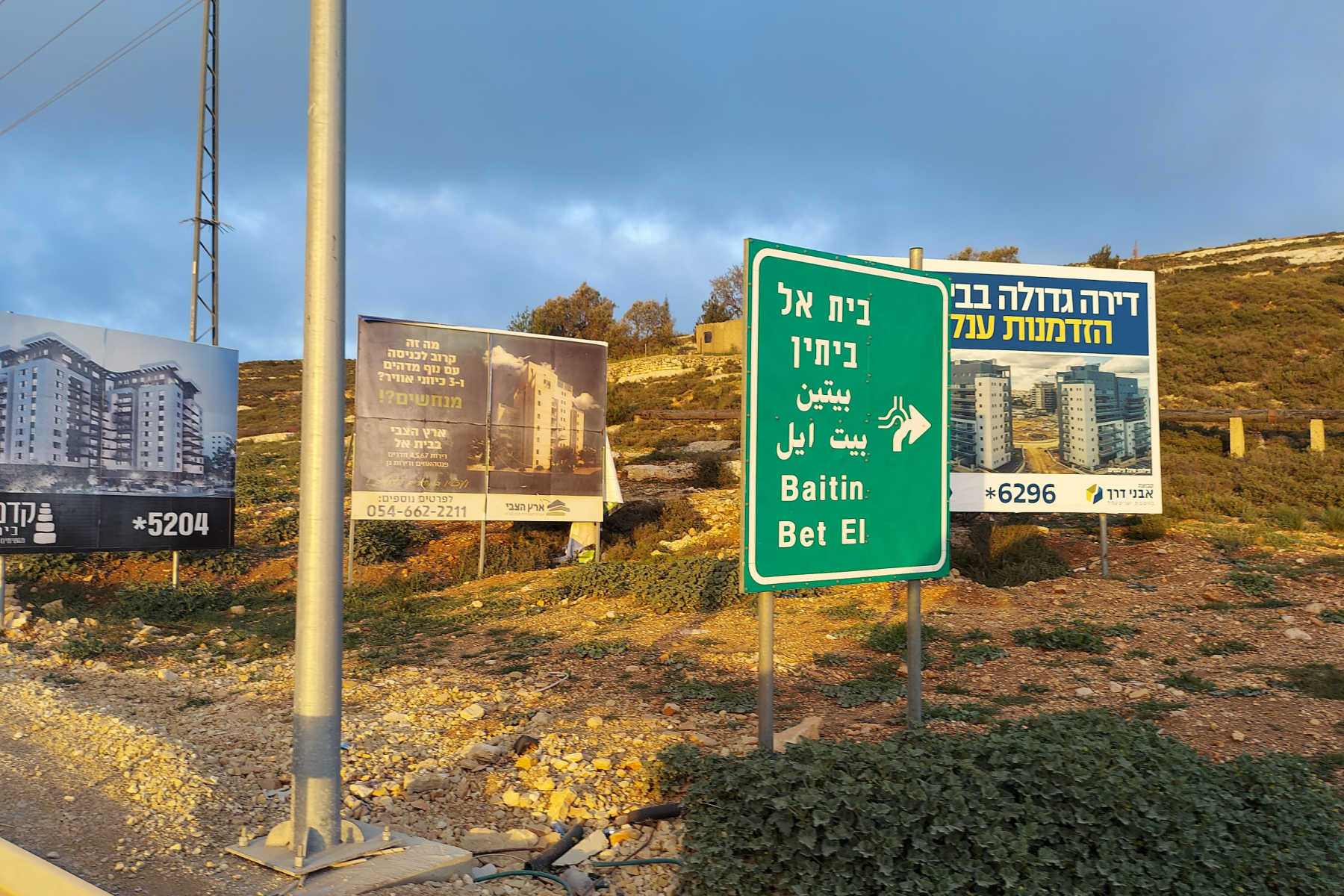
When Jacob awakens, he exclaims, “Mah norah ha’makom hazeh” – “How awesome is this place! God was present in it and I did not know! This is none other than the house of God and that is the gateway to heaven.” Jacob then sets up the stone he used as his pillow as a sacred pillar and names the place Beit El (“house of God”).

Centuries of commentators have inquired about the specific nature of this makom/place. Was it just a random spot where Jacob happened to spend the night or was it a sacred place toward which he was somehow guided by God? Our interrogation of this question begs an even deeper question: is the whole world in a sense, sacred space or are there some places in the world that are “more sacred” than others?

The answers to these questions are not, of course, are not mutually exclusive. Most spiritual traditions consider certain locations or sites to be uniquely invested with divinity. It is undeniable that Jewish tradition has traditionally ascribed sacred meaning to a specific land known as Eretz Yisrael. Some commentators say this land is uniquely holy because certain commandments can only be observed there and nowhere else. According to Jewish mystical tradition Eretz Yisrael – and the Temple Mount in particular – marks the very center of the universe.

It does not follow, however, that these ideas ipso facto give the Jewish people entitlement to assert control or dominion over the land (or the people who dwell upon it). On the contrary, I would argue that this sense of entitlement actually betrays the sanctity of the land. Indeed, it is difficult to read this Torah portion in the age of Zionism and fail to note that Beit El is the name of a prominent West Bank settlement that was established in 1977 by the ultranationalist settler group Gush Emunim.  

This sacrilegious hyperliteralism also ignores what the Torah teaches us from the very first chapter of Genesis: namely, that the entire earth is God’s divine creation. This ideal became more critical in Judaism after the destruction of the Temple in Jerusalem in 70 CE, when the Jewish people spread throughout the diaspora and created a spiritual system where God could be found anywhere in the world. Notably, the rabbis taught that the word makom is one of the names of God, referring specifically, the experience of the divine that is connected to place. (Or in the words of my favorite movie superhero, “wherever you go, there you are.”)

The Hebrew word for diaspora, galut, literally means exile, but as a famous rabbinic midrash teaches, “when the people of Israel went into exile, God went into exile with them.” Of course, the experience of exile is a universal one: as human beings, we understand that live in an imperfect world that has not yet experienced a complete and lasting justice. Nevertheless, as this midrash suggests, the imperfect exilic state in which we live is still infused with transcendent meaning and purpose wherever our steps may lead us.

As the great Yiddish writer S. Ansky powerfully wrote in his play “The Dybbuk,” “Every piece of ground on a person resides when they raise their eyes to heaven is a Holy of Holies.” That is to say, every place on earth has the potential to be a place of divine encounter. Every place has the potential to be a makom: holy space. Every home we create can be a Beit El – the sacred meeting place between heaven and earth.

I’m sure we all can think of these holy spaces in our own lives: places that are sacred because they were the sites of deep and significant meaning for us; places made holy because of the experiences we experience in them and the sacred memories we associate with them. At the same time, it is impossible to ignore that the entire earth abounds in sanctity – as we read in the book of Isaiah: “The whole world is filled with God’s glory.”

In other words, like Jacob, any place we lay down our heads has the potential to be a makom: a holy place with limitless potential for sacred, transformative experience.

Reenacting Pharoah’s Genocidal Decree in Gaza

(Photo: EFE)

The introduction to the book of Exodus, which we begin reading this Shabbat, has never resonated so deeply or so powerfully for me as it does this very moment.

We’re all familiar with the events that spark the Exodus narrative: a new Pharoah arises over Mitzrayim who does not know or remember Joseph. Alarmed that the Israelite minority is growing, he oppresses them with forced labor – but the more he oppresses them, the more the Israelites increase in number.

Pharoah then attempts to stem the Israelite birth rate directly by ordering the Hebrew midwives Shifra and Puah to kill every newborn boy. When they defy his order, Pharoah orders that every newborn boy be cast into the Nile. Commentators differ on why Pharoah made this very specific decree. Some say that in his paranoia, he believed the boys would eventually grow up to be soldiers and take up arms against his people. Other say his soothsayers predicted the birth of Moses. Still others say Pharoah believed that the Israelite women would intermarry and assimilate into the majority culture.

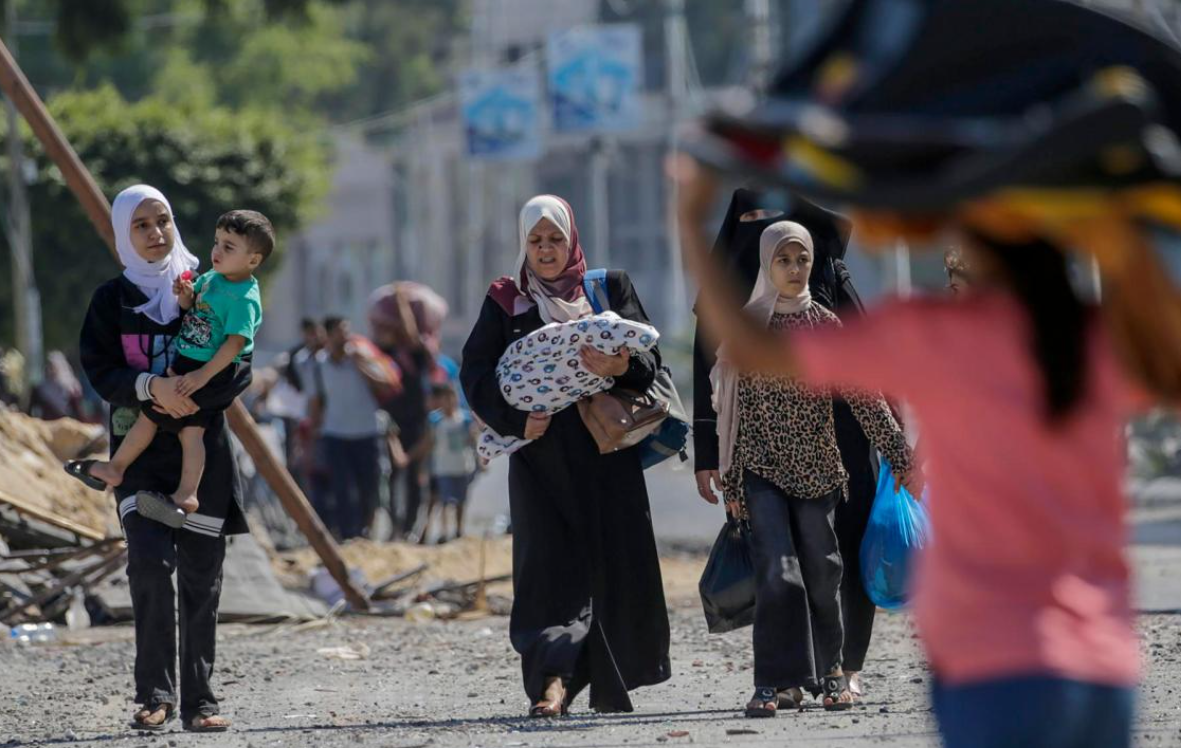
Whatever the reason, it is striking to note that Exodus’ liberation narrative begins with Pharoah’s efforts to head off the Israelite birth rate. As I’ve noted before, there are powerful parallels between this narrative and the state of Israel’s regard of the Palestinian people as a “demographic threat” to their Jewish majority. But in the midst of Israel’s genocidal assault on the people of Gaza, I’m finding that these verses now resonate with a brutal – and almost unbearable – urgency.

On November 3, less than a month into Israel’s military bombardment of Gaza, UNICEF, the World Health Organization and other NGOs reported that “Women, children and newborns in Gaza are disproportionately bearing the burden of the escalation of hostilities in the occupied Palestinian territory, both as casualties and in reduced access to health services.” More recently, the UN estimated that “around 50,000 pregnant women are currently living in Gaza, with more than 180 births taking place every day amid the ‘decimation’ of its healthcare system.”

The most devastating details on the impact of this onslaught on Gazan mothers can be read in the South African government’s application to the International Court of Justice, formally accusing Israel of committing genocide in Gaza. I strongly recommend reading this document in its entirety. Though South Africa’s claim was cynically dismissed by the White House as “meritless, counterproductive and completely without any basis in fact whatsoever,” its 84 page report is painstakingly researched, citing 574 independent sources. Though it is often near-unbearable to read, I believe it is an immensely important document and deserves the widest possible readership.

Here is a sample of the report’s findings on impact of Israel’s genocidal violence on pregnant women and newborn babies. Please be warned: the following quote it includes very graphic descriptions of traumatic violence inflicted on women and children.

Pregnant women and children –– including newborn babies –– are also particularly impacted by displacement, lack of access to food and water, shelter, clothes, hygiene and sanitation, and lack of access to health services. These effects are severe and significant. An estimated 5,500 of approximately 52,000 pregnant Palestinian women in Gaza giving birth each month are doing so in unsafe conditions, often with no clean water, much less medical assistance, “in shelters, in their homes, in the streets amid rubble, or in overwhelmed healthcare facilities, where sanitation is worsening, and the risk of infection and medical complications is on the rise”. Where they are able to get to a functioning hospital, pregnant women are having to undergo caesarean sections without anaesthetic.

Given the lack of access to critical medical supplies, including blood, doctors are being compelled to perform ordinarily unnecessary hysterectomies on young women in an attempt to save their lives, leaving them unable to have more children. Indeed, the Minister of Health for the State of Palestine, Dr May al-Kaileh, confirms that the only option facing Palestinian women in Gaza who ‘bleed out’ after giving birth is to undergo a hysterectomy in order for their lives to be saved. The lack of available drugs, such as the anti-D injection –– given to Rhesus negative women on the birth of a Rhesus positive baby –– also seriously impacts the possibility of future healthy pregnancies for affected women.

Premature births have reportedly increased by between 25-30 per cent, as stressed and traumatised pregnant women face a myriad of challenges, including being compelled to walk long distances in search of safety, attempting to escape from bombs and being crowded into shelters in often squalid conditions. Particularly in northern Gaza, cases of placenta abruption –– a serious condition that occurs to pregnant women during childbirth which is potentially life-threatening to both mother and baby –– have more than doubled.

An ever-increasing number of Palestinian babies in Gaza are reportedly dying from entirely preventable causes, brought about by Israel’s actions: newborns up to three months old are dying of diarrhea, hypothermia, and other preventable causes. Without essential equipment and medical support, premature and underweight babies have little to no chance of survival. Palestinian newborn babies have died due to the lack of fuel to supply hospital generators; others have been found decomposing in their hospital cots, medical staff taking care of them having been forced by Israel to evacuate.

On 3 November 2023, the World Health Organisation warned that “[m]aternal deaths are expected to increase given the lack of access to adequate care”, with deadly consequences on reproductive health, including a rise in stress-induced miscarriages, stillbirths and premature births. The impact will necessarily be long lasting and severe for Palestinians in Gaza as a group. By 22 November 2023 the United Nations Special Rapporteur on violence against women and girls, its causes and consequences, has expressly warned that:

“[T]he reproductive violence inflicted by Israel on Palestinian women, newborn babies, infants, and children could be qualified as… acts of genocide under Article 2 of the Convention on the Prevention of Genocide … including “imposing measures intended to prevent births within a group”. She stressed that “States must prevent and punish such acts in accordance with their responsibilities under the Genocide Convention.”

(Sections 96-100)

If there could be any doubt as to the question of intentionality behind these barbaric measures, the section immediately following these findings includes exhaustive quotes by Israeli politicians and military leaders that make their genocidal intentions all too clear. Most chillingly, it offers this quote from 95-year old Israeli army reservist Ezra Yachin — a veteran of the Deir Yassin massacre during the 1948 Nakba — who was called up for reserve duty to “boost morale” amongst Israeli troops ahead of the ground invasion: Be triumphant and finish them off and don’t leave anyone behind. Erase the memory of them. Erase them, their families, mothers and children. These animals can no longer live. . . Every Jew with a weapon should go out and kill them. (Section 102)

In this week’s Torah portion, the cry of the oppressed Israelites rises up to God, who hears and hearkens to their pain. This year, there can be no more critical question posed by our Torah portion: will God hearken to the collective cry of the people of Gaza?

The answer, as ever, is up to us all.

From Interfaith Dialogue to Interfaith Solidarity: Sermon for Rosh Hashanah 5784

(AP photo by Adam J. Dewey/NurPhoto)

During the course of my rabbinical career, I’ve participated in a good number of interfaith dialogues. These were facilitated conversations, usually involving the three so-called Abrahamic traditions – Christians, Muslims and Jews – in which we would explore our respective faith traditions together. The goal of the dialogues, generally speaking, was to achieve a deeper level of interfaith appreciation and understanding – to walk away with a respect for our differences as well as the underlying values we had in common. 

I haven’t participated in an interfaith dialogue in many years. If truth be told, I’m not sure I really believe in them anymore. It’s not that I don’t think it’s a good thing for people of different religions to learn from one another – I certainly do. It’s just that our dialogues never seemed to go much further than the talking. While our conversations were often substantive, we generally avoided more uncomfortable political topics. The underlying assumption seemed to be that religion and politics didn’t mix.

During Jewish – Christian conversations in particular, we rarely delved too deeply into issues such as Christian hegemony, white supremacy and antisemitism. When we did, we tended to treat such issues as part of the past. We seemed to be guided by the liberal assumption that such things belonged to a bygone, less enlightened age than our own. 

I can’t help but think such assumptions feel downright quaint today, in an age in which White Christian Nationalism is openly amassing political power. In which a mob wielding crosses and Christian banners literally stormed the Capitol in a coup attempt. In which Republican politicians have openly declared themselves to be Christian nationalists and a Republican candidate for president has called on his followers to “put on the full armor of God.” In the current political age, I think it’s safe to say the interfaith need of the moment goes far beyond liberal religious dialogue. The stakes are now far too serious – and far too consequential – for that.

Over the past two years, there’s been a great deal of analysis of the political threat posed by White Christian Nationalism: an ethno-nationalist movement that espouses a toxic combination of Christian exceptionalism and white supremacist ideology. White Christian Nationalists are guided by the belief that God has destined America, like Biblical Israel, for a special role in history – and that it will receive divine blessing or judgment depending on its obedience. It also promotes Replacement theory and actively demonizes Muslims, Jews, LGBTQ+ people, immigrants, and all others who do not fit into their white Christian ideal.

In the age of Trump, this movement has become entrenched in the Republican Party – and while they’re still a minority, their power has become critical to the GOP’s political strength. According to polls, most Republicans support declaring the US to be Christian nation, even if such a move would be unconstitutional. And among White Christian nationalists as a whole, 40% believe ​that “true patriots might have to resort to violence to save our country.”

Though this movement has emerged in a specific political moment, it is not uniquely of the moment. It actually dates as far back as the early days of European colonialism. Experts trace its roots back to the Doctrine of Discovery: a 15th century papal decree proclaiming European civilization and western Christianity to be superior to all other religions and cultures. The Doctrine of Discovery, of course, was an important driving force behind European colonial domination of the so-called New World and the conversion of the native peoples who lived there. 

This movement is also deeply rooted in white supremacist ideology. In his book, “White Too Long: The Legacy of White Supremacy in American Christianity,” Robert P. Jones wrote powerfully about this connection: how a wide spectrum of white Christians – from evangelicals in the South to mainline Protestants in the Midwest and Catholics in the Northeast – developed theologies that justified American slavery and Jim Crow. 

This legacy of white supremacy in American Christianity is alive and well in 2023. In 2015, a white supremacist entered Mother Emanuel AME Church in Charleston, South Carolina and murdered nine African American members of the congregation during a Bible study. Though there was extensive press at the time about his white supremacist beliefs, there was relatively little discussion of his Christian faith. In fact, his manifesto was filled with Christian imagery, including a drawing of a resurrected white Jesus rising from the tomb. He also wrote in his journal a call to action to white people to transform American Christianity from being “this weak cowardly religion” to “a warrior’s religion.”

Of course, Jews have every reason to be alarmed by such a movement as well. It was a brutal wake-up call indeed to watch torch carrying marchers in Charlottesville calling to “reclaim” America as a Christian nation while chanting “Jews will not replace us!” That wake-up call became downright deafening on a Shabbat in 2018, when a Bible quoting white supremacist murdered 11 Jewish worshippers at the Tree of Life synagogue in Pittsburgh.

At the same time, the Jewish community has been the recipient of genuine solidarity from Christian allies and friends. I’ve experienced this first hand more than once. This past February, for instance, when it was reported that Christian nationalists were planning to mobilize a “Day of Hate” against the Jewish community, my colleague and comrade, Reverend Tom Gaulke, wrote these beautiful words in a letter to our congregation:

As we hear of Christian Nationalists and Christian Supremacists calling for a “day of hate,” I would like to renew a promise on my own behalf and on behalf of the communities I’ve served:

For over a decade, we have marched side by side. And we’re not going to stop. As your family, we’ve got your back, come what may. Together, we’ve got a love that will conquer hate and a love that can only overcome.

To my mind, this gesture sums up the critical need of our new political moment: not so much interfaith dialogue, as interfaith solidarity. We must find a way to mobilize an interfaith movement that, in Tom’s words, ‘will conquer hate and can only overcome.”

If we are truly serious about this level of solidarity, however, each of our religious communities will need to engage in a great deal of deep discernment in our own backyards. I know there are many examples of white Christian communities who are doing this work in important ways; who understand that white solidarity must go hand in hand with justice and reparation. In his book, Robert Jones wrote about one white Baptist minister whose congregation has entered into an ongoing relationship with a black Baptist church. In describing that relationship, the minister said:

I’ve stopped using the word reconciliation…for what we’re doing. I’ve started using justice work more… When we throw around the word reconciliation, especially as white Christians, white people, we’re betraying our desire to just kind of move through all of the hard stuff to get to the happy stuff. So, when we’re talking about justice work, for me we’re getting into these much stickier questions of what has been lost, what is owed. 

Christian solidarity with non-Christians can also be hampered when well-meaning Christians fall back on a myth of innocence – when they distance themselves from White Christian Nationalism by saying “it’s not my religion.” I’ve witnessed this repeatedly – last year, for instance, the presiding Episcopal Bishop stated that White Christian Nationalism was “not Christianity.” Another progressive Christian activist has written it is a “political ideology rather than a religious one.” 

While I understand the good intentions behind these kinds of statements, I believe it’s deeply problematic when Christians disavow the more unsavory aspects of their religious tradition. In so doing, they avoid accountability for centuries of their own history and invisiblize its victims. As I’ve often commented, no religion is pure – all religions have their good, their bad and their ugly. In the end, I would submit that the proper way to confront the toxicity in our traditions is for people of faith to own the all of our religions – and to grapple with them seriously, honestly and openly. 

This will be a reckoning for the Jewish community as well. For one thing, in order to confront White Christian Nationalism, we will need to honestly interrogate persistent myths about Jews and whiteness. While white Jews understandably feel vulnerable at this particular moment, we still dwell under a shelter of white privilege. We must not assume that the threat of White Christian Nationalism poses a danger to all members of the Jewish community equally. White Jews will have to reckon with the fact that we are protected from this threat in ways that Jews of color are not. In other words, for the Jewish community, intra-communal racial solidarity will be just as critical as interfaith solidarity.

There is another issue facing the Jewish community that is perhaps even more challenging: if we are to truly stand down this movement – this toxic fusion of religion and nationalism – we’ll have to do so without exception. That means that Israel cannot get a pass. 

Though it may be troubling for many to consider, there are clear parallels between white Christian Nationalism and Zionism. Consider this: the Doctrine of Discovery holds that America was “discovered,” glorifying the noble innocence of the nation’s original “pioneers.” The ideology of Manifest Destiny is deeply connected to a vision of European Christian chosenness, viewing America as a “new Zion.” 

For its part, Zionism is rooted in a similar colonial view of a “land without a people for a people without a land.” It venerates the heroism of the chalutzim – the pioneers who “drained the swamps” and cultivated the land. And Zionism’s central narrative also comes from the Bible, utilizing texts that emphasize Jewish chosenness and exclusive entitlement to the land. 

Even more to the point, both White Christian nationalism and Zionism are forms of ethno-nationalism: movements that seek to establish and maintain nation-states predicated on the identity of one specific group of people. In its way, these two movements are religious nationalist mirror-images of each other, both seeking to create exclusive, homogeneous nation-states at the expense of their native inhabitants. 

Believe me, I know all too well that there are many in the Jewish community who will vociferously object to this kind of analysis. But painful as it may be, we can no longer cling to this myth of innocence when it comes to Israel. I think it’s absolutely critical that we find the strength to say these things out loud: to admit that after centuries of persecution at the hands of Christian empire, a modern Jewish movement is now actively following in its footsteps. 

All of this means that Jews, Christians – and all people of faith will need to reckon seriously with the issue of power – and in particular, the fusing of religion and state power. After all, don’t we know all too well from history where this road leads? We know what happens when religion is used by nations as a weapon of conquest. When God is invoked by the state to demonize others and exert their power over them. And make no mistake, religions that follow Biblical tradition will find ample justification for conquest and domination in that particular text.

But there is, however, another, decidedly different religious vision: it is a sacred act to resist oppressive state power. This path comes from the Bible as well; it is embodied by the Exodus narrative, the sacred story that lifts up the God of Liberation, and stands down the god of conquest. That puts the oppressed, not the oppressor at the center. That views the Promised Land not as a territory to be conquered by a chosen few but a land of equity and justice that is open to all.  We don’t have to look far to find contemporary examples of this sacred narrative in action. To name but two examples, it is exemplified by the Latin American liberation theology movement and the American black church: both of which lift up sacred visions of resistance that have leveraged genuine socio-political change.

This sacred narrative of liberation runs mightily through Jewish tradition as well. We are currently witnessing an emergent movement of radical, liberative Judaism that is truly exciting to behold. And I am so proud that Tzedek Chicago is an active and important participant in this movement. As we’ve done this work together, it’s been striking to me how integral and basic these values of solidarity and liberation are to Jewish tradition: from the weekly radical revolution that is Shabbat, to our deep-seated culture of study, questioning and Godwrestling, to our holidays, all of which contribute to a sacred drama that enact and re-enact the possibility of change and transformation in our world.

We enact these sacred values, in fact, each and every Rosh Hashanah. One of the central themes of the New Year is malchuyot – “divine sovereignty.” As I’ve come to understand it, this concept doesn’t have to refer to a literal belief in an all-powerful supernatural God sitting on his Kingly throne. Another way of understanding malchuyot, is as an affirmation of a Force Yet Greater – greater than any human or institution in our world: a power greater than Pharaoh in Mitzrayim, greater than the mightiest empire – and yes, even greater than systems of colonialism and white supremacy. 

Rosh Hashanah is also the day in which we stand before the open gates of heaven and sound the shofar as a wake-up call for the new year. We declare Hayom Harat Olam – “today the world was created,”affirming the eternal potential for transformation in our world. Over the next ten days, we will dig deeply into our individual and collective souls and discern what needs changing. Then, at the close of Yom Kippur, we will sound the shofar once final time as a call to action to go forth and create the world we know is possible. 

I’d like to close now with the words of a contemporary religious leader who truly embodies these ideas and values of interfaith solidarity: the great Rev. William Barber, co-chair of the Poor People’s campaign and president of Repairers of the Breach. May his words be our call to action this Rosh Hashanah:

The world doesn’t change when powerful people get new ideas. The world changes when people who’ve been rejected come together and realize that they are blessed to show their neighbors that another world is possible. Change happens when those who have been otherized decide we ain’t takin’ it no more…

There’s some stuff wrong in America and there’s no way to mend the flaws of this nation and be one nation under God with liberty and justice for all, unless the rejected people are at the center.

May this be the year we discover the true source of our collective power. May this be the year we transform the world that is into the world we know is possible. 

On Shavuot, the Book of Ruth and Palestinian Exile

On the surface, the Book of Ruth, the Biblical story traditionally read on the Jewish festival of Shavuot (which began last evening), appears to be a simple parable about two women struggling to survive in the wake of a devastating famine. If we dig deeper, however, we’ll find that Ruth is actually a profound and radical story that explores themes of isolation and connection, dispossession and return, emptiness and plenitude, exile and redemption.

As a Jew who views solidarity with the Palestinian struggle for liberation to be a sacred obligation, I find that these themes to be particularly resonant. As we celebrate Shavuot this year, for instance, we are receiving tragic reports that the Israeli military has forcibly transferred the Palestinian residents of the Ein Samiya village, including 78 children (whose school was targeted for demolition). This latest act of political dispossession is only the latest in a larger Israeli program of ethnic cleansing that dates back to the establishment of the state in 1948.

Amidst this ongoing reality of Palestinian exile, I’d like to suggest four themes from the Book of Ruth that call out to me with special urgency this Shavuot:

One: the story of Ruth tells the story of Naomi, a childless Israelite widow and her Moabite daughter in law Ruth, who return to Naomi’s home in Bethlehem, in the hopes of finding safety and security. As unmarried women, they are radically marginalized, forced to use the power they have at their disposal to survive in a world that has symstemically disempowered them. Those of us who stand in solidarity with Palestinians – indeed, all who are oppressed – would do well to heed the moral imperative at the heart of this story.

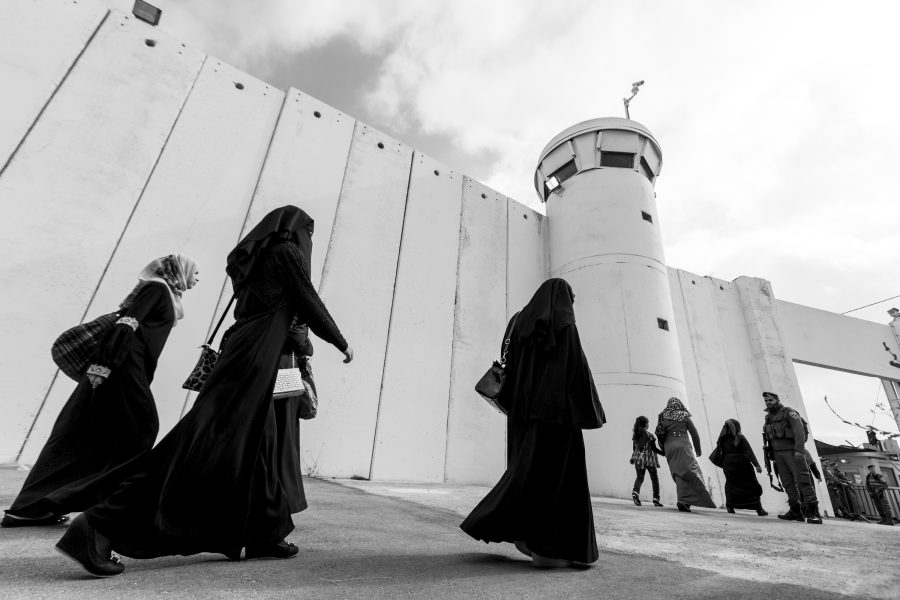
Two: as the story opens, Naomi migrates with her husband and two sons to the land of Moab. She later crosses back with her daughter-in-law when she receives word that the famine has lifted in her home country. In its way, the Book of Ruth portrays a world in which migration was a natural social phenomenon; when border-crossing was an accepted and necessary part of life. Today, this very land is strewn with militarized borders, checkpoints and refugee camps – and Palestinians are routinely denied the most basic right of human mobility. The Book of Ruth thus calls to us with a striking vision: a land and a world in which borders pose no barrier to those seeking a better future for themselves and their families.

Third: the driving center of the Book of Ruth is the deep and loyal relationship between an Israelite woman and her Moabite daughter-in-law. Those who are familiar with the Hebrew Bible will not help but note that the Moabite nation is typically portrayed as the arch enemy of the Israelite people. In this story, however, these national allegiances and historical enmities are nowhere to be found. Instead we are left with this simple, sacred message: the ultimate path to redemption is not to be found through power and violence – but rather through mutual love and solidarity.

And finally, the Book of Ruth opens in amidst a devastating famine in Bethlehem and ends with the reaping of a new harvest and the promise of an abundant future for Ruth, Naomi, their family and descendents. This vision of abundance: in which there is more than enough for all who dwell on the land, is indeed at the heart of the Palestinian struggle for liberation: one that envisions a future of equity, justice and peace for all who live between the river and the sea.

Yom Ha’atzmaut and the Nakba: Jewish Religious Responses

“I Don’t Think I Can Celebrate this Holiday Anymore.”

As a Jewish kid growing up in Los Angeles in the 1970s, I remember Yom Ha’atzmaut as the one day every year in which our city’s Jewish community would turn out en masse in celebration. I have vivid memories of our marching through the sidewalks of West LA, waving our Israeli flags, ending with a picnic at Rancho Park. As in many US cities, Yom Ha’atzmaut was the  “go-to” day for expressing our Jewish communal pride.

In addition to this annual event, I also remember regularly celebrating Yom Ha’atzmaut as a religious festival on the Jewish holiday calendar. Every year, usually on the closest Shabbat to May 15, our Reform Temple would acknowledge the occasion with special prayers and songs – including the Israeli national anthem, Hatikvah. In short, Yom Ha’atzmaut was not only an occasion to express our Jewish communal solidarity with the state of Israel – it was a day we invested with sacred meaning. When I became a rabbi many years later, I accepted it as common practice to acknowledge Yom Ha’atzmaut in this manner.

Over the years, however, as my own relationship to Israel and Zionism changed, I found the religious observance of Yom Ha’atzmaut increasingly problematic, even painful. In a 2009 blog post, I shared my struggle publicly:

I’ve decided not to celebrate Yom Ha’atzmaut today. I don’t think I can celebrate this holiday any more.

That doesn’t mean I’m not acknowledging the anniversary of Israel’s independence – only that I can no longer view this milestone as a day for unabashed celebration. I’ve come to believe that for me, Yom Ha’atzmaut is more appropriately observed as an occasion for reckoning and honest soul searching.As a Jew, as someone who has identified with Israel for his entire life, it is profoundly painful to me to admit the honest truth of this day: that Israel’s founding is inextricably bound up with its dispossession of the indigenous inhabitants of the land. In the end, Yom Ha’atzmaut and what the Palestinian people refer to as the Nakba are two inseparable sides of the same coin. And I simply cannot separate these two realities any more.

By this point I had come to believe that Yom Ha’atzmaut was a paradigmatic of a deeper moral problem: that the creation of a Jewish nation state in historic Palestine resulted in injustice against the Palestinian people – an injustice that was in fact still ongoing. I could no longer regard it as something to celebrate, let alone invest with religious meaning.

“May Our Eyes See the Complete Redemption of Israel”

The creation of a Jewish religious holiday by government legislation is, needless to say, unprecedented in Jewish history. Its origins date back to the period immediately following Israel’s birth, when the Knesset officially established the 5th of the Jewish month of Iyar1 as its permanent date. At the time, Knesset members were unanimous that this holiday should have “traditional Jewish significance” and the new government subsequently created a committee to consult with Israel’s new Chief Rabbis in order to determine the precise nature of its religious observance.2 In a subsequent letter to their Rabbinate council, Israel’s Chief Rabbis Yitzchak HaLevi Herzog and Ben-Zion Meir Hai Uziel framed the day as a celebration of divine deliverance and redemption:

The fundamental turning point in God’s compassion on us, the declaration of our independence in the Land, which saved us and redeemed our souls, obligates us to uphold and keep this day of the fifth of Iyar, the day of the declaration of the State of Israel, for all generations, a day of joy of the beginning of the redemption for all of Israel.3

Over the next few months, Israeli religious authorities held extensive debates over how the new holiday should be acknowledged liturgically. Many of these questions focused on the recitation of Hallel – a series of Psalms of praise traditionally added to the morning worship service for festivals. The first formal Jewish liturgy developed specifically for Yom Ha’atzmaut was a new version of  Al Hanisim (“For the Miracles”), a traditional prayer recited on the festivals of Purim and Hanukkah praising God’s miraculous deliverance of the Jewish people from their enemies. While it was not approved by Israel’s Chief Rabbinate and did not gain universal acceptance upon its introduction, the practice of reciting Al Hanisim on Yom Ha’atzmaut has since grown in popularity and the prayer has appeared in many different forms throughout the decades.

The first Al Hanisim for Yom Ha’atzmaut was written in 1949 by Biblical and Talmudic scholar Rabbi Ezra Zion Melamed and later published by the Kibbutz Hadati (the Religious Kibbutz Movement):

For the miracles and for the redemption and for the mighty deeds and for the deliverance and for the wars that You did for our fathers and for us in those days at this season.

You, O God, awakened the heart of our fathers to return to the mountain of Your inheritance, to settle there and to rebuild it from the ruins, and its land. And when an evil regime stood over us and shut the gates of our land to our brethren who were fleeing from the sword of a cruel enemy, and they sent them back in ships to the islands of the sea and to distant shores, You in Your might toppled his throne and freed the land from his hand. And when enemies rose against us and plotted to destroy us, You in your might sent upon them fear and panic, and they abandoned all their goods, and fled in confusion and haste beyond the borders of our land. 

And when seven nations rose up against us to conquer our land and to make us as bonded servants, You in Your mercies stood by the right hand of the Israel Defense Army and delivered the mighty into the hands of the weak, the many into the hands of the few, and evildoers into the hands of the righteous. And with Your outstretched arm you helped the young men of Israel to expand the boundaries of our settlement, and to bring our brethren up from the concentration camps.

For all this we thank You, O Lord our God, with bowed head; and on this, our day of festivity and joy, we stretch our hands before You and beseech pray on behalf of our dispersed brethren and say: Please, our Father, our Shepherd, gather them quickly to Your holy habitation, and may they dwell there in peace and calm and tranquility and security. Expand the borders of our land as You promised our forefathers, to give to their seed from the River Euphrates to the Brook of Egypt. Build your holy city Jerusalem, capital of Israel, and reestablish there your Temple as in the days of Solomon. And as we have merited to see the beginning of our redemption and the liberation of our souls, so may we live and may our eyes see the complete redemption of Israel and renew our days as of old. Amen! 4

Using unabashedly Biblical language, this new prayer rendered the Zionist colonization of Palestine as an “awakening” and “return” to the Jewish peoples’ “inheritance.” The British Mandatory authorities were referred to as “an evil regime.” The Zionist militias’ dispossession of Palestinians from their homes (still ongoing at the time of its writing in the spring of 1949), was ascribed to divine intervention, using imagery that evoked the conquest of the Biblical Canaanites. Similar framing was used to describe the Arab armies that joined the war in 1949; the term “seven nations” was a pointed reference to the Canaanite nations dispossessed from the land by the Biblical Israelites in the book of Joshua.5

The final stanza of the prayer contained a reference to kibbutz galuyot (the “ingathering of the exiles”), God’s promise to return the Israelites to their land following the Babylonian exile.6 The term was used here according to the tenets of religious Zionism, which viewed the establishment of a Jewish state in the land as a necessary precursor to the coming of the messiah.7 The prayer concludes by looking forward to a return to the widest Biblical borders of Israel (from the Euphrates to the Nile) and the reestablishment of the Temple in Jerusalem.

“To Serve God in the Joy of Victory”

In due time, American Jewish denominations would formally adopt the observance of Yom Ha’atzmaut as a religious holiday as well. The Conservative movement included its own version of Al Hanisim for Yom Ha’atzmaut in its 1961 Weekday Prayerbook8 and later in its 1985 prayer book Siddur Sim Shalom:

In the days when Your children were returning to their borders, at the time when our people took root in its land as in days of old, the gates to the land of our ancestors were closed before those who were fleeing the sword. When enemies from within the land, together with seven neighboring nations, sought to annihilate Your people, You, in Your great mercy, stood by them in time of trouble. You defended them and vindicated them. You gave them courage to meet their foes, to open the gates to those seeking refuge, and to free the land of its armed invaders. You delivered the many into the hands of the few, the guilty into the hands of the innocent. You have revealed Your glory and Your holiness to all the world, achieving great victories and miraculous deliverance for Your people Israel to this day.9

While considerably shorter than the original version, the Conservative movement Al Hanisim retains many of its central themes – particularly the Biblical concept of return and kibbutz galuyot. It also deletes the dated references to British Mandate authorities, firmly identifying Palestinians (“enemies from within the land”) and “seven neighboring nations” as the primary enemies of the Jewish people.

Given the Zionist narrative of Israel’s establishment, it’s not difficult to understand why Al Hanisim became a popular prayer for Yom Ha’atzmaut. The traditional version for Purim recalls the account in the Book of Esther in which ancient Persia “rose up against them and sought to destroy, to slay, and to exterminate all of the Jews, young and old…” On Hanukkah, the prayer extols how God “delivered the strong into the hands of the weak, the many into the hands of the few, the impure into the hands of the pure…” In a sense, the Al Hanisim for Yom Ha’atzmaut combines both of these narratives. Indeed, Israel’s “miraculous” victory over its Arab foes would become central to Zionist mythology following 1948 – and even more so after the Six Day War in 1967.

While the American Reform movement did not originally include prayers for Yom Ha’atzmaut in its Union Prayer Book (almost certainly due to that denomination’s historically anti-Zionist orientation), the Central Conference of American Rabbis eventually established Yom Ha’atzmaut as “a permanent annual festival in the religious calendar of Reform Judaism” in 1970. Five years later, the movement’s prayer book, “Gates of Prayer” included an extensive service for the holiday, including a partial Hallel.10 The most recent Reform prayer book, Mishkan T’filah (2007), contains a seven-candle lighting ceremony for Yom Ha’atzmaut, featuring a variety of prayers, poems and songs (including Hatikvah, Israel’s national anthem). The service also references kibbutz galuyot with this passage from the Biblical book of Jeremiah 23:3, 8: “And Myself will gather the remnants of the flock from all the lands…And I will bring them back to their pasture. And they will dwell upon their own soil.” 11

The Reconstructionist movement prayer book, Kol Haneshama includes a similar Yom Ha’atzmaut service12 that includes Hatikvah as well as the famous “valley of the dry bones” prophecy from Ezekiel 37:13-14. Here, Israel’s founding is juxtaposed with God’s promise to “resurrect” and restore the Israelites to the land of Israel following their exile in Babylonia: “Behold, I am opening your graves, and I shall raise you up from where you lie, my people, and shall bring you to the land of Israel, and you shall know that I am The Eternal One, I who open up your graves and raise you up, my people, from your place of burial!” 13

In addition to these Yom Ha’atzmaut liturgies, many prominent American Jewish scholars and leaders frame the day as a sanctification of sovereign state power. In his popular book “The Jewish Holidays: A Guide and Commentary,” Rabbi Michael Strassfeld suggests, “as our religious perspective on Israel deepens, Yom Ha’atzmaut will become more and more a reflection of a vision rather than the simple birthday party of a nation.” 14

For Strassfeld, that vision involves a dialectic between the “Torah of Sinai” and the “Torah of Jerusalem.” The former, he posits, reflects the revelation that “took place outside of the land of Israel at Sinai” that has become “familiar to us as the life of our people during the 2,000 years of the Diaspora.” The latter emphasizes “sovereignty and independence” and “finds its symbols in the place itself – the site of the ancient temple of sacrifices and the political capital of King David.” 15 As Strassfeld explains:

We need both, for with only Israel and its Torah, it would be easy to make an idolatry of nationalism. We would end up reveling in earth, blood, and power. But with only the Torah of Sinai, we could continue to revel in abstractness and powerlessness, constructing worlds, as the Talmud does, made of oxen that fall into pits and gore each other.16

In his book “The Jewish Way: Living the Holidays,” Rabbi Irving Greenberg goes even farther, suggesting that Yom Ha’atzmaut celebrates “a new Exodus” and represents “a call to power to end the tradition of suffering, to serve God in the joy of victory.” 17 Noting Israel’s early tradition of military parades on Yom Ha’atzmaut, Greenberg writes,

Diaspora Jews who still live with the ideals and illusions of powerlessness are often embarrassed by this phenomenon. Yet a military parade is a most appropriate symbol for an era whose central theme, set in motion by the Holocaust and the creation of the state, is the emergence of Jews from powerlessness.18

Among other things, these Yom Ha’atzmaut liturgies and commentaries attest to the deep influence of Religious Zionist ideology on American Jewish life. It is indeed troubling to consider: the prayers of every American Jewish denomination frame Israel’s military dispossession of Palestinians from their homes in the context of holy war and ascribe explicitly messianic meaning to Zionist colonization of the land.

Thus, to return to the questions I asked in my 2009 blog post, I ask again: how should we reckon with the knowledge that Jewish communities the world over offer prayers of joy and praise that essentially celebrate the Palestinian people’s collective tragedy? Might it be possible, to use Edward Said’s term, to view Zionism from “the standpoint of its victims?” If so, what might a Jewish ritual acknowledgement of this event actually look like? 

“Beyond Fear and Omnipotence, Beyond Innocence and Militarism”

American Jews – and young American Jews in particular – are starting to ask this very question. In 2013 New Voices, a journal published by the Jewish Student Press Service, published an article that featured Jewish student essays debating whether to “celebrate, commemorate or mourn” on Yom Ha’atzmaut. More recently, the relatively mainstream Jewish newspaper, the Forward featured a debate between two of its regular columnists entitled “Should American Jews celebrate Yom Ha’atzmaut?” As one writer observed:

It seems to me that the elevation of Yom Ha’atzmaut to the level of a religious holiday…is an attempt not to provide American Jews with holidays that celebrate our identities as we are, but to construct our identities politically.

As well, some liberal quarters of the American Jewish community now make a point of acknowledging the Nakba in relation to Yom Ha’atzmaut. The Reconstructionist volume, “Guide to Jewish Practice: Shabbat and Holidays,” for instance, includes the following commentary:

The creation of Israel came with a real cost of hundreds of thousands of Palestinians being displaced from their homes. Yom Ha’atzmaut may be a joyous day for us, but the Nakba reminds us that this joy, as on Passover, has its limits.19

Similarly, in 2015, Rabbi Donniel Hartman, president of the Shalom Hartman Institute, led a session for American rabbis entitled, “Yom Ha’atzmaut: Between Redemption and Nakba.” In his session he noted that the increasing awareness of the Nakba means that Israelis and Jewish Zionists can no longer “control the narrative” of Israel’s establishment, adding tellingly: “If we have to ‘sell’ and get people excited about the redemption narrative, we have to make room for the fact that ‘something happened.’”

In the end, however, these mild interventions fail to address the heart of the conceptual/ethical issue at hand, as they ultimately seek to strengthen and uphold the Jewish redemption narrative. Is it possible to commemorate this occasion with a fundamentally different Jewish narrative? One that stands down this redemptive view of militarism and state power?

In my own search for answers to this question, the work of several Jewish scholars has become particularly important to me. One such figure is Marc Ellis who has written extensively about the theological dynamics of Jewish empowerment in the wake of the Holocaust and the establishment of the state of Israel:

In the formation, sustenance and expansion of Israel, Judaism and Jewish identity has likewise been actively employed, indeed has been militarized and, yes, infected with atrocity. Because once religion and identity become accomplices to atrocity it must disguise that atrocity and twist it to conform to an innocence and redemption that is now visited, as a form of oppression, on the Other, in this case the Palestinian people.

For Ellis, the onset of Jewish state power has resulted in an era of “Constantinian Judaism,” comparable to the elevation of Christianity to the religion of empire in the 4th century. In the current age, Ellis suggests, “dissenting Jews must learn how to practice their Judaism in the shadow of Constantinian Judaism.” 20 He refers to these dissenting Jews as “Jews of Conscience” who, he writes, “are fighting a high stakes battle against the final Jewish assimilation to unjust power which, in their view, articulated in overt Jewish language or not, signals the end of Jewish history.”

Likewise, Sara Roy, whose work has detailed the devastating effect of Israel’s ongoing blockade of Gaza on Palestinians, has written, in an essay entitled “A Jewish Plea:”

I have come to accept that Jewish power and sovereignty and Jewish ethics and spiritual integrity are, in the absence of reform, incompatible, unable to coexist or be reconciled. For if speaking out against the wanton murder of children is considered an act of disloyalty and betrayal rather than a legitimate act of dissent, and where dissent is so ineffective and reviled, a choice is ultimately forced upon us between Zionism and Judaism.

Roy then asks, powerfully:

As Jews in a post-Holocaust world empowered by a Jewish state, how do we as a people emerge from atrocity and abjection, empowered and also humane, something that still eludes us? How do we move beyond fear and omnipotence, beyond innocence and militarism, to envision something different, even if uncertain?

“A Full Accounting of the Wrongdoing that was Committed in Our Name.”

In response to challenges such as these, we are now witnessing the tentative emergence of new alternative approaches to Yom Ha’atzmaut/Nakba Day as an occasion for reckoning and remembrance rather than joy and celebration. One such example is the “Joint Nakba Remembrance Ceremony,” an annual gathering sponsored by the Israeli organization Combatants for Peace and co-sponsored by a variety of Israeli and Palestinian NGOs. According to organizers, this ceremony seeks

to bring attention to the Nakba and acknowledge the great pain it brings, through the understanding of the Nakba’s importance in the Palestinian collective memory and in the history of the Israeli-Palestinian conflict. The ceremony’s message is that we must face our past with honesty, integrity, and empathy in order to bring a future of reconciliation, liberty and peace for both sides.

My own synagogue, Tzedek Chicago, has been exploring ways to develop a Jewish observance of Nakba Day with a service of combining prayer, readings, poetry and survivor testimonies. Here, for instance, is my “Jewish Prayer for Nakba Day,” which I wrote to be a centerpiece of our ritual:

Le’el she’chafetz teshuvah,
to the One who desires return:

Receive with the fulness of your mercy
the hopes and prayers of those
who were uprooted, dispossessed
and expelled from their homes
during the devastation of the Nakba.

Sanctify for tov u’veracha,
for goodness and blessing,
the memory of those who were killed
in Lydda, in Haifa, in Beisan, in Deir Yassin
and so many other villages and cities
throughout Palestine.

Grant chesed ve’rachamim,
kindness and compassion,
upon the memory of the expelled
who died from hunger,
thirst and exhaustion
along the way.

Shelter beneath kanfei ha’shechinah,
the soft wings of your divine presence,
those who still live under military occupation,
who dwell in refugee camps,
those dispersed throughout the world
still dreaming of return.

Gather them mei’arbah kanfot ha’aretz
from the four corners of the earth
that their right to return to their homes
be honored at long last.

Let all who dwell in the land
live in dignity, equity and hope
so that they may bequeath to their children
a future of justice and peace.

Ve’nomar
and let us say,
Amen.

Le’el she’chafetz teshuvah,
to the One who desires repentance:

Inspire us to make a full accounting
of the wrongdoing that was
committed in our name.

Help us to face the terrible truth of the Nakba
and its ongoing injustice
that we may finally confess our offenses;
that we may finally move toward a future
of reparation and reconciliation.

Le’el malei rachamim,
to the One filled with compassion:

show us how to understand the pain
that compelled our people to inflict
such suffering upon another –
dispossessing families from their homes
in the vain hope of safety and security
for our own.

Osei hashalom,
Maker of peace,

guide us all toward a place
of healing and wholeness
that the land may be filled
with the sounds of joy and gladness
from the river to the sea
speedily in our day.

Ve’nomar
and let us say,

Amen.

In this prayer, I use the Hebrew word “teshuvah” according to two of its meanings: both “return” and “repentance.” The first half of the prayer acknowledges the historical reality of the Nakba. The phrase “gather them from the four corners of the earth” is an explicit reference to kibbutz galuyot – “the ingathering of the exiled,” applying it here to the Palestinian right of return. The second half of the prayer uses the word teshuvah/repentance in the context of the collective Jewish responsibility to confess Jewish complicity in the depopulation, destruction and replacement of Palestine, looking forward to a future of “reparation and reconciliation.”

It should be noted that as as Jewish community in the diaspora, our service differs in crucial ways from the Israeli-Palestinian Nakba Remembrance Ceremony noted above. For Jewish Israelis and Palestinians living in a Jewish nation-state, the vision of a “future of reconciliation, liberty and peace for both sides” has a very specific political meaning. For Jews who seek liberation in a diasporic context, this goal must necessarily exist within the vision of a greater transformation.

In the end, we cannot interrogate the meaning of the Jewish diaspora without also understanding the diasporas of other transnational and/or dispossessed peoples. From a Jewish diasporist perspective, the aspiration for a just future in Israel/Palestine cannot help but be bound up with the prophetic vision of justice and liberation for marginalized and colonized communities everywhere.

In the words of scholar Susannah Heschel:

The diasporic position … is the condition for the prophetic: standing at the boundaries between society and the reins of governance, the prophet demands justice from the governing, while giving voice to the unheard who suffer at the hands of the regime.

My own personal struggle with the legacy of Yom Ha’atzmaut has led me to explorations I could never have imagined when I wrote that blog post in 2009. While these new Jewish approaches to Yom Ha’atzmaut are obviously in a nascent stage, we may reasonably expect them to develop and evolve, particularly as demographic studies of the American Jewish community indicate an increasing detachment of American Jewish connection to the state of Israel. As the Forward article cited above notes: “When you interview young American Jews who disaffiliate, the politics of Yom Ha’atzmaut celebrations come up as a major reason why.”

As the American Jewish community continues to transform, we can only hope we will witness the further transformation of this festival as well: from a day celebrating political nationalism and colonial dispossession to a Jewish observance rooted in solidarity, memory and repentance.

 Footnotes:

1 This day corresponded to May 15, 1948 – the date the state of Israel was declared one year earlier. As Yom Ha’atzmaut is determined according to the lunar Jewish calendar, it falls on different days during the months of April or May.

2  Katz, Shmuel, “Establishing a Holiday: The Chief Rabbinate and Yom HaAtzma’ut,” in The Koren Mahzor for Yom Haatzmaut and Yom Yerushalayim, Jerusalem: Koren Publishers, 2016  p. 188.

3 IBID, p. 190.

4 Seder Tefillot le-Yom ha-Atzmaut, 2nd edition, Tel Aviv: Hotza’at Ha-kibbutz ha-Dati, 1969, p. 101, (translation mine).

5 There were actually five – not seven – Arab nations involved in the 1948-49 war. The number seven seems to be used here to directly equate them with the seven Biblical Canaanite nations.

6  See Deuteronomy 30:1-5, Isaiah 11:11-12, Jeremiah 29:14 and Ezekiel 20:41-42. Kibbutz galuyot would later come to be understood in messianic terms – see for instance, Maimonides, Mishneh Torah, Laws of Kings, 11:1-2.

7 This precept is also cited in the “Prayer for the Welfare of the State of Israel,” written in 1948 by Israel’s Chief Rabbis, which described the establishment of the state as “the beginning of the flowering of our redemption.”

8 Weekday Prayer Book, New York: Rabbinical Assembly, 1961, pp.64-65.

9 Siddur Sim Shalom, Harlow, Jules, ed., New York: Rabbinical Assembly/United Synagogue of America, 1985, p. 183.

10 Gates of Prayer: The New Union Prayerbook, Stern, Chaim, ed., New York: CCAR Press, 1975, pp. 590-611.

11 Mishkan T’filah: Services for Shabbat, Frishman, Elyse D., ed., New York: CCAR Press,  2007, p. 542.

12 Kol Haneshamah: Limot Hol, Teutsch, David, ed., Pennsylvania: The Reconstructionist Press. 1996, pp. 456-471.

13  IBID, p. 460.

14  Michael Strassfeld, The Jewish Holidays: A Guide and Commentary, New York: Harper and Row, 1985, p. 66.

15  IBID, p. 65.

16  IBID

17  Irving Greenberg, The Jewish Way: Living the Holidays, New York: Summit Books, p. 387.

18  IBID 396.

19  A Guide to Jewish Practice Volume 2: Shabbat and Holidays, Pennsylvania: RRC Press, 2014, p. 693.

20 Marc H. Ellis, Toward a Theology of Liberation, 3rd expanded edition, Waco:Baylor University Press, 2004, p. 206.

Who is the Stranger Here? Reading the Torah through a Decolonized Lens

Photo credit: 
Paul Connors/Media News Group/Boston Herald

Cross-posted with Jewschool.

This week’s Torah portion, Parashat Ekev, contains the well-known commandment: 

“You must love the stranger because you were strangers in the land of Egypt.”

(Deuteronomy 10:19)  

While it’s often characterized as the most repeated commandment in the Torah – occurring a total of 36 times, that’s actually a bit of hyperbole – it actually appears only six times.[1]  The number 36 seems to have originated from a passage in the Talmud [2] but in the end, I’d suggest that the accuracy of this claim is really irrelevant. For liberal Jews in particular, this commandment looms large because it’s a powerful statement of collective empathy. The Jewish people, who have historically lived as “strangers in strange lands,” are as such commanded to love and protect all who know the experience of the stranger. 

The Hebrew word for “stranger,” is ger – a legal term in the Bible for “resident non-citizen.”[3] Throughout the laws of the Torah, there is a clear concern expressed for the legal status of gerim, who are often included in the ritual life of ancient Israel. In the commandment to keep the Shabbat, for instance, the “ger within your settlements” is included in the list of those who must cease from work.[4] God also adjures Israelites repeatedly that there must be “one law” that governs the ger as well as the Israelites.[5] 

Given the Torah’s tolerant attitude toward the “stranger,” this commandment is popularly invoked by Jewish communal leaders, particularly in reference to the issues of immigrant justice and refugee rights. This statement from the Religious Action Center for Reform Judaism is a classic example, using the commandment to highlight the classic American dream of immigrant “opportunity.”

Our own people’s history as “strangers” reminds us of the many struggles faced by immigrants today, and we affirm our commitment to create the same opportunities for today’s immigrants that were so valuable to our own community not so many years ago.  

Upon deeper examination, however, this use of the commandment to “love the stranger” is not as powerfully straightforward as it may first appear. This commandment – like all commandments in the Torah – is directed toward the Israelites as they prepare to assume a position of power. Even more critically, their position of power will be attained by means of conquest

In fact, this week’s Torah portion – the very same one that contains this famously empathic commandment – also contains a divine command to the Israelites to brutally dispossess and destroy the peoples of Canaan:

You shall destroy the peoples that the Lord your God delivers to you, showing them no pity…The Lord your God will deliver them up to you, throwing them into utter panic, until they are wiped out. He will deliver their kings into your hand, and you shall obliterate their name from under the heavens; no man shall stand up to you, until you have wiped them out.

(Deuteronomy 7:16, 22-24)

In this context, we would thus do well to ask ourselves, what does it mean for Jews – particularly white Jews – to invoke this Biblical verse as we dwell on land stolen by a settler colonial power from its indigenous population? Or to put it another way, before intoning the commandment to love the stranger, we might first ask ourselves, “who is the real stranger here?” 

Indeed, we cannot deny the fact that the Biblical conquest tradition has historically been used – and continues to be used – to justify colonial dispossession, turning indigenous peoples into strangers in their own lands. In other words, the definition of who is a “citizen” and who is a “stranger” is – and has always been – determined by those who wield the power.

Where does this leave us, then? Is it even possible for Jews who cherish Biblical tradition to read the Torah through a decolonial lens? 

I believe it is. I would suggest that the first step is to ask questions precisely such as these. To avoid the temptation to ignore or wish away these kinds of texts; to actively challenge and interrupt the Biblical conquest tradition head on. For there is no getting around it: the Exodus story is not only about a people liberated by God from slavery – it is also about a people commanded by God to conquer and annihilate the Canaanites before occupying the land they inhabit.  

Reading the Torah through a decolonial lens also means coaxing out and amplifying the voices of the “strangers” in the text – the disenfranchised and colonized who might otherwise be voiceless to us. In this regard, I’ve learned a great deal from the pedagogy of commentators from outside Jewish tradition. One such teacher is the Indigenous Studies scholar Robert Warrior, who has written powerfully about the Biblical conquest tradition in his essay, “Canaanites, Cowboys and Indians:”

The obvious characters in the story for Native Americans to identify with are the Canaanites, the people who already lived in the promised land. As a member of the Osage Nation of American Indians who stands in solidarity with other tribal people around the world, I read the Exodus stories with Canaanites eyes. 

I find another important teacher in the work of black womanist theologian Delores S. Williams, whose book “Sisters in the Wilderness” lifts up the voice of the Biblical character Hagar as a role model for African-American women: 

Hagar’s heritage was African as was black women’s. Hagar was a slave. Black women had emerged from a slave heritage and still lived in light of it. Hagar was brutalized by her slave owner, the Hebrew woman Sarah. The slave narratives of African-American women and some of the narratives of contemporary day-workers tell of the brutal or the cruel treatment black women have received from the wives of slave masters and from contemporary white female employers.[6]

I realize that interpretations such as these are undeniably challenging for Jews who read the text literally, identifying Jewish experience exclusively with the experience of the Israelites. It is even more challenging for white Jews who benefit from power and privilege to reckon with the ways we are complicit in the European Christian legacy of colonization – a legacy that continues to do harm even now.

I would suggest that the commandment to “love the stranger” can never be truly honored if it comes from a position of power or noblesse oblige. It can only be honored when those in power step back and amplify the voices of strangers so that they may assume a rightful place of prominence in the narrative. In so doing, we may yet come to see that the decolonization of the text is in fact inseparable from the decolonization of the world in which we live. 


[1] Exodus 22:20, Exodus 23:9, Leviticus 19:33-34, Deuteronomy 10:19, Deuteronomy 24:17-18, Deuteronomy 24:21-22. Some versions of this commandment read “Do not oppress the stranger…” 

[2] Baba Metzia 59a

[3] The word ger would later be defined by rabbinical tradition to mean “proselyte” or “righteous gentile.”

[4] Exodus 20:10

[5] Exodus 12:49, Leviticus 24:22, Numbers 15:15

[6] Delores S. Williams, Sisters in the Wilderness: The Challenge of Womanist God-Talk, (New York: Orbis, 1993, 2013), p. 2. 

Judaism Beyond Zionism: Toward a New Jewish Liturgy

Introduction

In the spring of 2015, I helped to establish a Jewish congregation, Tzedek Chicago, motivated in part by a desire to create a religious space for those in the Jewish community who did not consider themselves to be Zionists. The founders of the congregation articulated this intention openly, in a core value we called “Judaism Beyond Nationalism:”

While we appreciate the important role of the land of Israel in Jewish tradition, liturgy and identity, we do not celebrate the fusing of Judaism with political nationalism. We are non-Zionist, openly acknowledging that the creation of an ethnic Jewish nation state in historic Palestine resulted in an injustice against its Indigenous people – an injustice that continues to this day.

In the contemporary Jewish community, of course, identification with the Zionist narrative has become the sine qua non of Jewish identity. While it is beyond the scope of this essay to analyze the process by which Zionism – a 19th century European nationalist ideology that represented a radical departure from traditional Judaism – became normalized in the American Jewish community, it is fair to say that since the founding of the state of Israel, Zionism has become thoroughly enmeshed in the culture of American Jewish life.

There are signs, however, that the linkage between Zionism and Judaism has begun to loosen in the Jewish community – particularly among younger Jews. According to a widely read 2013 Pew Research Center Study, 27% of American Jews aged 18 to 29 do not feel “very attached” to Israel and another 11% feel “not at all attached.” In a 2017 study commissioned by the Jewish Community Federation of San Francisco reported that among Bay Area Jews, 22 % of the respondents reported that a Jewish state’s existence is “not important” or were “not sure.”

Beyond individual attitudes, the nascent beginnings of a “Judaism beyond Zionism” are organically developing outside the bounds of the Jewish communal establishment. As Atalia Omer has written,” we are witnessing the emergence of a “grassroots movement that seeks…to transformatively reimagine American Jewish identity outside the Zionist paradigm.” 1 Though still a distinct minority, the growth of American Jewish organizations such as Jewish Voice for Peace, #IfNotNow, the Center for Jewish Nonviolence and Open Hillel attest to burgeoning desire for a Judaism that unabashedly challenges Jewish communal support for Israel’s occupation – and in some cases, the very concept of Jewish statehood itself. 2

Another important indication of this shift occurred when Jewish Voice for Peace – an organization that promotes Jewish solidarity with Palestinians and “unequivocally opposes Zionism” – broadened its mission to include the goal of “Jewish Communal Transformation.” In 2011, JVP created its Rabbinical Council to provide “a prophetic Jewish voice inside the Palestine solidarity movement (and) create meaningful ritual, tradition and culture accessible to our growing membership.” JVP subsequently established its own Havurah Network, which it described as “an emergent network that gathers, supports and resources anti-zionist, non-zionist and diasporist Jews and Jewish spiritual communities across the country yearning for a vibrant Jewish life beyond nationalism that condemns and challenges white supremacy within and outside Jewish communities.”

1 Atalia Omer, Days of Awe: Reimagining Judaism in Solidarity with Palestinians, Chicago: University of Chicago Press, 2019, p. 68.

2 Another important sea change occurred in July 2020, when prominent Jewish journalist Peter Beinart, a long-time Liberal Zionist, wrote the New York Times op-ed, “I No Longer Believe in a Jewish State.”

Jewish Diasporism

This newly emergent Judaism beyond Zionism is increasingly being described in positive terms as Jewish diasporism. While this term may seem redundant, we cannot underestimate the extent to which the importance of the Jewish diaspora 3 has been undermined in the era of Zionism. In an age when the idea of Jewish statehood has become thoroughly normalized, however, it is well worth remembering that Rabbinic Judaism originally emerged as a spiritual response to the experience of Jewish dispersion. 

Before the destruction of the Second Temple in 70 ACE, Judaism was a land-centered, Temple-based sacrificial system that was splintering into several competing sects. When the Temple was destroyed and the center of Jewish life shifted from land to diaspora, the rabbis adapted to this new reality accordingly, developing a religious system that could be observed anywhere in the world.

In truth, thriving Jewish diaspora communities existed well before the destruction of the Temple. When Cyrus the Great allowed the exiled Jewish community of Babylon to return to the land in 538 BCE, scores remained in Persia where they enjoyed relative economic stability, “unswayed by the promises of a distant homeland they had never seen.” 4 There were also significant diaspora Jewish communities throughout the Hellenistic world. Between the third century BCE and the end of the first century CE, Alexandria, Egypt became one of the most populous Jewish communities in the world, numbering at least several hundred thousand.

Judaism’s foundational Jewish text – the Talmud – was itself composed and compiled in Babylonia. In a similar way, the myriad of lands in which Jews have lived have provided fertile soil for Jewish spiritual creativity throughout the centuries. Indeed, the most important Jewish religious figures clearly reflect their specific cultural time and place: the great 10th century Jewish philosopher Saadia Gaon, the founder of Judeo-Arabic literature, integrated Jewish theology with the Hellenistic Greek philosophy of his day; Maimonides’ classic philosophical treatises were deeply influenced by the neo-Aristotelian philosophy of medieval Spain; Franz Rosenzweig’s work clearly reflects the ideas of modern German liberalism.

This is not to say that the land of Israel ceased to become important in Jewish tradition. The symbolism of the major Jewish holidays is deeply rooted in the seasonal/agricultural rhythms of the land. A great deal of rabbinic debate in classical Jewish writings focused on how Biblical laws specifically pertaining to the land might be observed in a diasporic setting. There was also extensive theological speculation as to whether or not the land itself was inherently holy or whether it’s holiness derived from the commandments that were fulfilled there. 5

The rabbis also debated whether or not it was a mitzvah (religious obligation) for individual Jews to emigrate to the land. 6 At the same time, however, rabbinic authorities were virtually united in their opposition to the political reestablishment of a Jewish commonwealth. While a yearning for the restoration of Zion is undeniably central to rabbinic Judaism, this ideal was expressed within a decidedly messianic context. Jewish tradition is replete with strong warnings against the creation of a sovereign Jewish state via human agency. 7

When political Zionism arose in the 19th century, it consciously sought to overturn the diasporic focus of Jewish life. A central Zionist dictum known as shlilat hagalut (“negation of the diaspora”) viewed the diaspora as an inherently inhospitable place for Jews; only through the establishment of a Jewish state in their “ancient homeland” would the Jewish people normalize and safeguard their existence among the nations.

Many classical Zionist figures were so vehement in their rejection of the diaspora that their descriptions of European Jewry reflected a palpable sense of internalized antisemitism. Zionist writer/journalist Micha Josef Berdichevski opined for instance, that the Jews of the pale were “not a people, not a nation, not human.” 8 Hebrew poet/author Joseph Chaim Brenner called diaspora Jews “Gypsies and filthy dogs” 9 and the Labor Zionist icon A.D. Gordon wrote that diaspora Jewish life was the “parasitism of a fundamentally useless people.” 10 The views of Revisionist Zionist founder Vladimir Ze’ev Jabotinsky, who was clearly influenced by European fascist ideology, infamously referred to religious diaspora Jews as “ugly, sickly Yids” and Zionist settlers as “Hebrews.” 11

Now six decades after the founding of the state of Israel, however, it might be claimed that the Jews who live there are experiencing a new form of exile. 12 On the eve of its establishment, the celebrated Jewish German political theorist Hannah Arendt presciently warned that the new Jewish state would be “secluded inside ever-threatened borders, absorbed with physical self-defense to a degree that would submerge all other interests and activities.” 13 Today, Israel is one of the most militarized nations in the world, a virtual garrison state with a traumatized national culture. More tragically, the movement that ostensibly sought to end Jewish exile ended up exiling another people in the process. The state of Israel was created through the expulsion of the Palestinians, who today live under military occupation, as second-class citizens in their own land, or else in a diaspora of their own – as refugees or citizens of other countries – and are forbidden to return to their homes.

The Jewish population of the world is currently split almost in half between Israel and the diaspora. Where does this leave those in the diaspora who choose not to center our Judaism on the state of Israel; who refuse to celebrate a Judaism that glorifies ethnic Jewish nation-statism? Is there a place for Jews who want to celebrate the diaspora as dynamic and fertile ground for a new kind of Judaism? One that embraces Jewish existence among diverse nations as a multi-ethnic, multi-racial peoplehood? One that advocates for the universal redemption of all peoples?

Over the past two decades, prominent Jewish scholars have been reclaiming and reframing the concept of Jewish diaspora in compelling ways. Melanie Kaye Kantrowitz, for instance, has advocated a conscious celebration of the diaspora as part of a larger project of Jewish empowerment:

Celebrating dispersion, Diasporism challenges the Edenic premise: once we were gathered in our own land, now we are in exile. What if we conceive of diaspora as the center: an oxymoron, putting the margin at the center of the circle that includes but does not privilege Israelis?… Jews worldwide number only about 13.3 million, a tiny minority except in Israel. Diasporism means embracing this minority status, leaving us with some tough questions: Does minority inevitably mean feeble? Can we embrace diaspora without accepting oppression? Do we choose to be marginal? Do we choose to transform the meaning of center and margins? Is this possible? 14

Daniel Boyarin has argued that the Babylonian Talmud itself is a “diasporist manifesto,” imagining its own community and sense of portable homeland:

The Talmud in its textual practices produces Babylonia as a homeland, and since this Babylonia is produced by a text that can move, that homeland becomes portable and reproduces itself over and over. The Talmud, I would submit, is not only the only classical work of the rabbinic period produced outside the Land of Israel; it is a diasporist manifesto, Diasporist Manifesto Number 1. 15

More recently, Susannah Heschel has suggested the concept of diaspora as a prophetic alternative to the traditional Jewish “embrace of exile:”

As prophetic, the diasporic Jew is never entirely at home, never content or complacent in a world of injustice. Diaspora transforms exile into Jewish creativity, as has happened for over two millennia. The prophet is a diasporic exemplar, leaving home and journeying to the urban seat of the political, military, and economic power to demand an end to corruption, exploitation, cruelty, and indifference. The prophetic position cannot exist by trying to end exile with statehood or by embracing exile as the essential mentality of Jewishness. To abandon diaspora in favor of exile is to walk away from the prophetic; to reject exile while embracing diaspora is to retain the prophetic passion for justice.

In short, we are currently witnessing the emergence of a new Jewish diasporism: one that neither stigmatizes existence outside the land nor romanticizes the experience of exile, but rather seeks to center the diaspora as the essential locus of Jewish life, creativity and purpose.

3 While I use the term “Jewish diaspora” here for the sake of clarity, it might be more accurate to refer to Jewish “diasporas,” as Jewish life throughout the world has existed in very different social, cultural and political milieus and throughout unique, distinct periods of world history.

4 H.H. Ben-Sasson, A History of the Jewish People, Cambridge: Harvard University Press, 1976, p. 168.

5 See Mishnah Kelim 1:6: “What is the nature of (the land’s) holiness? That from it are brought the omer, the firstfruits and the two loaves, which cannot be brought from any of the other lands.”

6 From Talmud Ketubot 110a: “Whoever lives outside of Israel may be regarded as one who worships idols.” From Ketubot 111a: “Whoever returns from Babylon to Israel transgresses a positive commandment of the Torah.”

7 The classic rabbinic prohibition against reestablishing the Jewish commonwealth before the coming of the Messiah is known as the “Three Oaths.” See Babylonian Talmud, Ketubot 110b, Shir Hashirim Rabbah, 8:11.

8 Walter Laqueur, A History of Zionism: From the French Revolution to the Establishment of the State of Israel, New York: Schocken, 1972, p. 61.

9 IBID.

10 IBID.

11 Alan Wolfe, At Home in Exile: Why Diaspora is Good for the Jews, Boston: Beacon Press, 2014, p. 17. For more on Zionist ideals of Jewish masculinity, see Daniel Boyarin, Unheroic Conduct: The Rise of Heterosexuality and the Invention of the Jewish Man, Berkeley: University of California Press, 1997.

12 See Raz-Krakotzkin, Amnon, Exile Within Sovereignty: Critique of “The Negation of Exile” in Israeli Culture, from “The Scaffolding of Sovereignty: Global and Aesthetic Perspectives on the History of a Concept,”edited by  Zvi Ben-Dor Benite, Sefanos Geroulanos, Nicole Jerr, pp. 393-420, New York, Columbia University Press, 2017.

13 Hannah Arendt, The Jewish Writings, New York: Schocken, 2007, p. 396.

14 Melanie Kaye Kantrowitz, The Colors of Jews: Racial Politics and Radical Diasporism, Indiana: Indiana University  Press, 2007, p. 200.

15 Daniel Boyarin, A Traveling Homeland: The Babylonian Talmud as Diaspora, Philadelphia: University of Pennsylvania Press, 2015, p. 32.

Jewish Diasporism at Tzedek Chicago

Since its founding, Tzedek Chicago has become a practical laboratory for the development of this new Jewish diasporism, particularly through the creation of rituals that explicitly celebrate the idea of “diaspora as homeland.”

During the holiday of Sukkot, for instance, instead of the traditional lulav and etrog – the four species native to the Biblical land of Israel – we use symbolic species indigenous to the prairie of the Midwestern United States. 16 We are exploring diasporist approaches to other Jewish holidays as well. On the festival of Tu B’shvat, which typically falls in late January/early March, I offered this teaching to the Tzedek Chicago community:

In the land of Israel, the “harbinger of Spring” festival of Tu B’shvat is marked at this time of year by the blossoming of the white almond blossoms through the central and northern parts of the land. However, those of us who live in the diaspora of the American Midwest, often celebrate Tu B’shvat surrounded by several inches of white snow and leafless trees. Is this any way to celebrate a harbinger of Spring?

I’ll suggest that it is. I actually find it very profound to contemplate the coming of Spring in the depths of a Chicago winter. It reminds me that even during this dark, cold season, there are unseen forces at work preparing our world for renewal and rebirth. Deep beneath the ground, the sap is beginning to rise in the roots of our trees – although this fructification process might not be as visually spectacular as the proliferation of white almond blossoms exploding across the countryside, I believe this invisible life-giving energy is eminently worth acknowledging – and celebrating.

It is true, of course, that the Biblical land of Israel was central to Judaism centuries before the ideology of political Zionism emerged. As such, some might well claim that the decentering of land-based symbolism represents a kind of “radical surgery” to Jewish tradition. If, as I noted above, Judaism originally spiritualized the concept of homeland, might we still retain its land-centric aspects for their symbolic, mythic power?

Such a question fails to confront the radical way Zionism has transformed Judaism itself and how deeply it has influenced Jewish attitudes toward the diaspora. Just as radically, diasporic Judaism seeks to re-right this imbalance by lifting up and centering the idea of Jewish home wherever we happen to live in the world. In Kaye Kantrowitz’s words, “Where Zionism says go home, Diasporism says we make home where we are.” 17 For those of us who affirm that the entire world is and has been our actual Jewish homeland, these new, reframed rituals seek to celebrate the Jewish people’s adaptability – and the unique nature of the homes we have created for ourselves throughout the diaspora.

Another, related issue is the concept of “Zion” itself, an idea that is undeniably, indelibly imprinted upon Jewish tradition and Jewish liturgy. How might a diasporic Judaism understand this concept, whose meaning has been thoroughly literalized by political Jewish nationalism?

As stated above, the idea of the Jewish return to Zion was traditionally understood in messianic terms. This belief is particularly embodied in the concept of kibbutz galuyot (“ingathering of exiles”), which emerged during the Babylonian exile as expressed in the Biblical books of Isaiah, Jeremiah and Ezekiel. 18 In Jewish liturgy, this concept is prominent in a number of prayers, including the Daily Amidah and Ahavah Rabbah (“Abounding Love”), a prayer that is traditionally read before the Shema during the morning service and ends with the line, “May we be glad, rejoicing in your saving power, and may you reunite our people from all corners of the earth, leading us proudly to our land.”

Zionism lifted kibbutz galuyot out of its messianic context and reframed it in explicitly nationalist terms. It is notably referenced in Israel’s Declaration of Independence as well as the Prayer for the Welfare of the State of Israel, both written in 1948 to explicitly celebrate the literal “exilic ingathering” of modern Jewry to the state of Israel. The Zionist interpretation of kibbutz galuyot has been internalized in American Jewish life as well. In many synagogues, for instance, it is even customary to sing the line “may you reunite our people” in the Ahavah Rabbah prayer to the melody from Hatikvah – the Israeli national anthem.

How might kibbutz galuyot be reimagined in a diasporist context? At Tzedek Chicago, our version of Ahavah Rabbah is rendered thus, “May it lead us toward your justice, toward liberation for all who dwell on earth; that all who are exiled and dispossessed may safely find their way home.” Our new reading replaces Jewish particularism and exceptionalism with a universalist, decolonial ethic. As such, it is neither messianic nor Zionist. In this post-modern diasporist reimagining, Zion is not unique to the Jewish people and does not exist in any particular place. So too, kibbutz galuyot does not refer to the Jewish exiled alone but to all who have been – or continue to be – dispossessed throughout the world.

16 In 2018, a small group of radical Jews published a zine that offered “reflections, tips, and resources about creating your own diasporic lulav,” explaining, “Our lulavs – both the ritual object and the ritual acts – are situated in diaspora, and explicitly reject the colonization of Palestine and the mandate to use the “four kinds” (“arbah minim”) of plants associated with the biblical Land of Israel.”

17 Kantrowitz, p. 199.

18 See Isaiah 11:12; 27:13; 56:8, 66:20, Jeremiah 16:15; 23:3, 8; 29:14; 31:8; 33:7 and Ezekiel 20:34, 41; 37:21. The term itself was coined in the Talmud (see Babylonian Talmud, Megillah 12a) and was later connected to the coming of the Messiah by Moses Maimondies (see Mishneh Torah, “Laws of Kings,” 11:1-2).

Jewish Anti-Militarism

In addition to re-centering diaspora, any attempt at promoting a Judaism Beyond Zionism must reckon seriously with the culture of militarism that thoroughly pervades the ideology of Zionism and Israeli society. As Rabbi Lynn Gottlieb has pointed out, “During the past sixty years, the assumption that a highly militarized Jewish state ensures Jewish security has become entrenched as an article of faith… To critique Israeli militarism is to critique Zionism in the minds of many contemporary Jews.” 19

Prior to the onset of Zionism, Jewish tradition promoted nonviolence and quietism over the glorification of war, 20 a doctrine generally traced to the aftermath of the Bar Kochba rebellion (132-135 CE). As Reuven Firestone has written, in the wake of this catastrophic event, “Jewish wisdom would teach that it is not physical acts of war that would protect Israel from its enemies, but rather spiritual concentration in righteousness and prayer.” 21

The rabbis were also painfully aware that the Hasmonean revolt centuries earlier had ended disastrously for the Jewish people. This uprising, chronicled in the Books of the Maccabees and commemorated by the festival of Hanukkah, was waged by the Maccabees, a priestly family who led a rebellion against the religious persecution of the Seleucid empire. Their victory resulted in the establishment of the Hasmonean Kingdom – the second Jewish commonwealth – in Palestine in 164 BCE. 

The militarism of the Hasmoneans however, would eventually prove to be its downfall. Following the Maccabean victory, their brief period of independence was wracked by internecine violence, anti-rabbinic persecution and ill-advised wars of conquest against surrounding nations. In 63 BCE, the Hasmonean Kingdom was conquered by the Romans (with whom they had previously been allied). In the end, the last period of Jewish political sovereignty in the land lasted less than one hundred years. 22

The rabbis of the Talmud were loath to glorify the Books of the Maccabees – secular stories of a violent civil war that were never actually canonized as part of the Hebrew Bible. In fact, the festival of Hanukkah is scarcely mentioned in the Talmud beyond a brief debate about how to light the Hanukkah menorah and a legend about a miraculous vial of oil that burned for eight days. 23 Notably, the rabbis chose the words of Zechariah 4:6, Not by might and not by power, but by my spirit, says the Lord of Hosts to be recited as the prophetic portion for the festival.

Hanukkah remained a relatively minor Jewish festival until it was revived by early Zionists and the founders of the state of Israel, who fancied themselves as modern-day Maccabees engaged in their own military struggle for political independence. At the end of his book, The Jewish State, Zionist movement founder Theodor Herzl famously wrote, “The Maccabees will rise again!” 24 Even today, the celebration of the Maccabees as Jewish military heroes is deeply ingrained in Israeli culture.

This Zionist sacralizing of militarism and conquest represented a radical overturning of these central tenets of traditional Judaism. The term kibush ha’aretz (“conquest of the land”) was one of the terms used by Zionist settlers to describe their colonization of Palestine. 25 As noted above, many Zionist ideologues promoted the ideal of the muscular, heroic “New Jew” in contrast with Diaspora Jewry. Zionists were also instrumental in helping to form the Jewish Legions that fought against the Ottomans in Palestine in World War 1. During the British Mandate, Zionists created armed militias such as the Haganah (which later became the Israeli Defense Force after the founding of the state) as well as the more militant Irgun and Lehi.

In 1948-49, during what Jewish Israelis refer to as their War of Independence and Palestinians call the Nakba (the “catastrophe”), these armed forces engaged in the widespread ethnic cleansing of Palestinians from villages and cities throughout Palestine. Notably, these military operations often used names associated with Biblical history and Jewish religious tradition. For instance, a joint force of the Haganah and Irgun dispossessed 61,000 Palestinians from Haifa on eve of Passover 1948, in a campaign known as “Operation Biur Chametz,” (“Operation Cleaning Out the Leaven”) – a reference to the commandment to remove leaven from Jewish homes before the onset of the festival. 26 Another campaign, waged in the southern Negev desert and the coastal plain was given the name “Operation Ten Plagues.” 27

The Zionist movement and the fledgling state of Israel notably looked to the Biblical conquest tradition – and in particular, the Book of Joshua – as a model for its own conquest of historic Palestine. Though largely secular, Israel’s founders utilized the Bible as a canvas for promoting a national myth of a glorious military past. As scholar Nur Masalha has pointed out, “The Book of Joshua provided Ben-Gurion, Jabotinsky and muscular Zionism with the militaristic tradition of the Bible: of military conquest of the land and subjugation of the Canaanites and other ancient people that populated the ‘promised land.” 28 Ben Gurion himself viewed the book of Joshua as the most important book of the Bible; in 1958 he convened a study group at his home where Israeli generals, politicians, and academics discussed the book of Joshua against the founding of the modern state of Israel. 29

19 Lynn Gottlieb, Trail Guide to the Torah of Nonviolence, France: Earth of Hope Publishing, 2013, p. 19.

20  Reuven Firestone, Holy War in Judaism: The Fall and Rise of a Controversial Idea, New York: Oxford University Press, 2012.

21 IBID, p. 62.

22 For more on the history of the Hasmonean Kingdom, see Kenneth Atkinson, A History of the Hasmonean State: Josephus and Beyond, London: T&T Clark, 2016.

23 See Babylonian Talmud, Shabbat 21b.

24 Arthur Hertzberg, ed., The Zionist Idea, Canada: Atheneum, 1959, p. 225.

25  Firestone, pp. 181-182.

26  Benny Morris, The Birth of the Palestinian Refugee Problem Revisited, Cambridge: Cambridge University Press, 2004, pp. 186-211.

27  IBID, p. 462.

28 Nur Masalha, The Bible and Zionism: Invented Traditions, Archaeology and Post-Colonialism in Israel-Palestine, London: Zed Books, 2007, p. 24.

29 See Rachel Haverlock, The Joshua Generation: Israeli Occupation and the Bible, Princeton: Princeton University Press, 2020.

Jewish Anti-Militarism at Tzedek Chicago

At Tzedek Chicago, our core values clearly and unabashedly condemn the glorification of war and violence. This is both a return to the traditional rabbinic approach as well as step beyond it. Our vision of Jewish nonviolence does not emerge from quietism but rather from the value of solidarity: the conviction that security for Jews is irrevocably bound up with security for all.

As we state in our core values:

In our education, celebration and communal observances, we honor those aspects of our tradition that promote peace and reject the pursuit of war as a solution to our conflicts. We openly disavow those aspects of our religion – and all religions – that promote violence, intolerance and xenophobia.

Our activism is based upon a vision of shared security for the world; we support the practices of nonviolence, civil resistance, diplomacy and human engagement. Through our advocacy, we take a stand against militarism and colonialism, particularly when it is waged in our name as Jews and Americans.

Liturgically, we express this value in a variety of ways. For instance, in our poetic rendering of the prophetic portion for Hanukkah (Zechariah 2:14-4:7), the rededication of the Temple by the Maccabees is reframed as a dedication to ideals of nonviolence and justice for all people:

Let loose your joy for
your prayers have
already been answered;
even in your exile
the one you seek has been
dwelling in your midst
all along.

Quiet your raging soul
and you will come to learn:
every nation is my nation
all peoples my chosen
anywhere you choose to live
will be your Holy Land,
your Zion, your Jerusalem.

Open your eyes and
look across the valley
look at this ruined land
seized and possessed
throughout the ages.

Look upon your
so-called city of peace
a place that knows
only debasement
and desecration
at your hand.

Turn your gaze to the heavens
and there you will find
the Jerusalem that you seek:
a city that can never be conquered,
only dreamed of, yearned for, strived for;
a Temple on high that can never be destroyed.

No more need for priestly vestments
or plots to overrun that godforsaken mount –
just walk in my ways
and you will find your way there:
a sacred pilgrimage to the Temple
in any land you call home.

Enter the gates to
this holiest of holy places,
lift up its fallen walls,
relight the branches of the lamp
so that my house will truly
become a sanctuary
for all people.

Yes, this is how you will
restore the Temple:
not by might, not by power
but by the spirit
you share with every
living, breathing soul.

These values are also reflected in our Prayer for Reparation and Restoration. which we read in lieu of the congregational Prayer for Peace or Prayer for the Welfare of the Government. (Compare our prayer below for instance, with the Reform Movement’s “Prayer for Peace and Strength:”)

To the One who demands justice:
inspire us to become rodfei tzedek,
pursuers of justice
in our lives and in our communities.

Give us the strength to resist power
wielded with fear and dread;
fill us with the vision and purpose
to build a power yet greater,
a power rooted in solidarity,
liberation and love.

Grant us the courage to dismantle
systems of oppression –
and when they are no more,
let us dedicate our wealth and resources
toward the well-being of all.

May we abolish all forms of state violence
that we might make way for a world
free of racism and militarization,
a world where no one profits
off the misery of others,
a world where the bills owed those who have been
colonized, enslaved and dispossessed
are finally paid in full.

Inspire us with the knowledge
that real justice is indeed at hand,
that we may realize
the world we know is possible,
right here, right now,
in our own day.

May our thoughts and our hopes,
our words and our deeds
guide us toward a future of reparation,
of restoration, of justice,
al kol yoshvei teivel
for all who dwell on earth,
amen.

As a response to the issue of domestic militarization, the prayer below was delivered at a Tisha B’Av vigil, co-sponsored by Tzedek Chicago, at an immigrant detention center in Kankakee, IL. The text is an adaptation from the Biblical book of Lamentations, traditionally read on the festival of Tisha B’Av:

We are beyond humiliation
beyond shame
we incarcerate children without pity
we deport parents without a thought
and build systems that destroy families indiscriminately
now we truly know what it means to be dishonored
our so-called glorious past is now seen
for the sham that it was
the way of life we celebrate is but a privilege
for the few and the powerful
we can’t see that our own might
will be our downfall.

We venerate leaders
who should be tried for their crimes
we never dared imagine a power
greater than our own
like so many before us
we conquered the land then drew borders
as a testament to our fear and dread
now we build higher walls
to keep out those who seek shelter
we built massive checkpoints
we lined up human beings
like cattle in cages
now children cry out for parents
who will never answer their calls
their voices echo endlessly
through the camps but there
is no one left to hear.

We ask one another with bewilderment
have we ever seen such cruel violations
yet in truth we ourselves have inflicted
such cruelties on children here
and around the world
we sentence minors to life in prison without parole
we remain silent as a cruel occupation
abducts and imprisons children in military prisons
convicts them in military courts
and yet we dare to act surprised when
we hear news of children thrown into cages
at our southern border.

Our silence betrays us
these walls will soon encircle us all
soon there will be no one left
only a single mass of mourners
whispering broken hymns of lament
grieving what was lost
and what might have been
one day we will know the sorrow
of the dispossessed.

We who never heard the cries of migrants
and their children will know what it means
to be uprooted detained and discarded
those who we scorned and abandoned
will bitterly welcome us to the world
of the dispossessed
the enemies we created
through our own fearful actions
will surely come back for us all.

Let us hope and pray
there is still time
let the cries of our children
pour into our hearts like water
the cries of any who have been forced
from their homes pursued
taken locked away sent away
anyone whose very lives are forbidden
forgotten forsaken
let their cries compel us
to take down oppressive systems
built by the powerful to maintain
the power of the powerful.

Let their cries remind us
that there is a power yet greater
that comes from a place that knows no borders
no deportations no barrier walls no prisons
no guards no soldiers no ICE no police
a place where we no longer need to struggle because
justice gushes forth like a mighty stream flowing freely.

From the sovereign beyond all sovereigns
we beseech you chadeish yameniu
renew our days
that we may build the world
that somehow still might be
kein yehi ratzon – may it be your will
and may it be ours.

Jewish Solidarity with Palestinians

At Tzedek Chicago, we understand solidarity with Palestinians not merely as a political position, but a sacred imperative. As we state in one of our core values, that “the creation of an ethnic Jewish nation state in historic Palestine resulted in an injustice against its indigenous people.” Accordingly, we reject the ways that the establishment of the state of Israel has become sacralized as redemptive in most American synagogues.30 Needless to say, for those Jews who consider the Nakba to be an historic – and ongoing – injustice, the birth of the Jewish state has a decidedly different religious meaning.

We express our sacred solidarity with Palestinians in a variety of ways. One Passover, for instance, we invited Omar Barghouti, co-founder of the Palestinian movement for Boycott, Divestment and Sanctions, to our congregation to speak about BDS as a liberation movement. In our advertising, we described the program thus: “Taking our cue from the season of Passover we will engage in a deep exploration of this important call for Palestinian liberation, and explore its profound challenge to all people of conscience.”

Tzedek Chicago also expresses Jewish solidarity with Palestinians through the use of sacred ritual. For instance, while most American synagogues celebrate Yom Ha’atzmaut (Israel Independence Day) as part of the Jewish religious calendar, we observe this occasion through our recognition of Nakba Day – the day Palestinians mark as the day of their catastrophic dispossession. In our “Jewish Prayer for Nakba Day” we use traditional Jewish liturgical/theological imagery to reflect our observance of this day as an occasion for mourning, remembrance and repentance:

Le’el she’chafetz teshuvah,
to the One who desires return:

Receive with the fulness of your mercy
the hopes and prayers of those
who were uprooted, dispossessed
and expelled from their homes
during the devastation of the Nakba.

Sanctify for tov u’veracha,
for goodness and blessing,
the memory of those who were killed
in Lydda, in Haifa, in Beisan, in Deir Yassin
and so many other villages and cities
throughout Palestine.

Grant chesed ve’rachamim,
kindness and compassion,
upon the memory of the expelled
who died from hunger,
thirst and exhaustion
along the way.

Shelter beneath kanfei ha’shechinah,
the soft wings of your divine presence,
those who still live under military occupation,
who dwell in refugee camps,
those dispersed throughout the world
still dreaming of return.

Gather them mei’arbah kanfot ha’aretz
from the four corners of the earth
that their right to return to their homes
be honored at long last.

Let all who dwell in the land
live in dignity, equity and hope
so that they may bequeath to their children
a future of justice and peace.

Ve’nomar
and let us say,
Amen.

Le’el she’chafetz teshuvah,
to the One who desires repentance:
Inspire us to make a full accounting
of the wrongdoing that was
committed in our name.

Help us to face the terrible truth of the Nakba
and its ongoing injustice
that we may finally confess our offenses;
that we may finally move toward a future
of reparation and reconciliation.

Le’el malei rachamim,
to the One filled with compassion:
show us how to understand the pain
that compelled our people to inflict
such suffering upon another –
dispossessing families from their homes
in the vain hope of safety and security
for our own.

Osei hashalom,
Maker of peace,
guide us all toward a place
of healing and wholeness
that the land may be filled
with the sounds of joy and gladness
from the river to the sea
speedily in our day.

Ve’nomar
and let us say,
Amen.

In another example of communal Palestinian solidarity, we dedicated a portion of our 2018 Yom Kippur Service to the Palestinians who were then being killed weekly by the Israeli military in Gaza’s Great Return March. In the introduction to this ritual, we stated:

 It is traditional at the end of the Yom Kippur morning service to read a Martyrology that describes the executions of ten leading rabbis, including Rabbi Akiba, Rabbi Shimon ben Gamliel and Rabbi Yishmael, who were brutally executed by the Roman Empire. This liturgy is included to honor those who have paid the ultimate price for the cause of “Kiddush Hashem” – the sanctification of God’s name.

At Tzedek Chicago, we devote the Yom Kippur Martyrology to honor specific individuals throughout the world who have given their lives for the cause of liberation. As we do, we ask ourselves honestly: what have we done to prove ourselves worthy of their profound sacrifices? And what kinds of sacrifices will we be willing to make in the coming year to ensure they did not die in vain?

This year, we will dedicate our Martyrology service to the Palestinians in Gaza who have been killed by the Israeli military during the Great Return March. This nonviolent demonstration began last spring with a simple question: “What would happen if thousands of Gazans, most of them refugees, attempted to peacefully cross the fence that separated them from their ancestral lands?”

Since the first day of the march last spring, demonstrators have consistently been met by live fire from the Israeli military. To date, 170 Palestinians have been killed and tens of thousands wounded and maimed, most of them unarmed demonstrators, including children, medics and bystanders.

30 This sacralization is reflected in a myriad of ways, whether it be through the placement of the Israeli flag next to the ark containing the sacred scrolls of the Torah, the regular recitation of the “Prayer for the State of Israel” (which refers to its establishment as “the first flowering of our redemption,”) or the celebration of Yom Ha’atzmaut (Israeli Independence Day) alongside traditional Jewish festivals.

Decolonial Judaism

As we have explored the meaning of Judaism beyond Zionism, we have quickly come to realize that many of these issues are rooted in more foundational concerns. For instance, we cannot interrogate the meaning of the Jewish diaspora without also understanding the diasporas of other transnational and/or dispossessed peoples. As we grapple with issues of militarism we must invariably confront the connections between state violence and structural racism. Solidarity with Palestinians cannot be viewed in isolation from the larger legacy of settler colonialism and the dispossession of Indigenous Peoples in the US and around the world.

These connections have, in turn, given rise to critical questions, such as:

• In North America, white Jews are participants in the ongoing colonization of stolen land. How can we celebrate diaspora in a way that respects the land upon which we live and the Indigenous Peoples for whom it remains sacred? 

• In the United States, 12 to 15% of the American Jewish community are Jews of color, many of whom have their own history of colonization and enslavement. How will white Jews center their experience and stand down the culture of White supremacy in the American Jewish community? 

• If we view atonement as a sacred imperative, how can we, as a Jewish congregational community advocate and participate in a process of reparations and rematriation for the members of Indigenous Nations and descendants of enslaved people? 

As a response to questions such as these, Tzedek Chicago has convened an internal task force “to explore how Tzedek as a community can best participate and support reparative justice efforts, especially regarding the harms of slavery and colonization.” We are also exploring ways to address these questions through Jewish ritual. In 2019, for instance, we celebrated a Sukkot festival celebration jointly sponsored with Chi-Nations Youth Council – a Chicago-based group that organizes on behalf of Native Youth in the region. Our celebration included the prayer, “Earth Shema,” written for Tzedek Chicago by poet/liturgist Aurora Levins Morales:

There is no earth but this earth and we are its children.  The earth is our home, and there is only one.  The ground beneath our feet was millions of years in the making. Each leaf, each blade, each wing, each petal, each hair on the flank of a red fox, each scale on the sturgeon, each mallard feather, each pine needle and fragment of sassafras bark took millions of years to become, and we ourselves are millions of years in the making.

The earth offers itself and all its gifts freely, offers rain and sunlight, and the shimmer of moon on its lakes, offers corn and squash, apples and honey, salmon and lamb, and clear, cold water and all it asks in return is that we love it, respect its ways, cherish it.

We shall love the earth and all that lives with all our hearts, with all our souls, with all our intelligence, with all our might.   

Wherever we walk, wherever we sleep, wherever we eat, wherever we pray upon the face of the earth, we shall uphold the first peoples of that place, those who have loved it longest and know its ways most deeply.  We shall listen to them, learn from them, follow their lead, defend them, and join with them to protect each other and our world, and of every two grains in our bowls, we will give one to the first peoples who sit beside us at the earth’s table. 

The names of those who were here before us are syllables of the earth’s name, so know them and speak them, and speak the first names for the places where you dwell, the water you drink, the winds that bring you breath.  Say the name of this place, which is Shikaakwa, and say the names of its people: Myaamiaki, Illiniwek who are also the Inoca, the Asakiwaki and Meskwaki, people of the yellow earth and the red earth, the Hochagra, and the Bodewadmi who keep the hearth fires, for the land held many stories before we came and the places that were made for us were made by shattering their worlds.

Take to heart these words with which I charge you this day.  Cherish this land beneath your feet. Cherish the roots and the waterways, the rocks and trees, the ancestor bones in the ground and the people who dance on the living earth and make new paths with their feet, with their breath, with their dreaming.  Love and serve this world, this creation, as you love the creator who gifted it to us.  Defend it from those whose hunger for riches cannot be filled, who devour and destroy, bringing death to everything we love. 

Fight for the earth and protect it with all your heart and soul and strength, and hold nothing back, so that the rains fall in their season, the early rain and the late, and we may gather in the new grain and the wine and the oil, the squash and beans and corn, the apples and grapes and nuts, so that the grass grows high in the fields and feeds the deer and the cattle, so that the water flows clean in river and lake, filled with abundant fish, and birds nest among the reeds, and all that lives shall eat its fill. 

Do not be lured into the worship of consumption, comfort, convenience. Do not suck on the drinking straws of extraction, or bow down to the hoarders of what is good. For if we do, the breath of life that is in all things will empty the skies of clouds, and there will be no rain, and the earth will not yield its blessings, but will be laid waste.

So summon all the courage which is in you and in your people, stretching back to the dawn of time and remember this promise by night and by day, with every breath, whatever you are doing.  Let nothing stand in your way.  Put your hands into the soil of this moment and plant good seed that we and all our children may live long in the land and be a blessing. 31

31  This prayer was written as part of Morales’ Rimonim Liturgy Project, a network of which Tzedek Chicago is a participating member. Rimonim seeks the creation of new liturgies that reflect, among other things, “a full integration of the lives and experiences of Indigenous Jews and Jews of Color of all backgrounds, diaspora-centered Judaism that is rooted in global Jewish cultures, and explicitly replaces Zionist content in our liturgy… and acknowledgement and accountability to Indigenous peoples on whose land non-Indigenous Jews are settlers.”

 Conclusion

In her analysis of Tzedek Chicago, Omer referred to our congregation as a “prefigurative Jewish community.” 32 I believe this to be an extremely apt description: Tzedek Chicago is part of a nascent movement that is consciously attempting to build and model a future Jewish community guided by the transformative core values of justice that we hold sacred. In the end, however, it is not only the Jewish world we seek to transform – it is the world at large.

This idea is perhaps most prominently expressed during our Shabbat celebrations, when we liturgically welcome the Sabbath as a weekly taste of olam ha’ba (“the “world to come.”) 33 As opposed to the traditional messianic view of this concept, we define it as “the world as it should be” – i.e., the very real world of equity and justice for which we work and strive and struggle during the week. When Shabbat arrives, our liturgy provides us with the opportunity to experience this world, so that when Shabbat ends, we will be reinspired, replenished – and ready to continue the sacred work that will bring it that much closer to reality.

With this vision in mind, I will conclude with one final prayer – Tzedek Chicago’s poetic rendering of Psalm 92 (The Song for the Sabbath Day):

Tonight we raise the cup,
tomorrow we’ll breathe deeply
and dwell in a world
without borders, without limit
in space or in time,
a world beyond wealth or scarcity,
a world where there is nothing
for us to do but to be.

They said this day would never come,
yet here we are:
the surging waters have receded,
there is no oppressor, no oppressed,
no power but the one
coursing through every living
breathing satiated soul.

Memories of past battles fading
like dry grass in the warm sun,
no more talk of enemies and strategies,
no more illusions, no more dreams, only
this eternal moment of victory
to celebrate and savor the world
as we always knew it could be.

See how the justice we planted in the deep
dark soil now soars impossibly skyward,
rising up like a palm tree,
like a cedar, flourishing forever
ever swaying, ever bending
but never breaking.

So tonight we raise the cup,
tomorrow we’ll breathe deeply
to savor a world recreated,
and when sun sets once again
we continue the struggle.

32  Omer, p. 155.

33  From the Babylonian Talmud, Berachot 57b: “Shabbat is one sixtieth of the world to come.”