Monthly Archives: July 2010

The Jewish Community Debates BDS

As the Boycott, Divestment and Sanctions movement gains momentum, I’ve been pleasantly surprised to see at least two internal Jewish community conversations in which this painful, volatile issue with was debated with intelligence and mutual respect.

Last month, the New York-based org Jews Say No sponsored a debate/discussion featuring Israeli activist Yonatan Shapira, Birthright Unplugged director Hannah Mermelstein, Forward editor JJ Goldberg and J Street board member Kathleen Peratis.  It takes thirteen YouTube clips to see the entire program, but I highly recommend watching it from beginning to end. I found it informative, intelligent, passionate – and ultimately inspiring for the way a Jewish gathering could discuss such a potentially divisive subject so gracefully. (Click above for the first clip, then surf to the Jews Say No website to watch the next twelve.)

For its part, Tikkun Magazine held its own Jewish roundtable on BDS featuring Tikkun editor Rabbi Michael Lerner, Jewish Voice for Peace director Rebecca Vilkomerson; Rabbi Lynn Gottlieb, founder of Shalom Shomer Network for Jewish Nonviolence, J Street president Jeremy Ben Ami; and Israeli Shministit (refuser) Maya Wind. The entire conversation can only be accessed by purchasing the July/August edition of Tikkun Magazine, but you can read key excerpts at the JVP website.

More Hyatt Demonstration Pix

Here are some more pix of the Hyatt civil disobedience actions that took place across the country last Thursday. The first two come from the Chicago demonstration, next down are demonstrators on the red carpet in (where else?) Hollywood, CA.

Click here to see my good friend and brave colleague Rabbi Toba Spitzer getting arrested at the demonstration in Boston.

Workers to Hyatt: Enough is Enough!

It was my honor to participate yesterday in a civil disobedience action in front of the Chicago Hyatt Regency Hotel. The action was part of a 15-city North American campaign targeting the Hyatt and other hotel corporations who have been squeezing workers and cutting staff across the country.

I’ve written about the Hyatt’s increasingly draconian labor practices before. Last August, Hyatt fired its longtime housekeeping staff at its three Boston-area hotels, many of whom had worked for their hotels for over 20 years. Many were required to train their replacements, who are being paid minimum wage. Hyatt defended its action by claiming it was a “business decision” and to this day the workers have not been rehired.

Meanwhile, Hyatt and other hotel chains are using the recession as an excuse to lock in employees to new long-term contracts that will freeze salaries and require workers to contribute to their own health care benefits. Blaming these actions on the recession is dubious at best, as the Hotel Workers Rising website points out:

Nationwide, the hotel industry is rebounding faster and stronger than expected, with a hearty rebound projected in 2011 and 2012. In the six months following Hyatt’s November initial public offering, Hyatt’s shares were up over 65%. In one day, majority owners of Hyatt Hotels, the Pritzker family, cashed out over $900 million in an initial public offering of the company’s stock.

Yesterday’s Chicago action in front of the Hyatt Regency took place on the busy intersection of Michigan Avenue and Wacker Drive. In the presence of hundreds of cheering supporters, two hundred hotel employees, allies, and clergy locked arms and sat down in rows in the middle of the street, and chanted “Enough is enough!”

Though we were all prepared to be arrested, Unite Here Local 1 leaders decided at the last minute that the majority of us would leave the scene before arrests took place, out of respect for the recently slain Chicago police officer Michael Bailey, whose wake was taking place that day. In the end, only 25 protesters were formally taken into custody.

It was a profound experience to send this public message of solidarity to the Hyatt company – and it was moving indeed to witness the mutual respect exchanged by protesters and police, which is obviously not always the case when it comes to acts of civil disobedience.

Click above to see a clip from the Chicago demonstration. I’m the one in the third row, in the light blue shirt. To my right is Cantor Michael Davis of Lakeside Congregation, Highland Park. That’s me and Michael in the pic below.

Fellow Jewish clergy and community leaders: I enourage you to sign this statement of support for Hyatt workers.

Sari Bashi on Gaza: Control Without Responsibility

Today Ta’anit Tzedek sponsored an incredibly informative and thought-provoking conference call with Sari Bashi, Executive Director of Gisha Legal Center for Freedom of Movement.  We were also joined by Reut Katz of Physicians for Human Rights – Israel who shared information about the medical infrastructure in Gaza and the difficulties faced by Gazans needing medical treatment

Toward the end of the call, I asked Sari why the crisis in Gaza always seemed to be so central to the Palestinian-Israeli conflict. Her incisive response:

I think Gaza is a bit like the canary in the coal mine. What is being done now in Gaza is being done to a lesser extent in the West Bank and we will see some of the terrible effects in the West Bank as well if we continue on the path we are on. The concern about Israel’s behavior in Gaza is that it is exercising control without taking responsibility. It is controlling people’s lives by controlling movement and access but it is not taking responsibility for the effects of that control on a million and half civilians who need to be able to access all of the things we’ve been discussing.

In the West Bank that process is also underway. Israel is dividing up the West Bank between Jewish areas, where the settlements are, and Palestinian areas – and it is slowly disengaging from responsibility for what happens in the Palestinian areas without giving up on control of those borders and of movement and access. And it can’t be both ways: either Israel continues to control movement and access but takes responsibility for that control or if it wants to disengage from responsibility it must let go of control – and that also means letting go of checking for security reasons what leaves and enters Gaza and the West Bank.

Click here to hear the call in its entirety. The conversation begins at 1:38 minutes and includes several questions from participants.

Is it “Nonviolence” When Stones are Thrown?

Can a demonstration be truly “nonviolent” if there is stone-throwing involved?  I’ve heard many claim that the growing Palestinian nonviolence movement is no such thing by pointing to the presence of stone-throwing youths at many demonstrations.

This assertion was even made by the liberal NY Times columnist Nicholas Kristof, who filed several reports on his recent trip to Israel/Palestine. Here is his description of his experience at one of the weekly nonviolent demonstrations in Bi’lin:

Most of the marchers were Palestinians, but some were also Israeli Jews and foreigners who support the Palestinian cause. They chanted slogans and waved placards as photographers snapped photos. At first the mood was festive and peaceful, and you could glimpse the potential of this approach.

But then a group of Palestinian youths began to throw rocks at Israeli troops. That’s the biggest challenge: many Palestinians define “nonviolence” to include stone-throwing.

Soon after, the Israeli forces fired volleys of tear gas at us, and then charged. The protesters fled, some throwing rocks backward as they ran. It’s a far cry from the heroism of Gandhi’s followers, who refused even to raise their arms to ward off blows as they were clubbed.

Does stone-throwing – which is invariably carried out by angry, frustrated youths – necessarily nullify the nonviolent nature of these demonstrations? For Kristof, who sets the bar at highly principled Ghandian nonviolent resistance, clearly the answer is yes. But according to nonviolence experts, it may not quite be that simple.

In this regard, I highly recommend a trenchant and extremely thorough reasearch paper entitled “The Road to Nonviolent Coexistence in Palestine/Israel” written by Michael N. Nagler, PhD., Tal Palter-Palman, and Matthew A. Taylor of UC Berkeley’s Peace and Conflict Studies program.  Among other things, they point out that the role of stone throwing has been discussed and debated by Palestinians as far back as the First Intifada in 1988:

Stone throwing was one of the more controversial aspects of the Intifada, mainly practiced by Palestinian youths age 10-20 (called the shabab). Some Palestinians have argued that stone throwing is more an act of defiance than an intention to injure (the literal meaning of himsa, violence), saying that stones (in most cases) cannot hurt well-equipped helmeted soldiers. The shabab resort to stone throwing to protest the presence of the army on their lands. For Palestinian youngsters suffering from a deep feeling of humiliation and hopelessness, this simple yet concrete act of resistance is often a way to survive psychologically, by reclaiming a feeling of empowerment in an otherwise forlorn and depressive environment. Accordingly, different scholars note that stone throwing falls into a gray area between violence and nonviolence. Dr. Abu-Nimer of American University refers to it as nonlethal force or unarmed resistance.

However it is described, and whatever the motives of the youth who engage in the activity, unfortunately it does have a real potential to injure. For instance, during the time we visited the Holy Land in the summer of 2005, one Israeli soldier reportedly lost use of an eye due to a stone. Even if such incidents are rare, the media tends to focus on them, leading to misconstrual of the movement by the ‘reference publics.’

On the other hand, a well-known right-wing Israeli military spokesperson and veteran of the first Intifada recently stated at a public event that he had respect for the kids who threw stones at him, because he understood that they were not out to hurt him, but simply send a message: get off our lands. (He directly contrasted that with the violence of the second Intifada.) In assessing the effect of stone throwing, we can recognize that those who are the targets are likely to perceive the act in different ways: this is a difficulty with all symbolic acts.

Here’s Nagler, Palter-Palman, and Taylor’s description of the Bi’lin demonstrations (note the contrast with Kristof’s more simplistic portrayal):

Bil’in’s demonstrations have taken place every Friday for the past two years and represent a complex mix of principled (Gandhian) nonviolence, strategic nonviolence a la Gene Sharpe, and at times stone throwing. The shabab at times throws stones while standing behind the peaceful demonstrators — usually of the older generation, who tend to disapprove of the stoning. This debate takes place during rallies and everyday life. After one of the weekly demonstrations in July of 2005, for example, a long, meaningful and very-much-needed discussion took place between Israelis, Palestinians, and international activists about stone throwing in particular and nonviolence in general. Some of the activists argued — correctly, in our view — that stone throwing provokes the army to use tear gas, rubber-coated bullets, and live ammunition. Additionally, they stated that the violent conclusion of each demonstration is the only part that gets media coverage, and draws public attention away from any meaningful discussion about the issue of the wall. In conclusion, although the village council affirmed a desire to stop stone throwing, they simultaneously justified and understood the youths’ need to release their anger through throwing stones.

My two cents? I believe that the Palestinian nonviolent resistance movement has deep historical roots – and that its current growth is significant and undeniable. I also believe it is all too easy to dismiss its significance by pointing to the presence of frustrated stone-throwing youths at demonstrations.

Yes, as Kristof points out it will be a “challenge” for Palestinian popular movement leaders to reign in the stone-throwers. But the challenge is just as equally Israel’s to understand that no matter how it tries, it will never break Palestinian resistance through the means of brutal military force.

Ta’anit Tzedek Presents “Myths and Facts About the Siege of Gaza”

To mark our July fast day Ta’anit Tzedek – Jewish Fast for Gaza is sponsoring “Myths and Facts About the Siege of Gaza,” a conference call with Sari Bashi, Executive Director of Gisha: Legal Center for Freedom of Movement on Thursday, July 15 at 12 noon EST.

Since Israel’s easing of its blockade of Gaza, international pressure to end the siege has eased as well. Does this “easing” in fact represent actual change for the people of Gaza? What kinds of good and services are Israel allowing in? What is the status of Gazans’ freedom of movement? What are the current effects of the blockade on the lives of residents?

To help us better understand these questions, we turn to Gisha, one of Israel’s leading human rights experts on the siege on Gaza. Founded in 2005, Gisha seeks to protect the freedom of movement in the Occupied Territories, offering legal assistance and public advocacy to protect the rights of Palestinian residents. Because freedom of movement is an essential precondition for the exercising of other basic rights, Gisha’s work also helps residents of the Occupied Territories gain access education, jobs, family members and medical care.

Gisha’s work in Gaza has been critical in this respect. I’ve long been referring folks to their website Gaza Gateway, an essential resource that present credible information about the amount of traffic that Israel allows to pass through the Gaza Strip border crossings. I also highly recommend Gisha’s publications for critical, up-to-date reports on the effects of the siege.

Call-in info:

Phone Number: 1.800.920.7487
Participant Code: 92247763#

As with our call last month, we will be offering the opportunity for Q&A during the call.

Click here for a recent Gisha article, “Unraveling the Closure of Gaza.” Click on the clip above to watch “Closed Zone” – a brief animated film about the basic effects of the siege created for Gisha by Yoni Goodman, Director of Animation for “Waltz with Bashir.”

Demonstration in Nabi Salih: The Camcorder Doesn’t Lie

Joseph Dana is an American-Israeli freelance journalist, filmmaker and photographer who has been relentlessly tracking settler violence, IDF misconduct and settlement expansion in the Occupied Territories. I’ve long considered Dana’s reports to be mandatory reading/viewing – and if you are at all concerned about the reality of life on the ground in the West Bank and East Jerusalem, then you should too.

His latest blog post includes footage (taken by fellow blogger/reporter Max Blumenthal) of a demonstration this past Friday in the West Bank village of Nabi Salih. During the action, two Israeli demonstrators, Matan Cohen and Yonatan Shapira were violently arrested by IDF soliders. Though the IDF later reported that the demonstrators attacked a soldier, the clip above clearly shows that this claim is a blatant lie.

This reportage is particularly essential not least because it documents the systematic policy of the IDF to violently repress growing acts of Palestinian civil disobedience – only to justify their actions later by claiming their soldiers were “under attack.” The flotilla tragedy is certainly the most well-known example of this tactic, but as Dana and other reporters are showing us, it actually occurring on a regular basis in the Occupied Territories.

Here’s Blumenthal’s description of what he actually witnessed at the July 2 demonstration:

On July 2, at the weekly demonstration in the Palestinian village of Nabi Saleh, Israeli army troops violently arrested Israeli activists Yonatan Shapira and Matan Cohen. I witnessed the incident that led to the arrests and filmed them as they took place. As a group of soldiers pursued children up a small hill, then began firing teargas shells and percussion grenades at them, presumably in response to a few stones the children had thrown, Cohen and Shapira mocked the soldiers. “Shooting at children! You are so brave!” Cohen exclaimed.

Within a few seconds the commander of the IDF division (an oleh named Danny) charged Cohen and Shapira, then headlocked Cohen and dragged him into a jeep. When Shapira protested, he was thrown to the ground, violently subdued and dragged into a jeep. At no point did Cohen or Shapira attack any soldier.

The IDF Spokesman’s Unit issued a statement on Twitter claiming Cohen and Shapira — “two arrested rioters” — had “attacked an IDF soldier.” However, my footage of the incident completely discredits the IDF’s claim. As I said in the wake of the flotilla massacre, nothing the IDF Spokesman’s Office says can be trusted. Ever. The IDF’s intention is to smear human rights activists as violent terrorists while portraying itself as the blameless victim. Anyone who spends a day in Nabi Saleh or any Palestinian village engaged in popular protest against the occupation will see that the complete reverse is true.

BTW: you may remember that I reported on my meeting with Yonatan Shapira last May. He is a helicopter pilot and former officer in the Israeli Air Force who is now actively participating in Palestinian non-violent actions in the West Bank and East Jerusalem. (I know Yonatan would be the first to say that it is the Palestinians themselves who are bearing the brunt of this oppression week after week in demonstrations such as this.)

Postscript 7/5: Max Blumenthal has now posted a more complete version of the clip, below:

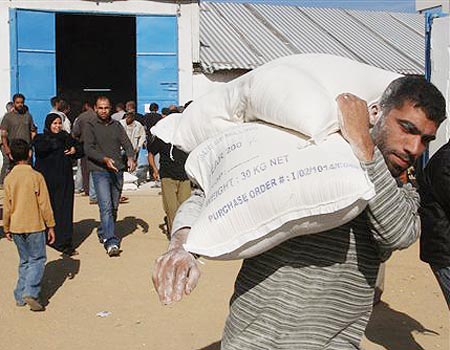
Gaza: Humanitarian Crisis or Collective Punishment?

More than one Israeli politician has commented that there is “no humanitarian crisis in Gaza.” Fair enough. During Ta’anit Tzedek’s monthly conference calls with Gazans we heard over and over that Gazan citizens do not want this crisis to be viewed as a humanitarian issue.

For instance, journalist Sami Abdel-Shafi told us in March that he believed casting Gaza as a humanitarian case is ultimately harmful to Gazans (80% of whom are dependent on foreign aid to survive). That is to say, the longer Gazans are kept dependent on humanitarian largess, the longer Gaza will successfully be kept isolated from the international community:

As long as the so-called “humanitarian” classification continues, I’m afraid we can stay like this for years. But the key is, why leave a population of more than 1.5 million people almost completely deprived of being educated and being developed and of the opportunity to be effective contributors to the regional economy, in addition to the economy of the world?

The answer (as I’m sure Abdel-Shafi well knows) is that this is precisely the point. The blockade of Gaza has never been about Israel’s security. From the very beginning, its aim has always been the isolation of Hamas through the collective punishment of Gazans.

Of course Israel has long tried to make the case that its blockade was initiated to keep weapons out of Gaza, but this justification has grown increasingly hollow over the years. (The surreal revelation that coriander was on the “forbidden list” is perhaps the most infamous example.)

I’ve noticed that even Israel has become less and less inclined to defend the blockade on security grounds.  This past week, it was reported that Israel’s defense establishment is urging the government not to cave in to growing international pressure and permit Palestinians to export goods from the Gaza Strip.  As one defense official put it, “If this happens, we will lose all of our leverage over Hamas.”  When I read this, I couldn’t help but think about Abdel-Shafi’s comments. What possible security benefit could Israel gain with this kind of economic warfare?

On a more heartening note, I just read in the Israeli press that “reliable sources” report that Obama will insist on a full lifting of the blockade when Netanyahu visits Washington in two weeks. According to the report, the President considers the continuing travel ban on Gazans to be (you guessed it) “collective punishment.”

Here’s hoping…