Monthly Archives: December 2010

Tel Aviv, West Bank: A Tale of Two Demonstrations

Tear Gas in Nabi Saleh, Dec. 10, 2010 (Photo: Joseph Dana)

Please read this enormously important post by Israeli activist Joseph Dana, who attended nonviolent West Bank demonstrations in the Palestinian villages of Ni’ilin and Nabi Saleh yesterday. The twist is that these demonstrations happened to occur just as ten thousand Israelis were participating in a Tel Aviv march in honor of International Human Rights Day.

I first learned about these simultaneous events through Dana’s numerous tweets from the ground. Here’s a sampling:

– While the Human Rights March gets underway in Tel Aviv, I am on my to Ni’ilin/Nabi Saleh

– Ni’ilin demo underway while tel aviv marches

– While tel aviv marches for human rights, palestinians are attacked with tear gas

– Human rights day is underway, tel aviv is talking peace while ni’ilin and bil’in are under cover tear gas. I am on the way to nabi saleh

– 10000 people march in tel aviv for human rights and we could not get 20 israelis in ni’ilin. Upsetting

Dana later made the point explicitly in his blog post: for those interested in human rights, the real struggle is not occurring in the streets of Tel Aviv but in the villages of the West Bank, where Palestinian nonviolent activists are regularly brutalized by Israeli military forces. How differently things might have turned out if these thousands of Israelis had saw fit to demonstrate alongside Palestinians in Ni’ilin and Nabi Saleh?

The (Tel Aviv march) brought together various Israeli NGO’s and thousands of concerned citizens in the spirit of presenting a face of Israel that supports human rights and progressive values. Placards were carried through the streets supporting gay rights, woman’s rights, African refugees rights and, also, coexistence between Jews and Arabs. Police lined the streets of the demonstration to ensure the safety of the protesters and keep confrontation with the right wing counter protesters at bay (one has to hand it to the right in Israel, a counter protest to human rights?!). If the Tel Aviv Human Rights Day march wanted to have more authenticity in terms of Palestinian/Israeli coexistence, it should have had more connection with the human rights struggle happening simultaneously in the West Bank.

I’m in complete agreement. Those who seek human rights in Israel/Palestine would do well to support the cause of justice in the Occupied Territories – and in particular, the popular Palestinian committees whose demonstrations are regularly broken up by the IDF with violence and whose leaders are regularly imprisoned without cause.

To this end, I encourage you to this recent statement by Abdallah Abu Rahmah, a leader of the Bil’in popular demonstrations who was imprisoned by Israel a year ago (on, that’s right, International Human Rights Day). This past October, Abdallah was sentenced to an additional year in prison, with a six months suspended sentence for three years and a 5,000 NIS fine:

I often wonder what Israeli leaders think they will achieve if they succeed in their goal of suppressing the Palestinian popular struggle? Is it possible that they believe that our people can sit quietly and watch as our land is taken from us? Do they think that we can face our children and tell them that, like us, they will never experience freedom? Or do they actually prefer violence and killing to our form of nonviolent struggle because it camouflages their ongoing theft and gives them an excuse to continue using us as guinea pigs for their weapons?

My eldest daughter Luma was nine years old when I was arrested. She is now ten. After my arrest she began going to the Friday demonstrations in our village. She always carries a picture of me in her arms. The adults try to look after her but I still worry for my little girl. I wish that she could enjoy her childhood like other children, that she could be studying and playing with her friends. But through the walls and barbed wire that separates us I hear my daughter’s message to me, saying: “Baba, they cannot stop us. If they take you away, we will take your place and continue to struggle for justice.” This is the message that I want to bring you today. From beyond the walls, the barbed wire, and the prison bars that separate Palestinians and Israelis.

Click here to send a letter to Secretary of State Clinton requesting that she advocate the release of Abdallah Abu Rahmah and demand that Israel cease its targeting of the Palestinian popular resistance.
Conference Call With Journalist Jared Malsin: “Operation Cast Lead: Two Years Later”

This Thursday, December 16, at 12:00 pm (EST), Ta’anit Tzedek  – Jewish Fast for Gaza will present a conference call, “Operation Cast Lead: Two Years Later” featuring American journalist Jared Malsin.

Call-in info:

Access Number: 1.800.920.7487

Participant Code: 92247763#

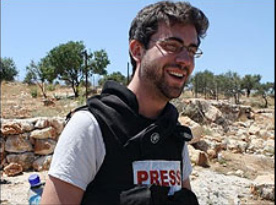
Jared Malsin served as the chief English editor of the Palestinian news agency Ma’an. He spent two and a half years reporting from the West Bank, based in Bethlehem.

In January 2010, while returning from a vacation in Prague, the Israeli government detained Malsin at Ben-Gurion airport after questioning him about his allegedly “anti-Israeli” political views, Palestinian contacts, and news articles authored “inside the territories.” Malsin spent a week in jail before he was deported to the US.   His deportation was condemned by the head of the International Federation of Journalists as “an intolerable violation of press freedom.”

Since October 2010, Malsin has been reporting regularly from Gaza as a free lance journalist.

Here’s Malsin in an interview with radio journalist Christophen Lydon:

If you’re living in the West Bank or Gaza, your water gets shut off for a week or ten days at a time, in the summer, routinely. Which means that if you live in a refugee camp in Bethlehem, for a week or ten days in the summer you can’t wash yourself; you can’t wash your children. You can’t take a shower. You can’t cook food. It’s incredibly dehumanizing, but it’s one of these issues you just don’t hear about because there are no explosions going on. It’s one of these daily lived ways that people live occupation. And that’s what I think the real meaning of it is… Those are the stories I’m interested in.

Why the Peace Talks Failed

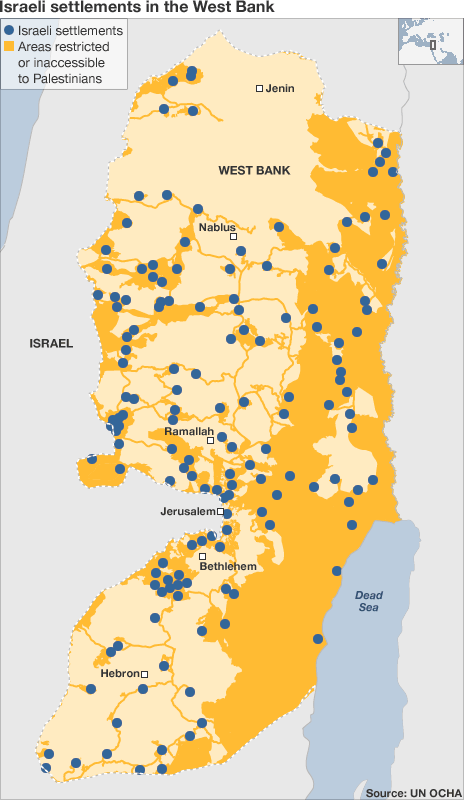
The New York Times tells us that Israeli-Palestinian peace talks have fallen through because the Palestinians are “refusing to resume direct negotiations absent a (settlement) moratorium.”

I’d say the map below (from a BBC article on the “settlement row”) explains everything you need to know about why the peace process has failed – and why a viable two state solution is well nigh impossible at this point.

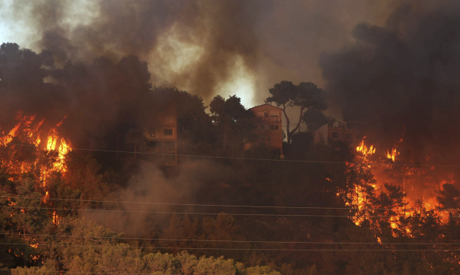
Fire in Northern Israel: Israel’s Katrina?

The news out of Israel is just heartbreaking.

We in post-Katrina America know a thing or two about a how a country can spend obscene amounts of resources on weapons of war while its basic home front preparations are left to languish. I well remember how back in 2005, even while the causalities in NOLA mounted, painful readiness issues were being publicly debated.

Now they’re asking the same questions in Israel. Israeli blogger Noam Sheizaf has placed direct blame at the feet of the Ministry of Interior, who may turn out to be the the Israeli equivalent of our Michael (“You’re doin’ a heck of a job, Brownie”) Brown:

By yesterday evening the supply of chemicals used in fighting flames ran out, and the firefighters had to settle for water. Israel issued an urgent request for help form other European countries, but for the casualties and their families it was too late…

Eli Yishai is the Interior Minister. Yesterday, when PM Netanyahu did the right thing and showed up at the emergency command center in Haifa, Yishai was nowhere to be found. Earlier, he tried to spin the story, blaming the finance ministry for the budget cuts.

Reuters pointed out that for all of its high tech military aircraft, Israel lacked even one even one water bombing plane:

Israel could buy three state-of-the-art Bombardier Superscooper firefighting planes for the price of just one of the F-35 stealth fighters it has on order.

The highly specialized amphibious aircraft, costing $28.5 million each, can scoop and drop six tones of water up to 10 times per hour on a fire that is near a big body of water. The Israeli blaze is only a few km (miles) from the sea.

But Israel does not have any. Instead it has to rely on Mediterranean neighbors who also face a constant wildfire risk and were prudent enough to buy the water-bomber aircraft. Greece has 21 of them, Croatia 6.

Israel instead has chosen to “improvise,” critics said. On Thursday night, airforce mobile water cannon designed to operate on flat tarmac could be seen trundling warily into position on steep earthen slopes, their range still quite inadequate.

By contrast, Israel has 360 F-16 fighters, far more than most countries outside the United States that have bought the world’s best-selling attack plane, not to mention many F-15s and the whole panoply of costly, advanced military aviation.

Israeli journalist Aluf Benn, writing in Haa’retz, says this tragedy makes it clear that Israel might well think twice about waging war on Iran:

Under such circumstances, it is best for Israel not to embark on war against Iran, which will involve thousands of missiles being fired on the home front.

After the Second Lebanon War, which exposed how pathetic the civil defense system was, reports were written, exercises were held, but everything broke down under the stress of a real emergency on the Carmel range − an area that already experienced the trauma of Hezbollah missiles.

Yesterday Israel asked for help from Cyprus and Greece, and the air force traveled to France to bring fire retardants to make up for the material that had run out. In war time, it is doubtful whether Israel will be able to rely on the generosity and largess of its neighbors.

We can expect more recrimination and accounting in the days to come. In the meantime, however, I know our hearts and prayers are with all whose lives have been torn by this horrible tragedy that, as of this writing, continues to rage on.