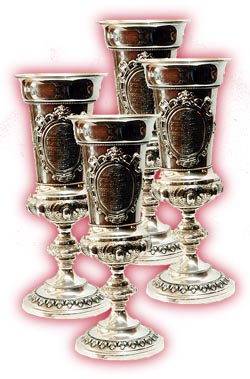
 Here is a guest post written by my friend and colleague, Rabbi Lynn Gottlieb, founder of Shomer Shalom Institute for Jewish Nonviolence. Read it around your seder table:
Talmud Yerushalmi (Pesachim 10a) associates the four verses that describe the liberation of the families of Israel from subjugation with the four cups of wine at the Passover table. As it is written, “Say, therefore to the Families of Yisrael, ‘I am Adonai and I will take you out from under the burdens of Mitzryim, and I will save you from their bondage, and I will redeem you with an outstretched arm and with great judgments and I will take you to Me as a people…and you shall know the Spirit that draws you forth from under the burdens of subjugation.”
The four words imply a process a process of transformation. This process has four parts: Mitzryim is the Hebrew word that refers to the condition of structural subjugation. Pesakh moves from limping under the burden of the oppression to leaping like a liberated lamb through the parting seas that lead to freedom. The process happens in stages.
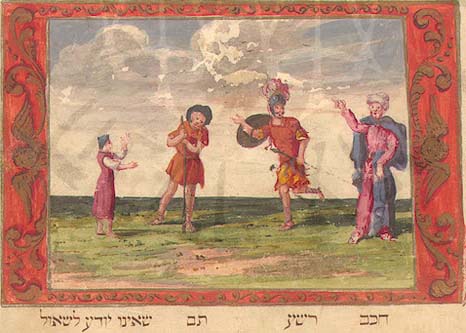
V’hotzayti~I will take you out: Complete subjugation is resisted by resisting the occupation of the mind that oppression imposes. In this stage we must ask questions that release us from the narratives that justify subjugation. That is why the seder begins with a collective invitation to the poor and oppressed to speak their stories and share a meal. The four children are a way of exploring one’s own relationship to subjugation.
V’he’tzal’ti~I will save you: Mitzryim is not mentioned by name, implying a lessening of the power of subjugation. At this stage, the community engages in acts of resistance and noncooperation-direct action in order to embody the liberation and begin the long journey of stepping out of subjugation. The midwives boycotting Pharaoh’s order to harm children, and instead, made the healing of children their first priority. Some traditions say they were non-Jewish midwives, and other traditions equate them with Miriam and Yochevet. What is clear for all of us? Liberation depends on multicultural, intergenerational and multifaith solidarity. Freedom is a country without borders.
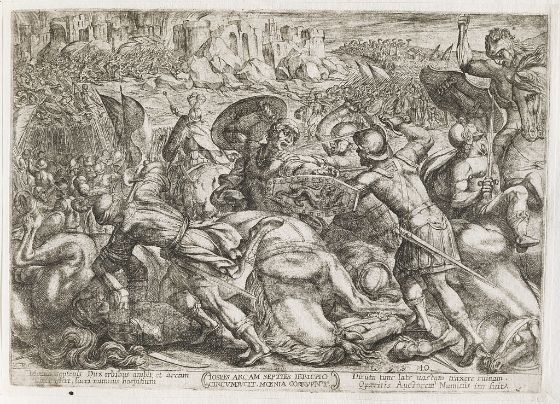
V’ga’al’ti~I will redeem you: Redemption requires collective mass action and the building of pillars of support in sections of society that have not yet taken action. Systematic and structural violence can be overcome when the society as a whole no longer accepts the normative status quo. Oppression is moved out of the margins into the center as a social issue. During this stage oppression can increase because people are moving closer to the goal of overcoming subjugation. Pharaoh sends his armies to attack those seeking liberation. At this moment we need to call upon the entire nation’s faith that the seas will part.
Lakach’ti~I will take you in beloved relationship: Liberation requires a communal effort to building alternative institutions, and to create alternatives to the violent narratives of oppression. Liberation is the creation of a new reality outside the subjugation framework where the dignity of every single human being is valued. Dignity is a country without borders, it is the promised land.
As the process of liberation proceeds, we come to V‘yadatem~and you shall know. This knowledge is the knowledge of the heart that comes from faith in nonviolence and compassion. When liberation is internalized it is a powerful turning point in the healing process. It is awakening to the realization that we are all equal and precious in the eyes of the Creator.

 Shalom Rav