Monthly Archives: March 2017

The Cry of the Canaanites: A New Passover Seder Supplement


7079146_orig

Here is the introduction to my new Passover seder supplement, “The Cry of the Canaanites.” Click here for the entire text to print out and read at your seder table this year. (Click here, here and here for supplements I’ve written in previous years):

After singing Dayenu, we say:

Our telling of the Exodus story is not yet complete. It is not “dayenu” – it is not enough for us – to sing joyfully of the Israelites entrance into the Promised Land without noting that this promise came with a command: to dispossess and annihilate the indigenous inhabitants of Canaan:

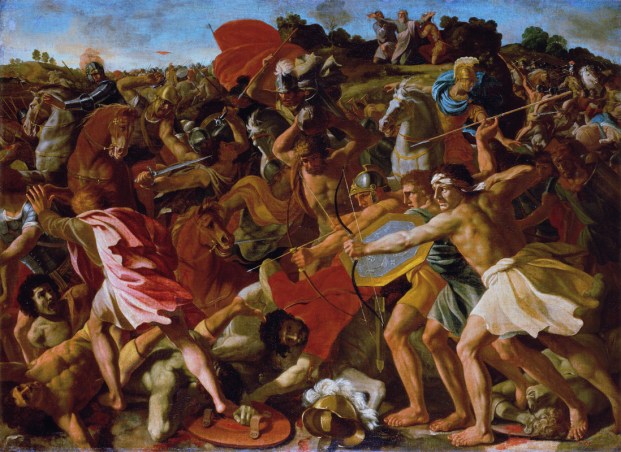
So the trumpets were sounded, and when they army heard the sound, they raised a great shout, and the wall collapsed. The army advanced on the city, every man straight ahead, and they captured it. And they utterly destroyed all that was in the city; both man and woman, young and old, as well as the cattle, the sheep and the donkeys, with the edge of the sword.

(Joshua 6:20-21)

As difficult as it may be to read such as these in our most sacred text, it is even more unsettling when we consider that the conquest tradition of the Bible has been used to justify centuries of colonial dispossession of indigenous peoples throughout the world. It has also been used in various ways by early Zionist ideologues, the political founders of the state of Israel and by the present day religious settler movement.

Therefore, we cannot continue with our seder until we honestly face – and disavow – the immoral conquest tradition that is embedded within our Exodus story. We now take this time to read and discuss the teachings of three liberation theologians: one Native American, one African American and one Palestinian. As we consider their challenge to us, let us ask one another: how will we hearken to the cry of Canaanites past and present? Are we ready to admit our complicity in their dispossession? Can we transform the dream of a Promised Land into the reality of a land that is truly promised to all?

On the Fallacy of “Liberal Zionism”

Take a look at the short video that the liberal Zionist organization Ameinu recently posted on its Facebook page. Entitled, “Why Israel’s survival as a Jewish state is now in danger,” the clip essentially makes the familiar argument for maintaining a Jewish demographic majority in order to ensure Israel’s status as a “Jewish and democratic state.”

While there’s nothing particularly new in the video that hasn’t been argued by liberal Zionists for the past twenty years, I was intrigued by the following quote from the opening narrative:

What makes Britain British? Is it the London Bridge? Or the people driving over it? And Italy: is it the pizza, or the people eating it? What about Israel? What makes it a Jewish state? Is it its geographical shape? Its landmarks? Like any country, what makes Israel a Jewish state, and what guarantees that it will remain one, is that the overwhelming majority of its residents are Jewish.

It’s a fascinating way to frame the issue. It also betrays the inherent contradiction at the heart of  liberal Zionism.

From a national identity point of view, Israel simply isn’t comparable to Britain or Italy (or the US for that matter). The latter countries have civic national identities; that is to say, they are defined by a sense of common citizenship. Britain is not British because it maintains a demographic majority of one specific religious or ethnic identity.  It sounds obvious, but it bears noting in this context: one can belong to the British nation and be Christian, Jewish, Muslim or Hindu as well. That is because the British people are bound together as citizens of the British nation.

Israel, on the other hand, is not a state of all its citizens. It is rather, a state for only some of its citizens – namely Jews. This is because the purpose of the Zionist enterprise is to create a state for the Jewish people.

In fact, there is actually no such thing as an Israeli “nationality” according to Israeli law. Unlike Britain and Italy and other Western democracies, Israel actually maintains a legal distinction between citizens (ezrachim in Hebrew) and nationals (le’umim). In theory at least, all Israeli citizens have equal rights – but only Jewish citizens can be considered nationals.

There are indeed non-Jewish citizens of Israel – they make up roughly 20% of the population. But because these citizens are not nationals, they are subjected to extensive discrimination within Israeli society. (According to Adalah: The Legal Center for Arab Minority Rights in Israel, there are more than 50 Israeli laws that “directly or indirectly discriminate against Palestinian citizens of Israel in all areas of life.”)

The liberal Zionist trope advocated by the Ameinu clip claims that the demographic threat posed by Palestinians began in 1967, when Israel “conquered several areas of land” and was faced with a “rapidly growing Arab population that never wanted to live in a Jewish state.”

The real problem, however, is not the Palestinian birth rate in the West Bank. The problem lies with the very notion of a state predicated on the identity of one particular people in a land that has always been multi-religious and multi-ethnic.

This is why the concept of liberal Zionism is ultimately an oxymoron. There is nothing liberal about a nation state that predicates its national character upon – and grants full citizenship to – one particular group of people.

In other words, the problem is not “the Occupation.” The problem, quite simply, is Zionism.

Esther and the Agagite: A Love Story

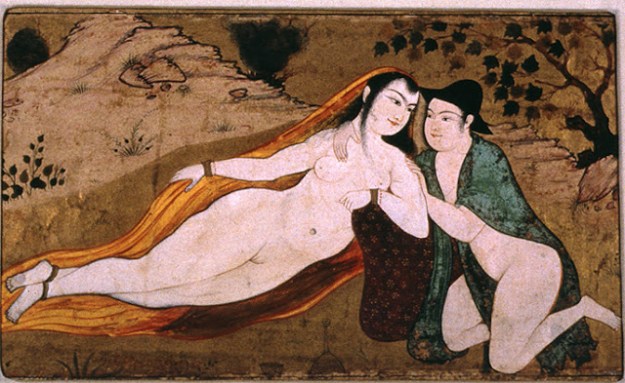
persian_lovers

“Lovers,” c. 1630, by Riza-i Abbasi, Aqa, ca. 1570-1635 

“Rava said: ‘It is one’s duty to make oneself fragrant with wine on Purim until one cannot tell the difference between ‘Cursed be Haman’ and ‘Blessed be Mordecai.'”

– Babylonian Talmud Megillah 7b

Now it came to pass in the days of King Ahasuerus,
(this is Ahasuerus who reigned
over the great Persian empire in 486 BCE)
that the King made a feast unto all the men of his kingdom
and Vashti the Queen held a feast for the women.

On the seventh day,
when the heart of the King was merry with wine,
he demanded that Vashti the Queen dance before him
wearing nothing but her royal crown.
But Vashti refused to come at the King’s command.

Thereupon the King asked his wise men,
“What shall we do to the Queen Vashti;
she has disobeyed an order of King Ahasuerus!”
Their answer: “Vashti has not merely insulted the King,
but all the people of Persia.”

The King’s men went to summon the Queen,
but she was nowhere to be found.
Some say she was executed,
others say she was imprisoned,
still others say she fled the empire.

The legends of her fearlessness however,
are told yet to this day.
(On many a moonlit night, they say,
Vashti’s songs and laughter can be heard
ringing out across the shores of the South Persian Sea).

The King sent out a royal command
Throughout all the provinces of his kingdom,
to all the maidens of the land:
Come to the palace!
The one that most pleases the King
shall replace Vashti as Queen.

Now the Jews had lived in Persia for a century –
ever since the Great Destruction
and they enjoyed freedom and prosperity
throughout the land.

In those days there was a certain Jew,
whose name was Mordechai.
Although he lacked for nothing,
he could not find peace,
for the memory of his ancestors’ exile
burned within him
like a fire that raged without end.

Mordechai’s niece Esther
decided that she would go the King’s palace.
When she told Mordechai, he smiled within.
“If Esther does indeed become Queen,” he thought to himself,
“I may finally avenge the wrongs done to my ancestors
and bring ruin upon the people of Persia.”

When Esther went into the King’s house
King Ahasuerus proclaimed:
“This one shall be my Queen.
Together we shall rule over all Persia.”

When Mordechai learned his niece
would soon be crowned as Queen,
he said to her:

“This is just the moment
for which we have waiting!
You must tell me everything
you hear from the King’s palace
so that we may move against it.

For we know it is but a matter of time
before the Persian empire makes good
on its plans to destroy our people.
Be true to your kin!
Who knows, maybe you have been made Queen
for such as time as this?”

But Esther said to Mordechai,
“This I will not do, for Persia is our home.
We dwell here in security and enjoy
a bounty of blessings in this land.
If I were as to do as you instruct me,
it would bring hatred and retaliation
against the Jewish people.”

And so Esther married King Ahasuerus
and joined him in his palace.
Esther did not hide her Jewish identity
from the King or anyone else who lived in the land.
The Jews of Persia rejoiced –
for although many of their kin
had held high and respected positions
in the King’s court,
they were proud that one of their own
had become Queen of all Persia!

Sometime later,
Ahasuerus promoted Haman the Agagite
to a place of highest honor in his court.
Though the Jews had been taught
to fear his ancestors,
Haman was a man of compassion and wisdom,
held in great esteem by all who know him.

When Mordechai learned of Haman’s rise
in the King’s court
he was filled with loathing and dread.
He gathered with four conspirators
and together they plotted Haman’s downfall
by striking a mighty blow against his people.

Back in the palace, Esther grew bored of the King,
whose passions were directed exclusively
toward dreary matters of state
and late night trysts with his many consorts.

But Esther was not content
to remain alone in her chamber.
She and Haman had come to know one another
and soon they became lovers.
When night fell they would steal away to his bed
while the King was snoring
in the chambers of his concubines.

In due time, one of Mordechai’s co-conspirators
came to regret the terrible plans they had made,
and he requested an audience with the Queen.
Bowing low to Esther, he said,

“Please forgive me, your highness,
for I have committed a grievous wrong.
Mordechai has set a terrible plot in motion:
In one day, on the thirteenth day
of the twelfth month of Adar,
he plans to murder Haman while he worships.
None will be spared and all who are gathered in prayer
with him will be slain.”

That evening, Esther lay awake
with great anguish.
If she remained silent, she would allow
the death of many innocents
and the Jews of Persia would be in grave danger.
But could she betray her own kin?
If she told the King of Mordechai’s plot
he would most certainly be put to death.

With morning soon to break
Esther finally knew what she must do.
Leaving the palace quietly before dawn,
she rode to Mordechai’s home
and told him thus:

“I know what you have planned,
so hear me now:
Although you are my own flesh and blood,
I am prepared to tell the king
of your evil plot.
If you attack Haman and his people,
you will bring nothing but bloodshed and sorrow
to our people and all of Persia as well.”

Then coming closer she said to him:

“We are Jews, but Persia is our home.
As a Jew, as a Persian, and as your Queen:
I swear that as I stand here before you now,
I will turn you in before I allow you
to bring ruin upon us all.”

Thereupon Esther returned to the palace
as the sun rose on the thirteenth of Adar.

That morning, Esther woke with a start
because Haman had already left
for his morning prayers.
When he returned, she she gave thanks to God
for she knew that Mordechai had turned away
from his wicked plan.

As Esther embraced her love, she marveled
at how quickly her sorrow had turned to joy
her fear into power,
her anguish into hope.

(So may it be for us
and for all who dwell on earth).
Synagogues and Sanctuary: It’s Time to Get Politicized

0211-cbsn-xbx-immigration-1249951-640x360

In a recent op-ed for the Forward, Editor-in-Chief Jane Eisner expressed unease at the prospect of synagogues getting involved in growing Sanctuary Movement. “Unease” doesn’t even begin to describe how I felt upon reading it.

The crux of Eisner’s argument: this “nascent movement of churches, mosques and synagogues to become sanctuaries, to aid and house undocumented immigrants (represents) a further politicization of religious life.”

She writes:

While I appreciate and even admire the moral compulsion of synagogues willing to go so far as to break the law in this particular case, what about others? What about the houses of worship that have politics I don’t agree with — the ones that exhibit an equal moral passion to, in their words, protect the unborn? Or resist accommodating trans people? Or same-sex marriage?

In other words, Eisner believes it is problematic for progressive houses of worship to engage in acts of civil disobedience in the furtherance of justice because conservative faith communities might well use the same tactics for their own causes.

Eisner’s argument against religiously-motivated civil disobedience is essentially an argument for neutrality. I can’t help but wonder how she would have responded when Dr. Martin Luther King Jr., the pastor at Atlanta’s Ebenezer Baptist Church, led a religious call for civil rights in this country. Would she have felt stymied by the masses of southern whites in states that actively resisted federal laws against segregation and voter suppression? Would she have likewise counseled King to “consider the consequences?”

Of course, we cherish the separation between church and state. At the same time, however, religious life in this country has always been “politicized” – and progressives need not hesitate in celebrating this fact. If religion hadn’t been politicized, we wouldn’t have had the abolitionist movement, the anti-war movement, the civil rights movement or the original sanctuary movement of the 1980s.  Each and every one of these movements helped to further the cause of justice and equity in this country – and thank God for that (pun intended).

Eisner correctly observes that “(religion) has flourished in America because it is independent from the state, and able to serve as a prophetic voice against government corruption and cruelty.”  But her logic fails her when she concludes, “that standing comes from respecting the law and working within the system.” On the contrary, prophets were not particularly well-known for “working within the system.” As Thoreau, Ghandi, King, Mandela and others have taught us, civil disobedience is a tactic rooted in the conviction that there are laws that need to be broken. It does not purport to merely protest unjust systems but to dismantle them.

In this regard, Eisner’s hypothetical citation of those who engage in civil disobedience to “resist accommodating trans people or same sex marriage” is little more than a red herring. In such instances, civil disobedience would be used in order to maintain the unjust systems that exclude and oppress vulnerable minorities in this country. The sanctuary movement, on the other hand, seeks to dismantle an unjust immigration system that literally treats human beings as illegal, rips families apart, and often sends people back into countries of origin where they will face certain persecution or death.

When Eisner writes that she would feel “more comfortable about the sanctuary movement if it had a specific policy aim,” she betrays an egregious blindness to our current political moment. In Trump’s America, the goal of sanctuary is not political immigration reform, but triage. In my work supervising immigrant justice programs at the American Friends Service Committee throughout the Midwest, I can attest that the threats facing undocumented immigrants in our country have reached emergency levels. While Eisner frets that “resistance from a few renegade churches and synagogues may only alienate…reasonable Americans,” she might do better to worry about the fates of individuals and families who are living with the daily fear of incarceration and deportation.

When I read Eisner’s words, I couldn’t help but think back to the liberal clergy to whom MLK addressed his Letter from a Birmingham Jail: well-meaning religious leaders who “appealed to white and negro citizenry to observe the principles of law and order and good sense.”  In response to them, King famously wrote:

Any law that uplifts human personality is just. Any law that degrades human personality is unjust.

The laws that oppress undocumented immigrants in the US are degrading and unjust – and will become even more so very soon. If we want to be on the right side of history, it’s time for our synagogues to find the courage of their convictions and get “politicized.”