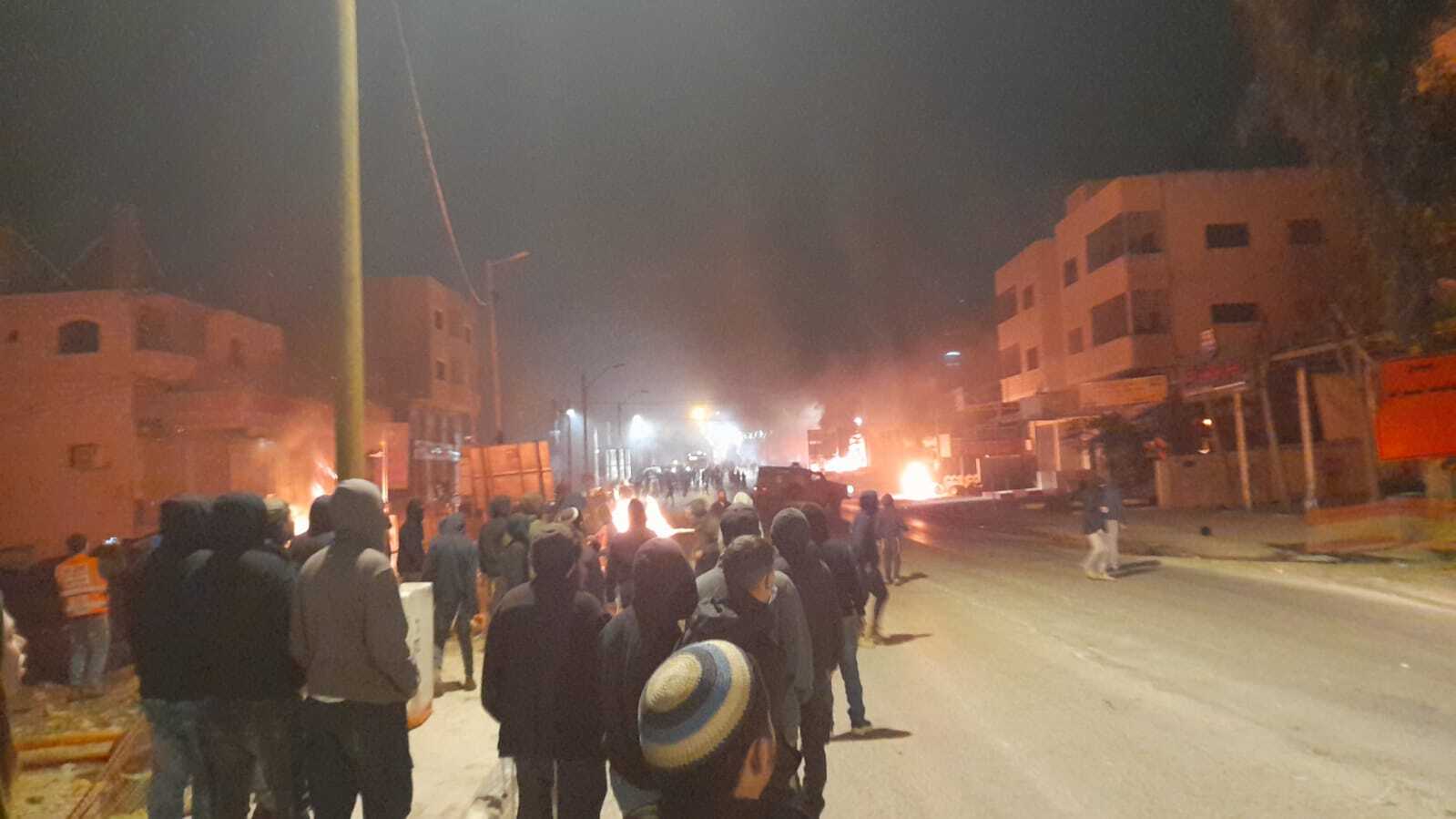
For the past several days, Israeli politicians and military leaders have been publicly condemning last Sunday’s settler rampage in the West Bank village of Huwara. While the pogrom was well underway, in fact. Netanyahu publicly assumed the posture of the reasonable, measured moderate, pronouncing to the settlers, “Don’t take the law into your hands. I ask that you allow the IDF and security forces to do their work.” More recently, a top Israeli general said in an interview that the military had predicted the settler attack, but that they “didn’t predict a pogrom.”
It was indeed ironic that during the attack, Netanyahu beseeched the settler community to “let the IDF and security forces do their work” since the IDF and security forces had already done their work all too well. Israeli journalist Orly Noy reported that when the attack commenced, “the Israeli army shut down the two entrances to Huwara and allowed the settler mob to enter the town by foot, doing nothing to prevent the ensuing atrocity.” Noy added that “settlers were seen handing out food to the soldiers stationed at the town’s entrances, which the soldiers gladly took and warmly thanked them for.”
So don’t be fooled by the hand-wringing. The notion that one of the most powerful militaries in the world was unable to control a civilian mob is nonsense. Despite official protestations to the contrary, this was state-endorsed violence, full stop.
In this regard, it bears a chilling resemblance to the horrific 1982 massacres in the Sabra and Shatila refugee camps. Another Israeli reporter, Gideon Levy, aptly made this connection in a recent Ha’aretz op-ed:
Turning a blind eye in this way conjures up forgotten memories. The IDF also turned a blind eye in 1982 at the Palestinian refugee camps of Sabra and Chatila in Lebanon, making it possible for Lebanese Phalangist militias to commit the terrible massacres there. There was no massacre at Hawara, not yet, but no one could have known in advance how things would turn out. If the rioters had also wanted to massacre the population, no one would have stood in their way on Sunday. No one stopped the Phalangists at Sabra and no one stopped the Phalangists at Hawara.
Indeed, when these kinds of events occur, we must never lose sight of the face that they occur within a context of constant state violence. These are not isolated “vigilante actions,” nor do they constitute a “cycle of violence.” Yes, the pogrom occurred in retaliation for the murder of two Israeli settlers – but we cannot forget that it also occurred within the context of a brutal military occupation in which the Israeli military has routinely been killing Palestinians on an almost daily basis.
It’s also critical to note that military violence against Palestinians in the West Bank has dramatically increased over the past few months – just last week at least 11 Palestinians were killed and more than 100 injured in an Israeli military raid on Jenin – and that observers have long been warning of a resurgent Palestinian uprising in response. But of course, none of this is new. Israel’s military oppression of West Bank Palestinians has been normalized and routinized for decades. If there is anything new now, it is that there are now Israeli politicians who are ready to proudly display their hated of Palestinians out loud, as Zvika Fogel, chairman of the Knesset’s National Security Committee did when he proclaimed on Monday, “A closed, burnt Huwara — that’s what I want to see…We need burning villages when the IDF doesn’t act.”
In the wake of the Huwara rampage, I’ve read some debate as to whether or not it should accurately be referred to as a “pogrom.” To my mind, most of these analyses miss the central point entirely. Yes, the pogroms waged against Jewish communities of Eastern Europe were carried out by local non-Jewish populations, but they were typically fanned and encouraged “with government and police encouragement.” Historically speaking, pogroms have generally been carried out by local actors, as a pretext for larger government designs.
When it comes to Jewish pogroms against Palestinian communities, some of the worst violence has historically occurred during the holiday of Purim. I’ve written about this sickening phenomenon before; Jewish pogroms against Palestinians have become an annual inevitability in Israel, when extremists have used the violence at the end of the Book of Esther as a pretense to terrorize and brutalize Palestinian communities. In particular, the settlers’ Purim parade in Hebron has become an annual tradition for the unleashing of anti-Palestinian pogroms.
As Purim eve arrives this Monday evening, I have no doubt that Palestinians in Hebron and throughout the occupied territories are bracing for more rounds of horrid, tragic violence. I fervently hope and pray that this will not be the case – and I hesitate to indulge in alarmism – but given the tenor of the current moment, I genuinely fear that Purim is arriving at the worst possible time.
Whatever may happen this year, I hope we will not be fooled by the hand-wringing protestations of hypocritical politicians, that we will summon the courage to call out state-sponsored violence when we see it, and that we are prepared to demand in no uncertain terms that the true perpetrators are held accountable.
 Shalom Rav