Author Archives: Rabbi Brant Rosen

Unknown's avatar

About Rabbi Brant Rosen

I'm a rabbi, blogger, and activist with a special interest in Israel/Palestine justice work.

A Reckoning for Yom Ha’atzmaut

I’ve written before that as a Jew, I no longer consider Yom Ha’atzmaut to be a day of unmitigated celebration – but rather be an occasion for honest reckoning and soul searching.  In particular, I believe we need to struggle with the very meaning of independence itself. In our profoundly interdependent world, what does the concept of “independence” ultimately mean?  Is independence a one-time occurrence or an ongoing process? And, perhaps most painfully, in what ways has Jewish independence come at a very real cost to the rights of another people?

To help us reckon with these kinds of questions, I encourage you to visit the new website, #Nakbasurvivor.  This is an amazing new project from the Institute for Middle East Understanding that invites Palestinians to tell their family’s story of the Nakba over Twitter and YouTube. It’s a brand new effort, but already the stories seem to be pouring in. (Click above for one such story.)

As Jews, we know as well as people that memory is profoundly sacred – and that it is our duty to transmit our memories to the next generation so that we might be transformed by the lessons they teach us. As I watched these videos, I felt a myriad of emotions: a sense of honor that these sacred stories were being preserved and transmitted, a sense of pain that my own people’s independence came at the cost of another’s, and a sense of responsibility to acknowledge this memory – and to speak out against the injustices that still continue to this day.

When it comes to memory of the Nakba, there is no justice. This past year, the Knesset has passed legislation that makes it illegal for any Israeli communities that hold events commemorating the Nakba on Yom Ha’atzmaut. In other words, Israel has essentially criminalized the memory of 20% of its citizens.

Today, on the first Yom Ha’atzmaut since this law was passed, Nakba demonstrations have taken place across East Jerusalem and the West Bank. There have been widespread clashes with the IDF and numerous Palestinian casualties have been reported.  (In the East Jerusalem neighborhood of Ras el-Amud, a 17 year old was shot in the stomach with live ammunition – as of this writing, he has no pulse and the doctors are now fighting for his life.)

There will be no independence for anyone – Israeli or Palestinian – until there is justice. And there will be no justice until we truly honor memory, no matter how painful.
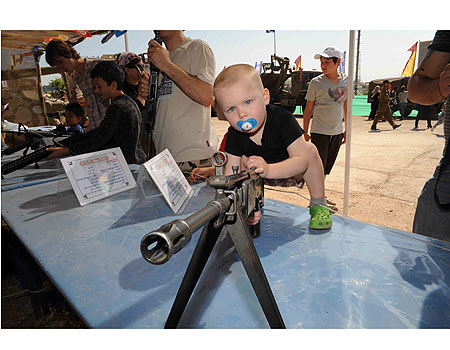

Happy Independence Day?

Ynet Photo: Avihu Shapira

Saw this in Ynet this morning, from an article covering Yom Ha’atzmaut celebrations in Israel. Caption: “Tens of thousands visited IDF bases.”

My first thought: the famous picture of the Palestinian baby in a bomb vest that got some major play in the Jewish press some years back.

My second thought: those Jews who claim Palestinians harbor a “culture of death” should take a good long look at this picture.

My third thought: this recent picture of an Israeli preschool – another image that stopped me in my tracks.

I really don’t know what else to think…

Hospitality Staffing Solutions and the Dehumanization of Workers

I was thinking of writing a post about how dehumanizing it is to work for Hospitality Staffing Solutions, the “temporary agency” used by Hyatt Hotels in Boston, Indianapolis and other cities, where workers start at minimum wage with no benefits and have to clean up to 30 rooms a day.

I was thinking about writing a post about the safety orders recently issued to Hospitality Staffing Solutions and the Hyatt Regency Indianapolis by the Indiana Occupational Safety and Health Administration following injury complaints lodged by Hyatt housekeepers. (The proposed fines to both companies total more than $50,000.)

I was thinking about writing a post about how Hospitality Staffing Solutions has faced wage complaint lawsuits in Massachusetts, Florida, Georgia, and Pennsylvania, including a 2009 class-action suit on behalf of more than 100 janitors and housekeepers at two Pittsburgh Hyatts.

I was thinking of driving home the point that these kind of labor subcontractors are increasingly enabling the hospitality industry to treat its workers as cheap and disposable commodities…

…but I think this recent ad for Hospitality Staffing Solutions will tell you everything you need to know…

(h/t Ross Hyman)

Gaza and the Arab Spring: A Conversation with Nadia Hijab

I’m pleased to announce that Ta’anit Tzedek – Jewish Fast for Gaza will sponsor “Gaza and the Arab Spring,” a conference call with prominent Palestinian writer and human rights advocate Nadia Hijab on Thursday, May 19 at 12:00 pm EST. 

The Arab Spring – a series of popular uprisings all over the Arab world – has brought new hope for greater freedom, justice and democracy to millions of people throughout the Arab world and beyond. The uprisings have already brought about dramatic changes in several countries and the popular movement is growing in strength. How will these changes affect the Israeli-Palestinian conflict and more particularly the people of Gaza? What is impact of related developments, such as the Hamas – PA unity agreement and Egypt’s opening of the Rafah crossing into Gaza?

Our guest, Nadia Hijab was born in Syria to Palestinian parents and was raised in Lebanon. Ms. Hijab began her career as Editor-in-Chief of Middle East Magazine and later moved to New York to work for the United Nations Development Program where she served in several UNDP departments and helped organize the Program’s contribution to the 1993 World Conference on Human Rights.

After leaving the United Nations, Ms. Hijab became Executive Director of the Palestine Center, a Washington, DC-based think tank affiliated with the Jerusalem Fund. In 2000 she established her own consulting business on human rights, human development, and gender. Ms. Hijab has served as co-chair of the US Campaign to End the Israeli Occupation and is on its advisory board, and is a Past President of the Association of Arab American University Graduates.

Ms. Hijab appears frequently as an Arab-affairs commentator on television, radio and print outlets and has authored more than 100 articles and has published two books: Womanpower: The Arab Debate on Women at Work. and Citizens Apart: A Portrait of Palestinians in Israel.

To participate in the call:

Dial the Access Number: 1.800.920.7487 

When prompted, enter your Participant Code: 92247763# 

There will be a question and answer period during the call.

Participants in the call are encouraged to read one or more of the following three articles by Ms. Hijab.

The Arab revolutions and the Israeli-Palestinian Conflict

Understanding Obama’s Settlement Posture

The Palestinian Narrative: Then and Now

We are honored to welcome Ms. Hijab to our monthly conference call and invite you to join the conversation!

Osama Bin Laden: Was Justice Done?

On nights like this one, we can say to those families who lost loved ones to al Qaeda’s terror: justice has been done (President Obama, May 1, 2011)

I can’t say that.

In Jewish tradition, there are two different terms for “justice.” The first is mishpat, which is generally understood to mean “retributive justice.” In other words, we apply mishpat when we settle our disputes by right rather than by might, through due process of law rather than by resorting to revenge or vigilantism. Jewish – as well as American – values teach that law must be held in the highest regard by any community that considers itself a free society.

By this standard, justice was certainly not done when bin Laden was summarily executed by extra-judicial assassination. Many American leaders have repeated that terrorists have declared war on American values. What does it mean, then, when we fight them by betraying the very values of justice that we purport to uphold?

Louise Richardson, whose book “What Terrorists Want” is the wisest book on terrorism I’ve ever read, hits right it on the head:

Had we captured bin Laden alive and then resisted the very human urge to exact revenge and instead handed him over to an international court of impeccable rectitude and reputation for trial on charges against humanity, we would have deprived him of glory and demonstrated, even to the skeptical, the vast difference between his values and ours (p. 198)

(Though I hold tight to this moral conviction, I have no illusions that trying bin Laden in an international court would have been anywhere near the realm of political possibility. Just last month, the White House gave up on its intention to try accused 9/11 mastermind Khalid Shaikh Mohammed in a New York civilian court. Attorney General Eric Holder now says Mohammed and four other 9/11 terror suspects will face a military trial at, you guessed it, Guantanamo Bay.)

The other word for justice is tzedek, or “distributive justice.” According to this definition, we promote justice whenever we strive to eradicate the inequities in our society, be they imbalances of wealth, power, or privilege.

By this measure, our execution of bin Laden represents the tragic failure of imagination that our government calls the “War on Terror.” We are sadly deluded if we believe we will end terror through the force of our military might. We will never fully eradicate terrorism – but we can certainly mitigate it by taking responsibility for the ways our nation may be contributing to the global injustices that create breeding grounds for terrorists around the world.

Now that we’ve killed bin Laden, are we ready to have a real national conversation about the hundreds of military bases our country maintains around the world, our ongoing wars in three Middle Eastern countries, and our unconditional military support for Israel’s occupation? For all of the billions of dollars we are pouring into our national military machine, might we be prepared to contemplate, as Richardson suggests, “the adoption of a comprehensive development agenda to address the underlying or permissive causes of terrorism?” (p. 221)

No, I do not believe justice, in any sense of the word has been achieved here. Visceral satisfaction, relief or grim pleasure, perhaps, but not justice.

Palestinian Unity: In Search of a Game Changer

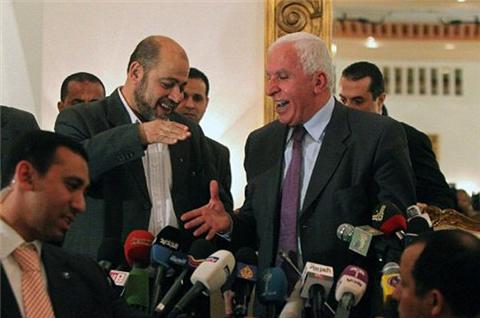
When I read of the reported “PA-Hamas reconciliation” deal, my initial response was generally positive. It seemed to me that Palestinian leaders on both sides were finally taking their constituents’ desire for unified leadership seriously. It also appeared that – together with the PA’s campaign to find international support for a declaration of statehood – Palestinian leadership had decided to proactively shake up the paralyzed status quo.

Readers of my blog know I’ve long believed that Israel, the US and the international community should end its shunning of Hamas if any real progress will be made in settling this conflict. Alas, I’m saddened but not too surprised that Bibi’s immediate response to Palestinian unity talks was to say the PA “must choose whether it is interested in peace with Israel or reconciliation with Hamas.”  For its part, the White House stated it “supports Palestinian reconciliation,” but then rejected its support in its very next sentence:

The United States supports Palestinian reconciliation on terms which promote the cause of peace. Hamas, however, is a terrorist organization which targets civilians.

At any rate, it’s fairly clear that the unity effort is likely to be more symbolic than an actual game changer. As Ali Abunimah recently pointed out, it’s difficult to imagine how a unified Palestinian leadership could ever operate effectively under current circumstances:

If there is an agreement on a joint “government” how can it possibly function without Israeli approval? Will Israel allow Hamas ministers be able to operate freely in the occupied West Bank? Will PA officials be able to move freely between the West Bank and Gaza? Israel is effectively at peace with the current Abbas wing of the Palestinian Authority and at war with Hamas. Impossible to see how such a government can operate under Israeli occupation. If anything this proves the impossibility of democracy and normal governance under Israeli military occupation.

In the end, writes Joseph Dana, the issue is not whether or not the Palestinian leadership could function with Hamas involved. The actual motive behind unity talks is not the Palestinian leadership’s desire to serve as a real functioning government – but rather its desire to co-opt the Palestinian masses who are inspired by the revolutionary spirit currently coursing though the Arab world:

 The agreement signed last night between Fatah and Hamas does not represent unity. The reconciliation agreement represents a move to appease growing popular movements on the streets of Gaza and the West Bank which are demanding real unity, one that might not even involve the PA and Hamas, in order to combat Israeli occupation.

I completely agree with Dana that the Palestinian popular nonviolent resistance movement has the power to challenge Israel in ways that the PLO and Hamas never could. Indeed, this is the kind of Palestinian unity Israel should really be taking seriously:

A unified Palestinian population in the West Bank and Gaza which adopts nonviolent resistance tactics has the potential to inflict incredible damage on the Israeli occupation. Actually, Israel does not have an effective strategy to combat Palestinian nonviolence and unity. Look at the amount of military resources Israel have used to crush small West Bank villages like Nabi Saleh, which embrace unity and nonviolence against occupation.

Unless American, Israeli and Palestinian leaders show real leadership, there is every reason to believe Palestinian people may well seize that mantle themselves. Now that would be a real game changer…

Bibi’s New “Peace Plan?” Just Watch the Facts on the Ground

Map: Peace Now

Netanyahu plans to unveil a new peace plan early next month, just before he is scheduled to address both Houses of Congress in Washington. According to reports, the plan will suggest a transfer of additional territory in the West Bank to “full Palestinian control.”

Meanwhile back in the real world, Israel’s Ministry of Housing has just announced plans to build a new neighborhood of 800 housing units south of West Bank settlement Givat Ze’ev. Peace Now correctly points out that these plans represent the true intentions of the Israeli government:

It is a strategic plan, that is meant, from the one hand, to create a territorial continuity between Jerusalem and Givat Zeev, and from the other hand to create a barrier between the Palestinian communities south-west of Ramallah, and the heart of the potential Palestinian State in East Jerusalem and Ramallah.

The construction in the “Settlement Blocs” is more of a threat to the two states solution than in the other settlements, because it creates facts on the ground that will be much harder for Israel to remove, and it limits the ability of the negotiators to find potential land-swaps that would be necessary for an agreement.

Just bear this in mind when Netanyahu unveils his latest “peace plan:” actions on the ground speak much louder than his words.

Liberate Yourself With New Passover Resources!


With the first night of Passover fast approaching, check out these great new seder resources you can bring to the table:

– Hot off the presses: the Jewish Voice for Peace 2011 Haggadah. One powerful excerpt – a new Passover poem written by Rabbi Rachel Barenblat for her “Velveteen Rabbi’s Haggadah for Pesach“:

Freedom
In remembrance of the 2011 protests in Tunisia, Egypt, Gabon, Bahrain, Libya, and elsewhere.

Liberation comes when people gather
by the tens and by the thousands
demanding that the despot who’s held the reins
step down, and in between the slogans
they dish out lentils cooked over open flame,
and homes open up so the protestors can shower
and members of one faith link hands
to protect members of another faith at prayer.
Liberation comes at a cost: not only
the horses and chariots swept away, but
innocents gunned down by their own army,
panicked children lost in the roiling crowds
activists imprisoned for speaking freely,
and when the world stops watching
they may be beaten—or worse.
It’s upon us to at least pay attention
on mobile phones and computer screens
as real people rise up to say
we have the right to congregate and to speak
we will not be silenced, we are not afraid.

A “Food and Justice” seder from Uri L’Tzedek;

– “The Labor Seder” by Jews United for Justice;

– American Jewish World Service’s “Slavery, Freedom and Migration;”

A Haggadah Insert by Jewish Solidarity with Native American People;

The 2011 Tikkun Magazine Haggadah supplement which, as always, has enough material for 10 seders.

May it be a liberating Pesach for us all!

An Open Letter to Our Rabbinical Colleagues

This past week, rabbis across the country received a request from the Religious Action Center of Reform Judaism to sign a public rabbinic letter to Congress that urged our Representatives and Senators not to cut any foreign aid to Israel as part of the FY2012 budget. The request was co-signed by the rabbinical leaders of four major American Jewish denominations.

As rabbis who received these appeals for our endorsement, we would like to voice our respectful but strong disagreement to the letter. We take particular issue with the statement:

As Jews we are committed to the vision of the Prophets and Jewish sages who considered the pursuit of peace a religious obligation. Foreign Aid to Israel is an essential way that we can fulfill our obligation to “seek peace and pursue it”

We certainly agree that the pursuit of peace is our primary religious obligation.  Our tradition emphasizes that we should not only seek peace but pursue it actively.  However we cannot affirm that three billion dollars of annual and unconditional aid – mainly in the form of military aid – in any way fulfills the religious obligation of pursuing peace.

This aid provides Israel with military hardware that it uses to maintain its Occupation and to expand settlements on Palestinian land. It provides American bulldozers that demolish Palestinian homes. It provides tear gas that is regularly shot by the IDF at nonviolent Palestinian protesters. It also provided the Apache helicopters that dropped tons of bombs on civilian populations in Gaza during Operation Cast Lead, as well as the white phosphorus that Israel dropped on Gazan civilians, causing grievous burns to their bodies – including the bodies of children.

In light of Israel’s past and continuing military actions, how can we possibly affirm that our continued unconditional aid fulfills the sacred obligation of pursuing peace?

We also take exception to this assertion:

U.S. foreign aid reaffirms our commitment to a democratic ally in the Middle East and gives Israel the military edge to maintain its security and the economic stability to pursue peace.

In fact our ally, the Netanyahu administration, has even rebuffed mild pressure from the US government to comply with the longstanding US position against new settlements in the West Bank. If we believe that any peaceful settlement requires the end of the Occupation and Israel’s settlement policy, how will massive and unconditional foreign aid – and the support of hundreds of rabbis for this aid – promote a negotiated peaceful settlement of the conflict?

An Israeli government that continues to settle occupied territory with impunity will not change its policy as long as it is guaranteed three billion dollars a year.  With every other ally, our government pursues a time-honored diplomatic policy that uses “sticks” as well as “carrots.” We believe the cause of peace would be better served by conditioning support to Israel on its adherence to American and Jewish values of equality and justice.

We are also mindful that the Arab world itself feels under assault by the US when it witnesses Palestinians regularly assaulted with American-made weapons. With the vast and important changes currently underway in the Middle East, we are deeply troubled by the message that this policy sends to Arab citizens who themselves are struggling for freedom and justice.

We know that many of our colleagues who have signed this statement have taken courageous public stands condemning Israel’s human rights abuses in the past. We also know it is enormously challenging to publicly take exception to our country’s aid policy to Israel. Nonetheless, we respectfully urge our our colleagues to consider the deeper implications represented by their support of this letter.

Unconditional aid to Israel may ensure Israel’s continued military dominance, but will it truly fulfill our religious obligation to pursue peace?

In Shalom,

Rabbi Brant Rosen and Rabbi Brian Walt

On Palestinian Humanity and the Murder of Vik Arrigoni

Required reading: Ashley Bates on Vittorio Arrigoni, the Italian journalist and human rights activist who was murdered by jihadist militants in Gaza yesterday:

I met Vittorio, known to his friends as Vik, during my first week of freelance reporting in Gaza last year for publications including The Nation, GlobalPost, and Jerusalem Post Magazine. Vik graciously offered to show me around. The first time we met, he recounted the Israeli army assaults that he’d witnessed, and advised me on humanitarian stories that I might cover in Gaza. He brought along his laptop, and offered to let me use his pictures and videos. He took deep puffs from his pipe as he told me about the things he’d seen, including the time he saw a friend of his killed in an Israeli airstrike. I remember feeling awed by his determination to perservere despite his grief…

He was among a handful of foreigners present in Gaza during Israel’s 2008 / 2009 invasion—he called it a “life-changing trauma.” During the invasion, Vik rode with ambulances to document civilian casualities; he took photographs of bomb wreckage, including many photos of dead children. Vik said that the ambulance workers, 22 of whom were ultimately killed during the war, were the most courageous people he’d ever met. I would say the same about Vik.

I have no doubt that the vicious kidnapping and murder of Vik Arrigoni will reinforce some peoples’ worst assumptions about the humanity of the Palestinian people. Last night, for instance, I received this message through my blog:

The recent assassinations of Pro-Peace activists and supporters of Palestinians by Palestinians is telling us something very loudly.

I’m not exactly sure what the commenter believed these tragedies are telling us, but I suspect this person meant something along the lines of: “See, this is the nature of the enemy Israel has to deal with. How will we possibly make peace with people who are insane enough to murder the very people who are actually working for their own liberation?”

No, I have no illusions about the knee-jerk generalizations that we’ll be hearing aired in the wake of this horrid event. For me, however, the effect has been precisely the opposite. Over the past day, my Twitter feed has been absolutely overwhelmed with expressions of grief from Gazans who are mourning the loss of someone they clearly consider to be one of their own:

Last night was like hell,so cold, so cruel, so unsafe, why couldnt we save him?we owed him that

Vik had the same flame we had,he was Palestinian,I cant help but wonder & question allot of stuff, may he RIP

I still cant believe it angered and saddened by kidnap of Vittorio Arrigoni. Gaza has been so safe from such acts in recent years

we lost a brother. he was one of us, he was more palestinian than many palestinians here.

Rest in Peace #Vittorio Arrigoni, we lost a Palestinian, not a friend to the Palestinians

Vik was murdered by the Salafists, an ultra-radical fringe group that is strongly opposed by Hamas and the overwhelming majority of Palestinians. We would be no more justified in judging Palestinian society by their actions than we would in judging Israelis by the actions of Yigal Amir or Yona Avrushmi (the individual who murdered Israeli peace activist Emil Grunzweig.)

Final word goes to Gazan blogger Omar Ghraieb:

Vittorio meant allot for Palestinians, Gazans and his friend everywhere. He is a huge loss for us all, may he rest in peace.