Category Archives: Anti-Semitism

Reading Goldstone

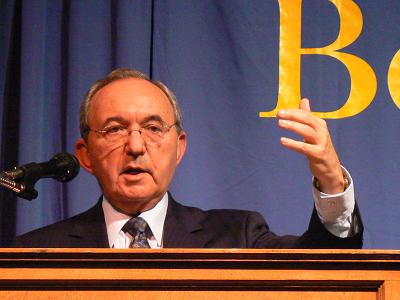
richard_goldstone

Why should we trust the Goldstone report if it was produced by the UN Human Rights Commission – a body which has a notorious history of focusing overwhelmingly on Israel to the near exclusion of other potential human rights abusers around the world?

I posed this very question to Fred Abrahams, senior researcher for Human Rights Watch’s emergencies division who, together with B’tselem Executive Director Jessica Montell, participated in a remarkable conference call organized by Ta’anit Tzedek yesterday.

Fred, who is currently in Geneva attending the UN discusion of the report, answered that there is ample reason to be concerned about the HRC’s undue attention on Israel, but that this particular mission presented a very real “opportunity” for the council to prove otherwise.

In fact, Justice Richard Goldstone initially refused to chair the mission until it was agreed that Palestinian wartime behavior would be investigated in addition to Israel’s.  Indeed, in the end, both sides were taken to task in the report’s final recommendations. It was a shame, Fred said, that Israel’s abject dismissal of Goldstone might actually be thwarting the HRC in its first genuine attempt to realize its true mandate.

For her part, Jessica pointed out that B’tselem did have some concerns about possible bias in the report – a point she also made in a recent Jerusalem Post article. She did add, however, that Goldstone largely confirms the findings of B’tselem’s own investigations, including the huge number of civilian casualties and the targeting of civilian neighborhoods and Gazan infrastructure that had no clear military objective.

I’ve started reading the Goldstone report myself – all 575 pages of it – and encourage you to do the same (but recommend that like me you save some trees by reading it off your computer screen.)  My initial impression: this report is an honorable and good faith attempt to elucidate the facts of what occurred. Quite frankly, it makes for compelling and often devastating reading.  I am certainly aware that it is not a perfect document, but in the end I cannot accept that it deserves to be dismissed without due consideration  (let alone be painted as “blood libel.”)

And I will only add that after reading the report, I consider Richard Goldstone to be a heroic individual who should be lauded for taking on this enormously difficult task with such moral courage.

I was particularly moved by his willingness to address the critical context of this tragic crisis. Witness this excerpt from his opening statement to the UN upon presenting the report:

The Mission decided that in order to understand the effect of the Israeli military operations on the infrastructure and economy of Gaza, and especially its food supplies, it was necessary to have regard to the effects of the blockade that Israel has imposed on the Gaza Strip for some years and has been tightened since Hamas became the controlling authority of Gaza.

The Mission found that the attack on the only remaining flour producing factory, the destruction of a large part of the Gaza egg production, the bulldozing of huge tracts of agricultural land, and the bombing of some two hundred industrial facilities, could not on any basis be justified on military grounds. Those attacks had nothing whatever to do with the firing of rockets and mortars at Israel.

The Mission looked closely and sets out in the Report statements made by Israeli political and military leaders in which they stated in clear terms that they would hit at the “Hamas infrastructure.”

If “infrastructure” were to be understood in that way and become a justifiable military objective, it would completely subvert the whole purpose of International Human rights Law built up over the last 100 years and more. It would make civilians and civilian buildings justifiable targets.

These attacks amounted to reprisals and collective punishment and constitute war crimes.

The Government of Israel has a duty to protect its citizens. That in no way justifies a policy of collective punishment of a people under effective occupation, destroying their means to live a dignified life and the trauma caused by the kind of military intervention the Israeli Government called Operation Cast Lead. This contributes to a situation where young people grow up in a culture of hatred and violence, with little hope for change in the future.

Finally, the teaching of hate and dehumanization by each side against the other contributes to the destabilization of the whole region.

A transcript of our conference call will be posted on the Ta’anit Tzedek website soon. I’m excited to report that Ta’anit Tzedek is sponsoring a conference call between Justice Goldstone and Jewish clergy on October 18.  We have a great deal to learn from him and I look forward to reporting on our conversation.

Judaism as Nonviolence: A Sermon for Rosh Hashanah

During my Rosh Hashanah sermon, I asked the following questions:

Is there a place in Judaism for pacifism? Is it in fact possible – or desirable – as a Jew, to walk the path of nonviolence?

Click below to read my answers…

Continue reading

Is BDS anti-Semitism?

boycott1For many Jews, no three letters seem to conjure up rage and fury as effectively as “BDS.” Still, I have a strong suspicion that we’ll be hearing them bandied about increasingly in the coming months.

Since the Gaza war, the movement for global Boycott/ Divestment/ Sanctions against Israel seems to have gained new momentum. Among its prominent new supporters is economic journalist/activist Naomi Klein, who made a passionate call for BDS at the peak of the crisis:

Every day that Israel pounds Gaza brings more converts to the BDS cause, and talk of cease-fires is doing little to slow the momentum. Support is even emerging among Israeli Jews. In the midst of the assault roughly 500 Israelis, dozens of them well-known artists and scholars, sent a letter to foreign ambassadors stationed in Israel. It calls for “the adoption of immediate restrictive measures and sanctions” and draws a clear parallel with the anti-apartheid struggle. “The boycott on South Africa was effective, but Israel is handled with kid gloves.… This international backing must stop.”

Yet even in the face of these clear calls, many of us still can’t go there. The reasons are complex, emotional and understandable. And they simply aren’t good enough. Economic sanctions are the most effective tools in the nonviolent arsenal. Surrendering them verges on active complicity.

Count longtime peace activist Rabbi Arthur Waskow is one of those who “still can’t go there.” The current issue of “In These Times” contains a fascinating debate between Klein and Waskow on the merits of BDS. For his part, Waskow opposes it primarily for tactical reasons:

(The) BDS approach is not the way to bring about the change that is absolutely necessary.  The most important, and probably the only effective, change that can be brought about is a serious change in the behavior of the U.S. government. That means we need to engage in serious organizing within the United States…Boycotts and divestment are not going to do it. I understand that they express a kind of personal purity—”not with my money you don’t”— but they won’t change U.S. policy, which is exactly what needs to be changed.

Klein and Waskow’s conversation is edifying as far as it goes, but to my mind it doesn’t address the main concern over BDS articulated by so many American Jews: namely that given all of the odious regimes throughout the world, the unique singling out of Israel for sanction is an expression of flat-out anti-Semitism. This point of view was well summed up by Thomas Friedman in the NY Times back in 2002, at a time when student movements were increasingly pressuring universities to divest from Israel:

How is it that Egypt imprisons the leading democracy advocate in the Arab world, after a phony trial, and not a single student group in America calls for divestiture from Egypt? (I’m not calling for it, but the silence is telling.) How is it that Syria occupies Lebanon for 25 years, chokes the life out of its democracy, and not a single student group calls for divestiture from Syria? How is it that Saudi Arabia denies its women the most basic human rights, and bans any other religion from being practiced publicly on its soil, and not a single student group calls for divestiture from Saudi Arabia?

Criticizing Israel is not anti-Semitic, and saying so is vile. But singling out Israel for opprobrium and international sanction — out of all proportion to any other party in the Middle East — is anti-Semitic, and not saying so is dishonest.

For his part, Alan Dershowitz expressed a similar critique in response to recent reports (later retracted) that Hampshire College was divesting from six companies that profit from Israel’s occupation:

The divestment campaign applies to Israel and Israel alone. Hampshire will continue to deal with companies that supply Iran, Saudi Arabia, China, Cuba, North Korea, Zimbabwe, Libya, Syria, Sudan, Belarus and other brutal dictatorships around the world that routinely murder civilians, torture and imprison dissenters, deny educational opportunities to women, imprison gays and repress speech. Indeed many of those who support divestiture against Israel actively support these repressive regimes. This divestment campaign has absolutely nothing to do with human rights. It is motivated purely by hatred for the Jewish state.

Klein is absolutely right when she writes of BDS that “many of us can’t go there.” The reasons for this are complex and painful – and Friedman and Dershowitz do a compelling job of spelling out just how deeply painful and divisive they are. I must admit I have serious hesitation in taking on an issue that pushes so many of my own Jewish fear-buttons. (I’m not unmindful of the tragic historic spectres that boycotts against Jews and Jewish institutions conjure up for us.)  Still and all, I can’t help but wonder that by dismissing BDS as simple, abject hatred of Jews and Israel, we are misunderstanding the essential of the point of this movement. Even more fundamentally, I wonder if our rejection of BDS simply papers over our inability to face the more troubling aspects of the Jewish state.

I’ll start here: in a way, Dershowitz is correct when he writes that BDS has “nothing to do with human rights.” This particular movement did not in fact arise out of the international community’s concern over human rights in Israel/Palestine: it was founded in 2005 by a coalition of Palestinian groups who sought to fight for self-determination through nonviolent direct action. It arose out of their frustration over Israel’s continued refusal to comply with international law on any number of critical issues – and the oppressive manner in which Israel has occupied and ruled over Palestinians.  In other words, it is absolutely true that BDS is not an international human rights campaign. It is, rather, a liberation campaign waged by the Palestinian people – one for which they are seeking international support.

Yes, there are many oppressive nations around the world – and if a call came from indigenous, grassroots movements in these nations calling for international support of BDS, I’d say we most of us would seriously consider lending them our support. To use a partial list of nations mentioned by Friedman-Dershowitz, if any constituencies of the oppressed in Egypt, Syria, Saudia Arabia, Libya, Zimbabwe or Belarus called for nonviolent global boycott/divestment/sanction campaigns to force change in their countries’ policies, yes, I think we might well agree that they would be worthy of our backing. However, the absence of such movements does not necessarily negate the justice of the Palestinians’ current campaign. And it doesn’t seem to me that support of their call automatically constitutes hatred of Israel or Jews.

What I think Friedman-Dershowitz – and so many of us – fail to grasp is this: even as we recoil from nations that “choke the life out of their democracies” and “routinely murder civilians, torture and imprison dissenters, deny educational opportunities to women, imprison gays and repress speech,” the only way we can help truly address this kind of oppression is to support the ones who struggle for rights within these countries themselves – it is not for us Westerners to determine what is best for them. (And I particularly fear that when we frame this as a fight for “democracy,” as Friedman does,  this is really just a code for “imposing Western influence” – but perhaps that is a discussion for another day.)

The bottom line? While I believe there are undoubtedly those out there who will support BDS out of hatred pure and simple, I think it is just too easy to dismiss this movement as ipso facto anti-Semitism. Beyond the fears articulated by Friedman, Dershowitz and so many others like them, I think there’s an even deeper fear for many of us in the Jewish community: the prospect of facing the honest truth of Israel’s oppression of Palestinians.

For so many painful reasons, it is just so hard for us to see Israel as an oppressor – to admit that despite all of the vulnerability we feel as Jews, the power dynamic is dramatically, overwhelmingly weighted in Israel’s favor.  Though a movement like BDS might feel on a visceral level like just one more example of the world piling on the Jews and Israel, we need to be open to the possibility that it might more accurately be described as the product of a weaker, dispossessed, disempowered people doing what it must to resist oppression.

I have to say it feels like I’m going out on a serious limb by writing these words. I’m only raising these issues, as always, in the hope of starting a wider discussion in the Jewish community. Somehow, I feel that it is only by facing the stuff we prefer not to have to face that we might begin to find a way out of the this painful reality.

As always, I welcome your thoughts and reactions…