Category Archives: Civil Rights

Chicago Students Organize to Save Their Schools

If you want to see an inspiring example of young people speaking truth to power, take a look at the clip above. At a recent meeting of the Chicago School Board a group of students publicly demanded to know, one after the other, why the board was closing down fifty public schools in predominantly black and brown Chicago neighborhoods – and publicly asked why the students themselves had no voice in decisions that directly affect them and their communities.

The video begins with a single student speaking at the podium. At about the 2:00 mark individual students begin standing up and speaking out from the audience as security guards rush in and escort them from the room. Finally a hand is placed over the video taker’s camera and he is pushed out – you can hear his voice telling the guard, “I’m just here for students.”

The students’ action is all the more dramatic when you consider that the Chicago School Board is an unelected body that is appointed by Chicago Mayor Rahm Emanuel – meaning they are utterly unaccountable to the community.  Underscoring the depths of this fraudulent “public body”, Emanuel recently announced that he was appointing millionaire venture capitalist Deborah Quazzo to replace outgoing board member, billionaire Hyatt heiress Penny Pritzker (recently nominated by President Obama to be US Commerce Secretary).

What makes Quazzo qualified to make decisions that will impact the 400,000 students that attend Chicago Public Schools? According to reports, Quazzo is the daughter of a corporate CEO/bank chairman from Jacksonville who moved to Chicago after marrying Stephen Quazzo, Co-Founder and CEO of Pearlmark Real Estate Partners. She successfully climbed the ranks of investment banking and venture capital at J.P. Morgan and Merrill Lynch. In 2001, she co-founded ThinkEquity Partners – an “investment firm boutique” that a few years later ran into serious financial problems and eventually had to file for Chapter 7 bankruptcy protection.

Quazzo is just the latest example of the kind of people who the mayor has personally chosen to serve on the Chicago School Board (which is headed up by President David Vitale, Chairman of Urban Partnership Bank and former President and Chief Executive Officer of the Chicago Board of Trade.)

This, in a nutshell, is why these courageous young students spoke their truth to a body that so patently answers to wealthy corporate interests rather than the communities of Chicago. 

For my part, I’ll second the words of the invisible cameraman: “I’m here for the students.” Please watch this clip and share this widely.

The One-State Reality in Israel/Palestine

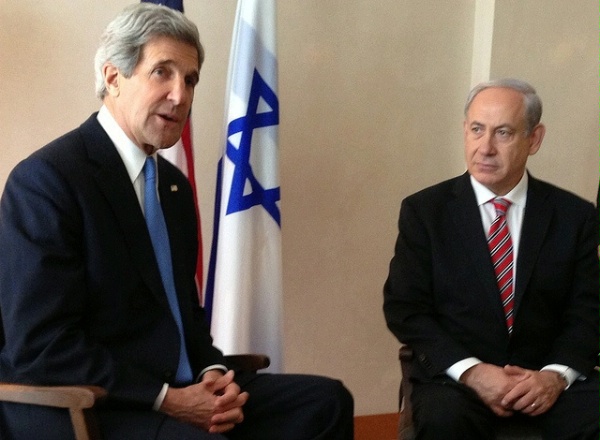
bibi1_600_1 Every time a new new Israeli-Palestinian peace plan is unveiled, diplomats and analysts will invariably urge the various players to summon the political courage to seize this latest “window of opportunity.” And sure enough – as I was reading an article on the latest revamping of the Arab Peace Plan, one Israeli leftist pundit was quoted tweeting:””Historic opportunity for Israel. Will our government have the guts to seize it?”

As for me, I’m asking a different question: “Since Israel has all but annexed 60% of the West Bank through home demolitions, forced evictions, revocation of residency rights and unchecked construction of Jewish settlements, how could anyone think this government is even remotely interested in a viable two-state solution?”

How much longer does this have to continue until we are ready to admit the patently obvious intentions of Israel’s governments? Given the facts on the ground, the discussion of a viable, contiguous Palestinian state in the West Bank is beyond absurd.  Israel has been inexorably settling Area C and East Jerusalem while simultaneously depopulating those regions of Palestinian residents for decades. By this point, this process has become nigh well complete. Now Israel’s newest government coalition includes a major party whose official platform calls to annex Area C. One prominent Israeli settler leader calls the current government “a wet dream.”  Are we really, truly going to continue to talk about a two-state peace process with a straight face?

According to a 2011 EU research report, in 1967, between 200,000 and 320,000 Palestinians lived in what is today called Area C. But since that time, home demolitions and Israel’s prevention of new building has caused that number drop to 56,000. In a similar period, the Jewish population in Area C has grown from 1,200 to 310,000.

Israeli journalist Amira Hass has convincingly argued that the creation of “Palestinian ghettos” in Areas A and B “were always the plan” even well before the 1993 Oslo peace process that created these zones. According to Hass, when new coalition party member Naftali Bennett calls for annexing Area C, he is only “following the logic of every single Israeli government: maximize the territory, minimize the Arabs:”

According to Bennett, about 60 percent of the West Bank – a.k.a. Area C – is annexable. What’s important about Area C is not whether 50,000 Palestinians live there, as democratic, benevolent Bennett claims, while suggesting to naturalize them and grant them Israeli citizenship, or whether the number is around 150,000 (as my colleague Chaim Levinson reminded us earlier this week).

Don’t worry. Even if there are 300,000 Palestinians living in Area C and all of them agree to become citizens, the Israeli bureaucracy will find ways to embitter their lives (the way it does the lives of the Bedouin in the Negev), revoke their citizenship (the way it does the residency status of Palestinians in East Jerusalem) and leave them without the little share of their land they still have (the way it did to the Palestinian citizens of Israel within the 1948 borders).

This is why Bennett can allow himself to be munificent. The true story behind area C is that there aren’t 400,000 Palestinians living there today; the villages have not expanded in accordance with their natural population growth; the number of residents has not grown; the herders can no longer graze their flocks freely; many of the inhabitants lack access to water, electricity, school and medical clinics; Israel has not been taken to the International Criminal Court in the Hague for destroying the cisterns; there are no paved roads in and between villages…

As I have said a million times and will say another million times: Area C is a tremendous success of Israeli policy and its implementers, the army and the Civil Administration. It is part of a farsighted, well-executed, perfectly thought-out policy that has succeeded precisely in that there aren’t 400,000 Palestinians living in the area. Bennett is probably decent/honest enough to acknowledge the debt he owes to the previous generations of Israeli politicians and military officials who warmed the country up for his annexation plan, ensuring its acceptance would be as effortless as a knife cutting butter in the sun.

The long and short of it? If the international community is really interested in a just peace, it should stop trying to breathe life into a corpse of a peace process and hold Israel accountable for its ethnic cleansing/annexation of Area C.  And at the same time, it would behoove us all to start exploring creative new solutions that would extend full civil and human rights to all who live on the land.

In this regard, I highly recommend this recent piece by journalist/blogger Mitchell Plitnick. Mitchell has long represented an important progressive voice on Israel/Palestine: consistently smart, well-informed and always underscored by an abiding political realism. Like so many of us, he has long clung to the paradigm of a two-state solution – but over the past year he has been openly exploring the compelling reasons why he believes that the door to this solution has now become irrevocably closed. In this recent article, he dares to explore out loud what a new one-state solution might possibly look like:

…In the end, Israelis will realize that the status quo can’t hold and they will have to find a way to give Palestinians their freedom and their rights. That can be done without losing the most basic elements of a Jewish homeland. But it will require abandoning the ethnocratic concept of the Jewish state that has characterized Israel since before it was Israel.

The state can still be a Jewish home, with a constitution that guarantees that any Jew fleeing anti-Semitism anywhere in the world can find a haven in Israel. It can be a state where Hebrew is still a national language and one that has a culture that draws heavily from Jewish roots, European, Middle Eastern and Iberian. It just can’t do these things exclusively. They will also have to apply equally to Palestinians.

It’s not such a leap. Palestinians would also be able to come to this reformed state to flee persecution. Arabic would also be a national language, as it officially is now. The culture of the state would reflect the Palestinian heritage as well as the Jewish one. Yad Vashem, the Holocaust memorial, would still be there, but there might also be memorials to the Palestinian villages that were destroyed. Palestinian refugees who wish to would have an opportunity to return gradually, through some bureaucratic process that both peoples would agree upon. Yes, that means the Jews will not be a majority, but a constitution would protect not only Jewish and Arab rights equally, but would ensure that the character of the state reflected both cultures.

That is important, and it is also the place where the vision of a secular, democratic state falls short. The biggest problem with that vision is that it ignores the strong sense of nationalism that exists among both Israeli Jews and Palestinian Arabs. As someone who has no use or liking for nationalism, I wish that were not the case, but wishing does not make it so. The future state cannot be a melting pot, a mere civic society, in the manner the United States strives to be. It must be a national home. Whatever the political formation may be, it must be reflective of the nations that have been created by Zionism among Jews and Palestinian nationalism among the Arabs of Palestine.

Obviously, this is a future that is not on the horizon. And it is clear that many people, probably most, would not be able to conceive that such a future is even possible. But the alternative for Israeli Jews will be the eventual total loss of any homeland in Eretz Yisrael. A state with democratic structures like Israel which deprives millions of people of human and civil rights is an inherent contradiction. A state with one set of laws for some people and another set for another group of people all under one sovereign is an apartheid state, and it is a thing the world no longer tolerates. Only Israel’s unique place as the state of the Jews, in the wake of the Holocaust has allowed that state of affairs to last this long.

Mitchell is certainly correct when he says that this future is not on the horizon as of yet. Soon enough, however, the world will see the patently apartheid nature of a state the privileges its Jewish citizens while warehousing Palestinians inside a “security” regime of walls and checkpoints.  As this oppression become more undeniable, we’ll surely be hearing and reading similar visions to Mitchell’s. At present these ideas exist largely in the domain of academia, journalism and the activist community; might we dare to imagine that events on the ground will eventually cause them to be considered by the political elites?

As far as I’m concerned, that time cannot come soon enough.

Naftali Bennett and the Politics of Jewish Supremacy

By all accounts, Bibi Netanyahu will be the winner of the upcoming elections on January 22 – after which he will proceed to form the most right-wing/ultra-nationalist coalition in Israeli history. The only question that remains is by what degree.

Among new political figures on the scene, Naftali Bennett, the leader of the HaBayit HaYehudi (“Jewish Home”) party seems to be garnering the most attention. Even as Bibi’s Likud-Beiteinu party drops in the polls, HaBayit HaYehudi (a restructured version of the old National Religious Party) is growing in popularity – and will almost certainly become an important player in a new coalition.

If you’ve never heard of Bennett, you will soon. He’s the son of American immigrants, a successful hi-tech businessman, Bibi’s former chief of staff (they’ve since had a high profile falling out) and the former head of the West Bank settlers’ Yesha Council. Bennett raised some major dust last month when he told a television interviewer that he would personally refuse orders to evacuate settlements or outposts in the West Bank while on reserve army duty.  He also is on record as advocating the annexation of Area C of the West Bank. Under his plan, Palestinians already living there would be given the choice to accept Israeli citizenship or leave.

While he was roundly criticized from many political quarters for his remarks about army service, his party has become the most popular Israeli party with young Israelis under the age of 30. Clearly, Bennett and his views represent Israel’s future – one that seems to be skewing further and further away from democracy and ever closer to apartheid policies.

Take a look at HaBayit Hayehudi’s English language campaign video ad at the top of this post. As Don Futterman recently observed in Open Zion, it’s a canny attempt to gloss over the more odious aspects of Bennett’s ideology with a legit and cheerful veneer designed specifically to appeal to American immigrants to Israel:

This ad, which is part of a campaign to create different and more positive associations with the name HaBayit HaYehudi (the Jewish Home), is an invitation, not a polemic. It mentions buzzwords—Jewish values and Zionist ideals—and one issue from the party’s platform—Jewish education—but does not harp on any of them. You wouldn’t guess that HaBayit HaYehudi has any connection to the national religious right in Israel, and you might even miss the single reference to West Bank settlements (“I live in Samaria”). You certainly wouldn’t suspect that Bennett has promised he would go to jail rather than evacuate a settlement.

Watching the video, I was also struck that it made repeated references to the importance of Israel’s Jewish character without explicitly explaining why this should in any way be considered a political issue:

If you want to bring Jewish values and Zionist ideals to Israel, then the Bayit Yedudi is your home…If you believe that every Israeli child deserves a quality Jewish education, the Bayit Yehudi is your home.

While on the surface, remarks such as this sound perfectly innocuous, they mask a profoundly troubling agenda.  What about the Palestinians citizens of Israel who do not adhere to “Jewish values” or “Zionist ideals?”  It’s certainly sounds noble to say that Israeli child deserves a quality Jewish education, but what about the considerable percentage of Israeli children who don’t happen to be Jewish? The answer, of course, is not too difficult to understand. These Israeli citizens simply don’t fit in the xenophobic ideology advocated by Naftali Bennett and HaBayit HaYedudi.

In a recent post for +972 mag, Noam Sheizaf makes a perfectly reasonable argument – but given Israel’s current reality it would likely strike many as radical in the extreme. Pointing out that in 64 years of Israel’s existence, no government has ever included one of the Arab parties in a coalition, Sheizaf concludes:

Cooperation between Palestinian and Jews is by far the greatest, most important challenge in this country. Every element of Israeli life – from the education system to zoning plans – is constructed to promote ethnic separation, with politics being just the tip of the iceberg…Therefore, the ability to create joint structures and partnerships is the single most important element that would determine the chances of survival and the quality of life for the entire society.

The necessary conclusion for me is that it is simply forbidden to vote for parties which are not shared by Palestinians and Jews, or for ones that preserve the policy of separation between Palestinians and Jews. There are no perfect parties, but this should be the basic condition, just as an American shouldn’t vote for a party that doesn’t accept black people.

Alas, voices like Sheizaf’s are but a whisper in the Israeli wilderness. According to the latest polls, Arab-Jewish parties will garner only a small sliver of votes in the upcoming election.  When it comes to the Israeli electorate, the ideology of Jewish supremacy is clearly the order of the day.

For comparison purposes, take a look, below, at this campaign video ad for the Da’am Workers Party – one of the few Arab-Jewish parties of which Sheizaf spoke.  I’d say their values provide a powerful contrast to ethnic exclusivism of HaBayit Hayehudi:

(This) movement is our hope, everyone’s hope that here will arise, in the State of Israel, for the first time in history a political, social, economic alternative, sane, human, fair, that knows how to be part of the region where it’s located. For 64 years we’ve lived in a ghetto. The time has come to get out of the ghetto! Israel has to stop isolating itself…We say no! We’ll bring down the wall of Occupation, the wall of racism, and the wall of violence. We want to be free in our land indeed, and our land is the entire world, and this world needs one unique answer, it needs a revolution!

American Civil Rights Leaders: End the Violence and Secure a Just Peace

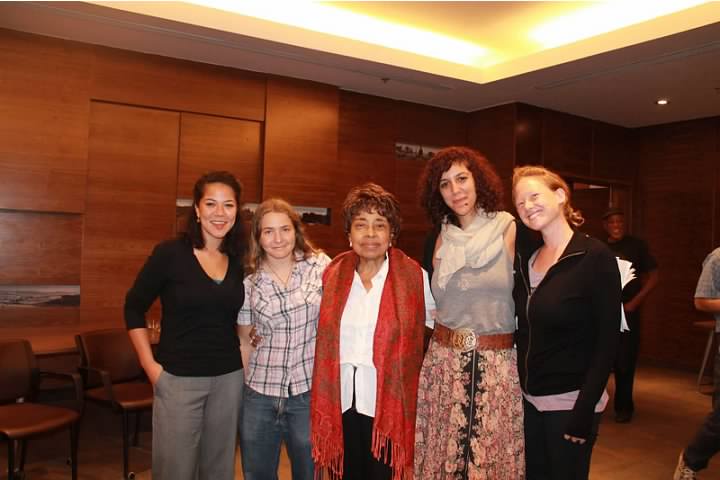
Delegates on a tour led by Ruth Edmonds of the Israeli Coalition Against Home Demolitions (photo: Allie Perry)

Received from my friend and colleague Rabbi Brian Walt:

“Our lives begin to end the day we become silent about the things that matter.”

Dr. Martin Luther King, Jr.

An immediate end to Israel’s assault on Gaza, “Operation Pillar of Defense,”matters. An immediate end to the violence—the onslaught of missiles, rockets, drones, killing, and targeted assassination—matters. An end to Israel’s ongoing blockade of Gaza matters.  An end to Israeli’s 45-year occupation of Palestine matters. A resolution of the issue of Palestinian refugees expelled from their homes in 1948, many of whom live in Gaza matters.  Equality, security, and human rights for everyone matters.

We write as individuals who recently traveled to the West Bank with the Dorothy Cotton Institute’s 2012 Civil and Human Rights Delegation, organized by Interfaith Peace-Builders.  We cannot and will not be silent.  We join our voices with people around the world who are calling for an immediate cease-fire. Specifically, we implore President Barack Obama to demand that Israel withdraw its forces from Gaza’s borders; make U.S. aid to Israel conditional upon Israel’s adherence with relevant U.S. and international law; work with Israeli and Palestinian leaders to bring an end to Israel’s occupation of the Palestinian territories and to secure a just peace that ensures everyone’s human rights.

In the words of Dr. Martin Luther King, Jr., “Returning violence for violence multiplies violence, adding deeper darkness to a night already devoid of stars.”  As Prime Minister Yitzhak Rabin declared in 1993, “Enough of blood and tears.”  Enough!

We deplore the firing of rockets on civilian areas in Israel.  We also deplore and are outraged by the asymmetry, the disproportionality, of Israel’s bombardment of Gaza, evidenced by the growing number of Palestinian civilian deaths and casualties.  This is not a conflict between equal powers, but between a prosperous occupying nation on one hand, armed and sanctioned by 3 billion dollars in annual U.S. military aid, and on the other, a population of 1.7 million besieged people, trapped within a strip of land only 6 miles by 26 miles, (147 square miles) in what amounts to an open-air prison.

United States military support to Israel is huge.  From 2000 to 2009, the US appropriated to Israel $24 billion in military aid, delivering more than 670 million weapons and related military equipment with this money.  During these same years, through its illegal military occupation of the Palestinian West Bank, East Jerusalem and Gaza Strip, Israel killed at least 2,969 Palestinians who took no part in hostilities.

During our trip to the West Bank, we witnessed for ourselves the injustice and violence of the Israeli occupation and the suffering inflicted on the Palestinians, in violation of international law and UN resolutions.

In the Palestinian village of Nabi Saleh, for just one example, we observed a weekly nonviolent protest.   The neighboring Israeli settlement of Halamish was illegally built on Nabi Saleh’s land.  This settlement has also seized control of the Nabi Saleh’s water spring, allowing villagers to access their own spring water for only 7-10 hours a week.  Demonstrators of all ages participated in the protest, including several who, in recognition of the civil rights veterans in our delegation, carried posters with quotations from Dr. Martin Luther King, Jr.  We watched in horror as heavily armed members of the Israel Defense Forces (IDF) responded to this peaceful assembly with violence, strafing the demonstrators with a barrage of tear gas canisters, rubber bullets, gas grenades, and even a round of live ammunition.

The IDF assault in response to these weekly nonviolent demonstrations can be deadly.  Rushdi Tamimi, a young adult Nabi Saleh villager, died this past week while he was protesting Israel’s attack on Gaza.  The IDF fired rubber bullets into Rushdi’s back and bullets into his gut, and slammed his head with a rifle butt.

Israel’s assault on Gaza is exponentially more violent than what we witnessed in the West Bank, but the context–the oppression of the Palestinian people—is the same.  Most of the inhabitants of Gaza are refugees or descendants of refugees expelled from their homes in Israel in 1948.   This dispossession of the Palestinians that they call the Nakba (The Catastrophe) continues on the West Bank where Israel has built extensive Jewish settlements on confiscated Palestinian land. We saw with our own eyes how this settlement expansion and the systemic discrimination has further dispossessed the Palestinian people and is creating a “silent transfer” of Palestinians who are either forced or decide to leave because of the oppression.   This injustice—Israel’s decades-long oppression of the Palestinian people—has to be addressed by honest and good-faith negotiations and a genuine agreement to share the land.  The alternative is a future of endless eruptions of aggression, senseless bloodshed, and more trauma for Palestinians and Israelis. This surely matters to all people of good will.

To President Obama, we say, use the immense power and authority United States citizens have once again entrusted to you, to exercise your courage and moral leadership to preserve lives and protect the dignity and self-determination, to which the Palestinian people and all people are entitled.   Israel relies upon the economic, military, and strategic cooperation and support of the United States.  You have the power to not only appeal to Israel to show restraint, but to require it.

Feeling ourselves deeply a part of “We the People,” sharing so much of your own tradition of organizing for justice and peace, we believe it is just, moral and in keeping with the best spirit of Dr. King to urge you to:

§  Call for an end to violence by all parties and an immediate cease-fire for the sake of all people in the region.

§  Use your power to demand that Israeli Prime Minister Benjamin Netanyahu and the IDF cease the bombardment of Gaza and withdraw their armed forces immediately.

§  Join with the international community in using all diplomatic, economic, and strategic means to end Israel’s illegal, brutal siege of Gaza.

§  Insist that the United States condition aid to Israel on compliance with U.S. law (specifically the U.S. Arms Export Control Act) and with international law.

§  Work with the leaders of Israel and Palestine to secure an end to Israel’s occupation and to negotiate a just peace.

As citizens of the United States, we are responsible for what our government does in our name, and so we will not be silent.  Justice, peace and truth matter.  The future of the children of Israel and Palestine matter.  We cannot be silent and neither can you.

Members of the The Dorothy Cotton Institute 2012 Civil and Human Rights Delegation:

(List in formation)

Continue reading

Calling Israel’s Discrimination What it Is

The H-2 section of Hevron, where Palestinians must walk on separate sidewalks from Jews.

Cross-posted with the Jewish Daily Forward “Forward Thinking” Blog:

Forward columnist Philologos recently took the Israeli daily Ha’aretz to task for using the term “apartheid” in its reporting on a poll that showed most Israelis support discrimination against Arab citizens. “Apartheid” and mere discrimination are two very different things, Philologos claimed. He suggested that Ha’aretz should be censured for using such a damning epithet.

Philologos went on to define what he sees the critical difference between “apartheid” and “discrimination.” The former refers to “the systematic segregation of one people, race or group from another,” while the latter means “the systematic favoring of one people, race or group over another, such as exists in numerous countries around the world today.” And while Israel may practice regrettable discrimination against its Arab citizens, he claimed it was a “lie” to suggest that it is in any way an apartheid state.

While Philologos may be a fine linguist, his knowledge of international human rights law is sorely lacking.

Contrary to Philologos’ characterization, the term “apartheid” does not refer simply to segregation, although the term comes from a word in the South African Afrikaans language that means separate-ness or segregation. In legal terms, apartheid applies to a wide range of acts in which a dominant racial regime commits institutionalized oppression against another ethnic group.

According to the 1998 Rome Statute of the International Criminal Court, for instance, the “crime of apartheid” was included in a list of “crimes against humanity,” and defined as:

(Inhuman) acts…committed in the content of an institutionalized regime of systematic oppression and domination by one racial group over any other racial group and committed with the intention of maintaining that regime.

Earlier, in 1973, the UN’s General Assembly adopted the International Convention on the Suppression and Punishment of the Crime of Apartheid. Among the “inhuman acts” listed were:

(Any) legislative measures and other measures calculated to prevent a racial group or groups from participation in the political, social, economic and cultural life of a country.

There is certainly a compelling claim to be made that the term “apartheid” may appropriately be applied to Israel’s treatment of its Palestinian citizens. In a recent report, Adalah, an Israeli legal NGO, described no fewer than 30 laws, either enacted or proposed, that create different sets of legal rights for Jewish and non-Jewish (i.e. Palestinian) citizens of Israel.

While many Jews prefer to view Israel as an essentially healthy, if flawed, democracy, those willing to face the painful truth have long known that the so-called “democratic Jewish state” would more accurately be described as a democracy for Jews but not for non-Jews. Consider the following facts:

– Israel has no constitution that guarantees individual liberties for all. Palestinian citizens’ homes and land are regularly seized or demolished to give housing to Jews. B’tselem, an Israeli human rights organization, recently reported that the citizenship of increasing numbers of East Jerusalem residents are being revoked to make way for more land appropriation.

– There are separate schools for Palestinians and Jews. In Israeli universities, no courses are offered in Arabic, even Arabic literature. Use of Arabic in road signs is banned except in towns that the government deems Arab.

– While Jewish citizens of Israel can confer citizenship on new spouses who are not already Israeli citizens, Palestinian citizens cannot. According to the law, a Palestinian citizen of Israel who marries a Palestinian resident of the West Bank or Gaza may not reside inside Israel. The ruling literally affects the lives of thousands of couples and their precious right to marry if they so choose. In upholding this law, one Israeli Supreme Court judge conceded that Palestinian rights take a back seat to maintaining a Jewish majority in Israel. “Human rights are not a prescription for national suicide,” he wrote.

– Palestinian citizens of Israel have distinguishing characteristics on their ID cards, presumably so they can be easily identified for additional scrutiny by law enforcement agencies. Palestinians are regularly harassed, searched and asked to produce identification, based entirely on their race. While Jewish citizens are legally entitled to a speedy trial, fair legal representation and clear charges, these laws do not apply to Palestinian citizens.

There are many more examples of ways that Israel systematically privileges Jewish citizens over non-Jewish citizens. Organizations such as Adalah, B’tselem and the Association for Civil Rights in Israel have extensively documented these methods.

It is important to note that these are not simply a collection of random discriminatory laws, as Philologos would have it. Taken together, they constitute a systematic, institutional “legal” system that maintains Jews’ privileged status in the Jewish state and, most critically, seeks to ensure a Jewish demographic majority within Israel’s borders at all costs.

One telling case in point: back in 2005, Shimon Peres told U.S. officials (in a statement recently revealed by Wikileaks) that Israel had “lost” land in the Negev “to the Bedouin” and would need to take steps to “relieve” the “demographic threat”.

Flash forward to January 2012: the Israeli government approves the Prawer Plan for mass expulsion of the Arab Bedouin community in the Negev desert. When fully implemented, this plan will result in the forced displacement of up to seventy thousand Arab Bedouin citizens of Israel and the destruction of thirty-five “unrecognized” villages.

At the end of the day, it really is academic whether we choose to label this kind of policy — and many others like it — to be “discrimination,” “institutional racism” or “apartheid.”

The real question before us not what to call it. For Jews who purport to cherish human rights, the right question is: what are we willing to do about it?

Guest Post By Rabbi Brian Walt: We are Building Up a New World

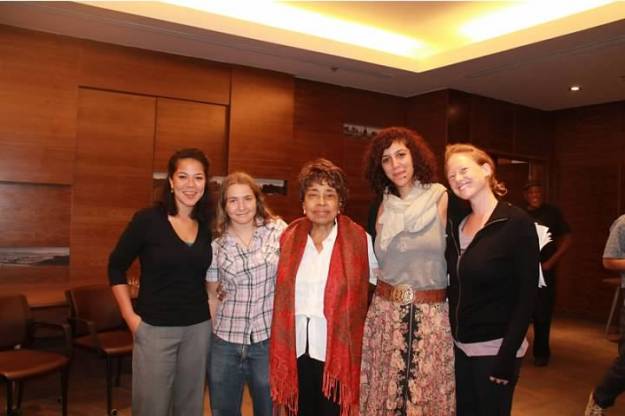
Dorothy Cotton (middle) with Israeli and Palestinian Activists (Photo: Rev. Osagyefo Sekou)

Cross-posted with Rabbi Brian’s Blog

We are building up a new world, we are building up a new world,
We are building up a new world, builders must be strong.
Courage brothers don’t be weary, courage sisters don’t be weary,
Courage people don’t be weary, though the road be long.
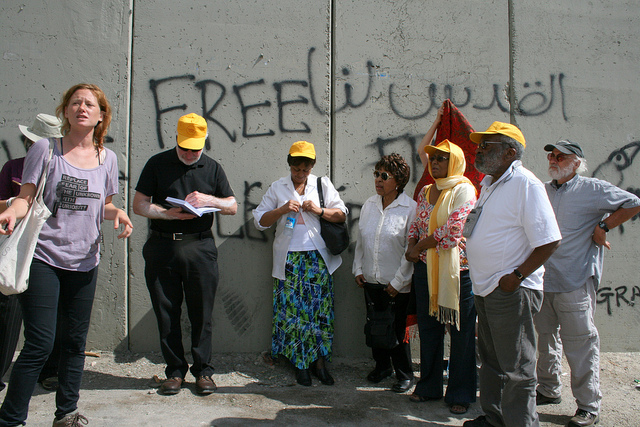
This is one of the many songs I sang as I led a remarkable delegation of US Civil Rights movement leaders, young human rights leaders, prominent Black academics and educators and several Jewish activists that traveled through the West Bank two weeks ago.

Our delegation was a project of the Dorothy Cotton Institute, an organization dedicated to human rights education and to building a global human rights community. Dorothy Cotton served as the Director of Education of the Southern Christian Leadership Conference (SCLC) and was the only woman on the executive staff.  She led the Citizenship Education Program that empowered the disenfranchised to exercise their rights as citizens.

The goals of this historic delegation were:

– to create and build an ongoing relationship between leaders of the US civil rights movement and the leaders of the growing Palestinian nonviolent resistance movement on the West Bank and their Israeli allies;

– to increase the visibility of this movement in the US and internationally;

– to learn from one another about nonviolence, effective solidarity and social transformation;

– and to educate Americans about the role the United States plays in supporting the status quo on the West Bank.

Our delegation spent two weeks on the West Bank.  We visited three Palestinian villages – Budrus, Bilin, Nabi Saleh – that have engaged for many years in a popular nonviolent struggle to reclaim land expropriated by the Israeli military.  We met several young Palestinians who are building the Coalition for Dignity, a grassroots, youth – led nonviolent movement.

And we met Israeli allies who stand in solidarity with the Palestinian nonviolent movement and who work in their own society to end militarism and human rights violations against Palestinians.  We learned from many Israeli and Palestinian nonviolent activists about their work, their vision and their dreams.

In short, our delegation saw and learned about realities that the overwhelming number of visitors to Israel never see or hear.

Singing was an essential part of the spiritual and political life of our trip.  Dorothy has a beautiful spirit, a powerful voice, and loves to sing.  Throughout the delegation, she always reminded us that singing was a critical tool for energizing the civil rights movement.  She told me,

We had songs for different occasions. We sang at mass meetings, and we sang at funerals … We sang, “I am going to do what the Spirit says do” and our singing inspired us to do just that.

And so our new civil rights delegation sang as we traveled through the West Bank.  Singing was just one powerful way in which our delegation made a connection between the Black-led struggle for civil rights in the US and the Palestinian struggle for justice, peace and security for all.

This, for instance, is the song we sang at the grave of a young man in Budrus who was killed in a nonviolent demonstration to protest the confiscation of his village’s land:

Come By here my Lord, come by here.
For our brother, my Lord, come by here.
For his courage my Lord, come by here.

Standing around the grave, delegates spontaneously composed the lyrics. It felt like we were praying, acknowledging the courage and the profound cost that the struggle for freedom demands.

We sang before we joined the weekly nonviolent demonstration in Nabi Saleh, another village on the West Bank fighting to reclaim their land.   The residents of the village had made special signs composed of quotations from Dr. Martin Luther King in honor of our visit.  “Injustice anywhere is a threat to justice everywhere” read one of the signs.

And we sang:

Ain’t going to let nobody turn me around, turn me around, turn me around.
Keep on walking, keep on talking, marching down to freedom land.

We sang to express our appreciation and to provide support after hearing activists tell us their stories – Palestinians and Israelis who told us of their amazing work and the toll it has taken on their lives, and sometimes even their spirits and souls.  One such occasion was after Israeli activist Gabi Laski told us of her work to defend children from villages like Nabi Saleh who are arrested at night.

We’re going to keep on marching forward, keep on marching forward, keep on marching forward, never turning back, never turning back.

We sang after standing next to the thirty foot high Separation Wall in Jerusalem dividing a Palestinian neighborhood in two.  And we sang on the bus as we went through a checkpoint on our way to the airport at the end of our trip, encouraged by our Palestinian guide to keep singing even when the soldier boarded our bus.  (Our bus was pulled aside for a security check because it was a Palestinian bus while Israeli buses and motorists were waved through the checkpoint).

We returned to the United States both inspired and disturbed by our experience.  We were inspired by the determination, vision and commitment of so many Palestinians and their Israeli allies, working tirelessly day after day, year after year, often at great personal and communal cost, for justice, freedom and equality for all.  Now that we are home, we look forward to sharing the stories and vision of these courageous civil rights activists with our friends and communities.

But our trip was not simply inspiring.  It was profoundly disturbing to witness the harsh realities of life on the West Bank that are so invisible to the discourse in America.  Every day we saw and heard about a systematic denial of human rights in countless ways: land confiscation, extensive restrictions on movement, humiliation at check points, home demolition, the arrest of children, the revocation of residency permits and many other violations.

The delegates were profoundly shocked. Several American civil rights veterans  commented that the discrimination, humiliation and injustice they witnessed was “frighteningly familiar.”

While we were on the West Bank the two presidential candidates tried to outdo one another in their public declarations of support for Israel in the final presidential debate.  They mentioned Israel 31 times with only one passing reference to Palestinians.  The contrast between American policy and what we witnessed is stark.  Now that we have returned, we are determined to share this disturbing reality with our communities; to challenge the ways in which our country funds, provides diplomatic cover, and enables these injustices.

I have visited the West Bank before but never for more than a day or two, and almost always with progressive Israeli groups.  On this visit, however, we spent virtually all out time in the West Bank – on the other side of the Separation Wall.  For me personally, it was a transformative experience.  It was a privilege to travel with such a special group of people and to see the profound impact of our delegation on the activists that we met.

Before we left on our journey, I was struck by a comment made by Dr. Vincent Harding, a close associate of Dr. Martin Luther King, a person with a long history of involvement in the struggle for freedom and a very close life-long connection to Jewish teachers, fellow travelers and co-workers.  Dr. Harding talked about “encouragement” as one of his primary goals for the trip.  I was struck by the word and the simple power of his intention.  He wanted to meet activists on the West Bank and to “encourage” them.

And that is exactly what happened. The people we met commented how encouraged they felt by meeting people who had spent their entire lives fighting for freedom in the US.  Dr. Harding and others would repeatedly ask all our presenters to tell us about themselves, their families and what motivated them to do what they were doing.

He and others always shared how much he appreciated their work and how important it was for all of us and for our collective future.  After hearing an inspiring talk by Fadi Quran, one of the young leaders of the Palestinian nonviolent movement, Dr. Harding said, “Fadi, I want to tell you how proud I am and how grateful I am for you, and want to encourage you to keep on going.”

It felt like we were building a new world.  On the very first day of our trip, Dorothy Cotton sang and danced with three women activists, Israeli and Palestinian, who had spoken to us. It was a joy to see the profound gift she was giving them and that they were giving her in return. Those who had spent their lives building a new world in America were creating a relationship with those who were building a new world in Israel/Palestine.

Towards the end of the trip we realized that we were just beginning to build a new world in another way by creating a new possibility for the relationship between Jews and Blacks in our own country.   Historically, Israeli policy has been a source of tension between the African American and Jewish communities.  While many African Americans on the delegation have deep and positive connections to Jews, it is often difficult for Blacks and Jews to have honest conversations about Israel.

There were eight Jews on this delegation.  On this trip we joined together as a group of Blacks, Jews, Christians and people with varied faith commitments, united in our commitment to nonviolence and our dedication to justice, freedom and equality in Israel/Palestine, in our own country, and around the world.  We are renewing an alliance between Blacks and Jews, an alliance rooted in our shared values.

We are building up a new world, we are building up a new world.
We are building up a new world, builders must be strong.
Courage brothers don’t be weary, courage sisters don’t be weary,
Courage people don’t be weary, though the road be long.

Rabbi Brian Walt: Christian Leaders Cannot be Cowed into Silence

Please read my friend Rabbi Brian Walt’s new piece in Ha’aretz. He has recently returned from a remarkable interfaith delegation to the West Bank; I will be posting more of his writings about his experiences in the near future.

In his recent Haaretz op-ed, “Heading toward an irreparable rift between U.S. Jews and Protestants,” my colleague, Rabbi Eric Yoffie, sharply criticized the recent letter to Congress by leaders of Protestant churches that called for U.S. military aid to Israel to be contingent on Israeli compliance with American law. Nowhere in his article, however, did Yoffie mention the central concern of the Christian leaders’ letter: the overwhelming evidence of systematic human rights violations by the Israeli military against Palestinians.

Over the past two weeks, I had the privilege of leading an interfaith delegation including several leaders of the civil rights movement, younger civil and human rights leaders, Christian clergy, academics, and several Jews, on a two-week trip to the West Bank.

We were all shocked by the widespread human rights violations that we saw with our own eyes and that we heard about from both Palestinians and Israelis. Several black members of our group, including those who participated actively in the civil rights movement, remarked that what they saw on the West Bank was “frighteningly familiar” to their own experience, a systemic pattern of discrimination that privileged one group (in this case, Jews) and denigrated another (Palestinians).

Continue reading

Standing Down Rep. Joe Walsh’s Islamophobic Bigotry

Shortly after a gunman killed six worshipers in a Wisconsin Sikh temple and a Joplin Missouri mosque was burned to the ground, Illinois Congressman Joe Walsh felt perfectly comfortable uttering incendiary anti-Muslim comments at a town hall meeting last Wednesday, warning that “there is a radical strain of Islam in this country…trying to kill Americans every week.”  Offering no evidence or backup for his allegations, he continued: “It’s here. It’s in Elk Grove, it’s in Addison, it’s in Elgin. It’s here.”

Then he poured it on:

I’m looking for some godly men and women in the Senate, in the Congress, who will stand in the face of the danger of Islam in America without political correctness.  Islam is not the peaceful, loving religion we hear about.

Shortly after Walsh’s town meeting remarks, pellet rifle shots were fired at a mosque in Morton Grove, IL.

I don’t know about a domestic “radical Islamic plot” but by now it should be abundantly clear that there is a deadly strain of Islamophobia in our country. In such a climate, I’d say it is the height of irresponsibility for public servants to issue remarks such as these.

It was my honor to stand, together with interfaith colleagues, with my good friends at CAIR – Chicago to express our outrage at Walsh’s sick bigotry (clip above). If you stand with us, please, please let Rep. Walsh know how you feel.

Jeff Halper: Israel is Warehousing Palestinians

I’m sure there are many who watch Israel’s Jewish settlement policy unfold in the West Bank and East Jerusalem and ask themselves: is there actually a method to this madness?  Among the most compelling answers to this question comes from veteran Israeli peace activist Jeff Halper, co-founder and coordinator of the Israeli Committee Against House Demolitions.

One of the truly great Israeli peace organizations, ICAHD has been indefatigably tracking the demolition of homes and evictions of Palestinians in the Occupied Territories since 2007.  Even more critically, Halper and Co. have been exposing Israel’s institutionalized displacement of Palestinians and their resettlement in concentrated areas throughout the West Bank.

In an interview last week, Halper offered a detailed – and profoundly troubling – picture of Israel’s resettlement of Palestinians throughout the Occupied Territories:

(Area C of the West Bank) contains less than 5 per cent of the Palestinian population. In 1967 the Jordan valley contained about 250,000 people. Today it’s less than 50,000. So the Palestinians have either been driven out of the country, especially the middle class, or they have been driven to areas A and B. That’s where 96 or 97 per cent of them are. The Palestinian population has been brought down low enough, there is probably somewhere around 125,000 Palestinians in area C, so Israel could annex area C and give them full citizenship.

Basically, Israel can absorb 125,000 Palestinians without upsetting the demographic balance. And then, what is the world going to say? It’s not apartheid, Israel has given them full citizenship. So I think Israel feels it could get away with that. No one cares about what’s happening in areas A and B. If they want to declare a state, they can…

In other words, we’re finished. Israel is now from the Mediterranean to the Jordan River, the Palestinians have been confined in areas A and B or in small enclaves in East Jerusalem, and that’s it.

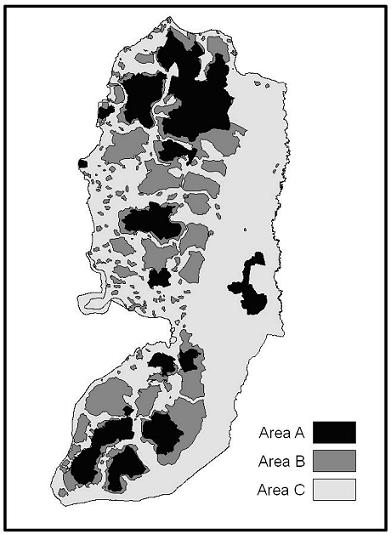
To better understand Halper’s point, look carefully at the map on the top right of this post. Areas A, B and C refer to regions that were created through the terms of the 1993 Oslo Accords.  According to the agreement, Palestinians are responsible for security and for the civil administration of Area A; Area B is under Israeli military control and Palestinian civil authority; and Area C is under total Israeli military and civil control. (In reality, however, the Israeli military has ultimate control over all three areas – for over a decade the IDF regularly has made incursions into Areas A and B with impunity).

According to the terms of the Oslo Accords, these three regions were intended to be temporary until 1998; today they have become permanent facts on the ground. As you can see from white portions of the map, Area C comprises the strong majority of the West Bank. It contains nearly all Israeli settlements; it is crisscrossed by Israeli-only access roads that connect the settlements to each other and to Israel proper; it includes large buffer zones and almost all of the Jordan Valley and the Judean Desert (the large swath of white on the east).

As Halper points out, Israel is pursing policies that are systematically driving Palestinians out of Area C, to the extent that these regions now contain less than 5% of the population. The overwhelming majority of West Bank Palestinians now live in Areas A and B (on the map, grey and black) – which are essentially concentrated, disconnected cantons separated by checkpoints and choked off from Israel by the Separation Wall.

Bottom line? Israel has succeeded extending its control over the majority of the West Bank by moving Palestinian residents into what amount to “legal” open-air prisons – or as Halper calls it,”warehousing.”

(Warehousing) captures what’s going on better than apartheid. Warehousing is permanent. Apartheid recognizes that there is another side. With warehousing it’s like prison. There is no other side. There is us, and then there are these people that we control, they have no rights, they have no identity, they’re inmates. It’s not political, it’s permanent, static. Apartheid you can resist. The whole brilliance of warehousing is that you can’t resist because you’re a prisoner.

Prisoners can rise up in the prison yards but prison guards have all the rights in the world to put them down. That’s what Israel has come to. They are terrorists and we have the right to put them down. In a sense Israel has succeeded with the international community, and the US especially, in taking out of this situation the political. It’s now solely an issue of security, just like in prisons.

Halper actually predicted the warehousing phenomenon as long ago as 2008, in an important piece that offered an in depth analysis of Israel’s practices throughout the West Bank. Among other things, he compared Israel’s practice to South Africa’s creation of Bantustans, in which 3.5 million black South Africans were forced from their homes from the 1960s through the 1980s:

Warehousing…is in many ways worse than the Bantustans of apartheid-era South Africa. The ten non-viable “homelands” established by South Africa for the black African majority on only 11% of the country’s land were, to be sure, a type of warehouse. They were intended to supply South Africa with cheap labor while relieving it of its black population, thus making possible a European dominated “democracy.” This is precisely what Israel is intending – its Palestinian Bantustan encompassing around 15% of historic Palestine – but with a crucial caveat: Palestinian workers will not be allowed into Israel. Having discovered a cheaper source of labor, some 300,000 foreign workers imported from China, the Philippines, Thailand, Rumania and West Africa, augmented by its own Arab, Mizrahi, Ethiopian, Russian and Eastern European citizens, Israel can afford to lock them out even while withholding from them a viable economy of their own with unfettered ties to the surrounding Arab countries. From every point of view, historically, culturally, politically and economically, the Palestinians have been defined as “surplus humanity;” nothing remains to do with them except warehousing, which the concerned international community appears willing to allow Israel to do.

Perhaps most crucially, Halper places Israel’s policies and practices within a larger global context.  He refers to a “Global Palestine”: a new 21st century reality in which political considerations and human rights are jettisoned in favor of a corporate-military model that seeks to control, manage, contain (and profit from) “surplus populations.”

Again, from last week’s interview:

(Warehousing) does not have any legal reference today but we’d like to put that in because warehousing is not only in Israel. Warehousing exists all over the capitalist world. Two-thirds of the people have been warehoused. That’s why I’m writing about Global Palestine. I’m saying that Palestine is a microcosm of what’s happening around the world.

Even though Jeff Halper may be a secular Israeli anthropologist, I believe him to be a prophetic figure of the highest order. He has long been speaking hard truths on the wages of corrupt power in his country. Do we have the courage to listen to his message?

Some Thoughts on Passover 5772

This Pesach I’m thinking about the exceedingly radical message at the heart of the story we’ll retell around the seder table tonight.

I’m thinking in particular about what the story tells us about power, about the ways the powerful wield their power against the less powerful, and about the inevitability of corrupt power’s eventual fall. And I’m thinking about what is possibly the most radical message of all: that there is a Power greater, yes even greater than human power.

Woe betide the empire that fails to heed this message. Powerful empires have come and gone, but the Power that Makes for Liberation still manages to live to fight another day. Will the Pharoahs among us ever learn?

There’s no getting around the fact that our seder story is not a neat, tidy or particularly pleasant story. That’s because – as we all know too well – the powerful never give up their power without a fight. No one ever made this point better or more eloquently than Frederick Douglass when he said in 1857:

The whole history of the progress of human liberty shows that all concessions yet made to her august claims have been born of earnest struggle. The conflict has been exciting, agitating, all-absorbing, and for the time being, putting all other tumults to silence. It must do this or it does nothing. If there is no struggle there is no progress. Those who profess to favor freedom and yet deprecate agitation are men who want crops without plowing up the ground; they want rain without thunder and lightning. They want the ocean without the awful roar of its many waters.

This struggle may be a moral one, or it may be a physical one, and it may be both moral and physical, but it must be a struggle. Power concedes nothing without a demand. It never did and it never will.

Read that one around the seder table tonight. And for good measure, throw in this sentence from MLK’s “Letter from a Birmingham Jail:”

We know through painful experience that freedom is never voluntarily given by the oppressor; it must be demanded by the oppressed.

It is my fervent hope that this Pesach, we American Jews, who rank among the most privileged and powerful citizens on earth, will talk openly and honestly about the wages of our power when we gather yet again to tell the story. What would it mean if we truly took to heart our tradition’s most challenging teachings: that God hears the cries of the enslaved, that God is a God of Liberation, that God stands with the oppressed, not the oppressor and demands that we do as well?

Conversely (and much more painfully), are we, as Americans and as Jews, ready to confront the ways we regularly wield our own power and privilege in any number of oppressive ways at home and abroad? Might we possibly be willing to contemplate this truth: that the power that we chronically take for granted, will eventually, inevitably go the way of history as well?

Indeed, if there is any message we learn at seder table tonight, it’s that, to paraphrase the words of poet Kevin Coval, all Pharoahs must eventually fall:

wake in this new day
we will all die soon
let us live while we have the chance
while we have this day
to build and plot and devise
to create and make the world
just
this time for us
this time for all
this time the pharaohs must fall

Read that one around the seder table too.

I’m so proud to be part of a tradition, a people, a spiritual nation that has survived to outlast far mightier nations because it has affirmed a Power even greater. Greater than Pharaoh, greater than Babylon, even greater than the Roman empire that exiled us and dispersed our people throughout the diaspora, where this sacred vision was sown, took root and eventually blossomed forth.

May the story we tell tonight inspire us to be bearers of that vision in our lives and in our world.

All the best for a challenging and liberating Pesach.