Category Archives: Civil Rights

My Favorite Rabbis: Everett Gendler

Most people probably don’t realize this, but rabbis need rabbis too.

And there are a lot of great rabbis out there. Over the years I’ve been personally inspired by many of them: remarkable, talented leaders whose work challenges me, drives me and constantly reminds me why I do what I do. So with this post I’m debuting a new series I’m calling “My Favorite Rabbis:” ongoing profiles of the contemporary rabbis whom I consider to be my own spiritual teachers.

I’ll start by introducing you to Rabbi Everett Gendler, a Conservative rabbi whose moral courage has provided Jewish leadership for some of the most important progressive causes of our day. Today, some fifty years since he became a rabbi, I believe he remains on the cutting edge of the issues that truly matter.

This MLK weekend, it is certainly appropriate to note that Rabbi Gendler was one of the first rabbis to become actively involved in the struggle for civil rights in America and played a critical role in involving American rabbinical leadership in the movement. It’s doubtful that American rabbis would have stepped up to this struggle nearly as much had it not been for Rabbi Gendler’s prophetic influence.

During the early and mid-1960s, Rabbi Gendler led groups of American rabbis to participate in numerous prayer vigils and protests throughout the South. Of course many know that the legendary Rabbi Abraham Joshua Heschel marched with Dr. Martin Luther King in Selma in 1965. I imagine far fewer are aware that it was in fact Rabbi Gendler who persuaded Heschel to do so.

Heschel biographer Edward K. Kaplan writes:

Despite fears for his safety from his wife and the twelve year old Susannah, (Rabbi Heschel) agreed to join the march at the urging of Rabbi Everett Gendler, a pacifist and former student. Gendler had led a group of rabbis to Birmingham, Alabama to work for voting rights and remained in touch with the Reverend Andrew Young, King’s Executive Assistant at the SCLC. (From “Spiritual Radical: Abraham Joshua Heschel in America,” p. 222)

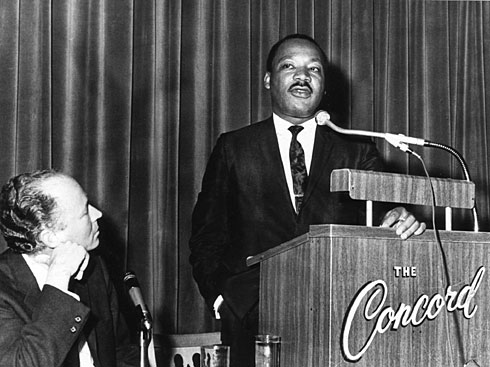
Rabbi Gendler was also instrumental in arranging Martin Luther King’s keynote address at the Rabbinical Assembly’s convention on March 25, 1968. This now-legendary speech took place at the Concord Resort hotel in New York’s Catskill Mountains just 10 days before King’s death. (That’s Rabbi Gendler to the left of Dr. King in the pic above).
Today, decades after King’s death, Rabbi Gendler remains an eloquent Jewish advocate for the path of nonviolence. His work has taken him across the world – most notably to India where he and his wife Mary teach the principles of nonviolence to Tibetan exiles.

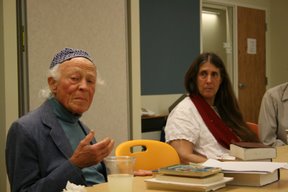
I’m personally honored to serve with Rabbi Gendler on the Elder’s Council of the Shomer Shalom Institute for Jewish Nonviolence. In this picture, he leads a workshop at JRC in 2008. Shomer Shalom founder Rabbi Lynn Gottlieb (someone whom I may well be profiling in the future) is sitting next to him.

Rabbi Gendler has also been a long time advocate for Palestinian human rights – and his courageous stands have made it possible for new generations of rabbis to find their own voices on this painful issue. When Rabbi Brian Walt and I first began Ta’anit Tzedek and were looking for rabbis to join our campaign to protest the blockade of Gaza, we immediately turned to Rabbi Gendler, who joined our effort without hesitation. It is difficult to describe how much it means to know there are rabbis out there like Everett, someone who has been putting himself on the line for so long, and upon whom we always know we can rely for guidance and support.

Rabbi Gendler was also one of the first Jewish leaders to embrace environmentalism and vegetarianism long before they became fashionable. As the rabbi of a green synagogue myself, I recognize a tremendous debt to Everett, who more than anyone helped to put environmental issues on the radar screen of the Jewish community.

From a 2008 article in the Los Angeles Jewish Journal:

On a ferociously cold evening in November 1978, Rabbi Everett Gendler climbed atop the icy roof of Temple Emanuel in Lowell, Mass., and installed solar panels to fuel the synagogue’s ner tamid (eternal light)…

Gendler’s conversion of that eternal light marks the first known action to green a synagogue, making it more spiritually and ecologically sustainable, and Gendler himself, now Temple Emanuel’s rabbi emeritus, has been hailed as the father of Jewish environmentalism.

There so much more to say about Everett and his work. I suppose the most essential thing I can say about him is that he was and remains a spiritual maverick. His work remains as relevant and courageous as ever.

As we honor Dr. King this weekend, it’s critically important to honor those who continue his to walk his path in our own day. For me and so many others, Rabbi Everett Gendler is the one who teaches us how to walk that walk.

Life in the Green Zone

A few posts ago I described the crisis in Sheikh Jarrah and the increasing Judaization of Arab East Jerusalem. For further analysis of this issue, I strongly encourage you to watch the 20 minute documentary, “Green Zone” (above). It brilliantly exposes the sham of a legal system that is Jerusalem’s housing policy.

The bottom line: Arabs are being expelled from their homes for no other reason than they are not Jews.

Please find 20 minutes to watch this film.  Then please consider supporting the Israel Committee Against Home Demolitions and their campaign to rebuild demolished Palestinian homes.

(H/T to Adam Horowitz and Mondoweiss)

Immigration Justice in Illinois

p5300044_2Some rare good news in the quest for compassionate immigration reform out here in Illinois:

Thanks to the unanimous passage of the Access to Religious Ministry Act in both state houses this past December, detained immigrants will now have the same access to clergy as those imprisoned for other crimes.  Up until now, undocumented immigrants awaiting deportation in Illinois jails have been restricted to clergy visits of two hours or less per month.

In addition to representing a clear victory for freedom of religion, this new access will help us shine a brighter light on conditions in ICE detention facilities.  The law is scheduled to go into effect in June and The Trib  has just reported that volunteer lay-clergy training began yesterday in Chicago. Major kudos to bill-sponsor Sen. Iris Martinez and the inspirational, indefatigable Sisters of Mercy (above) who led the fight for the passage of the bill.

Demanding Justice in Postville

I spent an incredible day yesterday in Postville, Iowa, where an interfaith mobilization of nearly 1,500 people prayed, marched, sang and testified in solidarity with the 390 immigrant Agriprocessor workers arrested in the May 12 raid. I’m still processing the experience the morning after – suffice to say this action provided a powerful ray of light in the midst of the ongoing tragedy that is Postville.

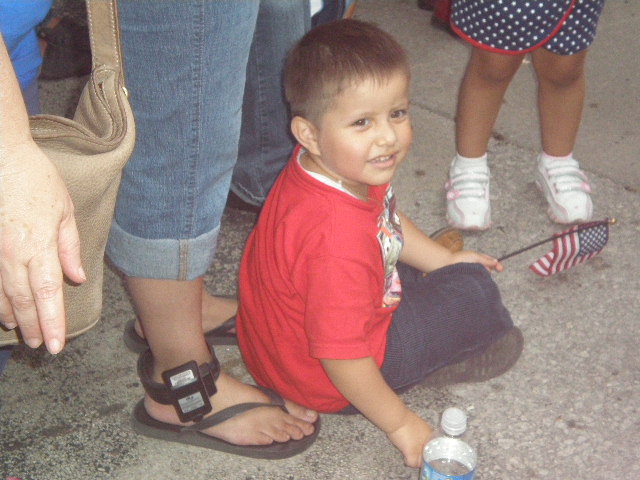
Some brief background for those who still need it: on May 12, US Immigration and Customs Enforcement raided the Agriprocessors kosher meat packing plant. It was the largest single-site workplace raid in US history, resulting in the detainment of 390 employees (out of a total of 968). Ninety were subsequently released (many with GPS ankle bracelets) – the remaining 300 have convicted as criminals on felony charges.

This is the first time that criminal charges were used as a deportation tactic in an immigrant raid. Most of the detained workers were sentenced to five months in prison for engaging in identity theft, in addition to being charged with committing a civil offense for living in the US illegally. According to the terms of their sentence, they are to be deported after serving their time. (Agriprocessors has not been charged, although there have been widespread and growing charges of worker abuse at the plant).

Yesterday’s demonstration was organized to show solidarity with the Agriprocessor workers and their families and to shine a bright light on our profoundly broken immigration policy. This action brought together an unprecedented coalition of activists and was organized by Postville’s St. Bridget’s Catholic Church, Jewish Community Action (St. Paul, MN), the Jewish Coucil on Urban Affairs (Chicago), and the Office for College Ministries at Luther College (Decorah, IA).

Marchers came from throughout the Midwest – largely from Iowa, Minneapolis/St. Paul and Chicago. I joined two full tour buses organized by JCUA for the five hour ride. As we arrived, the scale of the action quickly became evident – throngs were simply pouring into Postville from every direction. I was honored to participate in an interfaith service at St. Bridget’s (below) – the Catholic church that initially provided refuge for families of the detained and has been the base of operations for the crisis response team.

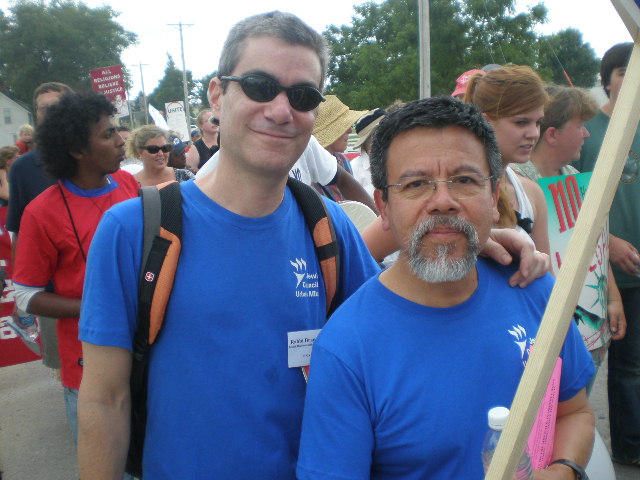
After the service, we began our march. (That’s me with JRC members Leon and Sue Fink and Gonzalo and Tina Escobar below). Our first stop was the Agriprocessor’s plant which was adorned, horrifyingly enough, with a menorah, a Jewish star, and a banner that read “Agriprocessors: A Great Place to Work!” Needless to say, I was heartened by the strong Jewish presence at the demonstration, which provided Postville with a very different face of the Jewish community.

Our march also stopped at large playground that has remained largely empty since the raid. (The Postville school system has been decimated since employee children have either moved away with their families or are living in fear in their homes). In one of the many emotional high points of the day, a group of employee children (below) recited this piece, which was inspired by the poem “I Am A Jew” (from the classic collection “I Never Saw Another Butterfly”):

We are Latinos and will be Latinos forever.
Even if they should try to separate our families
never will we submit.
We will always fight for our people
on our honor.
We will never be ashamed of them
we give our word.

We are proud of our people,
how dignified they are.
Even though we are supressed,
we will always come back to life.

Our march then took us into downtown Postville, where we encountered the inevitable counter demonstrators. As you can see from the pix below, their signs ranged from the more than mildly offensive to the outright repulsive. (We quickly learned, however, that these fine citizens were not locals. I want to take pains to note that we were largely received with respect and appreciation by the citizens of Postville).

During the final rally, the skies opened up with a thunderstorm, so we moved back into St. Bridget’s. By far, the most moving part of this gathering were the personal testimonies of Agriprocessor workers and their families. One young boy, whose mother is currently imprisoned in Leavenworth, KS, spoke eloquently about his family and their plight, while choking back tears.

As painful as it is, I believe it is so essential for us to bear witness to stories such as these. They are critical reminders that the immigration debate in our country is not about abstract policy, but real people whose lives are literally being torn apart by structural violence. At the end of the day, this really is the crux of the issue. All the rest, as the ubiquitous Rabbi Hillel once said, is mere commentary.

Still, yesterday was a proud day for us all. And I can’t help but hope that this newly emboldened coalition will now take the struggle to the next level.

I’ll close with the picture below. Take a close look – I think it says it all. (The mother with the ankle bracelet is Maria Garcia, an ex-Agriprocessor employee originally from San Luis Potasi, Mexico. That’s her son Anthony holding the American flag…)