Category Archives: Current Events

Seeking Understanding Amidst the Horror in Israel/Palestine

When I heard the initial reports that Palestinians had breached the fences of Gaza this past Saturday, I will be completely honest – my first reaction was “good for them.” Israel had been collectively punishing Palestinians in Gaza for years with a crushing blockade with little to no care from the rest of the world. Now, amazingly, Palestinians had broken free from this seemingly impenetrable open-air prison. With power and ingenuity, they were resisting their oppression, reminding Israel – and the world at large – that they were still here. That they would not submit.

Inevitably, as the news of the attacks trickled in during the course of the day, however, my emotions turned to shock and grief. Along with the rest of the world, I learned about the sheer scale of violence committed by Hamas militants against Israeli civilians: the largest single day massacre in Israeli history. At last count, at least 1,200 Israelis have been killed and it is estimated that 150 have been abducted and taken hostage into Gaza. Everyone in Israel and many Jews throughout the world, know people – or know of people – who were killed, injured or taken hostage. Like so many in the Jewish community, my social media feed has been filled with heartbreaking pictures and stories of Israelis who have been slain or are still unaccounted for.

Amidst all the grief, however, I was also deeply troubled by the ominous, growing cries for vengeance voiced by the Israeli government and media, and felt a creeping dread over the shattering military response that would almost certainly rain down on the people of Gaza. And now that day has come. Israel has shut off all electricity and water for over two million Palestinians as the military wreaks complete and total devastation on across that tiny strip, attacking hospitals, schools, mosques, marketplaces, and apartment buildings.  As of this writing, the death toll has risen to more than 1,200, with 5,600 wounded. More than 250,000 people have been rendered homeless – and these numbers will almost certainly rise significantly in the coming days and weeks.

In a letter to my congregation a few days ago, I wrote that “so many of us are feeling layers upon layers of intense emotion, in often confusing and contradictory ways. For Jews who stand in solidarity with Palestinians, I know these confusing contradictions are particularly keen.” Even so, I wrote, we simply must lift up the underlying context of this horrible violence. I continue to hold tightly to this conviction. While the sheer scope of our grief may feel incomprehensible, we simply must find the wherewithal to say out loud that the facts of these events have not only been comprehensible, but in fact inevitable.

Indeed, Palestinians and their allies have long been sounding the alarm that Israel was subjecting Palestinians to a brutally violent apartheid regime with impunity – and that there would be terrible consequences if the international community failed to intervene. Over and over, we’ve been warned about the cataclysmic violence that would inevitably ensue if Israel was not held to account. As Palestinian historian Rashid Khalidi put it recently, “an entire people (has been) living under this kind of incredible oppression, in a pressure cooker. It had to explode.”

As we attempt to understand the context of this recent violence, I believe it’s utterly critical to know where to plot the starting point – and to my mind, this is precisely where most of the media analyses of the past several days have sadly gone astray. To judge by any number of pundits, this current outbreak of violence began alternatively with the US – Saudi deal or the policies of the far-right Netanyahu administration. While it might be said that any of these causes may have provided the most recent spark, I’ve been deeply disappointed, if not surprised, that precious few of these analyses have even mentioned the Nakba in relation to this latest outbreak of violence.

To be sure, the Nakba was an act of violence and harm that has been reverberating through the land between the river and the sea from 1948 until this very day. To put it simply, for the past 75 years, Israel has been violently dispossessing Palestinians in order to make way for a majority Jewish state. And for just as long, the Palestinian people have been resisting their dispossession – yes, often violently.

It is not by chance that this most recent violence has occurred in and around Gaza. As many commentators have observed, Gaza has in many ways been the epicenter of the Nakba – and of the Palestinian people’s resistance to it. To grasp this fully, it is important to understand the history of this region. Gaza’s narrative did not begin with Israel’s blockade or the political ascension of Hamas. What we call today the “Gaza Strip” was artificially created in 1949, when it became a repository for a flood of ethnically cleansed Palestinian refugees from cities and villages in the coastal plain and lower Galilee. Before the Nakba, the population of this small region numbered 60 to 80,000 residents. By the end of the hostilities, at least 200,000 refugees were crowded into this 140 square mile strip of land.

At the time, most of the refugees fully expected to return home – some could even see their towns and villages through the fences. Those who crossed the border to gather their possessions or harvest their crops were considered “infiltrators” by Israel and shot on sight. Eventually, it became all too clear there would be no return. Over the years the tents turned into concrete buildings that grew ever higher along that narrow corridor. The numbers of that once sparse territory have grown to a population today of over 2,000,000 people – at least 70% of whom are refugees.

Following the founding of the state of Israel, many of the original settlements and kibbutzim founded on the border with Gaza were military outposts, most of which were built on top of or near demolished Palestinian villages. In fact, the sites that suffered the brunt of last Saturday’s massacres (including Kibbutz Kfar Aza, Re’im and Sderot) were settlements that were originally established in these locations for reasons of Israeli “national security.”

One such site was Kibbutz Nahal Oz, which was flooded by dozens of Hamas militants, and where, according to witnesses, at least two entire families were killed, and two more kidnapped and taken to Gaza as hostages. When I heard about the massacre at Nahal Oz, I couldn’t help but recall that this was not the first time this community had experienced Palestinian armed resistance. Back in 1956, a group of Palestinian militants entered Nahal Oz and killed a kibbutznik named Roi Rotenberg. At the time, this tragedy was keenly felt throughout the nascent state of Israel. At Roi’s funeral, the famed Israeli general Moshe Dayan offered a eulogy, expressing himself with brutal and unexpected honesty:

Do not today besmirch the murderers with accusations. Who are we that we should bewail their mighty hatred of us? For eight years they sit in refugee camps in Gaza, and opposite their gaze we appropriate for ourselves as our own portion the land and the villages in which they and their fathers dwelled…This we know: that in order that the hope to destroy us should die we have to be armed and ready, morning and night. We are a generation of settlement, and without a steel helmet and the barrel of a cannon we cannot plant a tree and build a house. Our children will not live if we do not build shelters, and without a barbed wire fence and a machine gun we cannot pave a road and channel water. The millions of Jews that were destroyed because they did not have a land look at us from the ashes of Israelite history and command us to take possession of and establish a land for our nation.

Dayan’s words resonate today with terrible prescience. Decades later, the descendants of this original Gazan generation still remain in refugee camps in Gaza, “gazing though the barrier fences as Israel appropriates as its own portion the land and the villages in which their ancestors dwelled.” Dayan’s eulogy also powerfully described a hypervigilant Israeli mindset that has only deepened throughout the decades. Since the Nakba could not and did not result in the complete ethnic cleansing of Palestinians from their homes, Israel has attempted to control them with a “steel helmet and the barrel of a cannon” for the past 75 years. During this time, Israel has widened its regime of violence in order to contain Palestinians in the occupied territories, subjecting them to a daily context of systemic, unceasing state violence every moment of their lives.

It is also telling that Dayan invoked the trauma of the Holocaust in his eulogy – and today, so many decades later, we can clearly see that this trauma was not limited to his generation alone. If anything, it has been handed down to subsequent generations in way that are all too real and all too palpable. Indeed, we can clearly see this generational trauma at work in Jewish responses to this latest violence, which is being openly characterized as “the worst mass murder of Jews since the Holocaust.” It is painfully poignant to consider that these massacres occurred in a state that was founded in the wake of the Holocaust in order to safeguard Jewish lives once and for all.

At the same time, however, this Holocaust rhetoric is deeply troubling given the vengeful fury currently being whipped up by a far-right Israeli government that is demonizing Palestinians with unabashedly genocidal language. Israel’s Defense Minister Yoav Gallant recently stated “Israel is fighting human animals” and should “act accordingly.” Netanyahu has promised that Israel’s military offensive on Gaza will “reverberate for generations.” One prominent Israeli general has promised to “open the gates of hell.” And perhaps most chillingly, a member of Israeli Parliament has called for a “second Nakba that will overshadow the Nakba of 1948.”

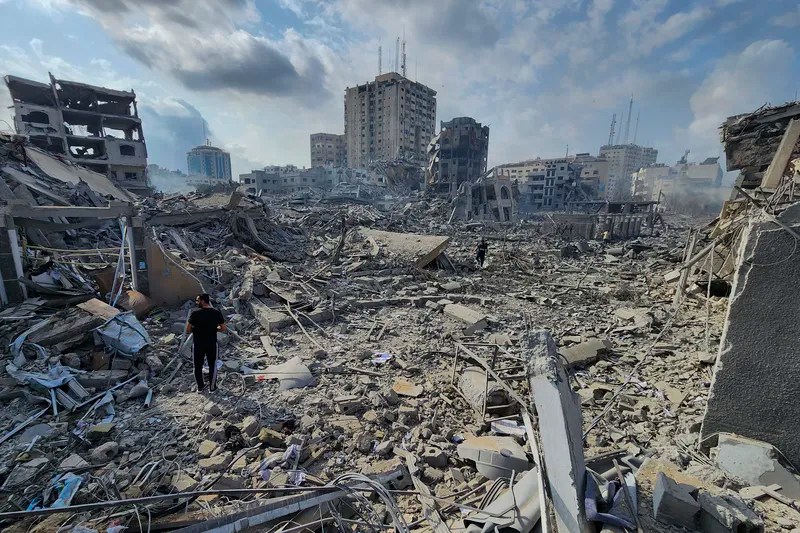
As I write these words, the Israeli military is mercilessly bombarding the Gaza Strip with a ferocity that is truly terrifying to behold. For the past few days, I’ve been combing social media for their postings from friends in Gaza, as I helplessly watch footage of whole neighborhoods and communities completely destroyed along with their inhabitants. One of the last messages I read came from a friend and former colleague at American Friends Service Committee: “Nothing left to say. More than 80 hours without electricity, water, or internet connection. Communication is very limited with everyone inside or outside Gaza. Carnage everywhere, hard to recognize streets, we are all waiting for the time to die.”

It is not an understatement to suggest that the Jewish community is now faced with a profound moral challenge. Even as we mourn our dead in Israel, we must acknowledge and protest the genocide Israel is currently perpetrating in their memory in no uncertain terms. I cannot say this forcefully enough: those of us who ignore this reality – who mourn the Jewish dead exclusively without even a mention of the massive crimes Israel is actively committing against the Palestinian people – will be quite frankly, complicit in this horrific bloodshed.

Over the past several days, I’ve found myself returning to a famous narrative from this week’s Torah portion: the story of Cain and Abel. In the wake of the first act of violence in human history, God says to Cain, “What have you done? The blood of your brother is crying out to me from the ground! Cursed by the ground that opened its mouth to receive the blood of your brother.”  From this we learn, among other things, that bloodshed actually has the power to pollute the earth. Later on in the Torah, we will learn that nothing can ever be the same – or considered normal again – when blood is spilled. it must be expiated, or atoned for through a set of very complex and explicit sacrificial rituals. In our day, we can understand these to be acts of reparation, restoration and repatriation. We will only truly make atonement for this bloodshed with very real measures that will restore justice and balance for those who dwell in the land. 

As I read this story, I can’t help but think of the blood originally shed in the terrible days of the Nakba, and how it continues to cry out to us all from the ground. I can’t help but think of the immense amount of blood that has been shed since, whose collective cry must certainly be a searing roar, if only we would allow ourselves to hear it. But we will never heed the cry as along as we remain hardened into sides, into “us and them.” In fact, in this week’s Torah portion, there are no “sides” to speak of. There are no nations, no Israelites, no Canaanites, no Amalekites, no Moabites. There is only one common humanity, struggling how to live together in a too often harsh and unyielding world.

Those it may seem more painfully difficult than ever, let us hearken to this voices that have so long been crying out from the ground. Let us respond with understanding, compassion and action. Even amidst the terrible grief, let us shine an unflinching light on the true roots of this violence – and on the vision of a future based on justice and equality for all who live in the land.

With this in mind, I will conclude now with the prayerful words of my dear friend and colleague Rabbi Alissa Wise:

May the One Who Remembers allow us to hold in one hand 75 years of occupation,
dispossession and violence and in the other a future of peace, justice and freedom;

May the One Who is Slow to Anger soften our hearts and our fists helping us to put down the sword even at the height of the arc of our rage;

May the One of Possibility remind us that a future of peace with justice is possible;

May the One Who Awakens Us to Life hold us in our pain and vindictiveness until we set those down for the sake of life;

May the One Who Endures allow us to act for the sake of the coming generations;

May the One Who is Without Limit expand our senses of what is possible as we reach for justice, freedom and peace for us all.

Amen.

Naming Israeli Apartheid on Capitol Hill

While the US Congress is undoubtedly a horrid dysfunctional mess of an institution, there have been occasional examples of genuine hope and even inspiration. This past week provided us with one of those examples.

Many of you, I’m sure, have been following the upheaval that occurred when Washington Rep. Pramila Jaypal called Israel “a racist state” at the Netroots Nation conference. After the wrath of the Israel lobby and her Israel-supporting congressional colleagues inevitably rained down upon her, Jaypal walked back her statement. Shortly after, a Republican congressperson cynically introduced a non-binding House resolution that expressed unconditional support for Israel and condemned antisemitism. Of course, it passed overwhelmingly.

While all this was boilerplate Israel politics on Capitol Hill, nine Democratic representatives had the courage to vote no on the resolution: Alexandria Ocasio-Coretz and Jamaal Bowman of New York, Cori Bush of Missouri, Andre Carson of Indiana, Summer Lee of Pennsylvania, Ilhan Omar of Minnesota, Ayanna Pressley of Massachusetts, Delia Ramirez of Illinois and Rashida Tlaib of Michigan.

And speaking of courage, Tlaib went on to say this on the House floor: 

Israel is an apartheid state. To assert otherwise, Mr. Speaker, in the face of this body of evidence, is an attempt to deny the reality and an attempt to normalize violence of apartheid. Don’t forget: This body, this Congress, supported the South African apartheid regime, and it was bipartisan as well.

And if this wasn’t enough, all of this occurred before a US visit from Israeli Prime Minister Isaac Herzog. When Herzog address a joint session of Congress, his speech was openly boycotted by Ocasio-Cortez, Bowman, Omar, Bush and Tlaib. 

While some will undoubtedly say that we are only talking about a small number of congresspeople here, it is still utterly unprecedented. Some might well recall that back in 2015, 58 members of Congress similarly skipped a speech by Prime Minister Netanyahu. That protest, however, was largely an issue of political protocol – it was a Democratic response to the refusal of Congressional Republicans to alert the Obama White House of their invitation to Netanyahu to address Congress. By contrast, this boycott was an unabashed protest against Israeli racism and apartheid.

Of course, Jaypal was absolutely correct in referring to Israel as a racist state – a fact that was pointed out in several mainstream media op-eds following her comment. It was also noted that many Israelis and Israeli organizations have regularly referred to Israel in this manner as well. Apropos of Tlaib’s comment, I can’t help but recall when it was considered politically beyond the pale to criticize South African apartheid on the Hill. To be sure, naming this term out loud was an important part of what eventually resulted in the passage of the Anti-Apartheid Act of 1986 (vetoed by President Reagan, but overridden largely due to the leadership of the Black Congressional Caucus).

Fast forward to 2023: did any of us ever expect we would live to see the day that a Palestinian American congressperson would call Israel an apartheid state on the House floor? Or that another congressperson (Ilhan Omar) would publicly state:

There is no way in hell I am attending the joint session address from a President…during the deadliest year for Palestinians in the West Bank in history, immediately following Israel’s largest incursion into the occupied West Bank in two decades, one that flattened city blocks, and killed at least a dozen people.

Yes, we did indeed witness genuine political courage in Washington DC this week. Please join me in thanking these congresspeople for their fearless stand against Israeli apartheid. 

On the Battle of Jenin and “The Battle of Algiers”

For many, Gillo Pontecorvo’s “The Battle of Algiers” (1966) remains one of the truly great movies of modern times – and arguably the greatest anti-colonial film ever made. So much has been written about its audacious pseudo-documentary style and its radical ideological pedagogy – and well as the ways it has provided a kind of real life template for colonial powers and liberation movements throughout history. For me, this latter point has particular resonance and relevance in the wake of Israel’s latest military “counter-terrorism” operation in Jenin.

I use the word “latest,” because this recent assault was precisely that – the latest of a continuum of Israeli military incursions into the Jenin refugee camp on the pretense of rooting out Palestinian “terrorists” and “militants.” Jenin – a camp composed of refugees who were ethnically cleansed from their homes in 1948 – has long been a center of Palestinian resistance by groups such as the PLO, the Al Aqsa Martyrs Brigades, Hamas and Palestinian Islamic Jihad (PIJ), among others. Despite a long litany of Israeli operations to crush them, however, Palestinian resistance groups have inevitably continued to regroup and thrive throughout the years.

This dynamic was incisively described in a recent New York Times op-ed by Tareq Baconi, “The Tale of Two Invasions,” in which he compared Israel’s recent assault on Jenin to its 2002 Jenin assault led by then Prime Minister Ariel Sharon. Baconi powerfully concludes:

Residents of the Jenin camp, some of whom had fled from their homes in what is now Israel in 1948, are refugees once again. And some of the toddlers who were in the camp in 2002 are now the young men of the Palestinian resistance. As the history of other struggles against apartheid and colonial violence have taught us, today’s children will no doubt take up arms to resist such domination in the future, until these structures of control are dismantled.

After reading Baconi’s article, I immediately flashed on a memory from Israel’s 2002 invasion of Jenin (in which, according to Human Rights Watch, 52 Palestinians were killed, at least 22 of whom were civilians, including children, physically disabled, and elderly people). I well recall reading at the time that Israeli commander, Col. Moshe “Chico” Tamir, believed that “The Battle of Algiers” was “a valuable source of information” for his soldiers who were fighting against PIJ in the Jenin casbah. It was also noted that PIJ leader Iyad Sawalhe was hunted down and killed much in the same manner as in the conclusion of the film, when the Algerian rebel leader Ali La Pointe is killed by the French military.

Much of the power of “The Battle of Algiers” derives from its complex portrayal of the military mentality and tactics of the French in Algeria. In one of its most famous scenes, the French commander Col.  Mathieu offers a long monologue at at press conference in which he calmly and rationally presents the colonial case for what amounts to the torture and oppression of the Algerian people. When he concludes, he offers this final rhetorical argument: “Do you think France should stay in Algeria? If you do, you have to accept the necessary consequences.”

This colonial rationale, of course, is often made in a myriad of ways by the state of Israel and its defenders – and it goes a long way in explaining why Israel continues to stage brutal assaults upon Jenin, Gaza and other sites of Palestinian resistance. In essence: “Do you believe a Jewish state must continue to exist? If so, you have to accept the necessary consequences.”

Every time I watch “The Battle of Algiers,” I’m always moved by the dramatic finale, which portrays the killing of Ali La Pointe then abruptly jump cuts five years later to the liberation of the resistance and end of French colonial rule in Algeria. The message is all too clear: colonial powers may win the battles, but they will inevitably be defeated in the end.

So too in Jenin: Israel’s regular assaults may succeed in quashing the latest leaders of the Palestinian resistance, but it will never destroy the Palestinian people’s will to resist. As Baconi so aptly put it: “today’s children will no doubt take up arms to resist such domination in the future, until these structures of control are dismantled.”

Resistance to Pharaoh in Jenin

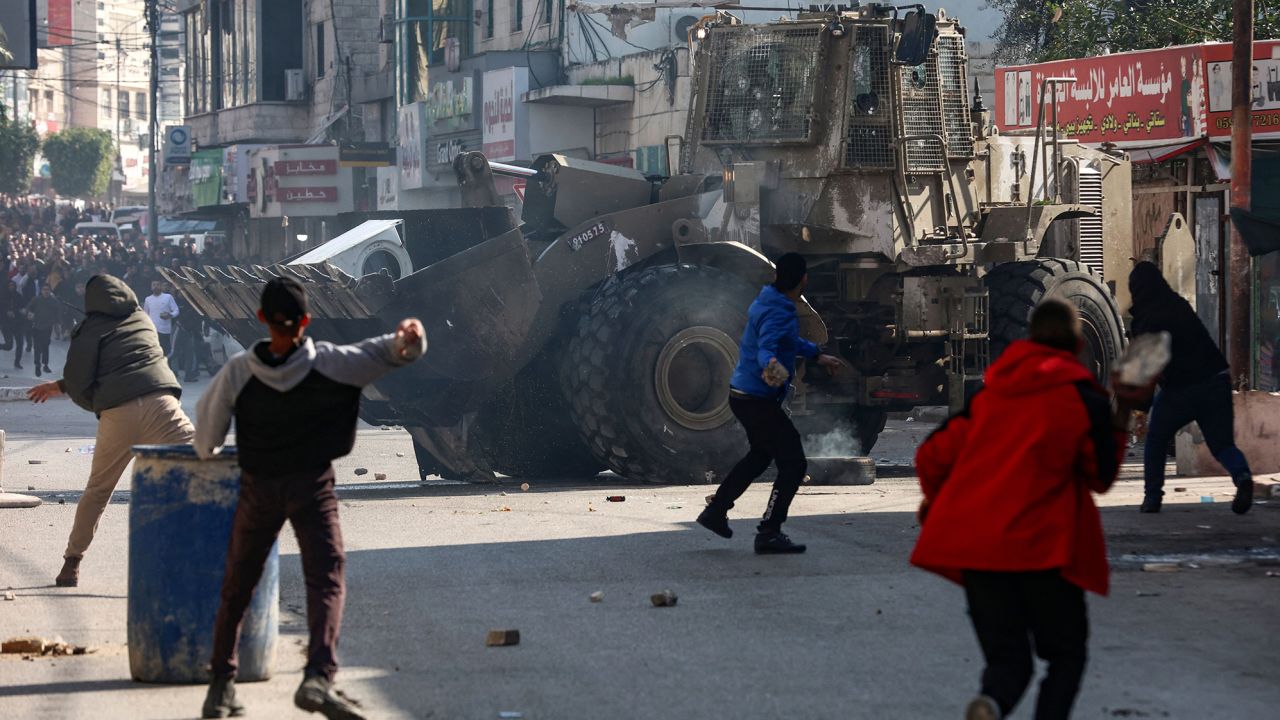
Jenin, 1/26/2023 photo: Zain Jaafar/AFP/Getty Images

As I write these words, it’s been reported that Israeli troops have killed nine Palestinians, including an elderly woman, in the Jenin refugee camp. Another twenty have been wounded, at least four of whom are in critical condition. 

This tragedy should not come as a surprise to us. Observers have noted that the Israeli military has been killing Palestinians with alarming regularity in recent months. According the UN, 2022 was the deadliest year for Palestinians since 2006. 30 Palestinians have been killed in January alone – and the month isn’t even over yet.

Though it has not been widely reported, Israel has been dramatically escalating these deadly raids against Palestinians in the West Bank. While the election of its radical right-wing government is garnering the lion’s share of attention these days, it’s important to note that these raids were initiated well before Netanyahu’s regime took power. As  journalists Mariam Barghouti and Yumna Patel reported last October (before the election):

The past few weeks have witnessed a noticeable intensification of Israel’s crackdown on Palestinians in the West Bank, targeting both ordinary civilians in their homes and villages, and armed resistance fighters and groups…

The current repression, and the resistance to it, are part of a larger, months-long campaign to quell growing Palestinian resistance, particularly armed resistance, which has seen a resurgence in areas of the West Bank. 

While the Israeli government justifies this violence as “security measures to fight terrorists” and the mainstream media describes these events as “clashes,” I’d argue for a different power analysis: “this is state violence, full stop. The state of Israel was founded upon the dispossession of Palestinians and Palestinians have been resisting that dispossession ever since. Yes, some of that resistance is violent in nature. Such has been the nature of resistance struggles from time immemorial. 

As I watch this current violence unfold, I’m mindful that we’re currently reading the Exodus story in our weekly cycle of Torah portions. At its core, this narrative has a very clear power analysis: it’s a story about resistance to violent state power. How else are we to regard Pharaoh, who responds to the demographic growth of the Israelites by subjecting them to avodah kashah (“brutal servitude”)? How else are we to understand a God who “hearkens to the cry of the oppressed?”

If we are to be true to this sacred narrative, I do not think we can dither on this point. Yes, as a Jew, I’ve obviously been conditioned to identify with the Israelites – but as I’ve learned about the history of liberation movements (including those inspired by this very story), I’ve come to understand that any people who suffer under oppressive state violence are, in a sense, Israelites. And any state — even a Jewish state — that builds its statehood on the backs of another people can become a Pharaoh.

As Shabbat approaches, may this be our prayer:

To the One who demands justice…
give us the strength to resist power
wielded with fear and dread;
fill us with the vision and purpose
to build a power yet greater,
a power rooted in solidarity,
liberation and love.

Grant us the courage to dismantle
systems of oppression –
and when they are no more,
let us dedicate our wealth and resources
toward the well-being of all.

May we abolish all forms of state violence
that we might make way for a world
free of racism and militarization,
a world where no one profits
off the misery of others,
a world where the bills owed those who have been
colonized, enslaved and dispossessed
are finally paid in full.

On Tisha B’Av 2022, Israel’s Baseless Hatred Unleashed on Gaza

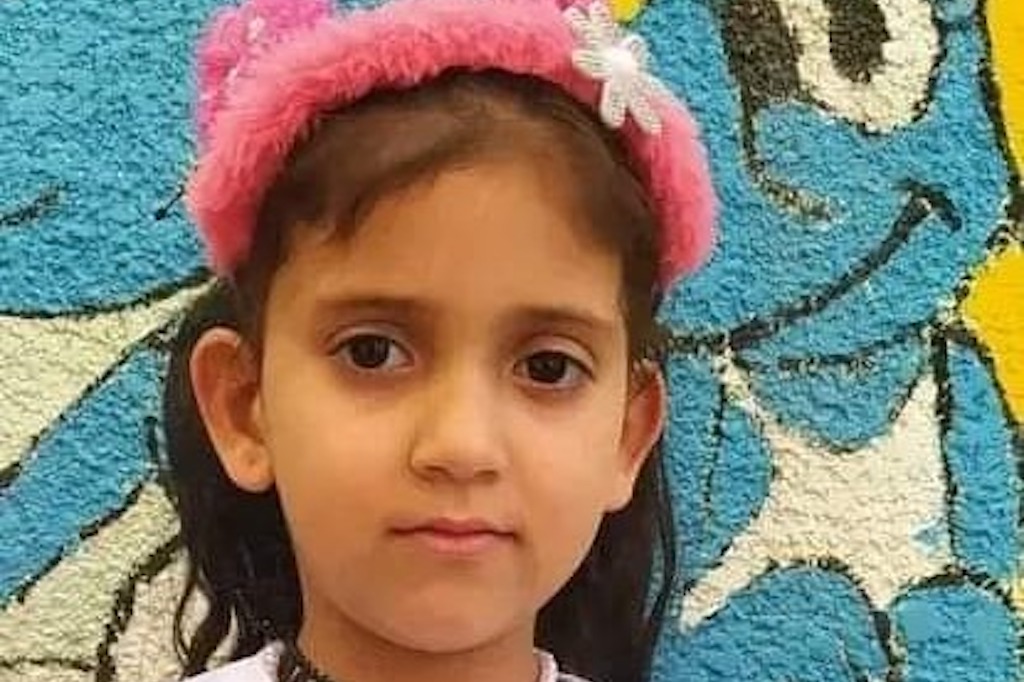
Alaa Abdullah Riyad Qaddoum, age 5, killed by the Israeli military in Gaza City on August 5, 2022.

In August 2014, the Jewish festival of Tisha B’Av arrived as Israel was waging a military onslaught on Gaza that would eventually kill 2,251 Palestinians, 1,462 of whom were civilians, including over 500 children. Tisha B’Av is traditionally observed a day of mourning over the destruction of the Temple in Jerusalem and by extension, the tragedies that have befallen the Jewish people throughout its history. To mark the occasion of the festival in 2014, I wrote a new version of the first chapter of Lamentations (the Biblical book traditionally chanted on Tisha B’Av). At the time, I suggested this new version be added to the ceremony to acknowledge the massive tragedy the state of Israel was inflicting on Palestinians in Gaza in the name of the Jewish people.

Now eight years later, the eve of Tisha B’Av 2022 arrives this evening amidst yet another grievous military assault on Gaza. As of this writing, 24 people have been killed and over 120 more have been wounded. The Israeli military reports it is preparing for a week long operation “that could take longer, if needed.” It is not currently engaging in any ceasefire negotiations.

As in 2014, Israel, its supporters and the mainstream media at large are selling this latest military onslaught by claiming “Israel has a right to defend itself” from Gazan rocket fire. But as I wrote about Israel’s actions in 2014, this is a cynical and empty posture. As was the case eight years ago, this new war on Gaza was openly and unabashedly provoked by Israel. The timeline leading up to this latest assault is a matter of public record that is available to anyone interested in reading past Israel’s hollow propaganda:

• This past May, it was reported that the Israeli military was expanding what it described as a “bank of targets” in the Gaza Strip it had identified since its most recent military offensive in 2021.

On Monday, August 1, the Israeli military arrested Bassam al-Saadi, a senior member of the Palestinian Islamic Jihad (PIJ), during a raid on the Jenin refugee camp. The PIJ issued threats in response but took no action.

• Concerned that the PIJ would attack in retaliation, the Israeli military directed authorities to close roads near the Gaza border.

Yesterday, claiming that it was responding to an “imminent threat,” Israel unleashed a wave of airstrikes in Gaza, killing PIJ military commander Tayseer Jabari along with seven other people, including a 5 year old girl, Alaa Abdullah-Riyad Qaddoum.

• The PIJ retaliated by sending more than 100 missiles into Israel. The Israeli military reported that it had intercepted about 95 percent of the rockets. There were no reports of significant property damage.

• The US Ambassador to Israel, Tom Nides, stated that “the United States firmly believes that Israel has a right to protect itself.” 

This is, in short, purposeful wanton aggression. That it is repeatedly committed against a blockaded, besieged population of 2,000,000 who literally have nowhere to run raises it to the level of atrocity. It is no less abominable to rationalize it away by with the bromide that “Israel has the right to defend itself” or to blame Palestinians themselves for their own destruction by invoking the allegation of “human shields” –  a false claim that has been repeatedly disproved by human rights observers.

These rationalizations are particularly profane in the way they rob Palestinians of their basic humanity. I remember thinking of precisely this on Tisha B’Av 2014 – and how incongruous it felt to engage in a ceremony of grief over Jewish loss while a nation state purporting to act in the name of the Jewish people inflicted such unspeakable losses on another people.

According to Jewish tradition, the fall of the Temple was caused by internal sinat chinam – baseless hatred – that wracked the disempowered, besieged Jewish community of ancient Jerusalem. In the age of Zionism, it seems to me, we must be ready to acknowledge a different kind of sinat chinam – one that is wielded by a Jewish state power against a people it continues to disempower and besiege.

As in 2014, I will not be mourning the destruction of the Temple this Tisha B’Av. I will be mourning the losses of yet another merciless war waged by Israel against the Palestinian people. And as in 2014, this will be my lament:

For these things I weep:
for the toxic fear we have unleashed
from the dark place of our hearts
for the endless grief
we are inflicting
on the people of Gaza.

ADL CEO Misrepresents Report on Antisemitism to Attack Palestinian Groups

photo: John Cherry/Getty Images

Cross-posted with Truthout

Keen observers have long noted that the Anti-Defamation League (ADL) is essentially a xenophobic Israel-advocacy organization masquerading as a Jewish civil rights organization. If there was ever any doubt, this became abundantly clear at the ADL’s National Leadership Summit on May 1, when CEO Jonathan Greenblatt delivered a prerecorded speech, ostensibly to discuss the mission of the organization in light of its just-released 2021 Audit of Antisemitic Incidents. Instead, Greenblatt spent the majority of his time denouncing anti-Zionism (i.e., legitimate opposition to an ideology that promotes an exclusively Jewish state in historic Palestine) as antisemitism. In his speech, he specifically vilified three Palestine solidarity groups — Students for Justice in Palestine, the Council on American-Islamic Relations and Jewish Voice for Peace — terming them “hateful” and “extremist.”

Greenblatt’s doubling down was particularly notable because his message represented a change from the ADL’s official statement that “anti-Zionism isn’t always antisemitic.” Indeed, it was difficult to not be struck by the sheer amount of time he spent on the subject — and the vehemence with which he pressed his talking points:

To those who still cling to the idea that anti-Zionism is not antisemitism — let me clarify this for you as clearly as I can — anti-Zionism is antisemitism.

Anti-Zionism as an ideology is rooted in rage. It is predicated on one concept: the negation of another people, a concept as alien to the modern discourse as white supremacy. It requires a willful denial of even a superficial history of Judaism and the vast history of the Jewish people. And, when an idea is born out of such shocking intolerance, it leads to, well, shocking acts.

Greenblatt’s claims were particularly cynical because they actually flew directly in the face of the ADL’s own 2021 Audit of Antisemitic Incidents, which found that of the 2,717 incidents it recorded last year, 345 (just over 12 percent) involved “references to Israel or Zionism” (and of these, “68 took the form of propaganda efforts by white supremacist groups.”) Though he actually opened his speech by invoking his report, Greenblatt actively misrepresented its findings, choosing instead to vilify three organizations that legitimately protest Israel’s human rights abuse of Palestinians. Most outrageously, he actually equated anti-Zionists with “white supremacists and alt-right ilk who murder Jews,” as if the rhetoric of Palestine solidarity activists could in any way be comparable to the mass murder of Jews in a Pittsburgh synagogue.

By singling out these Palestine solidarity groups, Greenblatt was clearly employing a familiar strategy utilized by the Israeli government and its supporters: blaming the current rise in antisemitism on Muslims, Palestinians, and those who dare to stand in solidarity with them. The “anti-Zionism is antisemitism” trope has also been the favored political tactic of liberal and conservative politicians alike. It is most typically invoked to attack supporters of the Palestinian call for Boycott, Divestment and Sanctions. Pro-Palestinian activists well know there is no better way to silence and vilify their activism than to raise the specter of antisemitism.

As journalist Peter Beinart has put it, “It is a bewildering and alarming time to be a Jew, both because antisemitism is rising and because so many politicians are responding to it not by protecting Jews but by victimizing Palestinians.” Of course, the rise in antisemitism is alarming, but as ever, the greatest threat to Jews comes from far-right nationalists and white supremacists — not Palestinians and those who stand with them. It is particularly sobering to contemplate that this definition essentially defines all Palestinians as antisemitic if they dare to oppose Zionism. But what else can Palestinians be expected to do, given that Zionism resulted in their collective dispossession, forcing them from their homes and lands and subjecting them to a crushing military occupation?

The growing crackdown on anti-Zionism can also be understood as a conscious effort to stem the growing number of Jews in the U.S. — particularly young Jews — who do not identify with the state of Israel and openly identify as anti-Zionist. The backlash against this phenomenon has been fierce — at times perversely so. In a widely discussed 2021 essay, Natan Sharansky and Gil Troy lamented the growth of anti-Zionist Jews, by labeling them as “un-Jews.” Last May, immediately following Israel’s military onslaught on Gaza, a Chicago-area Reform rabbi gave a sermon in which she called anti-Zionist Jews “Jews in name only” who must be “kept out of the Jewish tent.”

Beyond these extreme protestations, it bears noting that there has always been principled Jewish opposition to Zionism. While there are certainly individual anti-Zionists who are anti-Semites, it is disingenuous to claim that opposition to Zionism is fundamentally antisemitic. Judaism (a centuries-old religious peoplehood) is not synonymous with Zionism (a modern nationalist ideology that is not exclusively Jewish).

My congregation, Tzedek Chicago, recently amended our core values statement to say that we are “anti-Zionist, openly acknowledging that the creation of an ethnic Jewish nation state in historic Palestine resulted in an injustice against the Palestinian people — an injustice that continues to this day.” Our decision to articulate anti-Zionism as a value came after months of congregational deliberation, followed by a membership vote. As the Tzedek Chicago board explained our decision:

Zionism, the movement to establish a sovereign Jewish nation state in historic Palestine, is dependent upon the maintenance of a demographic Jewish majority in the land. Since its establishment, Israel has sought to maintain this majority by systematically dispossessing Palestinians from their homes through a variety of means, including military expulsionhome demolitionland expropriation and revocation of residency rights, among others.

It is becoming increasingly difficult to deny the fundamental injustice at the core of Zionism. In a 2021 report, the Israeli human rights group B’Tselem concluded that Israel is an “apartheid state,” describing it as “a regime of Jewish supremacy from the river to the sea.” In the same year, Human Rights Watch released a similar report, stating Israel’s “deprivations are so severe that they amount to the crimes against humanity of apartheid and persecution.”

Given the reality of this historic and ongoing injustice, we have concluded that it is not enough to describe ourselves as “non-Zionist.” We believe this neutral term fails to honor the central anti-racist premise that structures of oppression cannot be simply ignored — on the contrary, they must be transformed. As political activist Angela Davis has famously written, “In a racist society, it is not enough to be non-racist, we must be anti-racist.”

While we are the first progressive synagogue to openly embrace anti-Zionism, there is every reason to believe we will not be the only one. At the very least, we hope our decision will widen the boundaries of what is considered acceptable discourse on the subject in the Jewish community. As Shaul Magid recently — and astutely — wrote:

[Israel is] a country stuck with an ideology that impedes equality, justice, and fairness. Maybe the true messianic move is not to defend Zionism, but to let it go. Maybe the anti-Zionists are on to something, if we only allow ourselves to listen.

Whether or not organizations such as the ADL succeed in their efforts to falsely conflate anti-Zionism with antisemitism depends largely on the response of the liberal and centrist quarters of the Jewish community. Indeed, Greenblatt’s doubling down on anti-Zionism may well reflect a political strategy seeking to drive a wedge in the Jewish community between liberal Zionist and anti-Zionist Jews. Jewish establishment organizations, such as the ADL and American Jewish Committee view this moment as an opportunity to broaden their political influence, with the support of right-wing Democrats and Christian Zionists. The end game of this growing political coalition: an impenetrable firewall of unceasing political/financial/diplomatic support for Israel in Washington, D.C.

In the end, of course, the success or failure of this destructive tactic will ultimately depend on the readiness of Jews and non-Jews alike to publicly stand down Israeli apartheid and ethnonationalism — and to advocate a vision of justice for all who live between the river and the sea.

Mir Zaynen Do – Sermon for Rosh Hashanah 5782

When I tried to think of the most appropriate saying I could offer you this Rosh Hashanah, I kept coming back to those famous Yiddish words from The Partisans Songmir zaynen do – “we are here.” It somehow feels right to invoke words of resistance at this particular moment, doesn’t it? It’s been a hard and painful battle for us all this past year, but we are here. Tragically, too many of our comrades are no longer with us, but, nevertheless, mir zaynen do. We are here. 

In an age of pandemic, just surviving itself can feel like a victory. So here we are: to date, COVID has claimed 640,000 lives in the US and over 4.5 million worldwide. And though it felt as if we’d finally turned a corner last spring, the arrival of the Delta variant was a brutal reminder that the pandemic is not at all behind us. The number of deaths is climbing again. Hospitals around the country are filling up, in some states to over-capacity. And though Trump is no longer our President, the Republican party continues to politicize the pandemic with ever-astonishing cynicism.

Despite a slight rebound last spring, things are still economically dire in our country. The percentages of those who are unemployed and uninsured are still shamefully high. Just this last August, the Supreme Court struck down eviction protections for most of the US, putting as many as 3.5 million households at risk of losing their homes, including hundreds of thousands of tenants this year alone. 

Last Rosh Hashanah, I suggested that, in a very real way, we’re all in a state of grief over the world we’ve lost. If we were to continue with this metaphor – and I still believe it’s an apt one – we’ve now gone through one full year of mourning. In Jewish tradition, the year following a loss is a spiritually intense time for mourners, traditionally marked by the regular recitation of Kaddish. When the first year is up, the intensive part of our observance is lifted and we begin our reemergence back into the world. We know, however, that we won’t be reentering the world as it was. That world has been forever changed. 

And so, even though the year of formal mourning is over, we’ll continue to say Kaddish regularly for the rest of our lives. We will never stop grieving what we’ve lost. The pain may come and go, but it never goes away entirely. Indeed, sometimes it will grip us when we least expect it. At the same time, however, we know that things can get better. If we work at it. If we affirm the truth of our healing and actively participate in the healing process. 

So all of this to say yes, it is one year later and yes, we are still experiencing the pain of the loss of the world we once knew. But while the reality of what was lost is still brutally painful for us, it is also true that there has been healing. We are not, in fact, in the same place that we were last year. 

Most obviously – and most importantly – last Rosh Hashanah, I don’t think any of us would dare to imagine that we would see a COVID vaccine any time soon. Then just a few months later, the first fully-tested immunization was approved. Let’s pause now and just try to grasp the enormity of this. It is actually unprecedented in scientific history to go from the onset of a deadly new virus to the creation of a tested vaccine in less than a year. There is really no other word for it: the vaccine is a blessing. It is saving scores of lives as we speak and it remains our greatest hope to finally reach the end of this pandemic. 

It has often occurred to me, when we gather for the High Holidays and pray to be written in the Book of Life for the coming year, we’re essentially coming to grips with the terrifying truth of our mortality. Every Rosh Hashanah we say the unsayable out loud: this time next year, some of us will still be alive and some of us will not. The Book of Life is a stark liturgical metaphor of this immensely painful truth. 

But it also occurs to me that maybe it’s not quite that simple. Maybe the book is a work in progress. Maybe, just maybe, there are a myriad of ways that we take the radical, audacious step to write ourselves into the Book of Life. If we ever needed a reminder of this, just think: last year, after the holidays were over and the gates were supposedly closed, so many people from around the world: doctors and scientists and researchers and immunologists and donors and vaccine developers and caregivers heroically took it upon themselves to write scores of human souls into the Book of Life.

So before I continue any further, I’d like us to pause and honor the blessing of this moment – to offer a blessing of gratitude for having been kept alive long enough to reach this New Year. Please join together with me: 

Blessed are you, spirit of the universe, you have given us life, you kept us alive and you have brought us all to arrive at this season together.

Now of course, while the arrival of a vaccine has been a game changer, it has decidedly not brought about the end of the pandemic. And in some ways I think this kind of magical thinking has contributed to the pain and confusion of our current moment. Last spring, when the shelter orders ended and the re-openings began, we all experienced a collective euphoria and elation that the world was finally getting back to normal. That’s why the mutations of the virus and the arrival of variants has been so brutal. That’s why we’re asking the questions now: will this ever end? Will it ever get any better? 

Again, these are the very same questions we ask when we go through the experience of grief: will things ever get back to normal? Will it ever get any better? Yes, the questions are the same – and the answers are the same as well. No, things will not get back to “normal.” But yes, it can get better. If we work at it. 

We know that this coronavirus will never be eradicated completely. The key is to suppress it to the point that it no longer poses a significant threat to us. When enough people have gained some immunity through either vaccination or infection – preferably vaccination – the coronavirus will transition from pandemic to “endemic.” It won’t be eliminated, but it won’t upend our lives anymore. It won’t cause our ICUs to overflow, force us to shelter at home and wreak havoc with our economy. We can learn to live with it

So therein lies both the blessing and the challenge for us this Rosh Hashanah. The arrival of the vaccine last year was an undeniable blessing. And this year, it seems to me, our challenge is to not squander that blessing. Our challenge is to advocate in no uncertain terms for the blessing of this vaccine to be spread as widely as is humanly possible in this country and throughout the world. 

I would go as far as to say that vaccine advocacy is, in fact, nothing short of a sacred obligation. In Jewish tradition, the mitzvah of pikuach nefesh – saving a life – is our most sacred religious value, the one that supersedes all others. That means fighting misinformation is pikuach nefesh. Advocating for vaccine mandates is pikuach nefesh. Making vaccines available to underserved populations that lack access to health care is pikuach nefesh

And there is every reason to believe we can succeed in these efforts. Strategically speaking, I don’t think it makes much sense to try to convince people who utterly refuse to get vaccinated to change their minds. I think the more effective strategy is to make the vaccine as widely available as possible to anyone and everyone. According to a recent poll, nearly four out of five adults in this country say they are ready and willing to get vaccinated. As well, the number of parents who report they are planning to vaccinate their children are increasing – more than at any other time during the pandemic. This is particularly critical, given that vaccines for children five years old and up will likely be authorized soon – and clinical trials are currently underway for children as young as six months old. 

I also want to stress that this sacred obligation is not merely local but global. Truly, one of the most shameful aspects of 2020 – and this was a year that had no shortage of shameful moments – is the phenomenon known as “vaccine apartheid.” The development of vaccines was indeed the result of the unprecedented cooperation between researchers, governments, and businesses throughout the world. But when it came time to roll them out, wealthy countries hoarded enough to vaccinate their citizens several times over. Now these countries are already administering booster shots – while fewer than 1% of people in low-income countries have received any vaccinations at all. 

But ironically enough, it is actually in our self-interest to ensure global vaccine distribution. Because the longer the world goes unvaccinated, the greater the risk for new variants to emerge that are even more dangerous than Delta – and the longer it will take for those of us in wealthy countries to achieve endemic status. This is one of the many tragic realities of the current moment: in this age of rising nativism and hyper-nationalism, we’re discovering that viruses don’t respect national borders. Economically powerful countries might find safety for their citizens in the short term, but as ever, our well-being is ultimately tied to the well-being of all who dwell on earth. 

Here are some links that will give you more information about how you can participate in advocacy for global vaccine distribution. I encourage you to get involved in this sacred effort, whether in your own home country or abroad, to ensure that this life-saving blessing is made as widely available as possible. 

On Rosh Hashanah, we undertake a cheshbon nefesh – a soul accounting – of ourselves and of the greater community. We examine deeply and unsparingly the ways we as individuals are accountable to the collective. In our 21st century world, I believe it’s imperative that we define the collective as nothing less than the global community. I can’t think of a better kavanah – spiritual intention – for the New Year than that: to affirm that our well-being is irrevocably tied to the well-being of all who dwell on earth. 

So this Rosh Hashanah, let us joyously say to one another, Mir Zaynen Do – We are here. Let us grieve those we’ve lost and celebrate the lives we’ve saved. Let’s continue to show up for one another.  Let us fight every moment of this New Year to write ourselves and our neighbors into the Book of Life. 

May it be a Shanah Tovah – a good year, a Shanah Bri’ah – a year of health, a Shanah Shel Hayyim – a year of life – for us all.

Punishing Gaza: When Narratives Collide

I delivered this sermon yesterday at Second Unitarian Universalist Church of Chicago:

When Reverend Jason invited me to give the sermon to you today, I had some idea of what I wanted to talk to you about. My original thought was to address the idea of collective narrative. To explore the stories communities tell about themselves – and the often unintended impact those stories have on our lives and on our world.

I think it’s important to understand the way collective narratives can blind us to the narratives of others. It’s particularly critical for communities of power and privilege to understand how the stories tell about themselves affect their actions toward disenfranchised communities. Or more to the point, the communities they disenfranchise.

I think it’s safe to say that white America is starting to challenge the dominant narratives that are told about the birth of this country – and the harm they continue to cause to this very day. In a very similar way, increasing numbers of us in the Jewish community are now starting to confront the Zionist narrative that has been instilled in us for the past 73 years. Much like the American narrative, it is also rooted in colonialism and racism – i.e., the story of about a nation created on the backs of a dispossessed and disenfranchised people. 

However, given the terrible, tragic events that are still ongoing now in Palestine/Israel, I’ve decided to address this issue in a more immediate way – and a more personal way. In particular, I want to talk to you about Gaza. I’ve chosen this subject because that’s where the greatest and most tragic violence is occurring right now. I also believe Gaza epitomizes the ways Israel’s national narrative has inflicted harm on Palestinians – and how it continues to inflict such unthinkable harm even as we speak.

The subject of Gaza also has a special place in my own heart. In 2008, Israel launched a military operation on Gaza known as “Operation Cast Lead” not unlike the one we are witnessing at this very moment. This event became a pivotal turning point in my own relationship to Israel/Palestine – and to Zionism in general.

By the end of this “operation,” the Israeli military killed over 1,300 Palestinians, including 300 children. Beyond my anguish over these horrific casualties, it was the response of many in my Jewish community that shook me to my core. The rationalizations. The moral equivocation. The inability to face with the wider context in which these actions were occurring. The vilification of those – including many reputable human rights organizations – who suggested that Israel’s actions constituted war crimes and even crimes against humanity. 

Then it happened again in 2014: the Israeli military killed over 2,000 Palestinians were killed, 495 of whom were children. And now today: Israel is once again unleashing overwhelming military firepower against a population of 2,000,000 whom they’ve blockaded in a tiny strip of land and who literally have nowhere to run. This is not a difficult moral calculus for me anymore – as a rabbi, as a Jew, and as human being of conscience. 

Like many American Jews, my identity growing up was profoundly informed by the classic Zionist narrative: the story of a small underdog nation forging a national and cultural rebirth out of the ashes of its near-destruction. The redemptive nature of this narrative assumed a quasi-sacred status for me, as it did for many American Jews of my generation and older.

Politically speaking, I identified with what tends to be referred to today as “liberal Zionism.” I connected in particular with Israel’s Labor Zionist origins and generally aligned myself with positions advocated by the Israeli left and the Israeli peace movement. When it came to the ongoing conflict with the Palestinians, I’d invariably intone a familiar refrain of liberal Zionists: “It’s complicated.”

2008, however, was a tipping point for me. I read about the bombing of schools, whole families wiped out, children literally burned to the bone with white phosphorous. Somehow, it didn’t seem so complicated to me anymore. At long last, it felt as if I was viewing the conflict with something approaching clarity.

My relationship to Gaza deepened yet further in 2017, when I visited Gaza as a staff person for the American Friends Service Committee to meet with our programmatic staff there. I don’t know any other way to say it other than that I now take Gaza very, very personally. I have been indelibly transformed by my experience of there and by the friendships that I cherish to this day. As a result, it has given me an even deeper sensitivity into a narrative about a place that has become hideously twisted, even by the most well-meaning of people.

Too often, I believe, we tend to fetishize Gaza and Gazans, describing them alternatively as murderous terrorists, helpless pawns of Hamas or poor, passive victims. And since most people only tend to think of Gaza when the bombs are falling, this is generally about as far as its public image tends to go. Gaza becomes an objectified symbol of people’s fears, their political agendas and their own internalized prejudices.

So for some time now, it’s been something of a personal mission of mine to try and expand the one-dimensional narratives that are routinely told about Gaza. To contextualize Gaza’s history with information that is generally unknown to most of the world but is absolutely critical if we want a deeper understanding of the events currently unfolding there. I also see it as a mission to shine a light on the moral and religious challenge that Gaza presents to the Jewish community – and to all people of conscience. 

First, a brief geography tutorial: what we call the “Gaza strip” constitutes a 140 square mile piece of land on the southeastern Mediterranean coast. While we generally think of “Gaza” as this one little crowded land mass, this term historically refers to a much larger territory that has been continuously inhabited for over 3,000 years. In ancient times it enjoyed extensive commerce and trade with the outside world and was a major port and an important stop along the spice and incense route. As such, it was located at a significant cultural crossroad, connecting a wide variety of different civilizations over the centuries.

Of course if folks associate Gaza with anything today, it’s with violence, refugees and refugee camps. But it’s important to bear in mind that this is a relatively recent phenomenon in its history. The so-called “Gaza strip” was created in 1949, when it became a repository for a flood of Palestinian refugees from cities and villages who had been expelled from their homes by Zionist militias. Before the outset of war, the population of this small strip of land numbered 60 to 80,000. By the end of the hostilities, at least 200,000 refugees were crowded into what we call today the Gaza Strip. The borders of this area were drawn arbitrarily, determined by the position of Egyptian and Israeli forces when the ceasefire was announced. It ended up being smaller by at least a third than the entire area of the Gaza District during the British mandate.

At the time, most of the refugees fully expected to return home – some could even see their own towns and villages through the barbed wire fences. Those who crossed the border to gather their possessions or harvest their crops were considered “infiltrators” by Israel and shot on sight. Eventually, it became all too clear there would be no return. Over the years the tents turned into concrete buildings that grew ever higher in that narrow corridor. The population of that once sparse territory has now grown to almost 2,000,000 people.

Given this context, it was natural that Gaza would become a center for the Palestinian resistance movement. We know from history that when a people are oppressed, they will inevitably resist their oppression. And yes, sometimes that resistance will be violent in nature.

As early as the 1950s, groups of Palestinians known as “fedayeen” crossed over the border to stage violent attacks in the surrounding settlements. One of these attacks offers an important insight into the course of Gaza’s history in ways that reverberate for us even today. In 1956, a group of fedayeen entered a field in Kibbutz Nahal Oz and killed a kibbutznik named Roi Rotenberg. The famed Israeli general Moshe Dayan spoke at his funeral – and he expressed himself himself in his eulogy with remarkable candor:

Do not today besmirch the murderers with accusations. Who are we that we should bewail their mighty hatred of us?  For eight years they sit in refugee camps in Gaza, and opposite their gaze we appropriate for ourselves as our own portion the land and the villages in which they and their fathers dwelled…

This we know: that in order that the hope to destroy us should die we have to be armed and ready, morning and night. We are a generation of settlement, and without a steel helmet and the barrel of a cannon we cannot plant a tree and build a house. Our children will not live if we do not build shelters, and without a barbed wire fence and a machine gun we cannot pave a road and channel water. The millions of Jews that were destroyed because they did not have a land look at us from the ashes of Israelite history and command us to take possession of and establish a land for our nation.

It’s now 73 later and Israel continues to rule with a barbed wire fence and the barrel of a gun. Just as importantly, the descendants of the original Gazan refugees have lost none of their ancestors’ desire for return. Most of them know full well where their ancestral homes and fields are located – in some cases just a few short kilometers from where currently live. 

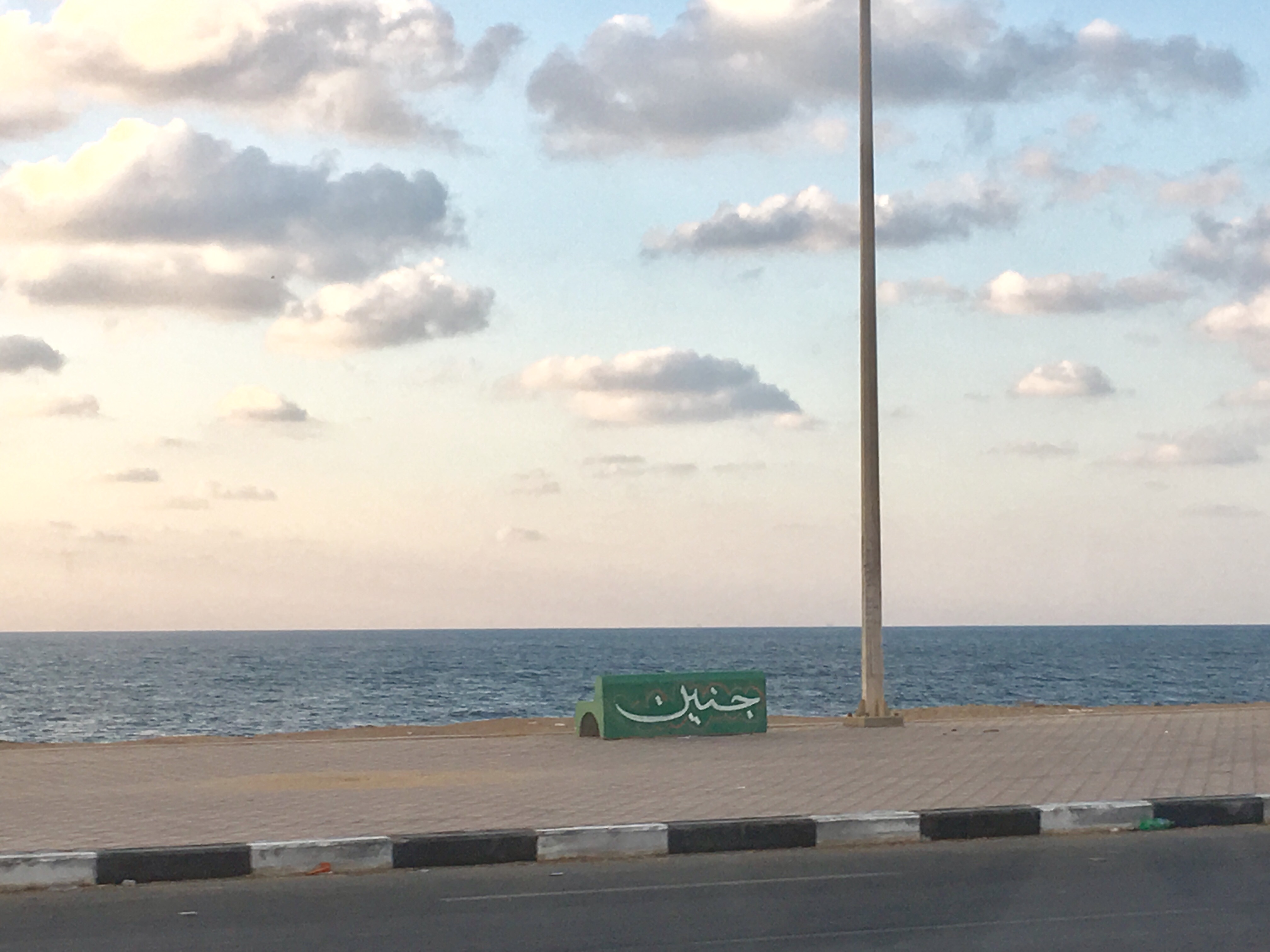
As in other parts of Palestine, the memory of home and the desire for return are a palpable part of Gazan culture. I experienced this in a simple yet powerful way during my visit there. One afternoon, while we were traveling north along the coast from Rafah to Gaza City, I noticed a series of colorful concrete benches along the beachfront. My colleague Ali explained that each one bore the name of a Palestinian city or town where Gazans lived prior to 1948. 

It’s not difficult to grasp the sacred significance of these simple seaside benches to the refugees of Gaza. Unlike most memorials, which commemorate what was lost and is never to be found, I’d wager that those who come to these beaches don’t believe their home cities and villages to be lost at all. On the contrary, I believe these benches testify that these places are still very real to them. And to their faith that they will one day return home.

When we consider the narrative of Gaza, I believe we must keep this critical piece of context in mind: long before there was a Hamas, Palestinians in Gaza have been resisting their oppression – and Israel has been retaliating brutally against their resistance. Of course, when we do the moral calculus, we can argue about the strategic sense and morality of the rockets Hamas fires into Israel – as many Palestinians do.  But if we truly seek to understand Gaza’s narrative, we must honestly ask ourselves – what would we ourselves do in their situation?

As I noted earlier, many white Americans are starting to reckon seriously with the colonial narratives instilled about the birth of this country. The narratives of the powerful and the privileged have great power. But when they collide with the narratives of those they’ve disenfranchised, the impact can sometimes create a spark of transformation – it can indeed, lead to the construction of a new and more just narrative. The Black Lives Matter protests that were born last summer are a powerful example of this phenomenon. I think we’ve all been astonished and inspired by a new narrative struggling to be born in this country.

I fervently believe there is a potential for a similar transformation in Israel/Palestine. It will not happen easily, or painlessly, but I do believe it can happen. In a very real sense, it has to happen. 

May we commit ourselves to this transformation – and may it happen soon in our day. 

Christian Zionists Leaving their Legacy on the Way Out

In the waning days of the Trump presidency, it’s become painfully clear that this administration is engaged in a political scorched earth campaign – i.e., doing everything it can to ram through its most harmful policies before Inauguration Day – and to do so in ways that will make them difficult to undo by the incoming Biden administration. Secretary of State Mike Pompeo’s visit to the West Bank yesterday, where he unabashedly unveiled the Trump administration’s “parting gifts to the Israeli right,” is the latest case in point – and a particularly harmful one at that.

Speaking from the illegal West Bank settlement of Psagot, Pompeo announced two new policies. The first was the State Department’s designation of products made in West Bank settlements as being “Made in Israel,” which now paves the way for US approval of Israel’s formal annexation of Area C of the West Bank.

The second gift came with this announcement:

As we have made clear, anti-Zionism is anti-Semitism.  The United States is, therefore, committed to countering the Global BDS Campaign as a manifestation of anti-Semitism.

Pompeo’s statement further directed the Office of the Special Envoy to Monitor and Combat Anti-Semitism “to identify organizations that engage in, or otherwise support, the Global BDS Campaign… to ensure that their funds are not provided directly or indirectly to organizations engaged in anti-Semitic BDS activities.” In a joint statement with Israeli Prime Minister Netanyahu, Pompeo put a finer point on his intentions:

“Look, we want to stand with all other nations that recognize the BDS movement for the cancer that it is. And we’re committed to combating it. Our record speaks for itself. During the Trump administration, America stands with Israel like never before.”

While there is clearly much to parse here, I’d like to unpack Pompeo’s pronouncement that “Anti-Zionism is Anti-Semitism.”

When considering the implications of this new policy, it’s essential to note that Mike Pompeo himself is a fervent Christian Zionist who adheres to an eschatological ideology that seeks a Jewish return to the Holy Land as a precursor to the apocalypse and the Second Coming of the Messiah. Pompeo has in fact, made no secret of his extreme religious beliefs. In 2015, when he was a congressman, he uttered these immortal words from the pulpit of a Kansas church:

We will continue to fight these battles. It is a never-ending struggle. Until that moment … until the Rapture be part of it, be in the fight.

I’ve written a great deal about Christian Zionism and it’s influence within the Trump administration before, so I won’t go into great detail here about this dangers of this extreme religious ideology. For now, I’d just like to contextualize Pompeo’s presumptuous equation of Anti-Zionism = Antisemitism with a few points:

• Zionism does not equal Judaism. In fact, Zionism is not an exclusively Jewish movement. It is rather, a fundamentally interfaith movement “that has informed and propelled Christian Zionists into the very halls of power.”

• There are far more Christian Zionists in the world than Jewish Zionists (or Jews for that matter). There are 9 million members of the organization Christians United for Israel alone. While American Jewish attachment to Israel is declining, Evangelical Christian support is growing significantly.

• Christian Zionism is itself an antisemitic religious ideology that objectifies the Jewish people as pawns in a cosmic drama that seeks to further the coming of the Christian messiah.

• There has always been principled Jewish opposition to Zionism.

• There are increasing numbers of Jews who support BDS as an expression of intrinsically Jewish values.

We should make no mistake: even if they are no longer in the administration, the threat of this Christian extremist movement will remain very real. But as ever, for Palestinians and those of us who stand in solidarity with them, the struggle will continue – no matter who happens to live in the White House.

Interregnum: Sermon for Yom Kippur 5781

photo credit: Getty Images

On Rosh Hashanah I addressed the powerful feeling of uncertainty that pervades our lives and our world at this unprecedented moment. I want to return to this theme for this Yom Kippur – to speak to a parallel level of uncertainty that I know has been weighing deeply on us all. More specifically, I’d like to address the current political moment in our country; one that is more fraught, dangerous – and frankly more terrifying – than any of us have ever seen in our lifetimes. 

I know this isn’t a pleasant topic to talk about. Frankly, this was not a particularly pleasant sermon to write. I know that most of us feel beaten down by political events as they’ve unfolded over the past four years. I know it’s become something of a routine in our social gatherings to set a strict time limit on discussing the latest outrage committed by our President and his administration – or to even declare such talk off limits entirely. And I get this. I know how depleting the past four years have been on our own emotional and psychological well-being. I’m all too familiar with the ways we instinctively compartmentalize the news of the outside world for purposes of self-preservation.

But even so, painful though it may be, I believe we need to talk about it. Our avoidance, while understandable, has come with a cost. On a certain level, I think our denial and incredulity reflect an unwillingness to admit to ourselves that what is happening is really happening. In a very real way, I think this unwillingness has kept us from meeting the challenges of this unprecedented moment.

Jewish tradition teaches us that the ten days between Rosh Hashanah and Yom Kippur is an immensely critical period, spiritually and existentially speaking. It’s said that during the days between these two festivals the gates of heaven are at their widest; the time in which God is most open and receptive to our prayers. It is, if you will, “time out of time:” a liminal, marginal period during which we’re given the unique power to change the course of our lives and our world. There’s no other time on the Jewish calendar when it feels as if there is so much at stake. 

I’d suggest that politically speaking, we’re in a very similar place. Indeed, there seems to be a kind of synchronicity between the ten days and the current political moment – as if the confluence of this High Holiday season and this particular election season is demanding us to take stock in a deeper and more fundamental way than ever before. And I believe we’d be remiss if we didn’t take this opportunity to step out of time and honestly face up to what is at stake in our country. 

Now that the gates are open, there’s no time for denial. It’s time to say some painful things out loud. It’s time to name the hard fact that we are sliding steadily into an age of authoritarian rule in this country. It has become clearer and clearer with each passing day, even if it’s difficult for us to fully accept. And it’s even harder to contemplate what we must know in our hearts to be true: that if this president gets the opportunity to serve for another four years, authoritarian rule will take hold in our country in ways that will be truly frightening to behold.

From the moment our President first announced his candidacy, there actually were observers who warned us about precisely this. While most of them were dismissed as alarmists, their words now ring with chilling kind of prescience. Here’s one such warning, written by anthropologist and journalist Sarah Kenzidor just two weeks after the 2016 election:

It is increasingly clear, as Donald Trump appoints his cabinet of white supremacists and war mongers, as hate crimes rise, as the institutions that are supposed to protect us cower, as international norms are shattered, that his ascendancy to power is not normal. 

This is an American authoritarian kleptocracy, backed by millionaire white nationalists both in the United States and abroad, meant to strip our country down for parts, often using ethnic violence to do so.

This is not a win for anyone except them. This is a moral loss and a dangerous threat for everyone in the United States, and by extension, everyone abroad. 

I have been studying authoritarian states for over a decade, and I would never exaggerate the severity of this threat. Others who study or who live in authoritarian states have come to the same conclusion as me. 

And the plight is beyond party politics: it is not a matter of having a president-elect whom many dislike, but having a president-elect whose explicit goal is to destroy the nation. 

But for all of these warnings, I think the most compelling words came from the President himself. There are so many examples to choose from; I’ll quote a 2014 interview with Fox News, when he was asked how he would solve the problems with the US economy:

You know what solves it? When the economy crashes, when the country goes to total hell, and everything is a disaster, then you’ll have riots to go back to where we used to be, when we were great.

If we’re going to be completely honest, however, our current moment didn’t begin with the election of this particular President. It has been unfolding over a period of many years: the erosion of our voting rights, the creation of the surveillance state, the incarceration of human bodies for profit, the deporting of our immigrants, the rise of a kleptocratic billionaire class in our country. And it’s not incidental that this gutting of our democracy and civil rights has disproportionately harmed black and brown and poor people in our country. In truth, our descent into authoritarianism has actually been decades in the making. The election of this President has only accelerated the process much faster than any of us dared anticipate.

We should also note that this phenomenon isn’t unique to the United States – it is, in fact, a global reality. It’s no accident that our President routinely praises and curries favor with the strongmen leaders of countries like Russia, North Korea, China, Turkey, Saudi Arabia, and yes, Israel. As American Jews, we should have no illusions about this. 

So here we are. Our President has been systematically dismantling and plundering the institutions of our government in broad daylight and now he’s openly committing election fraud before our very eyes. We know what is happening: his dismantling of the US Postal service, his baseless claims of voter fraud, his clear intention to sow as much chaos as he can to cast doubt on the election. Most recently, he’s been announcing unabashedly that he has no intention to concede this election, no matter what the outcome. 

In American political life, the period between the election on November 3 and the Presidential inauguration on January 20 is called the “interregnum.” This term originally referred to the period between the reign of monarchs. Longer, more complicated interregna have invariably been accompanied by widespread unrest, civil wars and succession battles. Historically, failed states would often fail during an interregnum.

In the US, we’ve taken for granted that there will be an orderly transition of power from one to the other whenever we elect a new President – but I wonder if we’ve ever understood how technically fraught this in-between period really always been. We’re currently on the verge of an interregnum like none other we’ve ever experienced in our lifetimes – and I fear we’re waking up to this reality too late. 

But I also believe there is much we can still do. That we must do.

The medieval Jewish philosopher Moses Maimonides famously interpreted the call of the shofar as a wake-up call. The blast of the shofar, he wrote, is meant to say to us “Sleepers, wake up from your slumber! Examine your ways, return, and remember your Creator!” This new year, I’d suggest that this wake-up call is resonating for us with profound urgency: to awaken from our incredulity, our denial, our comforting belief that “it could never happen here.” 

And it’s also calling us to wake up on a deeper level: to face up to the very real possibility that this President could be staying in the White House for another four years. And while we might say that prospect is too frightening to contemplate, we must contemplate it. No matter how unthinkable, we must accept in our hearts and our guts that God forbid, it might well happen. It’s calling us to accept that if this does happen, it will not be the end. It will mean the onset of a new fight. And we will need to be prepared to fight it. 

So now that I’ve said this out loud, let me say this: we are not there and we don’t have to be there. There is a little over a month until the election – and while we may have been late in our awakening, it is not too late. There is still much we can do, and I know so many of you are doing these things already: registering voters, preparing get out the vote campaigns, fighting against voter suppression on every level. 

Yes, we need to vote. We need to vote because it’s clearly the most potent force we have at our disposal at this particular moment. But at the same time, we cannot view politicians as our saviors. We shouldn’t forget that our current situation was caused in no small part by politicians on both sides of the aisle. Too often we assume that politicians are the only change agents in the world – and that political change only happens on the electoral level. Too often we underestimate the historic role of social movements and the power of people to move politics and politicians. In the end, elections are but one tactic among many. More often than not, voting serves more as a form of harm reduction than a means for progressive change. We are most certainly in one of those moments right now. 

Even if we fight like we’ve never fought before during this election, we can’t be sanguine about the morning after. We must be prepared for the chaos that is sure to follow. Fomenting chaos is one thing this President knows well and it’s clearly his primary strategy in this election. If there was ever any doubt consider this: last June an organization called the “Transition Integrity Project” convened a group of more than 100 bipartisan experts to simulate what might happen the day after Election Day — a kind of electoral “war game.” They simulated four different scenarios, and each one but one – a Democratic landslide victory – indicated significant levels of post-election chaos, with both sides contesting the election until inauguration day. 

What will we do if this happens? In all likelihood, we’ll need to do what citizens of every other authoritarian nation have done when their elections are stolen from them. We’ll have to be prepared to take to the streets and stay in the streets. While this is certainly daunting to contemplate, we would do well to learn from the history of popular protest. We’d also do well to learn from the history that is unfolding as we speak. Indeed, if there’s anything the Black Lives Matter movement has taught us these past several months it’s that sustained popular protest has the very real power to make real change. 

I know that given the pandemic, each of us will clearly need to make our own personal health decisions when we consider participating in any form of mass demonstration. And those who do must certainly be prepared for a violent response that will inevitably follow. Whether it comes from armed forces mobilized by the government, from white supremacist militias, or agent provocateurs, we know what will be coming. Even though the overwhelming majority of the recent racial justice protests have been non-violent, the backlash against them has been brutally violent. The unleashing of state violence against public protest is, of course, a hallmark of authoritarianism, and we’ve witnessed it ourselves throughout our country these past several months. We should have no illusions about this. 

Beyond mass demonstrations, there are other forms of civil disobedience such as general strikes, boycotts and other acts of noncooperation large and small citizens have historically organized in moments such as this. We know that these kinds of tactics have the potential to succeed when carried out with unity, a clear strategy, and widespread participation. If campaigns of mass resistance are indeed mobilized, we’ll all need to be ready to help organize and participate in them, at whatever level is possible for us. 

Whatever comes, the most basic form of resistance will be our readiness to show up for one another. To participate and support mutual aid initiatives in our communities. To learn about and support the areas of greatest need. To stand in particular with those who are most vulnerable, most at risk, those who have always been the first to be impacted by a government that views their lives as disposable. Such is as it’s always been in resistance movements throughout history: in ways large and small everyone has a part to play. There is still a great deal of love and freedom in our world and there is still a myriad of ways we can make a difference. And we must never forget this.

OK. If you haven’t turned off your computer by now, thank you for going to this place with me. I know, as I said earlier, that none of this is easy to hear out loud. This is an enormously frightening moment. Personally, I’m scared shitless. But when I went over the things I felt I should talk about this Yom Kippur, I frankly couldn’t imagine anything more critical to our current moment. And I wouldn’t have said any of this if I felt things were hopeless. As I said on Rosh Hashanah, true hope is in our readiness to act precisely when things feel hopeless. Not to passively hope for the best, but to find courage in each other to fight on, no matter what may happen. 

At sundown tonight, they say, this sacred interregnum of the ten days will conclude – and soon enough, another will begin. But this time, it seems to me, we won’t passively ask to be saved. No, this time we’ll have to demand that the gates open and remain open. We’ll need to take responsibility for writing our own names and the names of our neighbors in the Book of Life. If we’re going to be sealed for life, it is we who must affix that seal.

And so, in that spirit I’d like to end now with a prayer I wrote a few years ago. We’ll be saying it at the end of Yom Kippur, at our Neilah service later tonight. But I’d like to offer it now as a prayer for our upcoming interregnum – with the hope it might awaken us all to the possibility of new life in the year to come:

when the final tekiah sounds
anyone still sleeping will have to
rise up and join the strategizers
and schemers the marchers and
rabble rousers to chant that
final neilah prayer ki fana yom
there’s no time left it’s time
to storm the gates.

we’ll blow away the wasted years
the work undone the dreams denied
the lazy thinking and careless complicity
so that we may clearly see the road
leading to a world we always
knew was possible.

yes finally we’ll break the insatiable
unquenchable appetites threatening
to consume everything we’ve ever known
our hunger will turn into desire
our hollow emptiness into wide open spaces
that roll on without end.

when that final tekiah sounds
the barrier walls and security fences
will come crashing down
no one will be forced to wait in line
no one turned away at the border
no unseen hands opening and closing
the gates on a whim.

so let every shofar
send forth one unbroken call
quick while the sun is setting
we’ll gather together and march forward
under cover of darkness
in the halls of the most high
we’ll make sure there’s
room for all.