As if there wasn’t enough drama over the candidacy of Zohran Mamdani in New York City’s mayoral race, last week saw the release of “A Rabbinic Call to Action: Defending the Jewish Future,” a statement from an ad hoc group calling itself “The Jewish Majority,” condemning Mamdani for voicing political convictions that “delegitimize the Jewish community and encourage and exacerbate hostility toward Judaism and Jews.” By the end of the week, the call had garnered over 1,000 signatures from rabbis, cantors and rabbinical students from NYC and around the US.
Notably, the statement only mentions Mamdani once. The rest of the six-paragraph letter is devoted to defending the state of “Israel’s right to exist in peace and security” and promoting Zionism as central to Judaism and Jewish identity. It’s centerpiece is a long and pointed quote from a recent sermon by Rabbi Elliot Cosgrove of Park Avenue Synagogue, in which he warned that Mamdani “poses a danger to the New York Jewish community”:
Zionism, Israel, Jewish self-determination—these are not political preferences or partisan talking points. They are constituent building blocks and inseparable strands of my Jewish identity. To accept me as a Jew but to ask me to check my concern for the people and state of Israel at the door is a nonsensical proposition and an offensive one, no different than asking me to reject God, Torah, mitzvot, or any other pillar of my faith.
Given the timing of the letter, “The Jewish Majority” statement is clearly an effort to stem Mamdani’s surging lead – and his popularity with young leftist Jews in NYC. But on a deeper level, the fundamental goal of the letter is made all-too plain: it seeks to combat the growing “political normalization of anti-Zionism.”
From what I can tell, Mamdani has never explicitly referred to himself as an “anti-Zionist.” What he has said, over and over again in response to the incessant gotcha question “does Israel have the right to exist as a Jewish state?” is that he “believes Israel has the right to exist as a state with equal rights.” Of course, the words “a state with equal rights” is enough to make him an anti-Zionist – because the only way Israel can exist as a Jewish state is by denying equal rights to Palestinians.
For me, this is the real significance of this statement – it shines a hard light on the deep moral hypocrisy of a Jewish communal establishment that is threatened by anti-Zionism: a political position that is rooted in human rights and equal rights for all. Indeed, if you listen to Mamdani’s words carefully, he takes pains to point this out: he refers to Israel’s actions in Gaza as a genocide because he agrees with the opinions of international bodies such as ICJ as well as scores of otherhuman rightsobservers. He openly says he would not welcome Netanyahu in NYC because the ICC has put a warrant out for his arrest as a war criminal.
These are not hateful or inciteful positions. What is remarkable – and galling to the Jewish communal establishment – is that Mamdani is not paying a political price for expressing them. Quite the contrary: he is the one who comes off as eminently principled and reasonable, while apoplectic Jewish leaders are having an increasingly difficult time explaining why a genocidal, apartheid nation-state is a “building block” of their Jewish identity. True to form, this clergy group is simply trotting out familiar talking points, fully expecting their morality and veracity to be self-evident.
Contrary to the claims of the statement’s signers, the increasing normalization of anti-Zionism does not “delegitimize Jewish identity and community.” As the rabbi of an openly anti-Zionist Jewish congregation, I can attest that increasing numbers of Jews are identifying as such out of genuine Jewish conscience: from a deep attachment to Jewish ethical values that mandate the pursuit of justice and hold that all human beings are equally created in the divine image.
Recent surveys certainly bear this out: according to an October 2025 Washington Post poll, of American Jews, 61% believe Israel has committed war crimes and 4 out of 10 say the country is guilty of genocide against the Palestinians, views that would certainly track with an anti-Zionist identity. As Jewish Currents editor-in-chief Arielle Angel has observed, “the catastrophic failure of Zionist Judaism” has marked “an opening for anti-Zionist Jews to step into greater influence, (to) make our case for something new.” By all accounts, the time has come for a Judaism that rejects the fusion of toxic ethno-nationalism with Judaism.
I’m also struck by another note of desperation from this ad-hoc group of Jewish clergy: they purport to speak for the Jewish majority as if that alone confers legitimacy. They of all people should know dissent is a sacred, cherished aspect of Jewish tradition. They of all people should know that in Talmudic debate, both majority and minority views are given equal weight and consideration. They of all people should know of the Torah’s sacred injunction “Do not go after the majority to do evil” (Exodus 23:2). And any student of history, Jewish or not, should know that the majority is not always right, whether it be the majority of Southern Whites who supported slavery and Jim Crow in the US, apartheid in South Africa or the injustices of Zionism today.
The real moral question here, it seems to me, is not “who is in the majority?” but rather “who is on the right side of history?”
Like all of you, I’m sure, I’m still in deep shock and anguish over Donald Trump’s electoral victory this past Tuesday. And while I certainly have my opinions about how this terrifying outcome could have possibly happened, I’m going to resist the urge to engage in post-election punditry. There’s more than enough to go around right now, some of it interesting, some of it clarifying, but to my mind, much of it tone-deaf and destructive. There will be time for the analysis, the interrogating and the strategizing. For now, however, I think it is critical that we sit with what has happened and give ourselves space to grieve and respond emotionally to the enormity of what has just occurred.
Of course, none of this happened overnight. Well before last Tuesday, were all too aware of the growth of fascism in the US and around the world, the scourge of state violence and mass incarceration, the loss of reproductive freedoms, the genocide against Palestinians, political targeting of immigrants, LGBTQ+ people, Muslims, disabled people, and other vulnerable minorities. After Tuesday, however, the stakes of these threats have reached a terrifying new level. Yes, what happened this week was shocking and heartbreaking. But it was also clarifying. We should no longer have any illusions about what we are up against.
I know that many of us who have been on the front line of the resistance to these threats are feeling exhausted and demoralized. Those who are members of targeted groups are understandably feeling a new level of fear for their own well-being. That is why, I believe to the core of my being, that the most important thing that those of us who have been organizing movements for justice can do in this moment is to reaffirm our commitment and care for one another.
In order to do that, we will need to resist the politics of division lest they infect the movements of solidarity we’ve been building so carefully and lovingly. During this past election, there was strong and passionate disagreement on whether a vote for Kamala Harris was a vote for genocide or a vote to hold back a Trump presidency. There were good, principled arguments to be made on both side of that debate. Even so, it was immensely painful to witness what this election did to the Palestine solidarity movement. Those who chose to vote for Harris were accused of “supporting genocide.” Those who chose withhold their vote for Harris were accused of being “MAGA enablers.” Our movement was faced with a profoundly untenable choice. There were times I feared it would rip us apart.
But after last Tuesday’s election, none of this really matters anymore. We simply cannot afford to turn on each other. Not now. We need each other more than ever.
I don’t yet know what kind of political strategies we will need to employ to resist the fascist reality posed by the MAGA movement – but I do know that whatever happens, we will need to show up for one another now more than ever. We will need to protect and defend one another. We will need to be clearer than ever about the values we hold sacred and be prepared to ground everything we do in the conviction that every single human life is of infinite worth – and is worth fighting for.
We will need to be clear-eyed about the challenges ahead and stand together to face them. For those of us in the Jewish community, that means lifting up solidarity as our most central sacred imperative. All the rest is mere commentary. As I said this past Yom Kippur:
In the 21st century, I believe this is the sacred calculus the Jewish people have to offer the world: Creation + Exodus = Solidarity. More than ever, the Jewish communities we create simply must value solidarity as our most sacrosanct mitzvah. In an age in which we are witnessing the increased scapegoating, yes of Jews, but also of Muslims, LGBTQ+ people, people of color, disabled people, immigrants, indigenous people and so many others, our sacred tradition must promote collective liberation first and foremost.
The predominant theme in this week’s Torah portion, Lech Lecha, is the act of going forth into the unknown with nothing but a promise of blessing and liberation. But unlike the literal meaning of the words in our portion, we must affirm that this liberation cannot be for one privileged group of people alone. We must affirm a Lech Lecha of collective liberation, where all people are God’s people and all people are chosen and the boundaries of the Promised Land extend to include all who dwell on earth.
In this moment, like Abraham and Sarah, we are all being called into a land we do not yet know. But as we read in our portion, it is a collective going-forth – for the sake of both the living and future generations.
Yes, in this current moment, there is much we do not yet know. But we do know that we will have the hearts and minds to resist what is to come. That there is still a world worth fighting for. And that the way to that world is through our solidarity and care for one another.
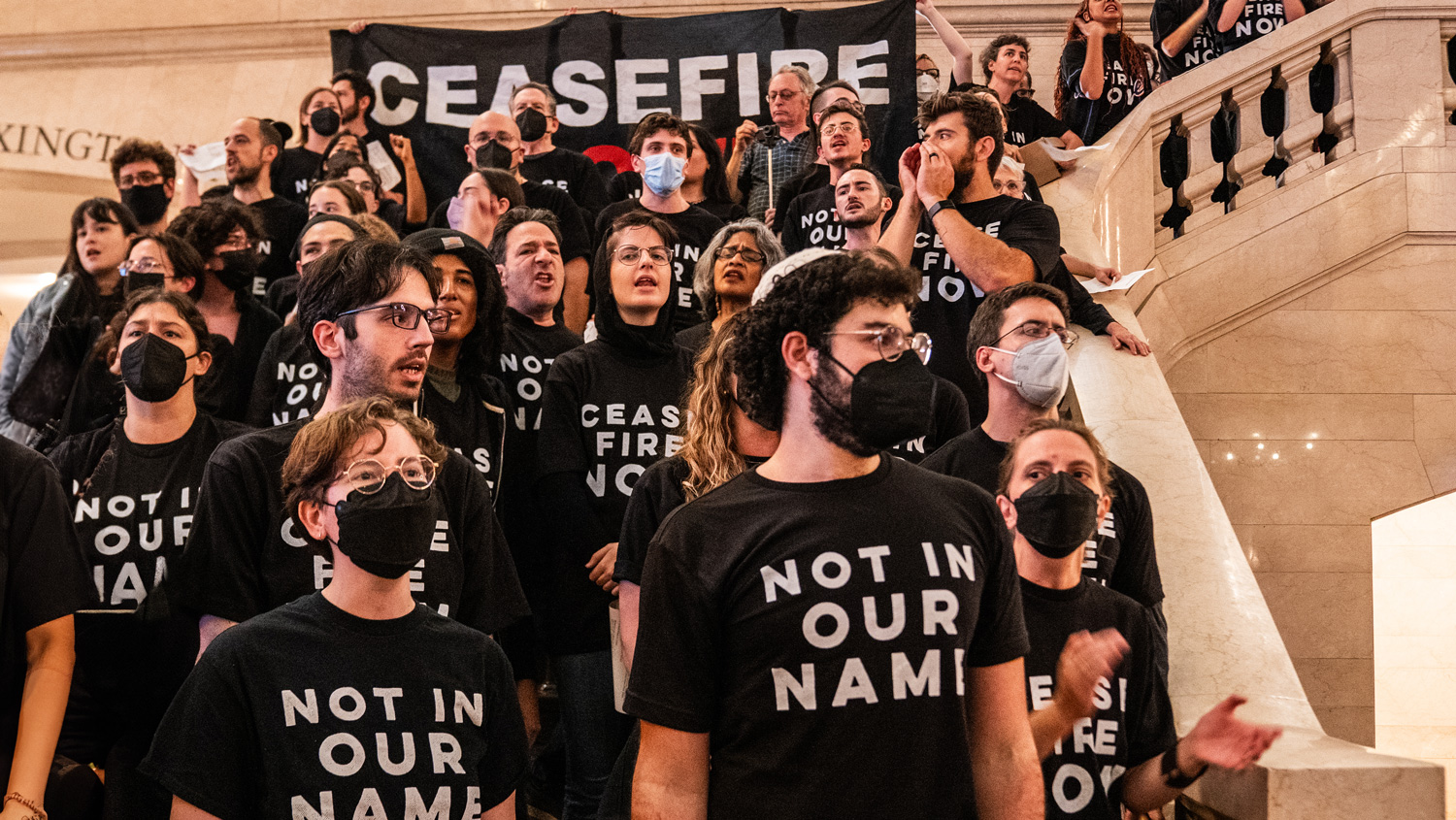
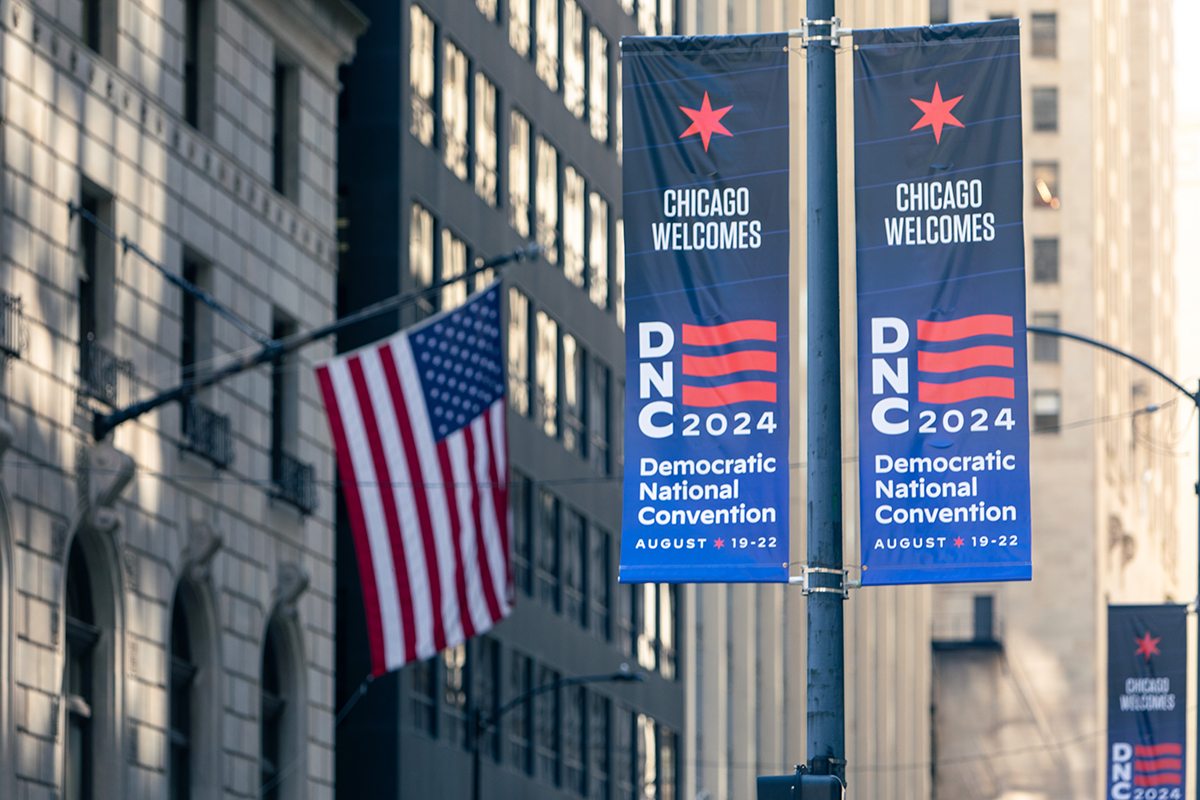
As I’ve written previously, a large coalition of leftist groups has been preparing to take to the streets when the Democratic National Convention comes to Chicago next week. Although there will be a variety of different demands leveled at the DNC during the course of the convention, one key issue clearly stands out as a central common thread through them all – namely, an immediate US arms embargo and a permanent ceasefire to end Israel’s genocide in Gaza.
To name but one example: a rally and march for reproductive justice (of which my congregation, Tzedek Chicago, is a co-sponsor) will take place this Sunday, on the eve of the convention. As “Bodies Outside of Unjust Laws” organizers have made clear, however, the demands of this protest are not limited to issues of domestic reproductive justice alone:
Reproductive justice inherently includes ending the reproductive genocide in Palestine. As U.S. citizens, it is our duty to call on our own government to end the funding of weapons to Israel that enable this nightmare to continue and robs us of funds at home. As feminists and reproductive justice activists, we must also highlight a horrific aspect of the war on Palestinians: it is a war against women and children, who suffer in uniquely cruel ways.
Likewise, the Coalition to March on the DNC, a group of over 200 national and local organizations is calling for an “End to US Aid to Israel” along with demands on immigrant justice, police crimes, healthcare, housing and the environment. Here again, justice for Palestinians is not viewed in isolation from other issues. As protest organizers correctly understand, these issues are irrevocably interlinked and intertwined.
During the course of this election cycle, those of us who have been demanding an arms embargo and ceasefire in Gaza have become all too familiar with one recurrent criticism in particular: that we are “one issue voters.” I find this to be a dangerous attitude for a number of reasons. More than anything, it’s an egregiously dismissive stand to take in an age of genocide, smacking of “it’s not my problem” American isolationism during the 1940s. For the Palestinian people, of course, Israel’s genocide in Gaza is not simply one issue – it’s the issue.
Witness, for instance, the news from this past weekend:
Officials in Gaza say more than 100 people were killed Saturday in an Israeli attack on a school and mosque where thousands of displaced Palestinians had sought shelter. The attack on the al-Tabin school in Gaza City was one of the deadliest individual attacks since Israel’s war on Gaza began over 10 months ago. Rescue workers said they did not find a “single full body” among the deceased — just body parts often destroyed beyond recognition. Survivors said Israel attacked the school during morning prayers…
CNN has confirmed a US-made GBU-39 small diameter bomb was used in the Israeli strike on the school. The attack came two days after the Biden administration notified Congress that it was preparing to provide Israel with an additional $3.5 billion to spend on US weapons and military equipment. Congress had approved the money as part of a $14 billion package for Israel in April. Zeteo reports part of the new US package includes a direct sale of 6,500 joint direct action munitions to Israel.
First and foremost, the genocide in Gaza is a crime against humanity that should concern us all. But as citizens of the nation that is funding and abetting this genocide, we Americans cannot look away from the blood that is surely on our collective hands. Nor can we ignore the shock waves that resonate far outside the borders of Palestine/Israel: the threat of an all-out regional war, the profits enjoyed by the arms and surveillance industry at taxpayer expense, the devastating environmental impact – the list goes on and on. Palestinian human rights lawyer and activist Noura Erakat put it perfectly on Twitter/X recently: “PSA: ending a genocide is not ‘a single issue’ it is an entire universe of issues.”
Another refrain I’ve been hearing repeatedly is the critique that protesting at the DNC “will only help Trump.” Harris herself leveled this argument at a campaign rally in Detroit when she sternly admonished pro-Palestinian protesters: “If you want Donald Trump to win, then say that. Otherwise, I’m speaking.” To be sure, it was an astonishingly tone-deaf and dismissive response to make in Michigan, the very birthplace of the Uncommitted Campaign. But on a more fundamental level, Harris’s response denied the very real impact of her own administration’s policies. As one of the protesters later put it, “When people are demanding a ceasefire and arms embargo and an end to the genocide and you say that we want Donald Trump to step in—it just shows a lack of accountability. It shows a lack of leadership, a lack of responsibility and a lack of ownership.”
In essence, Harris’s comment was just the latest version of the “shut up and vote” message that the Democratic party routinely sends progressives during every election cycle. In an age of US-supported genocide, however, the cynical emptiness of this message has become patently, painfully obvious. As journalist Masha Gessen has rightly pointed out. “These voters are not choosingbetween Harris and Trump. They are choosing between their sense of themselves as moral beings if they vote for Harris and their sense of themselves if they vote for a third-party candidate or for no one at all.”
Of course those who will be protesting at the DNC next week do not want to see Trump elected in November. But even from a purely strategic point of view, what has a better chance of helping the Democrats fortunes in November? We know that a strong majority of American voters across the political spectrum support a permanent ceasefire in Gaza. What would be the more winning strategy: telling those who want to end a genocide to shut up, or exert real leadership that will bring about a ceasefire and an end to the threat of a devastating regional war?
While party conventions function largely as candidate-coronations, they still function as places where parties express their collective vision and finalize their political platforms. On this score, I’m not at all optimistic that an arms embargo to Israel and a permanent ceasefire will find any purchase at the DNC. There are a mere 30 Uncommitted delegates out of 4,600 – and while they are pushing for a voice at the convention (they’ve asked that Dr. Tanya Haj-Hassan, a pediatric intensive care doctor who has volunteered in Gaza, speak from the convention floor), they have still not been offered a slot. Harris’s national security advisor has also made it clear that she opposes an arms embargo to Israel. By every indication, it certainly feels like “shut up and vote” will be the dominant Democratic party message coming out of the convention next week.
I have enormous respect for the Uncommitted delegates who will engage within the convention, particularly co-founder Layla Elabed, who has said even if they are not given a speaking slot, delegates will make their presence known with “news conferences, candle light vigils, tables to distribute literature and, they hope, guest testimonies about life in war-torn Gaza.” When it comes to political advocacy, however, there is always an inside game and an outside game. That’s why those of us who are not delegates will (quite appropriately) be making our presence known outside the walls of the convention hall as well.
Protest organizers have no illusions about the overwhelming militarized presence that will greet us when we gather next week. Federal authorities have divided the area surrounding the United Center, where the main speaking events of the convention will take place, into “soft” and “hard” zones – the latter being off limits to cars and non-credentialled delegates. But even in the soft zones, movement has been heavily restricted. The main protests have been given approved routes far from the convention site, and at one point goes through narrow residential side streets, that will be completely inadequate to handle thousands of protesters. While organizers have appealed the march route, as of this writing there has been no response from the city of Chicago.
When we talk about the potential for police violence next week, of course, the specter of the 1968 Democratic convention in Chicago looms very large. A great deal of ink has been spilled analyzing the differences and similarities between Chicago 1968 and Chicago 2024 – and while I’m loath to venture too far into this rabbit hole, there is one point of commonality I believe bears noting. In general, the mythos around the 1968 DNC protests tend to lay the blame for the Democrats’ defeat on the protest movement that “divided the party.” Often lost in this discussion is the fact that in 1968, those protests were directed toward a political party that had been prosecuting an increasingly unpopular war in Vietnam. Today, as then, I find it deeply misguided to blame protesters and not the immoral policies of the Democratic party itself.
While it’s not particularly helpful to use Chicago 1968 to heighten hysteria over the DNC, protestors are certainly justified in being vigilant over the very real possibility of police violence. I’m not the only one who finds it ominous that the city is doubling down on armed presence in the city. In advance of the convention, the Secret Service agent in charge of “security” has commented that “Chicago has a proven track record when it comes to putting on huge events” – citing the city’s response to Lollapalooza, the NASCAR Chicago Street Race and the Chicago Air & Water Show – as if the DNC is just another tourist event to showcase to the public.
No, we cannot deny of the very real moral and political reality that will be at stake in Chicago next week. We cannot deny that state violence directed against Palestinians is one and the same with so many other forms of state violence that are routinely normalized as “necessary.” And we must resist the call to dismiss any form of systemic violence as just “one issue.” As my friend and comrade, organizer Kelly Hayes has so wisely written:
We have to recognize victims of police brutality, Palestinians, our disabled and unhoused neighbors, and so many others who are subject to forgetting as worthy of grief, outrage and action. Everyday people who are fleeing violence, hunger, and militarism, everyday people whose cites are running out of water or are in danger of disappearing beneath rising flood waters, everyday people who are dying right now because they lack air conditioning amid heat waves – these are the people whose plights and fates should shape our politics. If we are going to fight for any semblance of human decency, we need to reclaim and reassert the value of our lives.
By all accounts, the Democratic Party is closing ranks at lighting speed. As of this writing, Vice-President Harris now has more than enough delegates to clinch the party’s nomination, with a virtual roll-call planned prior to the convention in Chicago next month. The endorsements from powerful Dems continue to roll in, including from virtually all of those who might be considered viable as her potential opponents. Just two days after Biden’s withdrawal from the race, her coronation as the Democrats’ candidate is now all but assured.
I fully understand the euphoria of this moment. With Biden as the Democratic candidate, the prospect of another Trump presidency was becoming more terrifyingly real by the day. But make no mistake, Biden’s downfall was not the product of one horrible debate. On this point, I am in total agreement with Palestinian-American community organizer Linda Sarsour, who recently posted on her Facebook page:
They will never admit this but Joe Biden became a political liability for the Democratic Party on Gaza. Period. The media won’t say this. The pundits will talk around it and the party will say it’s not the case as not to offend their pro-Israel donors – but they knew that they could not win states like Michigan, Georgia, Wisconsin and they had lost big chunks of important constituencies like young people, Arab and Muslim voters, and many progressives. The fact that anyone thinks we are going to believe that one dismal debate performance was the reason they pushed Biden out is just ludicrous.
Absolutely. While the doubts over his age may have motivated his donors to abandon him in the end, Biden was fatally weakened as a candidate by his unabashed support for Israeli genocide – and the solidarity movement that held him to account. As was reported as far back as January, “It’s not just the major prime-time rallies that are now attracting the anti-Gaza war crowd’s wrath. Everywhere Biden goes he is being dogged, whether it is outside the church he attends near his home in Delaware or along the route of his presidential motorcade.”
Many are noting that Harris has been marginally better on the issue of Palestine/Israel than Biden. Last December, it was reported that she was pushing the Biden administration to “to show more concern publicly for the humanitarian damage in Gaza.” During a speech in Selma last March she called for a temporary ceasefire, adding that “too many innocent Palestinians have been killed.” In the same speech, she spoke empathetically about Gazans seeking aid who “were met with gunfire and chaos.”
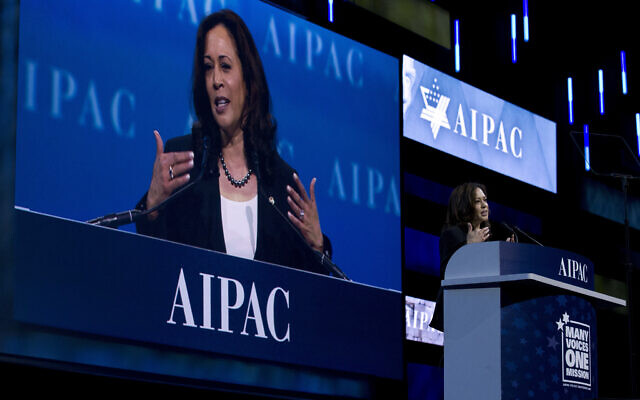
At the same time, we should have no illusions about Harris’ record of unconditional support for Israel. During a speech at the 2017 AIPAC conference, she offered the requisite oath of fealty, ““Let me be clear about what I believe. I stand with Israel because of our shared values, which are so fundamental to the founding of both our nations.” And during her 2019 Presidential campaign, she was praised by the lobbying group Democratic Majority for Israel for running to the right of Obama on the Iran deal. Indeed, despite her softer tone, Harris has been in lockstep with the Biden administration – indeed with, the entire Democratic Party leadership – on this issue.
For the past several months I’ve been actively involved in the Palestine solidarity movement holding the Biden administration to account for enabling and support Israel’s genocidal violence in Gaza. Along with scores of others, I’ve made plans to participate in the protests planned at the Democratic National Convention next month. Even with Kamala Harris now leading the ticket, I have no intention of changing those plans.
Those of us who are part of this movement have not forgotten the essential reason for our organizing: we are living in a time of genocide – one that is being aided and abetted by a Democratic government. Whether it is Biden or Harris at the top of the ticket, nothing has changed in this regard. Moreover, conventions are the place where party policy and platforms are decided. Those of us who have been holding our government to account all year have a solemn responsibility to continue to do so: to demand that the governing party enact an arms embargo on the Israeli government and to establish a foreign policy centered in human rights.
Though news of Gaza has been swept off the front pages, Israel’s carnage against the Palestinian people has continued with impunity. It was reported today that “at least 84 Palestinians were killed over the past day in (Khan Yunis), with more than 300 others wounded. Medical staff at the Nasser Medical Complex report they are completely overwhelmed and have been forced to treat patients on hospital floors.” Yesterday, the World Health Organization revealed there is now a high risk of the polio virus spreading across Gaza – and beyond its borders – due to the dire health and sanitation situation there. The Israeli military has just announced that it will start offering the polio vaccine to its soldiers though there are not enough vaccines – or the distribution capacity – to reach the 2.2 million Palestinians in Gaza.
In other words, now is not the time to let up. In the words of Linda Sarsour, “no matter what, our work doesn’t change.” Or as Waleed Shahid of the Uncommitted Movement has correctly said:
We are making clear that we think that Biden and the White House’s disastrous policy on Gaza makes it harder for them to defeat Trump. In fact, having a campaign based on democracy, having a campaign fighting far-right authoritarianism, while sending bombs to one of the world’s biggest far-right authoritarians in Netanyahu, who is now visiting Washington, DC, makes a mockery of that party’s claim to be fighting on the right side of history, fighting on the behalf of democracy. And we want to see that party change course.
That’s why, no matter who is heading the ticket, I plan to be on the front lines with my friends and comrades when the DNC comes to town next month.
On Rosh Hashanah I addressed the powerful feeling of uncertainty that pervades our lives and our world at this unprecedented moment. I want to return to this theme for this Yom Kippur – to speak to a parallel level of uncertainty that I know has been weighing deeply on us all. More specifically, I’d like to address the current political moment in our country; one that is more fraught, dangerous – and frankly more terrifying – than any of us have ever seen in our lifetimes.
I know this isn’t a pleasant topic to talk about. Frankly, this was not a particularly pleasant sermon to write. I know that most of us feel beaten down by political events as they’ve unfolded over the past four years. I know it’s become something of a routine in our social gatherings to set a strict time limit on discussing the latest outrage committed by our President and his administration – or to even declare such talk off limits entirely. And I get this. I know how depleting the past four years have been on our own emotional and psychological well-being. I’m all too familiar with the ways we instinctively compartmentalize the news of the outside world for purposes of self-preservation.
But even so, painful though it may be, I believe we need to talk about it. Our avoidance, while understandable, has come with a cost. On a certain level, I think our denial and incredulity reflect an unwillingness to admit to ourselves that what is happening is really happening. In a very real way, I think this unwillingness has kept us from meeting the challenges of this unprecedented moment.
Jewish tradition teaches us that the ten days between Rosh Hashanah and Yom Kippur is an immensely critical period, spiritually and existentially speaking. It’s said that during the days between these two festivals the gates of heaven are at their widest; the time in which God is most open and receptive to our prayers. It is, if you will, “time out of time:” a liminal, marginal period during which we’re given the unique power to change the course of our lives and our world. There’s no other time on the Jewish calendar when it feels as if there is so much at stake.
I’d suggest that politically speaking, we’re in a very similar place. Indeed, there seems to be a kind of synchronicity between the ten days and the current political moment – as if the confluence of this High Holiday season and this particular election season is demanding us to take stock in a deeper and more fundamental way than ever before. And I believe we’d be remiss if we didn’t take this opportunity to step out of time and honestly face up to what is at stake in our country.
Now that the gates are open, there’s no time for denial. It’s time to say some painful things out loud. It’s time to name the hard fact that we are sliding steadily into an age of authoritarian rule in this country. It has become clearer and clearer with each passing day, even if it’s difficult for us to fully accept. And it’s even harder to contemplate what we must know in our hearts to be true: that if this president gets the opportunity to serve for another four years, authoritarian rule will take hold in our country in ways that will be truly frightening to behold.
From the moment our President first announced his candidacy, there actually were observers who warned us about precisely this. While most of them were dismissed as alarmists, their words now ring with chilling kind of prescience. Here’s one such warning, written by anthropologist and journalist Sarah Kenzidor just two weeks after the 2016 election:
It is increasingly clear, as Donald Trump appoints his cabinet of white supremacists and war mongers, as hate crimes rise, as the institutions that are supposed to protect us cower, as international norms are shattered, that his ascendancy to power is not normal.
This is an American authoritarian kleptocracy, backed by millionaire white nationalists both in the United States and abroad, meant to strip our country down for parts, often using ethnic violence to do so.
This is not a win for anyone except them. This is a moral loss and a dangerous threat for everyone in the United States, and by extension, everyone abroad.
I have been studying authoritarian states for over a decade, and I would never exaggerate the severity of this threat. Others who study or who live in authoritarian states have come to the same conclusion as me.
And the plight is beyond party politics: it is not a matter of having a president-elect whom many dislike, but having a president-elect whose explicit goal is to destroy the nation.
But for all of these warnings, I think the most compelling words came from the President himself. There are so many examples to choose from; I’ll quote a 2014 interview with Fox News, when he was asked how he would solve the problems with the US economy:
You know what solves it? When the economy crashes, when the country goes to total hell, and everything is a disaster, then you’ll have riots to go back to where we used to be, when we were great.
If we’re going to be completely honest, however, our current moment didn’t begin with the election of this particular President. It has been unfolding over a period of many years: the erosion of our voting rights, the creation of the surveillance state, the incarceration of human bodies for profit, the deporting of our immigrants, the rise of a kleptocratic billionaire class in our country. And it’s not incidental that this gutting of our democracy and civil rights has disproportionately harmed black and brown and poor people in our country. In truth, our descent into authoritarianism has actually been decades in the making. The election of this President has only accelerated the process much faster than any of us dared anticipate.
We should also note that this phenomenon isn’t unique to the United States – it is, in fact, a global reality. It’s no accident that our President routinely praises and curries favor with the strongmen leaders of countries like Russia, North Korea, China, Turkey, Saudi Arabia, and yes, Israel. As American Jews, we should have no illusions about this.
So here we are. Our President has been systematically dismantling and plundering the institutions of our government in broad daylight and now he’s openly committing election fraud before our very eyes. We know what is happening: his dismantling of the US Postal service, his baseless claims of voter fraud, his clear intention to sow as much chaos as he can to cast doubt on the election. Most recently, he’s been announcing unabashedly that he has no intention to concede this election, no matter what the outcome.
In American political life, the period between the election on November 3 and the Presidential inauguration on January 20 is called the “interregnum.” This term originally referred to the period between the reign of monarchs. Longer, more complicated interregna have invariably been accompanied by widespread unrest, civil wars and succession battles. Historically, failed states would often fail during an interregnum.
In the US, we’ve taken for granted that there will be an orderly transition of power from one to the other whenever we elect a new President – but I wonder if we’ve ever understood how technically fraught this in-between period really always been. We’re currently on the verge of an interregnum like none other we’ve ever experienced in our lifetimes – and I fear we’re waking up to this reality too late.
But I also believe there is much we can still do. That we must do.
The medieval Jewish philosopher Moses Maimonides famously interpreted the call of the shofar as a wake-up call. The blast of the shofar, he wrote, is meant to say to us “Sleepers, wake up from your slumber! Examine your ways, return, and remember your Creator!” This new year, I’d suggest that this wake-up call is resonating for us with profound urgency: to awaken from our incredulity, our denial, our comforting belief that “it could never happen here.”
And it’s also calling us to wake up on a deeper level: to face up to the very real possibility that this President could be staying in the White House for another four years. And while we might say that prospect is too frightening to contemplate, we must contemplate it. No matter how unthinkable, we must accept in our hearts and our guts that God forbid, it might well happen. It’s calling us to accept that if this does happen, it will not be the end. It will mean the onset of a new fight. And we will need to be prepared to fight it.
So now that I’ve said this out loud, let me say this: we are not there and we don’t have to be there. There is a little over a month until the election – and while we may have been late in our awakening, it is not too late. There is still much we can do, and I know so many of you are doing these things already: registering voters, preparing get out the vote campaigns, fighting against voter suppression on every level.
Yes, we need to vote. We need to vote because it’s clearly the most potent force we have at our disposal at this particular moment. But at the same time, we cannot view politicians as our saviors. We shouldn’t forget that our current situation was caused in no small part by politicians on both sides of the aisle. Too often we assume that politicians are the only change agents in the world – and that political change only happens on the electoral level. Too often we underestimate the historic role of social movements and the power of people to move politics and politicians. In the end, elections are but one tactic among many. More often than not, voting serves more as a form of harm reduction than a means for progressive change. We are most certainly in one of those moments right now.
Even if we fight like we’ve never fought before during this election, we can’t be sanguine about the morning after. We must be prepared for the chaos that is sure to follow. Fomenting chaos is one thing this President knows well and it’s clearly his primary strategy in this election. If there was ever any doubt consider this: last June an organization called the “Transition Integrity Project” convened a group of more than 100 bipartisan experts to simulate what might happen the day after Election Day — a kind of electoral “war game.” They simulated four different scenarios, and each one but one – a Democratic landslide victory – indicated significant levels of post-election chaos, with both sides contesting the election until inauguration day.
What will we do if this happens? In all likelihood, we’ll need to do what citizens of every other authoritarian nation have done when their elections are stolen from them. We’ll have to be prepared to take to the streets and stay in the streets. While this is certainly daunting to contemplate, we would do well to learn from the history of popular protest. We’d also do well to learn from the history that is unfolding as we speak. Indeed, if there’s anything the Black Lives Matter movement has taught us these past several months it’s that sustained popular protest has the very real power to make real change.
I know that given the pandemic, each of us will clearly need to make our own personal health decisions when we consider participating in any form of mass demonstration. And those who do must certainly be prepared for a violent response that will inevitably follow. Whether it comes from armed forces mobilized by the government, from white supremacist militias, or agent provocateurs, we know what will be coming. Even though the overwhelming majority of the recent racial justice protests have been non-violent, the backlash against them has been brutally violent. The unleashing of state violence against public protest is, of course, a hallmark of authoritarianism, and we’ve witnessed it ourselves throughout our country these past several months. We should have no illusions about this.
Beyond mass demonstrations, there are other forms of civil disobedience such as general strikes, boycotts and other acts of noncooperation large and small citizens have historically organized in moments such as this. We know that these kinds of tactics have the potential to succeed when carried out with unity, a clear strategy, and widespread participation. If campaigns of mass resistance are indeed mobilized, we’ll all need to be ready to help organize and participate in them, at whatever level is possible for us.
Whatever comes, the most basic form of resistance will be our readiness to show up for one another. To participate and support mutual aid initiatives in our communities. To learn about and support the areas of greatest need. To stand in particular with those who are most vulnerable, most at risk, those who have always been the first to be impacted by a government that views their lives as disposable. Such is as it’s always been in resistance movements throughout history: in ways large and small everyone has a part to play. There is still a great deal of love and freedom in our world and there is still a myriad of ways we can make a difference. And we must never forget this.
OK. If you haven’t turned off your computer by now, thank you for going to this place with me. I know, as I said earlier, that none of this is easy to hear out loud. This is an enormously frightening moment. Personally, I’m scared shitless. But when I went over the things I felt I should talk about this Yom Kippur, I frankly couldn’t imagine anything more critical to our current moment. And I wouldn’t have said any of this if I felt things were hopeless. As I said on Rosh Hashanah, true hope is in our readiness to act precisely when things feel hopeless. Not to passively hope for the best, but to find courage in each other to fight on, no matter what may happen.
At sundown tonight, they say, this sacred interregnum of the ten days will conclude – and soon enough, another will begin. But this time, it seems to me, we won’t passively ask to be saved. No, this time we’ll have to demand that the gates open and remain open. We’ll need to take responsibility for writing our own names and the names of our neighbors in the Book of Life. If we’re going to be sealed for life, it is we who must affix that seal.
And so, in that spirit I’d like to end now with a prayer I wrote a few years ago. We’ll be saying it at the end of Yom Kippur, at our Neilah service later tonight. But I’d like to offer it now as a prayer for our upcoming interregnum – with the hope it might awaken us all to the possibility of new life in the year to come:
when the final tekiah sounds anyone still sleeping will have to rise up and join the strategizers and schemers the marchers and rabble rousers to chant that final neilah prayer ki fana yom there’s no time left it’s time to storm the gates.
we’ll blow away the wasted years the work undone the dreams denied the lazy thinking and careless complicity so that we may clearly see the road leading to a world we always knew was possible.
yes finally we’ll break the insatiable unquenchable appetites threatening to consume everything we’ve ever known our hunger will turn into desire our hollow emptiness into wide open spaces that roll on without end.
when that final tekiah sounds the barrier walls and security fences will come crashing down no one will be forced to wait in line no one turned away at the border no unseen hands opening and closing the gates on a whim.
so let every shofar send forth one unbroken call quick while the sun is setting we’ll gather together and march forward under cover of darkness in the halls of the most high we’ll make sure there’s room for all.
As I was reading the various analyses of the Brexit vote yesterday, I remembered an article I had read back in 2011 by the International Affairs scholar, Stephen M. Walt. His basic thesis was that despite all of the new global trends in 21st century, nationalism was still “the most powerful political force in the world.”
Walt concluded:
Unless we fully appreciate the power of nationalism, in short, we are going to get a lot of things wrong about the contemporary political life. It is the most powerful political force in the world, and we ignore it at our peril.
I recall being a bit irritated when I that article. Like many, I believed that the world had certainly learned its lesson from two cataclysmic world wars and that for all the problems that came with globalization, nationalism was a relic of the past.
But I’m convinced now. And at the risk of sounding too apocalyptic about it, I’m wondering if the peril we’ve ignored is now at our door.
It’s hard not to see the increasing national fervor developing all around us. Great Britain has voted to exit the European Union and other member countries are threatening to follow suit. Nationalist parties are making big gains in countries around Western Europe and Vladimir Putin has whipped a strong nationalist fervor in Russia. Many countries throughout Eastern Europe, Southeast Asia and the Far East are led by leaders who use nationalist rhetoric to win elections and promote their domestic policies.
I’ve never been a fan of nationalism. I accept that nation states are part of the social, political and economic fabric of the modern world – but I’ve long believed that the nation-statism too often fuses with tribalism – particularly during time of economic instability. This phenomenon, as we know all too well, has inevitably led the modern world to dark and destructive places.
In his article, Walt suggested that the US isn’t as susceptible to overt nationalism as other other countries:
Because American national identity tends to emphasize the civic dimension (based on supposedly universal principles such as individual liberty) and tends to downplay the historic and cultural elements (though they clearly exist).
Yes they clearly do exist in this country. Even if Trump loses in November – and I do believe he will – the sick nationalist fervor he has unleashed will not vanish overnight. Nor will the nations around the world that are currently increasing xenophobia, racism and fear of the other.
Now more than ever we need to stand down the sorrows of nationalism. I don’t think its too alarmist to suggest that we heed the lessons of the past lest it become an unimaginable future. As journalist Ed Fuller recently wrote in the aptly titled article: “Nationalism: Back Again Like a Bad Dream:”
I can’t help but think about the political excesses of the 1930s, the protectionism and the xenophobic zeal that were all part of the Nationalistic wave that swept the world following the First World War. It ultimately resulted in Japan’s invasion of Manchuria, Nazi Germany’s invasion of Poland and Japan’s bombing of Pearl Harbor, ending with Hiroshima. Something to think about as we grapple with the challenges facing our world today.
By all accounts, Bibi Netanyahu will be the winner of the upcoming elections on January 22 – after which he will proceed to form the most right-wing/ultra-nationalist coalition in Israeli history. The only question that remains is by what degree.
Among new political figures on the scene, Naftali Bennett, the leader of the HaBayit HaYehudi (“Jewish Home”) party seems to be garnering the most attention. Even as Bibi’s Likud-Beiteinu party drops in the polls, HaBayit HaYehudi (a restructured version of the old National Religious Party) is growing in popularity – and will almost certainly become an important player in a new coalition.
If you’ve never heard of Bennett, you will soon. He’s the son of American immigrants, a successful hi-tech businessman, Bibi’s former chief of staff (they’ve since had a high profile falling out) and the former head of the West Bank settlers’ Yesha Council. Bennett raised some major dust last month when he told a television interviewer that he would personally refuse orders to evacuate settlements or outposts in the West Bank while on reserve army duty. He also is on record as advocating the annexation of Area C of the West Bank. Under his plan, Palestinians already living there would be given the choice to accept Israeli citizenship or leave.
While he was roundly criticized from many political quarters for his remarks about army service, his party has become the most popular Israeli party with young Israelis under the age of 30. Clearly, Bennett and his views represent Israel’s future – one that seems to be skewing further and further away from democracy and ever closer to apartheid policies.
Take a look at HaBayit Hayehudi’s English language campaign video ad at the top of this post. As Don Futterman recently observed in Open Zion, it’s a canny attempt to gloss over the more odious aspects of Bennett’s ideology with a legit and cheerful veneer designed specifically to appeal to American immigrants to Israel:
This ad, which is part of a campaign to create different and more positive associations with the name HaBayit HaYehudi (the Jewish Home), is an invitation, not a polemic. It mentions buzzwords—Jewish values and Zionist ideals—and one issue from the party’s platform—Jewish education—but does not harp on any of them. You wouldn’t guess that HaBayit HaYehudi has any connection to the national religious right in Israel, and you might even miss the single reference to West Bank settlements (“I live in Samaria”). You certainly wouldn’t suspect that Bennett has promised he would go to jail rather than evacuate a settlement.
Watching the video, I was also struck that it made repeated references to the importance of Israel’s Jewish character without explicitly explaining why this should in any way be considered a political issue:
If you want to bring Jewish values and Zionist ideals to Israel, then the Bayit Yedudi is your home…If you believe that every Israeli child deserves a quality Jewish education, the Bayit Yehudi is your home.
While on the surface, remarks such as this sound perfectly innocuous, they mask a profoundly troubling agenda. What about the Palestinians citizens of Israel who do not adhere to “Jewish values” or “Zionist ideals?” It’s certainly sounds noble to say that Israeli child deserves a quality Jewish education, but what about the considerable percentage of Israeli children who don’t happen to be Jewish? The answer, of course, is not too difficult to understand. These Israeli citizens simply don’t fit in the xenophobic ideology advocated by Naftali Bennett and HaBayit HaYedudi.
In a recent post for +972 mag, Noam Sheizaf makes a perfectly reasonable argument – but given Israel’s current reality it would likely strike many as radical in the extreme. Pointing out that in 64 years of Israel’s existence, no government has ever included one of the Arab parties in a coalition, Sheizaf concludes:
Cooperation between Palestinian and Jews is by far the greatest, most important challenge in this country. Every element of Israeli life – from the education system to zoning plans – is constructed to promote ethnic separation, with politics being just the tip of the iceberg…Therefore, the ability to create joint structures and partnerships is the single most important element that would determine the chances of survival and the quality of life for the entire society.
The necessary conclusion for me is that it is simply forbidden to vote for parties which are not shared by Palestinians and Jews, or for ones that preserve the policy of separation between Palestinians and Jews. There are no perfect parties, but this should be the basic condition, just as an American shouldn’t vote for a party that doesn’t accept black people.
Alas, voices like Sheizaf’s are but a whisper in the Israeli wilderness. According to the latest polls, Arab-Jewish parties will garner only a small sliver of votes in the upcoming election. When it comes to the Israeli electorate, the ideology of Jewish supremacy is clearly the order of the day.
For comparison purposes, take a look, below, at this campaign video ad for the Da’am Workers Party – one of the few Arab-Jewish parties of which Sheizaf spoke. I’d say their values provide a powerful contrast to ethnic exclusivism of HaBayit Hayehudi:
(This) movement is our hope, everyone’s hope that here will arise, in the State of Israel, for the first time in history a political, social, economic alternative, sane, human, fair, that knows how to be part of the region where it’s located. For 64 years we’ve lived in a ghetto. The time has come to get out of the ghetto! Israel has to stop isolating itself…We say no! We’ll bring down the wall of Occupation, the wall of racism, and the wall of violence. We want to be free in our land indeed, and our land is the entire world, and this world needs one unique answer, it needs a revolution!
Recently read an interesting blog post by Rabbi Rachel Gurevitz of Congregation B’nai Shalom (Reform), in Westborough, MA, in which she expresses her disapproval of clergy who endorse candidates for public office.
Exhibit A: “Rabbis for Obama:”
Over 600 rabbis, from across the Jewish denominations, have signed their names – as individuals – to ‘Rabbis for Obama’ … I will tell you now, my name is not on that list. And, while I see that many of my colleagues who I deeply respect as rabbis, have chosen to add themselves to the list, I am not at all comfortable with it. I see little difference between adding one’s name to a publicly available list of this kind, and endorsing a candidate from the pulpit. And, while I am no constitutional scholar, and am willing to accept the possibility that individual religious leaders may have a constitutional right to something, that doesn’t mean that, as responsible religious leaders and teachers, we should necessarily exercise that right.
I’m not a constitutional scholar either, but I’m fairly certain clergy don’t endanger their 501 c3 status as long as they make it clear in their endorsements that they are speaking as individuals and not on behalf of their congregations. But be that as it may, Gurevitz’s real issue with such endorsements is less legal than philosophical:
Each individual candidate and the parties they represent, hold diverse views on a very wide array of subjects. It is simply not true – it cannot be – that one side is ‘right’ and the other side is ‘wrong’. This is the case whether we are speaking in terms of ethics and morals, or whether we are speaking about issues of social equity and justice. Our political arena has become polarized enough already. We do absolutely no service to this country, to the well-being of our society, or to the legitimacy and value of the religious traditions we serve and represent when we add to that polarization by picking sides.
Rather exacerbate our national polarization, Gurevitz suggests, rabbis should take their cue from Jewish/Talmudic tradition, which values diversity of opinion and debates “for the sake of heaven” – and not, as she puts it, “debates for the sake of winning.”
While I appreciate Rabbi Gurevitz’s desire to mitigate the polarizing discourse in American political culture, I don’t think it’s quite fair of her to assert that rabbinical endorsements automatically translate into (as she puts it), “I’m right and you are wrong, therefore we are good and you are evil, therefore we speak in God’s name and you don’t.”
This is certainly not the message – in content or tone – set by the Rabbis for Obama website, which merely contains a list of rabbis, various links, along with this fairly mild statement:
This group of over 613 rabbis … from across the country and across all Jewish denominations recognize that the President has been and will continue to be an advocate and ally on issues important to the American Jewish community. That is why they are committed to re-electing President Obama and actively doing their part to move our country forward.
That’s a pretty far cry from “We speak in God’s name and you don’t.”
In truth, when I think of rabbis who have publicly endorsed candidates over the years, I’m hard pressed to find many who have done so in an overly polarizing or patronizing manner. In this regard, I still remember well the words of the venerable Reform Rabbi Arnold Jacob Wolf, whose last major public statement was an article for the Jewish Week entitled “My Neighbor Barack” – in which he voiced his support for Obama during the 2008 campaign. (His article was particularly meaningful because it was published during a period in which Obama was under withering attack from certain neo-conservative quarters of the Jewish community.)
On a deeper level, however, I think Gurevitz fundamentally misreads the legacy of rabbinic debate “for the sake of heaven.” While the rabbinic discussions of Talmud do indeed provide a graphic representation of this legacy, I would suggest that our job as rabbis is not to emulate a page of Talmud, but to engage in the debate itself.
There is no question that the issues discussed during election cycles are of profound significance for our national community. None of us can afford to stand aloof from these issues – least of all rabbis. Indeed, by advocating for candidates who support the policies we believe will best serve the common good, we advocate for the sacred values we purport to cherish as religious leaders. If we preach about social issues from the pulpit, why should it be inappropriate for us to endorse the candidates who are directly responsible for enacting the policies related to these issues?
I certainly agree with Gurevitz when she exhorts clergy to must speak out against “the polarizing and vindictive narrative of political debate when we see and hear it.” But I’m not at all convinced we must stand on the sidelines during election season in order to do so.
The Republican Jewish Coalition and the Emergency Committee for Israel this week urged a group of rabbis supporting President Barack Obama’s reelection to purge members of the Jewish Voice for Peace Rabbinical Council from its ranks. The conservative groups claimed they were shocked by the inclusion in the “Rabbis for Obama” list of those whose “values are representative of a small and extreme group of anti-Israel activists.”
We are deeply dismayed by this cynical attempt at political gain through smears, half-truths and innuendos that only serve to create division in the Jewish community.
It is certainly true that many of on the JVP Rabbinical Council are deeply critical of Israeli policy (and the U.S. policy that too often enables it). It is not at all true, however, that such criticisms are “extreme” or marginal. Indeed, increasing numbers of Jews and Jewish leaders are finding the courage to speak out publicly against Israel’s practice of home demolition, forced eviction, settlement expansion and administrative detention, as well as its widespread restriction on Palestinians’ freedom of movement in the West Bank and Gaza.
Jewish Voice for Peace rabbis were not the only ones singled out by RJC and ECI’s smear. William Kristol included members of the J Street Rabbinical Cabinet and Rabbis for Human Rights as well. There are many perspectives within the American rabbinical community about how to create a just and lasting peace between Israelis and Palestinians. At the same time, we share a commitment to open and honest conversation about how a negotiated solution can ensure security and human rights for all.
By a margin of more than 2 to 1, according to the Public Religion Research Institute American Jews say that good diplomacy rather than military strength is the best way to ensure peace (63% vs. 24% respectively).
This reality stands in sharp contrast to the Jewish donors to the Republican party, such as Sheldon Adelson, who has reportedly asked Romney to state publicly that Israeli-Palestinian peace talks are a “waste of time.” Adelson is also pressing Romney for a firmer commitment to move the U.S. Embassy in Israel from Tel Aviv to Jerusalem, in what would be a de facto recognition of Israel’s annexation of East Jerusalem. These views lie far outside what most Americans would tolerate or expect from an American president.
We are saddened, but not surprised, by these smear tactics. They have long been the stock in trade of a Jewish establishment that demands lock-step agreement from Jewish rabbis and leaders – and Jewish neo-conservatives who do not hesitate to use divisive rhetoric and slanderous allegations against their own community members to achieve their political goals.
We are proud of the diversity of the American Jewish community and voice our hope that it will make room for all those who are dedicated to a future of peace, justice and dignity in Israel and Palestine. We are heartened that that by resisting calls to purge individual rabbis from their ranks, the leadership of “Rabbis for Obama” is remaining true to this inclusive vision.
Man, what a difference four years makes. I think I can safely say it will be impossible for me to summon the kind of excitement I expressed in that giddy blog post just four short years ago.
Actually, if truth be told, it was just one year into his presidency when I concluded that Obama, from a foreign policy point of view at least, was essentially Bush 2.0. Now as his first term comes to a close, I’m daring to consider the possibility that he might actually be worse.
I’ve already written a fair amount about my disillusionment on this score – most pointedly in my Yom Kippur serrmon from earlier this year:
For some Americans the most salient lesson of 9/11 was that the world is a dangerous place and we must use military power to mitigate the danger. I include myself among those who learned a very different lesson: 9/11 taught us that when we intervene militarily abroad, we beget blowback here at home.
Many of us had hope that Obama truly believed this as well – that he would turn back the Bush doctrine and steer our nation’s foreign policy toward a saner course. But as it has turned out, the very opposite has happened. He has embroiled us in even more Mideast wars and has deployed even larger numbers of special operations forces to that region. He has also transferred or brokered the sale of substantial quantities of weapons to these countries and has continued to build and expand US military bases at an ever-increasing rate.
He also promised to prosecute the so-called “War on Terror” with greater attention to civil liberties, but that hope has been fairly dashed as well. During his campaign, note what he had to say about this subject:
“As president, I will close Guantanamo, reject the Military Commissions Act, and adhere to the Geneva Conventions. Our Constitution and our Uniform Code of Military Justice provide a framework for dealing with the terrorists. Our Constitution works. We will again set an example for the world that the law is not subject to the whims of stubborn rulers, and that justice is not arbitrary.”
And it’s gotten even worse since then. More recently, we’ve learned that Nobel Peace Prize Laureate Obama has been personally been maintaining a drone “kill list” which, according to the NY Times:
counts all military-age males in a strike zone as combatants … unless there is explicit intelligence posthumously proving them innocent. (Emphasis mine).
Even more recently, the NY Times has revealed that President Obama has been secretly overseeing a massive cyber-war initiative against Iran (known as “Olympic Games”) that, among other things, almost assuredly represents the official kickoff to a global cyber-weapons race. As the article correctly concludes, the blowback to our nation from Obama’s cyber-adventures could potentially be devastating:
(No) country’s infrastructure is more dependent on computer systems, and thus more vulnerable to attack, than that of the United States. It is only a matter of time, most experts believe, before it becomes the target of the same kind of weapon that the Americans have used, secretly, against Iran.
But my disillusionment in the Obama administration is most profound when it comes to its handling Israeli-Palestinian peace process. I’ve written about this issue over and over as well – but if you still need more convincing that this administration has utterly caved to the Israel lobby and has abdicated any semblance of “honest broker” status in this process, it was recently reported that Obama unabashedly assured a group of Jewish orthodox leaders that his administration is “decidedly more attentive to Israel than it is to the Palestinians.”
All this to say that I’m in a very different frame of mind as Obama now runs for reelection. The giddiness has been replaced with a dose of hard, cold realism about the role of the President in the 21st century national security regime:
Again, from my Yom Kippur sermon:
I’m focusing these observations exclusively on our Commander-in-Chief, but of course I realize that this issue is much, much larger than just one man. I know it’s natural to look to our primarily to our President, but in truth what we call “Washington” is really a massive bureaucracy that includes a myriad of interests. It’s a far reaching power elite that includes not only the federal government but the national security state, as well as the intelligence and federal law enforcement communities. It also includes big banks and other financial institutions, defense contractors, major corporations and any number of lawyers, lobbyists former officials, and retired military officers, all of whom hold enormous influence over our foreign policy.
So as we swing into summer and we listen to Obama and Romney trade salvos over foreign policy, don’t be fooled – at the end of the day there is less than an inch of daylight between the two. Mideast analyst Aaron David Miller, in a Foreign Policy post entitled “Barack O’Romney” only half jokingly suggested that if reelected, Obama ought to consider making Mitt Romney his new Secretary of State. Another respected analyst, MJ Rosenberg, has gone as far as to suggest that President Obama would actually be more likely to bomb Iran than a President Romney.
What should we do with all this hard political realism? As for me, I’m taking my cue from the classical Jewish text, Pirke Avot:
Love work. Hate authority. Don’t get too friendly with the government. (1:10)
And for good measure:
Be careful with the government, for they befriend a person only for their own needs. They appear to be friends when it is beneficial to them, but they do not stand by a person at the time of his distress. (2:3)
The events of these last four years have provided a painful education for me. I’ve learned more than ever that it is not politicians who create socio-political change – it is, rather, the people and the movements who make it impossible for them not to.
Yes, there are some important domestic issues at stake in this election (not least of which are potential Supreme Court appointments) but let’s not be fooled into thinking that the future of US foreign policy fundamentally depends on who we choose to be our Commander in Chief.
The real difference will depend on our readiness to hold him accountable once the election is over.

 Shalom Rav