My friend Rabbi Brian Walt is currently living in Jerusalem with his family and will be there for next five months. I strongly encourage you to read his blog posts, in which he powerfully reflects on his experiences and describes the struggle for justice in Israel/Palestine. He just posted a piece on a recent demonstration in Sheikh Jarah; his post on a visit to Hebron last week is breathtaking.
Category Archives: Gaza
On Haiti Remembered and Gaza Forgotten
Two prominent Israeli columnists ask: why are Israelis so eager to pitch in to the rescue effort in Haiti and yet show such little concern over the dire humanitarian crisis they’ve helped to create just a few kilometers away in Gaza?
Akiva Eldar, writing in Ha’aretz
(The) remarkable identification with the victims of the terrible tragedy in distant Haiti only underscores the indifference to the ongoing suffering of the people of Gaza. Only a little more than an hour’s drive from the offices of Israel’s major newspapers, 1.5 million people have been besieged on a desert island for two and a half years. Who cares that 80 percent of the men, women and children living in such proximity to us have fallen under the poverty line? How many Israelis know that half of all Gazans are dependent on charity, that Operation Cast Lead created hundreds of amputees, that raw sewage flows from the streets into the sea?
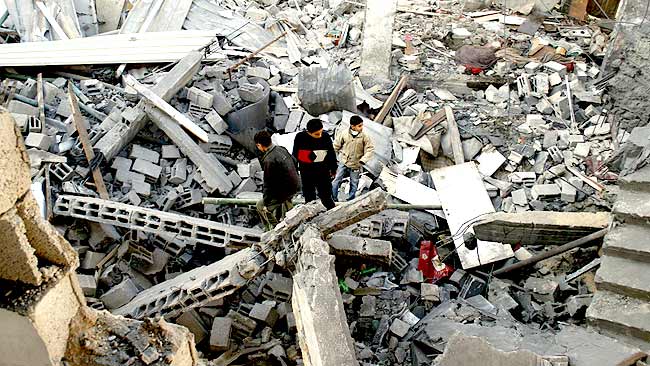
The disaster in Haiti is a natural one; the one in Gaza is the unproud handiwork of man. Our handiwork. The IDF does not send cargo planes stuffed with medicines and medical equipment to Gaza. The missiles that Israel Air Force combat aircraft fired there a year ago hit nearly 60,000 homes and factories, turning 3,500 of them into rubble. Since then, 10,000 people have been living without running water, 40,000 without electricity. Ninety-seven percent of Gaza’s factories are idle due to Israeli government restrictions on the import of raw materials for industry. Soon it will be one year since the international community pledged, at the emergency conference in Sharm el-Sheikh, to donate $4.5 billion for Gaza’s reconstruction. Israel’s ban on bringing in building materials is causing that money to lose its value.
Gershon Baskin, in today’s Jerusalem Post:
Humanitarian disasters around the world bring out the best in Israel and in Israelis. The horrific devastation caused by the earthquake in Haiti and the scenes of unbearable human suffering brought about an immediate enlistment of both civilian and public efforts to come to the aid of the poorest nation in the Western hemisphere…
But what about the humanitarian disaster in our own backyard caused in a large part by our own doing? What about Gaza? More than 1.5 million people are living in total poverty, without sanitary drinking water, under an economic and physical siege, locked in what could easily be called the world’s largest prison. While we ask to see in all of the gory details, all of the destruction including hundreds of corpses on the streets of Port-au-Prince, we wish to see none of the human suffering of our Palestinian neighbors in Gaza where we literally hold the keys to the end of their suffering.
My Favorite Rabbis: Everett Gendler
Most people probably don’t realize this, but rabbis need rabbis too.
And there are a lot of great rabbis out there. Over the years I’ve been personally inspired by many of them: remarkable, talented leaders whose work challenges me, drives me and constantly reminds me why I do what I do. So with this post I’m debuting a new series I’m calling “My Favorite Rabbis:” ongoing profiles of the contemporary rabbis whom I consider to be my own spiritual teachers.
I’ll start by introducing you to Rabbi Everett Gendler, a Conservative rabbi whose moral courage has provided Jewish leadership for some of the most important progressive causes of our day. Today, some fifty years since he became a rabbi, I believe he remains on the cutting edge of the issues that truly matter.
This MLK weekend, it is certainly appropriate to note that Rabbi Gendler was one of the first rabbis to become actively involved in the struggle for civil rights in America and played a critical role in involving American rabbinical leadership in the movement. It’s doubtful that American rabbis would have stepped up to this struggle nearly as much had it not been for Rabbi Gendler’s prophetic influence.
During the early and mid-1960s, Rabbi Gendler led groups of American rabbis to participate in numerous prayer vigils and protests throughout the South. Of course many know that the legendary Rabbi Abraham Joshua Heschel marched with Dr. Martin Luther King in Selma in 1965. I imagine far fewer are aware that it was in fact Rabbi Gendler who persuaded Heschel to do so.
Heschel biographer Edward K. Kaplan writes:
Despite fears for his safety from his wife and the twelve year old Susannah, (Rabbi Heschel) agreed to join the march at the urging of Rabbi Everett Gendler, a pacifist and former student. Gendler had led a group of rabbis to Birmingham, Alabama to work for voting rights and remained in touch with the Reverend Andrew Young, King’s Executive Assistant at the SCLC. (From “Spiritual Radical: Abraham Joshua Heschel in America,” p. 222)
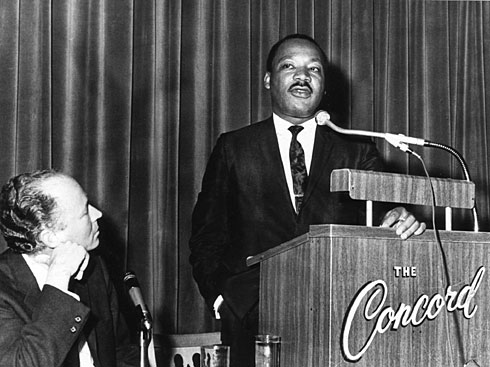
Rabbi Gendler was also instrumental in arranging Martin Luther King’s keynote address at the Rabbinical Assembly’s convention on March 25, 1968. This now-legendary speech took place at the Concord Resort hotel in New York’s Catskill Mountains just 10 days before King’s death. (That’s Rabbi Gendler to the left of Dr. King in the pic above).
Today, decades after King’s death, Rabbi Gendler remains an eloquent Jewish advocate for the path of nonviolence. His work has taken him across the world – most notably to India where he and his wife Mary teach the principles of nonviolence to Tibetan exiles.
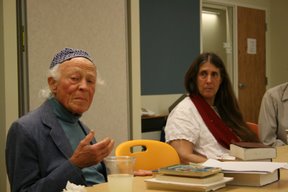
I’m personally honored to serve with Rabbi Gendler on the Elder’s Council of the Shomer Shalom Institute for Jewish Nonviolence. In this picture, he leads a workshop at JRC in 2008. Shomer Shalom founder Rabbi Lynn Gottlieb (someone whom I may well be profiling in the future) is sitting next to him.
Rabbi Gendler has also been a long time advocate for Palestinian human rights – and his courageous stands have made it possible for new generations of rabbis to find their own voices on this painful issue. When Rabbi Brian Walt and I first began Ta’anit Tzedek and were looking for rabbis to join our campaign to protest the blockade of Gaza, we immediately turned to Rabbi Gendler, who joined our effort without hesitation. It is difficult to describe how much it means to know there are rabbis out there like Everett, someone who has been putting himself on the line for so long, and upon whom we always know we can rely for guidance and support.
Rabbi Gendler was also one of the first Jewish leaders to embrace environmentalism and vegetarianism long before they became fashionable. As the rabbi of a green synagogue myself, I recognize a tremendous debt to Everett, who more than anyone helped to put environmental issues on the radar screen of the Jewish community.
From a 2008 article in the Los Angeles Jewish Journal:
On a ferociously cold evening in November 1978, Rabbi Everett Gendler climbed atop the icy roof of Temple Emanuel in Lowell, Mass., and installed solar panels to fuel the synagogue’s ner tamid (eternal light)…
Gendler’s conversion of that eternal light marks the first known action to green a synagogue, making it more spiritually and ecologically sustainable, and Gendler himself, now Temple Emanuel’s rabbi emeritus, has been hailed as the father of Jewish environmentalism.
There so much more to say about Everett and his work. I suppose the most essential thing I can say about him is that he was and remains a spiritual maverick. His work remains as relevant and courageous as ever.
As we honor Dr. King this weekend, it’s critically important to honor those who continue his to walk his path in our own day. For me and so many others, Rabbi Everett Gendler is the one who teaches us how to walk that walk.
Nurit Peled Elhanan’s Cry from the Heart
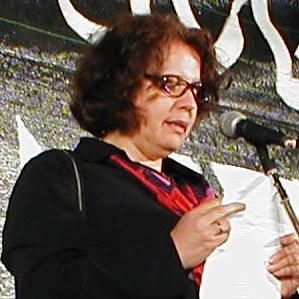
Dr. Nurit Peled Elhanan is an Israeli woman whose 13 year old daughter was killed by a Palestinian suicide bomber in 1997. Shortly after, she helped found the Bereaved Parent’s Circle, a courageous Israeli-Palestinian coexistence group about which I’ve frequently written. It’s not an exaggeration to say that over the past two decades she has become one of the most important and eloquent members of the Israeli peace activist community.
On January 2, Peled Elhanan gave an emotional speech in Tel Aviv at a rally commemorating the one-year anniversary of Israel’s military assault on Gaza. I don’t know how else to describe it but as a primal scream – a cry from deep within the reaches of her heart. It is a gut-wrenching read, but also, in its way, enormously edifying. More than anything else I’ve read lately, it addresses head-on the poison that has been spreading through Israel’s soul – a phenomenon many fear to be true, but few are willing to identify out loud.
Please make sure to read all the way to the end, including the footnotes, which will help you to better understand her references, as well as the Jewish soul that throughly permeates her words.
Toward a New Gaza Strategy
There is new tension along the Israel-Gaza border. Israel is bombing targets in Gaza; mortar shells and Qassams are flying into southern Israel once again. If Israel’s massive military assault last year was designed to deter Hamas and/or provide security for the citizens of southern Israel – then it now appears that effort has been for naught.
When will we learn that bombs won’t work? As so many of us have been shouting for so long, the only true solution to the Gaza conflict is a political solution: to open the border, to provide relief and development assistance, to engage with Hamas directly.
I’m gratified, at least, that the editorial board of Ha’aretz seems to be moving in this direction:
A renewal of rocket fire shows that even a major military operation that brought death and destruction cannot ensure long-term deterrence and calm. Israel has an interest in stopping escalation at the border so as not to find itself caught up in another belligerent confrontation with Hamas …
Instead of erring by invoking the default solution of more force, which does not create long-term security or ease the distress of the Palestinians in Gaza, the crossings between Israel and the Gaza Strip should be opened and indirect assistance rendered to rebuild its ruins.
Amen. Massive military bombardment and a crushing blockade is not making either side more secure – it is only exacerbating the conflict and ensuring the likelihood we will be reading more tragic news from a small patch of land that has known nothing but tragedy for the past six decades.
PS: Since I wrote this post this morning, I’ve been thinking all day about how I addressed the Gaza conflict as largely a strategic policy issue. If I’m going to be totally honest, however, I’d have to admit that my feelings about this issue go deeper than simply “war doesn’t work.”
I’ve come to accept that at its heart, this conflict is not simply strategy but about justice. To anyone who believes that this latest border issue is about Hamas and its missiles, I’d respond that it is only the latest incarnation of an injustice that was committed against the Palestinian people, long, long before the Qassams started flying.
I’m currently reading Joe Sacco’s devastating graphic-novel style reportage, “Footnotes in Gaza.” I highly recommend it to anyone interested in the tragic history of the Palestinian experience in Gaza.
Playing the Blood Libel Card
(An) Italy-based group of researchers studied Israel’s use of ammunition and said the population of the Gaza Strip is “in danger.” It based the claim on soil analysis of four bomb craters. “It is essential to intervene at once to limit the effects of the contamination on people, animals and cultivation,” the researchers stated…
“Our study indicates an anomalous presence of toxic elements in the soil,” (the committee’s spokesperson) stated. This included metals that “can cause tumors and problems with fertility, and they can have serious effects on newborns, like deformities and genetic pathologies.”
The article continues:
Professor Gerald Steinberg, founder of the Jerusalem-based, non-governmental Monitor organization, said the study did not present enough evidence to support its claim… (He) said the committee’s “accusations are designed to stigmatize Israel and erase the context of mass terror.” He said he considers the accusations “a modern form of blood libel.”
Dr. Moshe Kantor, president of the European Jewish Congress had a similar reaction:
“This so-called research is eerily reminiscent of ancient blood libels against the Jewish people, when rumors were spread about Jews poisoning wells” … “Today we are seeing a recurrence of all the worst excesses of anti-Semitism and diatribes that we perhaps naively thought had remained in the Dark Ages.”
I don’t know if the Italian scientists’ research is accurate or not, but I do know this: we Jews are becoming much too fond of shouting “blood libel” for political purposes.
Not long ago, of course, the epithet was directed at Judge Richard Goldstone. I’m also reminded of another recent news story, in which a Swedish newspaper made the ghoulish claim that Israel was killing Palestinians to harvest their organs. Israel’s outrage was inevitably swift:
“This is an anti-Semitic blood libel against the Jewish people and the Jewish state. The Swedish government cannot remain apathetic,” said Israel’s Finance Minister Yuval Steinitz.
“We know the origins of these claims. In medieval times, there were claims that the Jews use the blood of Christians to bake their Matzas for Passover. The modern version now is that the IDF (Israel Defense Forces) soldiers use organs of Palestinians to make money.”
When I first heard this news, I was also outraged by the allegations. Then I read last month that a former head of an Israeli forensic institute admitted that forensic pathologists did indeed illegally harvest organs from bodies, including Palestinian bodies, in the 1990s.
According to reports there was no proof that individuals were actually killed for their organs – but as I continue to read up on this incident, I’ve become further mortified to learn that NGOs have long considered Israel to be among the top purveyors of illegal organ-trafficking in the world. Will we take these kinds of reports seriously or will we simply accuse these organizations of blood libel as well?
While there is still no lack of irrational hatred directed at Jews, I believe Israel does the Jewish people no good every time its leaders invoke the spectre of anti-Semitism to deflect criticism. At the end of the day, which is worse: the very real scourge of anti-Jewish prejudice or the cynical accusation of blood libel to cover up potential crimes of our own?
Gaza One Year Later: Beyond the Complications
It was exactly one year ago that I read the first news accounts of Israel’s military assault in Gaza:
Waves of Israeli airstrikes destroyed Hamas security facilities in Gaza on Saturday in a crushing response to the group’s rocket fire, killing more than 225 — the highest one-day toll in the Israeli-Palestinian conflict in decades…
(There) was a shocking quality to Saturday’s attacks, which began in broad daylight as police cadets were graduating, women were shopping at the outdoor market, and children were emerging from school. The center of Gaza City was a scene of chaotic horror, with rubble everywhere, sirens wailing, and women shrieking as dozens of mutilated bodies were laid out on the pavement and in the lobby of Shifa Hospital so that family members could identify them. The dead included civilians, including several construction workers and at least two children in school uniforms.
By afternoon, shops were shuttered, funerals began and mourning tents were visible on nearly every major street of this densely populated city.
Previously, whenever I’d hear this kind of news out of Israel/Palestine, my shock and anguish would quickly be tempered by a familiar voice telling me to calm down, don’t overreact, don’t forget how terribly “complicated” the situation is. (Indeed, I recall hearing that voice distinctly three years earlier when the IDF responded to Hezbollah rocket attacks with a similarly massive military onslaught.)
This time, though, it was different. This time I didn’t hear the voice. Somehow, it just didn’t seem all that complicated to me any more.
This is what I wrote on my blog that day:
The news today out of Israel and Gaza makes me just sick to my stomach.
I know, I can already hear the responses: every nation has a responsibility to ensure the safety of its citizens. If the Qassams stopped, Israel wouldn’t be forced to take military action. Hamas also bears responsibility for this tragic situation…
I could answer each and every one of these claims in turn, but I’m ready to stop this perverse game of rhetorical ping-pong. I don’t buy the rationalizations any more. I’m so tired of the apologetics. How on earth will squeezing the life out of Gaza, not to mention bombing the living hell out of it, ensure the safety of Israeli citizens?
We good liberal Jews are ready to protest oppression and human-rights abuse anywhere in the world, but are all too willing to give Israel a pass. It’s a fascinating double-standard, and one I understand all too well. I understand it because I’ve been just as responsible as anyone else for perpetrating it.
So no more rationalizations. What Israel has been doing to the people of Gaza is an outrage. It has brought neither safety nor security to the people of Israel and it has wrought nothing but misery and tragedy upon the people of Gaza.
There, I’ve said it. Now what do I do?
As I read this post one year later, I remember well the emotions I felt as I wrote it. I also realize what a critical turning point that moment represented for me.
As a Jew, I’ve identified deeply with Israel for my entire life. I first visited the country as a young child and since then I’ve been there more times that I can count. Family members and some of my dearest friends in the world live in Israel.
Ideologically speaking, I’ve regarded Zionism with great pride as the “national liberation movement of the Jewish people.” Of course I didn’t deny that this rebirth had come at the expense of another. Of course I recognized that Israel’s creation was bound up with the suffering of the Palestinian people. The situation was, well, it was “complicated.”
Last year, however, I reacted differently. I read of Apache helicopters dropping hundreds of tons of bombs on 1.5 million people crowded into a 140 square mile patch of land with nowhere to run. In the coming days, I would read about the bombing of schools, whole families being blown to bits, children literally burned to the bone with white phosphorous. Somehow, it didn’t seem so complicated at all any more. At long last, it felt as if I was viewing the conflict with something approaching clarity.
Of course I think we’d all agree that the Israeli-Palestinian conflict is technically complicated. But at the same time I think we all know that at the end of the day, there is nothing complicated about persecution. The political situation in Darfur, for instance, is enormously complicated – but these complications certainly haven’t stopped scores of Jews across North America from protesting the human rights injustices being committed there. We do so because we know that underneath all of the geopolitical complexities, oppression is oppression. And as Jews, we know instinctively that our sacred tradition and own tragic history require us to speak out against all oppression committed in our midst.
I’d suggest that if there is anything complicated for us here, it is in possibility that we might in fact have become oppressors ourselves. That is painfully complicated. After all, our Jewish identity has been bound up with the memory of our own persecution for centuries. How on earth can we respond – let alone comprehend – the suggestion that we’ve become our own worst nightmare?
More than anything else, this is was what I was trying to say in that anguished, emotional blog post one year ago: is this what it has come to? Have we come to the point in which Israel can wipe out hundreds of people, whole families, whole neighborhoods and our response as Jews will be to simply rationalize it away? At the very least will we able to stop and question what has brought us to this terrifying point? Have we become unable to recognize persecution for what it really and truly is?
Those who know me (or read my blog) surely know that it has been a painfully challenging year for me. My own relationship to Israel is changing in ways I never could have predicted. Since I started raising questions like those above, I’ve lost some friends and, yes, my congregation has lost some members. If Zionism is the unofficial religion of the contemporary Jewish community then I’m sure there are many who consider me something of an apostate.
But at the same time, I’ve been surprised and encouraged by the large number of people I’ve met who’ve been able to engage with these questions openly and honestly, even if they don’t always agree with me. I suppose this is what I decided to do one year ago: to put my faith in our ability to stand down the paralyzing “complexities,” no matter how painful the prospect.
One year later, I still hold tight to this faith.
Gilad Shalit and the Sorrows of Tribalism
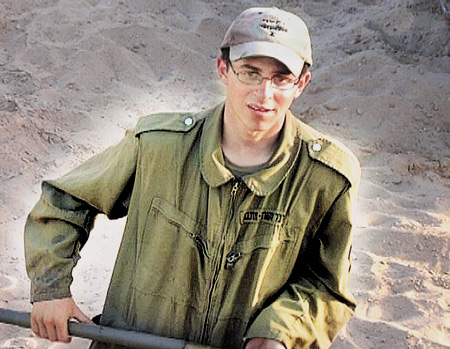
Not long ago I was asked by a friend: why are Israelis and Jews so fixated on the kidnapping of Gilad Shalit? With all of the crises and injustices being committed in the world, why is there such a hue and cry over this one particular man?
I answered that like all nations, Israel takes this kind of thing personally. I mentioned that just like many Jews in Israel and around the world, I also experienced Hamas’ abduction of Gilad Shalit as an injustice committed against one of my own. Even as a Jew living in the comfort of my Evanston home, I felt a visceral sense of pain three years ago when I first heard the news of Shalit’s kidnapping. Over time, my pain turned to anger as Hamas denied him Red Cross visits and refused to confirm (until only recently) whether he was even dead or alive.
I went on to compare Israel’s trauma to the feeling of collective trauma we felt in our country in 1979, when Iranian militants took American embassy workers hostage: how violated our nation felt: how personally we identified with the hostages; how deeply we experienced the injustice of their imprisonment.
On a less tribal level, of course, I do understand that there was a deeper context to the hostage crisis. Underneath our feelings of personal violation were more challenging questions – questions few of us were prepared to ask out loud. Why, for instance, did we have so much concern over 53 fellow Americans, but not for countless other political prisoners around the world, many of them incarcerated by regimes actively supported by our nation?
In just the same way, I believe too few Jews even know – let alone protest – that while Hamas unjustly imprisons Shalit, Israel holds hundreds of Palestinians taken in operations that at best must be considered ethically dubious. While Israel defends its actions legally by terming these prisoners “enemy combatants,” the hard truth remains that for decades Israel’s security services have rounded up scores of Palestinians without charge and have imprisoned them indefinitely – in many cases for years.
Yes, many of the prisoners are undoubtedly guilty of plotting or carrying out violent acts against Israelis. Many of these incarcerations can surely be defended on grounds of security. But it has become impossible to ignore that Israel has also incarcerated considerable numbers of Palestinians who by any reasonable definition must be considered political prisoners.
(One recent case in point: many Jews are familiar with the case of Gilad Shalit, but I’m sure that far fewer know, for instance, about Abdallah Abu Rahmah, a Palestinian high school teacher and coordinator of the non-violent campaign in the West Bank village of Bil’in, who was arrested last week by the Israeli military. According to eyewitness accounts, Abu Rahmah was taken from his bed at 2:00 am in the presence of his wife and children.)
And so, beyond the emotions of tribalism, the question remains: will we ever be able to see past our own loyalties and find equal value in the lives of others – human beings who are just as eminently worthy of fair treatment, justice and dignity? And even more challenging: will we ever be ready to admit that the violence committed against us is often inspired in no small way by the injustices we ourselves have committed – and continue to commit?
To return to the Iranian hostage example: back in 1979, few Americans cared to even ask why their Iranian captors might have been so motivated to commit this act. Most of us were ignorant to the powerful significance of the American embassy for Iranians – that it was this very same embassy from which our nation had plotted the overthrow of Iran’s democratically elected government in 1953. As it turned out, the regime we subsequently installed would persecute and unjustly imprison countless Iranian citizens over the next two decades.
So too in the case of Gilad Shalit. Few of us in the Jewish community are truly ready to examine the source of Gazan’s fury toward Israel – a fury that has been building since long before Hamas even existed. Few of us are willing to face the history of Israel’s oppressive policies in Gaza or the fact that Gazans have been living under an intolerable occupation for decades.
And even fewer of us even know that the overwhelming majority of the 1.5 million who live in Gaza belong to families that originally came from outside of Gaza – from towns and villages like Ashkelon and Beersheba – and were expelled from their homes by the Israeli military in 1948. Indeed, when I think of Gazan rage in 2009, I can’t help but think of these chilling words by Moshe Dayan from back in 1956:
Who are we that we should bewail their mighty hatred of us? (They) sit in refugee camps in Gaza, and opposite their gaze we appropriate for ourselves as our own portion the land and the villages in which they and their fathers dwelled.
The history of Gaza is indeed a tragic one – and yes, Israel’s oppression of its population is a critical part of this tragedy. Unless we take the time to understand this history – and our part in it – I don’t believe we can even begin to pretend there is a way out of this conflict.
To be clear: understanding the source of Gazans feelings toward Israel does not mean condoning their actions. Hamas’ imprisonment of Gilad Shalit is barbaric. As a fellow Jew, I grieve for Shalit and I pray for his safe return. But at the same time, I cannot look away from the more painful realities that led to his capture in the first place, and I truly believe that until we make an honest effort to face and address these realities, there will invariably be more Gilad Shalits in Israel’s future.
Following Israel’s military campaign in Lebanon in the summer of 2006, journalist Amira Hass wrote these powerful words in Ha’aretz. I believe she presents us with a profound model of an Israeli who is able to hold her own concern for her people together with a willingness to face the truth of the injustices perpetrated her nation. Her words are doubly tragic as we now approach the one-year anniversary of Israel’s military campaign in Gaza:
We are justly concerned about the welfare of northern residents, proud of their fortitude, understand those who leave, are shocked by the death of each person and by every rocket hit, and identify with those suffering from anxiety. Take what the northern residents have been going through for a month, multiply it by 1,000, add an economic blockade, power and water cuts, and no wages. This is how the Palestinians in the Gaza Strip have been “living” for the past six years.
The Israelis allow their army to continue destroying, trampling and killing in the Palestinian territories. Here, like in Lebanon, the real intelligence and security failure is Israel’s ignoring the extent of our uninhibited, unrestrained devastation and their amazing power of human endurance. This is why Israel has delusions of “victories.” If the homemade rockets are still being fired at Sderot despite the Palestinians’ extensive suffering, it is because they have concluded, correctly, that Israel’s destruction power is not intended to stop Qassam rockets – or to free Gilad Shalit. It is intended to force them to accept a surrender arrangement, which they reject not with military victories but with their power of endurance.
“Cursed Be He That Keepeth Back His Sword From Blood.”
The Israel Defense Forces’ chief rabbi told students in a pre-army yeshiva program last week that soldiers who “show mercy” toward the enemy in wartime will be “damned.”
Brig. Gen. Avichai Rontzki also told the yeshiva students that religious individuals made better combat troops. Speaking Thursday at the Hesder yeshiva in the West Bank settlement of Karnei Shomron, Rontzki referred to Maimonides’ discourse on the laws of war. That text quotes a passage from the Book of Jeremiah stating: “Cursed be he that doeth the work of the Lord with a slack hand, and cursed be he that keepeth back his sword from blood.”
In Rontzki’s words, “In times of war, whoever doesn’t fight with all his heart and soul is damned – if he keeps his sword from bloodshed, if he shows mercy toward his enemy when no mercy should be shown.”
Whatever else we might think about Maimonides’ (or Jeremiah’s) words, we are certainly free to debate their academic meaning. But when they are uttered by the Chief Rabbi of the IDF to future Israeli soldiers, words such as these are much, much more than merely academic.
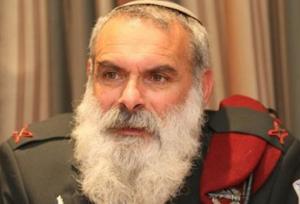
You may remember that Rabbi Rontzki (above) was in the news following Israel’s military operation in Gaza, when soldiers alleged that he gave them a religious booklet entitled “Go Fight My Fight.” This publication includes extensive quotes by Rabbi Shlomo Aviner, head of the Ateret Cohanim yeshiva in Jerusalem, who ruled that Palestinians were the equivalent of the Biblical Philistines and that cruelty can sometimes be a “good attribute.”
You may also remember that Israeli soldiers from the organization Shovrim Shtika (“Breaking the Silence”) brought this issue to light following the war in Gaza. Though they have been attacked mercilessly by the Israeli political establishment, these young soldiers have continued to speak out. Last September, Gal Einav and Shamir Yeger, two reserve infantry soldiers who fought in Gaza wrote a powerful editorial in the Israeli press about what they considered to be an unwelcome “messianic” religious influence into the IDF:
There is a problem with the growing tendency to provide religious elements with a monopoly on values and fighting spirit, and particularly with the legitimacy granted to organizations with a missionary and messianic character to operate amongst the soldiers. Most of the commanders in our division are religious, yet up until the last war there was complete separation between their private world and their military position.
If we fail to clearly draw the line right now, in a few years we shall find ourselves shifting from wars of choice or no-choice to holy wars.
In a September BBC report, Reserve General Nehemia Dagan had this to say about the issue:
We (soldiers) used to be able to put aside our own ideas in order to do what we had to do. It didn’t matter if we were religious or from a kibbutz. But that’s not the case anymore.
The morals of the battlefield cannot come from a religious authority. Once it does, it’s Jihad. I know people will not like that word but that’s what it is, Holy War. And once it’s Holy War there are no limits.
(You can watch the BBC report in its entirety here and here. Highly recommended).
What explains the growth of this right-wing religious influence in the IDF? I tend to agree with blogger Zachary Goelman, who points out an larger demographic trend in Israeli society:
With conscription rates dropping annually, especially among secular Jews, and a simultaneous increase in the country’s religious population, Yeger and Einav are part of a shrinking minority. No doubt they know many who ducked their conscription call. If they have draft-age children, they’ve certainly heard them discuss the myriad ways of obtaining a deferral.
This trend is reversed in the dati-le’umi sector, the category of Israeli Jews broadly classified as “national religious.” In one way or another the men and women woven from this cloth see military and national service as a form of religious duty, and their ranks in uniform and civil society will increase in the coming decades. Coupled with the consistent growth of ultra-orthodox families, secular Israel may be in the final throes of its götterdämmerung.
Whatever the explanation, I personally find the implications of this trend to be beyond troubling. How will we, as Jews, respond to the potential growth of Jewish Holy War ideology within the ranks of the Israeli military? How do we feel about Israeli military generals holding forth on the religious laws of warfare? Most Americans would likely agree that in general, mixing religion and war is a profoundly perilous endeavor. Should we really be so surprised that things are now coming to this?
I do not ask these questions out of a desire to be inflammatory. I ask them only because I believe we need to discuss them honestly and openly – and because these kinds of painful questions have for too long been dismissed and marginalized by the “mainstream” Jewish establishment.
For myself at least – as a Jew and as a rabbi – I will take this opportunity to register my personal offense at statements such as those made last week by Rabbi Rontzki.
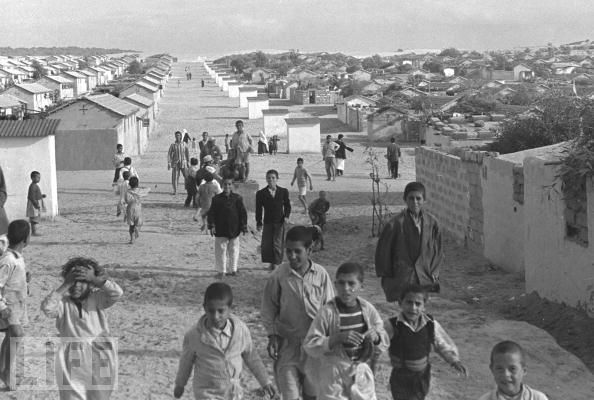
Gaza 1956

Earlier this year I shared a 2004 Jerusalem Post interview with Arnon Soffer, the architect of Israel’s disengagement from the Gaza Strip. It was a painfully sobering read, not least for his chilling predictions of Israel’s post-disengagement reality:
(When) 2.5 million people live in a closed-off Gaza, it’s going to be a human catastrophe. Those people will become even bigger animals than they are today, with the aid of an insane fundamentalist Islam. The pressure at the border will be awful. It’s going to be a terrible war. So, if we want to remain alive, we will have to kill and kill and kill. All day, every day…
If we don’t kill, we will cease to exist. The only thing that concerns me is how to ensure that the boys and men who are going to have to do the killing will be able to return home to their families and be normal human beings.
I thought of this article today as I read another piece about Gaza: a famous 1956 eulogy given by Moshe Dayan for a young kibbutznik named Ro’i Rotenberg, who was killed by Gazan Arabs who had crossed over the border into Israel.
At the start of his eulogy, Dayan offered these astonishingly candid remarks:
Do not today besmirch the murderers with accusations. Who are we that we should bewail their mighty hatred of us? For eight years they sit in refugee camps in Gaza, and opposite their gaze we appropriate for ourselves as our own portion the land and the villages in which they and their fathers dwelled.
Not from the Arabs in Gaza, but from ourselves shall we require the blood of Ro’i. How did we close our eyes so as not to see the goal of our generation in its full measure of cruelty? Did we forget that this group of young men and women, which dwells in Nahal Oz, bear on their shoulders the heavy gates of Gaza, gates on the other side of which are crowded together with hundreds of thousands of eyes and hands that pray for our weakness, that it may come, so that they may rip us to shreds – have we forgotten this?
This we know: that in order that the hope to destroy us should die we have to be armed and ready, morning and night. We are a generation of settlement, and without a steel helmet and the barrel of a cannon we cannot plant a tree and build a house. Our children will not live if we do not build shelters, and without a barbed wire fence and a machine gun we cannot pave a road and channel water. The millions of Jews that were destroyed because they did not have a land look at us from the ashes of Israelite history and command us to take possession of and establish a land for our nation.
(Translation, Michael Shalom Kochin, 2009)


From yesterday’s Ha’artez