Rabbi Brian Walt and I, along with the other rabbinical leaders of Ta’anit Tzedek were the object of an angry attack written by Rabbi David Forman in last Friday’s Jerusalem Post. Brian and I have written a response to the the Post and we hope it will be published. Please stay tuned…
Category Archives: Gaza
Gaza: Give Life a Chance
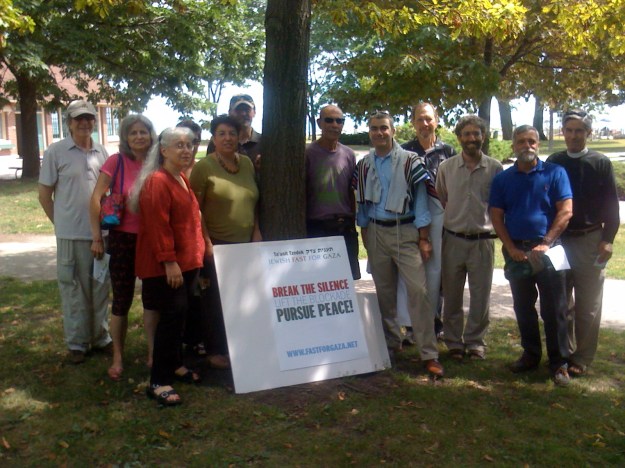
Today was the second monthly fast day for Ta’anit Tzedek – Jewish Fast for Gaza. To mark the occasion, a series of public vigils were held around the country (including one at the Liberty Bell in Philadelphia) and as far away as Glasgow, Scotland. Here in the Chicago area, it was my honor to lead a vigil at the Evanston lakefront with my good friend and colleague, Rabbi Rebecca Lillian. Here we are with some of the participants, below:

Our campaign continues to grow. As of this writing we currently have 627 supporters, including 71 rabbis. I encourage you to join us, if you haven’t already – just click on the link above to become a supporter. We are continuously uploading important articles and resources, so be sure to check in regularly.
Speaking of important resources on the Gaza crisis, I commend to you the new report from Gisha – Legal Center for Freedom of Movement entitled “Red Lines Crossed: Destruction of Gaza’s Infrastructure.” See below for the full report. Click above to watch “Lift the Closure – Give Life a Chance” – a new online film recently released by eight Israeli human rights organizations to mark the two years of closure that Israel has imposed on the Gaza Strip.
Flesh of Our Flesh?
Learn to do good, seek justice; relieve the oppressed. Uphold the orphan’s rights; take up the widow’s cause. (Isaiah 1:17)
This classic verse comes from the Haftarah portion for this Shabbat. It is the final so-called “Haftarah of affliction” coming annually on the Shabbat before the festival of Tisha B’Av. Beginning next week our prophetic portions will offer messages of consolation, reminding us that the path of return to righteousness is always open to us. Indeed, it is this very message that will guide us into the High Holiday season itself – the season of our return.
As I read this passage this year, I was mindful of a very similar passage that will appear in the Haftarah of Yom Kippur, also from the book of Isaiah:
No, this is the fast that I desire: to unlock fetters of wickedness and untie the cords of lawlessness; to let the oppressed go free and break off every yoke. It is to share your bread with the hungry, and to take the wretched poor into your home; to clothe when you see the naked, and never forget your own flesh (Isaiah 58:6-7).
In a way, these two similar Isaiah passages seem to represent spiritual bookends to the High Holiday season. These characteristically prophetic calls to justice and repentance guide us through our High Holiday journey, reminding us not only of our seemingly chronic hypocrisy but also of the eternally simple route to return: “learn to do good, free the oppressed, feed the hungry…”
As many of you know, our recently organized Fast for Gaza has cited Isaiah 58 as a kind of spiritual prooftext to our initiative. As it turns out, ever since we’ve launched this project I’ve been in a kind of dialogue with more than one correspondent over this particular verse. Several people have already written to me that we’ve misinterpreted Isaiah. It appears that for some, calling a Jewish fast in support of Gazan Palestinians rather than Jewish Israelis represents a betrayal of this prophetic imperative (not to mention the Jewish people.) As one writer put it, “never forget your own flesh” means “charity begins at home.”
This criticism motivated me to do a bit of digging into the source material. As it turns out the Hebrew word for “your flesh” – b’sarcha – can indeed refer to blood relations or kin. But interestingly, according to the Brown, Driver, Briggs Biblical Dictionary (p. 142), this term can also mean “all living beings” (occurring in this usage at least 13 times throughout the Bible.)
So, in fact, there is good, solid linguistic evidence to reject this narrow, tribal reading of Isaiah. Now I’m certainly willing to admit that this passage might have referred only to fellow Israelites when it was originally written. But today we live in a fundamentally different time than the ancient Israelites. In our globalized, post-modern world, the Jewish community has become inter-dependent with others in profound and unprecedented ways. Whether we are prepared to admit it or not, our Jewish security, our Jewish destiny is now irrevocably bound up with the destiny of all peoples and nations of the world.
I am well aware that this viewpoint represents a distinctly 21st century Torah. I also have no illusions that it will be a simple matter for the Jewish community to heed this call. Having only recently emerged from the ghetto, still living with a collective memory of anti-Semitism, still reeling from the trauma of the Holocaust, it will necessitate a radical shift in consciousness to understanding our place in the world in such a way.
It will not be easy, but I believe it will be essential. It can no longer be us against them. At the end of the day, we are all one flesh.
Gaza: A Rabbinical Exchange

Since we launched the Jewish Fast for Gaza, we’ve received all kinds of feedback, some supportive, some critical, some utterly unprintable. (My personal favorite from the latter category: “You should all get severe stomach ailments.”)
On occasion, however, our effort has offered us the opportunity for genuinely respectful dialogue. Below is one such exchange – an email I received from a rabbinic colleague, followed by my response:
Dear Ta’anit Tzedek,
Having cares and concerns of the plight of humanity is a most noble cause. That you are willing to extend effort is most commendable. Your organization, however, is extending its efforts in a manner which is not only counterproductive, but can be harmful as well.
How can you look into the face of a 12 year old girl from Sderot who suffers from post traumatic syndrome as for most of life she has been awakened on a nightly basis by sirens and rocket fire? What do you say to the families of victims killed by suicide bombers who killed their teenagers who were casually enjoyed a slice of pizza? What do you say to an organization whose very goal is the annihilation of our people?
You may answer, “Had we been better, they may have liked us more.” or some such configuration thereof. It’s not plausible. Since 1948, the goal of the Arab world has been the removal of a Jewish presence in the middle east. Our interference with their dream of a Pan-Arabic state stretching from Morocco to Iraq is sullied by our very presence.
It would better for your organization to spend is resources on ideals that truly further the continuity of Jews and Judaism.
I await your response,
Rabbi X
Dear Rabbi X,
I want to thank you for taking the time to reach out and respond to our initiative. I’m glad to have the opportunity for this dialogue.
You ask what I would say to the 12 year old girl from Sderot or the families of terror victims. I believe I would say that as a fellow Jew that their pain is my pain as well. I would say that I could not begin to comprehend the realities they must face. But I would also share my belief that that Israel’s current treatment of the people of Gaza will bring them neither safety nor security – and that the only true way out of these traumas is a lifting of the blockade and the negotiation of a settlement by all parties involved.
As regards Hamas “whose very goal is the annihilation of our people:” though I have no love lost for Hamas, the reality is that Israel will have to deal with them if any true peace will be achieved. And in truth, Israel has already dealt with Hamas through any number of channels over the years already. Making peace is a sacrosanct Jewish value – and as difficult as it is, the truth is that we make peace with our enemies. In the past, Israel has made peace with former enemies whom we once believed sought nothing but our “annihilation.” To surrender this value means to doom the people of this region to endless violence and tragedy.
Thus we do indeed believe that this effort furthers the resources of Jews and Judaism. We do not hold that the only Jewish path is the one that addresses Jews and Jewish “needs” alone. In the case of Jews and Palestinians in particular, our fates are fundamentally intertwined: we will either live together or else we will die together. The Jewish path has always been to choose life – this sacred imperative is at the core of our initiative.
Thank you again for sharing your thoughts with us. Even as we may disagree, I hope you will share my conviction that our conversation is a “machloket l’shem shamayim” (“argument for the sake of heaven.”) I also know that you join with me in prayers for peace for this tortured region that is so dear to both of us.
Kol Tuv,
Rabbi Brant Rosen
Jewish Fast for Gaza

In response to the dire humanitarian crisis in Gaza, my dear friend and colleague Rabbi Brian Walt and I have organized a new initiative, Ta’anit Tzedek – Jewish Fast for Gaza.
See below for the press release about the project, which is already attracting increasing numbers of supporters, including many rabbis. Click the link above to visit the website and sign up yourself…
RABBIS ANNOUNCE MONTHLY FAST FOR GAZA
Seeking “to end the Jewish community’s silence over Israel’s collective punishment in Gaza,” an ad-hoc group of American rabbis has called for a communal fast. Known as Ta’anit Tzedek – Jewish Fast for Gaza, this new initiative will organize a series of monthly fasts beginning on July 16.
The project was initiated by a group of thirteen rabbis representing a spectrum of American Jewish denominations. The group’s website explains the religious meaning of the campaign: “In Jewish tradition a communal fast is held in times of crisis both as an expression of mourning and a call to repentance. In this spirit, Ta’anit Tzedek – Jewish Fast for Gaza is a collective act of conscience initiated by an ad hoc group of rabbis, Jews, people of faith, and all concerned with (this) ongoing crisis…”
The fast has four goals: to call for a lifting of the blockade, to provide humanitarian and developmental aid to the people of Gaza, to call upon Israel, the US, and the international community to engage in negotiations with Hamas in order to end the blockade, and to encourage the American government to “vigorously engage both Israelis and Palestinians toward a just and peaceful settlement of the conflict.”
The water-only fast will take place every third Thursday of the month, from sunrise to sunset. In addition to signing on to the fast statement, participants have been asked to donate the money they save on food to the Milk for Preschoolers Campaign sponsored by American Near Eastern Refugee Aid, a relief campaign that combats malnutrition among Gazan preschool children.
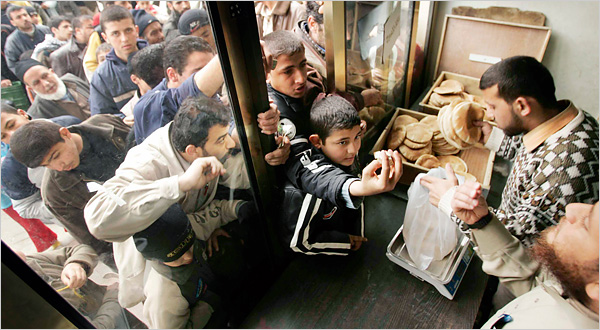
Since the electoral victory of Hamas in January 2006, Israel has imposed a blockade that has severely restricted Gaza’s ability to import food, fuel and other essential materials. As a result, the Gazan economy has completely collapsed and it suffers from high levels of unemployment and poverty and rising levels of childhood malnutrition.
“Israel’s treatment of the Palestinian people in Gaza amounts to nothing less than collective punishment. While we condemn Hamas’ targeting of Israeli civilians, it is immoral to punish an entire population for the actions of a few,” said Rabbi Brant Rosen, who serves Jewish Reconstructionist Congregation in Evanston, IL. “This blockade has only served to further oppress an already thoroughly oppressed people. As Jews and as human beings of conscience, we cannot stand idly by.”
“We’ve been enormously encouraged by the initial response we’ve received from the Jewish community thus far,” said fast organizer Rabbi Brian Walt, former Executive Director of Rabbis for Human Rights – North America, who noted that the initiative has signed up numerous supporters prior to the launch of the project. “We truly believe this effort is giving voice to a significant number of people who been looking for a Jewish voice of conscience on this issue.”
Rescue the Spirit of Humanity

The humanitarian situation in Gaza has grown beyond intolerable. If you have any doubts, just read this devastatingly important article by Sara Roy, senior research scholar at Harvard’s Center for Middle Eastern Studies:
Today, 96 percent of Gaza’s population of 1.4 million is dependent on humanitarian aid for basic needs. According to the World Food Programme, the Gaza Strip requires a minimum of 400 trucks of food every day just to meet the basic nutritional needs of the population. Yet, despite a 22 March decision by the Israeli cabinet to lift all restrictions on foodstuffs entering Gaza, only 653 trucks of food and other supplies were allowed entry during the week of May 10, at best meeting 23 percent of required need.
Israel now allows only 30 to 40 commercial items to enter Gaza compared to 4,000 approved products prior to June 2006. According to the Israeli journalist, Amira Hass, Gazans still are denied many commodities (a policy in effect long before the December assault): Building materials (including wood for windows and doors), electrical appliances (such as refrigerators and washing machines), spare parts for cars and machines, fabrics, threads, needles, candles, matches, mattresses, sheets, blankets, cutlery, crockery, cups, glasses, musical instruments, books, tea, coffee, sausages, semolina, chocolate, sesame seeds, nuts, milk products in large packages, most baking products, light bulbs, crayons, clothing, and shoes.
What possible benefit can be derived from an increasingly impoverished, unhealthy, densely crowded, and furious Gaza alongside Israel? Gaza’s terrible injustice not only threatens Israeli and regional security, but it undermines America’s credibility, alienating our claim to democratic practice and the rule of law.
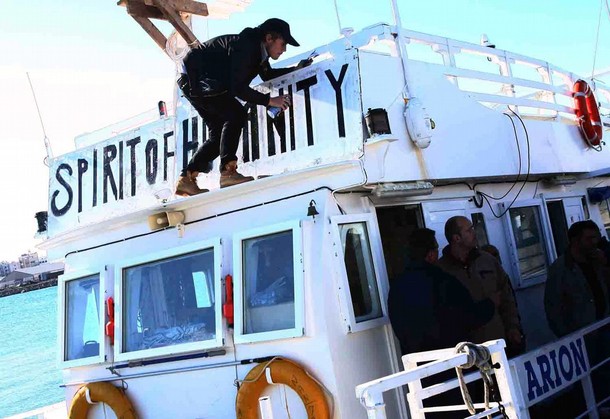
And now the news has just come in that Israel has seized the “Spirit of Humanity,” a boat carrying a cargo of humanitarian aid in international waters, and is forcibly towing it to an Israeli port. The boat contained 21 human rights workers from 11 countries, including Nobel Peace Prize laureate Mairead Corrigan Maguire and former U.S. Congresswoman Cynthia McKinney. It was bringing medicine, toys, and other much needed humanitarian relief.
If you’re looking for a way to channel your upset over this dire situation into effective contribution to Gaza relief, I particularly recommmend American Near East Refugee Aid. Their projects in Gaza include:
– Delivery of life-saving pharmaceuticals and medical supplies to hospitals and clinics;
– Distribution of fortified milk and high-energy biscuits to 25,200 children in 186 preschools.
– Water projects that bring water networks to families in need and pumping systems to keep raw sewage off the streets.
– A psychosocial program that helps thousands of children and parents struggling to survive the effects of war.
– Cash-for-work programs that employ workers to clear agricultural land of plastic waste and provide 200 families a means of self-reliance.
I Can’t Dance Any More

I know there are those who wonder why, with all of the various injustices going on in the world, do I seem to dwell on Israel’s treatment of Palestinians? It’s a fair and important question. For me it boils down to this: I’ve come to believe that too many of us in the Jewish community will unabashedly protest persecution anywhere in the world, yet remain silent when Israel acts oppressively.
I know all too well how we actively avoid this truth. We use any number of rhetorical and political arguments to deny it, to mitigate the discomfort and pain it causes us. We engage in a kind of tortured dance of rationalization that we save for no other world issue but this one. But for me, at least, but none of it really addresses the core issue at hand: however difficult it might be for us to face, Israel is unjustly oppressing Palestinians.
So what are we going to do about it?
Many of us deal with it by putting our faith and efforts into the peace process. And well we should: though I’ve been honest in expressing my own doubts and concerns regarding the peace process, I understand that in the end the only true solution to this conflict will be a political one. But as the peace process enters into its latest incarnation, as the various actors involved painfully wrangle over diplomatic parameters, it is safe to say this saga will continue to take its time to unfold. And in the meantime, the real lives of real Palestinians on the ground will continue to grow increasingly intolerable.
For myself, at least, I cannot use the peace process, critical as it is, as a kind cover to keep me from facing and protesting the oppression that is occuring in Israel/Palestine every day, even as I write these very words. While I will do what I can to advocate for a just and peaceful political settlement to this crisis, this work does not give me a pass on speaking out. If we truly believe we must protest injustice anywhere, anytime, then it seems to me that this principle must apply to Israel/Palestine as well, no matter how painful or difficult the prospect of doing so.
Earlier this week, I was the moderator of a discussion following the showing of a powerful new documentary, “This Palestinian Life” – a film that was often unbearably painful to watch. TPL documents a little-seen aspect of Palestinian life: the nonviolent steadfastness (in Arabic: “sumoud“) of Palestinian villagers who live with a crushing occupation, constant settler attacks, and the deliberate, relentless annexation of their farm land.
This quote from one villager sums up the movie’s essential theme:
I don’t own a gun.I don’t own any weapons and I’m not prepared to own any…
My only weapon of defense is that I won’t leave this place…
and my hope is that the world will respond to Israel’s treatment of us.
As difficult as it was, I was honored to have been asked to moderate the post-film discussion. I know there are many who would regard my participation in such a program as an act of disloyalty or at the very least an exercise in masochism. But in the end, it really came down to this: I just can’t do the dance any more.
Gaza: Soldiers Are Speaking Out

Once permission has been given to the destroyer to do harm, it does not discriminate between the guilty and the innocent. (Mechilta, Bo)
Today the NY Times reported on an issue that has gripped the Israeli press and public for some time now:
In the two months since Israel ended its military assault on Gaza…testimony is emerging from within the ranks of soldiers and officers alleging a permissive attitude toward the killing of civilians and reckless destruction of property…On Thursday, the military’s chief advocate general ordered an investigation into a soldier’s account of a sniper killing a woman and her two children who walked too close to a designated no-go area by mistake, and another account of a sharpshooter who killed an elderly woman who came within 100 yards of a commandeered house.
In reading these accounts, I’m especially struck by the powerfully defensive reaction of many within Israel – insisting that these were either isolated incidents or that they were simply untrue. Witness Defense Minister Barak’s recent statement on Israel radio:
The Israeli Army is the most moral in the world, and I know what I’m talking about because I know what took place in the former Yugoslavia, in Iraq.
I don’t know if Israel’s army is the “most moral” in the world. I’m not sure if I even know what that means. I don’t know what we really expect when we train young men and women to kill, give them the most sophisticated killing instruments on earth, then demonize their enemies before sending them off to battle.
Israel has long claimed its army follows the military war ethic of Tohar Haneshek (“Purity of Arms”). Whether or not this was ever true, there is seems to be growing evidence that in the heat of battle (or if you prefer, the “fog of war”), the difference between “legal killing” and “war crimes” becomes increasingly fuzzy to those who wield the weapons. And I’m fairly sure that this is the case whether or not the soldiers in question happen to be Jewish.
Even more disturbing are the reports from Israeli soldiers that the Israeli rabbinate is urging them to view this conflict as nothing less than a holy war. Richard Silverstein, blogging over at Tikun Olam, has translated some of the Hebrew press accounts, uncovering this jaw-dropping testimony from a commander named Ran:
The military rabbis sent us lots of material and in these articles the message was clear: we are the nation of Israel. We arrived by a miracle in Israel. God returned us to the Land (of Israel). Now we must battle to remove the non-Jews who disturb us in our conquest of the Holy Land. That was the main message. And the sense of many of the soldiers in this operation was that it was a religious war. From my perspective as a commander, I tried to talk about politics and various strains within Palestinian society. That not everyone in Gaza was Hamas and not every resident wants to conquer us. I wanted to explain to them that this war was not about Kiddush Hashem (sanctifying the name of God), but about stopping Qassam fire.
Expect more horrifying news in the coming weeks…
A Peace Veteran Bears Witness
This past Wednesday, JRC’s Peace Dialogue sponored a visit by longtime peace activist and nonviolence practitioner Kathy Kelly, who traveled to Gaza during the recent war.

If you’ve never heard of Kathy Kelly, you should read her bio because she’s someone you need to know about. This recent article will give some idea of the territory she covered in her presentation.
As she’s has been walking the walk for decades, I was surprised (and somewhat appalled) when she told us that this was the first time she had ever been invited to speak to a specifically Jewish audience. I hope and trust it won’t be the last. Through word and deed, I believe this inspiring peace veteran has a great deal to teach us.
Baskin: What the $%#@* Was it All For?

Are you ready to throw your head back and scream to the high heavens? Just read Gershon Baskin’s column in today’s J Post, in which he reveals that prior to Israel’s attack on Gaza, he met with a senior Hamas official in Europe to discuss possibilities for renewing the cease-fire. He returned to Israel ten days before Israel began the war and sent a letter to Olmert, Barak and Livni, informing them…
…that Hamas was willing to open a direct secret back channel for a package deal that would include the renewal of the cease-fire, the ending of the economic siege and the prisoner exchange for the release of (Gilad) Schalit. I further indicated that Hamas would be willing to implement the agreement on Rafah which included the stationing of Palestinian Authority personnel loyal to President Mahmoud Abbas in Rafah and a return of the European monitors. I communicated the same message to (Gilad’s father) Noam Schalit and asked him to make sure that Ofer Dekel, who is charged with the Schalit file by the government, received the Hamas “offer.”
Olmert, et al chose to ignore this opportunity, preferring instead to “teach Hamas a lesson.”
Baskin’s final conclusions:
What did this war achieve? What has changed? Has Israel gained its military deterrence? Has Israel changed the security reality in the South? Is Gilad Schalit at home? Has Hamas reduced its basic demands for the release of Schalit? No, no and no! Israel is negotiating now for exactly what could have been achieved without going to war. Israel spent $1 billion on the war, caused some $2 billion worth of damage in Gaza, more than 1000 people have been killed, thousands of lives have been destroyed. Hundreds of thousands of Israelis lived through weeks of terror; millions of Palestinians suffered the bombardment of their towns, cities and refugee camps – what is the result? More hatred, more extremism and more support for fanatics and their ideas – on both sides of the Gaza border.
Read the whole article and weep…
Learn to do good, seek justice; relieve the oppressed. Uphold the orphan’s rights; take up the widow’s cause. (Isaiah 1:17)