Category Archives: Global Activism

What We Need To Do For Haiti

In the wake of the terrifyingly tragic earthquake in Haiti, it has been gratifying to see private citizens give so generously to relief efforts. At the same time however, we shouldn’t forget that our own country’s policies can have a considerable impact on Haiti’s recovery. Check out what constitutional lawyer/human rights activist/Katrina survivor Bill Quigley has to say in his piece, “Ten Things the US Can and Should Do for Haiti.”

Item #3, for example:

Give Haiti grants as help, not loans. Haiti does not need any more debt. Make sure that the relief given helps Haiti rebuild its public sector so the country can provide its own citizens with basic public services.

On Jewish Hearts and Minds: A Response to Daniel Gordis

Just read Rabbi Daniel Gordis’ recent op-ed in the Jerusalem Post, one of several articles that have given some free publicity to Ta’anit Tzedek.  But it wasn’t Gordis’ offhand slam on TT that really bothered me – it was the decidedly patronizing way he analyzed the gulf between the American Jewish community and Israel – or as he termed it, American Jewry’s “growing abandonment of Israel.”

Gordis’ main premise: American Jewry’s newest generation is essentially self-centered (tainted “with the ‘I’ at the core of American sensibilities”) and simply cannot relate to the national sense of duty embodied by Israel:

In America, the narratives of immigrant groups are eroded, year by year, generation after generation.  In America, we are oriented to the future, not to the past, and if we cling to some larger grouping, it is to a human collective whole rather than to some “narrow” ethnic clan…

Similarly, the recreation of the State of Israel is truly powerful only against a backdrop of centuries of Jewish experience, and is spine-tingling only if my sense of self is inseparable from my belonging to a nation with a past and a people with a purpose.

In today’s individualistic America, the drama of the rebirth of the Jewish people creates no goose bumps and evokes no sense of duty or obligation. Add the issue of Palestinian suffering, and Israel seems worse than irrelevant – it’s actually a source of shame.

It’s not clear to me if Gordis is interested in winning over the hearts and minds of young American Jews, but if he is, I’d suggest that talking down to them from an Israeli ivory tower is not the way to do it.  I’m afraid that record just doesn’t play any more.

Gordis is correct when he posits that the old narratives simply aren’t working on American Jews the way they used to.  But that’s only because a new, more complex narrative is now being written by the current generation. It’s compelling in its own right, though this may be difficult to understand when viewed from the conventional Israeli vantage point.

I work with a great number of American Jews – particularly the 35 and younger demographic that Gordis cites – and from where I sit they look nothing like narcissistic, self-obsessed Americans he describes. On the contrary, most are engaged, seriously seeking Jews.  Yes, it’s true, unlike previous generations they don’t necessarily understand their Judaism in traditionally tribal terms anymore. But that doesn’t make them self-centered. Rather, they are increasingly viewing their Jewishness against a larger, more universal global reality.  In short, to be a Jew and a global citizen is what gives them “goose bumps.”

If, as Gordis suggests, American Jews are abandoning Israel, I’d suggest it’s not due to the lack of a sense of Jewish “duty or obligation” – I believe it’s because they are left cold by an Israeli national culture that appears to them to be overly tribal and collectively self-centered.

Indeed, while most young people today seem to be interested in breaking down walls between peoples and nations, Israel often appears determined to build higher and higher walls between itself and the outside world. It’s a poignant irony of Jewish history: while Zionism was ostensibly founded to normalize the status of Jewish people in the world, the Jewish state it spawned seems to view itself as all alone, increasingly victimized by the international community.

Gordis himself exemplifies this “it’s us Jews against the rest of the world” ethos in the opening paragraphs of his article:

About one thing, at least, the world seems to be in agreement: Israel is the primary culprit in the Middle East conflict, the cause of relentless Palestinian suffering and the primary obstacle blocking the way to regional peace.

The international chorus of opprobrium is growing by the day…It’s relentless, this ganging up, but it’s also not terribly new. The momentum has been building for years, and though we may not like it, we cannot honestly claim to be surprised.

While I understand the psychology of this world view, I don’t think it helps make Israel’s case for young Jews today – nor do I think it promotes a particularly healthy Jewish identity. It seems to me to be the product of self-pity, more than pride – a victim mentality that’s not likely to get us anywhere with newer generations of Jews who are feeling increasingly comfortable with the “outside world” and who don’t particularly identify with the claim that when push comes to shove, all the world really does just hate the Jews.

I will also predict that Gordis’ two cynical references to “Palestinian suffering”  will not resonate for growing numbers of Jews who are legitimately troubled by Israel’s treatment of Palestinians.  I understand full well that our criticism sounds galling to most Israeli ears. And no, I don’t believe that we American Jews can even begin to understand how Israelis feel – on so many levels.

But whether Israelis like it or not, there is a steadily growing demographic in the American Jewish community: proud, committed Jews who are deeply troubled when Israel acts oppressively, who feel implicated as Americans and as Jews in these actions, and who are galled at being labeled as traitors when they choose to speak out.

At the very least, I hope that Gordis will understand that if American Jews are identifying with organizations that protest Israel’s oppressive policies (organizations, yes, such as Ta’anit Tzedek) their affiliation does not come from a shame-filled desire to “bash” Israel. It comes from a deeper and much more Jewishly authentic place than that.

I realize that all of this may be too much to ask for. It’s long been clear that the American Jewish and Israeli Jewish communities are two very different animals with two decidedly different ways of understanding what it means to be a Jew in a rapidly changing world.  (Sociologists Steven Cohen and Charles Liebman pointed this out with great insight in their book “Two Worlds of Judaism” twenty years ago).

But it seems to me if we truly want to facilitate the Jewish future, we’re going to have to do it together. And to do that, we’ll  need to meet one another with openness and understanding, not dismissal and judgment.

Rescue the Spirit of Humanity

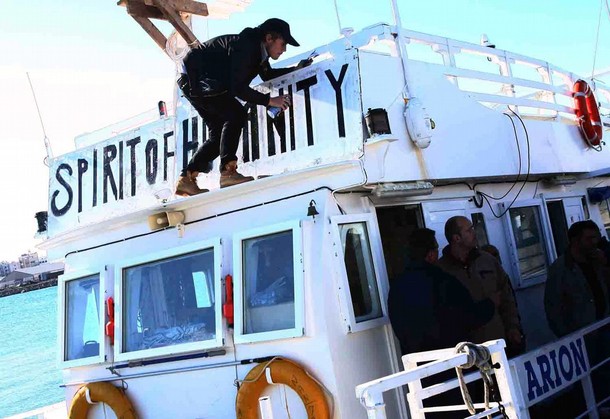
CYPRUS-MIDEAST-CONFLICT-GAZA-AID-BOAT

The humanitarian situation in Gaza has grown beyond intolerable.  If you have any doubts, just read this devastatingly important article by Sara Roy, senior research scholar at Harvard’s  Center for Middle Eastern Studies:

Today, 96 percent of Gaza’s population of 1.4 million is dependent on humanitarian aid for basic needs. According to the World Food Programme, the Gaza Strip requires a minimum of 400 trucks of food every day just to meet the basic nutritional needs of the population. Yet, despite a 22 March decision by the Israeli cabinet to lift all restrictions on foodstuffs entering Gaza, only 653 trucks of food and other supplies were allowed entry during the week of May 10, at best meeting 23 percent of required need.

Israel now allows only 30 to 40 commercial items to enter Gaza compared to 4,000 approved products prior to June 2006. According to the Israeli journalist, Amira Hass, Gazans still are denied many commodities (a policy in effect long before the December assault): Building materials (including wood for windows and doors), electrical appliances (such as refrigerators and washing machines), spare parts for cars and machines, fabrics, threads, needles, candles, matches, mattresses, sheets, blankets, cutlery, crockery, cups, glasses, musical instruments, books, tea, coffee, sausages, semolina, chocolate, sesame seeds, nuts, milk products in large packages, most baking products, light bulbs, crayons, clothing, and shoes.

What possible benefit can be derived from an increasingly impoverished, unhealthy, densely crowded, and furious Gaza alongside Israel? Gaza’s terrible injustice not only threatens Israeli and regional security, but it undermines America’s credibility, alienating our claim to democratic practice and the rule of law.

And now the news has just come in that Israel has seized the “Spirit of Humanity,” a boat carrying a cargo of humanitarian aid in international waters, and  is  forcibly towing it to an Israeli port.  The boat contained 21 human rights workers from 11 countries, including Nobel Peace Prize laureate Mairead Corrigan Maguire and former U.S. Congresswoman Cynthia McKinney. It was bringing medicine, toys, and other much needed humanitarian relief.

If you’re looking for a way to channel your upset over this dire situation into effective contribution to Gaza relief, I particularly recommmend American Near East Refugee Aid.  Their projects in Gaza include:

– Delivery of  life-saving pharmaceuticals and medical supplies to hospitals and clinics;

– Distribution of  fortified milk and high-energy biscuits to 25,200 children in 186 preschools.

– Water projects that bring water networks to families in need and pumping systems to keep raw sewage off the streets.

– A psychosocial program that helps thousands of children and parents struggling to survive the effects of war.

– Cash-for-work programs that employ workers to clear agricultural land of plastic waste and provide 200 families a means of self-reliance.

Is BDS anti-Semitism?

boycott1For many Jews, no three letters seem to conjure up rage and fury as effectively as “BDS.” Still, I have a strong suspicion that we’ll be hearing them bandied about increasingly in the coming months.

Since the Gaza war, the movement for global Boycott/ Divestment/ Sanctions against Israel seems to have gained new momentum. Among its prominent new supporters is economic journalist/activist Naomi Klein, who made a passionate call for BDS at the peak of the crisis:

Every day that Israel pounds Gaza brings more converts to the BDS cause, and talk of cease-fires is doing little to slow the momentum. Support is even emerging among Israeli Jews. In the midst of the assault roughly 500 Israelis, dozens of them well-known artists and scholars, sent a letter to foreign ambassadors stationed in Israel. It calls for “the adoption of immediate restrictive measures and sanctions” and draws a clear parallel with the anti-apartheid struggle. “The boycott on South Africa was effective, but Israel is handled with kid gloves.… This international backing must stop.”

Yet even in the face of these clear calls, many of us still can’t go there. The reasons are complex, emotional and understandable. And they simply aren’t good enough. Economic sanctions are the most effective tools in the nonviolent arsenal. Surrendering them verges on active complicity.

Count longtime peace activist Rabbi Arthur Waskow is one of those who “still can’t go there.” The current issue of “In These Times” contains a fascinating debate between Klein and Waskow on the merits of BDS. For his part, Waskow opposes it primarily for tactical reasons:

(The) BDS approach is not the way to bring about the change that is absolutely necessary.  The most important, and probably the only effective, change that can be brought about is a serious change in the behavior of the U.S. government. That means we need to engage in serious organizing within the United States…Boycotts and divestment are not going to do it. I understand that they express a kind of personal purity—”not with my money you don’t”— but they won’t change U.S. policy, which is exactly what needs to be changed.

Klein and Waskow’s conversation is edifying as far as it goes, but to my mind it doesn’t address the main concern over BDS articulated by so many American Jews: namely that given all of the odious regimes throughout the world, the unique singling out of Israel for sanction is an expression of flat-out anti-Semitism. This point of view was well summed up by Thomas Friedman in the NY Times back in 2002, at a time when student movements were increasingly pressuring universities to divest from Israel:

How is it that Egypt imprisons the leading democracy advocate in the Arab world, after a phony trial, and not a single student group in America calls for divestiture from Egypt? (I’m not calling for it, but the silence is telling.) How is it that Syria occupies Lebanon for 25 years, chokes the life out of its democracy, and not a single student group calls for divestiture from Syria? How is it that Saudi Arabia denies its women the most basic human rights, and bans any other religion from being practiced publicly on its soil, and not a single student group calls for divestiture from Saudi Arabia?

Criticizing Israel is not anti-Semitic, and saying so is vile. But singling out Israel for opprobrium and international sanction — out of all proportion to any other party in the Middle East — is anti-Semitic, and not saying so is dishonest.

For his part, Alan Dershowitz expressed a similar critique in response to recent reports (later retracted) that Hampshire College was divesting from six companies that profit from Israel’s occupation:

The divestment campaign applies to Israel and Israel alone. Hampshire will continue to deal with companies that supply Iran, Saudi Arabia, China, Cuba, North Korea, Zimbabwe, Libya, Syria, Sudan, Belarus and other brutal dictatorships around the world that routinely murder civilians, torture and imprison dissenters, deny educational opportunities to women, imprison gays and repress speech. Indeed many of those who support divestiture against Israel actively support these repressive regimes. This divestment campaign has absolutely nothing to do with human rights. It is motivated purely by hatred for the Jewish state.

Klein is absolutely right when she writes of BDS that “many of us can’t go there.” The reasons for this are complex and painful – and Friedman and Dershowitz do a compelling job of spelling out just how deeply painful and divisive they are. I must admit I have serious hesitation in taking on an issue that pushes so many of my own Jewish fear-buttons. (I’m not unmindful of the tragic historic spectres that boycotts against Jews and Jewish institutions conjure up for us.)  Still and all, I can’t help but wonder that by dismissing BDS as simple, abject hatred of Jews and Israel, we are misunderstanding the essential of the point of this movement. Even more fundamentally, I wonder if our rejection of BDS simply papers over our inability to face the more troubling aspects of the Jewish state.

I’ll start here: in a way, Dershowitz is correct when he writes that BDS has “nothing to do with human rights.” This particular movement did not in fact arise out of the international community’s concern over human rights in Israel/Palestine: it was founded in 2005 by a coalition of Palestinian groups who sought to fight for self-determination through nonviolent direct action. It arose out of their frustration over Israel’s continued refusal to comply with international law on any number of critical issues – and the oppressive manner in which Israel has occupied and ruled over Palestinians.  In other words, it is absolutely true that BDS is not an international human rights campaign. It is, rather, a liberation campaign waged by the Palestinian people – one for which they are seeking international support.

Yes, there are many oppressive nations around the world – and if a call came from indigenous, grassroots movements in these nations calling for international support of BDS, I’d say we most of us would seriously consider lending them our support. To use a partial list of nations mentioned by Friedman-Dershowitz, if any constituencies of the oppressed in Egypt, Syria, Saudia Arabia, Libya, Zimbabwe or Belarus called for nonviolent global boycott/divestment/sanction campaigns to force change in their countries’ policies, yes, I think we might well agree that they would be worthy of our backing. However, the absence of such movements does not necessarily negate the justice of the Palestinians’ current campaign. And it doesn’t seem to me that support of their call automatically constitutes hatred of Israel or Jews.

What I think Friedman-Dershowitz – and so many of us – fail to grasp is this: even as we recoil from nations that “choke the life out of their democracies” and “routinely murder civilians, torture and imprison dissenters, deny educational opportunities to women, imprison gays and repress speech,” the only way we can help truly address this kind of oppression is to support the ones who struggle for rights within these countries themselves – it is not for us Westerners to determine what is best for them. (And I particularly fear that when we frame this as a fight for “democracy,” as Friedman does,  this is really just a code for “imposing Western influence” – but perhaps that is a discussion for another day.)

The bottom line? While I believe there are undoubtedly those out there who will support BDS out of hatred pure and simple, I think it is just too easy to dismiss this movement as ipso facto anti-Semitism. Beyond the fears articulated by Friedman, Dershowitz and so many others like them, I think there’s an even deeper fear for many of us in the Jewish community: the prospect of facing the honest truth of Israel’s oppression of Palestinians.

For so many painful reasons, it is just so hard for us to see Israel as an oppressor – to admit that despite all of the vulnerability we feel as Jews, the power dynamic is dramatically, overwhelmingly weighted in Israel’s favor.  Though a movement like BDS might feel on a visceral level like just one more example of the world piling on the Jews and Israel, we need to be open to the possibility that it might more accurately be described as the product of a weaker, dispossessed, disempowered people doing what it must to resist oppression.

I have to say it feels like I’m going out on a serious limb by writing these words. I’m only raising these issues, as always, in the hope of starting a wider discussion in the Jewish community. Somehow, I feel that it is only by facing the stuff we prefer not to have to face that we might begin to find a way out of the this painful reality.

As always, I welcome your thoughts and reactions…
Exxon Valdez: A Dubious Anniversary

Hard to believe, but Tuesday, March 24 will mark the 20th anniversary of the Exxon Valdez oil spill in Prince William Sound, Alaska. On that infamous day nearly 11 million gallons of crude oil was spilled into this exquisite sea habitat, covering 11,000 square miles of ocean. Hundreds of thousands of animals died as a result; untold aftereffects continue to plague the sound and its surroundings to this day.

To mark this important anniversary (which will likely fly pretty low under the media radar) I recommend this excellent series from Buzzflash.com which reveals, among other things, that Exxon is still avoiding reparations to struggling Alaskans while making record profits (see clip above.)

Stumped for a way to acknowledge the importance of this day? Click on this action alert from Ocean Conservancy, and encourage your senator and representative to pass legislation that addresses the severe challenges confronting our ocean and marine ecosystems.

Jewish Brits Organize for Fair Trade

fairtradeKudos to the British Jewish community for mobilizing big time in support of Fair Trade!

Check out their impressive new Jewish Guide to Fair Trade – it has to be the most comprehensive resource of its kind.  It’s even more remarkable when you consider that it is the product of a wide-ranging coalition that includes every major British-Jewish denomination.

This campaign is but one project of Tzedek, a British org that self-describes itself as

…a voluntarily led Non-Governmental Organisation that draws upon the skills and resources of the Jewish Community to better the lives of those less fortunate. Tzedek aims to nurture and empower open-minded Jewish community leaders to promote the fight against extreme poverty.

Their new guide is much more than just Jewish lip-service to Fair Trade. It’s filled with lots of substantive info, including Jewish sources and curricula.

Any chance that the large Jewish community on the other side of the pond might follow their lead?

Understanding Iran, Facing our Fears: A Sermon for Yom Kippur

At Yom Kippur services yesterday, I announced to my congregation that I will be traveling to Iran on an interfaith peace delegation next month. I devoted the majority of my remarks to our current conflict with Iran, and why I have been so deeply frustrated with our government’s and the Jewish community’s response to this crisis.

Click below to read the entire text of my sermon:

Continue reading