 Learn to do good, seek justice; relieve the oppressed. Uphold the orphan’s rights; take up the widow’s cause. (Isaiah 1:17)
This classic verse comes from the Haftarah portion for this Shabbat. It is the final so-called “Haftarah of affliction” coming annually on the Shabbat before the festival of Tisha B’Av. Beginning next week our prophetic portions will offer messages of consolation, reminding us that the path of return to righteousness is always open to us. Indeed, it is this very message that will guide us into the High Holiday season itself – the season of our return.
As I read this passage this year, I was mindful of a very similar passage that will appear in the Haftarah of Yom Kippur, also from the book of Isaiah:
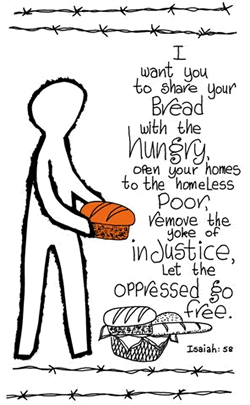
No, this is the fast that I desire: to unlock fetters of wickedness and untie the cords of lawlessness; to let the oppressed go free and break off every yoke. It is to share your bread with the hungry, and to take the wretched poor into your home; to clothe when you see the naked, and never forget your own flesh (Isaiah 58:6-7).
In a way, these two similar Isaiah passages seem to represent spiritual bookends to the High Holiday season. These characteristically prophetic calls to justice and repentance guide us through our High Holiday journey, reminding us not only of our seemingly chronic hypocrisy but also of the eternally simple route to return: “learn to do good, free the oppressed, feed the hungry…”
As many of you know, our recently organized Fast for Gaza has cited Isaiah 58 as a kind of spiritual prooftext to our initiative. As it turns out, ever since we’ve launched this project I’ve been in a kind of dialogue with more than one correspondent over this particular verse. Several people have already written to me that we’ve misinterpreted Isaiah. It appears that for some, calling a Jewish fast in support of Gazan Palestinians rather than Jewish Israelis represents a betrayal of this prophetic imperative (not to mention the Jewish people.) As one writer put it, “never forget your own flesh” means “charity begins at home.”
This criticism motivated me to do a bit of digging into the source material. As it turns out the Hebrew word for “your flesh” – b’sarcha – can indeed refer to blood relations or kin. But interestingly, according to the Brown, Driver, Briggs Biblical Dictionary (p. 142), this term can also mean “all living beings” (occurring in this usage at least 13 times throughout the Bible.)
So, in fact, there is good, solid linguistic evidence to reject this narrow, tribal reading of Isaiah. Now I’m certainly willing to admit that this passage might have referred only to fellow Israelites when it was originally written. But today we live in a fundamentally different time than the ancient Israelites. In our globalized, post-modern world, the Jewish community has become inter-dependent with others in profound and unprecedented ways. Whether we are prepared to admit it or not, our Jewish security, our Jewish destiny is now irrevocably bound up with the destiny of all peoples and nations of the world.
I am well aware that this viewpoint represents a distinctly 21st century Torah. I also have no illusions that it will be a simple matter for the Jewish community to heed this call. Having only recently emerged from the ghetto, still living with a collective memory of anti-Semitism, still reeling from the trauma of the Holocaust, it will necessitate a radical shift in consciousness to understanding our place in the world in such a way.
It will not be easy, but I believe it will be essential. It can no longer be us against them. At the end of the day, we are all one flesh.
 Shalom Rav