Category Archives: Holocaust

What Must Be Said: We All Profit from Occupations

There’s been a great deal of analysis written about German writer Gunther Grass’ now-infamous new poem, “What Must Be Said” (in which Grass criticized Israel’s nuclear program as endangering an “already fragile world peace.”)  For me, the most astute response by far comes from Mideast historian Mark LeVine, writing in Al-Jazeera.

LeVine skillfully parses the psychology and the politics behind the uproar – but it is his identification of the larger context of the issue that resonates most powerfully for me. Here’s a long excerpt from a much longer article. The entire piece is well worth reading:

Israel has always sought to portray itself as a “normal” country, yet goes out of its way to ensure no one “names it” – to use Grass’ words – as what it is, a colonial state that every day intensifies its occupation of another people’s land. And so Grass has taken it upon himself to “say what must be said”, to name Israel as what it is, a “nuclear power” that “endangers the already fragile world peace”. It’s worth noting he doesn’t even mention the occupation, which is the far greater threat to world peace.

I have no idea if Grass really believed himself to be “bound” to Israel; if he did, we can imagine the bond is broken today, at least by Israel, now that he’s banned from returning. But Grass’ feelings are not what’s interesting or important. What’s important is the larger context, all the other “facts” which refuse to be accepted as “pronounced truths”.

These facts are that Israel, however egregious its crimes – and anyone who denies them is either completely ignorant or a moral idiot – is but one cog in a much larger global machine, one that includes too many other cases of occupation, exploitation, and wanton violence to list comprehensively here (we can name a few – Syria, China, Russia, India, Sudan, Saudi Arabia, Iran, Bahrain, Uzbekistan, Sri Lanka, the Congo, and of course, NATO and the United States – whose oppression, exploitation, and murder of their own or other peoples is a far more concrete “fact” than the potential for mass destruction caused by Israel’s nuclear programme)…

The larger fact is that the global economy is addicted to war, to militarism, oil and the rape of the planet for the minerals and resources that fuel the now globalised culture of hyperconsumption that will doom our descendants to a fate we dare not contemplate. Israel’s gluttony for Palestinian territory, and its willingness to encourage a regional nuclear arms race to keep it, is ultimately no different than the the gluttony for the 60-inch TV, the iPhone/Pad, the cavernous homes and cars, the ability to live at levels of consumption that are only sustainable if most of the world lives in poverty that increasingly defines all our cultures.

Israel has gotten Palestine on the cheap, and it costs relatively little to continue the occupation. Far less than it would cost to end it. So why bother? Especially when everyone else is doing, more or less, the same thing and, it’s clear, no one really cares anymore. Germany, whose remarkable economic stability in the recent global financial crisis is in good measure due to its central role in this global economy of hyper-consumption (think of all the energy and resources that go into making and driving all those fancy German cars), is certainly playing its role all too well.

If Grass is right that we must talk about the threat to world peace posed by Israel’s nuclear programme – and far more by its ongoing occupation – then we must also talk about the threat to global peace posed by the sick global system of which Israel is merely one of the more easily identifiable symptoms. Unlike my parents, I’m happy that Germans finally feel secure enough publicly to speak critically about Israel. But if they want their words to have a chance of bringing about a change in its behaviour, they, and everyone else, needs to broaden the discourse to include their own role in enabling and profiting from the system that Israel’s actions so benefits, and the global scope of the victims it daily produces.

Of course, this discourse would require a much longer and more complex poem, written by an even better poet than Grass. If someone manages to write it, I hope it will get the same publicity as “What Must Be Said”.

Ahmed Moor on the One-State Solution

Last Thursday, Ta’anit Tzedek hosted a fascinating, stimulating conference call with Palestinian-American journalist Ahmed Moor. Moor, who was born in Gaza, has reported from Lebanon and Egypt and is currently a graduate student in public policy at Harvard.  He has been an outspoken advocate of a one-state solution in Israel/Palestine – and during our conversation he elaborated extensively on a subject not commonly countenanced in the American Jewish community.

We recorded the call and will be posting it on our website soon. In the meantime, I’ve transcribed portions of our conversation and have posted them below. Personally speaking, I find Moor’s way of thinking to be fresh and important and I believe these kinds of ideas deserve a fair hearing in our community.

On the notion that Israel must exist in order to safeguard Jewish culture:

First I want to address this idea that a Jewish state has a right to exist because Jewish culture is valuable.  Jewish culture is valuable. Hebrew culture is valuable. It is intrinsic – that’s true whether or not Newt Gingrich thinks it’s invented. But the question of whether culture needs to be mapped on a geographical space in a state environment, I think, is one that is open to discussion.

And so when we think about Jewish life here in America, I don’t know that many people would disagree with me when I say that some of the most vibrant examples of Jewish life are here in America, in the diaspora, amongst non-Jewish people. So right-wing Israelis like to make the argument that where Hitler failed, assimilation is going to succeed. Intermarriage is the biggest threat to the Jewish people, not Iran.

Well, if you believe that Israel is the homeland of the Jewish people and that it’s the only state guarding Jewish culture, well then you are in a sense aligning yourself with those arguments.  It’s illiberal, fundamentally illiberal.  We know from American experience that a multiplicity of cultures can exist alongside one another and engage with one another and strengthen one another and maybe, even yes, impact one another in positive ways.

And when it comes to Palestine and Israel, American Jews say, “Well this is kind of the homeland of the Jewish people, it’s going to preserve Jewish culture for us,” but it’s almost a relationship apt to an amusement park. “I don’t want to live there – I want to experience it for two weeks. I want to take some of the symbols home with me, but I don’t really want to engage with it in the way that I do at home.”

Well, that’s unfair. No matter how much you value Jewish culture, and no matter how much you believe Israel needs to exist for the preservation of Jewish culture, if it’s a museum, which I don’t think it is, you’ve got to realize that your cultural progress is coming at the expense of somebody else’s freedom. And I think that there’s an asymmetry there in what matters.

On the notion that Israel should exist in case another Holocaust should occur – and Israelis’ fears that a one-state solution is just a pretext for “throwing them into the sea:”

I think that first we’ve got to look at the reality today. The status quo is about expelling Palestinians from Jerusalem, their land in the West Bank, and disenfranchising them in greater ways in Israel proper…So the reality is exactly the opposite. The status quo, the two-state solution process, is about pushing the Palestinians not into the sea, but in the other direction.

First I want to address Jewish American fear, and I hear this from a lot of Jewish Americans of a certain age, when they talk about the Holocaust, which is obviously an evil, genocidal but I want to emphasize, a historical act. I had the benefit of speaking with (New York Times columnist) Roger Cohen recently, and we talked about American Jewish life and I asked him whether he feels unsafe in America. And he was unequivocal: “Absolutely not, America is safe for the Jewish people, we’re welcome here, we’re part of the people, we’re part of the cultural fabric. We are America. America is us.”

Do you ever believe as American people that there’s ever going to be something like Kristallnacht or a pogrom targeting the Jewish people in America?  If the answer is yes, well then perhaps it’s time to move to Israel – and that’s what most right-wing Israelis say. If the answer is no, well then you’ve got to realize that you are opting for the preservation of an insurance policy, but the price of that insurance policy is being borne by another people. The Palestinians are paying the cost of a Jewish American insurance policy. There’s that asymmetry again. That doesn’t work. That’s not a moral position to take and it’s unsustainable.

As for Israelis’ fear about whether we seek to ethnically cleanse them, I think there’s again a gap in perceptions of realities. The Israelis are the ones with the guns. The Israelis are the ones with the American support. When the one-state solution is actualized, it’s going to be necessarily through Israeli consent. The idea that the Middle East or Palestine has to be in any way ethnically cleansed of Jewish people is a European action transplanted onto Palestine.

On Israeli historian Gershon Gorenberg’s recent claim that a one-state solution in Israel/Palestine would create civil war à la Lebanon:

Gershon’s fear is related directly to governmental structures – the way in which you structure multi-ethnic, multi-religious societies, or sectarian societies. In Lebanon I think it was structured exactly the wrong way. In Lebanon, whether you’re liberal or you’re somebody who’s more conservative, whether you believe in one policy versus another, the state almost compels you to vote along sectarian lines.

In Lebanon the Speaker of the Parliament has to be a Shia Muslim, the Prime Minister is a Sunni and the President has to be a Maronite Christian. That’s constitutionally true – that’s mandated. And so what that means is that you end up voting – where your vote is impactful and meaningful – is in your sectarian group. The Lebanese demography there is so sensitive – they haven’t had a national census since 1932 or 33, I think.

You have the American case, on the other hand – the structure of this country is along a federal basis. Federalism enabled this country to recover from the wounds of the Civil War and to persist for another 150 – 160 years since the Civil War ended.

It’s important that we think about questions like the ones Gershon is raising, but I don’t think that those questions necessarily stand in the way of a one-state solution. So there are good federal structures, confederal structures even, for dealing with ethnic or religious strife in democracy.

What I’m thinking of specifically is a state with four federal units: the Gaza Strip, Jerusalem is its own district, sort of like Washington DC, central Israel and the Negev and finally the West Bank and the Mediterranean corridor so now you’ve got four districts and Jerusalem. And each of those federal units would be defined geographically and every one of them, with the exception of the Strip, would be made up of minorities either of Jewish people or Palestinian people.

And so in the West Bank federal state you’d have an expression mostly of Palestinian culture. Why? Because 5 out of every 6 people on the West Bank are Palestinians. In the Gaza Strip you could have an expression of Palestinian culture. In the northwestern state there’s a big minority of Palestinian Israelis, but it’s primarily Jewish. I mean we’re talking about the Tel Aviv – Haifa corridor and that would be a majority Hebrew culture state. Same with the Negev.

So you have parity amongst the states because the states are defined geographically and you enable people over time to move for personal preference reasons. Over time your could get a drift across these federal lines, kind of like what happened in the States. You used to define yourself as an American 100 years ago as a South Carolinian or a New Yorker, but today your primary locus of identity is as an American when you deal with the rest of the world. This was the failure of Lebanon – instead of geographically defining the states, the individual community boundaries within Lebanon don’t allow for that drift, so what they’ve ended up with is kind of ossified sectarian structure.

So I don’t think it will be perfect, I don’t it will be easy, but the idea is that you grant people equal rights and give them the freedom to move back and forth across borders. They won’t initially, but they will eventually. That’s been the American experience.

On the political future of the one-state solution:

I heard an Israeli speak recently, an older guy, an activist, and he mentioned the one-state solution is about where he remembers the two-state solution was in the seventies. And so it’s really about changing discourse, changing people’s thought patterns. Lots of people will come into the one-state conversation because they’ve realized the two-state solution is unworkable and that apartheid is just not something they are capable of supporting.  We’ll achieve a critical mass. It’s impossible to predict how or when, but two states isn’t going to work and apartheid isn’t going to work. And so you can arrive at this position by default even if you don’t actually believe it’s the best thing anyway.

On cultural autonomy in one democratic state:

People talk about a unitarian model where it would be just one man/one vote and I think that’s a great model to think about. My biggest concern there would be preservation of cultural autonomy, which I think many people at this stage really, really value in that part of the world. Palestinians don’t want to give up what it means to be a Palestinian and I think Jewish Israelis have developed a Jewish kind of culture. I don’t know whether its an Ashkenazic culture or a Sephardic culture, I don’t know. It’s not for me to decide. But there is an Israeli culture and I think those people want to preserve it. And when American Jewish people talk about Jewish culture in Israel, that’s something they’d like to be capable of accessing. And so I’m concerned that the unitary system may not permit the kind of cultural autonomy that many people would like.

But we’re still in the early stages of imagining what it could look like and the question of how to get there really does hinge on people of good will standing up and saying no to apartheid.

On the Palestinian right of return:

The right of return today for the Palestinians is actually about the right to be able to go back and live in Palestine. Lots of people still remember native villages which no longer exist, so the practicalities of it are difficult to map out.

The right of return for the diaspora is more about, I think, official recognition of the ethnic cleansing of Palestine in 1948 and in the period leading up to May 15 1948. It’s an official apology, reparations where appropriate and possible and just recognition. And I think the Jewish people probably understand this better than anybody. Once a historical injustice has been done to you as a people, recognition matters. Apologies matter. Reparations matter. Even symbolic measures matter a great deal.

When it comes to the practical implementation of the right of return, (Palestinian researcher) Salman Abu-Sitta has done really great work on identifying where refugees could return to.  Eitan Bronstein of Zochrot, an Israeli organization, has also done a lot of great work on the right of return…

Who do I believe will return to Palestine? I think most of us will not. The Palestinians in the diaspora have done pretty well for themselves. Palestinians in Jordan have done pretty well, the ones in Western Europe, in Latin America, in Northern America are doing pretty well. I think you could draw a direct analogy to the Jewish American diaspora. You want to go you want to visit, you want to go and hang out on the beach and go home to where you’re from.

The only missing group of Palestinian refugees who will actually return to Palestine if they have the opportunity are the 300,000 or 400,000 Palestinian refugees who live in Lebanon. Their lot really is very, very poor and the Lebanese state is racist in many ways in the way they interact with Palestinians there – it’s inexcusable, but that’s also the reality. And given the opportunity I think many of them will leave their squalid and impoverished camps and return to Palestine. But everywhere else, I think you’ll get kind of a vibrant interaction with a diaspora community and the country itself, which I think mirrors, in many ways, the Jewish experience.

Jews, Power and Privilege: A Sermon for Yom Kippur 5771

From my Yom Kippur sermon yesterday:

For matter how painful the prospect, I don’t think we can afford to dodge this question. If we agree that the inequitable distribution of power and privilege is a critical problem for us and for our world, then there will inevitably be times in which we are faced with an intensely difficult question: does tribal loyalty trump solidarity with the oppressed?

Actually, I’m coming to believe that this is not the best way to frame the question. I don’t really think it’s all that helpful to view this issue as some kind of zero-sum game; to see it as a question of tribal allegiance; to insist that I either stand with my own people or I don’t. I prefer to say it this way: that it is in my self interest as a Jew to stand in solidarity with the oppressed because I believe that Jews cannot be fully human while they benefit from a system that denies others their own humanity. For those with power and privilege, the struggle against racism and oppression is fought knowing that our own liberation is also at stake.

Click below to read the entire sermon:

Continue reading

The Supreme Sacrifice: A Sermon for Erev Yom Kippur 5771

From my Erev Yom Kippur sermon last Friday:

And as I think about it, perhaps this is why we read a Martyrology on Yom Kippur. As we remember our martyrs, we search our own souls and ask ourselves honestly: what have we done in the past year to prove ourselves worthy of these profound sacrifices? What have we done to affirm that these people did not die in vain? Did we indeed honor their memories by transforming loss into justice and hope for our world?

Click below to read the entire sermon:

A JRC member recently asked why we never do the Martyrology service on Yom Kippur. I wrote back to the congregant – and I’ll confess to you now: I’ve never been a huge fan of this particular liturgy.

Continue reading

Yom Hashoah: A Day to Affirm Universal Human Rights

I can think of no more powerful meditation for Yom Hashoah 5770 than this Huffington Post piece written by Steven Gerber and Rabbi Michael Schwartz, both of Rabbis for Human Rights.

An excerpt:

It is interesting to note how two very different sets of “responses” to the Shoah are heard frequently amongst Jews here in Israel and around the world. These two different responses reflect a shared sense of urgent necessity in responding here today because of what happened there then. At the same time they demonstrate almost opposite worldviews and understandings of Israel’s purpose, and lead toward totally inverse political perspectives and often contradictory activist involvements.

One response is that, essentially, Israel must do anything it wants or needs to do in order to defend itself from hateful enemies set on perpetrating a second holocaust by destroying both the Jewish State and the Jewish People along with it.

The other response is that precisely because of our experience as Jews in the Holocaust and through our history littered with injustice and tragedy, we ourselves must make sure that Israel of all places is a nation that stringently safeguards human rights even in the most difficult of circumstances and establishes, in the words of Israel’s Declaration of Independence, a nation that “foster[s] the development of the country for the benefit of all its inhabitants; [a nation] based on freedom, justice and peace as envisaged by the prophets of Israel.”

Indeed, both the physical and spiritual security of the Jewish People and the State of Israel is best guaranteed by the strength of Israel’s democracy and the rule of just law, its commitment to human rights, and – ultimately – to the achievement of peace.

On this day in which we recall the Jewish people’s loss of human rights, let us ensure that the Jewish state embodies these rights on behalf of all its citizens.

On this day in which we remember the tragedy of our people, may we redouble our efforts on behalf of all people who dwell on earth…

Elie Wiesel Can’t Have it Both Ways

Elie Wiesel has long walked the tightrope between pious pronouncements of universal Jewish conscience and unabashed political advocacy. He’s been trying to have it both ways for years, but it seems to me that his balancing act is becoming more and more transparent.

Last week, as Wiesel unveiled an anti-Ahmadinejad ad with other Nobel Prize laureates, he blasted the Goldstone report, calling it “a crime against the Jewish people.”  Leaving aside the issue that he took this opportunity once again to speak on behalf of the entire Jewish people, I’m still somewhat staggered that Wiesel, of all people, would use such charged Holocaust rhetoric in such a patently political manner. (I think Richard Silverstein at Tikun Olam hit it right on the head when he asked, “What was the last event in world history you can recall being a ‘crime against the Jewish people?'”)

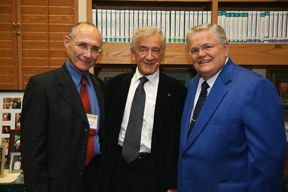
If this wasn’t enough, now I read on Max Blumenthal’s blog that Wiesel’s foundation received $500,000.00 for one speech he delivered at the church of fundamentalist Christian Zionist John Hagee (whom he referred to as “my dear pastor.”) Yes, this is the same John Hagee who publicly sermonized that Hitler was sent by God to create the Holocaust so that Jews would emigrate to Israel.  It’s simply astonishing to me that so many Jewish leaders are perfectly willing to cozy up to the likes of Hagee even after it has become so patently clear that his views are way off the rails. (That’s Wiesel, above, with Hagee, right, and Israeli minister Uzi Landau, left).

As far as I’m concerned, Justice Richard Goldstone is precisely the kind of courageous Jewish moral hero that Wiesel himself purports to be: someone committed to advocating for universal human rights even when doing so might mean holding our own community painfully to account.  As for Wiesel, I’m finding his words and actions increasingly craven. No one begrudges him his opinions – but it’s time he dropped the pretense that he’s somehow beyond the political fray.

In Memory of Howard Zinn, z”l

I’ve been reading and listening to Howard Zinn’s work since learning of his death last week – and I’m become increasingly saddened at just what we’ve lost in his passing.  Here are just a few pieces that have moved me tremendously:

– Click above to see a clip in which Zinn  shares his thoughts on human nature and aggression.

– My friend Mark Braverman has posted a powerful and important piece by Zinn on the legacy of the Holocaust. An exerpt:

I would never have become a historian if I thought that it would become my professional duty to go into the past and never emerge, to study long-gone events and remember them only for their uniqueness, not connecting them to events going on in my time. If the Holocaust was to have any meaning, I thought, we must transfer our anger to the brutalities of our time. We must atone for our allowing the Jewish Holocaust to happen by refusing to allow similar atrocities to take place now—yes, to use the Day of Atonement not to pray for the dead but to act for the living, to rescue those about to die.

– One of his many columns for The Progressive, this one published four days after 9/11:

We need to imagine that the awful scenes of death and suffering we are now witnessing on our television screens have been going on in other parts of the world for a long time, and only now can we begin to know what people have gone through, often as a result of our policies. We need to understand how some of those people will go beyond quiet anger to acts of terrorism.

We need new ways of thinking. A $300 billion dollar military budget has not given us security. Military bases all over the world, our warships on every ocean, have not given us security. Land mines and a “missile defense shield” will not give us security. We need to rethink our position in the world. We need to stop sending weapons to countries that oppress other people or their own people. We need to decide that we will not go to war, whatever reason is conjured up by the politicians of the media, because war in our time is always indiscriminate, a war against innocents, a war against children. War is terrorism, magnified a hundred times.

Our security can only come by using our national wealth, not for guns, planes, bombs, but for the health and welfare of our people – for free medical care for everyone, education and housing guaranteed decent wages and a clean environment for all. We can not be secure by limiting our liberties, as some of our political leaders are demanding, but only by expanding them.

We should take our example not from our military and political leaders shouting “retaliate” and “war” but from the doctors and nurses and medical students and firemen and policemen who have been saving lives in the midst of mayhem, whose first thoughts are not violence, but healing, not vengeance but compassion.

Zichrono Livracha – may the memory of this righteous man be for a blessing.  And may we continue his work of bearing witness through our words and deeds…

Playing Politics at Yad Vashem

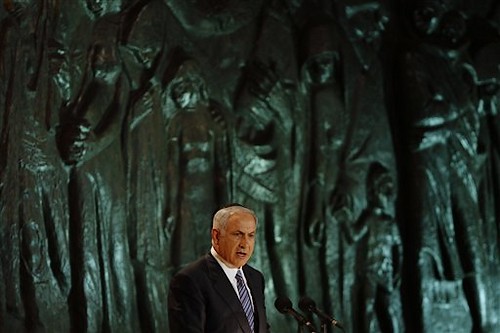
This is what I call cynically using the Holocaust for political purposes: Netanyahu recently used the opening of a new exhibit at Yad Vashem as an opportunity to denounce the Iranian regime, saying:

There is a new call to destroy the Jewish state, it’s our problem, but not only our problem. This is a crime against the Jews, and a crime against humanity, and it is a test of humanity. We shall see in the following weeks whether the international community deals with this evil before it spreads.

When I read this report, it sounded vaguely familiar – then remembered blogging about a similar comment Netanyahu made three years ago. Here’s what I wrote at the time:

Clearly Ahmadinejad’s murderous rhetoric toward Israel cannot and should not be taken lightly, and we should never minimize the threat posed by Iran’s nuclear ambitions. But we must also be very clear about what we are suggesting when we compare Ahmadinejad to Hitler and present day Iran to Nazi Germany. For what it’s worth, consider me to be one member of the organized Jewish community that finds this comparison unhelpful – and the prospect of an American or Israeli attack on Iran truly horrifying to contemplate.

Apropos of Netanyahu’s most recent comments: Ahmadinejad’s rhetoric toward Israel is definitely hateful, and is clearly designed to bait Israel and the West – but I can’t see how it possibly constitutes a “crime against humanity.”

Netanyahu’s Yad Vashem rhetoric certainly seems to indicate he’s itching to take the bait. Let’s hope the international community will see past his dangerous, wrongheaded invoking of a “second Holocaust” and deal with this crisis with intelligence and moderation.

Nurit Peled Elhanan’s Cry from the Heart

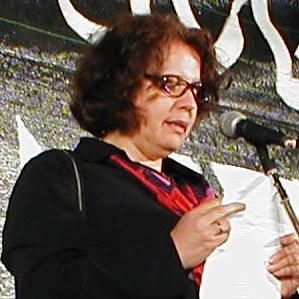
Dr. Nurit Peled Elhanan is an Israeli woman whose 13 year old daughter was killed by a Palestinian suicide bomber in 1997. Shortly after, she helped found the Bereaved Parent’s Circle, a courageous Israeli-Palestinian coexistence group about which I’ve frequently written. It’s not an exaggeration to say that over the past two decades she has become one of the most important and eloquent members of the Israeli peace activist community.

On January 2, Peled Elhanan gave an emotional speech in Tel Aviv at a rally commemorating the one-year anniversary of Israel’s military assault on Gaza. I don’t know how else to describe it but as a primal scream – a cry from deep within the reaches of her heart.  It is a gut-wrenching read, but also, in its way, enormously edifying.  More than anything else I’ve read lately, it addresses head-on the poison that has been spreading through Israel’s soul – a phenomenon many fear to be true, but few are willing to identify out loud.

Please make sure to read all the way to the end, including the footnotes, which will help you to better understand her references, as well as the Jewish soul that throughly permeates her words.

Continue reading

Judaism as Nonviolence: A Sermon for Rosh Hashanah

During my Rosh Hashanah sermon, I asked the following questions:

Is there a place in Judaism for pacifism? Is it in fact possible – or desirable – as a Jew, to walk the path of nonviolence?

Click below to read my answers…

Continue reading