Category Archives: Human Rights

“Beneath the Blindfold” and Torture’s Tragic Legacy

“Zero Dark Thirty” hasn’t come to Chicago yet, so I can’t weigh in on the controversy surrounding its portrayal of the torture in the Bin Laden raid. Having read countless articles already, however (most notably the pointed criticisms by Glenn Greenwald), I can safely say it’s going to be pretty hard for me to overcome my prejudices going in. I certainly can’t imagine feeling sanguine about a film that gives the mistaken (and dangerous) impression that torture “works.” Still, I’ll do my best to keep an open mind – and offer my thoughts after I’ve actually seen the movie.

In the meantime, if you’re looking interested in a film that accurately and powerfully explores torture’s tragic legacy, check out “Beneath the Blindfold,” a new documentary by Evanston-based independent filmmakers Ines Somer and Kathy Berger. The film follows the lives of four torture survivors – a nurse from Africa, an actor from Colombia, A US Navy veteran from Chicago, and a physician from Guatemala – and documents their journeys as they attempt to build new lives, careers, and relationships. Despite the painful fallout from their experiences, we witness each of them becoming empowered to speak out and become public advocates for an end to torture.

“Beneath the Blindfold” has been garnering rave reviews and was just voted the Best Political Documentary of 2012 by the Chicago Reader. JRC was honored to host Ines and Kathy four years ago when they showed and discussed some footage of their work in progress. Now that the film in finished, we are thrilled to screening and discussion with the filmmakers on Saturday, January 19 at 7:00, in partnership with Percolator Films. (Click here for more info.)

Click here for Ines’ and Kathy’s recent interview with Jerome McDonnell on WBEZ’s Worldview.

Marching in Solidarity: A Guest Post by Hallie Rosen

Gaza March

Guest post by Hallie Rosen

Like almost every Jew, I too have a complicated relationship with Israel.

Israel has always been an important part of my Jewish identity. Brant and I met doing Israel activism on campus at UCLA and we spent almost two years in Israel before we were married. I’ve worked in the organized Jewish community for almost twenty years, first at the Anti-Defamation League and more recently at the Illinois Holocaust Museum.

And like Brant, my views on Israel/Palestine have evolved. While I admire Brant’s courage regarding the Israel/Palestine issue, I haven’t felt completely comfortable taking the same kinds of public stands that he does. I agree with many of Brant’s viewpoints, but I admit there have been times I have felt uncomfortable with his being so public with his views – my ingrained impulse against airing Israel’s “dirty laundry.”

While I have read his blog and his book, and we have had many conversations about his activism and the general political situation in Israel/Palestine, I have never personally taken such a public stand on the issue until November 19, when I marched with Brant at a Chicago rally protesting Israel’s military actions in Gaza.

It was not a major decision on my part. I was very upset by the news out of Gaza, so when Brant invited me to join him in the march/rally, I readily agreed.  Since I work near the rally site and it took place at the end of the day, it was a simple matter to walk over and join the group as people gathered at the Federal Plaza.

My first impression was surprise at how many young families were in attendance. I expected to see primarily college age students, but I was struck by the sight of many parents with school aged children and a fair amount of strollers.  Since Brant was wearing a kippah, people knew that he was Jewish and several people came up to him to thank him for attending the rally and showing his support.  They didn’t necessarily know who he was, but it clearly meant a lot for see a Jew walk with them.  For me, it underscored that this was an issue of conscience for all peoples – not just Palestinians.

I expected to see protest posters and I braced myself for anti-Israel and anti-Jewish sentiments.  From my ADL days, I knew that these kinds of protests can easily become an opportunity for fringe elements to chant anti-Semitic slogans.

But that didn’t happen.  All of the messages were strong, but on target. As the group of about 700 people walked peaceably through the Loop during rush hour, there was chanting  but also simple non-political conversations among the marches – about shopping, uncomfortable shoes, upcoming holidays, etc.  I only saw one incident of an onlooker, who provoked some of the crowd – the police quickly subdued him and we continued on our way. As a relative newcomer, I didn’t fully feel ready to join the chanting. Perhaps I’ve not fully come to grips with what it means to be a Jew in solidarity with Palestinians.

We gathered once again after the walk to listen to speakers. Everyone was on message, asking for sanctions from the US, end of violence and settlement building, requesting a just peace, etc. When Brant spoke, he received a strong enthusiastic reception from the crowd – particularly when he was introduced as a rabbi.

As the crowd dwindled, we walked to the train station and back home. Later that night, I watched the news coverage of the rally and was surprised, at how violent the images were.  The piece included edited snippets of protestors chanting and because there were kafiyyahs and head coverings, it seemed that the news media was only interested in showing us the familiar images of “angry Arabs.”

The news report failed to convey the racial and religious diversity of the crowd – and there were none of the mothers and young children with whom I had just spent a few hours marching.  Once again I became profoundly aware of the power of stereotypes – and to a greater extent, of racism and how the images that we see on a regular basis prejudice our views and shape our opinions.

I also became aware of how important it is to step outside of one’s own comfort zone and find common cause with those whom you’ve previously assumed to be your enemy. In the end, marching for justice was for me an affirmation of our common humanity.

Upcoming “Wrestling in the Daylight” Gigs in Baltimore and DC!

This Sunday and Monday (December 2 and 3) I’ll be making a quick trip through Baltimore/DC for some “Wrestling in the Daylight” book readings. I’m looking forward to my first “Wrestling” gigs outside of my native habitat of Chicago.

On Sunday I’ll be appearing at a program sponsored by Jewish Voice for Peace – Baltimore at Space 2640, 2640 St. Paul Street at 1:00 pm (click here for the Facebook event page). That evening I’ll be in DC at Busboys and Poets on 5th and K at 8:45 pm  for reading sponsored by the DC Metro chapter of JVP.

On Monday, I’ll visit the Friends Committee on National Legislation, 245 2nd St, NE Washington (Wilson Conference Room) at 12:30 pm. And finally, I’ll speak that evening I’ll speak at St. John’s Church in Georgetown, 3240 O St. NW for a program sponsored by the Washington Interfaith Alliance for Middle East Peace.

If you live in or near the area, please drop by. I look forward to seeing you there!

American Civil Rights Leaders: End the Violence and Secure a Just Peace

Delegates on a tour led by Ruth Edmonds of the Israeli Coalition Against Home Demolitions (photo: Allie Perry)

Received from my friend and colleague Rabbi Brian Walt:

“Our lives begin to end the day we become silent about the things that matter.”

Dr. Martin Luther King, Jr.

An immediate end to Israel’s assault on Gaza, “Operation Pillar of Defense,”matters. An immediate end to the violence—the onslaught of missiles, rockets, drones, killing, and targeted assassination—matters. An end to Israel’s ongoing blockade of Gaza matters.  An end to Israeli’s 45-year occupation of Palestine matters. A resolution of the issue of Palestinian refugees expelled from their homes in 1948, many of whom live in Gaza matters.  Equality, security, and human rights for everyone matters.

We write as individuals who recently traveled to the West Bank with the Dorothy Cotton Institute’s 2012 Civil and Human Rights Delegation, organized by Interfaith Peace-Builders.  We cannot and will not be silent.  We join our voices with people around the world who are calling for an immediate cease-fire. Specifically, we implore President Barack Obama to demand that Israel withdraw its forces from Gaza’s borders; make U.S. aid to Israel conditional upon Israel’s adherence with relevant U.S. and international law; work with Israeli and Palestinian leaders to bring an end to Israel’s occupation of the Palestinian territories and to secure a just peace that ensures everyone’s human rights.

In the words of Dr. Martin Luther King, Jr., “Returning violence for violence multiplies violence, adding deeper darkness to a night already devoid of stars.”  As Prime Minister Yitzhak Rabin declared in 1993, “Enough of blood and tears.”  Enough!

We deplore the firing of rockets on civilian areas in Israel.  We also deplore and are outraged by the asymmetry, the disproportionality, of Israel’s bombardment of Gaza, evidenced by the growing number of Palestinian civilian deaths and casualties.  This is not a conflict between equal powers, but between a prosperous occupying nation on one hand, armed and sanctioned by 3 billion dollars in annual U.S. military aid, and on the other, a population of 1.7 million besieged people, trapped within a strip of land only 6 miles by 26 miles, (147 square miles) in what amounts to an open-air prison.

United States military support to Israel is huge.  From 2000 to 2009, the US appropriated to Israel $24 billion in military aid, delivering more than 670 million weapons and related military equipment with this money.  During these same years, through its illegal military occupation of the Palestinian West Bank, East Jerusalem and Gaza Strip, Israel killed at least 2,969 Palestinians who took no part in hostilities.

During our trip to the West Bank, we witnessed for ourselves the injustice and violence of the Israeli occupation and the suffering inflicted on the Palestinians, in violation of international law and UN resolutions.

In the Palestinian village of Nabi Saleh, for just one example, we observed a weekly nonviolent protest.   The neighboring Israeli settlement of Halamish was illegally built on Nabi Saleh’s land.  This settlement has also seized control of the Nabi Saleh’s water spring, allowing villagers to access their own spring water for only 7-10 hours a week.  Demonstrators of all ages participated in the protest, including several who, in recognition of the civil rights veterans in our delegation, carried posters with quotations from Dr. Martin Luther King, Jr.  We watched in horror as heavily armed members of the Israel Defense Forces (IDF) responded to this peaceful assembly with violence, strafing the demonstrators with a barrage of tear gas canisters, rubber bullets, gas grenades, and even a round of live ammunition.

The IDF assault in response to these weekly nonviolent demonstrations can be deadly.  Rushdi Tamimi, a young adult Nabi Saleh villager, died this past week while he was protesting Israel’s attack on Gaza.  The IDF fired rubber bullets into Rushdi’s back and bullets into his gut, and slammed his head with a rifle butt.

Israel’s assault on Gaza is exponentially more violent than what we witnessed in the West Bank, but the context–the oppression of the Palestinian people—is the same.  Most of the inhabitants of Gaza are refugees or descendants of refugees expelled from their homes in Israel in 1948.   This dispossession of the Palestinians that they call the Nakba (The Catastrophe) continues on the West Bank where Israel has built extensive Jewish settlements on confiscated Palestinian land. We saw with our own eyes how this settlement expansion and the systemic discrimination has further dispossessed the Palestinian people and is creating a “silent transfer” of Palestinians who are either forced or decide to leave because of the oppression.   This injustice—Israel’s decades-long oppression of the Palestinian people—has to be addressed by honest and good-faith negotiations and a genuine agreement to share the land.  The alternative is a future of endless eruptions of aggression, senseless bloodshed, and more trauma for Palestinians and Israelis. This surely matters to all people of good will.

To President Obama, we say, use the immense power and authority United States citizens have once again entrusted to you, to exercise your courage and moral leadership to preserve lives and protect the dignity and self-determination, to which the Palestinian people and all people are entitled.   Israel relies upon the economic, military, and strategic cooperation and support of the United States.  You have the power to not only appeal to Israel to show restraint, but to require it.

Feeling ourselves deeply a part of “We the People,” sharing so much of your own tradition of organizing for justice and peace, we believe it is just, moral and in keeping with the best spirit of Dr. King to urge you to:

§  Call for an end to violence by all parties and an immediate cease-fire for the sake of all people in the region.

§  Use your power to demand that Israeli Prime Minister Benjamin Netanyahu and the IDF cease the bombardment of Gaza and withdraw their armed forces immediately.

§  Join with the international community in using all diplomatic, economic, and strategic means to end Israel’s illegal, brutal siege of Gaza.

§  Insist that the United States condition aid to Israel on compliance with U.S. law (specifically the U.S. Arms Export Control Act) and with international law.

§  Work with the leaders of Israel and Palestine to secure an end to Israel’s occupation and to negotiate a just peace.

As citizens of the United States, we are responsible for what our government does in our name, and so we will not be silent.  Justice, peace and truth matter.  The future of the children of Israel and Palestine matter.  We cannot be silent and neither can you.

Members of the The Dorothy Cotton Institute 2012 Civil and Human Rights Delegation:

(List in formation)

Continue reading

Outrage in Gaza Redux

Israel’s military assault on Gaza in 2008-09 represented an important turning point in my own relationship with Israel. I recall experiencing a new and previously unfamiliar feeling of anguish as Israel bombarded the people living in that tiny, besieged strip of land over and over, day after day after day. While I certainly felt a sense of tribal loyalty to the Israelis who withstood Qassam rocket fire from Gaza, I felt a newfound sense of concern and solidarity with Gazans who I believed were experiencing nothing short of oppression during this massive military onslaught.

And now it’s happening again. Only this time I don’t think the term “anguish” quite fits my mindset. Now it’s something much closer to rage.

It’s happening again. Once again 1.7 million people, mostly refugees, who have been living in what amounts to the world’s largest open air prison, are being subjected to a massive military assault at the hands of the world’s most militarized nation, using mostly US-made weapons. And our President is not only looking on – he is defending Israel’s onslaught by saying it has a right to “self-defense in light of the barrage of rocket attacks being launched from Gaza against Israeli civilians.”

Let’s be clear: this tragedy didn’t start with the Qassams.  It didn’t start with the election of Hamas. And it didn’t start with the “instability” that followed Israel’s withdrawal from Gaza.

No, this is just the latest chapter of a much longer saga that began in 1947-48, when scores of Palestinians were ethnically cleansed from their cities and villages in the coastal plain and lower Galilee and warehoused in a tiny strip of land on the edge of the Mediterranean. By all accounts, most were simply too overwhelmed to realize what was happening. The ones who tried to return to their homes were termed “infiltrators” and were killed on sight. Others resisted by staging raids in the newly declared state of Israel. Sometimes they succeeded, more often they did not. Either way, Israel decided early on that it would respond to each of these reprisals with a overwhelming military show of force.  And those reprisals and that show of force have essentially been ongoing until this very day.

I realize, of course, there is plenty of political subtext to this latest go-around.  I’ve read the timelines and have formed my own opinions on the latest “who started it?” debate. I’ve also read plenty of analyses by Israeli observers who believe that this was not a response to Qassam fire at all but was very much a “war of choice” waged by an Israeli administration looking to shore up political support in an election season.

I’ve also read a widely circulated article from Ha’aretz about Israel’s recent execution of Ahmed Jabari (the head of Hamas’ military wing). I learned that up until now, Jabari was “Israel’s subcontractor” for security in the Gaza Strip, that Israel has been literally funding Hamas through intermediaries in exchange for peace and quiet on their southern border, and that when Jabari failed to deliver of late, the decision came down to take him out. Another article, written by the Israeli who negotiated with Jabari for the release of Gilad Shalit, revealed that negotiations were still ongoing with Jabari when the Israeli military assassinated him with a drone strike.

Yes, the wonky side of me has been avidly reading all these analyses. And while I do believe they provide an important counterbalance to the mythic statements by Israel’s Foreign Ministry and the US State Department, the more I read the cynical political subtext for this war, the sicker I get. No, this isn’t about Qassams, but don’t be fooled into thinking it’s about elections either. It’s really just the most recent chapter in a much longer litany of injustice – the latest attempt by Israel bring the Palestinians to their knees through the sheer force of their formidable military might.

Of all the analyses I’ve yet read, one of the very few that truly seemed to grasp this truth came from Yousef Munayyer, of The Jerusalem Fund/Palestine Center:

The problem Gaza presents for Israel is that it won’t go away—though Israel would love it if it would. It is a constant reminder of the depopulation of Palestine in 1948, the folly of the 1967 occupation, and the many massacres which have happened since them. It also places the Israelis in an uncomfortable position because it presents a problem (in the form of projectiles) which cannot be solved by force…

Israel has tried assassinating Palestinian leaders for decades but the resistance persists. Israel launched a devastating and brutal war on Gaza from 2008 to 2009 killing 1,400 people, mostly civilians, but the resistance persists.

Why, then, would Israel choose to revert to a failed strategy that will undoubtedly only escalate the situation? Because it is far easier for politicians to lie to voters, vilify their adversaries, and tell them ‘we will hit them hard’ than to come clean and say instead, ‘we’ve failed and there is no military solution to this problem.’

Like last time, I know many in the Jewish community will say it is unseemly of me to criticize Israel this way while Israelis live in fear of Qassam fire out of Gaza. I know there are those who believe that by writing these words, I’m turning my back on my own people in their time of need. But I know in my heart that my outrage at Israel’s actions goes hand in hand with compassion for Israelis – particularly those who know that their leaders’ devotion to the sword is leading them into the abyss.

Additionally, as I wrote under tragically similar circumstances in 2009:

I believe Israel’s response to Hamas’ missile attacks have been disproportionate and outrageous. I believe their actions only further endanger the security of  Israelis while inflicting collective punishment and a severe humanitarian crisis upon Gazans. Indeed, just as I cannot understand what it must be like to be a citizen of Sderot, I cannot even begin to imagine what it must be like to be a Gazan citizen at the moment, living under constant air attack, with no running water or electricity and dwindling food, as hospitals fill up with wounded and corpses lie rotting in the streets because relief workers are unable to reach them.

When will we be ready to accept that this is not a “balanced” conflict or even a “war” by any reasonable definition – and that it never was?  When will we face the painful truth that this is not a story about one side versus the other but about one side oppressing the other?  Frankly, all the well-meaning liberal comments about “praying for peace on both sides” and leave me cold. Worse, I find them insidious because they simply serve to support the myth that this is a conflict between two equal parties. It is not. And peace will not come until we admit this – until we admit that there is an essential injustice at the heart of this tragedy and that try as it might, Israel will never be able to make it go away through the sheer force of its increasingly massive military might.

Beyond the rage, I’m heartened that this time around there is a growing community of conscience that is speaking out publicly and in no uncertain terms to protest Israel’s latest outrage in Gaza. I am so deeply grateful for my friends and colleagues at Jewish Voice for Peace, who is alone in the Jewish world in condemning this latest assault.  I urge you to read JVP’s courageous statement, which I know gives voice to increasing numbers of Jews and non-Jews, young and old, religious and secular, who are coming together through the courage of their conscience.

At this point in my posts I would typically write “click here” to lend your voice to some kind of collective statement.  I’m going resist that temptation and urge you instead to take to the streets.

I’ll see you there.

An Open Letter to the President

Please, please read this recent blog post by my friend Abby Okrent. I will have more to write about Israel’s most recent outrages in Gaza very soon.

Dear Mr. President,

My younger brother was an early believer in you. He worked for your Senate campaign. At the age of 25, he ran the GOTV campaign in North Carolina, delivering an improbable victory for you in a Southern state that helped give you your first term. This year, slightly less bright-eyed but nonetheless a believer, he was working on your campaign again when he died suddenly, a brilliant, energetic 29 year old, dead in his tracks. You know this. You called my parents. Your campaign, to my greatest appreciation and respect, brought grief counselors for his coworkers, dedicated a corner of the office and much of your fundraising efforts to him, and bussed his coworkers to join the hundreds of others at his funeral.

You may not know that after his sudden passing, many of his friends quit their jobs, moved, changed their lives to continue working on your campaign in his memory. One of these friends ran your GOTV effort in Ohio, delivering a close swing state that resulted in the race being called for you early. My mom and I joined these efforts in Ohio, door-knocking until right before the polls closed, pounding the pavement in Alex’s memory and in hopes of your next presidency. Despite my disappointment in some of your stances, I proudly kept my Ohio for Obama sticker on my jacket.

Until yesterday. Mr. President, when the bombs began raining on Gaza again and you reiterated Israel’s “right to defend itself”, I took that sticker off my jacket. Later, you called Prime Minister Netanyahu and asked him to “use restraint,” as though he were a glutton at a feast, rather than an elected official of a powerful military nation, using your own country’s weaponry to engage in a one-sided assault. Mr. President, you are the most powerful man in the world. You do not need to politely request anything of Mr. Netanyahu; you can stop him by ending U.S. military aid to Israel until Israel complies with international and U.S. law. Mr. Netanyahu and his right-wing allies in the U.S. actively campaigned against your re-election, assuming that Governor Romney would be better positioned to give them carte blanche to violate Palestinian human rights and start regional wars. It is not to them that you now need to prove your allegiance, but to we the people who knocked doors for you, who made phone calls for you, who died getting you this 4 years more of opportunity.

My brother was an early believer in you. He knew, but disliked, that you would have to sway to right-wing Israeli interests. We watched you walk away from your Palestinian colleagues in Chicago. It became a painful issue in our Jewish family as we tried to support my brother all the while wondering how far you would go in continuing the charade that the American people and our interests, and not American money and its interests, really drove your Middle East policy. Mr. President, AIPAC’s star is fading. Not in your final term, maybe, but soon, politicians who hitch their ambitions to this tainted money will fall. You saw this at the DNC when Mayor Villaraigosa failed to get his 2/3 vote for an AIPAC-sponsored resolution but proceeded to pretend the support was still there; it’s not. My brother was an early American Jewish voice for Palestinians, but he was not alone and there are more of us than ever. And there are also Arabs now in your coalition; you saw them at the DNC in their “Yalla Vote!” t-shirts. You have a rainbow of supporters who worked to re-elect you. We voted for you. We fund-raised for you. We do not want to watch you pretend like it is for us that you allow these massacres to continue with our money.

My brother would be disappointed to see your impotence in the face of continuing Israeli aggression shortly after such a sweeping re-election victory. I am still proud of him. I am still proud of all of the Americans that worked so hard to deliver you this re-election. But I am so hurt and ashamed to watch you use restraint when you are the only person with the power to stop this massacre. Mr. President, I am barely over 5 feet tall and I am not afraid of AIPAC; why are you?

Sincerely,

A bereaved sister

Calling Israel’s Discrimination What it Is

The H-2 section of Hevron, where Palestinians must walk on separate sidewalks from Jews.

Cross-posted with the Jewish Daily Forward “Forward Thinking” Blog:

Forward columnist Philologos recently took the Israeli daily Ha’aretz to task for using the term “apartheid” in its reporting on a poll that showed most Israelis support discrimination against Arab citizens. “Apartheid” and mere discrimination are two very different things, Philologos claimed. He suggested that Ha’aretz should be censured for using such a damning epithet.

Philologos went on to define what he sees the critical difference between “apartheid” and “discrimination.” The former refers to “the systematic segregation of one people, race or group from another,” while the latter means “the systematic favoring of one people, race or group over another, such as exists in numerous countries around the world today.” And while Israel may practice regrettable discrimination against its Arab citizens, he claimed it was a “lie” to suggest that it is in any way an apartheid state.

While Philologos may be a fine linguist, his knowledge of international human rights law is sorely lacking.

Contrary to Philologos’ characterization, the term “apartheid” does not refer simply to segregation, although the term comes from a word in the South African Afrikaans language that means separate-ness or segregation. In legal terms, apartheid applies to a wide range of acts in which a dominant racial regime commits institutionalized oppression against another ethnic group.

According to the 1998 Rome Statute of the International Criminal Court, for instance, the “crime of apartheid” was included in a list of “crimes against humanity,” and defined as:

(Inhuman) acts…committed in the content of an institutionalized regime of systematic oppression and domination by one racial group over any other racial group and committed with the intention of maintaining that regime.

Earlier, in 1973, the UN’s General Assembly adopted the International Convention on the Suppression and Punishment of the Crime of Apartheid. Among the “inhuman acts” listed were:

(Any) legislative measures and other measures calculated to prevent a racial group or groups from participation in the political, social, economic and cultural life of a country.

There is certainly a compelling claim to be made that the term “apartheid” may appropriately be applied to Israel’s treatment of its Palestinian citizens. In a recent report, Adalah, an Israeli legal NGO, described no fewer than 30 laws, either enacted or proposed, that create different sets of legal rights for Jewish and non-Jewish (i.e. Palestinian) citizens of Israel.

While many Jews prefer to view Israel as an essentially healthy, if flawed, democracy, those willing to face the painful truth have long known that the so-called “democratic Jewish state” would more accurately be described as a democracy for Jews but not for non-Jews. Consider the following facts:

– Israel has no constitution that guarantees individual liberties for all. Palestinian citizens’ homes and land are regularly seized or demolished to give housing to Jews. B’tselem, an Israeli human rights organization, recently reported that the citizenship of increasing numbers of East Jerusalem residents are being revoked to make way for more land appropriation.

– There are separate schools for Palestinians and Jews. In Israeli universities, no courses are offered in Arabic, even Arabic literature. Use of Arabic in road signs is banned except in towns that the government deems Arab.

– While Jewish citizens of Israel can confer citizenship on new spouses who are not already Israeli citizens, Palestinian citizens cannot. According to the law, a Palestinian citizen of Israel who marries a Palestinian resident of the West Bank or Gaza may not reside inside Israel. The ruling literally affects the lives of thousands of couples and their precious right to marry if they so choose. In upholding this law, one Israeli Supreme Court judge conceded that Palestinian rights take a back seat to maintaining a Jewish majority in Israel. “Human rights are not a prescription for national suicide,” he wrote.

– Palestinian citizens of Israel have distinguishing characteristics on their ID cards, presumably so they can be easily identified for additional scrutiny by law enforcement agencies. Palestinians are regularly harassed, searched and asked to produce identification, based entirely on their race. While Jewish citizens are legally entitled to a speedy trial, fair legal representation and clear charges, these laws do not apply to Palestinian citizens.

There are many more examples of ways that Israel systematically privileges Jewish citizens over non-Jewish citizens. Organizations such as Adalah, B’tselem and the Association for Civil Rights in Israel have extensively documented these methods.

It is important to note that these are not simply a collection of random discriminatory laws, as Philologos would have it. Taken together, they constitute a systematic, institutional “legal” system that maintains Jews’ privileged status in the Jewish state and, most critically, seeks to ensure a Jewish demographic majority within Israel’s borders at all costs.

One telling case in point: back in 2005, Shimon Peres told U.S. officials (in a statement recently revealed by Wikileaks) that Israel had “lost” land in the Negev “to the Bedouin” and would need to take steps to “relieve” the “demographic threat”.

Flash forward to January 2012: the Israeli government approves the Prawer Plan for mass expulsion of the Arab Bedouin community in the Negev desert. When fully implemented, this plan will result in the forced displacement of up to seventy thousand Arab Bedouin citizens of Israel and the destruction of thirty-five “unrecognized” villages.

At the end of the day, it really is academic whether we choose to label this kind of policy — and many others like it — to be “discrimination,” “institutional racism” or “apartheid.”

The real question before us not what to call it. For Jews who purport to cherish human rights, the right question is: what are we willing to do about it?

Guest Post By Rabbi Brian Walt: We are Building Up a New World

Dorothy Cotton (middle) with Israeli and Palestinian Activists (Photo: Rev. Osagyefo Sekou)

Cross-posted with Rabbi Brian’s Blog

We are building up a new world, we are building up a new world,
We are building up a new world, builders must be strong.
Courage brothers don’t be weary, courage sisters don’t be weary,
Courage people don’t be weary, though the road be long.

This is one of the many songs I sang as I led a remarkable delegation of US Civil Rights movement leaders, young human rights leaders, prominent Black academics and educators and several Jewish activists that traveled through the West Bank two weeks ago.

Our delegation was a project of the Dorothy Cotton Institute, an organization dedicated to human rights education and to building a global human rights community. Dorothy Cotton served as the Director of Education of the Southern Christian Leadership Conference (SCLC) and was the only woman on the executive staff.  She led the Citizenship Education Program that empowered the disenfranchised to exercise their rights as citizens.

The goals of this historic delegation were:

– to create and build an ongoing relationship between leaders of the US civil rights movement and the leaders of the growing Palestinian nonviolent resistance movement on the West Bank and their Israeli allies;

– to increase the visibility of this movement in the US and internationally;

– to learn from one another about nonviolence, effective solidarity and social transformation;

– and to educate Americans about the role the United States plays in supporting the status quo on the West Bank.

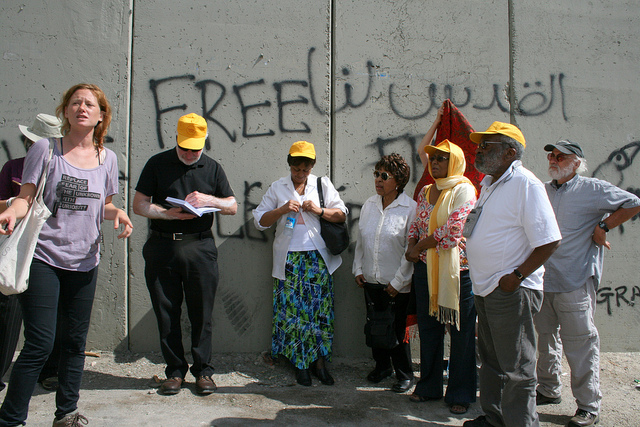
Our delegation spent two weeks on the West Bank.  We visited three Palestinian villages – Budrus, Bilin, Nabi Saleh – that have engaged for many years in a popular nonviolent struggle to reclaim land expropriated by the Israeli military.  We met several young Palestinians who are building the Coalition for Dignity, a grassroots, youth – led nonviolent movement.

And we met Israeli allies who stand in solidarity with the Palestinian nonviolent movement and who work in their own society to end militarism and human rights violations against Palestinians.  We learned from many Israeli and Palestinian nonviolent activists about their work, their vision and their dreams.

In short, our delegation saw and learned about realities that the overwhelming number of visitors to Israel never see or hear.

Singing was an essential part of the spiritual and political life of our trip.  Dorothy has a beautiful spirit, a powerful voice, and loves to sing.  Throughout the delegation, she always reminded us that singing was a critical tool for energizing the civil rights movement.  She told me,

We had songs for different occasions. We sang at mass meetings, and we sang at funerals … We sang, “I am going to do what the Spirit says do” and our singing inspired us to do just that.

And so our new civil rights delegation sang as we traveled through the West Bank.  Singing was just one powerful way in which our delegation made a connection between the Black-led struggle for civil rights in the US and the Palestinian struggle for justice, peace and security for all.

This, for instance, is the song we sang at the grave of a young man in Budrus who was killed in a nonviolent demonstration to protest the confiscation of his village’s land:

Come By here my Lord, come by here.
For our brother, my Lord, come by here.
For his courage my Lord, come by here.

Standing around the grave, delegates spontaneously composed the lyrics. It felt like we were praying, acknowledging the courage and the profound cost that the struggle for freedom demands.

We sang before we joined the weekly nonviolent demonstration in Nabi Saleh, another village on the West Bank fighting to reclaim their land.   The residents of the village had made special signs composed of quotations from Dr. Martin Luther King in honor of our visit.  “Injustice anywhere is a threat to justice everywhere” read one of the signs.

And we sang:

Ain’t going to let nobody turn me around, turn me around, turn me around.
Keep on walking, keep on talking, marching down to freedom land.

We sang to express our appreciation and to provide support after hearing activists tell us their stories – Palestinians and Israelis who told us of their amazing work and the toll it has taken on their lives, and sometimes even their spirits and souls.  One such occasion was after Israeli activist Gabi Laski told us of her work to defend children from villages like Nabi Saleh who are arrested at night.

We’re going to keep on marching forward, keep on marching forward, keep on marching forward, never turning back, never turning back.

We sang after standing next to the thirty foot high Separation Wall in Jerusalem dividing a Palestinian neighborhood in two.  And we sang on the bus as we went through a checkpoint on our way to the airport at the end of our trip, encouraged by our Palestinian guide to keep singing even when the soldier boarded our bus.  (Our bus was pulled aside for a security check because it was a Palestinian bus while Israeli buses and motorists were waved through the checkpoint).

We returned to the United States both inspired and disturbed by our experience.  We were inspired by the determination, vision and commitment of so many Palestinians and their Israeli allies, working tirelessly day after day, year after year, often at great personal and communal cost, for justice, freedom and equality for all.  Now that we are home, we look forward to sharing the stories and vision of these courageous civil rights activists with our friends and communities.

But our trip was not simply inspiring.  It was profoundly disturbing to witness the harsh realities of life on the West Bank that are so invisible to the discourse in America.  Every day we saw and heard about a systematic denial of human rights in countless ways: land confiscation, extensive restrictions on movement, humiliation at check points, home demolition, the arrest of children, the revocation of residency permits and many other violations.

The delegates were profoundly shocked. Several American civil rights veterans  commented that the discrimination, humiliation and injustice they witnessed was “frighteningly familiar.”

While we were on the West Bank the two presidential candidates tried to outdo one another in their public declarations of support for Israel in the final presidential debate.  They mentioned Israel 31 times with only one passing reference to Palestinians.  The contrast between American policy and what we witnessed is stark.  Now that we have returned, we are determined to share this disturbing reality with our communities; to challenge the ways in which our country funds, provides diplomatic cover, and enables these injustices.

I have visited the West Bank before but never for more than a day or two, and almost always with progressive Israeli groups.  On this visit, however, we spent virtually all out time in the West Bank – on the other side of the Separation Wall.  For me personally, it was a transformative experience.  It was a privilege to travel with such a special group of people and to see the profound impact of our delegation on the activists that we met.

Before we left on our journey, I was struck by a comment made by Dr. Vincent Harding, a close associate of Dr. Martin Luther King, a person with a long history of involvement in the struggle for freedom and a very close life-long connection to Jewish teachers, fellow travelers and co-workers.  Dr. Harding talked about “encouragement” as one of his primary goals for the trip.  I was struck by the word and the simple power of his intention.  He wanted to meet activists on the West Bank and to “encourage” them.

And that is exactly what happened. The people we met commented how encouraged they felt by meeting people who had spent their entire lives fighting for freedom in the US.  Dr. Harding and others would repeatedly ask all our presenters to tell us about themselves, their families and what motivated them to do what they were doing.

He and others always shared how much he appreciated their work and how important it was for all of us and for our collective future.  After hearing an inspiring talk by Fadi Quran, one of the young leaders of the Palestinian nonviolent movement, Dr. Harding said, “Fadi, I want to tell you how proud I am and how grateful I am for you, and want to encourage you to keep on going.”

It felt like we were building a new world.  On the very first day of our trip, Dorothy Cotton sang and danced with three women activists, Israeli and Palestinian, who had spoken to us. It was a joy to see the profound gift she was giving them and that they were giving her in return. Those who had spent their lives building a new world in America were creating a relationship with those who were building a new world in Israel/Palestine.

Towards the end of the trip we realized that we were just beginning to build a new world in another way by creating a new possibility for the relationship between Jews and Blacks in our own country.   Historically, Israeli policy has been a source of tension between the African American and Jewish communities.  While many African Americans on the delegation have deep and positive connections to Jews, it is often difficult for Blacks and Jews to have honest conversations about Israel.

There were eight Jews on this delegation.  On this trip we joined together as a group of Blacks, Jews, Christians and people with varied faith commitments, united in our commitment to nonviolence and our dedication to justice, freedom and equality in Israel/Palestine, in our own country, and around the world.  We are renewing an alliance between Blacks and Jews, an alliance rooted in our shared values.

We are building up a new world, we are building up a new world.
We are building up a new world, builders must be strong.
Courage brothers don’t be weary, courage sisters don’t be weary,
Courage people don’t be weary, though the road be long.
Rabbi Brian Walt: Christian Leaders Cannot be Cowed into Silence

Please read my friend Rabbi Brian Walt’s new piece in Ha’aretz. He has recently returned from a remarkable interfaith delegation to the West Bank; I will be posting more of his writings about his experiences in the near future.

In his recent Haaretz op-ed, “Heading toward an irreparable rift between U.S. Jews and Protestants,” my colleague, Rabbi Eric Yoffie, sharply criticized the recent letter to Congress by leaders of Protestant churches that called for U.S. military aid to Israel to be contingent on Israeli compliance with American law. Nowhere in his article, however, did Yoffie mention the central concern of the Christian leaders’ letter: the overwhelming evidence of systematic human rights violations by the Israeli military against Palestinians.

Over the past two weeks, I had the privilege of leading an interfaith delegation including several leaders of the civil rights movement, younger civil and human rights leaders, Christian clergy, academics, and several Jews, on a two-week trip to the West Bank.

We were all shocked by the widespread human rights violations that we saw with our own eyes and that we heard about from both Palestinians and Israelis. Several black members of our group, including those who participated actively in the civil rights movement, remarked that what they saw on the West Bank was “frighteningly familiar” to their own experience, a systemic pattern of discrimination that privileged one group (in this case, Jews) and denigrated another (Palestinians).

Continue reading

American Christians Dare to Speak Their Conscience on Israel/Palestine

My recent op-ed for the Jewish Telegraphic Agency:

CHICAGO (JTA) — There has long been an unwritten covenant between the Jewish establishment and Christian leaders when it comes to interfaith dialogue: “We can talk about any religious issues we like, but criticism of Israel’s human rights violations is off limits.”

Over the past few weeks, we’ve painfully witnessed what can happen when Christians break this covenant by speaking their religious conscience.

Continue reading