Category Archives: Human Rights

Why I’m Presenting at Harvard’s One-State Conference

The Harvard Kennedy School is hosting a “One State Conference” this weekend and already the usual suspects are crying foul. Since I’m going to be speaking on a panel at the conference on Sunday, I thought it might be a good idea to weigh in with some thoughts.

I’ll begin with the stated vision/goals of the conference, according to student organizers:

To date, the only Israel/Palestine solution that has received a fair rehearsal in mainstream forums has been the two-state solution. Our conference will help to expand the range of academic debate on this issue. Thus, our main goal is to educate ourselves and others about the possible contours of a one-state solution and the challenges that stand in the way of its realization.

Sound reasonable? Not according to self-appointed Jewish community watchdogs like the ADL and NGO Monitor and the ubiquitous Alan Dershowitz and Jeffrey Goldberg.  According to the ADL, such a conference could only be interested in “the elimination of Israel as the national homeland of the Jewish people.”  Dershowitz referred to it as an “anti-Israel hate fest.” Goldberg thinks organizers share “a goal with Hamas: the elimination of Israel as a homeland and haven for Jews.”

Reading incendiary words such as these, I can’t help but be struck by the abject hysteria that gets regularly mistaken for public relations by the American Jewish establishment.

I find it fascinating that these concerned institutions and individuals are more than willing to rail against the wide eyed extremists and useful idiots participating in this conference, yet cannot take the time to ponder what might have brought us to this point in the first place.  Has Abe Foxman, for instance, ever called out Israel over its settlement policy that has by now made a mockery of a viable two-state solution?  Is Alan Dershowitz willing to bring half as much righteous anger to the concern that Israel is fast creating “one state” all by itself?

I wrote recently about the “ever-closing window” on the two state solution. We might still argue about whether or not the window has closed yet, but I think we can all agree that the prospect for a viable, equitable two state solution for Israel/Palestine is in serious jeopardy.

As I pointed out in my post, sooner or later we’ll be forced to choose between a patently undemocratic Jewish state that parcels out rights according to ethnicity and a democratic state in which equal rights are enjoyed by all its citizens. Given this scenario, is it unreasonable that people of good will seek to open conversations and suggest fresh, creative approaches that might ensure a better future for Israelis and Palestinians?

It’s even more ironic when you consider that notable and respected Israeli figures have been discussing a potential one state solution for some time. While the American Jewish establishment grows apoplectic at the very thought, Israeli society seems more than secure enough to tolerate the discussion.

As far back as 1991, for instance, respected Israeli/American political scientist Daniel J. Elazar promoted a one-state “federal solution” for Israel/Palestine (most notably in his book, “Two Peoples – One Land: Federal Solutions for Israel, the Palestinians, and Jordan.”) Meron Benvenisti, an Israeli political scientist who was Deputy Mayor of Jerusalem under Teddy Kollek from 1971 to 1978, has publicly advocated the idea of a bi-national state for several years. A more recent Israeli advocate of one state is Avrum Burg, former Speaker of the Knesset and chairman of the Jewish Agency, who wrote about the subject in a widely read 2011 op-ed in Ha’aretz.

It is even less widely-known in the American Jewish community that prominent numbers of the Israeli right wing, such as former Minister of Defense and Foreign Minister Moshe Arens and current Speaker of the Knesset Reuven Rivlin, have suggested the desirability of some form of a one-state solution. Granted, the solution advocated by Arens and Rivlin – an undivided state that nonetheless retains it’s exclusively Jewish character – differs significantly from the federalist or bi-national models promoted by Elazar, Benvenisti and Burg. Still, I believe these unlikely bedfellows share critical aspects in common: the conviction that a two-state solution is unworkable, a willingness to pursue fresh creative ideas, and – contrary to what many might claim – a hard-headed political realism.

Many of the conference’s critics have pointed out that secular multi-ethnic states simply do not work. Goldberg claims that it “barely works” in Belgium and Dershowitz points out that it failed in India and the former Yugoslavia.  Fine. If this is the criticism, then let’s put this issue on the table and discuss it – as we most certainly will be doing this weekend (most likely at the panels entitled “Nationhood and Cultural Identity: The Preservation of the Peoples” and “What are the Obstacles to the Realization of a One-State Solution?”) But must we seek to marginalize the conference for simply seeking to have the conversation?

There are also criticisms that the conference is too “one sided” and that the presenters are unduly “biased.”  In truth, the presenters in the conference represent a spectrum of opinions on this issue. Some (like Ali Abunimah) have openly advocated a one state solution, others (such as Stephen Walt) support a two state solution and some (like me) are agnostic on the issue.  But I know many of the presenters personally and have long admired many more. Contrary to the venom being slung their way, these are thoughtful – if sometimes controversial – people of good will.  While we are a diverse lot, I believe we share a common desire to broaden this scope of conversation and an eagerness to bring fresh new thinking to a painful and paralyzed status quo.

The student organizers of the conference have released an open letter to their critics. Here’s an excerpt:

The aim of this conference is to explore the possibility of different solutions to the Israeli-Palestinian conflict. Invoking inflammatory language like “anti-semitism” and “destruction of Israel” to describe the ideas and speakers of the conference is not only incorrect and defamatory but serves to prevent rational discussion of ideas and preempt the effective exercise of speech.

I look forward to reporting on my experiences at the conference.

I Support the Presbyterian Church (USA) Divestment Resolution

As a Jew, a rabbi and a person of conscience, I am voicing my support of the divestment resolution being brought to the General Assembly of the Presbyterian Church (USA) this June.

This resolution, which has been a point of divisive contention between the PC (USA) and some American Jewish organizations for many years,  recommends that the Church divest its funds from Caterpillar, Motorola and Hewlett-Packard. It was put forth by the church’s committee on Mission Responsibility Through Investment – an appointed body that recommended church divestment of companies engaged in “non-peaceful pursuits in Israel/Palestine.”

There is a long and tumultuous history to this resolution – here’s a basic outline:

– In 1971 and 1976 the Presbyterian Church stated that it had a responsibility to ensure that its funds be invested responsibly and consistent with the church’s mission.

– In 1986, the PC (USA) formed the Committee for Mission Responsibility Through Investing (MRTI) in 1986. The MRTI Committee carried out the General Assembly’s wish to engage in shareholder activism and as a last resort, divest itself of companies which contravened the GA’s position. Divestment would follow a phased process starting with attempted dialogue and shareholder resolutions and ultimately the total sale of and future ban on the church’s holdings in a company.

– In June 2004, the PC (USA) General Assembly adopted by a vote of 431-62 a resolution that called on the MRTI Committee “to initiate a process of phased, selective divestment in multinational corporations operating in Israel.” The resolution expressed the church’s support of the Geneva Accord, said that “the occupation . . . has proven to be at the root of evil acts committed against innocent people on both sides of the conflict,” that “the security of Israel and the Israeli people is inexorably dependent on making peace with their Palestinian neighbors”, that “horrific acts of violence and deadly attacks on innocent people, whether carried out by Palestinian suicide bombers or by the Israeli military, are abhorrent and inexcusable by all measures, and are a dead-end alternative to a negotiated settlement,” and that the United States government needed to be “honest, even-handed broker for peace.”

– In 2005, MRTI Committee named five US-based companies – Caterpillar Inc., Citigroup, ITT Industries, Motorola and United Technologies – for initial focus and that it would engage in “progressive engagement” with the companies’ management.

– In 2006, following an uproar of criticism from American Jewish organizations, the PC (USA) General Assembly overwhelmingly (483-28) replaced language adopted in 2004 that focused the “phased, selective divestment” specifically on companies working in Israel.  It now called for investment in Israel, the Gaza Strip, eastern Jerusalem and the West Bank “in only peaceful pursuits.” The new resolution also required the consideration of “practical realities,” a “commitment to positive outcomes” and an awareness of the potential impact of strategies on “both the Israeli and Palestinian economies.”  The 2006 resolution also recognized Israel’s right to build a security barrier along its pre-1967 boundaries. The GA acknowledged the “hurt and misunderstanding among many members of the Jewish community and within our Presbyterian communion” that resulted from the 2004 resolution and stated that the Assembly was “grieved by the pain that this has caused, accept responsibility for the flaws in our process, and ask for a new season of mutual understanding and dialogue.”

The most recent resolution is the result of this new process and now focuses on three of the original six companies under consideration.  From the PC (USA) website:

The General Assembly Mission Council (GAMC) is recommending that the upcoming 220th General Assembly of the Presbyterian Church (USA) divest the church of its stock in three companies “until they have ceased profiting from non-peaceful activities in Israel-Palestine.”

The three companies are Caterpillar, Motorola Solutions and Hewlett-Packard.

At issue are their participation in the Israeli occupation of the West Bank, the construction of the “security barrier” between Israel and Palestinian territory, and the destruction of Palestinian homes, roads and fields to make way for the construction of Israeli settlements in the West Bank, which have been declared illegal under international law.

“We have run out of hope that these companies are willing to change their corporate practices [in Israel-Palestine],” said the Rev. Brian Ellison, a Kansas City pastor and chair of the denomination’s Mission Responsibility Through Investment Committee (MRTI). “We have made diligent effort to engage in conversation. We’d like to do more, to make progress, but substantial change does not seem possible.”

As stated above, I support this resolution without reservation and urge other Jewish leaders and community members to do so as well. I am deeply dismayed that along every step of this process, Jewish community organizations (among them, the Anti-Defamation League, the Simon Wiesenthal Center and the Jewish Council on Public Affairs) that purport to speak for the consensus of a diverse constituency have been intimidating and emotionally blackmailing the Presbyterian Church as they attempt to forge their ethical investment strategy in good faith.

It is extremely important to be clear about what is at stake here. First of all, this is not a resolution that seeks to boycott or single out Israel. Divestment does not target countries – it targets companies.  In this regard speaking, the PC (USA)’s ethical investment process seeks to divest from specific “military-related companies” it deems are engaged in “non-peaceful” pursuits.

We’d be hard-pressed indeed to make the case that the Israeli government is engaged in “non-peaceful pursuits” in the Occupied Territories and East Jerusalem.  I won’t go into detail here because I’ve been writing about this tragic issue for many years: the increasing of illegal Jewish settlements with impunity, the forced evictions and home demolitions, the uprooting of Palestinian orchards, the separation wall that chokes off Palestinians from their lands, the arbitrary administrative detentions, the brutal crushing of non-violent protest, etc, etc.

All Americans – Jews and non-Jews alike – have cause for deep moral concern over these issues.  Moreover, we have cause for dismay that own government tacitly supports these actions. At the very least, we certainly have the right to make sure that our own investments do not support companies that profit from what we believe to be immoral acts committed in furtherance of Israel’s occupation.

As the co-chair of the Jewish Voice for Peace Rabbinical Council, I am proud that JVP has initiated its own divestment campaign which targets the TIAA-CREF pension fund, urging it to divest from companies that profit from Israel’s occupation. Among these are two of the three companies currently under consideration by PC (USA): Motorola and Caterpillar.

Why the concern over these specific companies? Because they are indisputably and directing aiding and profiting the oppression of Palestinians on the ground. Caterpillar profits from the destruction of Palestinian homes and the uprooting of Palestinian orchards by supplying the armor-plated and weaponized bulldozers that are used for such demolition work.  Motorola profits from Israel’s control of the Palestinian population by providing surveillance systems around Israeli settlements, checkpoints, and military camps in the West Bank, as well as communication systems to the Israeli army and West Bank settlers.

And why is Hewlett-Packard under consideration for divestment by the PC (USA)? HP owns Electronic Data Systems, which heads a consortium providing monitoring of checkpoints, including several built inside the West Bank in violation of international law.  The Israeli Navy, which regularly attacks Gaza’s fishermen within Gaza’s own territorial waters and has often shelled civilian areas in the Gaza Strip, has chosen HP Israel to implement the outsourcing of its IT infrastructure.  In addition, Hewlett Packard subsidiary HP Invent outsources IT services to a company called Matrix, which employs settlers in the illegal settlement of Modi’in Illit to do much of its IT work at low wages.

I repeat: by seeking to divest from these companies the PC (USA) is not singling out Israel as a nation.  The Presbyterian Church has every right to – and in fact does – divest its funds from any number of companies that enable non-peaceful pursuits around the world.  In this case specifically, the PC (USA) has reasonably determined that these particular “pursuits” aid a highly militarized, brutal and oppressive occupation – and it simply does not want to be complicit in supporting companies that enable it.

I am fully aware that there are several organizations in the Jewish community that are already gearing up a full court press to intimidate the PC (USA) from passing this resolution in June.  JCPA President Rabbi Steve Gutow recently accused national Presbyterian leaders of “making the delegitimization of Israel a public witness of their church.” The Simon Wiesenthal Center has called the resolution “poisonous,” and that by considering it the PC (USA) is “showing its moral bankruptcy.”

These sorts of statements do not speak for me nor, I am sure, do they speak for the wide, diverse spectrum of opinion on the issue in the American Jewish community.  There is no place for public bullying in interfaith relations – it is, needless to say, decidedly counter to principles of honest, good faith dialogue.  To our Presbyterian friends: please know there are many Jewish leaders who stand with you as you support the cause of peace and justice in Israel/Palestine.

In a recent open letter to the PC (USA), Rabbi Margaret Holub, my colleague on the JVP Rabbinical Council expressed this sentiment eloquently with the following words:

Your Church has long been active in pursuing justice and peace by nonviolent means, including divestment, in many places around the world.  As Christians, you have your own particular stake in the land to which both our traditions have long attachments of faith and history.  We particularly acknowledge the oppression of Palestinian Christians under Israeli occupation and the justice of your efforts to relieve the oppression directed against your fellows.

To advocate for an end to an unjust policy is not anti-Semitic.  To criticize Israel is not anti-Semitic.  To invest your own resources in corporations which pursue your vision of a just and peaceful world, and to withdraw your resources from those which contradict this vision, is not anti-Semitic.  There is a terrible history of actual anti-Semitism perpetrated by Christians at different times throughout the millennia and conscientious Christians today do bear a burden of conscience on that account.  We can understand that, with your commitment to paths of peace and justice, it must be terribly painful and inhibiting to be accused of anti-Semitism.

In fact, many of us in the Jewish community recognize that the continuing occupation of Palestine itself presents a great danger to the safety of the Jewish people, not to mention oppressing our spirits and diminishing our honor in the world community.  We appreciate the solidarity of people of conscience in pursuing conscientious nonviolent strategies, such as phased selective divestment, to end the occupation.

I am proud my name is under this letter, alongside many other members of our Rabbinical Council. If you stand with us, please join us in supporting the PC (USA) divestment resolution at their GA in Pittsburgh this summer.

Report: Khader Adnan Ends Hunger Strike

Israeli officials announced today that they have reached a deal with Khader Adnan. According to reports, they will not extend his administrative detention beyond his current term, which ends on April 17.  It has been also reported that he will end his hunger strike, although it has not yet been confirmed that he has accepted Israel’s terms.

Ofir Gendelman, a spokesperson for the Israeli Prime Minister’s office said “if there’s no new evidence against him, he will be released from custody on April 17,” adding that Adnan is also a “dangerous terrorist.”

No new evidence?  Does this mean that their current “evidence” is not sufficient to keep him in prison? Could there be any clearer proof that Israel has no case against Khader Adnan (and who knows how many hundreds of additional detainees?)

This deal only underscores the inherent injustice of Israel’s administrative detention policy – one that makes a mockery of democracy and due process.

Tent of Nations Told to Stop Working its Own Land – Be Ready to Act!

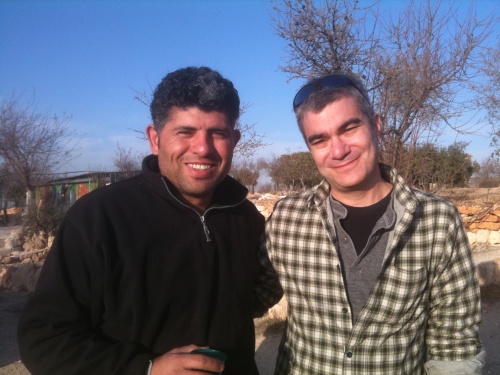
Friends of Tent of Nations has just shared this upsetting letter from Daoud Nasser (above left):

Dear Friends,

Today, the 14th of  February at 1.30 PM and as we were working on our land, specifically in the tree of life orchard, we found on three different places ,  papers with maps signed by the civil administration of Judea and Samaria which is the Israeli military government.

The papers say that we have to stop working  on the land specified on the map, because they declared it as a state land. According to them, this land doesn’t belong to us but it is a state land and we are cultivating it. The papers also say  that if we want to challenge this order, we can appeal against it within 45 days in front of the military representative office.

It is a shock to receive something like that after 21 years of legal battle defending our land and the right to it in front of Israeli courts.

We sent those papers to our attorney in Jerusalem and he is going to appeal against it within the next days.

This is just to inform you about what happened today, please be aware that the situation might get worse, please be prepared in case actions are needed. In the meanwhile, our attorney will appeal against it and we will see what kind of reaction we receive”

We will keep you updated and will inform you about our next steps and how you can help.

Thank you so  much for your support and solidarity. Please keep us in your thoughts and prayers.

Blessings and Salaam.

Readers of my blog should be well acquainted with my friend and personal hero Daoud Nasser. Last year I wrote about Tent of Nations and my visit, together with twenty JRC congregants, with Daoud on his family farm.

This new development is just the latest in a long history of harassment courtesy of the military administration in the West Bank – an institution that provides the shameful “legal” cover for Israel’s outright theft of Palestinian lands. Please stand by – I will forward any further news from Daoud and let you know how you can act on his behalf.

Hunger Striker Khader Adnan is Near Death

Palestinian hunger striker Khader Adnan is near death.

Adnan, a 33-year-old Palestinian, has been on a hunger strike since December 18 after he was arrested in a nighttime IDF raid on his home in the village of Arraba, Jenin.   Khader has been held without trial and charged, without any evidence presented, of affiliation with Islamic Jihad.

Yesterday, an Israeli military court rejected Khader’s appeal.  In his decision, Judge Moshe Tirosh disregarded Khader’s lawyers’ numerous arguments, including the lack of evidence that Khader Adnan has carried out any activities providing grounds for detention; that administrative detention is used in an arbitrary manner; and that affiliation to a political party is aligned with the right to freedom of expression, assembly and political association.

Judge Tirosh further dismissed Khader’s claim that he was subjected to torture, inhuman and degrading treatment while in custody, adding that only Khader is to blame for his physical health deterioration and that his grave medical condition will not influence the court’s administrative detention decision.

And so Khader remains chained to his hospital bed by Israeli authorities, despite warnings that his death is essentially imminent. Human Rights Watch has called upon Israel to “immediately charge or release” Adnan – a demand Israel stubbornly continues to refuse.

Khader Adnan is but one of thousands of Palestinian prisoners being held in Israel’s practice of arbitrary imprisonment  According to a January 1 report by Addameer, a Palestinian Prisoner Support and Human Rights NGO, there are currently 4417 Palestinians held as political prisoners, 310 of whom are being held in “administrative detention” without trial or formal charge.

In a recent op-ed, Ali Abunimah notes the appalling silence of the international community over Khader Adnan’s hunger strike – and Israel’s egregious practice of administrative detention in the West Bank:

Khader Adnan’s struggle reminds us that nonviolence is not the easy choice. It is often the harder one.

Yet the world is still failing to act. The Palestinian prisoner’s group Addameer undoubtedly spoke for many when it declared that it “holds the international community responsible for not taking action to save Khader’s life.” It demanded “that the European Union, the United Nations and the International Committee of the Red Cross intervene with Israel immediately before it is too late.”

And there has been silence too from prominent voices such Nick Kristof, the New York Times columnist famous for using individual stories to draw attention to human rights abuses around the world. In a 2010 column titled “Waiting for Gandhi,” Kristof scolded Palestinians for not adopting nonviolent tactics.

Of course Kristof was ignoring or simply ignorant of the rich history and present of such popular resistance in Palestine… Last Autumn hundreds of Palestinian prisoners spent weeks on hunger strike against punitive Israeli prison conditions, and many are on hunger strike now in solidarity with Adnan.

But if Kristof and others claim to be “waiting for Gandhi” why haven’t they spoken up for Adnan? After all it was Mahatma Gandhi himself who when repeatedly imprisoned by the British famously used hunger strikes to draw international attention to his people’s cause.

BTW: readers of this blog may remember the heartbreaking post I shared last December by Palestinian businessman Sam Bahour, who described the plight of his dear friend Walid Abu Rass.  Abu Rass, Finance and Administration Manager for Health Work Committees (HRW) – one of the largest community health service providers in the occupied Palestinian territory – was taken from his home in front of his wife and two daughters at 1:30 am on November 22.

Here’s Addameer’s update on Walid’s situation:

Walid’s administrative detention (hearing) took place in two phases. In the first session, the military judge allowed Walid and his lawyer to be present in court with the prosecution. The second session was a closed session, during which Walid and his lawyer were not allowed to be present while the judge read the classified material on which his administrative detention is supposedly based. The judge claimed that this material contains trusted information that Walid is an activist in the Popular Front for the Liberation of Palestine (PFLP) and that administrative detention is the “only way to prevent the danger posed by the detainee.”

When the judge confirmed his administrative detention order on 1 December, Walid’s lawyer filed an appeal, emphasizing that Walid is an employee in a humanitarian institution providing necessary medical services to many individuals and that his detention negatively affects his work and beneficiaries. He noted that Walid’s previous arrests were also all based on classified material and vague reasoning and that there was never any proof or official charges made regarding his alleged PFLP activity. The appeal was rejected by the judge on 15 January 2012.

Addameer believes that Walid’s detention is also connected to his work with the HWC and their support of the prisoners’ hunger strike launched on 27 September. The HWC actively coordinated solidarity events and other support of the prisoners during their 22-day hunger strike. Furthermore, as the hunger strike was initially launched by PFLP members in prison, this affiliation may cast light on why Walid has been accused by the military judge of being active in the PFLP.

Click here to sign a petition urging the International Committee of the Red Cross to take active steps to save Khader Adnan’s life “by applying pressure on the Israeli government to release him.”

Baylor’s “Investigation” of Prof. Marc Ellis – The Plot Thickens

In a post last November, I implored readers to support the cause of Jewish Studies Prof. Marc Ellis, who is currently being investigated by Baylor University’s new Prez Ken Starr in what increasingly looks like an unabashedly political house cleaning. Well, the plot is thickening.

According to this very thorough investigative report in Religion Dispatches, Ken Starr (yes, that Ken Starr) in interested in transforming Baylor into a major player in the Big 12 conference – and attracting major money from conservative Christian sources. Needless to say, a brave and outspoken academic such as Marc Ellis stands in the way of Starr’s grand plans.

The upshot:

“With Ken Starr as the president now, Baylor is really looking to clean house,” one faculty member, who spoke on condition of anonymity, told RD. “Finally they have a president who is accessible to the broader business community and can bring in lots of money.” In his first year at Baylor, Starr raised nearly $35 million of the $100 million 3-year goal he’d set upon arrival…

“I think there is big money behind it,” hypothesized another faculty member. “I don’t think the [local] Jewish community is driving this—like ‘get rid of Ellis and we’ll give you money’—but I do think it would open up possibilities.” Remaking Ellis’ Center for Jewish Studies into a “pro-Israel” center, the faculty member added, could help Baylor attract grants and donations at a national level. “Marc is just in the way.” Given the growing popularity of Christian Zionism in the U.S., it’s just as likely, if not more so, that conservative Christian donations might be easier to elicit with Ellis out of the way.

In the meantime, the Middle East Studies Association has just issued a strongly worded letter of support for Prof. Ellis. If you would like to voice your support as well, click here.

New Report on Israel’s Abuse of Palestinian Children

I strongly encourage you to read Guardian reporter Harriet Sherwood’s devastating new piece, which investigates allegations of human rights abuse of Palestinian children inside Israel’s Al Jalame prison.

I’m already anticipating the angry comments I invariably get when I share this kind of information. But what else should I do?  As an American Jew, what else am I supposed to do with the news that that Israel – the Jewish state, the “only democracy in the Middle East” and America’s “special ally” – is abducting, abusing and torturing Palestinian children?

I don’t know anything else to do but to bring this information into the light of day, urge you to share it, and encourage you to voice your outrage to your elected leaders.

Here’s the start of the article:

The room is barely wider than the thin, dirty mattress that covers the floor. Behind a low concrete wall is a squat toilet, the stench from which has no escape in the windowless room. The rough concrete walls deter idle leaning; the constant overhead light inhibits sleep. The delivery of food through a low slit in the door is the only way of marking time, dividing day from night.

This is Cell 36, deep within Al Jalame prison in northern Israel. It is one of a handful of cells where Palestinian children are locked in solitary confinement for days or even weeks. One 16-year-old claimed that he had been kept in Cell 36 for 65 days.

The only escape is to the interrogation room where children are shackled, by hands and feet, to a chair while being questioned, sometimes for hours.

Most are accused of throwing stones at soldiers or settlers; some, of flinging molotov cocktails; a few, of more serious offences such as links to militant organisations or using weapons. They are also pumped for information about the activities and sympathies of their classmates, relatives and neighbours.

At the beginning, nearly all deny the accusations. Most say they are threatened; some report physical violence. Verbal abuse – “You’re a dog, a son of a whore” – is common. Many are exhausted from sleep deprivation. Day after day they are fettered to the chair, then returned to solitary confinement. In the end, many sign confessions that they later say were coerced.

These claims and descriptions come from affidavits given by minors to an international human rights organisation and from interviews conducted by the Guardian. Other cells in Al Jalame and Petah Tikva prisons are also used for solitary confinement, but Cell 36 is the one cited most often in these testimonies.

Between 500 and 700 Palestinian children are arrested by Israeli soldiers each year, mostly accused of throwing stones. Since 2008, Defence for Children International (DCI) has collected sworn testimonies from 426 minors detained in Israel’s military justice system…

Human rights organisations say these patterns of treatment – which are corroborated by a separate study, No Minor Matter, conducted by an Israeli group, B’Tselem – violate the international convention on the rights of the child, which Israel has ratified, and the fourth Geneva convention.

Light One More Candle for Gaza

It’s the last day of Hanukkah and the third anniversary of Israel’s devastating military assault on Gaza. Although we are technically finished lighting candles, I’d like to suggest lighting one more tonight in commemoration of this tragic anniversary.

To this end, please read the post below, slightly adapted from a piece co-written by myself and Rabbi Alissa Wise for the JVP Rabbinical Council’s new blog, Palestinian Talmud:

On the morning of December 27, 2008, the sixth day of Hanukkah, Israel initiated a massive military assault against Gaza it called “Operation Cast Lead.”  The name of the operation was a reference to a popular Hanukkah song written by the venerable Israeli poet Chaim Nachman Bialik:  “My teacher gave a dreidel to me/A dreidel of cast lead.”

When Israel’s military actions ended on January 18, some 1,400 Palestinians had been killed. Among the dead were hundreds of unarmed civilians, including some 300 children.

Tonight begins the last day of Hanukkah—and we pause today to remember the lives lost three years ago, and the devastating blockade that continues to this day. Tonight, we invite you to light a ninth candle for Gaza.

As you gather to light the Hanukkah candles with your community and/or family, consider adding some moment of reflection on Gaza. You might include:

Discussing how Hanukkah, the festival that enshrines the ongoing human struggle for freedom, the season that seeks to shed light on the dark places of our world, can be a time for us stand in solidarity with all who are oppressed.

Researching the restrictions that continue to rob the people of Gaza of a life of normalcy and dignity. After all, Israel’s military assault occurred in the midst of a crushing blockade that Israel has imposed upon Gaza since January 2006. Despite Israel’s claims to the contrary, its blockade remains very much in force. You can find the most recent reports issued by Gisha – Legal Center for Freedom of Movement for information on the restrictions of movement for Gazans.

Reflecting on the personal testimonies from Gazans who lived through Israel’s military assault indicate tragedy beyond human comprehension. Here is one such account – excerpted from Amnesty International’s 2009 Report, “Operation Cast Lead: 22 Days of Death and Destruction”:

After Sabah’s house was shelled I ran over there. She was on fire and was holding her baby girl Shahed, who was completely burned. Her husband and some of the children were dead and others were burning. Ambulances could not come because the area was surrounded by the Israeli army. We put some of the injured in a wagon tied to the tractor to take them to hospital. My nephew Muhammad (Sabah’s son) picked up his wife, Ghada, who was burning all over her body, and I took her little girl, Farah, who was also on fire. My nephew Muhammad-Hikmat drove the tractor and my son Matar and my nephews ‘Omar and ‘Ali also came with us and took the body of baby Shahed and two other bodies. Sabah and the other wounded were put into a car; other relatives were also leaving. We drove toward the nearest hospital, Kamal ‘Adwan hospital. As we got near the school, on the way to al-‘Atatrah Square we saw Israeli soldiers and stopped, and suddenly, the soldiers shot at us. My son Matar and Muhammad-Hikmat were killed. The soldiers made us get out of the wagon. I ran away with ‘Ali and ‘Omar, who had also been shot and were injured. Muhammad, Ghada and Farah were allowed to go on but only on foot and the soldiers did not allow them to take the dead.

This Hanukkah, please light an extra candle for Gaza.

“Home Front” – Just Vision Chronicles the Struggle in Sheikh Jarrah

Just Vision (the folks behind the documentary films “Encounter Point” and “Budrus“) has just released “Home Front” – a new series of four video portraits that profiles Palestinians fighting Israeli settler takeover of their homes in Sheikh Jarrah as well as Israeli solidarity activists who are standing with them in their struggle.

If you ‘re unfamiliar with the situation in Sheikh Jarrah (and similar circumstances in other parts of E. Jerusalem and the West Bank) this film will provide you with a powerful and expertly documented introduction.  Click above to see the first clip. Click here to see all four.

Highly recommended.

Ahmed Moor on the One-State Solution

Last Thursday, Ta’anit Tzedek hosted a fascinating, stimulating conference call with Palestinian-American journalist Ahmed Moor. Moor, who was born in Gaza, has reported from Lebanon and Egypt and is currently a graduate student in public policy at Harvard.  He has been an outspoken advocate of a one-state solution in Israel/Palestine – and during our conversation he elaborated extensively on a subject not commonly countenanced in the American Jewish community.

We recorded the call and will be posting it on our website soon. In the meantime, I’ve transcribed portions of our conversation and have posted them below. Personally speaking, I find Moor’s way of thinking to be fresh and important and I believe these kinds of ideas deserve a fair hearing in our community.

On the notion that Israel must exist in order to safeguard Jewish culture:

First I want to address this idea that a Jewish state has a right to exist because Jewish culture is valuable.  Jewish culture is valuable. Hebrew culture is valuable. It is intrinsic – that’s true whether or not Newt Gingrich thinks it’s invented. But the question of whether culture needs to be mapped on a geographical space in a state environment, I think, is one that is open to discussion.

And so when we think about Jewish life here in America, I don’t know that many people would disagree with me when I say that some of the most vibrant examples of Jewish life are here in America, in the diaspora, amongst non-Jewish people. So right-wing Israelis like to make the argument that where Hitler failed, assimilation is going to succeed. Intermarriage is the biggest threat to the Jewish people, not Iran.

Well, if you believe that Israel is the homeland of the Jewish people and that it’s the only state guarding Jewish culture, well then you are in a sense aligning yourself with those arguments.  It’s illiberal, fundamentally illiberal.  We know from American experience that a multiplicity of cultures can exist alongside one another and engage with one another and strengthen one another and maybe, even yes, impact one another in positive ways.

And when it comes to Palestine and Israel, American Jews say, “Well this is kind of the homeland of the Jewish people, it’s going to preserve Jewish culture for us,” but it’s almost a relationship apt to an amusement park. “I don’t want to live there – I want to experience it for two weeks. I want to take some of the symbols home with me, but I don’t really want to engage with it in the way that I do at home.”

Well, that’s unfair. No matter how much you value Jewish culture, and no matter how much you believe Israel needs to exist for the preservation of Jewish culture, if it’s a museum, which I don’t think it is, you’ve got to realize that your cultural progress is coming at the expense of somebody else’s freedom. And I think that there’s an asymmetry there in what matters.

On the notion that Israel should exist in case another Holocaust should occur – and Israelis’ fears that a one-state solution is just a pretext for “throwing them into the sea:”

I think that first we’ve got to look at the reality today. The status quo is about expelling Palestinians from Jerusalem, their land in the West Bank, and disenfranchising them in greater ways in Israel proper…So the reality is exactly the opposite. The status quo, the two-state solution process, is about pushing the Palestinians not into the sea, but in the other direction.

First I want to address Jewish American fear, and I hear this from a lot of Jewish Americans of a certain age, when they talk about the Holocaust, which is obviously an evil, genocidal but I want to emphasize, a historical act. I had the benefit of speaking with (New York Times columnist) Roger Cohen recently, and we talked about American Jewish life and I asked him whether he feels unsafe in America. And he was unequivocal: “Absolutely not, America is safe for the Jewish people, we’re welcome here, we’re part of the people, we’re part of the cultural fabric. We are America. America is us.”

Do you ever believe as American people that there’s ever going to be something like Kristallnacht or a pogrom targeting the Jewish people in America?  If the answer is yes, well then perhaps it’s time to move to Israel – and that’s what most right-wing Israelis say. If the answer is no, well then you’ve got to realize that you are opting for the preservation of an insurance policy, but the price of that insurance policy is being borne by another people. The Palestinians are paying the cost of a Jewish American insurance policy. There’s that asymmetry again. That doesn’t work. That’s not a moral position to take and it’s unsustainable.

As for Israelis’ fear about whether we seek to ethnically cleanse them, I think there’s again a gap in perceptions of realities. The Israelis are the ones with the guns. The Israelis are the ones with the American support. When the one-state solution is actualized, it’s going to be necessarily through Israeli consent. The idea that the Middle East or Palestine has to be in any way ethnically cleansed of Jewish people is a European action transplanted onto Palestine.

On Israeli historian Gershon Gorenberg’s recent claim that a one-state solution in Israel/Palestine would create civil war à la Lebanon:

Gershon’s fear is related directly to governmental structures – the way in which you structure multi-ethnic, multi-religious societies, or sectarian societies. In Lebanon I think it was structured exactly the wrong way. In Lebanon, whether you’re liberal or you’re somebody who’s more conservative, whether you believe in one policy versus another, the state almost compels you to vote along sectarian lines.

In Lebanon the Speaker of the Parliament has to be a Shia Muslim, the Prime Minister is a Sunni and the President has to be a Maronite Christian. That’s constitutionally true – that’s mandated. And so what that means is that you end up voting – where your vote is impactful and meaningful – is in your sectarian group. The Lebanese demography there is so sensitive – they haven’t had a national census since 1932 or 33, I think.

You have the American case, on the other hand – the structure of this country is along a federal basis. Federalism enabled this country to recover from the wounds of the Civil War and to persist for another 150 – 160 years since the Civil War ended.

It’s important that we think about questions like the ones Gershon is raising, but I don’t think that those questions necessarily stand in the way of a one-state solution. So there are good federal structures, confederal structures even, for dealing with ethnic or religious strife in democracy.

What I’m thinking of specifically is a state with four federal units: the Gaza Strip, Jerusalem is its own district, sort of like Washington DC, central Israel and the Negev and finally the West Bank and the Mediterranean corridor so now you’ve got four districts and Jerusalem. And each of those federal units would be defined geographically and every one of them, with the exception of the Strip, would be made up of minorities either of Jewish people or Palestinian people.

And so in the West Bank federal state you’d have an expression mostly of Palestinian culture. Why? Because 5 out of every 6 people on the West Bank are Palestinians. In the Gaza Strip you could have an expression of Palestinian culture. In the northwestern state there’s a big minority of Palestinian Israelis, but it’s primarily Jewish. I mean we’re talking about the Tel Aviv – Haifa corridor and that would be a majority Hebrew culture state. Same with the Negev.

So you have parity amongst the states because the states are defined geographically and you enable people over time to move for personal preference reasons. Over time your could get a drift across these federal lines, kind of like what happened in the States. You used to define yourself as an American 100 years ago as a South Carolinian or a New Yorker, but today your primary locus of identity is as an American when you deal with the rest of the world. This was the failure of Lebanon – instead of geographically defining the states, the individual community boundaries within Lebanon don’t allow for that drift, so what they’ve ended up with is kind of ossified sectarian structure.

So I don’t think it will be perfect, I don’t it will be easy, but the idea is that you grant people equal rights and give them the freedom to move back and forth across borders. They won’t initially, but they will eventually. That’s been the American experience.

On the political future of the one-state solution:

I heard an Israeli speak recently, an older guy, an activist, and he mentioned the one-state solution is about where he remembers the two-state solution was in the seventies. And so it’s really about changing discourse, changing people’s thought patterns. Lots of people will come into the one-state conversation because they’ve realized the two-state solution is unworkable and that apartheid is just not something they are capable of supporting.  We’ll achieve a critical mass. It’s impossible to predict how or when, but two states isn’t going to work and apartheid isn’t going to work. And so you can arrive at this position by default even if you don’t actually believe it’s the best thing anyway.

On cultural autonomy in one democratic state:

People talk about a unitarian model where it would be just one man/one vote and I think that’s a great model to think about. My biggest concern there would be preservation of cultural autonomy, which I think many people at this stage really, really value in that part of the world. Palestinians don’t want to give up what it means to be a Palestinian and I think Jewish Israelis have developed a Jewish kind of culture. I don’t know whether its an Ashkenazic culture or a Sephardic culture, I don’t know. It’s not for me to decide. But there is an Israeli culture and I think those people want to preserve it. And when American Jewish people talk about Jewish culture in Israel, that’s something they’d like to be capable of accessing. And so I’m concerned that the unitary system may not permit the kind of cultural autonomy that many people would like.

But we’re still in the early stages of imagining what it could look like and the question of how to get there really does hinge on people of good will standing up and saying no to apartheid.

On the Palestinian right of return:

The right of return today for the Palestinians is actually about the right to be able to go back and live in Palestine. Lots of people still remember native villages which no longer exist, so the practicalities of it are difficult to map out.

The right of return for the diaspora is more about, I think, official recognition of the ethnic cleansing of Palestine in 1948 and in the period leading up to May 15 1948. It’s an official apology, reparations where appropriate and possible and just recognition. And I think the Jewish people probably understand this better than anybody. Once a historical injustice has been done to you as a people, recognition matters. Apologies matter. Reparations matter. Even symbolic measures matter a great deal.

When it comes to the practical implementation of the right of return, (Palestinian researcher) Salman Abu-Sitta has done really great work on identifying where refugees could return to.  Eitan Bronstein of Zochrot, an Israeli organization, has also done a lot of great work on the right of return…

Who do I believe will return to Palestine? I think most of us will not. The Palestinians in the diaspora have done pretty well for themselves. Palestinians in Jordan have done pretty well, the ones in Western Europe, in Latin America, in Northern America are doing pretty well. I think you could draw a direct analogy to the Jewish American diaspora. You want to go you want to visit, you want to go and hang out on the beach and go home to where you’re from.

The only missing group of Palestinian refugees who will actually return to Palestine if they have the opportunity are the 300,000 or 400,000 Palestinian refugees who live in Lebanon. Their lot really is very, very poor and the Lebanese state is racist in many ways in the way they interact with Palestinians there – it’s inexcusable, but that’s also the reality. And given the opportunity I think many of them will leave their squalid and impoverished camps and return to Palestine. But everywhere else, I think you’ll get kind of a vibrant interaction with a diaspora community and the country itself, which I think mirrors, in many ways, the Jewish experience.