Category Archives: Human Rights

Ahmed Moor on the One-State Solution

Last Thursday, Ta’anit Tzedek hosted a fascinating, stimulating conference call with Palestinian-American journalist Ahmed Moor. Moor, who was born in Gaza, has reported from Lebanon and Egypt and is currently a graduate student in public policy at Harvard.  He has been an outspoken advocate of a one-state solution in Israel/Palestine – and during our conversation he elaborated extensively on a subject not commonly countenanced in the American Jewish community.

We recorded the call and will be posting it on our website soon. In the meantime, I’ve transcribed portions of our conversation and have posted them below. Personally speaking, I find Moor’s way of thinking to be fresh and important and I believe these kinds of ideas deserve a fair hearing in our community.

On the notion that Israel must exist in order to safeguard Jewish culture:

First I want to address this idea that a Jewish state has a right to exist because Jewish culture is valuable.  Jewish culture is valuable. Hebrew culture is valuable. It is intrinsic – that’s true whether or not Newt Gingrich thinks it’s invented. But the question of whether culture needs to be mapped on a geographical space in a state environment, I think, is one that is open to discussion.

And so when we think about Jewish life here in America, I don’t know that many people would disagree with me when I say that some of the most vibrant examples of Jewish life are here in America, in the diaspora, amongst non-Jewish people. So right-wing Israelis like to make the argument that where Hitler failed, assimilation is going to succeed. Intermarriage is the biggest threat to the Jewish people, not Iran.

Well, if you believe that Israel is the homeland of the Jewish people and that it’s the only state guarding Jewish culture, well then you are in a sense aligning yourself with those arguments.  It’s illiberal, fundamentally illiberal.  We know from American experience that a multiplicity of cultures can exist alongside one another and engage with one another and strengthen one another and maybe, even yes, impact one another in positive ways.

And when it comes to Palestine and Israel, American Jews say, “Well this is kind of the homeland of the Jewish people, it’s going to preserve Jewish culture for us,” but it’s almost a relationship apt to an amusement park. “I don’t want to live there – I want to experience it for two weeks. I want to take some of the symbols home with me, but I don’t really want to engage with it in the way that I do at home.”

Well, that’s unfair. No matter how much you value Jewish culture, and no matter how much you believe Israel needs to exist for the preservation of Jewish culture, if it’s a museum, which I don’t think it is, you’ve got to realize that your cultural progress is coming at the expense of somebody else’s freedom. And I think that there’s an asymmetry there in what matters.

On the notion that Israel should exist in case another Holocaust should occur – and Israelis’ fears that a one-state solution is just a pretext for “throwing them into the sea:”

I think that first we’ve got to look at the reality today. The status quo is about expelling Palestinians from Jerusalem, their land in the West Bank, and disenfranchising them in greater ways in Israel proper…So the reality is exactly the opposite. The status quo, the two-state solution process, is about pushing the Palestinians not into the sea, but in the other direction.

First I want to address Jewish American fear, and I hear this from a lot of Jewish Americans of a certain age, when they talk about the Holocaust, which is obviously an evil, genocidal but I want to emphasize, a historical act. I had the benefit of speaking with (New York Times columnist) Roger Cohen recently, and we talked about American Jewish life and I asked him whether he feels unsafe in America. And he was unequivocal: “Absolutely not, America is safe for the Jewish people, we’re welcome here, we’re part of the people, we’re part of the cultural fabric. We are America. America is us.”

Do you ever believe as American people that there’s ever going to be something like Kristallnacht or a pogrom targeting the Jewish people in America?  If the answer is yes, well then perhaps it’s time to move to Israel – and that’s what most right-wing Israelis say. If the answer is no, well then you’ve got to realize that you are opting for the preservation of an insurance policy, but the price of that insurance policy is being borne by another people. The Palestinians are paying the cost of a Jewish American insurance policy. There’s that asymmetry again. That doesn’t work. That’s not a moral position to take and it’s unsustainable.

As for Israelis’ fear about whether we seek to ethnically cleanse them, I think there’s again a gap in perceptions of realities. The Israelis are the ones with the guns. The Israelis are the ones with the American support. When the one-state solution is actualized, it’s going to be necessarily through Israeli consent. The idea that the Middle East or Palestine has to be in any way ethnically cleansed of Jewish people is a European action transplanted onto Palestine.

On Israeli historian Gershon Gorenberg’s recent claim that a one-state solution in Israel/Palestine would create civil war à la Lebanon:

Gershon’s fear is related directly to governmental structures – the way in which you structure multi-ethnic, multi-religious societies, or sectarian societies. In Lebanon I think it was structured exactly the wrong way. In Lebanon, whether you’re liberal or you’re somebody who’s more conservative, whether you believe in one policy versus another, the state almost compels you to vote along sectarian lines.

In Lebanon the Speaker of the Parliament has to be a Shia Muslim, the Prime Minister is a Sunni and the President has to be a Maronite Christian. That’s constitutionally true – that’s mandated. And so what that means is that you end up voting – where your vote is impactful and meaningful – is in your sectarian group. The Lebanese demography there is so sensitive – they haven’t had a national census since 1932 or 33, I think.

You have the American case, on the other hand – the structure of this country is along a federal basis. Federalism enabled this country to recover from the wounds of the Civil War and to persist for another 150 – 160 years since the Civil War ended.

It’s important that we think about questions like the ones Gershon is raising, but I don’t think that those questions necessarily stand in the way of a one-state solution. So there are good federal structures, confederal structures even, for dealing with ethnic or religious strife in democracy.

What I’m thinking of specifically is a state with four federal units: the Gaza Strip, Jerusalem is its own district, sort of like Washington DC, central Israel and the Negev and finally the West Bank and the Mediterranean corridor so now you’ve got four districts and Jerusalem. And each of those federal units would be defined geographically and every one of them, with the exception of the Strip, would be made up of minorities either of Jewish people or Palestinian people.

And so in the West Bank federal state you’d have an expression mostly of Palestinian culture. Why? Because 5 out of every 6 people on the West Bank are Palestinians. In the Gaza Strip you could have an expression of Palestinian culture. In the northwestern state there’s a big minority of Palestinian Israelis, but it’s primarily Jewish. I mean we’re talking about the Tel Aviv – Haifa corridor and that would be a majority Hebrew culture state. Same with the Negev.

So you have parity amongst the states because the states are defined geographically and you enable people over time to move for personal preference reasons. Over time your could get a drift across these federal lines, kind of like what happened in the States. You used to define yourself as an American 100 years ago as a South Carolinian or a New Yorker, but today your primary locus of identity is as an American when you deal with the rest of the world. This was the failure of Lebanon – instead of geographically defining the states, the individual community boundaries within Lebanon don’t allow for that drift, so what they’ve ended up with is kind of ossified sectarian structure.

So I don’t think it will be perfect, I don’t it will be easy, but the idea is that you grant people equal rights and give them the freedom to move back and forth across borders. They won’t initially, but they will eventually. That’s been the American experience.

On the political future of the one-state solution:

I heard an Israeli speak recently, an older guy, an activist, and he mentioned the one-state solution is about where he remembers the two-state solution was in the seventies. And so it’s really about changing discourse, changing people’s thought patterns. Lots of people will come into the one-state conversation because they’ve realized the two-state solution is unworkable and that apartheid is just not something they are capable of supporting.  We’ll achieve a critical mass. It’s impossible to predict how or when, but two states isn’t going to work and apartheid isn’t going to work. And so you can arrive at this position by default even if you don’t actually believe it’s the best thing anyway.

On cultural autonomy in one democratic state:

People talk about a unitarian model where it would be just one man/one vote and I think that’s a great model to think about. My biggest concern there would be preservation of cultural autonomy, which I think many people at this stage really, really value in that part of the world. Palestinians don’t want to give up what it means to be a Palestinian and I think Jewish Israelis have developed a Jewish kind of culture. I don’t know whether its an Ashkenazic culture or a Sephardic culture, I don’t know. It’s not for me to decide. But there is an Israeli culture and I think those people want to preserve it. And when American Jewish people talk about Jewish culture in Israel, that’s something they’d like to be capable of accessing. And so I’m concerned that the unitary system may not permit the kind of cultural autonomy that many people would like.

But we’re still in the early stages of imagining what it could look like and the question of how to get there really does hinge on people of good will standing up and saying no to apartheid.

On the Palestinian right of return:

The right of return today for the Palestinians is actually about the right to be able to go back and live in Palestine. Lots of people still remember native villages which no longer exist, so the practicalities of it are difficult to map out.

The right of return for the diaspora is more about, I think, official recognition of the ethnic cleansing of Palestine in 1948 and in the period leading up to May 15 1948. It’s an official apology, reparations where appropriate and possible and just recognition. And I think the Jewish people probably understand this better than anybody. Once a historical injustice has been done to you as a people, recognition matters. Apologies matter. Reparations matter. Even symbolic measures matter a great deal.

When it comes to the practical implementation of the right of return, (Palestinian researcher) Salman Abu-Sitta has done really great work on identifying where refugees could return to.  Eitan Bronstein of Zochrot, an Israeli organization, has also done a lot of great work on the right of return…

Who do I believe will return to Palestine? I think most of us will not. The Palestinians in the diaspora have done pretty well for themselves. Palestinians in Jordan have done pretty well, the ones in Western Europe, in Latin America, in Northern America are doing pretty well. I think you could draw a direct analogy to the Jewish American diaspora. You want to go you want to visit, you want to go and hang out on the beach and go home to where you’re from.

The only missing group of Palestinian refugees who will actually return to Palestine if they have the opportunity are the 300,000 or 400,000 Palestinian refugees who live in Lebanon. Their lot really is very, very poor and the Lebanese state is racist in many ways in the way they interact with Palestinians there – it’s inexcusable, but that’s also the reality. And given the opportunity I think many of them will leave their squalid and impoverished camps and return to Palestine. But everywhere else, I think you’ll get kind of a vibrant interaction with a diaspora community and the country itself, which I think mirrors, in many ways, the Jewish experience.
Sam Bahour: Where’s My Friend?

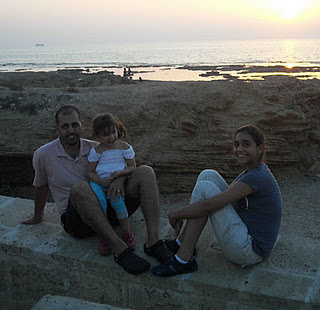
Walid Abu Rass, with daugthers Malak, and Mais, 13

Please read and share this recent post by Sam Bahour, a well-known Palestinian-American businessman who lives in Ramallah. For more information, check out his blog, ePalestine.

Where’s my friend?
By Sam Bahour

My friend is Walid Abu Rass. He is the Finance and Administration Manager for the Health Work Committees (HWC, at www.hwc-pal.org), one of the largest community health service providers in the occupied Palestinian territory. HWC serves over 500,000 patients/beneficiaries per year! More on HWC in a second.

I had not seen Walid for a while. We are both knee deep in Palestine’s daily rat race. About two months ago, Walid and his HWC colleagues called for a meeting of their circle of friends. They sought assistance. HWC was going through some financial hard times, especially with the financial crisis in Europe, where many of their donors are based.

Given it was close to the end of year, a season when I usually donate some time to assist a community based organization to fundraise, I offered to volunteer. Walid was my counterpart. During the past weeks, we were in daily phone and email contact, and every few days we met up to visit a potential local donor. Progress was being made. We then started to plan, with a few others, an end-of-year fundraising raffle. Plans were coming together, and there was excitement among the team and staff that we were taking our fundraising needs to our local community to compensate for the loss in European institutional funding. This is even more significant since HWC does not accept funding with strings attached (“conditional donor funds”), so they have to struggle just to keep the doors open in this tainted donor-driven market.

For nearly a week I was emailing Walid with no reply. This was not like him. He and I nearly live behind our keyboards. The deadline for the raffle details was rapidly approaching and if we did not get started, we would miss the end of year opportunity for fundraising. I started to think Walid was mad at me for some reason. I rethought our last few weeks of working together. There was absolutely nothing there to cause him to just ignore my calls; after all, I was his volunteer counterpart.

Then, last night I learned why Walid stopped replying to me. On November 22nd, Israeli occupation soldiers arrived at his home at 1:30 A.M. Walid lives in Ramallah with his wife, Bayan, and two daughters, Mais, 13 years old, and Malak, 4 years old, who were all frighteningly awakened during his arrest. Walid was taken into custody and transported in the bone chilling cold of the night to Israel’s Ofer Military Detention Center where hundreds of Palestinians are detained, the vast majority with absolutely no knowledge of why.

The Israelis have been arresting Palestinians nightly for years now. Israel releases a few hundred prisoners in a media frenzy and then, the same night, starts to refill its prisons, a few Palestinians at a time. Although, as per the Oslo Agreements, the Palestinian side is responsible for security inside the Palestinian cities, Israeli armed forces routinely—read nightly, every night—enter the cities in their armored vehicles in the middle of the night and arrest a dozen or so Palestinians from their homes. Walid was merely the latest victim of this kidnap-by-night strategy.

The routine then goes something like this. Within eight days he will be brought before an Israeli military “judge” for the sake of processing only, not deliberating. The entire kangaroo court then, without sharing the reason why the Palestinian detainee is being held, flashes the security card to justify not sharing information on why they have acted against a specific individual. Then the court slaps a six month Administrative Detention Order on the detainee. That means you sit in prison for six months for no reason at all. Walid has already been given just such an order.

Your wife, your children, your work, your end-of-year fundraising campaign, your 500,000 patients/beneficiaries, your life, all abruptly stop. Then, usually, that six month order gets extended a few times before you are released. Walid is not unacquainted with this Orwellian mess. He previously spent nearly five years in and out of detention, never once being charged with anything!

The Health Work Committees association is registered as a not-for profit organization with the Palestinian Ministry of the Interior and also has a Jerusalem registration since they work in Jerusalem as well. HWC employees over 300 persons and operates 14 clinics throughout the West Bank, providing primary health services via these health clinics, mostly in areas not fully covered by the Ministry of Health. HWC also has a community development aspect of their work and operate the following: Jadal Center for Culture and Social Development, Nidal Center (providing health education to East Jerusalem schools), Community Development Plan, Oasis Rehab Center, Community Based Rehabilitation, and the Elderly Care Nursery and Kindergarten. One of the success stories of HWC is its partnership with the Dunya Women’s Cancer Clinic.

All of these activities need health care administrators, of which Walid is one. At a time when the Israeli closure system is making life hell for Palestinians, especially those living in marginalized areas or areas directly affected by the Separation Wall, HWC is needed more than ever. Likewise, at a time when international organizations, like USAID, have dramatically cut funding and laid off staff from their heath care programs (such as Flagship) as punishment to the Palestinians for pursuing membership in UNESCO, HWC’s services are needed more than ever.

The era of silence is over. Also, over for me are the slogans that can’t be operationalized. Yes, we want all 5,000 or so Palestinian detainees released. Yes, the policy of administrative detention is inhumane and must end. However, these slogans, although needed at times, must be matched with action items. Each life being destroyed by the Israeli revolving door policy of detainment is a person with a name and a family and a job. And when the person is my friend or colleague, I refuse to swallow the fact that Israel has carte blanche to act above the law.

Help me get Walid back to his family and his desk so we can get back to the work of improving the Palestinian health care system. Consider contacting your local Israeli Embassy and any or all of the following and demanding his immediate release. Reference his name, Walid Abu Rass, and his ID # 9-9702819-6.

For more information on Administrative Detention see ADDAMEER (Arabic for conscience) Prisoner Support and Human Rights Association at www.addameer.org.

A Tragic Death in Nabi Saleh

Ola Tamimi after witnessing the shooting of her brother, Mustafa Tamimi. (Photo: Anne Paq/Activestills.org)

Tragic, horrible news. A Palestinian demonstrator, Mustafa Tamimi, has just died of his wounds after being shot point blank in the face with a tear gas canister by an IDF soldier during a demonstration in Nabi Saleh.  (I’ve written about Nabu Saleh before – for a quick tutorial on the village and the history behind their weekly demonstrations, read this Ha’aretz article by Gideon Levy.)

Immediately after the incident, an IDF spokeswoman claimed that Tamimi was throwing stones and tweeted a photo of as slingshot as proof. (On a more sickening note, another IDF officer, Major Peter Lerner, tweeted on the incident and mockingly added “#Fail.”)

It is not yet clear if Tamimi was throwing stones, but even if he was, do the math: young man with slingshot protesting the theft of his village’s land vs. massively armed soldiers in an armored personnel carrier. Who is going to lose that one?

On this issue, I highly recommend this very thoughtful post on the incident by Bethlehem Blogger who directly and powerfully addresses subject of Palestinian stone throwing.

Hyatt Threatens to Cut Off Workers’ Health Care

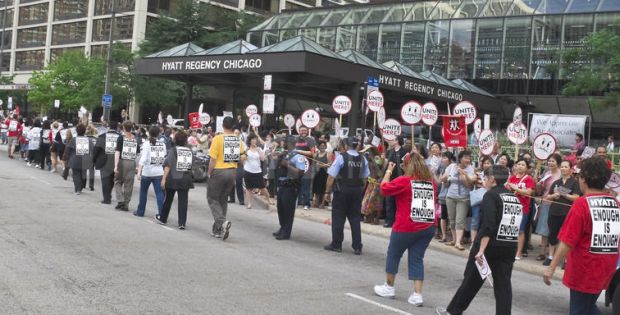
As I’ve written before, Chicago Hyatt workers have been negotiating for a fair contract with Hyatt for more than two years now. Sadly, Hyatt has refused to budge on crucial demands to curb subcontracting and ease working conditions for housekeepers—demands met by Hilton and other hotel employers citywide. In response, Hyatt workers have stood up and made tough sacrifices by striking and calling for hotel boycotts.

I’m now appalled to learn that Hyatt is currently threatening to strip health insurance from 1500 Chicago workers and their families unless they give up their fight and abandon their boycotts. In so doing, Hyatt is forcing workers to choose between their families’ immediate medical needs and a fight for their long-term survival.

Please join me in sending a message to Hyatt’s CEO Mark Hoplamazian to maintain Hyatt workers’ health insurance until they win a just settlement. Click here to sign the petition and please send it on.

Support Prof. Marc Elllis – and tell Ken Starr to Stand Down!

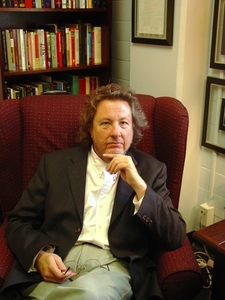
I first read Professor Marc Ellis’ book “Toward a Jewish Theology of Liberation” as a rabbinical student back in the mid-1980s – and suffice to say it fairly rocked my world at the time. Here was a Jewish thinker thoughtfully and compellingly advocating a new kind of post-Holocaust theology: one that didn’t view Jewish suffering as “unique” and “untouchable” but as an experience that should sensitize us to the suffering and persecution of all peoples everywhere.

And yet further: Ellis had the courage to take these ideas to the place that few in the Jewish world were willing to go.  If we truly believe in the God of liberation, if our sacred tradition truly demands of us that we stand with the oppressed, then the Jewish people cannot only focus on our own oppression – we must also come to grips with our own penchant for oppression, particularly when it comes to the actions of the state of Israel. And yes, if we truly believe in the God of liberation this also means that we must ultimately be prepared to stand with the Palestinians in their struggle for liberation.

When I first read Ellis’ words, I didn’t know quite what to make of them. They flew so directly in the face of such post-Holocaust theologians as Elie Wiesel, Rabbi Irving Greenberg and Emil Fackenheim – all of whom viewed the state of Israel in quasi-redemptive terms. And they were certainly at odds with the views of those who tended the gates of the American Jewish community, for whom this sort of critique of Israel was strictly forbidden.

Over the years, however, I’ve found Ellis’ ideas to be increasingly prescient, relevant – and I daresay even liberating. As a rabbi, I’ve come to deeply appreciate his brave willingness to not only ask the hard questions, but to unflinchingly pose the answers as well. And it is not at all surprising to me that we are now witnessing a new generation of rabbis and young Jewish leaders starting down the road he has paved for us.

All this to say I am profoundly sorrowed to learn that Ellis is currently under threat of losing his job at Baylor University due to an investigation led by new university president Ken Starr.

By every appearance, Ellis has had a distinguished academic career, having taught at Maryknoll School of Theology, Harvard Center for the Study of World Religions and Florida State University.   Thirteen years ago, he was appointed Professor of American and Jewish Studies at Baylor, where he founded Baylor University’s Center for American and Jewish Studies and currently serves as its director.

There is ample reason to mistrust the academic validity of this investigation.  According to a new petition now being circulated by Cornel West and Rosemary Ruether:

Marc Ellis was brought to Baylor in 1998 and all previous presidents supported his dissident voice. After Ken Starr (nemesis of Clinton in the White House) became president in 2010 the attacks started. During the last year Baylor lawyers were instructed to communicate with many of Marc’s colleagues, past students and staff. The objective was to request all of them to report all “abuse of authority.” Most of us explained to the lawyers that was a lost cause because Marc has been an exemplar colleague, professor and mentor.

But starting this Fall he was separated from his classes, his center closed and a hearing scheduled to take place some time in this academic year. As far as we know the accusations are about abuse of authority but we are not aware of the details because they are part of the internal legal process. Obviously it is about something else: Marc’s dissident voice. We will inform all of you as soon as we know more information.

In a statement released yesterday, Ellis commented thus:

Given what I currently understand of the rules of the Baylor process I will, for now, honor the process by not discussing the specifics, except to say that I believe this is a pretext to silence an independent voice at the place for which I have had deep appreciation.

I write now to ask you to please join me in signing this petition in support of Ellis – an important Jewish dissident thinker and (as his many academic colleagues are now attesting) a truly distinguished scholar. I would add: even if you don’t personally agree with all of his ideas, I urge you to support his cause. It is high time for us to stand down those who would trample academic freedom, shun open discourse and debate, and muzzle those with whom they simply disagree.

I’ll end with Professor Ellis’ own words, all too sadly apt under the circumstances:

Prophetic Jewish theology, or a Jewish theology of liberation, seeks to bring to light the hidden and sometimes censored movements of Jewish life. It seeks to express the dissent of those afraid or unable to speak. Ultimately, a Jewish theology of liberation seeks, in concert with others, to weave disparate hopes and aspirations into the very heart of Jewish life.

(“Toward a Jewish Theology of Liberation,” p. 206)

On “Pinkwashing in Israel” – My Response to a Friend’s Blog Post

My friend and colleague Rabbi Gail Diamond recently wrote an eloquent post in her blog discussing Sarah Schulman’s recent op-ed about Israeli “pinkwashing” in the NY Times. I submitted a comment but alas, it was too long to post. So I’m posting it here.

If you’d like to participate in our dialogue, first read the op-ed, then click here and read Gail’s post, then go ahead and read my response below. Respectful comments – on her blog or mine – are always welcome.

Dear Gail,

Thanks for an eloquent post. I’m happy to discover your blog and am grateful that you’re willing to publicly consider these kinds of tough issues.

Re your first response: I couldn’t help but detect a very palpable alienation, isolation and overall spirit of “it’s us against the world” in your and your friend Rich’s words. I know that this feeling of growing isolation from the international community is widespread among Israelis across the political spectrum. There’s no small sorrow in all this, especially considering that Zionism arose in part to solve the problem of Jewish “otherness” in the world. Nothing else to say about this except that politics aside, it’s just so sad to consider the extent to which the Jewish political/national project only seems to have exacerbated Jewish isolation on an international scale.

In your second response, you agree that there is something unjust about the fact that as a gay couple, you and your partner can take advantage of laws in Israel that privilege you as Jews. You add, however, that

The reality is the every country that surrounds Israel has human rights issues. Nothing is black and white, and every country lives with a messy reality. Because Israel is subject to an organized media campaign of de-legitimization, and because Israel cares about its image in the eyes of the western world, for self-serving reasons no doubt, we have people out there making the case for what’s good about the reality here.

With respect, Gail, try though I might, I just can’t accept this argument. Of course nothing is black and white and of course every country lives with a messy reality. But there is messy and there is messy. And I simply cannot agree with the claim that Israel is essentially a healthy Western liberal democracy with some “human rights issues.” I have come to believe that there is a much more fundamental form of oppression going on here.

I respect and celebrate the fact that, as you put it, “the reality of gay rights is directly impacting the lives of many people in Israel – for the good.” But if we’re truly going to calculate the greater good here, it’s difficult for me to weigh the benefits enjoyed by LGBTQ Israelis against the massive injustices Israel committed – and continues to commit – against millions of Palestinians in Israel, the occupied territories and throughout the Palestinian diaspora. It’s just not a level playing field. And unless these inherent injustices are dealt with fairly and directly, I don’t think it’s honest to speak of Israel as an essentially healthy, if blemished, democracy.

I was taken – and somewhat surprised – by your reference to “an organized media campaign of de-legitimization” against Israel. In the first place, I’m just not convinced that the media has nefarious designs on the state of Israel. If there is any “campaign,” I’d say it’s less a media conspiracy than a growing movement of activists throughout the world who are responding to the Palestinian call for solidarity with their struggle. I think it demeans the motives of those of us who are publicly holding Israel to account on very real and serious issues of human rights by saying we are trying to “de-legitimize” the state. This is a term wielded wantonly by Israel’s hasbara machine, and I believe it’s only real purpose is to muzzle honest and open debate on this issue.

You write that “none of us knows where this is all leading.” While this is true, of course, I think we can certainly predict certain general trends. And in this regard, I am truly frightened that in Israel, the direction is moving directly away from democracy and toward the greater influence of the ultra-right and the ultra-religious. (I think you know what I’m talking about, so I’ll spare you’re the links to the op-eds – most of them from Ha’aretz and Israel’s increasingly embattled progressive blogosphere). Unlike you, I’m less sanguine about “the intertwining of Jewish tradition and politics.” I genuinely fear that this particular marriage is leading us all down a very dark road.

Gail, I understand the reality that because you and your partner and are a bi-national same sex couple, your family cannot live together in the US. I realize that for you, this is your life we are talking about. And I deeply respect the courage it took you to publicly air the ways this reality impacts on you and your family. I think I know you well enough to know that you did not raise this point to in any way shut down debate with those outside Israel who don’t share your reality – only that you wanted to sensitize your readers to the deeper human truth of this issue.

I have faith that we can continue to keep this conversation going, as difficult and painful as it is. Thank you for putting yourself and your feelings out there. I hope you know that I offer mine in the same spirit of dialogue and friendship.

Kol Tuv,

Brant

Tell JNF to Cease its Practice of Ethnic Cleansing

The Sumarin Family (Photo by: Michal Fattal)

From the newly formed Campaign for Bedouin – Jewish Justice in Israel (a joint project of Rabbis for Human Rights-North America and the Jewish Alliance for Change):

While many of us will be gathering with our loved ones to celebrate Thanksgiving, the Sumarin family will be anxiously sitting on suitcases and wondering whether they will have a home in another week.

The Sumarins, a Palestinian family of twelve, including five children, a pregnant mother, and a grandfather on dialysis, have lived in their home for more than forty years in the East Jerusalem neighborhood of Silwan.

On Monday, November 28th, they will be evicted from their home – unless we raise our voices now.

We’re deeply troubled that a wholly-owned subsidiary of the Jewish National Fund in Israel, called Himnuta, is behind this move.

To expel this family is a violation of both Jewish and human rights law.   And it risks inflaming Arab-Jewish tensions in Jerusalem, further undermining the hope for Israeli-Palestinian peace.

Send a message now to JNF CEO Russell Robinson and urge him to stop JNF’s Himnuta from expelling the Sumarin family from their home.

The Silwan neighborhood has long been a flash point in the struggle over land in and around the Old City of Jerusalem and the site of clashes between Jews and Palestinians.

Twenty years ago, an ultra-nationalist Israeli government bent on expanding Jewish control in East Jerusalem took legal possession of the Sumarin home, along with other Arab properties in Silwan. The government transferred the Sumarins’ home to JNF’s Himnuta, along with seven other houses in Silwan.

Himnuta then turned its other East Jerusalem properties over to ELAD, a group whose explicit political agenda is to expropriate Palestinian homes and land in Silwan and transfer them to the control of Jewish settlers. There is every reason to expect that the Sumarins’ home will also end up in ELAD’s hands.

How has the Israeli government used the law to expropriate Palestinian property and land in East Jerusalem for Jewish settlers?Go here for the story.

Remind JNF CEO Russell Robinson that “legal” does not mean “just.”  The many anti-democratic and anti-Arab laws recently passed by the Knesset add yet more tragic testimony of the ways law can be used for injustice.

This will not be the last expulsion of a Palestinian family from Silwan by JNF’s Himnuta or ELAD.   Other families are facing the same threat.

Tell JNF CEO Russell Robinson: It’s time to end JNF’s role in expulsions or demolitions of Palestinian and Bedouin homes, whether in the Negev or East Jerusalem.

For more information, see this recent article in Ha’aretz and this post from Sheikh Jarrah Solidarity.

“Social Justice” Israel Trips Must Not Cover Up Oppression

Here is a guest post by Michael Deheeger, who you may know from the radio interview about our JRC Israel/Palestine Study Tour last year.

Michael grew up in my congregation and has worked for several years as in Chicago as a political activist and a community organizer. His most recent job, from which he has just resigned, was as Program Director for AVODAH: Jewish Service Corps in Chicago.

On October 26, I resigned from my position as Chicago Program Director for AVODAH: The Jewish Service Corps. Each day I have spent in this job has been a blessing, but I have no choice in light of AVODAH’s decision to co-sponsor a 10-day “service-learning” trip to Israel with the American Jewish World Service through their joint initiative Pursue: Action for a Just World.

AVODAH and AJWS agreed to this trip as a grant stipulation for funding from the Charles and Lynn Schusterman Family Foundation, a prominent donor in the Jewish nonprofit world, major supporter of pro-Israel causes, and Pursue’s principal funder.

I believe it is irresponsible for social justice organizations to organize a trip that focuses on “diversity, poverty and social integration” without meaningfully, and publicly, addressing Israel’s military occupation of Palestinian land, systematic oppression of Palestinians across “Israel proper” and the Occupied Territories, and enforced exile of Palestinian refugees.

I believe doing so contributes to the “normalization” of a deeply abnormal oppressive situation – presenting Israel as a liberal democracy with nothing more than the usual challenges rather than a state which imposes an ethnicity-based military regime on millions of people. It perpetuates the idea that it is acceptable to ignore Israel’s daily abuses of Palestinians in the pursuit of cultural, religious, financial or other interests.

Similar Jewish “social justice”, artistic, LGBTQ and environmental trips are often used to mount a facade of democracy over Israel’s state-sponsored human rights abuses.  It is well known that Israeli government ministries and American Jewish organizations have been collaborating on an extravagantly funded “Brand Israel” project designed to improve the country’s image abroad by “avoiding any discussion of the conflict with the Palestinians.” Arye Mekel, former Deputy Director-General for Cultural Affairs with Israel’s Foreign Ministry, has described this strategy as a way to “show Israel’s prettier face.” I have no doubt that the Schusterman Foundation has a similar agenda for this Pursue trip.

Through this trip, AVODAH and AJWS become active participants in covering up oppression, whether that is their intention or not. They publicly lend their organizations’ names and reputations to injustice, violating the social justice principles enshrined in their missions which inspired me to join AVODAH’s staff in the first place.

My decision to resign is informed by my support of the Palestinian call for Boycott, Divestment and Sanctions (BDS) against Israel. Initiated in 2005, BDS is a call endorsed by the great majority of Palestinian civil society groups as a nonviolent strategy to pressure Israel into ceasing its systematic oppression of Palestinians.

I believe in listening to people fighting their own oppression when they lay out a strategy to achieve their human rights. For the overwhelming number of Palestinians, BDS is that strategy.  Being strong allies and taking our lead from people directly impacted by oppression is, in fact, a philosophy deeply held by organizations such as AVODAH and AJWS.

I decided to write about my decision in the spirit of Tokhecha, or sacred rebuke, a central value of Torah:

Reprove your kinsman but incur no guilt because of him” (Leviticus 19:17)

Rashi’s interpretation of “incur not guilt” is “Do not embarrass [them] in public.” My goal is not to embarrass or shame AVODAH or AJWS. I love and respect AVODAH, which is staffed by dedicated and thoughtful individuals, and which remains committed to open discussion on this and other issues among its participants and alums.

However, this trip communicates a public message – that these organizations are willing to overlook Israel’s oppression of Palestinians in exchange for funding. It therefore requires a public response.

My understanding of Tokhecha is that it includes the responsibility to help those to whom it is directed make amends. I echo the call put out by AVODAH alums and current Corps members that AVODAH and AJWS commit publicly to “never sponsor an Israel trip in this way again.”

We in the Jewish social justice community have a choice. On the one hand, we can stay silent and try to avoid provoking the ire of powerful donors like the Schusterman Foundation. On the other hand, we can publicly oppose, or at least not cover up, the oppression Israel commits directly in our name.

I have faith that our community, increasingly, will choose the latter, and that as BDS continues to gain traction among young Jews, there will be a growing cost in staff and participants for organizations that allow themselves to be used as cover for the oppression of Palestinians.

From the American South to the West Bank: A Freedom Rider Bears Witness to Human Rights in Israel/Palestine

On November 15, Palestinian activists will attempt to board segregated Israeli settler public transport headed to occupied East Jerusalem in an act of civil disobedience inspired by the Freedom Riders of the US Civil Rights Movement.

Fifty years after the US Freedom Riders staged mixed-race bus rides through the roads of the segregated American South, Palestinian Freedom Riders will be asserting their right for liberty and dignity by disrupting the military regime of the Occupation through peaceful civil disobedience. Organizers say this ride to demand liberty, equality, and access to Jerusalem is the first of many to come.

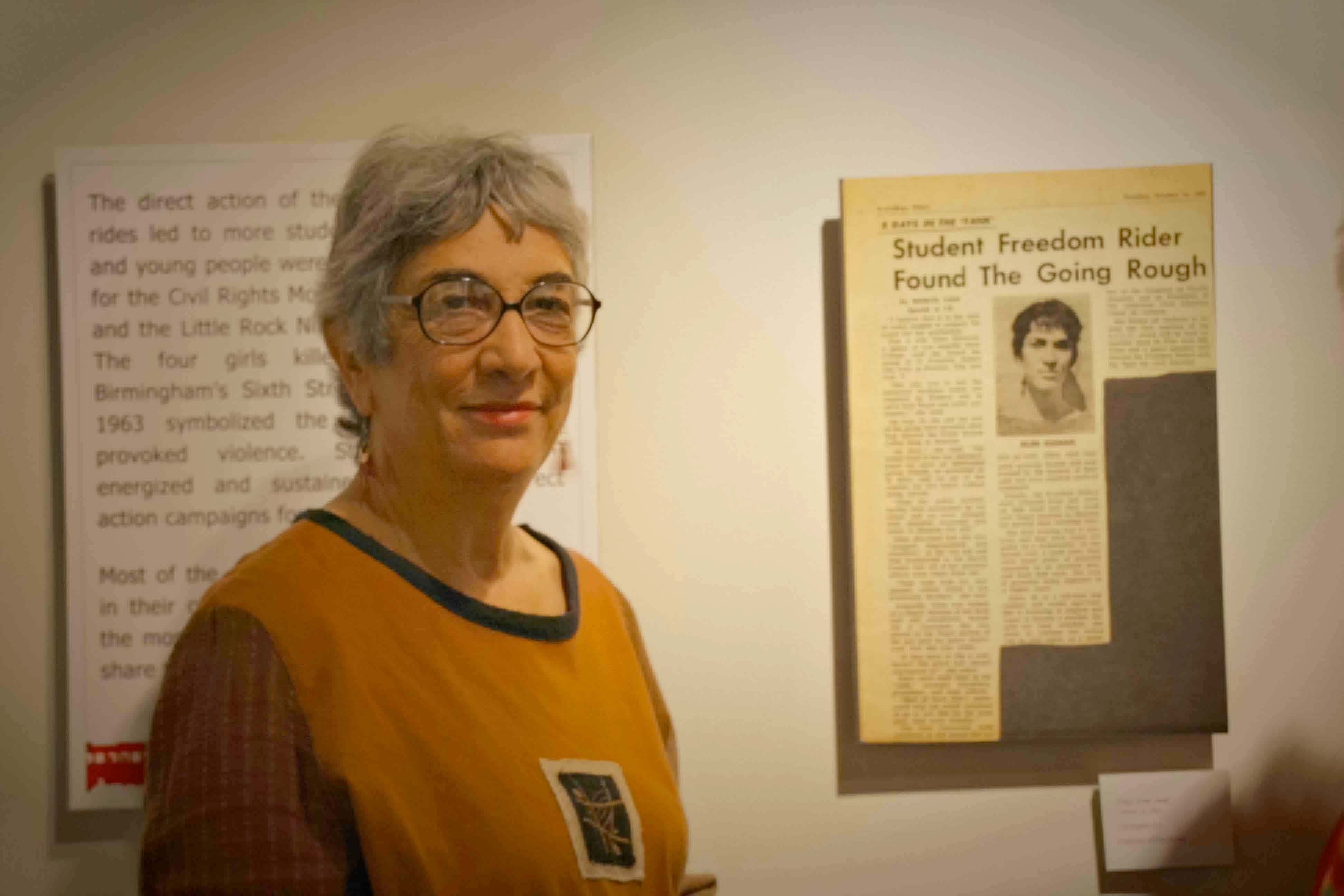
Ta’anit Tzedek – Jewish Fast for Gaza will stand in solidarity with the West Bank Freedom Riders with a very special conference call on the day of the demonstration. Please join us Tuesday, November 15 at 12 pm Eastern Time  to join our conversation with Ellen Broms, one of the original Freedom Riders for civil rights in the American South and currently an activist for a just peace in Israel/Palestine.

During our call, Ms. Broms will talk about her own experiences as an activist/demonstrator for civil rights in the 1960’s and why her activism has led her to take a stand on behalf of Palestinian human and civil rights.

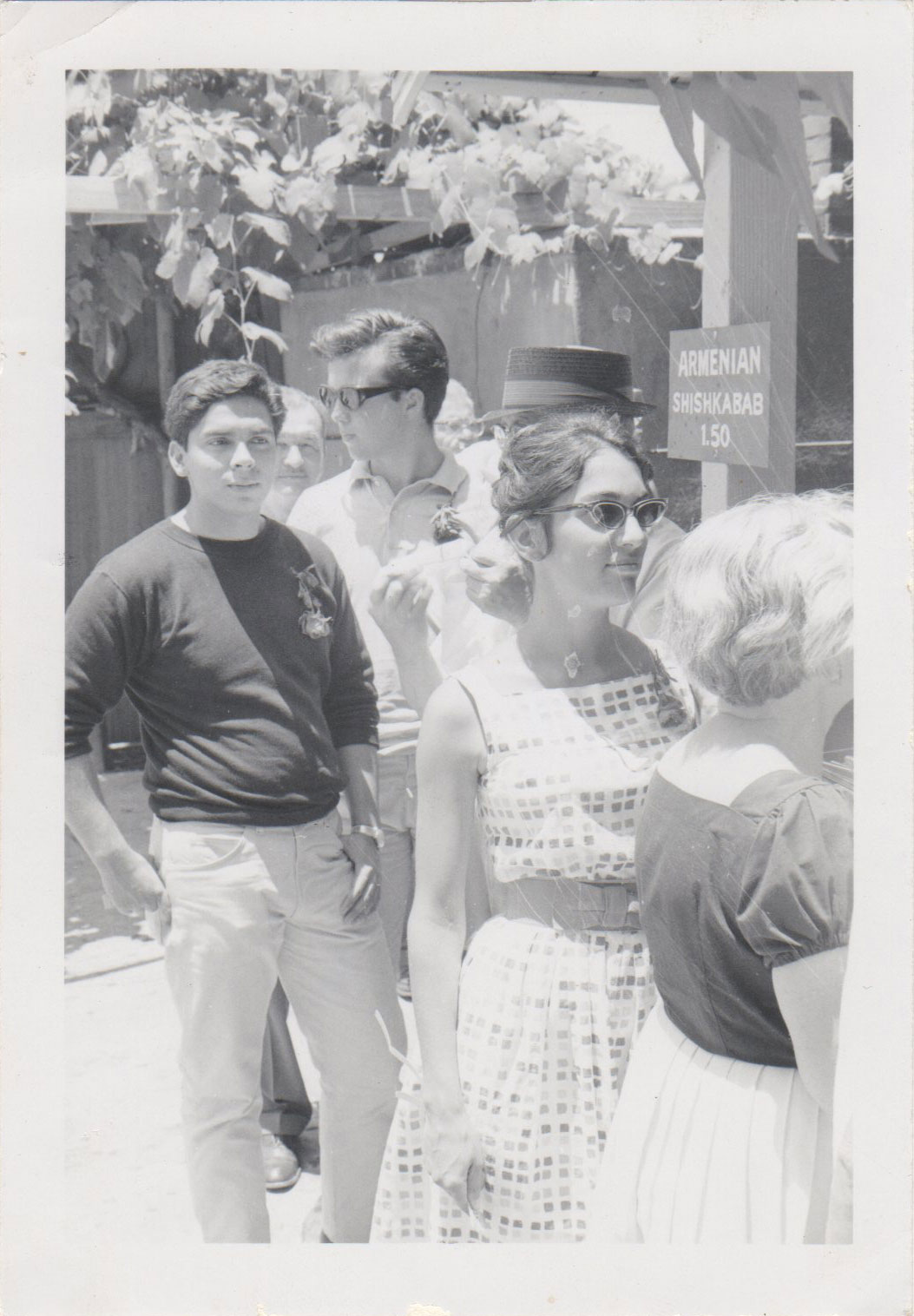
Ellen Broms is a retired state worker who resides in Sacramento, CA. Her involvement in the civil rights movement began when, as a student at Los Angeles City College, she demonstrated at Woolworth lunch counters in support of  similar sit-ins by students in the South.

In June 1961, Ms. Brom attended a freedom rally at the Sports Arena in Los Angeles where Dr. Martin Luther King, Jr. gave the keynote speech.  After hearing a freedom rider speak, she was inspired to participate in the rides herself. On August 11, Ms. Brom was arrested with other freedom riders after they sat down and demonstrated in a Houston coffee shop.

In her words:

The police arrived, having been summoned by the owner and we were charged with unlawful assembly and taken to the Houston city jail. We were fingerprinted, mugged, and classified at the city jail and then transferred to the Harris County Jail. Ironically, I was booked as a “Negro” because of my dark hair and complexion. We declined to state “race” and they classified me as “High Yellow”. Marjorie, a very fair skinned, green eyed female rider of African American descent was classified and booked as white. I was placed in the “tank” for black women and Marjorie went to the white women’s tank. If we did nothing else during that ride, we did succeed in briefly integrating the jail.

After spending eight days in jail, Ms. Brom was released. The riders were found guilty of “unlawful assembly” by an all-white jury and fined $100 each. Their case was eventually appealed to a higher court and overturned.

Ellen Broms has since been honored by Congress, the state of Texas and the city of Houston for risking incarceration and violence as a Freedom Rider. She continues to work as an activist for peace and justice, particularly in the area of a just peace in Israel/Palestine. She is actively involved in the Sacramento branch of Jewish Voice for Peace and is campaigning on behalf of the West Bank Freedom Riders.

To participate in the call:

Dial Access Number: 1.800.920.7487
Enter Participant Code: 92247763#

There will be opportunities for questions and answers during the call.

Please click here for more information about how you can get involved in support of the West Bank Freedom Riders. Please share this information with others you think may be interested in participating.

We looking forward to your joining the call!

State-Sponsored Mosque Desecration: I Express My Outrage

Last week I received an email request from the New Israel Fund (NIF) to sign a rabbinical statement condemning the recent desecration of a mosque in the Bedouin village of Tuba-Zangariya in the north of Israel. Of course I signed without hesitation. It was a sick, racist act that deserved to be condemned from every quarter.

Thus my deep dismay when I did not receive any similar request when the Israeli army demolished a mosque this week in West Bank village of Kherbet Berza – for the third time. (An incident, btw, that was scarcely covered by the western media.)

As per usual, the administration claims additions to the mosque were built “without a permit.” Naturally no such permits are issued when the Israeli government is interested in creating facts on the ground – this case being the northern Jordan Valley. (The news item above was released last year following the first demolition.)

Of course it’s easy to condemn racist acts of individuals – apparently it’s more difficult (or “complicated”) when this kind of thing is carried out by a government. I have no such difficulty: terror is terror whether perpetrated by one person or by the state.

So for the record (and using the same language as the NIF statement) I’d like to take this opportunity to:

express my deep sadness and outrage at the destruction of a mosque in the West Bank village of Kherbet Berza. I condemn this act as an affront to God, the values of our Torah and the international standards of basic human rights.

I extend a hand in friendship and solidarity to the leaders and residents of this small village, a prayer for their safety and peace in the days to come, and a hope that the government that perpetrated this despicable act will be held to account.

And while we’re expressing concern for the welfare of Bedouins, this recent announcement offers some cause for deep dismay as well:

The Civil Administration (CA) is planning to expel the Bedouin communities living in Area C in the West Bank, transferring some 27,000 persons from their homes. In the first phase, planned as early as January 2012, some 20 communities, comprising 2,300 persons, will be forcibly transferred to a site near the Abu Dis refuse dump, east of Jerusalem.

More government terror. I express my deep sadness and outrage…