Category Archives: Human Rights

Israel Levels a Bedouin Village – Add Your Voice of Protest

On July 27, an Israeli police force of 1,500 evicted over 300 Bedouin Israeli citizens – mostly children – from the village of Al-Arakib in the Negev, leaving them homeless, expelled from their land, and bereft of their possessions. Bulldozers from the Israel Lands Administration then proceeded to demolish their homes, sheep pens, fruit orchards and olive tree groves, so that the Jewish National Fund can plant a forest on their land.

You can read more about this shameful episode here in the LA Times and here in the BBC News. I also encourage you to read the reactions of the New Israel Fund and Adalah – The Legal Center for Arab Minority rights in Israel.

From an Adalah press release:

Residents of the Arab Bedouin unrecognized village al-Araqib in the Naqab (Negev) in the south of Israel were woken up at dawn on 27 July 2010 to find themselves surrounded by police officers, some of them on horseback. The police declared the village to be a “closed area”, and warned residents that any attempt to resist their orders would lead to their forced evacuation. The police ordered the residents to leave their homes in two minutes. The residents tried to take their belongings from their houses, but the police did not wait and began to immediately demolish their homes. No less than 1,300 police officers, accompanied by the Green Patrol, a unit within the Nature Reserves and Parks Authority that often harass the Arab Bedouin, took part in the brutal destruction of the village. Throughout the demolition operation, a helicopter flew above the village. When the demolition ended, all 45 houses of the houses were razed to the ground and its 250 residents – men, women, elderly people and children, were left without a roof over their heads and all of their belongings confiscated.

In violation of law, most police officers who took part in the raid covered their faces and did not wear identity tags. They had weapons, tear gas, truncheons and other arms. Apparently in this way, the police officers sought to prevent the residents from identifying them. T-he residents did not respond violently to the destruction.

One of the most shocking aspects of the raid was that a bus filled with dozens of radical right-wing Jewish youth accompanied the police to the village. The youth began to tease the Arab Bedouin residents, who are citizens of Israel and who just lost their homes, and applauded when the police officers demolished the homes. This conduct amounts to vigilantism, a punishment outside of the law.

During the operation of destruction, the police confiscated all personal possessions of the residents from their homes including refrigerators, ovens, closets, bedroom and dining room furniture, textiles, carpets, crafts, etc. They also took other property from the area surrounding the houses such as electricity generators, plows, flour bags and the like.

Representatives of the Tax Authority also accompanied the police and seized property of residents in debt to the tax authorities. This confiscation was undertaken without prior warning or demand from the residents to pay their debt, and therefore, it too was illegal. Residents were required to pay NIS 22,500 (almost US $6,000) to retrieve their property.

One final encouragement if you are a member of the Jewish community: while this action is clearly a violation of international human rights, it is also of critical importance to Jews, who are implicated in all actions taken by the Jewish state. Please sign and pass on this petition which is being disseminated by the Jewish Alliance for Change. The campaign hopes to add American Jewish voices to a growing Israeli petition, which will be hand delivered to the Prime Minister’s Office in Jerusalem on August 10.

Seek Interfaith Justice This Labor Day Weekend!

Interfaith Worker Justice has just launched its annual “Labor in the Pulpits/on the Bimah/in the Minbar” initiative, encouraging houses of worship around the country to dedicate Labor Day weekend (September 3-5) to worker justice awareness.

You can access the resources and materials by clicking here. I encourage you to share them with your Priest, Rabbi, Pastor or Imam, as the case may be. (I contributed a piece to the Jewish resources – click here to download the pdf.)

The Jewish Community Debates BDS

As the Boycott, Divestment and Sanctions movement gains momentum, I’ve been pleasantly surprised to see at least two internal Jewish community conversations in which this painful, volatile issue with was debated with intelligence and mutual respect.

Last month, the New York-based org Jews Say No sponsored a debate/discussion featuring Israeli activist Yonatan Shapira, Birthright Unplugged director Hannah Mermelstein, Forward editor JJ Goldberg and J Street board member Kathleen Peratis.  It takes thirteen YouTube clips to see the entire program, but I highly recommend watching it from beginning to end. I found it informative, intelligent, passionate – and ultimately inspiring for the way a Jewish gathering could discuss such a potentially divisive subject so gracefully. (Click above for the first clip, then surf to the Jews Say No website to watch the next twelve.)

For its part, Tikkun Magazine held its own Jewish roundtable on BDS featuring Tikkun editor Rabbi Michael Lerner, Jewish Voice for Peace director Rebecca Vilkomerson; Rabbi Lynn Gottlieb, founder of Shalom Shomer Network for Jewish Nonviolence, J Street president Jeremy Ben Ami; and Israeli Shministit (refuser) Maya Wind. The entire conversation can only be accessed by purchasing the July/August edition of Tikkun Magazine, but you can read key excerpts at the JVP website.

Sari Bashi on Gaza: Control Without Responsibility

Today Ta’anit Tzedek sponsored an incredibly informative and thought-provoking conference call with Sari Bashi, Executive Director of Gisha Legal Center for Freedom of Movement.  We were also joined by Reut Katz of Physicians for Human Rights – Israel who shared information about the medical infrastructure in Gaza and the difficulties faced by Gazans needing medical treatment

Toward the end of the call, I asked Sari why the crisis in Gaza always seemed to be so central to the Palestinian-Israeli conflict. Her incisive response:

I think Gaza is a bit like the canary in the coal mine. What is being done now in Gaza is being done to a lesser extent in the West Bank and we will see some of the terrible effects in the West Bank as well if we continue on the path we are on. The concern about Israel’s behavior in Gaza is that it is exercising control without taking responsibility. It is controlling people’s lives by controlling movement and access but it is not taking responsibility for the effects of that control on a million and half civilians who need to be able to access all of the things we’ve been discussing.

In the West Bank that process is also underway. Israel is dividing up the West Bank between Jewish areas, where the settlements are, and Palestinian areas – and it is slowly disengaging from responsibility for what happens in the Palestinian areas without giving up on control of those borders and of movement and access. And it can’t be both ways: either Israel continues to control movement and access but takes responsibility for that control or if it wants to disengage from responsibility it must let go of control – and that also means letting go of checking for security reasons what leaves and enters Gaza and the West Bank.

Click here to hear the call in its entirety. The conversation begins at 1:38 minutes and includes several questions from participants.

Ta’anit Tzedek Presents “Myths and Facts About the Siege of Gaza”

To mark our July fast day Ta’anit Tzedek – Jewish Fast for Gaza is sponsoring “Myths and Facts About the Siege of Gaza,” a conference call with Sari Bashi, Executive Director of Gisha: Legal Center for Freedom of Movement on Thursday, July 15 at 12 noon EST.

Since Israel’s easing of its blockade of Gaza, international pressure to end the siege has eased as well. Does this “easing” in fact represent actual change for the people of Gaza? What kinds of good and services are Israel allowing in? What is the status of Gazans’ freedom of movement? What are the current effects of the blockade on the lives of residents?

To help us better understand these questions, we turn to Gisha, one of Israel’s leading human rights experts on the siege on Gaza. Founded in 2005, Gisha seeks to protect the freedom of movement in the Occupied Territories, offering legal assistance and public advocacy to protect the rights of Palestinian residents. Because freedom of movement is an essential precondition for the exercising of other basic rights, Gisha’s work also helps residents of the Occupied Territories gain access education, jobs, family members and medical care.

Gisha’s work in Gaza has been critical in this respect. I’ve long been referring folks to their website Gaza Gateway, an essential resource that present credible information about the amount of traffic that Israel allows to pass through the Gaza Strip border crossings. I also highly recommend Gisha’s publications for critical, up-to-date reports on the effects of the siege.

Call-in info:

Phone Number: 1.800.920.7487
Participant Code: 92247763#

As with our call last month, we will be offering the opportunity for Q&A during the call.

Click here for a recent Gisha article, “Unraveling the Closure of Gaza.” Click on the clip above to watch “Closed Zone” – a brief animated film about the basic effects of the siege created for Gisha by Yoni Goodman, Director of Animation for “Waltz with Bashir.”

Demonstration in Nabi Salih: The Camcorder Doesn’t Lie

Joseph Dana is an American-Israeli freelance journalist, filmmaker and photographer who has been relentlessly tracking settler violence, IDF misconduct and settlement expansion in the Occupied Territories. I’ve long considered Dana’s reports to be mandatory reading/viewing – and if you are at all concerned about the reality of life on the ground in the West Bank and East Jerusalem, then you should too.

His latest blog post includes footage (taken by fellow blogger/reporter Max Blumenthal) of a demonstration this past Friday in the West Bank village of Nabi Salih. During the action, two Israeli demonstrators, Matan Cohen and Yonatan Shapira were violently arrested by IDF soliders. Though the IDF later reported that the demonstrators attacked a soldier, the clip above clearly shows that this claim is a blatant lie.

This reportage is particularly essential not least because it documents the systematic policy of the IDF to violently repress growing acts of Palestinian civil disobedience – only to justify their actions later by claiming their soldiers were “under attack.” The flotilla tragedy is certainly the most well-known example of this tactic, but as Dana and other reporters are showing us, it actually occurring on a regular basis in the Occupied Territories.

Here’s Blumenthal’s description of what he actually witnessed at the July 2 demonstration:

On July 2, at the weekly demonstration in the Palestinian village of Nabi Saleh, Israeli army troops violently arrested Israeli activists Yonatan Shapira and Matan Cohen. I witnessed the incident that led to the arrests and filmed them as they took place. As a group of soldiers pursued children up a small hill, then began firing teargas shells and percussion grenades at them, presumably in response to a few stones the children had thrown, Cohen and Shapira mocked the soldiers. “Shooting at children! You are so brave!” Cohen exclaimed.

Within a few seconds the commander of the IDF division (an oleh named Danny) charged Cohen and Shapira, then headlocked Cohen and dragged him into a jeep. When Shapira protested, he was thrown to the ground, violently subdued and dragged into a jeep. At no point did Cohen or Shapira attack any soldier.

The IDF Spokesman’s Unit issued a statement on Twitter claiming Cohen and Shapira — “two arrested rioters” — had “attacked an IDF soldier.” However, my footage of the incident completely discredits the IDF’s claim. As I said in the wake of the flotilla massacre, nothing the IDF Spokesman’s Office says can be trusted. Ever. The IDF’s intention is to smear human rights activists as violent terrorists while portraying itself as the blameless victim. Anyone who spends a day in Nabi Saleh or any Palestinian village engaged in popular protest against the occupation will see that the complete reverse is true.

BTW: you may remember that I reported on my meeting with Yonatan Shapira last May. He is a helicopter pilot and former officer in the Israeli Air Force who is now actively participating in Palestinian non-violent actions in the West Bank and East Jerusalem. (I know Yonatan would be the first to say that it is the Palestinians themselves who are bearing the brunt of this oppression week after week in demonstrations such as this.)

Postscript 7/5: Max Blumenthal has now posted a more complete version of the clip, below:

Gaza: Humanitarian Crisis or Collective Punishment?

More than one Israeli politician has commented that there is “no humanitarian crisis in Gaza.” Fair enough. During Ta’anit Tzedek’s monthly conference calls with Gazans we heard over and over that Gazan citizens do not want this crisis to be viewed as a humanitarian issue.

For instance, journalist Sami Abdel-Shafi told us in March that he believed casting Gaza as a humanitarian case is ultimately harmful to Gazans (80% of whom are dependent on foreign aid to survive). That is to say, the longer Gazans are kept dependent on humanitarian largess, the longer Gaza will successfully be kept isolated from the international community:

As long as the so-called “humanitarian” classification continues, I’m afraid we can stay like this for years. But the key is, why leave a population of more than 1.5 million people almost completely deprived of being educated and being developed and of the opportunity to be effective contributors to the regional economy, in addition to the economy of the world?

The answer (as I’m sure Abdel-Shafi well knows) is that this is precisely the point. The blockade of Gaza has never been about Israel’s security. From the very beginning, its aim has always been the isolation of Hamas through the collective punishment of Gazans.

Of course Israel has long tried to make the case that its blockade was initiated to keep weapons out of Gaza, but this justification has grown increasingly hollow over the years. (The surreal revelation that coriander was on the “forbidden list” is perhaps the most infamous example.)

I’ve noticed that even Israel has become less and less inclined to defend the blockade on security grounds.  This past week, it was reported that Israel’s defense establishment is urging the government not to cave in to growing international pressure and permit Palestinians to export goods from the Gaza Strip.  As one defense official put it, “If this happens, we will lose all of our leverage over Hamas.”  When I read this, I couldn’t help but think about Abdel-Shafi’s comments. What possible security benefit could Israel gain with this kind of economic warfare?

On a more heartening note, I just read in the Israeli press that “reliable sources” report that Obama will insist on a full lifting of the blockade when Netanyahu visits Washington in two weeks. According to the report, the President considers the continuing travel ban on Gazans to be (you guessed it) “collective punishment.”

Here’s hoping…

Gaza Witness: A Conversation With Ashley Bates

Yesterday Ta’anit Tzedek hosted an incredibly powerful conference call with journalist/blogger Ashley Bates, who spoke to us from Gaza City. If you didn’t make the call, you can listen to it yourself by clicking here. Ashley’s personal testimony provided an extremely important antidote to the misinformation about Gaza that we’ve heard bandied about – particularly since the flotilla crisis.

At the opening of our conversation, I asked Ashley to address the claims of the Israeli government that “there is no humanitarian crisis in Gaza” and that no one is starving as result of Israel’s blockade. I also asked her to address press reports that cite the upscale Roots Restaurant and well-stocked market stalls in Gaza City as proof that things are not nearly as dire as critics are claiming.

Ashley validated the reports that these kinds of goods are indeed available in the more affluent areas of Gaza. She added, however, that the only ones who can afford them are internationals such as herself or a relatively small number of affluent Gazans. She pointed out that the Gazan economy has completely collapsed as a result of the blockade, causing widespread unemployment and poverty for an overwhelming number of citizens. Ashley herself can afford to live a relatively comfortable life in a rented Gaza City apartment. Unlike most Gazans, she could purchase her own electric generator – so she is unaffected by the daily eight hour blackouts that are a familiar part of life in Gaza.

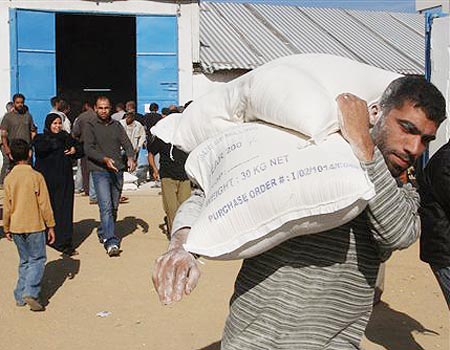
Ashley said that she saw no signs of starvation, but it was clear to her that the nutritional needs of Gazans are not being met. Eight out of ten Gazans are on some form of international aid. In the refugee camps, Gazans are essentially living on diets devoid of fruits and vegetables. As a result, anemia and malnutrition is on a sharp rise – particularly among children.

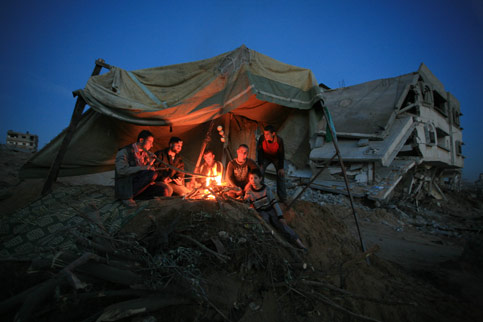
She also witnessed considerable numbers of homeless Gazan families, whose homes were destroyed during Israel’s military assault in December 2008. The majority of them have moved in with relatives or friends and live in very cramped quarters. Others rent apartments they cannot afford, relying upon the largess of landlords. Still others are forced to live in unstable, partially destroyed residences or in tents next to the rubble of their former homes (see pic above).

Ashley said she was not qualified to to comment as to whether this all constitutes a “humanitarian crisis.” She did, however, call it “a crisis of human dignity” – and it is clear to her that these circumstances are a direct result of the blockade.

It is also becoming clear to me that the world is becoming less and less inclined to buy the Israeli government’s calculated misinformation campaign about the blockade. Yesterday, blogger Richard Silverstein posted an extremely telling e-mail missive that the Israeli PR org The Israel Project recently sent out to its members:

Subject: In the “messages that fail” department, please see this…
Date: Tue, 15 Jun 2010 13:36:40 -0400
From: Jennifer Laszlo Mizrahi
To: Jennifer Laszlo Mizrahi

As to research on saying that there isn’t a “humanitarian crisis” in Gaza and that no one is starving, we will have that on what Luntz and Greenberg are testing next week. But you don’t need that data to know it is a complete dead-end of a message. Reporters and leaders all over Washington are complaining about this and some say they see Israel and cold and heard hearted. Given that 6 more flotillas are headed to Israel (including one of Jews from Germany and one of Jews from the UK) we need to make sure we understand this well.

Watch this from Jon Stewart. Watch to the end and listen to how they react to when Krauthammer uses the message…ouch!

http://vimeo.com/12350665

Clearly we need to be saying that “While no one is starving in Gaza because Israel delivers so much aid, there IS suffering in Gaza. We want the suffering to stop. That is why Iran-backed Hamas must stop using supplies for rockets and Hamas must release Gilad Shalit. Hamas must be accountable for their actions and for the suffering they are causing their OWN people.”

On a good note, the topic in the US tonight will shift to energy. Alternative energy is obviously a great topic for Israel as Israel has much to say that could help on this.

Thanks!

Jennifer

Spin notwithstanding, it’s an amazing admission. (You know, it’s often occurred to me that if Israel spent just a fraction of the time and energy it spends on public relations to actually own up to its responsibility for this crisis, we might see some real progress toward a resolution).

In the meantime, thank God for sane witnesses such as Ashley Bates. Please listen to the call.

What is Really Happening in Gaza? A Conversation with Journalist Ashley Bates

The next Ta’anit Tzedek fast day is Thursday, June 17 and to mark the occasion we’re sponsoring a conference call with freelance journalist Ashley Bates.

Ashley has been living in and reporting from Gaza for the past several months and as I’ve written before, her pieces offer invaluable, in-depth perspectives of life under the blockade. Her articles have appeared in Jerusalem Post, Jerusalem Post Magazine, Global Post, Huffington Post, Columbia Journalism Review, and Ha’aretz and she posts regularly on her blog Dispatches from Gaza.

Of course Israel’s recent raid on the Freedom Flotilla has recently put the blockade back on the mainstream media radar screen. Misinformation about this crisis has been on the increase – and it is all the more critical to hear from those such as Ms. Bates: reputable sources of information about life on the ground in the Gaza Strip.

The conference call will take place Thursday, June 17 at 12 noon EST.

Call-in info:

Access Number: 1.800.920.7487
Participant Code: 92247763#

We are thrilled that Ashley will be able to join us for this important and critical conversion. Please join us.

More Gaza Flotilla Aftermath

More odds and ends re the flotilla fallout:

– In contrast to the Israeli characterization of flotilla participants as jihadist thugs, pictures released by Turkish newspaper Hürriyet show activists actually protecting and aiding injured Israeli Navy commandos. (H/T to Ali Abunimah for the link).

– Flotilla participant Jamal Elshayyal (a British citizen and producer for Al Jazeera English) has written an extensive account of his experiences on the night of the raid. While there no way to verify his testimony, it does square with numerous other eyewitness reports. At the very least, it underscores the need for a credible international investigation to get to the bottom of what actually happened aboard the Mavi Marmara:

After spotting the warships at a distance, (at roughly 11pm) the organisers called for passengers to wear their life vests and remain indoors as they monitored the situation. The naval warships together with helicopters remained at a distance for several hours.

At 2am local time the organisers informed me that they had re-routed the ship, as far away from Israel as possible, as deep into international waters as they could. They did not want a confrontation with the Israeli military, at least not by night.

Just after 4am local time, the Israeli military attacked the ship, in international waters. It was an unprovoked attack. Tear gas was used, sound grenades were launched, and rubber coated steel bullets were fired from almost every direction.

Dozens of speed boats carrying about 15-20 masked Israeli soldiers, armed to the teeth surrounded the Mavi Marmara which was carrying 600 or so unarmed civilians. Two helicopters at a time hovered above the vessel. Commandos on board the choppers joined the firing, using live ammunition, before any of the soldiers had descended onto the ship.

Two unarmed civilians were killed just metres away from me. Dozens of unarmed civilians were injured right before my eyes.

One Israeli soldier, armed with a large automatic gun and a side pistol, was overpowered by several passengers. They disarmed him. They did not use his weapons or fire them; instead they threw his weapons over board and into the sea.

After what seemed at the time as roughly 30 minutes, passengers on board the ship raised a white flag. The Israeli army continued to fire live ammunition. The ships organisers made a loud speaker announcement saying they have surrendered the ship. The Israeli army continued to fire live ammunition.

– Finally, click above for a deeply disturbing clip of journalist Max Blumenthal interviewing participants at a recent Israeli rally in front of the Turkish embassy. I’m not sure what made me sadder: the callous celebration of an incident that led to the deaths of nine civilians or the “us against the world” siege mentality expressed by so many Israelis on the street.