Category Archives: Human Rights

A BDS Wake Up Call?

A recent report from the Forward:

With anti-Israel boycott, divestment and sanctions efforts gaining visibility, the Jewish community’s main public-policy coordinating body is for the first time confronting the BDS movement as a specific and stated priority.

At its recent annual plenum, the Jewish Council for Public Affairs passed a resolution stating that BDS should now “be regarded with the utmost seriousness and urgency.”

“This is a very serious matter,” JCPA’s executive director, Rabbi Steve Gutow, told the Forward. “We need to wake up, whether we are on the right, left or center.”

The JCPA, an umbrella body representing Jewish community relations councils across the country and more than a dozen leading national Jewish groups, adopted the anti-BDS resolution at its plenum in Dallas on February 23. Gutow said that JCPA member groups are planning to create a permanent body that would respond to the activities of the BDS movement.

My two cents: creating a permanent body to combat the “negative branding” caused by BDS is a waste of Jewish communal resources.  I just don’t believe that the old counterattack tactics will work any more (if they ever did).  I’d suggest that if the Jewish community really wants to “wake up” to the challenge presented by BDS, then we need to honestly confront the fundamental reasons for its growth in the first place.

The BDS movement was founded in 2005 by a coalition of Palestinian groups who sought to fight for Israel’s human rights violations through nonviolent direct action. It arose out of their frustration over Israel’s continued refusal to comply with international law on any number of critical issues – and the oppressive manner in which it has occupied and ruled over Palestinians. I can’t help but think that by treating BDS simply as a PR threat to be fought, we’re utterly misunderstanding the essential of the point (and strength) of this movement.

By all accounts, this campaign is rapidly gaining support. It’s not a stretch to assume that the longer this oppressive status quo is allowed to continue, the longer Palestinians will resist – and the longer they will seek international support for their resistance.  One year ago, I predicted as much on this blog: BDS will grow as long as very real injustices remain unaddressed.

When will we wake up to this painful reality?

What the US Should Do About Iran

Some of you may have noticed that I’ve been engaging in a bit of lively back and forth with one reader over my 2008 Yom Kippur sermon on Iran. I haven’t posted on Iran in some time, but that certainly doesn’t mean I’m not following developments there with great interest.

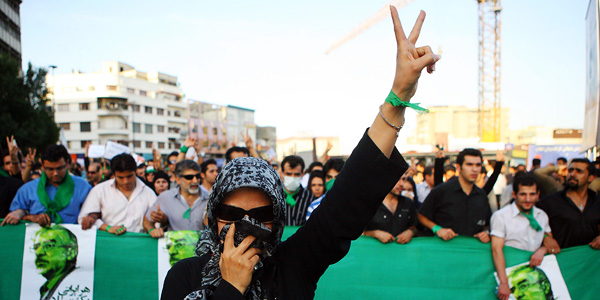
I do believe the Islamic regime’s increasingly brutal crackdown on human rights is a sign that it is taking the challenge of the Green Movement very, very seriously.  For our part, the the US administration appears somewhat paralyzed – issuing tepid statements, wary of throwing too much support to the Greens lest they get accused of meddling in Iranian politics yet again.  Meanwhile, the regime-change drumbeats of the right continue to grow ominously louder and louder.

Still, it would be mistaken and foolhardy to assume the only choice we have is between doing nothing and doing too much. In this regard, I commend to you this very insightful and helpful article by Dr. Trita Parsi and Alireza Nader of the National Iranian American Council.

Here’s my edited version:

(Between) the extremes of doing nothing and doing everything, there is a middle ground: providing the Iranian pro-democracy movement with breathing space, rather than engaging in risky and imprecise exercises that would directly involve America as an actor on the Iranian scene. The United States can achieve this through a few simple steps.

First, the United States should tread carefully when it comes to issuing military threats. Under the shadow of a foreign military threat, the uphill battle of the Iranian pro-democracy movement becomes even steeper, as the Iranian regime is quite adept at exploiting foreign threats to stifle criticism at home…

Second, the United States should avoid sanctions that put a burden on the Iranian people, rather than the Iranian government. Broad-based sanctions that hit the entire economy hurt common citizens far more than the powerful elites. Any new sanctions should demonstrate not only international discontent with the conduct of the Tehran government, but also an effort by the United States to keep from harming average Iranians…

Third, Washington should slow down the diplomatic process. Negotiation with Iran in and of itself is not the problem; engagement doesn’t legitimize the Iranian government, as only the people of Iran can do that. But in spite of President Mahmoud Ahmadinejad’s latest offer to accept the International Atomic Energy Agency nuclear deal, Iran remains in political turmoil. It is questionable that Tehran can make enduring decisions on issues of this magnitude under these circumstances…

Fourth, the international community, including the White House and U.S. State Department, should be vocal in excoriating Iran’s human rights abuses. Condemning abuses should not be confused with interfering in internal Iranian affairs…The Iranian government is, perhaps surprisingly, very sensitive in this area, due to its ambition to be perceived as a regional leader. This sensitivity should be utilized to make advances on the human rights front in Iran…

Finally, Washington should exercise patience and view Iran as a long-term factor in shaping U.S. national security interests across the Middle East. The green movement will not and cannot adjust its action plan to suit the U.S. political timetable. But if patience is granted – which includes avoiding a singular focus on the nuclear issue at the expense of all other considerations – Washington will access a far greater potential for change.

Thank You, Rep. Baird

Yet another American political voice calls to lift the Gaza blockade. From yesterday’s NY Times:

The United States should break Israel’s blockade of Gaza and deliver badly needed supplies by sea, a U.S. congressman told Gaza students.

Rep. Brian Baird, a Democrat from Washington state, also urged President Barack Obama’s Mideast envoy to visit the Hamas-ruled territory to get a firsthand look at the destruction caused by Israeli’s military offensive last year.

Rep. Baird’s statement on Gaza, from his website:

(Rocketing) from Gaza doesn’t necessarily mean that any response, regardless of scope, target or impact on civilians, is necessarily justified, moral or strategically prudent.  This kind of misleading duality itself reflects the thinking, on both sides, that can make peace so hard to achieve and violence so easy to justify.  The fact is, there were and are many alternative responses possible and it is a false dichotomy to suggest, as some have, that if one criticizes the actions taken by Israel in Gaza and the West Bank then one is necessarily ignoring the rocket attacks from Gaza or somehow siding with or enabling terrorists.

In my judgment what has happened in Gaza and what goes on in the West Bank every day endangers U.S. integrity and security and ultimately strengthens hard line extremists at the expense of moderates and to the detriment of long term Israeli security.   I also believe, having traveled and met with people throughout the region, that this adverse effect is not confined to Palestine but extends to varying degrees throughout the Islamic world and beyond.

I understand that people may disagree strongly with this perspective, but I am certainly not alone in expressing it.  Many people have contacted my office to convey support for what we have said about our visit and this includes many friends of Israel within our own country.

Click here to thank Rep. Baird for his courage.

More Join the Call to Lift the Blockade

When Brian Walt and I initiated the Jewish Fast for Gaza last year, advocating for a lifting of the Gaza blockade was not a particularly popular thing to do. I’m gratified to see that situation is beginning to change.

I’ve already reported on the Ha’aretz editorial; and now MJ Rosenberg, a respected Mideast analyst/columnist has recently made a forceful call to end the blockade as well.  In the political arena, 77 members of the British House of Commons have done the same through the introduction of an Early Day Motion. Here in the US, 54 members of Congress recently wrote a letter to President Obama that called for a lifting of the blockade, citing its dire strategic and humanitarian effects:

The unabated suffering of Gazan civilians highlights the urgency of reaching a resolution to the Israeli-Palestinian conflict, and we ask you to press for immediate relief for the citizens of Gaza as an urgent component of your Middle East peace efforts.

Several American Jewish organizations have publicly supported the letter and I was happy to learn that J Street actively lobbied members of Congress to sign on.  Take a look at all 54 signatories of the letter – if your Rep is not on the list, please consider contacting him/her to express your disappointment. (For my part, I’m very disappointed that my Rep, Jan Schakowsky – an active and vocal supporter of J St. – chose not to sign on).

Finally, if you agree with the sentiments expressed above, please sign on as a supporter of Ta’anit Tzedek – Jewish Fast for Gaza. Our next fast day is Thursday, February 18.

Rosenberg: BDS May Be Inevitable

MJ Rosenberg, a Mideast analyst I’ve respected for years, has just written a powerful blog post entitled, “Are Israeli-Palestinian Negotiations Finished?”  His words are particularly meaningful, I believe, coming from someone who is firmly ensconced in the mainstream liberal Zionist camp.

He opens with an all-too familiar concern: that Israel’s suicidal path of settlement expansion will soon make the possibility of a viable Palestinian state impossible (if it hasn’t already).

Then he takes this concern to its next logical conclusion, articulating what most two-staters are generally too frightened to say out loud:

What would happen is that the Palestinians would go to the United Nations, to the European Union, and even to the United States to seek ..consequences. And these would most likely come in the demand for sanctions. There is already a burgeoning BDS (Boycott, Divestment, Sanctions) movement that is seeking to bring down the occupation the way a similar movement brought down apartheid.

Is this what Israelis want? Do they really want those concerned about the occupation to be forced to turn to an option this extreme?

I know that the last thing I want is a successful international movement that would boycott and sanction Israel as if it was apartheid South Africa. But it’s probably inevitable unless Israelis come to their senses and begin the process of ending the occupation while the decision is still theirs to make.

In other words, sooner than later we’ll have to choose between a Jewish state and basic, fundamental human rights.  It’s not the first time we’ve heard sentiments such as this, but when they come from people like Rosenberg, it’s a sign that the lines on this issue are inexorably shifting.

In Memory of Howard Zinn, z”l

I’ve been reading and listening to Howard Zinn’s work since learning of his death last week – and I’m become increasingly saddened at just what we’ve lost in his passing.  Here are just a few pieces that have moved me tremendously:

– Click above to see a clip in which Zinn  shares his thoughts on human nature and aggression.

– My friend Mark Braverman has posted a powerful and important piece by Zinn on the legacy of the Holocaust. An exerpt:

I would never have become a historian if I thought that it would become my professional duty to go into the past and never emerge, to study long-gone events and remember them only for their uniqueness, not connecting them to events going on in my time. If the Holocaust was to have any meaning, I thought, we must transfer our anger to the brutalities of our time. We must atone for our allowing the Jewish Holocaust to happen by refusing to allow similar atrocities to take place now—yes, to use the Day of Atonement not to pray for the dead but to act for the living, to rescue those about to die.

– One of his many columns for The Progressive, this one published four days after 9/11:

We need to imagine that the awful scenes of death and suffering we are now witnessing on our television screens have been going on in other parts of the world for a long time, and only now can we begin to know what people have gone through, often as a result of our policies. We need to understand how some of those people will go beyond quiet anger to acts of terrorism.

We need new ways of thinking. A $300 billion dollar military budget has not given us security. Military bases all over the world, our warships on every ocean, have not given us security. Land mines and a “missile defense shield” will not give us security. We need to rethink our position in the world. We need to stop sending weapons to countries that oppress other people or their own people. We need to decide that we will not go to war, whatever reason is conjured up by the politicians of the media, because war in our time is always indiscriminate, a war against innocents, a war against children. War is terrorism, magnified a hundred times.

Our security can only come by using our national wealth, not for guns, planes, bombs, but for the health and welfare of our people – for free medical care for everyone, education and housing guaranteed decent wages and a clean environment for all. We can not be secure by limiting our liberties, as some of our political leaders are demanding, but only by expanding them.

We should take our example not from our military and political leaders shouting “retaliate” and “war” but from the doctors and nurses and medical students and firemen and policemen who have been saving lives in the midst of mayhem, whose first thoughts are not violence, but healing, not vengeance but compassion.

Zichrono Livracha – may the memory of this righteous man be for a blessing.  And may we continue his work of bearing witness through our words and deeds…

Rabbi Brian Reports From Israel/Palestine

My friend Rabbi Brian Walt is currently living in Jerusalem with his family and will be there for next five months. I strongly encourage you to read his blog posts, in which he powerfully reflects on his experiences and describes the struggle for justice in Israel/Palestine. He just posted a piece on a recent demonstration in Sheikh Jarah; his post on a visit to Hebron last week is breathtaking.

On Haiti Remembered and Gaza Forgotten

Two prominent Israeli columnists ask: why are Israelis so eager to pitch in to the rescue effort in Haiti and yet show such little concern over the dire humanitarian crisis they’ve helped to create just a few kilometers away in Gaza?

Akiva Eldar, writing in Ha’aretz

(The) remarkable identification with the victims of the terrible tragedy in distant Haiti only underscores the indifference to the ongoing suffering of the people of Gaza. Only a little more than an hour’s drive from the offices of Israel’s major newspapers, 1.5 million people have been besieged on a desert island for two and a half years. Who cares that 80 percent of the men, women and children living in such proximity to us have fallen under the poverty line? How many Israelis know that half of all Gazans are dependent on charity, that Operation Cast Lead created hundreds of amputees, that raw sewage flows from the streets into the sea?

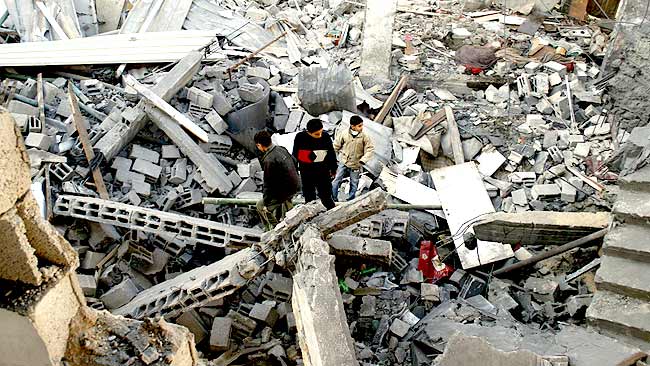
The disaster in Haiti is a natural one; the one in Gaza is the unproud handiwork of man. Our handiwork. The IDF does not send cargo planes stuffed with medicines and medical equipment to Gaza. The missiles that Israel Air Force combat aircraft fired there a year ago hit nearly 60,000 homes and factories, turning 3,500 of them into rubble. Since then, 10,000 people have been living without running water, 40,000 without electricity. Ninety-seven percent of Gaza’s factories are idle due to Israeli government restrictions on the import of raw materials for industry. Soon it will be one year since the international community pledged, at the emergency conference in Sharm el-Sheikh, to donate $4.5 billion for Gaza’s reconstruction. Israel’s ban on bringing in building materials is causing that money to lose its value.

Gershon Baskin, in today’s Jerusalem Post:

Humanitarian disasters around the world bring out the best in Israel and in Israelis. The horrific devastation caused by the earthquake in Haiti and the scenes of unbearable human suffering brought about an immediate enlistment of both civilian and public efforts to come to the aid of the poorest nation in the Western hemisphere…

But what about the humanitarian disaster in our own backyard caused in a large part by our own doing? What about Gaza? More than 1.5 million people are living in total poverty, without sanitary drinking water, under an economic and physical siege, locked in what could easily be called the world’s largest prison. While we ask to see in all of the gory details, all of the destruction including hundreds of corpses on the streets of Port-au-Prince, we wish to see none of the human suffering of our Palestinian neighbors in Gaza where we literally hold the keys to the end of their suffering.

My Favorite Rabbis: Everett Gendler

Most people probably don’t realize this, but rabbis need rabbis too.

And there are a lot of great rabbis out there. Over the years I’ve been personally inspired by many of them: remarkable, talented leaders whose work challenges me, drives me and constantly reminds me why I do what I do. So with this post I’m debuting a new series I’m calling “My Favorite Rabbis:” ongoing profiles of the contemporary rabbis whom I consider to be my own spiritual teachers.

I’ll start by introducing you to Rabbi Everett Gendler, a Conservative rabbi whose moral courage has provided Jewish leadership for some of the most important progressive causes of our day. Today, some fifty years since he became a rabbi, I believe he remains on the cutting edge of the issues that truly matter.

This MLK weekend, it is certainly appropriate to note that Rabbi Gendler was one of the first rabbis to become actively involved in the struggle for civil rights in America and played a critical role in involving American rabbinical leadership in the movement. It’s doubtful that American rabbis would have stepped up to this struggle nearly as much had it not been for Rabbi Gendler’s prophetic influence.

During the early and mid-1960s, Rabbi Gendler led groups of American rabbis to participate in numerous prayer vigils and protests throughout the South. Of course many know that the legendary Rabbi Abraham Joshua Heschel marched with Dr. Martin Luther King in Selma in 1965. I imagine far fewer are aware that it was in fact Rabbi Gendler who persuaded Heschel to do so.

Heschel biographer Edward K. Kaplan writes:

Despite fears for his safety from his wife and the twelve year old Susannah, (Rabbi Heschel) agreed to join the march at the urging of Rabbi Everett Gendler, a pacifist and former student. Gendler had led a group of rabbis to Birmingham, Alabama to work for voting rights and remained in touch with the Reverend Andrew Young, King’s Executive Assistant at the SCLC. (From “Spiritual Radical: Abraham Joshua Heschel in America,” p. 222)

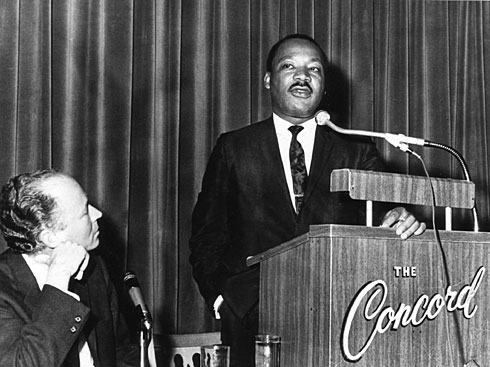
Rabbi Gendler was also instrumental in arranging Martin Luther King’s keynote address at the Rabbinical Assembly’s convention on March 25, 1968. This now-legendary speech took place at the Concord Resort hotel in New York’s Catskill Mountains just 10 days before King’s death. (That’s Rabbi Gendler to the left of Dr. King in the pic above).
Today, decades after King’s death, Rabbi Gendler remains an eloquent Jewish advocate for the path of nonviolence. His work has taken him across the world – most notably to India where he and his wife Mary teach the principles of nonviolence to Tibetan exiles.

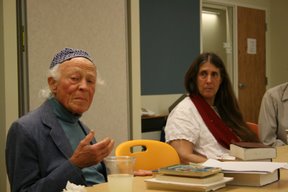
I’m personally honored to serve with Rabbi Gendler on the Elder’s Council of the Shomer Shalom Institute for Jewish Nonviolence. In this picture, he leads a workshop at JRC in 2008. Shomer Shalom founder Rabbi Lynn Gottlieb (someone whom I may well be profiling in the future) is sitting next to him.

Rabbi Gendler has also been a long time advocate for Palestinian human rights – and his courageous stands have made it possible for new generations of rabbis to find their own voices on this painful issue. When Rabbi Brian Walt and I first began Ta’anit Tzedek and were looking for rabbis to join our campaign to protest the blockade of Gaza, we immediately turned to Rabbi Gendler, who joined our effort without hesitation. It is difficult to describe how much it means to know there are rabbis out there like Everett, someone who has been putting himself on the line for so long, and upon whom we always know we can rely for guidance and support.

Rabbi Gendler was also one of the first Jewish leaders to embrace environmentalism and vegetarianism long before they became fashionable. As the rabbi of a green synagogue myself, I recognize a tremendous debt to Everett, who more than anyone helped to put environmental issues on the radar screen of the Jewish community.

From a 2008 article in the Los Angeles Jewish Journal:

On a ferociously cold evening in November 1978, Rabbi Everett Gendler climbed atop the icy roof of Temple Emanuel in Lowell, Mass., and installed solar panels to fuel the synagogue’s ner tamid (eternal light)…

Gendler’s conversion of that eternal light marks the first known action to green a synagogue, making it more spiritually and ecologically sustainable, and Gendler himself, now Temple Emanuel’s rabbi emeritus, has been hailed as the father of Jewish environmentalism.

There so much more to say about Everett and his work. I suppose the most essential thing I can say about him is that he was and remains a spiritual maverick. His work remains as relevant and courageous as ever.

As we honor Dr. King this weekend, it’s critically important to honor those who continue his to walk his path in our own day. For me and so many others, Rabbi Everett Gendler is the one who teaches us how to walk that walk.
Toward a New Gaza Strategy

There is new tension along the Israel-Gaza border. Israel is bombing targets in Gaza; mortar shells and Qassams are flying into southern Israel once again. If  Israel’s massive military assault last year was designed to deter Hamas and/or provide security for the citizens of southern Israel – then it now appears that effort has been for naught.

When will we learn that bombs won’t work?  As so many of us have been shouting for so long, the only true solution to the Gaza conflict is a political solution: to open the border, to provide relief and development assistance, to engage with Hamas directly.

I’m gratified, at least, that the editorial board of Ha’aretz seems to be moving in this direction:

A renewal of rocket fire shows that even a major military operation that brought death and destruction cannot ensure long-term deterrence and calm. Israel has an interest in stopping escalation at the border so as not to find itself caught up in another belligerent confrontation with Hamas …

Instead of erring by invoking the default solution of more force, which does not create long-term security or ease the distress of the Palestinians in Gaza, the crossings between Israel and the Gaza Strip should be opened and indirect assistance rendered to rebuild its ruins.

Amen. Massive military bombardment and a crushing blockade is not making either side more secure – it is only exacerbating the conflict and ensuring the likelihood we will be reading more tragic news from a small patch of land that has known nothing but tragedy for the past six decades.

PS: Since I wrote this post this morning, I’ve been thinking all day about how I addressed the Gaza conflict as largely a strategic policy issue. If I’m going to be totally honest, however, I’d have to admit that my feelings about this issue go deeper than simply “war doesn’t work.”

I’ve come to accept that at its heart, this conflict is not simply strategy but about justice. To anyone who believes that this latest border issue is about Hamas and its missiles, I’d respond that it is only the latest incarnation of an injustice that was committed against the Palestinian people, long, long before the Qassams started flying.

I’m currently reading Joe Sacco’s devastating graphic-novel style reportage, “Footnotes in Gaza.” I highly recommend it to anyone interested in the tragic history of the Palestinian experience in Gaza.