Category Archives: Immigration

God is in the Resistance: Sermon for Rosh Hashanah 5786

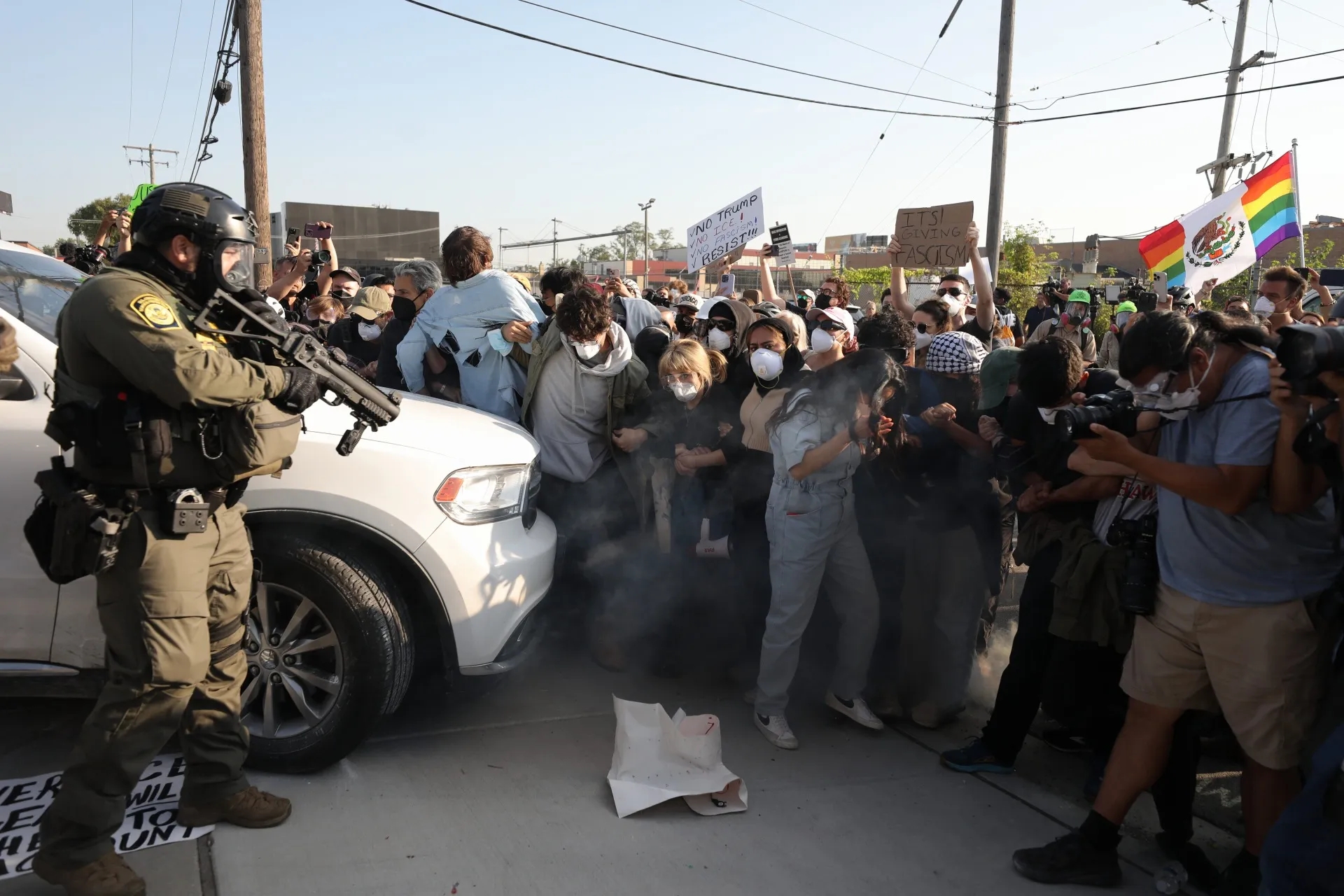
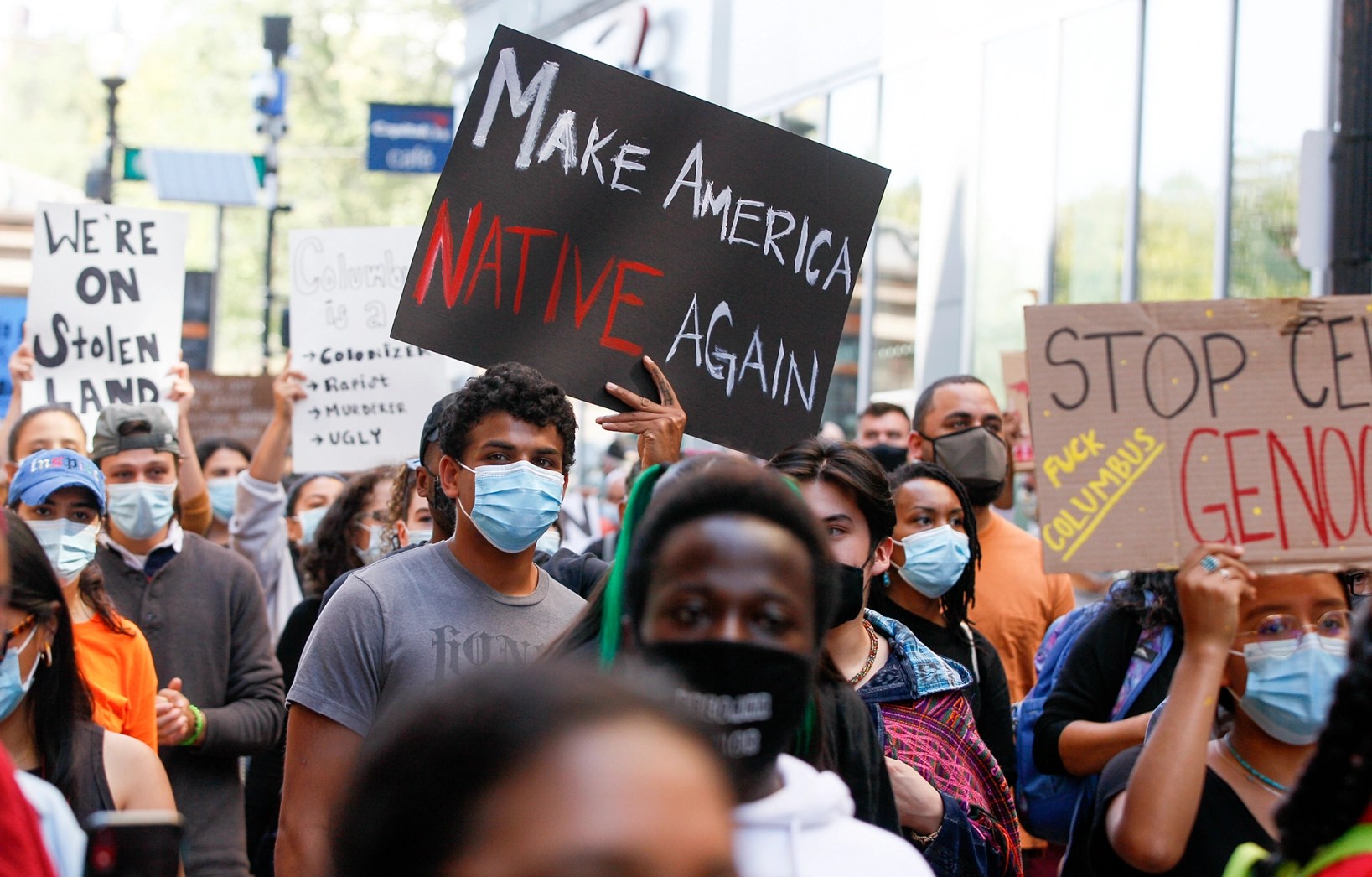
Protesters outside an ICE processing facility, Broadview Chicago. (Credit: Vincent D. Johnson/Block Club Chicago)

I’ll be honest with you: I never liked High Holiday services when I was a kid. 

There were so many things that just rubbed me the wrong way: they felt interminably long, the old school Reform choir music wasn’t my thing, and my parents would constantly shush me and my brothers when we got squirrelly (which was often). But most of all, I resented the seeming irrelevance of it all. I just couldn’t relate to the content of the services – and there was never any effort to explain why it should be relevant to me. 

On Rosh Hashanah in particular, I just couldn’t relate to the constant stream of prayers singing God’s praises, extolling God’s greatness and invoking God’s power. It all seemed designed to make us feel small and insignificant: this repeated glorification of an all-powerful God to whom we must beg and plead for another year of life. 

I realize now that I was a pretty astute kid. “Malchuyot,” which literally means “sovereignty,” is one of the central themes of Rosh Hashanah. Every new year we declare over and over that God is our supreme ruler. This theme is repeated throughout the liturgy, particularly during the Musaf service, when it is traditional to physically prostrate oneself on the floor before the divine throne during the Aleinu prayer. 

Over the years, however, as I began to attend services on my own terms rather than under duress, I came to appreciate Rosh Hashanah, yes, even the idea of Malchuyot. In fact, the older I get, the more relevant and important this concept feels to me. On a personal level, I understand to be a Malchuyot is a reminder that we often labor under illusions of our own power and control. We face these illusions head on during Rosh Hashanah when we do the work of teshuvah: the sacred process of return and repentance.

Of course, we are not all powerful. But ironically, acknowledging the limits of our power can actually be liberating. By affirming a transcendent source of power greater than our own, we can better focus and identify the things we can control in our lives. When we invoke God’s Malchuyot on Rosh Hashanah, we do so in the spirit of this liberation, to break free of our illusions of power and put ourselves on a more productive, healing path during the Days of Awe. 

Beyond the personal, I’d suggest Malchuyot has a collective and political dimension as well. It’s deeply rooted in Judaism’s central sacred narrative, the Exodus story. I actually made this very point during my very first sermon for Tzedek Chicago on Rosh Hashanah ten years ago:

At its core, I would suggest affirming Malchuyot means affirming that there is a Force Yet Greater: greater than Pharoah in Egypt, greater than the mighty Roman empire, greater than the myriad of powerful empires that have oppressed so many peoples throughout the world.

I would argue that this sacred conviction has been one of the central driving forces of Jewish tradition throughout the centuries: that it is not by might and not by power – but by God’s spirit that our world will ultimately be redeemed. I would further argue that this belief in a Power Yet Greater has sustained Jewish life in a very real way. After all, the Jewish people are still here, even after far mightier empires have come and gone. It might well be said that this allegiance to a Power Yet Greater is the force that keeps alive the hopes of all peoples who have lived with the reality of dislocation and state oppression.

I went on to suggest that through Zionism, the Jewish people have tragically betrayed this sacred Jewish narrative of liberation. When you think about it, the raison d’etre of Zionism literally is human sovereignty. It is an ideology that unabashedly deifies state power as a redemptive force in Jewish life and overturns centuries of Jewish tradition. It has subverted the sacred ideal of Malchuyot by centering and sacralizing human power above all else.

When I delivered that first Rosh Hashanah sermon, however, I never could have predicted where Zionism’s bargain with state power would lead us. In the misguided name of Jewish safety and supremacy, Israel has doubled down on its assumption of human Malchuyot to an unbearable degree. As we gather for Rosh Hashanah this year, Israel has been perpetrating an almost two-year genocide against the Palestinian people. Nearly 70,000 Palestinians have been killed, with real numbers likely to reach the hundreds of thousands. Whole families have been killed and entire bloodlines erased. Untold numbers of people have been buried under rubble, burned alive, dismembered and starved to death. At this very moment, Israel is literally bombing the entire north of Gaza off the map, trapping scores of residents who cannot leave their homes and sending scores of others to the south into active war zones.

And yet of course. Of course it has come to this. From the very beginning, the goal of establishing a Jewish-majority nation state could only be realized by dispossessing another people – what the Palestinian people refer to as the Nakba. Israel’s genocide against the Palestinians did not begin on October 7; it has been ongoing for over 70 years. There is a direct line leading from Zionism’s idolatrous attachment to Malchuyot to the crimes we are witnessing daily in Gaza.

This idolatrous attachment, of course, is not unique to Zionism. Looking back, I realize that Tzedek Chicago’s first Rosh Hashanah service took place shortly after Trump announced his first Presidential campaign. It’s also fair to say when I gave that first sermon, I never would have dreamed that just ten years later, the US would be rapidly descending into authoritarian fascist rule. That ICE would serve as our President’s secret police force, prowling the streets in plain clothes and face masks, abducting immigrants and student activists in unmarked vans. That thousands of National Guard troops would be mobilized to occupy American cities. That so many of our nation’s institutions would be defunded, plundered and centralized by unelected oligarchs. That our government would openly declare whole groups of people, including immigrants, trans people, people of color and unhoused people to be literal “enemies of the state.”

In the wake of Charlie Kirk’s murder, the incitement against these imagined enemies has reached a terrifying fever pitch. Trump and the movement he spawned are now seizing this moment to foment fury against a broad array of individuals and institutions they call the “radical left.” Trump’s aide Stephen Miller has chillingly characterized the current moment in America as a battle between “family and nature” and those who celebrate “everything that is warped, twisted and depraved.” 

Words such as these should not sound new to us; the Trump regime is using a time-honored tactic from the fascist playbook. We know that totalitarian regimes have historically consolidated their power during times of instability by fomenting a toxic “us vs. them” narrative. Hannah Arendt identified this mentality very clearly seventy-five years ago in her book The Origins of Totalitarianism: “Tribal nationalism always insists that its own people are surrounded by a ‘world of enemies’ – one against all – and that a fundamental difference exists between this people and all others.” 

Although the context of 21st century fascism is different in many ways from fascisms of the past, the fundamental building blocks of this phenomenon remain the same. In the parlance of Rosh Hashanah, the fascists of today are claiming Malchuyot – ultimate power – for themselves. And they are consolidating their power by demonizing those who do not fit into their idealized, privileged group as enemies who must be fought and eradicated at all costs. 

However, as overwhelming as the current political moment might feel, there is a textbook for resisting fascism as well. The essential rules for fighting fascism remain the same as they ever were. And the first order of business is: do not collaborate. 

This may seem obvious, but given the hard truth of the moment, I don’t think it can be repeated enough. It has been truly breathtaking to witness how quickly ostensibly independent non-governmental institutions have capitulated to Trump’s bullying and blackmail: from universities firing professors and defunding whole programs to businesses eradicating their DEI programs; from corporate media outlets becoming state mouthpieces, to law firms allocating hundreds of millions of dollars in legal services to defend the federal government. 

Has the liberal establishment been up to the challenge of this moment? Just consider its response to the murder of Charlie Kirk. Let’s be clear: Kirk was an unabashed white Christian Nationalist who incited young people on college campuses to hatred under the cynical pretense of “open dialogue.” Even so – and even as the MAGA movement is dangerously exploiting this moment – liberal leaders and institutions have been normalizing Kirk by openly praising him as a paragon of free speech and good faith debate. 

After he was killed, CA Governor Gavin Newsom eulogized Kirk by saying: “The best way to honor Charlie’s memory is to continue his work: engage with each other, across ideology, through spirited discourse. In a democracy, ideas are tested through words and good-faith debate.” Similarly, following Kirk’s murder, the Dean of Harvard College, David J. Deming publicly vowed to protect conservative students on campus, adding that Kirk’s enthusiasm for publicly debating his opponents could be a model for Harvard’s own civil discourse initiatives. And for his part, liberal New York Times columnist Ezra Klein wrote an op-ed entitled “Charlie Kirk Practiced Politics the Right Way.” 

It’s not clear if these apologists honestly believe what they are saying or if they’re just trying to avoid the government’s takedown of anyone who has anything remotely critical to say about Charlie Kirk. But in the end, it really doesn’t matter. The bottom line: liberal normalization will not appease fascists. 

To put it frankly, the government has declared war on us – and we must respond accordingly. The days of partisan cooperation and dialogue are over. The days of good faith debate and civic compromise are over. Capitulating to demagoguery and hatred will not convert the MAGA movement to the values of democracy and civil discourse. Yes, in a healthy democratic society, the concept of “collaboration” is something to be valued. But in a fascist regime, the term “collaborator” has a different meaning entirely. 

The first step in resisting collaboration is to accept that none of this is normal. We must let go of old assumptions, many of which, frankly, have led us to this moment. If we are to be totally honest, it must be said that the Democrats and the liberal establishment have been collaborating with corporate interests along with Republicans for years. As we interrogate the abnormality of this moment, we must admit that the entire system has been disenfranchising whole groups of people in this country for far too long. 

Resisting fascism also means letting go of our ultimate faith in the “rule of law.” Indeed, both the left and the right tend to fetishize the rule of law as an absolute good. And while it’s true that the law can be a tool to ensure a more just society, it can just as often be used as a blunt instrument to dismantle democracy. 

We know from history that governments routinely create laws that are inherently unjust. Slavery was legal in the US for almost 250 years. Apartheid in South Africa was legal. Apartheid continues to be legal in Palestine/Israel. In the face of such legal injustice, the obvious moral and strategic response is not to follow but to break the rule of law. As Dr. Martin Luther King famously wrote in his “Letter from a Birmingham Jail:” 

We should never forget that everything Adolf Hitler did in Germany was “legal” and everything the Hungarian freedom fighters did in Hungary was “illegal.” It was “illegal” to aid and comfort a Jew in Hitler’s Germany. Even so, I am sure that, had I lived in Germany at the time, I would have aided and comforted my Jewish brothers.

This is, in fact, the radical truth we affirm every Rosh Hashanah. When we affirm Malchuyot, we affirm that there is a moral law yet greater than any law levied by a government or regime. On this Rosh Hashanah in particular, the sound of the shofar calls on us to resist conformity; to vow to become criminals when confronted with laws that are inherently unjust. More than any Rosh Hashanah in our lifetimes, we must be ready to defy the illegitimate laws wielded by the illegitimate rulers who would govern us. 

Even if we do accept this challenge, however, the question remains: where does Malchuyot, ultimate Power, reside, if not with governments, politicians or the rule of law? Here, I’d like to quote yet another one of my heroes, the Puerto-Rican Jewish liturgist Aurora Levins Morales:

They told me we cannot wait for governments.
There are no peacekeepers boarding planes.
There are no leaders who dare to say
every life is precious, so it will have to be us.

Yes. God’s power is revealed in our readiness to show up for one another.  When we acknowledge Malchuyot on Rosh Hashanah, we affirm that the Divine Presence is manifest whenever we struggle and resist and fight for our communities, for a world where all are liberated and cherished and protected. When there are no leaders who dare to ensure that every life is precious, it will have to be us. 

Here are two concrete examples of Malchuyot in action: this last January, shortly after the inauguration, the Trump administration launched a series of raids in Chicago they called “Operation Safeguard” where, over the course of a few days, ICE, the FBI, the ATF and other federal forces coordinated massive raids in neighborhoods throughout the city and suburbs. We don’t know how many were arrested or detained, but we do know that this federal blitzkrieg was deeply frustrated by local organizing. Trump’s so-called “border czar” Tom Homan later complained that immigration organizers in Chicago were “making it very difficult” to arrest and detain people. He said, “They call it Know Your Rights. I call it how to escape from ICE.”  

Of course, even as we win these battles, this fierce war continues to escalate. ICE violence continues to rage in the neighborhoods of our cities. In Chicago, ICE has now launched another sweep, this one called “Operation Midway Blitz.” Just last Friday, at an immigrant processing center in the Broadview section of Chicago, federal agents shot tear gas, pepper spray and flash bang grenades into hundreds of demonstrators. Ten protesters were taken into custody by federal agents over the course of the day. Even amidst this escalating violence, however, local organizers here in Chicago continue to hold the line. 

Another example: in Washington DC which is still under occupation by National Guard troops, groups of local residents called “night patrols” have been regularly patrolling the streets. According to journalist Dave Zirin, whose reports from the ground have become invaluable:

These night patrols watch over the city to ensure that people are protected from state violence, false arrest, abduction, and harassment. Failing that, their goal is to document the constitutional violations or brutality they witness, so people can see the truths about the occupation that a compliant, largely incurious media are not showing. 

Critically, these neighborhood patrols are being led and stewarded by members of impacted groups: As one night patroller put it: “a lot of young people, a lot of people of color, queer and trans folks, people who have been directly impacted by policing, and folks with street medic backgrounds. It skews toward people who already know what it’s like to be criminalized.” 

Though it isn’t being highlighted by the corporate mainstream media, this local organizing is happening in communities all over the country: in Los Angeles, where there are also still hundreds of National Guard troops, as well as New Orleans, Memphis, Baltimore and other cities that the Trump administration is directly threatening with military invasion. I know that many Tzedek Chicago members have long been active in these organizing efforts, here in Chicago, around the US and even around the world. But again, we can have no illusions over what we are up against. 

I know that the magnitude of these events often leads us to a state of overwhelm and despair. We doom-scroll through the news every day, we read about Trump’s newest executive order, the latest regressive Supreme Court ruling or some other heinous event and the ferocity of this onslaught can literally leave us breathless. This is, of course, yet another page from the authoritarian textbook: to neutralize the population through a calculated strategy of shock and awe. They want us to feel that all is lost, to give in to our despair that their power over us is all but inevitable. 

Our experience of shock and overwhelm is compounded all the more by an all-pervasive sense of grief. So much of what we have fought for has been lost. So many of the institutions we assumed would be eternally with us are being plundered and dismantled. Some of these losses may be permanent, some may not, but the harms they are causing are very, very real. 

I feel this grief myself, believe me, I do. But I also know that if we surrender to it, then their victory over us will become self-fulfilling. The way through the fear and the grief, I truly believe, is to never forget that we have power, that our words and actions matter and that nothing is ever inevitable unless we let it be so. 

Whenever we feel overwhelmed, I think the critical first step is to reclaim our equilibrium by asking ourselves, what matters most to me? What are the issues that are nearest to my heart? Most of us have the capacity to devote our time and energy to one or two causes at most. What are the most effective organizations fighting for this cause? Who are the people in my life that can connect me with the people doing this work? If I don’t have the capacity or physical ability to engage actively in these kinds of responses, what are other meaningful ways I can show up?  

Amidst all this loss, we must never forget: even if our victory is not guaranteed, there are still things in this world worth fighting for. Generations of resisters have understood this axiom well: “If I’m going to go down, I’m sure as hell going to go down swinging.” In the words of my friend and comrade, Chicago organizer Kelly Hayes, who I’ve quoted in more than one High Holiday sermon over the years:

I would prefer to win, but struggle is about much more than winning. It always has been. And there is nothing revolutionary about fatalism. I suppose the question is, are you antifascist? Are you a revolutionary? Are you a defender of decency and life on Earth? Because no one who is any of those things has ever had the odds on their side. But you know what we do have? A meaningful existence on the edge of oblivion. And if the end really is only a few decades away, and no human intervention can stop it, then who do you want to be at the end of the world? And what will you say to the people you love, when time runs out? If it comes to that, I plan on being able to tell them I did everything I could, but I’m not resigning myself to anything and neither should you. Adapt, prepare, and take the damage done seriously, but never stop fighting. Václav Havel once said that “Hope is not the conviction that something will turn out well, but the certainty that something is worth doing no matter how it turns out.” I live in that certainty every day. Because while these death-making systems exist both outside and inside of us, so do our dreams, so long as we are fighting for them. And my dreams are worth fighting for. I bet yours are too.

This New Year, I realize I’ve come a long way from that beleaguered kid who felt disempowered on the High Holidays to a rabbi telling you Rosh Hashanah is our clarion call to fight facism. But here I am. And here we are. May this new year inspire us all with the knowledge that true sovereignty, true Malchuyot, lives at the heart of the struggle. 

On this, my final Rosh Hashanah with this amazing community, this is what I am feeling to my very bones at this moment: that while Pharaohs may rise, they will inevitably fall, that beyond the horizon of Olam Hazeh, this terribly broken world, there lies Olam Haba: the world we know is possible. And no matter what may happen this new year – and every new year to come – that world is always worth fighting for.

Shanah Tovah.

Standing at Sinai: Interrogating our National Myths of Unity

In the week’s Torah portion, Parashat Yitro, the Israelites stand at Mt. Sinai and collectively enter into a covenant with God. With a message conveyed through Moses, God says to the people:

“(If) you will obey Me faithfully and keep My covenant, you shall be My treasured possession among all the peoples. Indeed, all the earth is Mine, but you shall be to Me a kingdom of priests and a holy nation.” (Exodus 19:5-6)

Shortly after, the Israelites collectively accept:

…All the people answered as one, saying, “All that God has spoken we will do!” (19:8)

In this mythic moment, the Israelites become a nation unified in a shared, transcendent purpose.

But do they really, though? Most of the Torah’s narrative post-Sinai is less a record of a nation united by a shared purpose than a portrayal of a deeply fractured collection of tribes struggling mightily to live up to the covenant they made with God at Mt. Sinai. This certainly tracks with the evolution of Jewish peoplehood throughout the centuries. Though the organized Jewish community routinely clings to the mythic notion that “We are One,” we have always been a nation of sub-communities: a family divided by a of myriad of assumptions over what it means to be and behave as a Jew, often rancorously.

Of course, in the current moment the Jewish people are experiencing an exceedingly powerful and painful division. As I suggested in my sermon this past Yom Kippur:

Jewish life is going through … a monumental crisis and transformation right now. I’m speaking of course, about the abyss that has opened over the issue of Zionism – an abyss that has widened considerably this past year as a result of Israel’s genocide in Gaza.  

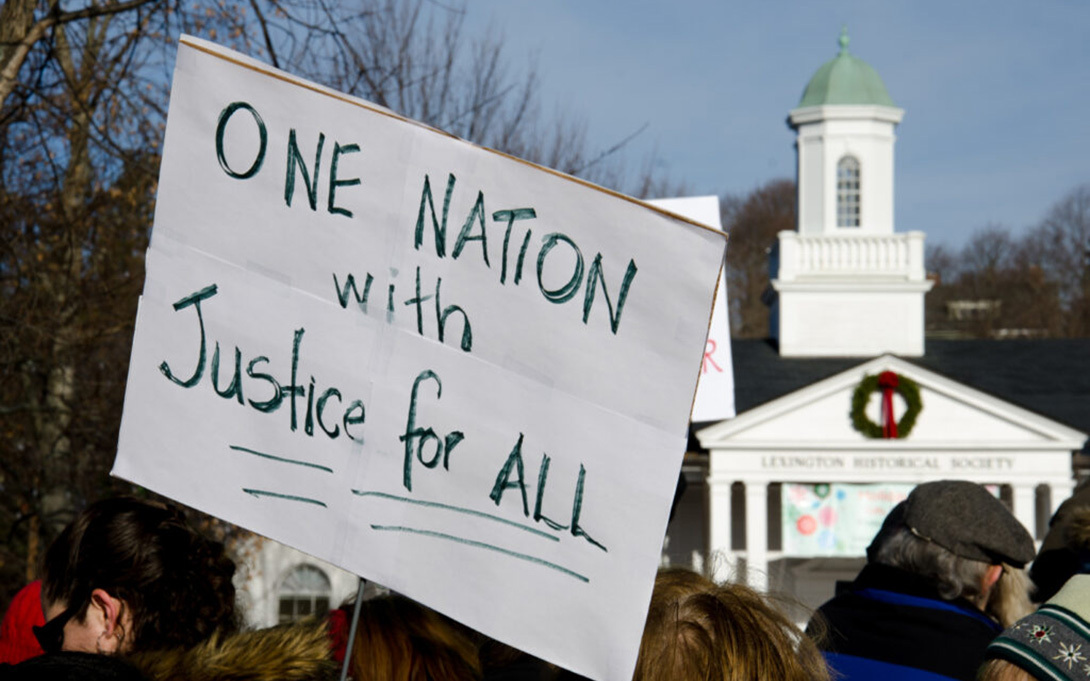
This mythology of national unity, however, is not unique to the Jewish people. Those of us raised in the US are all too familiar with such tropes, socialized as we were with the famous line from the Pledge of Allegiance: “One nation, under God, indivisible, with liberty and justice for all.” In truth, however, the US has been a deeply divided nation since the day it was founded. While the preamble of the Constitution reads “We the People,” the “people” it referred to were white, landowning men. The Naturalization Act of 1790 limited access to citizenship to “free white persons.” Later on, the US broke in two after slaveholding states succeeded – and the nation only became “one” again after fighting a bloody civil war. In too many ways, it’s a war that has never really ended.

As we see the rise of nativism and authoritarianism in nations around the world, it’s fair to say that this reckoning over national identity is truly a global phenomenon. Like many, I’ve been watching with alarm the rise of the far right nationalist AfD party in Germany (with the unabashed support of the ubiquitous Elon Musk) as they seek to build a coalition with conservative opposition parties. German Vice Chancellor Robert Habeck has warned ominously that such an alignment would “destroy Europe.”

So where does this leave us? Can we actually affirm these narratives of national unity in good faith? Do they serve us in any way – or do inevitably lead to authoritarianism and genocide?

I personally believe that national mythologies should not be literal oaths to be sworn to, but collective narratives to be interrogated deeply. In the case of the US narrative, we must ask honestly: what is the place of dispossessed indigenous nations in our national narrative? What is the place of descendants of kidnapped Africans who were brought here in chains to build up this nation? What is the place of immigrants who come to these shores seeking a better life – or to escape certain harm in in their home countries? What is the place of LGBTQ+ people, disabled people and members of other historically marginalized groups?

Those who uphold national mythologies must ask honestly, who exactly is the “we” in “We the People?” Because these narratives will only be useful if they lead to actual collective liberation for all. More critically, those of us who are committed to a truly inclusive national vision must prepare for the inevitable, often violent backlash from those who do not share our narrative. Indeed, history has proven all too often that a truly inclusive national vision never comes easily. On the contrary, it must be fought for.

At the end of the Torah, God says to the Israelites:

“I make this covenant and this oath, not with you alone, but both with those who are standing here with us this day before the ETERNAL our God and with those who are not with us here this day.” (Deuteronomy 29:13-14)

This Shabbat Yitro, as we stand once more at Sinai, let us ask ourselves: “Who are not with us on this day?” Why are they not here? What are we willing to sacrifice to ensure that they will be included in the covenant as well?”

From Gaza to Chicago: the Resistance of Disposable Populations

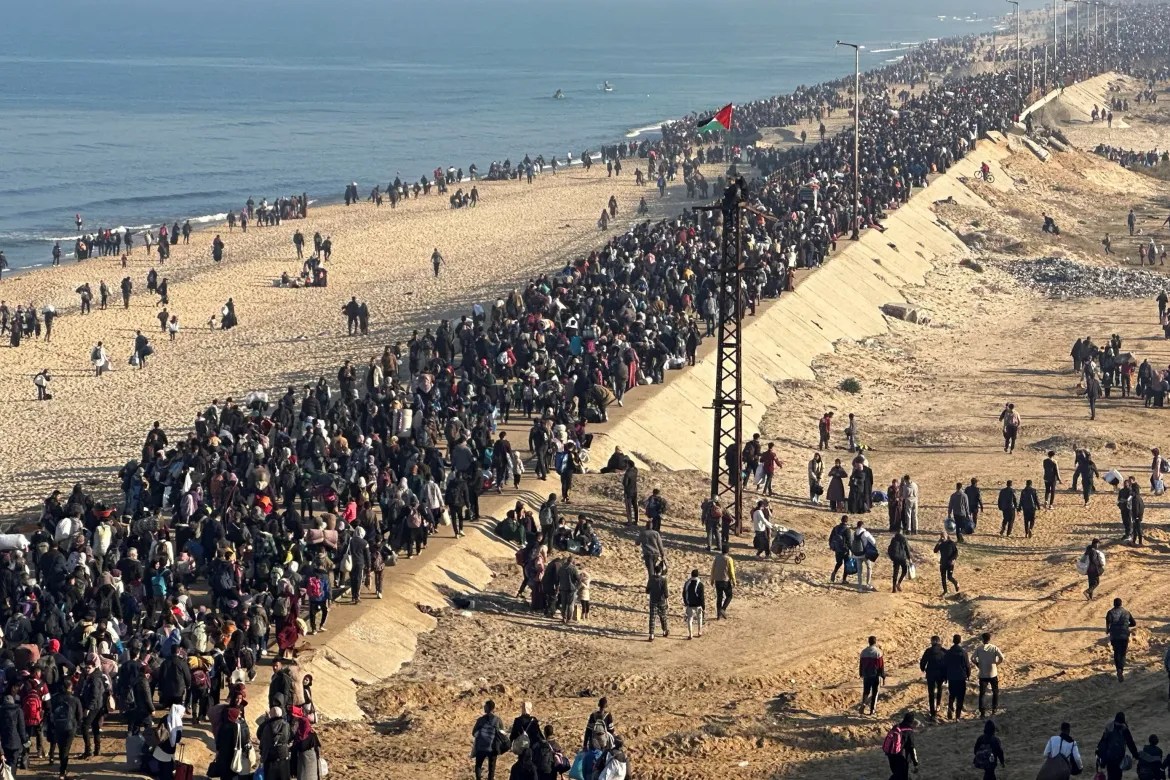
(Photo: Ramadan Abed/Reuters)

It’s difficult to describe the feelings I experienced this past weekend, as I watched hundreds of thousands of Gazans in a long and seemingly endless line, heading on foot to their homes in the north. Crossing the Netzarim corridor – the border the Israeli military demarcated separating north from south – they headed back with whatever possessions they were able to carry. Family members who thought each other dead clutched each other in tearful embrace. It was truly a wonder to behold: this resilient people who had defied and withstood the most destructive miliary onslaught in modern times. As Gazan activist Jehad Abusalim put it:

Gaza today, for now, disrupts and defies the global agenda of rendering entire populations disposable and rightless. This was achieved through the resilience of an entire population that has endured months of displacement, starvation, disease and bombardment.

Though this is a fragile and temporary ceasefire, it’s striking to note the depth of Israel’s failure to achieve any of its stated objectives of its genocidal war. It failed to destroy Hamas and the Palestinian armed resistance in Gaza. It failed to rescue hostages taken on Oct. 7 through military means. It failed to implement its so-called “General’s Plan” – its blueprint for ethnically cleansing northern Gaza. And perhaps most importantly, it failed to break the will of the Gazan people to survive its genocidal war.

Jehad’s words “for now” are appropriate. The overwhelming number of Gazans are returning to homes that are rubble – and it is by no means certain how they will be able to rebuild their lives. The ceasefire is a tenuous one; there is still no agreement on the second or third phases of deal and there is every possibility that Netanyahu will use the deal as cover to eventually depopulate Gaza of Palestinians. Trump’s recent comments (“I’d like Egypt to take people, and I’d like Jordan to take people…we just clean out that whole thing”) have made his intentions clear, even if his plan has been rejected outright by Arab states.

As I read the reports and analyses in the wake of this ceasefire, one thing seemed consistent to me: as ever, there is little, if any, concern for the humanity of the Palestinian people. On the contrary, every pronouncement by Western governments and the mainstream media treats their mere existence as a problem to be dealt with. In this regard, Jehad’s reference to “the global agenda of rendering entire populations disposable and rightless” is spot on. Palestinians in general – and Gazans in particular – have always been the canaries in the coal mine when it comes to the use of state violence against “problematic populations” deemed “disposable” by authoritarian states seeking to consolidate their power.

“Entire populations rendered disposable and rightless” certainly applied to events in my hometown of Chicago this past Sunday, where the Trump launched “Operation Safeguard,” a shock and awe blitz spearheaded by ICE, the FBI, ATF, DEA, CBP and US Marshals Service. Led by Trump’s so-called “border czar” Tom Homan (and surreally videotaped live by “Dr” Phil), heavily armed and armored forces terrorized Chicago neighborhoods all day, mostly going door to door, staking out streets in search of undocumented people, taking them away in full-body chains. While there is no definitive information on the numbers of people taken, federal immigration authorities claim to have arrested more than 100 people in recent days.

On a positive note, however, we are seeing that the strategies employed by local immigrant justice coalitions are making a real difference.  My congregation, Tzedek Chicago is part of a local interfaith coalition called the Sanctuary Working Group, which has been mobilizing Know Your Rights trainings and Rapid Response teams. From our experience in Chicago over these past few days, we’ve seen that this kind of mobilization really does have an impact. Perhaps the strongest validation of these resistance strategies came from Homan himself, who said on an interview with CNN:

Sanctuary cities are making it very difficult to arrest the criminals. For instance, Chicago, very well educated, they’ve been educated how to defy ICE, how to hide from ICE. They call it “Know Your Rights.” I call it how to escape arrest.

in my previous post, I wrote that “the current political moment has left many of us breathless.” But over the course of the last several days, we’ve seen it is indeed possible “to disrupt and defy the global agenda of rendering entire populations disposable and rightless.” If we had any doubt at all, let us take our inspiration from the Gazan people, who have refused to submit after 15 months of merciless genocidal violence and are returning to their homes, vowing to rebuild and remain.

The most powerful shock and awe in the world could not break them. Let this be a lesson to us all.

The New Jewish Abyss: Sermon for Yom Kippur 5783

(photo: Jewish Voice for Peace)

The course of Jewish history has never been a straight line. Throughout the centuries, the evolution of Jewish life has been shaped by a series of crises, tension points – and outright cataclysms. More often than not, these tumultuous events have even transformed the very nature of Judaism itself. 

To offer just a few examples: classical Judaism as we know it emerged out of a catastrophe: the destruction of the Temple in Jerusalem by the Romans in 70 ACE. The Spanish Inquisition in 1492 ended the Golden Age of Jewish life in Muslim Spain and initiated the spread of Sephardic Judaism throughout Europe, Africa and the Middle East; the Hasidic movement was born out of tensions in Eastern European Jewish life in the 17th century; the onset of modernity and the Enlightenment in Western Europe, created a wide constellation of movements whose legacies still influence Jewish life today. 

I’m making this point because there’s every indication that Jewish life is going through just such a monumental crisis and transformation right now. I’m speaking of course, about the abyss that has opened over the issue of Zionism – an abyss that has widened considerably this past year as a result of Israel’s genocide in Gaza. . 

Last night, Aviva Stein described how she painfully crossed this divide when she shared her own personal Jewish journey with us. I’d like to thank Aviva for her powerful words, which were truly a gift to our community. In my remarks to you today, I’d like to pick up where she left off. I want to begin by responding to her painful point about the increasing exile of young Jews from the Jewish community:

There is an epidemic in the Jewish community – young people are losing and leaving their jobs, and the Jewish community is losing the passion, critical thinking, and vitality that their best and brightest brought to their work. So many Jewish organizations are breaking this way – the big tent, so to speak, has collapsed, and Jews of conscience, Jews who say no to genocide and no to Islamophobia and war mongering, find ourselves on the outside.

Just two weeks ago, there was an extensive investigative article in the journal “In These Times,” which documented how “US Jewish institutions are purging their staffs of anti-Zionists.” The author of the article, Shane Burley observed:

If the trend continues, it could contribute significantly to one of the sharpest breaks in the history of American Jewish life, forcing out a generation of progressive Jews and furthering the crisis of legitimacy plaguing much of the communal Jewish infrastructure.

In other words, we’re currently witnessing a fundamental divide in the Jewish community – even a potential schism in the making. While it’s far too early to predict how it will play out, one thing seems clear to me: just as Israel is fast losing its legitimacy in the international community, Zionism is just as quickly losing its legitimacy in the Jewish community itself.

Of course we can’t write Zionism’s obituary just yet. There are still plenty of staunch Zionists in our community who have a decidedly different view of the past year – who insist that Israel is doing what it has to do to defeat its existential enemies. And there are also many liberal Zionists who refuse to recognize the reality of Israel’s genocide, who still point to the “complexities” of the “conflict.” 

This is what it has come to. The Jewish community has become irrevocably divided between those who stand with Israel – or apologize for its behavior – and those who believe Israel is a settler colonial apartheid state that is committing a genocide in our name. There is no more big tent, if there ever was one. There is little use in pretending that there is any conceivable room for consensus on this issue. 

While these fissures over Israel and Zionism have always been present in the Jewish community, it’s clear that they’ve been widening over the last decade or so. This past year, however, the divide broke wide open. And I honestly don’t believe we’ll ever be able to put the pieces back together again, certainly not in the way they were. 

Over the years, prophetic voices in our community have been sounding the alarm over this coming schism. One such voice was the great Jewish scholar and theologian Marc Ellis, of blessed memory, who tragically died far too soon this past June. Among other things, he wrote about the rise of what he called “Constantinian Judaism.” This was a reference to the pivotal moment in the 4th century when the Emperor Constantine made Christianity the official religion of the Roman Empire, transforming what had previously been a small and persecuted religious community in the first century after Jesus, into a religion of empire and state power. 

As Marc taught, after the cataclysm of the Holocaust and the birth of the state of Israel, Jewish tradition itself became Constantinian. In the 20th century, Judaism, which had previously been prophetic at its core, became wedded to systems of empire, militarism and Jewish supremacy. In very short order, Constantinian Judaism became the central focal point of Jewish life.

From the very beginning of the Zionist movement, however, there were always prophetic Jewish voices opposing Zionism. And they remained even after the founding of the state of Israel. Marc referred to them as “Jews of Conscience” – the minority of Jews who resisted Constantian Judaism, often at great cost. Because of Zionist hegemony, Jews of Conscience necessarily lived in exile, socially, religiously, and in many cases professionally from the Jewish communal establishment (as was the case, very sadly, for Marc).

Even so, every Jewish communal study over the past several years has shown that the ranks of Jews of Conscience have been growing, particularly among the younger generations. As Aviva explained to us last night, they have now burst out into the open –  and the Jewish communal establishment is responding with ferocious, desperate backlash

As we contemplate this unfolding schism, I believe it’s important to reckon with the profound damage Zionism has done to sacred Jewish tradition. This marriage of Judaism and ethno-nationalism has been so deeply normalized, it often feels difficult to know where one starts and the other stops. For example, for centuries, the Hebrew word “Yisrael” which means “wrestles with God” referred to a Jewish spiritual peoplehood. It had a religious cultural meaning that spoke deeply to Jewish collective identity throughout the diaspora. It referred to our history and practice of debate, of questioning, of challenging the status quo. Today, for most Jews – and most people in the world – the word “Yisrael” means one thing only: it refers exclusively to a heavily militarized political nation state. 

So too with the word “Zion,” which was always much more than a physical location. In Jewish liturgy, Zion is a signifier of our highest spiritual aspirations: the world to come that we were actively working to manifest in our day. After it was appropriated by Zionism, however, it became synonymous with a political movement whose realization tragically resulted in the dispossession and oppression of millions of people. 

There are so many other examples. The glorification of militarism we instill in our children in our religious schools; the holidays of conquest, like Israel Independence Day that have become an indelible part of the Jewish holiday calendar. The idolatrous placement of national symbols such as Israeli flags in our sacred spaces. The list goes on and on and on.

Marc Ellis used to observe that with the fusion of Judaism with empire, we have now reached the end of ethical Jewish history. As he once put it:

We Jews, all of us, no matter our various political positions, are responsible for what Israel has done and is doing to the Palestinian people. That is why I believe that we, as Jews, dwell in the abyss of injustice. The injustice we have perpetrated upon Palestinians has brought us to the end of ethical Jewish history. The question for Jews, the only question, is what are we to do at this end?

When Marc spoke those particular words, communities of Jews of conscience were still fairly nascent. But when we founded Tzedek Chicago in 2015, we were, in a sense, answering his question “what are we to do at this end?” by creating a vibrant, Jewish spiritual community that turned away from this abyss of injustice. I know it meant a great deal to Marc to become a member of our congregation after so many years of professional exile. 

When we founded Tzedek, we realized that we were one small, modest effort in this regard – but we still believed there was still a place for a dissident Jewish community such as ours. This is how I described it in 2015 in my very first Rosh Hashanah sermon:

(Ever) since our announcement, I’ve been hearing consistently from people all over the country who have told me they wish that something like Tzedek existed in their community. So while we might not statistically exist in the institutional sense, I believe we are very much alive out there in the borderlands of Jewish life. I just know in my heart that there is a place for a Jewish congregation such as ours. And while we are starting off modestly, mindful of our capacity, of what we are able and not able to do during this first year of our existence, I do believe the response we’ve received thus far indicates that the time has truly arrived for a congregation such as Tzedek Chicago.

Since that inaugural service, Tzedek has grown in ways we never could have predicted. In 2020, when we started holding our services and programs online, our membership expanded in numbers and geographically, transforming us into a global congregation. The people who told me they wished something like Tzedek existed in their community now participated in our programs and services and became members of our congregation. Many of them are among our most active members and more than a few serve on our boards and committees.

The horrors and atrocity of this past year, however, changed the Jewish community irrevocably. It has become a profoundly tragic irony that during times of particularly brutal Israeli military assaults on Palestinians, membership in anti-Zionist organizations like Jewish Voice for Peace tends to spike dramatically.  During the genocide of this past year, we’ve witnessed this growth at Tzedek like nothing we’ve ever seen before, nearly doubling in size. 

There were months on end that new members were literally joining us every week. As many of you know, our membership application includes a field that asks our new members to tell us why they were joining Tzedek Chicago. The statements we received were powerful and moving – and almost all of them expressed common themes: those who could no longer bear the the support of Israel’s genocide in their synagogues; those who had never belonged to a synagogue before because of the constant centering of Israel; those who were converting to Judaism but were starting to despair that it might never be possible if it required fealty to an ethnic Jewish nation-state.

One of the most powerful examples of Jewish anti-Zionist religious organizing I witnessed occurred this past Spring, during the growth of the student encampment movement on college campuses. In May, Tzedek was contacted by the student group Jews 4 Justice at DePaul, who asked if we could come lead a Shabbat service in their encampment. Adam Gottlieb and I came twice to lead Havdalah services. I’m not exaggerating when I say they were among the most inspiring ritual experiences I’ve ever experienced. 

Those of you who organized or visited these encampments likely know what I’m talking about. These were organically generated, living, breathing student communities. At DePaul, as in many other student encampments, there was a food tent and a first aid tent. There were learning sessions and tutoring stations. There were workshops on deescalation tactics. 

But for me, the most powerful aspect of the encampment was its grassroots, interfaith nature. Throughout the encampment there were signs that included solidarity statements from a variety of religious traditions. Hijabi women were congregating very naturally alongside Jews wearing kippot. When Adam and I arrived, there was a Muslim call to worship where the communal gathering took place. Our havdalah service was immediately followed by a ritual dance by a local indigenous dance troupe. 

Needless to say, this encampment was not the bastion of antisemitic Jew-hatred that has been falsely characterized by the media and the Jewish communal establishment. The Jewish students who we met at these and other student encampments are deeply serious, passionate Jews who are creating real communities that express solidarity with Palestinians as a sacred Jewish value. 

It was sad, but not at all surprising, that these encampments were eventually destroyed – overturned by state violence. But in the end, the brutality of this response only proved the students’ essential point about the world they were actively resisting – and more importantly, the one they sought to create in its stead. 

Yes, over the past summer, colleges and universities have cracked down hard on regulations prohibiting students’ freedom of assembly and speech. But I have no doubt that they will continue to find creative, meaningful ways to organize. So too, I know that these young Jewish students will not be deterred in their desire to create meaningful Jewish communities where they can be their full Jewish selves. To my mind they truly represent the best of our Jewish future. 

As we continue to organize these Jewish communities however, I think it’s enormously important to reckon with the tragic reason why they are growing in the first place. While the creation of these new Jewish communities of conscience is something to celebrate, there is absolutely nothing to celebrate about the circumstances that have led to their creation. Those of us who create spiritual anti-Zionist communities know that we must create them with deep sensitivity. In particular, as we craft our religious rituals, we must take care not to exploit Palestinian trauma for our own benefit. 

We must also draw a meaningful distinction between private Jewish ritual services, such as we are engaged in now – and public, politicized Jewish ritual, which has a different function and different goals. In their wonderful new book, “For Times Such as These: A Radical’s Guide to the Jewish Year,” my dear friends Rabbis Jessica Rosenberg and Ariana Katz offered this important wisdom:

We’ve experienced the way bringing Jewish ritual into political actions opposing the occupation of Palestine, which primarily harms Palestinians, can recenter the action and conversation on Jews and Jewish feelings. As with all ritual, and all political action, we believe in thinking strategically about the what, where, when and why. We can make plenty of Jewish ritual prayer space that grieves and counters Zionist narratives; when we bring the ritual into the street, it must be done strategically and in partnership with Palestinian-led organizing. 

So yes, while this new Jewish spiritual community organizing is exciting to witness, it is also complex and often fraught. This new Jewish transformation is occurring not as a result of a catastrophe that was inflicted on the Jewish people, but one a Jewish state is inflicting on others. This is something that is truly unprecedented in Jewish history; we cannot and should not take it for granted. 

We don’t yet know what the future will hold for the Jewish community but we do know that it will never be what it once was. And we know that this schism will be painful. It is not only dividing our community, it is causing deep estrangements in families and relationships between loved ones. I’ve done my share of what I call “political-pastoral counseling” in the past year and I can attest to the very real personal pain this schism is leaving in its wake. 

As Aviva told us last night, “I believe we are moving towards a Jewish future where the social norm of Zionism will become increasingly rare, and where communities like ours are not an anomaly but a standard of Jewish communities around the country.” I agree with her hopeful declaration. While it won’t be easy, I know it will happen. Why? Because we are ultimately building our communities with deep-seated, deeply held core values. 

When we created Tzedek Chicago, we started by crafting our core values statement before we actually began to recruit any members. As time goes by, I’ve come to realize that this was among the smartest things we ever did. I remember thinking at the time, there are plenty of Jewish congregations out there: why does the world need another? What do we have that’s unique to offer? As I think about it, this is a critical question for any Jewish community. Do we exist just to exist or for a more transcendent purpose? Does our existence actively seek to repair the world or does it merely serve to use up Jewish community resources? Or worse still, does our communal existence contribute to harm in the world? 

I’d like to finish by addressing these questions: Why should we create Jewish community in the first place? And more fundamentally, does Judaism have anything to uniquely offer the world in the 21st century? 

I’d like to return to the Hebrew word “Yisrael” – the community that wrestles and struggles with God. To me this means that Jewish tradition has never been self-evident; it has always been dialectical – we have always wrestled with very different meanings of what it means to be Jewish; what kind of Judaism we want to lift up in the world. The essential question before us has never been simply “What is Judaism?” but rather, “What is the Judaism we want to affirm and bequeath to future generations?”

Let’s take the two central sacred narratives in Torah: the Creation story and the Exodus story – the two poles that form the foundation of Jewish tradition. A signature moment of the creation story is God’s creation of humanity b’tzelem elohim – in God’s image. In the Talmud, there is a famous debate between the two great rabbis, Rabbi Akiba and Rabbi Ben Azzai. They were arguing, as rabbis are wont to do, about what they considered to be the central precept in Torah. Rabbi Akiba quotes the famous verse from Leviticus, “Love your neighbor as yourself.” Which certainly seems like a strong contender. But Ben Azzai says, no, it’s the verse from the Creation story, “God created humanity in God’s image.”

At the root of this argument, I believe, is a profound debate about particularism versus universalism.  “Love your neighbor as yourself” could very well be taken to mean “love your fellow community member as yourself.” In fact, there are many prominent Jewish commentators who interpret it to mean precisely this: “love your fellow Jew as yourself.” But Ben Azzai comes back with “we are created in God’s image,” pointing out that all people are of infinite worth. 

This approach has profound implications for the kind of Judaism we seek to affirm. Among other things, it comes from the section in the Torah before there were nations, before there were even Israelites, before land was promised to one particular people, conquered and carved up by the victors. When we promote a universalist approach to Judaism, it is a sacrilege to value Jewish lives over any other; it is an averah – a sin – to create a system of Jewish supremacy: a nation state that literally privileges Jews over non-Jews.

Our other sacred narrative, the Exodus, includes the famous moment when God heard the cry of the oppressed and responded by demanding their liberation. Again, there are some who might understand this narrative as a particularist one: a singular story about Jewish liberation in which a Jewish God hearkens to the cry of God’s chosen people. But when we promote a Judaism of universalism, we come to understand that God hearkens to the cry of all who are oppressed. Indeed, this is a precious lesson we can learn from Liberation Theology: all who are oppressed are God’s chosen. 

In the 21st century, I believe this is the sacred calculus the Jewish people have to offer the world: Creation + Exodus = Solidarity. More than ever, the Jewish communities we create simply must value solidarity as our most sacrosanct mitzvah. In an age in which we are witnessing the increased scapegoating, yes of Jews, but also of Muslims, LGBTQ+ people, people of color, disabled people, immigrants, indigenous people and so many others, our sacred tradition must promote collective liberation first and foremost. 

As I contemplate the growing schism in the Jewish community, it occurs to me that it really is a microcosm of a larger coming apart we are seeing in the world. And yes, so much of it is frightening to behold. At this moment, so much is breaking wide open around us – in our community and in our world. With so much uncertainty and no guarantees, we must respond by choosing the path of solidarity above all.

I’d like to end with words from our dear friend Marc Ellis, whose voice was largely silenced by the Jewish establishment. We miss his presence and his moral witness terribly, and it feels only appropriate to give him the last word.

For Marc, the essence of being Jewish was what he called “the prophetic” – he often referred to it as “the Jewish indigenous.” The prophetic, he taught, is where Jewish particularism and universalism came together. As he often wrote and said, the only authentic way to act Jewishly today is to act prophetically; to take a moral stand against empire, against oppressive state power, even if it invariably comes at great cost. 

Marc wrote a great deal about this subject in his 2014 book, “Future of the Prophetic: Israel’s Ancient Wisdom Re-presented.” This is how he concluded that book – and it is with his words that I will conclude as well:

This is where we end – now. The prophetic is always before us. When Jews – with others – embody the prophetic, the worldly powers are put on notice. What happens then we know from history. The struggle intensifies. The casualties mount. The empire, always on a war footing, intensifies the war against the prophetic. Yet history remains open. Perhaps this is the ultimate message the prophets communicate to us throughout the ages. When we come to the end, against all odds, the prophet glimpses a new beginning on the horizon. When that hope will be embraced, when it will broaden so that the global community becomes prophetic, cannot be foretold in advance. The prophet is not a soothsayer. The prophet is a gatherer of light in dark times. Gathering light, hope on the horizon, justice around the corners of our lives. Eyes wide open, Israel’s ancient wisdom, re-presented, reborn.

May these words inspire us to make real in the coming year: a new beginning on the horizon, justice around the corner, the birth pangs, at long last, of global prophetic community.

Ken Yehi Ratzon – So may it be.

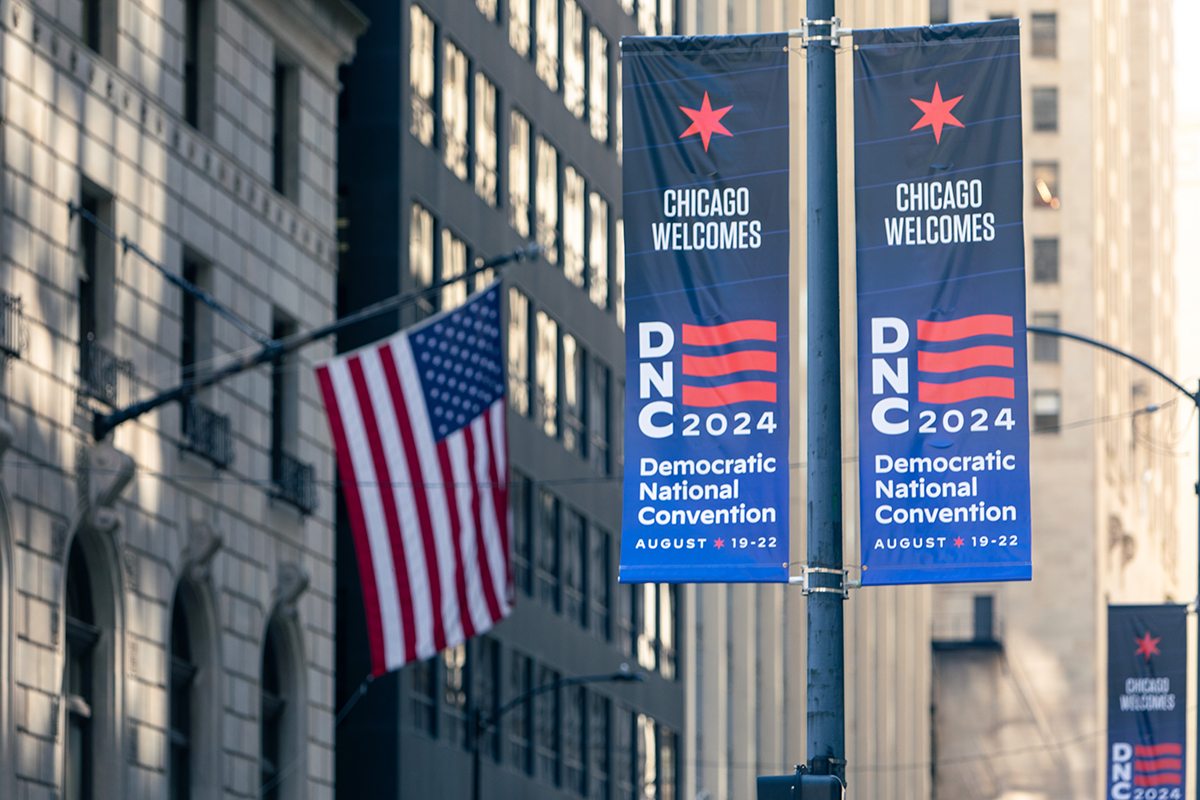
Protesting Genocide at the DNC in Chicago: Beyond “One Issue”

(photo by Keeton Holder)

As I’ve written previously, a large coalition of leftist groups has been preparing to take to the streets when the Democratic National Convention comes to Chicago next week. Although there will be a variety of different demands leveled at the DNC during the course of the convention, one key issue clearly stands out as a central common thread through them all – namely, an immediate US arms embargo and a permanent ceasefire to end Israel’s genocide in Gaza.

To name but one example: a rally and march for reproductive justice (of which my congregation, Tzedek Chicago, is a co-sponsor) will take place this Sunday, on the eve of the convention. As “Bodies Outside of Unjust Laws” organizers have made clear, however, the demands of this protest are not limited to issues of domestic reproductive justice alone:

Reproductive justice inherently includes ending the reproductive genocide in Palestine. As U.S. citizens, it is our duty to call on our own government to end the funding of weapons to Israel that enable this nightmare to continue and robs us of funds at home. As feminists and reproductive justice activists, we must also highlight a horrific aspect of the war on Palestinians: it is a war against women and children, who suffer in uniquely cruel ways. 

Likewise, the Coalition to March on the DNC, a group of over 200 national and local organizations is calling for an “End to US Aid to Israel” along with demands on immigrant justice, police crimes, healthcare, housing and the environment. Here again, justice for Palestinians is not viewed in isolation from other issues. As protest organizers correctly understand, these issues are irrevocably interlinked and intertwined.

During the course of this election cycle, those of us who have been demanding an arms embargo and ceasefire in Gaza have become all too familiar with one recurrent criticism in particular: that we are “one issue voters.” I find this to be a dangerous attitude for a number of reasons. More than anything, it’s an egregiously dismissive stand to take in an age of genocide, smacking of “it’s not my problem” American isolationism during the 1940s. For the Palestinian people, of course, Israel’s genocide in Gaza is not simply one issue – it’s the issue.

Witness, for instance, the news from this past weekend:

Officials in Gaza say more than 100 people were killed Saturday in an Israeli attack on a school and mosque where thousands of displaced Palestinians had sought shelter. The attack on the al-Tabin school in Gaza City was one of the deadliest individual attacks since Israel’s war on Gaza began over 10 months ago. Rescue workers said they did not find a “single full body” among the deceased — just body parts often destroyed beyond recognition. Survivors said Israel attacked the school during morning prayers…

CNN has confirmed a US-made GBU-39 small diameter bomb was used in the Israeli strike on the school. The attack came two days after the Biden administration notified Congress that it was preparing to provide Israel with an additional $3.5 billion to spend on US weapons and military equipment. Congress had approved the money as part of a $14 billion package for Israel in April. Zeteo reports part of the new US package includes a direct sale of 6,500 joint direct action munitions to Israel.

First and foremost, the genocide in Gaza is a crime against humanity that should concern us all. But as citizens of the nation that is funding and abetting this genocide, we Americans cannot look away from the blood that is surely on our collective hands. Nor can we ignore the shock waves that resonate far outside the borders of Palestine/Israel: the threat of an all-out regional war, the profits enjoyed by the arms and surveillance industry at taxpayer expense, the devastating environmental impact – the list goes on and on. Palestinian human rights lawyer and activist Noura Erakat put it perfectly on Twitter/X recently: “PSA: ending a genocide is not ‘a single issue’ it is an entire universe of issues.”

Another refrain I’ve been hearing repeatedly is the critique that protesting at the DNC “will only help Trump.” Harris herself leveled this argument at a campaign rally in Detroit when she sternly admonished pro-Palestinian protesters: “If you want Donald Trump to win, then say that. Otherwise, I’m speaking.” To be sure, it was an astonishingly tone-deaf and dismissive response to make in Michigan, the very birthplace of the Uncommitted Campaign. But on a more fundamental level, Harris’s response denied the very real impact of her own administration’s policies. As one of the protesters later put it, “When people are demanding a ceasefire and arms embargo and an end to the genocide and you say that we want Donald Trump to step in—it just shows a lack of accountability. It shows a lack of leadership, a lack of responsibility and a lack of ownership.”

In essence, Harris’s comment was just the latest version of the “shut up and vote” message that the Democratic party routinely sends progressives during every election cycle. In an age of US-supported genocide, however, the cynical emptiness of this message has become patently, painfully obvious. As journalist Masha Gessen has rightly pointed out. “These voters are not choosing between Harris and Trump. They are choosing between their sense of themselves as moral beings if they vote for Harris and their sense of themselves if they vote for a third-party candidate or for no one at all.”

Of course those who will be protesting at the DNC next week do not want to see Trump elected in November. But even from a purely strategic point of view, what has a better chance of helping the Democrats fortunes in November? We know that a strong majority of American voters across the political spectrum support a permanent ceasefire in Gaza. What would be the more winning strategy: telling those who want to end a genocide to shut up, or exert real leadership that will bring about a ceasefire and an end to the threat of a devastating regional war?

While party conventions function largely as candidate-coronations, they still function as places where parties express their collective vision and finalize their political platforms. On this score, I’m not at all optimistic that an arms embargo to Israel and a permanent ceasefire will find any purchase at the DNC. There are a mere 30 Uncommitted delegates out of 4,600 – and while they are pushing for a voice at the convention (they’ve asked that Dr. Tanya Haj-Hassan, a pediatric intensive care doctor who has volunteered in Gaza, speak from the convention floor), they have still not been offered a slot. Harris’s national security advisor has also made it clear that she opposes an arms embargo to Israel. By every indication, it certainly feels like “shut up and vote” will be the dominant Democratic party message coming out of the convention next week.

I have enormous respect for the Uncommitted delegates who will engage within the convention, particularly co-founder Layla Elabed, who has said even if they are not given a speaking slot, delegates will make their presence known with “news conferences, candle light vigils, tables to distribute literature and, they hope, guest testimonies about life in war-torn Gaza.” When it comes to political advocacy, however, there is always an inside game and an outside game. That’s why those of us who are not delegates will (quite appropriately) be making our presence known outside the walls of the convention hall as well.

Protest organizers have no illusions about the overwhelming militarized presence that will greet us when we gather next week. Federal authorities have divided the area surrounding the United Center, where the main speaking events of the convention will take place, into “soft” and “hard” zones – the latter being off limits to cars and non-credentialled delegates. But even in the soft zones, movement has been heavily restricted. The main protests have been given approved routes far from the convention site, and at one point goes through narrow residential side streets, that will be completely inadequate to handle thousands of protesters. While organizers have appealed the march route, as of this writing there has been no response from the city of Chicago.

When we talk about the potential for police violence next week, of course, the specter of the 1968 Democratic convention in Chicago looms very large. A great deal of ink has been spilled analyzing the differences and similarities between Chicago 1968 and Chicago 2024 – and while I’m loath to venture too far into this rabbit hole, there is one point of commonality I believe bears noting. In general, the mythos around the 1968 DNC protests tend to lay the blame for the Democrats’ defeat on the protest movement that “divided the party.” Often lost in this discussion is the fact that in 1968, those protests were directed toward a political party that had been prosecuting an increasingly unpopular war in Vietnam. Today, as then, I find it deeply misguided to blame protesters and not the immoral policies of the Democratic party itself.

While it’s not particularly helpful to use Chicago 1968 to heighten hysteria over the DNC, protestors are certainly justified in being vigilant over the very real possibility of police violence. I’m not the only one who finds it ominous that the city is doubling down on armed presence in the city. In advance of the convention, the Secret Service agent in charge of “security” has commented that “Chicago has a proven track record when it comes to putting on huge events” – citing the city’s response to Lollapalooza, the NASCAR Chicago Street Race and the Chicago Air & Water Show – as if the DNC is just another tourist event to showcase to the public.

No, we cannot deny of the very real moral and political reality that will be at stake in Chicago next week. We cannot deny that state violence directed against Palestinians is one and the same with so many other forms of state violence that are routinely normalized as “necessary.” And we must resist the call to dismiss any form of systemic violence as just “one issue.” As my friend and comrade, organizer Kelly Hayes has so wisely written:

We have to recognize victims of police brutality, Palestinians, our disabled and unhoused neighbors, and so many others who are subject to forgetting as worthy of grief, outrage and action. Everyday people who are fleeing violence, hunger, and militarism, everyday people whose cites are running out of water or are in danger of disappearing beneath rising flood waters, everyday people who are dying right now because they lack air conditioning amid heat waves – these are the people whose plights and fates should shape our politics. If we are going to fight for any semblance of human decency, we need to reclaim and reassert the value of our lives.

On Shavuot, the Book of Ruth and Palestinian Exile

On the surface, the Book of Ruth, the Biblical story traditionally read on the Jewish festival of Shavuot (which began last evening), appears to be a simple parable about two women struggling to survive in the wake of a devastating famine. If we dig deeper, however, we’ll find that Ruth is actually a profound and radical story that explores themes of isolation and connection, dispossession and return, emptiness and plenitude, exile and redemption.

As a Jew who views solidarity with the Palestinian struggle for liberation to be a sacred obligation, I find that these themes to be particularly resonant. As we celebrate Shavuot this year, for instance, we are receiving tragic reports that the Israeli military has forcibly transferred the Palestinian residents of the Ein Samiya village, including 78 children (whose school was targeted for demolition). This latest act of political dispossession is only the latest in a larger Israeli program of ethnic cleansing that dates back to the establishment of the state in 1948.

Amidst this ongoing reality of Palestinian exile, I’d like to suggest four themes from the Book of Ruth that call out to me with special urgency this Shavuot:

One: the story of Ruth tells the story of Naomi, a childless Israelite widow and her Moabite daughter in law Ruth, who return to Naomi’s home in Bethlehem, in the hopes of finding safety and security. As unmarried women, they are radically marginalized, forced to use the power they have at their disposal to survive in a world that has symstemically disempowered them. Those of us who stand in solidarity with Palestinians – indeed, all who are oppressed – would do well to heed the moral imperative at the heart of this story.

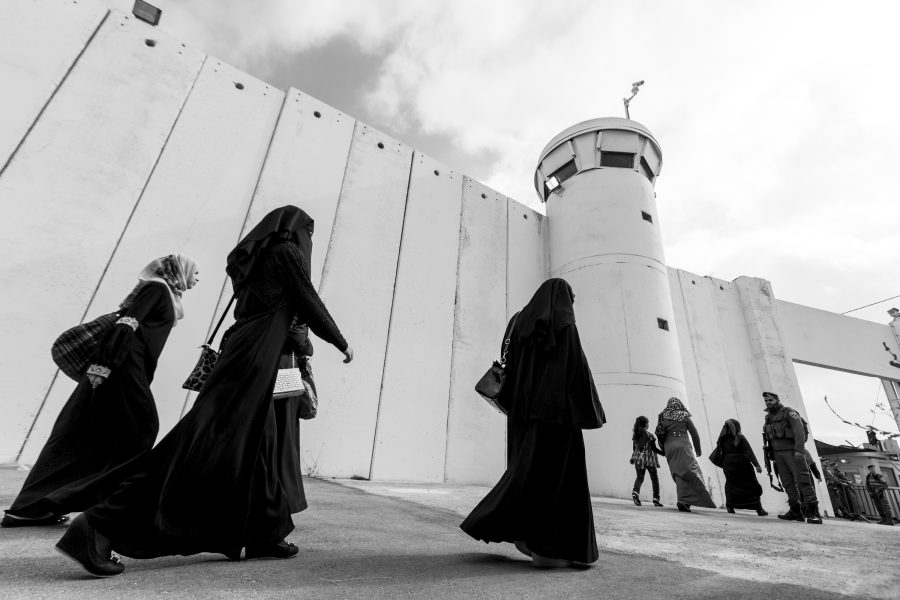
Two: as the story opens, Naomi migrates with her husband and two sons to the land of Moab. She later crosses back with her daughter-in-law when she receives word that the famine has lifted in her home country. In its way, the Book of Ruth portrays a world in which migration was a natural social phenomenon; when border-crossing was an accepted and necessary part of life. Today, this very land is strewn with militarized borders, checkpoints and refugee camps – and Palestinians are routinely denied the most basic right of human mobility. The Book of Ruth thus calls to us with a striking vision: a land and a world in which borders pose no barrier to those seeking a better future for themselves and their families.

Third: the driving center of the Book of Ruth is the deep and loyal relationship between an Israelite woman and her Moabite daughter-in-law. Those who are familiar with the Hebrew Bible will not help but note that the Moabite nation is typically portrayed as the arch enemy of the Israelite people. In this story, however, these national allegiances and historical enmities are nowhere to be found. Instead we are left with this simple, sacred message: the ultimate path to redemption is not to be found through power and violence – but rather through mutual love and solidarity.

And finally, the Book of Ruth opens in amidst a devastating famine in Bethlehem and ends with the reaping of a new harvest and the promise of an abundant future for Ruth, Naomi, their family and descendents. This vision of abundance: in which there is more than enough for all who dwell on the land, is indeed at the heart of the Palestinian struggle for liberation: one that envisions a future of equity, justice and peace for all who live between the river and the sea.

Surviving the Apocalypse: Sermon for Rosh Hashanah 5783

Hayom Harat Olam – “Today is the birthday of the world.” It’s one of the signature lines of Rosh Hashanah, and it might be the best, most basic definition of the holiday. Every new year, we celebrate the renewal of yet another cycle. Every Rosh Hashanah we anticipate a new round of possibilities for our lives and our world.

Judaism is deeply rooted in multiple cycles, actually: daily, weekly and yearly rhythms that revolve around each other simultaneously. We observe them as a way of maintaining our own personal balance and equilibrium – but also as an expression of our empowered faith. As Jewish tradition would have it, when we live according to these sacred cycles, it is said, we help maintain the equilibrium of the world itself.

Rabbi Arthur Waskow described this phenomenon beautifully in his classic book “Seasons of our Joy:” 

Long ago our people believed that if we celebrated the cycle, the cycle was more likely to continue. The rains would come when they were due, the sun would shine more warmly in its season, the crops would grow – and die, and grow again. 

And if we celebrated the cycle, we believed, our deliverance from slavery would come again. The spiral of history would keep on circling upward if we lived through the spirals of our past… And the cycle would also help us as individuals. It is intended to help us feel more deeply, more intensely, the cycle of feelings that make us fully human. 

While I’ve always connected with this spiritual approach, I’ll confess it hasn’t come so easily to me in recent years. Over the past few Rosh Hashanahs, I’ve wondered: what does it mean to affirm a cyclical worldview in the era of global climate change? With each passing year, we render our planet that much less livable. Every Rosh Hashanah, we seem to inch ever closer to a deadline that represents the earth’s point of no return. How do we celebrate the birthday of the world when the world itself is literally unraveling before us?

It isn’t just an academic question. There’s a strong case to be made that the disruption of our planet’s rhythm is affecting the natural rhythm of our lives as well. In a sense, it’s flattening out our cyclical view of the world and making it more linear. We’re experiencing the world less in terms of cycles and more as “beginning, middle and end.” 

There’s a time-honored word for this ominous concept, and I’ll put it plainly: it’s called apocalyptic thinking.

Now I know this is a religious term, but when I use it, I’m not just talking about theology. I’m interested in something deeper. I’m interested in the ways we ourselves engage in apocalyptic thinking – those of us who aren’t religious extremists, or even religious for that matter. I want to explore how end-of-days thinking has become culturally normalized in this 21st century moment to become part of the very oxygen we breathe. 

Statistics seem to bear this claim out. It’s been reported that over the past two decades, there’s been a marked increase in the stockpiling of food, provisions and weapons in preparation for an upcoming cataclysm. According to one study, nearly three in 10 adults in the US think it’s likely that there will be an apocalyptic disaster in their lifetime.  There’s also been increasing enrollment in survivalist courses; schools that train people in the practical skills they need to live in the wake of catastrophe. The owner of one such course recently commented on this phenomenon in the press: “I feel like people sense an impending doom … they feel like something’s about to happen, a shift in our society, a shift in our way of life – and they want to be prepared for whatever, be able to forage off the land, be able to do whatever it takes to get by.”

On a less quantifiable level, I believe that apocalyptic thinking is harbored even by those of us who aren’t hoarding food and drafting survival plans. I’m willing to wager that a growing number of folks are fantasizing about leaving it all behind to live off the grid – if not in anticipation of an upcoming disaster, then at least to move to higher ground. To escape to a place where they can keep the perils of 21st century life at bay.

It’s been observed that this attitude has become an indelible part of our cultural zeitgeist, reflected, among other things, in the explosion of post-apocalyptic movies, TV shows and video games. It’s certainly not difficult to understand the appeal of these dystopian fantasies. They function as a kind of cathartic outlet of our innermost fears, yet at the same time, they reassure us. They simplify the complex, overwhelming truth of our world. They give us the chance to start over again. After the apocalypse, life might be hard, but it would be simpler and more understandable. The good guys and bad guys would be clear and obvious. We’d have a straightforward sense of what we needed to do to survive. 

While I enjoy a good zombie movie as much as anyone, I do think these entertainments are a reflection of something very deep in our collective subconscious. And that’s what scares me – even more than the zombies. Indeed, there’s something deeply conservative and reactionary at the core of these dystopian fantasies. They almost always look to a strong hero or a messiah to save the day. By definition, there is always an in-group and an out-group: those who will be included in the future world and those who must be annihilated. They always focus on the journey to a better, safer future for the survivors. At their core, these stories reflect a deeper desire to wipe the slate clean and recreate a kind of mythic idyllic past that never actually was. 

More than anything, I think, these dystopian narratives reflect the fears of a privileged group that feels its power slipping away. Bear this in mind the next time you watch the armies of the undead coming to eat the flesh of the brave survivors. Just remember the rhetoric of many white Evangelicals and QAnon followers: how they utterly dehumanize and demonize those who don’t fit into their view of the world. As we indulge in our post-apocalyptic fantasies, we shouldn’t forget that there are increasing numbers of religious extremists in the US who are actively laying the political groundwork for the apocalypse in order to remake the world in their image.

On another level, when we engage in apocalyptic thinking, whether we realize it or not, we’re engaging in a form of surrender. We’re essentially admitting that it’s over – that we’ve lost. Apart from the abject defeatism of this attitude, I can’t help but think that it’s a profoundly privileged way of thinking. Because, quite frankly, there are millions of disenfranchised people in our own communities and around the world who are already living through the apocalypse and have been for some time. Perhaps we need to stop fearing the future and pay closer attention to the cataclysm that’s going on right now.

This is, for me, the most insidious thing about apocalyptic thinking: it focuses on the future at the expense of the present. Even as there’s every indication that the climate-related apocalypse that so many fear has actually been well underway. As I speak these words to you, Puerto Rico is reeling from the devastation of yet another hurricane – one that left the entire island without power and most of its residents without running water. In Pakistan, heavy monsoons have washed away whole villages, displacing more than 33 million people. Last year, over 59 million people became involuntary migrants – most of them displaced by climate related disasters. Yes, there are millions in our own backyard and around the world who are already experiencing the apocalypse in a real way right now, in real time.

One of the most impactful books I read this past year was “The Next Apocalypse: The Art and Science of Survival.” It was written by Chris Begley, an anthropologist, archaeologist and wilderness survival instructor who has studied the collapse of ancient civilizations throughout history. Begley convincingly argues that everything we assume about the coming apocalypse is wrong. He points out that most civilizational collapses were not the product of abrupt cataclysms. Rather, they were the result of extensive, multiple crises that had various causes that took place over a long period of time. In general, collapses of societies tend to be characterized less by sudden catastrophe than by change and transformation

Begley also makes it clear that when it comes to global climate-change we need to accept that this process of change is, in fact, already underway. He writes,

From our data about the past, I imagine that the process of collapse has already started, with environmental problems as one cause and political and social issues – particularly inequities in wealth and power exacerbated by neoliberal policies over the last half century – as the other. How quickly the unraveling will proceed, and how long until we realize that the process is going on, are harder to devine. Some processes, like climate change, are understood sufficiently well that, while unknowns exist, evidence suggests it will create profound and negative changes on a global scale. 

As a survival course teacher himself, Begley definitely advocates being prepared for emergencies – and he writes extensively about the skills that will likely be needed to survive the cataclysms that are most likely to occur in our lifetimes. But he also points out that survival skills are short term solutions, designed for the self-preservation of individuals. In the long term, he writes,

Adaptability and flexibility will be key to survival. Surviving and thriving after the next apocalypse will be all about community. None of us will be able to go it alone…If we are tempted to exclude people, we must find another route through the disaster. We must include everybody, or we are not in a sustainable pattern.

“Surviving and thriving after the next apocalypse will be all about community.” I can’t think of a better antidote to apocalyptic thinking. So often this mindset starts and ends with “how will I make it through?” “How will I protect myself and my loved ones?” But if or when a cataclysm occurs, our sustainability will ultimately depend upon our ability to cooperate for the long haul. We will have to accept that in the end, it must be all of us or none. 

What does this mean in practical terms? One example comes immediately to mind: in the face of unprecedented climate migration, I strongly believe we must become unabashed advocates for a world beyond borders. On this particular subject, I’d like to quote to from another must-read book for Rosh Hashanah: “Nomad Century: How to Survive the Climate Upheaval,” by Gaia Vince:

Migration, whether from disaster to safety, or for a new land of opportunity, is deeply interwoven with cooperation – it is only through our extensive collaborations that we are able to migrate, and it’s our migrations that forged today’s global society. Migration made us. It is our national identities and borders that are the anomaly…

I’ve visited people in refugee camps in different countries across four continents, where millions of people live in limbo, sometimes for generations…As our environment changes, millions more risk ending up in these nowhere places. Globally, this system of sealed borders and hostile migration policy is dysfunctional. It doesn’t work for anyone’s benefit.

Here’s another practical example: those of us who live in the Global North, who are responsible for around half of all emissions since the Industrial Revolution, who produce a carbon footprint 100 times greater than that of the world’s poor nations combined, must continue the fight to reduce the carbon emissions that are endangering life on our planet. And locally, we must keep fighting for emergency funding, for stronger infrastructure, for rapid response capacities, most particularly for our most vulnerable communities. According to Jewish tradition, pikuach nefesh – saving a life is sacrosanct. And even as we pass various doomsday deadlines, yes, even in the midst of an apocalypse, these kinds of policies and measures still have the very real power to save lives. 

Finally, we would do well to remind ourselves that the most committed and inspired climate activists are those who are most directly affected by climate change. Indigenous peoples in particular have long been on the front lines of this struggle. We would do well to learn about their efforts, support them, and most important, to follow their lead. Because if they have not succumbed to despair, then neither can we. In the words of the great Cherokee leader and activist, Wilma Mankiller, z”l: “The secret of our success is that we never, never, give up.”

When we engage in apocalyptic thinking, we reduce the climate crisis to a singular future cataclysm, while holding tight to the illusion that everything is still somehow “normal.” But if we resist the impulse to project our dread into the future, we can better recognize and respond to the transformative changes that are occurring even as we speak. Particularly those of us who have the luxury to live in parts of the world that are relatively safe from the disastrous impact already being experienced by so many. 

Accepting that it is already happening frees us up to discern more clearly what we can do right now. It allows us to live in the world and to respond to its changes with knowledge, creativity and compassion. When we admit that this transformation is already underway, we can stand down the fear and dread that is so prevalent in our culture. It gives us permission to move with these changes. It reminds us there is still a great deal we can – and must – do.

After all, as our liturgy will remind us, even in the midst of the most devastating of changes, our actions “ma’avirin et ro’ah ha’gezeirah” – “avert the severity of the decree.” Or as Chris Begley puts it, “there are no natural disasters, only natural phenomena that we convert into disasters via our responses.” When you think about it, the essential message of the High Holidays is the polar opposite of apocalyptic thinking. On Rosh Hashanah, we are asked to look deep into the latest turn of the cycle and face the all of our world. Then, and only then, can we go forth and greet the new year. 

So, this Rosh Hashanah, let us continue to dance to the rhythms of the cycle even when it becomes increasingly painful to do so. After all, it has ever been thus. Every new year, we pray these prayers that are filled with trepidation. We will say out loud that in the coming year there will be no guarantees – that some of us will live and some of us will die. But at the same time, we will affirm that this world is worth fighting for, no matter what may happen in the coming year and beyond. And most important we will affirm this all together. Because we know that however much time we have left, it must be all of us or none.

Shanah Tovah – may it be a healthy and liberating New Year for all. And may we commit together to making it so.

Who is the Stranger Here? Reading the Torah through a Decolonized Lens

Photo credit: 
Paul Connors/Media News Group/Boston Herald

Cross-posted with Jewschool.

This week’s Torah portion, Parashat Ekev, contains the well-known commandment: 

“You must love the stranger because you were strangers in the land of Egypt.”

(Deuteronomy 10:19)  

While it’s often characterized as the most repeated commandment in the Torah – occurring a total of 36 times, that’s actually a bit of hyperbole – it actually appears only six times.[1]  The number 36 seems to have originated from a passage in the Talmud [2] but in the end, I’d suggest that the accuracy of this claim is really irrelevant. For liberal Jews in particular, this commandment looms large because it’s a powerful statement of collective empathy. The Jewish people, who have historically lived as “strangers in strange lands,” are as such commanded to love and protect all who know the experience of the stranger. 

The Hebrew word for “stranger,” is ger – a legal term in the Bible for “resident non-citizen.”[3] Throughout the laws of the Torah, there is a clear concern expressed for the legal status of gerim, who are often included in the ritual life of ancient Israel. In the commandment to keep the Shabbat, for instance, the “ger within your settlements” is included in the list of those who must cease from work.[4] God also adjures Israelites repeatedly that there must be “one law” that governs the ger as well as the Israelites.[5] 

Given the Torah’s tolerant attitude toward the “stranger,” this commandment is popularly invoked by Jewish communal leaders, particularly in reference to the issues of immigrant justice and refugee rights. This statement from the Religious Action Center for Reform Judaism is a classic example, using the commandment to highlight the classic American dream of immigrant “opportunity.”

Our own people’s history as “strangers” reminds us of the many struggles faced by immigrants today, and we affirm our commitment to create the same opportunities for today’s immigrants that were so valuable to our own community not so many years ago.  

Upon deeper examination, however, this use of the commandment to “love the stranger” is not as powerfully straightforward as it may first appear. This commandment – like all commandments in the Torah – is directed toward the Israelites as they prepare to assume a position of power. Even more critically, their position of power will be attained by means of conquest

In fact, this week’s Torah portion – the very same one that contains this famously empathic commandment – also contains a divine command to the Israelites to brutally dispossess and destroy the peoples of Canaan:

You shall destroy the peoples that the Lord your God delivers to you, showing them no pity…The Lord your God will deliver them up to you, throwing them into utter panic, until they are wiped out. He will deliver their kings into your hand, and you shall obliterate their name from under the heavens; no man shall stand up to you, until you have wiped them out.

(Deuteronomy 7:16, 22-24)

In this context, we would thus do well to ask ourselves, what does it mean for Jews – particularly white Jews – to invoke this Biblical verse as we dwell on land stolen by a settler colonial power from its indigenous population? Or to put it another way, before intoning the commandment to love the stranger, we might first ask ourselves, “who is the real stranger here?” 

Indeed, we cannot deny the fact that the Biblical conquest tradition has historically been used – and continues to be used – to justify colonial dispossession, turning indigenous peoples into strangers in their own lands. In other words, the definition of who is a “citizen” and who is a “stranger” is – and has always been – determined by those who wield the power.

Where does this leave us, then? Is it even possible for Jews who cherish Biblical tradition to read the Torah through a decolonial lens? 

I believe it is. I would suggest that the first step is to ask questions precisely such as these. To avoid the temptation to ignore or wish away these kinds of texts; to actively challenge and interrupt the Biblical conquest tradition head on. For there is no getting around it: the Exodus story is not only about a people liberated by God from slavery – it is also about a people commanded by God to conquer and annihilate the Canaanites before occupying the land they inhabit.  

Reading the Torah through a decolonial lens also means coaxing out and amplifying the voices of the “strangers” in the text – the disenfranchised and colonized who might otherwise be voiceless to us. In this regard, I’ve learned a great deal from the pedagogy of commentators from outside Jewish tradition. One such teacher is the Indigenous Studies scholar Robert Warrior, who has written powerfully about the Biblical conquest tradition in his essay, “Canaanites, Cowboys and Indians:”

The obvious characters in the story for Native Americans to identify with are the Canaanites, the people who already lived in the promised land. As a member of the Osage Nation of American Indians who stands in solidarity with other tribal people around the world, I read the Exodus stories with Canaanites eyes. 

I find another important teacher in the work of black womanist theologian Delores S. Williams, whose book “Sisters in the Wilderness” lifts up the voice of the Biblical character Hagar as a role model for African-American women: 

Hagar’s heritage was African as was black women’s. Hagar was a slave. Black women had emerged from a slave heritage and still lived in light of it. Hagar was brutalized by her slave owner, the Hebrew woman Sarah. The slave narratives of African-American women and some of the narratives of contemporary day-workers tell of the brutal or the cruel treatment black women have received from the wives of slave masters and from contemporary white female employers.[6]

I realize that interpretations such as these are undeniably challenging for Jews who read the text literally, identifying Jewish experience exclusively with the experience of the Israelites. It is even more challenging for white Jews who benefit from power and privilege to reckon with the ways we are complicit in the European Christian legacy of colonization – a legacy that continues to do harm even now.

I would suggest that the commandment to “love the stranger” can never be truly honored if it comes from a position of power or noblesse oblige. It can only be honored when those in power step back and amplify the voices of strangers so that they may assume a rightful place of prominence in the narrative. In so doing, we may yet come to see that the decolonization of the text is in fact inseparable from the decolonization of the world in which we live. 


[1] Exodus 22:20, Exodus 23:9, Leviticus 19:33-34, Deuteronomy 10:19, Deuteronomy 24:17-18, Deuteronomy 24:21-22. Some versions of this commandment read “Do not oppress the stranger…” 

[2] Baba Metzia 59a

[3] The word ger would later be defined by rabbinical tradition to mean “proselyte” or “righteous gentile.”

[4] Exodus 20:10

[5] Exodus 12:49, Leviticus 24:22, Numbers 15:15

[6] Delores S. Williams, Sisters in the Wilderness: The Challenge of Womanist God-Talk, (New York: Orbis, 1993, 2013), p. 2. 

Judaism Beyond Zionism: Toward a New Jewish Liturgy

Introduction

In the spring of 2015, I helped to establish a Jewish congregation, Tzedek Chicago, motivated in part by a desire to create a religious space for those in the Jewish community who did not consider themselves to be Zionists. The founders of the congregation articulated this intention openly, in a core value we called “Judaism Beyond Nationalism:”

While we appreciate the important role of the land of Israel in Jewish tradition, liturgy and identity, we do not celebrate the fusing of Judaism with political nationalism. We are non-Zionist, openly acknowledging that the creation of an ethnic Jewish nation state in historic Palestine resulted in an injustice against its Indigenous people – an injustice that continues to this day.

In the contemporary Jewish community, of course, identification with the Zionist narrative has become the sine qua non of Jewish identity. While it is beyond the scope of this essay to analyze the process by which Zionism – a 19th century European nationalist ideology that represented a radical departure from traditional Judaism – became normalized in the American Jewish community, it is fair to say that since the founding of the state of Israel, Zionism has become thoroughly enmeshed in the culture of American Jewish life.

There are signs, however, that the linkage between Zionism and Judaism has begun to loosen in the Jewish community – particularly among younger Jews. According to a widely read 2013 Pew Research Center Study, 27% of American Jews aged 18 to 29 do not feel “very attached” to Israel and another 11% feel “not at all attached.” In a 2017 study commissioned by the Jewish Community Federation of San Francisco reported that among Bay Area Jews, 22 % of the respondents reported that a Jewish state’s existence is “not important” or were “not sure.”

Beyond individual attitudes, the nascent beginnings of a “Judaism beyond Zionism” are organically developing outside the bounds of the Jewish communal establishment. As Atalia Omer has written,” we are witnessing the emergence of a “grassroots movement that seeks…to transformatively reimagine American Jewish identity outside the Zionist paradigm.” 1 Though still a distinct minority, the growth of American Jewish organizations such as Jewish Voice for Peace, #IfNotNow, the Center for Jewish Nonviolence and Open Hillel attest to burgeoning desire for a Judaism that unabashedly challenges Jewish communal support for Israel’s occupation – and in some cases, the very concept of Jewish statehood itself. 2

Another important indication of this shift occurred when Jewish Voice for Peace – an organization that promotes Jewish solidarity with Palestinians and “unequivocally opposes Zionism” – broadened its mission to include the goal of “Jewish Communal Transformation.” In 2011, JVP created its Rabbinical Council to provide “a prophetic Jewish voice inside the Palestine solidarity movement (and) create meaningful ritual, tradition and culture accessible to our growing membership.” JVP subsequently established its own Havurah Network, which it described as “an emergent network that gathers, supports and resources anti-zionist, non-zionist and diasporist Jews and Jewish spiritual communities across the country yearning for a vibrant Jewish life beyond nationalism that condemns and challenges white supremacy within and outside Jewish communities.”

1 Atalia Omer, Days of Awe: Reimagining Judaism in Solidarity with Palestinians, Chicago: University of Chicago Press, 2019, p. 68.

2 Another important sea change occurred in July 2020, when prominent Jewish journalist Peter Beinart, a long-time Liberal Zionist, wrote the New York Times op-ed, “I No Longer Believe in a Jewish State.”

Jewish Diasporism

This newly emergent Judaism beyond Zionism is increasingly being described in positive terms as Jewish diasporism. While this term may seem redundant, we cannot underestimate the extent to which the importance of the Jewish diaspora 3 has been undermined in the era of Zionism. In an age when the idea of Jewish statehood has become thoroughly normalized, however, it is well worth remembering that Rabbinic Judaism originally emerged as a spiritual response to the experience of Jewish dispersion. 

Before the destruction of the Second Temple in 70 ACE, Judaism was a land-centered, Temple-based sacrificial system that was splintering into several competing sects. When the Temple was destroyed and the center of Jewish life shifted from land to diaspora, the rabbis adapted to this new reality accordingly, developing a religious system that could be observed anywhere in the world.

In truth, thriving Jewish diaspora communities existed well before the destruction of the Temple. When Cyrus the Great allowed the exiled Jewish community of Babylon to return to the land in 538 BCE, scores remained in Persia where they enjoyed relative economic stability, “unswayed by the promises of a distant homeland they had never seen.” 4 There were also significant diaspora Jewish communities throughout the Hellenistic world. Between the third century BCE and the end of the first century CE, Alexandria, Egypt became one of the most populous Jewish communities in the world, numbering at least several hundred thousand.

Judaism’s foundational Jewish text – the Talmud – was itself composed and compiled in Babylonia. In a similar way, the myriad of lands in which Jews have lived have provided fertile soil for Jewish spiritual creativity throughout the centuries. Indeed, the most important Jewish religious figures clearly reflect their specific cultural time and place: the great 10th century Jewish philosopher Saadia Gaon, the founder of Judeo-Arabic literature, integrated Jewish theology with the Hellenistic Greek philosophy of his day; Maimonides’ classic philosophical treatises were deeply influenced by the neo-Aristotelian philosophy of medieval Spain; Franz Rosenzweig’s work clearly reflects the ideas of modern German liberalism.

This is not to say that the land of Israel ceased to become important in Jewish tradition. The symbolism of the major Jewish holidays is deeply rooted in the seasonal/agricultural rhythms of the land. A great deal of rabbinic debate in classical Jewish writings focused on how Biblical laws specifically pertaining to the land might be observed in a diasporic setting. There was also extensive theological speculation as to whether or not the land itself was inherently holy or whether it’s holiness derived from the commandments that were fulfilled there. 5

The rabbis also debated whether or not it was a mitzvah (religious obligation) for individual Jews to emigrate to the land. 6 At the same time, however, rabbinic authorities were virtually united in their opposition to the political reestablishment of a Jewish commonwealth. While a yearning for the restoration of Zion is undeniably central to rabbinic Judaism, this ideal was expressed within a decidedly messianic context. Jewish tradition is replete with strong warnings against the creation of a sovereign Jewish state via human agency. 7

When political Zionism arose in the 19th century, it consciously sought to overturn the diasporic focus of Jewish life. A central Zionist dictum known as shlilat hagalut (“negation of the diaspora”) viewed the diaspora as an inherently inhospitable place for Jews; only through the establishment of a Jewish state in their “ancient homeland” would the Jewish people normalize and safeguard their existence among the nations.

Many classical Zionist figures were so vehement in their rejection of the diaspora that their descriptions of European Jewry reflected a palpable sense of internalized antisemitism. Zionist writer/journalist Micha Josef Berdichevski opined for instance, that the Jews of the pale were “not a people, not a nation, not human.” 8 Hebrew poet/author Joseph Chaim Brenner called diaspora Jews “Gypsies and filthy dogs” 9 and the Labor Zionist icon A.D. Gordon wrote that diaspora Jewish life was the “parasitism of a fundamentally useless people.” 10 The views of Revisionist Zionist founder Vladimir Ze’ev Jabotinsky, who was clearly influenced by European fascist ideology, infamously referred to religious diaspora Jews as “ugly, sickly Yids” and Zionist settlers as “Hebrews.” 11

Now six decades after the founding of the state of Israel, however, it might be claimed that the Jews who live there are experiencing a new form of exile. 12 On the eve of its establishment, the celebrated Jewish German political theorist Hannah Arendt presciently warned that the new Jewish state would be “secluded inside ever-threatened borders, absorbed with physical self-defense to a degree that would submerge all other interests and activities.” 13 Today, Israel is one of the most militarized nations in the world, a virtual garrison state with a traumatized national culture. More tragically, the movement that ostensibly sought to end Jewish exile ended up exiling another people in the process. The state of Israel was created through the expulsion of the Palestinians, who today live under military occupation, as second-class citizens in their own land, or else in a diaspora of their own – as refugees or citizens of other countries – and are forbidden to return to their homes.

The Jewish population of the world is currently split almost in half between Israel and the diaspora. Where does this leave those in the diaspora who choose not to center our Judaism on the state of Israel; who refuse to celebrate a Judaism that glorifies ethnic Jewish nation-statism? Is there a place for Jews who want to celebrate the diaspora as dynamic and fertile ground for a new kind of Judaism? One that embraces Jewish existence among diverse nations as a multi-ethnic, multi-racial peoplehood? One that advocates for the universal redemption of all peoples?

Over the past two decades, prominent Jewish scholars have been reclaiming and reframing the concept of Jewish diaspora in compelling ways. Melanie Kaye Kantrowitz, for instance, has advocated a conscious celebration of the diaspora as part of a larger project of Jewish empowerment:

Celebrating dispersion, Diasporism challenges the Edenic premise: once we were gathered in our own land, now we are in exile. What if we conceive of diaspora as the center: an oxymoron, putting the margin at the center of the circle that includes but does not privilege Israelis?… Jews worldwide number only about 13.3 million, a tiny minority except in Israel. Diasporism means embracing this minority status, leaving us with some tough questions: Does minority inevitably mean feeble? Can we embrace diaspora without accepting oppression? Do we choose to be marginal? Do we choose to transform the meaning of center and margins? Is this possible? 14

Daniel Boyarin has argued that the Babylonian Talmud itself is a “diasporist manifesto,” imagining its own community and sense of portable homeland:

The Talmud in its textual practices produces Babylonia as a homeland, and since this Babylonia is produced by a text that can move, that homeland becomes portable and reproduces itself over and over. The Talmud, I would submit, is not only the only classical work of the rabbinic period produced outside the Land of Israel; it is a diasporist manifesto, Diasporist Manifesto Number 1. 15

More recently, Susannah Heschel has suggested the concept of diaspora as a prophetic alternative to the traditional Jewish “embrace of exile:”

As prophetic, the diasporic Jew is never entirely at home, never content or complacent in a world of injustice. Diaspora transforms exile into Jewish creativity, as has happened for over two millennia. The prophet is a diasporic exemplar, leaving home and journeying to the urban seat of the political, military, and economic power to demand an end to corruption, exploitation, cruelty, and indifference. The prophetic position cannot exist by trying to end exile with statehood or by embracing exile as the essential mentality of Jewishness. To abandon diaspora in favor of exile is to walk away from the prophetic; to reject exile while embracing diaspora is to retain the prophetic passion for justice.

In short, we are currently witnessing the emergence of a new Jewish diasporism: one that neither stigmatizes existence outside the land nor romanticizes the experience of exile, but rather seeks to center the diaspora as the essential locus of Jewish life, creativity and purpose.

3 While I use the term “Jewish diaspora” here for the sake of clarity, it might be more accurate to refer to Jewish “diasporas,” as Jewish life throughout the world has existed in very different social, cultural and political milieus and throughout unique, distinct periods of world history.

4 H.H. Ben-Sasson, A History of the Jewish People, Cambridge: Harvard University Press, 1976, p. 168.

5 See Mishnah Kelim 1:6: “What is the nature of (the land’s) holiness? That from it are brought the omer, the firstfruits and the two loaves, which cannot be brought from any of the other lands.”

6 From Talmud Ketubot 110a: “Whoever lives outside of Israel may be regarded as one who worships idols.” From Ketubot 111a: “Whoever returns from Babylon to Israel transgresses a positive commandment of the Torah.”

7 The classic rabbinic prohibition against reestablishing the Jewish commonwealth before the coming of the Messiah is known as the “Three Oaths.” See Babylonian Talmud, Ketubot 110b, Shir Hashirim Rabbah, 8:11.

8 Walter Laqueur, A History of Zionism: From the French Revolution to the Establishment of the State of Israel, New York: Schocken, 1972, p. 61.

9 IBID.

10 IBID.

11 Alan Wolfe, At Home in Exile: Why Diaspora is Good for the Jews, Boston: Beacon Press, 2014, p. 17. For more on Zionist ideals of Jewish masculinity, see Daniel Boyarin, Unheroic Conduct: The Rise of Heterosexuality and the Invention of the Jewish Man, Berkeley: University of California Press, 1997.

12 See Raz-Krakotzkin, Amnon, Exile Within Sovereignty: Critique of “The Negation of Exile” in Israeli Culture, from “The Scaffolding of Sovereignty: Global and Aesthetic Perspectives on the History of a Concept,”edited by  Zvi Ben-Dor Benite, Sefanos Geroulanos, Nicole Jerr, pp. 393-420, New York, Columbia University Press, 2017.

13 Hannah Arendt, The Jewish Writings, New York: Schocken, 2007, p. 396.

14 Melanie Kaye Kantrowitz, The Colors of Jews: Racial Politics and Radical Diasporism, Indiana: Indiana University  Press, 2007, p. 200.

15 Daniel Boyarin, A Traveling Homeland: The Babylonian Talmud as Diaspora, Philadelphia: University of Pennsylvania Press, 2015, p. 32.

Jewish Diasporism at Tzedek Chicago

Since its founding, Tzedek Chicago has become a practical laboratory for the development of this new Jewish diasporism, particularly through the creation of rituals that explicitly celebrate the idea of “diaspora as homeland.”

During the holiday of Sukkot, for instance, instead of the traditional lulav and etrog – the four species native to the Biblical land of Israel – we use symbolic species indigenous to the prairie of the Midwestern United States. 16 We are exploring diasporist approaches to other Jewish holidays as well. On the festival of Tu B’shvat, which typically falls in late January/early March, I offered this teaching to the Tzedek Chicago community:

In the land of Israel, the “harbinger of Spring” festival of Tu B’shvat is marked at this time of year by the blossoming of the white almond blossoms through the central and northern parts of the land. However, those of us who live in the diaspora of the American Midwest, often celebrate Tu B’shvat surrounded by several inches of white snow and leafless trees. Is this any way to celebrate a harbinger of Spring?

I’ll suggest that it is. I actually find it very profound to contemplate the coming of Spring in the depths of a Chicago winter. It reminds me that even during this dark, cold season, there are unseen forces at work preparing our world for renewal and rebirth. Deep beneath the ground, the sap is beginning to rise in the roots of our trees – although this fructification process might not be as visually spectacular as the proliferation of white almond blossoms exploding across the countryside, I believe this invisible life-giving energy is eminently worth acknowledging – and celebrating.

It is true, of course, that the Biblical land of Israel was central to Judaism centuries before the ideology of political Zionism emerged. As such, some might well claim that the decentering of land-based symbolism represents a kind of “radical surgery” to Jewish tradition. If, as I noted above, Judaism originally spiritualized the concept of homeland, might we still retain its land-centric aspects for their symbolic, mythic power?

Such a question fails to confront the radical way Zionism has transformed Judaism itself and how deeply it has influenced Jewish attitudes toward the diaspora. Just as radically, diasporic Judaism seeks to re-right this imbalance by lifting up and centering the idea of Jewish home wherever we happen to live in the world. In Kaye Kantrowitz’s words, “Where Zionism says go home, Diasporism says we make home where we are.” 17 For those of us who affirm that the entire world is and has been our actual Jewish homeland, these new, reframed rituals seek to celebrate the Jewish people’s adaptability – and the unique nature of the homes we have created for ourselves throughout the diaspora.

Another, related issue is the concept of “Zion” itself, an idea that is undeniably, indelibly imprinted upon Jewish tradition and Jewish liturgy. How might a diasporic Judaism understand this concept, whose meaning has been thoroughly literalized by political Jewish nationalism?

As stated above, the idea of the Jewish return to Zion was traditionally understood in messianic terms. This belief is particularly embodied in the concept of kibbutz galuyot (“ingathering of exiles”), which emerged during the Babylonian exile as expressed in the Biblical books of Isaiah, Jeremiah and Ezekiel. 18 In Jewish liturgy, this concept is prominent in a number of prayers, including the Daily Amidah and Ahavah Rabbah (“Abounding Love”), a prayer that is traditionally read before the Shema during the morning service and ends with the line, “May we be glad, rejoicing in your saving power, and may you reunite our people from all corners of the earth, leading us proudly to our land.”

Zionism lifted kibbutz galuyot out of its messianic context and reframed it in explicitly nationalist terms. It is notably referenced in Israel’s Declaration of Independence as well as the Prayer for the Welfare of the State of Israel, both written in 1948 to explicitly celebrate the literal “exilic ingathering” of modern Jewry to the state of Israel. The Zionist interpretation of kibbutz galuyot has been internalized in American Jewish life as well. In many synagogues, for instance, it is even customary to sing the line “may you reunite our people” in the Ahavah Rabbah prayer to the melody from Hatikvah – the Israeli national anthem.

How might kibbutz galuyot be reimagined in a diasporist context? At Tzedek Chicago, our version of Ahavah Rabbah is rendered thus, “May it lead us toward your justice, toward liberation for all who dwell on earth; that all who are exiled and dispossessed may safely find their way home.” Our new reading replaces Jewish particularism and exceptionalism with a universalist, decolonial ethic. As such, it is neither messianic nor Zionist. In this post-modern diasporist reimagining, Zion is not unique to the Jewish people and does not exist in any particular place. So too, kibbutz galuyot does not refer to the Jewish exiled alone but to all who have been – or continue to be – dispossessed throughout the world.

16 In 2018, a small group of radical Jews published a zine that offered “reflections, tips, and resources about creating your own diasporic lulav,” explaining, “Our lulavs – both the ritual object and the ritual acts – are situated in diaspora, and explicitly reject the colonization of Palestine and the mandate to use the “four kinds” (“arbah minim”) of plants associated with the biblical Land of Israel.”

17 Kantrowitz, p. 199.

18 See Isaiah 11:12; 27:13; 56:8, 66:20, Jeremiah 16:15; 23:3, 8; 29:14; 31:8; 33:7 and Ezekiel 20:34, 41; 37:21. The term itself was coined in the Talmud (see Babylonian Talmud, Megillah 12a) and was later connected to the coming of the Messiah by Moses Maimondies (see Mishneh Torah, “Laws of Kings,” 11:1-2).

Jewish Anti-Militarism

In addition to re-centering diaspora, any attempt at promoting a Judaism Beyond Zionism must reckon seriously with the culture of militarism that thoroughly pervades the ideology of Zionism and Israeli society. As Rabbi Lynn Gottlieb has pointed out, “During the past sixty years, the assumption that a highly militarized Jewish state ensures Jewish security has become entrenched as an article of faith… To critique Israeli militarism is to critique Zionism in the minds of many contemporary Jews.” 19

Prior to the onset of Zionism, Jewish tradition promoted nonviolence and quietism over the glorification of war, 20 a doctrine generally traced to the aftermath of the Bar Kochba rebellion (132-135 CE). As Reuven Firestone has written, in the wake of this catastrophic event, “Jewish wisdom would teach that it is not physical acts of war that would protect Israel from its enemies, but rather spiritual concentration in righteousness and prayer.” 21

The rabbis were also painfully aware that the Hasmonean revolt centuries earlier had ended disastrously for the Jewish people. This uprising, chronicled in the Books of the Maccabees and commemorated by the festival of Hanukkah, was waged by the Maccabees, a priestly family who led a rebellion against the religious persecution of the Seleucid empire. Their victory resulted in the establishment of the Hasmonean Kingdom – the second Jewish commonwealth – in Palestine in 164 BCE. 

The militarism of the Hasmoneans however, would eventually prove to be its downfall. Following the Maccabean victory, their brief period of independence was wracked by internecine violence, anti-rabbinic persecution and ill-advised wars of conquest against surrounding nations. In 63 BCE, the Hasmonean Kingdom was conquered by the Romans (with whom they had previously been allied). In the end, the last period of Jewish political sovereignty in the land lasted less than one hundred years. 22

The rabbis of the Talmud were loath to glorify the Books of the Maccabees – secular stories of a violent civil war that were never actually canonized as part of the Hebrew Bible. In fact, the festival of Hanukkah is scarcely mentioned in the Talmud beyond a brief debate about how to light the Hanukkah menorah and a legend about a miraculous vial of oil that burned for eight days. 23 Notably, the rabbis chose the words of Zechariah 4:6, Not by might and not by power, but by my spirit, says the Lord of Hosts to be recited as the prophetic portion for the festival.

Hanukkah remained a relatively minor Jewish festival until it was revived by early Zionists and the founders of the state of Israel, who fancied themselves as modern-day Maccabees engaged in their own military struggle for political independence. At the end of his book, The Jewish State, Zionist movement founder Theodor Herzl famously wrote, “The Maccabees will rise again!” 24 Even today, the celebration of the Maccabees as Jewish military heroes is deeply ingrained in Israeli culture.

This Zionist sacralizing of militarism and conquest represented a radical overturning of these central tenets of traditional Judaism. The term kibush ha’aretz (“conquest of the land”) was one of the terms used by Zionist settlers to describe their colonization of Palestine. 25 As noted above, many Zionist ideologues promoted the ideal of the muscular, heroic “New Jew” in contrast with Diaspora Jewry. Zionists were also instrumental in helping to form the Jewish Legions that fought against the Ottomans in Palestine in World War 1. During the British Mandate, Zionists created armed militias such as the Haganah (which later became the Israeli Defense Force after the founding of the state) as well as the more militant Irgun and Lehi.

In 1948-49, during what Jewish Israelis refer to as their War of Independence and Palestinians call the Nakba (the “catastrophe”), these armed forces engaged in the widespread ethnic cleansing of Palestinians from villages and cities throughout Palestine. Notably, these military operations often used names associated with Biblical history and Jewish religious tradition. For instance, a joint force of the Haganah and Irgun dispossessed 61,000 Palestinians from Haifa on eve of Passover 1948, in a campaign known as “Operation Biur Chametz,” (“Operation Cleaning Out the Leaven”) – a reference to the commandment to remove leaven from Jewish homes before the onset of the festival. 26 Another campaign, waged in the southern Negev desert and the coastal plain was given the name “Operation Ten Plagues.” 27

The Zionist movement and the fledgling state of Israel notably looked to the Biblical conquest tradition – and in particular, the Book of Joshua – as a model for its own conquest of historic Palestine. Though largely secular, Israel’s founders utilized the Bible as a canvas for promoting a national myth of a glorious military past. As scholar Nur Masalha has pointed out, “The Book of Joshua provided Ben-Gurion, Jabotinsky and muscular Zionism with the militaristic tradition of the Bible: of military conquest of the land and subjugation of the Canaanites and other ancient people that populated the ‘promised land.” 28 Ben Gurion himself viewed the book of Joshua as the most important book of the Bible; in 1958 he convened a study group at his home where Israeli generals, politicians, and academics discussed the book of Joshua against the founding of the modern state of Israel. 29

19 Lynn Gottlieb, Trail Guide to the Torah of Nonviolence, France: Earth of Hope Publishing, 2013, p. 19.

20  Reuven Firestone, Holy War in Judaism: The Fall and Rise of a Controversial Idea, New York: Oxford University Press, 2012.

21 IBID, p. 62.

22 For more on the history of the Hasmonean Kingdom, see Kenneth Atkinson, A History of the Hasmonean State: Josephus and Beyond, London: T&T Clark, 2016.

23 See Babylonian Talmud, Shabbat 21b.

24 Arthur Hertzberg, ed., The Zionist Idea, Canada: Atheneum, 1959, p. 225.

25  Firestone, pp. 181-182.

26  Benny Morris, The Birth of the Palestinian Refugee Problem Revisited, Cambridge: Cambridge University Press, 2004, pp. 186-211.

27  IBID, p. 462.

28 Nur Masalha, The Bible and Zionism: Invented Traditions, Archaeology and Post-Colonialism in Israel-Palestine, London: Zed Books, 2007, p. 24.

29 See Rachel Haverlock, The Joshua Generation: Israeli Occupation and the Bible, Princeton: Princeton University Press, 2020.

Jewish Anti-Militarism at Tzedek Chicago

At Tzedek Chicago, our core values clearly and unabashedly condemn the glorification of war and violence. This is both a return to the traditional rabbinic approach as well as step beyond it. Our vision of Jewish nonviolence does not emerge from quietism but rather from the value of solidarity: the conviction that security for Jews is irrevocably bound up with security for all.

As we state in our core values:

In our education, celebration and communal observances, we honor those aspects of our tradition that promote peace and reject the pursuit of war as a solution to our conflicts. We openly disavow those aspects of our religion – and all religions – that promote violence, intolerance and xenophobia.

Our activism is based upon a vision of shared security for the world; we support the practices of nonviolence, civil resistance, diplomacy and human engagement. Through our advocacy, we take a stand against militarism and colonialism, particularly when it is waged in our name as Jews and Americans.

Liturgically, we express this value in a variety of ways. For instance, in our poetic rendering of the prophetic portion for Hanukkah (Zechariah 2:14-4:7), the rededication of the Temple by the Maccabees is reframed as a dedication to ideals of nonviolence and justice for all people:

Let loose your joy for
your prayers have
already been answered;
even in your exile
the one you seek has been
dwelling in your midst
all along.

Quiet your raging soul
and you will come to learn:
every nation is my nation
all peoples my chosen
anywhere you choose to live
will be your Holy Land,
your Zion, your Jerusalem.

Open your eyes and
look across the valley
look at this ruined land
seized and possessed
throughout the ages.

Look upon your
so-called city of peace
a place that knows
only debasement
and desecration
at your hand.

Turn your gaze to the heavens
and there you will find
the Jerusalem that you seek:
a city that can never be conquered,
only dreamed of, yearned for, strived for;
a Temple on high that can never be destroyed.

No more need for priestly vestments
or plots to overrun that godforsaken mount –
just walk in my ways
and you will find your way there:
a sacred pilgrimage to the Temple
in any land you call home.

Enter the gates to
this holiest of holy places,
lift up its fallen walls,
relight the branches of the lamp
so that my house will truly
become a sanctuary
for all people.

Yes, this is how you will
restore the Temple:
not by might, not by power
but by the spirit
you share with every
living, breathing soul.

These values are also reflected in our Prayer for Reparation and Restoration. which we read in lieu of the congregational Prayer for Peace or Prayer for the Welfare of the Government. (Compare our prayer below for instance, with the Reform Movement’s “Prayer for Peace and Strength:”)

To the One who demands justice:
inspire us to become rodfei tzedek,
pursuers of justice
in our lives and in our communities.

Give us the strength to resist power
wielded with fear and dread;
fill us with the vision and purpose
to build a power yet greater,
a power rooted in solidarity,
liberation and love.

Grant us the courage to dismantle
systems of oppression –
and when they are no more,
let us dedicate our wealth and resources
toward the well-being of all.

May we abolish all forms of state violence
that we might make way for a world
free of racism and militarization,
a world where no one profits
off the misery of others,
a world where the bills owed those who have been
colonized, enslaved and dispossessed
are finally paid in full.

Inspire us with the knowledge
that real justice is indeed at hand,
that we may realize
the world we know is possible,
right here, right now,
in our own day.

May our thoughts and our hopes,
our words and our deeds
guide us toward a future of reparation,
of restoration, of justice,
al kol yoshvei teivel
for all who dwell on earth,
amen.

As a response to the issue of domestic militarization, the prayer below was delivered at a Tisha B’Av vigil, co-sponsored by Tzedek Chicago, at an immigrant detention center in Kankakee, IL. The text is an adaptation from the Biblical book of Lamentations, traditionally read on the festival of Tisha B’Av:

We are beyond humiliation
beyond shame
we incarcerate children without pity
we deport parents without a thought
and build systems that destroy families indiscriminately
now we truly know what it means to be dishonored
our so-called glorious past is now seen
for the sham that it was
the way of life we celebrate is but a privilege
for the few and the powerful
we can’t see that our own might
will be our downfall.

We venerate leaders
who should be tried for their crimes
we never dared imagine a power
greater than our own
like so many before us
we conquered the land then drew borders
as a testament to our fear and dread
now we build higher walls
to keep out those who seek shelter
we built massive checkpoints
we lined up human beings
like cattle in cages
now children cry out for parents
who will never answer their calls
their voices echo endlessly
through the camps but there
is no one left to hear.

We ask one another with bewilderment
have we ever seen such cruel violations
yet in truth we ourselves have inflicted
such cruelties on children here
and around the world
we sentence minors to life in prison without parole
we remain silent as a cruel occupation
abducts and imprisons children in military prisons
convicts them in military courts
and yet we dare to act surprised when
we hear news of children thrown into cages
at our southern border.

Our silence betrays us
these walls will soon encircle us all
soon there will be no one left
only a single mass of mourners
whispering broken hymns of lament
grieving what was lost
and what might have been
one day we will know the sorrow
of the dispossessed.

We who never heard the cries of migrants
and their children will know what it means
to be uprooted detained and discarded
those who we scorned and abandoned
will bitterly welcome us to the world
of the dispossessed
the enemies we created
through our own fearful actions
will surely come back for us all.

Let us hope and pray
there is still time
let the cries of our children
pour into our hearts like water
the cries of any who have been forced
from their homes pursued
taken locked away sent away
anyone whose very lives are forbidden
forgotten forsaken
let their cries compel us
to take down oppressive systems
built by the powerful to maintain
the power of the powerful.

Let their cries remind us
that there is a power yet greater
that comes from a place that knows no borders
no deportations no barrier walls no prisons
no guards no soldiers no ICE no police
a place where we no longer need to struggle because
justice gushes forth like a mighty stream flowing freely.

From the sovereign beyond all sovereigns
we beseech you chadeish yameniu
renew our days
that we may build the world
that somehow still might be
kein yehi ratzon – may it be your will
and may it be ours.

Jewish Solidarity with Palestinians

At Tzedek Chicago, we understand solidarity with Palestinians not merely as a political position, but a sacred imperative. As we state in one of our core values, that “the creation of an ethnic Jewish nation state in historic Palestine resulted in an injustice against its indigenous people.” Accordingly, we reject the ways that the establishment of the state of Israel has become sacralized as redemptive in most American synagogues.30 Needless to say, for those Jews who consider the Nakba to be an historic – and ongoing – injustice, the birth of the Jewish state has a decidedly different religious meaning.

We express our sacred solidarity with Palestinians in a variety of ways. One Passover, for instance, we invited Omar Barghouti, co-founder of the Palestinian movement for Boycott, Divestment and Sanctions, to our congregation to speak about BDS as a liberation movement. In our advertising, we described the program thus: “Taking our cue from the season of Passover we will engage in a deep exploration of this important call for Palestinian liberation, and explore its profound challenge to all people of conscience.”

Tzedek Chicago also expresses Jewish solidarity with Palestinians through the use of sacred ritual. For instance, while most American synagogues celebrate Yom Ha’atzmaut (Israel Independence Day) as part of the Jewish religious calendar, we observe this occasion through our recognition of Nakba Day – the day Palestinians mark as the day of their catastrophic dispossession. In our “Jewish Prayer for Nakba Day” we use traditional Jewish liturgical/theological imagery to reflect our observance of this day as an occasion for mourning, remembrance and repentance:

Le’el she’chafetz teshuvah,
to the One who desires return:

Receive with the fulness of your mercy
the hopes and prayers of those
who were uprooted, dispossessed
and expelled from their homes
during the devastation of the Nakba.

Sanctify for tov u’veracha,
for goodness and blessing,
the memory of those who were killed
in Lydda, in Haifa, in Beisan, in Deir Yassin
and so many other villages and cities
throughout Palestine.

Grant chesed ve’rachamim,
kindness and compassion,
upon the memory of the expelled
who died from hunger,
thirst and exhaustion
along the way.

Shelter beneath kanfei ha’shechinah,
the soft wings of your divine presence,
those who still live under military occupation,
who dwell in refugee camps,
those dispersed throughout the world
still dreaming of return.

Gather them mei’arbah kanfot ha’aretz
from the four corners of the earth
that their right to return to their homes
be honored at long last.

Let all who dwell in the land
live in dignity, equity and hope
so that they may bequeath to their children
a future of justice and peace.

Ve’nomar
and let us say,
Amen.

Le’el she’chafetz teshuvah,
to the One who desires repentance:
Inspire us to make a full accounting
of the wrongdoing that was
committed in our name.

Help us to face the terrible truth of the Nakba
and its ongoing injustice
that we may finally confess our offenses;
that we may finally move toward a future
of reparation and reconciliation.

Le’el malei rachamim,
to the One filled with compassion:
show us how to understand the pain
that compelled our people to inflict
such suffering upon another –
dispossessing families from their homes
in the vain hope of safety and security
for our own.

Osei hashalom,
Maker of peace,
guide us all toward a place
of healing and wholeness
that the land may be filled
with the sounds of joy and gladness
from the river to the sea
speedily in our day.

Ve’nomar
and let us say,
Amen.

In another example of communal Palestinian solidarity, we dedicated a portion of our 2018 Yom Kippur Service to the Palestinians who were then being killed weekly by the Israeli military in Gaza’s Great Return March. In the introduction to this ritual, we stated:

 It is traditional at the end of the Yom Kippur morning service to read a Martyrology that describes the executions of ten leading rabbis, including Rabbi Akiba, Rabbi Shimon ben Gamliel and Rabbi Yishmael, who were brutally executed by the Roman Empire. This liturgy is included to honor those who have paid the ultimate price for the cause of “Kiddush Hashem” – the sanctification of God’s name.

At Tzedek Chicago, we devote the Yom Kippur Martyrology to honor specific individuals throughout the world who have given their lives for the cause of liberation. As we do, we ask ourselves honestly: what have we done to prove ourselves worthy of their profound sacrifices? And what kinds of sacrifices will we be willing to make in the coming year to ensure they did not die in vain?

This year, we will dedicate our Martyrology service to the Palestinians in Gaza who have been killed by the Israeli military during the Great Return March. This nonviolent demonstration began last spring with a simple question: “What would happen if thousands of Gazans, most of them refugees, attempted to peacefully cross the fence that separated them from their ancestral lands?”

Since the first day of the march last spring, demonstrators have consistently been met by live fire from the Israeli military. To date, 170 Palestinians have been killed and tens of thousands wounded and maimed, most of them unarmed demonstrators, including children, medics and bystanders.

30 This sacralization is reflected in a myriad of ways, whether it be through the placement of the Israeli flag next to the ark containing the sacred scrolls of the Torah, the regular recitation of the “Prayer for the State of Israel” (which refers to its establishment as “the first flowering of our redemption,”) or the celebration of Yom Ha’atzmaut (Israeli Independence Day) alongside traditional Jewish festivals.

Decolonial Judaism

As we have explored the meaning of Judaism beyond Zionism, we have quickly come to realize that many of these issues are rooted in more foundational concerns. For instance, we cannot interrogate the meaning of the Jewish diaspora without also understanding the diasporas of other transnational and/or dispossessed peoples. As we grapple with issues of militarism we must invariably confront the connections between state violence and structural racism. Solidarity with Palestinians cannot be viewed in isolation from the larger legacy of settler colonialism and the dispossession of Indigenous Peoples in the US and around the world.

These connections have, in turn, given rise to critical questions, such as:

• In North America, white Jews are participants in the ongoing colonization of stolen land. How can we celebrate diaspora in a way that respects the land upon which we live and the Indigenous Peoples for whom it remains sacred? 

• In the United States, 12 to 15% of the American Jewish community are Jews of color, many of whom have their own history of colonization and enslavement. How will white Jews center their experience and stand down the culture of White supremacy in the American Jewish community? 

• If we view atonement as a sacred imperative, how can we, as a Jewish congregational community advocate and participate in a process of reparations and rematriation for the members of Indigenous Nations and descendants of enslaved people? 

As a response to questions such as these, Tzedek Chicago has convened an internal task force “to explore how Tzedek as a community can best participate and support reparative justice efforts, especially regarding the harms of slavery and colonization.” We are also exploring ways to address these questions through Jewish ritual. In 2019, for instance, we celebrated a Sukkot festival celebration jointly sponsored with Chi-Nations Youth Council – a Chicago-based group that organizes on behalf of Native Youth in the region. Our celebration included the prayer, “Earth Shema,” written for Tzedek Chicago by poet/liturgist Aurora Levins Morales:

There is no earth but this earth and we are its children.  The earth is our home, and there is only one.  The ground beneath our feet was millions of years in the making. Each leaf, each blade, each wing, each petal, each hair on the flank of a red fox, each scale on the sturgeon, each mallard feather, each pine needle and fragment of sassafras bark took millions of years to become, and we ourselves are millions of years in the making.

The earth offers itself and all its gifts freely, offers rain and sunlight, and the shimmer of moon on its lakes, offers corn and squash, apples and honey, salmon and lamb, and clear, cold water and all it asks in return is that we love it, respect its ways, cherish it.

We shall love the earth and all that lives with all our hearts, with all our souls, with all our intelligence, with all our might.   

Wherever we walk, wherever we sleep, wherever we eat, wherever we pray upon the face of the earth, we shall uphold the first peoples of that place, those who have loved it longest and know its ways most deeply.  We shall listen to them, learn from them, follow their lead, defend them, and join with them to protect each other and our world, and of every two grains in our bowls, we will give one to the first peoples who sit beside us at the earth’s table. 

The names of those who were here before us are syllables of the earth’s name, so know them and speak them, and speak the first names for the places where you dwell, the water you drink, the winds that bring you breath.  Say the name of this place, which is Shikaakwa, and say the names of its people: Myaamiaki, Illiniwek who are also the Inoca, the Asakiwaki and Meskwaki, people of the yellow earth and the red earth, the Hochagra, and the Bodewadmi who keep the hearth fires, for the land held many stories before we came and the places that were made for us were made by shattering their worlds.

Take to heart these words with which I charge you this day.  Cherish this land beneath your feet. Cherish the roots and the waterways, the rocks and trees, the ancestor bones in the ground and the people who dance on the living earth and make new paths with their feet, with their breath, with their dreaming.  Love and serve this world, this creation, as you love the creator who gifted it to us.  Defend it from those whose hunger for riches cannot be filled, who devour and destroy, bringing death to everything we love. 

Fight for the earth and protect it with all your heart and soul and strength, and hold nothing back, so that the rains fall in their season, the early rain and the late, and we may gather in the new grain and the wine and the oil, the squash and beans and corn, the apples and grapes and nuts, so that the grass grows high in the fields and feeds the deer and the cattle, so that the water flows clean in river and lake, filled with abundant fish, and birds nest among the reeds, and all that lives shall eat its fill. 

Do not be lured into the worship of consumption, comfort, convenience. Do not suck on the drinking straws of extraction, or bow down to the hoarders of what is good. For if we do, the breath of life that is in all things will empty the skies of clouds, and there will be no rain, and the earth will not yield its blessings, but will be laid waste.

So summon all the courage which is in you and in your people, stretching back to the dawn of time and remember this promise by night and by day, with every breath, whatever you are doing.  Let nothing stand in your way.  Put your hands into the soil of this moment and plant good seed that we and all our children may live long in the land and be a blessing. 31

31  This prayer was written as part of Morales’ Rimonim Liturgy Project, a network of which Tzedek Chicago is a participating member. Rimonim seeks the creation of new liturgies that reflect, among other things, “a full integration of the lives and experiences of Indigenous Jews and Jews of Color of all backgrounds, diaspora-centered Judaism that is rooted in global Jewish cultures, and explicitly replaces Zionist content in our liturgy… and acknowledgement and accountability to Indigenous peoples on whose land non-Indigenous Jews are settlers.”

 Conclusion

In her analysis of Tzedek Chicago, Omer referred to our congregation as a “prefigurative Jewish community.” 32 I believe this to be an extremely apt description: Tzedek Chicago is part of a nascent movement that is consciously attempting to build and model a future Jewish community guided by the transformative core values of justice that we hold sacred. In the end, however, it is not only the Jewish world we seek to transform – it is the world at large.

This idea is perhaps most prominently expressed during our Shabbat celebrations, when we liturgically welcome the Sabbath as a weekly taste of olam ha’ba (“the “world to come.”) 33 As opposed to the traditional messianic view of this concept, we define it as “the world as it should be” – i.e., the very real world of equity and justice for which we work and strive and struggle during the week. When Shabbat arrives, our liturgy provides us with the opportunity to experience this world, so that when Shabbat ends, we will be reinspired, replenished – and ready to continue the sacred work that will bring it that much closer to reality.

With this vision in mind, I will conclude with one final prayer – Tzedek Chicago’s poetic rendering of Psalm 92 (The Song for the Sabbath Day):

Tonight we raise the cup,
tomorrow we’ll breathe deeply
and dwell in a world
without borders, without limit
in space or in time,
a world beyond wealth or scarcity,
a world where there is nothing
for us to do but to be.

They said this day would never come,
yet here we are:
the surging waters have receded,
there is no oppressor, no oppressed,
no power but the one
coursing through every living
breathing satiated soul.

Memories of past battles fading
like dry grass in the warm sun,
no more talk of enemies and strategies,
no more illusions, no more dreams, only
this eternal moment of victory
to celebrate and savor the world
as we always knew it could be.

See how the justice we planted in the deep
dark soil now soars impossibly skyward,
rising up like a palm tree,
like a cedar, flourishing forever
ever swaying, ever bending
but never breaking.

So tonight we raise the cup,
tomorrow we’ll breathe deeply
to savor a world recreated,
and when sun sets once again
we continue the struggle.

32  Omer, p. 155.

33  From the Babylonian Talmud, Berachot 57b: “Shabbat is one sixtieth of the world to come.”
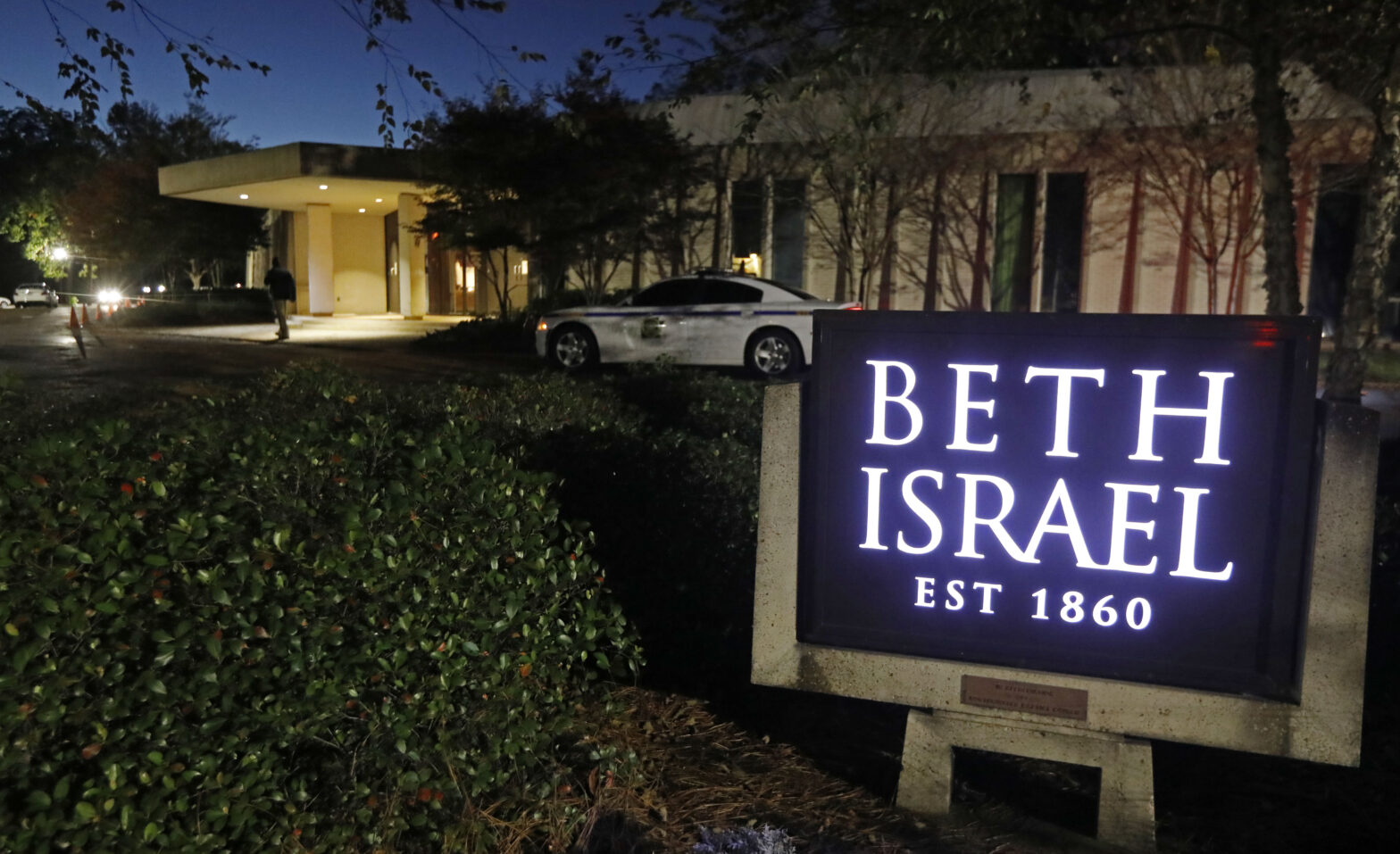
“It’s Time for All-Out Freedom” A Passover Guest Post by Maya Schenwar

c2tzcfgxgaitcn3

Remarks delivered by Maya Schenwar (editor of Truthout and author of “Locked Down, Locked Out” and the upcoming “Prison by Any Other Name”) at the Tzedek Chicago Passover Seder, April 14, 2020. 

A few months ago, which feels like a few centuries ago, Brant and I discussed the idea of me saying something at this seder about the difference between reform and liberation. I’d been writing about how popular prison reforms such as electronic monitoring, drug courts, and psychiatric institutions are actually entrenching the prison-industrial complex. I thought, what better occasion than Passover to talk about how we shouldn’t be pursuing fake liberation, and how we don’t want nicer-looking reforms that are still forms of oppression? What better occasion to affirm that we have to demand all-out freedom and stick with it?

Now, in these terrifying new times, it feels even more imperative to make vast, sweeping demands—demands that rise higher than we might think we can dream. In the midst of a worldwide plague that, in one way or another, engulfs us all, it’s time for that all-out freedom call.

What do I mean by “all-out freedom”? I’m thinking about the refrain that “no one is free while others are oppressed.” I’m thinking about Audre Lorde saying, “I am not free while any woman is unfree, even when her shackles are very different from my own.” The COVID-19 crisis has deeply and horribly impacted our own communities — and communities everywhere. Marginalized people have, of course, been disproportionately impacted. (Consider that approximately 70% of people who’ve died from COVID-19 in Chicago are Black.)

Right now, we are coming to understand that none of us are healthy while others are sick. As long as anyone is in peril, more will be in peril. And liberation for only some is not liberation.

Yet, in a lot of different arenas, we’ve come to accept small offerings from our political representatives and leaders—a bailout mostly geared toward banks and corporations, a slight reduction in drug prices, a few people freed from prisons, some limits on carbon emissions. We say, “Well, something is better than nothing,” even when the something is far from enough, and when the something leaves many people to die.

Even in the face of coronavirus, the health care plan of the presumptive Democratic presidential nominee would leave many millions of Americans uninsured. At this moment in which all of our lives are threatened, it’s time to call for Medicare for All—and much more. We need comprehensive cost-free mental and physical health services, including treatments that go well beyond doctors and hospitals. We need to recognize that plentiful nutritious food, housing, sleep, free time, relaxation, and self-determination are also part of health and survival—and part of liberation. This is the moment to demand universal housing, universal food access, and drastically improved labor practices, which are key to building the kind of freedom that sacrifices no one.

And, at a time when unemployment is skyrocketing and the climate crisis is amplifying the effects of COVID, where is our Green New Deal? Where is our jobs guarantee, our income guarantee for those who don’t work—and our guarantee that our leaders will do everything in their power to confront the climate emergency, which is on track to kill billions? These aren’t far-off dreams or hypotheticals; they are steps that it makes sense to implement now to directly address the public health and economic crises enveloping our country.

At a time when we’re witnessing a shortage of life-saving equipment – ventilators and protective gear – we can issue a pragmatic call for the end of the war industry. In fact, we can challenge the existence of the military-industrial complex as a whole. Has there ever been a clearer moment to say no to the machinery of death, and to demand a mass shift of funds away from the Pentagon and toward public health?

It’s not a time for compromise—not a time to save some and not others.

Moses abided by this philosophy in his dealings with Pharaoh. He said to Pharaoh, “Let us go into the wilderness and worship our own God!” In response, Pharaoh proposed compromises—little reforms, fake liberations.

Pharaoh’s first compromise proposal was for the Jews to stay in Egypt, but worship their own God there. Some people might have said, “Take what you can get! Stop there, Moses! It’s better than nothing.”

But Moses declined the compromise, which was a little better than nothing—but it wasn’t freedom.

So then some plagues happened, as we know, and Moses asked again. Pharaoh scrounged up another compromise: He would let the men go off into the wilderness, but the women and children would have to stay in Egypt. Of course, women and children were groups that were more vulnerable—multiply oppressed, within the oppressed group. And in this compromise, they’d be thrown under the bus.

This compromise reminds me of the “moderate” reforms we see all over the political stage right now, reforms that modestly benefit some people, while throwing other people entirely under the bus:

For example – the proposal that a few more people can have health care, but there will still be millions and millions who are uninsured. Some would say, It’s better than nothing!

And there are the proposals to let some people with nonviolent first-time drug offenses out of prison, while millions of others will be left in cages. Some would say, It’s better than nothing!

And of course, there’s the compromise that younger people with no criminal record will temporarily not be deported, while older people and people with criminal records are condemned to deportation. Some would say, It’s better than nothing!

These are reforms that throw people away. Liberation refuses to throw anybody away.

Moses said no to the compromise, and we have to say no to the politics of disposability, too.

So then there were more plagues, and Pharaoh issued a final compromise: The Jews, including the women and children, could go into the wilderness – but they’d have to leave their animals behind. Basically, they’d have to be released from captivity with barely any resources.

There’s no freedom without some means to survive, and even thrive. A country where many millions are without health care in the middle of a pandemic is not a free country. A country in which people are starving because they’ve suddenly lost their jobs and have no safety net is not a free country. A country in which a few people are released from jails because of a pandemic, but are released into homelessness, is not a free country. In fact, a country in which people experience homelessness is not a free country.

My longtime pen pal and friend Lacino Hamilton, who is incarcerated in Michigan, wrote me a letter about the experience of the pandemic behind bars. He is hoping to be released soon: After 26 years in prison, his challenge to his conviction appears to be on the verge of being recognized. But, Lacino wrote, “I’m worried that I’ll leave here and materially my life will worsen.” He wrote, “Returning citizens are supposed to be happy with dead-end opportunities, the kind that offer only a ‘piece of a life.’ I want a whole life.”

Everyone should have a whole life. Without that, it’s not real liberation.

So, Moses said “no” to the no-animals compromise, because it was not freedom at all.

Eventually, after the most gruesome and horrifying plague of all, the one we hate to talk about, Pharaoh agreed to the whole package.

Of course, that wasn’t the end of the story. Pharaoh tried to prevent the actual implementation of the plan, necessitating some miracles from God to allow the Jews to truly leave.

Some miracles are probably necessary now, too, because the forces of power are never going to agree to full liberation. But I personally don’t think those miracles will be bestowed by a powerful God (who, to be honest, sometimes comes across in parts of the Torah as another angry dictator). I think we have to make those miracles ourselves.

What would it look like for us to create miracles, in the uniquely brutal time we’re currently living through? A couple of weeks ago, Arundhati Roy wrote a beautiful piece about the COVID-19 crisis, in which she talked about this time as one that forces us into a kind of magic. She wrote,

Historically, pandemics have forced humans to break with the past and imagine their world anew. This one is no different. It is a portal, a gateway between one world and the next. We can choose to walk through it, dragging the carcasses of our prejudice and hatred, our avarice, our data banks and dead ideas, our dead rivers and smoky skies behind us. Or we can walk through lightly, with little luggage, ready to imagine another world. And ready to fight for it.

I love that passage, and it speaks to something important. I don’t think the miracle of a full-scale societal transformation that allows for the possibility of liberation will come from above. As far as I know, God cannot unilaterally snap their fingers and provide a universal health care plan or a Green New Deal, or end white supremacy or incarceration, or provide a home for every human being. We will need to grow these things. And I believe that we can, if we remember that no one is safe and healthy until everyone is safe and healthy, and that liberation cannot mean throwing anyone away.

There are many ways to take action right now to pursue liberatory goals, from mutual aid efforts that address urgent needs and build organizing infrastructure for the world we want to live in, to critical housing and labor campaigns, to racial justice movements working to release people from jails and prisons, to environmental campaigns that are drawing connections between this moment and the looming climate emergency, to the ongoing battle for Medicare for All, and much more. Brant is going to share some links in the chat for this Zoom call that will point you toward ways to get involved. These are only a smattering of the many crucial efforts currently underway.

I don’t think we need to drop horrible plagues on our enemies in order to refuse harmful compromises. Instead, we need to unite against horrible plagues – including the plagues of injustice, inequity, and mass violence – and for mass liberation.

I believe that we can enter the portal and fight for that new world, if we are prepared to do it together.

____________________________________________________________________________________________

Action items (National and Chicago-Based):

* The People’s Bailout: a coalitional effort by environmental, economic, racial and health justice groups to advocate a transformative economic package in response to COVID-19. 

#FreeThePeoplea coalition of advocacy organizations who do work to support imprisoned community members across the state of Illinois.

Physicians for a National Health Plan’s COVID-19 and Medicare for All

•  National Nurses United’s broad-based Medicare for All effort. 

Chicago COVID-19 Help & Hardship Page:  a mutual aid effort for direct food and housing assistance.

Rogers Park Food Not Bombs: Saves food from the waste stream while highlighting the inequities of our society.

Brave Space Alliance’s Crisis Food Pantry and Trans Relief Fund.

Greater Chicago Food Depository.

Restore Justice Illinois: to help provide for someone being released from prison.

Help Love & Protect: to make masks for people in women’s prisons:

Autonomous Tenants Union​: an all-volunteer organization committed to organizing for housing justice from below and to the left.

Lift the Ban: to advocate for lifting the ban on rent control in Chicago.

Organized Communities Against Deportations: resistance movement against deportations and the criminalization of immigrants and people of color in Chicago and surrounding areas.