Category Archives: Interfaith

New Clergy Report: Workers Speak out on Hyatt Injustice

Please, please read the recently released “Open the Gates of Justice: A Clergy Report on Working Conditions at Hyatt Hotels.”

Readers of this blog know I’ve long been standing in solidarity with Hyatt workers who have called for boycotts at eighteen hotels across the US. We’ve watched with deep dismay as Hyatt, a multi-billion dollar corporation, has eliminated jobs, replaced career housekeepers with minimum wage temporary workers, and imposed dangerous workloads on those who remain.

The centerpiece of this new report is the direct testimony of hotel workers themselves, who speak eloquently to the injustices they endure – as well as their desire only to be valued as workers for the important work they do for Hyatt hotels. Their testimonies came from numerous interviews conducted by clergy from across the country who fervently believe that the struggle for worker justice is a central tenet of all of our faith traditions.

From the introduction to the report:

It is part of the purpose of this report to challenge the complacency that we and the mainstream religious community have previously exhibited to these business practices, to identify these practice as oshek/oppression, and to propose steps that we, as people of faith, can do to stand in solidarity with workers as they challenge their employers to live up to the ideals set by our religious traditions for more equitable workplaces and a more equitable society.

I was also thrilled to read enthusiastic support for the report in a recent Forward editorial:

(This) much is clear: The extensive documentation and textual support in the rabbinical report is a welcome addition to a growing number of efforts to link Jewish law and scholarship to timely social concerns. Advocates for the environment, labor, sustainable agriculture and development policy increasingly use Jewish language and teachings to frame their arguments. The rabbinic report on Hyatt calls social teachings on labor “the best kept secrets of our religious tradition.” Not anymore.

And click here to read a substantive feature on the report from the Boston Jewish Advocate that just came out today.

Not In Your Local Paper: Egyptian Muslims Protect Coptic Community With Their Bodies


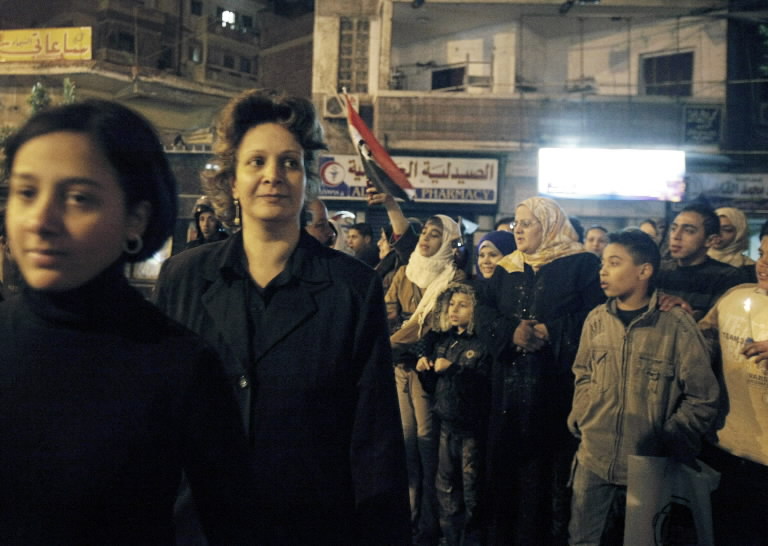
Muslims protect and greet Orthodox Christians leaving the church where Alexandria bomb blast took place. (Photo: REUTERS/Asmaa Waguih)

An important and inspiring report out of Egypt. From AhramOnline:

Egypt’s majority Muslim population stuck to its word Thursday night. What had been a promise of solidarity to the weary Coptic community, was honoured, when thousands of Muslims showed up at Coptic Christmas eve mass services in churches around the country and at candle light vigils held outside.

From the well-known to the unknown, Muslims had offered their bodies as “human shields” for last night’s mass, making a pledge to collectively fight the threat of Islamic militants and towards an Egypt free from sectarian strife.

“We either live together, or we die together,” was the sloganeering genius of Mohamed El-Sawy, a Muslim arts tycoon whose cultural centre distributed flyers at churches in Cairo Thursday night, and who has been credited with first floating the “human shield” idea.

Among those shields were movie stars Adel Imam and Yousra, popular preacher Amr Khaled, the two sons of President Hosni Mubarak, and thousands of citizens who have said they consider the attack one on Egypt as a whole.

Sorry to see that this story has been virtually ignored by the mainstream media. It seems to have been broken by the Egyptian press, but other than a report on WaPo’s online edition, I could only see it covered via the blogosphere.

What else is new? When it comes to Islam, it seems, the actions of an extremist minority is considered newsworthy while the courage of the Muslim majority flies right off the radar screen.

Be sure to pass this one on…

Seeking Dignity Under Occupation

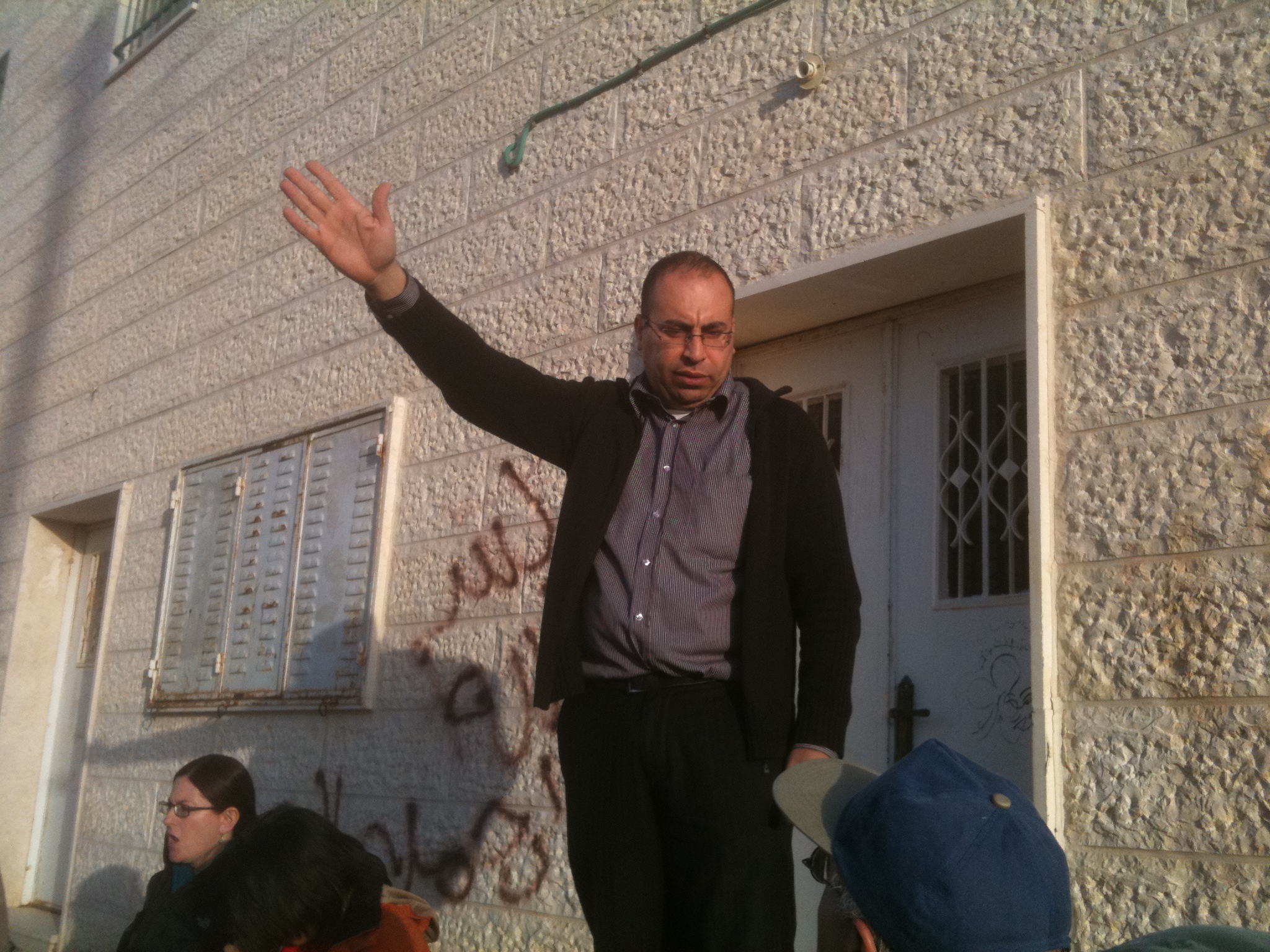
Our Wednesday began with a visit with Reverend Naim Ateek (above), founder and head of Sabeel, a well-known institute that advocates Palestinian Chrisitian Liberation Theology. As readers of my blog might know, I’ve long been an admirer of Reverend Ateek’s theological writings. In particular, his work has informed and challenged my own thinking about the Jewish conception of the land and the dangers inherent in wedding religion to power. It was a great pleasure to finally meet Reverend Ateek personally and to introduce him to members of my congregation.

To my dismay, Ateek has been unfairly and relentlessly attacked by the American Jewish establishment – largely, I believe, because he does not shrink from illuminating the problems that come with the land-centric nature of Zionist ideology. For myself, I’ve learned much from Ateek’s suggestion that Zionism represents a kind of “Constantinian Judaism” – i.e., a fusing of Judaism with Empire.

Whether or members of the Jewish community agree with him or not, I believe it would greatly behoove us to enter in dialogue with Ateek and others in the Palestinian Christian community – and I told him as much during our meeting. At the very least, it is my sincere hope that there might be Jewish leaders actively participating rather than protesting during the next American Friends of Sabeel conference.

After our visit we were joined by Meirav Zonsztein, (above) an Israeli/American journalist/blogger/activist, who led us on a tour of East Jerusalem. We first stopped at Gilo, a prominent development located east of the Green Line southwest of Jerusalem. Gilo is emblematic of a settlement considered by most Israelis to be part of the Jerusalem municipality, but its ongoing expansion has been severely encroaching upon Palestinian neighborhoods in the area. Gilo is but one of Israel’s many settlement projects that renders a viable, contiguous Palestinian state that much more remote.

We also stopped at Silwan, an Arab neighborhood located alongside the City of David outside the Old City. Silwan is currently the focus of a bitter struggle between Palestinian residents and an Israeli government that seeks to create a greater Jewish presence in East Jerusalem. In this case, the attempt to drive Arabs from their home is occurring under the guise of Israel’s historical “claim” to Biblical Jerusalem.

What makes this situation particularly galling is Israel has handed over the management of the archeological excavations to Elad, a private Jewish organization that seeks to “reclaim” Biblical Jerusalem in order to pave the way for the rebuilding of the Third Temple. Most visitors to the City of David excavations have no idea that their entrance fees to this popular tourist site fund this religiously radical organization.

To make matters worse, the Jerusalem municipality now plans to create an archeological park that will further decimate the Arab population of Silwan. According to a recent article by Israeli academic/activist Alice Shalvi,

The plans call for the demolition of 22 houses in the area, which the city claims were built without the necessary permits. (Ironically, the illegally constructed multi-story Beit Yonatan which towers above the overcrowded hovels of the village has not yet been evacuated and sealed, in defiance of a court order.) Few people are aware that the residents of Silwan, at their own expense, sought professional experts to draw up a plan which would enable them to engage in the kind of urban renewal that has taken place in other hitherto neglected areas of the city…The Jerusalem municipal authorities arbitrarily rejected the plan without even bringing it before the relevant planning forums.

Our group will return to Silwan this Friday to attend a major protest organized by the Sheikh Jarrah solidarity movement.

We then traveled into the West Bank to visit Wadi Fukin, an Arab village just east of the Green Line in the Gush Etzion bloc. In recent years, Wadi Fukin has been threatened by Israel’s planned construction of the Separation Barrier, which would cut off the village’s water source from numerous natural springs that the villagers use to irrigate their fields and orchards.

In a particularly inspiring example of coexistence and solidarity, the residents of Wadi Fukin were joined by residents of the nearby Israeli village of Tzur Hadassah in fighting the planned construction. Through a massive petition drive signed by hundreds of Israelis and Palestinians, Israel has for now forgone its plans to construct the wall – one of the very few success stories of its kind.

In the meantime, however, Wadi Fukin’s future is also being threatened by the expansion of nearby settlement Betar Illit. Ongoing construction of this populous and rapidly growing ultra-orthodox development is literally encircling the village and would likewise dry up Wadi Fukin’s freshwater springs. To add insult to injury, Beitar Illit regularly dumps its sewage into the village’s water supply, despite the repeated protests of village residents.

Despite these horrid hardships, Wadi Fukin is forging on with the help of Friends of the Earth -Middle East, an environmental NGO that has included the village in its “Good Water Neighbors” project. That’s Iyad Aburdeineh below, project co-cordinator of FOE-Middle East Wadi Fukin initiative, who led us on a tour of the village.
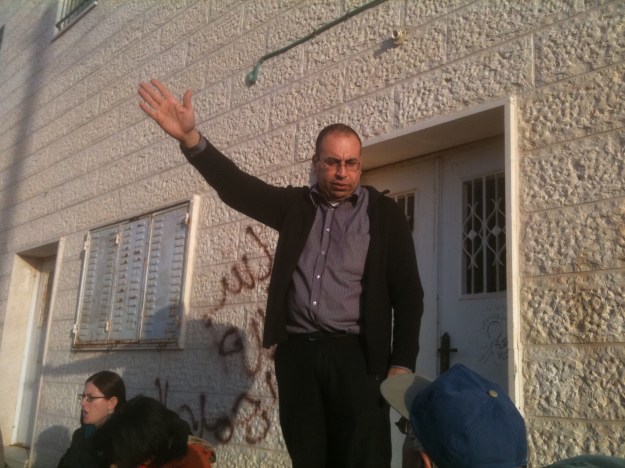
While in Wadi Fukin, our group was treated to a delicious lunch cooked for us the staff of the village’s Women’s Center. In all, it was impossible for us to be unmoved by the story of the village, one inspiring success story amidst an increasing dire situation in the Occupied Territories.

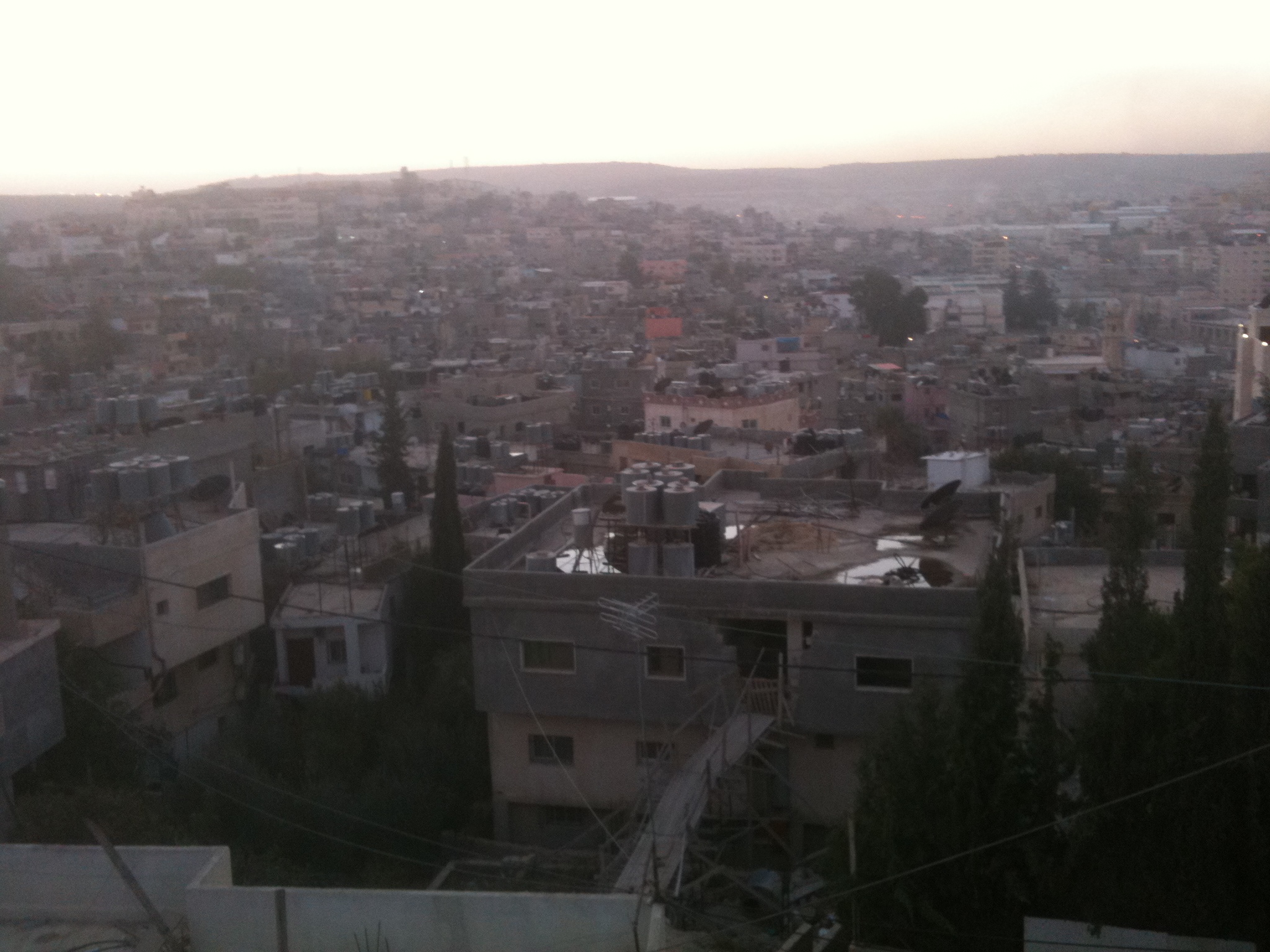
From there we traveled to Deheishe, a refugee camp near Bethlehem. Deheishe (below) was established as a refuge for 3,400 Palestinians who were expelled from 45 villages west of Jerusalem and Hebron in 1948. Originally simply a collection of tents, Deheishe is now a densely packed urban labyrinth of over 9,000 residents.
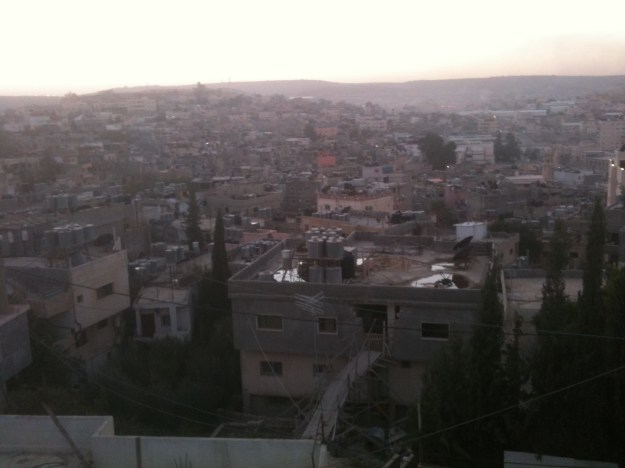
Adminstered by UNRWA, the camp is bordered to the north by the Jewish settlement of Efrat and to the south by Bethlehem. Like many Palestinian refugee camps, Deheishe has nowhere to grow but up – most of the homes have three stories and the camp seems to be in a constant state of vertical expansion.

Upon our arrival we were greeted by Deheishe resident Mazen Faraj, who coordinated our visit and introduced us to our host families. My group of seven was hosted by Nidal and Newarah and their three children, Haya, 18, Moad 17, and Tariq, 12, who opened their recently built home to us and were utterly gracious hosts to our intrepid little crew. They treated us to a delicious – actually sumptuous – dinner and we enjoyed each others’ company talking, sharing and laughing until the wee hours of the morning.

I spoke at length with Moad, who at one point took me out for a long night stroll through the winding alleyways of the camp, introducing me to friend after friend until it felt like I had met virtually the entire teenage population of Deheishe. After coming home, we continued to talk together as neighbors came and went through their home at a dizzying pace.

For right now, I don’t really know how else to describe our visit other than a genuinely delightful evening with wonderful new friends. I’ll share many more thoughts about our Deheishe soujourn in my next post. For now, suffice to say it today was an incredible journey for us all – and it has only been our second full day.

Much more to follow…
Jerusalem From a Shared Perspective

We’ve just finished the first full day of JRC’s Israel/Palestine study tour – which we devoted to understanding and experiencing Jerusalem as a “shared holy city.” While this might sound like an obvious fact, many Jews today (including myself) have been raised and socialized to regard Israel, if you will,  as a “Jewish city that just happens to be important to some other faiths as well.”

To this end we made a point of visiting and spending time at the three main holy sites of the city: the Western Wall, the al-Aqsa Mosque and the Church of the Holy Sepulchre.  Afterwards we met with two Shaykh Yusuf Abu Sneina, Imam of the al-Aqsa mosque and Rabbi Yechiel Grenimann of Rabbis for Human Rights. Tomorrow morning we’ll be meeting with Revered Naim Ateek of the Sabeel Institute to round out our visits with faith leaders.

Our tour is being led by Aziz Abu Sarah and Kobi Skolnick – who are Palestinian and Israeli respectively. Both Aziz and Kobi are remarkable individuals with powerful personal stories. Aziz is a native of Jerusalem who became radicalized at a young age after the death of his older brother at the hands of the IDF. He became active in the youth movement of Fatah and participated extensively in Palestinian resistance actions during the First Intifada.

Aziz has since become actively involved in Israeli-Palestinian coexistence work. He was one of the original staff members of the Bereaved Parents Circle and works with Rabbi Marc Gopin at the Institute for Conflict Resolution at George Mason University. Aziz and Rabbi Gopin have also founded Mejdi, a business that promotes coexistence through educational tourism and small business cooperation. (You can read an extensive interview with Aziz here.)

Kobi’s story is no less amazing. Born into a Chabad family in Israel, he moved to a settlement in the West Bank during his high school years. There he become a member of Kach – the Jewish extremist movement founded by Rabbi Meir Kahane that actively promotes violence against Palestinians. During his service in the Israeli army Kobi went though a personal transformation as he confronted the reality of the conflict.

Today, Kobi is highly involved in the Israeli-Palestinian peace movement – he was one of the original members of Breaking the Silence and now studies conflict resolution. He travels widely as a trained mediator and facilitator.

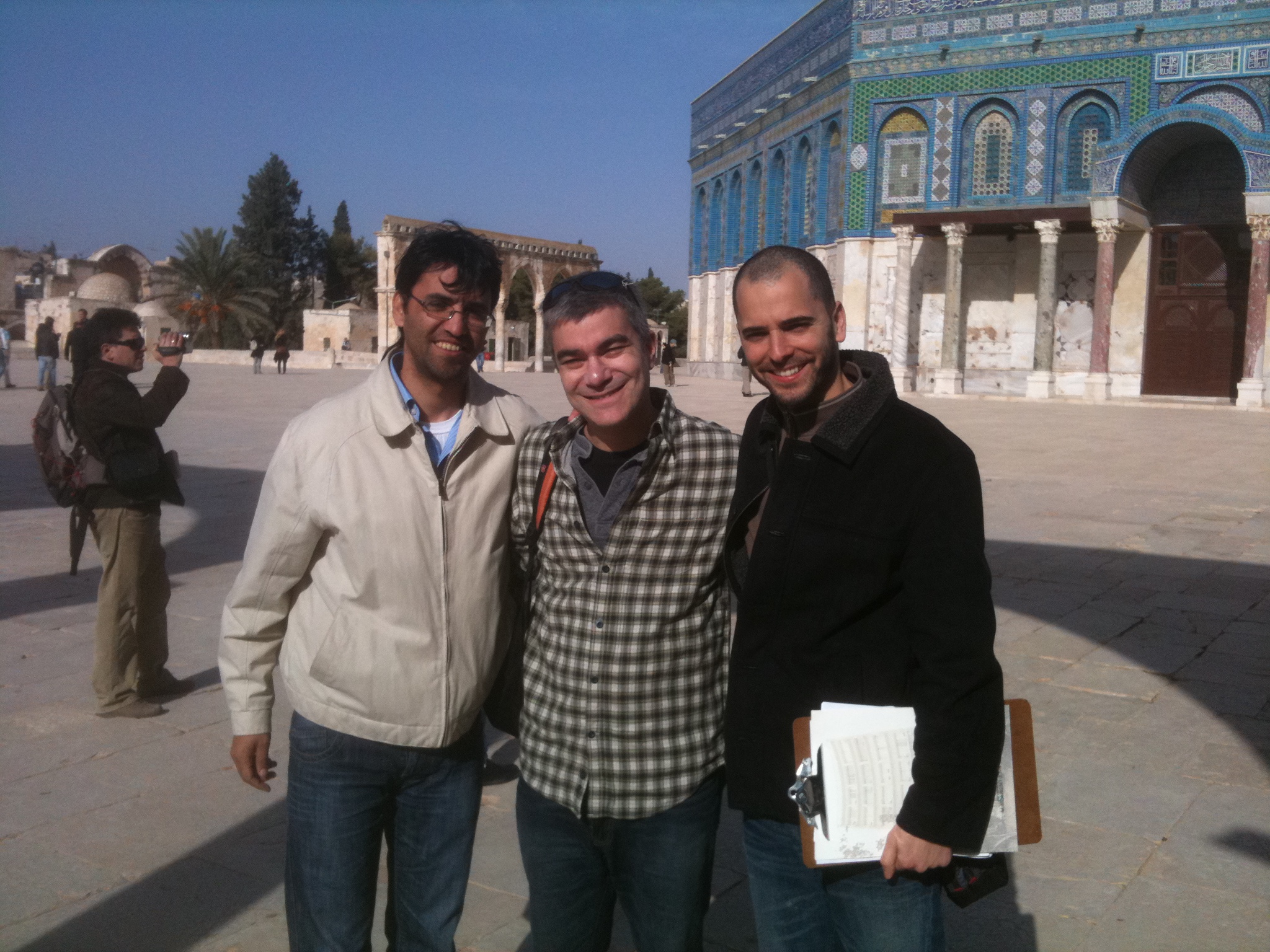
Among other things, the genuine friendship between Aziz and Kobi has powerfully affected the members of our group. Considering their respective backgrounds and personal journeys, their working relationship and very obvious affection for one another is moving and inspiring indeed. (The picture above was taken this morning at next to the Dome of the Rock. That’s me in the middle, with Aziz on the left and Kobi on the right.)

Tomorrow we’re off to tour East Jerusalem and Bethlehem before spending two nights in the Deheishe refugee camp. Stay tuned.

AJC Honors Hyatt CEO – Express Your Disapproval!

Some news on the Hyatt boycott front:

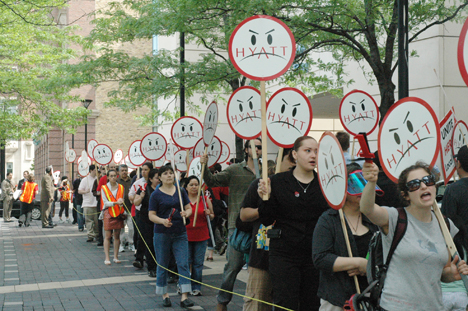
Last Thursday, I joined over seventy clergy, hotel workers and solidarity activists to participate in an interfaith service in front of the Hyatt Regency in downtown Chicago (click on the clip above). We sang, we chanted, we exhorted – and Rabbi Peter Knobel of Beth Emet in Evanston declared Hyatt “lo kasher” (“not kosher”) for its unjust labor practices.

Given Hyatt’s dismal labor record you may be more than a little appalled to learn that the American Jewish Committee in Chicago will be honoring Mark Hoplamazian, CEO of Hyatt Corporation, with its “Civic Leadership Award” during  a dinner which will take place tonight at – you guessed it – the Hyatt Regency.

In a recent article in the Boston Jewish Advocate, Chicago AJC Director Daniel Elbaum, commented that Hoplamazian “had a better understanding of Jewish values than anyone I knew.”

Huh?

If you disagree with the way Daniel Elbaum understands Jewish values, please click here to send him a letter that tells him so. We need to let Hyatt management know that this award will not provide a moral fig leaf for their immoral behavior.

Click below to read the entire Boston Advocate article:

Continue reading

Protest the FBI Raids – Support Freedom of Dissent in post 9/11 America!

On September 24, the FBI raided eight homes and offices of antiwar activists in Chicago and Minneapolis and subsequently issued a summons for them to appear before a grand jury in Chicago.  I won’t go into the details of this egregious violation of the Constitutional rights of US citizens because this Democracy Now piece (part one above, part two, below) does a thorough job in covering all the sordid details. (You can read the transcript here.)

If you live in the Chicago area (and are outraged at the increasing criminalization of dissent in post 9/11 America), I encourage you to attend a rally to against the raids and support of the peace activists subpoenaed by the FBI on Tuesday, October 5 at 8:30 am outside the Dirksen Federal Building, 230 S. Dearborn Avenue, Chicago.

If you can’t attend the rally, please join me and a growing list of signers who have added their names to the following interfaith statement (to sign, send an email to MMcConnell@afsc.org):

We are people of faith and conscience who condemn the recent FBI raids in Chicago as a violation of the constitutional rights of the people and organizations raided. They are a dangerous step to further criminalize dissent. The FBI raids chisel away and bypass fundamental constitutional rights by hauling activists before grand juries under the guise of national security. An overly broad definition of “material support for terrorism” in the June 2010 US Supreme Court ruling concerns us as people of faith who continue to be actively engaged in humanitarian work and peacemaking.

The real illegitimate activities are U.S. foreign policies that support war and occupation. We believe that peacemaking is a sacred commandment.  We feel compelled to work to end military solutions that kill and maim innocent people, destroy civil society institutions, create massive poverty and dislocation of people from their homelands, militarize our own nation and continue to create more animosity against the United States, thus undermining our security.

We are committed to a just peace in Israel and Palestine, Iraq, Afghanistan and Colombia. Some of us have visited these conflicted areas and accompanied those most affected by the violence. Some of us have permanent staff and volunteers working nonviolently for a peaceful resolution to these conflicts. We all stand opposed to the United States’ and all nations’ support of military aid and military intervention in these countries. The infusion of military aid has exacerbated violence rather than resolved it.

We believe in a divine spirit of justice and hope that promotes understanding and equality of all humanity. We refuse to remain silent in the face of the latest efforts of the FBI to chill dissent against war by invading homes of peace activists and calling a grand jury with sweeping powers to manufacture fear. We denounce the use of fear and the far-reaching labeling of critical dissent as “terrorism” that tramples on not only our right, but our duty to dissent as people called to a moral standard of justice for all.

Confronting Islamophobia: A Sermon for Rosh Hashanah 5771

From my Rosh Hashanah sermon last Thursday:

So what is the real issue here?  I don’t think it’s about sensitivity to individuals who may or may not be offended by this particular construction project. The real issue is really quite straightforward. The real issue, I believe, is the same as it ever was – and as Jews, it’s an issue we know all too well. Will America be a land of religious liberty for all or merely the few?

Click below to read the entire sermon:

Continue reading

Hyatt Boycott Reaches Chicago

It was my honor today to join with Hyatt workers and supporters for a press conference to announce that Unite Here Local 1 is now urging patrons to boycott three Chicago Hyatt locations.

From the union’s press release:

Today, UNITE HERE Local 1 members are gathering in front of Hyatt Global Headquarters in Chicago to call for a boycott at several area Hyatt Hotels—the Hyatt Regency Chicago, the Hyatt O’Hare, and the Park Hyatt. Hyatt workers will be joined by Jewish allies, who are releasing a pledge signed by over 250 Rabbis and other Jewish leaders nationwide in support of Hyatt workers across North America. The boycott and national pledge represent the latest escalation of a labor dispute with Hyatt, which has become the target of labor demonstrations across North America in recent weeks.

The boycott announcement comes almost one year after union contracts with Hyatt in Chicago have expired (Aug. 31, 2009). Hyatt workers have taken several actions in recent months, including a work stoppage on May 26, 2010, a picket of Hyatt’s annual shareholders meeting on June 9, 2010, a massive demonstration outside the Hyatt Regency Chicago on July 22, 2010, and a strike vote on July 29, 2010. Hyatt protests in Chicago have been echoed by other major demonstrations this summer in 15 cities across the U.S. and Canada.

The three Hyatt boycotts in Chicago, which join seven other active boycotts of Hyatt properties nationwide, signal a growing crisis for Chicago-based Hyatt and its billionaire owners—the Pritzker Family—who have become a symbol among hotel workers for how the wealthy are trying to take unfair advantage of the recession. Hotel workers in Chicago have endured staff cuts, reduced hours, and excessive injury rates. Frustration among area workers has deepened, as Hyatt has tried to make further job cuts and lock workers into recession contracts even as the economy rebounds.

In the clip above: behind me stands Rabbi Alison Abrams of Temple Chai in Long Grove and Cantor Michael Davis of Lakeside Congregation, Highland Park, both of whom spoke at the press conference as well.

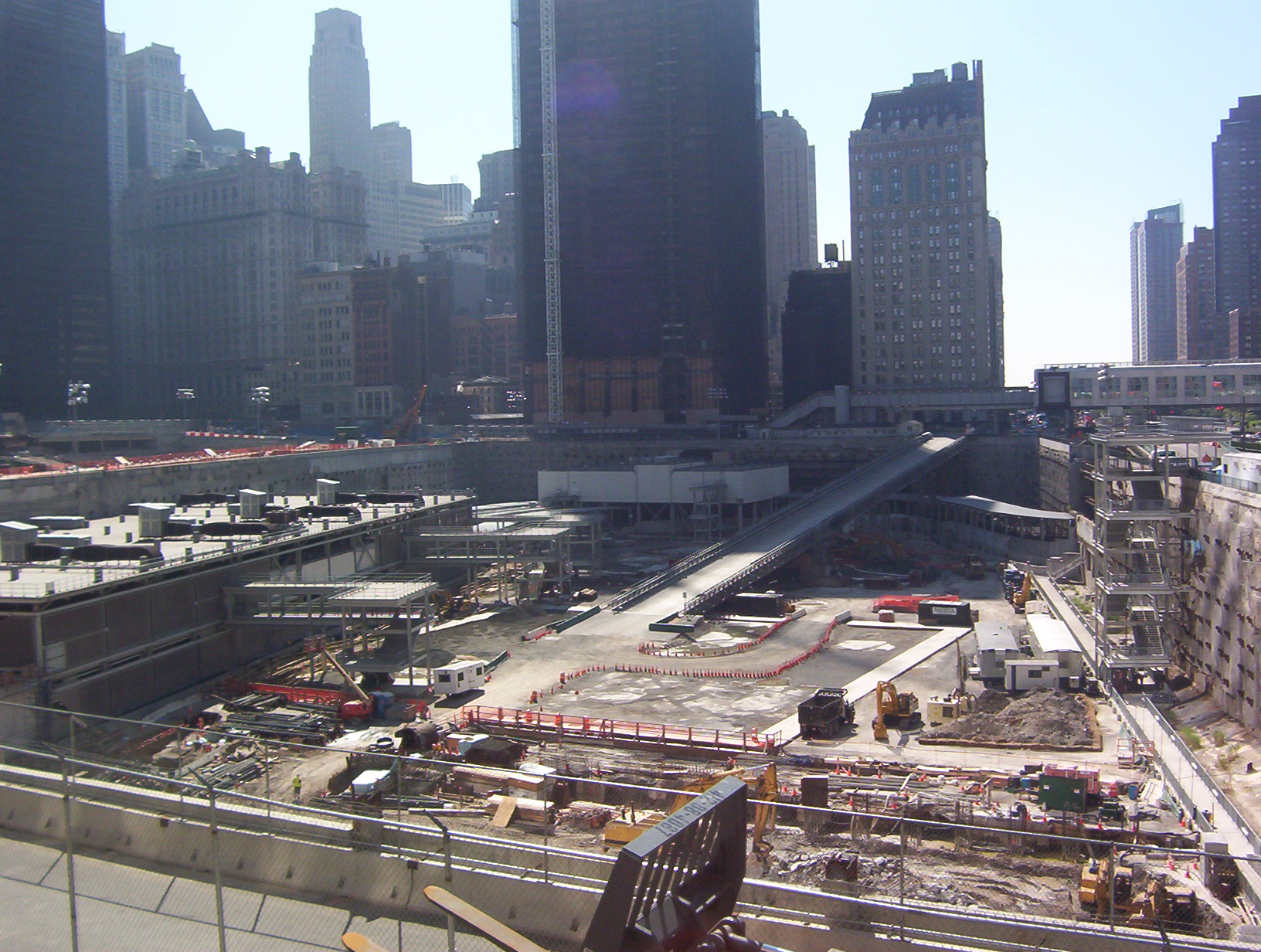
Hallowed Ground: From Jerusalem to Lower Manhattan

Land can be deemed “sacred ground” for many reasons, but I’m struck that much too often this concept has less to do with the experience of divinity than it does the exercise of human power.

The latest debate over the Cordoba Islamic community center is only the latest example of this phenomenon – on this point I believe blogger Paul Woodward hit the nail squarely on the head with this recent insight:

Another way of saying “sacred” is to say “off-limits.”

Something can be sanctified by placing a barrier around it constructed from rigid taboos. The most extreme among those taboos dictates not only silence but also exclusion.

In such a way, for many Americans, 9/11 has been sanctified. The sacred idea occupies a sacred space and only those willing to display sufficient awe and reverence can be allowed to enter.

Woodward is absolutely right that sacred space and exclusion can invariably go hand in hand. When we read in the Torah, for instance about the Israelites’ construction of the Tabernacle (and later in the Bible, the Temple itself), we learn that certain sacred areas correspond to the specific social hierarchies within the Israelite community. Rank and file Israelites are allowed into the outer courtyard, but the inner precincts are off limits to all but the priests. And only the High Priest himself is allowed into the innermost Holy of Holies – and only on Yom Kippur, the holiest day of the year.

Ironically enough, Jewish tradition teaches that it was precisely hierarchy and division that led to the loss of our most central of sacred spaces. According to the Rabbis, the destruction of the Second Temple was due not to the greater military might of the Romans, but because of the divisive, internecine hatreds (“sinat chinam”) harbored by the Jewish people between themselves. I often think about this teaching when I read about the power politics raging over the Western Wall or ongoing attempts to claim the areas in and around the Old City of Jerusalem in the name of the Jewish people alone.

When it comes to the area that is considered to be the holiest of places for Jews, I can’t help but think it has more often been a place of sacrilege, not sanctity. It has ever been thus: the more we press our own claims upon the places we deem sacred, the more we manage only to defile them in the end.

And so, as I have read about the horrid political wrangling over Cordoba House, it is becoming clearer and clearer to me that this little patch of land in Lower Manhattan will only truly become hallowed ground if we resist the temptation to yield exclusive political claims over it.

If there is any Biblical image we might look to for guidance, I would argue it is less the hierarchical, exclusivist priestly model than the universal, inclusive prophetic vision famously expressed in Isaiah 56:7: “My house shall be called a house of prayer for all peoples.”

To this end, I commend to you this recent statement from Faith in Public Life, to which I am honored to be a co-signer. I can think of no better definition of “sacred space” than this:

The profound tragedy of Sept. 11, 2001 revealed the horror that can unfold when a small minority of violent extremists manipulates religious language for political gain and falsely claims to represent one of the world’s great religions. We have witnessed this sinful corruption of religion across faith traditions throughout history and must condemn it without equivocation whenever or wherever it occurs. However, we fail to honor those murdered on that awful day – including Muslim Americans killed in the Twin Towers and Pentagon – by betraying our nation’s historic commitment to religious liberty, fueling ugly stereotypes about Islam and demeaning the vast majority of Muslims committed to peace. The proposed mosque would be part of Cordoba House, a center open to all Americans that will provide Islamic, interfaith and secular programs. The project aims to support “integration, tolerance of difference and community cohesion through arts and culture,” according to the Cordoba Initiative, which promotes improved “Muslim-West relations.” These are exactly the kind of efforts that foster dialogue, break down barriers and begin to build a world where religiously inspired violent extremism is less likely.

Seek Interfaith Justice This Labor Day Weekend!

Interfaith Worker Justice has just launched its annual “Labor in the Pulpits/on the Bimah/in the Minbar” initiative, encouraging houses of worship around the country to dedicate Labor Day weekend (September 3-5) to worker justice awareness.

You can access the resources and materials by clicking here. I encourage you to share them with your Priest, Rabbi, Pastor or Imam, as the case may be. (I contributed a piece to the Jewish resources – click here to download the pdf.)