Category Archives: Interfaith

Video: Hyatt Management Eats Bitter Herbs!

Here’s a 10 minute video of our interfaith labor action at the Hyatt shareholders’ meeting last Wednesday.

As I wrote in my previous post, we were met by Robb Webb, chief human resources officer for Hyatt. Here he is addressed by Reverend Lillian Daniel, Rabbi Barbara Penzer (from Boston), Reverend Calvin S. Morris, Reverend David Weasley and me.

Make sure to watch until the very end, where Rabbi Barbara presents a platter of bitter herbs to Mr. Webb, and we all eat it together!

The Hyatt Hotel Workers’ Bitter Herbs

Yesterday I had the honor of joining a demonstration of over 100 interfaith clergy who protested outside the Hyatt Hotel Corp’s shareholders’ meeting in Chicago. Hyatt went public last November and was hoping to have a quiet, pro-forma meeting. In the end, Hyatt’s increasingly draconian labor practices made that fairly impossible.

Here’s some background from the website Hotel Workers Rising:

In city after city across North America, Hyatt Hotels is leading the fight against middle class jobs for hotel workers. Nationwide, the hotel industry is rebounding faster and stronger than expected, with a hearty rebound projected in 2011 and 2012. In the six months following Hyatt’s November initial public offering, Hyatt’s shares were up over 65%. In one day, majority owners of Hyatt Hotels, the Pritzker family, cashed out over $900 million in an initial public offering of the company’s stock. As recently as March 31, 2010 Hyatt had $1.3 billion in cash on hand.

Despite trends showing a strong recovery for the hotel industry and hotel owners, big hotel companies are still squeezing workers and cutting staff. Hyatt is the starkest example. Hyatt is using the weak economy as an excuse to slash benefits, eliminate jobs and lock workers into the recession.  In Boston, Hyatt fired their entire housekeeping staff at three non-union hotels, laying off 98 longtime housekeepers and replacing them with outsourced workers making minimum wage. Many of the fired workers report that Hyatt required that they train their replacements…

In cities across North America, Hyatt is attempting to rollback quality job standards and make the recession permanent for thousands of unionized workers. Proposals in several cities would result in the elimination of quality health care for thousands of low wage workers. Cities with contracts Hyatt union contracts expiring in 2009-2010: San Francisco, Los Angeles, Toronto, Chicago, Vancouver, Monterey, Honolulu, and Washington DC.

As previous attempts to meet with Hyatt management proved fruitless, organizers decided to use the occasion of the shareholders’ meeting to force a meeting. Our clergy group gathered outside the Hyatt Regency McCormick Place and marched up to second floor where the meeting was taking place. We were stopped at the security line, where we were told we had to be “registered shareholders” if we wanted to enter the meeting.

As security scrambled and the police were called (below), we sang outside the doors of the meeting, booming out “Open up for me the gates of justice/I will enter and praise the Holy One” (Psalm 118:19). As we sang, it became clear that the meeting was ending – and one by one the shareholders had to walk through a huge crowd of singing, clapping clergy.

Eventually, our delegation was met by Robb Webb, chief human resources officer for Hyatt. He told us that he honored our motives and he “regretted” the way the Boston firings were handled, but we had to understand that it was ultimately a “business decision” in the end. We responded that If he truly honored our motives, then he must surely understand that “it’s only business” is not an acceptable explanation. Rabbi Barbara Penzner (my Reconstructionist colleague from Boston who has been helping lead the protest of the “Hyatt 100”) pointed out that beyond the economic bottom line, there was a “moral bottom line” due the workers who help make the Hyatt shareholders’ formidable profits possible.

Barbara then presented Mr. Webb with a platter of bitter herbs (top pic), pointing out that Hyatt was indeed embittering the lives of its workers. Noting the symbolism of the Passover story, we all then ate of the maror in solidarity with Hyatt employees.

Outside (above), we shared our experiences with the demonstrating workers (who let out a huge cheer when they learned that the new Hyatt shareholders were forced to run a gauntlet of raucous, singing clergy.)

Click here to sign a pledge of support for the Hyatt 100.


Passover and Good Friday: Together Like Never Before

The most memorable aspect of my Pesach this year? A combination Passover – Good Friday service JRC held together with the wonderful folks at Lake Street Church of Evanston.

The whole thing was hatched somewhat by chance. A month or so ago I was having lunch with my good friend Reverend Bob Thompson of Lake St. Church (appropriately enough at Evanston’s Blind Faith Cafe) and our conversation turned to our respective upcoming rites of spring. Bob mentioned to my surprise that he hadn’t celebrated Good Friday at Lake St. in quite some time – mainly because he simply couldn’t abide by blood atonement theology – the notion that God would somehow require the bloodshed of one man to atone for all of the sins of the rest of the world.

For my part, I mentioned that Good Friday had not generally been so “good” to the Jews throughout history, since this was invariably the time in which the worst pogroms were perpetrated against European Jewish communities. As a result, for much of Jewish history Passover was a secret ritual: observed in fear and in private. Given our complicated mutual history, we both agreed that it would be enormously powerful to celebrate Passover and Good Friday together in a spirit of healing and hope.

So that is exactly what we did this last Friday. While Bob and I weren’t at all sure if this service would fly, it actually suceeded beyond our highest expectations. Hundreds of JRC and Lake St. members filled the sanctuary at Lake St. church. Together we celebrated with a service that mixed Hebrew and English, Jewish songs, Christian hymns and prayers for healing. We ended with a rousing “Down By The Riverside.” Afterwards, countless participants – both Jewish and Christian – told us that the service was an immensely moving and healing experience for them.

During the service, Bob and I had a conversation in which we both mused about what our respective holidays might look like if we recast them in the spirit of healing and hope. Bob began by saying the first thing Christians needed to do when celebrating Good Friday was to apologize to the Jewish community for the legacy of Christian anti-Semitism. He then went on to explore how Christians might recast the meaning of the crucifixion itself. Here’s what he had to say:

Every Good Friday well meaning folk gather to listen to priests and ministers talk about how Jesus was crucified, the “lamb of God,” to take away the sins of the world. In other words, Jesus died a sacrificial death to satisfy the God who demands retribution – the God who requires the shedding of blood for the forgiveness of sins.

Thankfully these days there’s an emergent form of Christianity – one that does not buy this “blood atonement theory” – and it is a theory. Today, more and more Christians are saying they do not believe that God requires the shedding of blood… The point is, violence is not a solution – it’s always a problem. We have to get to see that violence never purifies – it always defiles. In every form it is defiling.

That’s why if Jesus was standing here today, I believe he’d say, “don’t call me the lamb of God who takes away the sins of the world.” He might say rather something more like “I am a window to divinity and a mirror of humanity. What I came to do is to show you what it means to be open to the Divine and to reflect the best of who we are as human beings. And everybody can reflect this and be this window if only we have the spiritual vision to see clearly enough.”

In other words, Jesus, I believe, would not say that he suffered to keep us from suffering – he suffered because to be human is to suffer. Jesus hangs there because life is always hanging in the balance for all of us all of the time.

I was so taken by his willingness to take on the violence inherent in the crucifixion image – and I responded in kind with my remarks:

There’s no getting around it: to observe the Seder, you need to tell a story of oppression and violence. And you cannot get to what is for Christians resurrection and what is for Jews the Exodus from Egypt without going through that moment of violence…

I will also say I share with you, Bob, completely, that I do not view violence in any way as redemptive. I reject that categorically. I think we all have to. But we still have to struggle with the way violence affects us and what it does to us and what it does to our souls. We can’t ignore it. Even if we disavow it, we can’t ignore it.

As a Jew… I fear the violence that is embodied by the Seder and that has been waged against the Jewish people for centuries will turn us into a bitter people. That it will only cause us to have a sense of entitlement which means we use our pain as a weapon against the outside world because nothing we do to anyone else can be nearly as horrible as what’s been done to us. Or it will cause us to build bigger walls between us and the rest of the world and to instill a Jewish identity that basically says nothing more than “all the world really wants us dead, and that’s what it means to be a Jew. And we have to be forever vigilant because we live in a world that hates Jews.”

And while I’m not unmindful of this history and I do think we need to retell this history because those who do not study history are condemned to repeat it…I also think we need to look seriously at what this legacy of violence and oppression does to us and what we do with it.

And for me that means bearing witness to oppression in the world. If there is any sliver of redemption in violence, it means that it can open the door to empathy – and I would suggest that this idea comes from a very deep place in Biblical tradition – in the Torah.

The commandment commanded more times than any other in the Torah is some version of “Do not oppress the stranger because you were once strangers in the land of Egypt.” To me what that says is “you don’t take your pain and use it as a weapon against the outside world. You take your pain and use it as a tool for empathy with the outside world – and to bear witness against oppression no matter where it is fomented, whether it is in our community or it’s in any community.

We cannot hold on to our pain as uniquely ours, and I want to come back to something you said earlier, Bob: “We’re all in this together. It’s not some of us – it’s all of us. And violence against one people is violence against all.”

You can read some of Bob’s thoughts about our service on a piece he’s just written for Examiner.com You can also click below to hear an audio of the entire service. (The service itself begins at the 10:00 point).

Rohina Malik Unveils Our Common Humanity

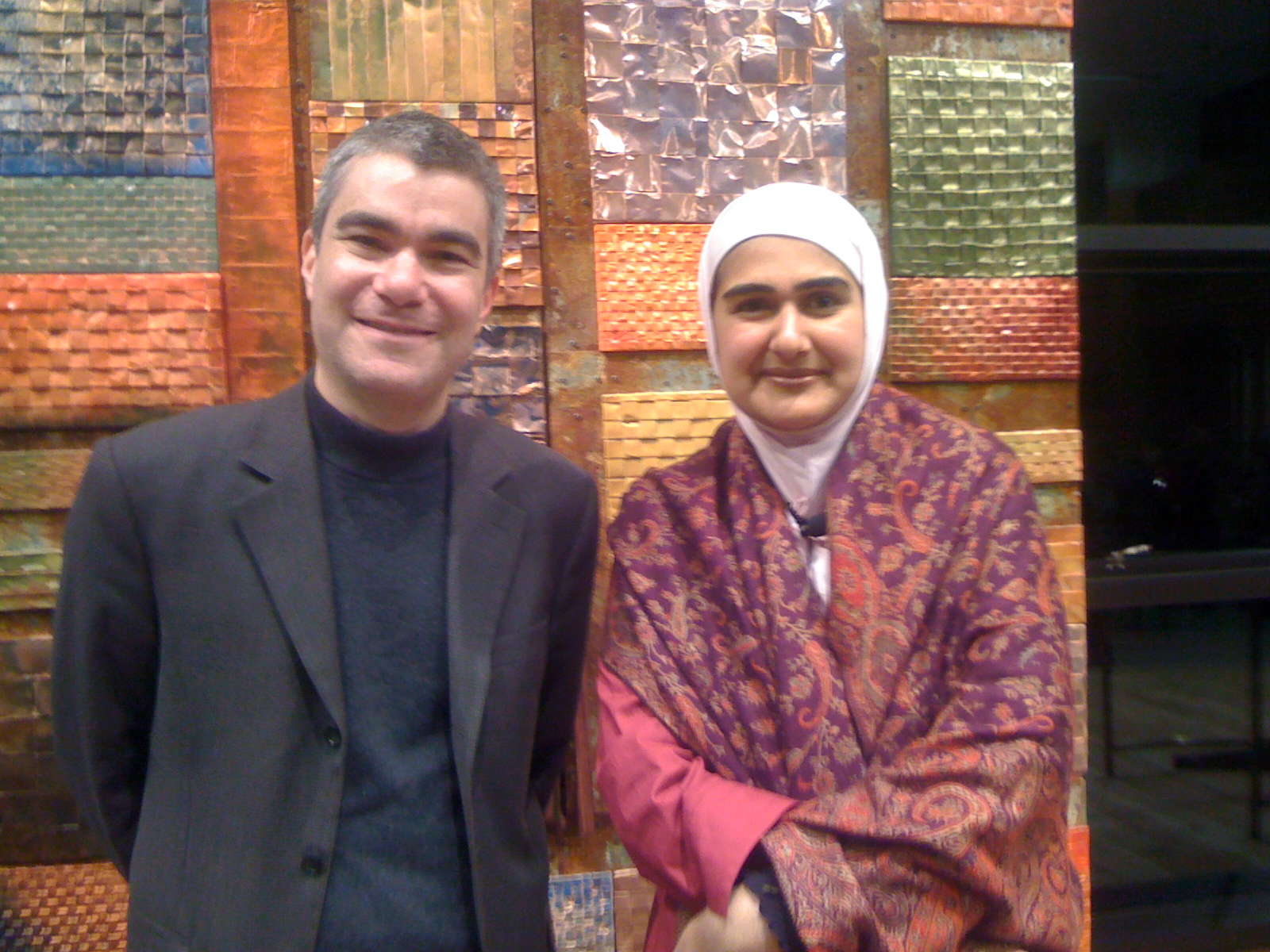
Last night JRC was honored to host a performance of the one-woman show “Unveiled,” by Rohina Malik. Breathtaking.

Rohina is a playwright, actress and solo artist of South Asian heritage who was born in London and emigrated to Chicago when she was 15.  She is an impressive and important contemporary artist – and her identity as an American Muslim woman clearly plays an important role in her art.

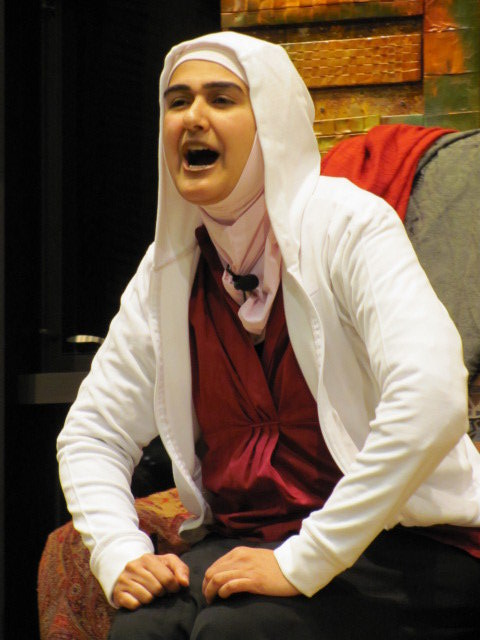
“Unveiled” is constructed around five monologues by five Muslim women. During the course of the play, each of them greets the audience in turn, “welcoming” us with tea.  Each woman tells the story of their lives, explains their Muslim culture and shares the experience of living as a Muslim woman in the post 9/11 world.

For her appearance at JRC last night, Rohina performed three monologues: “Maryam,” a Pakistani-American who has a dress making shop on Chicago’s Devon Avenue; “Shabana,” a young rapper of South Asian descent who was born and raised in London; and “Layla,” a Chicago restaurant owner from the Middle East who lost a brother to the fall of the twin towers.

It’s difficult to convey the cumulative effect these women had upon the audience. Rohina’s performances cut to the heart of painful and complicated political issues – but even more profound was the immediately empathy Rohina was able to conjure for us through these remarkable women. In a relatively short amount of time, she was able to bring us through an entire gamut of emotions – and in the end, the common humanity we shared with these women was palpable to everyone in the room.

Following the play we had an equally powerful post-performance discussion facilitated by the play’s director, Ann Filmer. Nearly 250 people were in attendance – including many members of the Chicagoland Muslim community – and it was truly a tribute to Rohina’s art that so many members of this large and diverse group were inspired to share deeply personal comments about their own lives and struggles.

If you live in the Chicago area, you should know that “Unveiled” will be starting a run at the Victory Gardens Theater on March 24. Highly, highly recommended.

Tel Aviv: “One of Your Own Kind, Stick to Your Own Kind…”

In past posts I’ve raised questions about the implications inherent in the establishment of a Jewish state – and the problems that invariably seem to arise in relations with Israel’s non-Jewish citizens and residents.

How do we American Jews  react, for instance, when we read that Israel is concerned about a “demographic threat” to the Jewish state? (That is to say, what would we say if  our President raised questions about the “demographic threat” of a particular minority group to the “American character” of our country?)

And now:  what would we say if an American city funded a campaign to discourage girls from dating or marrying boys from another ethnic group?

From Coteret (an Israeli news/media aggregator):

Maariv reported reported on February 23 that the Tel Aviv municipality  launched  a “counselling program” to “help”  Jewish girls who date and/or marry Arab boys.

Grassroots and governmental campaigning against interfaith mingling is  nothing new in Israel…But this is the first time officially sanctioned racism, funded by taxpayers, has come to Tel Aviv, Israel’s liberal heartland.

I’m not asking these questions to “bash Israel.”  I’m genuinely concerned by certain realities that seem intrinsic to ethnocracies. If we truly do cherish values inherent to American civil democracy, how do we react to news such as this?   Do we simply put these values on the shelf out of our desire for a Jewish state?  Or can we understand these kinds of measures in a way that is consonant with our most essential civic beliefs (beliefs, by the way that have been quite kind to the American Jewish community)?

And if not, then how will we respond?

Elie Wiesel Can’t Have it Both Ways

Elie Wiesel has long walked the tightrope between pious pronouncements of universal Jewish conscience and unabashed political advocacy. He’s been trying to have it both ways for years, but it seems to me that his balancing act is becoming more and more transparent.

Last week, as Wiesel unveiled an anti-Ahmadinejad ad with other Nobel Prize laureates, he blasted the Goldstone report, calling it “a crime against the Jewish people.”  Leaving aside the issue that he took this opportunity once again to speak on behalf of the entire Jewish people, I’m still somewhat staggered that Wiesel, of all people, would use such charged Holocaust rhetoric in such a patently political manner. (I think Richard Silverstein at Tikun Olam hit it right on the head when he asked, “What was the last event in world history you can recall being a ‘crime against the Jewish people?'”)

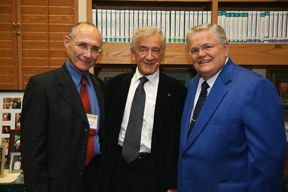
If this wasn’t enough, now I read on Max Blumenthal’s blog that Wiesel’s foundation received $500,000.00 for one speech he delivered at the church of fundamentalist Christian Zionist John Hagee (whom he referred to as “my dear pastor.”) Yes, this is the same John Hagee who publicly sermonized that Hitler was sent by God to create the Holocaust so that Jews would emigrate to Israel.  It’s simply astonishing to me that so many Jewish leaders are perfectly willing to cozy up to the likes of Hagee even after it has become so patently clear that his views are way off the rails. (That’s Wiesel, above, with Hagee, right, and Israeli minister Uzi Landau, left).

As far as I’m concerned, Justice Richard Goldstone is precisely the kind of courageous Jewish moral hero that Wiesel himself purports to be: someone committed to advocating for universal human rights even when doing so might mean holding our own community painfully to account.  As for Wiesel, I’m finding his words and actions increasingly craven. No one begrudges him his opinions – but it’s time he dropped the pretense that he’s somehow beyond the political fray.

Palestinian Christians: “The Occupation is a Sin”

Last week, a group of Palestinian Christians representing a variety of churches and church-related organizations issued a powerful, prayerful call for an end to the Israeli occupation.  My friend Rabbi Brian Walt was present at the meeting in Bethlehem in which the statement – known as  “The Kairos Palestine Document” – was released. Upon his return, he described to me his profound, often painful conversations with Palestinian Christians and he told me that as a Jew, he considered the Kairos Document to be an enormously important spiritual/political statement. Having now read the entire 12 page document, I must say that I agree wholeheartedly.

Palestinian Christian liberation theologians such as Naim Ateek of the Sabeel Institute have been doing important work for decades and I believe their ideas present important spiritual challenges to the Jewish community. Many Jews point to the more radical incarnations of these theologies – and while I share some of these concerns, I believe that we make a profound mistake by dismissing Palestinian Christian theology wholesale. (Frankly, I am much more troubled by the “End of Days” theologies of fundamentalist Zionist Christians such as Pastor John Hagee than I am by Naim Ateek and the authors of the Kairos document.)

My friend and colleague Father Cotton Fite of St. Luke’s Church in Evanston, tells me he hopes that American Christians will study the Kairos Document carefully. I mentioned to him that I hoped Jews would read it as well. In fact, I think we should create opportunities to read it together. Despite our differences, I believe it offers both of our communities an ideal place to begin meaningful dialogue over the spiritual implications of this conflict.

One of the more important and challenging passages:

Our presence in this land, as Christian and Muslim Palestinians, is not accidental but rather deeply rooted in the history and geography of this land, resonant with the connectedness of any other people to the land it lives in. It was an injustice when we were driven out. The West sought to make amends for what Jews had endured in the countries of Europe, but it made amends on our account and in our land. They tried to correct an injustice and the result was a new injustice.

I can already predict that many Jews will bristle that this passage does not specifically reference the Jewish connection to the land as well. To this I would say, how deeply do we Jews ever honor the reality that we are not the only people who are “deeply rooted in the history and geography of this land?” Moreover, how deeply do we ever face the true injustice that was committed when a people with deep roots in the land were driven out and not allowed to return?

Another sobering passage in the document describes the Occupation as no less than a “sin:”

We also declare that the Israeli occupation of Palestinian land is a sin against God and humanity because it deprives the Palestinians of their basic human rights, bestowed by God. It distorts the image of God in the Israeli who has become an occupier just as it distorts this image in the Palestinian living under occupation. We declare that any theology, seemingly based on the Bible or on faith or on history, that legitimizes the occupation, is far from Christian teachings, because it calls for violence and holy war in the name of God Almighty, subordinating God to temporary human interests, and distorting the divine image in the human beings living under both political and theological injustice.

Many of us view the Occupation as a political problem to be solved. But indeed, as Jews, we must admit basic human rights are rooted in our religious tradition. Like Christians, we also believe that all human beings are created in the image of God. We also believe that when the basic dignity of anyone’s humanity is diminished, the Divine Image is diminished as well. How then, can we fail to understand that the Occupation is not only a geo-political problem but a spiritual/moral problem as well?

This conclusion leads to a logical next step:

Love is seeing the face of God in every human being. Every person is my brother or my sister. However, seeing the face of God in everyone does not mean accepting evil or aggression on their part. Rather, this love seeks to correct the evil and stop the aggression.

The injustice against the Palestinian people which is the Israeli occupation, is an evil that must be resisted. It is an evil and a sin that must be resisted and removed. Primary responsibility for this rests with the Palestinians themselves suffering occupation. Christian love invites us to resist it. However, love puts an end to evil by walking in the ways of justice. Responsibility lies also with the international community, because international law regulates relations between peoples today. Finally responsibility lies with the perpetrators of the injustice; they must liberate themselves from the evil that is in them and the injustice they have imposed on others.

Again, the Occupation is viewed not as a diplomatic issue to be negotiated but a spiritual evil to be resisted.

I have no illusions that for many Jews, suggestions such as these present daunting and painful challenges.  So will many of the ultimate political ramifications of the Kairos Document. All I can hope for is that political disagreements will not keep us from honestly facing the profound spiritual dimensions of this conflict.  Speaking for myself, I do believe this statement was written in good faith, genuine love and true religious conviction:

Our message to the Jews tells them: Even though we have fought one another in the recent past and still struggle today, we are able to love and live together. We can organize our political life, with all its complexity, according to the logic of this love and its power, after ending the occupation and establishing justice.

What can I say to this except “Amen?”

Shabbat with a Shi’ite Cleric

IMG_0689
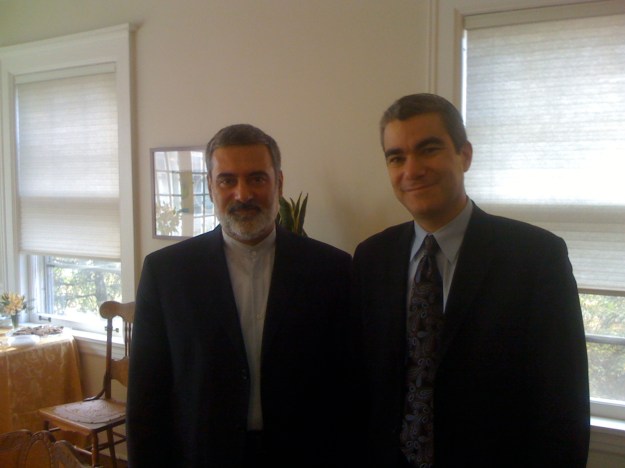
I spent a remarkable Shabbat lunch yesterday at the home of JRC members Mark and Margie Zivin, where I had the opportunity to meet and talk with prominent Iranian cleric, Dr. Mohsen Kadivar.  Those who assume all Iranian Shi’ite clergy are fundamentalist totalitarians would do well to learn about figures such as Dr. Kadivar, who is both a respected Muslim scholar and a vocal proponent for religious and political reform in his home country.

Among other things, Dr. Kadivar is well-known for his important three-volume treatise in which he sets forth a religious argument for the creation of an Iranian state based on the values of human rights, freedom and democracy.  He also has the dubious honor of having been jailed twice for his activism: once by the Shah and once by the Islamic regime.

During the latter imprisonment, he spent 18 months in Iran’s notorious Evin prison, where he repeatedly rejected offers of clemency if he renounced his religious ideas.  Political pressure has led Dr. Kadivar to leave his post at the Iranian Institute of Philosophy. He is currently serving as a visiting professor of Religious Studies at Duke University.

Our lunch conversation ran the gamut from political discussions of the current nuclear standoff, to human rights, to the political realities in Iran post-election.   For me, however, the most fascinating element of our discussion came when  Dr. Kadivar expressed his religious views.

Indeed, his dissent is notable because it is essentially spiritual rather than political. At the core of his critique is a challenge to the concept of velayat-e faqih, the religious rationale that was used by the Ayatollah Khomeini to grant absolute power to a Supreme Leader:

Kadivar argues that because the concept was conceived by clerics rather than by Allah, it cannot be considered sacred or infallible. And if clerics have no God-given right to rule, he says, that means that Muslims may freely select their government in a democratic Islamic republic. Kadivar has also formulated a theory on why terrorism is forbidden in Islam—an indirect reproach to an Iranian regime that is widely accused of backing terrorist groups (from Time Magazine, 2004.)

I find the notion of religious reform in Iran to be immensely exciting and I am eager to learn more. In the meantime, our conversation provided yet one more reminder for me that it is enormously important for us – as Americans and as Jews – to make the effort to understand the rich complexities of Iranian society. I am more convinced than ever that the most important way we can engage with Iran is by reaching out to and supporting of courageous individuals such as Dr. Kadivar.

Feeding the God of Compassion: A Sermon for Kol Nidre

From my Yom Kippur eve sermon last Sunday night:

If the Torah teaches us that human beings are made in the image of God, which image of God will we proclaim? The God of fear or the God of forgiveness? The God of hatred or the God of compassion? The God of xenophobia or the God of justice? And if our answer is indeed the latter, then we must affirm it. We must bear witness to this image of God in no uncertain terms. History teaches all too well what the God of hatred can do in our world. Those of us who reject this theology must be ready to do so without hesitation – to actively promote the God of compassion.

Click below to read the entire sermon:

Continue reading

Postville One Year Later

IMG_0312

Yesterday marked the one year anniversary of the ICE raid on the Agriprocessors plant in Postville, IA – at the time the largest immigration raid in US history.  Here in Chicago, I was honored gather with the Jewish Council on Urban Affairs and other orgs for an interfaith rally at Federal Plaza. It offered an important opportunity to remember this infamous milestone and to help keep immigration reform/worker justice alive on the national radar.

IMG_0314

Our gathering offered prayers, updates and testimonies, after which we marched several blocks to ICE headquarters where each name of the 389 arrested Agriprocessor employees was read aloud (below). It was a powerful moment of bearing witness – a reminder that our advocacy of immigration reform represents a fight for the real individuals, real lives, real families.

IMG_0317After all the names were read, we delivered a letter to Feds that demanded an end to unjust raids, detention and deportations. Following the rally, several members of our delegation traveled to Postville to mark the anniversary with a gathering at St. Bridget’s Church and the Agriprocessors plant. (Click here to donate to help support the residents of this devastated community.)

Though the Obama administration supports reform, there are any number of obstacles that might prevent immigration legislation from making it to a vote in Congress in 2009. Passage of the newly reintroduced DREAM Act would certainly be a great start (it’s currently eight votes short). Click here to offer your support.