Category Archives: International Aid

Overcoming Isolation in Gaza: A Report Back

IMG_3519 (1)

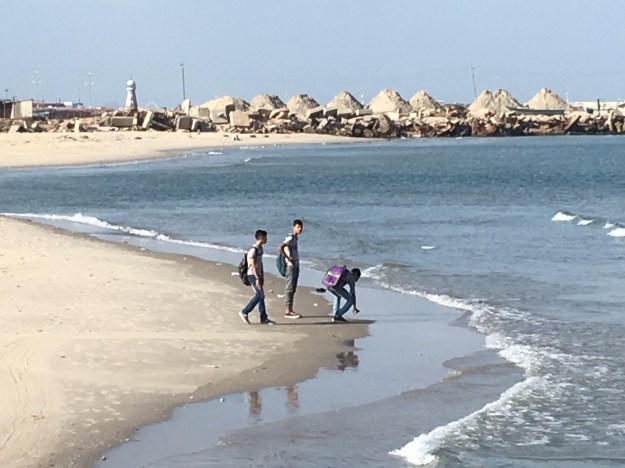
Gaza City, 10/8/17. The Bakr children were killed on this beach by Israeli military forces on 7/16/14.

I’ve been writing a great deal on this blog about Gaza for over ten years but until this past week, I haven’t had the opportunity to visit in person. I’m enormously grateful for the opportunity to experience Gaza as a real living, breathing community and I’m returning home all the more committed to the movement to free Gaza from Israel’s crushing blockade – now eleven years underway with no end in sight.

For the past ten days, I’ve been attending strategic planning meetings with staff colleagues of the American Friends Service Committee (AFSC) to sharpen our vision for our Israel/Palestine programs in the US, Israel, the West Bank and Gaza. We began with three days of meetings in Ramallah – with our Gazan staff members joining us via Skype. Following these meetings, six of us spent two days in Gaza, hosted by the two full-time members of the Gaza staff: Ali Abdel Bari and Firas Ramlawi.
FullSizeRender (3)

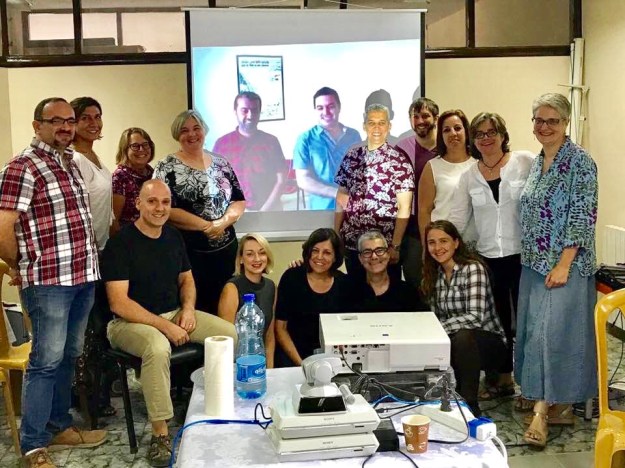
AFSC Israel/Palestine staff meeting in Ramallah (with Ali and Firas joining us from Gaza via Skype).

It’s extremely rare for Americans to receive permission from Israel to enter Gaza through the Erez Crossing. Permits are generally issued only for journalists and staff people of registered international NGOs. Though I was technically allowed to enter Gaza as an AFSC staff member, I wasn’t 100% sure it would really happen until the moment I was actually waved through the crossing by the solider at Passport Control in Erez.

Quakers have a long history in Israel/Palestine – dating back to before the founding of the state of Israel. The Ramallah Friends School for Girls was founded in 1889, and their School for Boys in 1901. The two schools subsequently merged into one; now well into the 21st century Ramallah Friends remains a important and venerable Palestinian educational institution. (The former head of the school Joyce Aljouny, was recently appointed AFSC’s General Secretary.)

AFSC has a particularly significant connection to Gaza. In 1949, immediately following Israel’s founding and the start of the Palestinian refugee crisis, the organization was asked by the UN to organize relief efforts for refugees in the Gaza Strip. Their efforts continued until the United Nations Relief Works Agency started its operations there a year later. Since that time, AFSC has retained its programmatic presence throughout the Israel and the Occupied Territories.

Up until relatively recently, AFSC’s Palestine youth program focused largely on Public Achievement, seeking to strengthen the civic ties of youth to their communities. Our current program, Palestinian Youth Together for Change (PYTC) is a more ambitious project, working to combat Palestinian geographical, social and cultural fragmentation in Israel, the West Bank and Gaza. It’s difficult to overestimate the devastating impact of this fragmentation – particularly on Palestinian youth who are growing up with increasing separation from one another. This isolation is most keenly felt of course, by the youth of Gaza who are literally imprisoned by Israel inside a small 140 square mile strip of land.

When we met the Gazan youth who participated in the PYTC program, they spoke powerfully about their experiences growing up with a strong sense of Palestinian identity while isolated from their peers in Israel and the West Bank. This particularly hit home for me when I heard one young woman speak of entering into Israel through the Erez Crossing for the first time to travel to the West Bank for meetings with her fellow participants. She was eighteen years old and had never seen an Israeli Jew in person in her life. Up until that time, she said, she had only seen them as “helicopters, planes and bombs.” Needless to say, this contrasted dramatically from the experience of her West Bank peers, who encountered Israeli soldiers as a very real, everyday presence in the streets and at checkpoints.
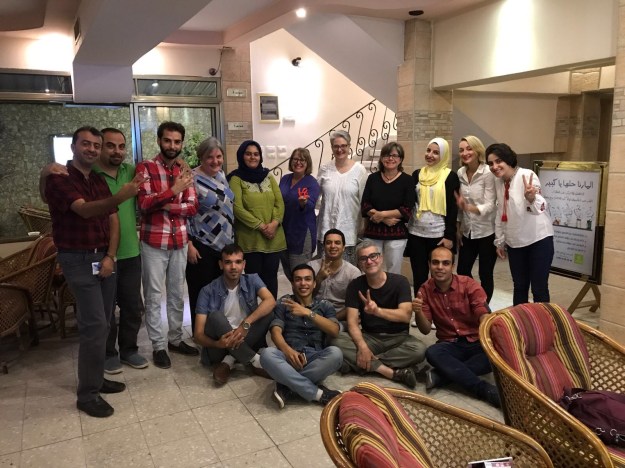
IMG_3411

With current participants of AFSC’s Palestinian Youth Together for Change program.

It’s also important to bear in mind that this isolation is not a “humanitarian” issue that can be fully addressed by greater NGO and civil society investment. Rather it is the result of very real and very intentional policies promulgated by Israel to purposefully divide and weaken Palestinian society. By the same token, the PYTC program is not a merely a youth service project – it’s ultimate goal is to strengthen Palestinian identity in order to counter the brutal and unjust occupation of their people. In this regard this program is connected in important ways to AFSC programs in the US that promote “co-resistance:” initiatives that support the Palestinian civil society call for Boycott, Divestment and Sanctions, advocate for Palestinian children held by Israel in military detention and educate the public about the devastating costs of the Gaza blockade.

There’s so much more I could write about my experiences in Gaza. As I prepare now to head back to the States, I’m struggling to give voice the myriad of emotions that are flooding through me. At the moment, I’m thinking particularly of Ali and Firas, our Gaza staff members, who were not only gracious and wonderful hosts (although they were entirely that); but also talented and visionary organizers who teach us a great deal about how to do this work effectively in the most extreme of circumstances.

Even under the brutality of Israel’s blockade, we could not help but be struck by the beauty of this place and the dignity of its people and culture (which includes, I hasten to add, the deliciousness of its cuisine). As it happened, our visit occurred immediately after the beginning of reconciliation talks between Hamas and the Palestinian Authority, brokered by the Egyptian government. Most of the Gazans we spoke to expressed a guarded sense of hope that it might result in some easement of the blockade – particularly in regards to freedom of movement, drinkable water and electrical service. Of course this optimism occurs within a constant context of isolation and vulnerability. The next Israeli military assault is altogether possible at any moment – and every Gazan must contend with this horrible reality every moment of every day.
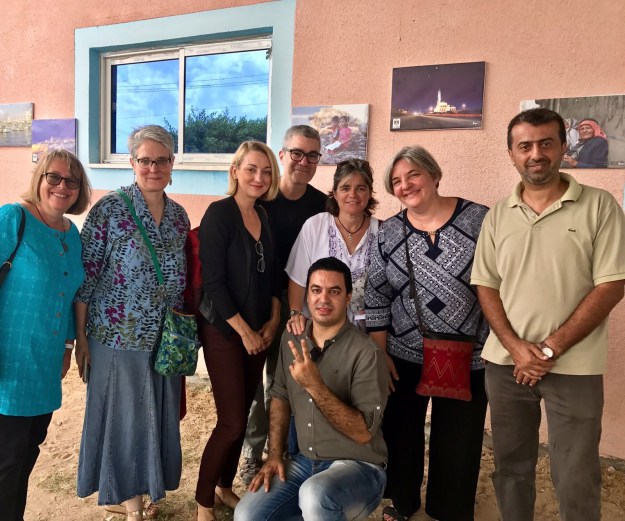
IMG_3573

Left to right: AFSC staff Jennifer Bing, Lucy Duncan, Erin Polley, Brant Rosen, Mati Gomis-Perez, Aura Kanegis and Firas Ramlawi. Kneeling: Ali Abdel Bari

I’ve posted below some additional pictures of memorable moments from our visit. My staff colleagues will be writing more about these moments and I will be sure to share their posts here. For now, I’ll end on a note of gratitude: to AFSC for giving me the opportunity to participate in this sacred work; to our gracious hosts in East Jerusalem, Ramallah and Gaza; and to my US staff colleagues who are true travel companions in more ways than one.

I took the picture at the top of this post during our final hours in Gaza. As we debriefed on a beautiful morning over coffee at a seaside cafe in Gaza City, three young boys came down to the beach to hang out and have fun together. The loveliness of the moment was both very real and very illusory. There was no mistaking the beauty of the place and people with whom we were sharing this moment. At the same time, however, we were aware that we were in the affluent tourist part of town and that we were privileged enough to soon be leaving Gaza to travel without restriction. We were also well aware that not far from the place these boys were standing, Ismail Mohammed Bakr (9), Zakaria Ahed Bakr (10), Ahed Atef Bakr (10) and Mohamed Ramez Bakr (11) were murdered by Israeli naval fire while they played soccer on the beach on July 16, 2014.

There can be no illusions where Gaza is concerned. As I leave for home, I’m more convinced than ever that we are all complicit in this cruelty – and that we are the ones who must end it.
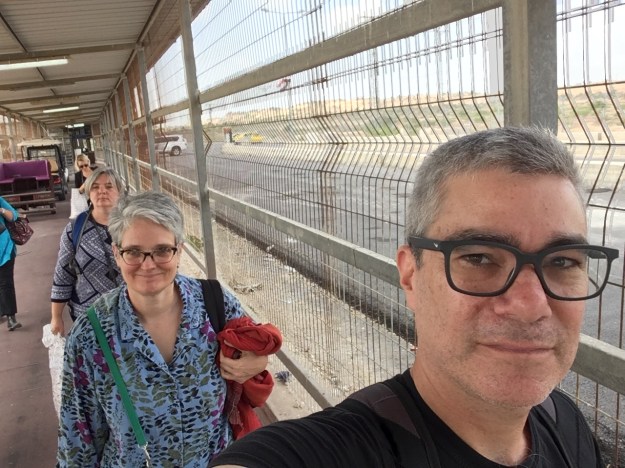
IMG_3554

The almost mile-long corridor between the Erez Crossing in Israel and the entrance into Gaza.
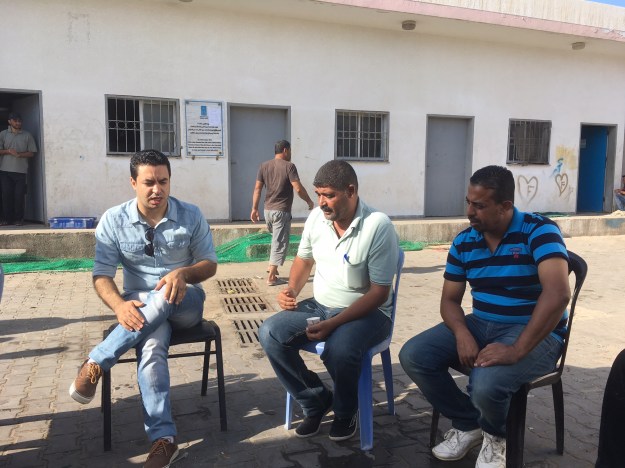
IMG_3419

Our meeting with the Gazan Fishermen’s Union. Ali translates the presentations of Zakaria Bakr – chair of the union and uncle of the murdered Bakr boys (Center), and Amjad Shrafi, President of the union (Right). Below: video from our morning excursion with Gazan fishermen:
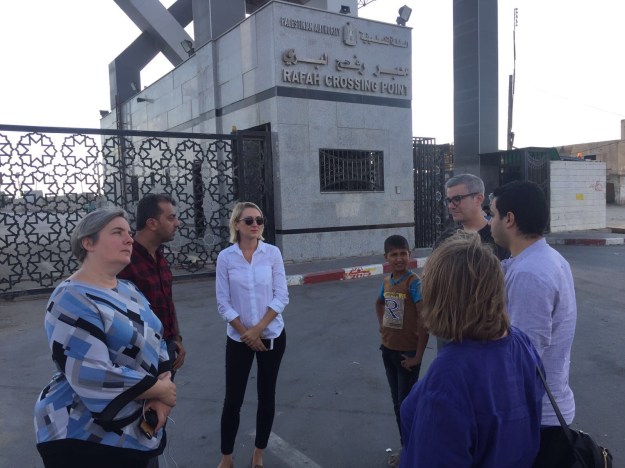
IMG_3363

At the Rafah crossing, on Gaza’s southern border with Egypt.
Rabbinical Support for the End of Unconditional Military Aid to Israel

Cross-posted with The Palestinian Talmud:

The undersigned members of the Jewish Voice for Peace Rabbinical Council stand with our American Christian colleagues in their recent call to “make U.S. military aid to Israel contingent upon its government’s compliance with applicable US laws and policies.”

We are as troubled as our Christian colleagues by the human rights violations Israel commits against Palestinian civilians, many of which involve the misuse of US – supplied weapons. It is altogether appropriate – and in fact essential – for Congress to ensure that Israel is not in violation of any US laws or policies that regulate the use of US supplied weapons.

The US Foreign Assistance Act and the US Arms Export Control Act specifically prohibit assistance to any country which engages in a consistent pattern of human rights violations and limit the use of US weapons to “internal security” or “legitimate self-defense.”  The Christian leaders’ letter points out, in fact, that the most recent 2011 State Department Country Report on Human Rights Practices covering Israel and the Occupied Territories detailed widespread Israeli human rights violations committed against Palestinian civilians, many of which involve the misuse of US – supplied weapons such as tear gas.

It is certainly not unreasonable to insist that foreign assistance be contingent on compliance with US laws and policies. Mideast analyst MJ Rosenberg has rightly pointed out that during this current economic downturn, Congress has been scrutinizing all domestic assistance programs -– including Social Security and food stamps –- to ensure that they are being carried out legally in compliance with stated US policy.  Why should US military aid to Israel be exempt from the same kind of scrutiny?

While some might feel that requiring assistance to be contingent with compliance would compromise Israel’s security, we believe the exactly the opposite is true. As Israel’s primary ally, the US alone is in a place to create the kind of leverage that might challenge Israel to turn away from policies that impede the cause of a just peace for Israelis and Palestinians –- and true security for all who live in the region.

As Jews we acknowledge that the signers of the letter, and the churches they represent, have ancient and continuing ties to the land of Israel just as we do, and that their concerns for the safety and dignity of Christians in Israel and in the occupied Palestinian territories is as compelling as our concern for the safety and dignity of Jews there.

We are troubled that several Jewish organizations have cynically attacked this faithful and sensitive call – and we are deeply dismayed that the Anti-Defamation League has gone so far as to pull out of a scheduled Jewish-Christian dialogue in protest.  We believe that actions such as these run directly counter to the spirit and mission of interfaith dialogue. True dialogue occurs not simply on the areas where both parties find agreement, but in precisely those places where there is disagreement and divergence of opinion. We call on all of our Jewish colleagues to remain at the table and engage our Christian colleagues on this painful issue that is of such deep concern to both our communities.

We express our full support for the spirit and content of this statement and likewise call upon US citizens to urge their representatives to end unconditional military aid to Israel.

Signed (list in formation):

Rabbi Brant Rosen
Rabbi Margaret Holub
Rabbi Alissa Wise
Rabbi Elizabeth Bolton
Rabbi Lynn Gottleib
Rabbi Brian Walt
Rabbi Julie Greenberg
Rabbi David Mivasair
Rabbi Joseph Berman
Cantor Michael Davis
Rabbi Shai Gluskin
Rabbi Tirzah Firestone
Jessica Rosenberg, Rabbinical Student
Ari Lev Fornari, Rabbinical Student

Volunteering + Values: What’s Motivating the Jewish Young Folk?

Repair the World, has just released “Volunteering+Values,” a report commissioned  “to understand the full extent of Jewish young adults’ volunteer habits and preferences.”  I’d say its findings/recommendations contain implications that North American Jewish communal institutions would do well to heed.

Conducted by the Cohen Center for Modern Jewish Studies at Brandeis
University and Gerstein|Agne Strategic Communications, V+V surveyed a sample of Jewish young adults between the ages of 18 and 35 and investigated their volunteer commitments and attitudes.

Among the findings I found notable:

Only a small portion of Jewish young adults prefer to or actually do volunteer with Jewish organizations … The minority of Jewish young adults who volunteer through Jewish organizations do so to support their own people and community. By contrast, the vast majority of Jewish young adults say it does not matter if they volunteer with a Jewish or non-Jewish organization.

Hand in hand with this finding, the report noted a growing universalist identity among Jewish young people:

Jewish young adults are primarily drawn to service through universal rather than Jewish-based values or identity … Only a very small portion of Jewish young adults volunteer as a means to represent the Jewish community to the larger society.

Not surprisingly to me, many Jewish young people seem to be turned off by what they perceive as the overly tribal concerns of the organized Jewish community:

Today’s Jewish young adults have grown up amidst and are at home with ethnic and religious diversity … As a result, most are concerned for all victims of poverty or injustice, not just those who are Jewish. It appears that they do not believe that Jewish organizations share this concern for universal causes.

I was particularly struck that Israel ranked consistently at the bottom of the list of priorities of young Jews. According to one graph, only 1% of those surveyed cited Israel/Middle East Peace as an “issue focus of primary volunteer work” (at the top of the list: “Material Assistance to the Needy.”) Another graph charted the geographic focus of primary volunteer work thus: 79%: Local Community, 13%: Domestic Non-Local, 4%: Developing World, 3%: Israel. (This trend is particularly noteworthy since the primary sample used by V+V was the Birthright applicant pool – a data base of 300,000 young Jews who either participated or applied for a Birthright Israel trip between 2001 and 2010.)

Among the many strategic implications identified by the study, this one resonated for me in particular:

Efforts are needed to educate Jewish young adults of the deep connection between Jewish thought and volunteering without implying that it is an exclusively Jewish perspective or only pertains to support of the Jewish community. Jewish young adults, regardless of denomination or level of religious involvement, should be encouraged to “own” a Jewish perspective on service. Widespread efforts are needed that draw attention to and link the universal and Jewish values that Jewish young adults already hold with the causes about which they care most deeply.

As always, I’d love to hear reactions.

On Haiti Remembered and Gaza Forgotten

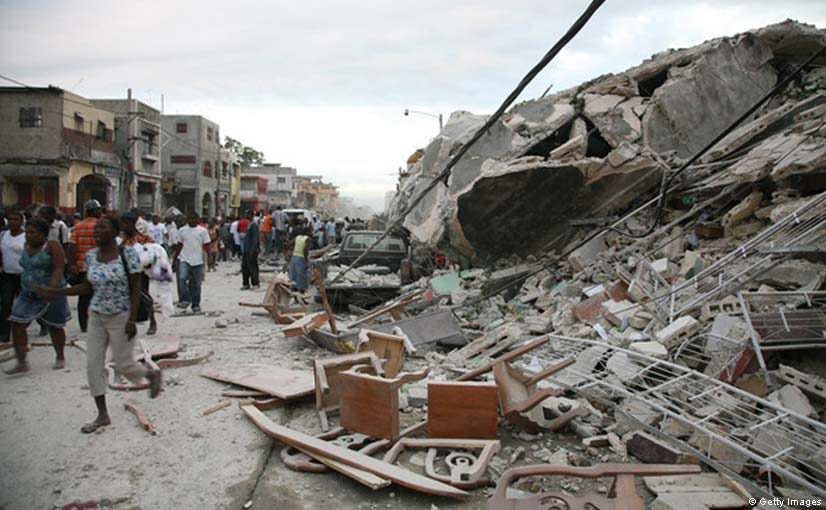
Two prominent Israeli columnists ask: why are Israelis so eager to pitch in to the rescue effort in Haiti and yet show such little concern over the dire humanitarian crisis they’ve helped to create just a few kilometers away in Gaza?

Akiva Eldar, writing in Ha’aretz

(The) remarkable identification with the victims of the terrible tragedy in distant Haiti only underscores the indifference to the ongoing suffering of the people of Gaza. Only a little more than an hour’s drive from the offices of Israel’s major newspapers, 1.5 million people have been besieged on a desert island for two and a half years. Who cares that 80 percent of the men, women and children living in such proximity to us have fallen under the poverty line? How many Israelis know that half of all Gazans are dependent on charity, that Operation Cast Lead created hundreds of amputees, that raw sewage flows from the streets into the sea?

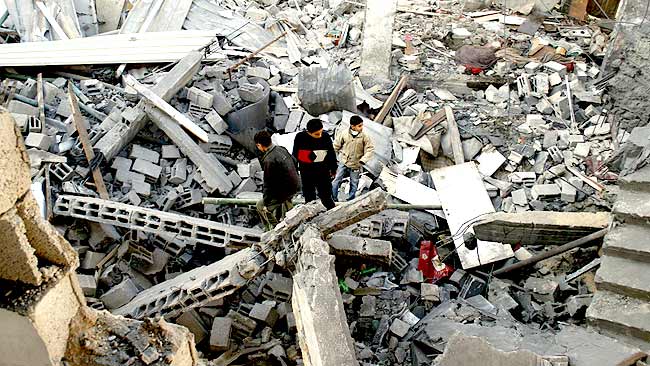
The disaster in Haiti is a natural one; the one in Gaza is the unproud handiwork of man. Our handiwork. The IDF does not send cargo planes stuffed with medicines and medical equipment to Gaza. The missiles that Israel Air Force combat aircraft fired there a year ago hit nearly 60,000 homes and factories, turning 3,500 of them into rubble. Since then, 10,000 people have been living without running water, 40,000 without electricity. Ninety-seven percent of Gaza’s factories are idle due to Israeli government restrictions on the import of raw materials for industry. Soon it will be one year since the international community pledged, at the emergency conference in Sharm el-Sheikh, to donate $4.5 billion for Gaza’s reconstruction. Israel’s ban on bringing in building materials is causing that money to lose its value.

Gershon Baskin, in today’s Jerusalem Post:

Humanitarian disasters around the world bring out the best in Israel and in Israelis. The horrific devastation caused by the earthquake in Haiti and the scenes of unbearable human suffering brought about an immediate enlistment of both civilian and public efforts to come to the aid of the poorest nation in the Western hemisphere…

But what about the humanitarian disaster in our own backyard caused in a large part by our own doing? What about Gaza? More than 1.5 million people are living in total poverty, without sanitary drinking water, under an economic and physical siege, locked in what could easily be called the world’s largest prison. While we ask to see in all of the gory details, all of the destruction including hundreds of corpses on the streets of Port-au-Prince, we wish to see none of the human suffering of our Palestinian neighbors in Gaza where we literally hold the keys to the end of their suffering.

What We Need To Do For Haiti

In the wake of the terrifyingly tragic earthquake in Haiti, it has been gratifying to see private citizens give so generously to relief efforts. At the same time however, we shouldn’t forget that our own country’s policies can have a considerable impact on Haiti’s recovery. Check out what constitutional lawyer/human rights activist/Katrina survivor Bill Quigley has to say in his piece, “Ten Things the US Can and Should Do for Haiti.”

Item #3, for example:

Give Haiti grants as help, not loans. Haiti does not need any more debt. Make sure that the relief given helps Haiti rebuild its public sector so the country can provide its own citizens with basic public services.

Gaza: A Rabbinical Exchange

GAZA_SCHOOL_One

Since we launched the Jewish Fast for Gaza, we’ve received all kinds of feedback, some supportive, some critical, some utterly unprintable. (My personal favorite from the latter category: “You should all get severe stomach ailments.”)

On occasion, however, our effort has offered us the opportunity for genuinely respectful dialogue. Below is one such exchange – an email I received from a rabbinic colleague, followed by my response:

Dear Ta’anit Tzedek,

Having cares and concerns of the plight of humanity is a most noble cause. That you are willing to extend effort is most commendable. Your organization, however, is extending its efforts in a manner which is not only counterproductive, but can be harmful as well.

How can you look into the face of a 12 year old girl from Sderot who suffers from post traumatic syndrome as for most of life she has been awakened on a nightly basis by sirens and rocket fire? What do you say to the families of victims killed by suicide bombers who killed their teenagers who were casually enjoyed a slice of pizza? What do you say to an organization whose very goal is the annihilation of our people?

You may answer, “Had we been better, they may have liked us more.” or some such configuration thereof. It’s not plausible. Since 1948, the goal of the Arab world has been the removal of a Jewish presence in the middle east. Our interference with their dream of a Pan-Arabic state stretching from Morocco to Iraq is sullied by our very presence.

It would better for your organization to spend is resources on ideals that truly further the continuity of Jews and Judaism.

I await your response,

Rabbi X

Dear Rabbi X,

I want to thank you for taking the time to reach out and respond to our initiative. I’m glad to have the opportunity for this dialogue.

You ask what I would say to the 12 year old girl from Sderot or the families of terror victims. I believe I would say that as a fellow Jew that their pain is my pain as well. I would say that I could not begin to comprehend the realities they must face. But I would also share my belief that that Israel’s current treatment of the people of Gaza will bring them neither safety nor security – and that the only true way out of these traumas is a lifting of the blockade and the negotiation of a settlement by all parties involved.

As regards Hamas “whose very goal is the annihilation of our people:” though I have no love lost for Hamas, the reality is that Israel will have to deal with them if any true peace will be achieved. And in truth, Israel has already dealt with Hamas through any number of channels over the years already. Making peace is a sacrosanct Jewish value – and as difficult as it is, the truth is that we make peace with our enemies. In the past, Israel has made peace with former enemies whom we once believed sought nothing but our “annihilation.” To surrender this value means to doom the people of this region to endless violence and tragedy.

Thus we do indeed believe that this effort furthers the resources of Jews and Judaism. We do not hold that the only Jewish path is the one that addresses Jews and Jewish “needs” alone. In the case of Jews and Palestinians in particular, our fates are fundamentally intertwined: we will either live together or else we will die together. The Jewish path has always been to choose life – this sacred imperative is at the core of our initiative.

Thank you again for sharing your thoughts with us. Even as we may disagree, I hope you will share my conviction that our conversation is a “machloket l’shem shamayim” (“argument for the sake of heaven.”)  I also know that you join with me in prayers for peace for this tortured region that is so dear to both of us.

Kol Tuv,

Rabbi Brant Rosen

Jewish Fast for Gaza

gazapic

In response to the dire humanitarian crisis in Gaza, my dear friend and colleague Rabbi Brian Walt and I have organized a new initiative, Ta’anit Tzedek – Jewish Fast for Gaza.

See below for the press release about the project, which is already attracting increasing numbers of supporters, including many rabbis. Click the link above to visit the website and sign up yourself…

RABBIS  ANNOUNCE MONTHLY FAST FOR GAZA

Seeking “to end the Jewish community’s silence over Israel’s collective punishment in Gaza,”  an ad-hoc group of American rabbis has called for a communal fast.  Known as Ta’anit Tzedek – Jewish Fast for Gaza, this new initiative will organize a series of monthly fasts beginning on July 16.

The project was initiated by a group of thirteen rabbis representing a spectrum of American Jewish denominations. The group’s website explains the religious meaning of the campaign: “In Jewish tradition a communal fast is held in times of crisis both as an expression of mourning and a call to repentance. In this spirit, Ta’anit Tzedek – Jewish Fast for Gaza is a collective act of conscience initiated by an ad hoc group of rabbis, Jews, people of faith, and all concerned with (this) ongoing crisis…”

The fast has four goals: to call for a lifting of the blockade, to provide humanitarian and developmental aid to the people of Gaza, to call upon Israel, the US, and the international community to engage in negotiations with Hamas in order to end the blockade, and to encourage the American government to “vigorously engage both Israelis and Palestinians toward a just and peaceful settlement of the conflict.”

The water-only fast will take place every third Thursday of the month, from sunrise to sunset. In addition to signing on to the fast statement, participants have been asked to donate the money they save on food to the Milk for Preschoolers Campaign sponsored by American Near Eastern Refugee Aid, a relief campaign that combats malnutrition among Gazan preschool children.

Since the electoral victory of Hamas in January 2006, Israel has imposed a blockade that has severely restricted Gaza’s ability to import food, fuel and other essential materials. As a result, the Gazan economy has completely collapsed and it suffers from high levels of unemployment and poverty and rising levels of childhood malnutrition.

“Israel’s treatment of the Palestinian people in Gaza amounts to nothing less than collective punishment. While we condemn Hamas’ targeting of Israeli civilians, it is immoral to punish an entire population for the actions of a few,” said Rabbi Brant Rosen, who serves Jewish Reconstructionist Congregation in Evanston, IL. “This blockade has only served to further oppress an already thoroughly oppressed people.  As Jews and as human beings of conscience, we cannot stand idly by.”

“We’ve been enormously encouraged by the initial response we’ve received from the Jewish community thus far,” said fast organizer Rabbi Brian Walt, former Executive Director of Rabbis for Human Rights – North America, who noted that the initiative has signed up numerous supporters prior to the launch of the project. “We truly believe this effort is giving voice to a significant number of people who been looking for a Jewish voice of conscience on this issue.”

Rescue the Spirit of Humanity

CYPRUS-MIDEAST-CONFLICT-GAZA-AID-BOAT

The humanitarian situation in Gaza has grown beyond intolerable.  If you have any doubts, just read this devastatingly important article by Sara Roy, senior research scholar at Harvard’s  Center for Middle Eastern Studies:

Today, 96 percent of Gaza’s population of 1.4 million is dependent on humanitarian aid for basic needs. According to the World Food Programme, the Gaza Strip requires a minimum of 400 trucks of food every day just to meet the basic nutritional needs of the population. Yet, despite a 22 March decision by the Israeli cabinet to lift all restrictions on foodstuffs entering Gaza, only 653 trucks of food and other supplies were allowed entry during the week of May 10, at best meeting 23 percent of required need.

Israel now allows only 30 to 40 commercial items to enter Gaza compared to 4,000 approved products prior to June 2006. According to the Israeli journalist, Amira Hass, Gazans still are denied many commodities (a policy in effect long before the December assault): Building materials (including wood for windows and doors), electrical appliances (such as refrigerators and washing machines), spare parts for cars and machines, fabrics, threads, needles, candles, matches, mattresses, sheets, blankets, cutlery, crockery, cups, glasses, musical instruments, books, tea, coffee, sausages, semolina, chocolate, sesame seeds, nuts, milk products in large packages, most baking products, light bulbs, crayons, clothing, and shoes.

What possible benefit can be derived from an increasingly impoverished, unhealthy, densely crowded, and furious Gaza alongside Israel? Gaza’s terrible injustice not only threatens Israeli and regional security, but it undermines America’s credibility, alienating our claim to democratic practice and the rule of law.

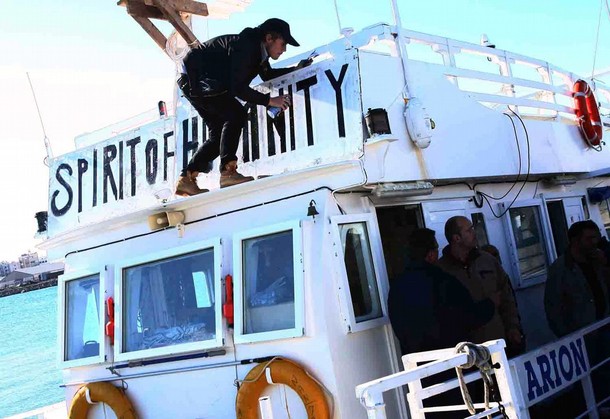
And now the news has just come in that Israel has seized the “Spirit of Humanity,” a boat carrying a cargo of humanitarian aid in international waters, and  is  forcibly towing it to an Israeli port.  The boat contained 21 human rights workers from 11 countries, including Nobel Peace Prize laureate Mairead Corrigan Maguire and former U.S. Congresswoman Cynthia McKinney. It was bringing medicine, toys, and other much needed humanitarian relief.

If you’re looking for a way to channel your upset over this dire situation into effective contribution to Gaza relief, I particularly recommmend American Near East Refugee Aid.  Their projects in Gaza include:

– Delivery of  life-saving pharmaceuticals and medical supplies to hospitals and clinics;

– Distribution of  fortified milk and high-energy biscuits to 25,200 children in 186 preschools.

– Water projects that bring water networks to families in need and pumping systems to keep raw sewage off the streets.

– A psychosocial program that helps thousands of children and parents struggling to survive the effects of war.

– Cash-for-work programs that employ workers to clear agricultural land of plastic waste and provide 200 families a means of self-reliance.