Category Archives: Islam

Shabbat with a Shi’ite Cleric

IMG_0689
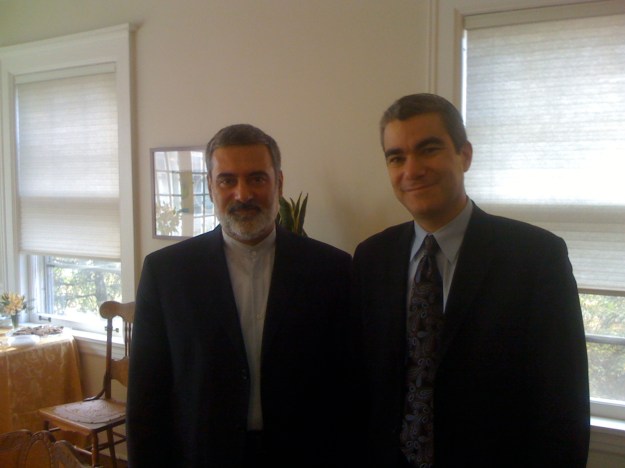
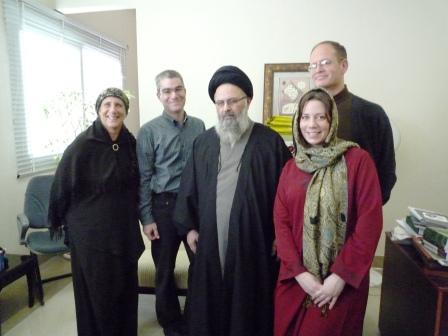
I spent a remarkable Shabbat lunch yesterday at the home of JRC members Mark and Margie Zivin, where I had the opportunity to meet and talk with prominent Iranian cleric, Dr. Mohsen Kadivar.  Those who assume all Iranian Shi’ite clergy are fundamentalist totalitarians would do well to learn about figures such as Dr. Kadivar, who is both a respected Muslim scholar and a vocal proponent for religious and political reform in his home country.

Among other things, Dr. Kadivar is well-known for his important three-volume treatise in which he sets forth a religious argument for the creation of an Iranian state based on the values of human rights, freedom and democracy.  He also has the dubious honor of having been jailed twice for his activism: once by the Shah and once by the Islamic regime.

During the latter imprisonment, he spent 18 months in Iran’s notorious Evin prison, where he repeatedly rejected offers of clemency if he renounced his religious ideas.  Political pressure has led Dr. Kadivar to leave his post at the Iranian Institute of Philosophy. He is currently serving as a visiting professor of Religious Studies at Duke University.

Our lunch conversation ran the gamut from political discussions of the current nuclear standoff, to human rights, to the political realities in Iran post-election.   For me, however, the most fascinating element of our discussion came when  Dr. Kadivar expressed his religious views.

Indeed, his dissent is notable because it is essentially spiritual rather than political. At the core of his critique is a challenge to the concept of velayat-e faqih, the religious rationale that was used by the Ayatollah Khomeini to grant absolute power to a Supreme Leader:

Kadivar argues that because the concept was conceived by clerics rather than by Allah, it cannot be considered sacred or infallible. And if clerics have no God-given right to rule, he says, that means that Muslims may freely select their government in a democratic Islamic republic. Kadivar has also formulated a theory on why terrorism is forbidden in Islam—an indirect reproach to an Iranian regime that is widely accused of backing terrorist groups (from Time Magazine, 2004.)

I find the notion of religious reform in Iran to be immensely exciting and I am eager to learn more. In the meantime, our conversation provided yet one more reminder for me that it is enormously important for us – as Americans and as Jews – to make the effort to understand the rich complexities of Iranian society. I am more convinced than ever that the most important way we can engage with Iran is by reaching out to and supporting of courageous individuals such as Dr. Kadivar.

Green Mosque, Green Shul

Here’s a nice piece that ran on Chicago’s ABC affiliate last January: a feature on JRC’s green building as well as a local mosque that incorporated energy-saving features into their recent renovation. Especially nice that they highlighted two “Abrahamic environmental efforts.”  (One snarky correction: it’s Jewish Reconstructionist Congregation, not Center).

Home From Iran, Final Thoughts

brant-ayatollah1During our final night in Iran, I was interviewed at length by two reporters from a Tehran newspaper. I mentioned to them that during my High Holiday sermon to my congregation, I noted that Americans (and especially American Jews) chronically misunderstand Iran. I told the reporters that ironically enough, I learned on this trip that I really hadn’t understood Iran nearly as well as I had thought myself.

The most essential thing I’ve learned is in some ways the most basic: Iran is a beautiful country with a venerable history and wonderful, gracious people. It is also a powerfully complicated country, marked by a myriad of cultural/political/religious/historical layers.  I am now more convinced than ever that we in the West harbor egregiously stereotypical assumptions about this country – and that we harbor them at our mutual peril.

p1000270

We spoke to many Iranian citizens during this trip and probably the most common comment we heard was that they had no problems with Americans – and that the real problem lay with our respective governments. (On more than one occasion, I heard this said in regard to Israel as well.)  While I realize that statements like these probably reflect characteristically Iranian t’aarof, (“graciousness”), I don’t underestimate their abiding truth. I do believe that we ultimately have more in common than not. I do believe that our respective governments continually misunderstand and misuse one another.  And I do believe that true communication and reconciliation between our two nations is not only possible, but utterly essential.

The challenge of communication was driven home to us over and over during the course of our formal meetings and dialogues. It became fairly clear to us fairly soon that even with direct face to face conversation, even with decent interpreters, miscommunication was virtually inevitable. And though these kinds of miscues might have seemed to us to be fairly benign at the time, we came to appreciate that even subtle misunderstandings had important implications.

More often than not, these barriers were due to cultural differences where words/idioms could not be simply translated literally in a single rendering.  And I can’t help but believe that many of the more ominous assumptions we hold about Iran and Iranians are due less to substance than to cultural misunderstanding. While I prefer not to weigh in on the rhetorical hairsplitting debate on Ahmadinejad’s notorious 2005 “threat” to “wipe Israel off the map,” I’ll only suggest that our attitudes (not to mention our foreign policy) must be based on real intelligence and understanding, and not fear-based, knee-jerk assumptions.

p10002564

None of this is to sugar-coat the more disturbing aspects of the Islamic Republic. If our delegation was ever tempted to do so, we received a hard dose of reality when we read in the Tehran Times about a public hanging of two men convicted of bombing a mosque that was scheduled to take place in Shiraz shortly after we were there. Yes, we are justified in recoiling from reports such as these – and we’d be foolish to deny that there are troubling human rights issues that Iran would do well to address. But at the end of the day, the solutions to these problems are certainly not ours to impose.

As a matter of fact, the Iranian human rights community has been confronting these issues for some time. And it is worth noting that their fight for peace and justice serves as a challenge to us as well. On the final night of our stay in Iran several women from our delegation met with members of Iranian Mothers for Peace, an anti-war NGO founded by courageous women, many of whom  have done time in Iranian prisons for speaking out against the injustices of the  Islamic Republic. But they have also gone on record against the US war in Iraq and in particular against a potential US attack on Iran.

From one of their public letters:

To all peace-loving mothers of America,

We are addressing you from the Middle East. Our motherly instincts compel us to share a common pain with those of you whose children are fighting in the Iraq war. Iranian Mothers for Peace is an independent organization that was established in October 2007 to object the war and warmongers both in Iran and the United States of America. We are diverse in terms of ethnicity, religion, and ideology. Iranian Mothers for Peace opposes war, human rights abuses, injustice, and poverty…

The wars in Iraq and Afghanistan are costing each American family $25,000 a year during a time in which the United States is in an economic crisis, with many citizens still lacking health care and economic stability.  Once again American Government officials are singing the ominous song of war – this time against Iran. It is unjust for our children to be killed and murdered while the weapons manufacturers and oil monopolies collect blood money.

Therefore, we are asking all of you peace-loving American mothers to oppose the war and those who are inciting the war in order to prevent this mistake from happening again. Please do not let our children draw weapons against each other. Please do not allow the decision makers to force Iranian, American, Iraqi, and Afghani mothers to suffer from pain and heartbreak for their children forced into fighting unjust wars.

As I read these words, I’m reminded of the many remarkable, inspired individuals we met on our journey:  Dr. Raffi, committed to serving a Jewish community that makes its home in an Islamic Republic; Habib, who seeks peace by bearing witness through his art; Dr. Rasoulipour, who devotes his life to religious understanding and tolerance, but to name a few.

So in the end I find myself returning to the subject of understanding – a concept that seems to be in such painfully short supply these days. If anything, I believe our trip highlighted for us the critical need for mutual understanding. Such a simple thing, yet somehow still so tragically elusive in our world.

There’s so much more to say, and perhaps I’ll have the opportunity to say it somehow down the line. For now, these are the impressions that will live with me forever: a beautiful country with an exquisite heritage. A gracious, poetic people who showed us the true meaning of honor and hospitality. And perhaps the most important: a reminder, despite all reports to the contrary, of our common humanity.

I can only hope that our experience can, in its small way, help bring this blessing to a world that needs it now more than ever. Inshallah…p1000128

Farewell to Esfahan

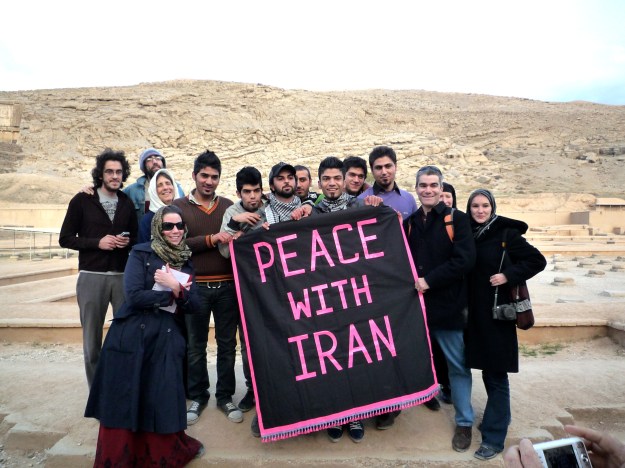
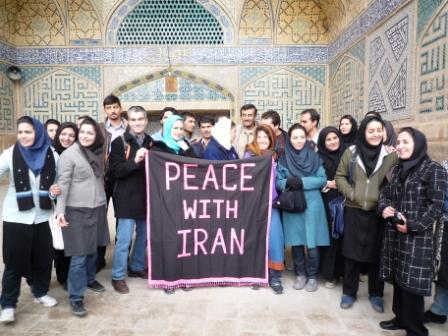
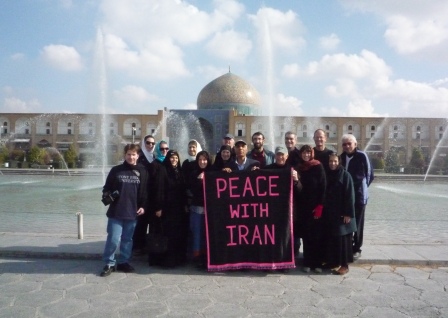
iran6peace
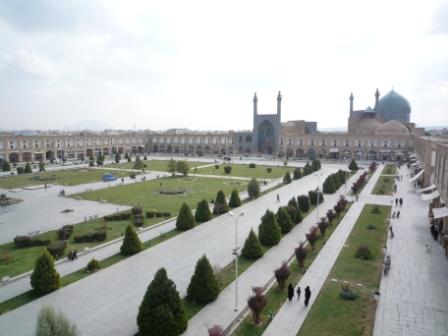
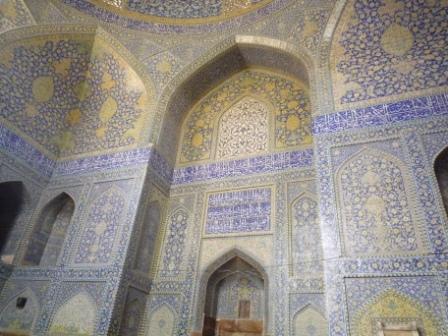
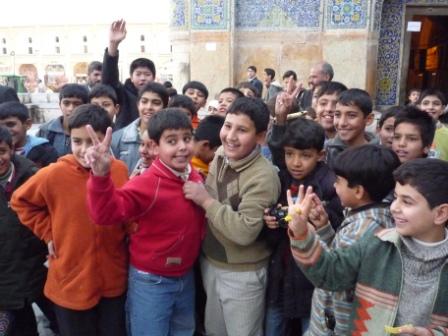
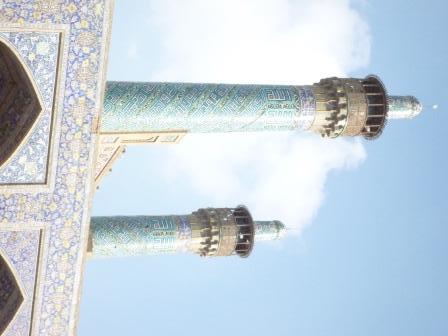
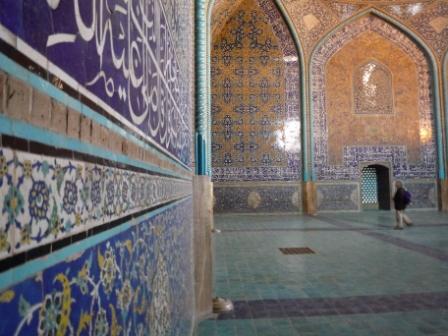
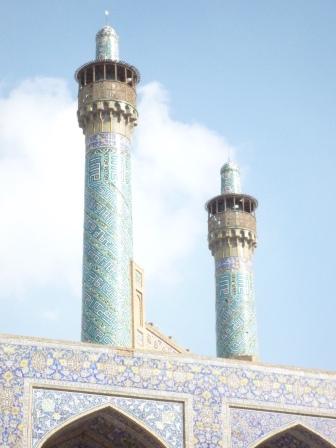
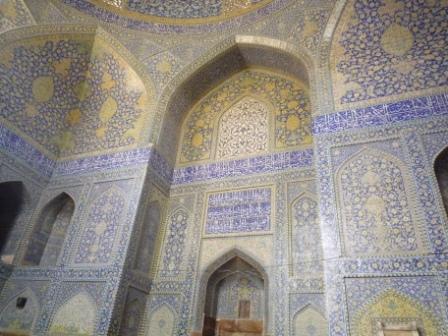
We’ve spent the last two days in Esfahan and we’re leaving for Shiraz early tomrrow morning. There is much to say about our stay in this gorgeous historic city – most of our time has been spent touring exquite 17th century mosques, hiking about massive, majestic Imam Square which stretches out for more than 80,000 square meters and is one of the largest city squares in the world. Have also been speaking extensively with the locals. All of the above has been richly and profoundly rewarding.

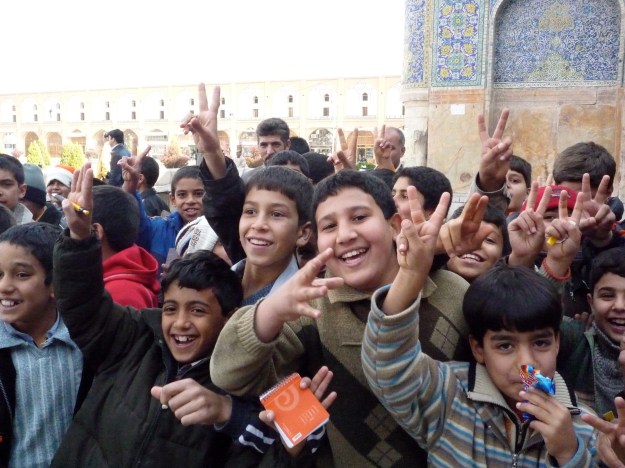
For this one, I’ll just let the pictures do the talking…

iran6-006

iran6-005

iran6

iran6-004

iran6-007

Dialogue in Qom

iran5-0021

We’re in Esfahan now (unquestionably one of the most stunning cities I’ve ever visited) but I want to tell you first about our day yesterday, which we spent at Mofid University in the city of Qom.

Qom is considered a holy city for Shia Islam and is the largest center for Shia scholarship in the world. In addition to traditional Islam, most of the seminaries also offer courses in social sciences, Western thought and comparative religion. Mofid is considered one of the more liberal universities in Qom and is notable in particular for its interfaith research.

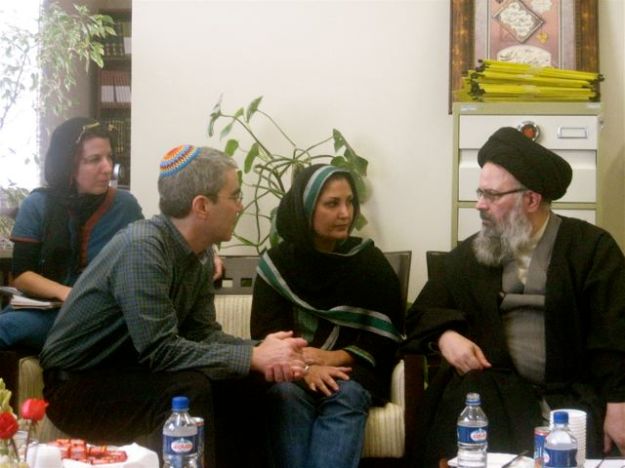
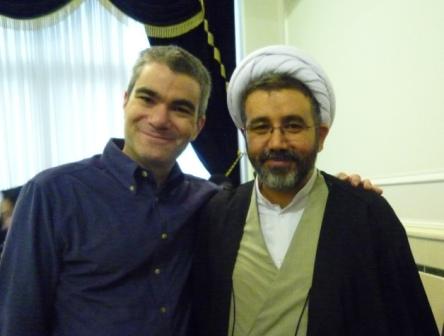
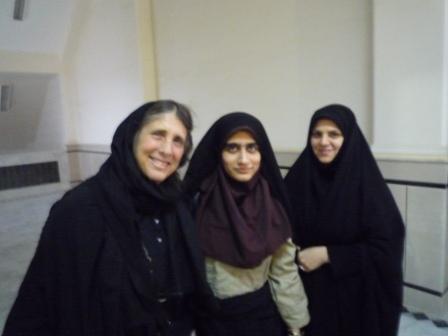
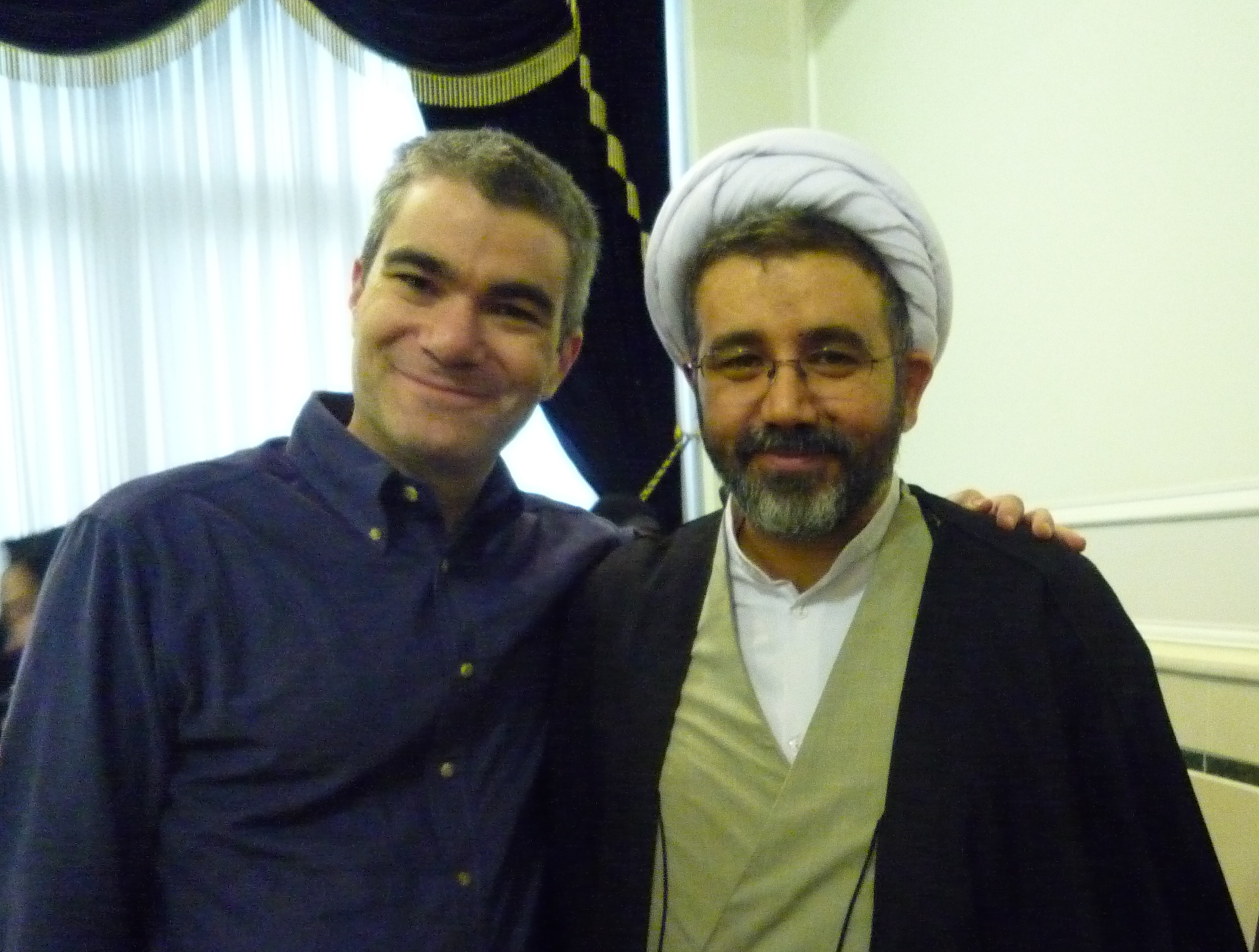
We spent the better part of the day at Mofid, visiting and dialoguing with professors and students. Any preconceptions we may have had about an Islamic university in Iran went out of the window almost immediately. We introduced ourselves to our host and the professors introduced themselves to us – they included scholars who were versed in a remarkable variety of subjects including Jewish law, contemporary feminism and Western philosophy. That’s me above with Dr. Masoud Adib, who among other things has translated a book by Dr. Jacob Neusner (a prominent American Jewish scholar) into Farsi. In the pic below Rabbi Lynn (left) poses with Fatima (center) a graduate student who is currently studying Rashi’s commentary on the Torah and has translated the Book of Mormon into Farsi. On the right is Haydeh Rostam Abadi, who works with the Center for Interreligious Dialogue and has been traveling with us for the past few days. Her research, among other things, focuses on a comparison of the Catholic and Islamic concepts of revelation.

iran5-003

Our discussion took the better part of two hours. The professors discussed their study of the relationsip between Islam and the other religious traditions and their research in the fields of comparative religious philosophy and law. The theological validity and spiritual worth of all Abrahamic religions was a common and recurring theme . Members of our group also spoke about Jewish and Christian attitudes toward Islam. Our discussion was relatively brief in the scheme of things, but it was enough to give us all the sense that these Islamic scholars were deeply engaged in a wide spectrum of religious and philosophical ideas and that they had an abiding desire to meet and learn from others.

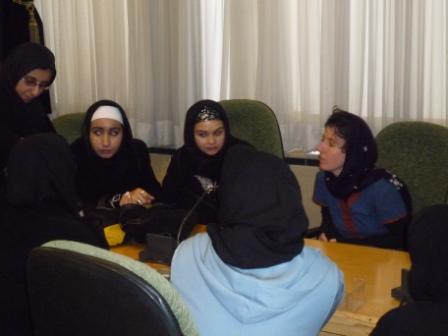
After our meeting we shared lunch with teachers and students and continued our conversation in a more informal manner. This was followed by a longer conversation with the thoughtful and enthusiastic students of Mofid. In the pic below, one of our younger delegation members, Ariel Vegosen (right) is chatting up a group of young students.

iran5-001

What can I say? Another day for smashing assumptions and preconceived notions to smithereens. I’m off to sleep now, but I’ll come back soon and tell you about our first day in ravishing Esfahan…

The Ayatollah and the Archbishop

iran3-001

Our first full day in Iran was devoted largely to religious destinations – our first stop was a visit to the office of Ayatollah Bojnoordi, a prominent religious leader who teaches Islamic law at Tehran and Qom Universities.

Ayatollahs are clerics of the highest order in Shia Islamic communities and they exercise enormous authority over their respective flocks. They are educated in seminaries, the most prominent of which are located in Najaf, Iraq and Qom, Iran (we will be traveling to Qom on Monday). Ayatollahs are awarded their titles after attending many years of rigorous training, which include such subjects on theology, jurisprudence, literature, as well as grounding in Western as well as Islamic philosophy. The status of an Ayatollah depends largely upon his scholarship and publication as well as the breadth of his patronage over his congregation. In Iran, of course, Ayatollahs can be political as well as religious leaders. Though the country is governed by a parliamentary democracy, no political decisions can be made without the ultimate approval of Iran’s Supreme Council of Ayatollahs and the Iran’s Supreme Leader, the Ayatollah Khameini.

Like all of our Iranian hosts, Ayatollah Bojnoordi received us with the requisite Persian hospitality. (At every meeting we attend, we are invariably served with a generous spread of cakes, fruit, coffee, tea, juice etc.) He spoke to us for the better part of an hour, with Leila serving as interpreter. His message was largely one of religious tolerance and reconciliation: he said emphatically that he believes Islam teaches all Abrahamic religions ultimately have the same aim: to promote peace and coexistence. Quoting the Koran, he said that peace is the ultimate goodness and war is the ultimate evil. (Interestingly, he also cited Hobbes’ assertion that war represents the animal aspect of humanity). He condemned all who used violence to achieve their aims – adding that all Muslims who act violently act counter to the way of Islam.

The Ayatollah also did not flinch from addressing politics head on. He underlined Imam Khomeini’s statement that Iran is a peaceful nation that doesn’t want war with anyone. He mentioned that in the past two hundred years, Iran has never invaded another country. The eight year war with Iraq, he said, was a defensive war against a country that aggressively sought to seize Iranian territory. He made a point of saying that Iran is surrounded directly by fourteen countries and it must constantly be on its guard, especially against the US, who has a significant military presence in the region and has made periodic threats to invade their country. He made no bones about his loathing of George Bush in this regard and he expressed his hope that our new President will pursue a path of peace.

After we spoke, our group peppered him with questions, most of which he answered with what I believed was genuine thoughtfulness. While I agreed with much of what he said, I was eager to engage him more on the political front – and since he was so candid in opening the door on political issues, I decided to press him a bit. He had mentioned earlier that he thought Hezbollah was a force for good and unity in Lebanon. I asked him, given his condemnation of the use of violence, what he thought about Hezbollah’s claim of responsibility for numerous suicide bombing attacks.

To my surprise, he thanked me for my question. He responded that he believed these bombings were wrong and that he condemned them. But he added that since Hassan Nasrallah has assumed leadership of Hezbollah he believed the organization was making important strides in changing their approach and that he hoped/expected them to convert from a primarily military force to a political party.

In the end, I realized that as much as our trip is focused on interfaith dialogue, you can never completely divorce religion from politics, especially in a nation such as Iran (which is, after all, governed by clerics). As regards this particular conversation, I can only say that while I didn’t always agree with his political assertions, I never once felt that he was speaking to us in a disingenuous or cynical way. I saw something authentic about the way in which he received us and I did indeed believe him when he told us finally, that everything he said to us came from the bottom of his own heart.

For our part, we must constantly bear in mind that we have not come here to debate or coerce. The goal of our delegation is to learn, to share, and to create connections within what is currently a terribly poisoned atmosphere between our two countries. And at the end of the day, I genuinely believe that meetings such as this, in a small but critical way, contribute to that goal.
iran3-002

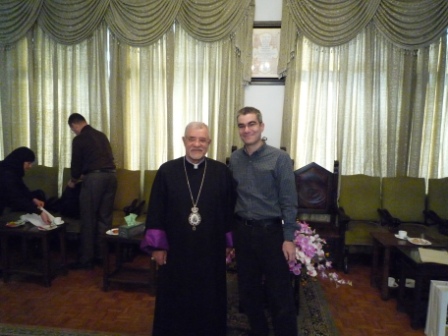
Our next stop was a visit with the Armenian Archbishop Sebouh Sarkissian at the Armenian Apostolic and Orthodox Church. Christianity, like Judaism, is an officially recognized religion in Iran and the Archbishop stressed to us that there have been Armenians in Persia even before the era of Jesus. Among other things, he stressed to us that the Islamic Republic is a religiously tolerant nation, and whatever difficulties there might be to live as a Christian in a Muslim nation, they were far outweighed by the benefits. (I am eager to explore the role of religious minorities in Iran further when we visit Jewish communal leaders on Sunday.

Like the Ayatollah, Archbishop Sarkissian addressed politics unabashedly, and he made no bones about his disgust that the US and Israeli governments refuse to officially recognize the Armenian genocide. But also like the Ayatollah, he espoused a tolerant and universal religious world view. I was especially taken by one comment: when asked of his opinion of evangelism, he emphatically rejected religious coercion, stating that in his view, “dialogue is a new kind of evangelism.”

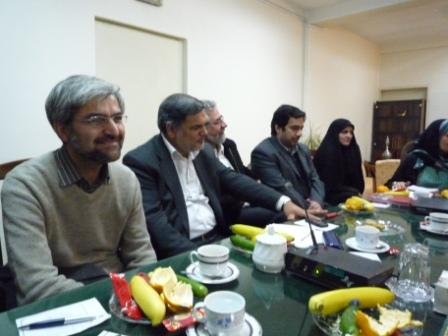
Our final visit of the day was with our hosts at the Center for Interreligious Dialogue. The Center is technically affiliated with the Iranian government (through the Department of Education and Research) but it operates in a sphere that ranges far beyond the government, conducting academic research and dialogue with a wide spectrum of faiths. The Center’s Director, Dr. Rasoul Rasoulipour, is a Professor of Philosophy and is clearly committed to religion as a force for uniting peoples. He also been the guiding presence for these eight FOR delegations from the Iranian side and his commitment to the power of dialogue and relationship is immediately obvious. We were all immediately taken by his warmth and humor, even as exhausted as we were by our first full day in Iran.
iran3-004

(Top pic: Rabbi Lynn Gottlieb, me, Ayatollah Bojnoordi, (HUC Rabbinical Student) Sarah Bassin, Brother Clark Berge (Franciscan); middle pic: me with Archbishop Sarkissian; Bottom pic: leadership of the Center for Interreligious Dialogue, Dr. Rasoulipour is on far left)