On November 2 I had the pleasure to engage in a public conversation with journalist/author Peter Beinart in a program co-sponsored by Jewish Currents and my congregation Tzedek Chicago, We explored a wide range of issues arising from the current moral-political moment in Israel Palestine.
I was particularly grateful to interrogate the issues raised by Peter in his recent book “Being Jewish After the Destruction of Gaza: A Reckoning:”
• Is the Jewish community currently facing an unbridgeable ethical divide?
• Is it possible to make community with Jews whom we believe support – or remain silent over – the genocide of Palestinian people in Gaza?
• Does Peter identify as a Zionist now? What is his opinion of the growing movement for antizionist Judaism?
I appreciated Peter’s honesty and willingness to engage over these issues – and many others. The entire program is available on the video recording above.
As if there wasn’t enough drama over the candidacy of Zohran Mamdani in New York City’s mayoral race, last week saw the release of “A Rabbinic Call to Action: Defending the Jewish Future,” a statement from an ad hoc group calling itself “The Jewish Majority,” condemning Mamdani for voicing political convictions that “delegitimize the Jewish community and encourage and exacerbate hostility toward Judaism and Jews.” By the end of the week, the call had garnered over 1,000 signatures from rabbis, cantors and rabbinical students from NYC and around the US.
Notably, the statement only mentions Mamdani once. The rest of the six-paragraph letter is devoted to defending the state of “Israel’s right to exist in peace and security” and promoting Zionism as central to Judaism and Jewish identity. It’s centerpiece is a long and pointed quote from a recent sermon by Rabbi Elliot Cosgrove of Park Avenue Synagogue, in which he warned that Mamdani “poses a danger to the New York Jewish community”:
Zionism, Israel, Jewish self-determination—these are not political preferences or partisan talking points. They are constituent building blocks and inseparable strands of my Jewish identity. To accept me as a Jew but to ask me to check my concern for the people and state of Israel at the door is a nonsensical proposition and an offensive one, no different than asking me to reject God, Torah, mitzvot, or any other pillar of my faith.
Given the timing of the letter, “The Jewish Majority” statement is clearly an effort to stem Mamdani’s surging lead – and his popularity with young leftist Jews in NYC. But on a deeper level, the fundamental goal of the letter is made all-too plain: it seeks to combat the growing “political normalization of anti-Zionism.”
From what I can tell, Mamdani has never explicitly referred to himself as an “anti-Zionist.” What he has said, over and over again in response to the incessant gotcha question “does Israel have the right to exist as a Jewish state?” is that he “believes Israel has the right to exist as a state with equal rights.” Of course, the words “a state with equal rights” is enough to make him an anti-Zionist – because the only way Israel can exist as a Jewish state is by denying equal rights to Palestinians.
For me, this is the real significance of this statement – it shines a hard light on the deep moral hypocrisy of a Jewish communal establishment that is threatened by anti-Zionism: a political position that is rooted in human rights and equal rights for all. Indeed, if you listen to Mamdani’s words carefully, he takes pains to point this out: he refers to Israel’s actions in Gaza as a genocide because he agrees with the opinions of international bodies such as ICJ as well as scores of otherhuman rightsobservers. He openly says he would not welcome Netanyahu in NYC because the ICC has put a warrant out for his arrest as a war criminal.
These are not hateful or inciteful positions. What is remarkable – and galling to the Jewish communal establishment – is that Mamdani is not paying a political price for expressing them. Quite the contrary: he is the one who comes off as eminently principled and reasonable, while apoplectic Jewish leaders are having an increasingly difficult time explaining why a genocidal, apartheid nation-state is a “building block” of their Jewish identity. True to form, this clergy group is simply trotting out familiar talking points, fully expecting their morality and veracity to be self-evident.
Contrary to the claims of the statement’s signers, the increasing normalization of anti-Zionism does not “delegitimize Jewish identity and community.” As the rabbi of an openly anti-Zionist Jewish congregation, I can attest that increasing numbers of Jews are identifying as such out of genuine Jewish conscience: from a deep attachment to Jewish ethical values that mandate the pursuit of justice and hold that all human beings are equally created in the divine image.
Recent surveys certainly bear this out: according to an October 2025 Washington Post poll, of American Jews, 61% believe Israel has committed war crimes and 4 out of 10 say the country is guilty of genocide against the Palestinians, views that would certainly track with an anti-Zionist identity. As Jewish Currents editor-in-chief Arielle Angel has observed, “the catastrophic failure of Zionist Judaism” has marked “an opening for anti-Zionist Jews to step into greater influence, (to) make our case for something new.” By all accounts, the time has come for a Judaism that rejects the fusion of toxic ethno-nationalism with Judaism.
I’m also struck by another note of desperation from this ad-hoc group of Jewish clergy: they purport to speak for the Jewish majority as if that alone confers legitimacy. They of all people should know dissent is a sacred, cherished aspect of Jewish tradition. They of all people should know that in Talmudic debate, both majority and minority views are given equal weight and consideration. They of all people should know of the Torah’s sacred injunction “Do not go after the majority to do evil” (Exodus 23:2). And any student of history, Jewish or not, should know that the majority is not always right, whether it be the majority of Southern Whites who supported slavery and Jim Crow in the US, apartheid in South Africa or the injustices of Zionism today.
The real moral question here, it seems to me, is not “who is in the majority?” but rather “who is on the right side of history?”
This Yom Kippur, amazingly, is Tzedek Chicago’s tenth Yom Kippur. And since Yom Kippur is a day for taking stock of the year that’s past, I want to to share some thoughts about our congregation’s first ten: to explore our history, our growth and perhaps most importantly, to offer some thoughts about what has changed in the Jewish world since Tzedek Chicago first began.
This will be a significant sermon for me for a number of reasons, so let’s just get it out of the way at the outset: this is not my goodbye. It may be my final sermon at Tzedek Chicago, but the year is young. There will be time for goodbyes later – but for now, please know I’m not going anywhere just yet. And there is so much work to be done in the coming year.
When I think back over the first ten years at Tzedek Chicago, I can clearly see critical milestones that fundamentally and irrevocably shaped our congregation. Like most things in life, the majority of these milestones were wholly unexpected. And yet they ended up being transformative.
How we began is a classic example. Just to give some context, in early 2015, Israel had just finished a military assault on Gaza it called “Operation Protective Edge.” At the time, it was Israel’s most brutal attack on Gaza yet, killing nearly 2,500 Palestinians and wounding 11,000 over the course of a month. It’s hard to imagine now, but at the time it felt like the most devastating massacre any of us could possibly fathom. Of course, we couldn’t begin to fathom the nightmare Israel would unleash upon the Palestinian people of Gaza nine years later.
Still, like other Israeli assaults before it, it was a last straw for many Jews, including me. A few months earlier I had painfully resigned from the congregation I had served as Rabbi for 16 years and I was fairly sure I’d never work as a congregational rabbi again. And there were others in Chicago who felt Jewishly adrift – many of us knew each other through our connection to the Chicago chapter of Jewish Voice for Peace and had marched together in Palestine solidarity protests for years.
At the time, we felt as if we were at a crossroads, not knowing where or how to express our Judaism in a community that seemed so thoroughly enmeshed in Israel and Zionism. But beyond the political, we had an underlying, perhaps still imperceptible yearning to be part of a religious community that expressed a different kind of Judaism.
So after Rosh Hashanah 2014, we began to meet semi-regularly as a havurah, a completely lay-led group. We got together for occasional Shabbat dinners and some Jewish holidays, including a memorable Palestine solidarity Passover seder. In those days, we called ourselves the Haymarket Havurah. Very quickly, it felt like we were organically creating the spiritual community we had been yearning for. We were celebrating Jewish life together, observing the Jewish rituals that we cherished so deeply, but we also included readings, prayers and music that reflected our political convictions, consciously centering solidarity with Palestinians as a sacred Jewish value.
Eventually, we started to talk together about what it would mean to actually turn our group into a formal congregation. Some of us had been members of synagogues for many years, others had never belonged to one in their lives. None of us however, had any experience founding a congregation. We decided fairly quickly that if we did start something, it would have to be a consciously intentional community. So before we recruited a single member, we drafted a list of core values that would be foundational to the life of our congregation. We listed them under seven categories: “A Judaism Beyond Borders,” “A Judaism of Solidarity,” “A Judaism of Nonviolence,” “A Judaism of Spiritual Freedom,” “A Judaism of Equity,” and “A Judaism Beyond Nationalism.”
By spelling out our values so specifically, we were consciously going against a major tenet of liberal synagogue life, which is to hew to the path of least resistance. If truth be brutally told, the central value of most liberal synagogues – most liberal congregations for that matter – is growth. I can’t tell you how many times, in my former congregations, I’ve sat at board and committee meetings convened to discuss the question, “What are our strategies for growth?” “What is our outreach plan?” “How can we attract more young families with school age kids?”
In building our new congregation, we approached this question from the opposite direction. We knew our congregation wouldn’t be for everyone, and we didn’t expect it to be. At the same time, we just knew there was a genuine desire for the Judaism we wanted to see in the world. So if we had a plan for growth, it was to be loud and proud about our values, and let our growth take care of itself.
So during the summer of 2015 we held a series of orientation meetings in people’s homes throughout Chicago. As word began to spread, the meetings got larger and larger. When we held our first High Holiday service that fall at Luther Memorial Church in Lincoln Square, over 200 people attended. Here is what I said at my very first Rosh Hashanah sermon:
I’ll be honest with you: I still can’t quite believe that we pulled this off. It was only a short time ago that we even began to think about creating this new congregation. The leadership of Tzedek Chicago began these conversations a few months ago, and we held our first orientation meeting just this last summer. Our start up period has been astonishingly short – but I think I can speak for the entire leadership of Tzedek when I say I’m not surprised by how far we’ve come in this relatively brief period of time. I’ve known in my heart that there is a very real need in the world for a congregation such as ours.
Those who attended that service will attest to the excitement we felt in that sanctuary on that first Rosh Hashanah when we said the Shechehianu blessing together. It all felt so right and so transgressive at the same time, which I guess means it felt so Jewish.
When we started out we were almost completely lay-driven. Our first board was a volunteer steering committee, led by our founders, Susan Klonsky and Mark Miller. My wife Hallie was our first part-time administrator. And I served as part-time rabbi for the congregation while I worked full time at the American Friends Service Committee, who very graciously allowed me to organize this new congregation as my side gig for our first five years. Our first family education program was created by our member families themselves, organized by member Erin Weinstein, of blessed memory.
In those early days, we were essentially a part-time congregation, careful to do what we could within our capacity. We held Shabbat services and Torah Studies once a month, observed all the major holidays and held educational programs throughout the year. We also became a regular presence in the Chicago justice community. One of our first acts of solidarity was with the hunger strikers at Dyett High School, which was one of 50 Chicago public schools closed in 2015 by then mayor Rahm Emanuel. On the second day of our first Rosh Hashanah, in fact, we hosted a solidarity action with hunger strikers at Chicago City Hall.
Despite our size, however, word about us spread fairly quickly. I remember getting regular emails from folks asking if there was a congregation like us in their community. We knew that we had tapped into a very real and growing desire in the Jewish world for a synagogue that centered justice-focused core values such as ours.
In 2019, we marked an important milestone when I made the decision to leave AFSC to serve as Tzedek Chicago’s full-time rabbi. When I officially started at the beginning of 2020, our first order of business was to find a more permanent rental space for our congregation. Of course, we all know what happened that year. When the pandemic descended upon us, everything changed for everyone.
We all recall the profound fear and uncertainty of those days. It was a time of so much grief and loss, so much fear and isolation. We weren’t sure what the future would hold but we knew the world would never be the same. We also knew we had to find creative, unprecedented ways to connect with each other and create community, which we realized more than ever was so essential to our collective well-being.
So like the rest of the world, we did find new ways to connect and care for each other. Our Chesed Committee, tasked with community care, quickly became our most important committee. We instituted a weekly virtual check-in gathering for members and friends that still meets every Wednesday. We also went from being a part time congregation to a full-time one, expanding our services and programs significantly. This was when we initiated our weekly Friday night online candle lighting and Shabbat morning Torah study. These gatherings also continue to meet every week, and are still the anchors of our congregational schedule.
Our congregation also grew. Significantly. By the end of 2020, we had almost doubled in size. But we didn’t only grow in numbers – we also grew geographically, gaining members throughout North America and from around the world. We attracted people from far outside our shtetl in Chicago who had long been seeking a Jewish congregation such as ours. We now had regularly attending members from across North America and as far away as the UK, Ireland, New Zealand, and Singapore. We also gained members who were disabled and immunocompromised who never had access to a congregation before. By going online, our community became available to the outside world in ways we never could have imagined.
To put it simply, that year transformed Tzedek Chicago into a Chicago-based, world-wide Jewish congregation. And that will always be the case. As we continue to grow, our leadership remains committed to maintaining this balance, to find creative new ways to build community in a congregation that is both local and global. And while this may be a challenge, it also makes perfect sense. Our congregation was never a neighborhood shul. We’ve always been more values-based than location-based. I personally never dreamed I would be leading Shabbat services and Torah Studies from my laptop every week, but then again, everything about our congregation has been a leap into the unprecedented.
I am also mindful that it would be a mistake to refer to this milestone as a historical or past tense phenomenon. Of course, the pandemic is by no means over. As I look out into our sanctuary now, to a room full of masked people gathering for Yom Kippur, I see a powerful visual of our congregation’s commitment to the health of all its members. This value will always be sacrosanct to us as well. Whether you’re a member or a guest with us today, we’re grateful for your readiness to honor our congregation’s mandatory community health policy – our congregation’s commitment to our collective well-being.
Another major milestone for our congregation occurred in 2022, when we voted to formally change our core value from “non-Zionist” to “antizionist.” Once again, it began rather unexpectedly, as an initial board conversation, that eventually turned into a unanimous vote. Since the board did not want to approve of this change unilaterally, however, it facilitated member meetings over a series of months, to discuss what this change would mean for our members and for our congregation. In the end, we held a vote and more than 70% of our membership quorum voted to approve the change. Since then, Tzedek Chicago has been, openly and officially, an antizionist congregation.
This was much, much more than a semantical change – it was a decision that reflected our moral commitment as a congregation. In our original core values statement, we define Zionism as “the creation of an ethnic Jewish nation state in historic Palestine” and affirm that “(Zionism)” resulted in an injustice against the Palestinian people – an injustice that continues to this day.” In other words, we make it clear that Zionism, at its core, is a form of systematic oppression.
The term non-Zionist, however, is a neutral term. It doesn’t take a stand or make a judgement about this injustice. In our deliberations, many of us were impacted by Angela Davis’ famous quote: “In a racist society, it is not enough to be non-racist – we must be anti-racist.” That is to say, we cannot remain neutral about systems of oppression. If we truly oppose them, we must affirm transformative justice: we must commit to dismantling oppressive systems and replacing them with ones that are more equitable and just.
I strongly recommend reading and sharing the board statement that explained the reasoning behind our decision; it is, in its way, just as important as our original core values statement. I truly believe it offers a critical vision for the direction and future for Jewish life, reflecting a consciousness that far transcends the simple label “antizionist”:
While we affirm that Tzedek Chicago is an anti-Zionist congregation, that is not all we are. This value is but one aspect of a larger vision we refer to in our core values statement as a “Judaism Beyond Borders.” Central to this vision is an affirmation of the diaspora as the fertile ground from which Jewish spiritual creativity has flourished for centuries. Indeed, Jewish life has historically taken root, adapted and blossomed in many lands throughout the world. At Tzedek Chicago we seek to develop and celebrate a diasporic consciousness that joyfully views the entire world as our homeland.
Moving away from a Judaism that looks to Israel as its fully realized home releases us into rich imaginings of what the World to Come might look like, where it might be, and how we might go about inhabiting it now. This creative windfall can infuse our communal practices, rituals, and liturgy. We also believe that Jewish diasporic consciousness has the real potential to help us reach a deeper solidarity with those who have been historically colonized and oppressed.
When Tzedek Chicago was first founded, we were something of a voice in the Zionist hegemonic wilderness. In 2015, one newspaper article about us included a snarky quote from a rabbi who said, “Statistically, they don’t exist.” Ten years on, I think it’s fair to say that antizionist Jews are now standing up to be counted. If there could be any doubt, just look at the dramatic increase in political efforts to label and legislate antizionism as antisemitism. Why would Israel and Israel advocates bother if they didn’t take us seriously? This is a reactionary response to a phenomenon that is very real – and growing.
Today, our congregation is on the vanguard of this emergent movement. Jewish Voice for Peace formally became an antizionist organization in 2019 – and for the past several years, JVP has coordinated a growing network of antizionist Jewish ritual spaces. Some are congregations with rabbis, some are lay-lead havurot, some are more traditional, some are more progressive in their liturgy, but all are committed to creating and building a Judaism beyond Zionism.
In addition, there are educational initiatives such as Jewish Liberation Learning in New York City, an “antizionist education program for kids,” Achvat Olam Diaspora Community Day School in Boston and Shel Mala, a queer, antizionist Talmud study program that meets online. There are antizionist Jewish student groups proliferating on universities and college campuses across North America. There are antizionist artists creating new Jewish liturgy and ritual art. There are antizionist spiritual resources such as “For Times Such as These,” the already classic “radical Jewish guide” to the holidays written by my colleagues, Rabbis Jessica Rosenberg and Ariana Katz.
Speaking of antizionist rabbis, more and more of them are being ordained every year. I know many of them through the JVP Rabbinical Council and Rabbis for Ceasefire: gifted, passionate Jewish leaders who have much to offer our community. Perhaps more than anything else, the emergence of new Jewish leadership is the most powerful signifier that antizionist Judaism has a real future – that it will continue to grow and thrive.
Though we’re still at the nascent beginnings of this movement, its emergence is surely a sign that Jewish life has changed dramatically over the past ten years. It’s also a validation of the leap of faith we took when we founded Tzedek Chicago, just knowing in our hearts there were growing numbers of Jews out there who shared our passionate vision for the kind of Judaism we wanted to live – or more to the point, the kind of world we wanted to live in.
I’ve just highlighted a few of the milestones that I believe have been critical in our congregation’s growth during our first decade of existence. In the coming year, we will mark another one: this spring Tzedek Chicago will be hiring a new rabbi to lead us into the next chapter of our journey.
Naturally, I have all kinds of feels about this, but mostly, I’m excited and proud. I’ve been doing the work of a congregational rabbi for a very long time – since I’ve been in my twenties, actually – and I’m genuinely ready for this change. But I’m also so proud that we’ve created a robust and thriving congregational community that will provide a full-time rabbinical job to one of the growing number of very talented antizionist rabbis who are emerging into the Jewish world.
As I said before, this is not goodbye yet. And I also want to say that while I’ll be stepping down from the day to day work of the synagogue, I’ll still be around. Soon enough I’ll have a conversation with the board about what an appropriate future involvement with Tzedek Chicago might look like for us. But for right now, there is still much work for us in the year ahead – and I’m eager for the blessings and challenges that the new year will bring.
I’d like to end on a personal note. I have often said, one of the most painful experiences of my life – resigning from my former congregation – led to one of the biggest blessings in my life: the opportunity to help found Tzedek Chicago. To be the rabbi of a congregational community of conscience, where I could for the first time in my rabbinical career, be my authentic self and speak my authentic truth.
I cannot begin to tell you how liberating this has been for me. I’ll offer you one small but telling example: Last year, as I was considering participating in the Rabbis for Ceasefire Passover action at the Gaza border, I was stressing because it came during a particularly busy, event-filled week in the congregation, not least of which was our annual Pesach Seder.
When I mentioned my hesitance to our then board president Nate Goldbaum, he said to me, “You have to do this. You need to be there. We need you to be there.” Mind you, this was the president of a congregation telling the rabbi that their congregation needed him to protest at the Gaza border. It was only later when I realized how revolutionary this actually was, how rare it is that any of us are given the permission to be our full moral selves, to speak our consciences openly, freely and without fear.
The opportunity to be one’s authentic self is a rare gift, and it is one that I have never taken for granted. I fervently hope that Tzedek Chicago has provided this gift to you as well. Because at the end of the day, isn’t this what our spiritual communities should be: places of authenticity and conviction, where no one has to bury their most deeply held values, where we have the permission to express our truest and best selves? It really shouldn’t be too much to ask: that our congregations reflect the world we want to see, or as I so often put it, the world we know is possible.
I don’t think I can put it any better than I did in 2015, at the conclusion of my first sermon for our congregation. So I will conclude with those very same words:
I want to express once more how blessed I feel that I have been granted such an opportunity at this point in my life and my career. I am so very grateful and excited to be embarking on a journey such as this with all of you and many more who will be joining us as we make our way. I know it will be a complex and challenging journey in many ways. We’ve set our sights high and it goes without saying that we will be learning together as we go.
To be sure, it is not easy to do this kind of work. It is challenging, it is painful, it can often mean being alienated or isolated from family and friends, from the larger community. But for so many of us, we don’t have a choice but to do this work – and we know that we will ultimately find the strength to continue through the sacred relationships we cultivate along the way. In the end, this is a journey we must take – and I can’t think of anyone I’d rather take it with than all of you. Speaking for myself and the leadership of Tzedek Chicago, thank you for putting your faith in us and in one another. Wherever our steps may lead us, I know we will be going from strength to strength.
And finally, please join me in expressing gratitude at having been sustained long enough to reach this incredible new season together:
Holy One of Blessing, your presence fills creation, you have given us life, sustained us and brought us all to this very sacred time together.
Over the past few weeks, we’ve witnessed a significant surge in Jewish protest over Israel’s starvation/genocide of Palestinians in Gaza. On July 28, two Israeli human rights organizations, B’Tselem and Physicians for Human Rights – Israel, released a comprehensive report that reached the “unequivocal conclusion” that “Israel is committing genocide against Palestinians in the Gaza Strip.” A week earlier Omer Bartov, a noted Israeli professor of Holocaust and genocide studies at Brown University, wrote a widely distributed op-ed for the New York Times entitled “I’m a Genocide Scholar. I Know it When I See It.” Even Jeremy Ben – Ami, the president of the liberal Israel advocacy organization J Street, waded ever-so-gently into the fray with this delicately worded statement: “(While) I am unlikely to use the term (genocide) myself…I cannot and will not argue against those using the term.”
There has also been an increase in rabbis (many of whom consider themselves to be “liberal Zionists”) publicly stepping up and speaking out against Israel’s genocide in Gaza. On July 28, eleven mainstream rabbis protested by blocking traffic in front of the Israeli consulate in midtown Manhattan, with eight taking arrest. One Jewish communal figure noted, “The protests we’ve typically seen at the Israeli Consulate in places like that are from the further left of the community.”
A day later, in Washington DC a group of 27 rabbis affiliated with the advocacy group Jews for Food Aid for People in Gaza entered Senate Majority leader John Thune’s office, displaying banners reading “Rabbis say: Protect Life!” and “Rabbis say: Stop the Blockade.” Then this past Monday, hundreds gathered (and more than 40 protesters took arrest) in front of the Trump International Hotel in New York City at a protest organized by IfNotNow under the banner “Stop Starving Gaza.” Among the speakers were Rabbi Jill Jacobs of T’ruah, Ruth Messinger, former head of American Jewish World Service and New York City Comptroller Brad Lander. Needless to say, none of them were previously known for taking a stand against Israel in such a dramatic and public manner.
I must admit I have a great deal of cognitive dissonance over these developments. First and foremost, I will say that it is a welcome development that ranks of Jewish leaders in the movement to end the genocide against Palestinians is broadening. In the end, when otherwise mainstream American Jewish leaders are willing to call out this genocidal behavior for what it is, it only further isolates Israel. When lives are literally being taken by Israel in massive numbers on the daily, this is truly an “all hands on deck” moment. Those of us who have been on the front lines of the movement since 2023 can ill afford to cynically dismiss their participation.
At the same time however, I can’t help but feel cynical over the kudos given to these leaders (many of whom have been silent or equivocal on the genocide until now) for their “bravery” while scores of Palestinians have been organizing, leading protests and crying out in a myriad of different ways for years. Palestinian witness has been insidiously discounted during this genocide just as the Palestinian people have been denied the “permission to narrate” their oppression for over 70 years. I can’t help but grieve the sad irony that any strategic success resulting from this new resurgence will come from the further decentering – and dehumanizing – of Palestinian voices.
Moreover in this moment, when the images of starving Palestinian children are spurring so many Jewish leaders into action, it’s worth asking whether this protest movement can be sustained and transformed into one that brings true justice and lasting for Palestinians.
I’m not convinced. I couldn’t help but note that in their speeches, many of these liberal Zionist rabbis and Jewish leaders lay the blame for this genocide firmly on the policies of Netanyahu and the current government. A recent op-ed in the Forward by Rabbi Jill Jacobs summed up this attitude perfectly:
(Our) own fear must not distract us from the reality that the biggest threat to Israel, and indeed to Judaism itself, is coming from Israel’s governing coalition. Israel is increasingly becoming an autocratic and theocratic state. This is the moment for American Jews — including both leaders and ordinary Jewish community members — to raise their voice.
It has become a common trope in the “liberal Zionist” world to personalize this genocide as “Netanyahu’s war.” In fact, the biggest threat to Israel and Judaism is not Israel’s current governing coalition – it comes from a Jewish ethno-national nation state that was established and is maintained through the dispossession of Palestinians for the sole reason that they are not Jewish. Indeed, Israel is not “becoming” an autocratic and theocratic state – it has long been one.
I was also struck by Jacob’s misleading claim that “the vast majority of Israelis want the war to end.” While this is true, it is overwhelmingly due to Jewish Israelis desire for the return of the hostages – not their concern for Palestinian human rights. A more telling poll, which was released this past Tuesday, found that a vast majority of Israeli Jews – 79 percent – say they are “not so troubled” or “not troubled at all” by the reports of famine and suffering among the Palestinian population. And according to a poll from last May, 82 percent of Jewish Israeli respondents supported the expulsion of Gaza’s residents, while 56 percent favored expelling Palestinian citizens of Israel.
These polls indicate that this is not a problem of the current government. It is not Netanyahu. It is not an issue of bad policy. It is, in fact, Zionism itself. The real problem is that the entire enterprise of Zionist Judaism has infected Jewish life, as Jewish Currents editor Arielle Angel recently and powerfully wrote, “with a voracious rot.”
So yes, it is welcome that increasing numbers of liberal Jewish leaders are finally speaking out against Israel’s carnage in Gaza – but I feel compelled to ask: what will it take to get them to finally break with the Zionist enterprise? When the ethnic cleansing of Gaza is complete? When Israel annexes the West Bank (which the Knesset approved 71-13 in a recent symbolic vote)? When an even more extremist government is elected into power by an increasingly extremist Israeli populace?
If ever there was a moment for Jewish anti-Zionists to proudly show up and be counted, this is it. There could be no more terrifying demonstration of the end game of Zionism than the genocidal violence Israel has been unleashing on Gaza.
It grieves me to my soul that these words are still relevant in August 2025. May the Jewish people and their leaders find the courage of their convictions to call out a genocidal ideology that has caused – and continues to cause – such untold suffering to the Palestinian people in the name of Jewish supremacy. And may this day come soon.
The ambitious intentions of Peter Beinart’s new book are evident from the title: Being Jewish After the Destruction of Gaza: A Reckoning. Responding to the current moment, Beinart has written nothing short of a spiritual manifesto for the future of Judaism.
It’s a tall-order for such a slim volume, but it’s one that Beinart is uniquely positioned to take on. As a well-known journalist, thought leader, and editor-at-large for the journal Jewish Currents, Beinart’s ideas carry a great deal of weight among large swaths of the Jewish establishment. His 2010 article in The New York Review of Books, “The Failure of the American Jewish Establishment” and his subsequent book, The Crisis of Zionism were widely read and debated in the American Jewish community. Since then, he’s continued to push the envelope in the discourse on Israel/Palestine. His 2020 New York Times op-ed, “I No Longer Believe in a Jewish State” and his 2021 Guardian essay, “A Jewish Case for Palestinian Refugee Return” were likewise considered game-changers in the Jewish communal discussion on Israel-Palestine.
Being Jewish, which attempts to reframe the Jewish spiritual narrative itself, is arguably his most dramatic attempt at game-changing. Following October 7 and Israel’s devastating military onslaught on Gaza, Beinart suggests that Judaism and Jewish identity have now reached a critical turning point. As he writes in the Prologue:
Jews have told new stories to answer the horrors we endured. We must now tell a new story to answer the horrors that a Jewish country has perpetrated, with the support of many Jews around the world… [This new Jewish story must be] based on equality rather than supremacy—because the current one doesn’t endanger only Palestinians. It endangers us.
As if this isn’t ambitious enough, Beinart also hopes his book will help heal the widening fractures over Israel/Palestine in the Jewish community. To drive this point home, he begins with a letter to a friend with whom he’s become estranged over the issue of Israel/Palestine. “I know,” he writes, “you believe that my public opposition to this war…constitutes a betrayal of our people…[and] I consider your single-minded focus on Israeli security to be immoral and self-defeating.” He ends his letter with the words: “I hope the rupture is not final, that our journey together is not done.”
While Being Jewish was published by a mass-market publisher and is being promoted to a wide readership, Beinart states at the outset that he’s suggesting a new Jewish narrative to bring the Jewish “family” together; to mend the deep familial rifts that have widened over Israel’s destruction of Gaza. “This book,” he writes, “is for the Jews who are still sitting at that Shabbat table, and for the Jews—sometimes their own children—who have left in disgust. I yearn for us to sit together.”
Beinart thus begins his book with a formidable—perhaps unbridgeable—tension. While he’s clear about his intention to bring Jews together, he also suggests that Israel’s oppression of Palestinians is rooted in a narrative of Jewish supremacy—a view which surely won’t endear him to millions of Jews in Israel and throughout the diaspora who identify deeply with Israel and Zionism. In many ways, this tension is characteristic of Beinart’s pedagogy: he seeks to influence Jewish communal discourse even as he pushes hard on the ideological envelope. It’s a balancing act that’s become increasingly precarious with his writings over the past several years. Given the stakes of the current moment, he sets a profoundly daunting goal for himself with his latest book.
For most of Being Jewish, Beinart does what he does best, expertly dismantling Israel’s hasbara—the propagandistic talking points used to justify Israel’s oppression of the Palestinian people. In chapter one, “They Tried to Kill Us We Survived, Let’s Eat,” for example, he interrogates the ways that Israel and Israel’s Jewish communal advocates, conveniently ignore Zionism’s colonial origins and reframe Israel’s founding to fit a Jewish narrative of victimhood:
The plot goes like this. We have finally achieved what every other people takes for granted: a state of our own. Yet in the case of Jews, and Jews alone, that right is contested. So even with a state, we remain victims.
His repeated willingness to frame political Zionism in a colonial context is a powerful, ongoing theme for Beinart. In another chapter “To Whom Evil is Done,” he considers the ways the violence committed by Hamas and other Palestinian resistance groups on October 7 was compared to the Holocaust by Israelis and Jews around the world. He goes on to assert that such a framing “transforms Palestinians from a subjugated people into the reincarnation of monsters of the Jewish past.” Again, Beinart doesn’t hesitate to reject this comparison in favor of a settler colonial framework. A better analogy, he suggests, would be the violent attacks of colonized Haitians, Creek Indians, or Mau Mau rebels against their colonial oppressors.
In “Ways of Not Seeing,” Beinart systemically eviscerates many other familiar claims wielded by Israeli leaders and Israel advocates: from their rejections of death estimates by the Gazan Health Ministry to the canard of Hamas’ human shields. He also devotes a chapter to the issue of antisemitism, using convincing argumentation along with hard survey data to demonstrate how Israel cynically uses the claim of antisemitism—which is much more prevalent on the Right than the Left—to cudgel Palestinians and their supporters. Taking the claim that anti-Zionism equals antisemitism head on, he writes astutely:
The whole point of conflating anti-Zionism with antisemitism is to depict Palestinians and their supporters as bigots, thus turning a conversation about the oppression of Palestinians into a conversation about the oppression of Jews.
Beinart’s book is strongest when he makes these kinds of expert political arguments. Yet, as critical as they are, as I read Being Jewish I found myself increasingly wishing he would drill deeper into the themes suggested by the title. Beyond promoting a Judaism of equality over conquest, how should Jews respond to the devastating moral reality of this moment? In his final chapter, “Korach’s Children,” he attempts to do precisely this, suggesting that Jewish political nationalism has become a form of Jewish “idolatry,” arguing that the only way toward an equitable future in Israel/Palestine is a single state in Israel that guarantees full citizenship for all.
While it’s a compelling vision, there’s little in his final chapter that he hasn’t already argued for more extensively in his 2020 and 2021 articles, which were written well before Israel’s destruction of Gaza. In this book, as with his earlier articles, Beinart offers examples from Ireland and South Africa to demonstrate how colonizers and colonized have found the political wherewithal—however imperfect—to dismantle systems of oppression and engage in processes of reconciliation.
In the midst of his argument, however, there’s little reckoning with the possibility that anything has fundamentally changed with Israel’s genocide in Gaza. Instead, Beinart simply repeats his talking points, continuing to hold out hope for a better future for Israeli Jews and Palestinians:
Although it won’t look the same, this kind of liberation is possible for us. We can lift the weight that oppressing Palestinians imposes on Jewish Israelis, and indirectly, on Jews around the world.
But who is the “we” in this statement? It’s certainly not in the power (nor is it currently the desire) of American or Diaspora Jews to leverage a socio-political transformation of such a magnitude in Israel/Palestine. The majority of Israelis have, for their part, long rejected a one-state solution—and by all accounts, they’re farther away than ever from embracing such a vision.
Indeed, Israelis post-October 7 are a thoroughly traumatized nation, inured to the carnage their nation is inflicting on Palestinians and according to polls, overwhelmingly supportive of Israel’s genocide in Gaza. As for Palestinians, many, if not most, are undoubtedly less inclined to imagine the realistic possibility of living side by side with Israeli Jews in a single state given the horrific reality of the past 16 months.
It’s notable that, even as Beinart doesn’t flinch from describing Israel’s onslaught in Gaza—often in terrifying detail—he largely avoids using the word “genocide” to describe it. This is more than merely a semantic issue. If we are to truly reckon with what it means to be Jewish after the destruction of Gaza, we must face this central question: what does it mean for the Jewish people that a Jewish state, founded in the wake of the Holocaust, is actively committing a genocide against another people?
Though Beinart writes that he “yearns for us to sit together,” it’s well worth asking: can we truly create Jewish community within such a reality? Can Jews who believe Israel is committing genocide coexist in community with those who are actively supporting it—or rationalizing it away? Is it possible for Jews to pray and study and make Shabbat and celebrate holidays together under such circumstances? If Jewish ethical values are the bedrock of our spiritual life, how do we truly bridge such a massive moral divide?
Although he doesn’t answer this question in his book, Beinart did give a clue to a potential response during a recent appearance at Duke University. Admitting that Israel was no longer a “unifying force” among Jews, he responded:
What I would like people to do is to bring Jews together across the ideological, political and religious spectrum, to study Torah, to study our texts. This is what ultimately unifies us, and I think that it can be a foundation for other kinds of conversations.
This kind of response might make sense to Beinart, an Orthodox Jew who cherishes traditional Jewish study, but it’s doubtful such an approach will bring together Jews in the way he envisions. It’s optimistic, to put it mildly, to assume that Jews will be able to put aside their differences on Israel and find a foundation for fruitful conversation through the study of Torah and Jewish text. It may be time for us to admit that being Jewish after the destruction of Gaza means our community isn’t simply fractured, but separated by a deep moral abyss that may well be unbridgeable.
As I read Beinart’s new book, I couldn’t help but be struck by the significant debt it owes to the landmark work of Jewish scholar and theologian Marc Ellis, who asserted as far back as the 1980s and 90s that post-Holocaust, the fusion of Judaism and Jewish state power had created a conquest-focused “Constantinian Judaism,” even as Israel maintained a collective myth of innocence.
The central question is how to move Jews in Israel and around the world to see that Jews can only be free if Palestinians are free as well. During the Gaza war, we could not be further from this goal. This makes it even more imperative that we begin now.
But while Beinart’s and Ellis’ analyses of the crisis may have been similar, their prescriptions for going forward were dramatically different. As Ellis put it in a 2018 interview, Israel’s state oppression of the Palestinian people represented the “end of ethical Jewish history”:
We Jews, all of us, no matter our various political positions, are responsible for what Israel has done and is doing to the Palestinian people. That is why I believe that we, as Jews, dwell in the abyss of injustice. The injustice we have perpetrated upon Palestinians has brought us to the end of ethical Jewish history. The question for Jews, the only question, is what are we to do at this end?
Marc Ellis died in July 2024, while Israel’s genocide in Gaza was raging in full force. His question, however, offers an important counterpoint to Beinart’s. While Beinart asks how we will come together to write a new Jewish story, Ellis asks how Jews will dwell in the abyss of injustice. In the end, Beinart’s book, for all of its courage, is ultimately unwilling to take this step: to truly reckon with how Jews of conscience should respond to the ongoing moral devastation that is Israel’s genocide in Gaza.
(There) are plenty of Jewish congregations out there: why does the world need another? What do we have that’s unique to offer? As I think about it, this is a critical question for any Jewish community. Do we exist just to exist or for a more transcendent purpose? Does our existence actively seek to repair the world or does it merely serve to use up Jewish community resources? Or worse still, does our communal existence contribute to harm in the world?
I recalled those words last week when I learned that Anshe Emet, a prominent Conservative synagogue in Chicago planned to host a program with invited guest Yoav Gallant, the former Israeli Minister of Defense and one of the primary architects of Israel’s genocide against Gaza – who currently has a warrant out for his arrest issued by the International Criminal Court.
It should go without saying, but I’ll say it out loud: it is appalling and sickening that a prominent synagogue welcomed – and in fact celebrated – a genocidal war criminal in their house of worship. I’m proud to say that a massive protest was organized by a wide coalition of Palestine solidarity groups, including US Palestine Community Network, American Muslims for Palestine, Jewish Voice for Peace and #IfNotNow to voice a message of outrage, solidarity and collective conscience.
Hundreds of us gathered last night across the street from the synagogue in the freezing cold to express our outrage and mutual solidarity. There were many speakers from our diverse coalition and it was my honor to be among them. Here are my remarks, below:
photo: Love and Struggle/Sarah Ji
My name is Brant Rosen; I’m a proud member of Jewish Voice for Peace, the Jewish Voice for Peace Rabbinical Council, and I’m the founding rabbi of Tzedek Chicago – a proudly anti-Zionist synagogue here inI Chicago with members here and around the world.
In Jewish tradition there is a central concept we call Hillul Hashem. It literally means “desecration of God’s name.” This is at root a deeply moral concept that goes to the heart of what it means to be a human being. When we diminish the humanity of another, we diminish God’s presence in the world – and we commit the worst kind of Hillul Hashem when we commit the crime against genocide against another people.
In October 2023, Yoav Gallant, Israel’s then defense minister, said:
We are imposing a complete siege on Gaza. There will be no electricity, no food, no water, no fuel, everything is closed. We are fighting human animals and we are acting accordingly.
The Palestinian people know what it means to be robbed of their humanity. They have been deemed a collectively disposable people by Israel for over 100 years. Their very presence is a problem for Israel. We Jews should know all too well what happens when a state robs a people of its essential humanity.
The ICC has put a warrant out for Yoav Gallant’s arrest as a war criminal because he actively dehumanized the Palestinian people in word and in deed. Over 60,000 Palestinians killed in Gaza to date and over 100,000 injured, the majority of whom are women and children. According to one estimate, the ultimate death toll may eventually be nearly 200,000. Whole extended families, entire Palestinian bloodlines have been wiped out completely. Much of Gaza has been literally reduced to a human graveyard, with scores of bodies buried beneath the rubble of destroyed and bulldozed homes. Neighborhoods and regions have been literally wiped off the map.
Gaza’s infrastructure and health care system has been decimated. According to the UN an “intentional and targeted starvation campaign” has led to widespread famine and disease throughout the Gaza strip. Health care workers, humanitarian workers and journalists are being killed, injured and imprisoned in massive numbers. Human rights agencies have documented widespread torture and abuse of prisoners, including sexual abuse, throughout a network of torture camps.
This is dehumanization, this is Hillul Hashem of the worst kind. And to you Yoav Gallant, we say, “We Charge Genocide!” “You are not welcome in our city!”
But Yoav Gallant and the nation he served could not have succeeded if there where not those who normalized this genocide. And that is why we are here tonight. As a rabbi, as a Jew, as a person of conscience, I am morally outraged – I am sickened – that this war criminal is being hosted – and in fact celebrated – at a synagogue, a Jewish house of worship. This is what it has come to.
And here I want to address the members of Anshei Emet and the Jewish community of Chicago. Our community has a profound moral choice to make. What is the Judaism we will affirm? Will we uphold Zionism – and its ideology of Jewish supremacy – or will we stand for the sacred divine image of all people? Will we stand with war criminals or will we stand with those who are deemed to be disposable? Will we stand with the genocidal state of Israel or will we stand with the Palestinian people?
Now I’d like to address my friends and comrades in the Palestinian community:, please know that are so many of us in the Jewish community who stand in solidarity with you. There is nowhere else we can possibly be at this moment. And there are so many of us who are voicing the alarm, marching in the streets, taking arrest to demand justice for Palestinians
It is not an overstatement to say this: history will remember what we did or did not do in this moment. We are ready, together with you, to call out those who, in our name, are committing the worst kind of Hillul Hashem against you, whether it is in the streets of Rafah and Deir al Balah, the halls of Washington DC or a synagogue in Chicago. And we will not cease until all are free, from the river to the sea!
It’s been a busy week. This past Wednesday, I was in Springfield with friends and comrades to announce new IL state legislation, “The Illinois Human Rights Advocacy Protection Act,” which would repeal our state’s 2015 anti-boycott legislation that punishes advocacy for Palestinian human rights. This unconstitutional and immoral legislation, signed by then Gov. Bruce Rauner, directed the Illinois Investment Policy Board to restrict public funding to companies that use human rights filters that exclude doing business with Israel.
The new legislation, which is being introduced in the IL State House by Palestinian-American representative Abdulnasser Rashid, will “(remove) provisions requiring the Illinois Investment Policy Board to include companies that boycott Israel in its list of restricted companies.” An identical bill will be introduced in the IL Senate as well.
You can watch the entire press conference here. My remarks follow below:
Here in Illinois and around the world, we are at a critical and frightening moment. The US is governed by an administration that openly considers certain populations to be disposable. Whether it is undocumented immigrants, birthright citizens, trans youth or the Palestinian people. Just yesterday, our president announced his intention to depopulate the entire Gaza strip of over 2 million Palestinians and turn it into the “Riviera of the Middle East.” This after a previous administration helped to arm Israel in its crushing military assault – one that many reputable human rights organizations have termed a genocide against the Palestinian people.
In Jewish tradition, one of our most central theological tenets, which is repeated over and over, is that God responds to the cries of the oppressed. The Palestinian people have long been crying out to the international community. Over the past sixteen months, their cries have reached a fever pitch. The question before us, that has ever been before us, is how will we respond?
That is the essence of the Palestinian call for Boycott, Divestment and Sanctions. It is a call from an oppressed people who are seeking support and solidarity from the international community. It originated in 2005, when a wide coalition of Palestinian civil society organizations made a crie de cour for solidarity and support. They issued a call to the world to use the time-honored nonviolent strategy of Boycott, Divestment and Sanctions.
There are three essential demands of this call, which are all are based in international law: to end the occupation of the West Bank and Gaza, full and equal rights for Palestinian citizens of Israel, and to honor the UN mandated Palestinian right of return. Like all boycotts, it allows private citizens, companies and civil society organizations around the world to actively and meaningfully respond to the legitimate and collective cry of the Palestinian people.
It is also a form of free speech. Just like historic Montgomery Bus Boycott, the United Farm Workers Boycott, the boycott of apartheid South Africa before it. When the state of Illinois passed legislation restricting participation in this pro-peace, pro-human rights movement, it actively criminalized free speech. It was immoral and illegal to do so when it was enacted by Governor Rauner in 2015 – and it remains so today. In the current moment, when our country is ruled by a regime that is actively and unabashedly criminalizing free speech, we should see this legislation for what it is. The state of Illinois has no business aiding and abetting in this stripping of our right to free speech. It has no moral standing to stifle and stigmatize the legitimate cry of the oppressed.
In the Jewish community this week we are reading from our Torah, the Exodus story. And the Exodus story makes it very clear: that God responds to the cry of the oppressed and demands their liberation. We also read that this process began with brave people to defy and resist oppression. That is how liberation happens.
We are at just a moment right now. This is truly a which side are you on moment. Will we hearken to the cries of the oppressed, or will suppress their voices – and those who support their call for liberation? We urge the state of Illinois to stand the right side of history.
A Jewish letter of support for the Illinois Human Rights Advocacy Act will soon be made public as well. I’ll make sure to post it when its available.
A photograph shows soldiers posing with an orange banner that reads: “Only settlement would be considered victory!” The color orange was used by the settler movement in 2004 and 2005 to protest Israel’s disengagement from Gaza.
It’s becoming ominously clear that the end game of Israel’s genocide in Gaza is the end of game of Zionism itself: namely, settlement. The writing has been on the wall for some time now. As I mentioned on Rosh Hashanah, we now know the existence of the so-called “General’s Plan,” in which:
Israel will control the northern Gaza Strip and drive out the 300,000 Palestinians still there. Major General Giora Eiland, the war’s ideologue, proposes starving them to death, or exiling them, as a lever with which to defeat Hamas. The Israeli right envisions a Jewish settlement of the area, with vast real estate potential of convenient topography, a sea view, and proximity to central Israel…
News accounts bear out that the General’s Plan is well underway. The vast majority of residents of Northern Gaza have now been ethnically cleansed from their homes and Israel has said it has no intentions to let them return. At a recent two-day conference, “Preparing to Resettle Gaza,” Israel’s National Security Minister Itamar Ben-Gvir told the hundreds who gathered, “If we want it, we can renew settlements in Gaza.”
With Trump now poised to take power, there will very likely be new wind behind these plans. Last March, Jared Kushner was quoted as saying: “Gaza’s waterfront property could be very valuable … It’s a little bit of an unfortunate situation there, but from Israel’s perspective I would do my best to move the people out and then clean it up.” With Kushner widely expected to be “pivotal” to Trump’s Middle East policy, his words now take on a terrifying new resonance of possibility.
Even more ominously, there is every reason to expect these plans will be aided and abetted by the American Jewish communal establishment. One week after Donald Trump’s reelection, Karen Paikin Barall, the Jewish Federation’s VP of government relations, remarked to a group of local Jewish community relations councils, “We should all look forward to the day we can hope to buy townhouses in the West Bank and Gaza.”
As a settler colonial movement, Zionism was always focused on the maintenance of a majority Jewish presence in historic Palestine. However, the seizing and control of resources has been no less integral to this project. The settler colonial reality of the 21st century is driven in no small part by the corporate interest of weapons manufacturers as well as the billionaire and oligarch class that seek to profit off the spoils of war and genocide. In the current moment, it should come as no surprise that there is also unabashed talk about the annexation of the West Bank and even parts of South Lebanon.
Such is the natural result of a movement and ideology that prizes real estate over the well-being of the actual people who happen to live on the land. I’m particularly mindful of this as I contemplate this week’s Torah portion, Chayei Sarah, which begins with the famous episode in which Abraham negotiates with the Hittites to purchase the Cave of Machpelah as a burial site for his recently deceased wife Sarah. This story is often wielded by many Zionists as a deed of sale to this sacred site – and contemporary land acquisition in Palestine as the “inalienable possession of the Jewish people.”
There is, of course, another way to understand the spiritual meaning of this story: it is not about land acquisition but love and loyalty. Abraham is not motivated to purchase this land in order to claim exclusive entitlement to it: he is driven by his desire to honor his beloved wife Sarah, and to ensure that she and his extended family will have a permanent resting place. To read this episode only about entitlement to land is limited at best – and to judge by the apartheid and violence by which Israel maintains its control of this site today – a moral sacrilege at worst.
At the end of the portion, following the death of Abraham, we read that his sons Ishmael and Isaac buried their father together in the Cave of Machpelah. I can think of no better image to underscore the critical importance of pursuing a Judaism that prizes love over land. This Shabbat Chayei Sarah, may we rededicate our commitment to this sacred vision.
A few days before Sukkot, the world witnessed the unbearably tragic image of 19-year-old Sha’ban al-Dalou, a software engineering student burning to death after Israel bombed Gaza’s Al-Aqsa Hospital in Deir al-Balah in Gaza. In the horrifying video footage, Sha’aban’s was lying on a hospital gurney, screaming as the flames engulfed him and onlookers screamed for help. His mother and younger brother also died in that fire. It was recently reported that his younger sister Farah has succumbed to her burns as well. May their memories be for a blessing.
Before his death, Sha’aban had recorded videos asking for help to move his family to safety in Egypt. In one video, he described his and his families life attempting to survive amidst the genocide: “I’m taking care of my family, as I’m the oldest,” adding that his parents, two sisters and two brothers were displaced five times before finding refuge on the hospital’s grounds. “The only thing between us and the freezing temperatures is this tent that we constructed by ourselves.”
Shaban al-Dalou with his parents and siblings [Photo courtesy of the al-Dalou family]
Like so many, I was shattered after learning of Sha’aban’s life and death. I was particularly devastated to learn that he burned to death while he was recovering from a previous attack and was receiving medical treatment in a shelter he had constructed to protect his family.
As it would turn out, all of this transpired as the Jewish community was preparing for the Sukkot holiday, in which we build fragile, makeshift shelters to dwell and eat in during our week-long festival. Like all of the Jewish festivals, Sukkot has now taken on an entirely new and immediate meaning after witnessing more than a year of Palestinians being driven from their homes, forced to life in flimsy makeshift tent shelters, which all too often have served as the place of their final, terrifying moments on earth.
As has been the case with other Jewish holidays this past year, many of us were unable to treat the Sukkot festival as “business as usual.” Rather, this holiday which sanctifies the literal creation of shelter, has provided us a ritual means to express our sacred solidarity with the Palestinian people during a time of genocide. And not unsurprisingly, college students across the country have once again led the way for us. According to Nate Cohn, the National Campus Organizer for Jewish Voice for Peace, almost 30 “solidarity sukkot” have been built – or are planning to be built – on campuses around the US. At least four that we know of have already been destroyed by police forces.
In the wake of the student Palestine solidarity encampment movement last spring, college administrations have spent the summer devising ways to crack down on its resurgence by developing draconian new rules designed to severely restrict freedom of assembly and speech. Of course, when it comes to Jewish students constructing sukkot on their campuses, it adds in the critical issue of freedom of religious expression. Moving, dismantling or destroying sukkot is, quite simply, act of religious desecration.
(Photo: JVP NU)
At Northwestern University, in my hometown of Evanston, the campus chapter of Jewish Voice for Peace attempted in vain to receive a permit to build a sukkah on their campus. On the eve of Sukkot last Wednesday evening, they put up a solidarity sukkah in Deering Meadow, a large open grassy area on campus (see above) – and within hours it was destroyed by campus police. With no other options, they decided to rebuild their sukkah last Friday at The Rock, a centrally located and historically protected space of expression which is the only area on campus where tents are techincally permitted.
Leaders of JVP NU reached out to my congregation, Tzedek Chicago, to support and protect their rebuilding, which took place on the eve of Shabbat. And so when the time came, Tzedek cantorial soloist Adam Gottllieb and I led a Shabbat service (see top pic) as students constructed the sukkah next to The Rock, on which they had painted the messages “TIkkun Olam Means Free Palestine” and “None of Us are Free Until All of Us are Free.” Dozens of people enthusiastically in the ceremony, which culminated in the final touches on the structure and the communal blessing for dwelling in the sukkah.
Two hours after the end of the service, we learned that campus police had come, thrown the student’s sukkah in a truck and drove it away.
(Photo: JVP NU)
There is little more to be said: this is what things have come to in American Jewish life. Jewish religious expression of solidarity with an oppressed people is deemed “antisemitic” while college campuses are desecrating sacred Jewish ritual with impunity. These facts tell you everything you need to know about the moment we are currently in.
In the end, however, the destruction of these symbolic fragile structures must not and should not be viewed primarly as an act of repression against Jewish college students. This would be an egregious misreading of the true meaning of Sukkot 2024. Rather, I fervently believe these acts must only serve to further sensitize us and deepen our outrage a desecration that is far more egregious and tragic: i.e., the genocidal violence that Israel has been inflicting on the Palestinians of Gaza, who have been seeking in vain for shelter for over a year.
And even more importantly, it must strengthen our resolve to do everything we can to create a real and lasting shelter – by finally bringing this heinous genocide to an end.
(photo: Irfan Khan / Los Angeles Times via Getty Images)
Guest sermon at Tzedek Chicago’s Erev Yom Kippur service by Tzedek staff member Aviva Stein on October 11, 2024:
Good Yuntif.
I am honored to have the opportunity to speak to you all tonight. I began working at Tzedek Chicago as our Family Program Coordinator in early 2019. In July of this year I became Tzedek Chicago’s second full-time staff person, serving as the community and organizational director for this inspiring congregation.
I am speaking to you now at Kol Nidre of Yom Kippur in the year 5785, as a genocide is being carried out against the Palestinian people.
For the past many months, and particularly on this day of reflection, as the gates of heaven open wide for our most intimate and vulnerable supplication, my mind keeps coming back to the question–how could we let this happen?
One answer I keep returning to is that this tragedy is in part a product of the decades-long campaign by American Jewish institutions to build nationalist, dogmatic support for the state of Israel within our communities, and particularly in our children. When reflecting on my own upbringing, the clarity with which I can see the indoctrination of my Jewish education as a young person is chilling.
From my summer camp’s obligatory High School Israel trip, where we dressed up in IDF uniforms and took pictures for instagram, to “Israeli club,” the only Jewish affinity space at my public high school, which I later learned was funded by an Orthodox “youth education” organization, to the march for Israel being an annual youth group event to singing the Israeli national anthem in Hebrew school. When I look back, I see the many ways nationalist fervor a created an ersatz version of Jewish identity for me as a child. I had been taught that being Jewish was loving Israel, and I believed it. By the time I was in college, I had become a successful product of what all that institutional Zionist funding had set out to do.
I got my first job after college in 2014 as a teacher’s aide at the local Jewish day school. It was sitting in on the daily “Jewish Studies” class, where I for the first time was able to clearly see the ideological manipulation of the Israel education machine. At that point, I did not identify as a Zionist – I didn’t feel I had enough political knowledge to know what that meant. I know now that internalized sense of ignorance is a tool well-used by the zionist establishment – telling us that it was “too complicated” and that “we didn’t understand” was a reliable way to suppress dissent among their targets. At that time I did, though, feel an obligation to the state of Israel as a Jewish person.
Watching those children create maps of Israel that highlighted popular tourist destinations, making pita on Israel day, and hanging pictures of Jewish men praying at the Western Wall, I had the perspective I needed to question the establishment in which I was raised and in which I was watching these children grow up. Wasn’t Israel a country, just like the US, and wasn’t it a country at war? My family openly objected to the war in Iraq – why not in Israel? I had questions that I as a young adult knew were too taboo to ask. But I had a new perspective in my position as a teacher of experiential and inquiry-based education: wasn’t being afraid to ask questions an indicator that something was very, very wrong?
That same year, #IfNotNow held its first public action, when a small group of young Jewish activists read the Mourner’s Kaddish in New York City in recognition of the Palestinian lives lost in the assault on Gaza that summer. And, also in 2014, my childhood rabbi, Brant Rosen, left the synagogue in which I had grown up in the wake of his increased outspokenness about human rights violations in Palestine that were being committed in our names as Jews. My questioning came at a moment in US history when objection to the occupation of Palestine in the Jewish community was more visible than ever. Without looking very hard, I was able to find community that ultimately carried me through the process of unlearning Zionism. I recognize that opportunity of being guided in loving, joyful Jewish community towards a Judaism of solidarity as a real gift for my generation, one that was not afforded to so many Jews of conscience in the decades before me.
My heart breaks when I see the same cycle of propaganda and silencing posing as pedagogy continue in Jewish education today. Six years ago I took a job at a religious school where I felt it was special that I was allowed to teach there while being open with leadership about my politics. It was challenging to work somewhere where I was not politically aligned, but it was a job, and I could manage. In October of last year, something broke in that community. Donors who had made their contributions with strings attached started pulling those strings, and leadership, which had prided itself on a liberal and open perspective on Palestine, quickly adopted the right-wing politics of their biggest donors. This spring, after months of censorship posing as policy, when my coworker was told that they could not wear a keffiyeh for explicitly Islamophobic reasons, we quit.
I am ashamed of the choice that synagogue made to uphold racism to shield its community from critical engagement with the devastation of Palestine. But my coworker and I were not alone – since March, eleven full and part time staff people at that “progressive” organization have left their jobs. In the past year, Adam and Leah, Tzedek Chicago’s cantorial team, both have left Jewish education jobs in solidarity with Palestine. Around the country, I know of a dozen more people who have left their jobs this past year, by being fired or quitting. There is an epidemic in the Jewish community –young people are losing and leaving their jobs, and the Jewish community is losing the passion, critical thinking, and vitality that their best and brightest brought to their work. So many Jewish organizations are breaking this way – the big tent, so to speak, has collapsed, and Jews of conscience, Jews who say no to genocide and no to Islamophobia and anti-Arab racism and war mongering, find ourselves on the outside.
But outside does not mean alone. Over the past 10 years at Tzedek Chicago, our membership has seen tremendous growth to nearly 400 member households. Our family program community has grown from four families to seven to more than twenty, and for the past six years, we’ve seen our children build joyful Jewish space rooted in solidarity with Palestine. Our membership has grown as a blended community across generations and our most active members range from movement elders to very young children, all of whom are committed to this new Jewish future we are building together.
These past 10 years have experienced a blossoming in Jewish communal life beyond zionism not just at Tzedek Chicago but around the world. Making Mensches in New York, Tirdof in Denver, and Makom in North Carolina are all explicitly anti zionist Jewish ritual communities. Organizing spaces #IfNotNow and JVP have become household names. The Jewish Liberation Fund has successfully challenged the status quo in philanthropy and offers grants for proudly anti-Zionist Jewish work (of which Tzedek Chicago has been a beneficiary). Tzedek UK/Ireland is a thriving community. In Chicago, we are now home to two prayer communities beyond Zionism, Tzedek Chicago and Higaleh Nah. There are of course many more chavurot, friend groups, and organizing communities around the country making meaningful Jewish life that reject Zionism.
So much has changed in the last ten years. And I believe it with all my heart when I say that we have entered a paradigm shift, where the politicized young, queer, disabled and neurodivergent people we have relied on to staff our Hebrew schools and summer camps will no longer accept propaganda and nationalism as normal. We don’t have to. We can choose to work in Jewish organizations that are actually values aligned rather than those that just “allow” us our politics. Of course these opportunities are few relative to Zionist institutions, but I believe we are moving towards a Jewish future where the social norm of Zionism will become increasingly rare, and where communities like ours are not an anomaly but a standard of Jewish communities around the country.
It has been truly meaningful to see what had felt like such a lonely landscape become so varied and rich. And, as heartening as this change is, it feels essential that we acknowledge that this is nowhere near enough. It breaks my heart that this is considered such a radical concept: a joyful community of people who are committed to a world beyond colonialism and oppression, and who say so, full stop. It breaks my heart that the victories we have to celebrate are about staffing and organizational capacity as we watch the devastation of Palestine in real time.
Twelve years ago I was pursuing a degree in environmental studies, and I remember very clearly a class where we discussed the mounting science pointing to the inevitability of climate collapse, just a couple years after it had become remotely socially acceptable to even use the term “global warming.”
“Something really big is going to happen,” we said, “and people will realize, something will change, something has to give.” This was seven years after Hurricane Katrina, and two years after the Deepwater Horizon oil spill. Still, we found ourselves saying, “something really big is going to happen, and then, and then…”
This memory haunts me as we consider the fight for Palestinian liberation. Climate collapse is here – I don’t need to list the many ways we experience its consequence. We know it’s here. We are right now seeing the extent of the destruction brought by Hurricanes Helene and Milton, record breaking storms inarguably exacerbated by rapidly warming seas. The consequence of our inaction is here.
The Nakba happened. The ethnic cleansing of hundreds of thousands of Palestinians from their homes, creating the largest refugee population in the world, happened. The occupation of millions of Palestinians happened. This year, at least 40,000 people, (though we know in truth many, many more) have been murdered. Entire family lines are gone from this earth and we suffer for the loss of each one of those lives. There is nothing bigger, nothing greater that will awaken our collective consciousness. The consequence of our inaction is here. The unthinkable has happened, and it’s happening right now as we sit here, gathered on this holiest day, the gates of heaven open wide.
We will never get back the biodiversity that once blanketed the earth, nor the beauty, and freedom and abundance that it provided. And, the earth is not lost. Song birds migrate, leaves change their color, networks of fungus communicate through untold billions of channels under our feet.
I mourn for the world we might have lived in had those tens of thousands of lives not been lost. The world and our souls are irrevocably damaged by this unthinkable loss of life.
And, in the face of this unimaginable loss we, as Jewish people, as Americans, as living beings on this earth, owe Palestine our radical imagination. We owe our steadfast belief that Palestine will be free. Palestine will be free, nation states will fall, families will flourish, and we will live in a world where everyone is fed, and everyone is housed, and children will play in river beds and groves of olive trees.
We are painfully far from that dream. Our small successes in the face of unspeakable evil are just that: small.
Kabbalah teaches that every time a person performs a mitzvah, they bring us that tiniest step closer to Olam Haba, the world to come. I do not believe that a Messiah will come and save us from the world we have created for ourselves. I do believe that when we make visible our refusal to participate in the Judaism of violence and supremacy that is normative in our institutions, we become that small bit more visible to the people who are looking for us. To the young people first entering a critical perspective of Israel, to the people who need to leave their job but don’t know where they can go, to the people who love being Jewish and don’t believe that it makes their safety more important than anyone else’s, they can find us. We’re here.
And no, the visibility of Jews who reject Zionism will not free Palestine. But our communities are growing. And as we grow, and our voices become louder, and as we send our money and march in the streets and dedicate our prayer and build our power, we bring more and more people into the sacred responsibility of radical imagination. As Aurora Levins Morales writes in “V’ahavta:”
When you inhale and when you exhale breathe the possibility of another world into the 37.2 trillion cells of your body until it shines with hope. Then imagine more.
We are here tonight, on the eve of Yom Kippur, to release all vows we have not fulfilled and to recommit ourselves to the holy work of teshuvah, of imagining more. Thank you for being here. We will be here. And Palestine will be free, soon and in our days.
Why do we sound the shofar on Rosh Hashanah? Over the centuries, commentators have offered us a variety of reasons. Moses Maimonides famously called it a wake-up call to personal atonement; others view it a call to action or a tribute to God’s power. This new year, however, I believe one reason stands out among all others. Today, this Rosh Hashanah, we sound the shofar as a call to moral accountability.
Today, we begin the holiest season of the year. Over the next ten days, we’ll be challenged to break open the shells of inertia and complacency that have built up over the past year. We’ll sound the shofar to herald the inauguration of a deep, collective soul searching: to look deep within, to face honestly what must be faced, if we are to truly begin our new year anew.
To put it frankly, I honestly cannot remember a Rosh Hashanah when the collective moral stakes were any higher for the Jewish community than this year. I would even go as far to say that this may be the most morally consequential High Holiday season of our lifetimes. As we begin this new year, the shofar calls us to account for a genocide, ongoing even as we speak, perpetrated by a nation acting in the name of the Jewish people.
How can we begin to fathom a moral accounting of such a magnitude? Over 41,000 Palestinians killed in Gaza to date and over 95,000 injured, the majority of whom are women and children. According to one estimate, the ultimate death toll may eventually be nearly 200,000. Whole extended families, entire Palestinian bloodlines have been wiped out completely. Much of Gaza has been literally reduced to a human graveyard, with scores of bodies buried beneath the rubble of destroyed and bulldozed homes. Neighborhoods and regions have been literally wiped off the map.
Gaza’s infrastructure and health care system has been decimated. According to the UN an “intentional and targeted starvation campaign” has led to widespread famine and disease throughout the Gaza strip. Polio has now broken out – relief workers are literally working to deliver vaccines to children as bombs and missiles fall around them.
Health care workers, humanitarian workers and journalists are being killed, injured and imprisoned in massive numbers. Human rights agencies have documented widespread torture and abuse of prisoners, including sexual abuse, throughout a network of torture camps.
Please note that this unspeakable litany is not a review of the past year. It is a description of a nightmare that continues as I speak, with no end in sight.
As we contemplate this inhuman status quo, it occurs to me that this Rosh Hashanah, the broken sound of the shofar is more than a mere all to accounting. It is a broken wail of grief – and a desperate moral challenge. This year the shofar calls out to us in no uncertain terms: We Charge Genocide.
This is not a point upon which we can equivocate. Not today. On this day, we face what must be faced and say out loud what must be said. To argue this point now would frankly be a sacrilege.
From a purely legal point of view, a myriad of academic and legal experts have long since confirmed the charge of genocide. As far back as October, Holocaust and Genocide scholar Raz Segal has called Israel’s actions in Gaza “a textbook case of genocide.” On October 18, almost 800 scholars, lawyers and practitioners called on “all relevant UN bodies…as well as the Office of the Prosecutor of the International Criminal Court to immediately intervene…to protect the Palestinian population from genocide.” More recently, Omer Bartov, a respected historian of the Holocaust and Genocide Studies at Brown University accused Israel of “systematic war crimes, crimes against humanity and genocidal actions.”
But beyond the legal arguments, there is a critical, moral imperative behind this claim. For many Jews, it’s impossible to imagine – let alone say out loud – that a Jewish state, founded in the wake of the Holocaust, could possibly be perpetrating a genocide.
I understand the pain behind this refusal. I know it confronts many Jews with an unimaginable prospect: to accept that we have become our own worst nightmare. But if we cannot admit the truth on this of all days, then why bother gathering for Rosh Hashanah in the first place? To dither on this point would make a sham of a festival we dare to call the holiest season of the year.
Not long ago I had a long conversation with my dear friend and colleague Rachel Beitarie, director of the Israeli organization Zochrot. Rachel is among the precious few Israeli activists who are in unabashed solidarity with Palestinians. You may remember her presentation to our Tzedek community several months ago. Among other things, she spoke about what it was like to be an Israeli activist for Palestinian liberation who grew up on a kibbutz near the Gaza border, who personally knew Israelis who were killed and taken hostage on October 7.
During our recent conversation, Rachel and I talked in particular about the way Israel metabolizes the traumatic memory of the Holocaust as a way to rationalize away its genocidal violence in Gaza. In a follow up letter to our conversation, Rachel wrote the following words to me:
As years go by and most Holocaust survivors are no longer with us, the identification and reliving of the trauma of former genocide seems to only grow, in direct relation to the crimes committed under the excuse of the right to defend ourselves and “prevent a second Holocaust.”
Because of this unrelenting propaganda, the linkage of the Hamas attack of October 7 to the Holocaust was made immediately, even though it was logically bogus. It was understandable at first, especially from people – many of my friends and acquaintances among them – who personally experienced the horrors of that day, waiting for help that took many hours to come.
Having grown up in Israel, exposed as we are to re-traumatizing Holocaust education, the associative connection was almost inevitable. Soon however, it became clear that this linkage was being overblown and manipulated to justify the annihilation of Gaza; to justify, dare I say it, another Holocaust.
Many outside of Israel have made the linkage between October 7 and the Holocaust as well. Almost immediately in fact, the terrible massacres of that day were openly characterized as “the worst mass murder of Jews since the Holocaust.” As Rachel pointed out, the two events have nothing to do with each other whatsoever. Still, it is indeed painfully poignant to consider that this mass killing occurred in a state founded in the wake of the Holocaust in order to safeguard Jewish lives once and for all.
We can only imagine what on earth will be said about October 7 on its one year anniversary, which will arrive exactly between Rosh Hashanah and Yom Kippur. From what I’ve read about officially sponsored Jewish community commemorations, the dominant message will be thoroughly suffused with a Holocaust-informed victim mentality: “Bring them home,” “We stand with Israel,” “It’s us against the world,” with nary a mention of the vengeful carnage Israel has been unleashing on Gaza for the better part of a year.
In contrast to this particular messaging, however, I would suggest that sacred Jewish tradition presents us with an important opportunity on this anniversary. Yes, the Days of Awe are an occasion to mourn the losses of the past year – but this season is also a time to seek out a deeper understanding. To do a genuine accounting and to take real accountability.
As we start to reckon with the events of October 7, I would suggest that the first step would be to admit that this date was not a starting point. If we are to truly and honestly commemorate this tragic anniversary, we must understand it in the context of the ongoing violence and injustice known as the Nakba – a nightmare that began decades ago and is still ongoing.
As Israel’s violence in Gaza escalated during the final months of 2023, Tzedek Chicago’s board had numerous conversations about whether or not to issue a congregational statement. I’ll make a confession: I wasn’t originally in favor of it. To be honest, I was starting to become dubious about the value of these kinds of gestures. At a moment when so many of us were working overtime organizing on behalf of the Palestine solidarity movement, it seemed like a waste of time to spend our time on a congregational statement. It felt as if the only statement that needed to be made, over and over again in the streets, was “Ceasefire Now!”
Eventually, however, I came to agree with our board that Tzedek Chicago – as an avowedly anti-Zionist congregation – had a unique voice to offer on this issue. And so, during the month of December, we worked together to craft a statement titled, “In Gaza, Israel is Revealing the True Face of Zionism.”
Here’s an excerpt:
We … know there was a crucial, underlying context to (the) horrible violence (of October 7). We assert without reservation that to contextualize is not to condone. On the contrary, we must contextualize these events if we are to truly understand them – and find a better way forward.
The violence of October 7 did not occur in a vacuum. It was a brutal response to a regime of structural violence that has oppressed Palestinians for decades. At the root of this oppression is Zionism: a colonial movement that seeks to establish and maintain a Jewish majority nation-state in historic Palestine.
While Israel was founded in the traumatic wake of the Holocaust to create safety and security for the Jewish people, it was a state founded on the backs of another people, ultimately endangering the safety and security of Jews and Palestinians alike. Israel was established through what Palestinians refer to as the Nakba: the ethnic cleansing of 750,000 Palestinians from their homes in 1948. And since that time, Israel has subjected Palestinians to a regime of Jewish supremacy in order to maintain its demographic majority in the land.
This ongoing Nakba is the essential context for understanding the horrifying violence of the past three months. Indeed, since October 7, Israeli politicians have been terrifyingly open about their intentions, making it clear that the ultimate end goal of their military assault is to ethnically cleanse Gaza of its 2.2 million Palestinian residents. One prominent member of the Israeli government put it quite plainly: “We are now rolling out the Gaza Nakba. Gaza Nakba 2023. That’s how it’ll end.” More recently, Prime Minister Netanyahu was reported as saying that he is actively working to transfer Palestinians out of Gaza. The problem, he said, “is which countries will take them.”
Israeli leaders are being true to their word: we are witnessing the continuation of the Nakba in real time. As in 1948, Palestinians are being driven from their homes through force of arms. As in 1948, families are being forced to march long distances with hastily-collected possessions on their backs. As in 1948, entire regions are being razed to the ground, ensuring that they will have no homes to return to. As in 1948, Israel is actively engineering the wholesale transfer of an entire population of people.
It is now eight months since we released that statement and I believe it is more accurate than ever. In her letter to me, Rachel observed the irony that more and more Israelis are now threatening a “second Nakba” when “until recently Israelis denied that the Nakba ever happened.” Now however, many Israelis are using the term with unabashed vengeance. Through word and deed, Israel’s ultimate end game is becoming all too clear: it is the ethnic cleansing of Gaza.
This past August, in fact, the Israeli press revealed the presence of a government plan for Israel’s long term occupation of Gaza on “the day after.” According to the plan:
Israel will control the northern Gaza Strip and drive out the 300,000 Palestinians still there. Major Gen.Giora Eiland, the war’s ideologue, proposes starving them to death, or exiling them, as a lever with which to defeat Hamas. The Israeli right envisions a Jewish settlement of the area, with vast real estate potential of convenient topography, a sea view, and proximity to central Israel… The southern Gaza Strip will be left for Hamas, which will have to care for the destitute residents under Israeli siege, even after the international community loses interest in the story and moves on to other crises.
In other words, a “real time Nakba” is being discussed openly in Israeli political and academic circles. More recently, on September 15, Professor Uri Rabi, a prominent researcher at Tel Aviv University, actually said these words in a radio interview: “Remove the entire civilian population from the north, and whoever remains there will be lawfully sentenced as a terrorist and subjected to a process of starvation or extermination.”
As we engage in moral accounting over the next ten days, we must reckon seriously with words such as these. Indeed, from the very beginning of this genocide, Israeli leaders and politicians have been all too transparent about their intentions. Just as the founders of the Zionist movement themselves, from Theodor Herzl to David Ben-Gurion promoted the “transfer” of the native Palestinian population to make way for a majority Jewish state. Then, as now, we must take these leaders at their word. We must take them very seriously. We can never say we didn’t know.
More than ever before, this High Holiday season calls to us to reckon seriously with what Zionism has wrought. Not only in Gaza, but throughout the West Bank, where violence and ethnic cleansing is running rampant and in Lebanon, which is now experiencing its own carnage and displacement, bringing the entire region ever closer to all-out war.
How could it be otherwise? This is what comes of an ideology and movement that from the beginning viewed Jewish safety as zero sum; in which our security can only be achieved at the expense of others, empowerment gained through the sheer power of superior military technology, stronger weapons and higher walls.
And finally, this High Holiday season, we must take this opportunity to ask ourselves collectively: where have we fallen short? This is a critical question in particular for those of us who have been active in the Palestine solidarity movement.
If this is indeed the season for hard truths, we must face the fact that despite all our efforts this past year, we failed to stop a genocide. For all our calls for ceasefire, on street corners and in the halls of city governments, for all of the mass protests and acts of civil disobedience, for all of the courageous student activism on college campuses, a ceasefire seems farther away than ever at the moment.
This is not to say that there has not been genuine progress this past year. But how do we measure these successes against the mass killing that has occurred and continues to occur every single day? On this point, I’d like to share with you the words of Sumaya Awad, of the Adalah Justice Project, who offered us this powerful challenge at the plenary for the Socialism 2024 conference here in Chicago last month:
We know that there has been a massive shift in the United States around Palestine. We have seen poll after poll show that the majority of Americans support an arms embargo, the majority of Americans don’t want to support Israel, are critical of Israel and yet we haven’t seen that translate into the mass action we need.
Despite this massive shift, we grapple with the fact that this shift came at the expense of how many lives lost? How many people murdered? Who paid the price for these people to shift? And it’s not to say that this shift is not tremendous and incredible and good – it is all of those things, but we must also grapple with the fact that lives are being lost on the daily. And that it is all by design and that it all can be stopped in basically a moment.
And I say all of this not to pity Palestinians, quite the opposite, nor that we must grieve more. Grief is necessary, but that’s not the answer. I say it all because … we have to keep asking ourselves – you have to ask yourselves – what am I doing with this knowledge? What am I doing with this education? How is it translating into action? How does it translate into action that does not preach to the choir, but preaches to those who are not yet where we need them to be?
And you have to have an answer to that question. Because a year from now, when you are back here, you have to have an answer. Don’t find yourself just asking the same question. Be ready to answer, what have I done in the last year?
Though Sumaya spoke these words in a very different context, I find them nonetheless appropriate to the sacred imperative of this new year. A year from now, when we are back here, we will have to have an answer. We can’t find ourselves just asking the same question. We must be ready to answer: what did we do in the last year to bring this genocide to an end?
I know this in my heart and soul as well: years from now, we will likewise have to stand in judgment. When the story of this genocide is written, we will be asked: did we speak out? And if so, what did we say? What did we risk?
For now, that book is still open, even if every new page is becoming increasingly unbearable to read. Even if the world would rather move on to another story. How will we write ourselves into this book when it is finally recorded?
May we all play our part in bringing this book of the genocide to a finish. May it come to an end soon, in our own day. And when it does, may we come to understand it was only part of a larger story – an even greater book that will conclude with these glorious words: “then Palestine was finally free, from the river to the sea.”
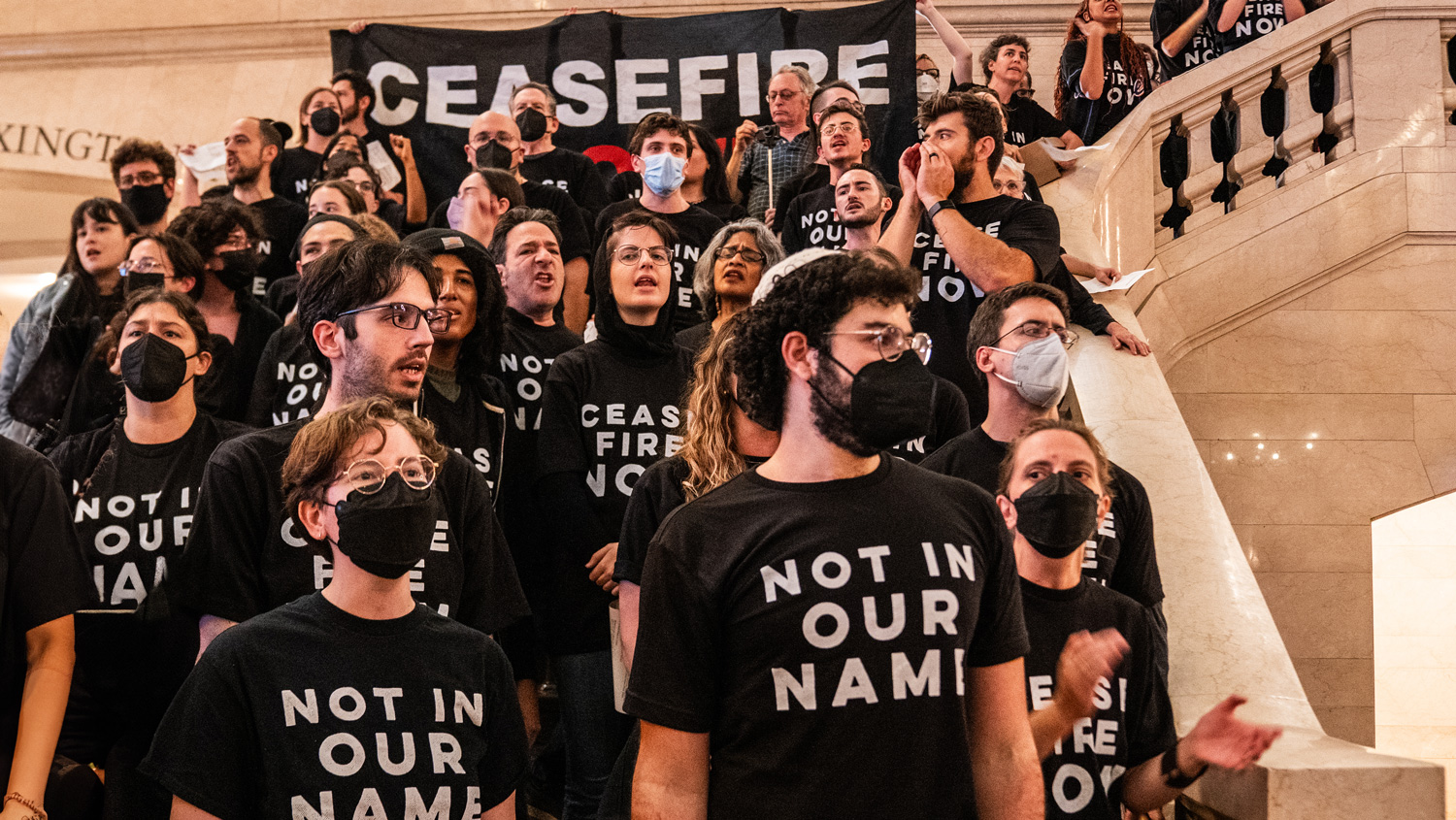
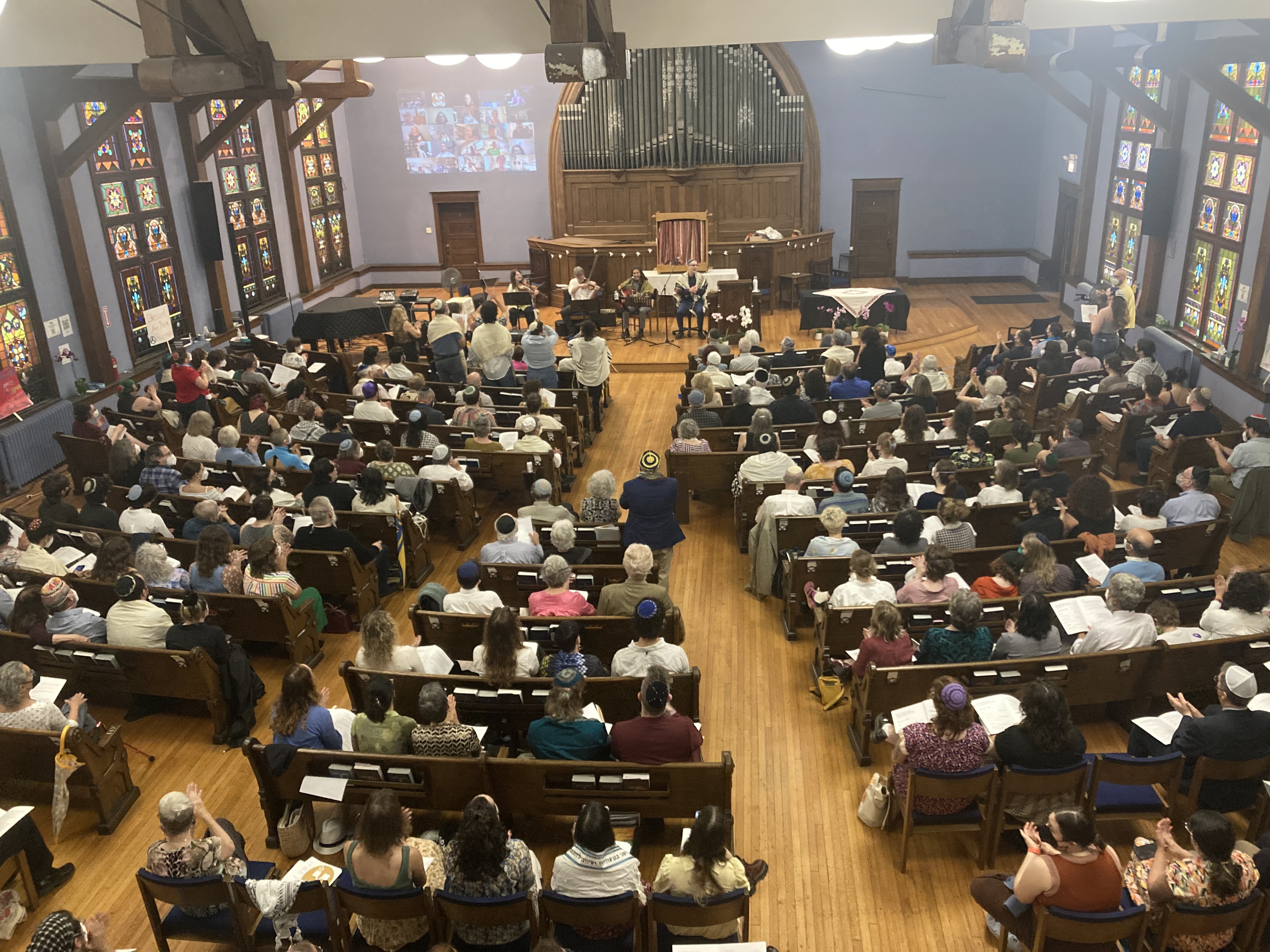
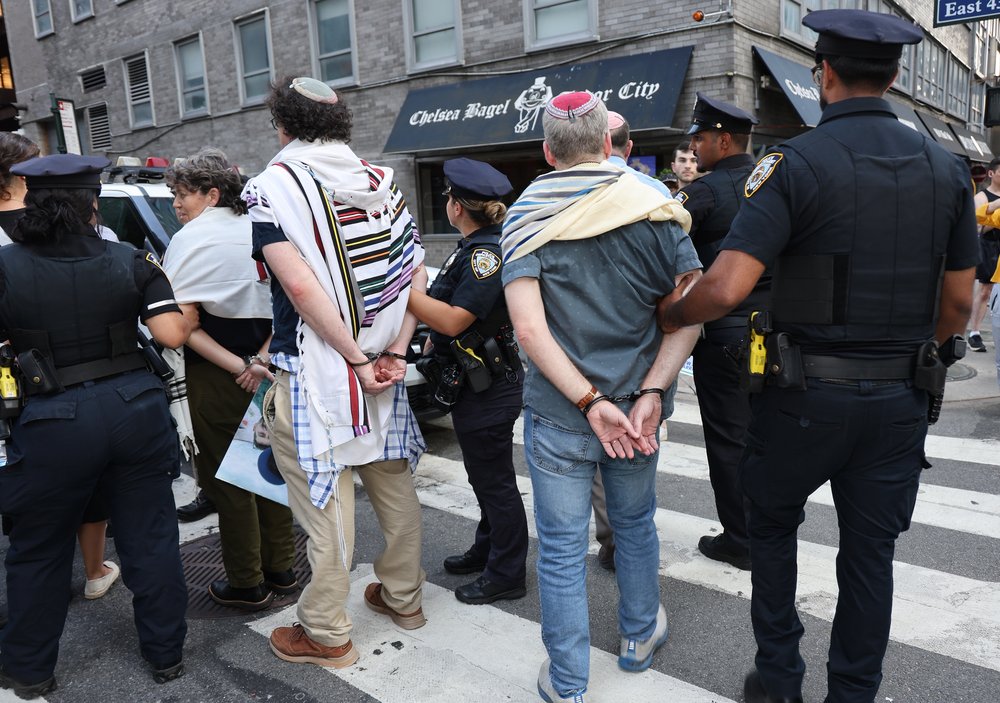
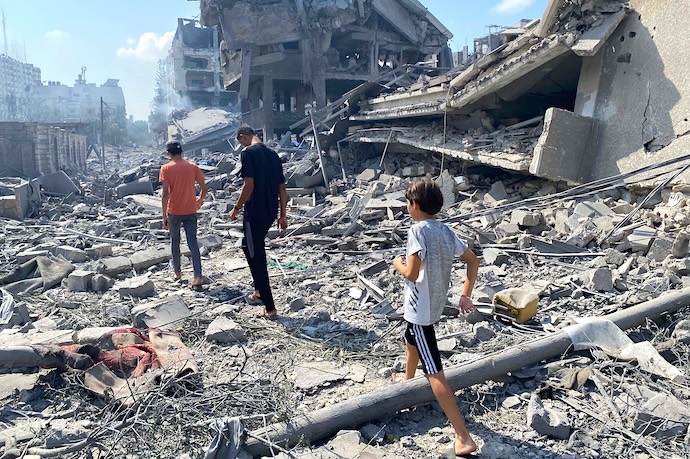
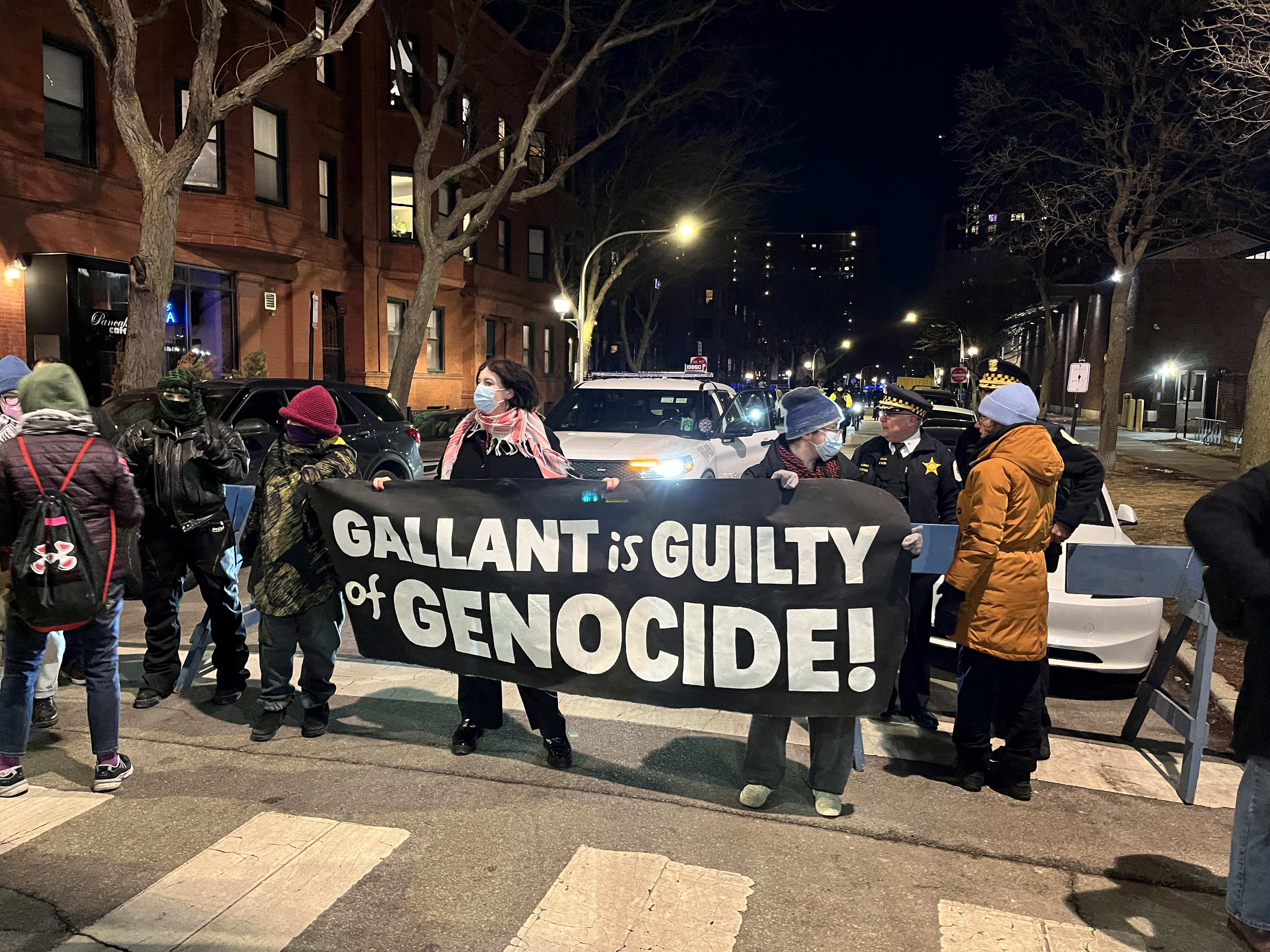
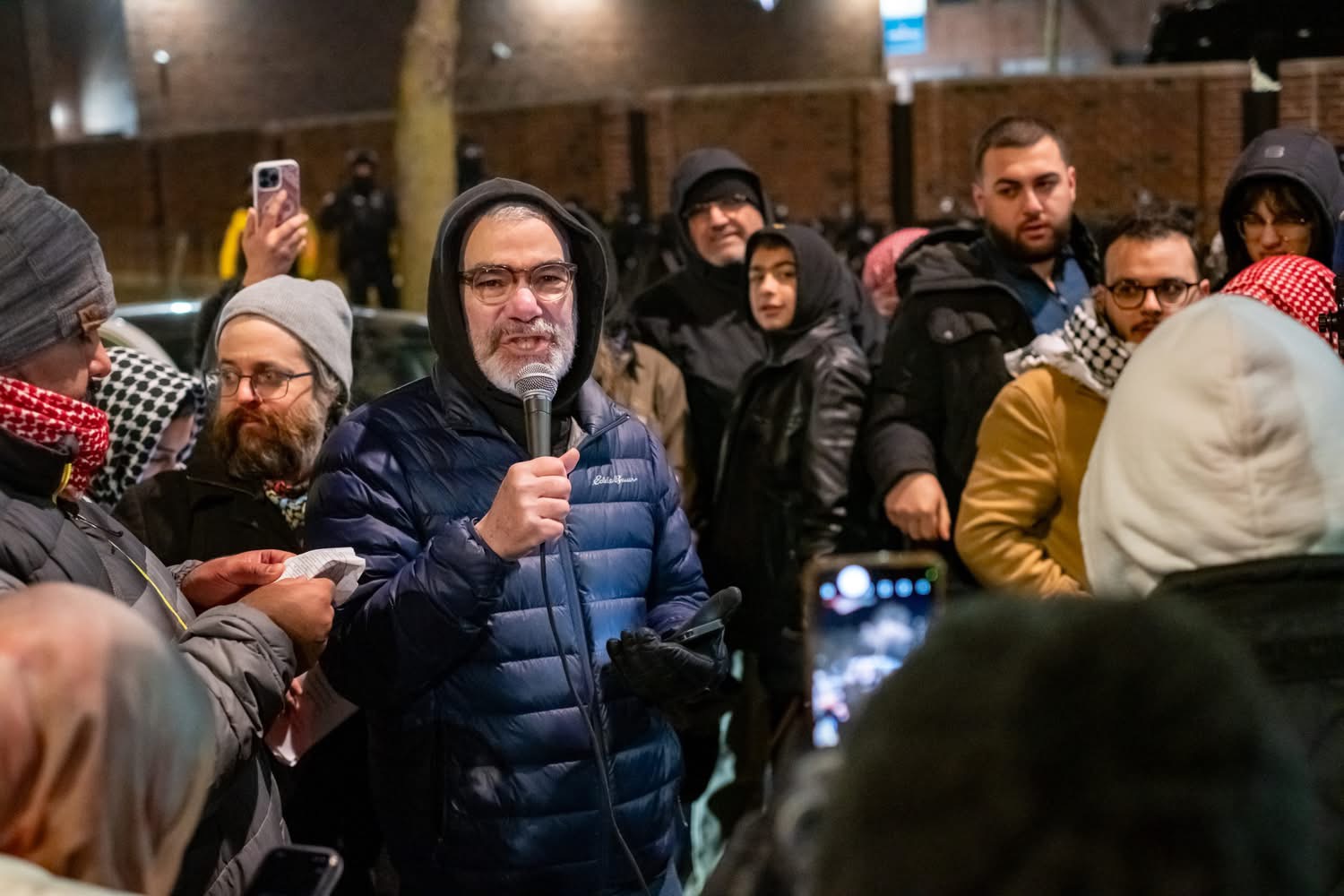
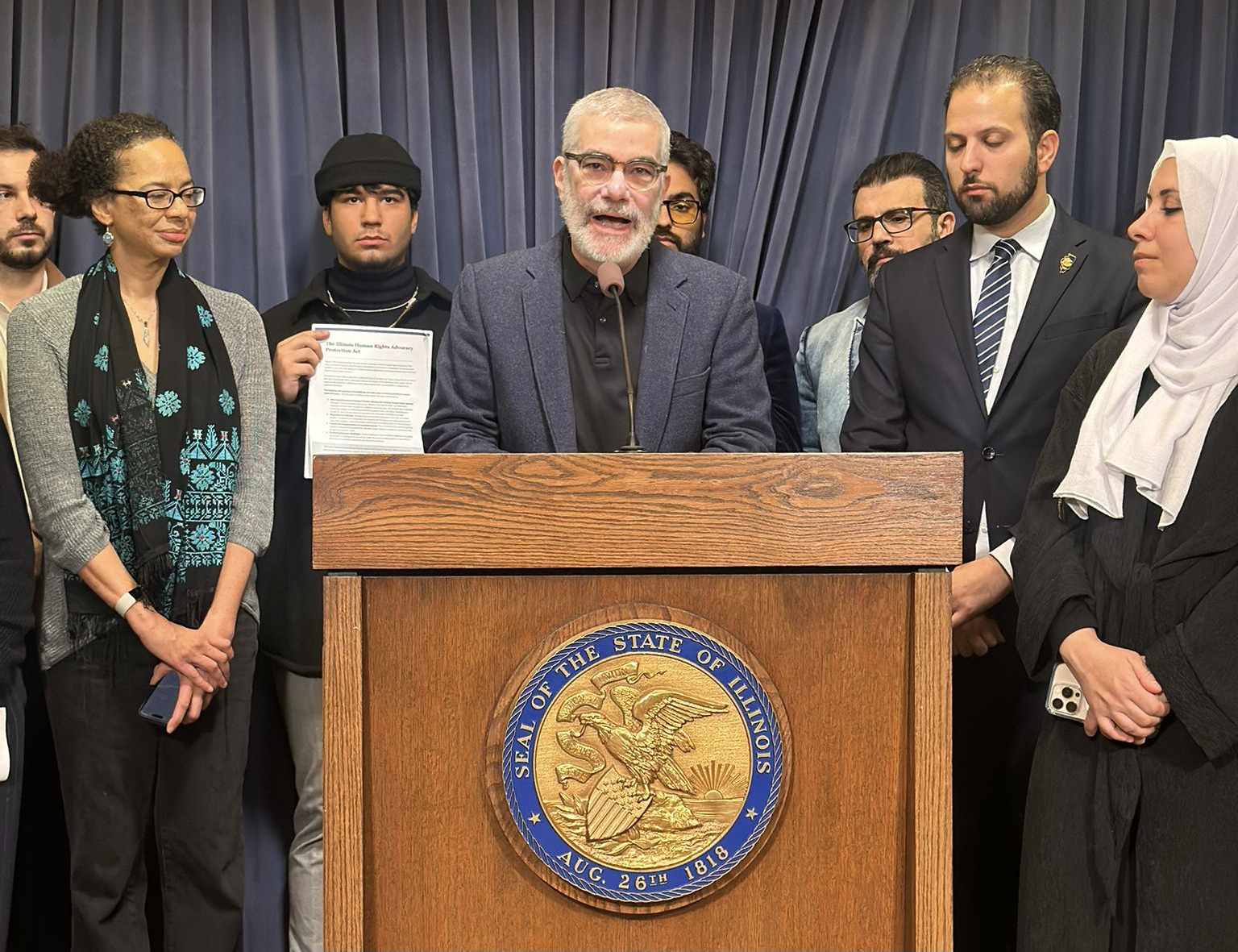
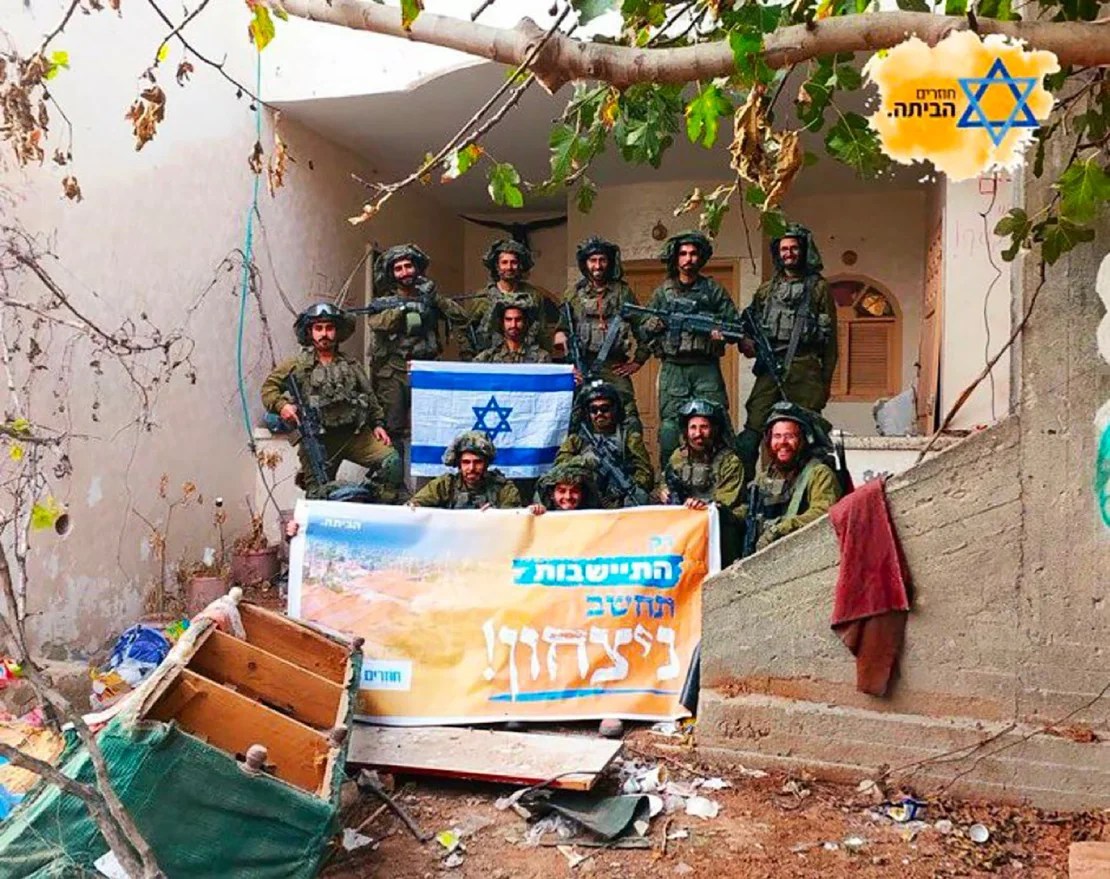
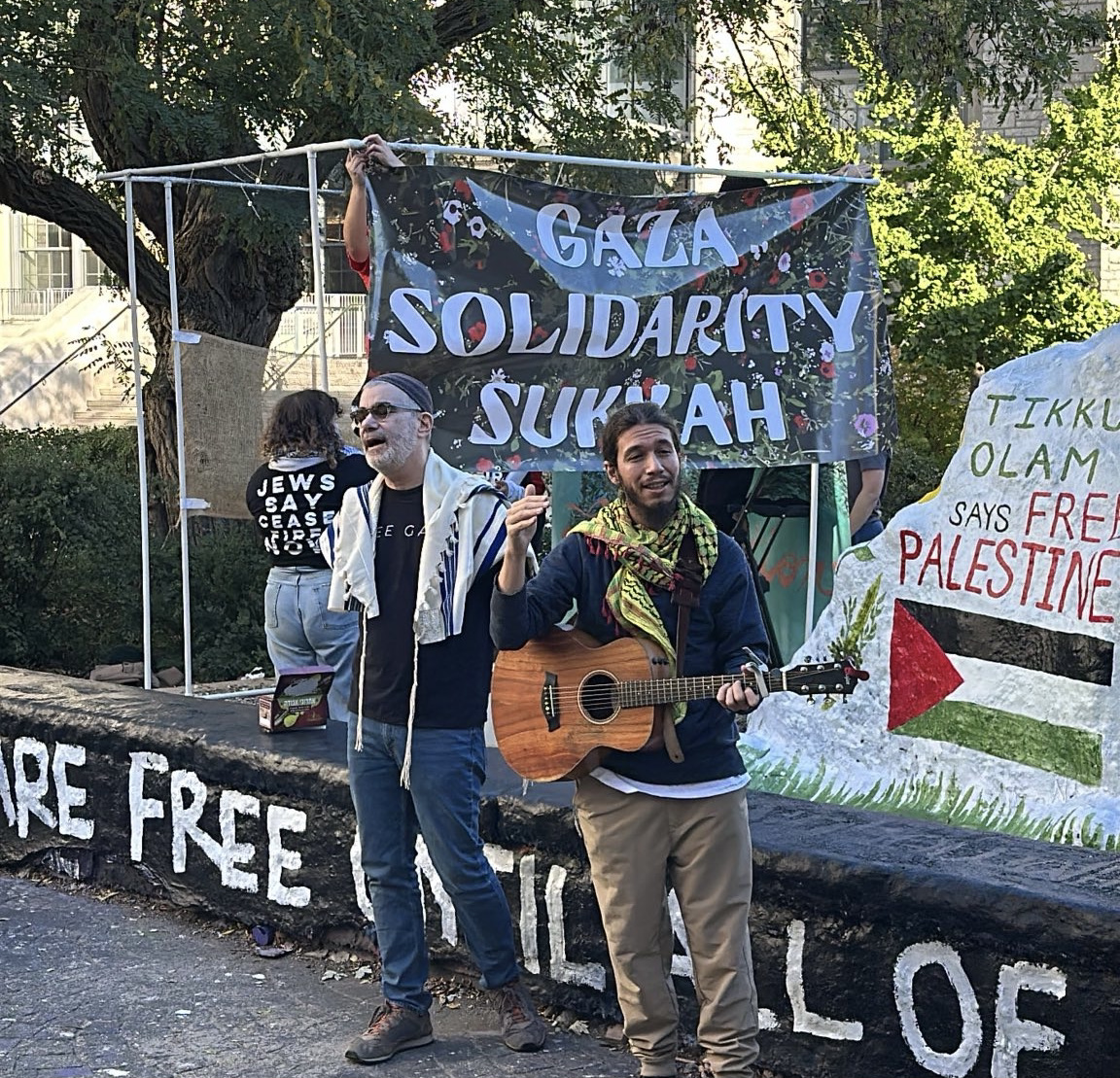
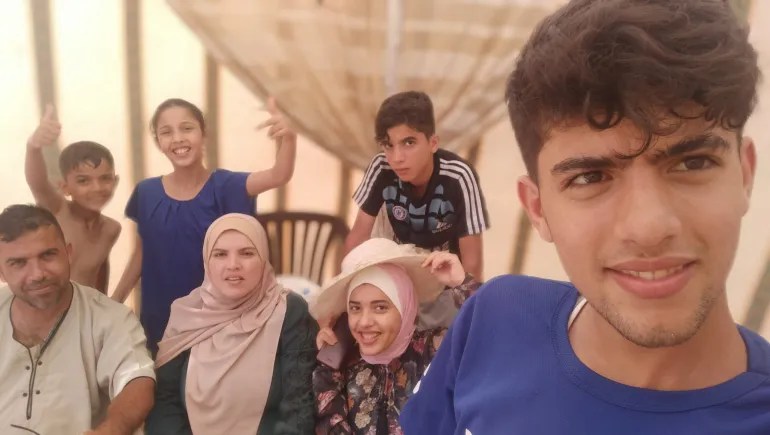

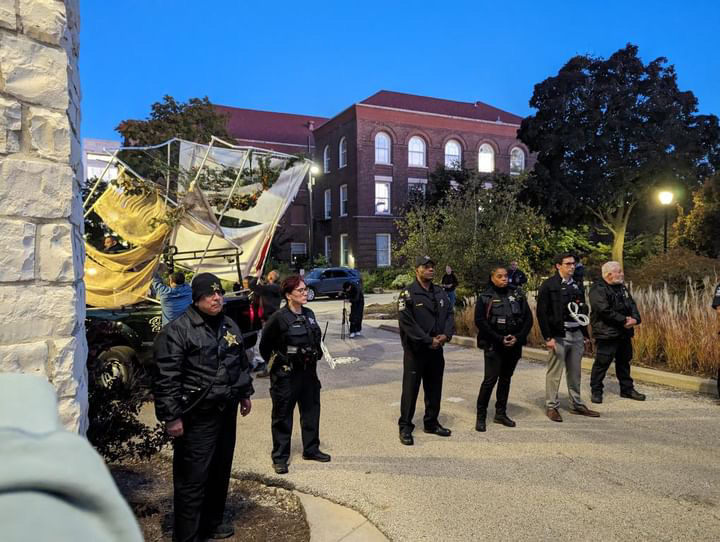

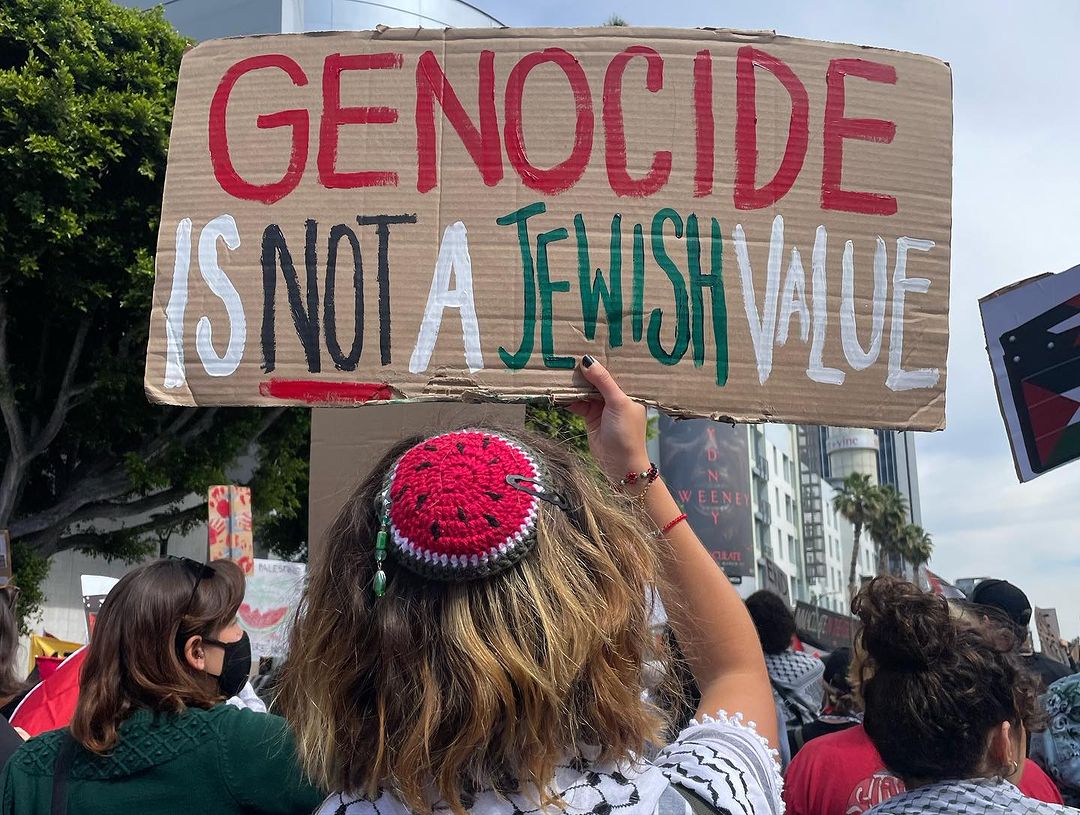
 Shalom Rav