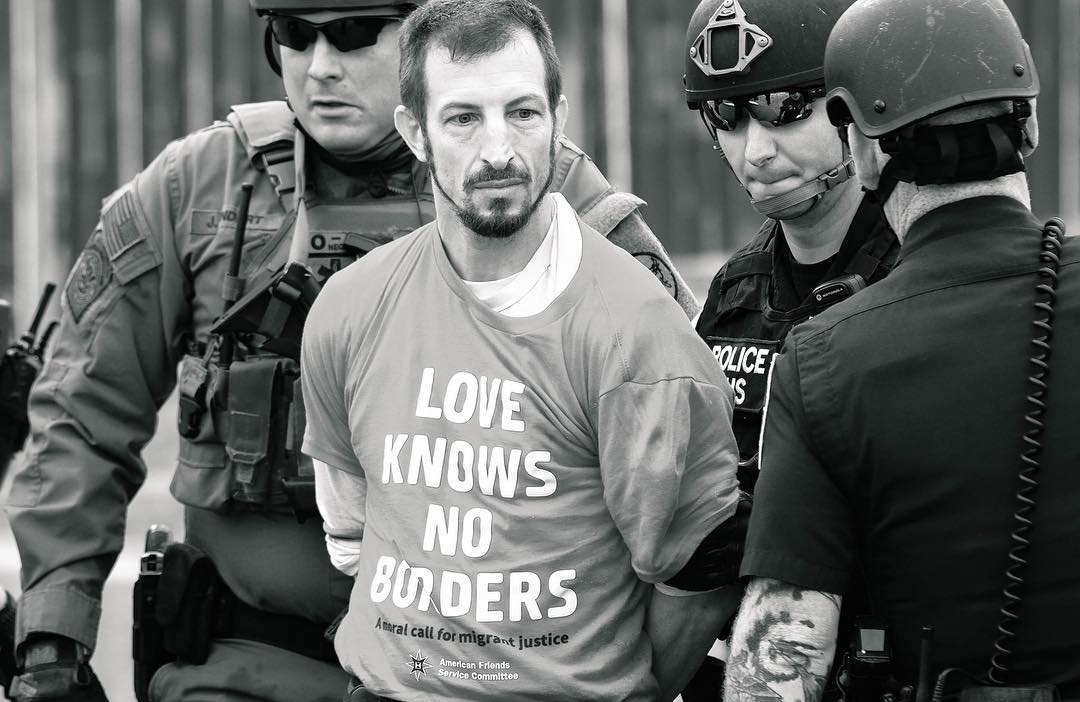
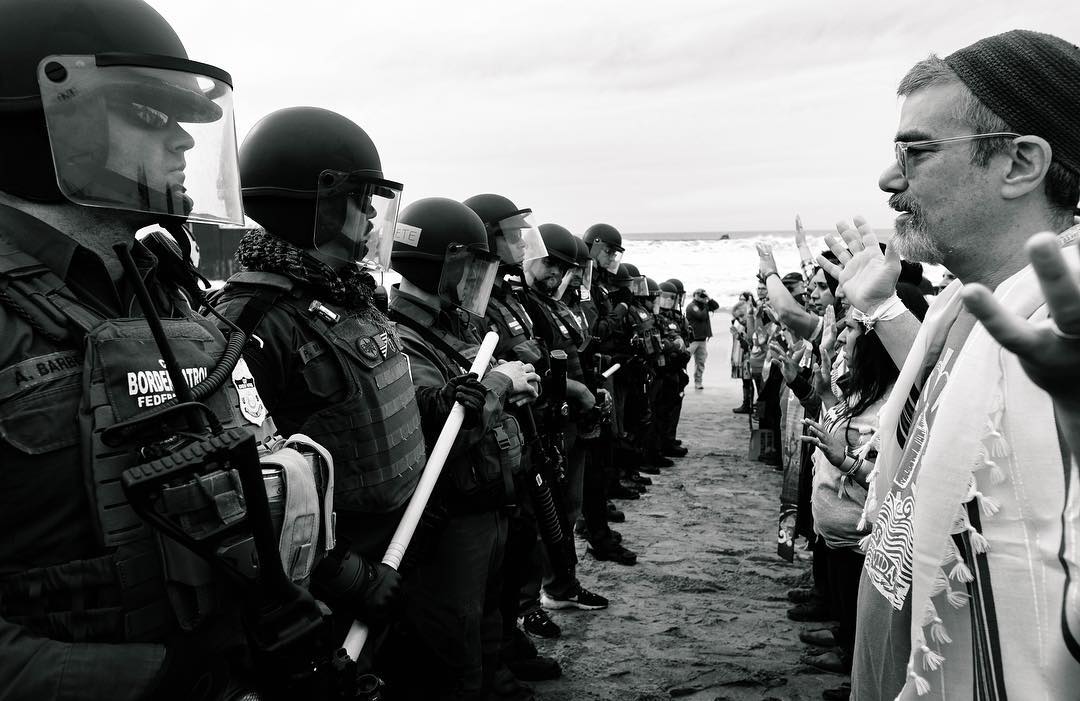
Category Archives: Nonviolence

Murder in DC: Toward a World Where All Lives are Grievable

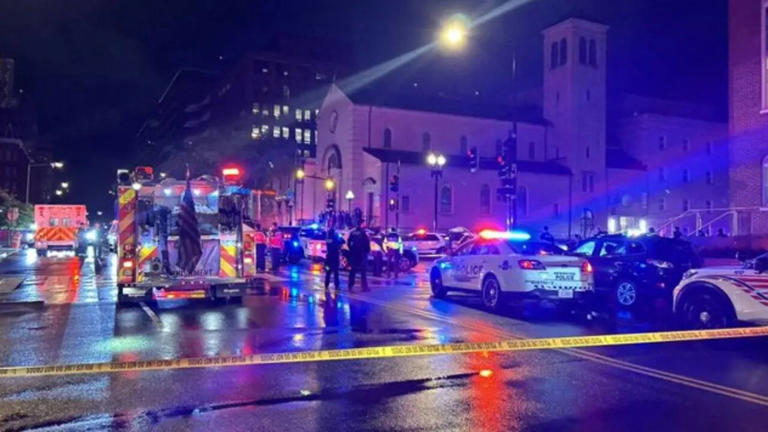
The shooting death of the two Israeli embassy workers in Washington DC this past Wednesday evening was tragic and horrific. All human life is precious – there can be no conceivable justification for this immoral act. Moreover, the man who perpetrated these murders is no hero; in addition to the lives he took and the grief he caused their families, his action has only served to harm – not help the Palestinian people. This is not what solidarity looks like.

As of this writing, there is much we don’t know about the shooting – and it would be irresponsible of me to speculate on whether the shooter was motivated by antisemitism. We do know that it was an act of political violence – and that the victims were embassy representatives of a nation that itself is engaged in an act of political violence that has killed tens of thousands of Palestinians – and is currently taking the lives of hundreds of people in Gaza every day.

Of course, there is no shortage of disingenuous politicians and media figures who are all too eager to use this act of violence for their own political advantage. But we cannot and should not equate the actions of one isolated incident with the entire movement for Palestinian liberation. Indeed, over the past nineteen months, millions of people across the US and around the world have protested peacefully for a ceasefire and an end to Israel’s genocide in Gaza. It is inaccurate – and in fact racist – to use this tragic event to make assumptions about Palestinians or collectively punish people of conscience who have been advocating for Palestinian safety and freedom. Our movement has always been about freedom, dignity and safety for all. The murderous action of one vigilante does not define us – nor should it lessen our resolve to continue advocating for an end to Israel’s genocide in Gaza.

According to one of the most sacrosanct teachings in Jewish tradition, all human beings are created in the divine image – and that all lives are equally, infinitely precious. I can’t help but think of this sacred value as I read the many poignant news stories about the young embassy workers Yaron Lischinsky and Sarah Milgrim: stories that honor the people they were as well as their hopes and dreams for the future.

At the same time, I couldn’t help but think: where are these stories in the mainstream media about the tens of thousands of Palestinians killed through political violence in Gaza over the past nineteen months? Where are the tributes to their lives, their hopes, their dreams? If they were afforded the same kinds of tributes, the media would be overwhelmed an endless cascade of stories about precious lives lost forever.

In her book, “Frames of War,” the scholar Judith Butler examines why some lives are “grievable” while others are not. Butler suggests that this selective mourning is due to a process of dehumanization, in which state powers determine which lives have the status of personhood – and thus more worthy of our grief. In short, if a person is deemed less human, they become less grievable.

When we engage in this kind of selective mourning, we become complicit in this process of anti-Palestinian dehumanization and racism. Here in the US, of course, people of color are all too familiar with this process. As Bernice Johnson Reagon powerfully wrote in her classic, “Ella’s Song:” Until the killing of black men, black mothers’ sons/Is as important as the killing of white men, white mothers’ sons/…We who believe in freedom will not rest.

How do we respond to the killings of Yaron Lischinsky and Sarah Milgrim? The same way we must respond to the tens of thousands of Palestinians who have been killed – and continue to be killed – by the Israeli military in Gaza: by continuing to protest openly and as openly as possible for an end to Israel’s genocide against the Palestinian people. By advocating for a free Palestine for all who live between the river and the sea.

And further: to insist on a world in which all may live in safety and dignity – and all people are mourned equally when they die.

The World as it Should Be: Reflections on the DePaul Student Encampment

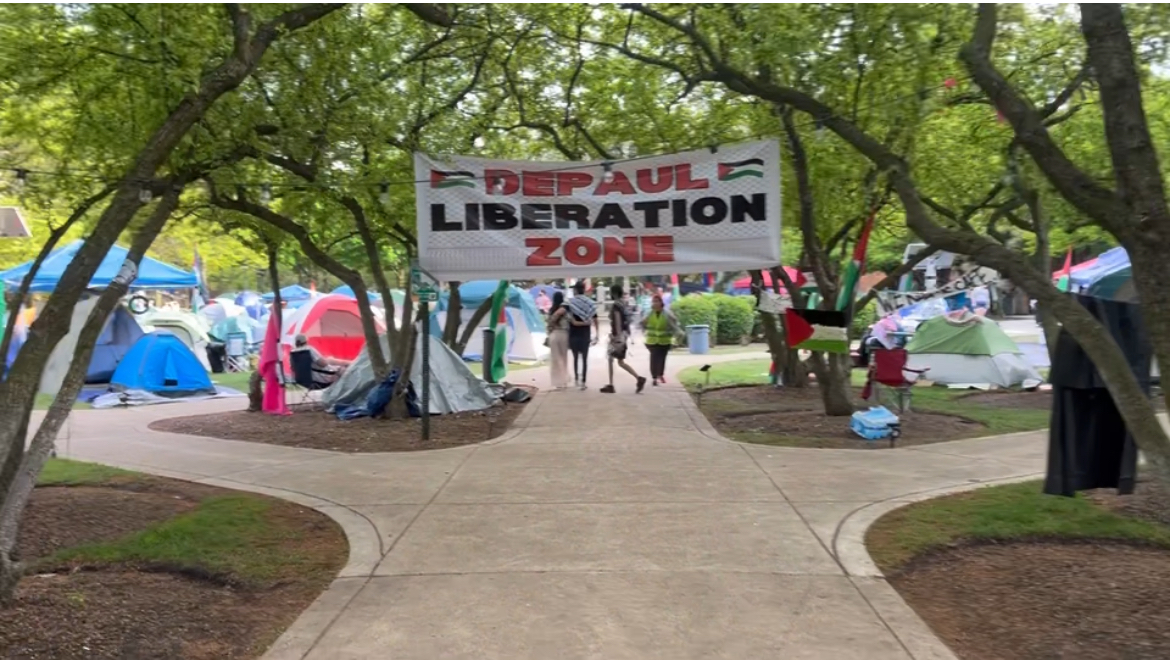
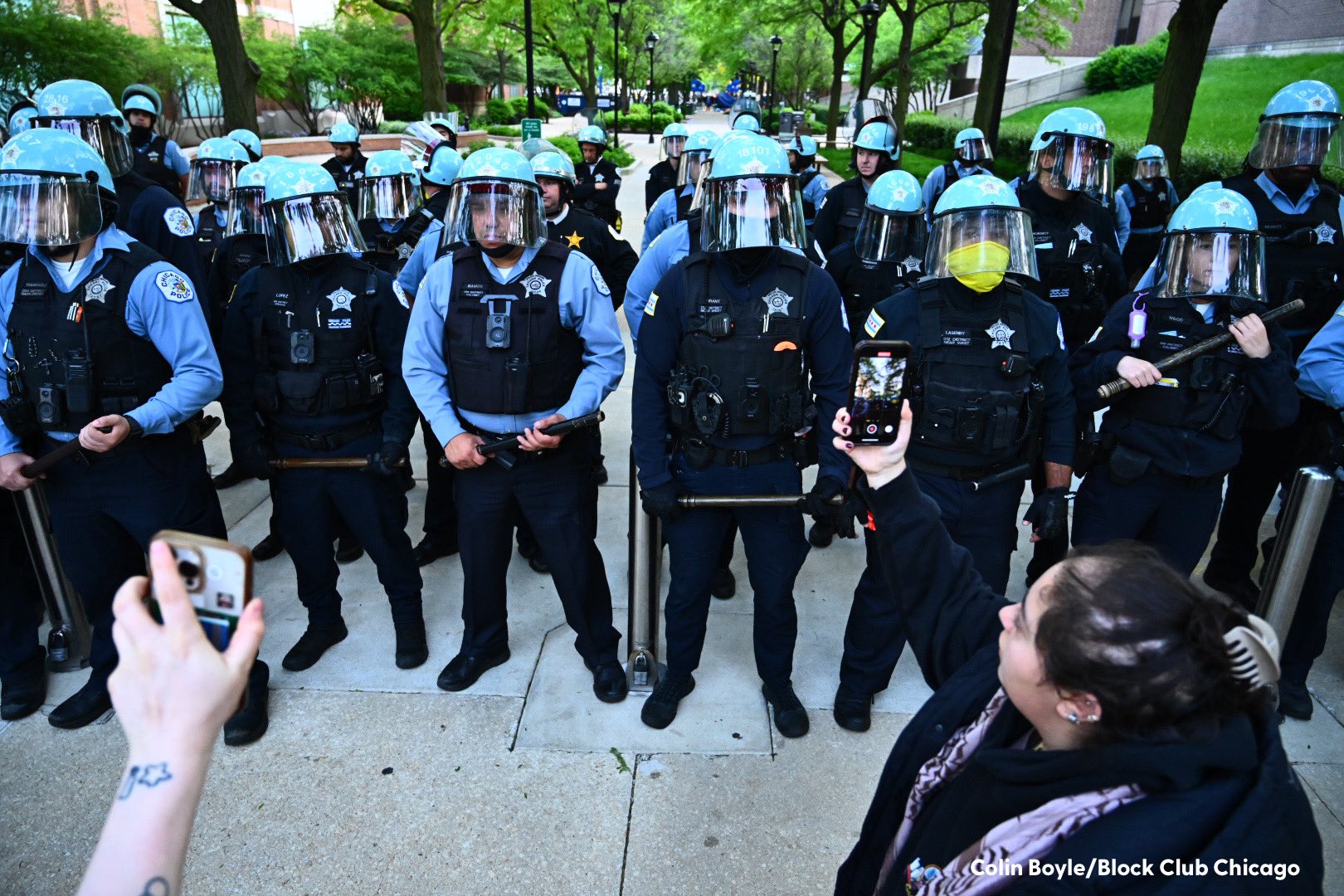
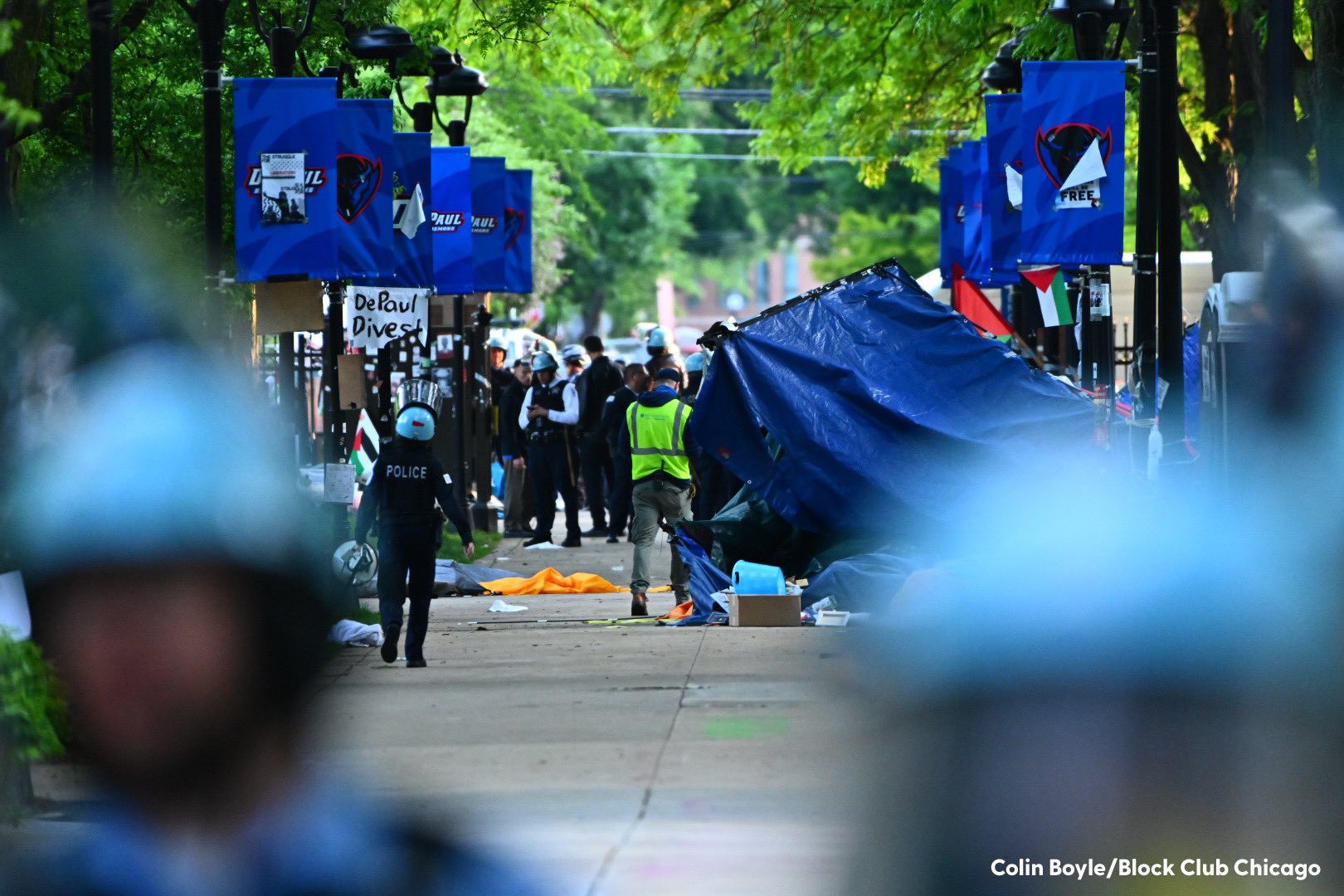
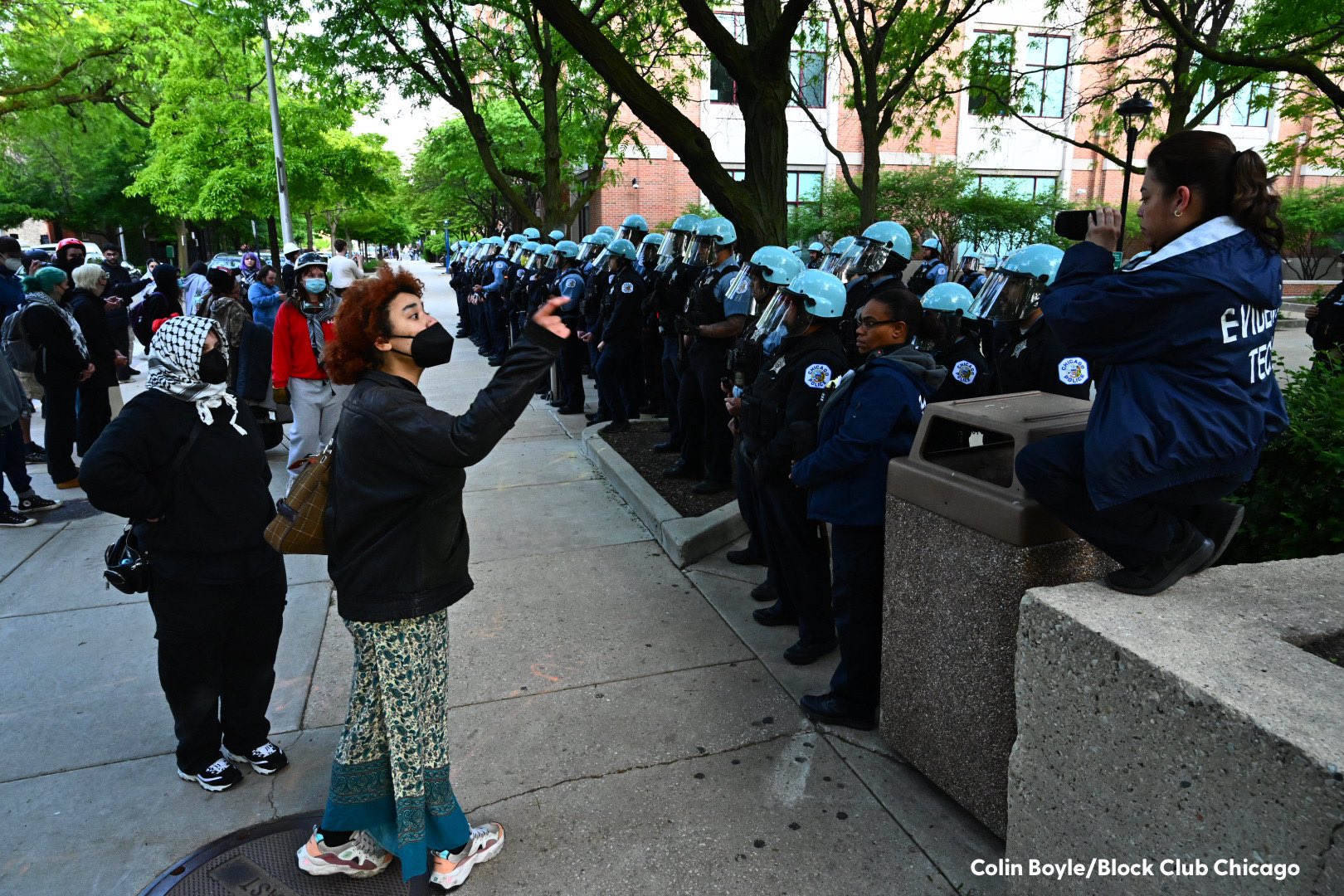
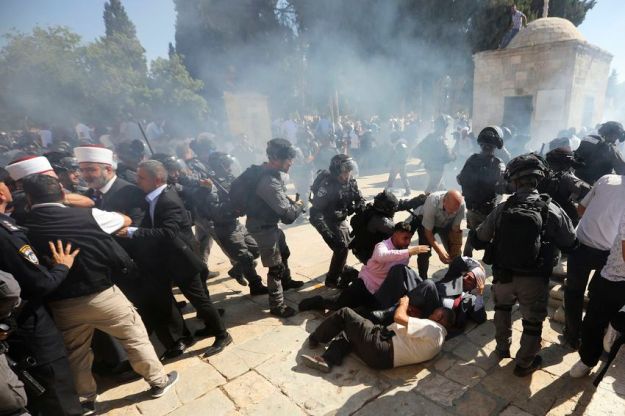
Early yesterday morning, the Chicago Police Department raided and destroyed the student encampment at DePaul University. The DePaul Liberation Zone was the last remaining student encampment in the Chicago area and had been ongoing for seventeen days. Here are my remarks from the student-called press conference at the DePaul student center that took place last night:

My name is Brant Rosen – I’m the rabbi of the congregation Tzedek Chicago and the co-founder of the Jewish Voice for Peace Rabbinical Council, and I’m here today representing the rapidly growing section of the Jewish community that is actively protesting Israel’s genocidal violence against the Palestinian people. As part of this protest, we stand with the student movement across the country – and around the world – that demand their schools divest from Israel’s war crimes in Gaza and throughout Palestine.

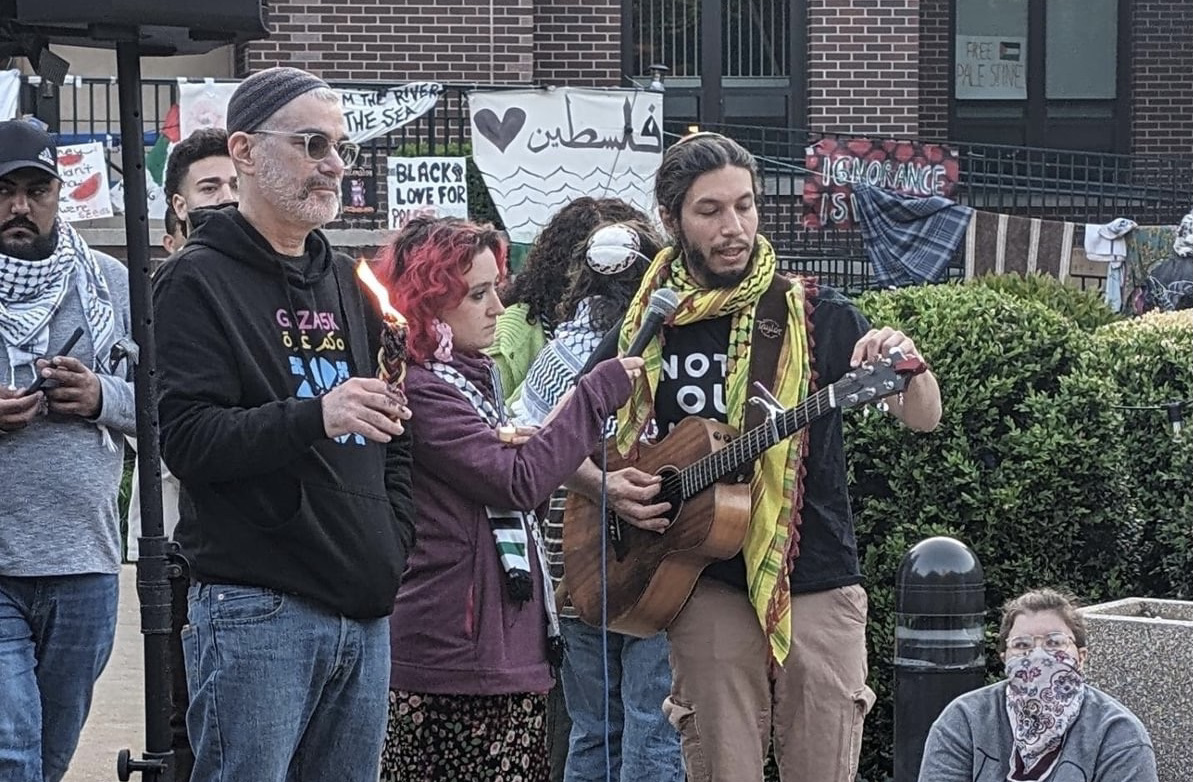
It has been my personal honor to visit the DePaul Liberation Zone numerous times over the past two weeks. Together with members of my congregation, we led two Havdalah services – the ceremonies that mark the end of the Jewish Sabbath. We were invited and scheduled to lead Shabbat services at the student encampment tomorrow evening – and are deeply saddened that this will now not be possible.

When I led Havdalah, I made the observation that Jewish tradition views Shabbat as a foretaste of Olam Haba – the World to Come. I added that this is exactly what the students were creating in their encampment. The students of DePaul created for themselves the World-As-It-Should-Be in real time. 

In truth, it was less a political protest encampment than a mindfully organized, genuine grassroots community. There was a planning committee to schedule ongoing events. There was a food tent and a first aid center. There were tutoring sites. There was training in nonviolent resistance and de-escalation. The students supported one another. They took care of one another. And they celebrated together as a truly multi-faith, multi-ethnic community. Last Saturday, our Jewish service was preceded by a Muslim call to prayer. Afterwards, a dance and music ceremony was performed by a local Aztec indigenous troupe.

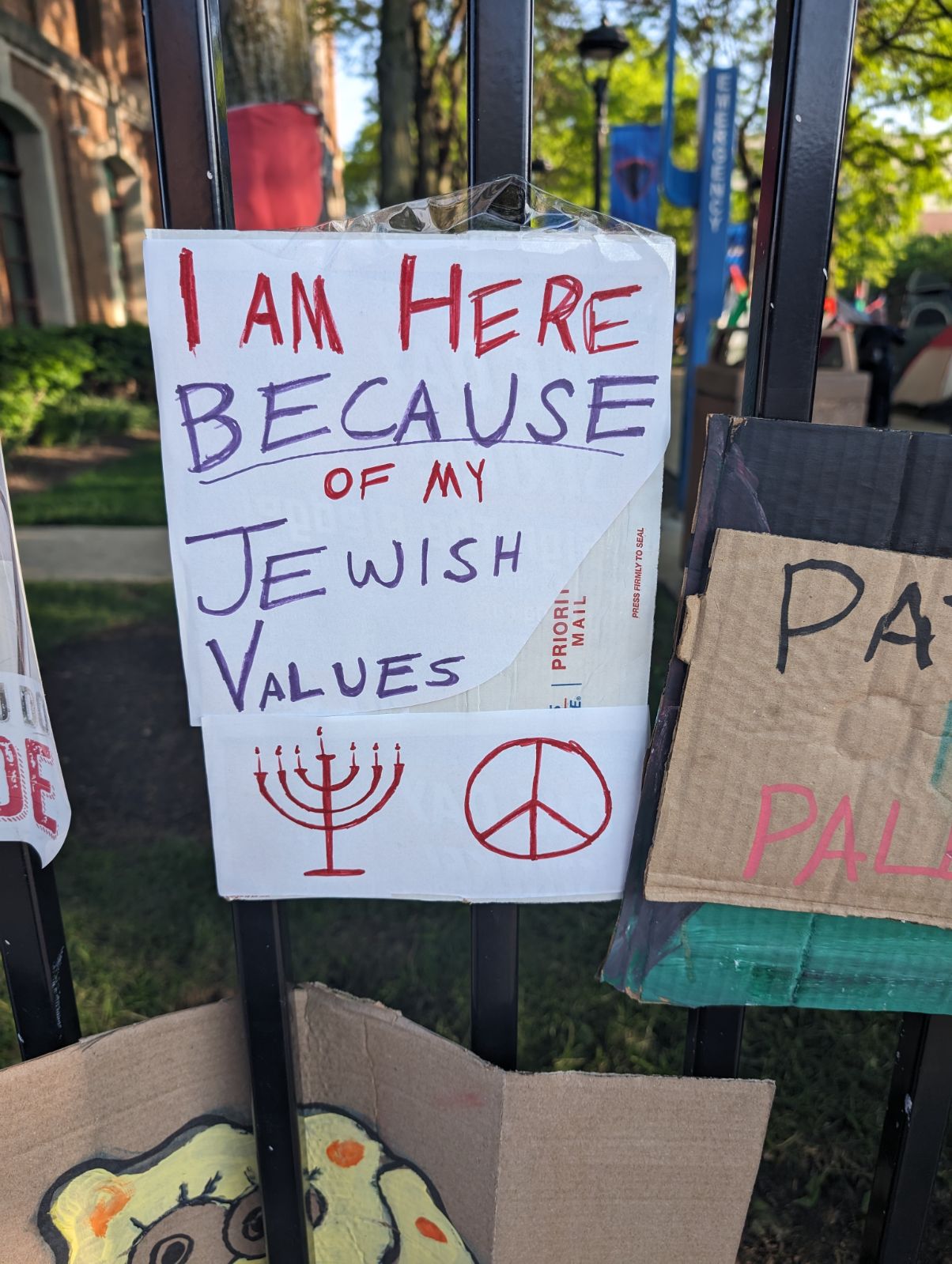
I want it to be known, for the record, that Jewish students – many of them members of Jews 4 Justice at DePaul, were an integral part of the DePaul Liberation Zone community. And I want to say as clear as I possibly can that the cynical characterization of this encampment – and others like it across the country – as bastions of Jew hatred could not be farther from the truth. As a Jewish person, I was welcomed into this community as an honored guest.

Last week, after leading Havdalah, I was approached by scores of students – many of them Palestinian – who expressed their appreciation for our presence there. There were also many Jewish students who thanked us for giving them a spiritual Jewish context for their solidarity. To my mind, this was the safest possible place I could be as a Jew: at a place where security was a shared and mutual concern. If there was any threat to safety, it came from the state violence that was unleashed on this community by DePaul and the Chicago Police Department.

As a faith-based university, DePaul should have respected the deep moral conviction at the heart of the student community. They could have followed the example of Rev. Serene Jones, the President of Union Theological Seminary, who had this to say about the students at the Columbia University encampment:

I’ve had the chance to see the protests up close, where the simple message of the demonstrators can still be heard: Stop the war, now. And I’ve learned a lot about who these protesters really are…

First and foremost, these encampments are filled with students from different religious traditions — Jews, Muslims, Christians, Buddhists, unaffiliated as well as spiritual but not religious students. They are finding solace and courage among themselves.

These spontaneous, interreligious communities happened organically, with the strikingly easy flow of connection different from self-consciously manufactured “interfaith moments.” It is simply who these protesters are: a community bound by a greater common cause to stop the mass killing of besieged Palestinians.”

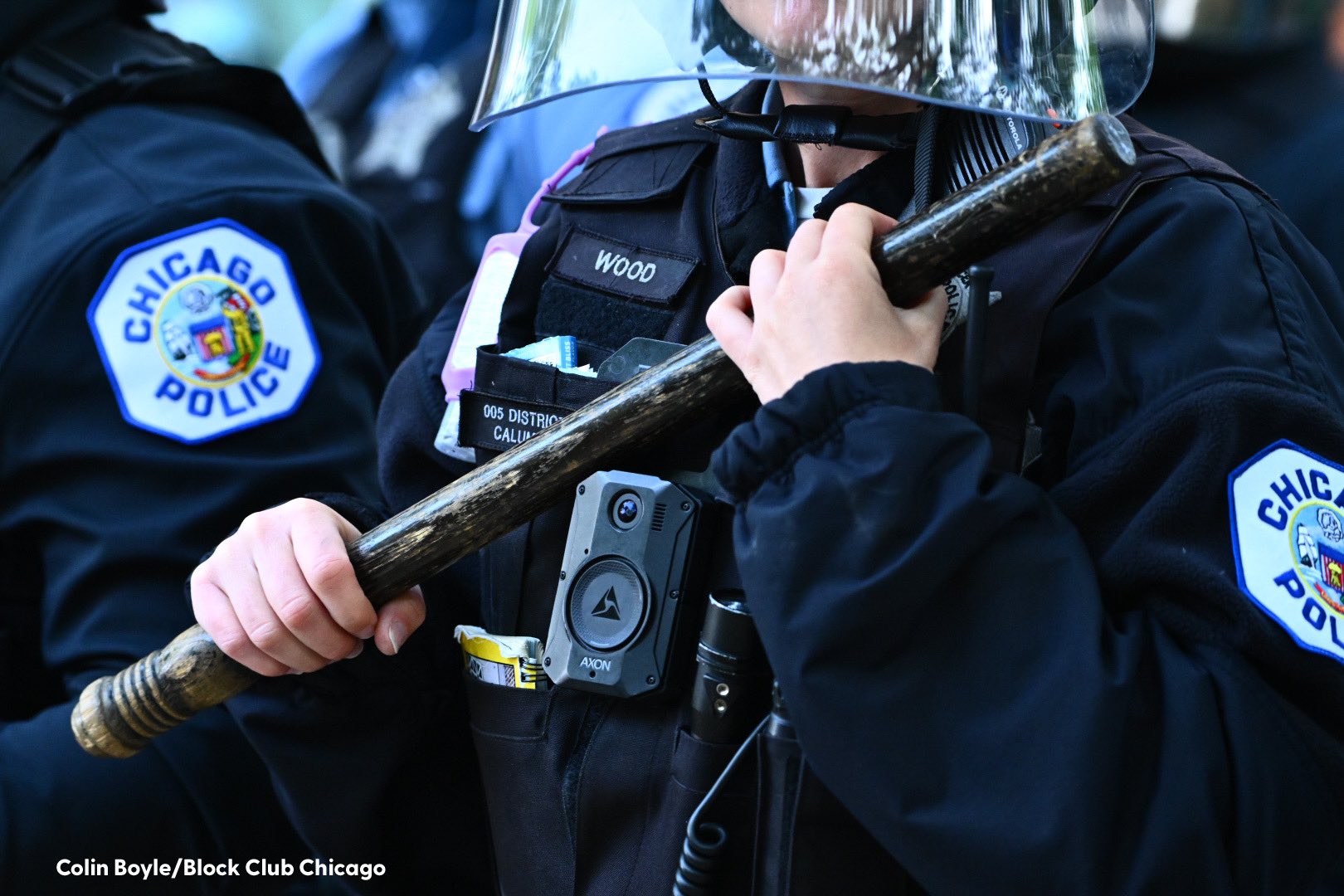
But shamefully, tragically, the DePaul administration chose a different course. It chose to negotiate in bad faith. They never seriously engaged with students’ deeply held, conscience-based convictions. They egregiously demanded that student leaders attend meetings during the Muslim and Jewish Sabbaths. Rather than responding honestly to the students’ counter proposals, they abruptly declared that the negotiations were at a stalemate, unlilaterally bringing the process to a halt. And then, early this morning, they brought in the CPD, clad in full riot gear, to violently overturn and destroy a peaceful student community.

Let me be clear – what DePaul did to its students this morning was a shandeh: for shame. It represents a moral stain on a university that purports to uphold Vincentian religious values of peace and justice. It represents a failure of leadership and imagination by responding violently to a good faith, conscience-driven action of students who were challenging their school to behave morally and to divest from genocidal violence. 

That their demand has occasioned such vicious state violence clearly demonstrates the truth of the students’ essential point for all the world to see. Their acts of solidarity and mutual support are a clear and direct threat to state power. There can be no better example of this truth than the travesty we witnessed at DePaul this morning.

But make no mistake, this violence will not break the will of these students, nor will it slow the progress of a solidarity movement that is breaking wide open across the country and around the world. We are all – as I speak to you now – living in a very real moment of truth. We are all being challenged to answer the question: where do I stand? Will I remain silent or will I speak out? Will I be complicit, or will I demand accountability? Will I enable the oppressive status quo, or will I call I find the courage to say out loud, “From the river to the sea, Palestine will be free!”

These students know the answers to these questions. We would do well to listen and learn from them. We would do well to follow their example. No matter how cynically they are characterized, no matter how violent the response to their moral challenge, they will not be deterred until liberation. And until that moment comes, it will be my honor – and the honor of so many others – to stand right alongside them.

“All Who are Hungry Come and Eat:” A Report from a Passover Action at the Gaza Border

Cross-posted with The Nation

In 2017, I spent several days in Gaza as a staff person for the American Friends Service Committee. Although I took away many powerful and vivid memories from that trip, some of the most indelible involved the delicious food that was continuously served to us by our Gazan hosts. Gazans are famously proud of their cuisine, and rightfully so, as it provides them with a palpable connection to Palestinian history and life outside that small 140 square mile strip – to communities in Palestine that their ancestors used to live. As journalist Laila El-Haddad has observed, Gazan food is “a sort of treasure map to a largely invisible, or invisibilized, world of Palestinian history going back well before the 1948 Nakba.”

During the course of our visit, Ali, a member of the AFSC Gaza staff, mentioned more than once that Gazan knafeh (a traditional Arabic dessert) was by far the best in Palestine. When our staff group gathered at a restaurant in Gaza City for our final meal, Ali was chagrined to learn that there was no more knafeh left in the kitchen. Determined, Ali got up, ran down the street to another restaurant, and returned with a huge round plate of the sticky, golden pastry for our table. It was indeed more delicious than any knafeh I have eaten before or since.

I’ve recalled that sweet memory often over the past seven years. When I think of it now, however, I find its sweetness has curdled into horror. As far back as December, human rights agencies determined that Israel “was using starvation as a weapon of war.” According to the World Food Program, Gaza’s food system was on the brink of collapse and the population was facing a “high risk of famine.”

This past March, the mainstream media published shocking, heartbreaking pictures of Yazan Kafarneh, a 10 year old Gazan boy reduced to skin and bones from starvation. To date, it has been estimated that 28 children have died of malnutrition and starvation in northern Gaza. By all accounts, starvation in Gaza has now reached “catastrophic” proportions. Knowing about the Gazan people’s deep pride in their food culture, I’m experiencing deep heartbreak as I read reports that Palestinians in Gaza are now forced to eat grass just to survive.

As a congregational rabbi, I’ve spoken with many people have told me that they are not sure how – or even if – they will celebrate Passover this year. With the genocide and forced starvation of the people of Gaza deepening with no end in sight, they say, it just feels beyond challenging to celebrate a festival of Jewish liberation. To make the moral dissonance even more dissonant, many in the Jewish communal establishment are framing Passover by focusing exclusively on the Israeli hostages in Gaza and call for their liberation from Hamas, with nary a mention of the 35,000 Gazans who have been destroyed in the process through Israel’s genocidal war of vengeance.

More than once I’ve been asked, “How can I partake of this festive meal while Israel has been starving Palestinians in the name of the Jewish people?” How can I read about Pharaoh’s oppression of Israelite children when I’ve just read the latest death count of Palestinian children dying increasingly things from forced starvation?

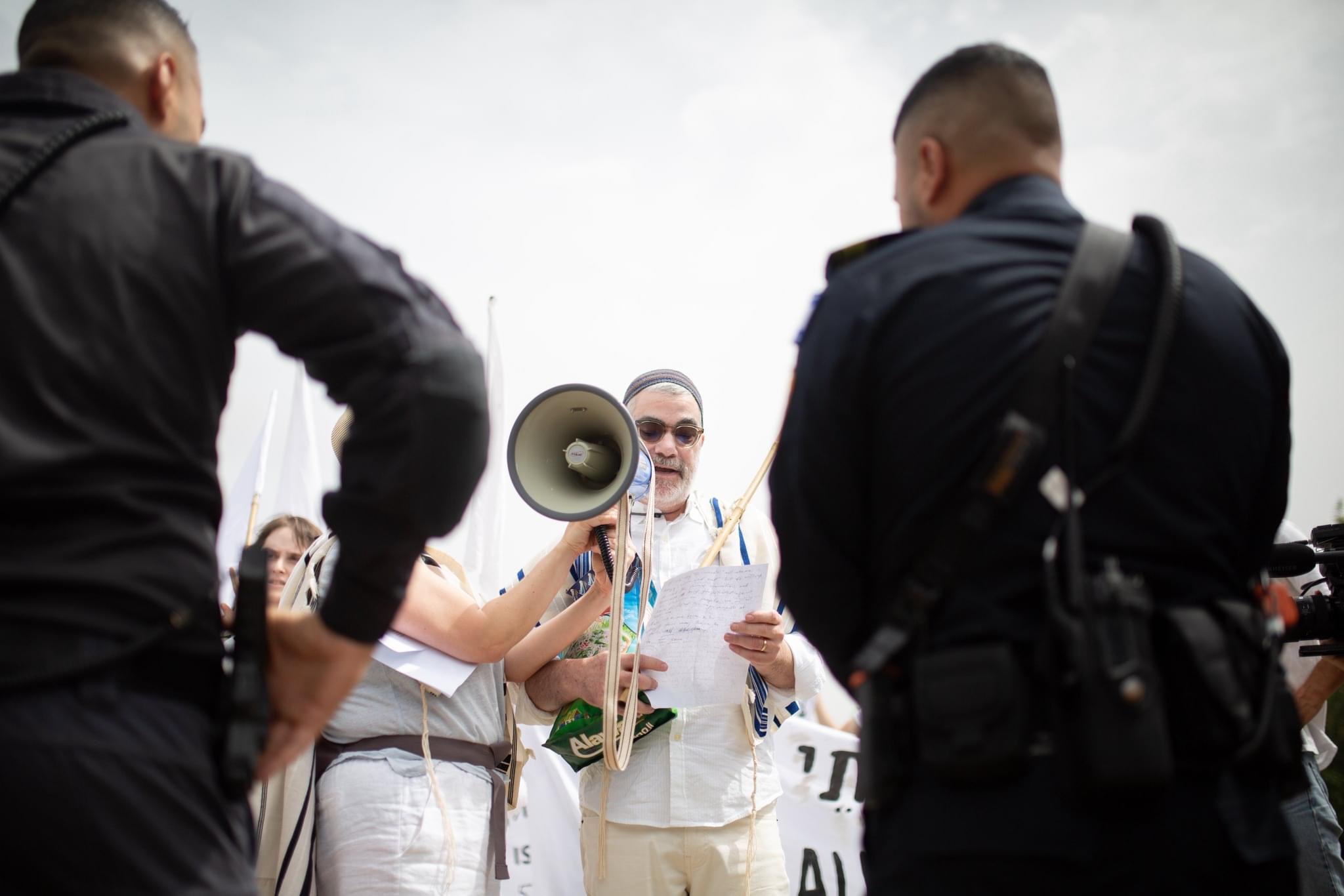
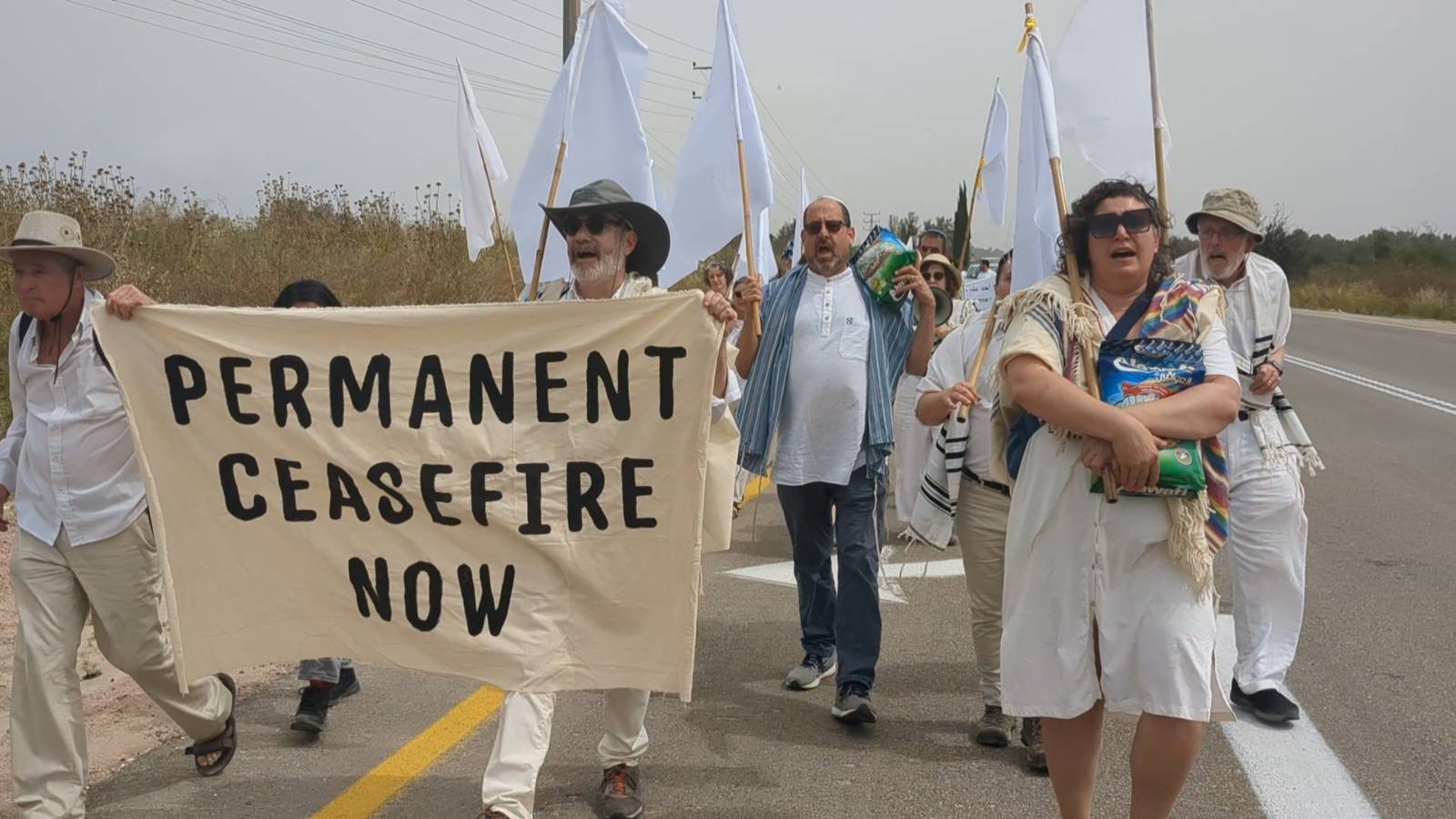
As a political-spiritual response to this unprecedented Passover moment, Rabbis for Ceasefire mobilized and began to organize as action at the Gaza border, to literally bring food supplies with us and demand to that Israel allow us to pass through the Erez Crossing, motivated by Passover’s central imperative, “All who are hungry come and eat!” Our action would include 10 American rabbis, writer/essayist Ayelet Waldman and 30 other Israeli activists – including Israeli rabbis – who have been tirelessly protesting both at the Gaza border and organizing protective presence for West Bank communities targeted by settler violence.

Our action was originally planned for the week leading up to Passover; but when Iran’s missile attack caused the country to go on alert and airlines cancelled their flights to Israel, we almost had to cancel our action. As we read the news, Israel’s escalating hostilities with Iran took front and center The US and the West were rearming Israel and focusing on the threat from Iran – even as Israel continuingly maintained its policy of starvation and bombardment of Gaza. Most alarming were the reports that an Israeli agreement to retaliate lightly against Iran would give them leeway to move ahead with a potentially disastrous ground invasion of Rafah.  We bought plane tickets for the next week, determined to make a collective Passover statement that felt more critical than ever.

During our action, we gathered at a preplanned meet-up location, with a truck filled with half a ton of flour. We each shouldered backs of rice and, carrying banners and flags, march in the direction of the Erez Crossing. The Israeli police quickly drove up to intercept us. During that initial stand-off, several of us offered statements. I began with an opening prayer, an adaptation of the “Magid” section of the Passover Haggadah:

“This is the bread of affliction, the bread and food systemically, cruelly denied the people of Gaza. Let all who are hungry come and eat. Let all who are oppressed be liberated this Pesach. Now we are here – tomorrow let there be bread for Gaza. Now we are here – next year may there be liberation from the river to the sea!”

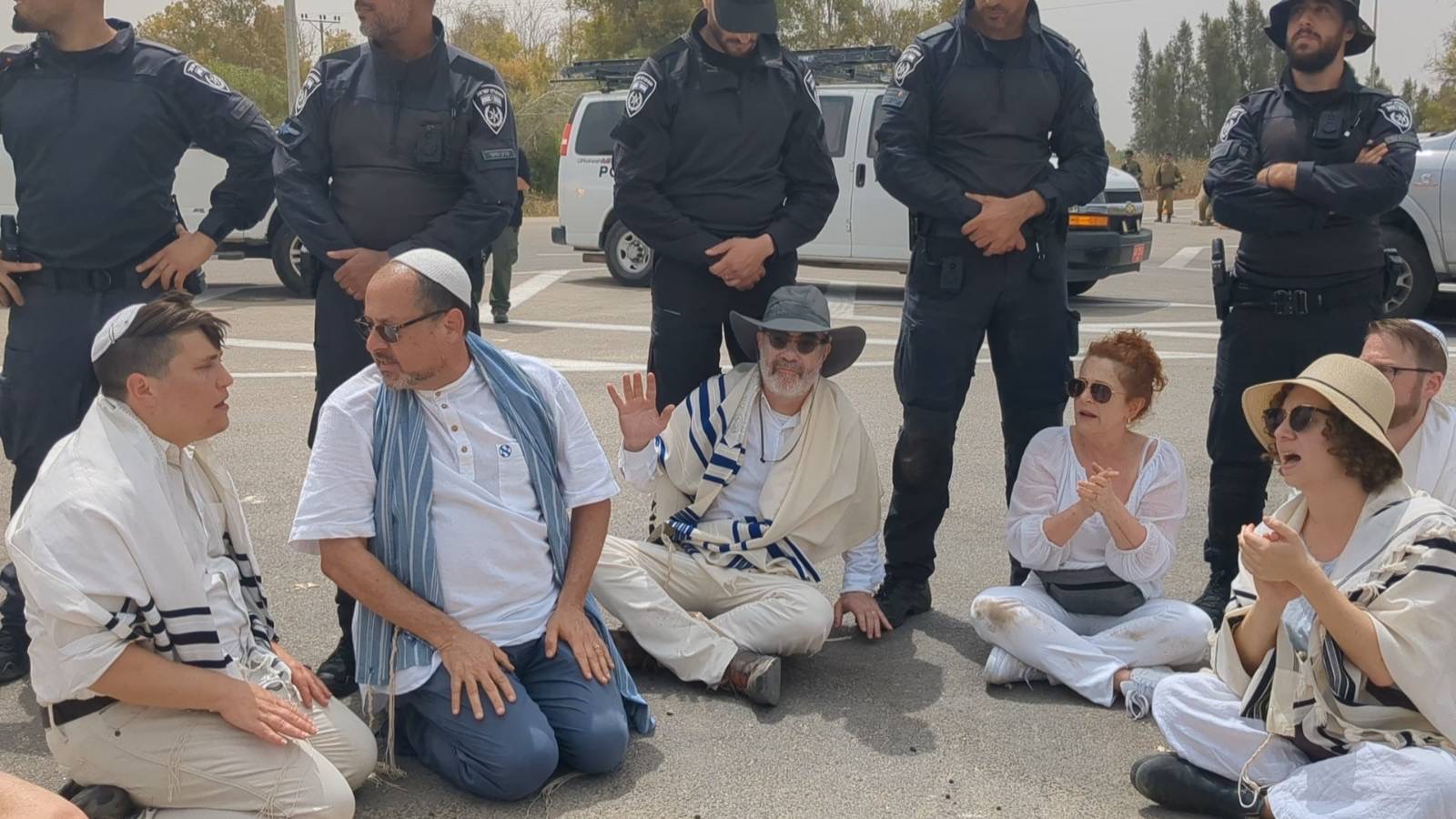
Other speakers included Israeli Rabbi Avi Dabush of Rabbis for Human Rights, a resident and survivor of a kibbutz that was attacked on October 7 and Noam Shuster-Eliassi, a well-known Israeli activist, writer and comedian. When our program was over, we pushed forward toward the border. When the soldiers violently attempted to break us up, several of us sat down in the road. During the course of the protest seven of our group: four Americans and three Israelis were arrested.

All of the arrested were fully prepared for this eventuality – the Israelis were in fact veterans at protest-arrests and had previously briefed us on protocol. They were taken to two dentention centers and interrogated for eight to nine hours. The American were told, perversely, that they were being held for “attempting to bring food into Gaza.” All the arrested were released that evening; thankfully the food we attempted to bring into Gaza was not confiscated; as we have previously planned, it was donated to the community of Masafer Yatta – an area in the South Hebron Hills were almost 3,000 residents are resisting the daily threat of demolitions, evictions and dispossession.

While we are satisfied with the attention our action has received, we have no illusions about the current moment in Gaza. Nearly 2.2 million Palestinians in Gaza currently face mass starvation and encroaching famine, these words have resonated with unbearably profound force during Passover this year. Hundreds of trucks filled with humanitarian goods have been sitting idle on roads leading into the Rafah crossing on the border with Egypt, blocked from entering Gaza by a draconian inspection process that severely limits the number of trucks that can pass through. Inside Gaza, the Israeli has been attacking efforts aid efforts with tragic results. According to the UN, the Israeli military has killed 196 relief workers; soldiers have also shot and killed hundreds of Gazans who venture out to seek food.

Amidst it all, the one agency that has the capacity and infrastructure to effectively distribute relief to the people of Gaza, the United Nations Relief and Works Agency (UNRWA), has been defunded by the Biden administration. This past January, the Israeli government leveled the still-unsubstantiated claim that 12 UNRWA employees were involved in Hamas’ October 7 attacks in Israel. Though UNRWA immediately fired the employees in question and launched an investigation, the US immediately withdrew their financial support of the agency, which was founded in 1949 to provide support to the hundreds of thousands of refugees created by the establishment of the state of Israel.

In its spending bill this past March, the US government extended its defunding of UNRWA for a year. Though the agency reports it has sufficient funds to operate until the end of May, its ability to operate in Gaza has already been gutted. Last month, Israel announced it would no longer approve UNRWA food convoys to the north of Gaza, where famine is the most. According to its report this month, the agency noted that “a total of 420 trucks food trucks were denied or impeded by Israeli authorities (during the month of March) …Gaza is on the brink of famine, with 1.1 million people—half of its population—experiencing catastrophic food insecurity due to the intense conflict and severe restrictions on humanitarian access.”

Most ominously, Israel continues to amplify its threats to invade Rafah, which would almost certainly result in massive human tragedy and the complete ethnic cleansing of Palestinians from Gaza. And yet, in the wake our action on the border, I continue to hold out hope. It is clear to me that our border-protest was part of something much larger: the dramatic rise in student resistance on college campuses throughout the US and unprecedented popular Palestine solidarity increasing around the world. For me, this moment expresses the core meaning of Passover powerfully than I have every experienced in my lifetime: in every generation, the cry of the oppressed demands to be heard.

This Passover, I also hold out hope from my own memory of meals in Gaza back in 2017. To be sure, AFSC’s Gaza staff has suffered terribly during this genocidal onslaught – and I’m sure the restaurants and neighborhoods where we enjoyed such delicious meals with our Gazan friends are no more. But I will never forget the tastes of the food that were so graciously served, as well as the communities in Palestine that they represent. And I am more convinced than ever that Israel cannot, try as it may, starve, bomb, or shoot away the Palestinian people’s love for their culture that is so deeply, fragrantly rooted in their homeland: In the words of El-Haddad:

Lately, I’ve been thinking about what I would go back to, and what I would find, if I returned to Gaza. Most of the landmarks have been destroyed. Gone too are many of the people I cherished. But … it feels like I am the torchbearer now, the family’s keeper of treasured recipes. Like Um Hani (Leila’s aunt, who was killed in an Israeli airstrike), I will cook and I will teach, connecting the next generation of Palestinians to our homeland.

Judaism Beyond Zionism: Toward a New Jewish Liturgy

Introduction

In the spring of 2015, I helped to establish a Jewish congregation, Tzedek Chicago, motivated in part by a desire to create a religious space for those in the Jewish community who did not consider themselves to be Zionists. The founders of the congregation articulated this intention openly, in a core value we called “Judaism Beyond Nationalism:”

While we appreciate the important role of the land of Israel in Jewish tradition, liturgy and identity, we do not celebrate the fusing of Judaism with political nationalism. We are non-Zionist, openly acknowledging that the creation of an ethnic Jewish nation state in historic Palestine resulted in an injustice against its Indigenous people – an injustice that continues to this day.

In the contemporary Jewish community, of course, identification with the Zionist narrative has become the sine qua non of Jewish identity. While it is beyond the scope of this essay to analyze the process by which Zionism – a 19th century European nationalist ideology that represented a radical departure from traditional Judaism – became normalized in the American Jewish community, it is fair to say that since the founding of the state of Israel, Zionism has become thoroughly enmeshed in the culture of American Jewish life.

There are signs, however, that the linkage between Zionism and Judaism has begun to loosen in the Jewish community – particularly among younger Jews. According to a widely read 2013 Pew Research Center Study, 27% of American Jews aged 18 to 29 do not feel “very attached” to Israel and another 11% feel “not at all attached.” In a 2017 study commissioned by the Jewish Community Federation of San Francisco reported that among Bay Area Jews, 22 % of the respondents reported that a Jewish state’s existence is “not important” or were “not sure.”

Beyond individual attitudes, the nascent beginnings of a “Judaism beyond Zionism” are organically developing outside the bounds of the Jewish communal establishment. As Atalia Omer has written,” we are witnessing the emergence of a “grassroots movement that seeks…to transformatively reimagine American Jewish identity outside the Zionist paradigm.” 1 Though still a distinct minority, the growth of American Jewish organizations such as Jewish Voice for Peace, #IfNotNow, the Center for Jewish Nonviolence and Open Hillel attest to burgeoning desire for a Judaism that unabashedly challenges Jewish communal support for Israel’s occupation – and in some cases, the very concept of Jewish statehood itself. 2

Another important indication of this shift occurred when Jewish Voice for Peace – an organization that promotes Jewish solidarity with Palestinians and “unequivocally opposes Zionism” – broadened its mission to include the goal of “Jewish Communal Transformation.” In 2011, JVP created its Rabbinical Council to provide “a prophetic Jewish voice inside the Palestine solidarity movement (and) create meaningful ritual, tradition and culture accessible to our growing membership.” JVP subsequently established its own Havurah Network, which it described as “an emergent network that gathers, supports and resources anti-zionist, non-zionist and diasporist Jews and Jewish spiritual communities across the country yearning for a vibrant Jewish life beyond nationalism that condemns and challenges white supremacy within and outside Jewish communities.”

1 Atalia Omer, Days of Awe: Reimagining Judaism in Solidarity with Palestinians, Chicago: University of Chicago Press, 2019, p. 68.

2 Another important sea change occurred in July 2020, when prominent Jewish journalist Peter Beinart, a long-time Liberal Zionist, wrote the New York Times op-ed, “I No Longer Believe in a Jewish State.”

Jewish Diasporism

This newly emergent Judaism beyond Zionism is increasingly being described in positive terms as Jewish diasporism. While this term may seem redundant, we cannot underestimate the extent to which the importance of the Jewish diaspora 3 has been undermined in the era of Zionism. In an age when the idea of Jewish statehood has become thoroughly normalized, however, it is well worth remembering that Rabbinic Judaism originally emerged as a spiritual response to the experience of Jewish dispersion. 

Before the destruction of the Second Temple in 70 ACE, Judaism was a land-centered, Temple-based sacrificial system that was splintering into several competing sects. When the Temple was destroyed and the center of Jewish life shifted from land to diaspora, the rabbis adapted to this new reality accordingly, developing a religious system that could be observed anywhere in the world.

In truth, thriving Jewish diaspora communities existed well before the destruction of the Temple. When Cyrus the Great allowed the exiled Jewish community of Babylon to return to the land in 538 BCE, scores remained in Persia where they enjoyed relative economic stability, “unswayed by the promises of a distant homeland they had never seen.” 4 There were also significant diaspora Jewish communities throughout the Hellenistic world. Between the third century BCE and the end of the first century CE, Alexandria, Egypt became one of the most populous Jewish communities in the world, numbering at least several hundred thousand.

Judaism’s foundational Jewish text – the Talmud – was itself composed and compiled in Babylonia. In a similar way, the myriad of lands in which Jews have lived have provided fertile soil for Jewish spiritual creativity throughout the centuries. Indeed, the most important Jewish religious figures clearly reflect their specific cultural time and place: the great 10th century Jewish philosopher Saadia Gaon, the founder of Judeo-Arabic literature, integrated Jewish theology with the Hellenistic Greek philosophy of his day; Maimonides’ classic philosophical treatises were deeply influenced by the neo-Aristotelian philosophy of medieval Spain; Franz Rosenzweig’s work clearly reflects the ideas of modern German liberalism.

This is not to say that the land of Israel ceased to become important in Jewish tradition. The symbolism of the major Jewish holidays is deeply rooted in the seasonal/agricultural rhythms of the land. A great deal of rabbinic debate in classical Jewish writings focused on how Biblical laws specifically pertaining to the land might be observed in a diasporic setting. There was also extensive theological speculation as to whether or not the land itself was inherently holy or whether it’s holiness derived from the commandments that were fulfilled there. 5

The rabbis also debated whether or not it was a mitzvah (religious obligation) for individual Jews to emigrate to the land. 6 At the same time, however, rabbinic authorities were virtually united in their opposition to the political reestablishment of a Jewish commonwealth. While a yearning for the restoration of Zion is undeniably central to rabbinic Judaism, this ideal was expressed within a decidedly messianic context. Jewish tradition is replete with strong warnings against the creation of a sovereign Jewish state via human agency. 7

When political Zionism arose in the 19th century, it consciously sought to overturn the diasporic focus of Jewish life. A central Zionist dictum known as shlilat hagalut (“negation of the diaspora”) viewed the diaspora as an inherently inhospitable place for Jews; only through the establishment of a Jewish state in their “ancient homeland” would the Jewish people normalize and safeguard their existence among the nations.

Many classical Zionist figures were so vehement in their rejection of the diaspora that their descriptions of European Jewry reflected a palpable sense of internalized antisemitism. Zionist writer/journalist Micha Josef Berdichevski opined for instance, that the Jews of the pale were “not a people, not a nation, not human.” 8 Hebrew poet/author Joseph Chaim Brenner called diaspora Jews “Gypsies and filthy dogs” 9 and the Labor Zionist icon A.D. Gordon wrote that diaspora Jewish life was the “parasitism of a fundamentally useless people.” 10 The views of Revisionist Zionist founder Vladimir Ze’ev Jabotinsky, who was clearly influenced by European fascist ideology, infamously referred to religious diaspora Jews as “ugly, sickly Yids” and Zionist settlers as “Hebrews.” 11

Now six decades after the founding of the state of Israel, however, it might be claimed that the Jews who live there are experiencing a new form of exile. 12 On the eve of its establishment, the celebrated Jewish German political theorist Hannah Arendt presciently warned that the new Jewish state would be “secluded inside ever-threatened borders, absorbed with physical self-defense to a degree that would submerge all other interests and activities.” 13 Today, Israel is one of the most militarized nations in the world, a virtual garrison state with a traumatized national culture. More tragically, the movement that ostensibly sought to end Jewish exile ended up exiling another people in the process. The state of Israel was created through the expulsion of the Palestinians, who today live under military occupation, as second-class citizens in their own land, or else in a diaspora of their own – as refugees or citizens of other countries – and are forbidden to return to their homes.

The Jewish population of the world is currently split almost in half between Israel and the diaspora. Where does this leave those in the diaspora who choose not to center our Judaism on the state of Israel; who refuse to celebrate a Judaism that glorifies ethnic Jewish nation-statism? Is there a place for Jews who want to celebrate the diaspora as dynamic and fertile ground for a new kind of Judaism? One that embraces Jewish existence among diverse nations as a multi-ethnic, multi-racial peoplehood? One that advocates for the universal redemption of all peoples?

Over the past two decades, prominent Jewish scholars have been reclaiming and reframing the concept of Jewish diaspora in compelling ways. Melanie Kaye Kantrowitz, for instance, has advocated a conscious celebration of the diaspora as part of a larger project of Jewish empowerment:

Celebrating dispersion, Diasporism challenges the Edenic premise: once we were gathered in our own land, now we are in exile. What if we conceive of diaspora as the center: an oxymoron, putting the margin at the center of the circle that includes but does not privilege Israelis?… Jews worldwide number only about 13.3 million, a tiny minority except in Israel. Diasporism means embracing this minority status, leaving us with some tough questions: Does minority inevitably mean feeble? Can we embrace diaspora without accepting oppression? Do we choose to be marginal? Do we choose to transform the meaning of center and margins? Is this possible? 14

Daniel Boyarin has argued that the Babylonian Talmud itself is a “diasporist manifesto,” imagining its own community and sense of portable homeland:

The Talmud in its textual practices produces Babylonia as a homeland, and since this Babylonia is produced by a text that can move, that homeland becomes portable and reproduces itself over and over. The Talmud, I would submit, is not only the only classical work of the rabbinic period produced outside the Land of Israel; it is a diasporist manifesto, Diasporist Manifesto Number 1. 15

More recently, Susannah Heschel has suggested the concept of diaspora as a prophetic alternative to the traditional Jewish “embrace of exile:”

As prophetic, the diasporic Jew is never entirely at home, never content or complacent in a world of injustice. Diaspora transforms exile into Jewish creativity, as has happened for over two millennia. The prophet is a diasporic exemplar, leaving home and journeying to the urban seat of the political, military, and economic power to demand an end to corruption, exploitation, cruelty, and indifference. The prophetic position cannot exist by trying to end exile with statehood or by embracing exile as the essential mentality of Jewishness. To abandon diaspora in favor of exile is to walk away from the prophetic; to reject exile while embracing diaspora is to retain the prophetic passion for justice.

In short, we are currently witnessing the emergence of a new Jewish diasporism: one that neither stigmatizes existence outside the land nor romanticizes the experience of exile, but rather seeks to center the diaspora as the essential locus of Jewish life, creativity and purpose.

3 While I use the term “Jewish diaspora” here for the sake of clarity, it might be more accurate to refer to Jewish “diasporas,” as Jewish life throughout the world has existed in very different social, cultural and political milieus and throughout unique, distinct periods of world history.

4 H.H. Ben-Sasson, A History of the Jewish People, Cambridge: Harvard University Press, 1976, p. 168.

5 See Mishnah Kelim 1:6: “What is the nature of (the land’s) holiness? That from it are brought the omer, the firstfruits and the two loaves, which cannot be brought from any of the other lands.”

6 From Talmud Ketubot 110a: “Whoever lives outside of Israel may be regarded as one who worships idols.” From Ketubot 111a: “Whoever returns from Babylon to Israel transgresses a positive commandment of the Torah.”

7 The classic rabbinic prohibition against reestablishing the Jewish commonwealth before the coming of the Messiah is known as the “Three Oaths.” See Babylonian Talmud, Ketubot 110b, Shir Hashirim Rabbah, 8:11.

8 Walter Laqueur, A History of Zionism: From the French Revolution to the Establishment of the State of Israel, New York: Schocken, 1972, p. 61.

9 IBID.

10 IBID.

11 Alan Wolfe, At Home in Exile: Why Diaspora is Good for the Jews, Boston: Beacon Press, 2014, p. 17. For more on Zionist ideals of Jewish masculinity, see Daniel Boyarin, Unheroic Conduct: The Rise of Heterosexuality and the Invention of the Jewish Man, Berkeley: University of California Press, 1997.

12 See Raz-Krakotzkin, Amnon, Exile Within Sovereignty: Critique of “The Negation of Exile” in Israeli Culture, from “The Scaffolding of Sovereignty: Global and Aesthetic Perspectives on the History of a Concept,”edited by  Zvi Ben-Dor Benite, Sefanos Geroulanos, Nicole Jerr, pp. 393-420, New York, Columbia University Press, 2017.

13 Hannah Arendt, The Jewish Writings, New York: Schocken, 2007, p. 396.

14 Melanie Kaye Kantrowitz, The Colors of Jews: Racial Politics and Radical Diasporism, Indiana: Indiana University  Press, 2007, p. 200.

15 Daniel Boyarin, A Traveling Homeland: The Babylonian Talmud as Diaspora, Philadelphia: University of Pennsylvania Press, 2015, p. 32.

Jewish Diasporism at Tzedek Chicago

Since its founding, Tzedek Chicago has become a practical laboratory for the development of this new Jewish diasporism, particularly through the creation of rituals that explicitly celebrate the idea of “diaspora as homeland.”

During the holiday of Sukkot, for instance, instead of the traditional lulav and etrog – the four species native to the Biblical land of Israel – we use symbolic species indigenous to the prairie of the Midwestern United States. 16 We are exploring diasporist approaches to other Jewish holidays as well. On the festival of Tu B’shvat, which typically falls in late January/early March, I offered this teaching to the Tzedek Chicago community:

In the land of Israel, the “harbinger of Spring” festival of Tu B’shvat is marked at this time of year by the blossoming of the white almond blossoms through the central and northern parts of the land. However, those of us who live in the diaspora of the American Midwest, often celebrate Tu B’shvat surrounded by several inches of white snow and leafless trees. Is this any way to celebrate a harbinger of Spring?

I’ll suggest that it is. I actually find it very profound to contemplate the coming of Spring in the depths of a Chicago winter. It reminds me that even during this dark, cold season, there are unseen forces at work preparing our world for renewal and rebirth. Deep beneath the ground, the sap is beginning to rise in the roots of our trees – although this fructification process might not be as visually spectacular as the proliferation of white almond blossoms exploding across the countryside, I believe this invisible life-giving energy is eminently worth acknowledging – and celebrating.

It is true, of course, that the Biblical land of Israel was central to Judaism centuries before the ideology of political Zionism emerged. As such, some might well claim that the decentering of land-based symbolism represents a kind of “radical surgery” to Jewish tradition. If, as I noted above, Judaism originally spiritualized the concept of homeland, might we still retain its land-centric aspects for their symbolic, mythic power?

Such a question fails to confront the radical way Zionism has transformed Judaism itself and how deeply it has influenced Jewish attitudes toward the diaspora. Just as radically, diasporic Judaism seeks to re-right this imbalance by lifting up and centering the idea of Jewish home wherever we happen to live in the world. In Kaye Kantrowitz’s words, “Where Zionism says go home, Diasporism says we make home where we are.” 17 For those of us who affirm that the entire world is and has been our actual Jewish homeland, these new, reframed rituals seek to celebrate the Jewish people’s adaptability – and the unique nature of the homes we have created for ourselves throughout the diaspora.

Another, related issue is the concept of “Zion” itself, an idea that is undeniably, indelibly imprinted upon Jewish tradition and Jewish liturgy. How might a diasporic Judaism understand this concept, whose meaning has been thoroughly literalized by political Jewish nationalism?

As stated above, the idea of the Jewish return to Zion was traditionally understood in messianic terms. This belief is particularly embodied in the concept of kibbutz galuyot (“ingathering of exiles”), which emerged during the Babylonian exile as expressed in the Biblical books of Isaiah, Jeremiah and Ezekiel. 18 In Jewish liturgy, this concept is prominent in a number of prayers, including the Daily Amidah and Ahavah Rabbah (“Abounding Love”), a prayer that is traditionally read before the Shema during the morning service and ends with the line, “May we be glad, rejoicing in your saving power, and may you reunite our people from all corners of the earth, leading us proudly to our land.”

Zionism lifted kibbutz galuyot out of its messianic context and reframed it in explicitly nationalist terms. It is notably referenced in Israel’s Declaration of Independence as well as the Prayer for the Welfare of the State of Israel, both written in 1948 to explicitly celebrate the literal “exilic ingathering” of modern Jewry to the state of Israel. The Zionist interpretation of kibbutz galuyot has been internalized in American Jewish life as well. In many synagogues, for instance, it is even customary to sing the line “may you reunite our people” in the Ahavah Rabbah prayer to the melody from Hatikvah – the Israeli national anthem.

How might kibbutz galuyot be reimagined in a diasporist context? At Tzedek Chicago, our version of Ahavah Rabbah is rendered thus, “May it lead us toward your justice, toward liberation for all who dwell on earth; that all who are exiled and dispossessed may safely find their way home.” Our new reading replaces Jewish particularism and exceptionalism with a universalist, decolonial ethic. As such, it is neither messianic nor Zionist. In this post-modern diasporist reimagining, Zion is not unique to the Jewish people and does not exist in any particular place. So too, kibbutz galuyot does not refer to the Jewish exiled alone but to all who have been – or continue to be – dispossessed throughout the world.

16 In 2018, a small group of radical Jews published a zine that offered “reflections, tips, and resources about creating your own diasporic lulav,” explaining, “Our lulavs – both the ritual object and the ritual acts – are situated in diaspora, and explicitly reject the colonization of Palestine and the mandate to use the “four kinds” (“arbah minim”) of plants associated with the biblical Land of Israel.”

17 Kantrowitz, p. 199.

18 See Isaiah 11:12; 27:13; 56:8, 66:20, Jeremiah 16:15; 23:3, 8; 29:14; 31:8; 33:7 and Ezekiel 20:34, 41; 37:21. The term itself was coined in the Talmud (see Babylonian Talmud, Megillah 12a) and was later connected to the coming of the Messiah by Moses Maimondies (see Mishneh Torah, “Laws of Kings,” 11:1-2).

Jewish Anti-Militarism

In addition to re-centering diaspora, any attempt at promoting a Judaism Beyond Zionism must reckon seriously with the culture of militarism that thoroughly pervades the ideology of Zionism and Israeli society. As Rabbi Lynn Gottlieb has pointed out, “During the past sixty years, the assumption that a highly militarized Jewish state ensures Jewish security has become entrenched as an article of faith… To critique Israeli militarism is to critique Zionism in the minds of many contemporary Jews.” 19

Prior to the onset of Zionism, Jewish tradition promoted nonviolence and quietism over the glorification of war, 20 a doctrine generally traced to the aftermath of the Bar Kochba rebellion (132-135 CE). As Reuven Firestone has written, in the wake of this catastrophic event, “Jewish wisdom would teach that it is not physical acts of war that would protect Israel from its enemies, but rather spiritual concentration in righteousness and prayer.” 21

The rabbis were also painfully aware that the Hasmonean revolt centuries earlier had ended disastrously for the Jewish people. This uprising, chronicled in the Books of the Maccabees and commemorated by the festival of Hanukkah, was waged by the Maccabees, a priestly family who led a rebellion against the religious persecution of the Seleucid empire. Their victory resulted in the establishment of the Hasmonean Kingdom – the second Jewish commonwealth – in Palestine in 164 BCE. 

The militarism of the Hasmoneans however, would eventually prove to be its downfall. Following the Maccabean victory, their brief period of independence was wracked by internecine violence, anti-rabbinic persecution and ill-advised wars of conquest against surrounding nations. In 63 BCE, the Hasmonean Kingdom was conquered by the Romans (with whom they had previously been allied). In the end, the last period of Jewish political sovereignty in the land lasted less than one hundred years. 22

The rabbis of the Talmud were loath to glorify the Books of the Maccabees – secular stories of a violent civil war that were never actually canonized as part of the Hebrew Bible. In fact, the festival of Hanukkah is scarcely mentioned in the Talmud beyond a brief debate about how to light the Hanukkah menorah and a legend about a miraculous vial of oil that burned for eight days. 23 Notably, the rabbis chose the words of Zechariah 4:6, Not by might and not by power, but by my spirit, says the Lord of Hosts to be recited as the prophetic portion for the festival.

Hanukkah remained a relatively minor Jewish festival until it was revived by early Zionists and the founders of the state of Israel, who fancied themselves as modern-day Maccabees engaged in their own military struggle for political independence. At the end of his book, The Jewish State, Zionist movement founder Theodor Herzl famously wrote, “The Maccabees will rise again!” 24 Even today, the celebration of the Maccabees as Jewish military heroes is deeply ingrained in Israeli culture.

This Zionist sacralizing of militarism and conquest represented a radical overturning of these central tenets of traditional Judaism. The term kibush ha’aretz (“conquest of the land”) was one of the terms used by Zionist settlers to describe their colonization of Palestine. 25 As noted above, many Zionist ideologues promoted the ideal of the muscular, heroic “New Jew” in contrast with Diaspora Jewry. Zionists were also instrumental in helping to form the Jewish Legions that fought against the Ottomans in Palestine in World War 1. During the British Mandate, Zionists created armed militias such as the Haganah (which later became the Israeli Defense Force after the founding of the state) as well as the more militant Irgun and Lehi.

In 1948-49, during what Jewish Israelis refer to as their War of Independence and Palestinians call the Nakba (the “catastrophe”), these armed forces engaged in the widespread ethnic cleansing of Palestinians from villages and cities throughout Palestine. Notably, these military operations often used names associated with Biblical history and Jewish religious tradition. For instance, a joint force of the Haganah and Irgun dispossessed 61,000 Palestinians from Haifa on eve of Passover 1948, in a campaign known as “Operation Biur Chametz,” (“Operation Cleaning Out the Leaven”) – a reference to the commandment to remove leaven from Jewish homes before the onset of the festival. 26 Another campaign, waged in the southern Negev desert and the coastal plain was given the name “Operation Ten Plagues.” 27

The Zionist movement and the fledgling state of Israel notably looked to the Biblical conquest tradition – and in particular, the Book of Joshua – as a model for its own conquest of historic Palestine. Though largely secular, Israel’s founders utilized the Bible as a canvas for promoting a national myth of a glorious military past. As scholar Nur Masalha has pointed out, “The Book of Joshua provided Ben-Gurion, Jabotinsky and muscular Zionism with the militaristic tradition of the Bible: of military conquest of the land and subjugation of the Canaanites and other ancient people that populated the ‘promised land.” 28 Ben Gurion himself viewed the book of Joshua as the most important book of the Bible; in 1958 he convened a study group at his home where Israeli generals, politicians, and academics discussed the book of Joshua against the founding of the modern state of Israel. 29

19 Lynn Gottlieb, Trail Guide to the Torah of Nonviolence, France: Earth of Hope Publishing, 2013, p. 19.

20  Reuven Firestone, Holy War in Judaism: The Fall and Rise of a Controversial Idea, New York: Oxford University Press, 2012.

21 IBID, p. 62.

22 For more on the history of the Hasmonean Kingdom, see Kenneth Atkinson, A History of the Hasmonean State: Josephus and Beyond, London: T&T Clark, 2016.

23 See Babylonian Talmud, Shabbat 21b.

24 Arthur Hertzberg, ed., The Zionist Idea, Canada: Atheneum, 1959, p. 225.

25  Firestone, pp. 181-182.

26  Benny Morris, The Birth of the Palestinian Refugee Problem Revisited, Cambridge: Cambridge University Press, 2004, pp. 186-211.

27  IBID, p. 462.

28 Nur Masalha, The Bible and Zionism: Invented Traditions, Archaeology and Post-Colonialism in Israel-Palestine, London: Zed Books, 2007, p. 24.

29 See Rachel Haverlock, The Joshua Generation: Israeli Occupation and the Bible, Princeton: Princeton University Press, 2020.

Jewish Anti-Militarism at Tzedek Chicago

At Tzedek Chicago, our core values clearly and unabashedly condemn the glorification of war and violence. This is both a return to the traditional rabbinic approach as well as step beyond it. Our vision of Jewish nonviolence does not emerge from quietism but rather from the value of solidarity: the conviction that security for Jews is irrevocably bound up with security for all.

As we state in our core values:

In our education, celebration and communal observances, we honor those aspects of our tradition that promote peace and reject the pursuit of war as a solution to our conflicts. We openly disavow those aspects of our religion – and all religions – that promote violence, intolerance and xenophobia.

Our activism is based upon a vision of shared security for the world; we support the practices of nonviolence, civil resistance, diplomacy and human engagement. Through our advocacy, we take a stand against militarism and colonialism, particularly when it is waged in our name as Jews and Americans.

Liturgically, we express this value in a variety of ways. For instance, in our poetic rendering of the prophetic portion for Hanukkah (Zechariah 2:14-4:7), the rededication of the Temple by the Maccabees is reframed as a dedication to ideals of nonviolence and justice for all people:

Let loose your joy for
your prayers have
already been answered;
even in your exile
the one you seek has been
dwelling in your midst
all along.

Quiet your raging soul
and you will come to learn:
every nation is my nation
all peoples my chosen
anywhere you choose to live
will be your Holy Land,
your Zion, your Jerusalem.

Open your eyes and
look across the valley
look at this ruined land
seized and possessed
throughout the ages.

Look upon your
so-called city of peace
a place that knows
only debasement
and desecration
at your hand.

Turn your gaze to the heavens
and there you will find
the Jerusalem that you seek:
a city that can never be conquered,
only dreamed of, yearned for, strived for;
a Temple on high that can never be destroyed.

No more need for priestly vestments
or plots to overrun that godforsaken mount –
just walk in my ways
and you will find your way there:
a sacred pilgrimage to the Temple
in any land you call home.

Enter the gates to
this holiest of holy places,
lift up its fallen walls,
relight the branches of the lamp
so that my house will truly
become a sanctuary
for all people.

Yes, this is how you will
restore the Temple:
not by might, not by power
but by the spirit
you share with every
living, breathing soul.

These values are also reflected in our Prayer for Reparation and Restoration. which we read in lieu of the congregational Prayer for Peace or Prayer for the Welfare of the Government. (Compare our prayer below for instance, with the Reform Movement’s “Prayer for Peace and Strength:”)

To the One who demands justice:
inspire us to become rodfei tzedek,
pursuers of justice
in our lives and in our communities.

Give us the strength to resist power
wielded with fear and dread;
fill us with the vision and purpose
to build a power yet greater,
a power rooted in solidarity,
liberation and love.

Grant us the courage to dismantle
systems of oppression –
and when they are no more,
let us dedicate our wealth and resources
toward the well-being of all.

May we abolish all forms of state violence
that we might make way for a world
free of racism and militarization,
a world where no one profits
off the misery of others,
a world where the bills owed those who have been
colonized, enslaved and dispossessed
are finally paid in full.

Inspire us with the knowledge
that real justice is indeed at hand,
that we may realize
the world we know is possible,
right here, right now,
in our own day.

May our thoughts and our hopes,
our words and our deeds
guide us toward a future of reparation,
of restoration, of justice,
al kol yoshvei teivel
for all who dwell on earth,
amen.

As a response to the issue of domestic militarization, the prayer below was delivered at a Tisha B’Av vigil, co-sponsored by Tzedek Chicago, at an immigrant detention center in Kankakee, IL. The text is an adaptation from the Biblical book of Lamentations, traditionally read on the festival of Tisha B’Av:

We are beyond humiliation
beyond shame
we incarcerate children without pity
we deport parents without a thought
and build systems that destroy families indiscriminately
now we truly know what it means to be dishonored
our so-called glorious past is now seen
for the sham that it was
the way of life we celebrate is but a privilege
for the few and the powerful
we can’t see that our own might
will be our downfall.

We venerate leaders
who should be tried for their crimes
we never dared imagine a power
greater than our own
like so many before us
we conquered the land then drew borders
as a testament to our fear and dread
now we build higher walls
to keep out those who seek shelter
we built massive checkpoints
we lined up human beings
like cattle in cages
now children cry out for parents
who will never answer their calls
their voices echo endlessly
through the camps but there
is no one left to hear.

We ask one another with bewilderment
have we ever seen such cruel violations
yet in truth we ourselves have inflicted
such cruelties on children here
and around the world
we sentence minors to life in prison without parole
we remain silent as a cruel occupation
abducts and imprisons children in military prisons
convicts them in military courts
and yet we dare to act surprised when
we hear news of children thrown into cages
at our southern border.

Our silence betrays us
these walls will soon encircle us all
soon there will be no one left
only a single mass of mourners
whispering broken hymns of lament
grieving what was lost
and what might have been
one day we will know the sorrow
of the dispossessed.

We who never heard the cries of migrants
and their children will know what it means
to be uprooted detained and discarded
those who we scorned and abandoned
will bitterly welcome us to the world
of the dispossessed
the enemies we created
through our own fearful actions
will surely come back for us all.

Let us hope and pray
there is still time
let the cries of our children
pour into our hearts like water
the cries of any who have been forced
from their homes pursued
taken locked away sent away
anyone whose very lives are forbidden
forgotten forsaken
let their cries compel us
to take down oppressive systems
built by the powerful to maintain
the power of the powerful.

Let their cries remind us
that there is a power yet greater
that comes from a place that knows no borders
no deportations no barrier walls no prisons
no guards no soldiers no ICE no police
a place where we no longer need to struggle because
justice gushes forth like a mighty stream flowing freely.

From the sovereign beyond all sovereigns
we beseech you chadeish yameniu
renew our days
that we may build the world
that somehow still might be
kein yehi ratzon – may it be your will
and may it be ours.

Jewish Solidarity with Palestinians

At Tzedek Chicago, we understand solidarity with Palestinians not merely as a political position, but a sacred imperative. As we state in one of our core values, that “the creation of an ethnic Jewish nation state in historic Palestine resulted in an injustice against its indigenous people.” Accordingly, we reject the ways that the establishment of the state of Israel has become sacralized as redemptive in most American synagogues.30 Needless to say, for those Jews who consider the Nakba to be an historic – and ongoing – injustice, the birth of the Jewish state has a decidedly different religious meaning.

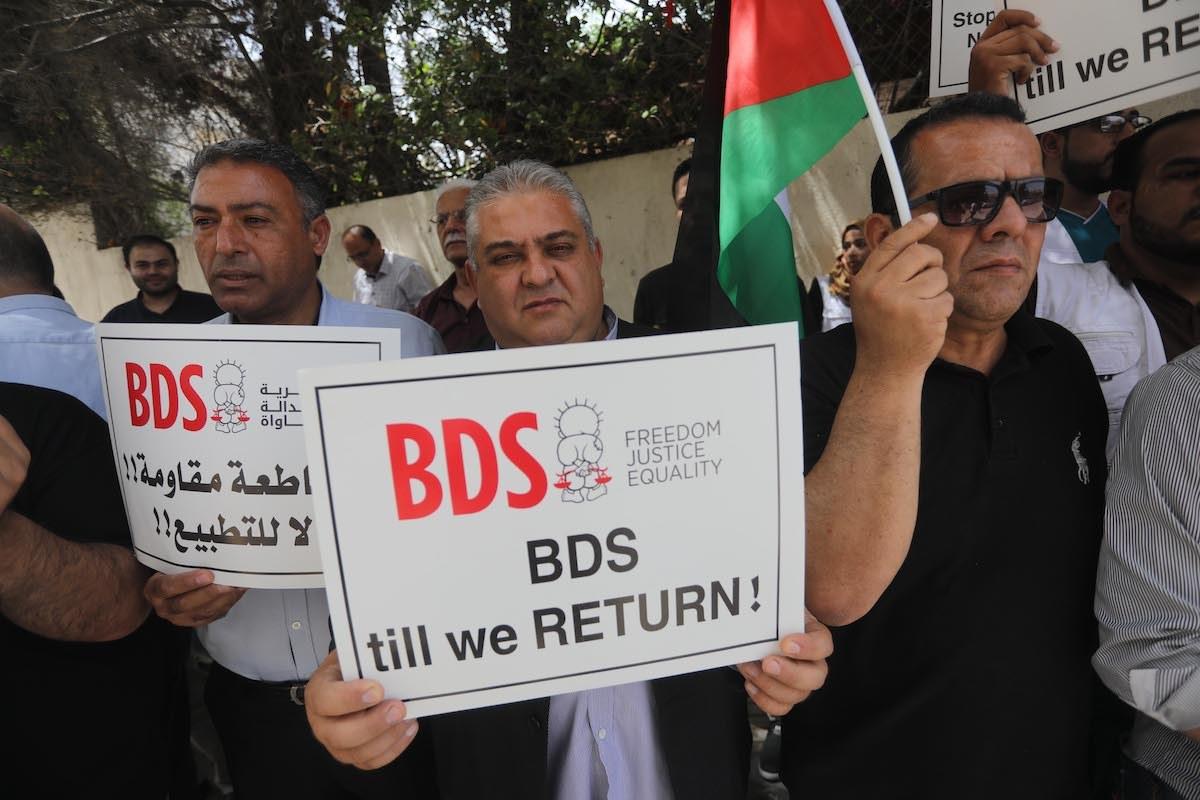
We express our sacred solidarity with Palestinians in a variety of ways. One Passover, for instance, we invited Omar Barghouti, co-founder of the Palestinian movement for Boycott, Divestment and Sanctions, to our congregation to speak about BDS as a liberation movement. In our advertising, we described the program thus: “Taking our cue from the season of Passover we will engage in a deep exploration of this important call for Palestinian liberation, and explore its profound challenge to all people of conscience.”

Tzedek Chicago also expresses Jewish solidarity with Palestinians through the use of sacred ritual. For instance, while most American synagogues celebrate Yom Ha’atzmaut (Israel Independence Day) as part of the Jewish religious calendar, we observe this occasion through our recognition of Nakba Day – the day Palestinians mark as the day of their catastrophic dispossession. In our “Jewish Prayer for Nakba Day” we use traditional Jewish liturgical/theological imagery to reflect our observance of this day as an occasion for mourning, remembrance and repentance:

Le’el she’chafetz teshuvah,
to the One who desires return:

Receive with the fulness of your mercy
the hopes and prayers of those
who were uprooted, dispossessed
and expelled from their homes
during the devastation of the Nakba.

Sanctify for tov u’veracha,
for goodness and blessing,
the memory of those who were killed
in Lydda, in Haifa, in Beisan, in Deir Yassin
and so many other villages and cities
throughout Palestine.

Grant chesed ve’rachamim,
kindness and compassion,
upon the memory of the expelled
who died from hunger,
thirst and exhaustion
along the way.

Shelter beneath kanfei ha’shechinah,
the soft wings of your divine presence,
those who still live under military occupation,
who dwell in refugee camps,
those dispersed throughout the world
still dreaming of return.

Gather them mei’arbah kanfot ha’aretz
from the four corners of the earth
that their right to return to their homes
be honored at long last.

Let all who dwell in the land
live in dignity, equity and hope
so that they may bequeath to their children
a future of justice and peace.

Ve’nomar
and let us say,
Amen.

Le’el she’chafetz teshuvah,
to the One who desires repentance:
Inspire us to make a full accounting
of the wrongdoing that was
committed in our name.

Help us to face the terrible truth of the Nakba
and its ongoing injustice
that we may finally confess our offenses;
that we may finally move toward a future
of reparation and reconciliation.

Le’el malei rachamim,
to the One filled with compassion:
show us how to understand the pain
that compelled our people to inflict
such suffering upon another –
dispossessing families from their homes
in the vain hope of safety and security
for our own.

Osei hashalom,
Maker of peace,
guide us all toward a place
of healing and wholeness
that the land may be filled
with the sounds of joy and gladness
from the river to the sea
speedily in our day.

Ve’nomar
and let us say,
Amen.

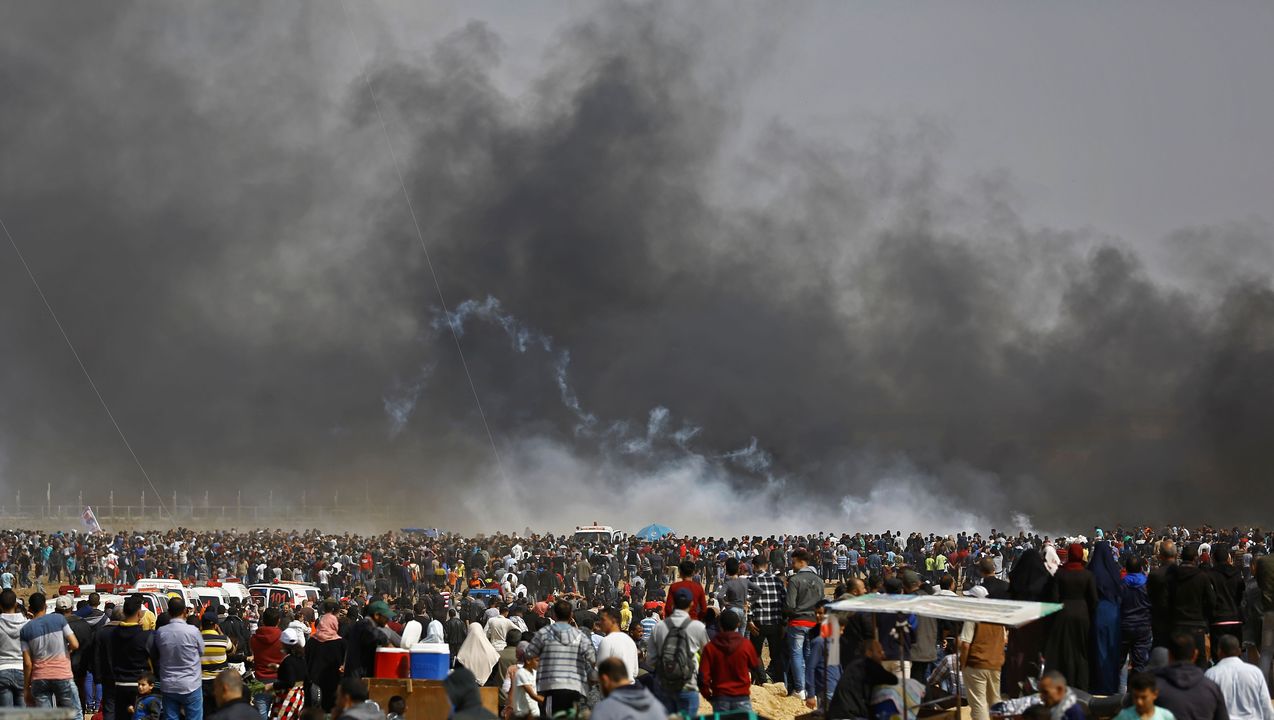
In another example of communal Palestinian solidarity, we dedicated a portion of our 2018 Yom Kippur Service to the Palestinians who were then being killed weekly by the Israeli military in Gaza’s Great Return March. In the introduction to this ritual, we stated:

 It is traditional at the end of the Yom Kippur morning service to read a Martyrology that describes the executions of ten leading rabbis, including Rabbi Akiba, Rabbi Shimon ben Gamliel and Rabbi Yishmael, who were brutally executed by the Roman Empire. This liturgy is included to honor those who have paid the ultimate price for the cause of “Kiddush Hashem” – the sanctification of God’s name.

At Tzedek Chicago, we devote the Yom Kippur Martyrology to honor specific individuals throughout the world who have given their lives for the cause of liberation. As we do, we ask ourselves honestly: what have we done to prove ourselves worthy of their profound sacrifices? And what kinds of sacrifices will we be willing to make in the coming year to ensure they did not die in vain?

This year, we will dedicate our Martyrology service to the Palestinians in Gaza who have been killed by the Israeli military during the Great Return March. This nonviolent demonstration began last spring with a simple question: “What would happen if thousands of Gazans, most of them refugees, attempted to peacefully cross the fence that separated them from their ancestral lands?”

Since the first day of the march last spring, demonstrators have consistently been met by live fire from the Israeli military. To date, 170 Palestinians have been killed and tens of thousands wounded and maimed, most of them unarmed demonstrators, including children, medics and bystanders.

30 This sacralization is reflected in a myriad of ways, whether it be through the placement of the Israeli flag next to the ark containing the sacred scrolls of the Torah, the regular recitation of the “Prayer for the State of Israel” (which refers to its establishment as “the first flowering of our redemption,”) or the celebration of Yom Ha’atzmaut (Israeli Independence Day) alongside traditional Jewish festivals.

Decolonial Judaism

As we have explored the meaning of Judaism beyond Zionism, we have quickly come to realize that many of these issues are rooted in more foundational concerns. For instance, we cannot interrogate the meaning of the Jewish diaspora without also understanding the diasporas of other transnational and/or dispossessed peoples. As we grapple with issues of militarism we must invariably confront the connections between state violence and structural racism. Solidarity with Palestinians cannot be viewed in isolation from the larger legacy of settler colonialism and the dispossession of Indigenous Peoples in the US and around the world.

These connections have, in turn, given rise to critical questions, such as:

• In North America, white Jews are participants in the ongoing colonization of stolen land. How can we celebrate diaspora in a way that respects the land upon which we live and the Indigenous Peoples for whom it remains sacred? 

• In the United States, 12 to 15% of the American Jewish community are Jews of color, many of whom have their own history of colonization and enslavement. How will white Jews center their experience and stand down the culture of White supremacy in the American Jewish community? 

• If we view atonement as a sacred imperative, how can we, as a Jewish congregational community advocate and participate in a process of reparations and rematriation for the members of Indigenous Nations and descendants of enslaved people? 

As a response to questions such as these, Tzedek Chicago has convened an internal task force “to explore how Tzedek as a community can best participate and support reparative justice efforts, especially regarding the harms of slavery and colonization.” We are also exploring ways to address these questions through Jewish ritual. In 2019, for instance, we celebrated a Sukkot festival celebration jointly sponsored with Chi-Nations Youth Council – a Chicago-based group that organizes on behalf of Native Youth in the region. Our celebration included the prayer, “Earth Shema,” written for Tzedek Chicago by poet/liturgist Aurora Levins Morales:

There is no earth but this earth and we are its children.  The earth is our home, and there is only one.  The ground beneath our feet was millions of years in the making. Each leaf, each blade, each wing, each petal, each hair on the flank of a red fox, each scale on the sturgeon, each mallard feather, each pine needle and fragment of sassafras bark took millions of years to become, and we ourselves are millions of years in the making.

The earth offers itself and all its gifts freely, offers rain and sunlight, and the shimmer of moon on its lakes, offers corn and squash, apples and honey, salmon and lamb, and clear, cold water and all it asks in return is that we love it, respect its ways, cherish it.

We shall love the earth and all that lives with all our hearts, with all our souls, with all our intelligence, with all our might.   

Wherever we walk, wherever we sleep, wherever we eat, wherever we pray upon the face of the earth, we shall uphold the first peoples of that place, those who have loved it longest and know its ways most deeply.  We shall listen to them, learn from them, follow their lead, defend them, and join with them to protect each other and our world, and of every two grains in our bowls, we will give one to the first peoples who sit beside us at the earth’s table. 

The names of those who were here before us are syllables of the earth’s name, so know them and speak them, and speak the first names for the places where you dwell, the water you drink, the winds that bring you breath.  Say the name of this place, which is Shikaakwa, and say the names of its people: Myaamiaki, Illiniwek who are also the Inoca, the Asakiwaki and Meskwaki, people of the yellow earth and the red earth, the Hochagra, and the Bodewadmi who keep the hearth fires, for the land held many stories before we came and the places that were made for us were made by shattering their worlds.

Take to heart these words with which I charge you this day.  Cherish this land beneath your feet. Cherish the roots and the waterways, the rocks and trees, the ancestor bones in the ground and the people who dance on the living earth and make new paths with their feet, with their breath, with their dreaming.  Love and serve this world, this creation, as you love the creator who gifted it to us.  Defend it from those whose hunger for riches cannot be filled, who devour and destroy, bringing death to everything we love. 

Fight for the earth and protect it with all your heart and soul and strength, and hold nothing back, so that the rains fall in their season, the early rain and the late, and we may gather in the new grain and the wine and the oil, the squash and beans and corn, the apples and grapes and nuts, so that the grass grows high in the fields and feeds the deer and the cattle, so that the water flows clean in river and lake, filled with abundant fish, and birds nest among the reeds, and all that lives shall eat its fill. 

Do not be lured into the worship of consumption, comfort, convenience. Do not suck on the drinking straws of extraction, or bow down to the hoarders of what is good. For if we do, the breath of life that is in all things will empty the skies of clouds, and there will be no rain, and the earth will not yield its blessings, but will be laid waste.

So summon all the courage which is in you and in your people, stretching back to the dawn of time and remember this promise by night and by day, with every breath, whatever you are doing.  Let nothing stand in your way.  Put your hands into the soil of this moment and plant good seed that we and all our children may live long in the land and be a blessing. 31

31  This prayer was written as part of Morales’ Rimonim Liturgy Project, a network of which Tzedek Chicago is a participating member. Rimonim seeks the creation of new liturgies that reflect, among other things, “a full integration of the lives and experiences of Indigenous Jews and Jews of Color of all backgrounds, diaspora-centered Judaism that is rooted in global Jewish cultures, and explicitly replaces Zionist content in our liturgy… and acknowledgement and accountability to Indigenous peoples on whose land non-Indigenous Jews are settlers.”

 Conclusion

In her analysis of Tzedek Chicago, Omer referred to our congregation as a “prefigurative Jewish community.” 32 I believe this to be an extremely apt description: Tzedek Chicago is part of a nascent movement that is consciously attempting to build and model a future Jewish community guided by the transformative core values of justice that we hold sacred. In the end, however, it is not only the Jewish world we seek to transform – it is the world at large.

This idea is perhaps most prominently expressed during our Shabbat celebrations, when we liturgically welcome the Sabbath as a weekly taste of olam ha’ba (“the “world to come.”) 33 As opposed to the traditional messianic view of this concept, we define it as “the world as it should be” – i.e., the very real world of equity and justice for which we work and strive and struggle during the week. When Shabbat arrives, our liturgy provides us with the opportunity to experience this world, so that when Shabbat ends, we will be reinspired, replenished – and ready to continue the sacred work that will bring it that much closer to reality.

With this vision in mind, I will conclude with one final prayer – Tzedek Chicago’s poetic rendering of Psalm 92 (The Song for the Sabbath Day):

Tonight we raise the cup,
tomorrow we’ll breathe deeply
and dwell in a world
without borders, without limit
in space or in time,
a world beyond wealth or scarcity,
a world where there is nothing
for us to do but to be.

They said this day would never come,
yet here we are:
the surging waters have receded,
there is no oppressor, no oppressed,
no power but the one
coursing through every living
breathing satiated soul.

Memories of past battles fading
like dry grass in the warm sun,
no more talk of enemies and strategies,
no more illusions, no more dreams, only
this eternal moment of victory
to celebrate and savor the world
as we always knew it could be.

See how the justice we planted in the deep
dark soil now soars impossibly skyward,
rising up like a palm tree,
like a cedar, flourishing forever
ever swaying, ever bending
but never breaking.

So tonight we raise the cup,
tomorrow we’ll breathe deeply
to savor a world recreated,
and when sun sets once again
we continue the struggle.

32  Omer, p. 155.

33  From the Babylonian Talmud, Berachot 57b: “Shabbat is one sixtieth of the world to come.”
Interregnum: Sermon for Yom Kippur 5781

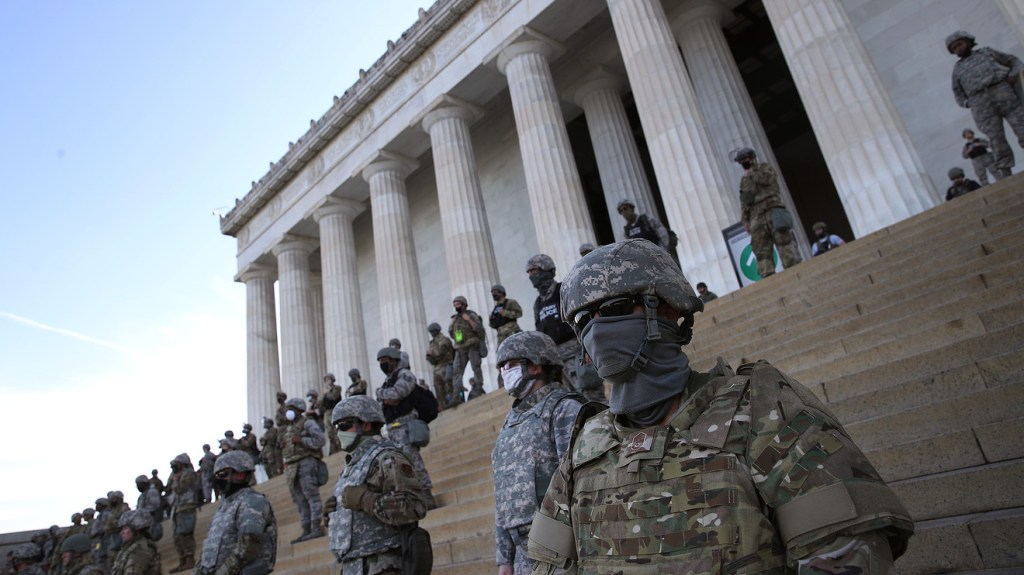
photo credit: Getty Images

On Rosh Hashanah I addressed the powerful feeling of uncertainty that pervades our lives and our world at this unprecedented moment. I want to return to this theme for this Yom Kippur – to speak to a parallel level of uncertainty that I know has been weighing deeply on us all. More specifically, I’d like to address the current political moment in our country; one that is more fraught, dangerous – and frankly more terrifying – than any of us have ever seen in our lifetimes. 

I know this isn’t a pleasant topic to talk about. Frankly, this was not a particularly pleasant sermon to write. I know that most of us feel beaten down by political events as they’ve unfolded over the past four years. I know it’s become something of a routine in our social gatherings to set a strict time limit on discussing the latest outrage committed by our President and his administration – or to even declare such talk off limits entirely. And I get this. I know how depleting the past four years have been on our own emotional and psychological well-being. I’m all too familiar with the ways we instinctively compartmentalize the news of the outside world for purposes of self-preservation.

But even so, painful though it may be, I believe we need to talk about it. Our avoidance, while understandable, has come with a cost. On a certain level, I think our denial and incredulity reflect an unwillingness to admit to ourselves that what is happening is really happening. In a very real way, I think this unwillingness has kept us from meeting the challenges of this unprecedented moment.

Jewish tradition teaches us that the ten days between Rosh Hashanah and Yom Kippur is an immensely critical period, spiritually and existentially speaking. It’s said that during the days between these two festivals the gates of heaven are at their widest; the time in which God is most open and receptive to our prayers. It is, if you will, “time out of time:” a liminal, marginal period during which we’re given the unique power to change the course of our lives and our world. There’s no other time on the Jewish calendar when it feels as if there is so much at stake. 

I’d suggest that politically speaking, we’re in a very similar place. Indeed, there seems to be a kind of synchronicity between the ten days and the current political moment – as if the confluence of this High Holiday season and this particular election season is demanding us to take stock in a deeper and more fundamental way than ever before. And I believe we’d be remiss if we didn’t take this opportunity to step out of time and honestly face up to what is at stake in our country. 

Now that the gates are open, there’s no time for denial. It’s time to say some painful things out loud. It’s time to name the hard fact that we are sliding steadily into an age of authoritarian rule in this country. It has become clearer and clearer with each passing day, even if it’s difficult for us to fully accept. And it’s even harder to contemplate what we must know in our hearts to be true: that if this president gets the opportunity to serve for another four years, authoritarian rule will take hold in our country in ways that will be truly frightening to behold.

From the moment our President first announced his candidacy, there actually were observers who warned us about precisely this. While most of them were dismissed as alarmists, their words now ring with chilling kind of prescience. Here’s one such warning, written by anthropologist and journalist Sarah Kenzidor just two weeks after the 2016 election:

It is increasingly clear, as Donald Trump appoints his cabinet of white supremacists and war mongers, as hate crimes rise, as the institutions that are supposed to protect us cower, as international norms are shattered, that his ascendancy to power is not normal. 

This is an American authoritarian kleptocracy, backed by millionaire white nationalists both in the United States and abroad, meant to strip our country down for parts, often using ethnic violence to do so.

This is not a win for anyone except them. This is a moral loss and a dangerous threat for everyone in the United States, and by extension, everyone abroad. 

I have been studying authoritarian states for over a decade, and I would never exaggerate the severity of this threat. Others who study or who live in authoritarian states have come to the same conclusion as me. 

And the plight is beyond party politics: it is not a matter of having a president-elect whom many dislike, but having a president-elect whose explicit goal is to destroy the nation. 

But for all of these warnings, I think the most compelling words came from the President himself. There are so many examples to choose from; I’ll quote a 2014 interview with Fox News, when he was asked how he would solve the problems with the US economy:

You know what solves it? When the economy crashes, when the country goes to total hell, and everything is a disaster, then you’ll have riots to go back to where we used to be, when we were great.

If we’re going to be completely honest, however, our current moment didn’t begin with the election of this particular President. It has been unfolding over a period of many years: the erosion of our voting rights, the creation of the surveillance state, the incarceration of human bodies for profit, the deporting of our immigrants, the rise of a kleptocratic billionaire class in our country. And it’s not incidental that this gutting of our democracy and civil rights has disproportionately harmed black and brown and poor people in our country. In truth, our descent into authoritarianism has actually been decades in the making. The election of this President has only accelerated the process much faster than any of us dared anticipate.

We should also note that this phenomenon isn’t unique to the United States – it is, in fact, a global reality. It’s no accident that our President routinely praises and curries favor with the strongmen leaders of countries like Russia, North Korea, China, Turkey, Saudi Arabia, and yes, Israel. As American Jews, we should have no illusions about this. 

So here we are. Our President has been systematically dismantling and plundering the institutions of our government in broad daylight and now he’s openly committing election fraud before our very eyes. We know what is happening: his dismantling of the US Postal service, his baseless claims of voter fraud, his clear intention to sow as much chaos as he can to cast doubt on the election. Most recently, he’s been announcing unabashedly that he has no intention to concede this election, no matter what the outcome. 

In American political life, the period between the election on November 3 and the Presidential inauguration on January 20 is called the “interregnum.” This term originally referred to the period between the reign of monarchs. Longer, more complicated interregna have invariably been accompanied by widespread unrest, civil wars and succession battles. Historically, failed states would often fail during an interregnum.

In the US, we’ve taken for granted that there will be an orderly transition of power from one to the other whenever we elect a new President – but I wonder if we’ve ever understood how technically fraught this in-between period really always been. We’re currently on the verge of an interregnum like none other we’ve ever experienced in our lifetimes – and I fear we’re waking up to this reality too late. 

But I also believe there is much we can still do. That we must do.

The medieval Jewish philosopher Moses Maimonides famously interpreted the call of the shofar as a wake-up call. The blast of the shofar, he wrote, is meant to say to us “Sleepers, wake up from your slumber! Examine your ways, return, and remember your Creator!” This new year, I’d suggest that this wake-up call is resonating for us with profound urgency: to awaken from our incredulity, our denial, our comforting belief that “it could never happen here.” 

And it’s also calling us to wake up on a deeper level: to face up to the very real possibility that this President could be staying in the White House for another four years. And while we might say that prospect is too frightening to contemplate, we must contemplate it. No matter how unthinkable, we must accept in our hearts and our guts that God forbid, it might well happen. It’s calling us to accept that if this does happen, it will not be the end. It will mean the onset of a new fight. And we will need to be prepared to fight it. 

So now that I’ve said this out loud, let me say this: we are not there and we don’t have to be there. There is a little over a month until the election – and while we may have been late in our awakening, it is not too late. There is still much we can do, and I know so many of you are doing these things already: registering voters, preparing get out the vote campaigns, fighting against voter suppression on every level. 

Yes, we need to vote. We need to vote because it’s clearly the most potent force we have at our disposal at this particular moment. But at the same time, we cannot view politicians as our saviors. We shouldn’t forget that our current situation was caused in no small part by politicians on both sides of the aisle. Too often we assume that politicians are the only change agents in the world – and that political change only happens on the electoral level. Too often we underestimate the historic role of social movements and the power of people to move politics and politicians. In the end, elections are but one tactic among many. More often than not, voting serves more as a form of harm reduction than a means for progressive change. We are most certainly in one of those moments right now. 

Even if we fight like we’ve never fought before during this election, we can’t be sanguine about the morning after. We must be prepared for the chaos that is sure to follow. Fomenting chaos is one thing this President knows well and it’s clearly his primary strategy in this election. If there was ever any doubt consider this: last June an organization called the “Transition Integrity Project” convened a group of more than 100 bipartisan experts to simulate what might happen the day after Election Day — a kind of electoral “war game.” They simulated four different scenarios, and each one but one – a Democratic landslide victory – indicated significant levels of post-election chaos, with both sides contesting the election until inauguration day. 

What will we do if this happens? In all likelihood, we’ll need to do what citizens of every other authoritarian nation have done when their elections are stolen from them. We’ll have to be prepared to take to the streets and stay in the streets. While this is certainly daunting to contemplate, we would do well to learn from the history of popular protest. We’d also do well to learn from the history that is unfolding as we speak. Indeed, if there’s anything the Black Lives Matter movement has taught us these past several months it’s that sustained popular protest has the very real power to make real change. 

I know that given the pandemic, each of us will clearly need to make our own personal health decisions when we consider participating in any form of mass demonstration. And those who do must certainly be prepared for a violent response that will inevitably follow. Whether it comes from armed forces mobilized by the government, from white supremacist militias, or agent provocateurs, we know what will be coming. Even though the overwhelming majority of the recent racial justice protests have been non-violent, the backlash against them has been brutally violent. The unleashing of state violence against public protest is, of course, a hallmark of authoritarianism, and we’ve witnessed it ourselves throughout our country these past several months. We should have no illusions about this. 

Beyond mass demonstrations, there are other forms of civil disobedience such as general strikes, boycotts and other acts of noncooperation large and small citizens have historically organized in moments such as this. We know that these kinds of tactics have the potential to succeed when carried out with unity, a clear strategy, and widespread participation. If campaigns of mass resistance are indeed mobilized, we’ll all need to be ready to help organize and participate in them, at whatever level is possible for us. 

Whatever comes, the most basic form of resistance will be our readiness to show up for one another. To participate and support mutual aid initiatives in our communities. To learn about and support the areas of greatest need. To stand in particular with those who are most vulnerable, most at risk, those who have always been the first to be impacted by a government that views their lives as disposable. Such is as it’s always been in resistance movements throughout history: in ways large and small everyone has a part to play. There is still a great deal of love and freedom in our world and there is still a myriad of ways we can make a difference. And we must never forget this.

OK. If you haven’t turned off your computer by now, thank you for going to this place with me. I know, as I said earlier, that none of this is easy to hear out loud. This is an enormously frightening moment. Personally, I’m scared shitless. But when I went over the things I felt I should talk about this Yom Kippur, I frankly couldn’t imagine anything more critical to our current moment. And I wouldn’t have said any of this if I felt things were hopeless. As I said on Rosh Hashanah, true hope is in our readiness to act precisely when things feel hopeless. Not to passively hope for the best, but to find courage in each other to fight on, no matter what may happen. 

At sundown tonight, they say, this sacred interregnum of the ten days will conclude – and soon enough, another will begin. But this time, it seems to me, we won’t passively ask to be saved. No, this time we’ll have to demand that the gates open and remain open. We’ll need to take responsibility for writing our own names and the names of our neighbors in the Book of Life. If we’re going to be sealed for life, it is we who must affix that seal.

And so, in that spirit I’d like to end now with a prayer I wrote a few years ago. We’ll be saying it at the end of Yom Kippur, at our Neilah service later tonight. But I’d like to offer it now as a prayer for our upcoming interregnum – with the hope it might awaken us all to the possibility of new life in the year to come:

when the final tekiah sounds
anyone still sleeping will have to
rise up and join the strategizers
and schemers the marchers and
rabble rousers to chant that
final neilah prayer ki fana yom
there’s no time left it’s time
to storm the gates.

we’ll blow away the wasted years
the work undone the dreams denied
the lazy thinking and careless complicity
so that we may clearly see the road
leading to a world we always
knew was possible.

yes finally we’ll break the insatiable
unquenchable appetites threatening
to consume everything we’ve ever known
our hunger will turn into desire
our hollow emptiness into wide open spaces
that roll on without end.

when that final tekiah sounds
the barrier walls and security fences
will come crashing down
no one will be forced to wait in line
no one turned away at the border
no unseen hands opening and closing
the gates on a whim.

so let every shofar
send forth one unbroken call
quick while the sun is setting
we’ll gather together and march forward
under cover of darkness
in the halls of the most high
we’ll make sure there’s
room for all.

On Trump’s Executive Order, BDS and the Real Threat of Antisemitism

Donald Trump, Melania Trump

photo credit: AP/Manuel Balce Ceneta

It’s certainly been a strange and surreal week for the American Jewish community. As is all too painfully well known by now, this past Tuesday, the New York Times reported that Donald Trump would sign an Executive Order that would “interpret Judaism as a race or nationality” to prompt a federal law penalizing colleges and universities that failed to protect Jewish students from the threat of BDS activism. This news caused an almost immediate upheaval, with vociferous protest emanating from a wide swath of the Jewish community concerned that this order could easily enable the antisemitic canard of Jewish “dual loyalties.”

While I certainly shared the outrage upon hearing this news, I harbored a deeper concern that I shared on my congregation‘s Facebook group page:  i.e., that the Jewish community was making this issue exclusively about us, ignoring the fact that Trump’s order was ultimately aimed at silencing Palestinians and those who stand in solidarity with them. “As ever,” I wrote:

I would suggest the most important response we can make to this latest cynical maneuver is to redouble our solidarity with the Palestinian people and to rededicate our support of the BDS movement – not merely for the sake of “free speech” but for a free Palestine. We must recommit ourselves to the central goals of the BDS call from Palestinian civil society itself: for a land where all who live between the river and the sea are full and equal citizens.

As it turned out, the New York Times report turned out to be false. The actual text of the Executive Order, which Trump signed at a bizarre White House Hanukkah reception, did not explicitly define Jews as a nationality (though it did rely on Title VI of the Civil Rights Act, which “prohibits discrimination on the basis of race, color and national origin” but not religion). Upon hearing this news, many in the Jewish community seemed to breathe a sigh of relief. Others dismissed the order itself, saying it was just a reaffirmation of the Obama administration’s policy and that “it wouldn’t change much at all.”

Whatever else this might mean, we certainly shouldn’t downplay the threat posed by this cynical Executive Order, which essentially puts into law what Israel advocates and their allies in Congress were unable to do with the stalled, ill-fated “Antisemitism Awareness Act.” Going forward, agencies and departments charged with enforcing Title VI can now “consider” using the International Holocaust Remembrance Alliance’s (IHRA) definition of antisemitism, which was never intended to be used to be enforce standards on college campuses.

There are a myriad of problems with the IHRA definition. In one oft-quoted line, for instance, it prohibits “applying double standards by requiring of it a behavior not expected or demanded of any other democratic nation.” However, as journalist Paul Waldman recently pointed out in the Washington Post, while “someone might apply double standards to Israel out of antisemitism, the idea that doing so is inherently antisemitic is preposterous. We can decry double standards, but people use them all the time in policy debates without being defined as bigoted.” Moreover, Waldman wrote, “‘saying criticism of Israel similar to that leveled against any other country’ is not antisemitic would mean criticisms of Israel would have to meet a higher standard than criticism of other countries or else they’re antisemitic.”

Additionally, the IHRA definition deems it antisemitic to “deny the Jewish people their right to self-determination.” This is a muddy and subjective standard that comes dangerously close to making the fallacious claim that anti-Zionism is synonymous with antisemitism. In fact, there are many different definitions of self-determination other than political nation-statism.  It could well be argued (as I have on several occasions) that the Jewish people have no more inherent “right” to create a political nation state in a specific piece of land than any other people might have – and it is certainly not antisemitic to say so. On the other hand, it would be immensely antisemitic to suggest that Jews do not have a right to self-determination as minority communities of the nations in which they live.

I certainly realize that how events of this past week may have conjured up the the deepest fears of American Jews. And I know full well that we cannot and must not be sanguine about the threat of resurgent antisemitism. But I would also suggest that is critically important that we remember where this threat is actually coming from – and where it is not. Indeed, it is critical to note that while the American Jewish community was tying itself up in knots around the issue of the so-called “antisemitic threat” of BDS on college campuses, four people, including two Jews, were killed in a kosher market in Jersey City, an incident the police is now investigating as a hate crime.

In an age where Jews are being regularly targeted and murdered by extremists, it is not only disingenuous of our government to spend so much time, energy and resources on combatting BDS – a nonviolent movement rooted in human rights for all – it is downright dangerous. It is time to stand down the false and pernicious equation of antisemitism coming from both the “right and the left.” We know full well where the most dangerous and deadly antisemitism is truly coming from – and we need to make this clear to the world in no uncertain terms.

In the end, I believe the most telling commentary on the events of this past week came in an op-ed by Kenneth Stern, one of the authors of the definition of antisemitism used in Trump’s Executive Order. I’ll let him have the last word:

Rather than champion the chilling of expressions that pro-Israel Jews find disturbing, or give the mildest criticism (if any) of a president who repeatedly uses antisemitic tropes, why weren’t those Jewish officials who were present when Trump signed the executive order reminding him that last year, when he demonized immigrants and called them “invaders”, Robert Bowers walked into a Pittsburgh synagogue because he believed Jews were behind this “invasion” of brown people as part of a plot to harm white people, and killed 11 of us?

Israel and North America: A Tale of Two Judaisms

Nur Shlapobersky / Never Again Action

Observers have long suggested that two radically different visions of Judaism are currently unfolding in the contemporary world: one in Israel and the other in North America. While this isn’t a particularly new phenomenon, I can’t recall a time in which there were both so fully on display as they were last Sunday during the Jewish holy day of Tisha B’Av – when two very different Jewish communities observed the day in dramatically different fashion.

Tisha B’Av (literally “the 9th of the month of Av”) is a Jewish fast day of quasi-mourning that commemorates the destruction of the Temple in Jerusalem. In addition to chanting from the Book of Lamentations, Tisha B’Av contains prayers that yearn for the restoration of the Temple. But while traditionally religious Jews characteristically view this mythic restoration in the context of a far-off messianic age, there is a rapidly growing extremist movement in Israel that has been calling for the literal rebuilding of the Temple on the Temple Mount. The Temple movement also advocates the destruction of Muslim shrines – an act that would undeniably result in a violent cataclysm of unthinkable proportions.

Last Sunday, the Temple Mount became a flash point for violence on the day of Tisha B’Av – which happened this year to coincide with the Muslim festival of Eid al-Adha. In anticipation of the day, Temple movement leaders were pushing hard on the Israeli government to upend the status quo and allow them to worship on the site (which is ruled off limits to Jews by Jewish law – and thus the state of Israel.) Eventually, the political pressure from the Temple movement and far-right Israeli politicians caused Prime Minister Netanyahu to cave and allow the extremist worshippers to enter the Temple Mount. In midst of election season, Netanyahu is loath to alienate the extreme rightist voters he has been desperately trying to court.

Thus, on Sunday morning. Temple movement worshippers gathered on the Temple Mount. Later that morning, violence erupted after Muslim worshipers finished their prayers at the Al-Aqsa Mosque. According to reports, police forces fired stun grenades and tear gas canisters after, they claimed, “worshipers began hurling objects at officers and yelling ‘nationalistic remarks.'” The Palestinian Red Crescent said 61 Palestinians were wounded in the clashes, with 15 evacuated to nearby hospitals. The police reported that seven people were arrested.

This then, was how Tisha B’Av was celebrated in Israel this year: a politically emboldened group of Jewish zealots was given license by the Israeli government to provoke violence on a site considered holy by both Jews and Muslims.

(AP Photo/Mahmoud Illean)

Now compare this with Tisha B’Av in the United States, when thousands of American Jews attended immigration protests and vigils in over 60 cities, organized by a broad network of Jewish groups, including Never Again Action, T’ruah, Bend the Arc, Jews for Racial and and Economic Justice, and a myriad of local immigrant justice organizations.

At one of the more substantive actions, more than 1,000 demonstrators sat down in an Amazon store in NYC to protest Amazon’s technology contract with ICE. 40 protesters took arrest, including numerous local area rabbis.  In downtown Los Angeles, members of Southern California’s Jewish community and other immigrant rights advocates held a “Close the Camps” rally at the Metropolitan Detention Center. Here in Illinois, it was my honor to be among the 250 Jews and allies gathered at the Jerome Combs Detention Center in Kankakee for a Tisha B’Av ceremony that included the chanting from Lamentations, and the recitation of prayers, songs and personal testimonies.

It’s not an understatement to suggest that the nascent Jewish resistance movement embodied by Never Again Action is one of the most remarkable and significant religious-political developments in American Jewish life in generations, as Allison Kaplan Sommer recently pointed out in a feature for Ha’aretz:

Never Again Action’s emergence highlights a growing trend: progressive young American Jews interested in political activism while clearly identifying themselves as Jews – in causes that have no direct link to Judaism. They wear T-shirts with Jewish slogans, sing Hebrew songs and in some cases even conduct prayer wearing kippot and tallit.

Critically, Sommer noted, “the issues that energize such leftist activists have nothing to do with Israel,” adding that “Israel has become a topic that divides their community rather than uniting it, depleting people rather than energizing them.”

I’d suggest that last week’s Tisha B’Av events demonstrated an even deeper dichotomy between these two communities. In Israel, the day was commemorated through a distinctly land-focused, land-centric style of Judaism that ultimately resulted in violence on the Temple Mount. Zionism after all, is an ideology that views the return to the land in real terms, and redemption is not envisioned in a far-off messianic age but through the real time settling of Jews in the land – an act that resulted, and continues to result, in the violent displacement of the Palestinian people.

Given this land-centric focus, it was really only a matter of time before Tisha B’Av became an occasion for viewing the destruction of the Temple as a historic loss that could only be redeemed through its literal rebuilding. It’s particularly notable that the Temple movement, once considered a fringe movement in Israel, is rapidly ascending in political power and is increasingly considered to be an important political bloc by the government of Israel .

By comparison, the diaspora movement of Jewish resistance currently emerging throughout North America regards the destruction of the Temple in mythic – not literal – terms. Note for instance, this pointed description of the Tisha B’Av vigil at the Illinois detention center, taken from its Facebook event page:

Tisha B’Av is a Jewish fast day that honors and mourns the brokenness, loss, and shattered ideals in whose shadow we live every day, symbolized by the destruction of Jerusalem 2,000 years ago.

This Tisha b’Av we’ll mourn the brokenness of a nation that hunts down, detains and deports immigrants, separates families, cages children and turns away asylum seekers. We will also explore our communal culpability in this tragedy and ask honestly: how do we stand down this causeless hatred?

Here, the destruction of the Temple is not regarded as a literal tragedy/loss, but a mythic moment of brokenness that is embodied by the chronically broken world in which we live. According to this view, redemption occurs not through the quasi-pagan deification of bricks and mortar but through sacred actions of resistance to injustice and oppression. Could there be any greater demonstration of the radical dichotomy between these two fundamentally divergent spiritual approaches?

There is, of course, a much simpler way to describe the difference between these two Tisha B’Av moments: one the one hand, redemption occurs through the physical power of the state while on the other, redemption occurs through resistance to that power. 

Postscript: as of this writing we are receiving news that an ICE police guard has driven a truck into a peaceful crowd of Never Again protesters at a detention center in Rhode Island. 

May the Temple be rebuilt speedily in our day. 

Playing Politics with Human Rights: Thoughts on the Recent Anti-BDS House Bill

651A9984

photo: Mohammed Asad/Middle East Monitor

Last Tuesday, the House voted overwhelmingly to pass an anti-BDS bill with the strong support of progressive democrats (including “squad” member Ayanna Pressley). I know there are many who are asking how and why did this happen? As I see it, the answer, as always, is pure politics.

Just a bit of history: the genesis of the bill known as H. Res. 246 dates back to the AIPAC convention last March, when a number of liberal Jewish groups, including  J Street, Ameinu, National Council of Jewish Women, Partners for Progressive Israel and Reconstructing Judaism (my own denomination), met informally to give their preliminary approval to this prospective bill. As they saw it, this was a strategic move. The bill was designed to give cover to liberal Democrats who had previously voted against anti-constitutional bills that virtually criminalized BDS. This new bill would allow them to vote on the record for a non-binding bill that criticized BDS without curtailing freedom of speech or labeling it as antisemitic. It would also give Democrats aligned with liberal Zionist groups the opportunity to reaffirm their support for the two state solution.

Like I said, pure politics.

Still, no matter how much liberal Democrats might rationalize their support for H. Res. 246, (Rep. Pressley explained on Twitter that her vote affirmed to her “constituents raised in the Jewish faith Israel’s right to exist”) no amount of explaining can wash away the fact that this resolution is a cynical political move that unfairly and incorrectly attacks a genuinely non-violent movement for human rights – and will do little to advance the cause of real justice in Israel/Palestine.

Just a few responses to the actual text of the resolution:

• While the resolution mentions “rising anti-Semitism,” it is completely silent on anti-Palestinian oppression and the threat of Islamophobia. Even the simple term “occupation” is nowhere to be found.

• The resolution claims that the BDS “seeks to exclude the State of Israel and the Israeli people from the economic, cultural, and academic life of the rest of the world.” In fact, this is not the goal of BDS; the very suggestion reduces the entire movement to an essentially nefarious aim. Rather, the Palestinian civil society call for BDS advocates for non-violent economic activism as a tactic toward three rights-based goals: an end to the occupation, equal rights for Palestinian citizens of Israel, and a recognition of the right of return for Palestinian refugees.

• The resolution claims that BDS “undermines the possibility for a negotiated solution to the Israeli-Palestinian conflict by demanding concessions of one party alone and encouraging the Palestinians to reject negotiations.” The three goals of BDS above are not “concessions” – they are basic rights enshrined in international law that have been patently ignored or denied in previous negotiations. There is nothing in the BDS call that “rejects negotiations.”

• The resolution quotes BDS leader Omar Barghouti (who addressed Tzedek Chicago on the eve of Passover this year) thus: “We oppose a Jewish state in any part of Palestine. No Palestinian, rational Palestinian, not a sell-out Palestinian, will ever accept a Jewish state in Palestine.” While this quote is genuine, it crucially omits the first part of his statement: “A Jewish state cannot but contravene the basic rights of the land’s indigenous Palestinian population and perpetuate a system of racial discrimination that ought to be opposed categorically, as we would opposed a Muslim state or a Christian state or any kind of exclusionary state…”

Here, Barghouti calls into question whether an exclusively Jewish state – as opposed to one state of all its citizens – can ever be truly democratic. This is an important question that deserves genuine consideration and debate. This egregiously truncated quote, however, only serves to imply Barghouti and the BDS movement seeks nothing more than the “destruction of the Jewish state.”

• The resolution states that the BDS movement ” targets … individual Israeli citizens of all political persuasions, religions, and ethnicities, and in some cases even Jews of other nationalities who support Israel.” This is a false and spurious accusation that the resolution offers with no evidence whatsoever. The targets of BDS campaigns have always been institutions, not individuals. (The government of Israel and Israel advocacy organizations, however, routinely target individuals with blacklisting websites such as Canary Mission and by barring entry of Palestine solidarity activists into the country.)

• The resolution states “BDS does not recognize the right of the Jewish people to self-determination.” There is no universal consensus that self-determination for any group of people must ipso facto mean the establishment of an independent nation state on a particular piece of land. Self-determination goes by many definitions and takes many forms. There are millions of Jews around the world who are happy to enjoy individual self determination in the nations in which they live. (It’s also worth noting that the Israeli government recently passed a law declaring that only Jews have a right to self-determination in Israel.)

• The resolution states that BDS “leads to the intimidation and harassment of Jewish students and others who support Israel.” Here again, the resolution is putting out a damaging claim without offering any evidence whatsoever. What can be stated however, is that however uncomfortable some Jewish students may be made to feel by pro-divestment campaigns on their campuses, pro-Israel activist students enjoy significant support from college and university administrations. By contrast, Palestine solidarity activists (including many Jewish students) experience routine suppression of their freedom of speech. Palestine Legal reports that “seventy-six percent of the incidents Palestine Legal responded to in 2018 were campus related” and that they “responded to 51 administrative complaints against Palestine activists, double the number from 2017.”

• The resolution states “in contrast to protest movements that have sought racial justice and social change, the Global Boycott, Divestment and Sanctions Movement targeting Israel is not about promoting coexistence, civil rights, and political reconciliation but about questioning and undermining the very legitimacy of the country and its people.” To this, I can only say, see bullet point #2 above. In fact, the BDS call is actually very much akin to “protest movements that have sought racial justice and social change.” Nowhere does it “delegitimize” the state of Israel. Anyone who take the time to read the actual call will see it focuses exclusively on the basic, essential rights that Israel routinely denies Palestinians.

To this final point, it was quite sobering to contemplate that on the very day that the House voted to condemn a nonviolent Palestinian call for human rights, House members were notably silent in response to Israel’s massive demolition of homes in East Jerusalem that took place at the very same moment.

In the end, despite the cynical politics behind this particular bill, I cannot personally view this as merely a political issue alone. As a Jew and a person of faith, I view the BDS call as nothing short of a religious imperative. I said as much in an address I was honored to deliver at the American Academy of Religion two years ago:

I realize there may be some in this room who cannot bear to hear me say these words, but I – and increasing numbers of people around the world – believe them to be true, no matter how painful it feels to hear them. Israel is oppressing Palestinians. And when a people are oppressed, they will inevitably resist their oppression – yes sometimes violently.

In this case, however, a nonviolent call for popular resistance has been placed before us. Thus, for those of us that believe God hears the cry of the oppressed and demands that we do the same, the BDS call represents a direct challenge to our faith. Will we be like God, and hearken to their cries, or will we be like Pharaoh and ignore them?

As a Jew, as an American, as a person of conscience, I would suggest this call presents us with nothing less than the most consequential spiritual challenge of our time.

Blessed are the ones who hearken to the cry of the oppressed.

Olives and Maror: A Seder Supplement in Honor of the Great Return March

636604238221814980-AFP-AFP-14D8ER

photo: AP

Here is an excerpt from my new Passover seder supplement, “Olives and Maror – The Great Return March:”

And so, on this night of Passover we affirm: we cannot gather to tell the Exodus story without acknowledging the liberation narrative that is currently unfolding at the Gaza border. We affirm further: if we remember our own persecution yet fail to call out Israel’s persecution of the Palestinian people, our seder will not be complete.

We now combine maror and olives, to acknowledge the bitterness of lives lost and dreams denied – together with the eternal hope of justice and return. Let us redouble our resolve to do our part to make these hopes and dreams a reality bimeirah be’yamneinu – speedily and in our own day.

Click here for the entire supplement to print out and read at your seder table this year. (Click here, here, here and here for supplements I’ve written in previous years.)

I Witnessed the Horror of Border Militarization, and Vow to Fight It

Cross-posted with Truthout

2018 1210 loveknowsnoborder pano stevepavey-8

Interfaith clergy lead demonstrators through Border Field State Park en route to the San Diego – Tijuana border (photo: Steve Pavey, Hope in Focus, stevepavey.com)

I‘ve just returned from the San Diego-Tijuana border where I had the honor of participating in “Love Knows No Borders” — an interfaith action sponsored by the American Friends Service Committee (AFSC) and co-sponsored by a myriad of faith organizations from across the country. As a staffer for AFSC and a member of Jewish Voice for Peace (one of the many co-sponsoring organizations), I took a special pride in this interfaith mobilization, in which more than 400 people from across the country gathered to take a moral stand against our nation’s sacrilegious immigration system. I’m particularly gratified that the extensive media from our action could shine a light on the brutal reality at our increasingly militarized southern border.

The date of the action (December 10) was symbolically chosen to take place on the anniversary of the Universal Declaration of Human Rights and served as the kick off to a nationwide week of action that will conclude on December 18, International Migrant’s Day. The action set three basic demands before the US government: to respect people’s human right to migrate, to end the militarization of border communities, and to end the detention and deportation of immigrants.

Over the course of this past weekend, hundreds of participants streamed into San Diego for orientation and training. To conclude our preparation and as a precursor to the upcoming action, an interfaith service was held in the packed sanctuary of University Christian Church. As one of the Jewish leaders of the service, I noted that it was the eighth and final night of Hanukkah and invited the Jewish members of our delegation up to sing the blessings.

Before the lighting, I explained that the final night of Hanukkah is the night in which our light shines the brightest, and I pointed out the wonderful confluence of this Jewish festival with our interfaith action the following day. Rev. Traci Blackmon, a United Church of Christ leader and prominent social justice activist, delivered one of the most powerful messages of the evening, properly placing the issue of immigrant justice within the context of US white supremacy. (You can find the Facebook Live video of the service here. The Hanukkah lighting begins at the 24:30 mark; Rev. Blackmon’s remarks begin at 1:19:16.)

Arrests at the Border

The next morning, we gathered at AFSC’s San Diego office and left in buses to Border Field State Park, located just north of the border with Tijuana. After a press conference, we marched west down the trail to the beach, then turned south and approached the border fence, which snaked across the beach and jutted several hundred feet into the water. As we got closer, we could see a tangle of barbed concertina wire laid out in front of the fence. Behind the wire stood a phalanx of heavily armed border patrol.

When we reached the edge of the wire, some of the clergy formed a semi-circle and offered blessings for the migrants. As the prayers were spoken aloud, border patrol officers used a megaphone to inform us that we were trespassing on federal property and that we needed to move to the back of the wire. I recited the Priestly Benediction in Hebrew and English (“May God bless you and keep you …”), doing my best to articulate the prayer between the voices of border patrol barking out orders (a ceremonial first for me).

When our blessings were over, we went back to the other side of the barbed wire and those of us in front formed a line directly facing the guards. A border patrol officer repeatedly told us to leave, adding that he did not want any violence — an ironic statement considering that he and the rest of the riot-gear clad border patrol officers wielded automatic weapons in front of our faces. We began to chant freedom chants and held the line, even as the border patrol officers inched forward and started to push us back.

While we were careful not to touch any officers, we continued to hold the line as the border patrol pushed us forward. Eventually, protesters who did not yield were grabbed, pulled to the border patrol’s side of the line and arrested. Most men were thrown to the ground and held down with their faces in the sand while their hands were bound together with plastic ties; women were generally allowed to kneel before they were led away from the beach to waiting border patrol vans

As I continued to hold the line on the far west end of the front line, I noticed a commotion at the other end: Officers had broken through the line and were chasing protesters down the beach. I saw one of our protest organizers, AFSC staffer Matt Leber, roughly thrown to the ground by at least five or six border patrol officers, handcuffed and led away. While Leber did not intend to take an arrest, this kind of intentional targeting of organizers is a common law enforcement tactic.

In this video taken of the incident you can see Leber (wearing the red T-shirt and backpack) guiding the protest when he is suddenly attacked, unprovoked, by the border patrol, who lunge at him and yank off his backpack. You can also see AFSC staffer Jacob Flowers (wearing the yellow vest) being thrown to the ground.

matt_leber_arrested

Border patrol officers arrest AFSC staffer Matt Leber (photo: Steve Pavey, Hope in Focus, stevepavey.com)

Shortly after Leber’s arrest, I dropped to my knees and was grabbed and pinned down by two border patrol officers. When it became clear that I wasn’t resisting, they allowed me to stand of my own accord and led me to the line of arrested protesters who were arrayed along a fence, waiting to be placed into vans.

According to the border patrol, 32 of us were arrested. We don’t currently have an exact arrest count, but it seems that most of us were charged with the misdemeanor of “nonconformity to the orders of a Federal Law Enforcement officer.” When a day went by with no further word about Leber, AFSC released a statement calling for his immediate release. To our collective relief, he was eventually let out of the Metropolitan Correction Center on Tuesday afternoon.

The True Meaning of Border Militarization

During our debrief, many noted the ferocity of the border guard’s response to our prayerful, nonviolent demonstration. Many of us — in particular the white, privileged members of our delegation — agreed that we had gained a deeper sense of empathy and solidarity with our migrant neighbors, a stronger understanding of the toxic effects of militarization on our border communities, and a more profound conviction than ever that we must all fight for a nation that receives immigrants with open hearts and open doors.

This experience also served to demonstrate what “militarization of the border” truly means. My friend and fellow Jewish Voice for Peace member Elaine Waxman put it well when she wrote about our experience on her Facebook page:

What has stuck with me most in the last 24 hours is a deeply uncomfortable sense of what that border surely looks like when the witnesses are gone, the journalists are not taking pictures, and the encounters are with migrants instead of documented (and often white) community leaders. Because what we saw yesterday looks like a police state.

Indeed, when we stood up to the line of armed border patrol officers, I couldn’t help but flash back to my very similar experience in a direct action with Youth Against Settlements during the summer of 2006 in Hebron. In both cases we faced heavily armed soldiers, the loud screaming of orders, and the use of the threat of violence to intimidate and deter those who do not yield to state control.

brant_border_b-w

Clergy demonstrators hold the line at the San Diego – Tijuana border fence. (photo: Steve Pavey, Hope in Focus, stevepavey.com)

I also noticed another, more specific similarity between these two experiences. When I stood in front of the border guards on the beach, I noticed familiar tear gas canisters belted across their chests. I’d seen the same on soldiers throughout the West Bank and Gaza: silver cylinders with blue writing manufactured by Combined Tactical Systems in Jamestown, Pennsylvania.

Seeing those same canisters at the US-Mexico border reminded me of the multiple intersections between systems of state violence and corporate profit – and of the need for a movement that will expose and dismantle them once and for all.