To those who live in or around Chicago: I’ll be appearing twice with the courageous Israeli peace activist Miko Peled (author of “The General’s Son: Journey of an Israeli in Palestine.“) Both Miko and I have books published by Just World Books – both of which chart the our respective (and unlikely) journeys to Palestinian solidarity work. I’ve admired Miko’s work enormously and am delighted we have the opportunity to engage in two public conversations.
Immediately after September 11, I was so struck by the predominant collective response: the ubiquitous display of flags everywhere you looked; the knee-jerk “U-S-A! U-S-A!” chant whenever the tragedies were invoked; the widespread desire for retributive justice, wherever, however possible.
Now eleven years later, even after all that’s happened since, I’m just so saddened that nationalistic displays seem to be the only way we know how to commemorate our dead. Maybe I’m naive, but it’s difficult for me to accept that we still haven’t found a healthier national outlet for our grief. Call me naive, but I was genuinely surprised – and quite honestly mortified – that the loudest cheers at the DNC last week (always accompanied by the still ubiquitous “U-S-A! U-S-A!”) were saved for references to 9/11 and the killing of Osama Bin Laden.
If you found yourself disturbed as well, I highly recommend that you read this recent piece by Glenn Greenwald, who sorrowfully identifies all that was wrong with the bloodlust on unabashed display during the DNC:
Americans once found national purpose – justification for their belief in their own exceptionalism – from inventing new life-improving technologies, or putting a man on the moon, or advancing the cause of equality, or vanquishing the mighty Nazi military machine, or enshrining unparalleled protections for core liberties in the constitution. Now, many Americans find it in the heroic ability to hunt someone down who is in hiding, pummel his skull full of bullets even as he lay dying on the ground, and then dump his corpse into the ocean…
The premise seems to be that – aside from this specific corpse and the others the president has piled up – there is little else for ordinary Americans to celebrate now when it comes to the search for nationalistic achievement, purpose and greatness among their political leadership. That this dark premise appears valid is what is most disturbing of all.
In the meantime, for me the most moving, compassionate and morally honest tribute to the 9/11 fallen – and all who have fallen by our hands since – is this spoken word piece by Palestinian-American Suheir Hammad (above) entitled “First Writing Since.”
i cried when i saw those buildings collapse on themselves like a broken
heart. i have never owned pain that needs to spread like that.
there is no poetry in this. there are causes and effects. there are
symbols and ideologies. mad conspiracy here, and information we will
never know. there is death here, and there are promises of more.
there is life here. anyone reading this is breathing, maybe hurting,
but breathing for sure. and if there is any light to come, it will
shine from the eyes of those who look for peace and justice after the
rubble and rhetoric are cleared and the phoenix has risen.
affirm life.
affirm life.
we got to carry each other now.
you are either with life, or against it.
affirm life.
A program note: I’m going to appear on Chicago Public Radio’s Worldview to discuss my new book “Wrestling in the Daylight” with Jerome McDonnell on Wednesday, September 5, 12:00 pm (Central). Locals can tune in at 91.5 – everyone else can catch it streaming from the WBEZ website.
Chicagoans: the gala launch party for “Wrestling” will take place this Thursday, September 6, 7:00 pm at The Book Cellar in Lincoln Square. (Click here for the FB event page).
I’m sure many people find it perfectly reasonable that an Israeli court recently ruled Palestinian solidarity protester Rachel Corrie caused her own death in 2003 by standing in front of a moving bulldozer. After all, as Judge Oded Gershon pointed out, she knew the risks. She “chose to endanger herself” by going into a “closed military zone” to try and stop the destruction of a Palestinian home in southern Gaza. Then she refused to step aside, as “any reasonable person would have done.”
If this verdict all sounds perfectly “reasonable” to some, I believe it is only because it was presented devoid of any real context. It utterly ignores the fact that it is the Israeli military – and by extension, Israel itself – that creates the rules that govern the “reality” of this situation. The court could rule any way it pleased – even despite all evidence to the contrary – because at the end of the day it answers to no one but itself.
Why was this civilian area deemed a “closed combat zone?” Because the Israeli military deemed it as such. This, despite the fact that no combat was taking place in the area on that day and no closed military zone order was ever presented in court. This despite the compelling claims that these home demolitions have nothing to do with Israeli’s security and everything to do with collective punishment.
If you have any doubt about the length and breadth of Israel’s military impunity, I urge you to read this article by the Guardian’s Chris McGreal – to my mind the most important article about the Corrie verdict thus far:
The case laid bare the state of the collective Israeli military mind, which cast the definition of enemies so widely that children walking down the street were legitimate targets if they crossed a red line that was invisible to everyone but the soldiers looking at it on their maps. The military gave itself a blanket protection by declaring southern Gaza a war zone, even though it was heavily populated by ordinary Palestinians, and set rules of engagement so broad that just about anyone was a target.
Yes, Rachel Corrie knew the risks. As an activist with the International Solidarity Movement (ISM), she went through extensive training to prepare herself to engage in this form of nonviolent protest. Eyewitnesses testified that she wore a high visibility orange vest and stood in full view of the soldier driving the bulldozer. But tragically, I doubt all the precautions in the world could ever have protected her from what McGreal refers to as “the collective Israeli military mind.”
Or, for that matter, Israeli military justice. As is now well known – and has even been admitted by US Ambassador to Israel Dan Shapiro – the IDF’s investigation into Rachel’s death was a sham, carried out by a team of 19-year-old inexperienced boys who never interrogated a single Palestinian or non-military witness. This is a critical point: Israel has to date not carried out a full, credible investigation of its military’s actions on that day – actions that resulted in the death of an American citizen. As Rachel’s mother Cindy has correctly pointed out: “a lawsuit is not a substitute for a legal investigation, which we never had.”
I have met Rachel’s parents Cindy and Craig on several occasions now and I know them to be among the most compassionate and principled social justice activists I have ever met. Yes, they are pursuing this case because of what happened to their daughter, but anyone who knows them knows they are driven by a deeply held belief in justice. Notably, they only sought one dollar in damages from the Israeli government – an award which Judge Gershon refused to grant them in his ruling. I have no doubt that Cindy Corrie meant it from the bottom of her heart when she said after the verdict:
This is a sad day, not only to us, as a family. This is a sad day for Israel, a sad day for human right activists, a sad day for international law, a sad day for justice.
I do agree with Judge Gershon when he ruled that Rachel did not step aside “as any reasonable person would have done.” As too many nonviolent protesters know all too well, when you find yourself in the midst of an unjust context, doing the just thing is rarely the most reasonable option. (I’m sure many didn’t consider it “reasonable,” for instance, when marchers in Selma walked straight into a line of armed state troopers on the Edmund Pettus Bridge in 1965.)
Look at the clip above. It comes from a Korean news story about the Palestinian nonviolent protest movement in the West Bank. In this clip, you can see ISM founder Huwaida Arraf protecting protesters from armed soldiers with her own body. Nothing reasonable there. How many of us have one iota of her – or Rachel’s – courage to stand firm in the face of such overwhelming injustice?
At the press conference following the verdict, the Corries were asked how they felt that the judge said that Rachel should have moved out of the bulldozer’s way. Cindy Corrie’s response:
I don’t think that Rachel should have moved. I think we should all have been standing there with her.
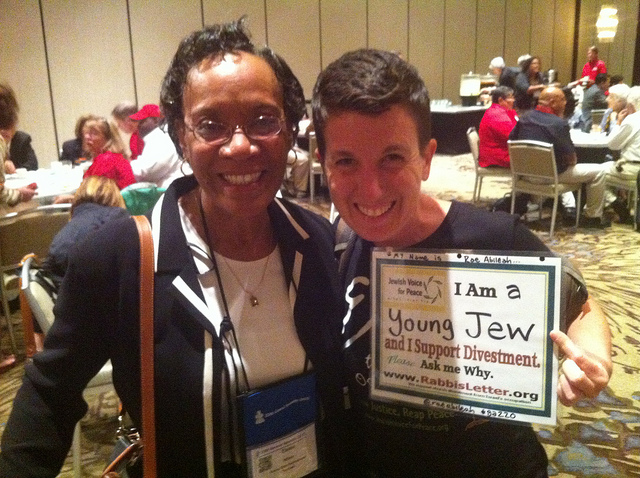
The Republican Jewish Coalition and the Emergency Committee for Israel this week urged a group of rabbis supporting President Barack Obama’s reelection to purge members of the Jewish Voice for Peace Rabbinical Council from its ranks. The conservative groups claimed they were shocked by the inclusion in the “Rabbis for Obama” list of those whose “values are representative of a small and extreme group of anti-Israel activists.”
We are deeply dismayed by this cynical attempt at political gain through smears, half-truths and innuendos that only serve to create division in the Jewish community.
It is certainly true that many of on the JVP Rabbinical Council are deeply critical of Israeli policy (and the U.S. policy that too often enables it). It is not at all true, however, that such criticisms are “extreme” or marginal. Indeed, increasing numbers of Jews and Jewish leaders are finding the courage to speak out publicly against Israel’s practice of home demolition, forced eviction, settlement expansion and administrative detention, as well as its widespread restriction on Palestinians’ freedom of movement in the West Bank and Gaza.
Jewish Voice for Peace rabbis were not the only ones singled out by RJC and ECI’s smear. William Kristol included members of the J Street Rabbinical Cabinet and Rabbis for Human Rights as well. There are many perspectives within the American rabbinical community about how to create a just and lasting peace between Israelis and Palestinians. At the same time, we share a commitment to open and honest conversation about how a negotiated solution can ensure security and human rights for all.
By a margin of more than 2 to 1, according to the Public Religion Research Institute American Jews say that good diplomacy rather than military strength is the best way to ensure peace (63% vs. 24% respectively).
This reality stands in sharp contrast to the Jewish donors to the Republican party, such as Sheldon Adelson, who has reportedly asked Romney to state publicly that Israeli-Palestinian peace talks are a “waste of time.” Adelson is also pressing Romney for a firmer commitment to move the U.S. Embassy in Israel from Tel Aviv to Jerusalem, in what would be a de facto recognition of Israel’s annexation of East Jerusalem. These views lie far outside what most Americans would tolerate or expect from an American president.
We are saddened, but not surprised, by these smear tactics. They have long been the stock in trade of a Jewish establishment that demands lock-step agreement from Jewish rabbis and leaders – and Jewish neo-conservatives who do not hesitate to use divisive rhetoric and slanderous allegations against their own community members to achieve their political goals.
We are proud of the diversity of the American Jewish community and voice our hope that it will make room for all those who are dedicated to a future of peace, justice and dignity in Israel and Palestine. We are heartened that that by resisting calls to purge individual rabbis from their ranks, the leadership of “Rabbis for Obama” is remaining true to this inclusive vision.
(The) quality of Israeli sperm is falling at an alarming rate, and no one’s sure exactly why.
Fertility is a major issue in Israel, where memories of the Holocaust genocide are fresh, and having children is an entrenched part of Judaism. There’s also a political aspect, because birthrates among Arabs in Israel have at times been as much as double those of Jews, triggering a population race that some believe could one day affect who controls the land.
…The white-coated director of the Hadassah Sperm Bank, Ruth Har-Nir, hunches over a microscope to view a freshly donated specimen and begins to methodically count each squiggly swimmer magnified on the slide.
… After a quick scan, she sits up straight and shakes her head. The number of spermatozoa darting around each tiny grid on the slide is two to four, well below the minimum six required, and nowhere near the 10 to 20 per grid that indicates the kind of healthy concentration the bank likes to see.
Also, rather than surging forward, some of the little guys flit left and right or just stall out, suggesting a weak motility.
“Under no circumstances can we accept sperm of this quality,” she says.
No, it’s not Monty Python. Just the kind of black comedy gold that ensues when a nation fights a “demographic time bomb”
From a recent review by Rabbi Rachel “Velveteen Rabbi” Barenblat:
Gwen Macsai
“Wrestling in the Daylight”… is Rabbi Brant’s self-curated compilation of his blog posts from Shalom Rav, so if you’ve been reading Shalom Rav, this material won’t be new to you. But I’m finding, as I read, that reading the posts in this new setting and context — curated by their author into a narrative which clearly shows the progression of his thinking over time — is a different experience from reading the blog. And Rabbi Brant has chosen to reprint some of the comments from readers as well as responses he’s offered to those comments, which gives the book a bit of the internet’s Talmudic multivocality (and offers an example of how one can host difficult conversations in a thoughtful and generous way — which can be hard to come by on the internet, especially on questions of Israel/Palestine.)
Andrew White
The choice to include commentary makes the book particularly interesting, I think. Some of Rabbi Brant’s most frequent commentors disagree with him deeply. Over the course of the book, one can see conversations unfolding. Sometimes they are quite heated. And his responses are always thoughtful and respectful, even as he resists attempts at derailing the conversation. Having hosted some conversations about Israel at this blog over the years, I have a sense for how difficult that can be.
Kevin Coval
… Rabbi Brant Rosen is one of my role models in the difficult but important work of coming to terms with the clash between the classic Zionist narrative (a story which many of us want to continue believing — I know I still yearn for it to be true) and some of the realities on the ground in Israel and the Palestinian territories. He models for me not how one would do this internal work despite his ardent Jewishness, but precisely of it; not despite being a rabbi, but precisely because his rabbinate calls him to take seriously the Jewish call to stand with those who are oppressed. And he has also taught me a great deal about how to disagree without falling into the trap of looking down on (or dehumanizing) those with whom one disagrees.
If you’re interested in progressive Jewish takes on Israel and Palestine, this book is worth reading, and worth having on your bookshelf to return to again.
I’m thrilled to be joined at our September launch party by local Chicago celebs Kevin Coval, (Poet, Co-Founder, “Louder Than a Bomb“), Gwen Macsai, (Host, WBEZ’s Re:Sound) and Andrew White (Artistic Director, Lookingglass Theatre Company), who will join me in reading excerpts from the book. We’ll also make plenty of time for Q&A, book signing and quality bookstore shmoozing.
It promises to be a wonderful evening – RSVP at our Facebook event page here.
Philologos has it completely wrong when he speaks of the “anti-Semitism in boycotts of Israel.” To begin with, Santis and Steinberg did not use the term “Jew-washing” in reference to a boycott of Israel as a whole, but rather to a resolution recently brought to the Pittsburgh General Assembly of the Presbyterian Church (USA) that called for divestment of their pension funds from three specific companies that profit from Israel’s brutal and illegal occupation of the West Bank.
Regardless, it is highly disingenuous for Philologos to accuse the Presbyterian Church of anti-Semitism. Our Christian friends’ response to the Palestinian civil society call for Boycott, Divestment and Sanctions (BDS), reflects their deeply held commitment to justice in a land their tradition also considers holy.
Philologos asks, “Have the Presbyterians considered boycotting China because of Tibet? India because of Kashmir? Russia because of Chechnya?” This, of course, is classic misdirection. The issue at hand is not global human rights, but a very specific call from Palestinian civil society for international support in ending their oppression.
The real question before them (and us) is not “what about Tibet, Kashmir and Chechnya?” The question, rather, is: “will we or won’t we respond to the Palestinian call?” To this question, many members of the Presbyterian Church are courageously responding “we will.” So too are increasing numbers of Jews who believe that our legacy of anti-Jewish oppression leads us to stand with Palestinians being denied basic human rights in our name.
No, we are not being used as pawns by Christian partners to further some nefarious “anti-Semitic plot”. Rather, we are standing in solidarity with the oppressed, as the most basic of our Jewish teachings demand that we do. What irony that other Jews should stand in the way of the Jewish imperative to end injustice. How heartbreaking that some in the Jewish community pervert this imperative by labeling the best intentions of our Christian friends as “anti-Semitism.”
We do, however, fully share Philogos’ distaste for the term “Jew-washing,” the coining of which is a sign of abject desperation that itself crosses the line of anti-Semitism, as blogger Jeremiah Haber pointed out last week. We predict that odious terms such as this will soon be relegated to the history books as part of a last, flailing effort by a fearful generation of Jewish leaders unwilling to recognize the moral urgency of the moment. It also reflects the short-sightedness of an establishment that continues to support war and occupation while deliberately alienating itself from the next generation of courageous Jewish leaders.
The number of Jewish settlers in the West Bank grew by more than 15,000 in the past year to reach a total that exceeds 350,000 for the first time and has almost doubled in the past 12 years.
Figures from Israel’s population registry show a 4.5% increase in the past 12 months. Most of the newcomers moved into settlements that many observers expect to be evacuated in any peace deal leading to a Palestinian state.
There are an additional 300,000 Jews living in settlements across the pre-1967 border in East Jerusalem, the pro-government and mass-circulation newspaper Israel Hayom reported.
Putting a finer point on these statistics, Dani Dayan, chairman of the settlers Yesha Council had this to say in a recent NY Times op-ed:
(We) aim to expand the existing Jewish settlements in Judea and Samaria, and create new ones. This is not — as it is often portrayed — a theological adventure but is rather a combination of inalienable rights and realpolitik. Even now, and despite the severe constraints imposed by international pressure, more than 350,000 Israelis live in Judea and Samaria. With an annual growth rate of 5 percent, we can expect to reach 400,000 by 2014 — and that excludes the almost 200,000 living in Jerusalem’s newer neighborhoods. Taking Jerusalem into account, about 1 in every 10 Israeli Jews resides beyond the 1967 border. Approximately 160,000 Jews live in communities outside the settlement blocs that proponents of the two-state solution believe could be easily incorporated into Israel.
…Our presence in all of Judea and Samaria — not just in the so-called settlement blocs — is an irreversible fact. Trying to stop settlement expansion is futile, and neglecting this fact in diplomatic talks will not change the reality on the ground; it only makes the negotiations more likely to fail.
In essence, Dayan is calling for a kind of a one-state solution here – albeit one that does not extend citizenship rights to non-Jewish residents. (Although in fairness to Dayan, he does say they should be given “freedom of movement.”)
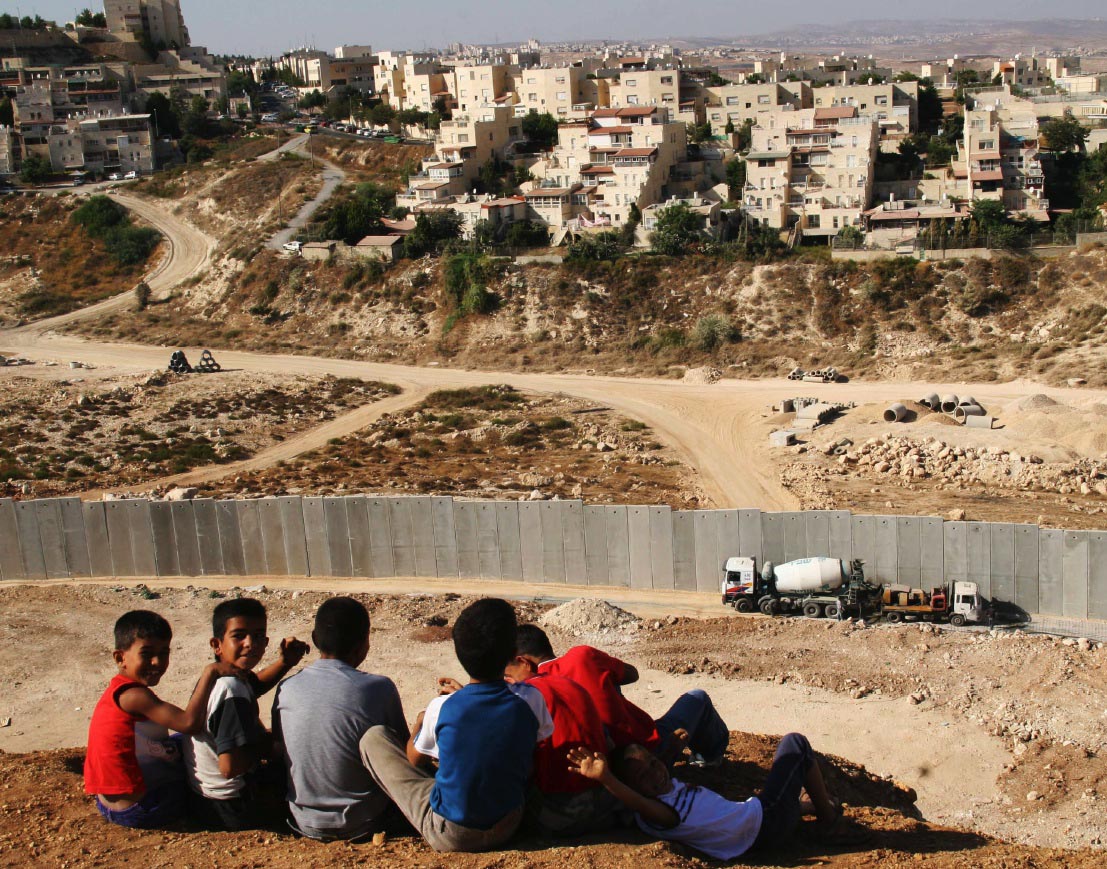
Still can’t figure out what’s going on here? Let’s connect the final dot. While the Jewish population in Area C of the West Bank is increasing, Israel is demolishing homes, evicting Palestinians, and moving them into Areas A and B at an ever-increasing pace.
At the same time that Israeli settlements are expanding unchecked, the state is putting the Palestinians and Bedouins who live in Area C under extreme, unrelenting pressure, as exemplified by this week’s report by Haaretz that Defense Minister Barak has ordered the demolition of eight Palestinian villages to make way for IDF training.
Demolitions of homes and structures in 2012 have seen an increase. According to a source at the United Nations, between January 1 and April 27 of 2011, 352 Palestinian and Bedouin were forcibly displaced from their homes in East Jerusalem and the West Bank. The same period of 2012 saw “at least 487″ people lose their homes.
It’s a one-two punch intended to increase the Jewish population in the West Bank as much as possible and deplete the Palestinian population as much as possible to ready the area for annexation. Susya, a Palestinian village that is under threat of demolition, is an example of how this works. The village has been destroyed numerous times since the Jewish settlement of Susya was built there in 1983, despite the documents proving it belongs to Palestinians and the fact that this small community has no where else to go.
Israeli pressure on the Palestinian and Bedouin residents of Area C has resulted in a drop in the Arab population in the same area.
And then there’s the Levy Committee Report, which denies that there is an occupation and, according to some observers, lays the legal groundwork (at least in the mind of the Israeli government) for a unilateral annexation of Area C.
It’s not a matter of if. It’s a matter of when.
OK, I’ll say it for you: Israel has no intention of creating a two-state solution. It is creating it’s own “one-state” solution by increasing the Jewish population in the West Bank and warehousing Palestinians in Bantustans throughout Areas A and B. By any other name this would be called an “apartheid” state.
If there are those who disagree with my calculus, I’m certainly open to hearing alternative explanations. In the meantime, here are two questions I’m still unable to answer: when will our community be ready to call out this illegal and immoral behavior? And what will we be willing to do about it?



 Shalom Rav