Category Archives: Peace

Palestinian Christians: “The Occupation is a Sin”

Last week, a group of Palestinian Christians representing a variety of churches and church-related organizations issued a powerful, prayerful call for an end to the Israeli occupation.  My friend Rabbi Brian Walt was present at the meeting in Bethlehem in which the statement – known as  “The Kairos Palestine Document” – was released. Upon his return, he described to me his profound, often painful conversations with Palestinian Christians and he told me that as a Jew, he considered the Kairos Document to be an enormously important spiritual/political statement. Having now read the entire 12 page document, I must say that I agree wholeheartedly.

Palestinian Christian liberation theologians such as Naim Ateek of the Sabeel Institute have been doing important work for decades and I believe their ideas present important spiritual challenges to the Jewish community. Many Jews point to the more radical incarnations of these theologies – and while I share some of these concerns, I believe that we make a profound mistake by dismissing Palestinian Christian theology wholesale. (Frankly, I am much more troubled by the “End of Days” theologies of fundamentalist Zionist Christians such as Pastor John Hagee than I am by Naim Ateek and the authors of the Kairos document.)

My friend and colleague Father Cotton Fite of St. Luke’s Church in Evanston, tells me he hopes that American Christians will study the Kairos Document carefully. I mentioned to him that I hoped Jews would read it as well. In fact, I think we should create opportunities to read it together. Despite our differences, I believe it offers both of our communities an ideal place to begin meaningful dialogue over the spiritual implications of this conflict.

One of the more important and challenging passages:

Our presence in this land, as Christian and Muslim Palestinians, is not accidental but rather deeply rooted in the history and geography of this land, resonant with the connectedness of any other people to the land it lives in. It was an injustice when we were driven out. The West sought to make amends for what Jews had endured in the countries of Europe, but it made amends on our account and in our land. They tried to correct an injustice and the result was a new injustice.

I can already predict that many Jews will bristle that this passage does not specifically reference the Jewish connection to the land as well. To this I would say, how deeply do we Jews ever honor the reality that we are not the only people who are “deeply rooted in the history and geography of this land?” Moreover, how deeply do we ever face the true injustice that was committed when a people with deep roots in the land were driven out and not allowed to return?

Another sobering passage in the document describes the Occupation as no less than a “sin:”

We also declare that the Israeli occupation of Palestinian land is a sin against God and humanity because it deprives the Palestinians of their basic human rights, bestowed by God. It distorts the image of God in the Israeli who has become an occupier just as it distorts this image in the Palestinian living under occupation. We declare that any theology, seemingly based on the Bible or on faith or on history, that legitimizes the occupation, is far from Christian teachings, because it calls for violence and holy war in the name of God Almighty, subordinating God to temporary human interests, and distorting the divine image in the human beings living under both political and theological injustice.

Many of us view the Occupation as a political problem to be solved. But indeed, as Jews, we must admit basic human rights are rooted in our religious tradition. Like Christians, we also believe that all human beings are created in the image of God. We also believe that when the basic dignity of anyone’s humanity is diminished, the Divine Image is diminished as well. How then, can we fail to understand that the Occupation is not only a geo-political problem but a spiritual/moral problem as well?

This conclusion leads to a logical next step:

Love is seeing the face of God in every human being. Every person is my brother or my sister. However, seeing the face of God in everyone does not mean accepting evil or aggression on their part. Rather, this love seeks to correct the evil and stop the aggression.

The injustice against the Palestinian people which is the Israeli occupation, is an evil that must be resisted. It is an evil and a sin that must be resisted and removed. Primary responsibility for this rests with the Palestinians themselves suffering occupation. Christian love invites us to resist it. However, love puts an end to evil by walking in the ways of justice. Responsibility lies also with the international community, because international law regulates relations between peoples today. Finally responsibility lies with the perpetrators of the injustice; they must liberate themselves from the evil that is in them and the injustice they have imposed on others.

Again, the Occupation is viewed not as a diplomatic issue to be negotiated but a spiritual evil to be resisted.

I have no illusions that for many Jews, suggestions such as these present daunting and painful challenges.  So will many of the ultimate political ramifications of the Kairos Document. All I can hope for is that political disagreements will not keep us from honestly facing the profound spiritual dimensions of this conflict.  Speaking for myself, I do believe this statement was written in good faith, genuine love and true religious conviction:

Our message to the Jews tells them: Even though we have fought one another in the recent past and still struggle today, we are able to love and live together. We can organize our political life, with all its complexity, according to the logic of this love and its power, after ending the occupation and establishing justice.

What can I say to this except “Amen?”
The Judaization of Jerusalem: What is Our Response?

Are these the actions of a country interested in negotiating in good faith for a Palestinian state alongside it, with East Jerusalem as its capital?

Ha’aretz announced today that

2008 set an all-time record for the number of Arab residents of East Jerusalem who were stripped of residency rights by the Interior Ministry. Altogether, the ministry revoked the residency of 4,577 East Jerusalemites in 2008 – 21 times the average of the previous 40 years.

Also from today’s Ha’aretz:

Clashes erupted yesterday in the Sheikh Jarrah neighborhood of East Jerusalem between demonstrators and counter-demonstrators, after a group of Jews announced their intention to move into a house in the neighborhood. The entry of the Jews into the home follows a court order ruling that the Arab al-Kurd family, which lives in a portion of the house, had no right to occupy an addition that they had built onto the house.

This situation has been unfolding for some time. In an nutshell: Palestinian families in Sheikh Jarrah have been evicted from their homes so that their land can be turned over to a settler organization that seeks to build a Jewish settlement called Shimon Ha Tzadik. According to the Jerusalem NGO Ir Amim, this settlement

constitutes one of a series of plans that seek to penetrate and surround Sheikh Jarrah with Israeli settlements, yeshivas, and other institutions as well as national park land, and complement government efforts to ring the Old City with Jewish development and effectively cut it off from Palestinian areas.

Meanwhile, since their eviction, the Palestinian families (55 people in total) have been sleeping on mattresses in the street “and spend the day sitting in the shade watching settlers walk in and out of their front doors.”

And in another part of East Jerusalem:

The World Likud movement held a cornerstone-laying ceremony yesterday for the expansion of the neighborhood of Nof Zion, despite – or possibly because of – American pressure against building in East Jerusalem. The Jewish settlement is in the middle of the Arab village of Jabal Mukkaber. Meanwhile, the Jerusalem municipality razed two Palestinian homes in East Jerusalem yesterday.

The plan is to add to Nof Zion 105 new apartments to the 90 ones that are already there, most of which are already occupied. The neighborhood is considered “prestigious,” but the developers ran into trouble a few years ago after they failed to sell the apartments to Jews from overseas. About a year ago the developers changed their marketing strategy to target the local national-religious market – and the apartments began selling quickly. The developers expect the same for the new part of the neighborhood…

In Isawiyah villagers tried to block the entrance to the village with cars, while in Silwan local residents threw rocks at police officers after the house was destroyed.

Addressing the ceremony, MK Danny Danon (Likud) said that Jerusalem will never be a part of negotiations with the Palestinians. He called Barack Obama “naive” and said the U.S. president still does not seem to understand who are the good guys and who are the bad guys in the conflict.

Yesterday the Jerusalem municipality razed two Palestinian homes in East Jerusalem, one in Isawiyah and one in Silwan. In both cases, local residents battled security forces.

It does not take a great deal of insight to connect these dots. These are not simply random municipal disputes. We are witnessing the systematic Judaization of Jerusalem.

International protesters refer to these actions as “ethnic cleansing.” If that seems like too incendiary a term, what do we prefer to call it? And more critically, what are we going to do about it?

Postscript: I just received an email from Rabbi Arik Ascherman (of Israel’s Rabbis for Human Rights) who was at yesterday’s demonstration at Sheikh Jarrah.  Though he is a veteran of such demonstrations, I have never heard Arik express such a profound level of despair.

His report has left me speechless.

Click below:

Continue reading

The Voice of Reason and Honest Hearts in Dark Times

I’ve been reading With an Iron Pen, a newly translated anthology of Israeli protest poetry from the past two decades.  I can’t recommend it enough – especially for those prefer poetry that goes straight to the heart and the gut.

Though I’d heard of some of these poets, I was unfamiliar with the remarkable depth and breadth of this particular genre.  It’s a diverse collection with one critical aspect in common: all these poems express a powerful voice of protest against Israel’s oppressive treatment of Palestinians dating back to the days of the First Intifada. The collection felt to me like nothing other than forty-two poets letting loose one singular prophetic howl of rage and sorrow over what their nation has wrought.

And like all protest poetry, this is art that clearly seeks to transform. As the editors write in introduction:

The ethical stand taken by the poets and poems of this anthology represents today the minority position – a minority that is seen by the majority of the Jewish Israeli public as “self-hating” and as desecrators of sacred ideals. And still, throughout history, literary creations have expressed  the forbidden and revolutionary and have preceded – in fact precipitated – changes in attitudes and societal norms. The day will come when the poems collected in With an Iron Pen will be read as the voice of reason and of honest hearts in dark times.

I see something quintessentially Jewish in the inner struggle reflected these poems – and at the same time, the tradition of protest they draw upon is so clearly universal.  I can’t help but think that these works represent, in their way, a contemporary form of sacred text.

Check out Richard Silverstein’s wonderful review for Tikkun. Click below for two of my particular favorites from the collection:

Continue reading

J Street Reflections

jst.I’m back from the national J Street Conference in DC and its been a whirlwind. There’s so much to tell, but I’m not sure I can do it any better than the myriad of bloggers who have already weighed in. For your reading pleasure, I recommend the missives from the good folks at Jewschool and the Velveteen Rabbi’s thorough session transcriptions. Also worthwhile: Adam Horowitz’s insightful piece in Mondoweiss and Richard Silverstein at Tikun Olam. Wade through all of those and you can consider yourself an honorary conference participant.

My proverbial two cents:

There is no denying that this was a milestone event for the American Jewish left. In a breathtakingly short amount of time, Jeremy Ben-Ami and his cohorts have rallied the “Pro- Israel, Pro-Peace” troops in an undeniably impressive show of force. For years, this message has been languishing in the hands of too many small groups that did little but wring their hands at the institutional strength of AIPAC. The American Jewish left is clearly ready to play with the big boys now.

Even before the conference began, however, it became obvious that it would not be a simple matter to gather the various progressive Jewish factions under a single tent. I was personally disappointed when J Street ominously bowed to pressure from the right wing press and rescinded its invitation to poets Kevin Coval and Josh Healy, who were scheduled to perform at the conference.

Now that the conference is over, it’s even clearer to me that this will be J Street’s greatest challenge: can it be a “big Israel tent” for the progressive Jewish community as well as a political lobbying force that must necessarily hew closely to its two-state solution talking points?

The JTA viewed this challenge in largely generational terms:

Older conference goers appeared to be virtually unanimous in expressing support for a  two-state solution, calling themselves Zionists and saying that while they back more U.S. pressure on the parties, they reject cutting aid to Israel if it does not accede to U.S. demands.

But a number of delegates under 40, especially college students and recent graduates, appeared to be much more equivocal on the idea of two states for two peoples. Some were hesitant about identifying as Zionists, and some were open to the idea of making U.S. aid to Israel conditional on progress in the peace process.

Whether this divide is strictly generational or not, I can attest that it was clearly apparent throughout the conference.  While virtually everyone I spoke to agreed that the conference was remarkable and often inspiring, I also heard widespread frustration that the content of most of the sessions revealed nothing particularly new.

Over the course of the three days, we repeatedly heard professions of love for Israel, concern over the endangered “Jewishness” of the Jewish state, and expert analysis of the peace process. But for many in the crowd, it seemed that the conference was most galvanizing during the relatively rare and unscripted moments when presenters and participants delved more deeply into the inherent injustice of the situation on the ground.

Indeed, this dynamic was apparent from the very beginning of the conference. During Jeremy B-A’s opening words, for instance, it was lost on no one that the only applause he received was when he acknowledged the suffering of Palestinian children. This kind of energy played out in notable ways over and over again. I can’t help but wonder if by pitching a wide tent, J Street has unwittingly opened a Pandora’s Box that will not easily be closed back up.

For me, the most unabashedly diverse and honest sharing of ideas occurred during the “bloggers lunch.” Interestingly enough the session was not officially sponsored by J Street – and given the free-wheeling nature of the opinions expressed it was to their credit that they allowed it to take place at all. (In a much-discussed Atlantic interview with Jeffrey Goldberg, Jeremy B-A defended his decision thus: “Come on Jeffrey, I’m letting them have a room for lunch.”)

Therein lies J Street’s genius – and its challenge.

Judaism as Nonviolence: A Sermon for Rosh Hashanah

During my Rosh Hashanah sermon, I asked the following questions:

Is there a place in Judaism for pacifism? Is it in fact possible – or desirable – as a Jew, to walk the path of nonviolence?

Click below to read my answers…

Continue reading

A Rosh Hashanah Wish for Israel/Palestine

Please read my editorial just published in the New York Jewish Week. Heartfelt thanks to editor extraordinaire, Emily Hauser and Brit Tzedek v’Shalom, with whom I collaborated on this piece:

One of the holiday season’s key lessons is that it’s never too late for reconciliation: between humanity and God, between loved ones, between bitter enemies. We see this later in Genesis when Abraham dies, and Isaac and Ishmael bury him together. Our rabbis teach us that the brothers had put aside their differences and reconciled – but only a fool would presume that it had been easy for them.

 As we greet our new year, President Obama is preparing a new peace initiative, intent upon bringing Israelis and Palestinians back to negotiations. Unlike his predecessor, Obama understands what so many of us know: Achieving a real Israeli-Palestinian peace will require painful compromise and difficult decisions. It will be hard. But it is doable.

Click here for the full article.

Parsing the J Street Generation

J STREET LOGOEnjoyed James Traub’s feature about J Street in yesterday’s NY Times Magazine. Great to see them getting such high profile press.

For me, the most fascinating insight in the article came from J Street director Jeremy Ben-Ami’s comments on the young ‘uns who work there:

The average age of the dozen or so staff members is about 30. Ben-Ami speaks for, and to, this post-Holocaust generation. “They’re all intermarried,” he says. “They’re all doing Buddhist seders.” They are, he adds, baffled by the notion of “Israel as the place you can always count on when they come to get you.” Living in a world of blogs, they’re similarly skeptical of the premise that “we’re still on too-shaky ground” to permit public disagreement.

I would say that this is my sense of 20-30 something Jews generally. I’m 46 myself, but I’m still old enough to remember the Yom Kippur War, Entebbe and Soviet Jewry rallies. Today’s new generation of Jews, however, has grown up with a decidedly different experience of their Jewish place in the world.  For them, the Jewish State doesn’t represent an antidote to Jewish insecurity, nor is it their last bastion of Jewish safety and survival.  Most Jewish young people I meet these days are comfortable enough in their post-modern Jewish skin and frankly, they fail understand why questioning traditionally held assumptions about Israel is considered so taboo.

I’ve long felt that unless the organized Jewish community makes an effort to grasp this, we’re going to lose this next generation. (I don’t care how many kids we send on Birthright – I don’t think the Jewish establishment is going to turn this tide around.)

Are you going to the first national J Street Conference on October 25-28? It’s increasingly looking like it’s going to be the place to be…

Gaza: Give Life a Chance

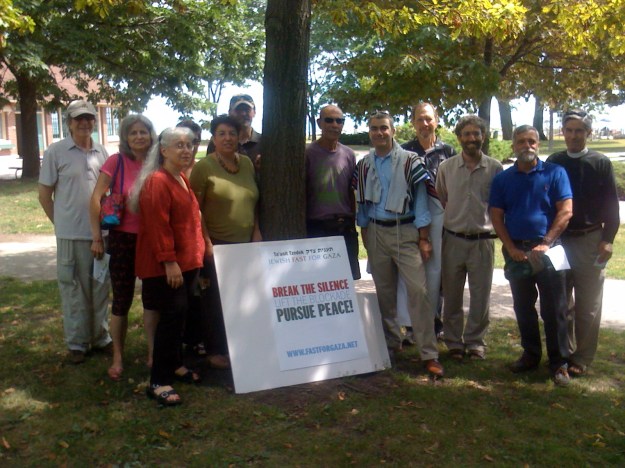
Today was the second monthly fast day for Ta’anit Tzedek – Jewish Fast for Gaza. To mark the occasion, a series of public vigils were held around the country (including one at the Liberty Bell in Philadelphia) and as far away as Glasgow, Scotland. Here in the Chicago area, it was my honor to lead a vigil at the Evanston lakefront with my good friend and colleague, Rabbi Rebecca Lillian. Here we are with some of the participants, below:

IMG_0654

Our campaign continues to grow. As of this writing we currently have 627 supporters, including 71 rabbis. I encourage you to join us, if you haven’t already – just click on the link above to become a supporter. We are continuously uploading important articles and resources, so be sure to check in regularly.

Speaking of important resources on the Gaza crisis, I commend to you the new report from Gisha – Legal Center for Freedom of Movement entitled “Red Lines Crossed: Destruction of Gaza’s Infrastructure.” See below for the full report. Click above to watch “Lift the Closure – Give Life a Chance” – a new online film recently released by eight Israeli human rights organizations to mark the two years of closure that Israel has imposed on the Gaza Strip.