Category Archives: Peace

Moment of Truth for Liberal Zionism

For the last ten plus years, advocates of a two-state solution in Israel/Palestine have been warning that the “window of opportunity” for a two-state solution is closing fast.

Here’s Jordan’s King Abdullah II using the image in a 2005 speech:

Israelis and Palestinians must take advantage of a “small window of opportunity” for peacemaking, he warned. “If we don’t do it, I think the Middle East will be doomed, unfortunately, to many more decades of violence.”

From a 2007 Boston Globe report:

Secretary of State Condoleezza Rice said yesterday that a “two-state solution” in the Middle East is in jeopardy and described a narrow window of opportunity to push Israel and the Palestinians toward peace.

J Street director Jeremy Ben-Ami, writing in a 2008 Forward op-ed:

The window is closing on a two-state solution, and Israel’s prospects for a second, safer 60 years grow are growing ever dimmer.

And as recently as two weeks ago, Ben-Ami used a different metaphor to underscore the urgency of the latest “moment:”

If this round of talks breaks down yet again – and you’ll be hard-pressed to find a single observer who’ll argue that they won’t – then Israel, like the boater on the river, can briefly revel in having avoided the risk of heading to shore.

But bear in mind that “sitting this one out” isn’t an option. The waterfall is still dead ahead.

As someone who’s invoked the “closing window” more than once myself over the years, I’m quite familiar with this pedagogy. Time is running out for a viable negotiated two-state agreement between Israelis and Palestinians – and thus the future of a Jewish and democratic state. The status quo – namely unrestricted Israeli settlement of the West Bank, coupled with an ever-increasing Palestinian birth rate – simply cannot be sustained.

At a certain point, however, I think it’s fair to pose the challenge: how many times can you repeatedly warn of a last chance before the notion is rendered devoid of all meaning? How long can advocates of a two-state solution invoke the urgency of a fleeting opportunity before admitting that this solution is simply no longer a realistic option any more?

To be sure, with each passing day, the warning of a last chance opportunity appears increasingly toothless. The latest “window of opportunity” occurred earlier this month when it was reported that Israeli Prime Minister Bibi Netanyahu was “mulling gestures to Palestinians to keep the peace talks going.” Barely a week later, we learned that Israeli officials had formally informed the PA of its position that West Bank settlements “must be a part of the Israeli State.”

Such a position, of course, makes a complete mockery of any suggestion of a viable, contiguous Palestinian state. It lays bare the truth that Israel is not really interested in two actual states, but merely the formalization of an inherently inequitable status quo.

The political realities here are stark and undeniable. Israel’s settlement of the West Bank continues with impunity and the US continues to provide its “closest ally” with all the diplomatic cover it needs to do so. Politically speaking, it is no longer possible to invoke windows of opportunity with a straight face. Perhaps the real question before us is not “how many times have we missed these opportunities?” but rather, “did they ever really exist at all?”

So what happens now? It’s reasonable to assume that this paralyzed, inequitable status quo will continue apace into the indeterminate future. Israel will continue to create facts on the West Bank with the tacit permission of the US, creating a conditions that no Palestinian leader could possibly be expected to accept.

Under such circumstances, it is equally reasonable to expect the reality for Palestinians on the ground to grow increasingly oppressive and dire.  As this occurs, their plight and their cause will be more difficult for the world to ignore. Governments, individuals and institutions will increasingly rally to Palestinian requests for support, most prominently the Palestinian civil society call for Boycott, Divestment and Sanctions against Israel.

In turn, Israel’s actions will be increasingly more difficult for its supporters to defend.  As the status quo is allowed to languish, the state of Israel will become further and further isolated from the rest of the world community and more pressure will be brought to bear upon the political elites to fundamentally change their approach to ending this conflict.

While these are certainly sobering and painful prospects, I don’t think they are exaggerated or far-fetched. On the contrary, I believe the burden of proof is on those who believe the same tired approach to the “peace process” will somehow yield results in the future when it has failed repeatedly in the past.

Once we accept that a division into two states is no longer realistically possible, the calculus is sobering, to put it mildly: we will be forced to choose between a patently undemocratic apartheid Jewish state, in which a minority rules over a majority or a civil democracy in which all citizens have equal rights under the law.

For many liberal Zionists, this unbearably painful decision will represent a profound moment of truth. If forced to choose, which will it be? A Jewish state that parcels out its citizens’ rights according to their ethnicity – or a democratic state in which equal rights are enjoyed by all its citizens?

I truly believe this is more than an academic question.  Perhaps it’s time to stop talking about mythic “windows of opportunity” and open a new discussion: what will it take for us to admit that it is finally closed? And what will our options be then?
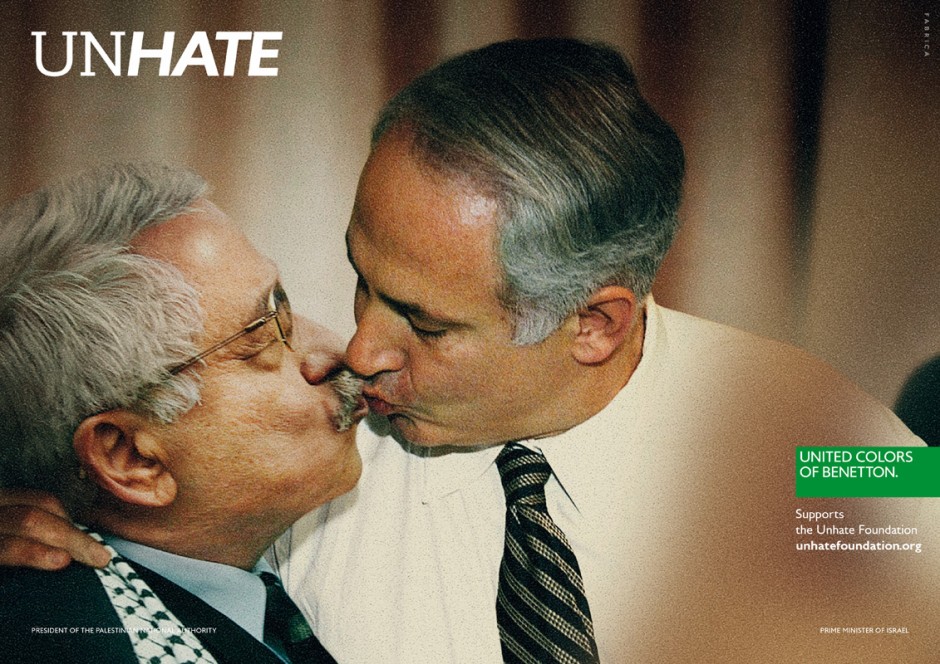
What Do You Think of Benetton’s New Ad Campaign?

From the website of Benetton’s newly created “Unhate Foundation:”

The UNHATE Foundation, desired and founded by the Benetton Group, seeks to contribute to the creation of a new culture of tolerance, to combat hatred, building on Benetton’s underpinning values. It is another important step in the group’s social responsibility strategy: not a cosmetic exercise, but a contribution that will have a real impact on the international community, especially through the vehicle of communication, which can reach social players in different areas.

The Foundation will organise initiatives involving different stakeholders, from the new generations to the institutions, international organisations and NGOs, through to civil society.

The Foundation also aims to be a think tank, attracting personalities and talents from the fields of culture, economy, law and politics, and people who have gone from simple citizens to leaders of movements, distinguishing themselves through their ideas and actions against the causes and effects of hatred.

If the pairing of Abu Mazen and Bibi aren’t your cup of tea, the campaign also includes other pix of unlikely political smooching partners…

(h/t Susan Klonsky)

War Without End: Sermon for Yom Kippur 5772

US Global Command and Control System

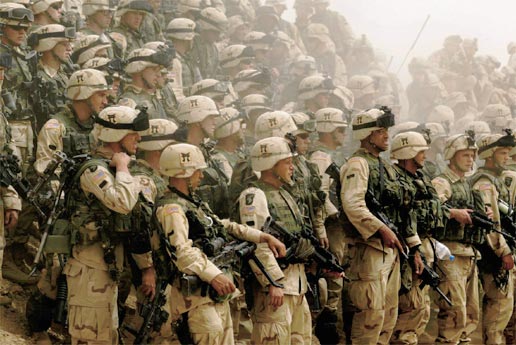
In 2006, I was approached by JRC’s Peace Dialogue task force and asked if I would consider adding something to our Shabbat prayer for peace. Could we, they asked, introduce the prayer by reading the names of three American soldiers, three Iraqi civilians and three Afghan civilians who had been killed in these two ongoing wars?

The reason, they explained, was to remind ourselves that peace is not just an abstract concept. If we’re going to say a prayer for peace, we should own up to the stakes – we should acknowledge that we are citizens of nation at war, that war comes with a very real human cost, and that as American citizens, we are complicit in all actions made by our country.

Continue reading

Time to Leave Iraq as Promised!

At every JRC Shabbat evening service since December 2006, we’ve introduced our Prayer for Peace by reading the names of three American soldiers, three Iraqi civilians and three Afghan civilians who have been killed since these wars began in 2001.

It’s our way of very simply reminding ourselves that we are citizens of nation at war, that war comes with a real human cost, and that war is a terrible and daily reality for real life individuals. And we do it to acknowledge that as American citizens, we are complicit in all actions made by our country.

Exactly one year ago, when Obama announced a reduction of American combat forces in Iraq from 144,000 to 50,000 troops, I was tempted to stop reading the names of the Iraqi war dead during our services – but I was prevailed upon to continue by many JRC members. After all, Obama himself said that our active combat presence would be maintained until the end of 2011. And as long as this is the case, we’d be hard pressed to deny that we were still a nation at war.

And now – surprise of surprises – we’re hearing indications that Secretary of Defense Panetta and others in the Obama administration believe that “some American forces should stay beyond 2011.”

Oh yes, make no mistake: we are still very much at war in Iraq….

Obama campaigned on the promise to end this war. Americans oppose the war in Iraq by an overwhelming margin. Our economy is in crisis and Congress has committed to find $1.2 trillion in savings for the coming year.  It’s time to wake up from our slumber and let our leaders know its time to end this misbegotten adventure as promised.

Rep. Barbara Lee of California is currently sponsoring a bill known as the “Iraq Withdrawal Accountability Act” – legislation that would prohibit funding of troops and military contractors in Iraq past 2011. Please click here and join me in urging your Congressperson to co-sponsor Rep. Lee’s bill.

PS: At the risk of ending this post on an abjectly depressing note, I recently read that regardless of when the American military pulls out of Iraq, our presence there would still not be over by a long shot. Read, if you dare, this piece by ex-foreign service staffer Peter Van Buren, in which he explains what will actually happen when the American presence in Iraq is transferred from the military to the Dept. of State:

(The) State Department hasn’t exactly been thinking small when it comes to its future “footprint” on Iraqi soil. The U.S. mission in Baghdad remains the world’s largest embassy, built on a tract of land about the size of the Vatican and visible from space. It cost just $736 million to build — or was it $1 billion, depending on how you count the post-construction upgrades and fixes?

In its post-“withdrawal” plans, the State Department expects to have 17,000 personnel in Iraq at some 15 sites. If those plans go as expected, 5,500 of them will be mercenaries, hired to shoot-to-kill Iraqis as needed, to maintain security. Of the remaining 11,500, most will be in support roles of one sort or another, with only a couple of hundred in traditional diplomatic jobs. This is not unusual in wartime situations. The military, for example, typically fields about seven support soldiers for every “shooter.” In other words, the occupation run by a heavily militarized State Department will simply continue in a new, truncated form — unless Congress refuses to pay for it.

JRC Israel/Palestine Study Tour Featured in +972!

Aziz Abu Sarah has just posted a wonderful piece in +972 about our JRC trip to E. Jerusalem and the West Bank last December:

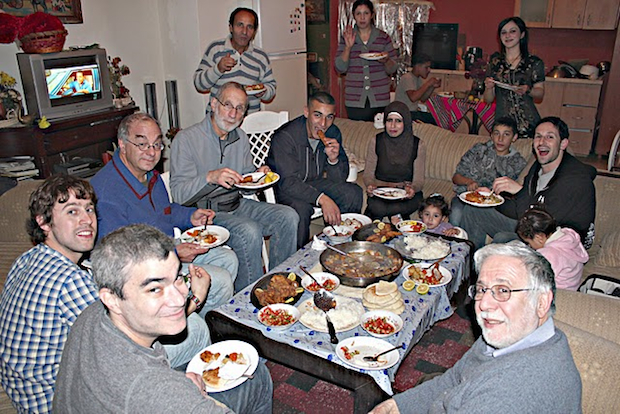
To my knowledge this is unprecedented, a delegation of Jewish congregants sleeping in Palestinian refugees homes, eating from their food, playing games with their children and grandchildren—a few even smoking hookah all night long with the youth of the camp. They talked about music, life, culture, romance, and–against my advice–even politics. The host families were the average Palestinian families and not the elite Palestinians. Some family members did not speak English, yet they did not have a problem communicating. They proved that the language of humanity transcends any linguistic boundaries…

Some Jewish extremists claim that if a Palestinian state is to be created, the Jews will not be able to visit their holy sites in the West Bank. They argue that Palestinians would not grant them the freedom to worship there. This argument is the basis for many settler justifications of the Occupation.

Nineteen Jews proved that this notion is not necessarily true. The Palestinian families in Deheisheh Refugee Camp did not mind hosting Jews, not just in hotels but rather in their homes. They stayed under the same roof, with no protection, no weapons or checkpoints. They were safe because they came as friends, not as enemies. They came with flowers and gifts, not with guns.

Remember the Fallen: End the War in Afghanistan

Here’s some assigned reading and viewing this Memorial Day Weekend, starting with a very thoughtful article written by David R. Henderson, a research fellow with the Hoover Institution and an economics professor at the Naval Postgraduate School.

Written immediately following Memorial Day 2008, Professor Henderson addressed the debate over the precise meaning of the day: is it to honor the soldiers who fought and died to preserve our “American freedoms,” or to mourn those who lost their lives in wars and to reflect on how to prevent this from happening in the future?

Henderson makes a compelling and eloquent case for the latter. His conclusion:

Exercise your freedom on future Memorial Days in any way that you wish as long as it’s peaceful. Take a minute or more to mourn the loss of so many U.S. soldiers and foreign soldiers, as well as millions of innocent civilians, who lost their lives because some government, whether the U.S., the USSR, the Nazis, or the Japanese government, killed them. Remember that almost all of those who die in war – even most of the soldiers who fought on the German side in World War II – are relatively innocent, even if their governments are not. And try your best to hold politicians accountable so that we’ll have fewer such deaths in the future rather than more.

After reading Henderson’s piece, please watch the clip above and sign this petition that encourages Congress to end the fruitless, tragic war in Afghanistan – currently the longest in American history.

PS: This just in today:

NATO has apologized for the deaths of Afghan civilians in an air strike in southern Afghanistan…

Authorities in Helmand Province said 14 civilians had died in the strike on May 28, 12 of them children.

How Do We Pursue Peace? A Response to Rabbi Shmuley Boteach

In his newsletter, Rabbi Shmuley Boteach (who in his byline refers to himself as “America’s Rabbi”) has written an account of Rae Ablieah’s protest during Netanyahu’s speech in Congress on Tuesday.

Apparently Rabbi Shmuley was two seats away from her at the time and witnessed the entire episode. In his piece, he explained why he decided not to “intervene” during the incident.  He also made some rather colorful observations about the Israel-Palestine conflict, including:

It’s not the ’67 borders that separate the Palestinians and Israelis. Rather, the conflict is all about values, specifically the Palestinians’ growing culture of death versus the Israeli culture of life.

My good friend and colleague Rabbi Lynn Gottlieb wrote an awesome response to Rabbi Shmuley and agreed to let me post it here below:

Dear Shmuley,

Thank you for your Shabbat hospitality the other night. Your family is beautiful. I appreciate your wife’s efforts to feed us and make us welcome in your home. Your hosting of conversations that explore the dimensions of a variety of issues is representative of the finest in our tradition. Critical thinking is crucial to the work of peace. Therefore, I feel empowered to address the issues your raised in your newsletter, especially since I know Rae Abileah personally and she ended up in the hospital.

1)  She was not uttering curses. A curse is wishing for destruction or harm of another person or people. This was not the case. “End Occupation” is not a curse, it is a political statement. Great lovers of Israel including Jewish parents in the Bereaved Parent’s Circle support this position.

2) Whether you agree or disagree with her statement, Rae was physically assaulted which is against the law. “Do not envy a man of violence nor follow any of his ways.” “Do not follow the majority to do evil.” “Do not hate your brother in your heart.” “Do not seek revenge…”

Physical assault is a crime. Period. Interrupting a speech may not be well received but it is not physical assault.

3) By becoming a bystander and watching a physical assault without intervening and making an effort to stop the assault, you committed a sin of omission. You became a bystander.

4) By polarizing the conflict with your words in this newsletter, you are creating new enemies. The mitzvah is “to turn an enemy into a friend.” Our tradition asks religious leaders to rise above the fray and to stand against violence of any sort. That is why we are commanded to help an enemy before a friend in the question of relieving a donkey of his load. Or take the example of Aaron, running between two enemies to make friends.

As someone who has a following I urge you not to promote more hatred by creating a category of “Israel haters.”  Rather, seek to understand their concerns, open a dialogue, become a Rodef Shalom (“Pursuer of Peace”) and not someone who fuels feelings that violence and revenge are justified.

By making the deeply distorted and uneducated statement about “the Palestinian culture of death and the Israeli culture of life” you are contributing to hate mongering which is a violent act according to our tradition. You have obviously not been in Palestine, nor do you seem to know about the very widespread movement for nonviolence that has been part of the Palestinian struggle for freedom for several decades. Yes, there are forces of violence in Palestine, just as there are in Israel. How do we pursue peace?

The kind of advice and opinion that appears in this newsletter puts you outside the circle of traditional Jewish sensitivities and commitments to peacemaking. As people in leadership, we have a great responsibility to Torah as a path of peace. Just as you urge Rae to use her words wisely, I urge you to do the same. I would be happy to continue this discussion with you at your convenience.

L’shalom,

Rabbi Lynn Gottlieb

Bibi Fails AIPAC Bible Test

For me the most significant part of Bibi’s AIPAC speech last night came at the very end, when he invoked the famous Leviticus verse on the Liberty Bell:

Now, as Prime Minister of Israel, I can walk down the street and see an exact replica of that bell in Jerusalem’s Liberty Park. On both bells is the same inscription. It comes from the Bible, from the book of Leviticus “Proclaim liberty throughout the land.”

Actually, what’s most significant is what he left out. Bibi only quoted the first half of Leviticus 25:10 – the entire verse reads:

Proclaim liberty throughout all the land unto all the inhabitants thereof.

(Emphasis mine.)

AIPAC: Dangerous for Jews and Other Living Things

I encourage you to read this important guest post by Alice Rothchild:

The American Israel Public Affairs Committee is holding its annual conference May 22-24, where Congress people and many of our national leaders will rush headlong into the committee’s open arms and bountiful coffers. In an increasingly bizarre time warp they will congratulate each other and kvell about Israel’s special relationship with the US, our strategic partnership, and Israel’s commitment to democratic ideals in a “sea of dictatorships” (to quote the website).

What they will not talk about is reality. US Jews are increasingly uncomfortable with a lobby that claims to represent us, but is deeply committed to the militaristic and rightwing policies of successive Israeli governments. Jews in the US tend to be politically progressive, but we are being asked to suspend our liberal beliefs when it comes to Israel. While maintaining a steady dream beat for war against Iran and a world view that, “Israel continues to fulfill its ancient obligation as a ‘light unto the nations,’” AIPAC lobbyists with their Christian Zionist allies guarantee billions of dollars in military aid for Israel each year . Much of this goes towards buying US military weapons and machinery, cementing the massive, interconnected, and lucrative military-industrial-security complex that now exists between our two countries.

Not only has this made a brutal 43 year military occupation possible, but it also provides military and political support to the current Netanyahu government. Let’s be clear. Netanyahu is committed to building Jewish settlements in the West Bank and East Jerusalem, undermining any possibility for a two-state solution. He is building Jewish settler-only roads and roads for Palestinians funded by USAID. He tightly controls Palestinian movement through checkpoints, permits, and the Separation Wall which has stolen thousands of acres of Palestinian land and destroyed the lives and livelihoods of people whose families have lived in the region for centuries. His idea of Palestinian statehood, (should he still have one), is a scattering of weak enclaves surrounded by Israeli military. The recently released Palestine Papers painfully documented the degree to which Palestinian negotiators were willing to sell their souls while Israeli negotiators refused to accept any concessions. The US was revealed twisting the arms of Palestinians diplomats to give up basic demands and the massive security coordination between the Israelis and the Palestinian Authority was exposed.

Within Israel, there is a rightwing crackdown on human rights activists, and laws brewing in the Knesset that will criminalize:

1. Nonviolent protests (in Israel and internationally) that advocate boycotts, divestments, and sanctions;

2. Providing information that could lead to Israeli war crime charges;

3. Any activity against Israeli soldiers or State symbols including nonviolent legitimate resistance to the occupation;

4. Commemorations of the Nakba, the Palestinian experience of 1948

At the same time there are over 20 laws that maintain the second class status for Palestinians with Israeli citizenship.

While Israeli activists worry about rising fascism in Israeli society, Palestinians are celebrating the Arab Spring that is blossoming in the region and Fatah and Hamas are gingerly talking about unity and democratic elections. Arabs from Tunisia to Yemen are putting their lives on the line for equality and freedom of speech. This breathtaking political moment is changing the political discourse in the Middle East and the US Congress needs to take notice and shake itself free of the world view that is promoted by AIPAC lobbyists. Fear of anti-Semitism and the traumas of the Holocaust do not justify Israeli exceptionalism, militarism, racism towards Arabs, or a belief in permanent Jewish victimization.

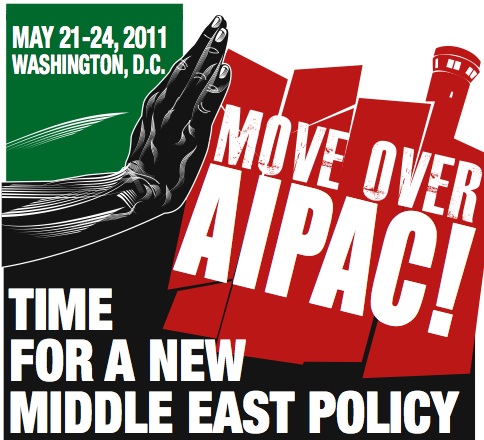
Peace in the Middle East is more urgent than ever, but it needs to be based on international law, human rights, and UN resolutions. AIPAC and its supporters are deluding themselves, promoting a perpetual state of war and hostility, living in a world that does not match reality. At the same time, over 100 peace organizations will be meeting in Washington. Under the call: Move Over AIPAC: Building a New US Middle East Policy, they will explore the impacts of US military aid and political cover, the demand to end the Israeli occupation, and the building of a solution that respects the rights and dignity of everyone in the region. There will be no big donors there, but Congress would do well to listen.

Bibi’s New “Peace Plan?” Just Watch the Facts on the Ground

Map: Peace Now

Netanyahu plans to unveil a new peace plan early next month, just before he is scheduled to address both Houses of Congress in Washington. According to reports, the plan will suggest a transfer of additional territory in the West Bank to “full Palestinian control.”

Meanwhile back in the real world, Israel’s Ministry of Housing has just announced plans to build a new neighborhood of 800 housing units south of West Bank settlement Givat Ze’ev. Peace Now correctly points out that these plans represent the true intentions of the Israeli government:

It is a strategic plan, that is meant, from the one hand, to create a territorial continuity between Jerusalem and Givat Zeev, and from the other hand to create a barrier between the Palestinian communities south-west of Ramallah, and the heart of the potential Palestinian State in East Jerusalem and Ramallah.

The construction in the “Settlement Blocs” is more of a threat to the two states solution than in the other settlements, because it creates facts on the ground that will be much harder for Israel to remove, and it limits the ability of the negotiators to find potential land-swaps that would be necessary for an agreement.

Just bear this in mind when Netanyahu unveils his latest “peace plan:” actions on the ground speak much louder than his words.