Category Archives: Politics

Protesting Genocide at the DNC in Chicago: Beyond “One Issue”

(photo by Keeton Holder)

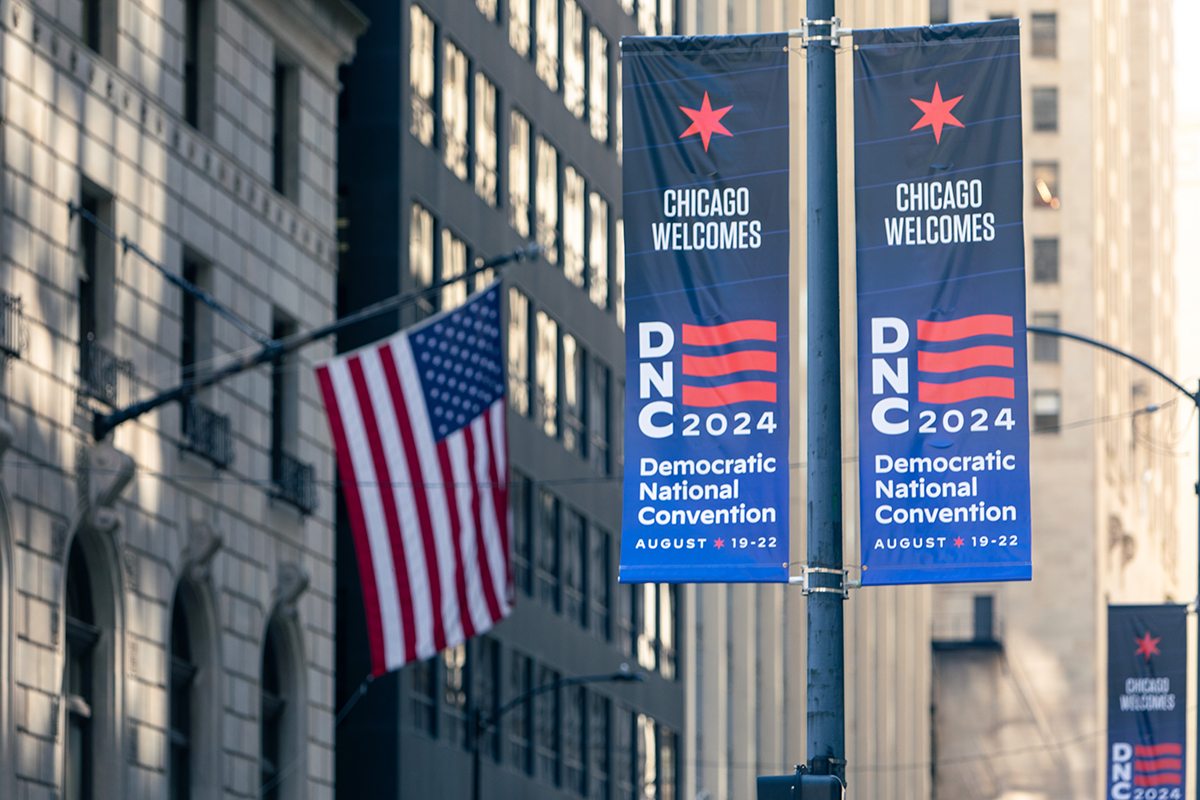
As I’ve written previously, a large coalition of leftist groups has been preparing to take to the streets when the Democratic National Convention comes to Chicago next week. Although there will be a variety of different demands leveled at the DNC during the course of the convention, one key issue clearly stands out as a central common thread through them all – namely, an immediate US arms embargo and a permanent ceasefire to end Israel’s genocide in Gaza.

To name but one example: a rally and march for reproductive justice (of which my congregation, Tzedek Chicago, is a co-sponsor) will take place this Sunday, on the eve of the convention. As “Bodies Outside of Unjust Laws” organizers have made clear, however, the demands of this protest are not limited to issues of domestic reproductive justice alone:

Reproductive justice inherently includes ending the reproductive genocide in Palestine. As U.S. citizens, it is our duty to call on our own government to end the funding of weapons to Israel that enable this nightmare to continue and robs us of funds at home. As feminists and reproductive justice activists, we must also highlight a horrific aspect of the war on Palestinians: it is a war against women and children, who suffer in uniquely cruel ways. 

Likewise, the Coalition to March on the DNC, a group of over 200 national and local organizations is calling for an “End to US Aid to Israel” along with demands on immigrant justice, police crimes, healthcare, housing and the environment. Here again, justice for Palestinians is not viewed in isolation from other issues. As protest organizers correctly understand, these issues are irrevocably interlinked and intertwined.

During the course of this election cycle, those of us who have been demanding an arms embargo and ceasefire in Gaza have become all too familiar with one recurrent criticism in particular: that we are “one issue voters.” I find this to be a dangerous attitude for a number of reasons. More than anything, it’s an egregiously dismissive stand to take in an age of genocide, smacking of “it’s not my problem” American isolationism during the 1940s. For the Palestinian people, of course, Israel’s genocide in Gaza is not simply one issue – it’s the issue.

Witness, for instance, the news from this past weekend:

Officials in Gaza say more than 100 people were killed Saturday in an Israeli attack on a school and mosque where thousands of displaced Palestinians had sought shelter. The attack on the al-Tabin school in Gaza City was one of the deadliest individual attacks since Israel’s war on Gaza began over 10 months ago. Rescue workers said they did not find a “single full body” among the deceased — just body parts often destroyed beyond recognition. Survivors said Israel attacked the school during morning prayers…

CNN has confirmed a US-made GBU-39 small diameter bomb was used in the Israeli strike on the school. The attack came two days after the Biden administration notified Congress that it was preparing to provide Israel with an additional $3.5 billion to spend on US weapons and military equipment. Congress had approved the money as part of a $14 billion package for Israel in April. Zeteo reports part of the new US package includes a direct sale of 6,500 joint direct action munitions to Israel.

First and foremost, the genocide in Gaza is a crime against humanity that should concern us all. But as citizens of the nation that is funding and abetting this genocide, we Americans cannot look away from the blood that is surely on our collective hands. Nor can we ignore the shock waves that resonate far outside the borders of Palestine/Israel: the threat of an all-out regional war, the profits enjoyed by the arms and surveillance industry at taxpayer expense, the devastating environmental impact – the list goes on and on. Palestinian human rights lawyer and activist Noura Erakat put it perfectly on Twitter/X recently: “PSA: ending a genocide is not ‘a single issue’ it is an entire universe of issues.”

Another refrain I’ve been hearing repeatedly is the critique that protesting at the DNC “will only help Trump.” Harris herself leveled this argument at a campaign rally in Detroit when she sternly admonished pro-Palestinian protesters: “If you want Donald Trump to win, then say that. Otherwise, I’m speaking.” To be sure, it was an astonishingly tone-deaf and dismissive response to make in Michigan, the very birthplace of the Uncommitted Campaign. But on a more fundamental level, Harris’s response denied the very real impact of her own administration’s policies. As one of the protesters later put it, “When people are demanding a ceasefire and arms embargo and an end to the genocide and you say that we want Donald Trump to step in—it just shows a lack of accountability. It shows a lack of leadership, a lack of responsibility and a lack of ownership.”

In essence, Harris’s comment was just the latest version of the “shut up and vote” message that the Democratic party routinely sends progressives during every election cycle. In an age of US-supported genocide, however, the cynical emptiness of this message has become patently, painfully obvious. As journalist Masha Gessen has rightly pointed out. “These voters are not choosing between Harris and Trump. They are choosing between their sense of themselves as moral beings if they vote for Harris and their sense of themselves if they vote for a third-party candidate or for no one at all.”

Of course those who will be protesting at the DNC next week do not want to see Trump elected in November. But even from a purely strategic point of view, what has a better chance of helping the Democrats fortunes in November? We know that a strong majority of American voters across the political spectrum support a permanent ceasefire in Gaza. What would be the more winning strategy: telling those who want to end a genocide to shut up, or exert real leadership that will bring about a ceasefire and an end to the threat of a devastating regional war?

While party conventions function largely as candidate-coronations, they still function as places where parties express their collective vision and finalize their political platforms. On this score, I’m not at all optimistic that an arms embargo to Israel and a permanent ceasefire will find any purchase at the DNC. There are a mere 30 Uncommitted delegates out of 4,600 – and while they are pushing for a voice at the convention (they’ve asked that Dr. Tanya Haj-Hassan, a pediatric intensive care doctor who has volunteered in Gaza, speak from the convention floor), they have still not been offered a slot. Harris’s national security advisor has also made it clear that she opposes an arms embargo to Israel. By every indication, it certainly feels like “shut up and vote” will be the dominant Democratic party message coming out of the convention next week.

I have enormous respect for the Uncommitted delegates who will engage within the convention, particularly co-founder Layla Elabed, who has said even if they are not given a speaking slot, delegates will make their presence known with “news conferences, candle light vigils, tables to distribute literature and, they hope, guest testimonies about life in war-torn Gaza.” When it comes to political advocacy, however, there is always an inside game and an outside game. That’s why those of us who are not delegates will (quite appropriately) be making our presence known outside the walls of the convention hall as well.

Protest organizers have no illusions about the overwhelming militarized presence that will greet us when we gather next week. Federal authorities have divided the area surrounding the United Center, where the main speaking events of the convention will take place, into “soft” and “hard” zones – the latter being off limits to cars and non-credentialled delegates. But even in the soft zones, movement has been heavily restricted. The main protests have been given approved routes far from the convention site, and at one point goes through narrow residential side streets, that will be completely inadequate to handle thousands of protesters. While organizers have appealed the march route, as of this writing there has been no response from the city of Chicago.

When we talk about the potential for police violence next week, of course, the specter of the 1968 Democratic convention in Chicago looms very large. A great deal of ink has been spilled analyzing the differences and similarities between Chicago 1968 and Chicago 2024 – and while I’m loath to venture too far into this rabbit hole, there is one point of commonality I believe bears noting. In general, the mythos around the 1968 DNC protests tend to lay the blame for the Democrats’ defeat on the protest movement that “divided the party.” Often lost in this discussion is the fact that in 1968, those protests were directed toward a political party that had been prosecuting an increasingly unpopular war in Vietnam. Today, as then, I find it deeply misguided to blame protesters and not the immoral policies of the Democratic party itself.

While it’s not particularly helpful to use Chicago 1968 to heighten hysteria over the DNC, protestors are certainly justified in being vigilant over the very real possibility of police violence. I’m not the only one who finds it ominous that the city is doubling down on armed presence in the city. In advance of the convention, the Secret Service agent in charge of “security” has commented that “Chicago has a proven track record when it comes to putting on huge events” – citing the city’s response to Lollapalooza, the NASCAR Chicago Street Race and the Chicago Air & Water Show – as if the DNC is just another tourist event to showcase to the public.

No, we cannot deny of the very real moral and political reality that will be at stake in Chicago next week. We cannot deny that state violence directed against Palestinians is one and the same with so many other forms of state violence that are routinely normalized as “necessary.” And we must resist the call to dismiss any form of systemic violence as just “one issue.” As my friend and comrade, organizer Kelly Hayes has so wisely written:

We have to recognize victims of police brutality, Palestinians, our disabled and unhoused neighbors, and so many others who are subject to forgetting as worthy of grief, outrage and action. Everyday people who are fleeing violence, hunger, and militarism, everyday people whose cites are running out of water or are in danger of disappearing beneath rising flood waters, everyday people who are dying right now because they lack air conditioning amid heat waves – these are the people whose plights and fates should shape our politics. If we are going to fight for any semblance of human decency, we need to reclaim and reassert the value of our lives.
Why I’ll Still be Participating in the Protests at the DNC Next Month

 (photo: AP/Jose Luis Magana)

By all accounts, the Democratic Party is closing ranks at lighting speed. As of this writing, Vice-President Harris now has more than enough delegates to clinch the party’s nomination, with a virtual roll-call planned prior to the convention in Chicago next month. The endorsements from powerful Dems continue to roll in, including from virtually all of those who might be considered viable as her potential opponents. Just two days after Biden’s withdrawal from the race, her coronation as the Democrats’ candidate is now all but assured.

I fully understand the euphoria of this moment. With Biden as the Democratic candidate, the prospect of another Trump presidency was becoming more terrifyingly real by the day. But make no mistake, Biden’s downfall was not the product of one horrible debate. On this point, I am in total agreement with Palestinian-American community organizer Linda Sarsour, who recently posted on her Facebook page:

They will never admit this but Joe Biden became a political liability for the Democratic Party on Gaza. Period. The media won’t say this. The pundits will talk around it and the party will say it’s not the case as not to offend their pro-Israel donors – but they knew that they could not win states like Michigan, Georgia, Wisconsin and they had lost big chunks of important constituencies like young people, Arab and Muslim voters, and many progressives. The fact that anyone thinks we are going to believe that one dismal debate performance was the reason they pushed Biden out is just ludicrous.

Absolutely. While the doubts over his age may have motivated his donors to abandon him in the end, Biden was fatally weakened as a candidate by his unabashed support for Israeli genocide – and the solidarity movement that held him to account. As was reported as far back as January, “It’s not just the major prime-time rallies that are now attracting the anti-Gaza war crowd’s wrath. Everywhere Biden goes he is being dogged, whether it is outside the church he attends near his home in Delaware or along the route of his presidential motorcade.”

Many are noting that Harris has been marginally better on the issue of Palestine/Israel than Biden. Last December, it was reported that she was pushing the Biden administration to “to show more concern publicly for the humanitarian damage in Gaza.” During a speech in Selma last March she called for a temporary ceasefire, adding that “too many innocent Palestinians have been killed.” In the same speech, she spoke empathetically about Gazans seeking aid who “were met with gunfire and chaos.”

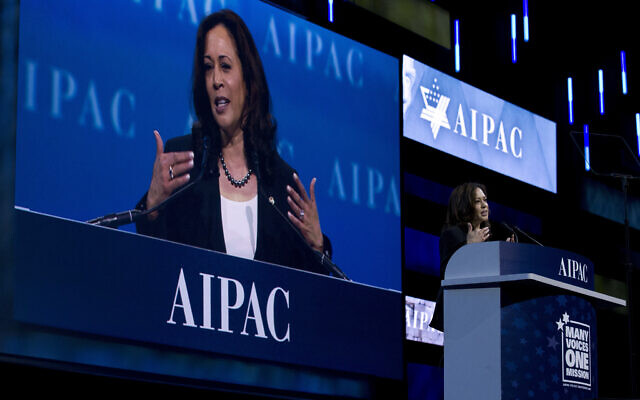
At the same time, we should have no illusions about Harris’ record of unconditional support for Israel. During a speech at the 2017 AIPAC conference, she offered the requisite oath of fealty, ““Let me be clear about what I believe. I stand with Israel because of our shared values, which are so fundamental to the founding of both our nations.”  And during her 2019 Presidential campaign, she was praised by the lobbying group Democratic Majority for Israel for running to the right of Obama on the Iran deal. Indeed, despite her softer tone, Harris has been in lockstep with the Biden administration – indeed with, the entire Democratic Party leadership – on this issue.

For the past several months I’ve been actively involved in the Palestine solidarity movement holding the Biden administration to account for enabling and support Israel’s genocidal violence in Gaza. Along with scores of others, I’ve made plans to participate in the protests planned at the Democratic National Convention next month. Even with Kamala Harris now leading the ticket, I have no intention of changing those plans.

Those of us who are part of this movement have not forgotten the essential reason for our organizing: we are living in a time of genocide – one that is being aided and abetted by a Democratic government. Whether it is Biden or Harris at the top of the ticket, nothing has changed in this regard. Moreover, conventions are the place where party policy and platforms are decided. Those of us who have been holding our government to account all year have a solemn responsibility to continue to do so: to demand that the governing party enact an arms embargo on the Israeli government and to establish a foreign policy centered in human rights.

Though news of Gaza has been swept off the front pages, Israel’s carnage against the Palestinian people has continued with impunity. It was reported today that “at least 84 Palestinians were killed over the past day in (Khan Yunis), with more than 300 others wounded. Medical staff at the Nasser Medical Complex report they are completely overwhelmed and have been forced to treat patients on hospital floors.” Yesterday, the World Health Organization revealed there is now a high risk of the polio virus spreading across Gaza – and beyond its borders – due to the dire health and sanitation situation there. The Israeli military has just announced that it will start offering the polio vaccine to its soldiers though there are not enough vaccines – or the distribution capacity – to reach the 2.2 million Palestinians in Gaza.

In other words, now is not the time to let up. In the words of Linda Sarsour, “no matter what, our work doesn’t change.” Or as Waleed Shahid of the Uncommitted Movement has correctly said:

We are making clear that we think that Biden and the White House’s disastrous policy on Gaza makes it harder for them to defeat Trump. In fact, having a campaign based on democracy, having a campaign fighting far-right authoritarianism, while sending bombs to one of the world’s biggest far-right authoritarians in Netanyahu, who is now visiting Washington, DC, makes a mockery of that party’s claim to be fighting on the right side of history, fighting on the behalf of democracy. And we want to see that party change course.

That’s why, no matter who is heading the ticket, I plan to be on the front lines with my friends and comrades when the DNC comes to town next month.

Safety in Abundance: Remembering Wadee Alfayoumi

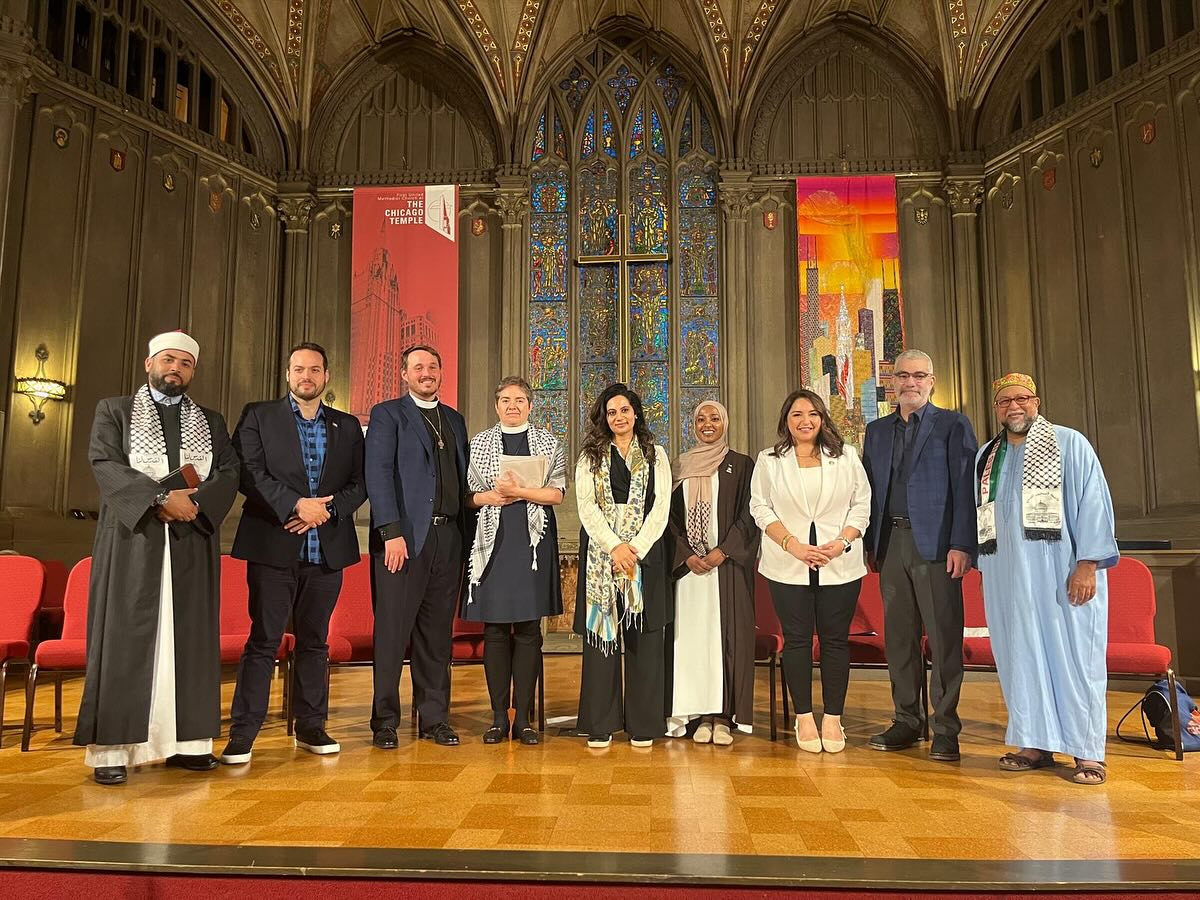
left to right: Sheikh Hassan Ali, Tarek Khalil, Rev. Michael Wolff, Rev. Anna Piela, Maaria Mozaffar, Deena Habbal, Rep. Delia Ramirez, Rabbi Brant Rosen, and Imam Hassan Aly.

My remarks from last Sunday, delivered at an interfaith memorial in Chicago for Wadee Alfayoumi, a six year old Palestinian-American boy from Plainfield, IL, who was murdered in a hate crime on. October 14. Our service also included words from IL Rep. Delia Ramirez, who is co-sponsoring a House resolution affirming that “the United States has zero tolerance for hate crimes, Islamophobia, anti-Semitism, and anti-Palestinian and anti-Arab discrimination.” 

When precious lives are unjustly taken from the world, the most essential way we can honor their memory is to ensure that they have not died in vain. Wadee’s young life was cruelly taken from us through a heinous and unjust act. While it is true that his murderer has been caught and will be tried by our legal system, our work is by no means over. We must continue to demand justice for Wadee Alfayoumi. 

While it is true that Wadee’s life was taken by one hateful, hate-filled individual, those who view this was a random, isolated incident are gravely mistaken. Wadee’s murder did not occur in a vacuum. It occurred in the toxic context of Islamophobia and anti-Palestinianism that has long been rising throughout this country and around the world. It was inspired by an ideology emanating from the state of Israel that has routinely and regularly dehumanized Palestinians for decades – a state that is, even as we speak, unleashing genocidal violence against a captive Palestinian population in Gaza. 

How can we honor the life of Wadee Alfayoumi? How can we ensure his death will not be in vain? By speaking out as loudly and unabashedly as possible against anti-Muslim, anti-Arab and anti-Palestinian hatred – and the systems that support it. By demanding that the safety and security of some groups cannot be upheld at the expense of others. By affirming the most essential of moral truths: that all people – and peoples – are equally precious in the eyes of God, and equally worthy of human dignity and respect. 

In a celebrated Talmudic debate, two rabbis, Rabbi Akiba and Rabbi Ben Azzai argued over what is the most central precept in Torah. Rabbi Akiba claims it is the famous verse from Leviticus: “Love your neighbor as yourself.” Ben Azzai disagrees, and cites the verse from Genesis: “When God created humankind, God created humankind in God’s image.” Why does Ben Azzai disagree? Some commentators suggest that while “love your neighbor as yourself” is a powerful moral imperative, it is somehow incomplete. It potentially limits our love to our immediate neighbors, to members of our community, religious or ethnic group. However when we lift up the Biblical precept that all humanity is created in the divine image, we assert our love and care for all who dwell on earth. Likewise, when we dehumanize or diminish the humanity of others, God’s presence is diminished in the world.

In other words, this divine precept is rooted in a vision of abundance. Human safety and security cannot be a zero-sum game: in the end, it must be all of us or none. There are many of us in the American Jewish community who are deeply, profoundly dismayed by the cynical accusations of antisemitism wielded by right wing political leaders who have made it abundantly clear they do not, to put it mildly, have my community’s well-being at heart. We know that the charge has less to do with Jewish safety than punishing those who stand in solidarity with Palestinians. 

We would do well to ask: why does the ignorant conflation of anti-Zionism with antisemitism merit so many hearings on Capitol Hill? Why is antisemitism being politically exceptionalized over other forms of bigotry and hatred? Why has the murder of Wadee Alfayoumi – and the shooting of three Palestinian college students in Burlington, Vermont – met with nothing but abject silence from the representatives holding these hearings? In this time of growing hatred, we must stand down this privileging of one group of people over others for cynical political gain. We must demand that our politics be leveraged to protect the safety and security for all groups targeted by hate. 

Unfortunately – tragically – we live in an age in which right-wing, white supremacists are strategically targeting their hate at Muslims, Jews, people of color, immigrants, gay, trans and disabled people, among others. Yes, as a Jewish person, I feel genuinely threatened by the rise of antisemitism in this country and around the world – but I also know full well that Christian nationalist hatred is equal opportunity in nature. I understand full well that my safety and security is inseparable from the safety and security of all. 

As remember the precious life of Wadee Alfayoumi, whose was taken from the world so unjustly, let us demand justice. Let us, as affirm, as the House Resolution introduced by Rep. Delia Ramirez and her colleagues states so plainly, that it is “the duty of elected officials and media to tell the truth without dehumanizing rhetoric when informing the public of factual information.” And that “the United States has zero tolerance for hate crimes, Islamophobia, anti-Semitism, and anti-Palestinian and anti-Arab discrimination.” 

In Jewish tradition, when we invoke the name of someone who has died, we traditionally follow with “may their life be for a blessing.” This is not only a statement of respect to the dead: it is also a moral imperative for the living. If their memories are to be a blessing, it is we that must make it so. 

I’d like to end my remarks now with the traditional Jewish prayer for the dead, El Male Rachamim (“God Full of Compassion”). We offer it now in memory of Wadee Alfayoumi, whose precious life was unjustly taken from us. Let it’s resonance be a blessing to all whose lives have been ended by bigotry – and an inspiration to us all to dismantle the systems that enable hate and oppression once and for all:

Oh God filled with compassion, whose loving presence ever surrounds us, bring final rest to the soul of Wadee Alfayoumi, who has returned to his source. May the memory of his life shine forth like the brilliance of the skies above, as it brightens our own lives and even now. Source of mercy, please shelter him beneath the softness of you wings, that he may be protected in your presence for eternity, that he may rest in peace and power.

Amen.

The “Jewish Community” Letter to Mayor Johnson, With Commentary

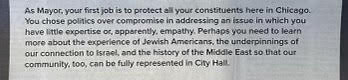
Last Sunday, this full-page ad appeared in the Chicago Tribune: a hate-filled diatribe against Mayor Brandon Johnson for his support of the recent city council ceasefire resolution. Here it is, in full, along with my commentary.

Criticizing one resolution for “doing nothing to substantively affect the outcomes in the Middle East” is a straw man argument. No one who supported this resolution has any illusions that it alone will change the terrible facts on the ground in Israel-Palestine. It does represent, however, a civic statement of conscience. To date, over 70 US cities have passed similar ceasefire resolutions. Taken together, they constitute a collective moral call for an end to the humanitarian nightmare that has been unfolding and escalating in Gaza for the past four months.

The letter makes the unsubstantiated claim that the City Council’s resolution proceedings “fanned the flames of antisemitism.” This is a serious accusation – and it is exceedingly irresponsible to level such a claim without any examples or proof. No, ceasefire resolutions do not cause antisemitism – and protesting Israel’s genocidal violence against Palestinians in Gaza is not antisemitic. It is a call for justice.

Chicago’s ceasefire resolution was based on a resolution passed by the UN last December, which emphasized that “the Palestinian and Israeli civilian populations must be protected in accordance with international humanitarian law.” It also called for “the immediate and unconditional release of all hostages, as well as ensuring humanitarian access.”

This is an exceedingly fair resolution. No, it did not absolve Hamas for the war and civilian deaths, but neither did it condemn Israel for its outrageous prosecution of a military assault that international experts and courts have have claimed fits the definition of genocide.

The letter then goes on to say that Hamas “misused humanitarian aid” – another unsubstantiated claim – and criticizes the resolution for failing to demand that Hamas disarm. Since this is an Israeli demand, to include this would be to inject an egregiously partisan statement into the resolution.

The January 30 high school walkouts were powerful demonstrations of collective student conscience that Mayor Johnson was right to support. The claim that “hundreds of CPS parents, students and teachers” were harassed during the protests is completely anecdotal and in fact, outrageous. If harassment on such a scale actually took place, there would surely be widespread press and investigations into these alleged actions. In fact, the press around the walkouts cited “worries from some CPS parents and Jewish groups that Jewish students could be targeted or made to feel uncomfortable.” There is, of course, a world of difference between “uncomfortable” and “unsafe.”

Palestinians have long pointed out that the call “from the river to the sea” is not a genocidal threat, but a demand for equality and justice for all. If that makes some Jews uncomfortable, they should interrogate their support for “the world’s only Jewish state” – an ethno-nation that does not afford equal rights to the Palestinians who happen to live between the river and the sea.

The “compromises” suggested in this letter are exceedingly more political than anything Mayor Johnson supported – and slamming him for having no expertise or empathy is hateful in its own right. What these signees really want is for him to submit to their own personal opinions about “the Jewish American experience, the underpinnings of our (sic) connection to Israel and the history and the history of the Middle East.”

For shame. These individuals speak for themselves – not for the growing numbers of American Jews who are actively protesting Israel’s genocidal violence in Gaza – and who fully support Mayor Johnson’s courageous moral leadership.

Ceasefire Now vs. Free the Hostages: Doing the Moral Calculus in Gaza

photo: Hassan Eslaiah / AP

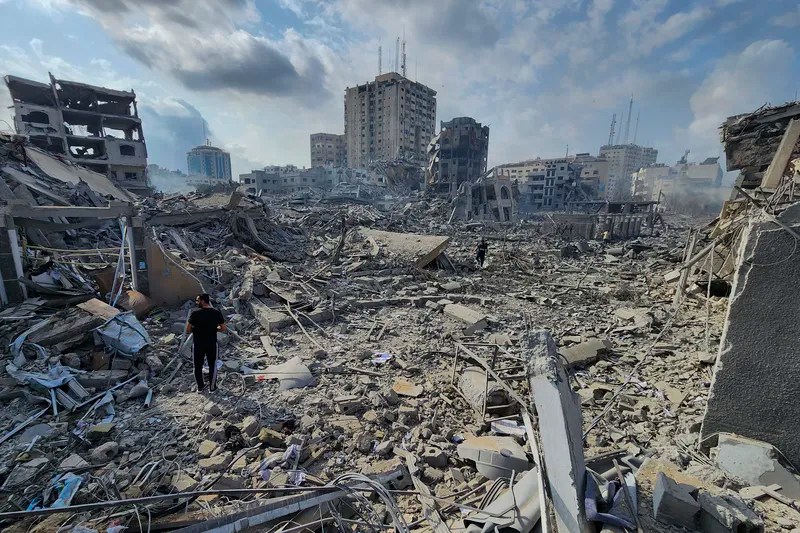
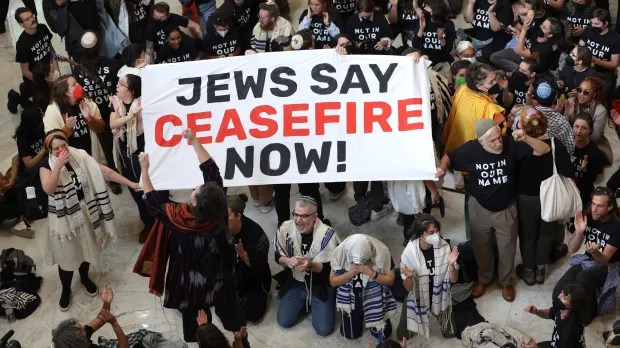
As Israel intensifies its horrific military assault on Gaza – at current count, over 8,000 Palestinians have been killed, including over 3,000 children – the popular call for a ceasefire in Gaza is growing powerfully around the US and throughout the world. Last weekend, hundreds of thousands of protesters took to the streets. Jewish Voice for Peace, together with other Jewish groups, have organized massive actions of civil disobedience in Washington DC, New York City and other cities throughout the North America. Last Friday, “Rabbis for Ceasefire” released a new initiative that included a video calling for a “complete ceasefire now.” To date, over 100 rabbis have signed on to our statement.

As I wrote in my previous post, there is still a discernable resistance to the call for a ceasefire from members of the Jewish community. That resistance now seems to have developed a public call of its own: “Free the Hostages Now.” Over the past week or so, this adversarial binary has been echoing throughout social media in the form of dueling memes. When I posted a “Ceasefire Now” profile picture on my Facebook page, a FB friend immediately added the comment, “Free the Hostages” as a kind of knee-jerk rejoinder to my public statement. The increasing back and forth between these two demands has all but turned into a perverse game of rhetorical ping-pong.

As I consider this phenomenon, I can’t help but think that this alternative call is presenting us with a moral litmus test – as if those who advocate for a ceasefire without also demanding a release of the hostages somehow favor Palestinian lives over Israeli lives. As if calling for a ceasefire expresses concern for Palestinians only and not all who happen to be in Gaza at this terrifying moment.

Of course, any humane person would and should desire a return of the hostages. The details of Hamas’ mass murders and their abduction of hostages have been appalling and horrific to behold. But just as we struggled to comprehend the scope the trauma that occurred on October 7, our grief was weaponized and metabolized into a war of vengeance. Before we had time to even catch our breath, Israel immediately initiated a massive scorched earth military campaign in Gaza, unleashed a scale of death and destruction that has magnified this grief to unimaginable proportions.

It has been truly unsettling to witness the apocalyptic language used by Israeli leaders to describe the military objectives of this withering assault. Despite their claim to be prioritizing the release of the hostages, Israeli leaders have made it clear that vengeance and the destruction of Hamas – along with the rest of Gaza – is its primary objective. On October 11, Israel’s President Isaac Herzog said, “It is an entire nation who are responsible. This rhetoric about civilians being uninvolved is absolutely untrue…We will fight until we break their backs.” More recently, Israeli PM Netanyahu compared their military assault to the commandment to destroy the Amalekites – the divine Biblical imperative to wipe out an entire people completely.

Amidst this unsparing bombing campaign, family members of hostages have been speaking openly about their fear that their loved ones will be killed before they can be rescued. The father of one hostage has said “We are very worried about our loved ones who are there and we don’t know if the military operation will take those hostages under consideration, (to make sure) that no one will be injured.” Others are imploring their government to engage diplomatically to ensure the return their loved ones in exchange for Palestinian prisoners.

Indeed, the issue of Palestinian prisoners raises a crucial piece of context that has been regularly been lost in discussions of the current hostage crisis. Over the past several decades, in fact, there has been precious little discussion in the mainstream media of Israel’s practice of imprisoning Palestinians in military prisons as well as in “administrative detention” – a central feature of its brutal occupation. While many Palestinian prisoners have been committed violent acts against Israelis, many more are imprisoned without anything remotely resembling due process. Israel’s Military Order 101 has essentially criminalized civic activities under the basis of “hostile propaganda and prohibition of incitement.” The order, which is still in use in the occupied West Bank, outlaws the participation and organization of protests, printing and distributing political material, waving flags and other political symbols – and any activity that demonstrates sympathy for an organization deemed illegal under military orders.

As described by the Israeli human rights organization B’Tselem:

In administrative detention, a person is held without trial without having committed an offense, on the grounds that he or she plans to break the law in the future. As this measure is supposed to be preventive, it has no time limit. The person is detained without legal proceedings, by order of the regional military commander, based on classified evidence that is not revealed to them. This leaves the detainees helpless – facing unknown allegations with no way to disprove them, not knowing when they will be released, and without being charged, tried or convicted.

Unjust illegal imprisonment has long been a way of life for the Palestinian people. It has been estimated that four in ten Palestinian men have spent time in Israeli jails. According to the Palestinian prisoner support and human rights organization Adameer, there are currently, 1264 administrative detainees – and 5,200 Palestinian political prisoners overall – currently being held in Israeli prisons.

As has been widely noted, Palestinian minors are also among the imprisoned. Defense for Children International – Palestine has reported, approximately 500 to 700 Palestinian children, some as young as 12 years old, are detained and prosecuted in the Israeli military court system every year. Israel remains the only country in the world that automatically and systematically prosecute children in military courts. According to child rights groups, these children are often interrogated without the presence of a parent or lawyer, subjecting them to physical and psychological torture.

Bottom line? Abducting and imprisoning civilians – whether by militant groups or militarized states – is an immoral act. But as we do this moral calculus, we must also make sure to include an honest power analysis. Israel’s imprisonment of Palestinians in administrative detention – not to mention their imprisonment of 2.2 million Gazans in an open-air prison – occurs in the context of a heavily militarized state who have been subjecting the Palestinian people to systemic oppression and dispossession for decades. Hamas’ abduction of hostages – brutal and heinous as it was – occurred in response to a colonial, apartheid regime that been governing their lives for the past 75 years.

This is key: while Netanyahu would like us to believe that Hamas are Amalekites who have abducted hostages out of sheer evil, these acts were ultimately carried out in order to gain some leverage in amidst a never-ending blockade that has left them completely at Israel’s mercy. Such has always been the case with these hostage crises: underlying the terrifying violence of these acts lie a desire for strategic leverage in potential negotiations.

When it comes to understanding the strategic realities involved in hostage negotiations, there are few Israelis with more experience than Gershon Baskin, Middle East director of the International Communities Organization. According to Baskin, who was instrumental in procuring the release of the abducted Israeli solider Gilad Shalit in 2011 and has had relationships with Hamas leaders over the years, the current situation is considerably more complex than the one he faced back twelve years ago. As Baskin has pointed out, Israel has never had to face such a massive number of civilians taken hostage. Things are further complicated by the fact that the hostages seem to be held by multiple groups in addition to Hamas, Moreover, he says:

We’re in the midst of a war with an enormous bombing campaign going on in Gaza, destroying much of the Gaza Strip. More than a million Gazans are homeless already. So there’s a horrific humanitarian crisis in Gaza as well, with so many innocent people being killed.

Baskin added that while the safe return of the hostages is the number one priority of their family members, “it’s not necessarily the number one priority of Israel. There are other priorities, like dismantling Hamas’s ability to ever attack Israel again and threaten Israel.” In other words, Israel is more interested in the destruction of Hamas than ensuring the welfare of anyone who happens to be in Gaza at the moment. At the end of the day, the hard fact remains: Israel cannot destroy Hamas without killing scores of Palestinians – and likely many hostages as well.

This, in short, is why it is so profoundly problematic to counter the demand for a ceasefire with a demand to release the hostages first. As long as Israel rains bombs mercilessly on Gaza, the chances of getting the hostages back alive grow that much dimmer. At the same time, it is utterly unrealistic to expect that Hamas will release the hostages without a ceasefire. The hostages are the only realistic leverage Hamas has at this moment. And Hamas most certainly knows if they hand over the hostages before a ceasefire is negotiated, Israel will almost certainly press on with its massive military assault until Hamas is completely destroyed – along with much of Gaza.

On both a moral and strategic level, if we want to save the lives of Israelis as well as Palestinians, we simply must put all our efforts into a demand for a ceasefire now. As ever, there is no military solution to this crisis. There are only two alternatives: engagement or annihilation. While the former now feels more remote than ever, the latter is simply unthinkable.

I’ll end now with the powerful, heartfelt, urgent words of Gershon Baskin:

My heart bleeds for all of the innocent people of Gaza who have been killed, many of them buried alive under the thousands of homes that have been destroyed by Israeli bombs. War crimes are being committed by Israel in Gaza. Killing innocent people is not “collateral damage.” We are talking about the lives of thousands of people who are victims of this conflict as well, regardless of their political opinions or their views on Hamas. If they are non-combatants, they are innocent victims. The indiscriminate bombings have to end. There will be a day after tomorrow when this war ends. There will still be two peoples living on this land and we will either look back at the horrors of what we have done to each other, or we will begin to look forward. These events are the biggest traumas for Israelis since the Holocaust and for the Palestinians since the Nakba. We will not forget. This will be the new chapters in our collective memories and narratives. The question is will we stand up from the ashes and from the pains and finally realize that everyone living between the River and the Sea must have the same right to the same rights or we will continue to say that only my side has the rights to express our collective identity on this Land?

The Radical Audaciousness of a Ceasefire in Gaza Now

As of this writing, Israel has killed over 7,000 Palestinians in Gaza – almost 3,000 of whom are children. (According to Defense for Children International – Palestine, almost 1,000 children are reported missing under the rubble of destroyed buildings.) Israel has cut off all food, water and power to the Gaza Strip. Gazans will soon run out of fuel to run their generators – their last link to medical treatment and drinkable water.

Israel clearly has no intention to end their onslaught any time soon; in fact, they are making their intentions all too clear. Prime Minister Netanyahu: “We will turn Gaza into an island of ruins.” Israeli army spokesman, Daniel Hagari: “We are dropping hundreds of tons of bombs on Gaza. The focus is on destruction, not accuracy.” President Herzog: “It is an entire nation who are responsible. This rhetoric about civilians being involved is absolutely untrue…We will fight until we break their backs.”

I don’t think it’s an overstatement to say we are currently facing the greatest moral reckoning of our time. A genocidal onslaught in unfolding before us in real time – countenanced by the international community and enabled by the US government. There can be no more pressing, urgent need at this moment than an immediate ceasefire to this unspeakable violence.

On the face of it, a ceasefire would seem to be the most morally obvious and straightforward course of action – but alas, the simple suggestion that Israel cease its carnage is tantamount to a radical – even extreme – idea at the moment. The Biden administration has made its staunch opposition to a ceasefire abundantly clear. When asked about the human toll, White House spokesperson John Kirby commented, “It is ugly and it’s going to be messy, and innocent civilians are going to be hurt.” When Biden himself was asked a similar question, he answered that he “has no confidence in the numbers that the Palestinians are using.”

Ceasefire is the last thing on Biden’s mind at the moment. Quite the contrary: he’s asking Congress for $14.3 billion in supplemental military aid to enable Israel’s war effort. The only sign of moral leadership in Washington: the “Ceasefire Now” resolution introduced last week by Rep. Cori Bush, which actually asserts currently audacious suggestion that “all human life is precious.” As Bush put it, “We can’t bomb our way to peace, equality, and freedom. With thousands of lives lost and millions more at stake, we need a ceasefire now.” (The number of endorsers currently stands at 18 members of congress. Click here to urge your representative to sign it – or to thank them for doing so.)

Yes, in the current political moment, simply calling for a ceasefire is considered to be a radically dangerous act. Democratic Rep. Josh Gottheimer lambasted the 18 signers, referring to them as “a very small group of extremists.” UN General Secretary António Guterres was subjected to similar treatment: after he recently called for a ceasefire, Israel’s envoy Gilad Erdan, demanded that he resign immediately, saying, “His comments … constitute a justification for terrorism and murder. It’s sad that a person with such views is the head of an organization that arose after the Holocaust.”

This is what it has come to.

I’m profoundly sorry to say that things are no better in the Jewish community. While it’s not a surprise that the Jewish communal establishment is offering its full-throated support to Israel’s military actions, The response from liberal Jewish organizations, sadly, has been no different. J Street, for instance, has warned Democrats who don’t sponsor a “We Stand with Israel” bill that they will lose the group’s endorsement come reelection time. The rabbinical organization T’ruah has also resisted calls for a ceasefire, issuing instead a tepid call for Israel to “follow the laws of armed conflict to avoid harm to civilians” and a “humanitarian corridor” to be opened so that “critical supplies” can enter Gaza.

For its part, the venerable Boston Workers’ Circle dared to sign on to a call for a ceasefire and promptly found itself facing expulsion from the Boston Jewish Community Relations Council. The organization choose to quit the group voluntarily, stating, “Rather than engage in the lengthy and arduous process to be formally expelled, we are turning our attention to focusing on building a future of peace and justice for all.”

According to the Torah, we must not stand idly by while the blood of our neighbor is being shed. And yet here we are. The world is allowing – if not actively enabling – the mass carnage Israel is inflicting on the people of Gaza. Please do what you can: contact President Biden, tell Congress, write to the press. Hit the streets. Shout it to the world:

 Ceasefire now!

Confronting the New COVID Normal: Sermon for Erev Yom Kippur 5784

(photo: Jose Carlos Fajardo/Bay Area News Group)

The High Holidays we observed in 2020 were like none we’d ever experienced before. We were in the midst of the COVID lockdown – and like every other synagogue, we held our services entirely on Zoom. It all felt utterly unprecedented and surreal – apropos of a year in which pretty much everything felt unprecedented and surreal.

On Rosh Hashanah, I addressed the pandemic directly, suggesting that we were all in a collective state of grief – both for those had died and for the world we had lost:

Amidst all of this massive change, even as we adjust to this new world, there’s that nagging question lurking in the background: how long will we actually have to do this? When will we get our lives and our world back? When will things get back to “normal?”

I think it’s safe to say we’ve come a long way in the three years since then. Just a few months after I spoke those words, the first COVID vaccine was administered – and since that time, COVID related deaths and hospitalizations have decreased dramatically. Lockdown orders have been lifted, mask mandates have disappeared and social distancing requirements are now a thing of the past. While a large percentage of the workforce are still working from home, increasing numbers are returning to their workplaces. 

We’re also receiving a confident political message that things are getting “back to normal.” A year ago, President Biden publicly declared that the pandemic was over during an appearance in 60 Minutes. This past May, his administration ended the Public Health Emergency Declaration, dramatically reducing funding for COVID vaccines and treatments. In its announcement, the White House claimed that “(COVID-19) no longer meaningfully disrupts the way we live our lives.”

Is this actually true? Are things really getting back to normal? Technically speaking, the pandemic is not over, though we fervently wish it were. Thousands continue to die every week – in the US, nearly one hundred are dying every day. In recent weeks, a spike has caused a sharp increase in hospitalizations, a dramatic reminder that COVID is still very much a part of our lives and our world. 

What’s the reason for this normalization? On a purely human level, I think it’s pretty easy to understand. We want our lives back. We don’t want to live with uncertainty and upheaval any more. We crave the connection and community that we once knew. We want things to feel normal again. 

But no matter how fervently we might back our days of old, things are still not normal. On so many levels. 

In the first place, things are not certainly normal for the loved ones of the millions who have died of COVID. Almost 7,000,000 people have died from COVID globally since the pandemic began – including over 1,000,000 in the US. The mass grief caused by this pandemic is still very palpable and very real. For those who are just beginning to struggle with the loss of a parent, a partner, a child, the suggestion that it is time for things to “get back to normal” is quite simply, profane. 

This insistence on normalcy dismisses the massive, life-altering consequences of these losses. Many who died of COVID were the primary or sole wage earner in their household. Moreover, hundreds of thousands of children in the US – and over 10 million children worldwide – have lost a parent or caregiver to COVID. According to a report last December by the Covid Collaborative, more than 13,000 children have lost their sole caregiver; children who were already more socially and economically at risk. 

COVID normalization also amounts to an abject abandonment of elderly people in our communities. Hospital admissions, while dropping, are more than five times higher among people over 70 than those in their 50s. COVID also disproportionately affects immunocompromised, disabled and chronically ill people, whose humanity is routinely dismissed by US government and health officials that treat their conditions as expected, and thus somehow more acceptable. 

In a recent New York Times article about the latest COVID spike, I read one subtle paragraph that sums up the prevailing attitude toward those who are at higher risk of illness and death:

At the moment, the numbers suggest that Americans should tailor their behavior to their own risks, some experts said. Those who are the most vulnerable to COVID — older adults, pregnant women and those with weakened immune systems — might well choose to take the utmost precautions, such as masking most or all of the time and avoiding crowded indoor spaces.

In other words, those who are the most vulnerable people are essentially on their own. Their welfare is their individual responsibility – it is not the problem of the communities in which they live. 

The changes to our world wrought by the virus remain so profound. The increasing numbers of people who have developed the post-virus condition known as long COVID will attest to its debilitating and life-altering symptoms. Scores of children have lost years of their education. Teachers, health care workers and essential service workers continue to live with acute trauma and anxiety. We’ve witnessed the massive loss of small businesses and the devastation of whole economies. The list goes on and on. Truly, it would take a great deal of willful denial to regard any of this as normal. 

The political motives behind COVID normalization, of course, are clear – and it is causing very real harm. When the Biden administration terminated the Public Emergency Declaration in May, it was essentially capitulating to congressional Republicans, who months earlier had passed a bill they called “The Pandemic is Over Act.” In so doing, it ended a vital series of protections for millions of Americans, causing what the Nation Magazine referred to as “a public health disaster.”

In the meantime, the Biden administration is also preparing to transfer COVID vaccines to the private market. For their part, Pfizer and Moderna have announced that they plan to increase the price of their vaccines by 400%, which will cost uninsured Americans anywhere from $110 to $130 per dose. Such is the human price of the new normalcy. It is, in the end, really just the entrenchment of the old normalcy. 

This human price, of course, is symptomatic of a deeper dysfunction: a system that has always divided humanity into those who count and those who do not. In their important and powerful new book “Let This Radicalize You,” Mariame Kaba and Kelly Hayes put it perfectly:

(Capitalism) requires an ever-broadening disposable class of people in order to maintain itself, which in turn requires us to believe that there are people whose fates are not linked to our own: people who must be abandoned or eliminated. 

When the COVID pandemic first broke out, it occurred to me that this virus was presenting us with a fundamentally different way to live. It was challenging us to live according to an ethic of collectivity rather than radical individualism. COVID was a dramatic reminder that our neighbors’ fates were linked to our own. And that if we were to literally survive, we had to accept that our personal well-being was inextricably tied to the well-being of all.  

People in disenfranchised communities have long understood this truth. When you live in a system that doesn’t care about you, that regards you as disposable, you learn how to care for one another. Indeed, long before the pandemic descended, poor people, people of color, disabled people, LGBTQ+ people and Native people have been creating their own communities of care through powerful mutual aid projects

The term mutual aid refers to grassroots groups that organize collectively outside the mainstream and are not dependent on the largess of external charity. While mutual aid projects have long existed in various forms, they mobilized and proliferated during the pandemic in ways that were truly inspiring to behold. As Kaba and Hayes have described it:

In spring 2020, unprecedented numbers of people organized mutual aid efforts to help their neighbors survive. Using technology to overcome the physical barriers imposed by the pandemic, tens of thousands of people started new groups and built new mechanisms within existing organizations to meet the needs of people who were struggling. From delivering groceries and medicine to helping people access remote therapy after the loss of loved ones, people across the country devised ways to care for one another. Contrary to fictitious, popular depictions of people in dire straits, many people coping with the grief, uncertainty, and isolation of the pandemic longed to connect through acts of aid and care and they did. Grassroots groups redistributed millions of dollars to people who were struggling. Empty refrigerators were stocked. Countless people in crisis were met with compassion and assistance. In a society where we are taught to fear each other, many were moved by the realization that we were and are each other’s best hope amid catastrophe. 

To my mind, these words are a powerful description of what the new normal should be. Though we must always fight to hold them accountable, governments are not going to save us. Nor will philanthropic charities, crisis response or nonprofit organizations. Collective care will ultimately be created by communities of people honoring their interconnectedness. By those who understand that they are each other’s best hope. 

As the world increasingly looks to mutual aid groups as a model for living, it will be important for privileged folks not to tokenize disenfranchised people or co-opt their efforts. But having said this, I do believe that the idea of mutual aid models a way of living for all people. One that values a culture of care: interdependence over individualism. Thriving and not merely surviving. A way of creating community that centers innate altruism and a long-term commitment to one another.

In her book, “A Paradise Built in Hell,” Rebecca Solnit pointed out that contrary to the dominant narrative, the natural human response to disaster is not an apocalyptic, individualistic “everyone for themselves” mentality. Through examining the human response to several different catastrophes, Solnit concluded, “The image of the selfish, panicky or regressively savage human being in times of disaster has little truth to it.” Rather, “most people are altruistic, urgently engaged in caring for themselves and those around them, strangers and neighbors as well as friends and loved ones.” This, I would suggest, is the true normal: a more natural culture of mutuality, not self-interest and abandonment. 

As you know, last month, the Tzedek Chicago board passed a COVID safety policy for our High Holiday services requiring all in-person attendees to wear N95 masks and have up to date vaccinations. Our board’s decision was prompted by a request from chronically ill and disabled members of our congregation, which inspired our leadership to engage in honest process of discernment. It occurred to me that these conversations were utterly appropriate to our season – a time for interrogating how we can do better in our lives and in our communities.

Though mask mandates have become politicized to an absurd degree, two-way masking is still the most effective way to mitigate the spread of the COVID virus. When healthy, younger, abled people put the burden of masking on those at greater risk, whether they realize it or not they are sending the message that they health is not their problem. As one public health expert has written:

I get it—wearing a mask can suck. I don’t exactly enjoy it, and like most people, I’d rather be living life like it is 2019. That’s the final problem with one-way masking: If we can all relate to masking being uncomfortable, why would we suggest that the immunocompromised and disabled be relegated to wearing a mask in perpetuity? 

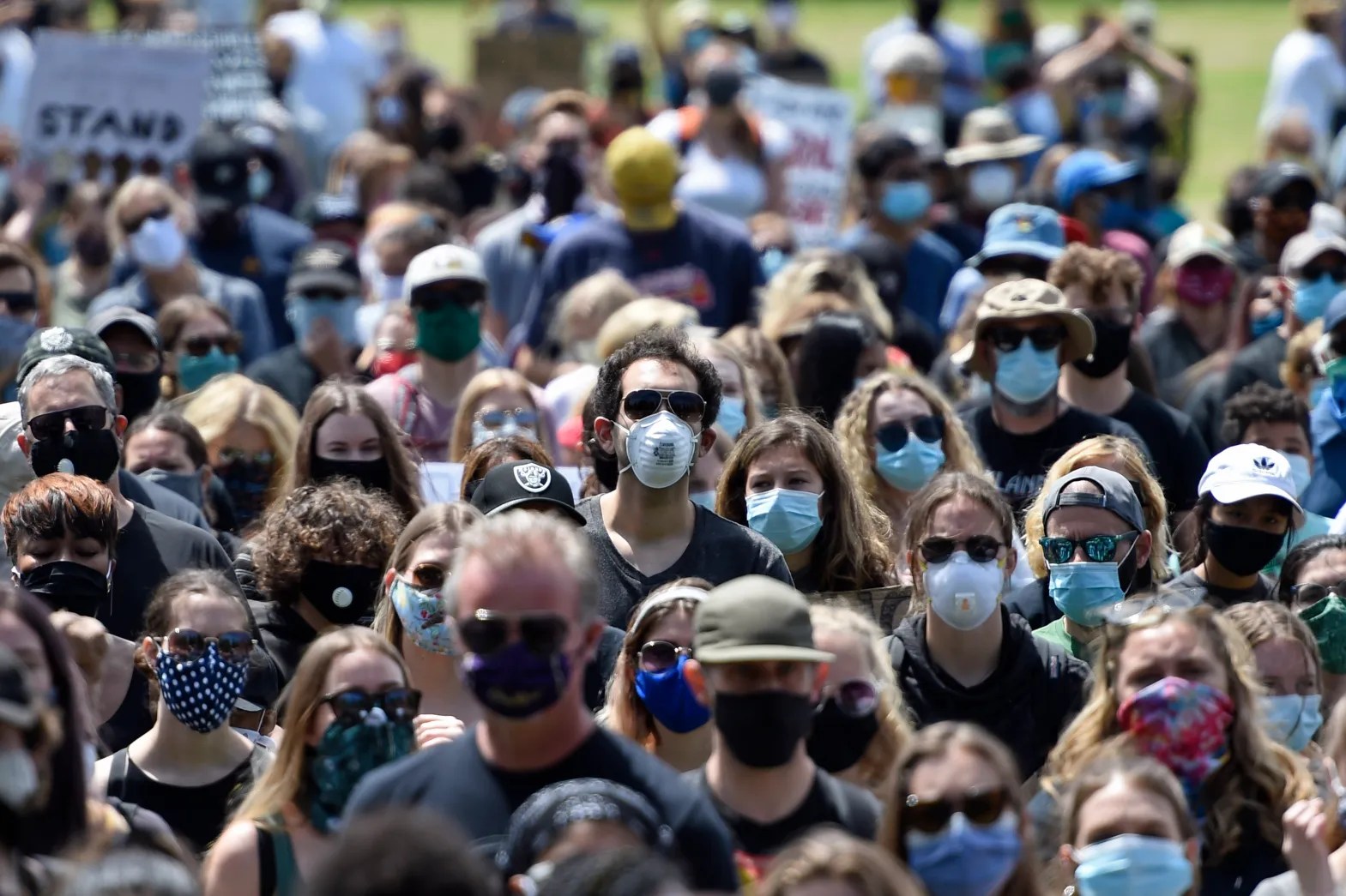
As I look out into our sanctuary now, to a room full of masked people gathering for Yom Kippur, I see a powerful visual of one community’s commitment to the health of all its members. This what the new normal should look like.

In my High Holiday sermon three years ago, I quoted the great activist poet Sonya Renee Taylor who wrote these words at the outset of the pandemic:

We will not go back to normal. Normal never was. Our pre-corona existence was not normal other than we normalized greed, inequity, exhaustion, depletion, extraction, disconnection, confusion, rage, hoarding, hate and lack. We should not long to return my friends. We are being given the opportunity to stitch a new garment. One that fits all of humanity and nature. 

Today, three years after those words were written, powerful interests are trying to convince us that it is time to “go back to normal.” We must not let them. We must continue to hold on to Taylor’s beautiful vision of a new garment, even in the face of such daunting odds. We must cherish this vision and resist the cynical voices telling us that what they are giving us is the best we can hope for. 

Because we should hope for more. We should aspire to more. After all, isn’t this what Yom Kippur is ultimately all about? Every year, at this season, we’re commanded to take a hard, unflinching look at the status quo, openly admit what needs changing, and commit to the hard work it will take to transform it. It’s an inherently radical idea: to proclaim every year that the status quo is unacceptable and that nothing short of genuine intervention will do. If our Yom Kippur prayers are to mean anything at all, we must be prepared to act upon this radical idea. 

This is also the season in which we stand before the open gates of heaven, before the open books of life and death, and pray that we may be written in the book of life for the coming year. But we also affirm that repentance, prayer and acts of justice can “avert the decree.” To me that means that we cannot wait passively for that choice to be made for us. In the end, we’ll need to take responsibility for writing our own names and the names of our neighbors in the Book of Life. If we’re going to be sealed for life, it is we who must affix that seal.

So this new year, let us affix that seal by recommitting ourselves to the value of pikuach nefesh – the moral imperative that views the saving of life as sacrosanct. Let us resist a “return to a normalcy” that values some lives over others. Let’s enter this new year affirming not only in word, but in deed, that it must be all of us or none.

Naming Israeli Apartheid on Capitol Hill

While the US Congress is undoubtedly a horrid dysfunctional mess of an institution, there have been occasional examples of genuine hope and even inspiration. This past week provided us with one of those examples.

Many of you, I’m sure, have been following the upheaval that occurred when Washington Rep. Pramila Jaypal called Israel “a racist state” at the Netroots Nation conference. After the wrath of the Israel lobby and her Israel-supporting congressional colleagues inevitably rained down upon her, Jaypal walked back her statement. Shortly after, a Republican congressperson cynically introduced a non-binding House resolution that expressed unconditional support for Israel and condemned antisemitism. Of course, it passed overwhelmingly.

While all this was boilerplate Israel politics on Capitol Hill, nine Democratic representatives had the courage to vote no on the resolution: Alexandria Ocasio-Coretz and Jamaal Bowman of New York, Cori Bush of Missouri, Andre Carson of Indiana, Summer Lee of Pennsylvania, Ilhan Omar of Minnesota, Ayanna Pressley of Massachusetts, Delia Ramirez of Illinois and Rashida Tlaib of Michigan.

And speaking of courage, Tlaib went on to say this on the House floor: 

Israel is an apartheid state. To assert otherwise, Mr. Speaker, in the face of this body of evidence, is an attempt to deny the reality and an attempt to normalize violence of apartheid. Don’t forget: This body, this Congress, supported the South African apartheid regime, and it was bipartisan as well.

And if this wasn’t enough, all of this occurred before a US visit from Israeli Prime Minister Isaac Herzog. When Herzog address a joint session of Congress, his speech was openly boycotted by Ocasio-Cortez, Bowman, Omar, Bush and Tlaib. 

While some will undoubtedly say that we are only talking about a small number of congresspeople here, it is still utterly unprecedented. Some might well recall that back in 2015, 58 members of Congress similarly skipped a speech by Prime Minister Netanyahu. That protest, however, was largely an issue of political protocol – it was a Democratic response to the refusal of Congressional Republicans to alert the Obama White House of their invitation to Netanyahu to address Congress. By contrast, this boycott was an unabashed protest against Israeli racism and apartheid.

Of course, Jaypal was absolutely correct in referring to Israel as a racist state – a fact that was pointed out in several mainstream media op-eds following her comment. It was also noted that many Israelis and Israeli organizations have regularly referred to Israel in this manner as well. Apropos of Tlaib’s comment, I can’t help but recall when it was considered politically beyond the pale to criticize South African apartheid on the Hill. To be sure, naming this term out loud was an important part of what eventually resulted in the passage of the Anti-Apartheid Act of 1986 (vetoed by President Reagan, but overridden largely due to the leadership of the Black Congressional Caucus).

Fast forward to 2023: did any of us ever expect we would live to see the day that a Palestinian American congressperson would call Israel an apartheid state on the House floor? Or that another congressperson (Ilhan Omar) would publicly state:

There is no way in hell I am attending the joint session address from a President…during the deadliest year for Palestinians in the West Bank in history, immediately following Israel’s largest incursion into the occupied West Bank in two decades, one that flattened city blocks, and killed at least a dozen people.

Yes, we did indeed witness genuine political courage in Washington DC this week. Please join me in thanking these congresspeople for their fearless stand against Israeli apartheid. 

Our Vision of Liberation This Passover Must Include Palestinians

NASSER ISHTAYEH / SOPA IMAGES / LIGHTROCKET VIA GETTY IMAGES

Crossposted with Truthout

On Passover, when we gather at the seder table to tell the story of the Exodus, we are reminded by the haggadah (the seder text) that merely telling the story is not enough. We are asked to not only relate but to interrogate this sacred narrative, to contemplate its meaning and to discuss the questions it raises for us. Most importantly, we must connect the lessons of the Exodus story to liberation struggles “in every generation.”

This year, many have inevitably been making connections between the Passover story and the recent anti-government protests that have unfolded in Israel since January. In a widely read sermon last February, for instance, Rabbi Sharon Brous compared the protests to the “great birth story” of the Exodus. In a recent New York Times op-ed, Bret Stephens wrote that the protests were “as close to a revolution as the modern state of Israel has ever seen.” One Jewish leader commented to the press that he plans to read from the Israeli Declaration of Independence at his seder, particularly the passage that promises the “complete equality of social and political rights to all its inhabitants.”

On the surface, this framing might seem to make sense: Since late last year, thousands of Israelis have regularly been filling the streets to protest draconian policies proposed by the newly elected far right government of six-term Prime Minister Benjamin Netanyahu. The protests have largely focused on the “threat to democracy” posed by the government’s plans to drastically curtail the power of the judiciary. The demonstrations seem to have succeeded: late last month Prime Minister Netanyahu announced that he would seek a compromise with his political opponents in order to “avoid civil war.”

While this certainly seems like a “power to the people moment,” it’s worth asking: who exactly are the “people” who have taken back the “power?” Though it was not widely noted by the mainstream media, the protests were largely organized and attended by centrist and liberal Israeli Jews — Palestinians were notably absent. Indeed, it was difficult to ignore the sea of Israeli flags at these demonstrations, along with the drumbeat messaging over “saving Israeli democracy.” By the end, it had become clear that these protests were less about equal rights for Jewish Israelis and Palestinians alike than a desire to reclaim the patriotic Zionist mantle from a newly elected far right government.

In other words, before we’re tempted to connect the Israeli demonstrations to the festival of Passover, it’s worth investigating how we tell the story of liberation, who tells it, who we include, and who we leave out.

These questions are not, in fact, unique to this year. It is common for Zionists to refer to Zionism — the movement to build a political Jewish nation-state — as “the national liberation movement of the Jewish people.” Many might find this to be a curious use of the term, as it is typically used in regard to movements that struggle for liberation against colonial oppression — not settler colonial movements themselves. Such rhetoric belies the origins of an ideology inspired by 19th-century European nationalism and a movement that actively sought to transplant European Jews in historic Palestine.

However, even Zionists who view Jewish nation-statehood in liberative terms must ultimately admit that from the beginning, Zionism focused exclusively on Jewish liberation — and that this liberation most certainly did not extend to Palestinians. Quite the contrary, of course. As a nation-state whose identity was predicated on a demographic majority of Jews in the land, Palestinians were, through their very existence, viewed as an obstacle to Jewish liberation.

Israel’s Declaration of Independence makes it clear that this nation was created first and foremost for Jews. The 10 paragraph-long preamble essentially reads as a Jewish history lesson, ending with the line, “This right is the natural right of the Jewish people to be masters of their own fate, like all other nations, in their own sovereign State.” There is only one paragraph that pertains to the rights of non-Jews:

THE STATE OF ISRAEL will be open for Jewish immigration and for the Ingathering of the Exiles; it will foster the development of the country for the benefit of all its inhabitants; it will be based on freedom, justice and peace as envisaged by the prophets of Israel; it will ensure complete equality of social and political rights to all its inhabitants irrespective of religion, race or sex; it will guarantee freedom of religion, conscience, language, education and culture; it will safeguard the Holy Places of all religions; and it will be faithful to the principles of the Charter of the United Nations.

Note that the Declaration “ensures” social, political and religious — but not national — rights to its Palestinian citizens. This language is quite intentional: Israel considered Jews throughout the diaspora to be part of the “Jewish nation,” granting any Jew who immigrated to the state from anywhere in the world instant citizenship through its Law of Return. Conversely, the over 700,000 Palestinians refugees who were forcibly displaced from their homes and forbidden to return were decidedly not included as part of the newly established nation.

To this day, Israel has maintained a careful distinction between “nationals” and “citizens.” As non-Jews, Palestinians in Israel can be citizens, but they are not nationals, thus depriving them of rights and privileges enjoyed by Israeli Jews. As a result, to this day, there are more than 60 laws that discriminate against Palestinian citizens of Israel directly or indirectly, impacting virtually every aspect of their lives, including housing, employment, education, health care, and who they can marry.

The status of Palestinian citizens was compromised yet further in 2018 with Israel’s passage of the so-called Nation-State Law, which determined that “the right to exercise national self-determination” in Israel is “unique to the Jewish people,” established Hebrew as Israel’s official language, and established “Jewish settlement as a national value,” mandating that the state “will labor to encourage and promote its establishment and development.” According to Adalah:

This law – which has distinct apartheid characteristics – guarantees the ethnic-religious character of Israel as exclusively Jewish and entrenches the privileges enjoyed by Jewish citizens, while simultaneously anchoring discrimination against Palestinian citizens and legitimizing exclusion, racism, and systemic inequality.

Of course, the injustices facing the almost 3,000,000 Palestinians who live under military occupation in the West Bank — and the over 2,000,000 who live under a crushing blockade in Gaza — are dramatically worse than those experienced by Palestinian citizens of Israel. But it would be a mistake to draw a fundamental distinction between these different Palestinian populations. As the Israeli human rights organization B’Tselem puts it in its 2021 report, Israel maintains “a regime of Jewish supremacy from the Jordan River to the Mediterranean Sea.” Put simply, as a Jewish nation-state, Israel systemically denies basic civil and human rights to all non-Jews who live under its control.

It’s interesting to note that the “selective liberation” story we tell about Israel is not dissimilar from the story we tell about the establishment and history of another notable settler colonial state — namely, the United States. Indeed, I’m often struck that we typically use the term “American Revolution” to refer to what was essentially a political-economic secession by colonists from the British empire, whose nation was built on the genocide of Native peoples, enabled by the stolen labor of Black slaves.

Here too, it’s critical to interrogate how we tell the story of this national liberation, who tells it, who we include, and who we leave out. It has often been observed that the opening words to the American Constitution, “We the People,” is a radical misnomer as the founders originally defined “we” to be limited to white, property-owning males. This inherent inequity was already being openly challenged not long after the founding of the state. As Frederick Douglass famously declared in his 1852 speech, “What to a Slave is the Fourth of July:”

The rich inheritance of justice, liberty, prosperity and independence bequeathed by your fathers, is shared by you, not me. The sunlight that brought light and healing to you, has brought stripes and death to me. This Fourth of July is yours, not mine. You may rejoice, I must mourn.

When it comes to this legacy of American structural injustice, one can draw a direct line from Douglass to the words of Malcolm X, from his 1964 speech “The Ballot or the Bullet”:

No, I’m not an American. I’m one of the 22 million Black people who are the victims of Americanism. One of the 22 million Black people who are the victims of democracy, nothing but disguised hypocrisy. So, I’m not standing here speaking to you as an American, or a patriot, or a flag-saluter, or a flag-waver — no, not I. I’m speaking as a victim of this American system. And I see America through the eyes of the victim. I don’t see any American dream; I see an American nightmare.

At the same time, however, there remains a uniquely American tension between the “American nightmare” of Malcolm X and the “American Dream” referred to by Dr. Martin Luther King Jr. in his “I Have a Dream” speech, where he famously challenged the United States to be true to its stated intention to form a more perfect union: “I have a dream that one day this nation will rise up and live out the true meaning of its creed: We hold these truths to be self-evident, that all men are created equal.”

More recently, Nikole Hannah-Jones, author of the “1619 Project” has observed that “the United States is a nation founded on both an ideal and a lie.” Still, she concluded:

Despite being violently denied the freedom and justice promised to all, Black Americans believed fervently in the American creed. Through centuries of Black resistance and protest, we have helped the country live up to its founding ideals. And not only for ourselves — Black rights struggles paved the way for every other rights struggle, including women’s and gay rights, immigrant and disability rights.

Of course, we are currently witnessing a white supremacist backlash against those who seek to challenge the legacy — and reality — of American structural racism. As ever, Americans are struggling openly over how inclusive, extensive and complete our liberation will be. It is a tension that has been ongoing since the very founding of this country — it is at its core, a quintessentially American struggle.

In Israel, however, the struggle for democracy is far more complicated. As a Jewish state, Israeli democracy can only truly extend to its Jewish citizens. Unlike the U.S., where those who advocate equal rights for all can still be described as “believing fervently in the American creed,” those who call for one state with full citizenship for all are routinely accused of antisemitism, seeking nothing less than “the destruction of the Jewish state.”

Another important difference: unlike the U.S., Israel does not have a Constitution that, theoretically at least, ensures equal rights for its citizens. Noting Israel’s early, aborted attempts at creating a Constitution, journalist Joshua Leifer has recently commented:

America’s Constitution begins, “We the People.” One of the things that’s very striking when you read the drafts of the Israeli constitution that were written in 1950 is that the proposed version of Israel’s constitution began with “the Jewish people.” The ethnos was imagined as the demos from the beginning.

Like many Americans, I believe it is my responsibility to challenge my country to, as MLK put it, “live out the true meaning of its creed.” Among other things, this means actively supporting anti-racist struggles in the U.S. that demand full and equal rights for all its citizens. As an American Jew living in the age of Zionism, I can demand nothing less for all who live between the river and the sea.

As Aurora Levins Morales concludes in her classic poem “Red Sea:”

This time that country
is what we promise each other,
our rage pressed cheek to cheek
until tears flood the space between,
until there are no enemies left,
because this time no one will be left to drown
and all of us must be chosen.
This time it’s all of us or none.

This Passover, it is clearer than ever before that we need a new Jewish liberation story: one that is inseparable with the vision of liberation for all.

Interrogating Liberal Zionist Myths: A Response to Rabbi Sharon Brous

Israelis protest against the new government’s proposed changes to the legal system, at Habima Square, Tel Aviv, January 28, 2023. (Avshalom Sassoni/Flash90)

For the past two months or so, thousands of Israelis have been holding weekly protests against the extremism of the newly elected Israeli administration, focusing in particular on the new government’s proposals to gut the power of the Israeli judiciary. While many American Jewish institutions have been predictably loath to publicly criticize the new Israeli government, liberal Zionist organizations in the US such as J St., the New Israel Fund (NIF) and T’ruah have been openly supportive of the protests. But as heartening as these statements may seem on the surface, there is a deeply problematic contradiction at the heart of this new movement to “save Israeli democracy.”

This contradiction was in full force during a widely shared sermon recently delivered by Rabbi Sharon Brous, spiritual leader of the Los Angeles synagogue, Ikar. In her stirring and passionately delivered remarks, Brous rightly criticized the American Jewish community for its silence over the policies proposed by the new Israeli administration. Calling for a “reckoning,” she went on to identify several “myths” about Israel/Palestine that the Jewish community “needs to smash.” With respect, however, I believe that Brous herself perpetuated numerous problematic myths herself during the course of her sermon.

These most prominent: the oft-invoked myth of the “endangered Israeli democracy.” This is, of course, a well-known Liberal Zionist trope and Brous drove it home early in her remarks when she stated “we believe not only in the legitimacy, but the necessity of a Jewish state….We believe in the vision of a state that is both Jewish and democratic, as envisioned by (Israel’s Declaration of Independence.)” She continued, warning that this “precious, beautiful dream” is currently under threat from extreme, undemocratic political forces in the current Israeli government.

Brous reinforced the “threat to Israeli democracy” myth when she curiously referred to the Israeli Supreme Court as the “great defender of the abuse of human rights” while there is ample evidence that demonstrates it is precisely the opposite. The Israeli human rights group B’Tselem has in fact, referred to the Israeli Supreme Court as “the Supreme Court of the Occupation” and has documented it’s systemic enabling of Israel’s ongoing human rights abuses in numerous reports:

When it comes to violation of Palestinians’ rights, Israel’s Supreme Court neither holds effective judicial review nor keeps the security forces in check. It is willing to sanction almost any injustice based on unreasonable legal interpretation, and systemically ignores the context: that the appellants come from an unrepresented population governed by a strict military regime for more than 50 years, denied political rights and excluded from basic decision-making. The court thereby sanctions not only violations – but the occupation itself.

Brous rightly went on to state that Israel’s “march toward illiberalism, ultra-nationalism and extremism has been building for decades.” However she undermined that very argument by claiming this march began when we “got comfortable with the language of ‘us and them.'” In truth, however, the rhetoric of “us and them” has been deeply rooted in the culture of the Zionist project since before the founding of the state. That is because the very idea of a Jewish state predicated on a demographic Jewish majority is itself inherently illiberal.

Similarly, Brous did well to raise the odious ideology of “Jewish Supremacy” inbred in Israeli culture. But this this ideology is not, as she put it, the product of a “marginal, fringe group” whose ideas have moved “into the mainstream.” Yes, Itamar Ben Gvir and Bezalel Smotrich are most certainly extremists who espouse patently undemocratic ideas. But they are also expressing an inconvenient truth: that the notion of a majority Jewish nation state is itself intrinsically undemocratic – and that to maintain a Jewish majority, Israel has been ethnically cleansing and expelling Palestinians from their homes since its origin.

I was heartened when Brous later addressed the “myth of moral equivalency,” correctly stating that we cannot condemn the recent killing of Jewish worshippers in Jerusalem without also condemning the Israeli military’s killing of 35 Palestinians during the month of January (including a 6 year old boy and a 61 year old woman). I likewise appreciated the way she connected the dots between the young Palestinian gunman’s personal story to his grandfather who was murdered by a Jewish settler who has never held accountable (by yes, an Israeli court).

But while Brous invited us to “interrogate why there is so much violence,” she herself sadly failed in this regard when she neglected to interrogate the crucial role played by Israeli state violence and militarism in the structural oppression of the Palestinian people. On the contrary, she notably romanticized Israeli militarism earlier in her sermon when she spoke about the father of an Israeli friend who was “born with the state” and had served as “an IDF commander in two wars.” As she put it, “these are the ones who dedicated themselves to building the state so precious, so beautiful, so fragile. And they see it being transformed before their very eyes into something utterly recognizable.”

But perhaps the most problematic myth perpetuated by Brous was the Liberal Zionist trope of a “shared future.” She raised this issue at the end of her remarks when she concluded, “If you’re feeling helpless about what’s unfolding over there, the way forward is to follow the lead of Israelis and Palestinians in the streets who are speaking a language of shared destiny.”

This is, in fact, a complete misrepresentation of the current demonstrations. As Israeli journalist Haggai Matar has pointed out:

Palestinians, for their part, have so far mostly been sitting this one out. While many Jewish Israelis are mourning, terrified, or enraged over the barrage of illiberal legislation that they see as signifying the “end of Israeli democracy,” most Palestinians on both sides of the Green Line never saw the regime as a democracy to begin with. In the words of MK Ahmad Tibi, “this is a Jewish Democracy: democratic for Jews, and Jewish for Arabs.”

Or as another Israeli journalist, Gideon Levy has powerfully put it:

The current protests are thus intended to defend only the rights of Israel’s already privileged Jewish citizens, while ignoring the rights of the oppressed who lack citizenship and civil rights. The thousands of Israeli flags waved by protesters symbolize what is bad about these demonstrations: They are intended for Jews only.

It is indeed difficult to ignore the overwhelming preponderance of Israeli flags of these demonstrations, underscoring the reality that these protests are less about justice for Palestinians than they are about saving the Zionist enterprise. As Brous quoted her friend’s parents at the beginning of her sermon, “we have no other home, no other loyalty but to Zion.”

Moreover, Brous is crucially silent over the precise nature of this “shared future.” Is she advocating a two-state solution that even J St. admits is now all but impossible? Or is she promoting equal rights for all who live in the land – a move that would inevitably spell the end of her “precious, beautiful, miraculous dream?” As long as she refuses to address this critical question, I can’t help but view her call for a “shared future” as an empty and disingenuous gesture.

Brous ended her sermon by invoking the Torah portion Beshallach, which recounts the Israelites crossing over the Sea following their Exodus from Egypt. She powerfully and poetically compared the Exodus story to a birth moment, calling upon us all to “amplify the voices” of our “Palestinian and Israeli friends and their calls for a just and equal society, to remind them to breathe and push, to breathe and push and then to be with them on the other side, to join hands and sing together a song of freedom, of liberation, of justice and a song of love.”

Like Rabbi Brous, I also find a profound resonance to the Exodus story in this current moment – but it isn’t in the myth of Palestinians and Israelis joining hands and singing a song of liberation. Rather, it is through the painful admission, at long last, that Zionism represents a present day Pharaoh – and that we will only make it to the other side when we dismantle and transform Israel’s systemic oppression of the Palestinians into a truly Promised Land for all who live between the river and the sea.