Category Archives: Politics

In Memory of Howard Zinn, z”l

I’ve been reading and listening to Howard Zinn’s work since learning of his death last week – and I’m become increasingly saddened at just what we’ve lost in his passing.  Here are just a few pieces that have moved me tremendously:

– Click above to see a clip in which Zinn  shares his thoughts on human nature and aggression.

– My friend Mark Braverman has posted a powerful and important piece by Zinn on the legacy of the Holocaust. An exerpt:

I would never have become a historian if I thought that it would become my professional duty to go into the past and never emerge, to study long-gone events and remember them only for their uniqueness, not connecting them to events going on in my time. If the Holocaust was to have any meaning, I thought, we must transfer our anger to the brutalities of our time. We must atone for our allowing the Jewish Holocaust to happen by refusing to allow similar atrocities to take place now—yes, to use the Day of Atonement not to pray for the dead but to act for the living, to rescue those about to die.

– One of his many columns for The Progressive, this one published four days after 9/11:

We need to imagine that the awful scenes of death and suffering we are now witnessing on our television screens have been going on in other parts of the world for a long time, and only now can we begin to know what people have gone through, often as a result of our policies. We need to understand how some of those people will go beyond quiet anger to acts of terrorism.

We need new ways of thinking. A $300 billion dollar military budget has not given us security. Military bases all over the world, our warships on every ocean, have not given us security. Land mines and a “missile defense shield” will not give us security. We need to rethink our position in the world. We need to stop sending weapons to countries that oppress other people or their own people. We need to decide that we will not go to war, whatever reason is conjured up by the politicians of the media, because war in our time is always indiscriminate, a war against innocents, a war against children. War is terrorism, magnified a hundred times.

Our security can only come by using our national wealth, not for guns, planes, bombs, but for the health and welfare of our people – for free medical care for everyone, education and housing guaranteed decent wages and a clean environment for all. We can not be secure by limiting our liberties, as some of our political leaders are demanding, but only by expanding them.

We should take our example not from our military and political leaders shouting “retaliate” and “war” but from the doctors and nurses and medical students and firemen and policemen who have been saving lives in the midst of mayhem, whose first thoughts are not violence, but healing, not vengeance but compassion.

Zichrono Livracha – may the memory of this righteous man be for a blessing.  And may we continue his work of bearing witness through our words and deeds…

Replanting the Uprooted on Tu B’shevat

Last week, Israeli Prime Minister Netanyahu celebrated the festival of Tu B’shevat (“The New Year of the Trees”) by leaving a meeting with American peace envoy George Mitchell and promptly embarking upon a tree-planting tour at Jewish settlements in the West Bank.

Here is what he had to say:

The message is clear – we are here and will remain here. We are planting and building; this is an inseparable part of the State of Israel.

For those looking for a different way to connect the festival of Tu B’shevat to the current political reality in the State of Israel, I recommend reading this at your seder, written by Rabbi Arik Ascherman of Israel’s Rabbis for Human Rights:

Lift the olive branch and say:

The olive branch, what is the reason for this?

We raise the olive branch as a symbol of responsibility, identification and hope.

We raise this branch in sorrow because each and every year, olive trees, the source of livelihood for Palestinian families, are intentionally chopped down, burned and uprooted.  In attempting to exercise their right to work their lands, farmers repeatedly put themselves in danger. Both the human being and the trees of the field are desecrated, and there is no earthly law or judge (ein din v’ein dayan). Only a few are guilty, but all are responsible (Rabbi Abraham Joshua Heschel).

On Tu B’shevat, we are taught that the trees cease to drink from the rains of the past year and begin to be nourished from the rains of the current year (Jerusalem Talmud, Rosh Hashanah 56a). However, into the old and the new waters have fallen the tears of the dove of peace whose feet cannot find a resting place (Genesis 8:9) because the earth has become filled with violence (Genesis 6:11). The olive branch has become bitter in her mouth – a symbol of strife.

We raise this branch as a symbol of identification with those Israelis and Palestinians who are doing everything in their power to change this reality and make enemies into friends (Pirke Avot De’Rabbi Natan) by planting, pruning, plowing and harvesting together, despite the voices of hate and incitement from both sides.

May it be Your will that the fruit of the olive, symbol of the World of Yetzirah/Creativity (Pri Eytz Hadar) inspire us to create justice and peace out of the basic materials of the soil, the fruit of the soil, and the human spirit (adamah, pri adamah, ve’ruakh ha’adam) so that by the time evening falls (Genesis 8:11) we will reconnect the olive branch to the root of the soul (Shoresh Nishmato).

May we thus beat our swords into plowshares and  our spears into pruning hooks…so that every person may sit under their vine or fig tree and none shall make them afraid (Micah 4:3-4) and the land shall know tranquility (Judges 3:11, etc.) and all of its inhabitants will rejoice.

Rabbi Brian Reports From Israel/Palestine

My friend Rabbi Brian Walt is currently living in Jerusalem with his family and will be there for next five months. I strongly encourage you to read his blog posts, in which he powerfully reflects on his experiences and describes the struggle for justice in Israel/Palestine. He just posted a piece on a recent demonstration in Sheikh Jarah; his post on a visit to Hebron last week is breathtaking.

Playing Politics at Yad Vashem

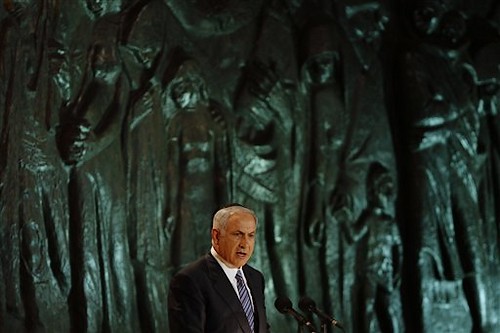
This is what I call cynically using the Holocaust for political purposes: Netanyahu recently used the opening of a new exhibit at Yad Vashem as an opportunity to denounce the Iranian regime, saying:

There is a new call to destroy the Jewish state, it’s our problem, but not only our problem. This is a crime against the Jews, and a crime against humanity, and it is a test of humanity. We shall see in the following weeks whether the international community deals with this evil before it spreads.

When I read this report, it sounded vaguely familiar – then remembered blogging about a similar comment Netanyahu made three years ago. Here’s what I wrote at the time:

Clearly Ahmadinejad’s murderous rhetoric toward Israel cannot and should not be taken lightly, and we should never minimize the threat posed by Iran’s nuclear ambitions. But we must also be very clear about what we are suggesting when we compare Ahmadinejad to Hitler and present day Iran to Nazi Germany. For what it’s worth, consider me to be one member of the organized Jewish community that finds this comparison unhelpful – and the prospect of an American or Israeli attack on Iran truly horrifying to contemplate.

Apropos of Netanyahu’s most recent comments: Ahmadinejad’s rhetoric toward Israel is definitely hateful, and is clearly designed to bait Israel and the West – but I can’t see how it possibly constitutes a “crime against humanity.”

Netanyahu’s Yad Vashem rhetoric certainly seems to indicate he’s itching to take the bait. Let’s hope the international community will see past his dangerous, wrongheaded invoking of a “second Holocaust” and deal with this crisis with intelligence and moderation.

Toward a New Gaza Strategy

There is new tension along the Israel-Gaza border. Israel is bombing targets in Gaza; mortar shells and Qassams are flying into southern Israel once again. If  Israel’s massive military assault last year was designed to deter Hamas and/or provide security for the citizens of southern Israel – then it now appears that effort has been for naught.

When will we learn that bombs won’t work?  As so many of us have been shouting for so long, the only true solution to the Gaza conflict is a political solution: to open the border, to provide relief and development assistance, to engage with Hamas directly.

I’m gratified, at least, that the editorial board of Ha’aretz seems to be moving in this direction:

A renewal of rocket fire shows that even a major military operation that brought death and destruction cannot ensure long-term deterrence and calm. Israel has an interest in stopping escalation at the border so as not to find itself caught up in another belligerent confrontation with Hamas …

Instead of erring by invoking the default solution of more force, which does not create long-term security or ease the distress of the Palestinians in Gaza, the crossings between Israel and the Gaza Strip should be opened and indirect assistance rendered to rebuild its ruins.

Amen. Massive military bombardment and a crushing blockade is not making either side more secure – it is only exacerbating the conflict and ensuring the likelihood we will be reading more tragic news from a small patch of land that has known nothing but tragedy for the past six decades.

PS: Since I wrote this post this morning, I’ve been thinking all day about how I addressed the Gaza conflict as largely a strategic policy issue. If I’m going to be totally honest, however, I’d have to admit that my feelings about this issue go deeper than simply “war doesn’t work.”

I’ve come to accept that at its heart, this conflict is not simply strategy but about justice. To anyone who believes that this latest border issue is about Hamas and its missiles, I’d respond that it is only the latest incarnation of an injustice that was committed against the Palestinian people, long, long before the Qassams started flying.

I’m currently reading Joe Sacco’s devastating graphic-novel style reportage, “Footnotes in Gaza.” I highly recommend it to anyone interested in the tragic history of the Palestinian experience in Gaza.

Palestinian Christians: “The Occupation is a Sin”

Last week, a group of Palestinian Christians representing a variety of churches and church-related organizations issued a powerful, prayerful call for an end to the Israeli occupation.  My friend Rabbi Brian Walt was present at the meeting in Bethlehem in which the statement – known as  “The Kairos Palestine Document” – was released. Upon his return, he described to me his profound, often painful conversations with Palestinian Christians and he told me that as a Jew, he considered the Kairos Document to be an enormously important spiritual/political statement. Having now read the entire 12 page document, I must say that I agree wholeheartedly.

Palestinian Christian liberation theologians such as Naim Ateek of the Sabeel Institute have been doing important work for decades and I believe their ideas present important spiritual challenges to the Jewish community. Many Jews point to the more radical incarnations of these theologies – and while I share some of these concerns, I believe that we make a profound mistake by dismissing Palestinian Christian theology wholesale. (Frankly, I am much more troubled by the “End of Days” theologies of fundamentalist Zionist Christians such as Pastor John Hagee than I am by Naim Ateek and the authors of the Kairos document.)

My friend and colleague Father Cotton Fite of St. Luke’s Church in Evanston, tells me he hopes that American Christians will study the Kairos Document carefully. I mentioned to him that I hoped Jews would read it as well. In fact, I think we should create opportunities to read it together. Despite our differences, I believe it offers both of our communities an ideal place to begin meaningful dialogue over the spiritual implications of this conflict.

One of the more important and challenging passages:

Our presence in this land, as Christian and Muslim Palestinians, is not accidental but rather deeply rooted in the history and geography of this land, resonant with the connectedness of any other people to the land it lives in. It was an injustice when we were driven out. The West sought to make amends for what Jews had endured in the countries of Europe, but it made amends on our account and in our land. They tried to correct an injustice and the result was a new injustice.

I can already predict that many Jews will bristle that this passage does not specifically reference the Jewish connection to the land as well. To this I would say, how deeply do we Jews ever honor the reality that we are not the only people who are “deeply rooted in the history and geography of this land?” Moreover, how deeply do we ever face the true injustice that was committed when a people with deep roots in the land were driven out and not allowed to return?

Another sobering passage in the document describes the Occupation as no less than a “sin:”

We also declare that the Israeli occupation of Palestinian land is a sin against God and humanity because it deprives the Palestinians of their basic human rights, bestowed by God. It distorts the image of God in the Israeli who has become an occupier just as it distorts this image in the Palestinian living under occupation. We declare that any theology, seemingly based on the Bible or on faith or on history, that legitimizes the occupation, is far from Christian teachings, because it calls for violence and holy war in the name of God Almighty, subordinating God to temporary human interests, and distorting the divine image in the human beings living under both political and theological injustice.

Many of us view the Occupation as a political problem to be solved. But indeed, as Jews, we must admit basic human rights are rooted in our religious tradition. Like Christians, we also believe that all human beings are created in the image of God. We also believe that when the basic dignity of anyone’s humanity is diminished, the Divine Image is diminished as well. How then, can we fail to understand that the Occupation is not only a geo-political problem but a spiritual/moral problem as well?

This conclusion leads to a logical next step:

Love is seeing the face of God in every human being. Every person is my brother or my sister. However, seeing the face of God in everyone does not mean accepting evil or aggression on their part. Rather, this love seeks to correct the evil and stop the aggression.

The injustice against the Palestinian people which is the Israeli occupation, is an evil that must be resisted. It is an evil and a sin that must be resisted and removed. Primary responsibility for this rests with the Palestinians themselves suffering occupation. Christian love invites us to resist it. However, love puts an end to evil by walking in the ways of justice. Responsibility lies also with the international community, because international law regulates relations between peoples today. Finally responsibility lies with the perpetrators of the injustice; they must liberate themselves from the evil that is in them and the injustice they have imposed on others.

Again, the Occupation is viewed not as a diplomatic issue to be negotiated but a spiritual evil to be resisted.

I have no illusions that for many Jews, suggestions such as these present daunting and painful challenges.  So will many of the ultimate political ramifications of the Kairos Document. All I can hope for is that political disagreements will not keep us from honestly facing the profound spiritual dimensions of this conflict.  Speaking for myself, I do believe this statement was written in good faith, genuine love and true religious conviction:

Our message to the Jews tells them: Even though we have fought one another in the recent past and still struggle today, we are able to love and live together. We can organize our political life, with all its complexity, according to the logic of this love and its power, after ending the occupation and establishing justice.

What can I say to this except “Amen?”

Gilad Shalit and the Sorrows of Tribalism

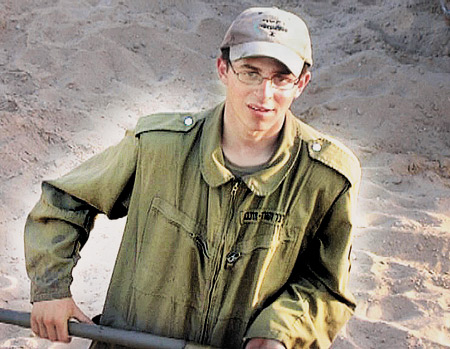
Not long ago I was asked by a friend: why are Israelis and Jews so fixated on the kidnapping of Gilad Shalit? With all of the crises and injustices being committed in the world, why is there such a hue and cry over this one particular man?

I answered that like all nations, Israel takes this kind of thing personally. I mentioned that just like many Jews in Israel and around the world, I also experienced Hamas’ abduction of Gilad Shalit as an injustice committed against one of my own. Even as a Jew living in the comfort of my Evanston home, I felt a visceral sense of pain three years ago when I first heard the news of Shalit’s kidnapping. Over time, my pain turned to anger as Hamas denied him Red Cross visits and refused to confirm (until only recently) whether he was even dead or alive.

I went on to compare Israel’s trauma to the feeling of collective trauma we felt in our country in 1979, when Iranian militants took American embassy workers hostage: how violated our nation felt: how personally we identified with the hostages; how deeply we experienced the injustice of their imprisonment.

On a less tribal level, of course, I do understand that there was a deeper context to the hostage crisis. Underneath our feelings of personal violation were more challenging questions – questions few of us were prepared to ask out loud. Why, for instance, did we have so much concern over 53 fellow Americans, but not for countless other political prisoners around the world, many of them incarcerated by regimes actively supported by our nation?

In just the same way, I believe too few Jews even know – let alone protest – that while Hamas unjustly imprisons Shalit, Israel holds hundreds of Palestinians taken in operations that at best must be considered ethically dubious. While Israel defends its actions legally by terming these prisoners “enemy combatants,” the hard truth remains that for decades Israel’s security services have rounded up scores of Palestinians without charge and have imprisoned them indefinitely – in many cases for years.

Yes, many of the prisoners are undoubtedly guilty of plotting or carrying out violent acts against Israelis. Many of these incarcerations can surely be defended on grounds of security. But it has become impossible to ignore that Israel has also incarcerated considerable numbers of Palestinians who by any reasonable definition must be considered political prisoners.

(One recent case in point: many Jews are familiar with the case of Gilad Shalit, but I’m sure that far fewer know, for instance, about Abdallah Abu Rahmah, a Palestinian high school teacher and coordinator of the non-violent campaign in the West Bank village of Bil’in, who was arrested last week by the Israeli military. According to eyewitness accounts, Abu Rahmah was taken from his bed at 2:00 am in the presence of his wife and children.)

And so, beyond the emotions of tribalism, the question remains: will we ever be able to see past our own loyalties and find equal value in the lives of others – human beings who are just as eminently worthy of fair treatment, justice and dignity? And even more challenging: will we ever be ready to admit that the violence committed against us is often inspired in no small way by the injustices we ourselves have committed – and continue to commit?

To return to the Iranian hostage example: back in 1979, few Americans cared to even ask why their Iranian captors might have been so motivated to commit this act. Most of us were ignorant to the powerful significance of the American embassy for Iranians – that it was this very same embassy from which our nation had plotted the overthrow of Iran’s democratically elected government in 1953. As it turned out, the regime we subsequently installed would persecute and unjustly imprison countless Iranian citizens over the next two decades.

So too in the case of Gilad Shalit. Few of us in the Jewish community are truly ready to examine the source of Gazan’s fury toward Israel – a fury that has been building since long before Hamas even existed. Few of us are willing to face the history of Israel’s oppressive policies in Gaza or the fact that Gazans have been living under an intolerable occupation for decades.

And even fewer of us even know that the overwhelming majority of the 1.5 million who live in Gaza belong to families that originally came from outside of Gaza – from towns and villages like Ashkelon and Beersheba – and were expelled from their homes by the Israeli military in 1948. Indeed, when I think of Gazan rage in 2009, I can’t help but think of these chilling words by Moshe Dayan from back in 1956:

Who are we that we should bewail their mighty hatred of us? (They) sit in refugee camps in Gaza, and opposite their gaze we appropriate for ourselves as our own portion the land and the villages in which they and their fathers dwelled.

The history of Gaza is indeed a tragic one – and yes, Israel’s oppression of its population is a critical part of this tragedy. Unless we take the time to understand this history – and our part in it – I don’t believe we can even begin to pretend there is a way out of this conflict.

To be clear: understanding the source of Gazans feelings toward Israel does not mean condoning their actions. Hamas’ imprisonment of Gilad Shalit is barbaric. As a fellow Jew, I grieve for Shalit and I pray for his safe return. But at the same time, I cannot look away from the more painful realities that led to his capture in the first place, and I truly believe that until we make an honest effort to face and address these realities, there will invariably be more Gilad Shalits in Israel’s future.

Following Israel’s military campaign in Lebanon in the summer of 2006, journalist Amira Hass wrote these powerful words in Ha’aretz. I believe she presents us with a profound model of an Israeli who is able to hold her own concern for her people together with a willingness to face the truth of the injustices perpetrated her nation. Her words are doubly tragic as we now approach the one-year anniversary of Israel’s military campaign in Gaza:

We are justly concerned about the welfare of northern residents, proud of their fortitude, understand those who leave, are shocked by the death of each person and by every rocket hit, and identify with those suffering from anxiety. Take what the northern residents have been going through for a month, multiply it by 1,000, add an economic blockade, power and water cuts, and no wages. This is how the Palestinians in the Gaza Strip have been “living” for the past six years.

The Israelis allow their army to continue destroying, trampling and killing in the Palestinian territories. Here, like in Lebanon, the real intelligence and security failure is Israel’s ignoring the extent of our uninhibited, unrestrained devastation and their amazing power of human endurance. This is why Israel has delusions of “victories.” If the homemade rockets are still being fired at Sderot despite the Palestinians’ extensive suffering, it is because they have concluded, correctly, that Israel’s destruction power is not intended to stop Qassam rockets – or to free Gilad Shalit. It is intended to force them to accept a surrender arrangement, which they reject not with military victories but with their power of endurance.

The Judaization of Jerusalem: What is Our Response?

Are these the actions of a country interested in negotiating in good faith for a Palestinian state alongside it, with East Jerusalem as its capital?

Ha’aretz announced today that

2008 set an all-time record for the number of Arab residents of East Jerusalem who were stripped of residency rights by the Interior Ministry. Altogether, the ministry revoked the residency of 4,577 East Jerusalemites in 2008 – 21 times the average of the previous 40 years.

Also from today’s Ha’aretz:

Clashes erupted yesterday in the Sheikh Jarrah neighborhood of East Jerusalem between demonstrators and counter-demonstrators, after a group of Jews announced their intention to move into a house in the neighborhood. The entry of the Jews into the home follows a court order ruling that the Arab al-Kurd family, which lives in a portion of the house, had no right to occupy an addition that they had built onto the house.

This situation has been unfolding for some time. In an nutshell: Palestinian families in Sheikh Jarrah have been evicted from their homes so that their land can be turned over to a settler organization that seeks to build a Jewish settlement called Shimon Ha Tzadik. According to the Jerusalem NGO Ir Amim, this settlement

constitutes one of a series of plans that seek to penetrate and surround Sheikh Jarrah with Israeli settlements, yeshivas, and other institutions as well as national park land, and complement government efforts to ring the Old City with Jewish development and effectively cut it off from Palestinian areas.

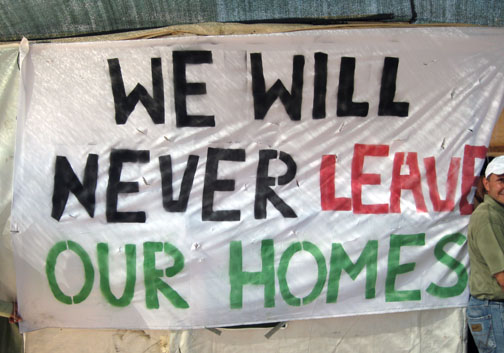
Meanwhile, since their eviction, the Palestinian families (55 people in total) have been sleeping on mattresses in the street “and spend the day sitting in the shade watching settlers walk in and out of their front doors.”

And in another part of East Jerusalem:

The World Likud movement held a cornerstone-laying ceremony yesterday for the expansion of the neighborhood of Nof Zion, despite – or possibly because of – American pressure against building in East Jerusalem. The Jewish settlement is in the middle of the Arab village of Jabal Mukkaber. Meanwhile, the Jerusalem municipality razed two Palestinian homes in East Jerusalem yesterday.

The plan is to add to Nof Zion 105 new apartments to the 90 ones that are already there, most of which are already occupied. The neighborhood is considered “prestigious,” but the developers ran into trouble a few years ago after they failed to sell the apartments to Jews from overseas. About a year ago the developers changed their marketing strategy to target the local national-religious market – and the apartments began selling quickly. The developers expect the same for the new part of the neighborhood…

In Isawiyah villagers tried to block the entrance to the village with cars, while in Silwan local residents threw rocks at police officers after the house was destroyed.

Addressing the ceremony, MK Danny Danon (Likud) said that Jerusalem will never be a part of negotiations with the Palestinians. He called Barack Obama “naive” and said the U.S. president still does not seem to understand who are the good guys and who are the bad guys in the conflict.

Yesterday the Jerusalem municipality razed two Palestinian homes in East Jerusalem, one in Isawiyah and one in Silwan. In both cases, local residents battled security forces.

It does not take a great deal of insight to connect these dots. These are not simply random municipal disputes. We are witnessing the systematic Judaization of Jerusalem.

International protesters refer to these actions as “ethnic cleansing.” If that seems like too incendiary a term, what do we prefer to call it? And more critically, what are we going to do about it?

Postscript: I just received an email from Rabbi Arik Ascherman (of Israel’s Rabbis for Human Rights) who was at yesterday’s demonstration at Sheikh Jarrah.  Though he is a veteran of such demonstrations, I have never heard Arik express such a profound level of despair.

His report has left me speechless.

Click below:

Continue reading

“Cursed Be He That Keepeth Back His Sword From Blood.”

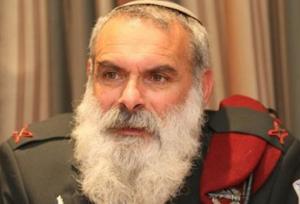
Rabbi-Avi-Ronzki_From yesterday’s Ha’artez:

The Israel Defense Forces’ chief rabbi told students in a pre-army yeshiva program last week that soldiers who “show mercy” toward the enemy in wartime will be “damned.”

Brig. Gen. Avichai Rontzki also told the yeshiva students that religious individuals made better combat troops.  Speaking Thursday at the Hesder yeshiva in the West Bank settlement of Karnei Shomron, Rontzki referred to Maimonides’ discourse on the laws of war. That text quotes a passage from the Book of Jeremiah stating: “Cursed be he that doeth the work of the Lord with a slack hand, and cursed be he that keepeth back his sword from blood.”

In Rontzki’s words, “In times of war, whoever doesn’t fight with all his heart and soul is damned – if he keeps his sword from bloodshed, if he shows mercy toward his enemy when no mercy should be shown.”

Whatever else we might think about Maimonides’ (or Jeremiah’s) words, we are certainly free to debate their academic meaning. But when they are uttered by the Chief Rabbi of the IDF to future Israeli soldiers, words such as these are much, much more than merely academic.

You may remember that Rabbi Rontzki (above) was in the news following Israel’s military operation in Gaza, when soldiers alleged that he gave them a religious booklet entitled “Go Fight My Fight.”  This publication includes extensive quotes by Rabbi Shlomo Aviner, head of the Ateret Cohanim yeshiva in Jerusalem, who ruled that Palestinians were the equivalent of the Biblical Philistines and that cruelty can sometimes be a “good attribute.”

You may also remember that Israeli soldiers from the organization Shovrim Shtika (“Breaking the Silence”) brought this issue to light following the war in Gaza.  Though they have been attacked mercilessly by the Israeli political establishment, these young soldiers have continued to speak out. Last September, Gal Einav and Shamir Yeger, two reserve infantry soldiers who fought in Gaza wrote a powerful editorial in the Israeli press about what they considered to be an unwelcome “messianic” religious influence into the IDF:

There is a problem with the growing tendency to provide religious elements with a monopoly on values and fighting spirit, and particularly with the legitimacy granted to organizations with a missionary and messianic character to operate amongst the soldiers. Most of the commanders in our division are religious, yet up until the last war there was complete separation between their private world and their military position.

If we fail to clearly draw the line right now, in a few years we shall find ourselves shifting from wars of choice or no-choice to holy wars.

In a September BBC report, Reserve General Nehemia Dagan had this to say about the issue:

We (soldiers) used to be able to put aside our own ideas in order to do what we had to do. It didn’t matter if we were religious or from a kibbutz. But that’s not the case anymore.

The morals of the battlefield cannot come from a religious authority. Once it does, it’s Jihad. I know people will not like that word but that’s what it is, Holy War. And once it’s Holy War there are no limits.

(You can watch the BBC report in its entirety here and here. Highly recommended).

What explains the growth of this right-wing religious influence in the IDF? I tend to agree with blogger Zachary Goelman, who points out an larger demographic trend in Israeli society:

With conscription rates dropping annually, especially among secular Jews, and a simultaneous increase in the country’s religious population, Yeger and Einav are part of a shrinking minority. No doubt they know many who ducked their conscription call. If they have draft-age children, they’ve certainly heard them discuss the myriad ways of obtaining a deferral.

This trend is reversed in the dati-le’umi sector, the category of Israeli Jews broadly classified as “national religious.” In one way or another the men and women woven from this cloth see military and national service as a form of religious duty, and their ranks in uniform and civil society will increase in the coming decades. Coupled with the consistent growth of ultra-orthodox families, secular Israel may be in the final throes of its götterdämmerung.

Whatever the explanation, I personally find the implications of this trend to be beyond troubling. How will we, as Jews, respond to the potential growth of Jewish Holy War ideology within the ranks of the Israeli military?  How do we  feel about Israeli military generals holding forth on the religious laws of warfare? Most Americans would likely agree that in general, mixing religion and war is a profoundly perilous endeavor.  Should we really be so surprised that things are now coming to this?

I do not ask these questions out of a desire to be inflammatory. I ask them only because I believe we need to discuss them honestly and openly – and because these kinds of painful questions have for too long been dismissed and marginalized by the “mainstream” Jewish establishment.

For myself at least – as a Jew and as a rabbi – I will take this opportunity to register my personal offense at statements such as those made last week by Rabbi Rontzki.

J Street Reflections

jst.I’m back from the national J Street Conference in DC and its been a whirlwind. There’s so much to tell, but I’m not sure I can do it any better than the myriad of bloggers who have already weighed in. For your reading pleasure, I recommend the missives from the good folks at Jewschool and the Velveteen Rabbi’s thorough session transcriptions. Also worthwhile: Adam Horowitz’s insightful piece in Mondoweiss and Richard Silverstein at Tikun Olam. Wade through all of those and you can consider yourself an honorary conference participant.

My proverbial two cents:

There is no denying that this was a milestone event for the American Jewish left. In a breathtakingly short amount of time, Jeremy Ben-Ami and his cohorts have rallied the “Pro- Israel, Pro-Peace” troops in an undeniably impressive show of force. For years, this message has been languishing in the hands of too many small groups that did little but wring their hands at the institutional strength of AIPAC. The American Jewish left is clearly ready to play with the big boys now.

Even before the conference began, however, it became obvious that it would not be a simple matter to gather the various progressive Jewish factions under a single tent. I was personally disappointed when J Street ominously bowed to pressure from the right wing press and rescinded its invitation to poets Kevin Coval and Josh Healy, who were scheduled to perform at the conference.

Now that the conference is over, it’s even clearer to me that this will be J Street’s greatest challenge: can it be a “big Israel tent” for the progressive Jewish community as well as a political lobbying force that must necessarily hew closely to its two-state solution talking points?

The JTA viewed this challenge in largely generational terms:

Older conference goers appeared to be virtually unanimous in expressing support for a  two-state solution, calling themselves Zionists and saying that while they back more U.S. pressure on the parties, they reject cutting aid to Israel if it does not accede to U.S. demands.

But a number of delegates under 40, especially college students and recent graduates, appeared to be much more equivocal on the idea of two states for two peoples. Some were hesitant about identifying as Zionists, and some were open to the idea of making U.S. aid to Israel conditional on progress in the peace process.

Whether this divide is strictly generational or not, I can attest that it was clearly apparent throughout the conference.  While virtually everyone I spoke to agreed that the conference was remarkable and often inspiring, I also heard widespread frustration that the content of most of the sessions revealed nothing particularly new.

Over the course of the three days, we repeatedly heard professions of love for Israel, concern over the endangered “Jewishness” of the Jewish state, and expert analysis of the peace process. But for many in the crowd, it seemed that the conference was most galvanizing during the relatively rare and unscripted moments when presenters and participants delved more deeply into the inherent injustice of the situation on the ground.

Indeed, this dynamic was apparent from the very beginning of the conference. During Jeremy B-A’s opening words, for instance, it was lost on no one that the only applause he received was when he acknowledged the suffering of Palestinian children. This kind of energy played out in notable ways over and over again. I can’t help but wonder if by pitching a wide tent, J Street has unwittingly opened a Pandora’s Box that will not easily be closed back up.

For me, the most unabashedly diverse and honest sharing of ideas occurred during the “bloggers lunch.” Interestingly enough the session was not officially sponsored by J Street – and given the free-wheeling nature of the opinions expressed it was to their credit that they allowed it to take place at all. (In a much-discussed Atlantic interview with Jeffrey Goldberg, Jeremy B-A defended his decision thus: “Come on Jeffrey, I’m letting them have a room for lunch.”)

Therein lies J Street’s genius – and its challenge.