Category Archives: Politics

On Jewish Hearts and Minds: A Response to Daniel Gordis

Just read Rabbi Daniel Gordis’ recent op-ed in the Jerusalem Post, one of several articles that have given some free publicity to Ta’anit Tzedek.  But it wasn’t Gordis’ offhand slam on TT that really bothered me – it was the decidedly patronizing way he analyzed the gulf between the American Jewish community and Israel – or as he termed it, American Jewry’s “growing abandonment of Israel.”

Gordis’ main premise: American Jewry’s newest generation is essentially self-centered (tainted “with the ‘I’ at the core of American sensibilities”) and simply cannot relate to the national sense of duty embodied by Israel:

In America, the narratives of immigrant groups are eroded, year by year, generation after generation.  In America, we are oriented to the future, not to the past, and if we cling to some larger grouping, it is to a human collective whole rather than to some “narrow” ethnic clan…

Similarly, the recreation of the State of Israel is truly powerful only against a backdrop of centuries of Jewish experience, and is spine-tingling only if my sense of self is inseparable from my belonging to a nation with a past and a people with a purpose.

In today’s individualistic America, the drama of the rebirth of the Jewish people creates no goose bumps and evokes no sense of duty or obligation. Add the issue of Palestinian suffering, and Israel seems worse than irrelevant – it’s actually a source of shame.

It’s not clear to me if Gordis is interested in winning over the hearts and minds of young American Jews, but if he is, I’d suggest that talking down to them from an Israeli ivory tower is not the way to do it.  I’m afraid that record just doesn’t play any more.

Gordis is correct when he posits that the old narratives simply aren’t working on American Jews the way they used to.  But that’s only because a new, more complex narrative is now being written by the current generation. It’s compelling in its own right, though this may be difficult to understand when viewed from the conventional Israeli vantage point.

I work with a great number of American Jews – particularly the 35 and younger demographic that Gordis cites – and from where I sit they look nothing like narcissistic, self-obsessed Americans he describes. On the contrary, most are engaged, seriously seeking Jews.  Yes, it’s true, unlike previous generations they don’t necessarily understand their Judaism in traditionally tribal terms anymore. But that doesn’t make them self-centered. Rather, they are increasingly viewing their Jewishness against a larger, more universal global reality.  In short, to be a Jew and a global citizen is what gives them “goose bumps.”

If, as Gordis suggests, American Jews are abandoning Israel, I’d suggest it’s not due to the lack of a sense of Jewish “duty or obligation” – I believe it’s because they are left cold by an Israeli national culture that appears to them to be overly tribal and collectively self-centered.

Indeed, while most young people today seem to be interested in breaking down walls between peoples and nations, Israel often appears determined to build higher and higher walls between itself and the outside world. It’s a poignant irony of Jewish history: while Zionism was ostensibly founded to normalize the status of Jewish people in the world, the Jewish state it spawned seems to view itself as all alone, increasingly victimized by the international community.

Gordis himself exemplifies this “it’s us Jews against the rest of the world” ethos in the opening paragraphs of his article:

About one thing, at least, the world seems to be in agreement: Israel is the primary culprit in the Middle East conflict, the cause of relentless Palestinian suffering and the primary obstacle blocking the way to regional peace.

The international chorus of opprobrium is growing by the day…It’s relentless, this ganging up, but it’s also not terribly new. The momentum has been building for years, and though we may not like it, we cannot honestly claim to be surprised.

While I understand the psychology of this world view, I don’t think it helps make Israel’s case for young Jews today – nor do I think it promotes a particularly healthy Jewish identity. It seems to me to be the product of self-pity, more than pride – a victim mentality that’s not likely to get us anywhere with newer generations of Jews who are feeling increasingly comfortable with the “outside world” and who don’t particularly identify with the claim that when push comes to shove, all the world really does just hate the Jews.

I will also predict that Gordis’ two cynical references to “Palestinian suffering”  will not resonate for growing numbers of Jews who are legitimately troubled by Israel’s treatment of Palestinians.  I understand full well that our criticism sounds galling to most Israeli ears. And no, I don’t believe that we American Jews can even begin to understand how Israelis feel – on so many levels.

But whether Israelis like it or not, there is a steadily growing demographic in the American Jewish community: proud, committed Jews who are deeply troubled when Israel acts oppressively, who feel implicated as Americans and as Jews in these actions, and who are galled at being labeled as traitors when they choose to speak out.

At the very least, I hope that Gordis will understand that if American Jews are identifying with organizations that protest Israel’s oppressive policies (organizations, yes, such as Ta’anit Tzedek) their affiliation does not come from a shame-filled desire to “bash” Israel. It comes from a deeper and much more Jewishly authentic place than that.

I realize that all of this may be too much to ask for. It’s long been clear that the American Jewish and Israeli Jewish communities are two very different animals with two decidedly different ways of understanding what it means to be a Jew in a rapidly changing world.  (Sociologists Steven Cohen and Charles Liebman pointed this out with great insight in their book “Two Worlds of Judaism” twenty years ago).

But it seems to me if we truly want to facilitate the Jewish future, we’re going to have to do it together. And to do that, we’ll  need to meet one another with openness and understanding, not dismissal and judgment.

The Goldstone Interview: Now Go and Study…

We’ve just uploaded the transcript of Ta’anit Tzedek‘s recent rabbical conference call with Judge Richard Goldstone. As I wrote in my last post, you need to read it.  Goldstone addresses a variety of critical issues, including  how his mission conducted its investigation, the report’s suggestion that there were intentional IDF attacks on Gazan civilian targets, whether or not he’s backing away from its findings, how he felt about his experience as a  Zionist and a South African, and much more.

Click below for a cleaned up, very slightly edited version. You can also listen to an audio file of the entire interview here.

Continue reading

A Conversation with Judge Goldstone

Ta’anit Tzedek convened an conference call last night between Judge Richard Goldstone and 150 American rabbis. I’m still sorting through this remarkable, inspiring experience but what I’m mostly left with is this: the world owes Judge Goldstone an enormous debt of gratitude for his commitment to humanitarian ideals and much of the Jewish world owes him a huge apology for the egregious way he has been assailed for his efforts.

A full audio file of the call can be found on the Ta’anit Tzedek website. Kudos to the Velveteen Rabbi, who has already transcribed major portions of the conversation. The JTA has reported on the call today as well.

A full written transcript will be up on the Ta’anit Tzedek website this Thursday. It deserves to be read as widely as possible. Beyond its value as a new item, it provides us all with a profound, resolutely moral statement of purpose.

Please read it.

Dirty Laundry

dirty-laundryI’ve been getting a heap of feedback about my recent Chicago Tribune op-ed, ranging from abject excoriation to deep gratitude and pretty much everything in between. It’s obviously impossible to respond to it all, but I would like to address one consistently recurrent criticism: namely, that a statement so critical of Israel should have been kept within the Jewish community – and that it was wrong of me to publish it in a paper as prominent and public as the Tribune.
A few disconnected thoughts re the “dirty laundry” argument:

– I’m not sure I understand what it means to keep a conversation “within the community” any more.  Whether we like it or not, we Jews are now part of an open, pluralistic society.  We’ve long since left the ghetto and most of us consider this to be a good thing.  And part of that deal is that for better or worse, our community conversations have become transparent and our so-called “internal debates” are now part of the public domain. (I’d say this is all the more so in the post-modern information age – in which no community conversation can truly be considered private or internal anymore.)

– I’ve been blogging for several years now and have written my share of sharp posts on Israel.  This one was relatively milder than what I generally post here, yet it really seems to have struck a chord.  I’m intrigued that for all of the talk about the death of print media, its reach is still significant – and the traditional op-ed page still seems to have important symbolic significance for folks.

– In this day and age, which do we really think is better for the Jews: a public communal face that demonstrates a monolithic, knee-jerk defense of Israel’s every action – or a Jewish community that is confident and secure enough in itself to model healthy self-reflection?  In my experience, non-Jews tend to be much more alienated by the former and appreciative of the latter.

– Many in the Jewish community feel that we should not be contributing to the already significant public criticism of Israel. I am not so naive to say that some of this criticism has fairly dark motivations. But I am also not so cynical to say that the “outside world” cannot tell the difference between abject prejudice and legitimate self-criticism.

– If we do believe that speaking out against oppression is one of our most sacrosanct values,  then we are guilty of hypocrisy if we fail to speak out when Israel acts oppressively.  For me at least, the value of pursuing justice ultimately trumps the fears that arise when we publicly call our community to account.

I know it is painful and complicated when we do so.  I know this first hand.  I realize that such a step comes with difficult consequences – but at the very least we should be willing to honestly face the consequences of keeping silent.

I welcome your (respectful) feedback.

Iran: Setting the Record Straight

brant-ayatollah1

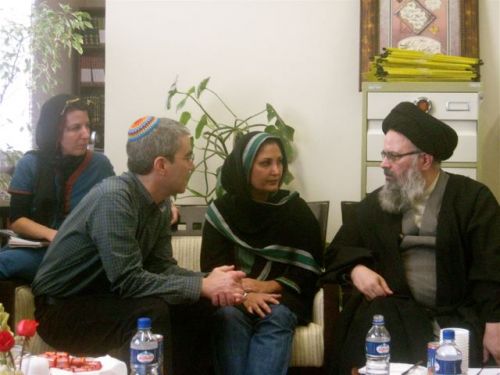
I’ve read and heard about some silly misinformation being spread around regarding my trip last year to Iran – and I’m thinking it might behoove me to set the record straight.

I will say at the outset that I gave a Yom Kippur sermon on this topic and I blogged extensively from Iran. If you haven’t read these posts yet, please do so. They will give you a pretty good sense of the why, what and how of my Iran experiences.

Right off the bat: I did not meet with Mahmoud Ahmadinejad.

Now that I’ve gotten that straightened out, I’d like to address one particular quote of mine that’s being bandied about out of context:

While I prefer not to weigh in on the rhetorical hairsplitting debate on [President Mahmoud] Ahmadinejad’s notorious 2005 threat to wipe Israel off the map, I’ll only suggest that our attitudes and foreign policy must be based on real intelligence and understanding, and not fear-based, knee-jerk assumptions.

I still think this quote should pretty well speak for itself, but apparently I need to explain further.  I know of at least two instances in which this quote was used to somehow imply traitorous intentions on my part – i.e., that I prefer not to “weigh in” on the serious threats posed by Iran toward the Jewish state.

To those who doubt where my ultimate loyalties lay, I was actually referring with this quote to the rhetorical debate over the actual Farsi meaning of Ahmadinejad’s words from this oft-quoted speech. There has been an important ongoing debate as to whether these words were intended as a threat of genocide against the Jewish state or a predication of the eventual dissolution of the “Zionist regime” from within.

A recent blog post by Juan Cole represents this point of view well:

President Mahmoud Ahmadinejad did quote Ayatollah Khomeini to the effect that “this Occupation regime over Jerusalem must vanish from the page of time” (in rezhim-e eshghalgar-i Qods bayad as safheh-e ruzgar mahv shavad). This was not a pledge to roll tanks and invade or to launch missiles, however. It is the expression of a hope tha the regime will collapse, just as the Soviet Union did. It is not a threat to kill anyone at all.

As I myself am not a scholar of Farsi, I don’t consider myself qualified to weigh in on this debate, but I do believe that “our attitudes and foreign policy must be based on real intelligence and understanding, and not fear-based, knee-jerk assumptions.” I continue to stand by this assertion – I’m simply not a fan of fear-based foreign policy.  I am well aware that there are those who will say, “maybe Iran does intend to destroy Israel or maybe it doesn’t, but can we really take that chance?” I’m more inclined to say it this way: “when we jump to conclusions and base our reactions on fear rather than true understanding, we may ultimately cause our deepest fears to actually come true.”

By the way,  I encourage you to read Cole’s entire post, entitled “Top Things You Think You Know About Iran That Are Not True.” Whether or not you agree with his analysis, I believe his perspective provides a thought-provoking corrective to so many of the fear-based assumptions currently being bandied about regarding Iran.

Here are a few excerpts:

Belief: Iran is a militarized society bristling with dangerous weapons and a growing threat to world peace.

Reality: Iran’s military budget is a little over $6 billion annually. Sweden, Singapore and Greece all have larger military budgets. Moreover, Iran is a country of 70 million, so that its per capita spending on defense is tiny compared to these others, since they are much smaller countries with regard to population. Iran spends less per capita on its military than any other country in the Persian Gulf region with the exception of the United Arab Emirates.

Belief: Isn’t the Iranian regime irrational and crazed, so that a doctrine of mutually assured destruction just would not work with them?

Actuality: Iranian politicians are rational actors. If they were madmen, why haven’t they invaded any of their neighbors? Saddam Hussein of Iraq invaded both Iran and Kuwait. Israel invaded its neighbors more than once. In contrast, Iran has not started any wars. Demonizing people by calling them unbalanced is an old propaganda trick. The US elite was once unalterably opposed to China having nuclear science because they believed the Chinese are intrinsically irrational. This kind of talk is a form of racism.

PS: By the way, did I mention I didn’t meet with Ahmadinejad?

Israel, the UN and the Perennial Double-Standard

iccTikkun has published an important interview conducted by Rabbis Michael Lerner and Brian Walt with Justice Richard Goldstone that should be read by anyone concerned with the (now ill-fated) Goldstone report.  Among other things, it contains a fascinating analysis of the perennial double-standard issue:

Rabbi Michael Lerner: OK.  Let me give you one of the frequent criticisms of the Goldstone report that I’ve heard and that I’d like to put to you.  Not that it’s inaccurate but that it’s a reflection of a prejudice because of selective prosecution. The UN gives this attention to the sins of little countries or powerless countries, relatively powerless countries, while never daring to do a comparable report on big guys like the human rights violations of the United States in Iraq, of Russia in Chechnya, China in Tibet. The argument goes that when one picks on historically oppressed groups like Jews for their sins while ignoring the far greater sins of the more powerful, the UN participates in a kind of double standard that in other contexts would be seen transparently as racist or illegitimate.  So that even though you, Judge Goldstone,  were perfectly fine in what you did, the actual investigation itself by virtue of selecting this target by a body that doesn’t target the more powerful is a reflection of prejudice.

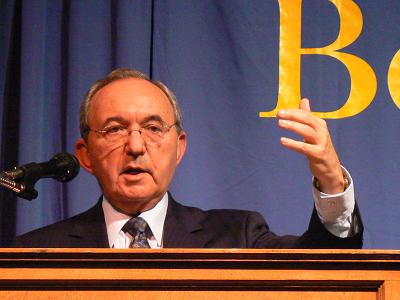
Justice Richard Goldstone: Generally I agree with the criticism.  I think the powerful are protected because of their power.  But it’s not prejudice it’s politics. It’s a political world.  There’s no question of not investigating countries because of who they are for religious reasons or cultural reasons, it’s because of their power.  They use their power to protect themselves.  It doesn’t mean that investigations [in countries] where politically they can be held are in any way necessarily flawed or shouldn’t take place.  The same argument was raised by Serbia in particular.  They said, “Why was the international criminal tribunal set up for us? It wasn’t set up for Pol Pot, it wasn’t set up for Saddam Hussein, it was set up for Milosevic.” And my response at the time when it was put to me by the Serb minister of justice, as I remember very well, was if this is the first of the lot, then I agree with you, it’s an act of discrimination, but if it’s the first of others to come then you can’t complain, you have no right to complain because you’re the first.  And if crimes are being committed then at least, to go after those that one can go after politically is better than doing nothing.

ML: For example, there haven’t been any comparable investigations of human rights violations by Syria, by Saudi Arabia, by Egypt — admittedly these are against their own populations.

RG: I think that what distinguishes this from that is that these war crimes are committed in a situation of international armed conflict.  It’s not going to be a civil war situation.

ML: And you don’t think there is something inconsistent or one-sided and prejudicial in investigating this type of crime but not internal crime?

RG: I think it’s a double-standard more than prejudice.

ML: So you would agree that there’s a double-standard.

RG: Absolutely.

ML: And that it should be changed, but that doesn’t invalidate what you do.

RG: This is why.  The best way of changing it is for every nation to join the International Criminal Court.

It’s an extremely compelling argument. Is it a double-standard to only investigate the human rights abuses that are politically possible to investigate? Probably. But it doesn’t mean that investigations such as this are not important and it certainly doesn’t mean they are ipso-facto anti-Semitic.

We in the Jewish community are right to shine a light on this kind of hypocrisy, but I sense this accusation only goes so far. Are we willing to admit that after a certain point, the double-standard argument essentially serves as a way of avoiding certain painful truths about Israel’s conduct?

As Justice Goldstone correctly points out, the best way to ensure that the UN and the ICC fulfill their mandates is for all nations – particularly the most powerful – to agree to be held accountable for their actions.

Reading Goldstone

richard_goldstone

Why should we trust the Goldstone report if it was produced by the UN Human Rights Commission – a body which has a notorious history of focusing overwhelmingly on Israel to the near exclusion of other potential human rights abusers around the world?

I posed this very question to Fred Abrahams, senior researcher for Human Rights Watch’s emergencies division who, together with B’tselem Executive Director Jessica Montell, participated in a remarkable conference call organized by Ta’anit Tzedek yesterday.

Fred, who is currently in Geneva attending the UN discusion of the report, answered that there is ample reason to be concerned about the HRC’s undue attention on Israel, but that this particular mission presented a very real “opportunity” for the council to prove otherwise.

In fact, Justice Richard Goldstone initially refused to chair the mission until it was agreed that Palestinian wartime behavior would be investigated in addition to Israel’s.  Indeed, in the end, both sides were taken to task in the report’s final recommendations. It was a shame, Fred said, that Israel’s abject dismissal of Goldstone might actually be thwarting the HRC in its first genuine attempt to realize its true mandate.

For her part, Jessica pointed out that B’tselem did have some concerns about possible bias in the report – a point she also made in a recent Jerusalem Post article. She did add, however, that Goldstone largely confirms the findings of B’tselem’s own investigations, including the huge number of civilian casualties and the targeting of civilian neighborhoods and Gazan infrastructure that had no clear military objective.

I’ve started reading the Goldstone report myself – all 575 pages of it – and encourage you to do the same (but recommend that like me you save some trees by reading it off your computer screen.)  My initial impression: this report is an honorable and good faith attempt to elucidate the facts of what occurred. Quite frankly, it makes for compelling and often devastating reading.  I am certainly aware that it is not a perfect document, but in the end I cannot accept that it deserves to be dismissed without due consideration  (let alone be painted as “blood libel.”)

And I will only add that after reading the report, I consider Richard Goldstone to be a heroic individual who should be lauded for taking on this enormously difficult task with such moral courage.

I was particularly moved by his willingness to address the critical context of this tragic crisis. Witness this excerpt from his opening statement to the UN upon presenting the report:

The Mission decided that in order to understand the effect of the Israeli military operations on the infrastructure and economy of Gaza, and especially its food supplies, it was necessary to have regard to the effects of the blockade that Israel has imposed on the Gaza Strip for some years and has been tightened since Hamas became the controlling authority of Gaza.

The Mission found that the attack on the only remaining flour producing factory, the destruction of a large part of the Gaza egg production, the bulldozing of huge tracts of agricultural land, and the bombing of some two hundred industrial facilities, could not on any basis be justified on military grounds. Those attacks had nothing whatever to do with the firing of rockets and mortars at Israel.

The Mission looked closely and sets out in the Report statements made by Israeli political and military leaders in which they stated in clear terms that they would hit at the “Hamas infrastructure.”

If “infrastructure” were to be understood in that way and become a justifiable military objective, it would completely subvert the whole purpose of International Human rights Law built up over the last 100 years and more. It would make civilians and civilian buildings justifiable targets.

These attacks amounted to reprisals and collective punishment and constitute war crimes.

The Government of Israel has a duty to protect its citizens. That in no way justifies a policy of collective punishment of a people under effective occupation, destroying their means to live a dignified life and the trauma caused by the kind of military intervention the Israeli Government called Operation Cast Lead. This contributes to a situation where young people grow up in a culture of hatred and violence, with little hope for change in the future.

Finally, the teaching of hate and dehumanization by each side against the other contributes to the destabilization of the whole region.

A transcript of our conference call will be posted on the Ta’anit Tzedek website soon. I’m excited to report that Ta’anit Tzedek is sponsoring a conference call between Justice Goldstone and Jewish clergy on October 18.  We have a great deal to learn from him and I look forward to reporting on our conversation.

On Gaza and Yom Kippur: A Call to Moral Accounting

From my op-ed in this morning’s Sunday Chicago Tribune:

The actions of the Jewish State ultimately reflect upon the Jewish people throughout the world. We in the Diaspora Jewish community have long taken pride in the accomplishments of the Jewish State. As with any family, the success of some reflects a warm light on us all. But pride cannot blind us to the capacity for error on the part of the country we hold so dear. We cannot identify with the successes, but refuse to see the failures.

As we approach Yom Kippur, I call on America’s Jews to examine the Goldstone findings, and consider their implications. In the spirit of the season, we must consider the painful truth of Israel’s behavior in Gaza, and understand that we must work, together, to discover the truth — and then urge on all relevant parties in the search for peace.

Judaism as Nonviolence: A Sermon for Rosh Hashanah

During my Rosh Hashanah sermon, I asked the following questions:

Is there a place in Judaism for pacifism? Is it in fact possible – or desirable – as a Jew, to walk the path of nonviolence?

Click below to read my answers…

Continue reading

Conservative Movement: Hatikvah Instead of Shofar

The Rabbinical Assembly (the rabbinical association of the Conservative movement) distributed this letter today to its members, asking its rabbis to read the piece below in lieu of the Shofar service on Rosh Hashanah. (The shofar is traditionally not sounded when RH falls on Shabbat, as it does this year.)

Friends,

On this Rosh Hashanah our brothers and sisters in Israel face the threat of a nuclear Iran – a threat to Israel’s very existence.

Today, we Jews around the world also confront the anti-Semitism and anti-Israel sentiment of the Goldstone report which blames Israel disproportionately for the tragic loss of human life incurred in Operation Cast Lead, which took place last winter in Gaza.  This unbalanced United Nations sponsored report portends serious consequences for Israel and the Jewish people.

On this holy day, which is not only Rosh Hashanah, but also Shabbat, the Shofar is silent in the face of this spurious report, the world is far too silent.

Today the state of Israel needs us to be the kol shofar, the voice of the shofar!

We ask you to write to our governmental leaders and call upon them to condemn the Goldstone report and to confront the threat of a nuclear Iran.

While the shofar is silent today, all Conservative rabbis, cantors and congregations have been asked to sing Hatikvah at this moment in the service.

We rise in solidarity with our brothers and sisters in Israel.

What troubles me most about this suggestion is how profoundly it flies in the face of the very meaning of the festival itself. On Rosh Hashanah, we affirm Malchuyot – God’s sovereignty over the universe. Rosh Hashanah is the only time of the year that Jews are commanded to bow all the way to the ground and pledge our allegiance to God and God alone. We acknowledge that our ultimate fealty lies with a Power beyond ourselves, beyond any mortal ruler, any government, any earthly power.

Beyond the political arguments over such a statement, it strikes me as something approaching idolatry.

I’m curious to know your reactions, particularly in regard to its religious implications.