While I’m sure that Syria has been on the lips of many a rabbi this High Holiday season, I’ll be honest with you: I’ve struggled with whether or not to give that sermon this year. Not because I don’t consider it to be an issue of critical importance, quite the contrary – no one can deny that the situation in Syria is a tragic and critically important one in our world at the moment. If I’ve been hesitant, it’s only because I’m not really sure I have much to add to the myriad of political analyses we’ve heard in the media these past few weeks.
So while my words to you today are not directly related to Syria, I would like to begin with one small but powerful story out of this crisis. It comes from an article written by my friend Aziz Abu Sarah, a young Palestinian peace activist and educator. At the moment Aziz is the Co-Executive Director at the Center for World Religions, Diplomacy and Conflict Resolution at George Mason University – and he was recently made a National Geographic Emerging Explorer where he serves as a cultural educator. Several JRC members know Aziz well as he was one of our tour guides of a JRC trip to East Jerusalem and the West Bank two years ago.
As the news out of Syria became more and more dire, particularly the news of the growing refugee crisis, Aziz and a colleague put their heads together to explore some kind of action they might possibly take. There are currently more than 2,000,000 Syrian refugees in camps throughout the Middle East – mostly in Lebanon, Jordan, Turkey, Iraq and Egypt. Women and children make up three quarters of the refugee population. There are over 1,000,000 children refugees as a result of this crisis.
In the end, Aziz and his colleague decided to establish an educational summer camp for refugee children on Syrian-Turkish border. In a blog post about his experiences in the camp, he wrote, “Whether the US bombs Assad or not is not in my control, but being active to help those in need is.”
In his post, Aziz wrote movingly about the children he had met and the stories they told him – stories that were at once horrific and at the same time the ordinary everyday stories of children everywhere. At the conclusion of his post, he wrote:
These are the stories that we need to remember when we argue about Syria. These are the people paying the heavy price. When we pass by a news item about Syria, we must remember the millions of children that could become another lost generation without our willingness to engage and help…
Opening our hearts and finding compassion must come before any discussion on military intervention.
When I read Aziz’s post, it reminded me how easily we debate these crises even while knowing so very little about the people who are actually living through them. How we tend to view these kinds of global tragedies in the abstract. It’s understandable, of course – when we read the staggering statistics coming out of these crises zones, it literally staggers our comprehension. How on earth do we grasp numbers such as these, let alone the reality of the suffering behind the statistics?
But while it’s understandable, I do find something profoundly troubling about this phenomenon. Because when we reduce people in crisis zones to abstractions, it invariably creates a kind of emotional callousness in the ways we think and form our opinions about the crises themselves. When we don’t make an effort to understand the human reality behind the headlines, it seems to me, our political ideas emerge in something of a moral and emotional vacuum.
I do believe that Aziz is absolutely right: before we start holding forth on whether or not to bomb, we must first open our hearts and find compassion for the people of Syria. We must make an effort to learn who they are, to learn about their unique experiences, to listen to them. Whatever we believe must be done, the process by which we form our opinions must begin with an effort to get to know the human beings behind the abstractions.
Now I realize that most of us don’t have the wherewithal to pack up and move to Turkey to work with Syrian refugees – but this doesn’t let us off the hook. Because quite frankly, we don’t have to literally go to the Middle East to discover populations at risk. While Syria has been at the center of the headlines of late, in truth there are all too many of communities in crisis in our midst. We don’t have to go all that far to find them.
Indeed, this is another way that our abstractions affect our perception of the world. Crises are things that happen “over there.” To be honest, sometimes it seems to me that we relate to the at-risk populations in our own backyard as if they are as far away as the Middle East. But of course, they’re not. They are right here, right outside our very door. They may not be of the same magnitude of those in places like Syria, but they are all too real nonetheless.
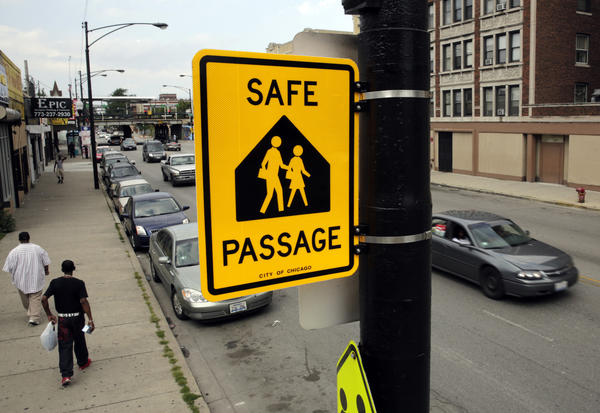
Here’s but one example, from right here in Chicago. Many of you, I know, are familiar with the initiative known as “Safe Passage” a program formed in 2009 as a response to gang and street violence in at risk Chicago neighborhoods. The program places community workers wearing bright fluorescent vests near public schools as a presence that will help create “safe passage” for High Schoolers who were walking to and from school.
The program was expanded significantly this past May, after the Chicago School Board closed almost 50 public elementary and middle schools in predominantly African-American and Hispanic communities on the South and West sides. Among the many devastating impacts of this decision was that it forced many children to walk longer routes to their new schools, through additional dangerous neighborhoods and across multiple gang boundaries. Whereas these children had previously walked an average of a few blocks to their neighborhood schools, many of them now have to walk half a mile or more through areas that are, quite literally, battle zones.
To deal with this reality, the school board expanded Safe Passage, hiring an additional 600 workers at $10 an hour to serve 12,000 schoolchildren in at-risk communities on their way to their new schools. While it is still early in the new school year, the preliminary reports are not promising. There have already been reports of violence along Safe Passage routes – not including the myriad of areas where children are not served by the program. We are now hearing reports that overwhelmed workers are quitting or just not showing up for work. One alderman has suggested the use of drones to protect children along Safe Passage routes.
No, we don’t need to look far away to find stories of children in battle zones. They are, in a very real way, right outside our door.
How do we respond to news such as this? Though it pains me to say so, I would suggest most of us who live the relatively safe and secure neighborhoods of greater Chicago respond to this news the same way we respond to the tragic news coming out of Syria, or Somalia or the Congo. Most of us, I think, thank goodness it’s not our reality. We quantify it in the abstract. We respond as if it’s happening “over there.”
Except it’s not. It’s happening right here in our very own community and in communities just like it across our country. These populations may not be terrorized by tyrannical dictators or civil war, but their lives and their families’ lives are at risk in a very real way. As a parent, I cannot fathom how it must feel to raise my children in neighborhoods wracked with violence, to send them off to walk miles to school through gangland battle zones. I cannot begin to fathom it. And maybe that is part of the problem.
This Yom Kippur, the season when our community honestly takes account of itself and how we might collectively atone, I think it is eminently appropriate to ask ourselves: what has been our response to communities in crisis? And are we truly able to see them? Have we truly opened our eyes and our hearts to their realities – particularly those who live right here in our own nation, our own city?
I can’t help but wonder what our communities would look like if our public policy was guided by such an approach. Let’s return to the example of Safe Passage that I gave earlier. There is no doubt that Chicago Public Schools, like all major urban school districts, faces daunting challenges. But unfortunately in my opinion, the Chicago School Board, like so many other urban school boards, now seeks to address these challenges from a corporate, efficiency-focused mindset rather than a community-based one.
I believe this approach to public education is problematic on many levels – but perhaps the most troubling is the way it has utterly blinded us to the critical role neighborhood schools play as the bedrock of our communities – particularly our at-risk communities. In areas that have already been profoundly destabilized by massive cuts to public services, neighborhood schools have served as the only real glue that holds these communities together. By closing these schools, CPS was in many cases literally cutting the final piece of government investment in these communities – and the last remaining institution in which residents can invest in one another.
It is impossible to understate the devastation these kinds of decisions inflict on low-income communities that have long been seriously at-risk. For decades, in fact, urban renewal policies have been decimating neighborhoods, uprooting residents who are largely poor and people of color. Neighborhood assets, like churches, stores, and parks that have been important community centers for generations, have become abandoned or have disappeared. And so residents have been forced out – they have become refugees, in as sense, of a different sort.
The neighborhood school is often the one institution still surviving in low-income neighborhoods and it has historically served as points of pride and community for families. If you had any doubt that these schools are important to their neighborhoods, you had only to listen to the thousands of parents who attended community meetings on school closings over the past few months. Despite their pleas, however, our new “education reformers” have chosen to close schools rather improve them, using the argument that we are in a time of public sector austerity and that we need to orient them to market forces.
This is what happens when leaders view schools using a corporate model rather than a community-based one. When CPS closed 50 neighborhood schools and slashed the budgets of those that remained, Chicago’s non-elected board addressed this issue with a top-down mindset that was ultimately divorced from the real-life reality on the ground. And so now we have it: thousands of students are now leaving their already devastated neighborhoods every day are forced to walk through battle zones in order to get to their schools.
Of course this phenomenon is not only restricted to our schools. In too many ways, our public policy is guided by the corporate goals of efficiency and profit over community and the greater good. While it is certainly true that many of our public institutions are bloated and inefficient and in need of reform, when we destroy them wholesale in this manner, we fail to reckon with the very real human cost of these actions. Even worse, when we privatize our public works, whether it is public housing, our health care system, or our prisons, we do more than simply turn lives into abstractions. We increasingly view human lives – and in some cases, human misery – as commodities to be profited from.
Whether we call this privatization or neo-liberalism whatever we choose to call it, I do believe it represents a very real form of institutional oppression. It may not be as obvious or as brutal as the oppression meted out by the Bashar Al-Assads of the world, but I submit it is a form of oppression nonetheless. Both stem from a view of our neighbors as somehow “other.” Both benefit from a more privileged people’s willingness to turn a blind eye. And most important, both forms of oppression affect the real lives of real people.
So what is there to be done? On an individual level, I think, one answer is very simple: we need to connect. We need to venture out of the hermetically sealed worlds we too often construct for ourselves and learn more about the people with whom we live – particularly those whose day-to-day reality is fundamentally different from our own.
Earlier this month, I read an article by a German journalist who was in Chicago to write about urban gun violence through a grant from the Pulitzer Center. It was fascinating to read the impressions of this European visitor from a Berlin, a city larger than Chicago but with a fraction of the homicides.
Here is how the journalist, Rieke Havertz, ended the article:
It is human nature to ignore Chicago’s gun violence as long as the shooting stays in the “bad” neighborhoods. Don’t take the “L” down south — that was the advice I always heard when I spoke about visiting less-fortunate neighborhoods.
I ignored the advice and nothing happened to me except that I got to know the city. I discovered that it’s not just money that needs to be thrown at these neighborhoods. They need economic opportunity, education, health care. They need a Chicago that is not a segregated city.
They need people who care. Take a different path, reach over the walls.
I know many JRC members who work and volunteer with in at-risk communities in Chicago and right here in Evanston – and I have learned a great deal from them over the years. I think it would behoove us all to not just to learn about these communities, but to create real connections, nurture real relationships. To meet and listen to those who live there. To relate to them as real people, not as charity cases to be helped or problems to be solved. To learn about their reality, their struggles, their needs, from them, not news reports or politicians or pundits.
We need to learn and act on an advocacy level as well. Here in Chicago, there is a remarkable grass-roots coalition that is shaping up and organizing on behalf of the at-risk communities in our city. In fact, polls show that 60% of Chicago’s citizens oppose the school closings and they are starting to make their voices and their presence heard in a major way. After the CPS’s announcement, many of us took to the streets for three straight days of marches in protest – and although the school closings and budget cuts are now a reality, they have galvanized a movement that is attracting a remarkable coalition – including growing numbers of young people.
But this movement has not grown up overnight – and it is not simply focused on the issue of public schools. It has in fact been building steadily over the years; it is the product of many community-based organizations mobilizing and organizing on behalf of the most vulnerable members of the greater Chicago community.
I’m proud to say here at JRC we are becoming increasingly active in this movement. I encourage you to find out more about our efforts and seriously consider lending us your support. Specifically speaking, I encourage to consider getting involved in our Labor Justice Task Force, our Immigrant Justice Task Force and to speak with JRC members who are currently exploring ways we can become active with Northside P.O.W.E.R., an institution-based people’s power organization with members on the Chicago’s North side and in North Shore Communities.
I have also personally been active with the wonderful organization Arise Chicago, an interfaith community organization that does important, critical local work on behalf of worker justice. (And of course, I would be derelict if I did not mention that we have many other active and vital Tikkun Olam Task Forces at JRC – I hope you will speak to JRC’s VP for Tikkun Olam and learn how you can get involved in our ongoing social justice efforts.)
I also want to encourage us all to educate ourselves and find ways to act on a national level as well. Indeed, it is not an understatement to say that the at-risk populations in our country are currently vulnerable in ways we haven’t seen in decades. According to new data from the US Department of Agriculture, more than one in five American children face hunger, this at a time in which our Congress is considering cutting the SNAP program (aka food stamps) for more than 800,000 Americans who currently receive them but still do not get enough to eat or maintain only a barely adequate diet.
The crisis facing our food stamp program is a particularly critical issue at this very moment – and I would be extremely derelict if I devoted a sermon to our at-risk populations without mentioning this. According to a new report released just a few days ago by the Agriculture Department, food insecurity in our nation remains at a stubbornly high 14.5 percent. According to these statistics, one in five American children are currently facing hunger.
Thanks to the stimulus package, we’ve been able to address this issue through the SNAP program, which last year served 47 million Americans to meet their basic nutrition requirements. However next week, House Republicans, in an effort led by Representative Eric Cantor, will vote to cut $40 billion out of the food stamp program – an act that would literally force hundreds of thousands of Americans into food insecurity.
In regard to this bill, Rep. Jim McGovern made this very astute comment:
There are 50 million people in the United States of America who are hungry, 17 million are kids. It is something we all should be ashamed of, and the United States House of Representatives is about to make that worse. This is a big deal and my hope is that we’ll treat it as such and not just let it go by without a lot of discussion and debate because we’re all focused on Syria.
Now these cuts are unlikely to become law since the Senate would never pass them and President Obama would certainly never sign them. But the very fact that such a bill could even be voted on in the House is a clear sign that those advocating for the poor and the hungry in our country must remain incredibly vigilant. We simply cannot let our foreign policy discussions, however important, to eclipse these critical issues facing at-risk citizens here at home.
Every Yom Kippur, we recite our prayers in the first person plural. When we seek atonement, hope and healing for the New Year, we don’t do so for our own individual selves – we ask for these things on behalf of our entire community. I would claim that in this day and age it is getting harder and harder for us to connect with this aspect of our Yom Kippur prayers. Increasingly, it feels to me that we liturgical lip service to the concept of community. Too often it seems like we’re all living our parallel lives, without the sense that at the end of the day we’re all somehow in this together.
But in fact, we are. I do believe this sense of living separately from one another is itself the illusion. At the end of the day, our fates are intertwined. We’re very much mistaken if we believe that we’re somehow immune from risk. As we all know too well, the middle class is being squeezed and endangered in ways we haven’t witnessed in decades. Over the years and even now, there have been JRC members living on the verge of hunger and homelessness. These problems are not somewhere “over there” and in truth, they never really were. Perhaps it’s only our individualistic 21st century perspective that has changed.
So this Yom Kippur, I’m suggesting a recalibration of our spiritual perspective. To view the risk to the well-being of some members of our community as a risk to our own well-being. In a very real way, to own the danger and let go of our illusions of invulnerability. Otherwise, what do all of these prayers really mean? What do our lives really amount to if we cannot somehow see them as integrally connected to the lives of others, whether they live in Syria or the Southwest side of Chicago or in Evanston?
May this be the new year we let go of our illusions. May this be the year we decide to share the risks as well as the rewards.
May it be a rewarding year for us all.
(Click here to sign a petition that tells the House and Senate to put low-income families ahead of corporate welfare and to oppose all cuts to food stamps.)
 Shalom Rav