Category Archives: Racism

God is in the Resistance: Sermon for Rosh Hashanah 5786

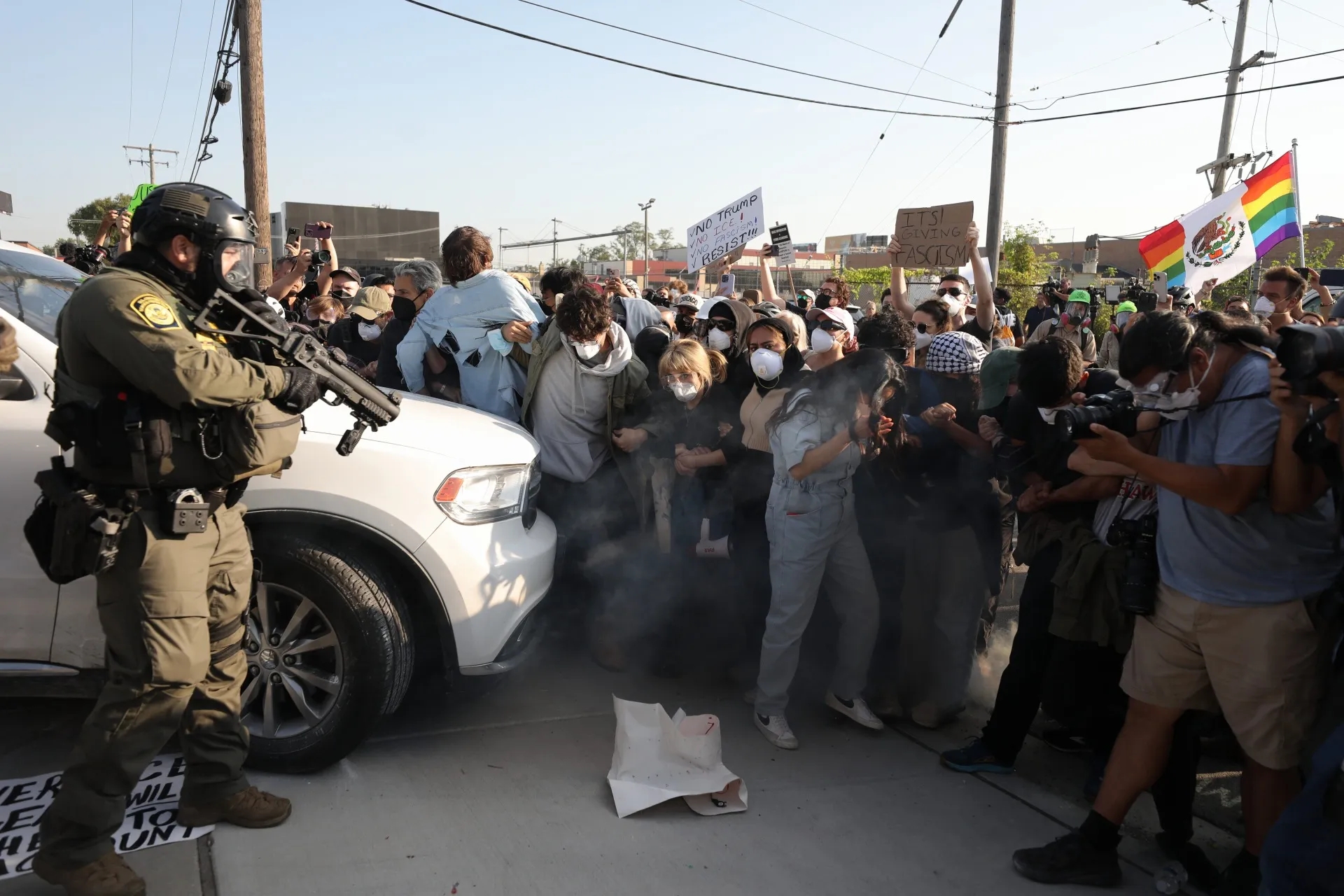
Protesters outside an ICE processing facility, Broadview Chicago. (Credit: Vincent D. Johnson/Block Club Chicago)

I’ll be honest with you: I never liked High Holiday services when I was a kid. 

There were so many things that just rubbed me the wrong way: they felt interminably long, the old school Reform choir music wasn’t my thing, and my parents would constantly shush me and my brothers when we got squirrelly (which was often). But most of all, I resented the seeming irrelevance of it all. I just couldn’t relate to the content of the services – and there was never any effort to explain why it should be relevant to me. 

On Rosh Hashanah in particular, I just couldn’t relate to the constant stream of prayers singing God’s praises, extolling God’s greatness and invoking God’s power. It all seemed designed to make us feel small and insignificant: this repeated glorification of an all-powerful God to whom we must beg and plead for another year of life. 

I realize now that I was a pretty astute kid. “Malchuyot,” which literally means “sovereignty,” is one of the central themes of Rosh Hashanah. Every new year we declare over and over that God is our supreme ruler. This theme is repeated throughout the liturgy, particularly during the Musaf service, when it is traditional to physically prostrate oneself on the floor before the divine throne during the Aleinu prayer. 

Over the years, however, as I began to attend services on my own terms rather than under duress, I came to appreciate Rosh Hashanah, yes, even the idea of Malchuyot. In fact, the older I get, the more relevant and important this concept feels to me. On a personal level, I understand to be a Malchuyot is a reminder that we often labor under illusions of our own power and control. We face these illusions head on during Rosh Hashanah when we do the work of teshuvah: the sacred process of return and repentance.

Of course, we are not all powerful. But ironically, acknowledging the limits of our power can actually be liberating. By affirming a transcendent source of power greater than our own, we can better focus and identify the things we can control in our lives. When we invoke God’s Malchuyot on Rosh Hashanah, we do so in the spirit of this liberation, to break free of our illusions of power and put ourselves on a more productive, healing path during the Days of Awe. 

Beyond the personal, I’d suggest Malchuyot has a collective and political dimension as well. It’s deeply rooted in Judaism’s central sacred narrative, the Exodus story. I actually made this very point during my very first sermon for Tzedek Chicago on Rosh Hashanah ten years ago:

At its core, I would suggest affirming Malchuyot means affirming that there is a Force Yet Greater: greater than Pharoah in Egypt, greater than the mighty Roman empire, greater than the myriad of powerful empires that have oppressed so many peoples throughout the world.

I would argue that this sacred conviction has been one of the central driving forces of Jewish tradition throughout the centuries: that it is not by might and not by power – but by God’s spirit that our world will ultimately be redeemed. I would further argue that this belief in a Power Yet Greater has sustained Jewish life in a very real way. After all, the Jewish people are still here, even after far mightier empires have come and gone. It might well be said that this allegiance to a Power Yet Greater is the force that keeps alive the hopes of all peoples who have lived with the reality of dislocation and state oppression.

I went on to suggest that through Zionism, the Jewish people have tragically betrayed this sacred Jewish narrative of liberation. When you think about it, the raison d’etre of Zionism literally is human sovereignty. It is an ideology that unabashedly deifies state power as a redemptive force in Jewish life and overturns centuries of Jewish tradition. It has subverted the sacred ideal of Malchuyot by centering and sacralizing human power above all else.

When I delivered that first Rosh Hashanah sermon, however, I never could have predicted where Zionism’s bargain with state power would lead us. In the misguided name of Jewish safety and supremacy, Israel has doubled down on its assumption of human Malchuyot to an unbearable degree. As we gather for Rosh Hashanah this year, Israel has been perpetrating an almost two-year genocide against the Palestinian people. Nearly 70,000 Palestinians have been killed, with real numbers likely to reach the hundreds of thousands. Whole families have been killed and entire bloodlines erased. Untold numbers of people have been buried under rubble, burned alive, dismembered and starved to death. At this very moment, Israel is literally bombing the entire north of Gaza off the map, trapping scores of residents who cannot leave their homes and sending scores of others to the south into active war zones.

And yet of course. Of course it has come to this. From the very beginning, the goal of establishing a Jewish-majority nation state could only be realized by dispossessing another people – what the Palestinian people refer to as the Nakba. Israel’s genocide against the Palestinians did not begin on October 7; it has been ongoing for over 70 years. There is a direct line leading from Zionism’s idolatrous attachment to Malchuyot to the crimes we are witnessing daily in Gaza.

This idolatrous attachment, of course, is not unique to Zionism. Looking back, I realize that Tzedek Chicago’s first Rosh Hashanah service took place shortly after Trump announced his first Presidential campaign. It’s also fair to say when I gave that first sermon, I never would have dreamed that just ten years later, the US would be rapidly descending into authoritarian fascist rule. That ICE would serve as our President’s secret police force, prowling the streets in plain clothes and face masks, abducting immigrants and student activists in unmarked vans. That thousands of National Guard troops would be mobilized to occupy American cities. That so many of our nation’s institutions would be defunded, plundered and centralized by unelected oligarchs. That our government would openly declare whole groups of people, including immigrants, trans people, people of color and unhoused people to be literal “enemies of the state.”

In the wake of Charlie Kirk’s murder, the incitement against these imagined enemies has reached a terrifying fever pitch. Trump and the movement he spawned are now seizing this moment to foment fury against a broad array of individuals and institutions they call the “radical left.” Trump’s aide Stephen Miller has chillingly characterized the current moment in America as a battle between “family and nature” and those who celebrate “everything that is warped, twisted and depraved.” 

Words such as these should not sound new to us; the Trump regime is using a time-honored tactic from the fascist playbook. We know that totalitarian regimes have historically consolidated their power during times of instability by fomenting a toxic “us vs. them” narrative. Hannah Arendt identified this mentality very clearly seventy-five years ago in her book The Origins of Totalitarianism: “Tribal nationalism always insists that its own people are surrounded by a ‘world of enemies’ – one against all – and that a fundamental difference exists between this people and all others.” 

Although the context of 21st century fascism is different in many ways from fascisms of the past, the fundamental building blocks of this phenomenon remain the same. In the parlance of Rosh Hashanah, the fascists of today are claiming Malchuyot – ultimate power – for themselves. And they are consolidating their power by demonizing those who do not fit into their idealized, privileged group as enemies who must be fought and eradicated at all costs. 

However, as overwhelming as the current political moment might feel, there is a textbook for resisting fascism as well. The essential rules for fighting fascism remain the same as they ever were. And the first order of business is: do not collaborate. 

This may seem obvious, but given the hard truth of the moment, I don’t think it can be repeated enough. It has been truly breathtaking to witness how quickly ostensibly independent non-governmental institutions have capitulated to Trump’s bullying and blackmail: from universities firing professors and defunding whole programs to businesses eradicating their DEI programs; from corporate media outlets becoming state mouthpieces, to law firms allocating hundreds of millions of dollars in legal services to defend the federal government. 

Has the liberal establishment been up to the challenge of this moment? Just consider its response to the murder of Charlie Kirk. Let’s be clear: Kirk was an unabashed white Christian Nationalist who incited young people on college campuses to hatred under the cynical pretense of “open dialogue.” Even so – and even as the MAGA movement is dangerously exploiting this moment – liberal leaders and institutions have been normalizing Kirk by openly praising him as a paragon of free speech and good faith debate. 

After he was killed, CA Governor Gavin Newsom eulogized Kirk by saying: “The best way to honor Charlie’s memory is to continue his work: engage with each other, across ideology, through spirited discourse. In a democracy, ideas are tested through words and good-faith debate.” Similarly, following Kirk’s murder, the Dean of Harvard College, David J. Deming publicly vowed to protect conservative students on campus, adding that Kirk’s enthusiasm for publicly debating his opponents could be a model for Harvard’s own civil discourse initiatives. And for his part, liberal New York Times columnist Ezra Klein wrote an op-ed entitled “Charlie Kirk Practiced Politics the Right Way.” 

It’s not clear if these apologists honestly believe what they are saying or if they’re just trying to avoid the government’s takedown of anyone who has anything remotely critical to say about Charlie Kirk. But in the end, it really doesn’t matter. The bottom line: liberal normalization will not appease fascists. 

To put it frankly, the government has declared war on us – and we must respond accordingly. The days of partisan cooperation and dialogue are over. The days of good faith debate and civic compromise are over. Capitulating to demagoguery and hatred will not convert the MAGA movement to the values of democracy and civil discourse. Yes, in a healthy democratic society, the concept of “collaboration” is something to be valued. But in a fascist regime, the term “collaborator” has a different meaning entirely. 

The first step in resisting collaboration is to accept that none of this is normal. We must let go of old assumptions, many of which, frankly, have led us to this moment. If we are to be totally honest, it must be said that the Democrats and the liberal establishment have been collaborating with corporate interests along with Republicans for years. As we interrogate the abnormality of this moment, we must admit that the entire system has been disenfranchising whole groups of people in this country for far too long. 

Resisting fascism also means letting go of our ultimate faith in the “rule of law.” Indeed, both the left and the right tend to fetishize the rule of law as an absolute good. And while it’s true that the law can be a tool to ensure a more just society, it can just as often be used as a blunt instrument to dismantle democracy. 

We know from history that governments routinely create laws that are inherently unjust. Slavery was legal in the US for almost 250 years. Apartheid in South Africa was legal. Apartheid continues to be legal in Palestine/Israel. In the face of such legal injustice, the obvious moral and strategic response is not to follow but to break the rule of law. As Dr. Martin Luther King famously wrote in his “Letter from a Birmingham Jail:” 

We should never forget that everything Adolf Hitler did in Germany was “legal” and everything the Hungarian freedom fighters did in Hungary was “illegal.” It was “illegal” to aid and comfort a Jew in Hitler’s Germany. Even so, I am sure that, had I lived in Germany at the time, I would have aided and comforted my Jewish brothers.

This is, in fact, the radical truth we affirm every Rosh Hashanah. When we affirm Malchuyot, we affirm that there is a moral law yet greater than any law levied by a government or regime. On this Rosh Hashanah in particular, the sound of the shofar calls on us to resist conformity; to vow to become criminals when confronted with laws that are inherently unjust. More than any Rosh Hashanah in our lifetimes, we must be ready to defy the illegitimate laws wielded by the illegitimate rulers who would govern us. 

Even if we do accept this challenge, however, the question remains: where does Malchuyot, ultimate Power, reside, if not with governments, politicians or the rule of law? Here, I’d like to quote yet another one of my heroes, the Puerto-Rican Jewish liturgist Aurora Levins Morales:

They told me we cannot wait for governments.
There are no peacekeepers boarding planes.
There are no leaders who dare to say
every life is precious, so it will have to be us.

Yes. God’s power is revealed in our readiness to show up for one another.  When we acknowledge Malchuyot on Rosh Hashanah, we affirm that the Divine Presence is manifest whenever we struggle and resist and fight for our communities, for a world where all are liberated and cherished and protected. When there are no leaders who dare to ensure that every life is precious, it will have to be us. 

Here are two concrete examples of Malchuyot in action: this last January, shortly after the inauguration, the Trump administration launched a series of raids in Chicago they called “Operation Safeguard” where, over the course of a few days, ICE, the FBI, the ATF and other federal forces coordinated massive raids in neighborhoods throughout the city and suburbs. We don’t know how many were arrested or detained, but we do know that this federal blitzkrieg was deeply frustrated by local organizing. Trump’s so-called “border czar” Tom Homan later complained that immigration organizers in Chicago were “making it very difficult” to arrest and detain people. He said, “They call it Know Your Rights. I call it how to escape from ICE.”  

Of course, even as we win these battles, this fierce war continues to escalate. ICE violence continues to rage in the neighborhoods of our cities. In Chicago, ICE has now launched another sweep, this one called “Operation Midway Blitz.” Just last Friday, at an immigrant processing center in the Broadview section of Chicago, federal agents shot tear gas, pepper spray and flash bang grenades into hundreds of demonstrators. Ten protesters were taken into custody by federal agents over the course of the day. Even amidst this escalating violence, however, local organizers here in Chicago continue to hold the line. 

Another example: in Washington DC which is still under occupation by National Guard troops, groups of local residents called “night patrols” have been regularly patrolling the streets. According to journalist Dave Zirin, whose reports from the ground have become invaluable:

These night patrols watch over the city to ensure that people are protected from state violence, false arrest, abduction, and harassment. Failing that, their goal is to document the constitutional violations or brutality they witness, so people can see the truths about the occupation that a compliant, largely incurious media are not showing. 

Critically, these neighborhood patrols are being led and stewarded by members of impacted groups: As one night patroller put it: “a lot of young people, a lot of people of color, queer and trans folks, people who have been directly impacted by policing, and folks with street medic backgrounds. It skews toward people who already know what it’s like to be criminalized.” 

Though it isn’t being highlighted by the corporate mainstream media, this local organizing is happening in communities all over the country: in Los Angeles, where there are also still hundreds of National Guard troops, as well as New Orleans, Memphis, Baltimore and other cities that the Trump administration is directly threatening with military invasion. I know that many Tzedek Chicago members have long been active in these organizing efforts, here in Chicago, around the US and even around the world. But again, we can have no illusions over what we are up against. 

I know that the magnitude of these events often leads us to a state of overwhelm and despair. We doom-scroll through the news every day, we read about Trump’s newest executive order, the latest regressive Supreme Court ruling or some other heinous event and the ferocity of this onslaught can literally leave us breathless. This is, of course, yet another page from the authoritarian textbook: to neutralize the population through a calculated strategy of shock and awe. They want us to feel that all is lost, to give in to our despair that their power over us is all but inevitable. 

Our experience of shock and overwhelm is compounded all the more by an all-pervasive sense of grief. So much of what we have fought for has been lost. So many of the institutions we assumed would be eternally with us are being plundered and dismantled. Some of these losses may be permanent, some may not, but the harms they are causing are very, very real. 

I feel this grief myself, believe me, I do. But I also know that if we surrender to it, then their victory over us will become self-fulfilling. The way through the fear and the grief, I truly believe, is to never forget that we have power, that our words and actions matter and that nothing is ever inevitable unless we let it be so. 

Whenever we feel overwhelmed, I think the critical first step is to reclaim our equilibrium by asking ourselves, what matters most to me? What are the issues that are nearest to my heart? Most of us have the capacity to devote our time and energy to one or two causes at most. What are the most effective organizations fighting for this cause? Who are the people in my life that can connect me with the people doing this work? If I don’t have the capacity or physical ability to engage actively in these kinds of responses, what are other meaningful ways I can show up?  

Amidst all this loss, we must never forget: even if our victory is not guaranteed, there are still things in this world worth fighting for. Generations of resisters have understood this axiom well: “If I’m going to go down, I’m sure as hell going to go down swinging.” In the words of my friend and comrade, Chicago organizer Kelly Hayes, who I’ve quoted in more than one High Holiday sermon over the years:

I would prefer to win, but struggle is about much more than winning. It always has been. And there is nothing revolutionary about fatalism. I suppose the question is, are you antifascist? Are you a revolutionary? Are you a defender of decency and life on Earth? Because no one who is any of those things has ever had the odds on their side. But you know what we do have? A meaningful existence on the edge of oblivion. And if the end really is only a few decades away, and no human intervention can stop it, then who do you want to be at the end of the world? And what will you say to the people you love, when time runs out? If it comes to that, I plan on being able to tell them I did everything I could, but I’m not resigning myself to anything and neither should you. Adapt, prepare, and take the damage done seriously, but never stop fighting. Václav Havel once said that “Hope is not the conviction that something will turn out well, but the certainty that something is worth doing no matter how it turns out.” I live in that certainty every day. Because while these death-making systems exist both outside and inside of us, so do our dreams, so long as we are fighting for them. And my dreams are worth fighting for. I bet yours are too.

This New Year, I realize I’ve come a long way from that beleaguered kid who felt disempowered on the High Holidays to a rabbi telling you Rosh Hashanah is our clarion call to fight facism. But here I am. And here we are. May this new year inspire us all with the knowledge that true sovereignty, true Malchuyot, lives at the heart of the struggle. 

On this, my final Rosh Hashanah with this amazing community, this is what I am feeling to my very bones at this moment: that while Pharaohs may rise, they will inevitably fall, that beyond the horizon of Olam Hazeh, this terribly broken world, there lies Olam Haba: the world we know is possible. And no matter what may happen this new year – and every new year to come – that world is always worth fighting for.

Shanah Tovah.
Standing at Sinai: Interrogating our National Myths of Unity

In the week’s Torah portion, Parashat Yitro, the Israelites stand at Mt. Sinai and collectively enter into a covenant with God. With a message conveyed through Moses, God says to the people:

“(If) you will obey Me faithfully and keep My covenant, you shall be My treasured possession among all the peoples. Indeed, all the earth is Mine, but you shall be to Me a kingdom of priests and a holy nation.” (Exodus 19:5-6)

Shortly after, the Israelites collectively accept:

…All the people answered as one, saying, “All that God has spoken we will do!” (19:8)

In this mythic moment, the Israelites become a nation unified in a shared, transcendent purpose.

But do they really, though? Most of the Torah’s narrative post-Sinai is less a record of a nation united by a shared purpose than a portrayal of a deeply fractured collection of tribes struggling mightily to live up to the covenant they made with God at Mt. Sinai. This certainly tracks with the evolution of Jewish peoplehood throughout the centuries. Though the organized Jewish community routinely clings to the mythic notion that “We are One,” we have always been a nation of sub-communities: a family divided by a of myriad of assumptions over what it means to be and behave as a Jew, often rancorously.

Of course, in the current moment the Jewish people are experiencing an exceedingly powerful and painful division. As I suggested in my sermon this past Yom Kippur:

Jewish life is going through … a monumental crisis and transformation right now. I’m speaking of course, about the abyss that has opened over the issue of Zionism – an abyss that has widened considerably this past year as a result of Israel’s genocide in Gaza.  

This mythology of national unity, however, is not unique to the Jewish people. Those of us raised in the US are all too familiar with such tropes, socialized as we were with the famous line from the Pledge of Allegiance: “One nation, under God, indivisible, with liberty and justice for all.” In truth, however, the US has been a deeply divided nation since the day it was founded. While the preamble of the Constitution reads “We the People,” the “people” it referred to were white, landowning men. The Naturalization Act of 1790 limited access to citizenship to “free white persons.” Later on, the US broke in two after slaveholding states succeeded – and the nation only became “one” again after fighting a bloody civil war. In too many ways, it’s a war that has never really ended.

As we see the rise of nativism and authoritarianism in nations around the world, it’s fair to say that this reckoning over national identity is truly a global phenomenon. Like many, I’ve been watching with alarm the rise of the far right nationalist AfD party in Germany (with the unabashed support of the ubiquitous Elon Musk) as they seek to build a coalition with conservative opposition parties. German Vice Chancellor Robert Habeck has warned ominously that such an alignment would “destroy Europe.”

So where does this leave us? Can we actually affirm these narratives of national unity in good faith? Do they serve us in any way – or do inevitably lead to authoritarianism and genocide?

I personally believe that national mythologies should not be literal oaths to be sworn to, but collective narratives to be interrogated deeply. In the case of the US narrative, we must ask honestly: what is the place of dispossessed indigenous nations in our national narrative? What is the place of descendants of kidnapped Africans who were brought here in chains to build up this nation? What is the place of immigrants who come to these shores seeking a better life – or to escape certain harm in in their home countries? What is the place of LGBTQ+ people, disabled people and members of other historically marginalized groups?

Those who uphold national mythologies must ask honestly, who exactly is the “we” in “We the People?” Because these narratives will only be useful if they lead to actual collective liberation for all. More critically, those of us who are committed to a truly inclusive national vision must prepare for the inevitable, often violent backlash from those who do not share our narrative. Indeed, history has proven all too often that a truly inclusive national vision never comes easily. On the contrary, it must be fought for.

At the end of the Torah, God says to the Israelites:

“I make this covenant and this oath, not with you alone, but both with those who are standing here with us this day before the ETERNAL our God and with those who are not with us here this day.” (Deuteronomy 29:13-14)

This Shabbat Yitro, as we stand once more at Sinai, let us ask ourselves: “Who are not with us on this day?” Why are they not here? What are we willing to sacrifice to ensure that they will be included in the covenant as well?”

Learning How to Breathe in the Era of Trump

(photo: Carl Juste/AP)

In this week’s Torah portion, Parashat Va’era, God’s tells Moses to return to Mitzrayim and say to the Israelites:

“I am יהוה. I will free you from the labors of the Egyptians and deliver you from their bondage. I will redeem you with an outstretched arm and through extraordinary chastisements.” (Exodus 6:6)

But when Moses attempts to impart this message of liberation to the people, they weren’t able to hear it as “their spirits were crushed (kotzer ruach) by cruel bondage.” (6:9)

This one verse says so much about the trauma of personal and systemic abuse. The Hebrew word ruach means both “spirit” and “breath/wind.” On one level this could mean that their oppression was so severe that individual Israelites could barely breathe. On a deeper level, it might indicate that their collective spirit was so damaged they couldn’t even begin to comprehend the possibility of liberation.  

The dual meaning of the word ruach in Jewish tradition suggests that the divine spirit is embodied by our very breath: the life force that we share with God and all that lives. In the first chapter of Genesis, we read that the process of creation began when the ruach elohim (“God’s breath”) rippled across the primordial waters. Humanity itself came to life when God breathed into the first human. In Jewish liturgy, we awaken every morning expressing gratitude for “the breath of every living thing and the spirit of all flesh.”

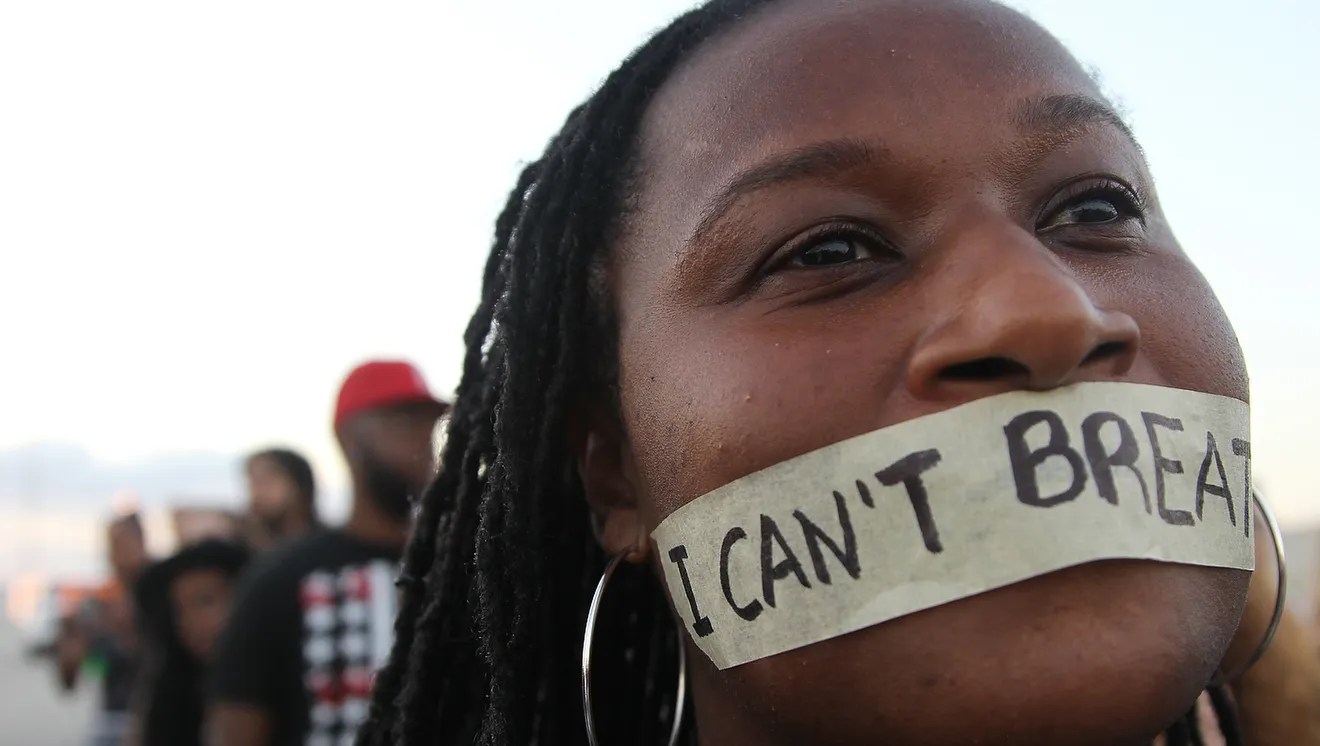
I believe there are powerful spiritual/political implications embedded in this theological concept. It suggests that when human beings – or humanly-created systems of oppression – deprive people of their ability to breathe freely, the flow of divine life force in the world is disrupted. Moreover, the demand to be able to breathe is itself a clarion call to action. We need look no farther than the phrase “I can’t breathe,” the final words of George Floyd and Eric Garner, whose deaths at the hands of systemic racism provided a powerful spark for the Black Lives Matter movement. Nigerian writer/poet Ben Okri has suggested that these three words “should become the mantra of oppression,” from the racist systems in our communities to the life-choking forces of global climate change.

In this regard, we might view the Jewish practice of giving thanks for our breath every morning as much more than a simple prayer discipline: it is nothing less than a statement of connection and solidarity with all that lives. Those who can breathe easily tend to regard the act of breathing as a natural, involuntary reflex. But as those with chronic respiratory illnesses will surely attest, it is no small thing to be able to take a breath. And in the age of COVID and climate change, millions throughout the world are increasingly becoming chronically kotzer ruach as a result of systemic oppression and corporate profit.

In other words, a commitment to a world in which everyone can breathe freely is a spiritual/political act of resistance. As disability justice activist Rabbi Julia Watts Belser has written:

Let’s learn to work more slowly, move more deliberately. Let’s learn to listen, when our bones say no. Let’s mandate breaks for anyone who works outside. Let’s require air purifiers, ventilation systems and safe work environments. Let’s make sure that all of us can breathe.

It is not too hyperbolic to suggest that the current political moment has left many of us breathless. As we death-scroll through the news of Trump’s executive orders and authoritarian policies, the ferocity of this onslaught can leave us literally or figuratively gasping for air. But this is, of course, just what Trump and his movement wants: to leave us reeling through a calculated strategy of shock and awe. They want us to feel breathless, paralyzed, despairing. We must not succumb. We must not accept that breathlessness is the new existential normal of our political age. We cannot become, like the Israelites of our Torah portion, so kotzer ruach that we cannot even imagine the possibility of something better beyond this authoritarian tyranny.

In the work of resistance, the first order of business is, quite simply, remembering to take a breath. Because in the end, if we are paralyzed with breathlessness for the next four years, we will be of no use to ourselves or anyone else. Moreover, once we regain our breath and our equilibrium, we will be in a better place to discern what we can do to meet this moment. In the wise words of Chicago organizer Kelly Hayes:

When your enemy wants you disoriented, your ability to focus is an important means of self-defense. What matters to you in this moment? Most of us can meaningfully dedicate ourselves to one or two causes, at the most. What can you commit to doing something about? Where do you get trustworthy information about those subjects? Who do you connect with when deciding what to do about what you’ve learned? Is there an organization whose resources you will employ or whose calls to action you will answer? Do you have a friend group or solidarity network that will formulate a response together? Answering these questions is key to steadying yourself in these times. Remember: Vulnerable people don’t need a sea of reactivity right now. They need caring groups of people who are working together to create as much safety as they can. We need to create a rebellious culture of care. That will take focus and intention. It will take relationships and a whole lot of energy. 

This Shabbat, let’s all commit to breathing more freely. Then let’s fight for a world in which that freedom is extended to all.

Protesting Genocide at the DNC in Chicago: Beyond “One Issue”

(photo by Keeton Holder)

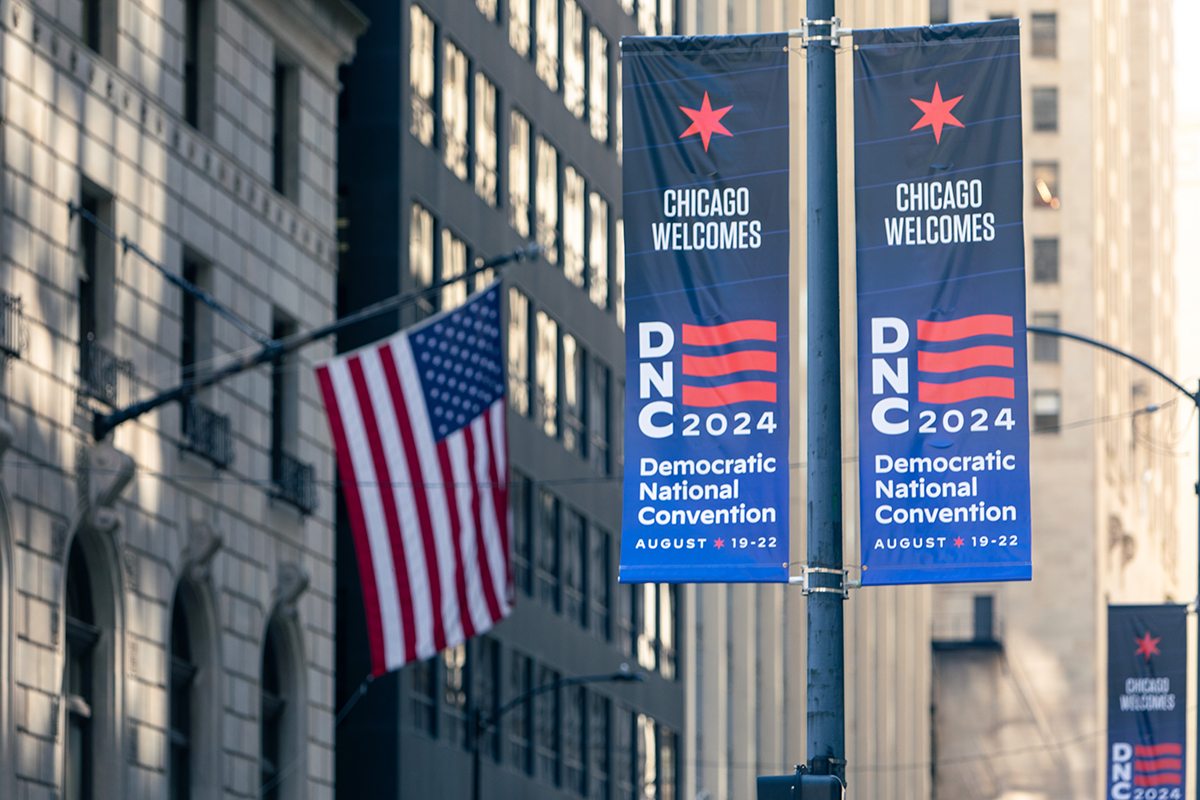
As I’ve written previously, a large coalition of leftist groups has been preparing to take to the streets when the Democratic National Convention comes to Chicago next week. Although there will be a variety of different demands leveled at the DNC during the course of the convention, one key issue clearly stands out as a central common thread through them all – namely, an immediate US arms embargo and a permanent ceasefire to end Israel’s genocide in Gaza.

To name but one example: a rally and march for reproductive justice (of which my congregation, Tzedek Chicago, is a co-sponsor) will take place this Sunday, on the eve of the convention. As “Bodies Outside of Unjust Laws” organizers have made clear, however, the demands of this protest are not limited to issues of domestic reproductive justice alone:

Reproductive justice inherently includes ending the reproductive genocide in Palestine. As U.S. citizens, it is our duty to call on our own government to end the funding of weapons to Israel that enable this nightmare to continue and robs us of funds at home. As feminists and reproductive justice activists, we must also highlight a horrific aspect of the war on Palestinians: it is a war against women and children, who suffer in uniquely cruel ways. 

Likewise, the Coalition to March on the DNC, a group of over 200 national and local organizations is calling for an “End to US Aid to Israel” along with demands on immigrant justice, police crimes, healthcare, housing and the environment. Here again, justice for Palestinians is not viewed in isolation from other issues. As protest organizers correctly understand, these issues are irrevocably interlinked and intertwined.

During the course of this election cycle, those of us who have been demanding an arms embargo and ceasefire in Gaza have become all too familiar with one recurrent criticism in particular: that we are “one issue voters.” I find this to be a dangerous attitude for a number of reasons. More than anything, it’s an egregiously dismissive stand to take in an age of genocide, smacking of “it’s not my problem” American isolationism during the 1940s. For the Palestinian people, of course, Israel’s genocide in Gaza is not simply one issue – it’s the issue.

Witness, for instance, the news from this past weekend:

Officials in Gaza say more than 100 people were killed Saturday in an Israeli attack on a school and mosque where thousands of displaced Palestinians had sought shelter. The attack on the al-Tabin school in Gaza City was one of the deadliest individual attacks since Israel’s war on Gaza began over 10 months ago. Rescue workers said they did not find a “single full body” among the deceased — just body parts often destroyed beyond recognition. Survivors said Israel attacked the school during morning prayers…

CNN has confirmed a US-made GBU-39 small diameter bomb was used in the Israeli strike on the school. The attack came two days after the Biden administration notified Congress that it was preparing to provide Israel with an additional $3.5 billion to spend on US weapons and military equipment. Congress had approved the money as part of a $14 billion package for Israel in April. Zeteo reports part of the new US package includes a direct sale of 6,500 joint direct action munitions to Israel.

First and foremost, the genocide in Gaza is a crime against humanity that should concern us all. But as citizens of the nation that is funding and abetting this genocide, we Americans cannot look away from the blood that is surely on our collective hands. Nor can we ignore the shock waves that resonate far outside the borders of Palestine/Israel: the threat of an all-out regional war, the profits enjoyed by the arms and surveillance industry at taxpayer expense, the devastating environmental impact – the list goes on and on. Palestinian human rights lawyer and activist Noura Erakat put it perfectly on Twitter/X recently: “PSA: ending a genocide is not ‘a single issue’ it is an entire universe of issues.”

Another refrain I’ve been hearing repeatedly is the critique that protesting at the DNC “will only help Trump.” Harris herself leveled this argument at a campaign rally in Detroit when she sternly admonished pro-Palestinian protesters: “If you want Donald Trump to win, then say that. Otherwise, I’m speaking.” To be sure, it was an astonishingly tone-deaf and dismissive response to make in Michigan, the very birthplace of the Uncommitted Campaign. But on a more fundamental level, Harris’s response denied the very real impact of her own administration’s policies. As one of the protesters later put it, “When people are demanding a ceasefire and arms embargo and an end to the genocide and you say that we want Donald Trump to step in—it just shows a lack of accountability. It shows a lack of leadership, a lack of responsibility and a lack of ownership.”

In essence, Harris’s comment was just the latest version of the “shut up and vote” message that the Democratic party routinely sends progressives during every election cycle. In an age of US-supported genocide, however, the cynical emptiness of this message has become patently, painfully obvious. As journalist Masha Gessen has rightly pointed out. “These voters are not choosing between Harris and Trump. They are choosing between their sense of themselves as moral beings if they vote for Harris and their sense of themselves if they vote for a third-party candidate or for no one at all.”

Of course those who will be protesting at the DNC next week do not want to see Trump elected in November. But even from a purely strategic point of view, what has a better chance of helping the Democrats fortunes in November? We know that a strong majority of American voters across the political spectrum support a permanent ceasefire in Gaza. What would be the more winning strategy: telling those who want to end a genocide to shut up, or exert real leadership that will bring about a ceasefire and an end to the threat of a devastating regional war?

While party conventions function largely as candidate-coronations, they still function as places where parties express their collective vision and finalize their political platforms. On this score, I’m not at all optimistic that an arms embargo to Israel and a permanent ceasefire will find any purchase at the DNC. There are a mere 30 Uncommitted delegates out of 4,600 – and while they are pushing for a voice at the convention (they’ve asked that Dr. Tanya Haj-Hassan, a pediatric intensive care doctor who has volunteered in Gaza, speak from the convention floor), they have still not been offered a slot. Harris’s national security advisor has also made it clear that she opposes an arms embargo to Israel. By every indication, it certainly feels like “shut up and vote” will be the dominant Democratic party message coming out of the convention next week.

I have enormous respect for the Uncommitted delegates who will engage within the convention, particularly co-founder Layla Elabed, who has said even if they are not given a speaking slot, delegates will make their presence known with “news conferences, candle light vigils, tables to distribute literature and, they hope, guest testimonies about life in war-torn Gaza.” When it comes to political advocacy, however, there is always an inside game and an outside game. That’s why those of us who are not delegates will (quite appropriately) be making our presence known outside the walls of the convention hall as well.

Protest organizers have no illusions about the overwhelming militarized presence that will greet us when we gather next week. Federal authorities have divided the area surrounding the United Center, where the main speaking events of the convention will take place, into “soft” and “hard” zones – the latter being off limits to cars and non-credentialled delegates. But even in the soft zones, movement has been heavily restricted. The main protests have been given approved routes far from the convention site, and at one point goes through narrow residential side streets, that will be completely inadequate to handle thousands of protesters. While organizers have appealed the march route, as of this writing there has been no response from the city of Chicago.

When we talk about the potential for police violence next week, of course, the specter of the 1968 Democratic convention in Chicago looms very large. A great deal of ink has been spilled analyzing the differences and similarities between Chicago 1968 and Chicago 2024 – and while I’m loath to venture too far into this rabbit hole, there is one point of commonality I believe bears noting. In general, the mythos around the 1968 DNC protests tend to lay the blame for the Democrats’ defeat on the protest movement that “divided the party.” Often lost in this discussion is the fact that in 1968, those protests were directed toward a political party that had been prosecuting an increasingly unpopular war in Vietnam. Today, as then, I find it deeply misguided to blame protesters and not the immoral policies of the Democratic party itself.

While it’s not particularly helpful to use Chicago 1968 to heighten hysteria over the DNC, protestors are certainly justified in being vigilant over the very real possibility of police violence. I’m not the only one who finds it ominous that the city is doubling down on armed presence in the city. In advance of the convention, the Secret Service agent in charge of “security” has commented that “Chicago has a proven track record when it comes to putting on huge events” – citing the city’s response to Lollapalooza, the NASCAR Chicago Street Race and the Chicago Air & Water Show – as if the DNC is just another tourist event to showcase to the public.

No, we cannot deny of the very real moral and political reality that will be at stake in Chicago next week. We cannot deny that state violence directed against Palestinians is one and the same with so many other forms of state violence that are routinely normalized as “necessary.” And we must resist the call to dismiss any form of systemic violence as just “one issue.” As my friend and comrade, organizer Kelly Hayes has so wisely written:

We have to recognize victims of police brutality, Palestinians, our disabled and unhoused neighbors, and so many others who are subject to forgetting as worthy of grief, outrage and action. Everyday people who are fleeing violence, hunger, and militarism, everyday people whose cites are running out of water or are in danger of disappearing beneath rising flood waters, everyday people who are dying right now because they lack air conditioning amid heat waves – these are the people whose plights and fates should shape our politics. If we are going to fight for any semblance of human decency, we need to reclaim and reassert the value of our lives.

Safety in Abundance: Remembering Wadee Alfayoumi

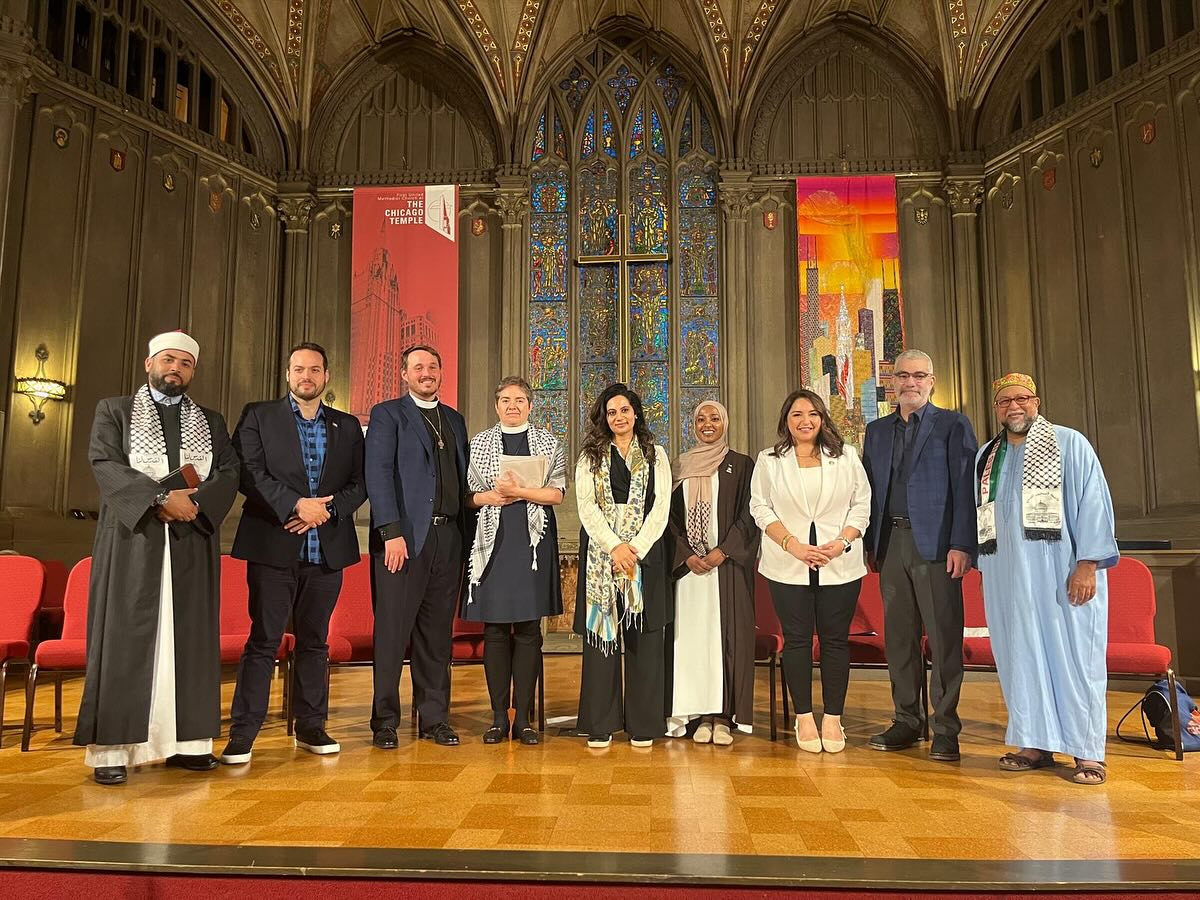
left to right: Sheikh Hassan Ali, Tarek Khalil, Rev. Michael Wolff, Rev. Anna Piela, Maaria Mozaffar, Deena Habbal, Rep. Delia Ramirez, Rabbi Brant Rosen, and Imam Hassan Aly.

My remarks from last Sunday, delivered at an interfaith memorial in Chicago for Wadee Alfayoumi, a six year old Palestinian-American boy from Plainfield, IL, who was murdered in a hate crime on. October 14. Our service also included words from IL Rep. Delia Ramirez, who is co-sponsoring a House resolution affirming that “the United States has zero tolerance for hate crimes, Islamophobia, anti-Semitism, and anti-Palestinian and anti-Arab discrimination.” 

When precious lives are unjustly taken from the world, the most essential way we can honor their memory is to ensure that they have not died in vain. Wadee’s young life was cruelly taken from us through a heinous and unjust act. While it is true that his murderer has been caught and will be tried by our legal system, our work is by no means over. We must continue to demand justice for Wadee Alfayoumi. 

While it is true that Wadee’s life was taken by one hateful, hate-filled individual, those who view this was a random, isolated incident are gravely mistaken. Wadee’s murder did not occur in a vacuum. It occurred in the toxic context of Islamophobia and anti-Palestinianism that has long been rising throughout this country and around the world. It was inspired by an ideology emanating from the state of Israel that has routinely and regularly dehumanized Palestinians for decades – a state that is, even as we speak, unleashing genocidal violence against a captive Palestinian population in Gaza. 

How can we honor the life of Wadee Alfayoumi? How can we ensure his death will not be in vain? By speaking out as loudly and unabashedly as possible against anti-Muslim, anti-Arab and anti-Palestinian hatred – and the systems that support it. By demanding that the safety and security of some groups cannot be upheld at the expense of others. By affirming the most essential of moral truths: that all people – and peoples – are equally precious in the eyes of God, and equally worthy of human dignity and respect. 

In a celebrated Talmudic debate, two rabbis, Rabbi Akiba and Rabbi Ben Azzai argued over what is the most central precept in Torah. Rabbi Akiba claims it is the famous verse from Leviticus: “Love your neighbor as yourself.” Ben Azzai disagrees, and cites the verse from Genesis: “When God created humankind, God created humankind in God’s image.” Why does Ben Azzai disagree? Some commentators suggest that while “love your neighbor as yourself” is a powerful moral imperative, it is somehow incomplete. It potentially limits our love to our immediate neighbors, to members of our community, religious or ethnic group. However when we lift up the Biblical precept that all humanity is created in the divine image, we assert our love and care for all who dwell on earth. Likewise, when we dehumanize or diminish the humanity of others, God’s presence is diminished in the world.

In other words, this divine precept is rooted in a vision of abundance. Human safety and security cannot be a zero-sum game: in the end, it must be all of us or none. There are many of us in the American Jewish community who are deeply, profoundly dismayed by the cynical accusations of antisemitism wielded by right wing political leaders who have made it abundantly clear they do not, to put it mildly, have my community’s well-being at heart. We know that the charge has less to do with Jewish safety than punishing those who stand in solidarity with Palestinians. 

We would do well to ask: why does the ignorant conflation of anti-Zionism with antisemitism merit so many hearings on Capitol Hill? Why is antisemitism being politically exceptionalized over other forms of bigotry and hatred? Why has the murder of Wadee Alfayoumi – and the shooting of three Palestinian college students in Burlington, Vermont – met with nothing but abject silence from the representatives holding these hearings? In this time of growing hatred, we must stand down this privileging of one group of people over others for cynical political gain. We must demand that our politics be leveraged to protect the safety and security for all groups targeted by hate. 

Unfortunately – tragically – we live in an age in which right-wing, white supremacists are strategically targeting their hate at Muslims, Jews, people of color, immigrants, gay, trans and disabled people, among others. Yes, as a Jewish person, I feel genuinely threatened by the rise of antisemitism in this country and around the world – but I also know full well that Christian nationalist hatred is equal opportunity in nature. I understand full well that my safety and security is inseparable from the safety and security of all. 

As remember the precious life of Wadee Alfayoumi, whose was taken from the world so unjustly, let us demand justice. Let us, as affirm, as the House Resolution introduced by Rep. Delia Ramirez and her colleagues states so plainly, that it is “the duty of elected officials and media to tell the truth without dehumanizing rhetoric when informing the public of factual information.” And that “the United States has zero tolerance for hate crimes, Islamophobia, anti-Semitism, and anti-Palestinian and anti-Arab discrimination.” 

In Jewish tradition, when we invoke the name of someone who has died, we traditionally follow with “may their life be for a blessing.” This is not only a statement of respect to the dead: it is also a moral imperative for the living. If their memories are to be a blessing, it is we that must make it so. 

I’d like to end my remarks now with the traditional Jewish prayer for the dead, El Male Rachamim (“God Full of Compassion”). We offer it now in memory of Wadee Alfayoumi, whose precious life was unjustly taken from us. Let it’s resonance be a blessing to all whose lives have been ended by bigotry – and an inspiration to us all to dismantle the systems that enable hate and oppression once and for all:

Oh God filled with compassion, whose loving presence ever surrounds us, bring final rest to the soul of Wadee Alfayoumi, who has returned to his source. May the memory of his life shine forth like the brilliance of the skies above, as it brightens our own lives and even now. Source of mercy, please shelter him beneath the softness of you wings, that he may be protected in your presence for eternity, that he may rest in peace and power.

Amen.

From Interfaith Dialogue to Interfaith Solidarity: Sermon for Rosh Hashanah 5784

(AP photo by Adam J. Dewey/NurPhoto)

During the course of my rabbinical career, I’ve participated in a good number of interfaith dialogues. These were facilitated conversations, usually involving the three so-called Abrahamic traditions – Christians, Muslims and Jews – in which we would explore our respective faith traditions together. The goal of the dialogues, generally speaking, was to achieve a deeper level of interfaith appreciation and understanding – to walk away with a respect for our differences as well as the underlying values we had in common. 

I haven’t participated in an interfaith dialogue in many years. If truth be told, I’m not sure I really believe in them anymore. It’s not that I don’t think it’s a good thing for people of different religions to learn from one another – I certainly do. It’s just that our dialogues never seemed to go much further than the talking. While our conversations were often substantive, we generally avoided more uncomfortable political topics. The underlying assumption seemed to be that religion and politics didn’t mix.

During Jewish – Christian conversations in particular, we rarely delved too deeply into issues such as Christian hegemony, white supremacy and antisemitism. When we did, we tended to treat such issues as part of the past. We seemed to be guided by the liberal assumption that such things belonged to a bygone, less enlightened age than our own. 

I can’t help but think such assumptions feel downright quaint today, in an age in which White Christian Nationalism is openly amassing political power. In which a mob wielding crosses and Christian banners literally stormed the Capitol in a coup attempt. In which Republican politicians have openly declared themselves to be Christian nationalists and a Republican candidate for president has called on his followers to “put on the full armor of God.” In the current political age, I think it’s safe to say the interfaith need of the moment goes far beyond liberal religious dialogue. The stakes are now far too serious – and far too consequential – for that.

Over the past two years, there’s been a great deal of analysis of the political threat posed by White Christian Nationalism: an ethno-nationalist movement that espouses a toxic combination of Christian exceptionalism and white supremacist ideology. White Christian Nationalists are guided by the belief that God has destined America, like Biblical Israel, for a special role in history – and that it will receive divine blessing or judgment depending on its obedience. It also promotes Replacement theory and actively demonizes Muslims, Jews, LGBTQ+ people, immigrants, and all others who do not fit into their white Christian ideal.

In the age of Trump, this movement has become entrenched in the Republican Party – and while they’re still a minority, their power has become critical to the GOP’s political strength. According to polls, most Republicans support declaring the US to be Christian nation, even if such a move would be unconstitutional. And among White Christian nationalists as a whole, 40% believe ​that “true patriots might have to resort to violence to save our country.”

Though this movement has emerged in a specific political moment, it is not uniquely of the moment. It actually dates as far back as the early days of European colonialism. Experts trace its roots back to the Doctrine of Discovery: a 15th century papal decree proclaiming European civilization and western Christianity to be superior to all other religions and cultures. The Doctrine of Discovery, of course, was an important driving force behind European colonial domination of the so-called New World and the conversion of the native peoples who lived there. 

This movement is also deeply rooted in white supremacist ideology. In his book, “White Too Long: The Legacy of White Supremacy in American Christianity,” Robert P. Jones wrote powerfully about this connection: how a wide spectrum of white Christians – from evangelicals in the South to mainline Protestants in the Midwest and Catholics in the Northeast – developed theologies that justified American slavery and Jim Crow. 

This legacy of white supremacy in American Christianity is alive and well in 2023. In 2015, a white supremacist entered Mother Emanuel AME Church in Charleston, South Carolina and murdered nine African American members of the congregation during a Bible study. Though there was extensive press at the time about his white supremacist beliefs, there was relatively little discussion of his Christian faith. In fact, his manifesto was filled with Christian imagery, including a drawing of a resurrected white Jesus rising from the tomb. He also wrote in his journal a call to action to white people to transform American Christianity from being “this weak cowardly religion” to “a warrior’s religion.”

Of course, Jews have every reason to be alarmed by such a movement as well. It was a brutal wake-up call indeed to watch torch carrying marchers in Charlottesville calling to “reclaim” America as a Christian nation while chanting “Jews will not replace us!” That wake-up call became downright deafening on a Shabbat in 2018, when a Bible quoting white supremacist murdered 11 Jewish worshippers at the Tree of Life synagogue in Pittsburgh.

At the same time, the Jewish community has been the recipient of genuine solidarity from Christian allies and friends. I’ve experienced this first hand more than once. This past February, for instance, when it was reported that Christian nationalists were planning to mobilize a “Day of Hate” against the Jewish community, my colleague and comrade, Reverend Tom Gaulke, wrote these beautiful words in a letter to our congregation:

As we hear of Christian Nationalists and Christian Supremacists calling for a “day of hate,” I would like to renew a promise on my own behalf and on behalf of the communities I’ve served:

For over a decade, we have marched side by side. And we’re not going to stop. As your family, we’ve got your back, come what may. Together, we’ve got a love that will conquer hate and a love that can only overcome.

To my mind, this gesture sums up the critical need of our new political moment: not so much interfaith dialogue, as interfaith solidarity. We must find a way to mobilize an interfaith movement that, in Tom’s words, ‘will conquer hate and can only overcome.”

If we are truly serious about this level of solidarity, however, each of our religious communities will need to engage in a great deal of deep discernment in our own backyards. I know there are many examples of white Christian communities who are doing this work in important ways; who understand that white solidarity must go hand in hand with justice and reparation. In his book, Robert Jones wrote about one white Baptist minister whose congregation has entered into an ongoing relationship with a black Baptist church. In describing that relationship, the minister said:

I’ve stopped using the word reconciliation…for what we’re doing. I’ve started using justice work more… When we throw around the word reconciliation, especially as white Christians, white people, we’re betraying our desire to just kind of move through all of the hard stuff to get to the happy stuff. So, when we’re talking about justice work, for me we’re getting into these much stickier questions of what has been lost, what is owed. 

Christian solidarity with non-Christians can also be hampered when well-meaning Christians fall back on a myth of innocence – when they distance themselves from White Christian Nationalism by saying “it’s not my religion.” I’ve witnessed this repeatedly – last year, for instance, the presiding Episcopal Bishop stated that White Christian Nationalism was “not Christianity.” Another progressive Christian activist has written it is a “political ideology rather than a religious one.” 

While I understand the good intentions behind these kinds of statements, I believe it’s deeply problematic when Christians disavow the more unsavory aspects of their religious tradition. In so doing, they avoid accountability for centuries of their own history and invisiblize its victims. As I’ve often commented, no religion is pure – all religions have their good, their bad and their ugly. In the end, I would submit that the proper way to confront the toxicity in our traditions is for people of faith to own the all of our religions – and to grapple with them seriously, honestly and openly. 

This will be a reckoning for the Jewish community as well. For one thing, in order to confront White Christian Nationalism, we will need to honestly interrogate persistent myths about Jews and whiteness. While white Jews understandably feel vulnerable at this particular moment, we still dwell under a shelter of white privilege. We must not assume that the threat of White Christian Nationalism poses a danger to all members of the Jewish community equally. White Jews will have to reckon with the fact that we are protected from this threat in ways that Jews of color are not. In other words, for the Jewish community, intra-communal racial solidarity will be just as critical as interfaith solidarity.

There is another issue facing the Jewish community that is perhaps even more challenging: if we are to truly stand down this movement – this toxic fusion of religion and nationalism – we’ll have to do so without exception. That means that Israel cannot get a pass. 

Though it may be troubling for many to consider, there are clear parallels between white Christian Nationalism and Zionism. Consider this: the Doctrine of Discovery holds that America was “discovered,” glorifying the noble innocence of the nation’s original “pioneers.” The ideology of Manifest Destiny is deeply connected to a vision of European Christian chosenness, viewing America as a “new Zion.” 

For its part, Zionism is rooted in a similar colonial view of a “land without a people for a people without a land.” It venerates the heroism of the chalutzim – the pioneers who “drained the swamps” and cultivated the land. And Zionism’s central narrative also comes from the Bible, utilizing texts that emphasize Jewish chosenness and exclusive entitlement to the land. 

Even more to the point, both White Christian nationalism and Zionism are forms of ethno-nationalism: movements that seek to establish and maintain nation-states predicated on the identity of one specific group of people. In its way, these two movements are religious nationalist mirror-images of each other, both seeking to create exclusive, homogeneous nation-states at the expense of their native inhabitants. 

Believe me, I know all too well that there are many in the Jewish community who will vociferously object to this kind of analysis. But painful as it may be, we can no longer cling to this myth of innocence when it comes to Israel. I think it’s absolutely critical that we find the strength to say these things out loud: to admit that after centuries of persecution at the hands of Christian empire, a modern Jewish movement is now actively following in its footsteps. 

All of this means that Jews, Christians – and all people of faith will need to reckon seriously with the issue of power – and in particular, the fusing of religion and state power. After all, don’t we know all too well from history where this road leads? We know what happens when religion is used by nations as a weapon of conquest. When God is invoked by the state to demonize others and exert their power over them. And make no mistake, religions that follow Biblical tradition will find ample justification for conquest and domination in that particular text.

But there is, however, another, decidedly different religious vision: it is a sacred act to resist oppressive state power. This path comes from the Bible as well; it is embodied by the Exodus narrative, the sacred story that lifts up the God of Liberation, and stands down the god of conquest. That puts the oppressed, not the oppressor at the center. That views the Promised Land not as a territory to be conquered by a chosen few but a land of equity and justice that is open to all.  We don’t have to look far to find contemporary examples of this sacred narrative in action. To name but two examples, it is exemplified by the Latin American liberation theology movement and the American black church: both of which lift up sacred visions of resistance that have leveraged genuine socio-political change.

This sacred narrative of liberation runs mightily through Jewish tradition as well. We are currently witnessing an emergent movement of radical, liberative Judaism that is truly exciting to behold. And I am so proud that Tzedek Chicago is an active and important participant in this movement. As we’ve done this work together, it’s been striking to me how integral and basic these values of solidarity and liberation are to Jewish tradition: from the weekly radical revolution that is Shabbat, to our deep-seated culture of study, questioning and Godwrestling, to our holidays, all of which contribute to a sacred drama that enact and re-enact the possibility of change and transformation in our world.

We enact these sacred values, in fact, each and every Rosh Hashanah. One of the central themes of the New Year is malchuyot – “divine sovereignty.” As I’ve come to understand it, this concept doesn’t have to refer to a literal belief in an all-powerful supernatural God sitting on his Kingly throne. Another way of understanding malchuyot, is as an affirmation of a Force Yet Greater – greater than any human or institution in our world: a power greater than Pharaoh in Mitzrayim, greater than the mightiest empire – and yes, even greater than systems of colonialism and white supremacy. 

Rosh Hashanah is also the day in which we stand before the open gates of heaven and sound the shofar as a wake-up call for the new year. We declare Hayom Harat Olam – “today the world was created,”affirming the eternal potential for transformation in our world. Over the next ten days, we will dig deeply into our individual and collective souls and discern what needs changing. Then, at the close of Yom Kippur, we will sound the shofar once final time as a call to action to go forth and create the world we know is possible. 

I’d like to close now with the words of a contemporary religious leader who truly embodies these ideas and values of interfaith solidarity: the great Rev. William Barber, co-chair of the Poor People’s campaign and president of Repairers of the Breach. May his words be our call to action this Rosh Hashanah:

The world doesn’t change when powerful people get new ideas. The world changes when people who’ve been rejected come together and realize that they are blessed to show their neighbors that another world is possible. Change happens when those who have been otherized decide we ain’t takin’ it no more…

There’s some stuff wrong in America and there’s no way to mend the flaws of this nation and be one nation under God with liberty and justice for all, unless the rejected people are at the center.

May this be the year we discover the true source of our collective power. May this be the year we transform the world that is into the world we know is possible. 

Our Vision of Liberation This Passover Must Include Palestinians

NASSER ISHTAYEH / SOPA IMAGES / LIGHTROCKET VIA GETTY IMAGES

Crossposted with Truthout

On Passover, when we gather at the seder table to tell the story of the Exodus, we are reminded by the haggadah (the seder text) that merely telling the story is not enough. We are asked to not only relate but to interrogate this sacred narrative, to contemplate its meaning and to discuss the questions it raises for us. Most importantly, we must connect the lessons of the Exodus story to liberation struggles “in every generation.”

This year, many have inevitably been making connections between the Passover story and the recent anti-government protests that have unfolded in Israel since January. In a widely read sermon last February, for instance, Rabbi Sharon Brous compared the protests to the “great birth story” of the Exodus. In a recent New York Times op-ed, Bret Stephens wrote that the protests were “as close to a revolution as the modern state of Israel has ever seen.” One Jewish leader commented to the press that he plans to read from the Israeli Declaration of Independence at his seder, particularly the passage that promises the “complete equality of social and political rights to all its inhabitants.”

On the surface, this framing might seem to make sense: Since late last year, thousands of Israelis have regularly been filling the streets to protest draconian policies proposed by the newly elected far right government of six-term Prime Minister Benjamin Netanyahu. The protests have largely focused on the “threat to democracy” posed by the government’s plans to drastically curtail the power of the judiciary. The demonstrations seem to have succeeded: late last month Prime Minister Netanyahu announced that he would seek a compromise with his political opponents in order to “avoid civil war.”

While this certainly seems like a “power to the people moment,” it’s worth asking: who exactly are the “people” who have taken back the “power?” Though it was not widely noted by the mainstream media, the protests were largely organized and attended by centrist and liberal Israeli Jews — Palestinians were notably absent. Indeed, it was difficult to ignore the sea of Israeli flags at these demonstrations, along with the drumbeat messaging over “saving Israeli democracy.” By the end, it had become clear that these protests were less about equal rights for Jewish Israelis and Palestinians alike than a desire to reclaim the patriotic Zionist mantle from a newly elected far right government.

In other words, before we’re tempted to connect the Israeli demonstrations to the festival of Passover, it’s worth investigating how we tell the story of liberation, who tells it, who we include, and who we leave out.

These questions are not, in fact, unique to this year. It is common for Zionists to refer to Zionism — the movement to build a political Jewish nation-state — as “the national liberation movement of the Jewish people.” Many might find this to be a curious use of the term, as it is typically used in regard to movements that struggle for liberation against colonial oppression — not settler colonial movements themselves. Such rhetoric belies the origins of an ideology inspired by 19th-century European nationalism and a movement that actively sought to transplant European Jews in historic Palestine.

However, even Zionists who view Jewish nation-statehood in liberative terms must ultimately admit that from the beginning, Zionism focused exclusively on Jewish liberation — and that this liberation most certainly did not extend to Palestinians. Quite the contrary, of course. As a nation-state whose identity was predicated on a demographic majority of Jews in the land, Palestinians were, through their very existence, viewed as an obstacle to Jewish liberation.

Israel’s Declaration of Independence makes it clear that this nation was created first and foremost for Jews. The 10 paragraph-long preamble essentially reads as a Jewish history lesson, ending with the line, “This right is the natural right of the Jewish people to be masters of their own fate, like all other nations, in their own sovereign State.” There is only one paragraph that pertains to the rights of non-Jews:

THE STATE OF ISRAEL will be open for Jewish immigration and for the Ingathering of the Exiles; it will foster the development of the country for the benefit of all its inhabitants; it will be based on freedom, justice and peace as envisaged by the prophets of Israel; it will ensure complete equality of social and political rights to all its inhabitants irrespective of religion, race or sex; it will guarantee freedom of religion, conscience, language, education and culture; it will safeguard the Holy Places of all religions; and it will be faithful to the principles of the Charter of the United Nations.

Note that the Declaration “ensures” social, political and religious — but not national — rights to its Palestinian citizens. This language is quite intentional: Israel considered Jews throughout the diaspora to be part of the “Jewish nation,” granting any Jew who immigrated to the state from anywhere in the world instant citizenship through its Law of Return. Conversely, the over 700,000 Palestinians refugees who were forcibly displaced from their homes and forbidden to return were decidedly not included as part of the newly established nation.

To this day, Israel has maintained a careful distinction between “nationals” and “citizens.” As non-Jews, Palestinians in Israel can be citizens, but they are not nationals, thus depriving them of rights and privileges enjoyed by Israeli Jews. As a result, to this day, there are more than 60 laws that discriminate against Palestinian citizens of Israel directly or indirectly, impacting virtually every aspect of their lives, including housing, employment, education, health care, and who they can marry.

The status of Palestinian citizens was compromised yet further in 2018 with Israel’s passage of the so-called Nation-State Law, which determined that “the right to exercise national self-determination” in Israel is “unique to the Jewish people,” established Hebrew as Israel’s official language, and established “Jewish settlement as a national value,” mandating that the state “will labor to encourage and promote its establishment and development.” According to Adalah:

This law – which has distinct apartheid characteristics – guarantees the ethnic-religious character of Israel as exclusively Jewish and entrenches the privileges enjoyed by Jewish citizens, while simultaneously anchoring discrimination against Palestinian citizens and legitimizing exclusion, racism, and systemic inequality.

Of course, the injustices facing the almost 3,000,000 Palestinians who live under military occupation in the West Bank — and the over 2,000,000 who live under a crushing blockade in Gaza — are dramatically worse than those experienced by Palestinian citizens of Israel. But it would be a mistake to draw a fundamental distinction between these different Palestinian populations. As the Israeli human rights organization B’Tselem puts it in its 2021 report, Israel maintains “a regime of Jewish supremacy from the Jordan River to the Mediterranean Sea.” Put simply, as a Jewish nation-state, Israel systemically denies basic civil and human rights to all non-Jews who live under its control.

It’s interesting to note that the “selective liberation” story we tell about Israel is not dissimilar from the story we tell about the establishment and history of another notable settler colonial state — namely, the United States. Indeed, I’m often struck that we typically use the term “American Revolution” to refer to what was essentially a political-economic secession by colonists from the British empire, whose nation was built on the genocide of Native peoples, enabled by the stolen labor of Black slaves.

Here too, it’s critical to interrogate how we tell the story of this national liberation, who tells it, who we include, and who we leave out. It has often been observed that the opening words to the American Constitution, “We the People,” is a radical misnomer as the founders originally defined “we” to be limited to white, property-owning males. This inherent inequity was already being openly challenged not long after the founding of the state. As Frederick Douglass famously declared in his 1852 speech, “What to a Slave is the Fourth of July:”

The rich inheritance of justice, liberty, prosperity and independence bequeathed by your fathers, is shared by you, not me. The sunlight that brought light and healing to you, has brought stripes and death to me. This Fourth of July is yours, not mine. You may rejoice, I must mourn.

When it comes to this legacy of American structural injustice, one can draw a direct line from Douglass to the words of Malcolm X, from his 1964 speech “The Ballot or the Bullet”:

No, I’m not an American. I’m one of the 22 million Black people who are the victims of Americanism. One of the 22 million Black people who are the victims of democracy, nothing but disguised hypocrisy. So, I’m not standing here speaking to you as an American, or a patriot, or a flag-saluter, or a flag-waver — no, not I. I’m speaking as a victim of this American system. And I see America through the eyes of the victim. I don’t see any American dream; I see an American nightmare.

At the same time, however, there remains a uniquely American tension between the “American nightmare” of Malcolm X and the “American Dream” referred to by Dr. Martin Luther King Jr. in his “I Have a Dream” speech, where he famously challenged the United States to be true to its stated intention to form a more perfect union: “I have a dream that one day this nation will rise up and live out the true meaning of its creed: We hold these truths to be self-evident, that all men are created equal.”

More recently, Nikole Hannah-Jones, author of the “1619 Project” has observed that “the United States is a nation founded on both an ideal and a lie.” Still, she concluded:

Despite being violently denied the freedom and justice promised to all, Black Americans believed fervently in the American creed. Through centuries of Black resistance and protest, we have helped the country live up to its founding ideals. And not only for ourselves — Black rights struggles paved the way for every other rights struggle, including women’s and gay rights, immigrant and disability rights.

Of course, we are currently witnessing a white supremacist backlash against those who seek to challenge the legacy — and reality — of American structural racism. As ever, Americans are struggling openly over how inclusive, extensive and complete our liberation will be. It is a tension that has been ongoing since the very founding of this country — it is at its core, a quintessentially American struggle.

In Israel, however, the struggle for democracy is far more complicated. As a Jewish state, Israeli democracy can only truly extend to its Jewish citizens. Unlike the U.S., where those who advocate equal rights for all can still be described as “believing fervently in the American creed,” those who call for one state with full citizenship for all are routinely accused of antisemitism, seeking nothing less than “the destruction of the Jewish state.”

Another important difference: unlike the U.S., Israel does not have a Constitution that, theoretically at least, ensures equal rights for its citizens. Noting Israel’s early, aborted attempts at creating a Constitution, journalist Joshua Leifer has recently commented:

America’s Constitution begins, “We the People.” One of the things that’s very striking when you read the drafts of the Israeli constitution that were written in 1950 is that the proposed version of Israel’s constitution began with “the Jewish people.” The ethnos was imagined as the demos from the beginning.

Like many Americans, I believe it is my responsibility to challenge my country to, as MLK put it, “live out the true meaning of its creed.” Among other things, this means actively supporting anti-racist struggles in the U.S. that demand full and equal rights for all its citizens. As an American Jew living in the age of Zionism, I can demand nothing less for all who live between the river and the sea.

As Aurora Levins Morales concludes in her classic poem “Red Sea:”

This time that country
is what we promise each other,
our rage pressed cheek to cheek
until tears flood the space between,
until there are no enemies left,
because this time no one will be left to drown
and all of us must be chosen.
This time it’s all of us or none.

This Passover, it is clearer than ever before that we need a new Jewish liberation story: one that is inseparable with the vision of liberation for all.

Living a Judaism Beyond Zionism: Sermon for Yom Kippur 5783

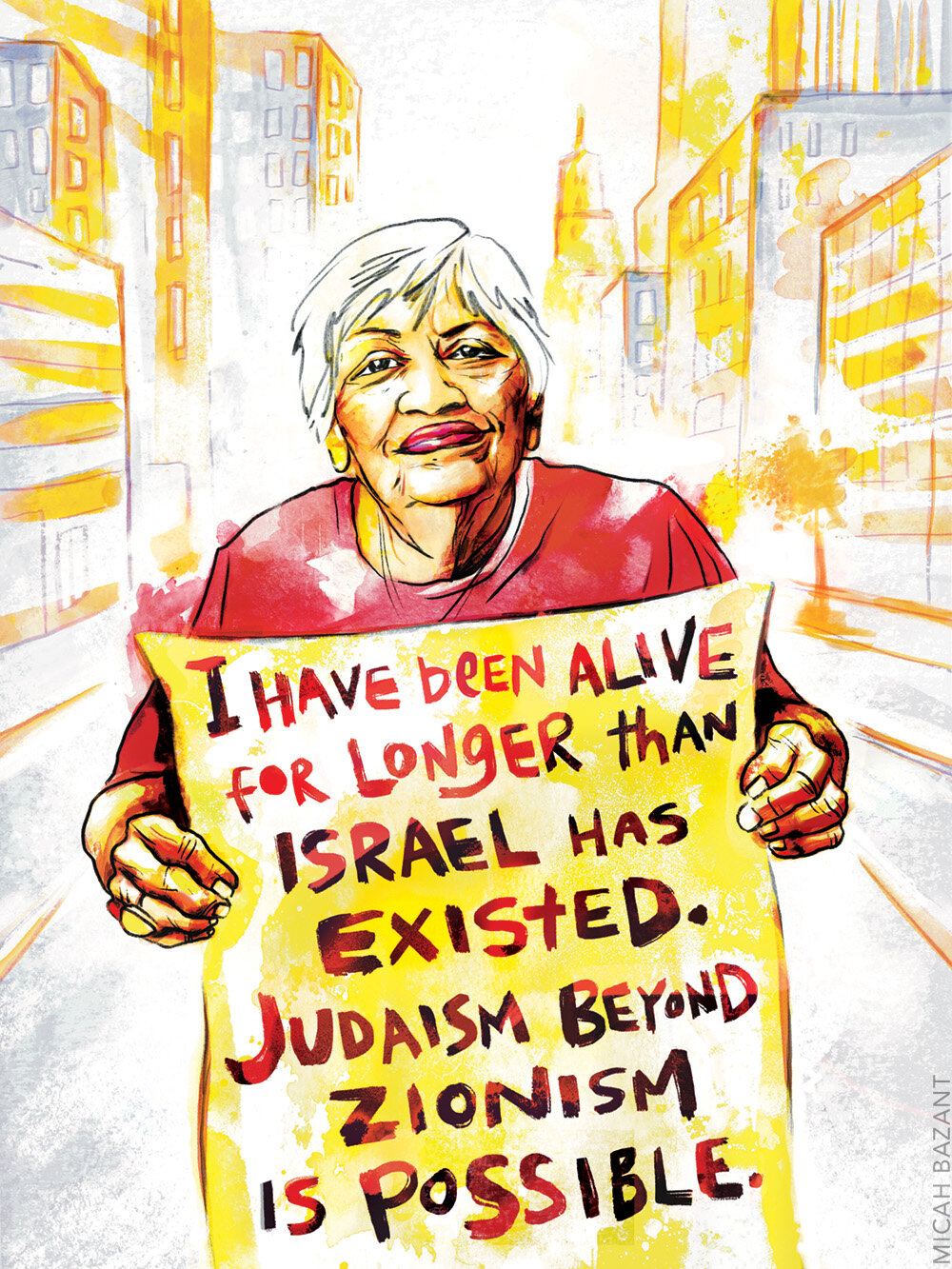
Art by Micah Bazant

Last month, Michigan Representative Rashida Tlaib spoke at an organizing seminar for Palestine solidarity activists. It was an in-house event, and it likely would not have garnered much attention except for one part of her speech:

It has become clear that you cannot claim to hold progressive values, yet back Israel’s apartheid government. And we will continue to push back on and not accept this idea that you are “progressive except for Palestine.” 

I’m opening with Rashida Tlaib’s words because I believe they’re deeply relevant to Yom Kippur. This is, after all, the day for facing up to hard truths, particularly the ones that affect our community. And I frankly cannot think of a more important, more critical moral challenge facing the Jewish community than the issue of Palestine-Israel. 

As you might expect, after Rep. Tlaib made her remarks, the wrath of the titans rained down upon her. Jonathan Greenblatt, the CEO of the Anti-Defamation League, berated her on Twitter and accused her of being an antisemite. So did Rep. Debbie Wasserman Schultz. Scores of her Democratic colleagues condemned her for slandering the “Jewish and Democratic state of Israel.” 

Tellingly, however, none of her critics actually responded to the essential claim of her comment – namely, that Israel is an apartheid state. None of them mentioned that Human Rights Watch, Amnesty International and B’tselem, the most prominent Israeli human rights organization, have all determined that Israel is an apartheid regime. B’tselem’s report concludes, in words that are powerfully appropriate for Yom Kippur:

As painful as it may be to look reality in the eye, it is more painful to live under a boot. The harsh reality described here may deteriorate further if new practices are introduced – with or without accompanying legislation. Nevertheless, people created this regime and people can make it worse – or work to replace it. That hope is the driving force behind this position paper. How can people fight injustice if it is unnamed? Apartheid is the organizing principle, yet recognizing this does not mean giving up. On the contrary: it is a call for change.

Fighting for a future based on human rights, liberty and justice is especially crucial now. There are various political paths to a just future here, between the Jordan River and the Mediterranean Sea, but all of us must first choose to say no to apartheid.

But you really don’t need to pore through human rights reports to grasp this reality. The bottom line is this: Zionism promotes a Jewish majority state in historic Palestine. In order to keep that majority, Israel must pursue policies that are patently undemocratic. It must create and enforce laws that fundamentally privilege Jews over non-Jews. It must dispossess and disenfranchise Palestinians. It must maintain what B’tselem calls “a regime of Jewish supremacy” from the river to the sea. 

So yes, as Rashida Tlaib put it, you can’t be progressive and support apartheid. Unless you define the term “progressive” in a way that is devoid of any meaning whatsoever, you cannot support a Jewish supremacist state and claim to be a progressive. It’s interesting to note that virtually every one of Rep. Tlaib’s critics slammed her for creating a “litmus test” for progressives. But in truth, I don’t believe she was interested in creating a test for her colleagues. She was simply arguing for moral consistency.

When I read about this dustup, I was reminded of Rev. Martin Luther King’s 1963 “Letter from a Birmingham Jail.” Whenever I hear so-called progressives defending injustice in the name of progressive values, I invariably think of King’s letter. It was written to liberal white clergy in Birmingham who had signed a public statement telling King to stay away and not make trouble in their city. At one point they wrote, “We feel that inflammatory and rebellious statements can lead only to violence, discord, confusion and disgrace for our beloved state.” 

Now fast forward to 2022. This was Debbie Wasserman Schultz’s angry response to Rep. Tlaib:

Proud progressives do support Israel’s right to exist as a Jewish and democratic state. Suggesting otherwise is shameful and dangerous. Divisive rhetoric does not lead to peace.

In the end, it’s really just a distraction to make this a debate about what is or isn’t “progressive.” It’s an issue of basic morality. For the Jewish community it’s a challenge that goes to the very core of our spiritual and ethical tradition. I don’t believe you can identify as a Jew in the age of Zionism and dither on this issue. Every single day, Israel’s actions present us with this basic question: will we support apartheid, dispossession and militarism in our name or will we not? 

I’m sure all of you know that the Tzedek Chicago membership voted last March to change our core values to articulate that we were an anti-Zionist congregation. Our decision followed a unanimous board vote and a month’s long series of congregational meetings. As those who attended will attest, these conversations were inspiring in their depth and thoughtfulness. No matter what their position, members who participated in this process shared their opinions openly, honestly, and with deep respect for one another. 

In the end, 72% of our membership quorum voted in favor of the change. Yes, there were those who voted against, but I’m heartened that as far as I know, no members have left our congregation as a result of our decision. In fact, we actually gained several new members, many of whom said that this was the first time they had joined a synagogue – that they had wanted to be part of a Jewish congregation, but the issue of Zionism had consistently kept them at bay.

I can’t understate what a powerful statement we’ve made. Yes, we are one small congregation, but the bottom line is that as a result of our decision there is now a new fact on the ground. There is now a progressive (yes, progressive) Jewish synagogue that is openly and unabashedly promoting a Judaism beyond Zionism. Tzedek Chicago has taken a public, principled stand on the most important, most critical moral challenge facing the Jewish community today. 

And by the way we don’t stand alone. At this very moment, the Mending Miyan, an anti-Zionist congregation in New Haven, is celebrating its first High Holidays with its new student rabbi, May Ye, who many of you will remember was Tzedek Chicago’s rabbinical intern in 2018. Just a few days ago, I was contacted by a friend who told me that a group of Jewish anti-Zionists, inspired by what we have done here in Chicago, had held their first Rosh Hashanah service together in Denver. And I have no doubt there are others – that this is only the beginning. 

Our decision is also important because we are currently witnessing a very real and very dangerous campaign that seeks to equate anti-Zionism with antisemitism. The Israeli government and the Jewish institutional establishment are clearly doubling down to stem the growing number of Jews in the US  — particularly young Jews — who are openly identifying as non or anti-Zionist. This backlash has been fierce, and at times perverse, actually calling into question our very status as Jews. In a widely read essay last year, Natan Sharansky labeled anti-Zionist Jews as “un-Jews.” Last May, immediately following Israel’s military onslaught on Gaza, a Reform rabbi in the Chicago area gave a sermon in which she called anti-Zionist Jews “Jews in name only” who must be “kept out of the Jewish tent.”

Given the tenor of the current moment, I believe the need for public stances by principled Jewish anti-Zionists is more critical now than ever. Most importantly, Jewish anti-Zionists create cover for Palestinians, the ones who are most directly impacted by these accusations of antisemitism. Right now, public figures such as Rashida Tlaib, as well as scores of Palestinian activists on college campuses and communities across North America, are being subjected to withering attack. We know how devastating the accusation of antisemitism can be. It destroys careers and ruin lives. And right now, this accusation is being weaponized by Israel and its institutional supporters in profoundly harmful ways. 

The most insidious thing about this accusation: when we equate anti-Zionism with anti-Semitism, we effectively brand just about every Palestinian in the world as an anti-Semite. How could it be otherwise? The direct product of Zionism was the Nakba – the forced expulsion of over 700,000 Palestinians from their homes in 1948, creating what is today the largest refugee population in the world. The creation of an exclusively Jewish nation state in historic Palestine has led to the ongoing dispossession and oppression of the Palestinian people that continues to this very day. How could we honestly expect Palestinians to be anything other than anti-Zionist? By this definition, Palestinians are guilty of being antisemites just for being Palestinian. 

We can’t underestimate the power of this current backlash against anti-Zionism. After Tzedek Chicago made our announcement, we garnered, as you might expect, some “responses” from the Jewish institutional community. While we did get some positive and thoughtful press, there was the inevitable nastiness, particularly and inevitably on Twitter. I don’t have much to say about that, except for this: amidst all the horribleness and toxicity, I noticed an interesting common denominator. Over and over, our attackers made the claim that Zionism was essential to Judaism – and that our being anti-Zionist was tantamount to being anti-Jewish. This, I would like to address:

Of course, the claim that Eretz Yisrael is intrinsic to Jewish tradition is absolutely correct. It would be ignorant to claim otherwise. However – and this is a big however – the notion of creating a sovereign Jewish nation state was never part of the Jewish land tradition until the rise of political Zionism in 19th century Europe. And herein lies the central fallacy of the Zionism equals Judaism argument: for most of Jewish history, the yearning for Zion has been rooted in an idealized messianic vision. The very idea of a mass migration to the land in order to establish a 3rd Jewish commonwealth was commonly considered to be an anathema – a “forcing of God’s hand” – by traditional rabbinic authorities.

Those who say Zionism is central to Judaism consistently and conveniently neglect this point: political Zionism did not arise until relatively recently in Jewish history. Yes, Zionism is undeniably a Jewish movement, and a successful one at that. But it is also a quintessential movement of Jewish modernity that represented a conscious and radical break with traditional Judaism as it was understood and practiced until that time. While it has clearly been embraced by a majority of Jews in Israel and throughout the diaspora, the claim that Zionism is somehow intrinsic to Judaism is false and in fact, deeply disingenuous.

In the end, however, this struggle isn’t over what is or isn’t Judaism. Rather, it is over what kind of Judaism we want to affirm in the world. I don’t believe in essentializing Judaism – or any religion, for that matter. The fact that Zionism was “a modern movement that broke with traditional Judaism” is not in itself a bad thing. After all, modernity gave rise to a host of Jewish movements that broke with traditional Judaism. My own denomination, Reconstructionist Judaism is most certainly such a movement. 

I often think of this when I hear liberal Christians respond to the hateful things said and done by white Christian nationalists by saying, “that is not Christianity.” No, in fact it is Christianity. The Christian church certainly has a great deal to live down from its history up until present day. But to the Christians who seek to promote humane Christianity, I would suggest that the answer is not to deny the more problematic or toxic manifestations of their tradition. The answer is to recognize that every religious tradition, every religious community has its good, its bad and yes, it’s ugly. And if we want the good to prevail, it seems to me, we must be ready to confront the all of our religious traditions. 

The same goes for the Jewish community. Even if Zionists deny us our Jewishness, It’s not intellectually honest, nor is it particularly productive, to deny Zionists theirs’. The question before us is not who is the most “authentic” Jew? The real question is: what kind of Judaism do we want to lift up in the world, to live out, to bequeath to future generations?

This is why I feel so blessed to be a part of Jewish congregation that is ready to stand up and say we seek a Judaism beyond Zionism, beyond apartheid and settler colonialism. A Judaism that views the diaspora as the fertile ground for Jewish creativity, a Judaism that seeks the Divine wherever we may happen to live, that affirms the whole earth is filled with God’s glory. A Judaism that values spiritual power over physical power. A Judaism that makes its home in the margins, because that’s where our sacred sparks of creativity have always resided. A Judaism of solidarity, that knows our place is alongside all who are marginalized, demonized and oppressed for who they are. 

So, this Yom Kippur and for every day forward, let this be our prayer:

May the dream of a world complete become reality soon, in our own day, that every land may be a Zion, every city a Jerusalem, every home a sanctuary offering welcome to all. May the world be rebuilt upon a foundation of compassion, equity and justice, as it is written, compassion and truth will meet; justice and peace will kiss. Baruch atah adonai, boneh ha’olam b’tzedek v’rachamim – Blessed are you, who rebuilds the world in justice and compassion. 

Amen.

Shabbat as Revolution: Sermon for Erev Yom Kippur 5783

If asked to pick one aspect of Jewish spiritual tradition that was the most important, the most valuable, the most genuinely impactful, it would be no contest. I’d answer without hesitation: it’s Shabbat. 

Shabbat just looms so large and is so basic to the Jewish experience, I don’t think we stop enough to consider how revolutionary it truly is. Once a week, Shabbat arrives to overturn the status quo. While the High Holidays represents our annual spiritual shake-up, Shabbat provides us with this radical reboot opportunity every single week.  

Jewish tradition gives us multiple rationales for keeping Shabbat: it’s a day of rest and renewal, a day to refrain from the creative work of the week, a day for drawing a distinction between the sacred and mundane. It’s also been called a weekly taste of Olam Haba – or “the World to Come.”  The Talmud, for instance, teaches that Shabbat is one sixtieth of Olam Haba. A classic midrash relates that at the moment God gave the Torah to the Israelites, they asked, “Sovereign of the Universe, show us an example of the World to Come,” and God replied, “It is Shabbat.” 

So, what exactly is this World to Come that we get to taste every Shabbat? The rabbis don’t give us any definite answers to this question. In classical Jewish sources, it’s a general term for the hereafter, a place where the souls of the righteous go after they die. In other instances, the World to Come is synonymous with the messianic age: a future time in which the dead will be resurrected and the world will be united under the rule of God. 

But we do know this: whatever Olam Haba might look like, it will definitely be better than the world we’re living in now. In the Talmud, for instance, we read this classic description:

The World to Come is not like this world. In the World to Come there is no eating, no drinking, no procreation, no business negotiations, no jealousy, no hatred, and no competition. Rather, the righteous sit with their crowns upon their heads, enjoying the splendor of the Divine Presence.

(Berachot 17a)

In recent years there’s been an emergent new reframing of Olam Haba, particularly in leftist and radical corners of the Jewish community. According to this new approach, the World to Come is viewed in the context of social and political transformation: a vision of a world in which systems of oppression have been dismantled and replaced by systems that work for the well- being of all. 

I personally view this vision of Shabbat as being deeply informed by the contemporary abolitionist movement. Those who are active in this movement will immediately understand this. When abolitionist activists call for defunding the police and dismantling the prison industrial complex, we’re not merely advocating for specific political goals: we’re ultimately promoting a larger vision of the world as it should be. The great abolitionist organizer Mariame Kaba, describes it this way:

Abolition is a vision of a restructured society in a world where we have everything we need: food, shelter, education, health, art, beauty, clean water and more things that are foundational to our personal and community safety.

from “We Do This ‘Til They Free Us”, by Mariame Kaba,  p. 2.

Like the traditional Olam Haba, abolitionist Olam Haba isn’t just an ethereal, aspirational concept: it’s meant quite literally. It doesn’t mean “the world we dream might be possible” or “the world we know is not possible but in the meantime maybe we can reform the world to make it a little less horrible.” When contemporary abolitionists talk about transforming oppressive systems, we are advocating for a vision that is practical and real. It’s rooted in the belief that we have the wherewithal to build a world that will work for all, not just a privileged few.

For those who view Shabbat this way, every seventh day is nothing short of a weekly revolution – a regular opportunity to live in the world we know is possible. Ana Levy-Lyons, describes it this way in her essay, “Sabbath Practice as Political Resistance:”

The goal of a Sabbath practice is not to patch us up and send us back out to the violent secular world, but to represent in the now what redemption looks like, what justice looks like, what a compassionate social order looks like. It is to reconstruct the rest of time from the viewpoint of the Sabbath as unjust and untenable.

While this is a compelling new understanding of Shabbat, it’s worth asking: what would such a Shabbat practice actually look like? What would it mean to observe it? Can we observe Shabbat in a way that honors these values of political resistance? I think it’s altogether appropriate to explore these questions tonight, on Yom Kippur – the day when we vow together that a better world is possible; a world free of injustice, oppression and violence. What better time than Yom Kippur to think seriously about what we must do to make the World to Come a reality?

I’ll start here: Shabbat challenges us to rethink the way we commodify time itself.  As Rabbi Abraham Joshua Heschel, famously wrote in his classic book, “The Sabbath,” on Shabbat we become attuned to the holiness of time rather than space. During the six days of the week, we find meaning in the creative endeavors of the material world – but when Shabbat arrives, we affirm the sanctity inherent in the rhythms of time. 

But we can only do this if we are prepared to give up our futile attempts to dominate time. This is particularly challenging in a capitalist society, in which time itself has become monetized – in which our worth is literally determined by the amount of time we spend at work. Rabbi Zalman Schacter Shalomi refers to the six days of the week as “commodity time.” “Commodity time,” he writes, “is the price we pay for organic time. In order to earn a living, this is the bargain you strike: you give your employer work, in return for which he gives you money. While you are working, your time belongs to your employer, and it’s used to create commodities of one sort or another.” 

But on Shabbat, we’re commanded to resist the commodification of time. It’s a weekly reminder that when we attempt to control or profit from time, we will inevitably become enslaved by it. In the World to Come, time may not be sold, spent, measured or exploited. On the contrary, it must be valued and cherished and savored. On Shabbat we stop punching the time clock and live according to the organic rhythms of time, from sundown to sundown.

Is it even possible to imagine non-commodified work? Over the past two decades, there’s been increased social and economic theorizing about a world without jobs. As machines and robotics are able to do more jobs previously done by human beings, there’s been renewed advocacy of a future in which a universal basic income is guaranteed, a future in which people are free to spend their time doing what they find purposeful and meaningful. This vision has become even more relevant and critical in the age of COVID, as record numbers of Americans are working at low wage jobs and the cost of living continues to rise. The pandemic has given rise to a new and unprecedented discourse on the meaning of work – and we should welcome this conversation.

The Shabbat prohibition on commerce and transactions suggests another way to observe Shabbat as a form of revolution. When we engage in transactions with others, we do so with the expectation that we’re entitled to receive something in return. Shabbat, however, rejects the transactional in favor of the relational. These are the most sacred relationships: the ones that are based on the building of trust – that favor long-term fulfillment over immediate gain. This is why on Shabbat, the traditional focus is on the most basic forms of human interaction: on communal meals, prayer and study, on physical intimacy between lovers. In the World to Come, relationships will not be exploitative or negotiable – they will, rather, model devekut – sacred at one-ness and coming together. 

A third suggestion: It’s been suggested that there are profound connections between Shabbat and the values of the disability justice movement. One of the central Principles of Disability Justice, affirms that the labor of disabled people is too often invisible to a system that defines labor by able-bodied standards. The disability justice movement makes this point very clearly and unabashedly: “our worth is not dependent on what and how much we can produce.”

This principle is rooted in one of the most basic values in Jewish tradition: that every human being is created in the image of God – b’stelem elohim. As Rabbi Julia Watts Belser, a prominent Jewish disability justice activist has written,

Jewish tradition affirms that the measure of a person’s worth does not rest upon what they can do, how much they produce, or how quickly they think. For all that our tradition praises right action, our fundamental value as people does not depend on our accomplishments or achievements; it is rooted in our very being. We all of us mirror the image of God.

Another one of the Principles of Disability Justice has a direct connection to the values of Shabbat: the principle of sustainability:

We learn to pace ourselves, individually and collectively, to be sustained long-term. We value the teachings of our bodies and experiences, and use them as a critical guide and reference point to help us move away from urgency and into a deep, slow, transformative, unstoppable wave of justice and liberation.

This is Shabbat wisdom through and through. On Shabbat, we, all of us, learn to pace ourselves, to be sustained for the long term. And what better definition of the World to Come could there be than a “deep, slow, transformative, unstoppable wave of justice and liberation?” 

A fourth and final suggestion: the traditional laws of Shabbat require us to cease our exploitation of the earth’s natural resources. There are many categories of forbidden work on Shabbat, for instance, that involve changing, transforming and extracting. In the World to Come, of course, the resources of the natural world will be nurtured to enhance life, not exploited for profit. 

Jewish scholar Jonathan Schorsch, who has founded an initiative called the “Green Sabbath Project, has written extensively about this idea. As Schorsch puts it:

Shabbat can and must be a radical ritual within which we can digest anew the biblical prophets’ warnings against the corruption of the rich and powerful, the oppression of the poor and the self-centered pursuit of short-sighted pleasures, understanding how relevant such warnings are to the ecological devastation wrought by hypercapitalism. Sabbath properly practiced offers a weekly interruption of the suicidal econometric fantasy of infinite growth, a weekly divestment from fossil fuels, a weekly investment in local community. 

These are but a few suggestions of where we might start to explore a new form of Shabbat observance – and I’m excited by the prospect of discovering more. At the same time, I realize that these approaches have inherent challenges. When we talk about the World to Come in this manner, we’re essentially talking about structural change – and I have no illusions that personal disciplines alone will themselves effect the wholesale changes we seek. 

At the same time, however, I strongly believe that Shabbat has the genuine potential to motivate us to keep the struggle going – to inspire us to continue building the movement for the long haul. As I like to put it, when Shabbat arrives every Friday evening, these rituals invite us to cease the struggle and experience together the world we are ultimately struggling for. Shabbat can renew and replenish us so that ideally, when it ends on Saturday evening, we are that much more inspired to go out and make that world a reality.

I’m also aware that not everyone will have the ability to observe Shabbat in the ways that I have outlined here. I know full well that there are those who cannot afford to take every Saturday off to resist the commodification of their labor. There are those who do not have the luxury of weekends, who must work sometimes multiple jobs just to get by. And I also know how challenging it is in the digital age to leave work at work, in an era where our work mail follows us electronically 24 hours a day, 7 days a week. But to my mind, this reality drives home the sacred importance of Shabbat all the more. Shabbat reminds us that we must continue to struggle for jobs that pay livable wages, for saner working hours, for the ability to live lives of purpose, for the right to spend our time in more meaningful and fulfilling ways.

I like to think of Tzedek Chicago as a spiritual laboratory where we can explore new ways of celebrating Shabbat as a revolution, where we can, on a regular basis, live in the world we know is possible. Those of you who have come to our Friday evening online services and candle lightings will know what I’m talking about. I’m fairly sure that not a Shabbat goes by when we don’t mention the World to Come – and try to make it real for one another. And I’m sure we’re not the only ones. 

Those of you who join us for Shabbat services also know that I like to write contemporary Shabbat liturgy that evoke the spiritual reframing that I’ve described to you tonight. I’d like to end with one of them: a prayer for Havdalah – the service that ends Shabbat on Saturday evening. I offer it in honor of this Yom Kippur, the day in which we vision of the world that might yet be – and vow to do what we must to make it a reality:

Savor this eternal moment
and hold it close,
before you leave the world to come
and re-enter the world as it is,
before your sweet dream
reverts back to hard truth.

For this much we know:
long after the day is done
the melody of this song will
reverberate through our souls,
driving us forward until the day
that liberation is finally won.

One day very soon,
the song will lead us
to a dream fulfilled, to a place
where light and gladness,
joy and wonder, justice and salvation
flow without cease.

But for now we’ll prepare ourselves
for the work ahead –
let’s light the fire, raise the cup
and breathe in the sweetness
of this moment.
With strength renewed
and spirit re-inspired it’s time
to rejoin the struggle.

Blessed is the One who separates
between inspiration and fulfillment,
exile and return,
struggle and liberation,
hard work and sweet victory,
between the world we know
and the world we know is possible.

Amen.

On Avodah and Anna Rajagopal: Is there a place for anti-Zionist Jews in our community?

Photo Credit: Very Good Light

The Jewish communal war on its own continues.

Last week, I was saddened to read that Anna Rajagopal (they/her), a Jewish activist and senior at Rice University, had been fired by Avodah: Jewish Service Corps after having just been hired as a Social Media Assistant. Their action followed – and seemed to be a result of – a relentless online campaign by the astroturf organization, StopAntisemitism.org, who demonized Anna as a “rabid antisemite” and urged its followers to deluge Avodah with demands to fire them.

After firing Anna, Avodah understandably received strong criticism from progressive Jewish quarters. In response, the organization then released its own statement on Twitter, insisting that they “did not and do not make decisions in response to actions or demands of any external group and … did not and do not make personnel decisions based on an individual’s politics related to the Israeli-Palestinian conflict.” Their statement also purported to stand in solidarity with Anna in the face of the horrid online attacks against them:

We’re angry & disgusted to witness this individual be subjected to vile racism, misogyny & even questioning of their Judaism. We condemn the demonizing & disparaging of anyone-especially the targeting Jews of Color who experience this type of hate & questioning regularly. We take seriously our commitment to Jewish pluralism and continue to work to ensure a respectful community for all.

Avodah’s claim that they did not fire Anna because of their views was contradicted in a leaked email from Avodah CEO Cheryl Cook, who wrote to a supporter, “We don’t believe (Anna’s) publicly-shared values align with ours, and we are parting ways.” Factoring in the fact that Cook is currently running for political office in Brooklyn, it seems fairly clear that Avodah did indeed “make a decision based on an individual’s politics on Israel/Palestine” – and that they did indeed capitulate to “the demands of an outside group.”

The issue in question centered on Anna’s use of strong, often scathing rhetoric as they criticized Israel and Zionism on social media. In this regard, their firing was similar to an incident that occurred almost exactly a year ago, when a Hebrew school teacher was fired from a Reform synagogue in Westchester, NY for publicly criticizing Israel’s “settler colonial violence” and referring to themself as an anti-Zionist. This most recent instance was particularly troubling, however, because Avodah is an Jewish institution whose primary focus is social justice.

Even more egregiously, the organization has now handed a victory to a new, privately-funded movement that seeks to promote a distinctly Islamophobic, anti-Palestinian narrative on antisemitism. Indeed, while StopAntisemitism.com describes itself on its website as a “grassroots watchdog organization,” it does not have non-profit status or a board of directors – and the source of its funding is exceedingly opaque. We do know that StopAntisemitism.com is a front project for Liora Rez, a right-wing Jewish activist and former social media influencer. Though her website claims SA.com was born “in response to increasing antisemitic violence and sentiment across the United States” her “Antisemite of the Week” list actually contains very few neo-Nazis or white nationalists. It is filled almost exclusively with Muslims, Palestinians and Palestinian solidarity activists – as well as popular celebrities such as Dua Lipa and Trevor Noah and, naturally, Representatives Ilhan Omar and Alexandria Ocasio Cortez.

As with previous attacks on individuals, StopAntisemitism.com’s campaign against Anna was exceedingly vile, giving rise to a torrent of toxic Twitter attacks questioning their status as a Jew (they are a convert to Judaism) as well as racist comments targeting them as a Jew of color. (Many of these horrid slurs still remain on Avodah’s comment board and Twitter feed.) This entire ordeal has understandably taken a huge emotional toll on Anna, who tweeted last Friday, “This week has been the most unimaginable hell possible. Being 21 years old and the incessant target of both right-wing extremists as well as institutional, racist abuse at the hands of grown adults…”

Anna’s firing is particularly painful when you consider just a few days earlier, Avodah publicly celebrated them thus: “We’ve got a new member of #TeamAvodah… Join us in welcoming Anna as our social media assistant! They’re joining us from Houston & have a background in digital literacy and advocacy, perfect for their role’s focus on racial justice and our Jews of Color Bayit.” By subsequently capitulating to StopAntisemitism.com’s toxic campaign, however, Avodah has effectively validated the very worst prejudices in our community against Jews of color and Jews by choice.

In some ways this episode illuminates the razor thin tightrope that many liberal Jewish organizations are walking as they reach out to younger generations of Jews who don’t toe the Jewish communal party line on Israel/Palestine. It’s worth noting that even as Avodah seeks to position itself on the Jewish vanguard of social justice, it also receives funding from the Schusterman Family Philanthropies, which also funds die-hard Zionist projects such as Birthright Israel and the Israel on Campus Coalition. 

Avodah’s precarious position was dramatically underscored last year when 274 program participants and alumni sent a letter to Avodah leadership, calling on the organization to endorse the Boycott, Divestment, and Sanctions movement, commit to Nakba education, support bills that would block or restrict military aid to Israel and end “official and unofficial gag rules that prevent corps members and staff from speaking freely about their support for BDS and Palestinian liberation.” To date, however, the organization has chosen not to take a public stand on the issue of Israel/Palestine.

In the end, Avodah’s action just further reinforces the line that there is no simply place for Jewish anti-Zionists like Anna Rajagopal in the Jewish institutional world. I’ve personally talked with several young people who have lost their jobs in the Jewish community in similar ways to Anna – and a number of others who feel they must stifle their moral/political convictions for fear of being fired. I truly believe these are among our brightest, critically thinking, and devoted members of our community – and that by excluding them, the Jewish communal establishment is only further hastening its irrelevance to the next generation of Jews.

As Rabbi Amy Bardack wrote in a powerful article for eJewishPhilanthropy.com earlier this year:

Our institutions have to wrestle with the reality that increasing numbers of passionate Jews do not support the State of Israel. Is it in our best long-term interest to be welcoming to everyone but them? I propose that we spend less time labeling all anti-Zionist Jews as antisemitic, and more time figuring out how to be truly inclusive. 

I stand with Anna Rajgopal and all of the young anti-Zionist Jews who are, whether the Jewish establishment gatekeepers like it or not, the future of our community.