Category Archives: Religion

The Politics of Archaeology Unearthed

This just in from AP:

An Israeli archaeologist said Monday that ancient fortifications recently excavated in Jerusalem date back 3,000 years to the time of King Solomon and support the biblical narrative about the era.

If the age of the wall is correct, the finding would be an indication that Jerusalem was home to a strong central government that had the resources and manpower needed to build massive fortifications in the 10th century B.C.

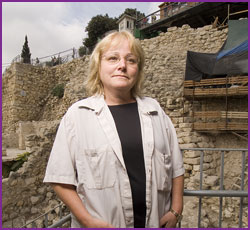
Just dig a little deeper, however and the plot thickens even more. The researcher in question is Eilat Mazar (above), an old school Israeli archaeologist whose essential goal is to prove the historical veracity of the Bible.  She’s made no bones (sorry) about this over the years.  In a 2006 interview with Moment Magazine, she made this very telling comment:

One of the many things I learned from my grandfather was how to relate to the biblical text. Pore over it again and again, for it contains within it descriptions of genuine historical reality.  I work with the Bible in one hand and the tools of excavation in the other. That’s what biblical archaeologists do. The Bible is the most important historical source and therefore deserves special attention.

The only problem with this is that the Bible is not a history book – it’s religious literature.  There certainly may be kernels of historical fact to be found in these narratives, but I’d say it’s exceedingly problematic for an archaeologist to assume ipso facto the historical veracity of the Bible.  Mazar’s comment that she works with a Bible in one hand and her tools in the other speaks volumes about her fundamental bias.

It’s also noteworthy that Mazar worked until recently for the Shalem Center, a partisan Israeli think-tank.  Among other things, the Shalem Center believes archeology should support “the claim that the Bible can be viewed as a work whose historical narrative is in large part accurate, and (strengthen) the ancient connection of the Jewish people to the land of Israel.”

It’s striking to compare Mazar’s approach to that of Israel Finkelstein, who comes from a new school of Israeli archaeologists who are aren’t driven by political ideology and are willing to go wherever their research takes them.   In a nutshell, Finkelstein and his colleagues have argued convincingly that it’s impossible to say much of anything about ancient Israel until the 7th century BCE (around the time of the reign of King Josiah). This casts doubt on the historical veracity of the Biblical narrative from the period of the Patriarchs/Matriarchs through the reigns of David and Solomon. These claims have largely been accepted as normative by most mainstream archaeologists outside of Israel.

If you are interested the current thinking of Israeli researchers who are unfazed by nationalist bias, I highly recommend Finkelstein’s 2002 book (with Neal Asher Silberman), “The Bible Unearthed.” Also check out this 2001 piece from Salon, which explores the deeper socio-political implications of Israeli archeology.

Replanting the Uprooted on Tu B’shevat

Last week, Israeli Prime Minister Netanyahu celebrated the festival of Tu B’shevat (“The New Year of the Trees”) by leaving a meeting with American peace envoy George Mitchell and promptly embarking upon a tree-planting tour at Jewish settlements in the West Bank.

Here is what he had to say:

The message is clear – we are here and will remain here. We are planting and building; this is an inseparable part of the State of Israel.

For those looking for a different way to connect the festival of Tu B’shevat to the current political reality in the State of Israel, I recommend reading this at your seder, written by Rabbi Arik Ascherman of Israel’s Rabbis for Human Rights:

Lift the olive branch and say:

The olive branch, what is the reason for this?

We raise the olive branch as a symbol of responsibility, identification and hope.

We raise this branch in sorrow because each and every year, olive trees, the source of livelihood for Palestinian families, are intentionally chopped down, burned and uprooted.  In attempting to exercise their right to work their lands, farmers repeatedly put themselves in danger. Both the human being and the trees of the field are desecrated, and there is no earthly law or judge (ein din v’ein dayan). Only a few are guilty, but all are responsible (Rabbi Abraham Joshua Heschel).

On Tu B’shevat, we are taught that the trees cease to drink from the rains of the past year and begin to be nourished from the rains of the current year (Jerusalem Talmud, Rosh Hashanah 56a). However, into the old and the new waters have fallen the tears of the dove of peace whose feet cannot find a resting place (Genesis 8:9) because the earth has become filled with violence (Genesis 6:11). The olive branch has become bitter in her mouth – a symbol of strife.

We raise this branch as a symbol of identification with those Israelis and Palestinians who are doing everything in their power to change this reality and make enemies into friends (Pirke Avot De’Rabbi Natan) by planting, pruning, plowing and harvesting together, despite the voices of hate and incitement from both sides.

May it be Your will that the fruit of the olive, symbol of the World of Yetzirah/Creativity (Pri Eytz Hadar) inspire us to create justice and peace out of the basic materials of the soil, the fruit of the soil, and the human spirit (adamah, pri adamah, ve’ruakh ha’adam) so that by the time evening falls (Genesis 8:11) we will reconnect the olive branch to the root of the soul (Shoresh Nishmato).

May we thus beat our swords into plowshares and  our spears into pruning hooks…so that every person may sit under their vine or fig tree and none shall make them afraid (Micah 4:3-4) and the land shall know tranquility (Judges 3:11, etc.) and all of its inhabitants will rejoice.

My Favorite Rabbis: Everett Gendler

Most people probably don’t realize this, but rabbis need rabbis too.

And there are a lot of great rabbis out there. Over the years I’ve been personally inspired by many of them: remarkable, talented leaders whose work challenges me, drives me and constantly reminds me why I do what I do. So with this post I’m debuting a new series I’m calling “My Favorite Rabbis:” ongoing profiles of the contemporary rabbis whom I consider to be my own spiritual teachers.

I’ll start by introducing you to Rabbi Everett Gendler, a Conservative rabbi whose moral courage has provided Jewish leadership for some of the most important progressive causes of our day. Today, some fifty years since he became a rabbi, I believe he remains on the cutting edge of the issues that truly matter.

This MLK weekend, it is certainly appropriate to note that Rabbi Gendler was one of the first rabbis to become actively involved in the struggle for civil rights in America and played a critical role in involving American rabbinical leadership in the movement. It’s doubtful that American rabbis would have stepped up to this struggle nearly as much had it not been for Rabbi Gendler’s prophetic influence.

During the early and mid-1960s, Rabbi Gendler led groups of American rabbis to participate in numerous prayer vigils and protests throughout the South. Of course many know that the legendary Rabbi Abraham Joshua Heschel marched with Dr. Martin Luther King in Selma in 1965. I imagine far fewer are aware that it was in fact Rabbi Gendler who persuaded Heschel to do so.

Heschel biographer Edward K. Kaplan writes:

Despite fears for his safety from his wife and the twelve year old Susannah, (Rabbi Heschel) agreed to join the march at the urging of Rabbi Everett Gendler, a pacifist and former student. Gendler had led a group of rabbis to Birmingham, Alabama to work for voting rights and remained in touch with the Reverend Andrew Young, King’s Executive Assistant at the SCLC. (From “Spiritual Radical: Abraham Joshua Heschel in America,” p. 222)

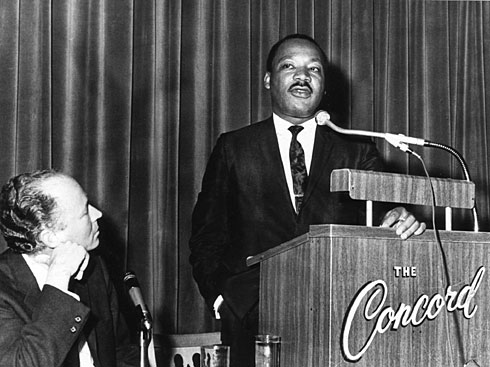
Rabbi Gendler was also instrumental in arranging Martin Luther King’s keynote address at the Rabbinical Assembly’s convention on March 25, 1968. This now-legendary speech took place at the Concord Resort hotel in New York’s Catskill Mountains just 10 days before King’s death. (That’s Rabbi Gendler to the left of Dr. King in the pic above).

Today, decades after King’s death, Rabbi Gendler remains an eloquent Jewish advocate for the path of nonviolence. His work has taken him across the world – most notably to India where he and his wife Mary teach the principles of nonviolence to Tibetan exiles.

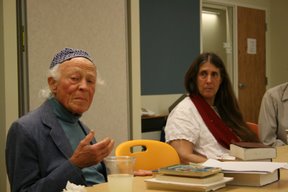
I’m personally honored to serve with Rabbi Gendler on the Elder’s Council of the Shomer Shalom Institute for Jewish Nonviolence. In this picture, he leads a workshop at JRC in 2008. Shomer Shalom founder Rabbi Lynn Gottlieb (someone whom I may well be profiling in the future) is sitting next to him.

Rabbi Gendler has also been a long time advocate for Palestinian human rights – and his courageous stands have made it possible for new generations of rabbis to find their own voices on this painful issue. When Rabbi Brian Walt and I first began Ta’anit Tzedek and were looking for rabbis to join our campaign to protest the blockade of Gaza, we immediately turned to Rabbi Gendler, who joined our effort without hesitation. It is difficult to describe how much it means to know there are rabbis out there like Everett, someone who has been putting himself on the line for so long, and upon whom we always know we can rely for guidance and support.

Rabbi Gendler was also one of the first Jewish leaders to embrace environmentalism and vegetarianism long before they became fashionable. As the rabbi of a green synagogue myself, I recognize a tremendous debt to Everett, who more than anyone helped to put environmental issues on the radar screen of the Jewish community.

From a 2008 article in the Los Angeles Jewish Journal:

On a ferociously cold evening in November 1978, Rabbi Everett Gendler climbed atop the icy roof of Temple Emanuel in Lowell, Mass., and installed solar panels to fuel the synagogue’s ner tamid (eternal light)…

Gendler’s conversion of that eternal light marks the first known action to green a synagogue, making it more spiritually and ecologically sustainable, and Gendler himself, now Temple Emanuel’s rabbi emeritus, has been hailed as the father of Jewish environmentalism.

There so much more to say about Everett and his work. I suppose the most essential thing I can say about him is that he was and remains a spiritual maverick. His work remains as relevant and courageous as ever.

As we honor Dr. King this weekend, it’s critically important to honor those who continue his to walk his path in our own day. For me and so many others, Rabbi Everett Gendler is the one who teaches us how to walk that walk.

Palestinian Christians: “The Occupation is a Sin”

Last week, a group of Palestinian Christians representing a variety of churches and church-related organizations issued a powerful, prayerful call for an end to the Israeli occupation.  My friend Rabbi Brian Walt was present at the meeting in Bethlehem in which the statement – known as  “The Kairos Palestine Document” – was released. Upon his return, he described to me his profound, often painful conversations with Palestinian Christians and he told me that as a Jew, he considered the Kairos Document to be an enormously important spiritual/political statement. Having now read the entire 12 page document, I must say that I agree wholeheartedly.

Palestinian Christian liberation theologians such as Naim Ateek of the Sabeel Institute have been doing important work for decades and I believe their ideas present important spiritual challenges to the Jewish community. Many Jews point to the more radical incarnations of these theologies – and while I share some of these concerns, I believe that we make a profound mistake by dismissing Palestinian Christian theology wholesale. (Frankly, I am much more troubled by the “End of Days” theologies of fundamentalist Zionist Christians such as Pastor John Hagee than I am by Naim Ateek and the authors of the Kairos document.)

My friend and colleague Father Cotton Fite of St. Luke’s Church in Evanston, tells me he hopes that American Christians will study the Kairos Document carefully. I mentioned to him that I hoped Jews would read it as well. In fact, I think we should create opportunities to read it together. Despite our differences, I believe it offers both of our communities an ideal place to begin meaningful dialogue over the spiritual implications of this conflict.

One of the more important and challenging passages:

Our presence in this land, as Christian and Muslim Palestinians, is not accidental but rather deeply rooted in the history and geography of this land, resonant with the connectedness of any other people to the land it lives in. It was an injustice when we were driven out. The West sought to make amends for what Jews had endured in the countries of Europe, but it made amends on our account and in our land. They tried to correct an injustice and the result was a new injustice.

I can already predict that many Jews will bristle that this passage does not specifically reference the Jewish connection to the land as well. To this I would say, how deeply do we Jews ever honor the reality that we are not the only people who are “deeply rooted in the history and geography of this land?” Moreover, how deeply do we ever face the true injustice that was committed when a people with deep roots in the land were driven out and not allowed to return?

Another sobering passage in the document describes the Occupation as no less than a “sin:”

We also declare that the Israeli occupation of Palestinian land is a sin against God and humanity because it deprives the Palestinians of their basic human rights, bestowed by God. It distorts the image of God in the Israeli who has become an occupier just as it distorts this image in the Palestinian living under occupation. We declare that any theology, seemingly based on the Bible or on faith or on history, that legitimizes the occupation, is far from Christian teachings, because it calls for violence and holy war in the name of God Almighty, subordinating God to temporary human interests, and distorting the divine image in the human beings living under both political and theological injustice.

Many of us view the Occupation as a political problem to be solved. But indeed, as Jews, we must admit basic human rights are rooted in our religious tradition. Like Christians, we also believe that all human beings are created in the image of God. We also believe that when the basic dignity of anyone’s humanity is diminished, the Divine Image is diminished as well. How then, can we fail to understand that the Occupation is not only a geo-political problem but a spiritual/moral problem as well?

This conclusion leads to a logical next step:

Love is seeing the face of God in every human being. Every person is my brother or my sister. However, seeing the face of God in everyone does not mean accepting evil or aggression on their part. Rather, this love seeks to correct the evil and stop the aggression.

The injustice against the Palestinian people which is the Israeli occupation, is an evil that must be resisted. It is an evil and a sin that must be resisted and removed. Primary responsibility for this rests with the Palestinians themselves suffering occupation. Christian love invites us to resist it. However, love puts an end to evil by walking in the ways of justice. Responsibility lies also with the international community, because international law regulates relations between peoples today. Finally responsibility lies with the perpetrators of the injustice; they must liberate themselves from the evil that is in them and the injustice they have imposed on others.

Again, the Occupation is viewed not as a diplomatic issue to be negotiated but a spiritual evil to be resisted.

I have no illusions that for many Jews, suggestions such as these present daunting and painful challenges.  So will many of the ultimate political ramifications of the Kairos Document. All I can hope for is that political disagreements will not keep us from honestly facing the profound spiritual dimensions of this conflict.  Speaking for myself, I do believe this statement was written in good faith, genuine love and true religious conviction:

Our message to the Jews tells them: Even though we have fought one another in the recent past and still struggle today, we are able to love and live together. We can organize our political life, with all its complexity, according to the logic of this love and its power, after ending the occupation and establishing justice.

What can I say to this except “Amen?”

You Are But Strangers: Jewish Theology and the Land of Israel

The land of Israel is ours because God gave it to us.

This particular Jewish claim is bandied about so much that I imagine it would some as a surprise to many that it is, in fact, a misrepresentation of the Torah and its teachings.

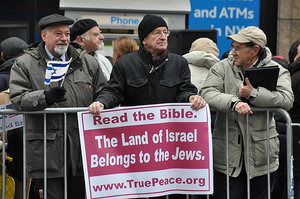
I would go farther and say this: this view is actually a betrayal of Jewish tradition – and has only become widely popular since the rise of political Zionism.

Let’s take a closer look at the texts in question:

Jewish fundamentalists and ultra-nationalists are fond of pointing out that God promised the land of Israel to Abraham in the book of Genesis:

On that day, the Lord made a covenant with Abram, saying, “To your offspring I assign this land, from the river of Egypt to the great river, the river Euphrates…” (Genesis 15:18)

Biblical scholars and commentators note that the covenant God makes with Abram (soon to be renamed Abraham) appears as a promisory covenant. In this early point in the narrative, the land indeed seems to be assigned to the people Israel with “no strings attached.”

Later in Exodus, however, once Israel has left Egypt and has become a nation at Sinai, God clarifies the terms of this covenant. It is spelled out in decidedly conditional language: if Israel follows God’s commandments, then they will indeed be able to live on the land that has been assigned to them by God. In other words, Israel now learns that their future on the land will be radically dependent on how they behave on the land.

As I see it, this is the fatal mistake made by those who claim that the land must ipso facto “belong” to the Jewish people. They focus exclusively on the Abrahamic promise, but neglect the critical next step: God’s conditional covenant with the Israelite nation.

In so doing, they pervert the Torah’s meaning – and do great damage to the central Jewish understanding of our relationship to the land. The land is not given to us unconditionally – we will only be able to live on the land if we prove ourselves worthy of it.

Interestingly, the Torah actually points out that previous inhabitants of the land had failed in this regard. Following a long litany of laws in Leviticus, we read:

Do not defile yourselves in any of those ways, for it is by such that the nations that I am casting out before you defiled themselves. Thus the land became defiled; and I called it to account for its iniquity and the land vomited out its inhabitants. (Leviticus 18:24-25)

In similarly colorful language, Israel is told that they might well meet the same fate if they do not keep God’s laws when they live on the land:

So let not the land vomit you out for defiling it, as it spewed out the nation that came before you. (18:28)

In another important verse from Leviticus, God makes it clear to whom the land ultimately belongs. In the discussion of the Jubilee year (in which landholdings revert back to their original owners) we read:

…the land must not be sold beyond reclaim, for the land is Mine; you are but strangers resident with Me. (Leviticus 25:23)

Notably, the Hebrew word for “stranger,” (“ger”) literally means “resident alien.” This word appears over and over throughout the Torah – particularly in admonitions to Israel not to mistreat the stranger, “for you were once strangers in the land of Egypt.” It is sobering indeed to learn that even after the Israelites enter Israel, they will still be, in effect, resident aliens on the land.

In the end, although many Jewish fundamentalists often treat the Torah as the Jews “deed of sale” to the land of Israel, it might be more accurate to describe it as a “lease” with very explicit conditions. In Deuteronomy, this conditional language reaches its apex. As the Israelites prepare to enter the land of Israel, Moses reminds them that they could be exiled from the land in an instant if they do not remain faithful to God’s covenant:

If you fail to observe faithfully all the terms of this Teaching…the Lord will scatter you among all the people from one end of the earth to the other, and there you shall serve other gods, wood and stone, whom neither you nor your ancestors have experienced. Yet even among those nations you shall find no peace, nor shall your foot find a place to rest… (Deuteronomy 28:58-65)

For the prophets and later the rabbis, the conditional covenant was central in understanding Israel’s collective tragedy: “mipnei chataeinu” – “because of our sins” we were exiled from the land. This in fact remained the normative Jewish understanding of our centuries-long sojourn in the diaspora until the advent of Zionism and the establishment of the state of Israel.

Though today we live in a radically different context than Ancient Israel, this question remains powerfully relevant: now that we have returned again to this land, how will we prove ourselves worthy of it?

Whatever our answer, this much seems clear: we will not be worthy of the land if we betray our own religious teachings and cling to misguided, exclusivist claims. The Torah teaches us still: if we insist that the land “belongs” to us and us alone, we will only endanger our collective future upon it.

Pogo Was Right

From today’s JTA:

The Los Angeles Police Department is investigating whether Israeli organized crime is connected to an attack at a local synagogue.

The department initially listed the Oct. 30 shooting at the Adat Yeshurun Valley Sephardic Synagogue in North Hollywood, Calif., as a hate crime, but in recent weeks police been working on the theory that the shooting was to silence someone, the Los Angeles Times reported Thursday.

Two people were shot in the legs in the parking lot of the synagogue, located in the San Fernando Valley’s Orthodox community. Police believe one of the men that was shot was the target of the attack, the newspaper reported…

Israeli organized crime has been operating in Los Angeles since the mid-1990s, according to the newspaper.

Postscript: I spoke with a friend who read the local Israeli press in LA immediately after the shooting and said that even then there was serious speculation that Israeli organized crime was behind it.

If it was indeed an “inside job,” it puts a very interesting twist on our thinking about Jewish safety in general. It was notable that the ADL, immediately after the shooting, issued a press release with the predictable language:

Statistics consistently show Jews to be far and away the most frequently targeted religious group, with 74 percent of hate crimes motivated by religion being perpetrated against Jews in Los Angeles County.

I think the issue of Jewish power vs. vulnerability in America and the diaspora at large is an important and complex one. For my part, I believe (ADL’s problematic “annual audit” notwithstanding) that we Jews have never been more secure in our history than we are in present day America. If for nothing else, this latest incident is newsworthy for adding one more complicated dimension to the issue.

Parsing Ft. Hood

I’ve been voraciously reading the various editorial reactions to the Ft. Hood shooting – and have found much of it to be confused at best and patently offensive at worst. If you’re eager for some intelligent commentary, I recommend this post from my friend Rabbi Nancy Fuchs-Kreimer, who took NY Times columnist David Brooks to task for his recent piece that explored the nature and causes of religious extremism, focusing exclusively on Islam.

Nancy writes:

Yes, there is evil in human hearts. Yes, religion can be the carrier of malevolent narratives. But it is both historically and ethically flawed to write a whole column devoted to this theme and never once even mention that Islam is not the only tradition that has this problem. Brooks speaks about suicide bombers and terrorists but he does not mention that we have seen these troubled tales of “us and them” played out by many other religious folks.

As a Jew, David Brooks might have had the grace to remind us that in 1994 an orthodox Jew,  Baruch Goldstein,  killed 29  Muslims and wounded 150 while they prayed in Hebron.  Like Dr. Hassan, Dr. Goldstein, also a physician,  was both a deeply troubled individual and a product of a deeply problematic version of his faith tradition.

Another adherent to a deeply problematic version of our faith tradition is Rabbi Yitzhak Shapira, head of the Od Yosef Chai Yeshiva in the West Bank settlement of Yitzhar, who recently published a book in which he opined that gentile babies and children can be killed if they pose a threat to the Jewish nation. This followed on the heels of the arrest of Jewish terrorist Yaakov Teitel, a West Bank settler who was charged with murdering two Palestinians in 1997 and bombing the home of a prominent Israeli professor last year.  (Teitel reportedly had this to say when arraigned in an Israeli courtroom: “It was a pleasure and an honor to serve my God. I have no regret and no doubt that God is pleased.”)

Intolerance is intolerance, regardless of the faith tradition to which it is attached.  As Nancy correctly points out, all religions can be carriers of malevolent narratives. And when deeply disturbed individuals such as Teitel and Hassan attach themselves to these toxic world views, we can predict all too well the tragic results.

“Cursed Be He That Keepeth Back His Sword From Blood.”

Rabbi-Avi-Ronzki_From yesterday’s Ha’artez:

The Israel Defense Forces’ chief rabbi told students in a pre-army yeshiva program last week that soldiers who “show mercy” toward the enemy in wartime will be “damned.”

Brig. Gen. Avichai Rontzki also told the yeshiva students that religious individuals made better combat troops.  Speaking Thursday at the Hesder yeshiva in the West Bank settlement of Karnei Shomron, Rontzki referred to Maimonides’ discourse on the laws of war. That text quotes a passage from the Book of Jeremiah stating: “Cursed be he that doeth the work of the Lord with a slack hand, and cursed be he that keepeth back his sword from blood.”

In Rontzki’s words, “In times of war, whoever doesn’t fight with all his heart and soul is damned – if he keeps his sword from bloodshed, if he shows mercy toward his enemy when no mercy should be shown.”

Whatever else we might think about Maimonides’ (or Jeremiah’s) words, we are certainly free to debate their academic meaning. But when they are uttered by the Chief Rabbi of the IDF to future Israeli soldiers, words such as these are much, much more than merely academic.

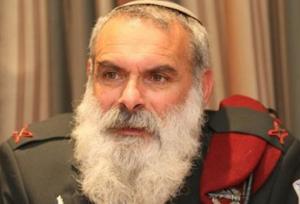
You may remember that Rabbi Rontzki (above) was in the news following Israel’s military operation in Gaza, when soldiers alleged that he gave them a religious booklet entitled “Go Fight My Fight.”  This publication includes extensive quotes by Rabbi Shlomo Aviner, head of the Ateret Cohanim yeshiva in Jerusalem, who ruled that Palestinians were the equivalent of the Biblical Philistines and that cruelty can sometimes be a “good attribute.”

You may also remember that Israeli soldiers from the organization Shovrim Shtika (“Breaking the Silence”) brought this issue to light following the war in Gaza.  Though they have been attacked mercilessly by the Israeli political establishment, these young soldiers have continued to speak out. Last September, Gal Einav and Shamir Yeger, two reserve infantry soldiers who fought in Gaza wrote a powerful editorial in the Israeli press about what they considered to be an unwelcome “messianic” religious influence into the IDF:

There is a problem with the growing tendency to provide religious elements with a monopoly on values and fighting spirit, and particularly with the legitimacy granted to organizations with a missionary and messianic character to operate amongst the soldiers. Most of the commanders in our division are religious, yet up until the last war there was complete separation between their private world and their military position.

If we fail to clearly draw the line right now, in a few years we shall find ourselves shifting from wars of choice or no-choice to holy wars.

In a September BBC report, Reserve General Nehemia Dagan had this to say about the issue:

We (soldiers) used to be able to put aside our own ideas in order to do what we had to do. It didn’t matter if we were religious or from a kibbutz. But that’s not the case anymore.

The morals of the battlefield cannot come from a religious authority. Once it does, it’s Jihad. I know people will not like that word but that’s what it is, Holy War. And once it’s Holy War there are no limits.

(You can watch the BBC report in its entirety here and here. Highly recommended).

What explains the growth of this right-wing religious influence in the IDF? I tend to agree with blogger Zachary Goelman, who points out an larger demographic trend in Israeli society:

With conscription rates dropping annually, especially among secular Jews, and a simultaneous increase in the country’s religious population, Yeger and Einav are part of a shrinking minority. No doubt they know many who ducked their conscription call. If they have draft-age children, they’ve certainly heard them discuss the myriad ways of obtaining a deferral.

This trend is reversed in the dati-le’umi sector, the category of Israeli Jews broadly classified as “national religious.” In one way or another the men and women woven from this cloth see military and national service as a form of religious duty, and their ranks in uniform and civil society will increase in the coming decades. Coupled with the consistent growth of ultra-orthodox families, secular Israel may be in the final throes of its götterdämmerung.

Whatever the explanation, I personally find the implications of this trend to be beyond troubling. How will we, as Jews, respond to the potential growth of Jewish Holy War ideology within the ranks of the Israeli military?  How do we  feel about Israeli military generals holding forth on the religious laws of warfare? Most Americans would likely agree that in general, mixing religion and war is a profoundly perilous endeavor.  Should we really be so surprised that things are now coming to this?

I do not ask these questions out of a desire to be inflammatory. I ask them only because I believe we need to discuss them honestly and openly – and because these kinds of painful questions have for too long been dismissed and marginalized by the “mainstream” Jewish establishment.

For myself at least – as a Jew and as a rabbi – I will take this opportunity to register my personal offense at statements such as those made last week by Rabbi Rontzki.

Shabbat with a Shi’ite Cleric

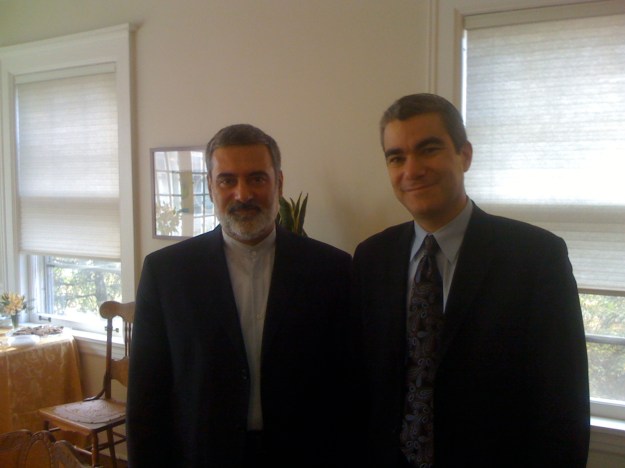
IMG_0689
I spent a remarkable Shabbat lunch yesterday at the home of JRC members Mark and Margie Zivin, where I had the opportunity to meet and talk with prominent Iranian cleric, Dr. Mohsen Kadivar.  Those who assume all Iranian Shi’ite clergy are fundamentalist totalitarians would do well to learn about figures such as Dr. Kadivar, who is both a respected Muslim scholar and a vocal proponent for religious and political reform in his home country.

Among other things, Dr. Kadivar is well-known for his important three-volume treatise in which he sets forth a religious argument for the creation of an Iranian state based on the values of human rights, freedom and democracy.  He also has the dubious honor of having been jailed twice for his activism: once by the Shah and once by the Islamic regime.

During the latter imprisonment, he spent 18 months in Iran’s notorious Evin prison, where he repeatedly rejected offers of clemency if he renounced his religious ideas.  Political pressure has led Dr. Kadivar to leave his post at the Iranian Institute of Philosophy. He is currently serving as a visiting professor of Religious Studies at Duke University.

Our lunch conversation ran the gamut from political discussions of the current nuclear standoff, to human rights, to the political realities in Iran post-election.   For me, however, the most fascinating element of our discussion came when  Dr. Kadivar expressed his religious views.

Indeed, his dissent is notable because it is essentially spiritual rather than political. At the core of his critique is a challenge to the concept of velayat-e faqih, the religious rationale that was used by the Ayatollah Khomeini to grant absolute power to a Supreme Leader:

Kadivar argues that because the concept was conceived by clerics rather than by Allah, it cannot be considered sacred or infallible. And if clerics have no God-given right to rule, he says, that means that Muslims may freely select their government in a democratic Islamic republic. Kadivar has also formulated a theory on why terrorism is forbidden in Islam—an indirect reproach to an Iranian regime that is widely accused of backing terrorist groups (from Time Magazine, 2004.)

I find the notion of religious reform in Iran to be immensely exciting and I am eager to learn more. In the meantime, our conversation provided yet one more reminder for me that it is enormously important for us – as Americans and as Jews – to make the effort to understand the rich complexities of Iranian society. I am more convinced than ever that the most important way we can engage with Iran is by reaching out to and supporting of courageous individuals such as Dr. Kadivar.