Category Archives: UN

The Nightmare in Gaza is Far From Over

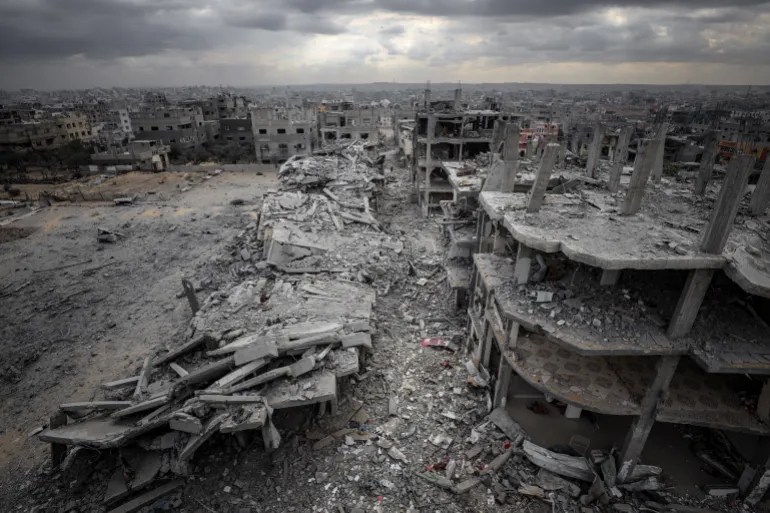
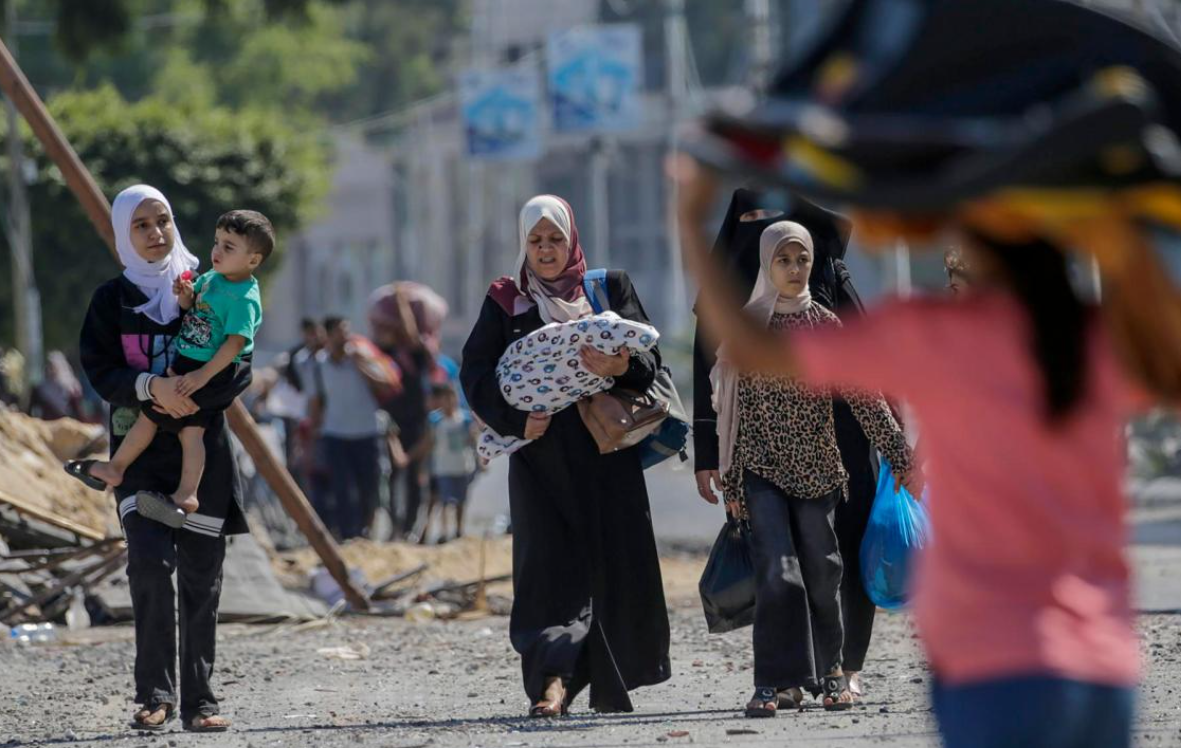
photo: Khames Alrefi/Anadolu

It is the morning after. While the ink has dried on Trump’s 20 point “peace plan,” it has become brutally clear that the nightmare for Gazans is far from over.

Yes, the return of Palestinian and Israeli captives has been an occasion for genuine joy and celebration. Yes, Israel has ended its relentless genocidal bombing of Gaza. Yes, Palestinians are returning en masse to their homes. But this nightmare is far from over.

Israel is by no means finished. Despite the plan’s requirement that “Israeli forces will withdraw to (an) agreed-upon line,” the military has restricted Palestinians’ access to 70% of Gaza, either by declaring large areas as no-go zones or by issuing forced displacement orders, according to the UN Office for the Coordination of Humanitarian Affairs. The Gazan health ministry reported that since Saturday – the first full day of the ceasefire – Israel has already killed 23 Palestinians and wounded 122.

Israel is also ramping up its support of rival Gazan militias to increase the violence on the ground. On October 12, one such group tortured and murdered the beloved Palestinian journalist Saleh Al-Jaafrawi. As Al-Jazeera reporter Eman Murtaja recently wrote: “The message of Saleh’s assassination is clear: Anyone who continues to critically report on what is going on in Gaza, on Israel’s continuing destructive presence and the betrayal of its allies on the ground will be captured, tortured and killed.”

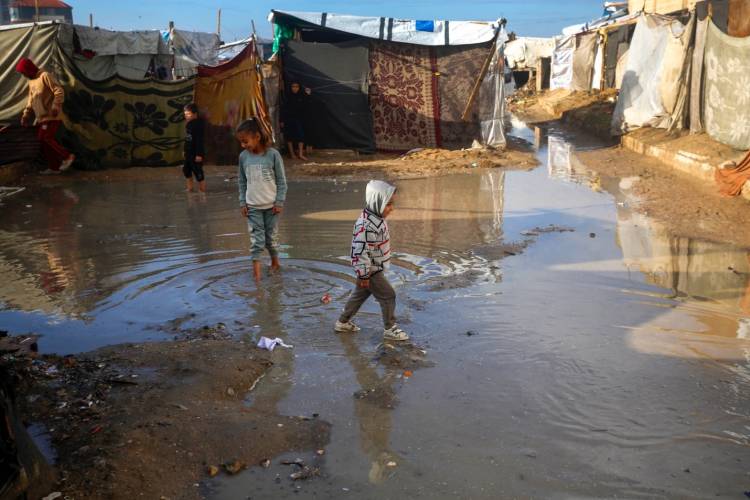
Meanwhile as Gazans continue to stream back to their homes, it has become tragically apparent that the overwhelming majority of them have no homes to return to. Scores of buildings have been reduced to rubble. Palestinians are arriving home to unlivable, broken shards of concrete, many of which still entomb dead loved ones. At the same time Israel’s forced starvation of Gazans continues to claim lives. As of October 12, at least 463 people, including 157 children, have died from starvation as Israel continues to block aid from entering the Gaza Strip. Nearly one in four children suffers from severe acute malnutrition.

It is difficult to overstate the depths of the annihilation that Israel has inflicted on Gaza over the past two years. As journalist Branko Marcetic has rightly termed it, “Israel’s Gaza war is one of history’s worst crimes”:

What we have watched, what we are continuing to watch, is the obliteration of a society of two million people. Every facet of modern civilization, as well as the most elementary things needed for even a state of basic subsistence for a human community, has been deliberately and almost completely destroyed by the Israeli military in Gaza. And now we are watching the gradual but accelerating mass die-off of the people who once lived there, through a combination of starvation, disease, and murder.

Though the political elites are rapturously describing a neo-liberal, neo-colonial post-war Gaza coastal resort, the hard truth is that the Gaza Strip is now a toxic moonscape and mass graveyard. According to the UN Environment Programme (UNEP), Israel’s relentless bombardment of populated areas has contaminated soil and groundwater for the long term, both through the bombardment of munitions and hazardous materials (such as asbestos, industrial chemicals and fuel) that have been released into the surrounding air, soil and groundwater from collapsed buildings. As of July 2024, UNEP estimated that Israel’s bombing had left 40 million tons of debris and hazardous material in Gaza, with much of the rubble containing human remains. It has been estimated that clearing this war rubble will take 15 years and could cost up to 40 to 50 billion dollars.

In addition to the toxicity of the environment, there also remains enormous amounts of unexploded ordnance throughout the Gaza Strip. An estimated 70,000 tons of explosives have been dropped on Gaza since October 2023 – the equivalent of roughly six Hiroshima bombings on an area less than half the size of Hiroshima but with six times its population. This past January, the UN Mine Action Service (UNMAS) estimated that between 5% and 10% of the munitions fired on Gaza have not yet exploded. According to the UNMAS, it could take 14 years to clear Gaza of all unexploded ordnance.

As I noted above, Israel is still restricting food aid from entering Gaza. According to the World Health Programme, over half a million people in the Gaza Strip are still facing catastrophic conditions characterized by starvation, destitution and deathOver 1 million more are facing emergency levels of food insecurity. Acute malnutrition is projected to continue worsening rapidly, with at least 132,000 children aged under 5 at risk of death through to June 2026. 

But even if food supplies were let in by Israel tomorrow, food alone will not save the starving population of Gaza. Starving people cannot simply become healthier by feeding themselves. A condition known as “refeeding syndrome” occurs when starving people who are desperate for food are simply given food supplies. Rapid eating can be catastrophic to the heart, lungs, nerves, and blood, resulting in arrhythmias, respiratory failure, and death. In order to nurse the malnourished back to health, a skilled, multidisciplinary team and routine laboratory testing are required. It has been estimated that without medical specialists and infrastructure accompanying aid, thousands will possibly die from refeeding syndrome.

In addition to starvation, deadly infectious diseases continue to spiral out of control in Gaza. The WHO has warned that the challenge of life-saving medicines reaching Palestinians in Gaza is currently dire:

Whether meningitis… diarrhea, respiratory illnesses, we’re talking about a mammoth amount of work,” Hanan Balkhy, regional director for the United Nations’ health body, told AFP in Cairo. A ceasefire deal between Israel and Hamas has raised hopes of life-saving aid and healthcare finally reaching Palestinians in Gaza after two years of war, but Balkhy warned the challenges are “unimaginable.” 

In this week’s Torah portion, Parashat Bereshit, we read that after Cain kills Abel, God exclaims, “Your brother’s blood cries out to me from the ground!” This is not the first time we will read that bloodshed literally pollutes the earth – and that this pollution must be expiated and atoned for.

Israel – and those who have aided and abetted its genocidal onslaught – has polluted the ground of Gaza in a myriad of ways, and the blood of its people continues to cry out to us even now. We cannot delude ourselves into thinking a ceasefire brokered by craven politicians and real estate oligarchs has ended the genocide. Now more than ever, we must respond to the voice that cries out to us from the ground of Gaza.

The Genocide in Gaza is the Shame of Us All

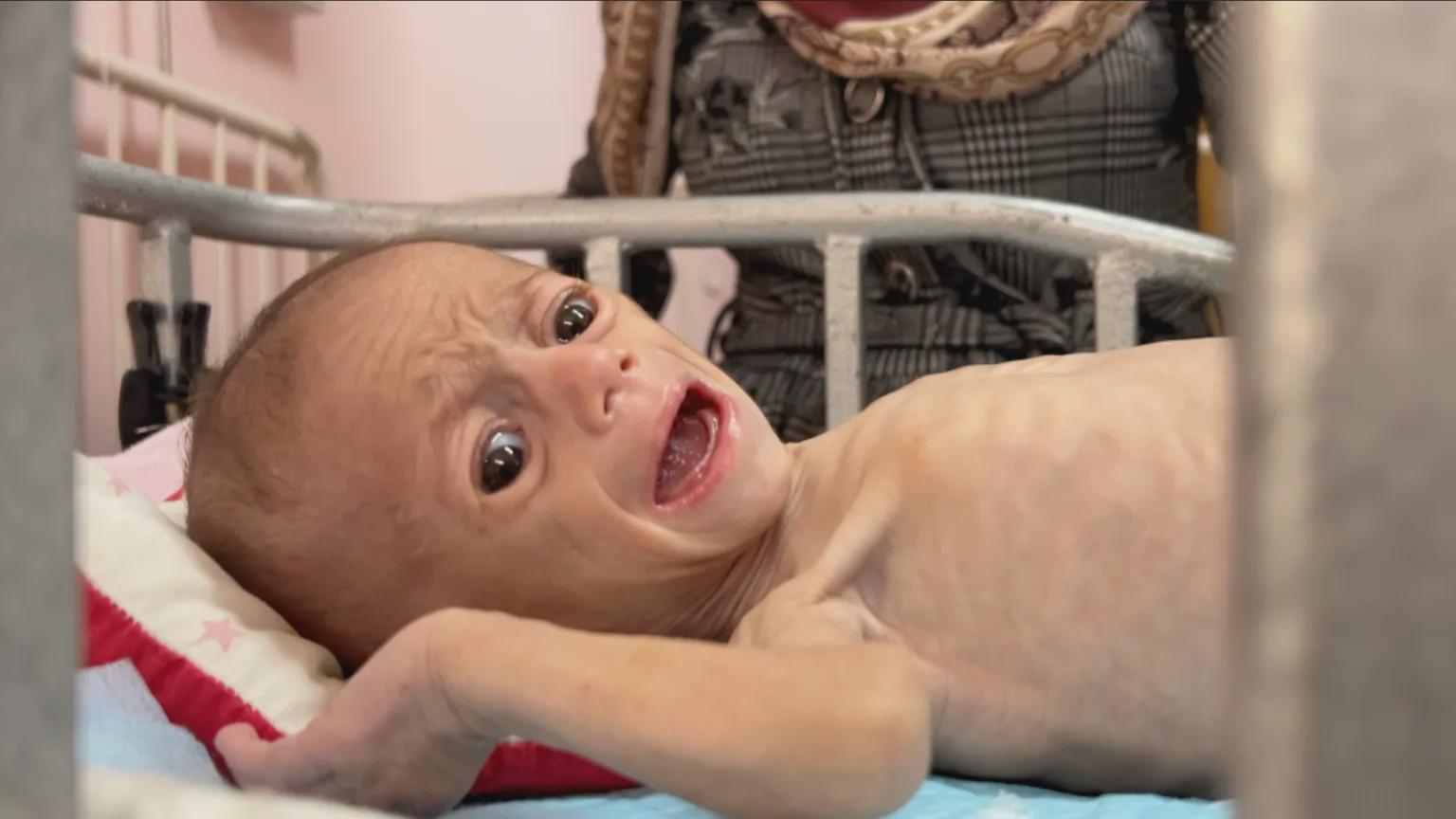
5 month old Gazan baby Sinwar Ashour, starving to death (photo: BBC)

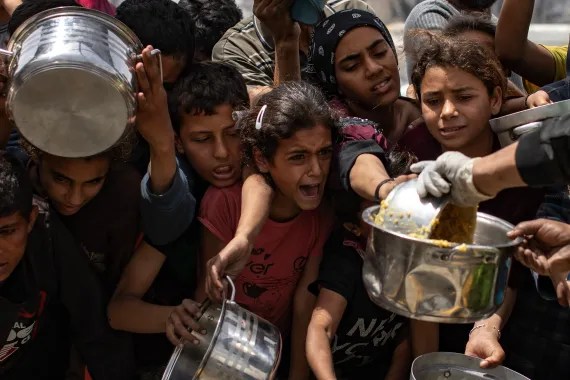
This is what it has come to: Israel is forcibly starving Palestinians. And when Palestinians go to the places Israel has designated as food distribution sites, they shoot them to death.

I will repeat that: Israel is forcibly starving Palestinians. And when Palestinians go to the places Israel has designated as food distribution sites, they shoot them to death.

Health authorities in Gaza said that 19 people died of starvation yesterday, including at least one infant.

Also yesterday, Israel killed 115 Palestinians – 92 of whom were shot while seeking food from the so-called “Gaza Humanitarian Aid Foundation” in Zikim, in Northern Gaza. Israeli troops opened fire and massacred at least 79 Palestinians as they gathered to wait for 25 aid trucks from the UN World Food Program. 

One of those killed was Raed Sindy, who was killed while attempting to access aid for his family. His brother Ahmed said, “They go out just trying to stave off their hunger and the hunger of their children, but they come back wrapped in shrouds.”

And this was just Sunday. Identical massacres and reports of death by starvation have been occurring regularly for months. We know this.

We know this because it has been happening in plain view of the world. Although this news has been all but pushed aside in the mainstream media, it is readily available on Al-Jazeera and alternative news sites and through social media.

Most importantly, we know this because Palestinians themselves have been telling us: reporting on their own genocide every day, in real time. Every day, I scroll through my mobile device and see videos of decapitated babies, corpses pulled from the rubble of bombed houses, bodies burned beyond recognition.

We also know that Israel is building a concentration camp for Palestinians in Rafah, a major southern center which has been completely reduced to rubble. The Israeli Defense Minister is calling it a “humanitarian city,” which will accommodate an initial group of some 600,000 displaced Palestinians. It would then be expanded to accommodate Gaza’s pre-war population of some 2.2 million people. They would not be allowed to move to other areas in Gaza but would instead be encouraged to “voluntarily emigrate” to unspecified countries.

So many of us who have been protesting Israel’s genocide in Gaza for the past year and a half have warned that this what it would come to: the total ethnic cleansing of Gaza. Now it is happening in front of us, for all too see: by bombs, by bullets, by starvation and by forced emigration.

In the decades after the Holocaust, a number of books were written that took the American government and the Allies to task for its inaction during the genocide against European Jewry. But even in that case, it could be argued that while we knew much of what was going on, we didn’t know the full extent of the heinous reality that was the Final Solution. In this case, we have no such excuse. This plans of this genocide are being announced openly and without shame by its perpetrators.

They are doing so because they know they no one will stop them. Not the US government, which is funding and supporting this genocide, not the international community, which is either aiding and abetting or simply wringing its hands. Not the UN, nor the ICC nor the ICJ, which can make pronouncements but have no power of enforcement.

The destruction of the Palestinian people in Gaza is the moral outrage of our time. Shame on every government and institution that has the power to stop it and has refused. Shame on every individual who had the power to lift their voices against this outrage and has remained silent.

For shame. For shame on us all.

The Nakba Unfolds in Gaza as the World Watches

(photo: Haitham Imad/EPA)

In December 2023, just three months into Israel’s genocide on Gaza, Tzedek Chicago’s board released a public statement entitled, “In Gaza, Israel is Revealing the True Face of Zionism,” arguing that “ongoing Nakba is the essential context for understanding the horrifying violence of the past three months.” A year and a half later, these words are resonating with an even more powerful urgency. There is every indication that Israel is beginning the process of engineering the wholesale destruction of Gaza – and the Palestinians who live there – by any means necessary. 

We are now three months into Israel’s total blockade of food, fuel and humanitarian aid – and Gazans are gripped by an increasing famine. On May 4 it was reported by Gaza’s government media office that at least 57 Palestinians have already starved to death, more than 3,500 young children face imminent death from starvation, another 70,000 children are being hospitalized for severe malnutrition, and 1.1 million Palestinian children lack the minimum nutritional requirements for survival. Over 20 UN human rights experts have determined that Israel is wielding starvation as a weapon of war, concluding that “these acts, beyond constituting grave international crimes, follow alarming, documented patterns of genocidal conduct.”

At the same time, the Israeli military has been stepping up its bombing campaign, killing Palestinians at a higher rate than any point since the beginning of the genocide. As of this writing, Israel has killed 100 people in the past 24 hours in a series of bombings throughout northern Gaza. In footage taken by NBC News, the bodies of young children could be seen lying among the dead at Al-Shifa Hospital in Gaza City. 

There are ominous, compelling signs that we are indeed witnessing the end game of Israel’s Nakba in Gaza. On May 4, the Israeli government approved a military operation called “Gideon’s Chariots,” directing the Israeli army to seize complete control of the Gaza Strip and displace the entire population to a small area of land in the south. Though this was technically a leaked story, some Israeli politicians have been unabashed about the plan. Finance Minister Betzalel Smotrich put it very plainly: “Gaza will be entirely destroyed” as a result of an Israeli military victory, and that Palestinians will “start to leave in great numbers to third countries.”

On top of this news, this past Wednesday, Reuters recently reported that the US and Israel have discussed the possibility of Washington leading “a temporary post-war administration of Gaza.” According to five sources, there would be no set timeline for how long the US led administration would last. They compared the proposal to the Coalition Provisional Authority in Iraq that Washington established in 2003, shortly after the US led invasion that toppled the regime of Saddam Hussein. As journalist/commentator Mehdi Hasan correctly pointed out in an interview today, the US’s administration of Iraq was an “absolute disaster.” As Hasan put it, “It increased sectarian tensions. It increased violence. It divided the country. It fomented more violent resistance.”

On May 15, the Palestinian people will observe Nakba Day, their collective observance of their dispossession and ethnic cleansing from their homes. For Palestinians this is not only an acknowledgement of an event that occurred in the past but a commemoration of an injustice that is still unfolding in real time. And yet the genocide in Gaza – as well as the ongoing ethnic cleansing of the West Bank – are completely absent from the mainstream press and international governmental concern. How long will the world allow this decades-long crime to continue? 

I can’t help but note that this week’s Torah portion, Parashat Acharei Mot (which means “after the death”) describes an elaborate sacrificial rite of collective atonement. As I read these words, it is so clear to me that our complicity in this ongoing sacrilege continues to deepen the longer we allow it to unfold. The news out of Gaza has long since receded into the background, even as the Palestinian people continue to cry out to the world.

As the 20 UN human rights experts wrote in their statement:

The world is watching. Will Member States live up to their obligations and intervene to stop the slaughter, hunger, and disease, and other war crimes and crimes against humanity that are perpetrated daily in complete impunity?

…The decision is stark: remain passive and witness the slaughter of innocents or take part in crafting a just resolution. The global conscience has awakened, if asserted – despite the moral abyss we are descending into – justice will ultimately prevail.

Ken Yehi Retzon – So may it be.

The Gaza Ceasefire: Pharoah is Still Pharoah

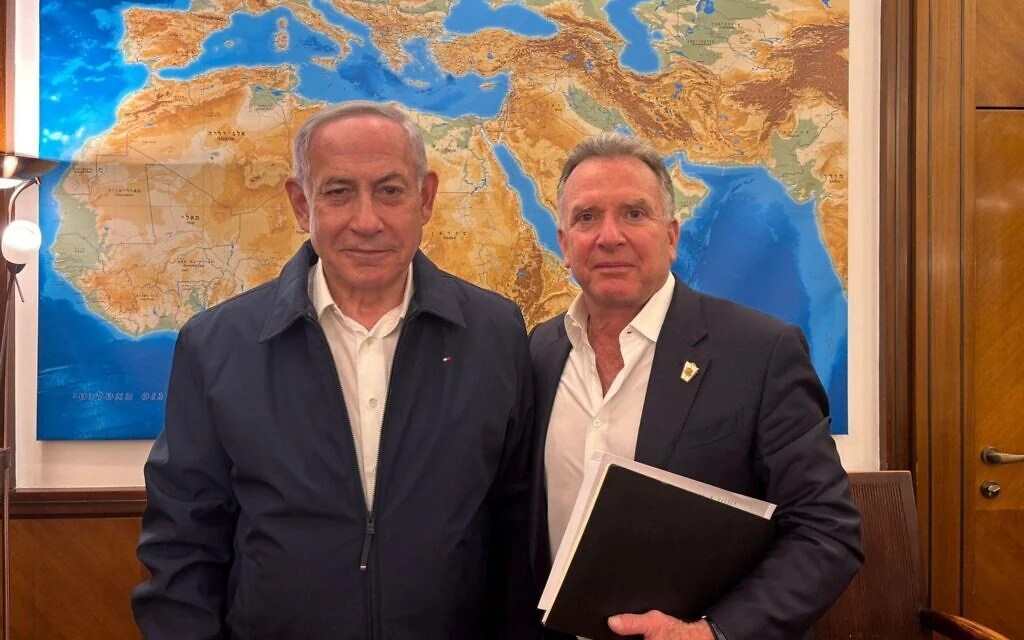
Benyamin Netanyahu and Steve Witkoff, January 11, 2025

For Palestinians and those who stand in solidarity with them, the news of a ceasefire agreement between the Netanyahu administration and Hamas was welcome news. When the reports first broke, and I saw images of Gazans singing and dancing in the streets, I couldn’t help but feel a joyful solidarity with them. But like all brokered agreements between Israelis and Palestinians, this deal is also fragile and fraught – and filled with deeply disingenuous political maneuvering.

Some history: according to reports, this ceasefire deal is identical to the one brokered by the Biden administration last May, which was accepted by Hamas leaders in early July. At the last minute, however, Netanyahu later backed out, insisting on nothing less than the total destruction of Hamas. Israel then assassinated Hamas’ political leader and chief negotiator, Ismail Haniyeh and continued its relentless bombardment of Gaza.

Though this was all a direct affront to the Biden administration, the US government responded not by pressuring Netanyahu to accept the deal but by rewarding Israel with a $20 billion arms sale. Biden and Secretary of State Blinken also actively promoted the lie that it was Hamas and not Israel that had kiboshed the deal. In the meantime, the Israeli military continued with its genocidal onslaught. From the time that the talks fell apart until now, the death toll of Palestinians rose from at least 39,000 to 46,707, including more than 18,000 children.

So why is Israel accepting the very same deal a half a year later? We now know it was due to the efforts of Donald Trump, who has made it clear he didn’t want to deal with the distraction of Israel’s war on Gaza as he began his presidency. Last week, Trump asked his friend, Steve Witkoff, a billionaire real estate developer, to call Netanyahu and tell him in no uncertain terms that Israel’s military operations in Gaza must end before the inauguration.

In other words, a President-elect was able to do with a single visit from a private citizen what the Biden administration was either unable or unwilling to do for over a year.

Though the ceasefire deal was welcome news, it was not accomplished through the “tireless efforts of the Biden administration.” Neither was it due to the altruism (needless to say) of the President elect. Trump is nothing if not transactional – and there is already speculation over what he might give Netanyahu in return, whether it’s a brokered diplomatic deal with Saudi Arabia or the annexation of the West Bank (or both).

In the meantime, within 24 hours of the announcement of the deal, Israel escalated its bombing of Gaza, killing 80 Palestinians. According to analyst Yousef Munayyer, Israel has a habit of late-hour bombing to empty its stockpiles in anticipation of larger military aid packages from the US. In this case, since Israel has not realized its military objective of obliterating Hamas, “there may be an urge to do great damage while they can before ceasefire comes in, reacting to that disappointment.” As of this morning, the Netanyahu government, is indicating his government is prepared to accept the deal, which is set to go into effect on Sunday, but it is still yet to be signed.  

But even if it is finalized, we should have no illusions. Like past deals, there is so much that Israel can do to pursue its own designs going forward. Like past deals, this one is set to unfold in stages. The first phase will feature a ceasefire, a withdrawal of Israeli troops, an initial swap of hostages and prisoners and an influx of humanitarian aid into Gaza. However, the second and third phases are far less developed. There is no agreement on the rebuilding of Gaza, the future of the Israeli military presence, who will govern, or how.

When I read the details of this agreement, I couldn’t help but recall the Oslo Accords in 1993, which was also negotiated in phases. The first was an interim phase, in which Israel would gradually withdraw from Palestinian areas in the West Bank and transfer administrative power to a temporary “Palestinian Authority.” The second phase involved permanent status details such as Jerusalem, refugee rights, settlements and borders. In the end, Israel agreed to the first phase as a cover to extend its settlement regime across the West Bank – all the while enacting policies that further dispossessed Palestinians from their homes.

Oslo was a hard lesson on the ultimate designs of all Israeli administrations, from left to right. No matter who is in power, the Israel’s goals are the goals of Zionism itself: the maintenance of a Jewish majority in the land. This goal necessarily entails the ongoing ethnic cleansing – an ongoing Nakba – of the Palestinian people. After the genocide in Gaza, we can honestly add the words “by any means necessary” to this sentence. No matter the diplomatic rhetoric around this current deal, we must not lose sight of this crucial history. Put simply: Netanyahu is all too likely to assent to phase one of the deal, get back a requisite number of hostages, then continue with the genocide in Gaza in order to destroy Hamas completely, ensure a maximum number of Palestinians are either dead or unable to return to their homes, and re-entrench Israeli civilian settlement there.

In this week’s Torah portion, Parashat Shemot, there arises a new Pharoah who “did not know Joseph.” Threatened by the demographic growth of the Israelite people in the land, he institutes murderous policies to stem their birthrate and reduce their number through harsh enslavement. But there are also those who resist Pharoah’s tyranny through acts of courageous civil disobedience: Hebrew midwives who refuse to kill Israelite baby boys, a mother and sister who save an Israelite child and a daughter of Pharoah who adopts him. All of these events set in motion a chain that will inexorably, inevitably lead toward the liberation of the Israelite people.

So in this moment, let us welcome the prospect of the cessation of hostilities. But let us have no illusions about the designs of all Pharoahs past and present. Like the Israelites in our Torah portion, the Palestinian people continue to cry out for liberation.

Let us continue to heed their call.

“All Who are Hungry Come and Eat:” A Report from a Passover Action at the Gaza Border

Cross-posted with The Nation

In 2017, I spent several days in Gaza as a staff person for the American Friends Service Committee. Although I took away many powerful and vivid memories from that trip, some of the most indelible involved the delicious food that was continuously served to us by our Gazan hosts. Gazans are famously proud of their cuisine, and rightfully so, as it provides them with a palpable connection to Palestinian history and life outside that small 140 square mile strip – to communities in Palestine that their ancestors used to live. As journalist Laila El-Haddad has observed, Gazan food is “a sort of treasure map to a largely invisible, or invisibilized, world of Palestinian history going back well before the 1948 Nakba.”

During the course of our visit, Ali, a member of the AFSC Gaza staff, mentioned more than once that Gazan knafeh (a traditional Arabic dessert) was by far the best in Palestine. When our staff group gathered at a restaurant in Gaza City for our final meal, Ali was chagrined to learn that there was no more knafeh left in the kitchen. Determined, Ali got up, ran down the street to another restaurant, and returned with a huge round plate of the sticky, golden pastry for our table. It was indeed more delicious than any knafeh I have eaten before or since.

I’ve recalled that sweet memory often over the past seven years. When I think of it now, however, I find its sweetness has curdled into horror. As far back as December, human rights agencies determined that Israel “was using starvation as a weapon of war.” According to the World Food Program, Gaza’s food system was on the brink of collapse and the population was facing a “high risk of famine.”

This past March, the mainstream media published shocking, heartbreaking pictures of Yazan Kafarneh, a 10 year old Gazan boy reduced to skin and bones from starvation. To date, it has been estimated that 28 children have died of malnutrition and starvation in northern Gaza. By all accounts, starvation in Gaza has now reached “catastrophic” proportions. Knowing about the Gazan people’s deep pride in their food culture, I’m experiencing deep heartbreak as I read reports that Palestinians in Gaza are now forced to eat grass just to survive.

As a congregational rabbi, I’ve spoken with many people have told me that they are not sure how – or even if – they will celebrate Passover this year. With the genocide and forced starvation of the people of Gaza deepening with no end in sight, they say, it just feels beyond challenging to celebrate a festival of Jewish liberation. To make the moral dissonance even more dissonant, many in the Jewish communal establishment are framing Passover by focusing exclusively on the Israeli hostages in Gaza and call for their liberation from Hamas, with nary a mention of the 35,000 Gazans who have been destroyed in the process through Israel’s genocidal war of vengeance.

More than once I’ve been asked, “How can I partake of this festive meal while Israel has been starving Palestinians in the name of the Jewish people?” How can I read about Pharaoh’s oppression of Israelite children when I’ve just read the latest death count of Palestinian children dying increasingly things from forced starvation?

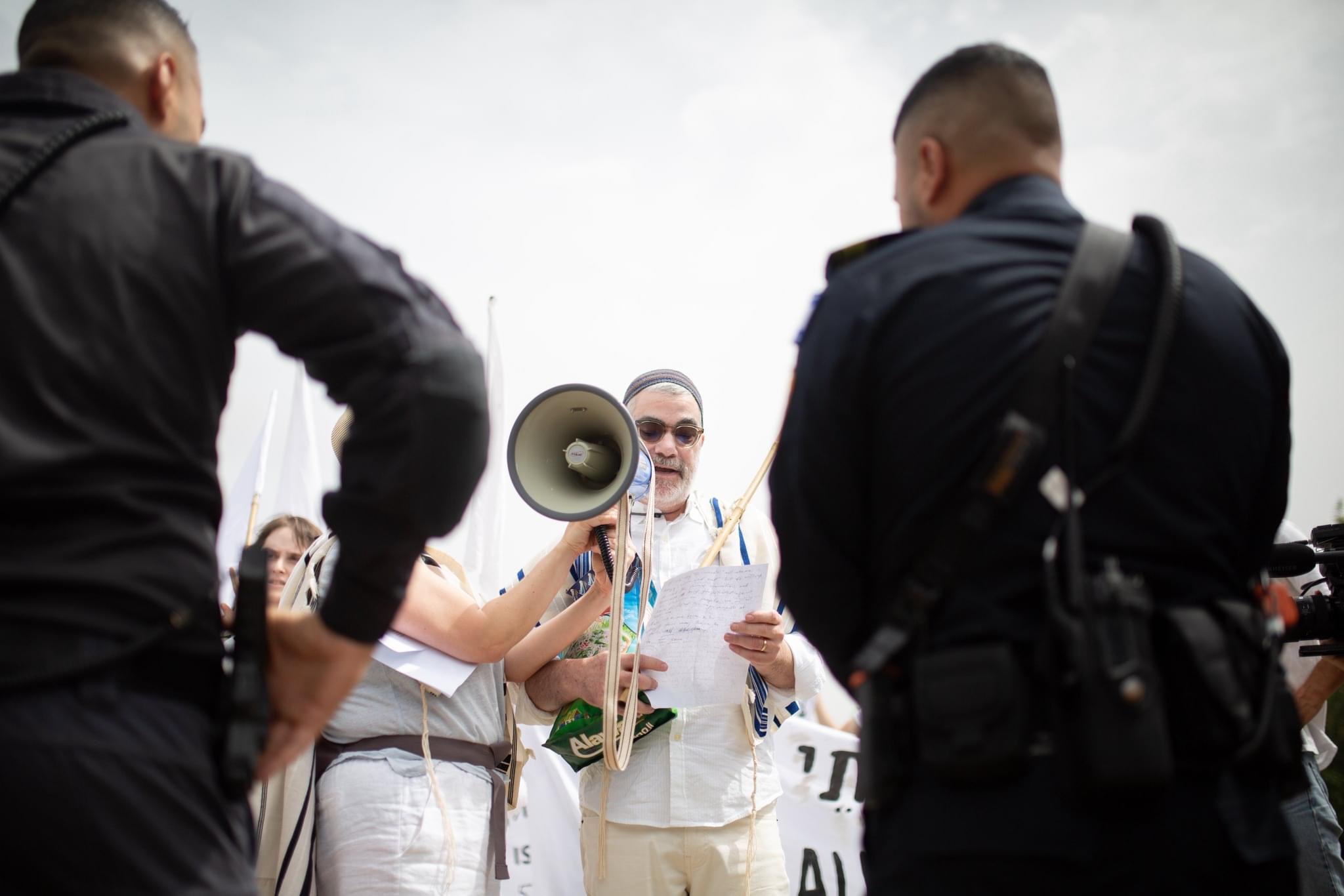
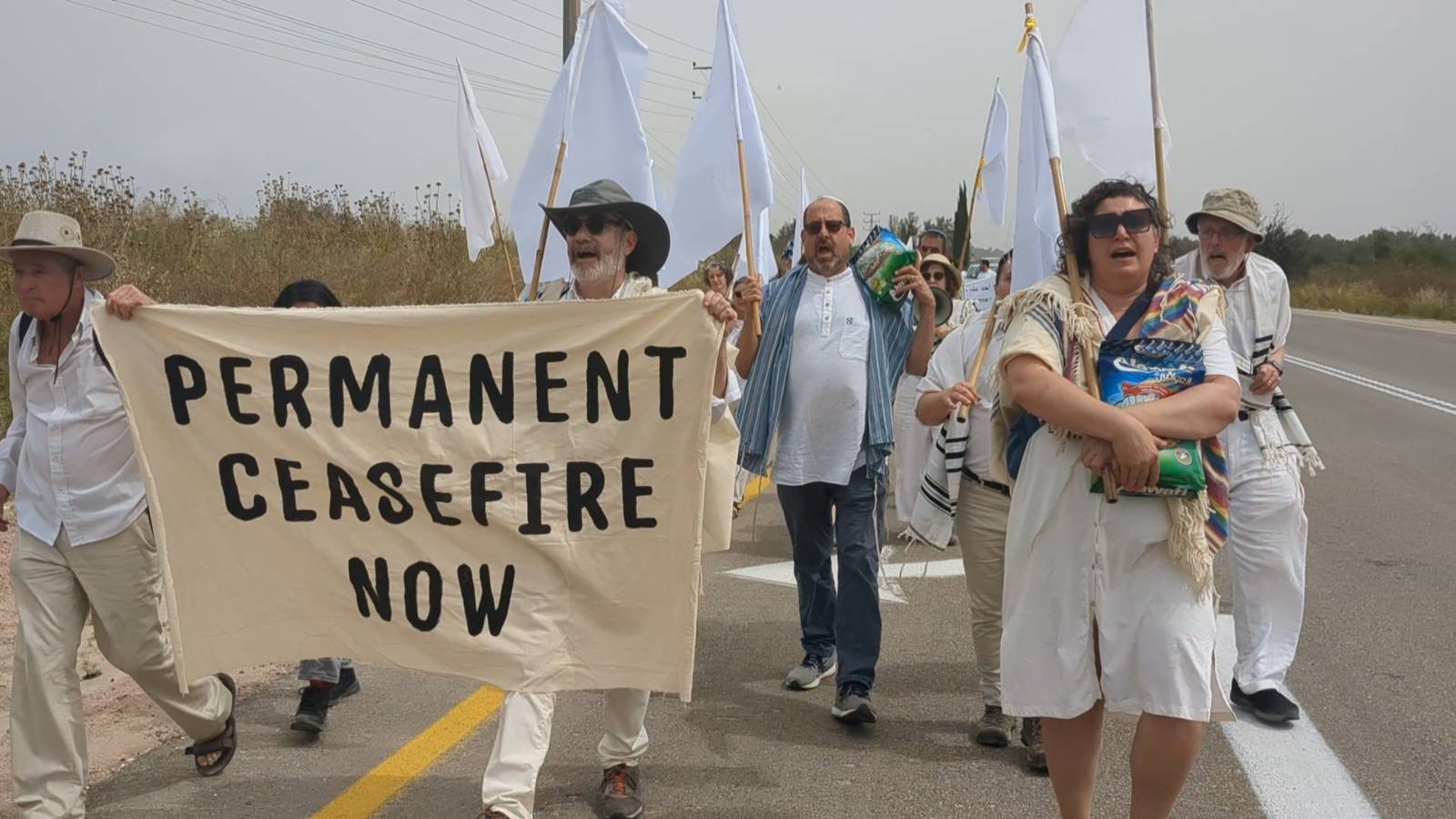
As a political-spiritual response to this unprecedented Passover moment, Rabbis for Ceasefire mobilized and began to organize as action at the Gaza border, to literally bring food supplies with us and demand to that Israel allow us to pass through the Erez Crossing, motivated by Passover’s central imperative, “All who are hungry come and eat!” Our action would include 10 American rabbis, writer/essayist Ayelet Waldman and 30 other Israeli activists – including Israeli rabbis – who have been tirelessly protesting both at the Gaza border and organizing protective presence for West Bank communities targeted by settler violence.

Our action was originally planned for the week leading up to Passover; but when Iran’s missile attack caused the country to go on alert and airlines cancelled their flights to Israel, we almost had to cancel our action. As we read the news, Israel’s escalating hostilities with Iran took front and center The US and the West were rearming Israel and focusing on the threat from Iran – even as Israel continuingly maintained its policy of starvation and bombardment of Gaza. Most alarming were the reports that an Israeli agreement to retaliate lightly against Iran would give them leeway to move ahead with a potentially disastrous ground invasion of Rafah.  We bought plane tickets for the next week, determined to make a collective Passover statement that felt more critical than ever.

During our action, we gathered at a preplanned meet-up location, with a truck filled with half a ton of flour. We each shouldered backs of rice and, carrying banners and flags, march in the direction of the Erez Crossing. The Israeli police quickly drove up to intercept us. During that initial stand-off, several of us offered statements. I began with an opening prayer, an adaptation of the “Magid” section of the Passover Haggadah:

“This is the bread of affliction, the bread and food systemically, cruelly denied the people of Gaza. Let all who are hungry come and eat. Let all who are oppressed be liberated this Pesach. Now we are here – tomorrow let there be bread for Gaza. Now we are here – next year may there be liberation from the river to the sea!”

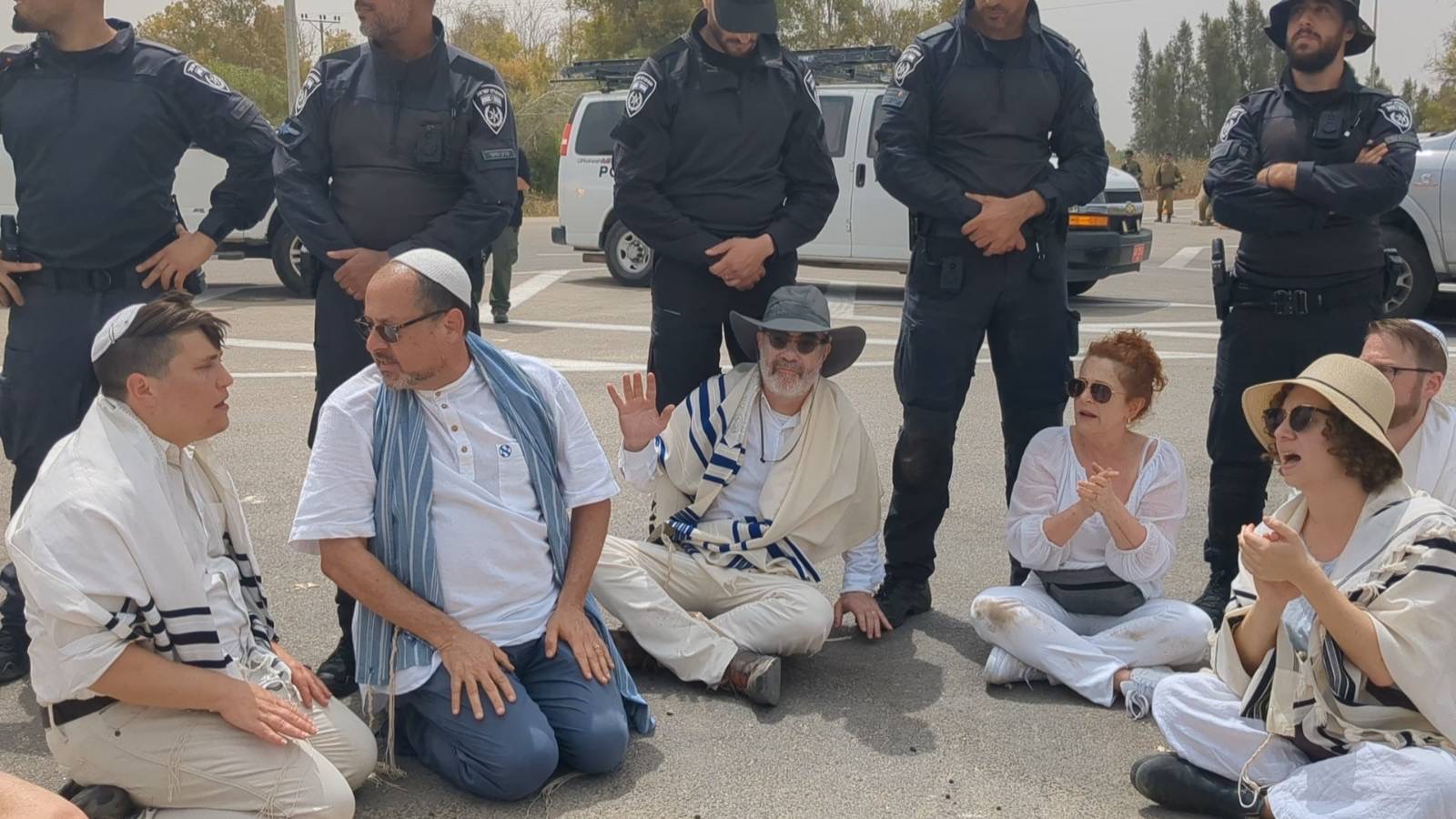
Other speakers included Israeli Rabbi Avi Dabush of Rabbis for Human Rights, a resident and survivor of a kibbutz that was attacked on October 7 and Noam Shuster-Eliassi, a well-known Israeli activist, writer and comedian. When our program was over, we pushed forward toward the border. When the soldiers violently attempted to break us up, several of us sat down in the road. During the course of the protest seven of our group: four Americans and three Israelis were arrested.

All of the arrested were fully prepared for this eventuality – the Israelis were in fact veterans at protest-arrests and had previously briefed us on protocol. They were taken to two dentention centers and interrogated for eight to nine hours. The American were told, perversely, that they were being held for “attempting to bring food into Gaza.” All the arrested were released that evening; thankfully the food we attempted to bring into Gaza was not confiscated; as we have previously planned, it was donated to the community of Masafer Yatta – an area in the South Hebron Hills were almost 3,000 residents are resisting the daily threat of demolitions, evictions and dispossession.

While we are satisfied with the attention our action has received, we have no illusions about the current moment in Gaza. Nearly 2.2 million Palestinians in Gaza currently face mass starvation and encroaching famine, these words have resonated with unbearably profound force during Passover this year. Hundreds of trucks filled with humanitarian goods have been sitting idle on roads leading into the Rafah crossing on the border with Egypt, blocked from entering Gaza by a draconian inspection process that severely limits the number of trucks that can pass through. Inside Gaza, the Israeli has been attacking efforts aid efforts with tragic results. According to the UN, the Israeli military has killed 196 relief workers; soldiers have also shot and killed hundreds of Gazans who venture out to seek food.

Amidst it all, the one agency that has the capacity and infrastructure to effectively distribute relief to the people of Gaza, the United Nations Relief and Works Agency (UNRWA), has been defunded by the Biden administration. This past January, the Israeli government leveled the still-unsubstantiated claim that 12 UNRWA employees were involved in Hamas’ October 7 attacks in Israel. Though UNRWA immediately fired the employees in question and launched an investigation, the US immediately withdrew their financial support of the agency, which was founded in 1949 to provide support to the hundreds of thousands of refugees created by the establishment of the state of Israel.

In its spending bill this past March, the US government extended its defunding of UNRWA for a year. Though the agency reports it has sufficient funds to operate until the end of May, its ability to operate in Gaza has already been gutted. Last month, Israel announced it would no longer approve UNRWA food convoys to the north of Gaza, where famine is the most. According to its report this month, the agency noted that “a total of 420 trucks food trucks were denied or impeded by Israeli authorities (during the month of March) …Gaza is on the brink of famine, with 1.1 million people—half of its population—experiencing catastrophic food insecurity due to the intense conflict and severe restrictions on humanitarian access.”

Most ominously, Israel continues to amplify its threats to invade Rafah, which would almost certainly result in massive human tragedy and the complete ethnic cleansing of Palestinians from Gaza. And yet, in the wake our action on the border, I continue to hold out hope. It is clear to me that our border-protest was part of something much larger: the dramatic rise in student resistance on college campuses throughout the US and unprecedented popular Palestine solidarity increasing around the world. For me, this moment expresses the core meaning of Passover powerfully than I have every experienced in my lifetime: in every generation, the cry of the oppressed demands to be heard.

This Passover, I also hold out hope from my own memory of meals in Gaza back in 2017. To be sure, AFSC’s Gaza staff has suffered terribly during this genocidal onslaught – and I’m sure the restaurants and neighborhoods where we enjoyed such delicious meals with our Gazan friends are no more. But I will never forget the tastes of the food that were so graciously served, as well as the communities in Palestine that they represent. And I am more convinced than ever that Israel cannot, try as it may, starve, bomb, or shoot away the Palestinian people’s love for their culture that is so deeply, fragrantly rooted in their homeland: In the words of El-Haddad:

Lately, I’ve been thinking about what I would go back to, and what I would find, if I returned to Gaza. Most of the landmarks have been destroyed. Gone too are many of the people I cherished. But … it feels like I am the torchbearer now, the family’s keeper of treasured recipes. Like Um Hani (Leila’s aunt, who was killed in an Israeli airstrike), I will cook and I will teach, connecting the next generation of Palestinians to our homeland.

On Gaza, Genocide and International Holocaust Remembrance Day

 (Photo by Axel Koester/Los Angeles Daily News)

It’s safe to day that International Holocaust Remembrance Day will arrive tomorrow at a deeply fraught moment for the Jewish community. Just today, we’ve received the news that the International Court of Justice, ruling on a case brought by South Africa, has ordered Israel to take action to “prevent acts of genocide” in Gaza. And later today, a federal court in California will hear a case brought by the Center for Constitutional Rights on behalf of Palestinian human rights organizations, Palestinians in Gaza and Palestinian Americans accusing Biden and other senior US leaders of being complicit in genocide.

In short, International Holocaust Remembrance Day 2024 is arriving just as Israel and the US government are literally being judged on the world stage for an ongoing genocide against the Palestinian people.

As we contemplate the monumental nature of this moment, it’s instructive to consider the history of International Holocaust Remembrance Day itself. This annual commemoration was created by the UN in 2005, to take place annually on January 27: the day Auschwitz was liberated by allied forces. In its resolution establishing the day, the UN General Assembly made it clear that this observance would not merely be about commemorating the past; it pointedly urged member states “to develop educational programs that will inculcate future generations with the lessons of the Holocaust in order to help to prevent future acts of genocide.”

The GA also made it explicit that this remembrance would not be limited to the European Jewry alone, but should also extend to “countless members of other minorities” who were murdered en masse by the Nazi regime. As then Secretary General Ban-Ki Moon pointedly commented during the 2015 commemoration, “More than a million inmates, primarily Jews, were brutally and systematically killed in the place where the Nazis introduced the monstrous concept of ‘industrialized murder.’ Among the other victims were non-Jewish Poles, political prisoners, Soviet prisoners of war, Sinti and Roma, homosexuals, disabled persons and Jehovah’s witnesses.”

In other words, International Holocaust Remembrance Day was purposely established to universalize the memory and the lessons of the Holocaust.

There is of course, another Holocaust memorial day widely observed by the world Jewish community – namely, Yom Hashoah. In contrast, to International Holocaust Remembrance Day, Yom Hashoah is not universal in nature – it is a day set apart by the Jewish community to mourn their own in a Jewish context, as part of the Jewish festival calendar. While it is altogether appropriate for the Jewish people to honor the memories of our ancestors in such a way, it’s worth noting the history of this particular day as well.

Yom Hashoah was officially founded by an act of Israeli parliament in 1951, immediately following the founding of the state itself. It was purposefully established on Jewish date of the 27 Nisan (April/May) to begin a week of commemoration leading into Yom Hazikaron (Memorial Day), concluding with Yom Ha’atzmaut (Independence Day). In this way, Yom Hashoah served to promote the Zionist historical mythology that viewed the establishment of the state of Israel as a “rebirth,” arising out of the ashes of the Holocaust, through the brave sacrifice made by the soldiers who fought in the War of Independence.

Like many Jews growing up in America, I simply accepted Yom Hashoah as an organic part of the rhythm of the Jewish year, observed annually in synagogue services and communal commemorations. I was never taught that it was first and foremost an Israeli national holiday. And of course, I was never taught that the state of Israel was founded in the wake of the Holocaust through the ethnic cleansing of the Palestinian people from their homes.

While there should most certainly be a communal Jewish day of memorial for the six million, it’s worth questioning the prominent status afforded Yom Hashoah by world Jewry. This is, after all, a day that serves to reinforce the view that the Israel’s founding was a “redemptive” moment for the Jewish people following the tragic cataclysm of the Holocaust – utterly ignoring the reality that the state of Israel was established through the dispossession of another people. I strongly believe we should consider an entirely different Jewish frame for commemorating the Holocaust; in the meantime, however, we should have no illusions about the real agenda behind Yom Hashoah and the problematic narrative it seeks to support.

It might well be said that in this terrifying current moment, the very real implications of this Zionist mythology are being directly challenged by the universal message of International Holocaust Remembrance Day. It’s actually quite staggering to consider: as the world prepares to observe this day, compelling legal proceedings are formally accusing Israel of (and the US of abetting) genocide. Even more sobering: it arrives amidst an increasingly damning verdict in the court of public opinion in which, according to a recent poll, “more than one in three Americans believe Israel is committing genocide against Palestinians.”

I realize how painful – even unthinkable – it will be for many Jews to lift up the lessons of International Holocaust Remembrance Day to suggest Israel that is committing genocide against the Palestinian people. But as I suggested in my sermon this past Yom Kippur, we must find the courage to say out loud the words that must be spoken. If this particular day is truly is to be a day for us to apply the “lessons of the Holocaust in order to help to prevent future acts of genocide,” it is all the more critical for us to speak out and name a genocide that is literally unfolding before us in real time. No matter how uncomfortable or painful the prospect.

In this regard, I’m immensely proud to be part of a Jewish community that has the courage to say these words out loud. In a just released public letter to President Biden, the Jewish Voice for Peace Rabbinical Council is demanding that he “honor the word and spirit of the International Holocaust Remembrance Day by using (his) office to bring a ceasefire to this tragic violence — and to stop blocking efforts toward building a truly just peace for all who live between the river and the sea.”

An excerpt:

We hold the traumatic history of our people with care and sensitivity — and know how painful it is for Jews to grasp that a Jewish state could possibly commit a genocide. Nevertheless, we must agree with increasing numbers of scholars and international rights experts who have determined that Israel’s actions in Gaza constitute, in the words of Prof. Raz Segal, “a textbook case of genocide.” 

We support and uplift South Africa’s recent application to the International Court of Justice claiming Israel is in breach of the 1948 Convention on the Prevention and Punishment of the Crime of Genocide. And now, Palestinian human rights organizations, together with Palestinians in the US and Gaza, are bringing a case against your administration for failure to prevent, and complicity in, the Israeli government’s unfolding genocide against them, their families, and the 2.2 million Palestinians in Gaza. We stand in support of their action as well.

According to a core teaching of Jewish spiritual tradition, humanity was created in the image of God. That means that each and every human being is of infinite value. The UN 1948 Convention on Genocide was created to uphold this very idea. The Torah also teaches that there will always be moments when we must make a critical moral choice. As Deuteronomy 30:19 says, “I have put before you life and death, blessing and curse. Choose life.” President Biden, you have chosen death. Instead of using your considerable power to prevent or end this genocide, you have directly abetted it with weapons, funds and diplomatic cover. 

On this day of remembrance in 2021, you noted that, “The Holocaust was no accident of history.” As you stated, “It occurred because too many governments cold-bloodedly adopted and implemented hate-fueled laws, policies, and practices to vilify and dehumanize entire groups of people, and too many individuals stood by silently. Silence is complicity.” 

President Biden, what is happening right now in Gaza is no accident of history — and your complicity has been anything but silent. We call upon you to be true to your word and end US complicity in Israel’s genocide against the Palestinian people.

This International Holocaust Remembrance Day, let us find the courage to speak the words that must be spoken. This International Holocaust Remembrance Day, let us find the courage to speak the words that must be spoken: Ceasefire now. Never again, for anyone. No more genocide.

Reenacting Pharoah’s Genocidal Decree in Gaza

(Photo: EFE)

The introduction to the book of Exodus, which we begin reading this Shabbat, has never resonated so deeply or so powerfully for me as it does this very moment.

We’re all familiar with the events that spark the Exodus narrative: a new Pharoah arises over Mitzrayim who does not know or remember Joseph. Alarmed that the Israelite minority is growing, he oppresses them with forced labor – but the more he oppresses them, the more the Israelites increase in number.

Pharoah then attempts to stem the Israelite birth rate directly by ordering the Hebrew midwives Shifra and Puah to kill every newborn boy. When they defy his order, Pharoah orders that every newborn boy be cast into the Nile. Commentators differ on why Pharoah made this very specific decree. Some say that in his paranoia, he believed the boys would eventually grow up to be soldiers and take up arms against his people. Other say his soothsayers predicted the birth of Moses. Still others say Pharoah believed that the Israelite women would intermarry and assimilate into the majority culture.

Whatever the reason, it is striking to note that Exodus’ liberation narrative begins with Pharoah’s efforts to head off the Israelite birth rate. As I’ve noted before, there are powerful parallels between this narrative and the state of Israel’s regard of the Palestinian people as a “demographic threat” to their Jewish majority. But in the midst of Israel’s genocidal assault on the people of Gaza, I’m finding that these verses now resonate with a brutal – and almost unbearable – urgency.

On November 3, less than a month into Israel’s military bombardment of Gaza, UNICEF, the World Health Organization and other NGOs reported that “Women, children and newborns in Gaza are disproportionately bearing the burden of the escalation of hostilities in the occupied Palestinian territory, both as casualties and in reduced access to health services.” More recently, the UN estimated that “around 50,000 pregnant women are currently living in Gaza, with more than 180 births taking place every day amid the ‘decimation’ of its healthcare system.”

The most devastating details on the impact of this onslaught on Gazan mothers can be read in the South African government’s application to the International Court of Justice, formally accusing Israel of committing genocide in Gaza. I strongly recommend reading this document in its entirety. Though South Africa’s claim was cynically dismissed by the White House as “meritless, counterproductive and completely without any basis in fact whatsoever,” its 84 page report is painstakingly researched, citing 574 independent sources. Though it is often near-unbearable to read, I believe it is an immensely important document and deserves the widest possible readership.

Here is a sample of the report’s findings on impact of Israel’s genocidal violence on pregnant women and newborn babies. Please be warned: the following quote it includes very graphic descriptions of traumatic violence inflicted on women and children.

Pregnant women and children –– including newborn babies –– are also particularly impacted by displacement, lack of access to food and water, shelter, clothes, hygiene and sanitation, and lack of access to health services. These effects are severe and significant. An estimated 5,500 of approximately 52,000 pregnant Palestinian women in Gaza giving birth each month are doing so in unsafe conditions, often with no clean water, much less medical assistance, “in shelters, in their homes, in the streets amid rubble, or in overwhelmed healthcare facilities, where sanitation is worsening, and the risk of infection and medical complications is on the rise”. Where they are able to get to a functioning hospital, pregnant women are having to undergo caesarean sections without anaesthetic.

Given the lack of access to critical medical supplies, including blood, doctors are being compelled to perform ordinarily unnecessary hysterectomies on young women in an attempt to save their lives, leaving them unable to have more children. Indeed, the Minister of Health for the State of Palestine, Dr May al-Kaileh, confirms that the only option facing Palestinian women in Gaza who ‘bleed out’ after giving birth is to undergo a hysterectomy in order for their lives to be saved. The lack of available drugs, such as the anti-D injection –– given to Rhesus negative women on the birth of a Rhesus positive baby –– also seriously impacts the possibility of future healthy pregnancies for affected women.

Premature births have reportedly increased by between 25-30 per cent, as stressed and traumatised pregnant women face a myriad of challenges, including being compelled to walk long distances in search of safety, attempting to escape from bombs and being crowded into shelters in often squalid conditions. Particularly in northern Gaza, cases of placenta abruption –– a serious condition that occurs to pregnant women during childbirth which is potentially life-threatening to both mother and baby –– have more than doubled.

An ever-increasing number of Palestinian babies in Gaza are reportedly dying from entirely preventable causes, brought about by Israel’s actions: newborns up to three months old are dying of diarrhea, hypothermia, and other preventable causes. Without essential equipment and medical support, premature and underweight babies have little to no chance of survival. Palestinian newborn babies have died due to the lack of fuel to supply hospital generators; others have been found decomposing in their hospital cots, medical staff taking care of them having been forced by Israel to evacuate.

On 3 November 2023, the World Health Organisation warned that “[m]aternal deaths are expected to increase given the lack of access to adequate care”, with deadly consequences on reproductive health, including a rise in stress-induced miscarriages, stillbirths and premature births. The impact will necessarily be long lasting and severe for Palestinians in Gaza as a group. By 22 November 2023 the United Nations Special Rapporteur on violence against women and girls, its causes and consequences, has expressly warned that:

“[T]he reproductive violence inflicted by Israel on Palestinian women, newborn babies, infants, and children could be qualified as… acts of genocide under Article 2 of the Convention on the Prevention of Genocide … including “imposing measures intended to prevent births within a group”. She stressed that “States must prevent and punish such acts in accordance with their responsibilities under the Genocide Convention.”

(Sections 96-100)

If there could be any doubt as to the question of intentionality behind these barbaric measures, the section immediately following these findings includes exhaustive quotes by Israeli politicians and military leaders that make their genocidal intentions all too clear. Most chillingly, it offers this quote from 95-year old Israeli army reservist Ezra Yachin — a veteran of the Deir Yassin massacre during the 1948 Nakba — who was called up for reserve duty to “boost morale” amongst Israeli troops ahead of the ground invasion: Be triumphant and finish them off and don’t leave anyone behind. Erase the memory of them. Erase them, their families, mothers and children. These animals can no longer live. . . Every Jew with a weapon should go out and kill them. (Section 102)

In this week’s Torah portion, the cry of the oppressed Israelites rises up to God, who hears and hearkens to their pain. This year, there can be no more critical question posed by our Torah portion: will God hearken to the collective cry of the people of Gaza?

The answer, as ever, is up to us all.

The Radical Audaciousness of a Ceasefire in Gaza Now

As of this writing, Israel has killed over 7,000 Palestinians in Gaza – almost 3,000 of whom are children. (According to Defense for Children International – Palestine, almost 1,000 children are reported missing under the rubble of destroyed buildings.) Israel has cut off all food, water and power to the Gaza Strip. Gazans will soon run out of fuel to run their generators – their last link to medical treatment and drinkable water.

Israel clearly has no intention to end their onslaught any time soon; in fact, they are making their intentions all too clear. Prime Minister Netanyahu: “We will turn Gaza into an island of ruins.” Israeli army spokesman, Daniel Hagari: “We are dropping hundreds of tons of bombs on Gaza. The focus is on destruction, not accuracy.” President Herzog: “It is an entire nation who are responsible. This rhetoric about civilians being involved is absolutely untrue…We will fight until we break their backs.”

I don’t think it’s an overstatement to say we are currently facing the greatest moral reckoning of our time. A genocidal onslaught in unfolding before us in real time – countenanced by the international community and enabled by the US government. There can be no more pressing, urgent need at this moment than an immediate ceasefire to this unspeakable violence.

On the face of it, a ceasefire would seem to be the most morally obvious and straightforward course of action – but alas, the simple suggestion that Israel cease its carnage is tantamount to a radical – even extreme – idea at the moment. The Biden administration has made its staunch opposition to a ceasefire abundantly clear. When asked about the human toll, White House spokesperson John Kirby commented, “It is ugly and it’s going to be messy, and innocent civilians are going to be hurt.” When Biden himself was asked a similar question, he answered that he “has no confidence in the numbers that the Palestinians are using.”

Ceasefire is the last thing on Biden’s mind at the moment. Quite the contrary: he’s asking Congress for $14.3 billion in supplemental military aid to enable Israel’s war effort. The only sign of moral leadership in Washington: the “Ceasefire Now” resolution introduced last week by Rep. Cori Bush, which actually asserts currently audacious suggestion that “all human life is precious.” As Bush put it, “We can’t bomb our way to peace, equality, and freedom. With thousands of lives lost and millions more at stake, we need a ceasefire now.” (The number of endorsers currently stands at 18 members of congress. Click here to urge your representative to sign it – or to thank them for doing so.)

Yes, in the current political moment, simply calling for a ceasefire is considered to be a radically dangerous act. Democratic Rep. Josh Gottheimer lambasted the 18 signers, referring to them as “a very small group of extremists.” UN General Secretary António Guterres was subjected to similar treatment: after he recently called for a ceasefire, Israel’s envoy Gilad Erdan, demanded that he resign immediately, saying, “His comments … constitute a justification for terrorism and murder. It’s sad that a person with such views is the head of an organization that arose after the Holocaust.”

This is what it has come to.

I’m profoundly sorry to say that things are no better in the Jewish community. While it’s not a surprise that the Jewish communal establishment is offering its full-throated support to Israel’s military actions, The response from liberal Jewish organizations, sadly, has been no different. J Street, for instance, has warned Democrats who don’t sponsor a “We Stand with Israel” bill that they will lose the group’s endorsement come reelection time. The rabbinical organization T’ruah has also resisted calls for a ceasefire, issuing instead a tepid call for Israel to “follow the laws of armed conflict to avoid harm to civilians” and a “humanitarian corridor” to be opened so that “critical supplies” can enter Gaza.

For its part, the venerable Boston Workers’ Circle dared to sign on to a call for a ceasefire and promptly found itself facing expulsion from the Boston Jewish Community Relations Council. The organization choose to quit the group voluntarily, stating, “Rather than engage in the lengthy and arduous process to be formally expelled, we are turning our attention to focusing on building a future of peace and justice for all.”

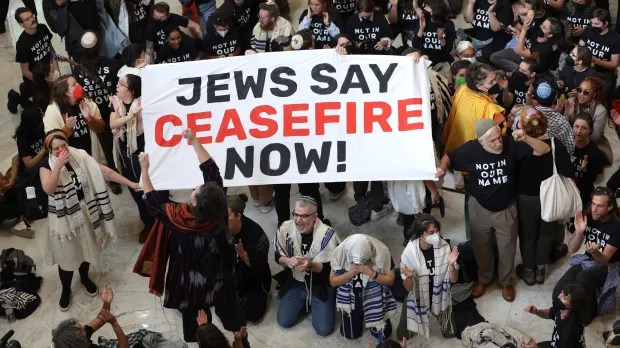
According to the Torah, we must not stand idly by while the blood of our neighbor is being shed. And yet here we are. The world is allowing – if not actively enabling – the mass carnage Israel is inflicting on the people of Gaza. Please do what you can: contact President Biden, tell Congress, write to the press. Hit the streets. Shout it to the world:

 Ceasefire now!

Israel’s Annexation is Just the Tip of the Iceberg

GettyImages-1213058193-e1589916345215

photo: Emmanuel Dunand/AFP via Getty Images

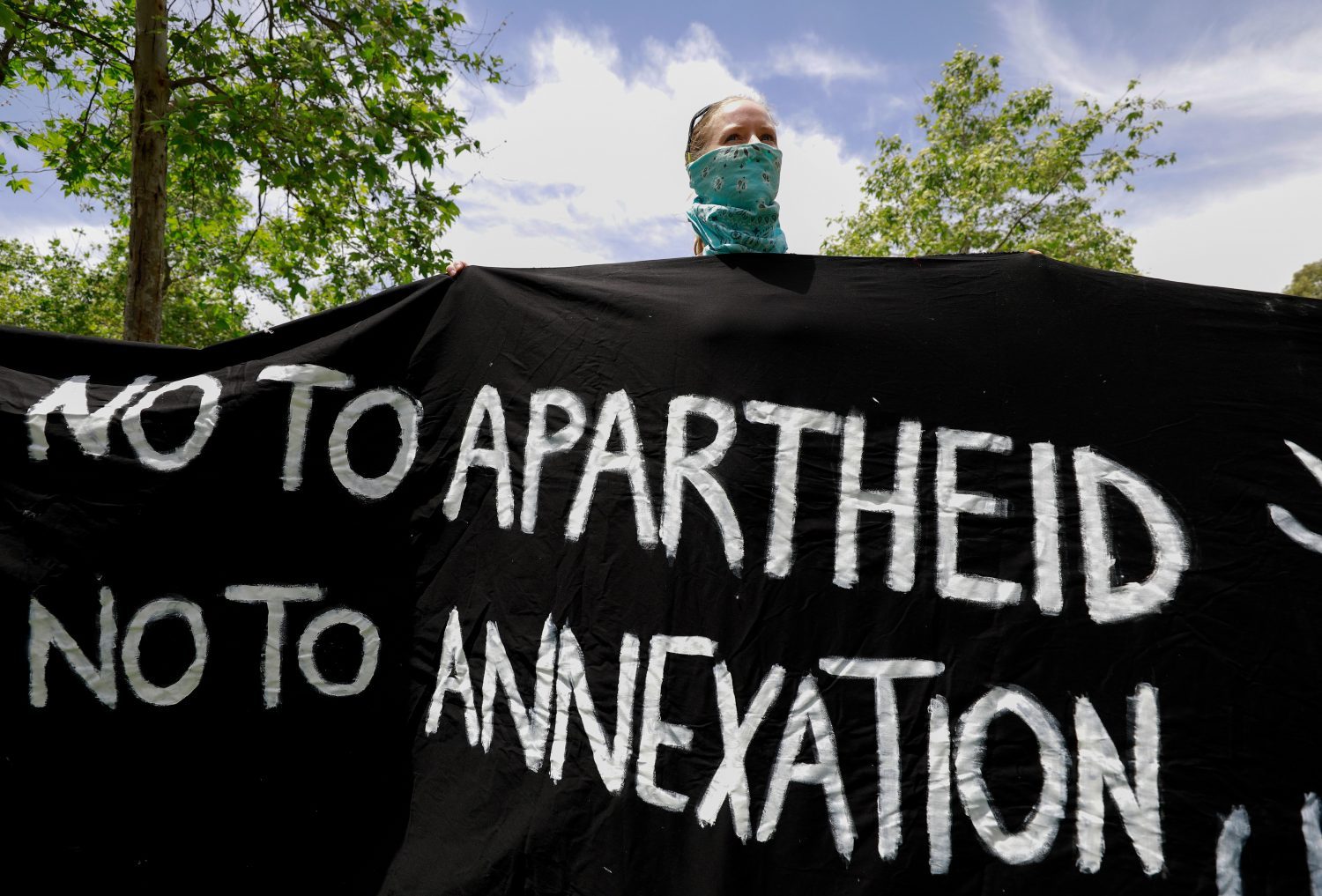
The day of Israel’s annexation of major West Bank settlement blocs has now come and gone. But while it didn’t actually happen, it’s not quite time to breathe a sigh of relief.  The Israeli government has made it clear that annexation plans are continuing apace and has now moved the deadline to later this month.

There’s so much to say about Israel’s plans to extend its sovereignty over major portions of the West Bank. For my part, I anticipated the response of the American Jewish communal establishment with particularly morbid fascination. How would these organizations, hardwired to defend Israel’s actions at all costs, possibly respond to what most would consider to be a patently immoral and undemocratic political move? As it would turn out, their contortions were truly something to behold.

The American Jewish Committee, true to form, doubled down unapologetically. In an article for the Times of Israel, AJC’s Chief Policy and Political Affairs Officer openly stated that when annexation came to pass, “we will make the strongest possible case for a decision reached by an elected Israeli government and supported by Israel’s (and anyone’s) most powerful partner, the United States.” In its FAQ sheet, the Jewish Federations of North America attempted to explain the nuanced differences between “annexation” and “applied sovereignty.” And the Anti-Defamation League, in a leaked internal memo, tellingly agonized over how they might “find a way to defend Israel from criticism without alienating other civil rights organizations, elected officials of color, and Black Lives Matter activists and supporters.”

In the end, the tortured moral/political posturings of these Jewish establishment institutions didn’t really surprise me all that much. They are who they are. But it was much more troubling to read the responses of the “liberal” institutions of the American Jewish community, who continue to enable Israel’s institutional oppression of Palestinians by trotting out their increasingly meaningless talking points of “Jewish and democratic” and “two-state solution” while consistently expressing little to no concern for the well-being of Palestinians themselves.

The Union for Reform Judaism began its statement by announcing its bona fides as “a proud Zionist movement.” It went on to express concern that annexation would “create significant diplomatic risks for Israel, jeopardize Israel’s security, jeopardize North American strategic interests,” and “repudiate the two-state solution.” In a particularly delicate turn of phrase, the URJ mentioned its potential “deleterious impact on the Palestinian people.” Even here, however, the issue was not Palestinian human rights per se, but Israel’s “moral standing,” which depended on “its commitment to ensuring that Palestinians do not live as second-class citizens.”

Another statement, signed by the ten members of the “Progressive Israel Network” (a coalition that includes J Street, the New Israel Fund, Truah, Americans for Peace Now, and my denomination, Reconstructing Judaism) pointed out that annexation would be counter to international law, endanger the well-being of the Palestinian Authority and harm the US-Israel relationship. Carefully avoiding use of the word “apartheid,” the statement expressed concern that annexation “would enact an institutionalized, formal system of discrimination between two ethnic-national populations, both living in the same territory, with each governed by a separate set of laws.”

I’ll confess that when I first heard of the unity government’s plans for annexation, I had a glancing thought that we’d finally arrived at a “moment of truth” for the American Jewish community. I immediately thought better of it, of course. As a former liberal Zionist myself, I’m very familiar with the “window is closing on the two-state solution” trope. It’s a desperate and hollow ploy, designed to avoid facing (or distract attention away from) the hard truth that one-state apartheid has been the reality in Israel/Palestine now for decades. Palestinian activist/scholar Yousef Munayyer put it well in a recent post for +972mag: “Contrary to the popular narrative, annexation will not kill the two-state solution — you cannot kill something that has long been dead. Rather, annexation is dragging and displaying the two-state solution’s corpse before the world.”

So here’s the thing: for years I’ve harbored the assumption that one day the time would come when these liberal Zionists organizations would finally say enough is enough. There is no way Israel can possibly be “Jewish and democratic.” The two state solution is a pipe dream that will only enable further oppression on the ground. The only answer is to give up on the notion of Jewish political nation statehood and advocate for full equality for all who live between the river and the sea.

But no more. I cannot honestly imagine any political event in Israel that would cause these so-called “progressive” Jewish institutions to ever cross this rubicon. Does anyone honestly believe the URJ, who defines itself as a “proud Zionist movement” will ever advocate for one democratic state of all its citizens in Israel/Palestine? Can we truly envision J Street or Americans for Peace Now, organizations that stake their very existence on a “Jewish and democratic” state of Israel, pulling their support for a Jewish state because it has finally become too undemocratic for them?

I have no doubt that when Israel does finally announce its formal annexation, these organizations will move the goalposts yet further down the road. They will studiously avoid use of the word apartheid while implying it could still happen if Israel does not change its ways. It will continue its warnings that Israel’s democracy is under threat, even as its institutional oppression of Palestinians continues to remain so tragically obvious for the world to see.

Consider this: while these organizations agonized over the issue of annexation, the UN Office for the Coordination of Humanitarian Affairs (UNOCHA) released a report that revealed the Israeli military had demolished at least 70 Palestinian buildings in the West Bank during the first two weeks of June, displacing 90 Palestinians. This represented a 250% increase over the weekly average of home demolitions since the beginning of 2020. It was also reported that the during this period the Israeli military forced 20 Palestinian households in East Jerusalem to knock down their own newly-built homes themselves.

This, to put it plainly, is annexation. Annexation is an institutional process by which Israel dispossesses Palestinians so that it can maintain a demographic advantage on land it has long sought to control. Annexation is not a line to be crossed by the Israeli government sometime down the road. It has been happening since 1948 and it is happening right now. And it will continue to happen until the racist system that enables it is finally dismantled.

I know this sounds harsh – perhaps terrifyingly unthinkable – to many in the American Jewish community. But in this powerful political moment, it should be clearer than ever that equity, justice and rights for all people will only happen when we honestly reckon with the legacy of institutional racism. So yes, let’s protest annexation. But let us also commit to fundamentally changing the structures that have been enabling it for far too long. 

When Secular Israelis Claim “God Gave This Land to Us”

danonbible

(photo: AP video)

Israeli Ambassador to the UN, Danny Danon, created something of viral sensation last week when, during a speech in the Security Council, he dramatically brandished a Bible and declared “This is the deed to our land.”

He then continued:

From the book of Genesis; to the Jewish exodus from Egypt; to receiving the Torah on Mount Sinai; to the gates of Canaan; and to the realization of God’s covenant in the Holy Land of Israel; the Bible paints a consistent picture. The entire history of our people, and our connection to Eretz Yisrael, begins right here.

Danon’s use of an ancient religious text as justification for the State of Israel’s right to the land was likely an astonishing moment for many. What on earth was a secular Israeli doing lecturing the UN on “God’s covenant in the Holy Land of Israel?” For those familiar with Zionist pedagogy however, his comments were neither unusual nor unprecedented.

When I heard about Danon’s Biblical tutorial, I immediately recalled a famous story about a 1937 meeting between David Ben-Gurion and Lord Peel, who was then heading the British Royal Peel Commission of Inquiry into the potential partition of Mandate Palestine. According to the story, Lord Peel asked Ben-Gurion where he was born and Ben-Gurion replied that he was from Plonsk, Poland. Lord Peel responded that the Arab leaders with whom he had met were all born in Palestine and most of the Jewish leaders were from Eastern Europe. Peel noted that the Arab people had a kushan (Ottoman land deed) that entitled them to the land – and asked Ben-Gurion if he also had a document that proved the land belonged to him.

At that point, Ben-Gurion became aware of the Bible upon which he had just sworn as a commission witness. He grabbed it, held it up and exclaimed, “Here is your kushan. It is the world’s most highly respected book and I believe that you British regard it with much respect too. We must have this land!”

This phenomenon – that of otherwise secular Israeli Jews proclaiming “God gave this land to us” – is not particularly uncommon. It is actually rooted in the unique form of nationalist ideology that gave rise the state of Israel. If we are to grasp this mentality properly then, we must first understand the early ideological trends that motivated Israel’s original settlers and eventual founders.

Many scholars have pointed out that Zionists – particularly those from Russia and Poland – were markedly influenced by the ideas of European Romantic nationalism (also known as “ethnic nationalism,” “organic nationalism” or “integral nationalism”) an intellectual movement that spread across Europe in the mid-19th century. The early seeds of this ideology were planted in the ideas of Rousseau, Hegel and particularly the German philosopher Johann Gottfried von Herder, who posited that “each nation is separate, distinguished by climate, education, custom, tradition, and heredity.”

These ideas were a powerful part of the ideological fabric of 19th century Europe from which Zionism emerged. In his book “The Founding Myths of Israel,” Israeli historian Zeev Sternhell notes that “Herder’s thinking had tremendous importance in Eastern Europe” during the 19th century and that these ideas were formative for important Labor Zionists such as A.D. Gordon, Berl Katznelson and David Ben-Gurion. Sternhell’s work compellingly demonstrates how otherwise secular socialists could espouse an ideology that articulated a deeply spiritual – and at times almost mystical connection of the Jewish people to land, history, language and ritual:

A cultural-organic conception of the nation necessarily included religion, which it saw as an inseparable part of national identity. This was the case in Eastern Europe, but also in Western Europe, in France and Spain. French integral nationalism was no less Catholic than Polish nationalism, and religion played the same role in it as it did in Poland or Romania. It was a focus of unity and identity, over and beyond social divisions. In integral nationalism religion had a social function, unconnected with its metaphysical content. Generally, it was a religion without God; in order to fulfill its function as a unifying force, religion required only external symbols, not inner content (p. 56, emphasis mine.)

In other words, the settlers and eventual founders of the Jewish state instrumentalized religion, emphasizing its social function to unify the people under one national identity. Indeed, the idea of a “religion without God” can be clearly discerned in the words of many pivotal Zionists. Thus Gordon, the father of Labor Zionism, could in one breath excoriate traditional Judaism with incredible vehemence while claiming that “the greatness of nationalism is its cosmic dimension” (p. 62). Sternhell also describes the venerable Labor Zionist figure, Berl Katznelson, as “a kind of secular rabbi whose strength lay in a direct contact with a sect of believers” (p. 135).

As my anecdote above demonstrates, Ben-Gurion’s world view was also deeply motivated by this mindset. Decades after lifting a Bible before Lord Peel, Ben-Gurion famously convened a study group of archeologists, academics and military officers to read and discuss the Biblical book of Joshua. It was well known that Joshua, which describes the Israelite conquest of Canaan in vivid detail, was Ben-Gurion’s favorite book of the Bible. In keeping with the ways of Romantic nationalists, he considered the Bible to be the Jewish people’s “national epic,” connecting them to a glorious ancient past as well as the a justification for their contemporary settlement of the land.

As American scholar Rachel Haverlock has noted:

Similar to other national movements, Zionism appealed to the glories of an ancient past and brought biblical words and phrases into spoken Hebrew. The Hebrew Bible served as a linguistic source and literary template in the prestate Yishuv and early decades of the State of Israel…

Ben-Gurion saw the biblical war narrative as constituting an ideal basis for a unifying myth of national identity. Not only could modern Israelis relate to the processes of conquest and settlement, but through the prism of Joshua they could also understand them as reenactments of the biblical past (“The Joshua Generation: Conquest and the Promised Land ” p. 309.)

The use of the Bible as national epic was not the exclusive provenance of Labor Zionists. Zeev Jabotinsky, the founder of Revisionist Zionism (the ideology of the present-day Likud party) wrote the 1927 novel, “Samson the Nazirite,” which portrays Samson as a Jewish national hero. Though Jabotinsky was a passionate opponent of Labor Zionism, he and his socialist Zionist compatriots clearly shared a deep attachment to the trappings of Romantic nationalism.

Since the founding of the state (when the Bible was invoked in its Declaration of Independence), these romantic mythic narratives have since exerted an indelible hold over Israeli socio-political culture. Well before Danon’s UN pronouncement one could choose from a myriad of examples. To offer but one more: Netanyahu’s 2015 speech before Congress, in which invoked the Biblical book of Esther to drive home the “threat” of present day Iran to the state of Israel. (“Today the Jewish people face another attempt by yet another Persian potentate to destroy us.”)

With the political ascendency of the settler movement, it might be said that the Romantic nationalism Israel’s of socialist founders has found common cause with religious Zionists who use the Bible to make unabashedly fundamentalist claims on the land. Thus, an extreme nationalist Israeli politician like Ayelet Shaked can be accurately described as “a secular woman from left-leaning Tel Aviv (who has) become the most successful spokesperson for the religious-nationalist party and the settlement movement it strongly supports.” In a sense, we might say that the trajectory of contemporary Zionism has hopelessly conflated secular nationalism and religious ideology into one Biblically-based claim to historic Palestine.

In the end, however, whether it is used by Labor Zionists, Revisionist Zionists or right wing West Bank settlers, the use of the Bible as the “Jewish people’s deed of sale” to the land of Israel represents a radical break with Jewish history, throughout which Jews regarded this text as a religious – not a political – document. It is also a profoundly fraught enterprise, particularly when you consider that the Zionist national epic includes God’s command in the book of Joshua for the Israelites to take the land by force and dispossess its Canaanite residents.

In an era that is currently witnessing the rise of romantic/ethnic (read “white”) nationalism throughout the world once more, it is critical that nations honestly assess what it is that truly binds them together. Is it one people’s “organic right” to a particular land or a commitment to the individual rights of all who dwell upon it?