Category Archives: War

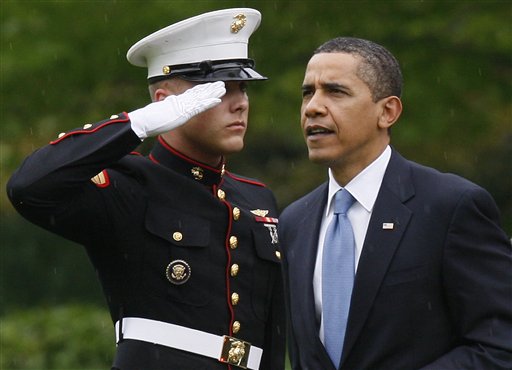
Obama in 2012: Won’t Get Fooled Again

Just happened to glance at a blog post I wrote during the 2008 Presidential General Election campaign entitled “Go Rabbis for Obama!”

Man, what a difference four years makes. I think I can safely say it will be impossible for me to summon the kind of excitement I expressed in that giddy blog post just four short years ago.

Actually, if truth be told, it was just one year into his presidency when I concluded that Obama, from a foreign policy point of view at least, was essentially Bush 2.0.  Now as his first term comes to a close, I’m daring to consider the possibility that he might actually be worse.

I’ve already written a fair amount about my disillusionment on this score – most pointedly in my Yom Kippur serrmon from earlier this year:

For some Americans the most salient lesson of 9/11 was that the world is a dangerous place and we must use military power to mitigate the danger.  I include myself among those who learned a very different lesson: 9/11 taught us that when we intervene militarily abroad, we beget blowback here at home.

Many of us had hope that Obama truly believed this as well – that he would turn back the Bush doctrine and steer our nation’s foreign policy toward a saner course. But as it has turned out, the very opposite has happened. He has embroiled us in even more Mideast wars and has deployed even larger numbers of special operations forces to that region.  He has also transferred or brokered the sale of substantial quantities of weapons to these countries and has continued to build and expand US military bases at an ever-increasing rate.

He also promised to prosecute the so-called “War on Terror” with greater attention to civil liberties, but that hope has been fairly dashed as well.  During his campaign, note what he had to say about this subject:

“As president, I will close Guantanamo, reject the Military Commissions Act, and adhere to the Geneva Conventions. Our Constitution and our Uniform Code of Military Justice provide a framework for dealing with the terrorists. Our Constitution works. We will again set an example for the world that the law is not subject to the whims of stubborn rulers, and that justice is not arbitrary.”

Well, it’s over two years later and Guantanamo is still open. This past March, the Obama administration announced it would be resuming military tribunals there. And just last week, we learned that our President did something truly unprecedented – our President actually approved the extra-judicial assassination of an American citizen in Yemen.

And it’s gotten even worse since then. More recently, we’ve learned that Nobel Peace Prize Laureate Obama has been personally been maintaining a drone “kill list” which, according to the NY Times:

counts all military-age males in a strike zone as combatants … unless there is explicit intelligence posthumously proving them innocent. (Emphasis mine).

Even more recently, the NY Times has revealed that President Obama has been secretly overseeing a massive cyber-war initiative against Iran (known as “Olympic Games”) that, among other things, almost assuredly represents the official kickoff to a global cyber-weapons race. As the article correctly concludes, the blowback to our nation from Obama’s cyber-adventures could potentially be devastating:

(No) country’s infrastructure is more dependent on computer systems, and thus more vulnerable to attack, than that of the United States. It is only a matter of time, most experts believe, before it becomes the target of the same kind of weapon that the Americans have used, secretly, against Iran.

But my disillusionment in the Obama administration is most profound when it comes to its handling Israeli-Palestinian peace process.  I’ve written about this issue over and over as well – but if you still need more convincing that this administration has utterly caved to the Israel lobby and has abdicated any semblance of “honest broker” status in this process, it was recently reported that Obama unabashedly assured a group of Jewish orthodox leaders that his administration is “decidedly more attentive to Israel than it is to the Palestinians.”

All this to say that I’m in a very different frame of mind as Obama now runs for reelection. The giddiness has been replaced with a dose of hard, cold realism about the role of the President in the 21st century national security regime:

Again, from my Yom Kippur sermon:

I’m focusing these observations exclusively on our Commander-in-Chief, but of course I realize that this issue is much, much larger than just one man.  I know it’s natural to look to our primarily to our President, but in truth what we call “Washington” is really a massive bureaucracy that includes a myriad of interests. It’s a far reaching power elite that includes not only the federal government but the national security state, as well as the intelligence and federal law enforcement communities. It also includes big banks and other financial institutions, defense contractors, major corporations and any number of lawyers, lobbyists former officials, and retired military officers, all of whom hold enormous influence over our foreign policy.

So as we swing into summer and we listen to Obama and Romney trade salvos over foreign policy, don’t be fooled – at the end of the day there is less than an inch of daylight between the two.  Mideast analyst Aaron David Miller, in a Foreign Policy post entitled “Barack O’Romney” only half jokingly suggested that if reelected, Obama ought to consider making Mitt Romney his new Secretary of State.  Another respected analyst, MJ Rosenberg, has gone as far as to suggest that President Obama would actually be more likely to bomb Iran than a President Romney.

What should we do with all this hard political realism?  As for me, I’m taking my cue from the classical Jewish text, Pirke Avot:

Love work. Hate authority. Don’t get too friendly with the government. (1:10)

And for good measure:

Be careful with the government, for they befriend a person only for their own needs. They appear to be friends when it is beneficial to them, but they do not stand by a person at the time of his distress. (2:3)

The events of these last four years have provided a painful education for me.  I’ve learned more than ever that it is not politicians who create socio-political change – it is, rather, the people and the movements who make it impossible for them not to.

Yes, there are some important domestic issues at stake in this election (not least of which are potential Supreme Court appointments) but let’s not be fooled into thinking that the future of US foreign policy fundamentally depends on who we choose to be our Commander in Chief.

The real difference will depend on our readiness to hold him accountable once the election is over.

NATO in Chicago: A Meaningless Demonstration

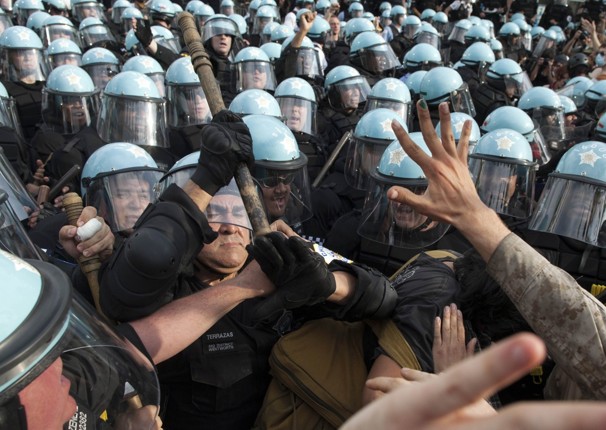
Now that the NATO Summit has swept out of my city, the local press can’t stop fawning over the performance of the Chicago police – and gloating over how silly and meaningless the mass demonstrations turned out to be in the end.

Mission accomplished. With all of the focus on the Chicago streets, I guess we were successfully distracted from the truly meaningless demonstration that was the NATO Summit.

As for me, I’m in full agreement with Stephen Walt, who has correctly pointed out that this massive, fancy, expensive, city-paralyzing event was little more than a “fig-leaf” for NATO – a pageant designed to put a happy face on an Afghanistan war that is hugely unpopular and has suffered from ever-changing objectives from the very beginning.

Actually, Obama’s summit pledge “to responsibly wind down the war” by the summer of 2014 is worse than a fig leaf – it’s simply not true. Earlier this month, Obama visited Afghanistan and signed a pact with Afghan president Hamid Karzai that will ensure a US military presence in Afghanistan until at least 2024. (This agreement was first made in secret, then when the news leaked out, the administration vehemently denied it. Later they conceded it was true, making no attempt to explain why they lied in the first place.)

And please don’t be fooled by the explanation that NATO will be ending “combat operations” by 2014.  Officials have openly stated that these post-2014 “non-combat” troops will continue to launch “anti-terror” raids – which is simply just another way of saying they will continue to do what they’ve been doing all along.

But for the most powerful rejoinder to the farce that was NATO in Chicago, I strongly encourage you to read this important piece by Gary Younge, who pointed out the irony (or if you prefer, the utter hypocrisy) of Mayor Rahm Emanuel’s boast that the summit was “an opportunity to showcase what is great about the greatest city in the greatest country.”

The murder rate in Chicago in the first three months of this year increased by more than 50% compared with the same period last year, giving it almost twice the murder rate of New York. And the manner in which the city is policed gives many as great a reason to fear those charged with protecting them as the criminals. By the end of July last year police were shooting people at the rate of six a month and killing one person a fortnight.

This violence, be it at the hands of the state or gangs, is both compounded and underpinned by racial and economic disadvantage. The poorer the neighbourhood the more violent, the wealthier the safer. This is no coincidence. Much like the NATO summit – and the G8 summit that preceded it – the system is set up not to spread wealth but to preserve and protect it, not to relieve chaos but to contain and punish it…

The paradox inherent in a city like Chicago hosting a summit like this not only lays bare the brutal nature in which these inequalities are maintained at a global level, but it lends us an opportunity to understand how those inequalities are replicated locally.

Chicago illustrates how the developing world is everywhere, not least in the heart of the developed. The mortality rate for black infants in the city is on a par with the West Bank; black life expectancy in Illinois is just below Egypt and just above Uzbekistan. More than a quarter of Chicagoans have no health insurance, one in five black male Chicagoans are unemployed and one in three live in poverty. Latinos do not fare much better. Chicago may be extreme in this regard, but it is by no means unique. While the ethnic composition of poverty may change depending on the country, its dynamics will doubtless be familiar to pretty much all of the G8 participants and most of the NATO delegates too.

The gated communities – like the one in which Trayvon Martin was killed – have been erected on a global scale to protect those fleeing the mayhem wrought by our economic and military policies. This was exemplified last March when a boat with 72 African refugees fled the NATO-led war in Libya. When the boat found itself stranded it sent out a distress signal that was passed on to NATO which had “declared the region a military zone under its control”, and then promptly ignored it, as did an Italian ship. The boat bobbed around in the Mediterranean for two weeks. All but nine on board were left to die from starvation, thirst or in storms, including two babies.

A meaningless demonstration indeed…

What Must Be Said: We All Profit from Occupations

There’s been a great deal of analysis written about German writer Gunther Grass’ now-infamous new poem, “What Must Be Said” (in which Grass criticized Israel’s nuclear program as endangering an “already fragile world peace.”)  For me, the most astute response by far comes from Mideast historian Mark LeVine, writing in Al-Jazeera.

LeVine skillfully parses the psychology and the politics behind the uproar – but it is his identification of the larger context of the issue that resonates most powerfully for me. Here’s a long excerpt from a much longer article. The entire piece is well worth reading:

Israel has always sought to portray itself as a “normal” country, yet goes out of its way to ensure no one “names it” – to use Grass’ words – as what it is, a colonial state that every day intensifies its occupation of another people’s land. And so Grass has taken it upon himself to “say what must be said”, to name Israel as what it is, a “nuclear power” that “endangers the already fragile world peace”. It’s worth noting he doesn’t even mention the occupation, which is the far greater threat to world peace.

I have no idea if Grass really believed himself to be “bound” to Israel; if he did, we can imagine the bond is broken today, at least by Israel, now that he’s banned from returning. But Grass’ feelings are not what’s interesting or important. What’s important is the larger context, all the other “facts” which refuse to be accepted as “pronounced truths”.

These facts are that Israel, however egregious its crimes – and anyone who denies them is either completely ignorant or a moral idiot – is but one cog in a much larger global machine, one that includes too many other cases of occupation, exploitation, and wanton violence to list comprehensively here (we can name a few – Syria, China, Russia, India, Sudan, Saudi Arabia, Iran, Bahrain, Uzbekistan, Sri Lanka, the Congo, and of course, NATO and the United States – whose oppression, exploitation, and murder of their own or other peoples is a far more concrete “fact” than the potential for mass destruction caused by Israel’s nuclear programme)…

The larger fact is that the global economy is addicted to war, to militarism, oil and the rape of the planet for the minerals and resources that fuel the now globalised culture of hyperconsumption that will doom our descendants to a fate we dare not contemplate. Israel’s gluttony for Palestinian territory, and its willingness to encourage a regional nuclear arms race to keep it, is ultimately no different than the the gluttony for the 60-inch TV, the iPhone/Pad, the cavernous homes and cars, the ability to live at levels of consumption that are only sustainable if most of the world lives in poverty that increasingly defines all our cultures.

Israel has gotten Palestine on the cheap, and it costs relatively little to continue the occupation. Far less than it would cost to end it. So why bother? Especially when everyone else is doing, more or less, the same thing and, it’s clear, no one really cares anymore. Germany, whose remarkable economic stability in the recent global financial crisis is in good measure due to its central role in this global economy of hyper-consumption (think of all the energy and resources that go into making and driving all those fancy German cars), is certainly playing its role all too well.

If Grass is right that we must talk about the threat to world peace posed by Israel’s nuclear programme – and far more by its ongoing occupation – then we must also talk about the threat to global peace posed by the sick global system of which Israel is merely one of the more easily identifiable symptoms. Unlike my parents, I’m happy that Germans finally feel secure enough publicly to speak critically about Israel. But if they want their words to have a chance of bringing about a change in its behaviour, they, and everyone else, needs to broaden the discourse to include their own role in enabling and profiting from the system that Israel’s actions so benefits, and the global scope of the victims it daily produces.

Of course, this discourse would require a much longer and more complex poem, written by an even better poet than Grass. If someone manages to write it, I hope it will get the same publicity as “What Must Be Said”.

Moral Courage from the General’s Son

Please, please take 30 minutes of your time to watch this presentation by Israeli peace activist, Miko Peled, author of the recently published book, “The General’s Son.”

Among other things, Peled’s ideas and convictions carry a profound sense of moral authority because he comes with impeccable Zionist credentials. His grandfather, Avraham Katznelson, was a prominent Zionist leader and signer of the Israeli Declaration of Independence. His father Matti Peled was a major Israeli military leader who fought in the 1948 War of Independence and was an Aluf (“Major-General”) during the 1967 Six-Day War. He later became a scholar of Arabic literature, a leftist politician, and a prominent Israeli advocate of peace talks with the PLO.

Miko is following in his father’s footsteps in more ways than one. In reading his book, it is so clear to me that he is an Israeli through and through and very much a product of his family’s remarkable history. At the same time, he has carried his father’s work of moral witness firmly into the 21st century.

In the video above, he addresses what he considers the fundamental myths of Israeli society: the “Land Without a People for a People Without a Land” myth of 1948, the “War of Survival” myth of 1967, and the myth of “Israeli democracy.” He also speaks eloquently about the moral outrage of the war in Gaza and the issue of Palestinian terror.  (Tragically, Peled’s family has first-hand experience with the latter subject: his niece Smadar was killed by a Palestinian suicide bomber in Jerusalem in 1997).

Please watch the clip and send the link on. Moral heroes such as Miko Peled deserve the widest possible audience.

PS: I’m thrilled to be able to say that the publisher of “The General’s Son,” Just World Books, will be soon publishing my book – a curated anthology of “Shalom Rav” posts and comments from 2008-2010.  Much more on this soon – stay tuned!

On “Rogues” in Afghanistan and the “Insanity” of War

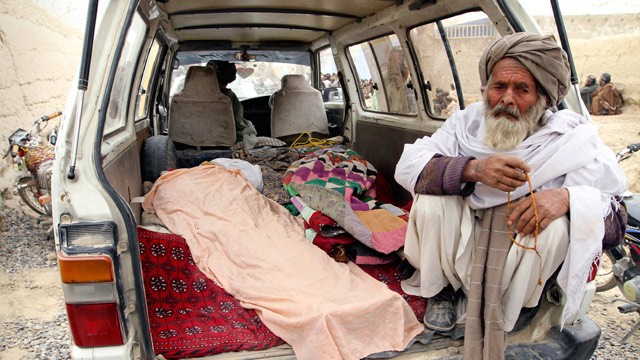
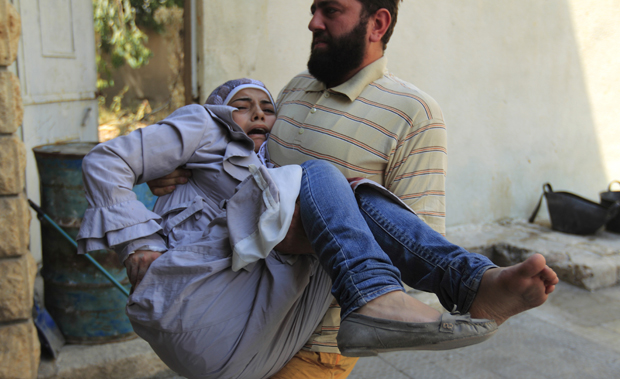
Four Marines urinate on Taliban corpsesUS troops burn Korans on an American army base. Now an American solider has murdered 16 Afghan civilians (including nine children and three women) before burning their corpses.

I’m not paying one whit of heed to what our leaders are telling us about this horrid tragedy. We’re told this act was the work of one lone deranged gunman – and it may well be, despite the fact that some eyewitnesses reported seeing more than one shooter – and other locals are publicly dubious that a single soldier could have shot and killed 16 civilians in houses over a mile apart then burned the bodies afterward.

Defense Secretary Leon Panetta’s explanation: “War is hell.” Yes, I suppose it is, but we are all sadly, tragically deluded if we feel we can sugar-coat the insanity of war by dismissing this incident as the handiwork of one “rogue” gunman.  I’m always fascinated that when these kinds of atrocities occur, defenders of war practically fall over themselves explaining that it was the work of “deranged individuals.” The sad truth is that in war, atrocities are the rule – not the exception.

Camillo “Mac” Bica, writing in a recent op-ed hit this point right on the head:

(Soldiers in war) are dehumanized and desensitized to death and destruction. Judgments of right and wrong – morality – quickly become irrelevant, and cruelty and brutality become a primal response to an overwhelming threat of annihilation. Consequently, atrocities in such an environment are not isolated, aberrant occurrences prosecuted by a few deviant individuals. Rather, they are commonplace, intrinsic to the nature and the reality of war, the inevitable consequence of enduring prolonged, life-threatening and morally untenable conditions, what psychologist Robert Jay Lifton describes as “atrocity-producing situations.”

Let’s assume for the sake of argument that there was only one shooter in this recent tragedy. Authorities report that he was in his fourth combat deployment in ten years and that he had suffered from a war-related head injury. Does this describe a “rogue” gunman to you?  I’d say given the insane circumstances in which his nation had placed him, his actions sound eminently understandable.

Afghanistan is now officially our longest war – i.e., the longest example of mass psychosis in our nation’s history. Contrary to what our leaders have been telling us, we are not experiencing anything resembling “success” in that country. The longer we stay, the more we will continue to desensitize and dehumanize the young Americans we have seen fit to place there – and the more we will continue to rain death and destruction upon the people of that country. Indeed, our interminable presence in Afghanistan virtually guarantees we will see more “rogue” incidents like the one we witnessed this past weekend.

The classic midrashic commentary “Mechilta of Rabbi Ishmaelteaches: When an arrow leaves the hand of a warrior he cannot take it back.  God help us if we truly believe we can control the insane forces we’ve unleashed in Afghanistan. It’s time to come to our senses and bring our troops home.

Rabbis of JVP Call on Obama: Don’t Let Bibi Pressure US into War on Iran!

The Jewish Voice for Peace Rabbinical Council has just released the following statement, below. If you are a rabbi or cantor, please consider signing on.

We, the undersigned American Jewish clergy, are deeply concerned about reports that Prime Minister Netanyahu will demand of President Obama, at their meeting at the White House today, that either the United States attack Iran, or else, Israel will.

We do not welcome the prospect of a nuclear-armed Iran. We call on all the military forces in the region – including Israel’s – to divest themselves of their nuclear armaments and renounce any belligerent nuclear aspirations.

The State of Israel refuses to acknowledge its own nuclear arsenal or to submit to international monitoring. We believe it is hypocritical of Israel to demand of Iran what it refuses to agree to itself.

Most of the people of the State of Israel oppose Prime Minister Netanyahu’s military threats against Iran. They fear the consequences of an attack on Iran. As Jewish leaders, we too believe that the path of wisdom towards achieving peace and stability in the region is through dialog and engagement and not through acts of war. We call on the United States government to safeguard the interests of the people of Israel and Iran.

Nine years after the United States launched a war against Iraq that is widely recognized as having been badly executed and unjustified, Israel would have the U.S. implicate itself in a new war in the region, this time against Iran. We believe that Jews, and other Americans, will not support more reckless adventurism in the Middle East.

In this election year, we call on President Obama not to give in to warmongering. As Jewish leaders we cannot endorse an Israeli act of war against the people of the Islamic Republic of Iran. The Bible teaches us: “bakesh shalom v’rodfehu –  seek peace and pursue it.” We urge President Obama to stand firm and to use his power as Israel’s chief supporter to draw Israel to the path of peace and justice.

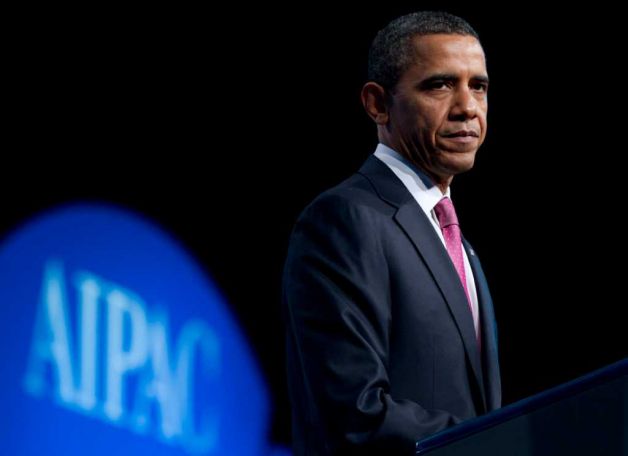
In the meantime, I strongly recommend MJ Rosenberg’s analysis of Obama’s much-anticipated speech at the AIPAC conference yesterday:

The President, in the middle of an election year, offered AIPAC no more than the bare minimum. In order to get away with that, he larded up the speech with embarrassing professions of love for Israel. I say embarrassing because no other country in the world demands such endless coddling. If a president spoke about Canada or the United Kingdom (two far closer allies) the way Obama does about Israel, he might be considered seriously off his game. Not to worry, he won’t.

But the lard doesn’t mean much except to smooth his way to the substance of the speech which Obama knew that neither AIPAC nor Prime Minister Netanyahu would like.

I Support the Presbyterian Church (USA) Divestment Resolution

As a Jew, a rabbi and a person of conscience, I am voicing my support of the divestment resolution being brought to the General Assembly of the Presbyterian Church (USA) this June.

This resolution, which has been a point of divisive contention between the PC (USA) and some American Jewish organizations for many years,  recommends that the Church divest its funds from Caterpillar, Motorola and Hewlett-Packard. It was put forth by the church’s committee on Mission Responsibility Through Investment – an appointed body that recommended church divestment of companies engaged in “non-peaceful pursuits in Israel/Palestine.”

There is a long and tumultuous history to this resolution – here’s a basic outline:

– In 1971 and 1976 the Presbyterian Church stated that it had a responsibility to ensure that its funds be invested responsibly and consistent with the church’s mission.

– In 1986, the PC (USA) formed the Committee for Mission Responsibility Through Investing (MRTI) in 1986. The MRTI Committee carried out the General Assembly’s wish to engage in shareholder activism and as a last resort, divest itself of companies which contravened the GA’s position. Divestment would follow a phased process starting with attempted dialogue and shareholder resolutions and ultimately the total sale of and future ban on the church’s holdings in a company.

– In June 2004, the PC (USA) General Assembly adopted by a vote of 431-62 a resolution that called on the MRTI Committee “to initiate a process of phased, selective divestment in multinational corporations operating in Israel.” The resolution expressed the church’s support of the Geneva Accord, said that “the occupation . . . has proven to be at the root of evil acts committed against innocent people on both sides of the conflict,” that “the security of Israel and the Israeli people is inexorably dependent on making peace with their Palestinian neighbors”, that “horrific acts of violence and deadly attacks on innocent people, whether carried out by Palestinian suicide bombers or by the Israeli military, are abhorrent and inexcusable by all measures, and are a dead-end alternative to a negotiated settlement,” and that the United States government needed to be “honest, even-handed broker for peace.”

– In 2005, MRTI Committee named five US-based companies – Caterpillar Inc., Citigroup, ITT Industries, Motorola and United Technologies – for initial focus and that it would engage in “progressive engagement” with the companies’ management.

– In 2006, following an uproar of criticism from American Jewish organizations, the PC (USA) General Assembly overwhelmingly (483-28) replaced language adopted in 2004 that focused the “phased, selective divestment” specifically on companies working in Israel.  It now called for investment in Israel, the Gaza Strip, eastern Jerusalem and the West Bank “in only peaceful pursuits.” The new resolution also required the consideration of “practical realities,” a “commitment to positive outcomes” and an awareness of the potential impact of strategies on “both the Israeli and Palestinian economies.”  The 2006 resolution also recognized Israel’s right to build a security barrier along its pre-1967 boundaries. The GA acknowledged the “hurt and misunderstanding among many members of the Jewish community and within our Presbyterian communion” that resulted from the 2004 resolution and stated that the Assembly was “grieved by the pain that this has caused, accept responsibility for the flaws in our process, and ask for a new season of mutual understanding and dialogue.”

The most recent resolution is the result of this new process and now focuses on three of the original six companies under consideration.  From the PC (USA) website:

The General Assembly Mission Council (GAMC) is recommending that the upcoming 220th General Assembly of the Presbyterian Church (USA) divest the church of its stock in three companies “until they have ceased profiting from non-peaceful activities in Israel-Palestine.”

The three companies are Caterpillar, Motorola Solutions and Hewlett-Packard.

At issue are their participation in the Israeli occupation of the West Bank, the construction of the “security barrier” between Israel and Palestinian territory, and the destruction of Palestinian homes, roads and fields to make way for the construction of Israeli settlements in the West Bank, which have been declared illegal under international law.

“We have run out of hope that these companies are willing to change their corporate practices [in Israel-Palestine],” said the Rev. Brian Ellison, a Kansas City pastor and chair of the denomination’s Mission Responsibility Through Investment Committee (MRTI). “We have made diligent effort to engage in conversation. We’d like to do more, to make progress, but substantial change does not seem possible.”

As stated above, I support this resolution without reservation and urge other Jewish leaders and community members to do so as well. I am deeply dismayed that along every step of this process, Jewish community organizations (among them, the Anti-Defamation League, the Simon Wiesenthal Center and the Jewish Council on Public Affairs) that purport to speak for the consensus of a diverse constituency have been intimidating and emotionally blackmailing the Presbyterian Church as they attempt to forge their ethical investment strategy in good faith.

It is extremely important to be clear about what is at stake here. First of all, this is not a resolution that seeks to boycott or single out Israel. Divestment does not target countries – it targets companies.  In this regard speaking, the PC (USA)’s ethical investment process seeks to divest from specific “military-related companies” it deems are engaged in “non-peaceful” pursuits.

We’d be hard-pressed indeed to make the case that the Israeli government is engaged in “non-peaceful pursuits” in the Occupied Territories and East Jerusalem.  I won’t go into detail here because I’ve been writing about this tragic issue for many years: the increasing of illegal Jewish settlements with impunity, the forced evictions and home demolitions, the uprooting of Palestinian orchards, the separation wall that chokes off Palestinians from their lands, the arbitrary administrative detentions, the brutal crushing of non-violent protest, etc, etc.

All Americans – Jews and non-Jews alike – have cause for deep moral concern over these issues.  Moreover, we have cause for dismay that own government tacitly supports these actions. At the very least, we certainly have the right to make sure that our own investments do not support companies that profit from what we believe to be immoral acts committed in furtherance of Israel’s occupation.

As the co-chair of the Jewish Voice for Peace Rabbinical Council, I am proud that JVP has initiated its own divestment campaign which targets the TIAA-CREF pension fund, urging it to divest from companies that profit from Israel’s occupation. Among these are two of the three companies currently under consideration by PC (USA): Motorola and Caterpillar.

Why the concern over these specific companies? Because they are indisputably and directing aiding and profiting the oppression of Palestinians on the ground. Caterpillar profits from the destruction of Palestinian homes and the uprooting of Palestinian orchards by supplying the armor-plated and weaponized bulldozers that are used for such demolition work.  Motorola profits from Israel’s control of the Palestinian population by providing surveillance systems around Israeli settlements, checkpoints, and military camps in the West Bank, as well as communication systems to the Israeli army and West Bank settlers.

And why is Hewlett-Packard under consideration for divestment by the PC (USA)? HP owns Electronic Data Systems, which heads a consortium providing monitoring of checkpoints, including several built inside the West Bank in violation of international law.  The Israeli Navy, which regularly attacks Gaza’s fishermen within Gaza’s own territorial waters and has often shelled civilian areas in the Gaza Strip, has chosen HP Israel to implement the outsourcing of its IT infrastructure.  In addition, Hewlett Packard subsidiary HP Invent outsources IT services to a company called Matrix, which employs settlers in the illegal settlement of Modi’in Illit to do much of its IT work at low wages.

I repeat: by seeking to divest from these companies the PC (USA) is not singling out Israel as a nation.  The Presbyterian Church has every right to – and in fact does – divest its funds from any number of companies that enable non-peaceful pursuits around the world.  In this case specifically, the PC (USA) has reasonably determined that these particular “pursuits” aid a highly militarized, brutal and oppressive occupation – and it simply does not want to be complicit in supporting companies that enable it.

I am fully aware that there are several organizations in the Jewish community that are already gearing up a full court press to intimidate the PC (USA) from passing this resolution in June.  JCPA President Rabbi Steve Gutow recently accused national Presbyterian leaders of “making the delegitimization of Israel a public witness of their church.” The Simon Wiesenthal Center has called the resolution “poisonous,” and that by considering it the PC (USA) is “showing its moral bankruptcy.”

These sorts of statements do not speak for me nor, I am sure, do they speak for the wide, diverse spectrum of opinion on the issue in the American Jewish community.  There is no place for public bullying in interfaith relations – it is, needless to say, decidedly counter to principles of honest, good faith dialogue.  To our Presbyterian friends: please know there are many Jewish leaders who stand with you as you support the cause of peace and justice in Israel/Palestine.

In a recent open letter to the PC (USA), Rabbi Margaret Holub, my colleague on the JVP Rabbinical Council expressed this sentiment eloquently with the following words:

Your Church has long been active in pursuing justice and peace by nonviolent means, including divestment, in many places around the world.  As Christians, you have your own particular stake in the land to which both our traditions have long attachments of faith and history.  We particularly acknowledge the oppression of Palestinian Christians under Israeli occupation and the justice of your efforts to relieve the oppression directed against your fellows.

To advocate for an end to an unjust policy is not anti-Semitic.  To criticize Israel is not anti-Semitic.  To invest your own resources in corporations which pursue your vision of a just and peaceful world, and to withdraw your resources from those which contradict this vision, is not anti-Semitic.  There is a terrible history of actual anti-Semitism perpetrated by Christians at different times throughout the millennia and conscientious Christians today do bear a burden of conscience on that account.  We can understand that, with your commitment to paths of peace and justice, it must be terribly painful and inhibiting to be accused of anti-Semitism.

In fact, many of us in the Jewish community recognize that the continuing occupation of Palestine itself presents a great danger to the safety of the Jewish people, not to mention oppressing our spirits and diminishing our honor in the world community.  We appreciate the solidarity of people of conscience in pursuing conscientious nonviolent strategies, such as phased selective divestment, to end the occupation.

I am proud my name is under this letter, alongside many other members of our Rabbinical Council. If you stand with us, please join us in supporting the PC (USA) divestment resolution at their GA in Pittsburgh this summer.
War on Iran: Recent Must Reads

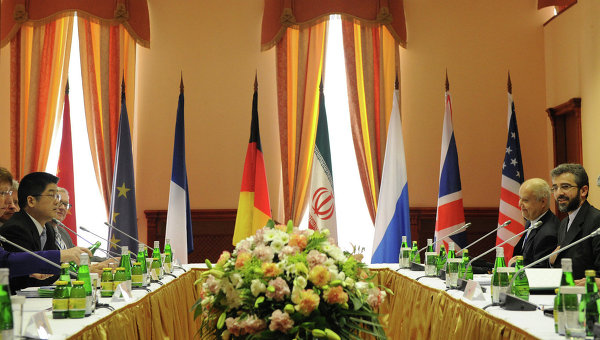
A few voices of sanity as the drumbeats for a US and/or Israeli military strike on Iran reach a fever pitch. First, here’s Gary Sick’s smart blog post addressing Ronen Bergman’s egregiously alarmist cover story in the New York Times Magazine last Sunday:

Bergman’s dramatic statement that “I have come to believe that Israel will indeed strike Iran in 2012,” is also nothing new — it simply changes the date. We heard the same thing a year ago from Jeffrey Goldberg of The Atlantic, and two years before that from uber-hawk John Bolton, who confidently predicted that the U.S. and/or Israel would strike Iran before George W. Bush left office.  It is becoming almost an annual ritual.

Why do these false alarms keep going off? Bergman suggests an answer with disarming honesty: “Some have argued that Israel has intentionally exaggerated its assessments to create an atmosphere of fear that would drag Europe into its extensive economic campaign against Iran…” To this, the ubiquitous “senior American official” adds that “It is unclear if the Israelis firmly believe this or are using worst-case estimates to raise greater urgency from the United States.” In other words, Israel benefits by keeping the pot near the boiling point so that no one can ignore the Iran issue, even for a moment.

Tom Englehardt’s op-ed in Al Jazeera English:

The only issue seriously discussed in this country is: How exactly can we do it, or can we do it at all (without causing ourselves irreparably greater harm)? Effectiveness, not legality or morality, is the only measurement. Few in our own little world (and who else matters?) question our right to do so, though obviously the right of any other state to do something similar to us or one of our allies, or to retaliate or even to threaten to retaliate, should we do so, is considered shocking and beyond all norms, beyond every red line when it comes to how nations (except us) should behave.

This mindset, and the acts that have gone with it, have blown what is, at worst, a modest-sized global problem up into an existential threat, a life-and-death matter. Iran as a global monster now nearly fills what screen-space there is for foreign enemies in the present US moment. Yet, despite its enormous energy reserves, it is a shaky regional power, ruled by a faction-ridden set of fundamentalists (but not madmen), the most hardline of whom seem at the moment ascendant (in no small part due to US and Israeli policies). The country has a relatively modest military budget, and no recent history of invading other states. It has been under intense pressure of every sort for years now and the strains are showing. The kind of pressure the US and its allies have been exerting creates the basis for madness – or for terrible miscalculation followed by inevitable tragedy.

And this one is a few weeks old already, but it’s still haunting my dreams: Mark Perry’ deeply disturbing expose for Foreign Policy that describes how Israel recruited members of a terrorist organization to fight their covert war against Iran. If you have any doubt about how reckless Israel has become in its determination to bring down the regime in Iran, please take the time to read this one.

The kicker:

While many of the details of Israel’s involvement with Jundallah are now known, many others still remain a mystery — and are likely to remain so. The CIA memos of the incident have been “blue bordered,” meaning that they were circulated to senior levels of the broader U.S. intelligence community as well as senior State Department officials.

What has become crystal clear, however, is the level of anger among senior intelligence officials about Israel’s actions. “This was stupid and dangerous,” the intelligence official who first told me about the operation said. “Israel is supposed to be working with us, not against us. If they want to shed blood, it would help a lot if it was their blood and not ours. You know, they’re supposed to be a strategic asset. Well, guess what? There are a lot of people now, important people, who just don’t think that’s true.”

Thousands of US Troops To Be Deployed in Israel?

How did this one slip in under the media radar (pun intended)?

From the Jerusalem Post 12/20:

Israel is moving forward with plans to hold the largest-ever missile defense exercise in its history this spring amid Iranian efforts to obtain nuclear weapons.

Last week, Lt.-Gen. Frank Gorenc, commander of the US’s Third Air Force based in Germany, visited Israel to finalize plans for the upcoming drill, expected to see the deployment of several thousand American soldiers in Israel.

This is not the first example of US military presence on Israeli soil. Back in 2008, it was reported that 120 US military technicians and advisers were permanently in Israel to help operate a new early-warning radar system that was designed to ward of a potential Iranian missile attack.

But the deployment of “several thousand American soldiers” in Israel is something else entirely. Could there be any more ominous sign of the “special relationship” between these two military-industrial juggernauts?

BTW, shortly after this report was issued, the chief of the Mossad publicly stated a nuclear Iran would not pose an existential threat to Israel. And still the drumbeats grow ever louder.

This one hasn’t trickled down to the mainstream media yet and clearly needs more independent confirmation. But for those hoping against hope that 2012 would be a more peaceful year, I’d say things are off to a pretty dismal start…

Israel Seeks Attack on Iran (aka “Politics as Usual”)

Netanyahu is seeking support in his cabinet for a military attack on Iran. Shimon Peres has just said an attack is “more and more likely.” This, despite the fact that numerous leaders in Israel’s security establishment, including former Mossad chief Meir Dagan, feel that such action would be disastrous.

Make no mistake: this has nothing to do with any imminent threat and everything to do with politics. Even Defense Minister Ehud Barak has said publicly he doesn’t believe Iran would ever drop a nuclear bomb on Israel.

So why this latest panic? Ha’aretz columnist Akiva Eldar hits it right on the head: Netanyahu knows that Obama is politically hamstrung on this issue and he smells serious blood in the water:

(Newt) Gingrich…declared at the week’s end that if the Israeli prime minister reaches the conclusion that the country is in danger, no American president could doubt it and expect Israel to sit with its arms folded and face the danger of another Holocaust. One of his rivals for the candidacy, Rick Perry, then hastened to announce that if Israel decided to attack Iran, he would demand that the United States stand behind it.

What do they have to lose? If this is a false threat designed to goad the United States into exerting more pressure on Tehran, they can wave their support. If a military assault is a new version of the last war in Iraq, they will be able to place the blame on President Barack Obama.

The problem with all this political saber-rattling, as Iran analyst Trita Parsi correctly points out, is that the more Israel presses its cynical “another Holocaust” narrative against Iran, the harder it will be “for any Israeli politician to walk back the threat depiction without losing critical political capital at home.” In other words, all this political bluster could well create a disastrous military fait accomplis.

Last word to David Remnick, who recently posted an important piece on this subject in the New Yorker blog:

A unilateral attack from Israel…would be a grave mistake for all the reasons made plain by Meir Dagan and so many others. It is terrible enough to imagine what might happen if Iran came to possess a bomb; but an attack now would almost certainly lead to a tide of blood in the region. The Middle East today is in a state of fragile possibility, full of peril, to be sure, but also pregnant with promise. A premature unilateral attack could upend everything and one result of many would be an Israel under fire, under attack, and more deeply isolated than ever before.