In Israel, Every Sperm is Sacred

This just in:

(The) quality of Israeli sperm is falling at an alarming rate, and no one’s sure exactly why.

Fertility is a major issue in Israel, where memories of the Holocaust genocide are fresh, and having children is an entrenched part of Judaism. There’s also a political aspect, because birthrates among Arabs in Israel have at times been as much as double those of Jews, triggering a population race that some believe could one day affect who controls the land.

…The white-coated director of the Hadassah Sperm Bank, Ruth Har-Nir, hunches over a microscope to view a freshly donated specimen and begins to methodically count each squiggly swimmer magnified on the slide.

… After a quick scan, she sits up straight and shakes her head. The number of spermatozoa darting around each tiny grid on the slide is two to four, well below the minimum six required, and nowhere near the 10 to 20 per grid that indicates the kind of healthy concentration the bank likes to see.

Also, rather than surging forward, some of the little guys flit left and right or just stall out, suggesting a weak motility.

“Under no circumstances can we accept sperm of this quality,” she says.

No, it’s not Monty Python.  Just the kind of black comedy gold that ensues when a nation fights a “demographic time bomb”

“Wrestling in the Daylight” Launch Party!

Please join me in celebrating the publication of my new book, “Wrestling in the Daylight: A Rabbi’s Path to Palestinian Solidarity” on Thursday, September 6, 7:00 pm at The Book Cellar, 4736-38 N. Lincoln Ave, Chicago.

From a recent review by Rabbi Rachel “Velveteen Rabbi” Barenblat:

Gwen Macsai

“Wrestling in the Daylight”… is Rabbi Brant’s self-curated compilation of his blog posts from Shalom Rav, so if you’ve been reading Shalom Rav, this material won’t be new to you. But I’m finding, as I read, that reading the posts in this new setting and context — curated by their author into a narrative which clearly shows the progression of his thinking over time — is a different experience from reading the blog. And Rabbi Brant has chosen to reprint some of the comments from readers as well as responses he’s offered to those comments, which gives the book a bit of the internet’s Talmudic multivocality (and offers an example of how one can host difficult conversations in a thoughtful and generous way — which can be hard to come by on the internet, especially on questions of Israel/Palestine.)

Andrew White

The choice to include commentary makes the book particularly interesting, I think. Some of Rabbi Brant’s most frequent commentors disagree with him deeply. Over the course of the book, one can see conversations unfolding. Sometimes they are quite heated. And his responses are always thoughtful and respectful, even as he resists attempts at derailing the conversation. Having hosted some conversations about Israel at this blog over the years, I have a sense for how difficult that can be.

Kevin Coval

… Rabbi Brant Rosen is one of my role models in the difficult but important work of coming to terms with the clash between the classic Zionist narrative (a story which many of us want to continue believing — I know I still yearn for it to be true) and some of the realities on the ground in Israel and the Palestinian territories. He models for me not how one would do this internal work despite his ardent Jewishness, but precisely of it; not despite being a rabbi, but precisely because his rabbinate calls him to take seriously the Jewish call to stand with those who are oppressed. And he has also taught me a great deal about how to disagree without falling into the trap of looking down on (or dehumanizing) those with whom one disagrees.

If you’re interested in progressive Jewish takes on Israel and Palestine, this book is worth reading, and worth having on your bookshelf to return to again.

I’m thrilled to be joined at our September launch party by local Chicago celebs Kevin Coval, (Poet, Co-Founder, “Louder Than a Bomb“), Gwen Macsai, (Host, WBEZ’s Re:Sound) and Andrew White (Artistic Director, Lookingglass Theatre Company), who will join me in reading excerpts from the book. We’ll also make plenty of time for Q&A, book signing and quality bookstore shmoozing.

It promises to be a wonderful evening – RSVP at our Facebook event page here.

Standing Down Rep. Joe Walsh’s Islamophobic Bigotry

Shortly after a gunman killed six worshipers in a Wisconsin Sikh temple and a Joplin Missouri mosque was burned to the ground, Illinois Congressman Joe Walsh felt perfectly comfortable uttering incendiary anti-Muslim comments at a town hall meeting last Wednesday, warning that “there is a radical strain of Islam in this country…trying to kill Americans every week.”  Offering no evidence or backup for his allegations, he continued: “It’s here. It’s in Elk Grove, it’s in Addison, it’s in Elgin. It’s here.”

Then he poured it on:

I’m looking for some godly men and women in the Senate, in the Congress, who will stand in the face of the danger of Islam in America without political correctness.  Islam is not the peaceful, loving religion we hear about.

Shortly after Walsh’s town meeting remarks, pellet rifle shots were fired at a mosque in Morton Grove, IL.

I don’t know about a domestic “radical Islamic plot” but by now it should be abundantly clear that there is a deadly strain of Islamophobia in our country. In such a climate, I’d say it is the height of irresponsibility for public servants to issue remarks such as these.

It was my honor to stand, together with interfaith colleagues, with my good friends at CAIR – Chicago to express our outrage at Walsh’s sick bigotry (clip above). If you stand with us, please, please let Rep. Walsh know how you feel.

Talking Tikkun Olam on Poco a Poco Radio

I recently had the pleasure, along with my good friend, community organizer extraordinaire Michael Deheeger (left), to be interviewed by Gonzalo and Maya Escobar for the Poco a Poco Radio program on WLUW 88.7 Chicago. During our wonderfully wide-ranging bilingual conversation, we had the opportunity to explore the Jewish roots of social justice and how it informs our work as activists.

Chicago locals can hear the interview on Sunday, August 12 1:30 pm at 88.7 FM, but anyone anywhere can tune in to the live stream from the WLUW website. And if you can’t catch it live, never fear – the full version of the interview will soon be archived at the site.

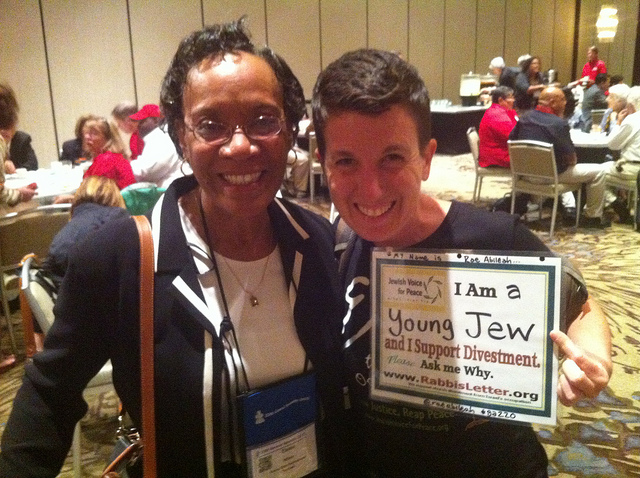
Parsing the (Odious) New Term, “Jew-Washing”

photo: Jewish Voice for Peace

Cross-posted in the “Forward Thinking” blog of the Jewish Daily Forward:

In his latest column, Philologos correctly parses the linguistic problems with Yitzhak Santis and Gerald M. Steinberg’s invented term, “Jew-washing.” His political analysis, alas, fails miserably.

Philologos has it completely wrong when he speaks of the “anti-Semitism in boycotts of Israel.” To begin with, Santis and Steinberg did not use the term “Jew-washing” in reference to a boycott of Israel as a whole, but rather to a resolution recently brought to the Pittsburgh General Assembly of the Presbyterian Church (USA) that called for divestment of their pension funds from three specific companies that profit from Israel’s brutal and illegal occupation of the West Bank.

Regardless, it is highly disingenuous for Philologos to accuse the Presbyterian Church of anti-Semitism. Our Christian friends’ response to the Palestinian civil society call for Boycott, Divestment and Sanctions (BDS), reflects their deeply held commitment to justice in a land their tradition also considers holy.

Philologos asks, “Have the Presbyterians considered boycotting China because of Tibet? India because of Kashmir? Russia because of Chechnya?” This, of course, is classic misdirection. The issue at hand is not global human rights, but a very specific call from Palestinian civil society for international support in ending their oppression.

The real question before them (and us) is not “what about Tibet, Kashmir and Chechnya?”  The question, rather, is: “will we or won’t we respond to the Palestinian call?” To this question, many members of the Presbyterian Church are courageously responding “we will.” So too are increasing numbers of Jews who believe that our legacy of anti-Jewish oppression leads us to stand with Palestinians being denied basic human rights in our name.

No, we are not being used as pawns by Christian partners to further some nefarious “anti-Semitic plot”. Rather, we are standing in solidarity with the oppressed, as the most basic of our Jewish teachings demand that we do.  What irony that other Jews should stand in the way of the Jewish imperative to end injustice. How heartbreaking that some in the Jewish community pervert this imperative by labeling the best intentions of our Christian friends as “anti-Semitism.”

We do, however, fully share Philogos’ distaste for the term “Jew-washing,” the coining of which is a sign of abject desperation that itself crosses the line of anti-Semitism, as blogger Jeremiah Haber pointed out last week. We predict that odious terms such as this will soon be relegated to the history books as part of a last, flailing effort by a fearful generation of Jewish leaders unwilling to recognize the moral urgency of the moment. It also reflects the short-sightedness of an establishment that continues to support war and occupation while deliberately alienating itself from the next generation of courageous Jewish leaders.

Syrians Pay the Price in a Sick Proxy War

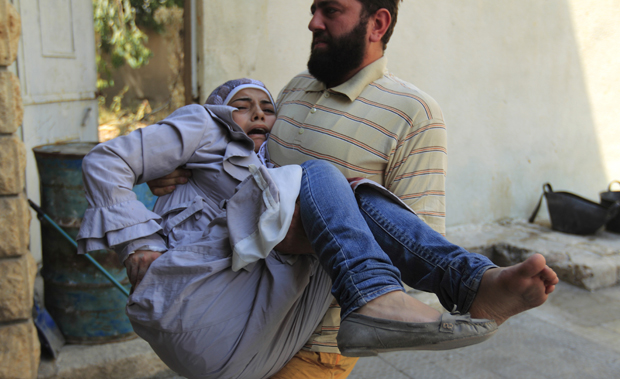
An injured civilian is evacuated after shelling by government forces in Aleppo. (Zohra Bensemra/Reuters)

Now that UN Secretary General Kofi Annan has resigned and is no longer leading the effort to find a diplomatic solution to the horrors unfolding in Syria, the prospect for a peaceful conclusion to this conflict look bleaker than ever – if it’s even possible to suggest such a thing:

(Kofi Annan) cited the Syrian government’s “intransigence” and the opposition’s “escalating military campaign” as major impediments to his peace efforts, along with a lack of unity in the international community on how to deal with the crisis.

I’m thinking “lack of unity in the international community” was just Annan’s polite way of saying this tragic mess in Syria has devolved into a sickening proxy war in which no one’s hands are clean and the only losers are the Syrian people themselves.

If you dare, I recommend you read this blisteringly bitter analysis by journalist Robert Fisk, who excoriates the cynical interests – from the US, to Russia and China, to Qatar and Saudi Arabia, to Hezbollah, to the media, to “our dear liberal selves – who are allowing Syria to be used as a bloody chess board, even as they speak out against the daily atrocities that are occurring there:

Has there ever been a Middle Eastern war of such hypocrisy? A war of such cowardice and such mean morality, of such false rhetoric and such public humiliation? I’m not talking about the physical victims of the Syrian tragedy. I’m referring to the utter lies and mendacity of our masters and our own public opinion – eastern as well as western – in response to the slaughter, a vicious pantomime more worthy of Swiftian satire than Tolstoy or Shakespeare.

What could possibly be the outcome of a cowardly proxy war in a sectarian Middle Eastern country? Samia Nakhoul, in a lengthy piece for Reuters, offered this dismal – if most likely – answer:

With no Western appetite for military intervention and no prospect of an internationally mediated political resolution, many see the civil war spreading and tearing the country apart.

“Disintegration of Syria is a possibility and the problem is it won’t work. It would create a power vacuum in which others get dragged in just like Iraq. It is a very frightening scenario,” (Cambridge University analyst George) Joffe said.

Lebanese columnist Rajeh Khoury predicted: “Syria could plunge into a long protracted civil war that could last years. The civil war in Lebanon, with its much smaller population of five million, lasted 15 years due to foreign interference so Syria would be much more complicated.

“The Syrian crisis is so inflammatory that its flames will affect the region in one way or another.”

A prayer for the people of Syria – and a pox on all our houses…

The New One-State Solution: Connecting the Dots

Connect these dots:

From The Guardian:

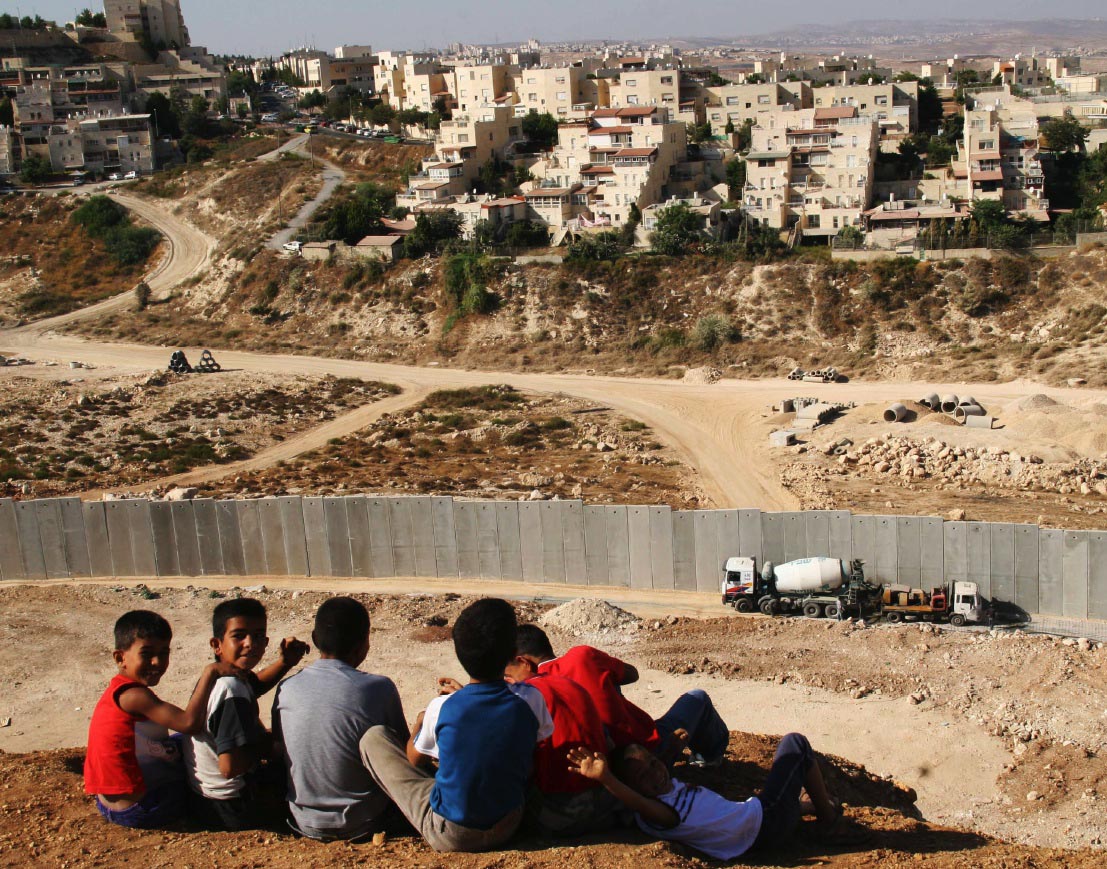
The number of Jewish settlers in the West Bank grew by more than 15,000 in the past year to reach a total that exceeds 350,000 for the first time and has almost doubled in the past 12 years.

Figures from Israel’s population registry show a 4.5% increase in the past 12 months. Most of the newcomers moved into settlements that many observers expect to be evacuated in any peace deal leading to a Palestinian state.

There are an additional 300,000 Jews living in settlements across the pre-1967 border in East Jerusalem, the pro-government and mass-circulation newspaper Israel Hayom reported.

Putting a finer point on these statistics, Dani Dayan, chairman of the settlers Yesha Council had this to say in a recent NY Times op-ed:

(We) aim to expand the existing Jewish settlements in Judea and Samaria, and create new ones. This is not — as it is often portrayed — a theological adventure but is rather a combination of inalienable rights and realpolitik. Even now, and despite the severe constraints imposed by international pressure, more than 350,000 Israelis live in Judea and Samaria. With an annual growth rate of 5 percent, we can expect to reach 400,000 by 2014 — and that excludes the almost 200,000 living in Jerusalem’s newer neighborhoods. Taking Jerusalem into account, about 1 in every 10 Israeli Jews resides beyond the 1967 border. Approximately 160,000 Jews live in communities outside the settlement blocs that proponents of the two-state solution believe could be easily incorporated into Israel.

…Our presence in all of Judea and Samaria — not just in the so-called settlement blocs — is an irreversible fact. Trying to stop settlement expansion is futile, and neglecting this fact in diplomatic talks will not change the reality on the ground; it only makes the negotiations more likely to fail.

In essence, Dayan is calling for a kind of a one-state solution here – albeit one that does not extend citizenship rights to non-Jewish residents. (Although in fairness to Dayan, he does say they should be given “freedom of movement.”)

Still can’t figure out what’s going on here? Let’s connect the final dot.  While the Jewish population in Area C of the West Bank is increasing, Israel is demolishing homes, evicting Palestinians, and moving them into Areas A and B at an ever-increasing pace.

Here’s Mya Guarnieri, writing in +972:

At the same time that Israeli settlements are expanding unchecked, the state is putting the Palestinians and Bedouins who live in Area C under extreme, unrelenting pressure, as exemplified by this week’s report by Haaretz that Defense Minister Barak has ordered the demolition of eight Palestinian villages to make way for IDF training.

Demolitions of homes and structures in 2012 have seen an increase. According to a source at the United Nations, between January 1 and April 27 of 2011, 352 Palestinian and Bedouin were forcibly displaced from their homes in East Jerusalem and the West Bank. The same period of 2012 saw “at least 487″ people lose their homes.

It’s a one-two punch intended to increase the Jewish population in the West Bank as much as possible and deplete the Palestinian population as much as possible to ready the area for annexation. Susya, a Palestinian village that is under threat of demolition, is an example of how this works. The village has been destroyed numerous times since the Jewish settlement of Susya was built there in 1983, despite the documents proving it belongs to Palestinians and the fact that this small community has no where else to go.

Israeli pressure on the Palestinian and Bedouin residents of Area C has resulted in a drop in the Arab population in the same area.

And then there’s the Levy Committee Report, which denies that there is an occupation and, according to some observers, lays the legal groundwork (at least in the mind of the Israeli government) for a unilateral annexation of Area C.

It’s not a matter of if. It’s a matter of when.

OK, I’ll say it for you: Israel has no intention of creating a two-state solution. It is creating it’s own “one-state” solution by increasing the Jewish population in the West Bank and warehousing Palestinians in Bantustans throughout Areas A and B. By any other name this would be called an “apartheid” state.

If there are those who disagree with my calculus, I’m certainly open to hearing alternative explanations. In the meantime, here are two questions I’m still unable to answer: when will our community be ready to call out this illegal and immoral behavior?  And what will we be willing to do about it?

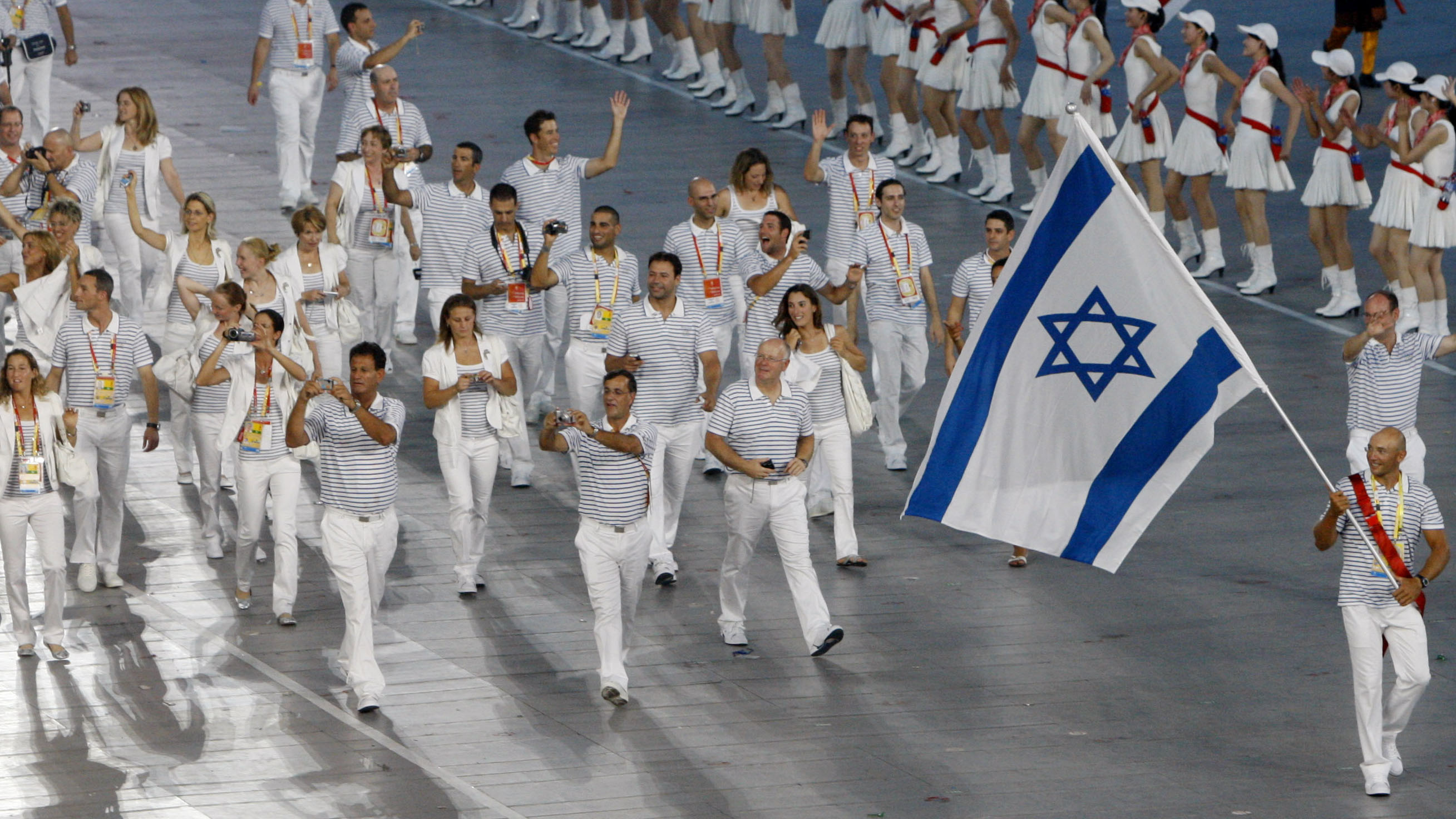
The Olympic Moment of Silence and the Politics of Victimhood

I’ve been following with some interest a cyber-dustup between Emory University Jewish Studies professor Deborah Lipstadt and Elisheva Goldberg, Assistant Editor of the Open Zion blog. In its way, I think it shines an interesting light on the ways the Jewish community deals with its sense of victimhood in public discourse.

The debate began with a piece Lipstadt wrote for Tablet on July 17, entitled “Jewish Blood is Cheap.” In her article, she inveighed against the International Olympic Committee for refusing requests to hold a one minute moment of silence during Opening Ceremonies to commemorate the 40th anniversary of the murder of 11 Israeli athletes in Munich. Lipstadt explored the various reasons given by the IOC for its refusal: that the IOC has honored the athletes repeatedly in other venues, that the Games should be “apolitical,” and that a commemoration of this sort was inappropriate at a “celebratory event.”

Lipstadt would have none of it:

The IOC’s explanation is nothing more than a pathetic excuse. The athletes who were murdered were from Israel and were Jews—that is why they aren’t being remembered. The only conclusion one can draw is that Jewish blood is cheap, too cheap to risk upsetting a bloc of Arab nations and other countries that oppose Israel and its policies.

…This was the greatest tragedy to ever occur during the Olympic Games. Yet the IOC has made it quite clear that these victims are not worth 60 seconds. Imagine for a moment that these athletes had been from the United States, Canada, Australia, or even Germany. No one would think twice about commemorating them. But these athletes came from a country and a people who somehow deserve to be victims. Their lost lives are apparently not worth a minute.

When I first read Lipstadt’s words, I strongly recoiled at her statement “Jewish blood is cheap” – and her claim that the IOC was motivated by anti-Semitism. Whether or not one agrees with the IOC’s decision, I found Lipstadt’s rhetoric to be incendiary and distinctly smacking of “victim politics.”

So, it seems did Elisheva Goldberg, who gently chided Lipstadt in a post for Open Zion. Goldberg pointed out that in fact, IOC President Jacques Rogge did make a statement and lead a minute of silence during a ceremony last Monday at the athlete’s village promoting the Olympic Truce (a UN backed initiative calling on warring parties around the world to end hostilities during the period of the games).  In her post, Goldberg asked what I thought was a valid question: when it comes to public commemoration of these kinds of tragedies, how much is really enough?  Or as she put it, “when will we be satisfied?”

To my dismay, Lipstadt did not think this question worthy of serious consideration – she responded to Goldberg instead with a petulant smackdown. In a Tablet piece entitled “No, Open Zion, Deborah Lipstadt Won’t Shut Up,” she concluded thus:

In making a statement on Monday, the IOC’s president tried to throw the victims’ families a bone. Goldberg has caught it, and is happily gnawing away. I, and many others, have no intention of being so easily satisfied.

While I agree with Lipstadt that Rogge is disingenuous in claiming the Games aren’t “political,” it bears noting that the Jewish establishment’s full court press on this issue has been highly politicized.  The minute of silence has been now pressed on the IOC by Israel’s Foreign Ministry (who produced a one minute video as part of the campaign), it has been introduced as a US House Resolution, and now of course, the obligatory campaign year statements of support have been elicited from President Obama and Mitt Romey. At this point, even if the IOC did assent to minute of silence at the ceremonies, it would resonate more as a moment of political victory than a genuine act of remembrance.

And that’s the problem I have with Lipstadt and the “many others” who have chosen to press the issue in this manner. They – and we – would do well to ask: when does the desire for public commemoration cross the line into cynical politicking?  On a deeper level, we might well ask: at what point does our need for the world to acknowledge Jewish suffering give way to a collective victim mentality?

To me, these are the critical questions, regardless of what does or doesn’t take place at Opening Ceremonies this Friday.

Supreme Court Opens the Door: Help End Juvenile Life Without Parole!

Adolfo Davis

Last year I gave a Kol Nidre sermon spotlighting our nation’s shameful practice of sentencing juveniles to life-without-parole. Now less than one year later, I’m thrilled to announce that the US Supreme Court has just recognized the fundamental unfairness of mandatory death-in-prison sentences that don’t allow sentencers to consider the unique status of children and their potential for change.

This decision has very direct bearing on the case of Adolfo Davis – one of the prisoners whose life I described in my sermon. It also has the potential to affect the case of Jacqueline Montanez, who has been in prison for 20 years and is the only woman in Illinois serving Juvenile Life Without Possibility of Parole. Adolfo and Jacqueline are two of nearly 2500 young people in the United States sentenced to life without the possibility of parole before their 18th birthday. As I mentioned in my sermon, the United States is the only country in the world that sentences children to life without possibility of parole.

At this critical moment, I’m asking you now to lend your voice in asking Governor Pat Quinn to join the Supreme Court in this tremendous decision and ask him to grant executive clemency to Adolfo and Jacqueline.  This past April their cases were heard before the Illinois Prisoner Review Board, with petitions seeking clemency.  The final decision to grant executive clemency is now in the hands of our Governor and is not guaranteed or ensured by the Court’s decision.

You can voice your concern by signing both Jacqueline and Adolfo’s online petitions, which can be found here and here.  In addition to signing the petitions, please consider contacting the Governor with your concerns through the State of Illinois website or by writing a letter to:

Governor Pat Quinn
c/o Era Laudermilk
Associate General Counsel
Office of the Governor,
James R. Thompson Center
100 W. Randolph, Suite 16-100
Chicago, IL 60601, United States
Fax: +1 312 814 3806

If you have the time, please send copies of your letters to Adolfo and Jacqueline so that they will know of your support. Letters may be sent to:

Children and Family Justice Center
Ms. Toni Curtis
Bluhm Legal Clinic, Northwestern University
School of Law, 357 East Chicago Avenue
Chicago, IL 60611, United States
Email: e-curtis@law.northwestern.edu

Thank you in advance for your support of this important and critical human rights issue.  It is my personal dream to some day invite Adolfo, Jacqueline and Cedric Cal to High Holiday services in the very near future so that we may all celebrate the joy of justice finally realized at long last.

Why I Support Kairos USA

Last week a group of US clergy, theologians and laypersons unveiled Karios USA, a powerful and important American Christian spiritual call for justice in Israel and Palestine.  As a religious Jew, I am inspired by its prophetic courage, its unabashed call for justice and its heartfelt model of compassion. It truly deserves to be shared and studied by all who who seek a genuinely religious call for justice in this land that is so central to so many peoples and spiritual traditions.

Kairos USA is modeled on the religious testimony of Kairos Palestine, a document that was drafted by prominent Palestinian Christian leaders in 2009 (which was itself inspired by the 1985 South African Kairos statement).  Despite these important influences, however, Kairos USA stands on its own as a uniquely American Christian call for justice in Israel/Palestine.

Indeed, this unique mission is evoked in the statement’s Preamble at the very outset:

In June 2011, a group of U.S. clergy, theologians and laypersons, cognizant of our responsibility as Americans in the tragedy unfolding in Israel and Palestine, and mindful of the urgency of the situation, met to inaugurate a new movement for American Christians. We have been inspired by the prophetic church movements of southern Africa, Central and South America, Asia and Europe that have responded to the call of their Christian sisters and brothers in occupied Palestine. This is our statement of witness and confession—and our response as U.S. Christians to the Palestinian call.

And more specifically, from the Introduction:

As U.S. Christians we bear responsibility for failing to say “Enough!” when our nation’s ally, the State of Israel, violates international law. Our government has financed Israel’s unjust policies and has shielded its government from criticism by the international community. At the outset of the current U.S. administration, our government led Palestinians to believe that at last we would pursue a political solution based on justice. But the “peace process” has continued to be no more than a means for the continuing colonization of the West Bank and East Jerusalem, the imprisonment of Gaza and the intensification of the structures of oppression.

I have no doubt at all that like Kairos Palestine, Kairos USA will be excoriated by many self-appointed leaders of the American Jewish establishment.  As for myself, now that I’ve read the document carefully, I can say without hesitation that I believe this statement is a truly sacred testimony, offered in good faith and with genuine religious integrity.

I was particularly moved to read how sensitively Kairos USA treads over some of the most complex hot-button issues in the Jewish-Christian relationship. For instance, on the issue of historical church anti-Semitism, the statement includes the following confession:

As Christians addressing the Palestinian cause we must also acknowledge our shameful role in the historic persecution of the Jewish people. We recognize the dehumanizing and destructive power of doctrines and theologies that denigrated Judaism. Our predecessors perpetuated anti-Semitic stereotypes, practiced scapegoating and cloaked prejudice, hostility and murder itself in the robes of our religion. We confess that our churches failed to resist, and sometimes even aided and abetted pogroms, mass dislocations of Jews, and the calamity of the Nazi Holocaust itself. In so doing, they betrayed the teaching and example of the one we claim to follow. We speak for and with our forbears in expressing deep remorse. With a commitment to never forget those failures and to be instructed by them, we pledge ourselves to growth in faithfulness, compassion and justice.

The statement goes on, however, to state that Christians’ honest desire to repent for the church’s historic crimes against Jews must not inhibit them from speaking out against injustices perpetrated by Israel against Palestinians. To my mind, this is a call for real and honest interfaith relations – dialogue that is not defined by guilt or emotional blackmail, but rather by a willingness to venture into and openly discuss the more difficult and painful places:

We acknowledge with sadness and distress that because of the powerful impulse on the part of Christians to atone for their sins against the Jewish people, vigilance against anti-Semitism today has come to trump working for justice in Palestine and Israel. The Christian need to rectify centuries of anti-Jewish doctrine and actions and to avoid even the perception of anti-Jewish feeling has served to silence criticism of Israel’s policies and any questioning of the consequences of U.S. government support for Israel. Differences between anti-Semitism and legitimate opposition to Israeli actions are avoided or explained away. Responsible discourse about Zionism is often denounced as hostility toward Israel and its citizens or branded as anti-Semitism. We believe that in our dialogue with our Jewish friends, family members and colleagues and in our relationships with the Jewish community on institutional levels, we must confront this pattern of avoiding, denying or suppressing discussion of issues that may cause conflict or discomfort. The fact that anti-Semitism still exists makes it all the more important to differentiate between actual anti-Jewish feelings and criticism of the actions of a nation state. Uncomfortable though it may be, we cannot be afraid to address the urgent issue of justice and human rights in Israel and Palestine with our Jewish sisters and brothers here in the United States.

I also deeply admire the statement’s willingness to directly address the charged issue of so-called Christian “replacement” or “supersessionist” theology (a view that promotes Christianity – and not Judaism – as the genuine fulfillment of Biblical tradition):

We are aware that in denying a theology of entitlement that gives the Jewish people exclusive rights to the Holy Land, we risk the charge of reviving the Christian doctrine known as replacement theology (sometimes known as supersessionism). In this view, the Church takes the place of Israel in God’s purposes, denigrating Judaism itself and condemning the Jews to suffering for rejecting the Gospel. Christians have rightly wished to distance themselves from this destructive and divisive doctrine. We repudiate the anti-Semitic legacy of the church’s past and the theology that undergirds it.

As a Jew who rejects a sense of Jewish entitlement just as strongly as I reject any religious viewpoint that makes an exclusive claim to the land, I particularly appreciate Kairos USA’s religious approach on this point:

Our core Christian belief is that God’s promise in the Gospel is a promise to all nations. This means that God’s kingdom work in Christ is a promise to everyone regardless of race. We believe that the Church has found in Christ a fulfillment of all that God promised in Abraham, and that both Jews and Gentiles have been invited equally into this promise of a world renewed in love and compassion. The Church does not replace Israel. Jews continue to have a place in God’s plan for the world. In Christ, all nations can be blessed (Genesis 18:18, 22:18; Galatians 3:8). In these times of growing international conflict and cultural mistrust, this is a significant promise. Theologies that privilege one nation with political entitlements to the exclusion of others miss a central tenet of the Gospel and inspire increased conflict.

I believe the above statement provides a crucial challenge to both American Jews and Christians.  From a theological point of view, I believe it is time to reframe the issue. The real debate is not about which religious tradition or people has a more compelling religious “right” to the land of Israel, rather, it is between those who make exclusivist theological claims and those whose theology makes room for all peoples who live on or feel a connection to this land.

I also have no doubt that many in the American Jewish establishment will reject out of hand Kairos USA’s positive advocacy of BDS (“Boycott, Divestment and Sanctions”).  But here again, I find that the statement deals with a hot-button issue with sensitivity and integrity:

Participation in the BDS movement by U.S. churches, notably in the form of initiatives to divest church funds from companies profiting from the occupation of the West Bank and the blockade of Gaza, has generated critically-important discussions at local, denominational and ecumenical levels about the responsibility of the church to act. It has also generated intense controversy. Opposition, from Jewish organizations as well as from voices within the churches, has often been fierce, claiming that such actions will inflict grievous damage on hard-won positive relationships with the Jewish community. Many express fear that these actions may encourage anti-Semitism. We note with distress that many have confused these actions with anti-Jewish discrimination and persecution in the Christian past. But BDS is directed at Israeli policy, not the state itself or its citizens, and certainly not against the Jewish people. Divestment and other forms of socially responsible investing (SRI) are not directed against groups, nor are they intended to hurt individuals, corporations or states. They are, rather, directed at unjust, oppressive policies and are about promoting our own values and stated commitments by noncooperation with evil. Furthermore, methods to exert economic pressure on governments and companies, in addition to being a legal, ethical and time-tested way of influencing the political process and corporate behavior, serve to increase awareness, promote open discussion and create the grassroots support required to urge governments to take effective action and to change unjust policies. We urge congregations, clergy and church leaders to become educated about the BDS movement and to consider the many forms that it can take on personal, local and national levels.

As I American Jew who is deeply distressed by the American Jewish establishment’s abject vilification of BDS, I don’t think I could possibly put it any better.

I urge all people – whether religious and secular, Christian, Jewish or Muslim – to read, share, discuss and respectfully debate this important new American statement of faith.  My deepest gratitude to those (including my good friends Mark Braverman and Father Cotton Fite) who helped spearhead and draft Kairos USA.  May it inspire us all to reframe a new religious response to the sorrows of Israel/Palestine – and lead the way to a better future to all who call this land home.